Special Collections Library reading rooms often require special equipment to view non-traditional record formats such as VHS players, cassette players, microfilm readers, etc. The Rubenstein Library recently welcomed a new piece to the set: a desktop computer.
Rubenstein Library Research Services staff check out the reading room's new e-records computer work station.
Though public computers have been available in our reference room for a long time to assist in finding and requesting physical materials in the reading room this new machine has been designed to support providing local access to electronic records and audio/video materials.
Some of the materials you can explore on the computer include:
Like most everyone else, I’ve been enjoying our beautiful spring weather. However, part of me still yearns for the winter I never experienced. So I’m returning to a manuscript I cataloged last year that contains illustrations I now associate with the chillier months.
Surgeon Major A. F. Elliot served several tours of duty with the 2nd West India Regiment in West Africa, primarily in Sierra Leone, Guinea-Bissau, and Ghana. He maintained diaries for six of those tours, from 1866-1881, and used calligraphy for all month titles. There are also watercolor paintings, photographs, and charts.
I don’t read manuscript volumes I’m cataloging in their entirety or I’d never be able to keep pace with the new acquisitions arriving. Duke Alumni Magazine had also published an article on this volume. After I finished my catalog record, I reviewed the volume again to see if we had missed anything. That’s when I came across this title for September 1874.
September, 1874: The men stayed in Elliot’s tent because of rain.
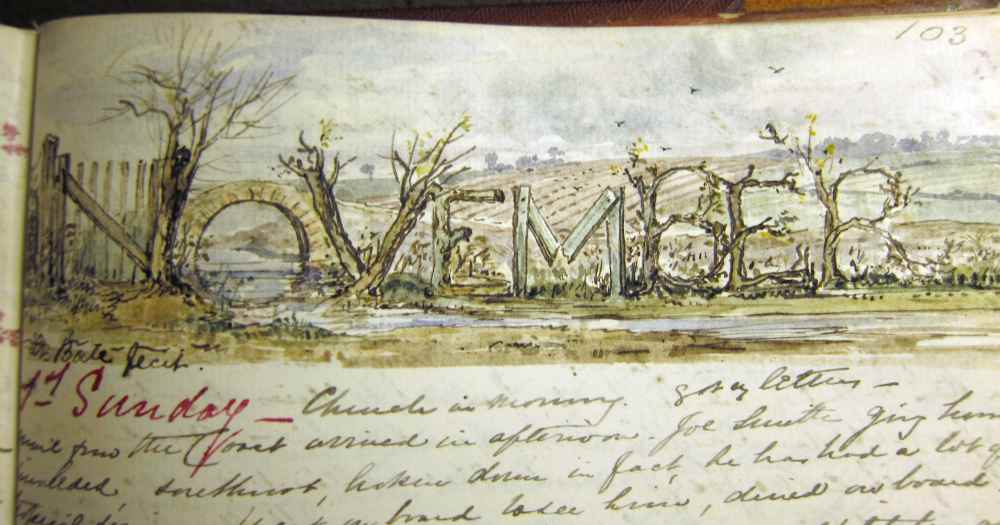
Elliot’s first entry for the month states “Rain & drizzle in the morning—Bale has drawn the heading this month[,] emblematical weather—rain all day.” I continued my perusal. October’s heading was fun, but November’s was stunning in both its design and detail.
The watercolor paintings by John Edward Bale in the volume are 7”x3” in size.
My student assistant, Sophia Durand, and I recently did a little research and found that these watercolors were painted by Elliot’s friend John Edward Bale, who was a member of the 1st. West India Regiment. Bale was promoted from Lieutenant to Captain during the months he created these paintings, and his signature changed accordingly. He retired from the Army as a Major, continued painting in both oil and watercolors, and several of those works have been sold at auction houses.
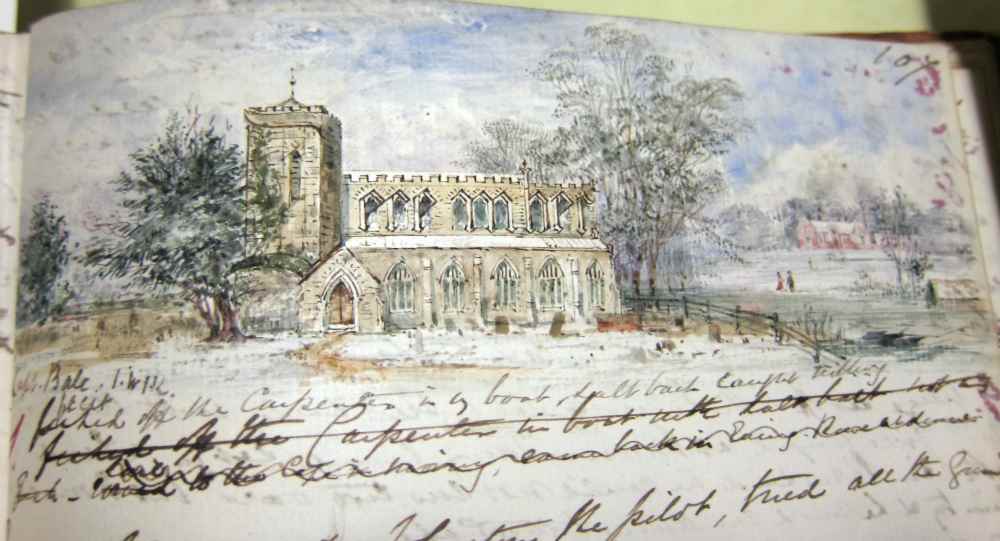
Do you see “December?” Hint: If this was a painting of Perkins Library, look at the Gothic Reading Room windows.
At the time I admit I was a tad disappointed that Bale painted only an accompanying illustration for Elliot’s December entry, rather than incorporating the month into it. To compensate, it pleased me that the church looks somewhat like the original Perkins Library building we are now in the process of renovating.
Imagine my astonishment when I discovered I was wrong about the absence of the month in the painting. I only became aware of it after I took a digital image of it for this blog post. Do you see “December”?
I’ve showed the paintings to my colleagues in Technical Services, and many of us rank these watercolors among our most amazing discoveries made while processing a manuscript collection.
Post contributed by Alice Poffinberger, Archivist/Original Cataloger in the Technical Services Dept..
My part in the preparation for the Rubenstein’s upcoming renovation is to assist in making sure that all of our beloved materials have accurate records before the move. Imagine when you have moved to a new house or dorm room and realized you just can’t find that book from that library that’s overdue. Now multiply that scenario by thousands of volumes and the importance of our task becomes clear!
Rows of books checked by the Holdings Management Team
Our Holdings Management Team members are going through the stacks systematically, checking records and barcodes on periodicals, reference items, pamphlets, and many, many sets of books. Out of the 13,000 volumes I personally have checked, over 2,000 needed to be fixed in some way. Our way of keeping track of various interdepartmental progress? Multi-colored post-it notes line the ends of shelf rows (ours are blue).
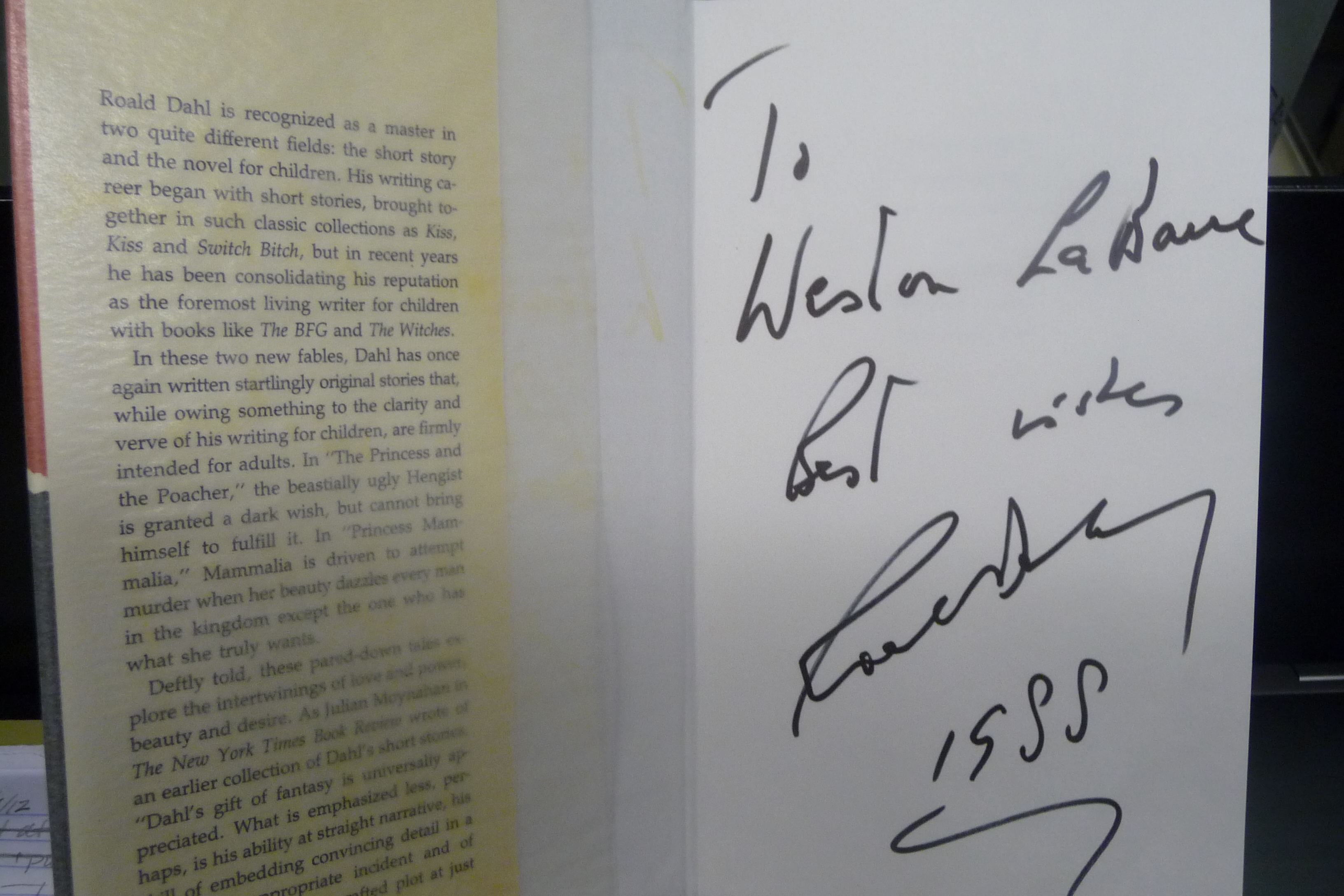
Roald Dahl's signature inside one of our books
It is always interesting to open a book and see the owner’s signature or personal bookplate. Today, I found a Roald Dahl book that was signed by the author in 1988. Once, I found a book on proper housekeeping that was signed to a friend on my birthday (except 200 years before I was born). I’m excited for the next 13,000 volumes!
Cullen Cornett is a Holdings Management Assistant in the Rubenstein Technical Services Dept.
When you hear the word “Panko,” do you think of Japanese bread crumbs?
Box cover for Panko, or, Votes for Women: The Great Card Game
I did, until the Sallie Bingham Center acquired this deck of Panko playing cards. It’s named for the leader of the British suffrage movement, Emmeline Pankhurst (1858-1928), and pits opponents and supporters of suffrage against each other in a game similar to rummy. The advertisement for the game claimed, “Not only is each picture in itself an interesting memento, but the game produces intense excitement without the slightest taint of bitterness.”
Pank! Pank! Pank! for Emmeline Pankhurst
This translation of the women’s suffrage movement into card games, and also board games, helped bring the message of the cause into domestic circles where more overt forms of propaganda might not have been welcomed. These cards were designed by the well-known Punch cartoonist E. T. Reed, and published by Peter Gurney in 1909.
Votes for Women, say the suffragettes.
These particular playing cards are owned by only three other libraries and are an important, rare piece of suffragette memorabilia that joins a number of other decks of cards held by the Bingham Center that explore issues related to women and gender. Check out the Panko catalog record here!
Post contributed by Megan Lewis, Technical Services Archivist for the Sallie Bingham Center for Women’s History and Culture.
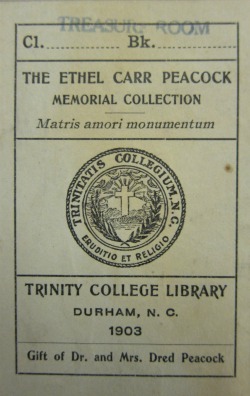
An Ethel Carr Peacock Memorial Collection Bookplate
Last fall, The Devil’s Tale posted “What’s in a Name,” where readers were asked to vote on their favorite name from a list accumulated from across our collections. The winner (although votes are still being accepted!) was Dred Peacock.
Peacock graduated from Trinity College (now Duke University), married the daughter of a Trinity professor, and eventually became President of the Greensboro Female College. Peacock and his wife, Ella, created an immense library which they established at the Greensboro Female College in memory of their daughter Ethel, who’d died at a young age. The Peacocks stipulated that should the College close, they could remove their collection and establish it elsewhere. Years later, when it appeared the College would in fact close its doors, the Peacocks moved their library to Trinity College, which by this time had moved from Randolph County to Durham.
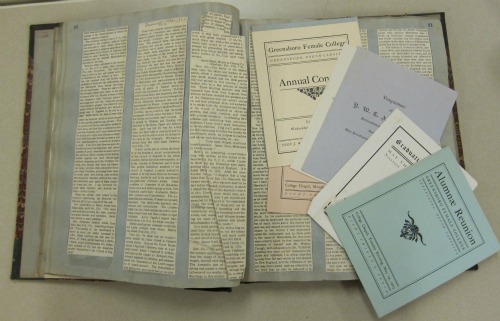
We recently uncovered several scrapbooks created by the Peacocks. They contain clippings, programs, and invitations from the late 19th century and largely relate to events and news regarding Greensboro Female College and Trinity College. One clipping that caught my eye highlights the professions of Trinity graduates by 1887: 275 graduates went into the ministry, 49 went into law, 66 went into teaching, 20 went into medicine, 11 went to the quill, and the rest to merchandising and agriculture. Of its alumni, 5 were judges, 7 were solicitors, 11 were either presidents or professors of leading colleges, 49 were members of legislatures of different states and territories, and several were in congress from 2-8 years.
Pages and Loose Programs from the one of the Peacock Scrapbooks
Curious about the other fascinating items contained in the scrapbooks? They are now available for use in the Rubenstein Library’s reading room. Check out the online finding aid for more details about the scrapbooks1
If you’ve wandered through the libraries lately, you’ve probably noticed the beautiful mobiles advertising Lilly Library’s Mobile Madness contest. As part of an initiative to bring art into our libraries, and in partnership with the Nasher Gallery’s new exhibit, Alexander Calder and Contemporary Art: Form, Balance, Joy, Lilly Library sponsored a Duke-wide contest encouraging people to create their own mobiles. Entries were judged by a panel of experts within the categories of most humorous, most Duke, and most creative.
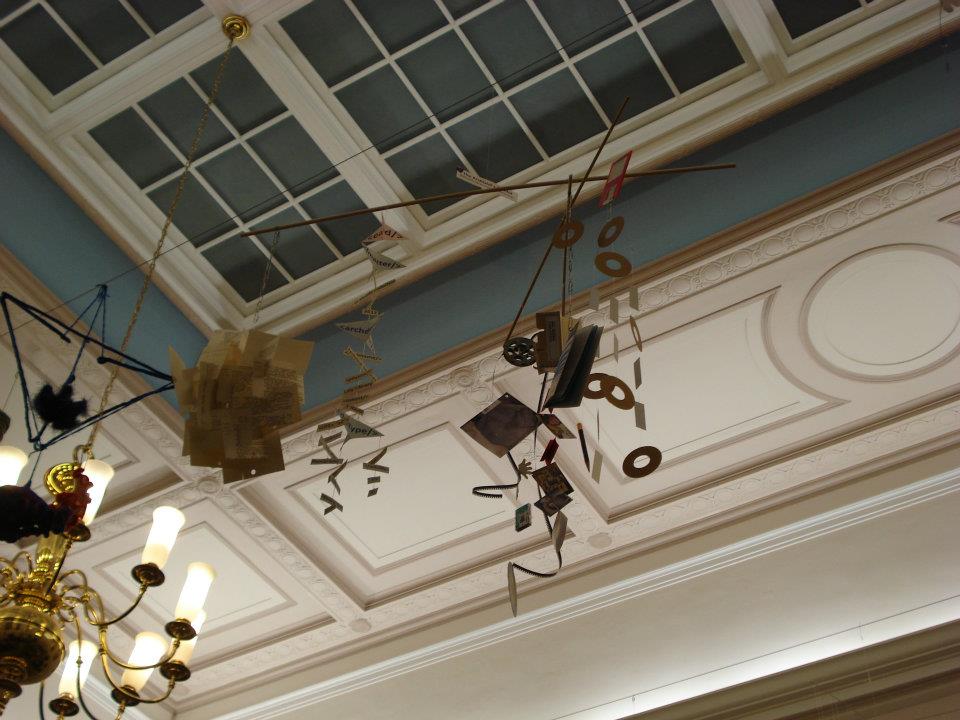
Archivist's Toolkit, balancing on our conference room coat rack
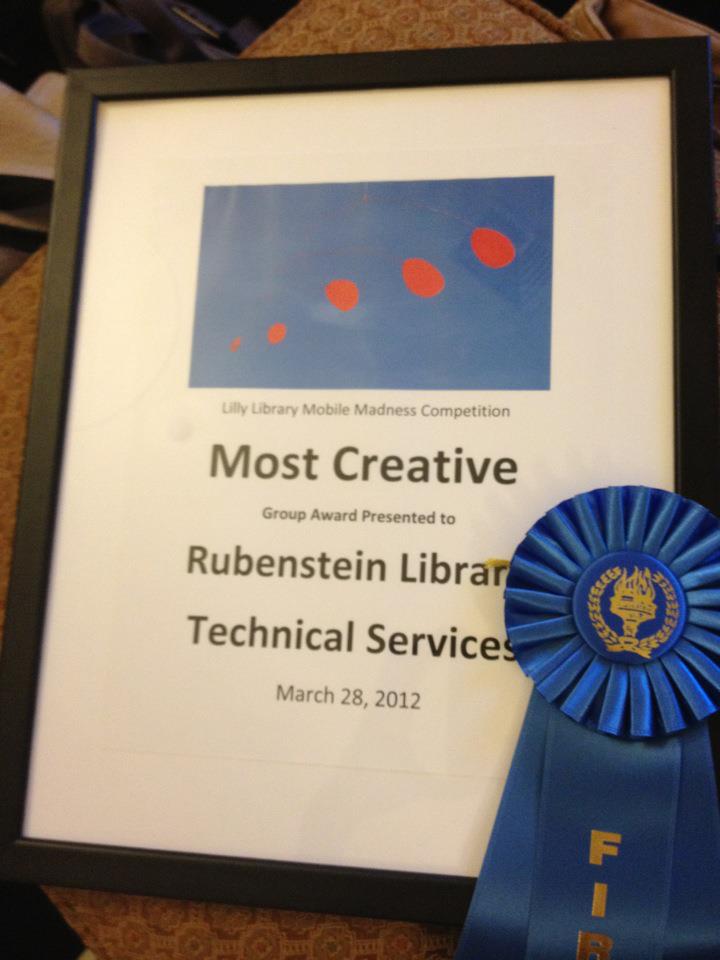
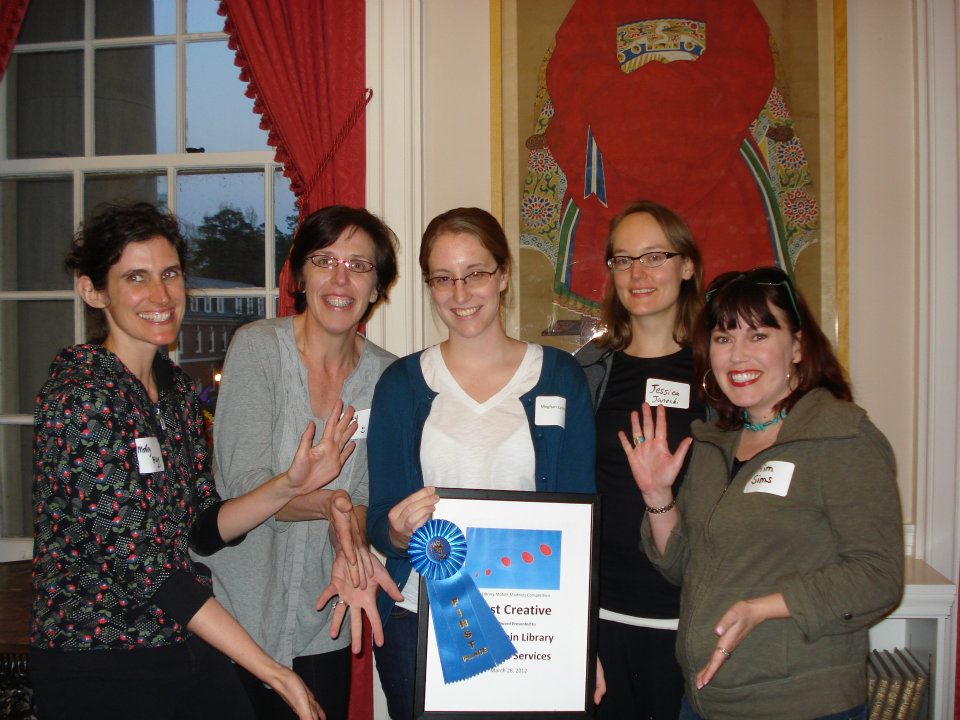
We in Rubenstein Technical Services are fairly competitive, and we also love what we do and are proud to show it off. Our entry, Archivist’s Toolkit, sought to highlight the wide range of formats and materials held by the Rubenstein, from manuscripts to rare books to audiovisual to electronic records. The department collected rusty paperclips, made little white gloves, and created tiny manuscripts tumbling from an archival box. We then included a mobile version of our finding aids and catalog records, complete with EAD tags and card catalog cards. The trickiest part was balancing everything (and also transporting it across campus to Lilly!), but it was very fun to work as a team and build our masterpiece. And then, last night, we won! Go TS!
Archivist's Toolkit hanging in Lilly Library
Part of the winning Technical Services team, with our blue ribbon and jazz hands
Check out all the entries and our fellow winners at Lilly Library (through April 27) or on the Lilly Library Flickr page, and be sure to visit the Nasher exhibit to see the wonderful Calder mobiles displayed there.
For the past two years, I’ve been working with Technical Services on the Frank Baker Collection of British Methodism and Wesleyana. Baker, a religion professor at Duke, was the preeminent scholar on the foundations of Methodism, specifically its founder, John Wesley. The collection is vast: it contains research for Baker’s many books and articles, original Wesleyan and Methodist documents from the 18th and 19th centuries, teaching materials, correspondence with other prominent religious minds, and a variety of items that simply fit no category.
Perhaps the most interesting part of working with the Frank Baker collection is this treasure trove of miscellany collected by Baker throughout the years. Though primarily a Wesleyan scholar, Frank Baker had a penchant for all religious historical materials, and his collection is frequently peppered with unidentifiable portraits, letters, and notes relating to religion.
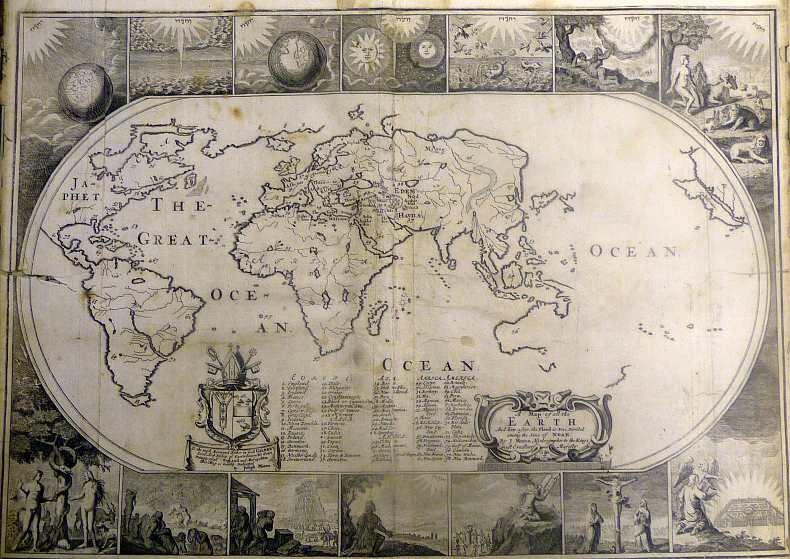
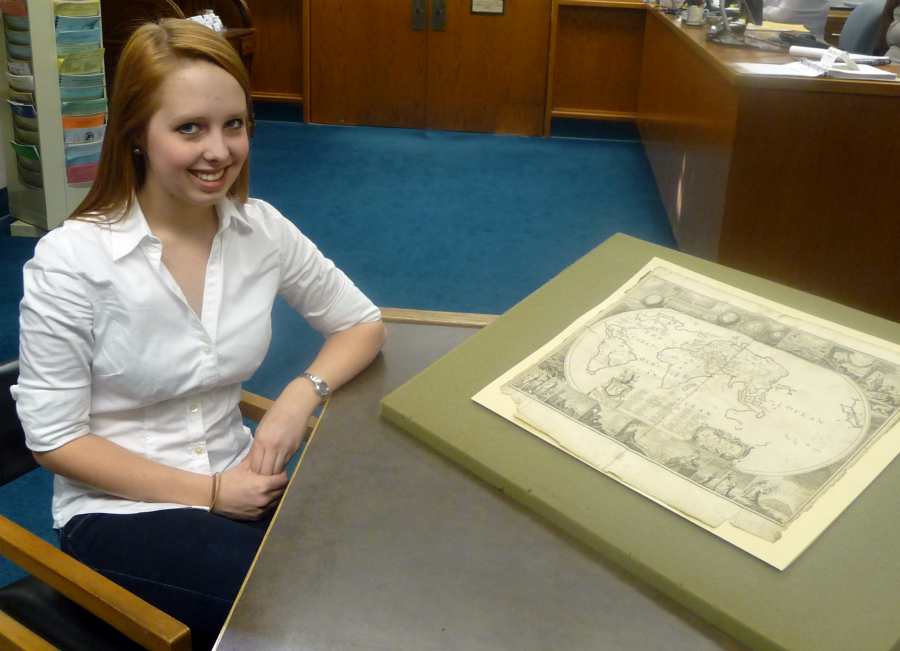
One such enigmatic finding was a folded, faded map that, at first, appeared rather unimpressive. Tucked away in a box of other large maps, our subject was folded, torn, and in pretty bad shape. Once unfolded, however, I was instantly drawn to it.
Chloe and a map from the Frank Baker Collection
Self-titled, the map reads: “A Map of all the Earth And how after the Flood it was Divided among the Sons of Noah.” Though faded, brittle, and torn, the value of this map is instantly obvious. From the fascinating religious motifs around the sides (some familiar, some indecipherable), to the labeling of each continent with a son’s name, the map certainly sucks you in.
"A Map of all the Earth And how after the Flood it was Divided among the Sons of Noah."
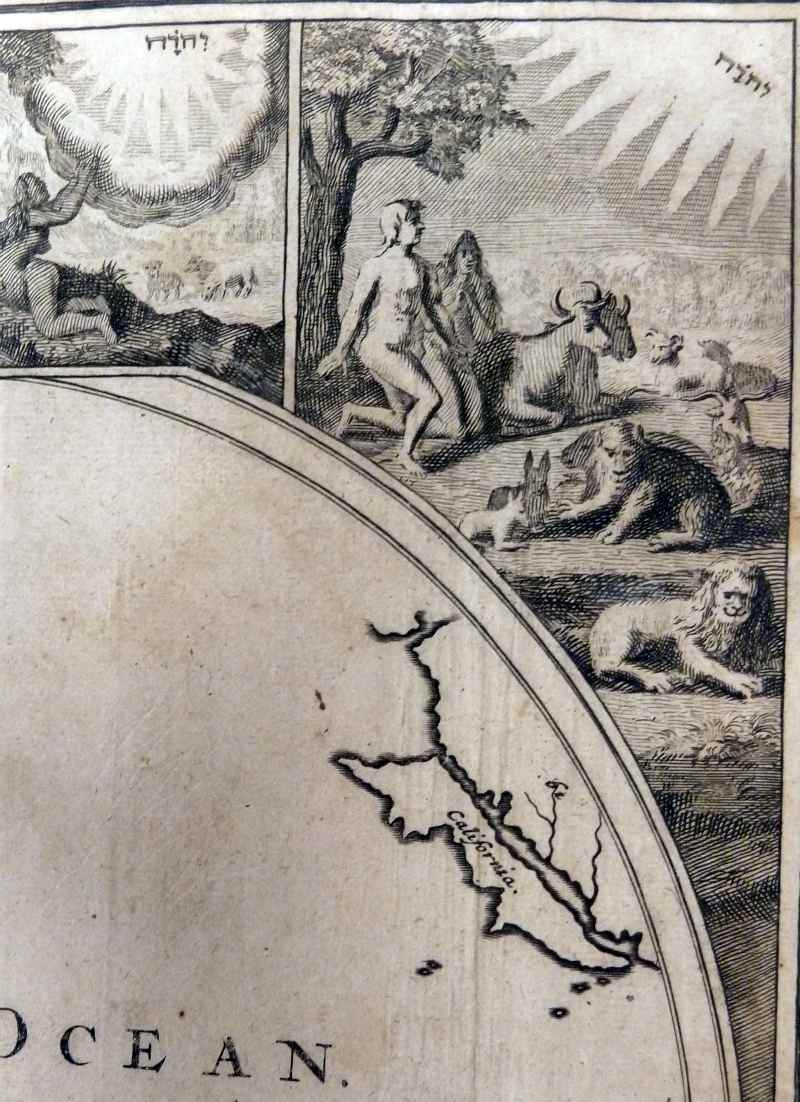
Some of my favorite parts of this map aren’t readily obvious, either. For example, take a good look at the West Coast of the United States. It’s subtle, but California is depicted as an island! It was actually this feature that helped me to date the map. With a little research as to when the name California came into usage, I discovered that our finding probably dates to the 1680s or 1690s. A little more research revealed that California was often depicted as an island in the 16th and 17th centuries: I even found a whole book full of maps with this cartographic error!
California as an island, with the Day of Rest above.
As a religion minor, I often found myself returning to the stunning religious motifs decorating the borders of this map. Some are familiar scenes, like Adam and Eve in the Garden of Eden, the Tower of Babel, the Crucifixion, etc. Others are less familiar, such as a shining city as viewed from a hill, or an unidentified man kneeling next to a tree.
I could spend hours trying to figure out the motivations behind the map, or its motifs, or why Japhet, son of Noah, got all of North America, but there’s many more mysteries to find and catalog in the Frank Baker Papers!
Post contributed by Chloe Rockow, a junior majoring in Public Policy Studies with a double minor in Religion and Political Science.
According to Wikipedia, “finding aids are a concept dating back to ancient clay tablets.” While I certainly didn’t learn that factoid in library school, I suppose that if you’re writing on tablets, then you probably need a special tablet (a finding aid?) that tells you where you put all of the other tablets, right? Maybe…
Whatever their origins, finding aids are an important tool for locating material in archival collections and last month the Rubenstein Library’s online finding aids got a major facelift. We’ve brought them out of the Stone Age by completely overhauling the layout and introducing some new functionality. With these improvements, we hope our finding aids are more attractive and usable for both researchers and staff.
What box is my stuff in? Requesting the wrong box is frustrating. With new color coding, repeating box numbers, and other visual cues, it’s now easier to determine which container to request. Container numbers have been moved to the right-hand side of the page so as not to interfere with description.
Navigation Box now on all finding aids
Boring stuff moved to the bottom. Finding aid usability studies indicate that administrative information, subject headings, and lengthy biographical notes are infrequently used, so we’ve relocated those sections to the bottom of the finding aid, keeping the most useful information at the top.
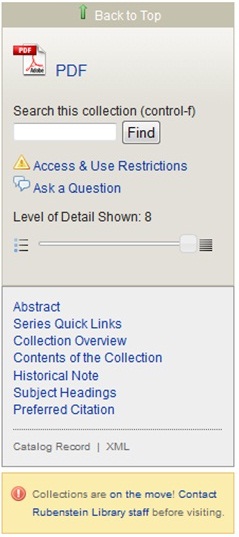
Floating navigation box. A navigation box at the right of the screen stays with you as you scroll, making it easy to navigate to other sections in the finding aid wherever you are. You can’t outrun it. Don’t even try.
Search this finding aid! A search box in the finding aid navigation box lets you search for keywords in the text of any finding aid. It’s just like your browser’s “Ctrl F” function!
Series Quick Links. The “Series Quick links” feature in the navigation box activates a small pop-up in the bottom right of the screen for quickly navigating through different series in a collection. Works great with really large finding aids with many series.
Expanding / Collapsing. Now you can control how much detail you want! By default, finding aids display in their entirety, but click a series/subseries title to expand or collapse content of that series or subseries. Also, an experimental “Level of Detail” slider in the navigation box lets you control how much detail you want. Sometimes you just can’t get enough.
Link to catalog records: At the bottom of the navigation box you’ll find a small “catalog record” link that will take you directly to the catalog record for that collection, no questions asked.
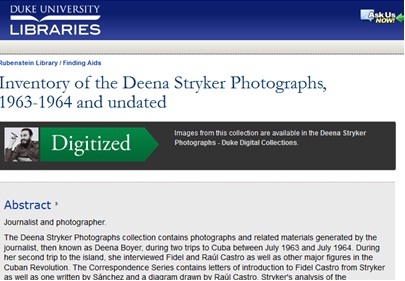
More prominent links to digital collections. Finding aids describing collections with digitized content now feature an icon above the banner with a link to the corresponding digital collection. Example: http://library.duke.edu/rubenstein/findingaids/strykerdeena/
Finding aid for the Deena Stryker Photographs, with a link to the digital collection.
More prominent warnings for access restrictions. Look for the yellow boxes and yield icons.
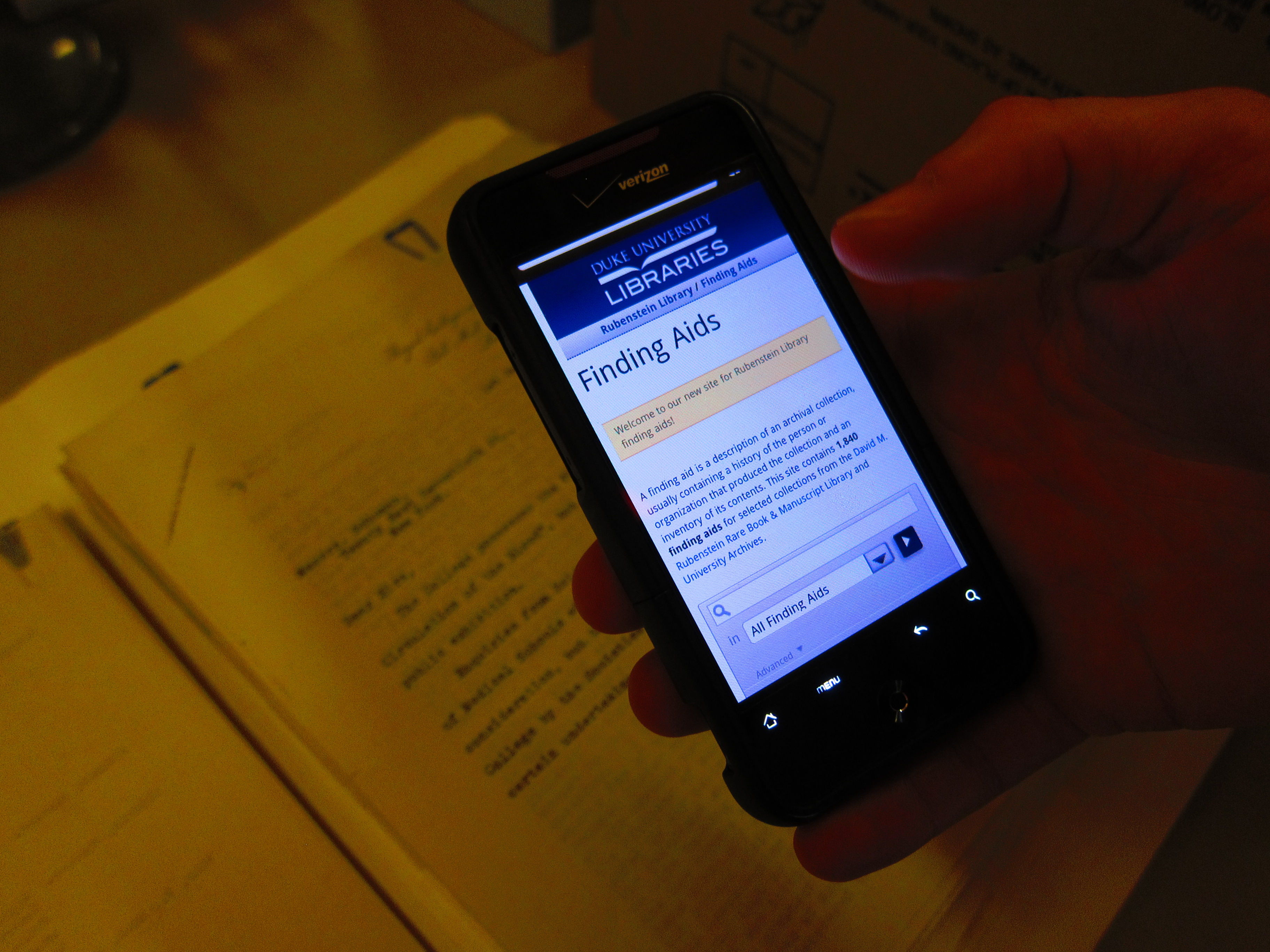
Finding aids on the go! Using the principles of Responsive Web Design, we’ve redesigned finding aids to display appropriately on any size device—iPhone, iPad, IMAX, you name it. Just for kicks, open a finding aid in your browser, start narrowing the browser window, and watch the content adjust to fit.
Finding aids are now easily accessed by phone.
Take a moment and let us know what you think about our new finding aids site. We appreciate your feedback.
Post contributed by Noah Huffman, Archivist for Metadata and Encoding.
Perhaps I just run with the bibliophiles, but when I tell people I work in a library, they usually say, “You’re lucky, you get to read books all day!” For most of my colleagues this is probably not the case, but I am one of the fortunate few for whom it is true. I am responsible for cataloging small or single-volume collections. They generally arrive with little or no description, so I must read the material to some extent in order to provide access to it. I also train others to catalog these collections, and I urge them to verify any information accompanying a new acquisition. In particular, I ask them to confirm the sex of any journal or diary author. Those describing these items before they reach our library still tend to assume that creators are male rather than female. Here is a case in point.
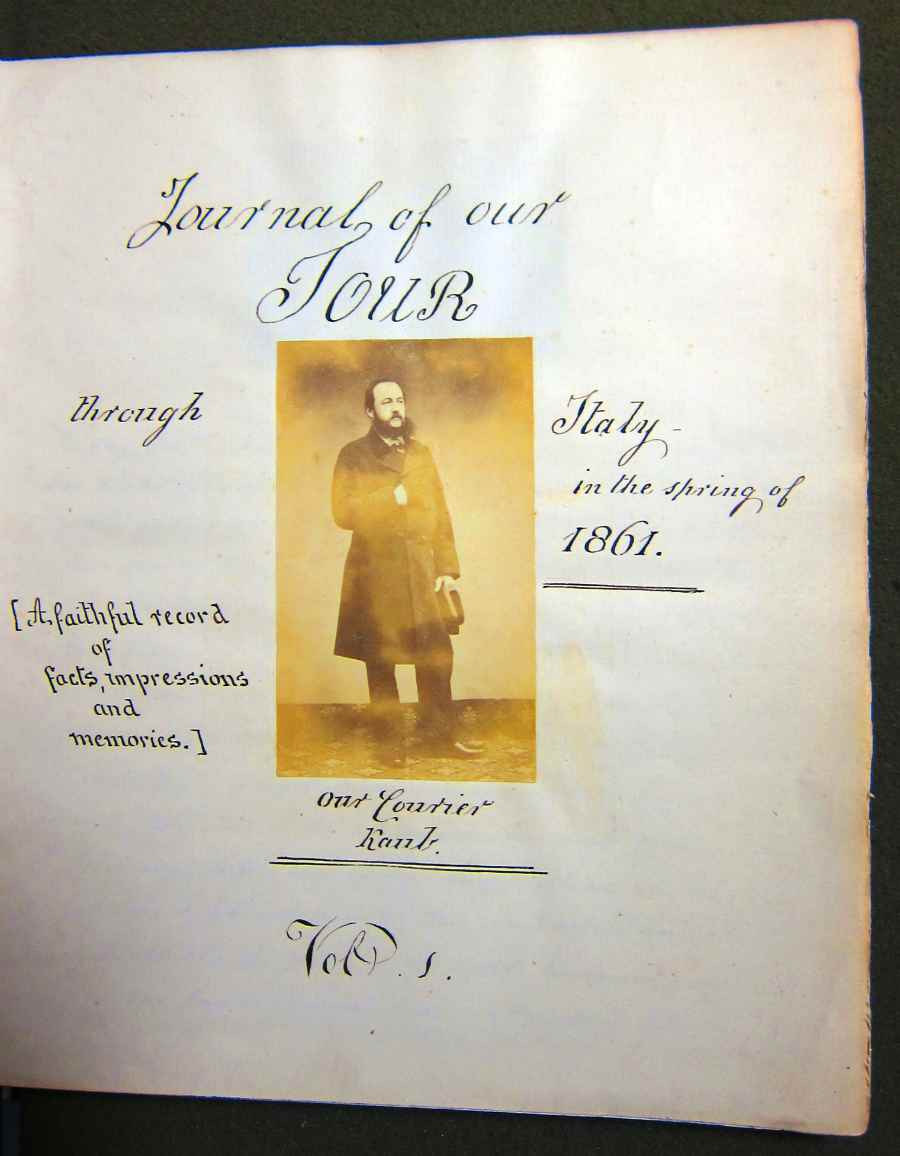
“Journal of our Tour through Italy in the spring of 1861. (A faithful record of facts, impressions and memories.)”
According to the description provided to us, Rev. James Lee-Warner of Norfolk, England, was the author of this travel journal. I needed to confirm this. The wrinkle was that, although I’ve often deciphered 19th-century handwriting in both quill and pen, this hand was rather difficult to read. With a little persistence I was able to read passages, including the one that provided the confirmation I was seeking.
In the entry for Friday, March 15, the traveling party joined a crowd of 10,000 people waiting at St. Peter’s to see Pope Pius IX. The author noted that “[The pope] did not arrive punctually, so we had ample leisure to look round on the vast crowds…,” then went on to describe what happened later that day:
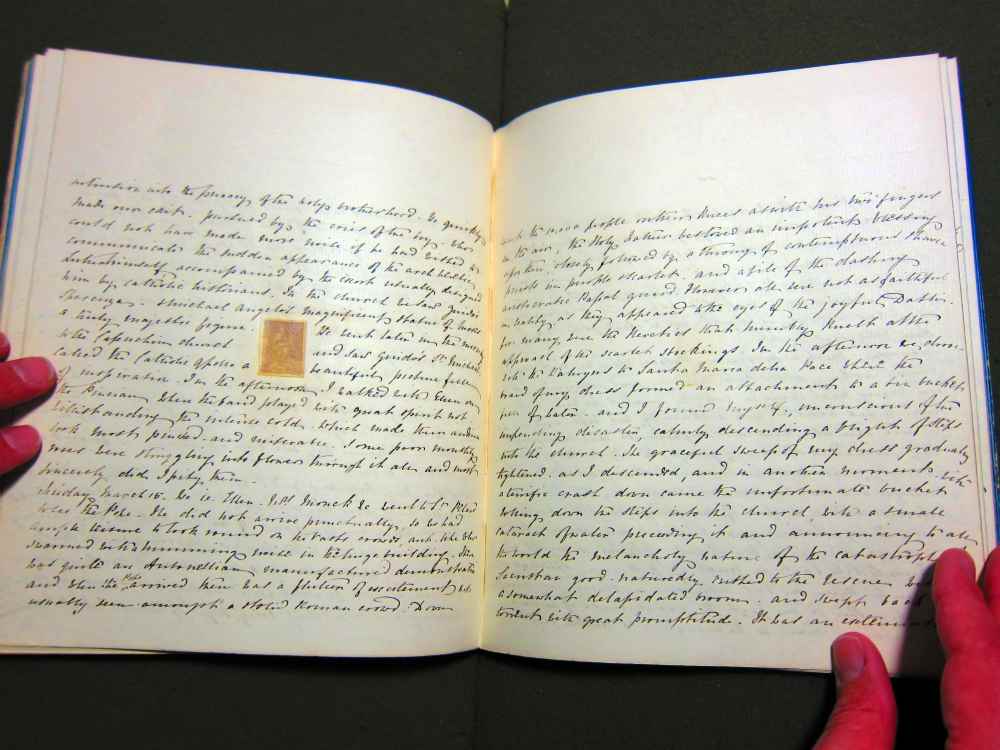
Pages of the diary, which sometimes include tiny albumen prints of artwork or tourist attractions.
In the afternoon we drove with the [W?]abryns to Santa Maria della Pace where the braid of my dress formed an attachment to a tin bucket full of water—and I found myself, unconscious of the impending disaster, calmly descending a flight of steps into the church. The graceful sweep of my dress gradually tightened as I descended, and in another moment with a terrific crash down came the unfortunate bucket [tolling?] down the steps into the church with a small cataract of water preceeding [sic] it and announcing to all the world the melancholy nature of the catastrophe. The Sacristan good-naturedly rushed to the rescue with a somewhat dilapidated broom and swept back the torrent with great promptitude.
I searched the journal and found no one else’s handwriting, so the volume’s sole author was a well-educated woman. Unfortunately, despite consulting entries for the Lee-Warner family and their relations in Burke’s Peerage and his Landed Gentry, I have not been able to identify her, although I am more certain that at least some members of the traveling party were Lee-Warners. To learn more about this journal and its content, visit our library’s catalog record.
Post contributed by Alice Poffinberger, Archivist/Original Cataloger in the Technical Services Dept.
Or, How I Learned to Stop Worrying About the Move and Obsess About Book Trucks.
When I started as Collections Move Coordinator, I knew it would be a challenging task involving inventories, spreadsheets, and endless logistics, as well as coordinating the work of students, colleagues, and staff in other departments. What I had not counted on was the number of supplies we would need to gather to complete the move. I spent my first two months on the job compiling opinions on carts, boxes, barcode scanners, shipping bins, and even post-it note color preferences (this was a particularly long discussion and search). I have become particularly obsessed with carts. There are so many different designs — so many ways to get your rare and unique materials from here to there and back again. But of course it takes more than just carts to move the Rubenstein Library. Below, please find a gallery of some of my favorite move supplies.
Code Name: “The Biscuit.” (Seriously, that’s what the manufacturer calls it.)
This height-adjustable table is truly the caddy of carts. It is ideal for reviewing collections in the stacks: narrow enough to fit between ranges of material and big enough to fit a laptop, barcode scanner, dust mask and measuring tape (I carry these with me at all times). The height-adjustable feature is amazing and keeps my colleagues and me from getting sore necks as a result of bending over our laptops.
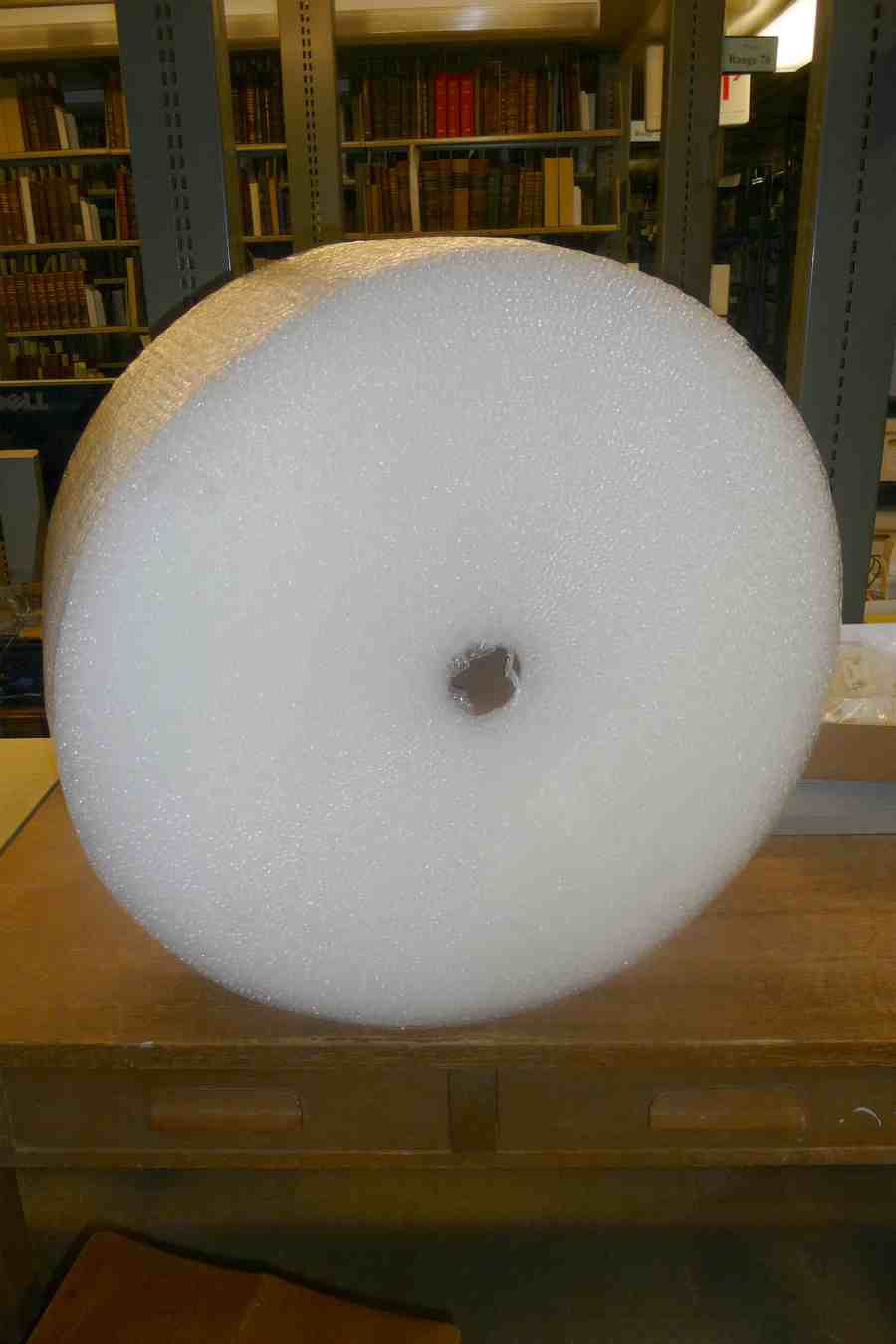
Code Name: “Bubbles.”
It’s bubble wrap, people: lots and lots of bubble wrap.
Code Name: “Ol’ Reliable.”
These sturdy wooden carts are the friends of everyone in the library, and we treat them sort of like cattle. Each department brands them, protects them fiercely, and works hard to rustle them up when one gets separated from the herd. Also, it’s fun to think about librarians and archivists as cowboys and girls on the frontier, wrangling up books and historical materials.
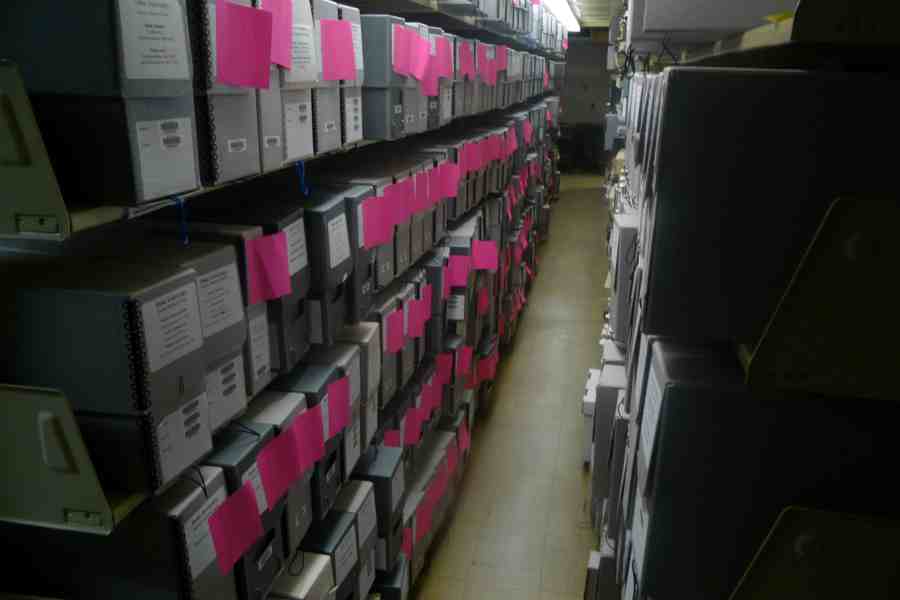
Code Name: “Fuchsia.”
When a manuscript box has been checked and is ready to move, we put a pink post-it note on it. This way everyone easily knows what collections have already been prepped and which need work. Plus, who doesn’t love a little extra color in the stacks!
Post contributed by Molly Bragg, Collections Move Coordinator.
Dispatches from the David M. Rubenstein Rare Book and Manuscript Library at Duke University