Post contributed by Reina Henderson, PhD, Eleanor Jantz Processing and Cataloging Intern
At first glance, the accounting books of E.L. Bernard look like any other set of nineteenth-century commercial records. The pages are filled with the looping script of professional clerks and the endless columns of numbers that drove the economy of antebellum New Orleans. They list shipments of French wine and invoices for mahogany furniture. They track the price of cotton and the arrival of ships from Bordeaux. It is a picture of sophisticated international trade. However, if you look closer at the columns of debits and credits, a much darker reality begins to emerge. These books do not just record the movement of goods. They record the systematic commodification of human beings.
Account books like these have long carried an aura of authority. Ledgers are presented as neutral instruments of fact where emotion falls away, and truth is reduced to figures that can be verified and balanced. We’re inclined to trust them precisely because they appear unadorned. Numbers seem to tell us what happened without interpretation. However, this promise of neutrality is itself fiction. Ledgers do not simply record economic life. In a place like New Orleans, one of the most profitable ports of the nineteenth century, they actively shaped it. They organized human activity into categories of value and loss. What they choose to name, how they name it, and what they render interchangeable all reveal the moral architecture of the world they helped sustain.
Accounting for Human Lives
The most chilling aspect of the Bernard ledgers is how mundane the entries are. In a General Ledger dating from 1815 to 1826, the merchant tracks his financial assets. On one page he lists his shares in the State Bank. On the very same spread, he lists an account titled “Nègres de Compte à 1/3.”
This was a joint-venture investment account. E.L. Bernard was not just buying enslaved people for his own use. He was speculating on them and trading them. The ledger shows that he held a one-third financial interest in a partnership designed to buy and sell human beings for profit. The debits represent the purchase price of men and women. The credits represent their sale. To the merchant and his accountant, these individuals were indistinguishable from the bales of cotton or barrels of sugar listed on the subsequent pages. They were simply inventory.
“Armantine, Her Child”
While the earlier ledgers show the cold mathematics of the slave trade, the later volumes reveal the daily reality of labor and control. In an account book from the 1850s, we find the name Armantine. She was an enslaved woman hired by Bernard from her owner for temporary work. The entry is brief but devastating. It records a payment for “Armantine, son enfant,” or Armantine and her child.
This single line item exposes the total dehumanization of the system. Bernard paid for the pair as a single unit. The child is listed not as a person but as an appendage to their mother. The age of Armantine’s child is impossible to determine from the record. Like so many children born into slavery, the child appears only fleetingly in the archive, visible only insofar as their dependency affected the price of their mother’s labor. The line does, however, imply the child was too young to be separated from her and so the business simply absorbed the cost of the child’s presence as a necessary expense attached to Armantine. Other entries show Bernard paying for “robes and souliers” or dresses and shoes for Armantine. These were not gifts. They were maintenance costs for a rented asset. In other words, supplies.
The Hidden Labor of the Port
The ledgers also challenge our image of slavery as a purely agricultural institution. E.L. Bernard was a city merchant and his books show that urban slavery was the engine of the New Orleans port. We see payments for enslaved men named Hilaire and Edouard. They were hired for “armement” or the outfitting of ships. These men were the ones loading the cargo and repairing the rigging and preparing the vessels that connected New Orleans to New York and France. They were skilled laborers whose time was rented out by the day or week.
When we read the manifests of the ships Mohawk or Neptune in the 1830s journals, we see lists of “Colonial Goods” like coffee and indigo arriving from the Caribbean and bales of cotton leaving for New York. It is easy to see these merely as commodities, but the names in the ledger remind us that every pound of sugar and every bale of cotton was the product of enslaved labor. The “Maison de Noir” or slave quarters mentioned in the expense accounts was just as essential to Bernard’s business as his warehouse or his counting house.
Recovering the Names
Documents like Bernard’s ledgers are difficult to read. They reduce complex human lives to prices and dates. However, they are also vital. They provide proof of the individuals who built the wealth of the Atlantic world. Armantine and her child. Marthe. Hilaire. Edouard. Nicaise. The names of enslaved people often appear in spaces such as these, in the margins of a white merchant’s account book. Whole lives, thoughts, and actions caught in a line or two of text from which entire stories can and should be brought into view. Recovering such names from documents like these is an act that insists that accounting records be read not only for what they quantify but for whom they erase. The ledgers of merchants like Bernard remind us that modern systems of finance and record keeping were built alongside and through human commodification, a legacy that continues to shape how institutions measure value, responsibility, and loss today. By studying these ledgers and telling the stories of the people trapped within their columns, we can begin to acknowledge the human cost buried in the archives of western economies.
Post contributed by Brandee Newkirk, Processing Intern for the John W. Hartman Center for Sales, Advertising & Marketing History.
For my first-ever processing project as an intern at the John W. Hartman Center for Sales, Advertising & Marketing History, I was given the opportunity to process the papers of Anne W. Pickford, known professionally as Kaylan Pickford. Anne Pickford was a model between the 1970s and the 2000s. However, unlike traditional models who typically begin their careers in their late teens or early twenties, Pickford, with the help of her friend J. Frederick Smith, started her career in her 40s after two marriages and the birth of two children.
To better understand the significance of Anne Pickford’s presence in the modeling industry, it is helpful to understand the changes the fashion industry made by the early 1980s. Through the commercial success of 1960s models like Twiggy and Donyale Luna, by the late 1970s the fashion industry saw the potential in establishing new relationships between the models and the public audience. This new preoccupation with how models engaged with the audience created the rise of the “Supermodel” and saw the deliberate hiring of models at younger and younger ages.
For Anne Pickford, who began her career in the late 1970s and into the early 1980s, the industry’s interest in cultivating youth as fashion ambassadors made it difficult for her to enter the industry at a later age. In an interview with the New York Times, Pickford described the beginning of her career as difficult and how she had to break through, stating, “I earned $3,000 the first year and $3,000 the second year. Then I sort of caught on.” This financial difficulty is reflected in the Hartman Center’s collection of Pickford’s papers, as Pickford kept detailed records of her checkbooks and pay stubs.
This early difficulty led Pickford, throughout her career, to dedicate herself to celebrating her age, opting not to dye her grey hair or undergo cosmetic surgery. When considering the fashion industry at the time, Pickford had good reason to assume an ageist bias. Models such as Brook Shields, Farida Khelfa, and Paulina Porizkova all began their careers in their mid-to-late teens, and larger fashion brands like Yves Saint Laurent, Chanel, and Jean Paul Gaultier were all known for hiring only teen to twenty-year-old models. This industry standard trickled down to more commercial advertising.
Inside the Anne “Kaylan” Pickford papers, researchers will see Anne Pickford’s interest in challenging the commercialization of older women. Featured in the collection are a series of advertising images that showcase Kaylan Pickford using beauty cosmetics or luxury goods. Anne Pickford wanted older women to be celebrated for their beauty in aging, making a conscious effort to turn away commercial pharmaceutical jobs for more beauty-based photoshoots. The collection also includes the writings of Anne Pickford. Two of her books, Always a Woman (1982), and Always Beautiful (1985), were written to inspire “mid-life” women and provide helpful tips on maintaining beauty without resorting to surgery.
Anne “Kaylan” Pickford’s collection is a celebration of what it means to get older. Anne Pickford dedicated her career to letting women know that just because they have lived a successful life, it does not mean that their beauty has faded.
Post contributed by Colette Harley, Graduate Student Intern, Sallie Bingham Center for Women’s History and Culture.
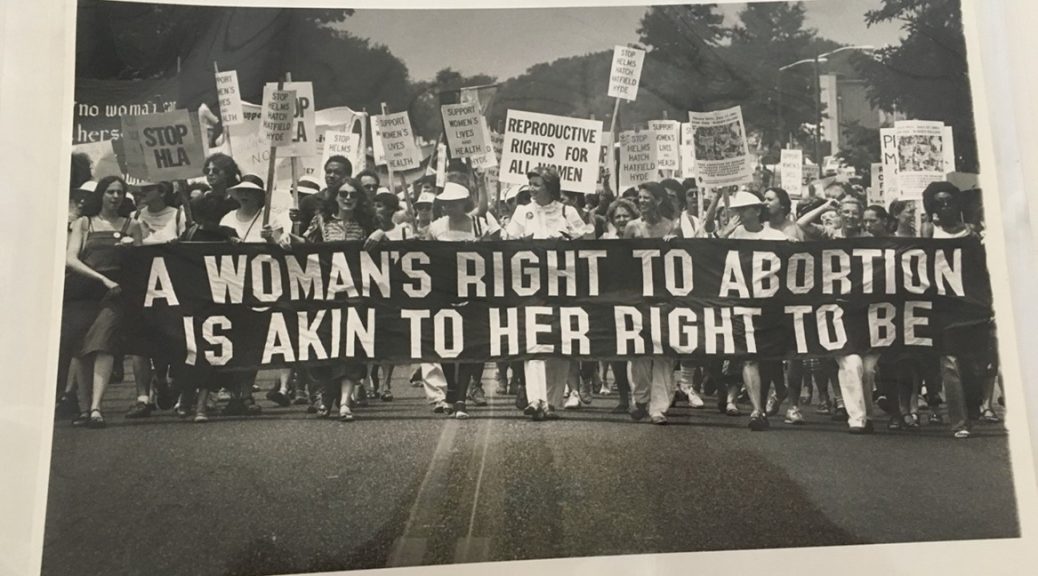
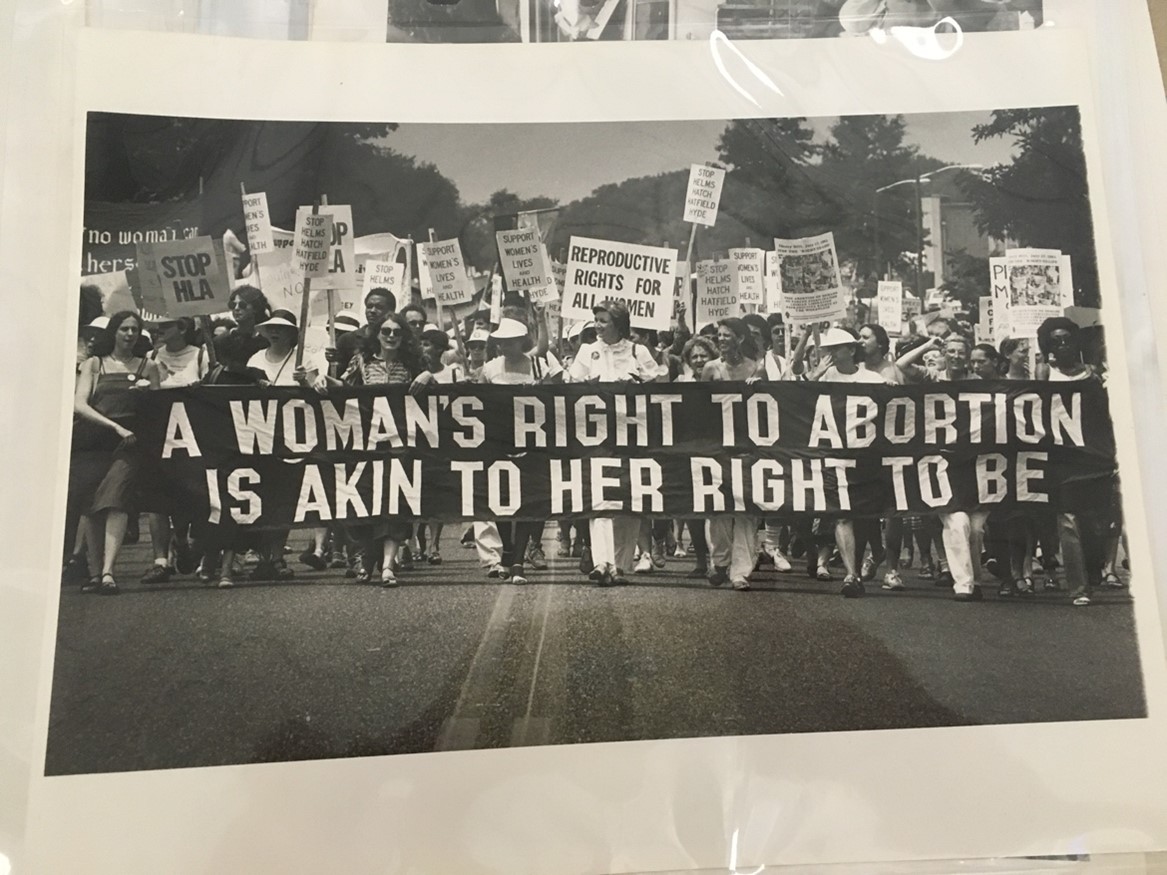
Photograph of the march organized by In Support of Women’s Lives in response to the National Right to Life’s 1982 National Convention in Philadelphia, Pennsylvania.
In March of 2024, I read an article about a woman named Julie Burkhart. The article detailed Burkhart’s challenges in opening an abortion clinic in Wyoming, one of the states with the strictest abortion laws in our post-Dobbs era. Burkhart was an employee and mentee of Dr. George Tiller, and worked in his clinic in Wichita, Kansas. Dr. Tiller was shot on two separate occasions by anti-abortion protestors, and his clinic in Kansas was the site of extended protests during the 1991 Summer of Mercy. The Summer of Mercy, organized by the anti-abortion organization Operation Rescue targeted abortion clinics and patients seeking care. This article piqued my interest—for all my knowledge about reproductive rights in America, this was not something I was familiar with. It had a strange sort of prescience, given our current political climate towards reproductive rights.
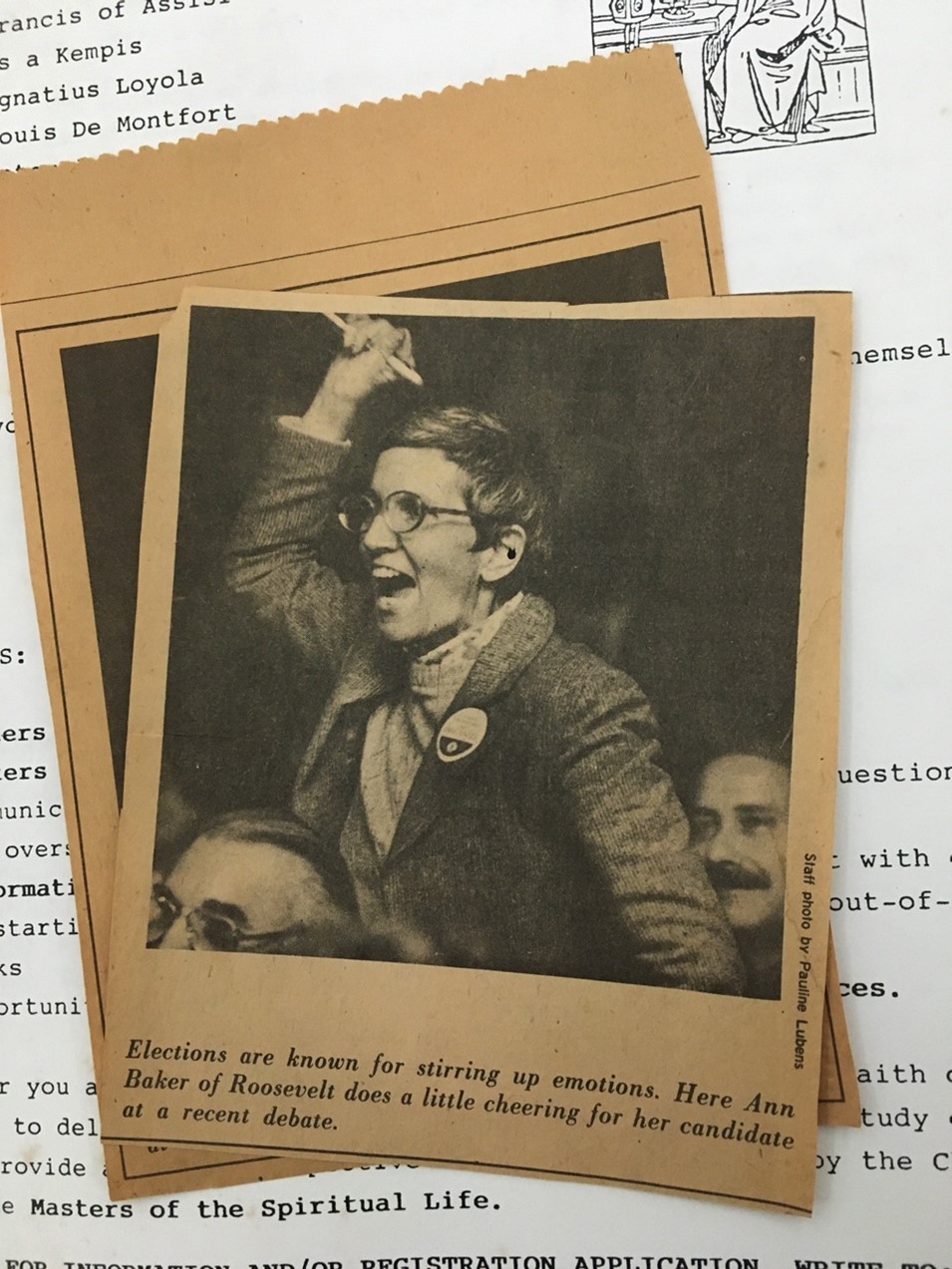
Image of Ann Baker from the Ann Baker papers.
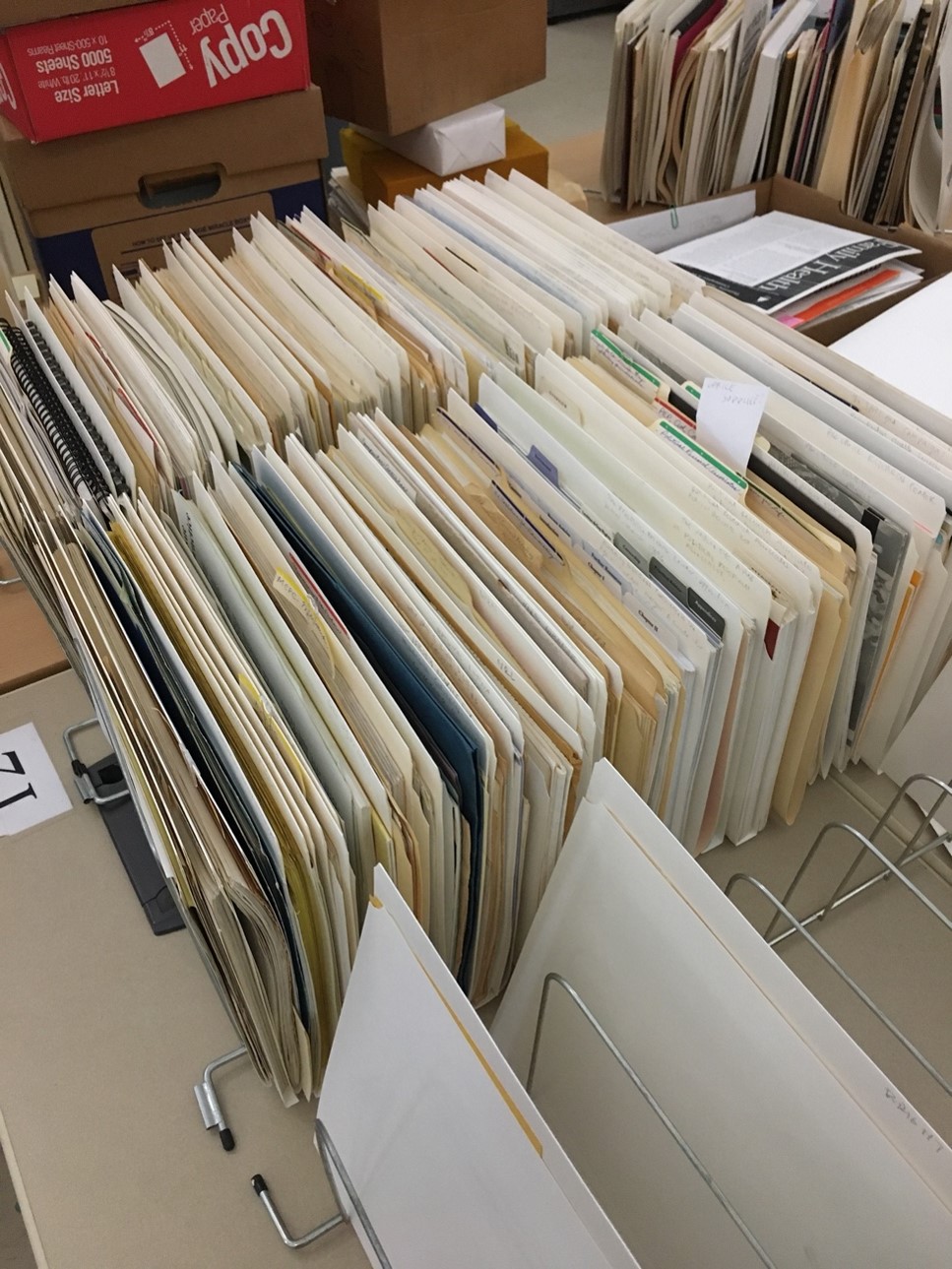
It was a strange sort of kismet a few months later when Laura Micham, Director of the Sallie Bingham Center for Women’s History and Culture, suggested I consider processing the papers of a woman named Ann Baker as my next project. Fresh off of smaller processing projects, the 130 linear feet were daunting. Packed by Ann’s widow and friends, the collection arrived on the Bingham ranges in a variety of boxes—some standard sizes, others repurposed from moves and office supplies. At the time, I knew Ann was from New Jersey and that she was a reproductive health and LGBT rights activist. What I didn’t know was that she focused her work on the impact of Operation Rescue and other pro-life organizations during the 1980s and 1990s.
As Laura and I surveyed the boxes, a picture started to slowly unfold. Baker’s organization, the National Center for the Pro-Choice Majority (originally the 80% Majority), served as a clearing house for information on anti-abortion protestors and tactics. Each week, Baker would compile arrest lists (sometimes provided by police departments, clinics, and local newspapers) for the different demonstrations that happened across the country. She would then cross-check with previous arrests to determine if any person had been involved in this kind of event in another city or state. As it became apparent that the same groups of people were involved in these “rescues” week after week, law enforcement began increasing fines and jail time for repeat offenders. The national movement against abortion, the scale of which was promised by leaders like Randall Terry and Joe Scheidler, turned out to be little more than a small group of devoted followers.
Baker documented the protestors, their tactics (such as chaining themselves to blocks of concrete inside the clinic), and their propaganda. She collected newspaper clippings, literature, policy books and reports, and dossiers of protestor information. She even subscribed to some of the more militant publications using money orders, fake names, and P.O. boxes. She tracked lawsuits that ranged from husbands and boyfriends suing their wives and girlfriends for seeking abortion, to Frisby v. Schultz, which made residential picketing of abortion providers’ homes illegal. Armed with this information, she wrote about these organizations in her newsletter, The Campaign Report, which was mailed to clinics, providers, and activists across the U.S. In this newsletter, she tracked the many tendrils of the pro-life movement, provided information on what clinics could expect to see when Operation Rescue came to town, explained how to work with local law enforcement, and offered analysis about politics, the U.S. government, and citizens’ attitudes toward abortion.
Baker’s papers slowly taking shape during processing.
Baker was a diligent filer. Many of the folders were titled and organized loosely by theme. The most difficult part was keeping track of all the different threads I’d found throughout this very large collection. Some of the original order of the collection needed to be fine-tuned for it to be easier for current researchers to use, but I kept all of her original folder titles. As I spent more time with her work, I gained a sense of her personality. One of my favorite aspects of the collection was the marginalia, whether it be complaints, frustrations, or New York Knicks scores scrawled in the margins. She had a penchant for argument through the written word, and some of my favorite letters she wrote had nothing to do with the pro-life movement at all. In one folder, I found a copy of a parking ticket, annotated with a note in which Baker insisted that paid parking should only extend through normal business hours.
I am deeply thankful to Baker and her work, as well as the other activists, providers, and clinic workers documented in this collection. She noticed a gap: no one was tracking the protests state by state, and she took it upon herself to fill that gap. Through this work, she provided clinics with the information they needed, whether it be organizing tactics or information on protestors. She built a deep network of contacts, many of whom are also represented in the Bingham Center’s collections. She is not a household name, but she is a reminder that to make a difference, one does not need to be.
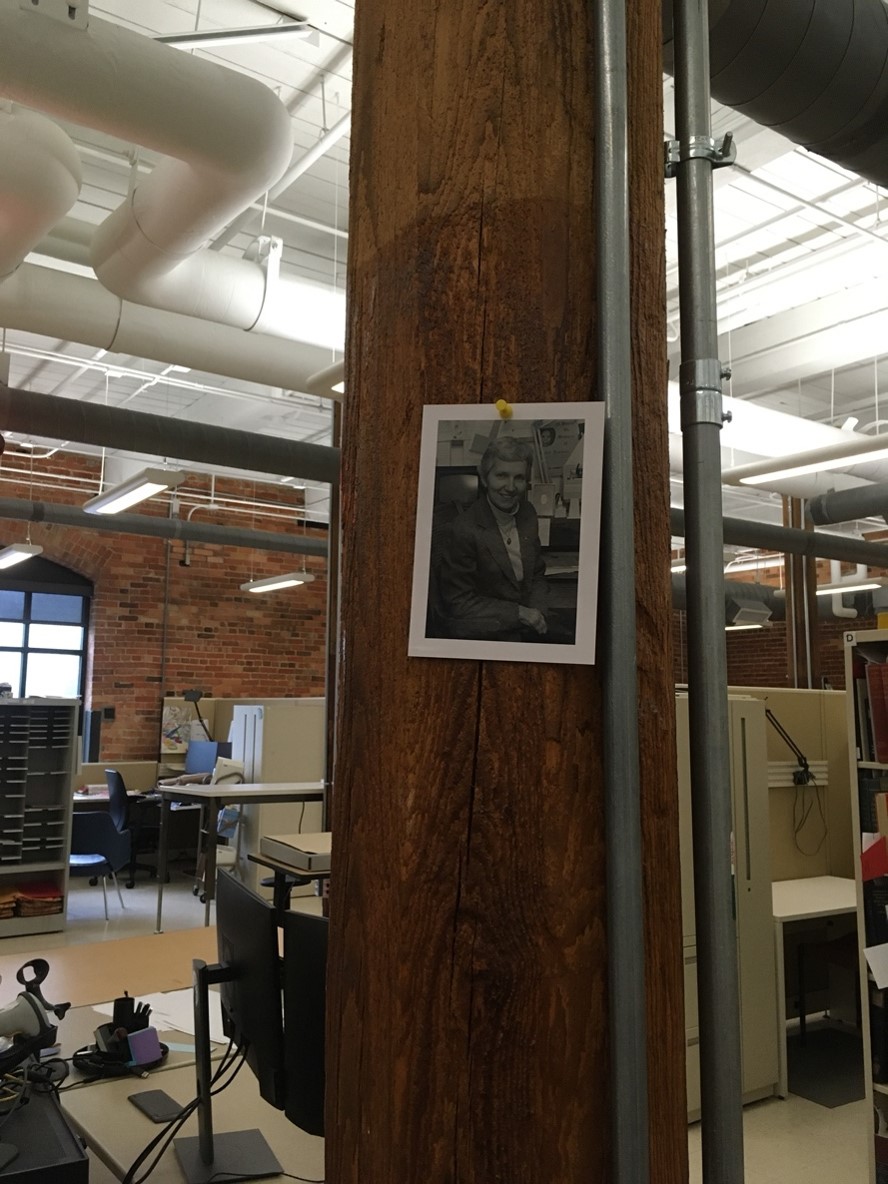
Photo of Ann Baker, a duplicate in the collection, surveying the processing of her papers. She guided me the entire process, from her spot on the pillar.
Processing archival collections is iterative, exacting work which often requires circling back through materials again and again. I went through this collection many times, moving materials into different series, trying to decide how they best made sense. In the thick of it over the summer, I had a sense that I’d never be finished. But slowly, day after day, it came together. I’ve been thinking often that it takes a village to process an archival collection, and I’m deeply thankful to everyone in Technical Services and the Bingham Center for their knowledge, expertise, and cheerleading. I believe this collection will be a valuable body of material for researchers looking to understand not only the period in which Baker did her work, but also our current era in which reproductive rights remain precarious.
Post contributed by Soroush Marouzi, Research Scholar at the Center for the History of Political Economy.
In 1960, the political activist known throughout Japan by the pen name Reiji Himeoka sat in solitary confinement at Tokyo’s Sugamo Prison. By 1967, now publicly known by his birth name Masahiko Aoki, he had become an Assistant Professor of Economics at Stanford University. His life circumstances had changed drastically over those seven years, but not his desire to understand the world and change it for the better. Today, the Masahiko Aoki papers present rich resources for historians eager to delve deeper into his life and work.
Aoki (right) in conversation with his colleagues.
Aoki was born on April 1, 1938, in Nagoya, Aichi Prefecture, Japan. He initially intended to become a historian, but his growing interest in Marxism led him to pursue economics at the University of Tokyo. As an undergraduate, he emerged as a leading ideologue, describing himself as an “information propaganda director” of left-wing organizations at the forefront of Japan’s student movement that aimed to discourage the ruling conservative government to sign the revised US-Japan Security Treaty—activities that culminated in his arrest in 1960. After his release, he earned his undergraduate degree in 1962 and his master’s in 1964. After reading the work of Kenneth Arrow and Leonid Hurwicz during his graduate studies, he started to distance himself from Marxism and became increasingly interested in “modern economics.” He left Japan to pursue his PhD in economics at the University of Minnesota under Hurwicz and John Chipman, graduating in 1967 then holding appointments at Stanford and Harvard University over the next two years. Returning to Japan in 1969, he continued his academic career at Kyoto University until coming back to Stanford in 1984 and retiring in 2005. He died in 2015, having dedicated his career to studying forms of economic organizations and making contributions in the theory of the firm, corporate governance, and East Asian economies.
This digital photo of Aoki during an interview comes from a set among the electronic records in the collection.
Aoki’s papers are the most recently processed collection in the Economists’ Papers Archive, which also houses the collections of Arrow, Hurwicz, and Chipman. A substantial portion of this collection highlights Aoki’s role in shaping the economics profession by establishing institutions, such as the Virtual Center for Advanced Studies in Institution, and by leading influential organizations, exemplified by his presidency of the International Economic Association (IEA) from 2008-2011. There are also collection materials that offer insights into Aoki’s graduate education through handwritten notebooks; the production of his scholarly works on game theory through drafts and referee reports; his contribution to the development of the field of comparative institutional analysis through Stanford University Economics Department records; and his relationships and collaborations with economists such as Arrow, Joseph Stiglitz, and János Kornai through correspondence.
Janos Kornai’s email to Aoki, dated Dec 18, 2004, asking for Aoki’s consent to be nominated for IEA’s presidency. He eventually won by one vote–a significant moment in his career.
In his memoir, Aoki described his life as “a transboundary game.” He lived in both the East and West, and he embraced an interdisciplinary approach to studying economics. Crossing boundaries—whether geographical or disciplinary—was a defining feature of the life he led. His transboundary game was marked by constant attempts to understand institutional arrangements in economic life, along with his desire to improve them through tireless professional service. This joint pursuit was perhaps the dominant theme of his life, from his time as the Marxist ‘Reiji Himeoka’ until he became a Stanford emeritus professor of economics.
This black and white portrait of Aoki is an example from an album reflective in tone.
Post contributed by Meghan Lyon, Head of Technical Services
The “Duke University Libraries Statement of Our Commitment” (issued in June 2020) commits Duke Libraries to expand our cultural competence and combat racism. The statement offered five goals (summarized below) as a means of upholding that commitment:
Dismantle white privilege in collections and services.
Diversify our staff.
Develop better relationships with community organizations and groups.
Document and share Duke’s complex institutional history.
And finally, “practice more inclusive metadata creation, with the goal of harm reduction from biased and alienating description and classification.”
Creating “Guiding Principles” for RL Technical Services
The Rubenstein Library Technical Services Department has been seeking to create “inclusive metadata” for much longer than the summer of 2020, but we have recently been inspired by Duke Libraries’ “Statement of Our Commitment” to more formally and concretely define what “inclusive metadata” means. We began this process by collecting and reading library and community literature, listening to panels and presentations on these topics, and researching what our peers and role models are doing. Our staff met and workshopped a draft of new “Guiding Principles for Description,” which was subsequently edited and adopted by the department and is now available here (along with links to some further reading and references):
The Rubenstein Library Technical Services Department acknowledges the historical role of libraries and archives, including our own institution, in amplifying the voices of those with political, social, and economic power, while omitting and erasing the voices of the oppressed. We have developed these Guiding Principles for Description as the first step in our ongoing commitment to respond to this injustice.
We will use inclusive and accessible language when describing the people represented by or documented in our materials. We commit to continually educate ourselves on evolving language and practices of inclusivity and accessibility.
We will prioritize facts and accuracy, and resist editorializing, valorizing, or euphemistic narratives or phrases in our description. This includes a commitment to revisit and revise our past description.
When describing our collections, we will purposefully seek and document the presence and activities of marginalized communities and voices.
We welcome and will seek to incorporate input and feedback on our descriptive choices from the communities and people represented by and in our materials.
We will be transparent about the origin of our description, and our role in adding or replacing description. We will also commit to increased transparency about our own institution’s past descriptive practices.
We will advocate for and celebrate library description, and the essential labor and expertise of the library practitioners who create and maintain that description, as crucial for any ongoing preservation of, access to, and research within library collections.
Developing this list of guiding principles is only one part of our ongoing commitment to create inclusive description of Rubenstein Library materials. Our department processes and catalogs a wide range of special collection formats (printed books, serials, ephemera, zines, archival papers, institutional records, film, video, born digital files, objects, and more) and creates description that is shared across a variety of platforms like the library catalog, finding aid database, and Duke’s institutional repository. Going forward, we hope the “Guiding Principles” will serve as the foundation for any type of description created or managed by Rubenstein’s catalogers and archivists.
Current and Future Inclusive Description Projects
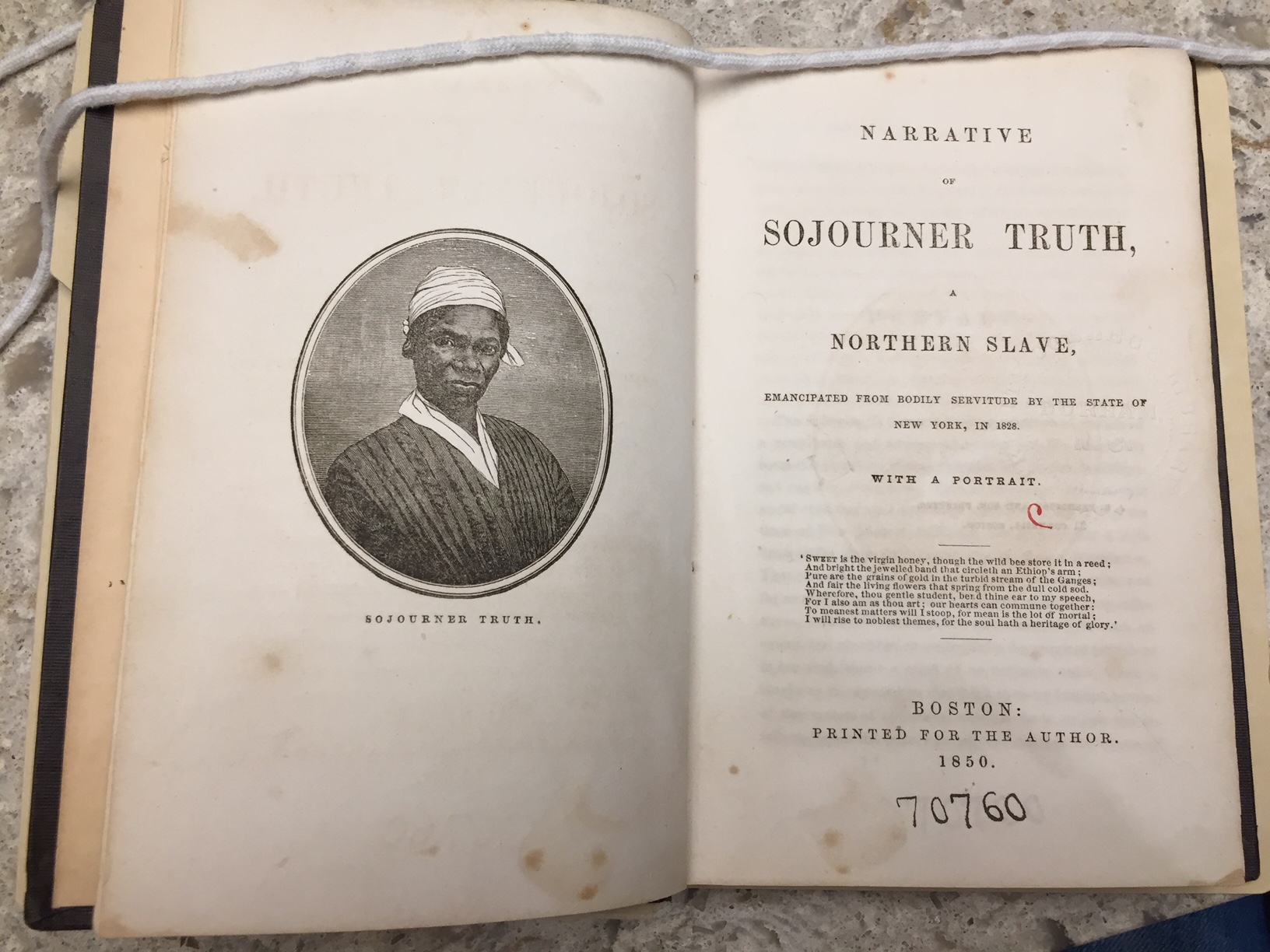
The Narrative of Sojourner Truth, 1850. As part of their work to catalog the Lisa Unger Baskin Collection, Rubenstein catalogers corrected a century-long misattribution of authorship in the Library of Congress Name Authority File, returning credit back to Sojourner Truth.
There is much work already underway, and much more planned as Rubenstein Technical Services continues to prioritize the creation of inclusive description. Some of these projects pre-date the coining of our “Guiding Principles” — for example, we are proud of the ongoing cataloging of the thousands of items in the Lisa Unger Baskin Collection, where catalogers are creating name authority records and detailed provenance notes tracing the often hidden role of women in printing, publishing, and book-binding. Our work to preserve and digitize film, including creating detailed description for collections like the H. Lee Waters’ Movies of Local People, have ensured the preservation and availability of community histories. When developing ArcLight, our finding aid interface (just launched in July), an important feature was the addition of a feedback button to encourage suggestions, particularly if a user spots harmful or incorrect descriptive language in our metadata.
Our projects continue this fall despite the COVID-19 pandemic. While working remotely, the Rare Materials Section has prioritized creating new manuscript catalog records for the Rubenstein’s American Slavery Documents, which will center the names and lives of Black people who were enslaved. We will share more about this project as the records are published in our catalog later this year.
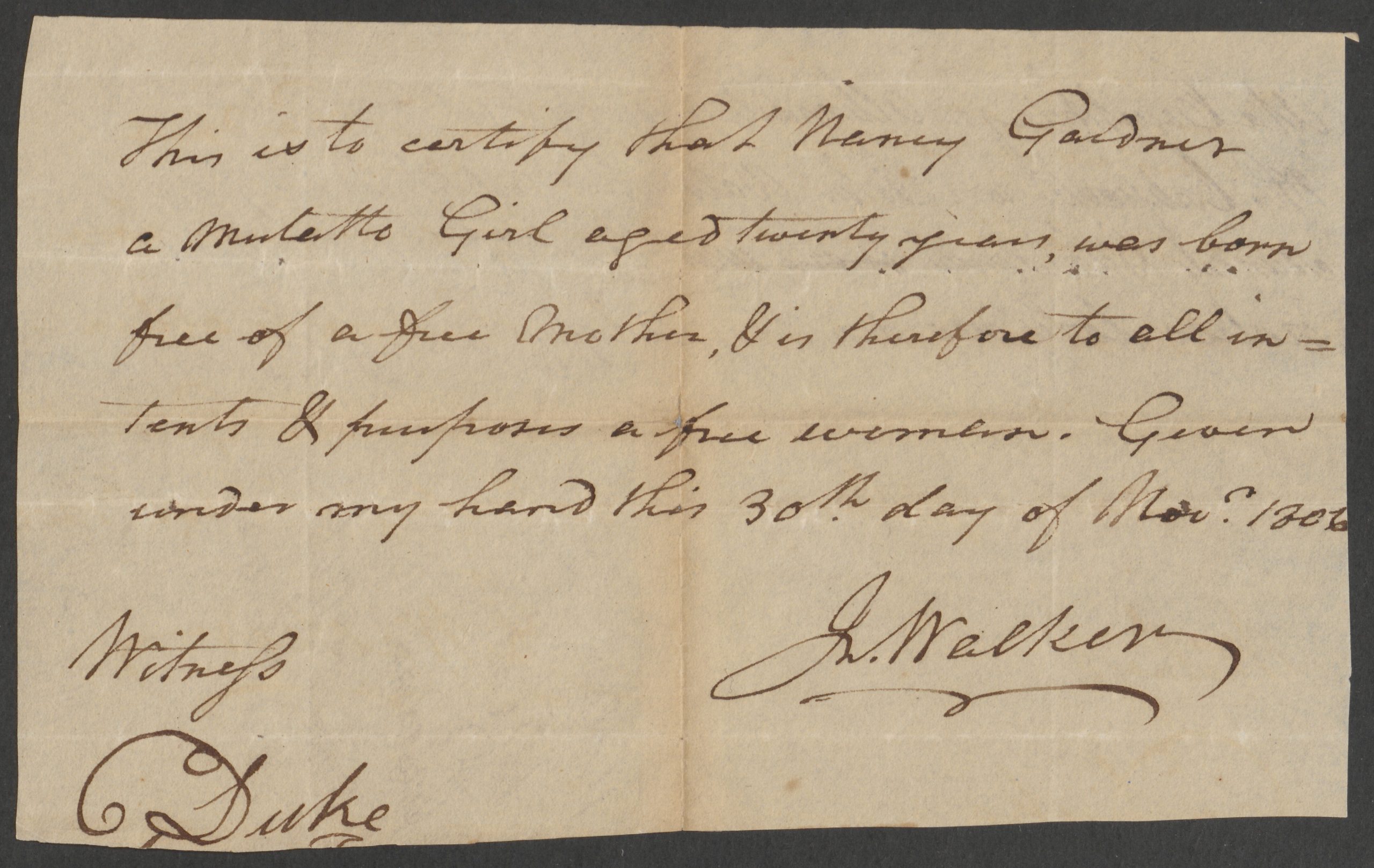
Free papers for Nancy Gardner, 1806. Catalogers are creating new description for manuscripts like this from the American Slavery Documents collection, along with creating name authority records that align with our new “Guiding Principles.”
Our Archival Processing Section has begun reviewing manuscript collections with outdated, inadequate, or offensive description, and they will be reprocessing, re-describing, and exploring how to be transparent about any changes or updates they make through development of a new style guide for finding aids. This includes acknowledging our library’s past decisions or mistakes, which may mean more blog posts like this one that question and critique our institution’s collecting and descriptive choices. Across the department, we intend to ramp up reparative description projects, particularly for our nineteenth-century Southern white family papers, because we know that the records of enslavers may be the only remaining documentation of those who were enslaved. We are seeking marginalized, hidden, and silenced voices. Even in their silences, our collections have much to say. Please stay tuned, and stay in touch, as we pursue this important work.
Post contributed by Leah Kerr, Technical Services Processing Archivist for the Duke University Archives.
At Smith Warehouse, the Technical Services archival processing area of Bay 11 is quiet. But not because the librarians working there have shushed everyone. Rather, the archivists, catalogers, interns and student workers perform many tasks by themselves. And most of us are wearing headphones or earbuds. Undoubtedly we are listening to music, podcasts, sports events, and whatever else we can stream. As a self-proclaimed news junkie, I often listen to live broadcasts.
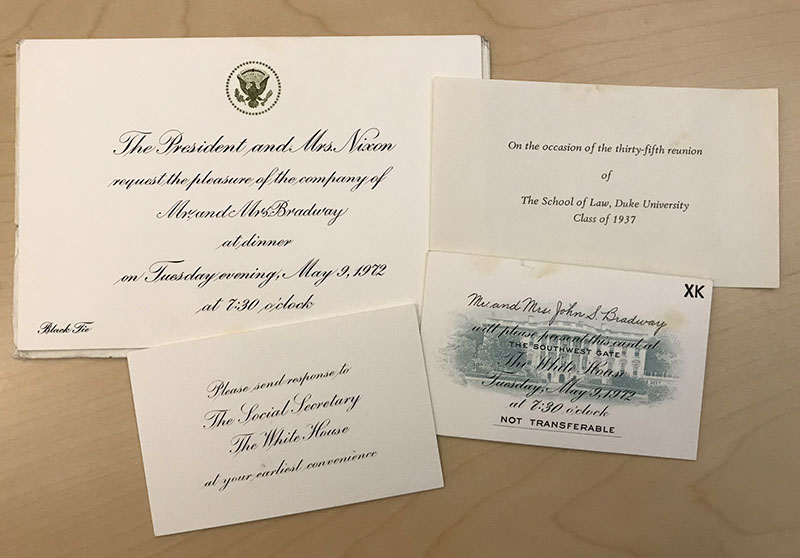
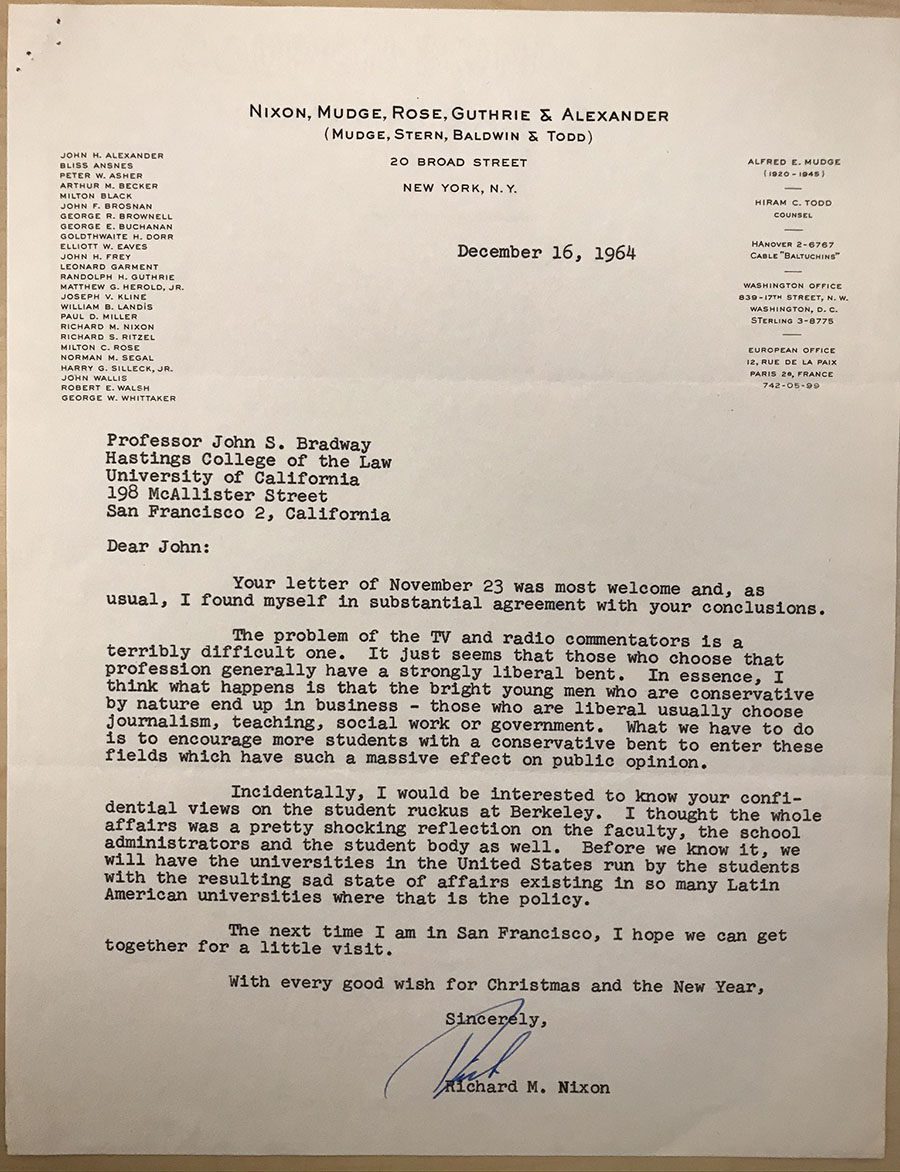
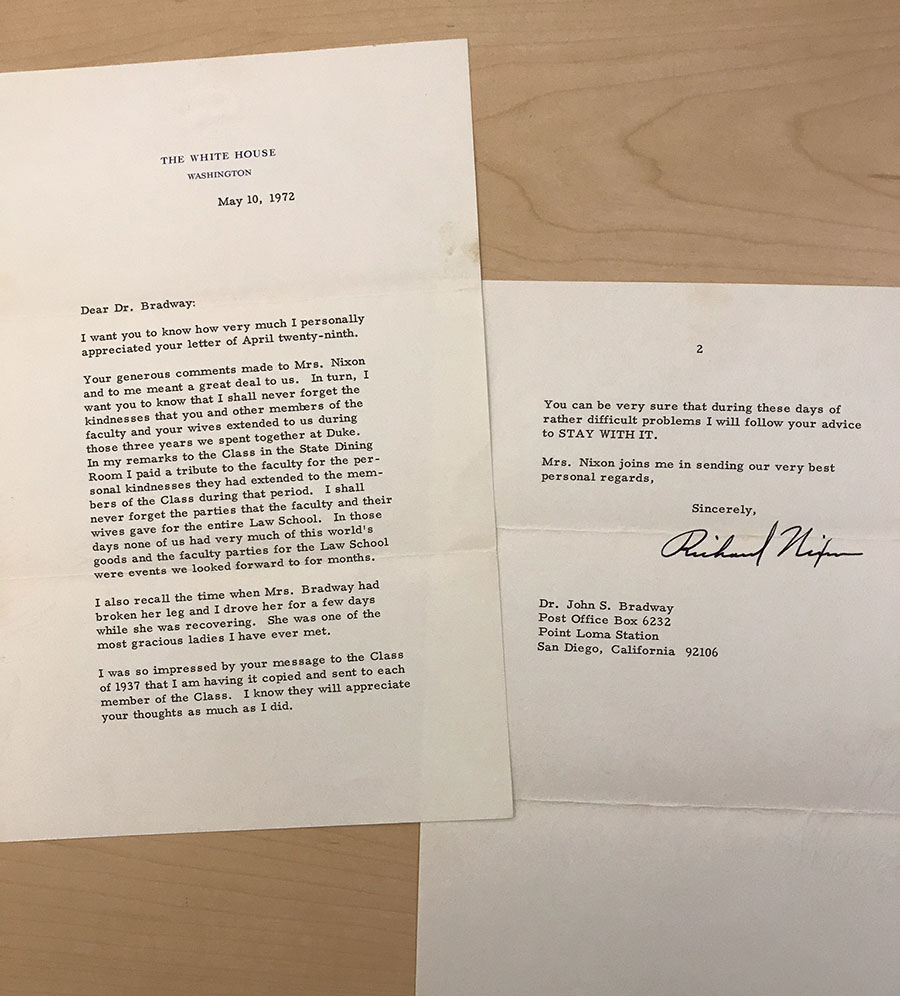
As an archivist of University Archives records, my worlds collided in a “deja vu all over again” manner. At the end of January and beginning of February I was listening to the impeachment hearings and trial of President Donald J. Trump as I was processing the John S. Bradway Correspondence with Richard M. Nixon records. The collection is comprised of letters written between the Duke law professor, and his former student from 1959-1978. Nixon graduated from Duke Law in 1937, and the two men stayed in touch. These letters were recently gifted to Duke from a historical society in New Jersey.
The correspondence covers the time periods that Nixon worked as an attorney at a law firm, a United States Vice President, a newly-elected United States President, an embattled impeachment defendant, and finally, a former President looking back at his legacy. But the bulk of the letters fall between 1973 and 1974, when President Nixon was first tied to, then accused of, and later resigned due to the Watergate break-in and scandal and subsequent White House cover-up.
Bradway and Nixon’s correspondence show the respect each had for the other. They often mention their spouses, Mary Bradway and Pat Nixon, offering their greetings to them in each letter. The men also write glowingly of each other, and Bradway offered his suggestions to “stay with it” and his view that neither the Republican party nor the country would have anything to gain by Nixon resigning. When Nixon finally did resign and leave Washington, the correspondence continued, and Bradway urged him to write “a book or a series of articles” giving his side of the Watergate story.
Processing this collection with impeachment trial streaming through my earbuds led to an unusual echo chamber. The same phrases that I saw in the documents were being repeated on the floors of the House and the Senate. For example, liberal media was mentioned in both the recent impeachment hearings and the correspondence. The phrase “Impeachment is a political process” and concerns about the health and future of the Republican party were discussed in the letters I read, and in the very recent commentaries I heard. For me it was a startling reminder of how primary source documents very clearly connect to our present-day lives and current affairs.
Post contributed by Laurin Penland, Library Assistant for Technical Services
Warning: Some of the language in this blog post is outdated and considered offensive today. There are also descriptions of violence against African Americans in the South during Reconstruction.
The way in which archivists think about Reconstruction (1865-1877) in the United States can sometimes determine how we describe and interpret materials produced during that period. For example, if you believe that Reconstruction was an ill-fated, corrupt takeover of the South by Northern Republicans—a brief episode doomed to fail—then it makes sense that you would describe a Republican politician in Georgia as self-interested. The particular politician that I have in mind is John Emory Bryant (1836-1900), who was born in Maine, fought for the Union, and pursued a Republican political career in Georgia after the Civil War. Bryant was also an abolitionist, teacher, agent of the Freedmen’s Bureau, newspaper editor and publisher, and lawyer. The Rubenstein Library holds his papers, the bulk of which were acquired in 1968 (a later addition arrived in 2002). His papers came up recently as a candidate for re-processing due to their popularity among researchers, the aging folders and worn-out boxes housing the collection, and the fact that there were many voices within the collection that could benefit from updated description in the online collection guide. Also, when we investigated further, it became clear that there was a large discrepancy between what was described in the old paper catalog and the online collection guide. The original card catalog entry included 50 cards of description! And the online collection guide included only two small paragraphs. Sometimes this discrepancy happens because of the way the library managed the mass migration of our collection guides online; description was simplified. And sometimes this happens when the description was viewed as problematic for some reason. For the JEB papers, the discrepancy in descriptions could have been for multiple reasons. My task was to assess the description that was available to me and to do my best to improve the collection guide, a process which inspired me to think about how archivists and researchers interpret and describe materials from the Reconstruction Era. This process ultimately led me to edit descriptions of JEB and to make sure that the voices of people of color where discoverable in the collection.
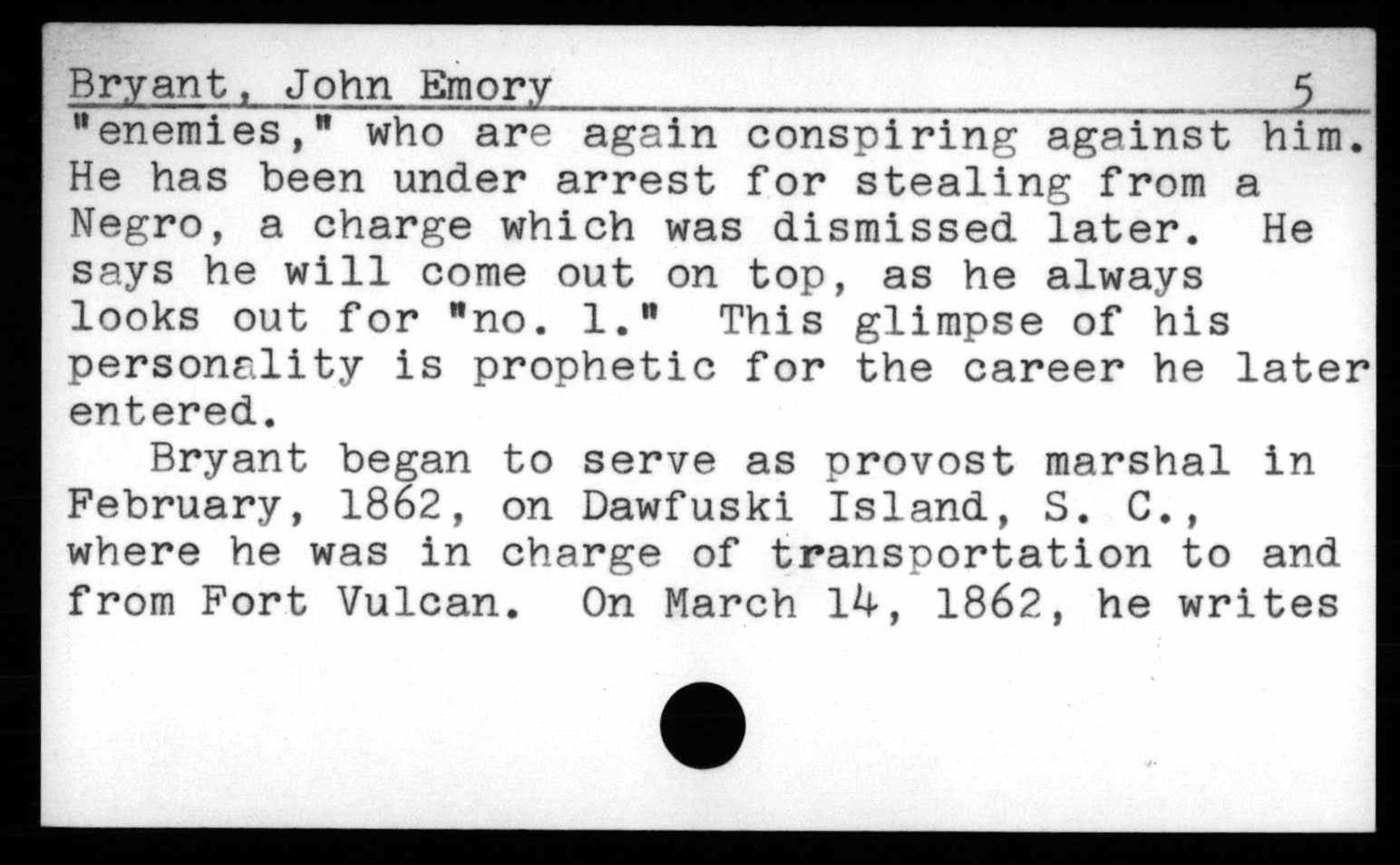
To get an idea of how JEB papers were originally described, here is an unflattering snippet about Bryant from the old card catalog:
On January 1, 1862, Bryant made a significant statement to Emma [his future wife]. He refers to his “enemies,” who are again conspiring against him. He has been under arrest for stealing from a Negro, a charge which was dismissed later. He says he will come out on top, as he always looks out for ‘no. 1.’ This glimpse of his personality is prophetic for the career he later entered.[1]
Card catalog describing John Emory Bryant.
The description portrays Bryant (JEB) as contentious, selfish, and possibly corrupt; the description also gives weighty significance to this episode in JEB’s life by suggesting that it illustrates an important aspect of his personality and the foundation for his political career. I think it’s also important to note that JEB was accused of stealing from a black person, which, if true, would do significant harm to any claims of integrity he might have had in fighting for the civil and political rights of African Americans.
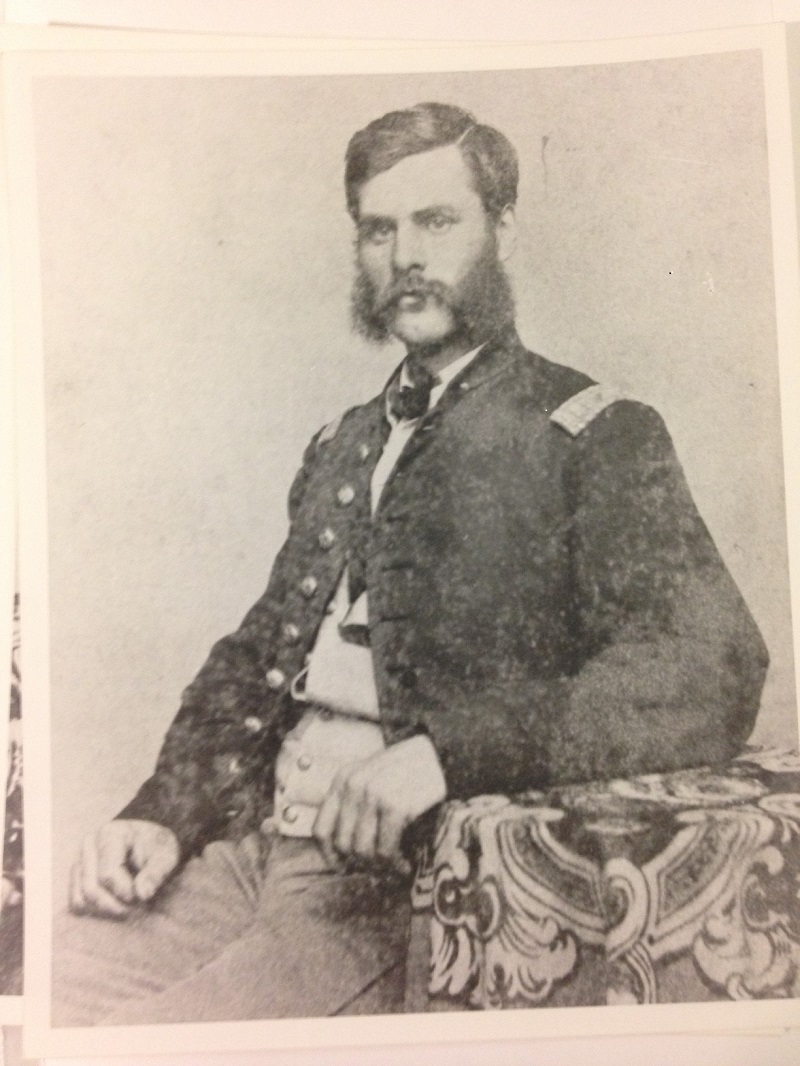
Photograph of John Emory Bryant.
Why did the previous cataloger of this collection choose to highlight this episode in Bryant’s life? One reason could be because of popular notions about Reconstruction during the 1960s—for example, the cataloger, expecting to find a corrupt carpetbagger, could have been drawn to troublesome moments in JEB’s life and career. After all, JEB was no stranger to conflict and controversy in both public and private affairs. In her book, Carpetbagger of Conscience: A Biography of John Emory Bryant, Ruth Currie-McDaniel probes JEB’s life and career, wading through many of his successes, failures, flaws, and contradictions in order to try to discern what kind of Republican he really was. Currie-McDaniel comes down on the side that JEB was a staunch supporter and fighter for civil rights for African Americans; he was also “a complicated mixture of idealistic reform zeal on the one hand and a certain selfish realism on the other,” as well as being a neglectful husband.[2] To say the least, JEB was a complicated person, and the letters that he left behind tell of a controversial personality.
Eric Foner, who is one of the most well-known Reconstruction scholars and who is heavily inspired by W. E. B. Du Bois (Du Bois wrote “Black Reconstruction in America: An Essay Toward a History of the Part Which Black Folk Played in the Attempt to Reconstruct Democracy in America, 1860-1880,” published in 1935), lays out an understanding of Reconstruction in which
the [Republican] Radicals in Congress were acquitted of both vindictive motives and the charge of serving as the stalking-horses of Northern capitalism. They emerged instead as idealists in the best nineteenth-century reform tradition…. Their Reconstruction policies were based on principle, not petty political advantage, for the central issue dividing [President] Johnson and these Radical Republicans was the civil rights of freedmen.
Foner writes that a key element of this understanding of Reconstruction, which is very different than the one depicted by previous historians such as William Dunning and films like Birth of a Nation and Gone With the Wind, is the “testimony of the central participant in the drama of Reconstruction—the black freedman.”[3] While John Emory Bryant was an important player in Republican politics during Reconstruction in the South, I took Foner’s depiction to heart and shifted my gaze beyond JEB’s voice and actions alone. Who were these black freedmen that Foner mentions, and what is their testimony from the Reconstruction Era? This blog post is an exploration of the African-American voices found within the JEB papers.
Daniel Broomfield: School Teacher in Warrenton, Georgia
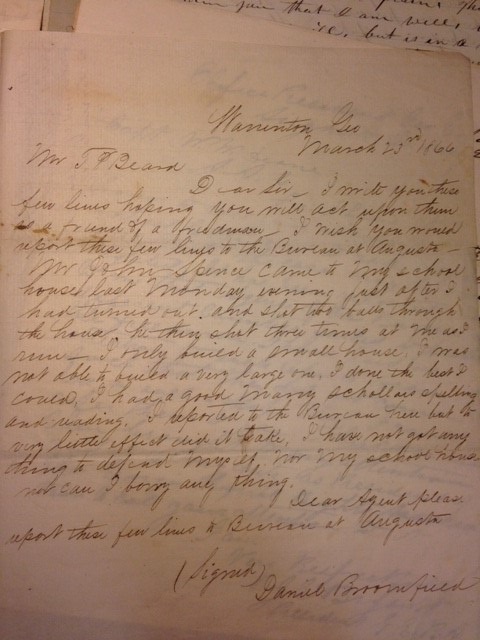
Scattered throughout the JEB papers, there are myriad portrayals of black people fighting for a better life (and sometimes fighting just to live) by participating in civic, educational, religious, and political organizations. In 1866, one school teacher, who recently built a small schoolhouse, writes to report being shot at:
William John Spence came to the school house last Monday evening just after I had turned out and shot two balls through the house, he then shot three times at me as I run. I only built a small house, I was not able to build a very large one, I done the best I could. I had a good many scholars spelling and reading. I reported to the Bureau here but to very little effect did it take.[4]
Letter from Daniel Broomfield, 1866.
This kind of terroristic violence is documented throughout the John Emory Bryant collection, perhaps most strikingly in a deposition describing KKK activity in Alabama, Florida, and Georgia in the 1870s. The African-American victims listed in the document are: Edward Thompson and his wife in Florida; Boss Fullard, Gamble Wright, and John Askie in Dublin, Georgia; and George Daymond in Montgomery County, Georgia. The atrocities recounted in the deposition paint a picture of white-supremacist terror.[5] We do not know the author of the deposition, but for those who are interested in this account and the efforts to hold the perpetrators of terror and violence responsible, we have another collection at the library that has more information. The Williams Woods Holden Papers, 1834-1929, document the life of a “journalist and Republican governor of North Carolina…. He was elected governor as a Republican in 1868, but was impeached by the Democratic state legislature in 1870 for his efforts to combat the Ku Klux Klan.”[6]
Henry McNeal Turner: Republican Leader, Preacher, Post Master General, and Bishop
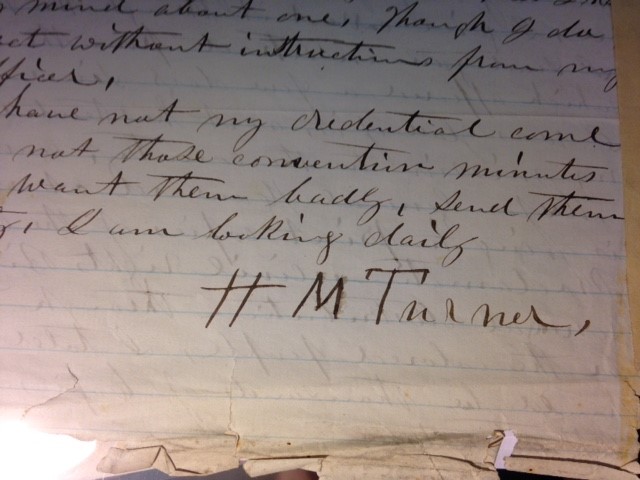
In the midst of violence, terror, and constant, ever-present racism (including both hate-filled and less incendiary paternalistic propaganda), black freedmen (formerly enslaved people) and black people who were born free pushed full-steam ahead. The same year that the school teacher, Broomfield, writes to report the assault against him, Henry McNeal Turner (1834-1915) writes a series of letters to JEB. Turner was a chaplain during the Civil War and went on to become a black Republican leader, legislator, preacher, Post Master of Georgia, and bishop in the African Methodist Church. He writes his letters to Bryant while enduring loss and illness in his family; one of Turner’s children had just died and his wife was gravely ill, yet Turner pushed on for Republican causes. He writes to JEB about political news, updates him on his efforts to get subscribers to their Republican newspaper, tells of his hopes for the Georgia legislature, and strategizes ways to inform black citizens about new laws: “Major General Howard at my suggestion is going to print copies of the Emancipation Proclamation, Civil Rights Bill etc. for general distribution through the South for the colored people. I told him there should be thousands of copies distributed like tracts.” When Turner tries to get Democrats to subscribe to his Republican newspaper, he says, “The few democrats that are here, with whom I have come in contact, treat me very scornfully. They say I aught not to speak of those outrages. But the Republicans have assured me, that Mr. Johnson shall execute that civil rights bill or leave his seat. They also say there is more on hand, when they get ready to enforce it, and they will do it.”[7] The Civil Rights Act about which Turner is writing was passed on April 9, 1866 (three days before Turner’s letter). This act provided:
that all persons born in the United States and not subject to any foreign power, excluding Indians not taxed, are hereby declared to be citizens of the United States; and such citizens, of every race and color, without regard to any previous condition of slavery or involuntary servitude, except as a punishment for crime whereof the party shall have been duly convicted, shall have the same right, in every State and Territory in the United States, to make and enforce contracts, to sue, be parties, and give evidence, to inherit, purchase, lease, sell, hold, and convey real and personal property, and to full and equal benefit of all laws and proceedings for the security of person and property, as is enjoyed by white citizens, and shall be subject to like punishment, pains, and penalties, and to none other, any law, statute, ordinance, regulation, or custom, to the contrary notwithstanding.[8]
Letter from Henry McNeal Turner written to JEB, 1866.
The law was passed, vetoed by President Andrew Johnson, and then passed again with a two-thirds majority. In another letter, Turner offers aid to JEB, who, he has heard, has been arrested and whose paper was suppressed. He writes, “If you are in great need, write to Oliver Sanders of Columbus, Ga. I helped them to organize a society there, and they have some money, which they will send you as quick as lighting if you need it.” Turner’s letters show someone who was deeply engaged in the issues of the time, made personal sacrifices to fight for what he believed in, and cared for his friend and colleague, JEB.
Charles R. Edwardes: Preacher and Labor Organizer
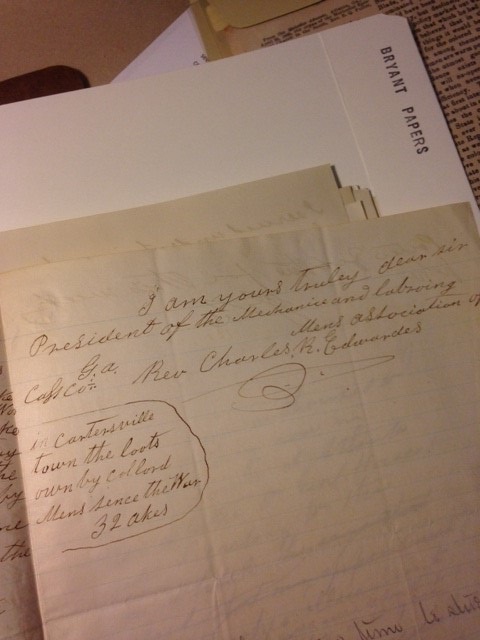
One of the common threads that connects several of the people in the Bryant papers is the importance of newspapers. JEB, along with Turner and William Anderson Pledger (who I’ll mention later), published Republican newspapers, which allowed them to share their ideas more widely and broaden their connections throughout Georgia. One African-American minister, Charles R. Edwardes, writes to JEB in 1869 to tell him about his efforts to get more subscribers for Bryant’s newspaper, and to inform Bryant of a meeting—of the Colored Men of the Mechanics and Laboring Men Association—that he would like to be mentioned in the newspaper. Edwardes reports that there are 87 members of the Association and that he hopes they will have many more members soon. At the meeting, the men counted how much land they had purchased, how many crops they had produced, and how much money they had made as tradesmen. Edwardes explains, “We wants to buy land as soon as we can to give homes to our poor peoples for many don’t [have] homes and land to work and cheated out what money works for. I have some promise to take your paper. I will do all I can to have this paper among my people. Do what you can for us.” [9]
Letter from Rev. Charles R. Edwardes to JEB, 1869.
William Anderson Pledger: Teacher, Republican, Lawyer, Newspaper Publisher
My Dear Sir: The schools of this county being in the hands of the Democrats and they having such an avowed hatred to me till it has become impossible for me to obtain employment. Their hatred is because of my Republican principles, or because that I speak them freely—yet moderately. Consequently I must have recourse to my Republican friends to obtain a livelihood: to you I look as a very dear friend, because you know the privations an active Republican is subjected….[10]
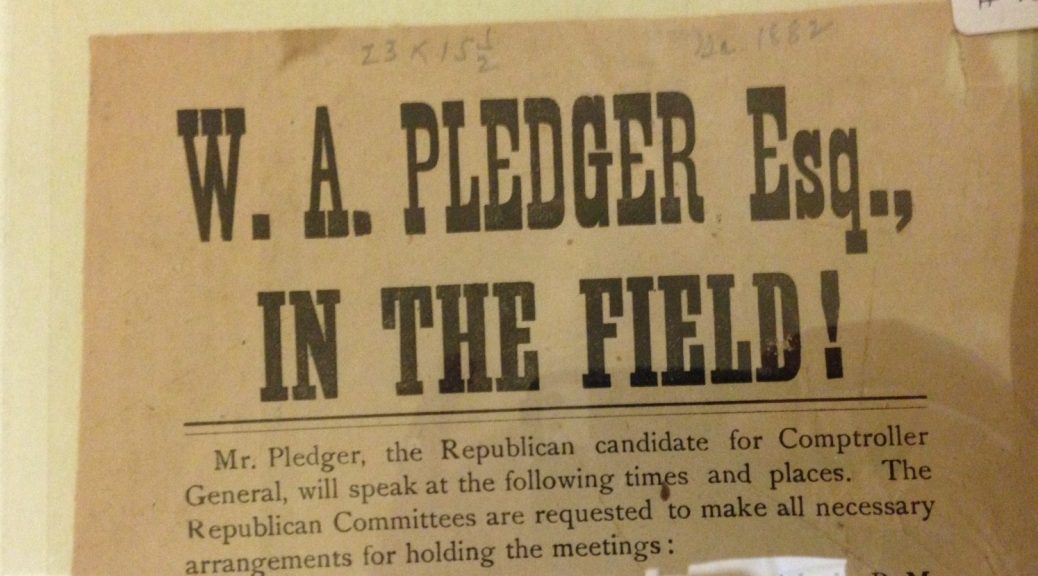
This letter is written by William Anderson Pledger, who was a prominent black Republican in Georgia. He was also an editor, teacher, and friend of JEB. Pledger’s letter press copybook (dated 1875-1879) includes faint copies of letters written to various Georgian politicians and Republicans, including John Emory Bryant, Henry McNeal Turner, E.R. Belcher, Benjamin Conly, Henry Farrow, M.T. Ackerman, and others. Many of the letters show his urgent attempts to attain employment and describe the discrimination that he faced due to his Republican political activities. In a different letter, he writes, “The Democrats have offered me if I would only leave off indoctrinating ‘radicalism’ into the negros’ [sic] heads that they would put at my disposal any position I wanted. You know I can not go back on Republicanism though I perish from this uncivilized conduct.”[11]
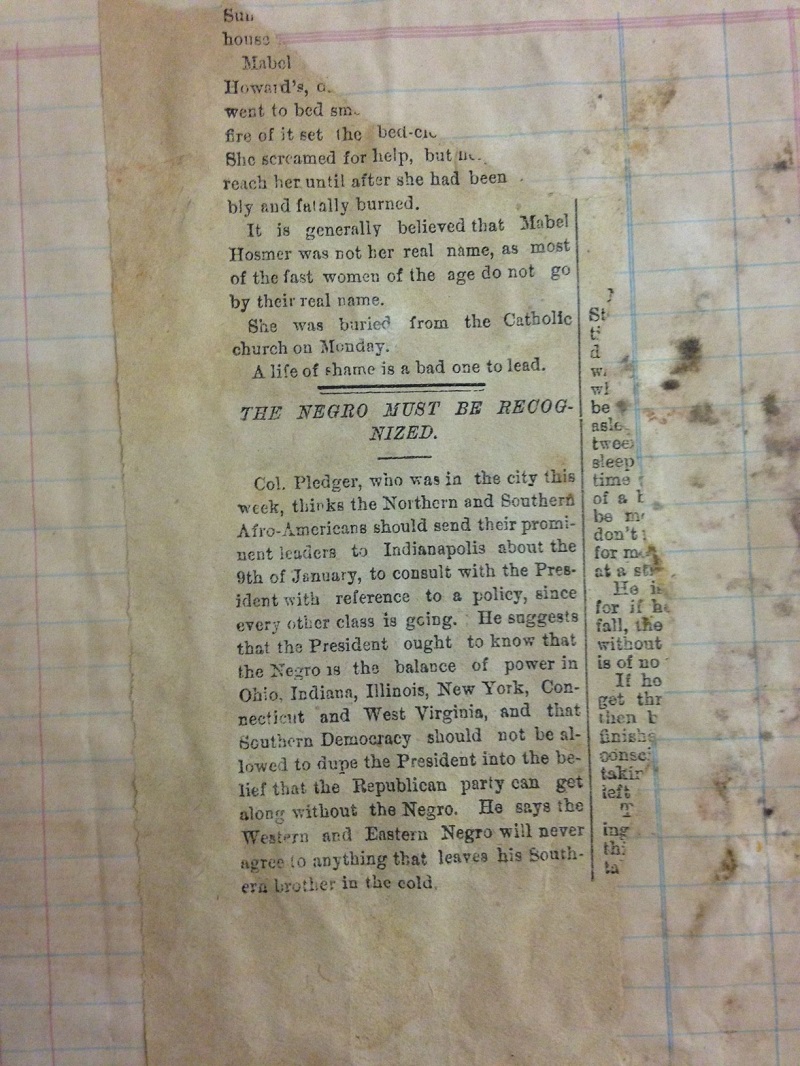
Clipping from Pledger’s scrapbook. The clipping describes a visit from Pledger in which he “suggests that the President ought to know that the Negro is the balance of power in Ohio, Indiana, Illinois, New York, Connecticut and West Virginia, and the Southern Democracy should not be allowed to dupe the President into the belief that the Republican party can get along without the Negro. He says the Western and Eastern Negro will never agree to anything that leaves his Southern brother in the cold.”
Pledger’s letters and scrapbook also show his engagement with social and political organizations, such as the Grand Fountain of Georgia (also referred to as the “colored Good Templars”), a black temperance organization.[12] Pledger was the Grand Worthy Master of the State in Georgia in 1876 and was credited with increasing the membership from 2000 to 8000.[13] These types of fraternal organizations were often at the heart of segregation battles that would go on to define the Jim Crow South. In a newspaper clipping, Pledger writes to the editor about a dispute within the Grand Fountain between the white and “colored” lodges, and he explains how the matter has been settled in his favor by the organization’s supreme court in England. Another clipping from 1878 describes “Emancipation Day,” which “was held in the First Congregational Church on Collins Street on Tuesday night, January 1st to celebrate the anniversary of Emancipation.”[14] There, the Emancipation Proclamation was read aloud and speeches were given, including one by Pledger. It is clear that Pledger was highly active in the public sphere. In The Way It Was in the South: The Black Experience in Georgia, author Donald Grant describes Pledger as being at the center of Republican politics: “he was a delegate to every Republican national convention from 1876 to 1900 and remained on the state Republican committee until his death in 1904.” In 1879, “smoldering black resentment against the white leadership of the Republican party resulted in a revolt by the blacks, who elected a new state committee of twenty-four blacks and eight whites. Black leader William A. Pledger led the revolt and replaced John E. Bryant as party chairman.”[15] During this period of Reconstruction, there was an internal struggle in the Republican Party against the lily-whites (those who wanted all-white leadership) and the black-and-tans (a coalition of blacks and whites). Three years after Pledger was elected chairman, he was “ousted” and “replaced by a white, Alfred E. Buck.”[16] Another important shift during this time was African-American disenfranchisement. During this moment in Reconstruction, black voting and participation were at their height: “In 1876, 53 percent of the eligible black males voted. The white vote was only slightly higher.” However, due to poll taxes, the Populist defeat, the lack of secrecy of ballots, the barring of black voters from primaries (called the “white primary”), intimidation and violence, and other disenfranchising efforts, black voting hit its nadir in Georgia in 1904 at 4 percent.[17]
Pledger was also a journalist and newspaper publisher. He founded The Athens Blade in 1879 “with the credo: ‘The Arm of justice Cannot—Will not Sleep,’” and he was very engaged in the debates of the time, such as the plan for African Americans to emigrate to Liberia.[18] Pledger also helped organize the Afro-American League (which later became the Afro-American Council) in 1890 in Chicago, and he was known for fighting against lynching. He “once led armed blacks to the Athens jail and successfully defied a mob bent on lynching two prisoners.”[19]
Altogether, Pledger’s papers show someone who seized upon the political momentum of the time to fight for a Republican platform that was built on equal rights for African Americans.
Conclusion
As archivists, when we preserve, organize, and describe manuscript collections, sometimes it is tempting to try to decide whether someone like John Emory Bryant did more good in the world than harm. To complicate matters, it is unclear how much significance to attribute to the correspondence, ephemera, and artifacts left behind by historical figures (e.g., we wonder whether these papers represent the whole person). In this case, widening my gaze beyond John Emory Bryant to his broader context and networks helped me address the issues at the center of this collection of papers, such as the Republican social and political fabric during Reconstruction, and, in particular, it illuminated the testimony of those fighting for equal rights, especially people of color. To give credit where credit is due, much of the work to describe this collection had been done by previous catalogers and researchers. My work benefited from the detailed description in the old card catalog, which highlighted contributions by Pledger, Turner, and others. In my revised collection guide, I built on the work that came before me, updated the language, and edited out descriptions that may have tried to pigeon hole Bryant as a self-interested Carpetbagger. Most importantly, widening my view helped me to make choices in my description of the collection, ultimately placing less focus on Bryant’s eccentricities and more focus on making a variety of voices discoverable. For instance, previously, the KKK disposition had been relegated to a “Miscellaneous” folder and was not described. Now, it has its own folder and is discoverable in the collection guide. This is not to say that now—fifty years after we acquired this collection—the description is finally complete. It can always be improved; and perhaps fifty years from now, archivists and researchers will take a new approach to this collection.
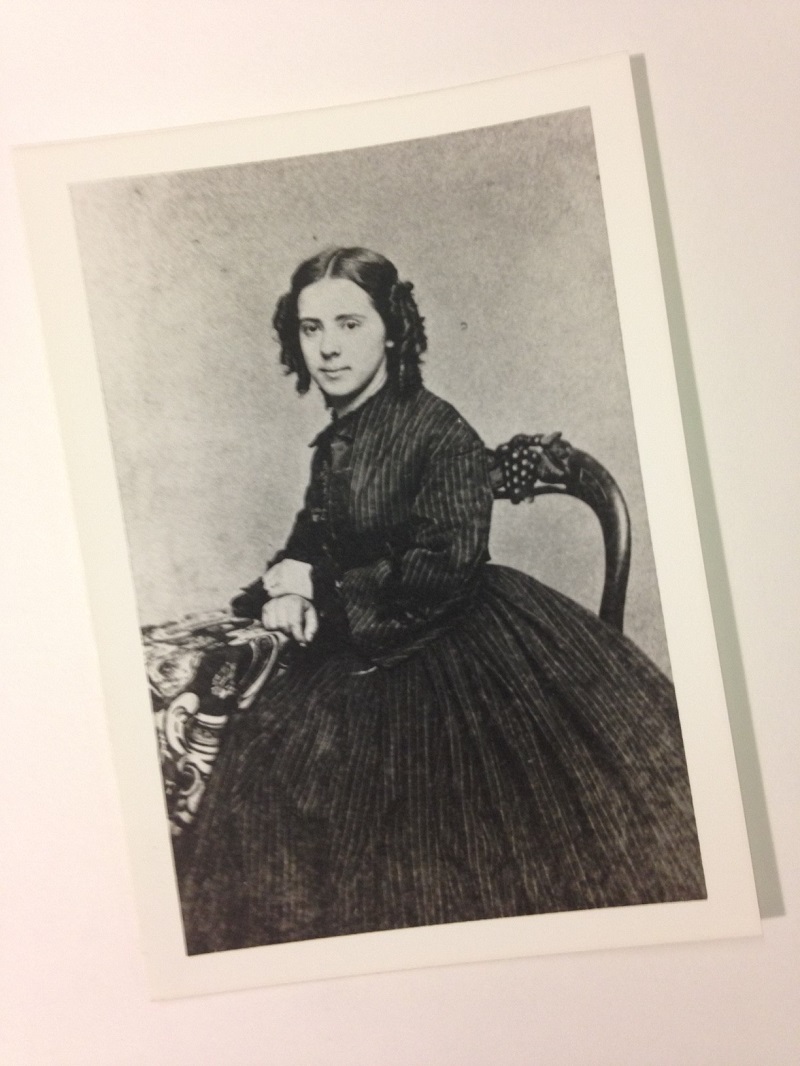
Photograph of Emma Spaulding Bryant.
As an addendum, I would like to address the fact that all of the people mentioned in this blog post are men. John Emory Bryant, while being a supporter of equal rights for men of color, did not support women’s suffrage or equal rights for women. However, there is copious correspondence in the collection between Bryant and his wife, Emma Spaulding Bryant, which is deserving of a blog post of its own. Emma Bryant often pushed back against ideas of male dominance and superiority. We have digitized a small portion of her correspondence that documents a particularly passionate response to John, who apparently objected to Emma seeing a male doctor about “uterine difficulties” without John’s permission or presence. Thanks to historian Ruth Currie-McDaniel, you can find a published collection of Emma Spaulding Bryant’s correspondence in Duke Libraries’ general collection: Emma Spaulding Bryant: Civil War Bride, Carpetbagger’s Wife, Ardent Feminist.
[1] Card catalog entry for the John Emory Bryant Papers, David M. Rubenstein Rare Book & Manuscript Library.
[2] Ruth Currie-McDaniel, Carpetbagger of Conscience: a Biography of John Emory Bryant (Athens: University of Georgia Press, 1987), 182.
[3] Eric Forner, “The New View of Reconstruction,” American Heritage 34, Issue 6 (October/November 1983): 10-15.
[4] Daniel Bromfield letter, 1866, John Emory Bryant Papers, David M. Rubenstein Rare Book & Manuscript Library, Duke University.
[5] Deposition describing Ku Klux activity in Alabama, Florida, and Georgia, 1870s, John Emory Bryant Papers, David M. Rubenstein Library, Duke University.
[6] William Woods Holden Papers, David M. Rubenstein Rare Book & Manuscript Library, Duke University.
[7] Henry McNeal Turner letters, 1866, John Emory Bryant Papers, David M. Rubenstein Rare Book & Manuscript Library, Duke University.
[8] United States, The Statutes at Large, Treaties, and Proclamations, of the United States of America, from December, 1865, to March, 1867 (Boston: Little, Brown, and Company, 1868), 27.
[9] Charles R. Edwardes letter, 1869, John Emory Bryant Papers, David M. Rubenstein Rare Book & Manuscript Library, Duke University.
[10] William Anderson Pledger letter press copybook, page 23, John Emory Bryant Papers, David M. Rubenstein Rare Book & Manuscript Library, Duke University.
Although he wouldn’t know it at the time, 1979 would become the most eventful year of Robert Cox’s life. A British journalist who spent most of his adulthood up to this point in Argentina, Cox found out that his son Peter had received a highly detailed anonymous death threat. The threat came as a result of Cox’s work covering the Dirty War as the editor of the English-language newspaper the Buenos Aires Herald. Cox and his family decided to flee from Argentina. His wife Maud Cox and their five children all came to England and then the United States with him at Harvard where Cox held a Nieman Fellowship. They later came to Charleston, South Carolina where Cox became the assistant editor for the Post & Courier.
A strong theme throughout Cox’s papers is the disappearances of political activists and dissidents, especially those of Jewish descent, throughout the country. Cox himself wrote about the desaparecidos (disappeared) and advocated for the Buenos Aires Herald to cover the violence enacted against them. Articles within the collection that cover the kidnappings range from brief passages to notices created by family members of the “disappeared.” However, one format that stands out above others in the collection never made their way into being published in an official formats – pamphlets created by the family members of the disappeared.
These pamphlets, almost zine-like, were created by Xeroxing official documents, photographs, newspaper clippings, and passages written by the creators alongside one another to create a narrative about what was known about the disappearance of this individual or group of individuals.
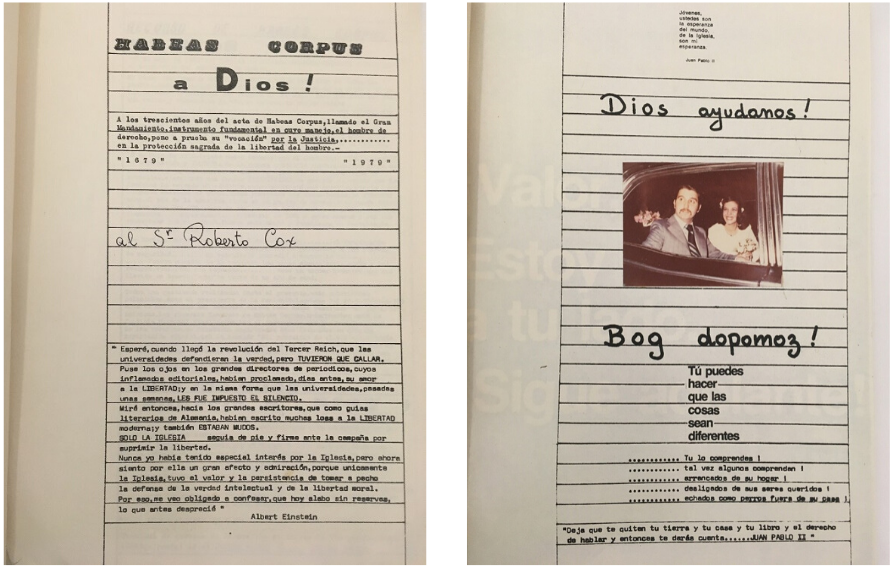
We know that at least one of these pamphlets was mailed to Robert Cox himself, as evidenced by Robert Cox’s mailing address on the back of the pamphlet. Working with the ERP (the People’s Revolutionary Army), Jorge Marcelo Dyszel Lewin and his wife Mirtha Nelida Schwalb de Dyszel were disappeared May 18, 1978. They were 22 and 21 years old respectively. Jorge was from a Polish Jewish immigrant family. This pamphlet was likely created by Jorge’s mother, Beatriz Lewin, who was very active in Las Madres de la Plaza de Mayo (the Mothers of the Plaza de Mayo).
Pages from pamphlet of the disappearance of Jorge Marcelo Dyszel Lewin and Mirtha Nelida Schwalb de Dyszel
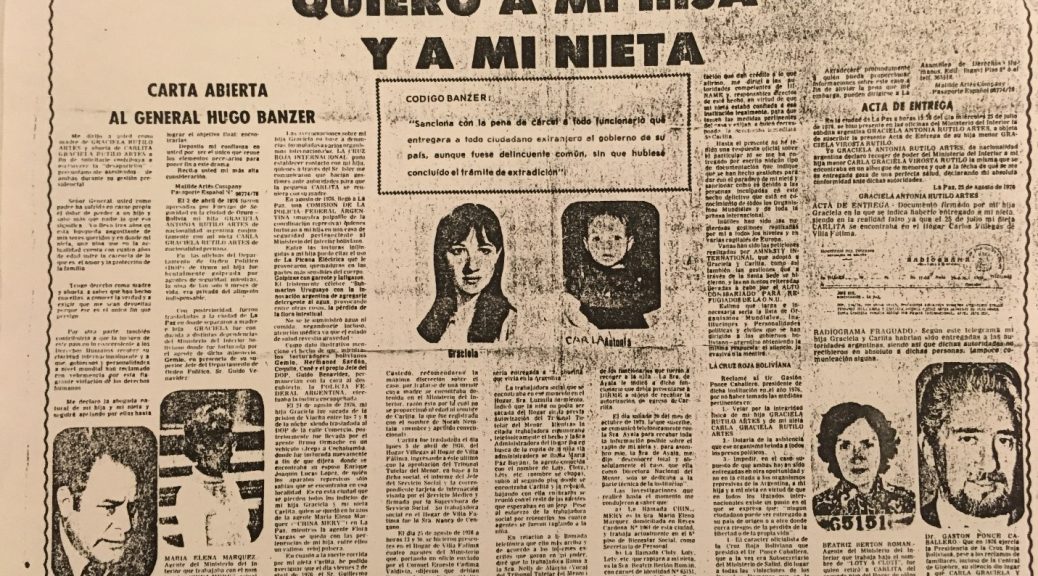
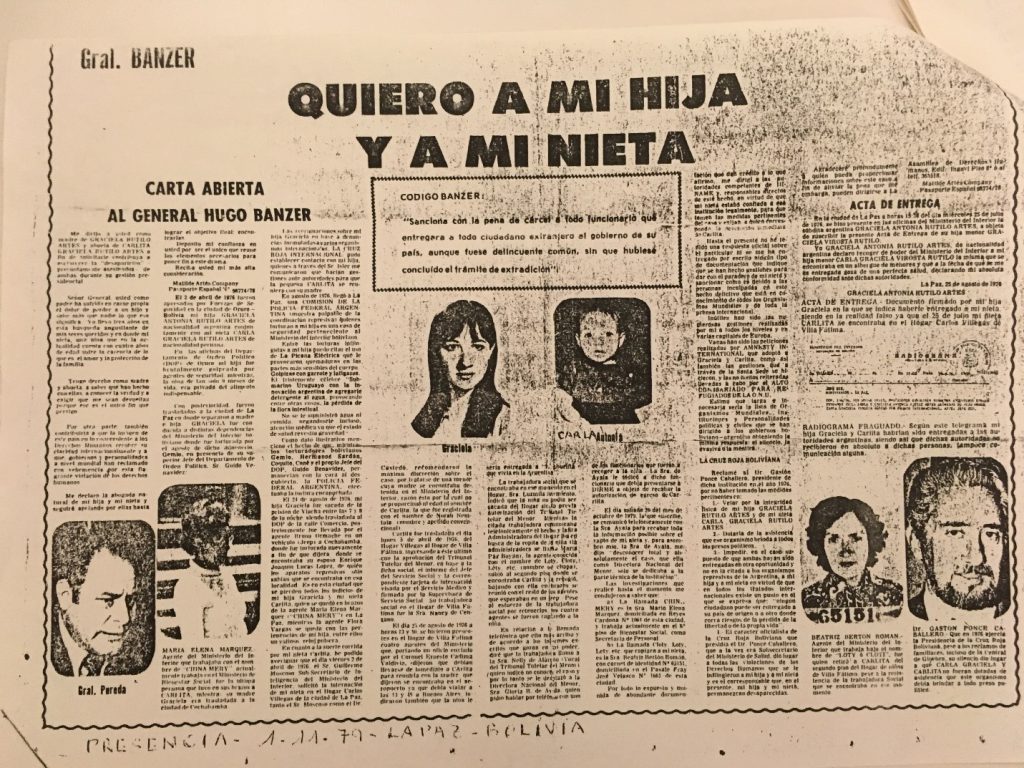
Another pamphlet tells the story of the disappearances of Graciela Antonia Rutilo Artes and her daughter Carla Graciela Rutilo Artes. Graciela’s mother Matilde Artes Company created the pamphlet and became active with Las Abuelas de la Plaza de Mayo.
Pamphlet on the disappearance of Graciela Antonia Rutilo Artes and Carla Graciela Rutilo Artes.
The Grandmothers and the Mothers of the Plaza de Mayo continue to work to hold accountable those who disappeared their grandchildren and children.
Cox did not return to Argentina for over a decade. However, from afar, Cox wrote about Argentina with continued urgency and commitment. His personal papers reflect this engagement, consisting of his own personal writings and those collected by him written by colleagues or other interested parties about Argentina. When democracy was restored to Argentina with the election of Raúl Alfonsín, Cox reported on this and outlined the challenges that lay ahead of the new president as he grappled with the aftermath of the Dirty War. His reporting continues shape how Argentines and the outside world view Argentina and its recent history.
His story is also told through two books written by his wife Maude, Salvados del Infierno: A 25 años de la dictadura Argentina, and his son David, Dirty Secrets, Dirty War: The Exile of Robert J. Cox.
If you are interested in learning more, a documentary film about Cox’s life and work called A Messenger on a White Horse is available from the Lilly Library. A shortened version of the film is also available on Amazon Prime.
Post contributed by Meghan Lyon, Head of General Manuscript Processing at the Rubenstein Library
One of the Rubenstein Library’s older collections, the William T. Blackwell Papers, has recently grown thanks to a generous gift of 19th and 20th century papers and photographs from the Martin family, descendants of the Blackwell family. Before this latest addition, the William T. Blackwell Papers consisted almost exclusively of financial ledgers documenting the dramatic failure of the Bank of Durham, which opened in 1883, extended credit too liberally, and subsequently closed in 1889. This new addition has earlier material, documenting the rise of Blackwell’s fortune during the 1870s, as he and business partners James R. Day and Julian Shakespeare Carr built their factory, manufacturing and selling smoking tobacco through the W.T. Blackwell and Co Tobacco Company. The addition includes a notable cache of letters from Carr (yes, that Carr), documenting his and Blackwell’s partnership and their legal strategies during the Bull Durham trademark litigation through the 1870s.
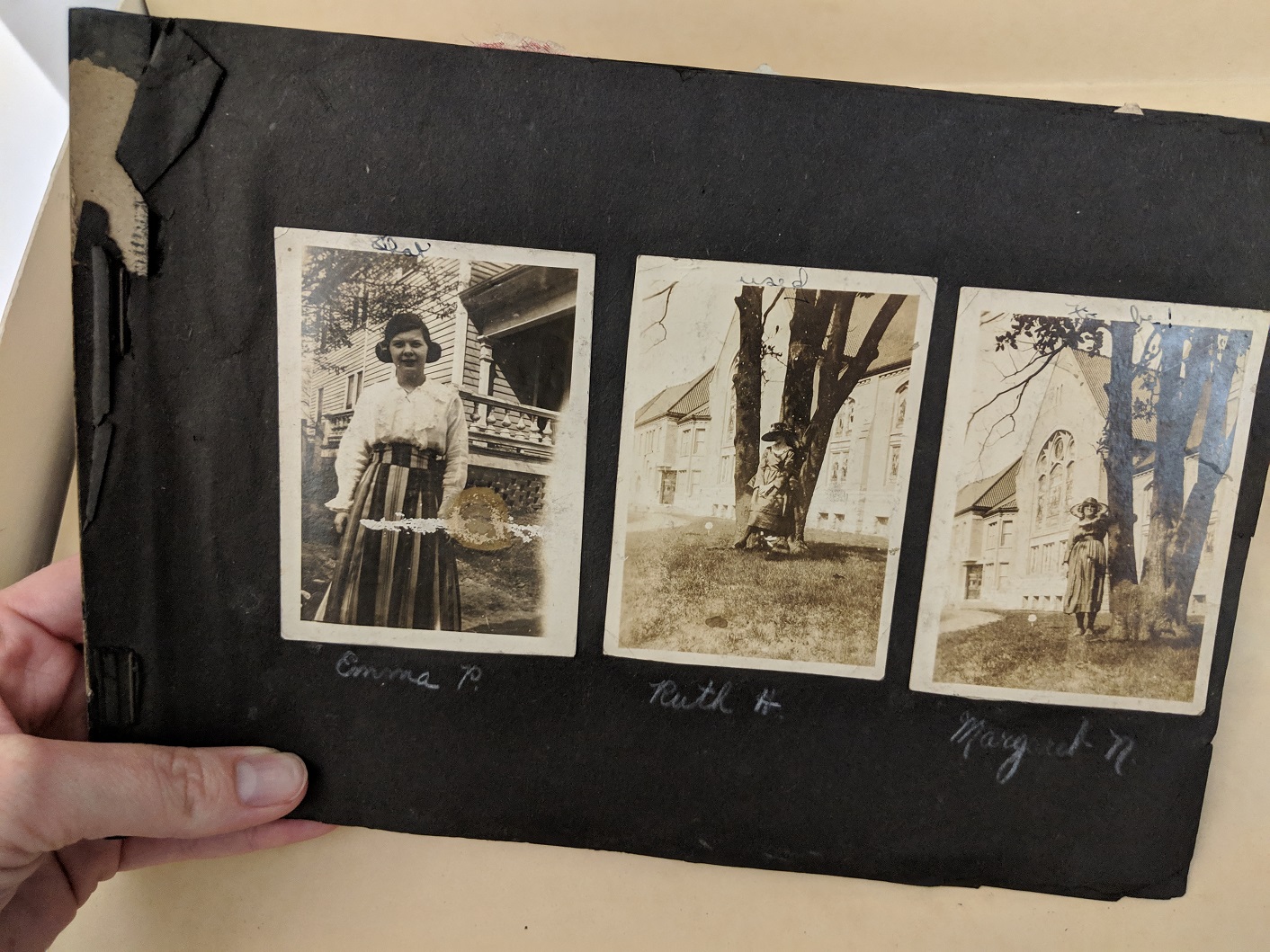
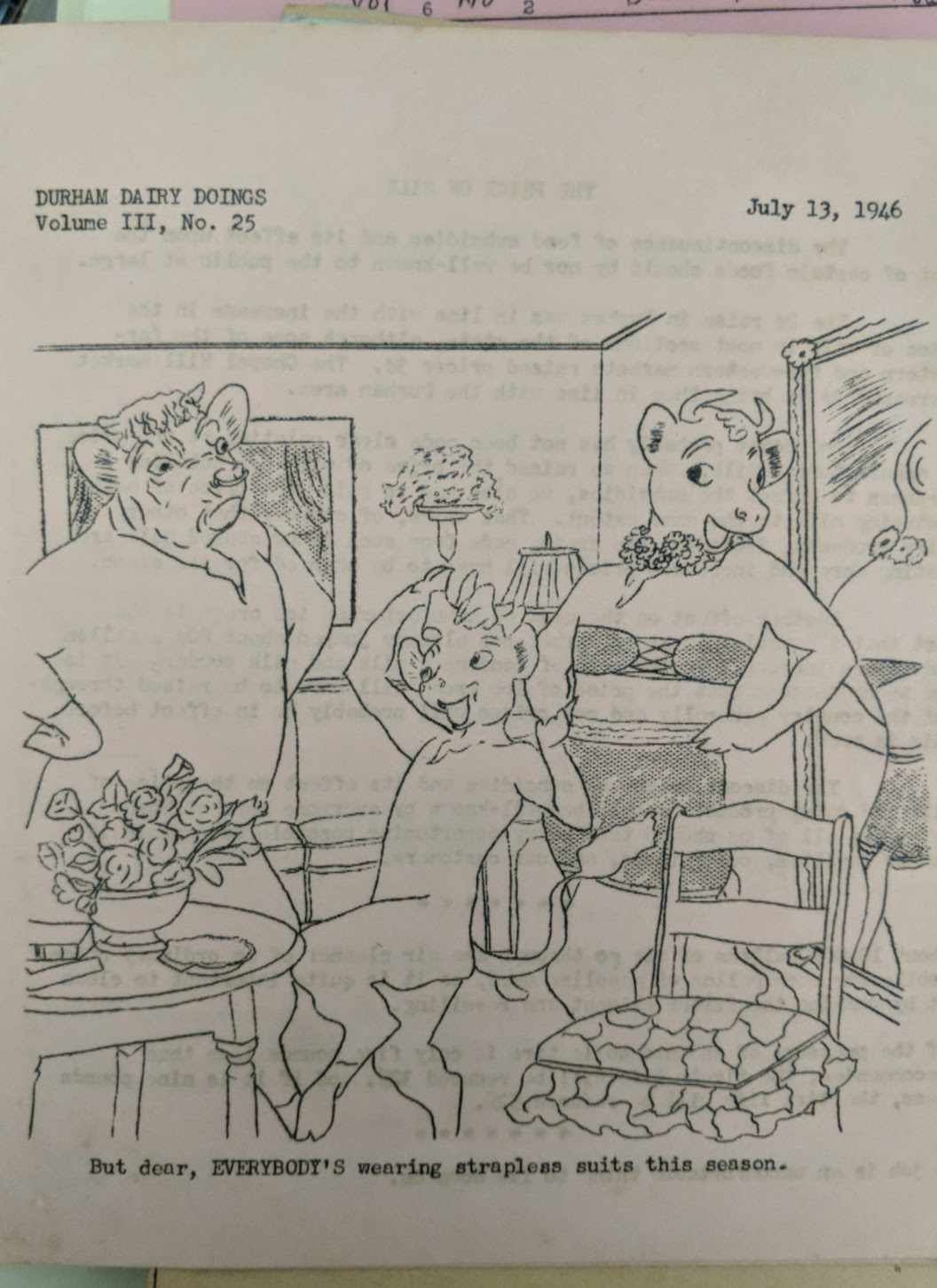
These new records with the details of the W.T. Blackwell and Co. business operations would be exciting enough, but the rest of the addition is fascinating too. In fact, the nature of the collection has changed so significantly that we have opted to rename the collection to be the William T. Blackwell Family Papers. This better reflects the range of the materials now held – in addition to William T. Blackwell’s business materials, there is now correspondence, receipts, invoices, and other documentation of the daily life of the Blackwells, both W. T. and Emma Exum Blackwell, whom he married in 1877. W.T. Blackwell’s sister, Lavinia Blackwell, later married J.D. Pridgen, who owned a shoe company in Durham and whose daughters attended Durham High School in the early 1900s. Their scrapbooks, which include snapshots and printed ephemera from their social activities and education in local Durham schools, have amusing, endearing captions. Mary Blackwell Pridgen, one of the daughters, kept scrapbooking as an adult, and her later marriage to Chester B. Martin explains the inclusion of Martin family materials in this collection as well. In 1927, Chester B. Martin co-founded and operated Durham Dairy Products, Inc., which was Durham’s first milk delivery service. Materials from Durham Dairy include a nearly-complete run of company newsletters – Durham Dairy Doings – with great hand-drawn cartoons, profiles of staff and workers, local Durham news, and insights into the company’s marketing and delivery of milk. The multi-generational aspect of this collection has been challenging but fun to sort out – especially since it is all Durham history, and not just about tobacco (or banks!) anymore.
Following are images of some of my favorite items from the collection. See the newly published collection guide to explore further.
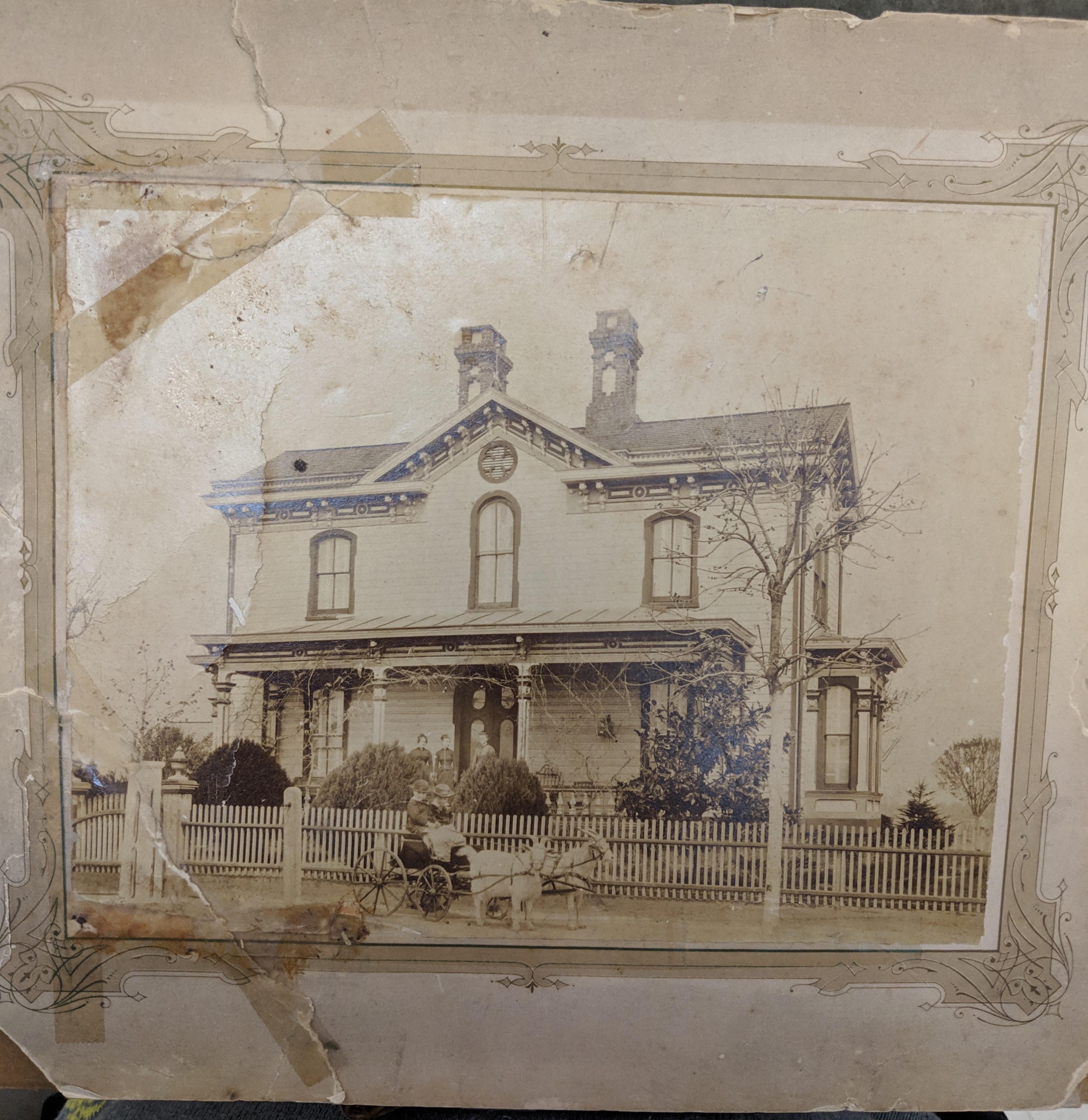
An original (but damaged) mounted photograph of the William T. and Emma Blackwell home, once located at Chapel Hill and Duke Streets, Durham. This is now the site of the Duke Memorial United Methodist Church. There is additional information about this site on OpenDurham.org.
An empty 19th century Durham tobacco pouch, featuring smoking animals.
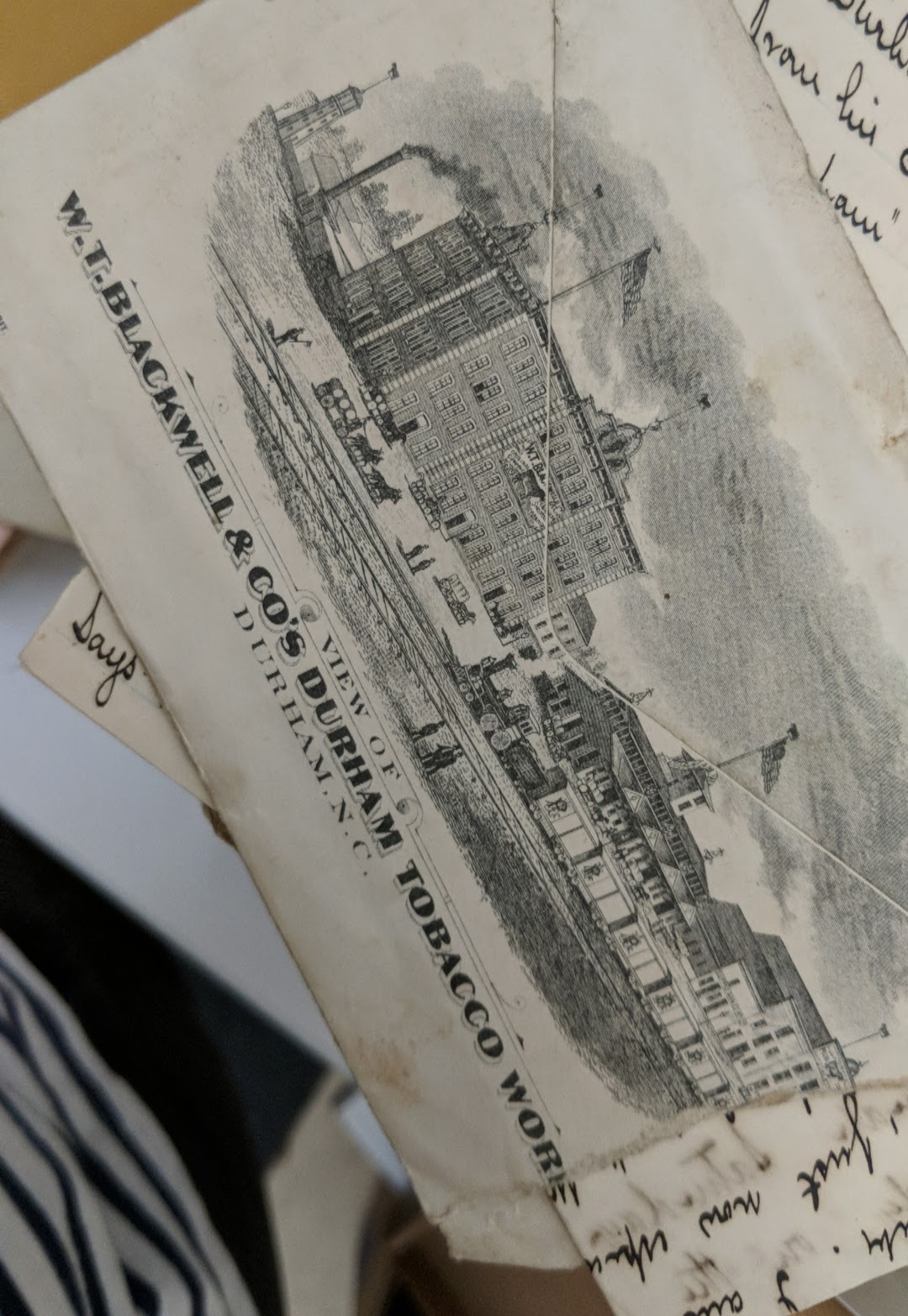
W.T. Blackwell & Co. had amazing stationary. This is the back of one of the company’s envelopes.
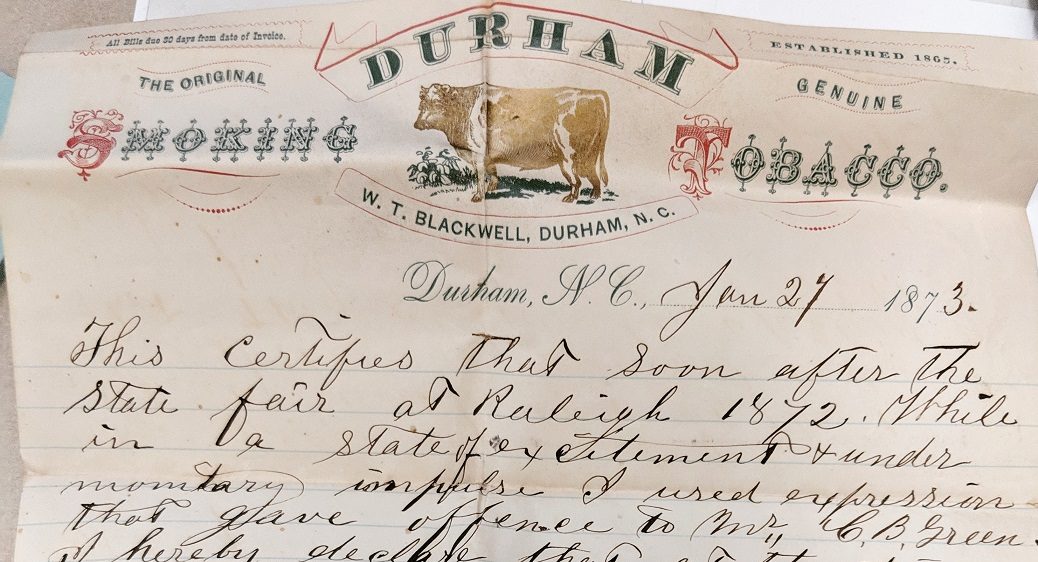
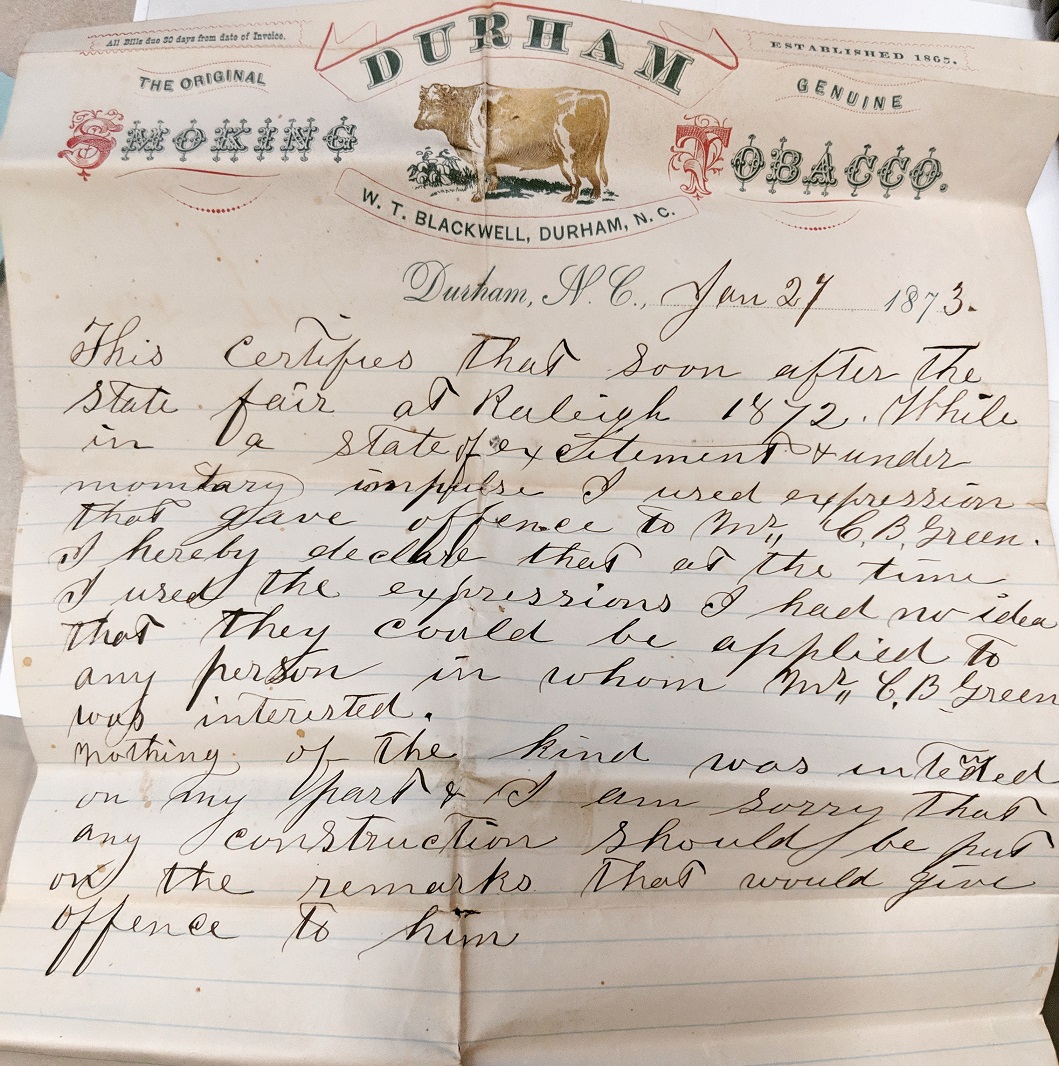
More W.T. Blackwell & Company letterhead can be seen on this statement where William T. Blackwell formally apologizes for offending Mr. C.B. Green during the Raleigh State Fair in 1872.
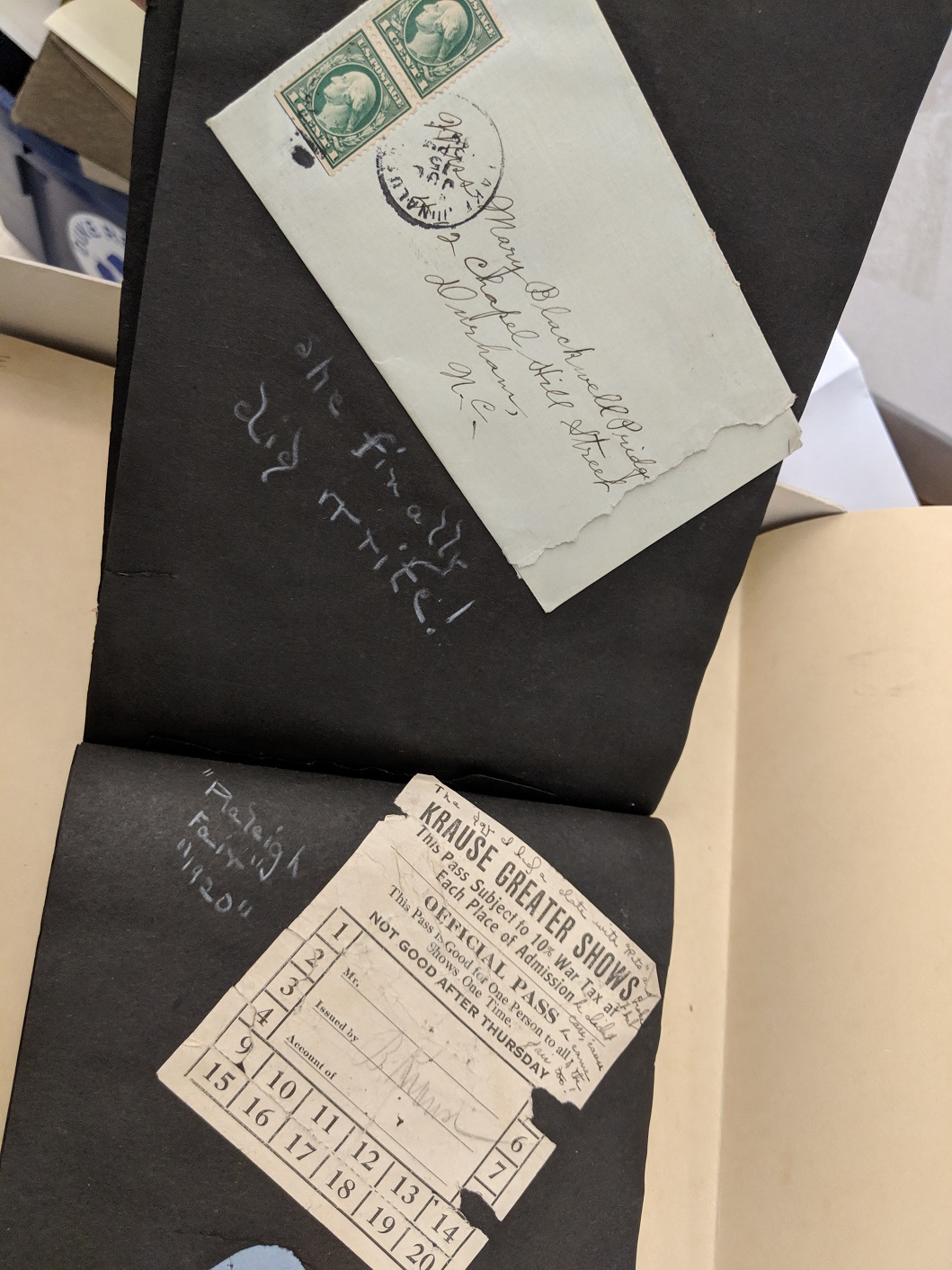
Two pages from Mary Blackwell Pridgen’s scrapbook; one includes a ticket to the 1920 Raleigh Fair, which was hopefully less scandalous than the 1872 Fair.
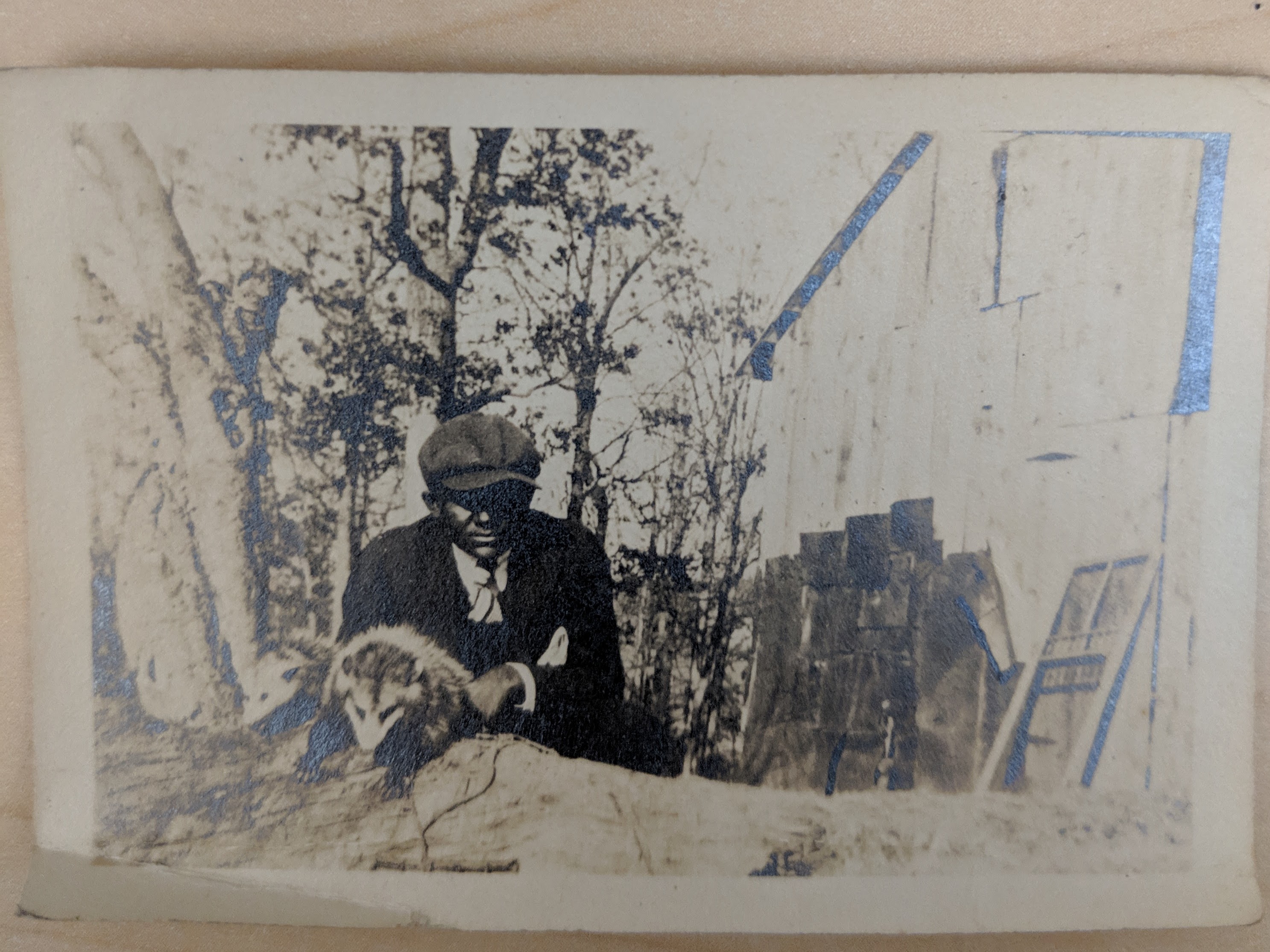
An (unfortunately) uncaptioned loose snapshot of a man and two possums.
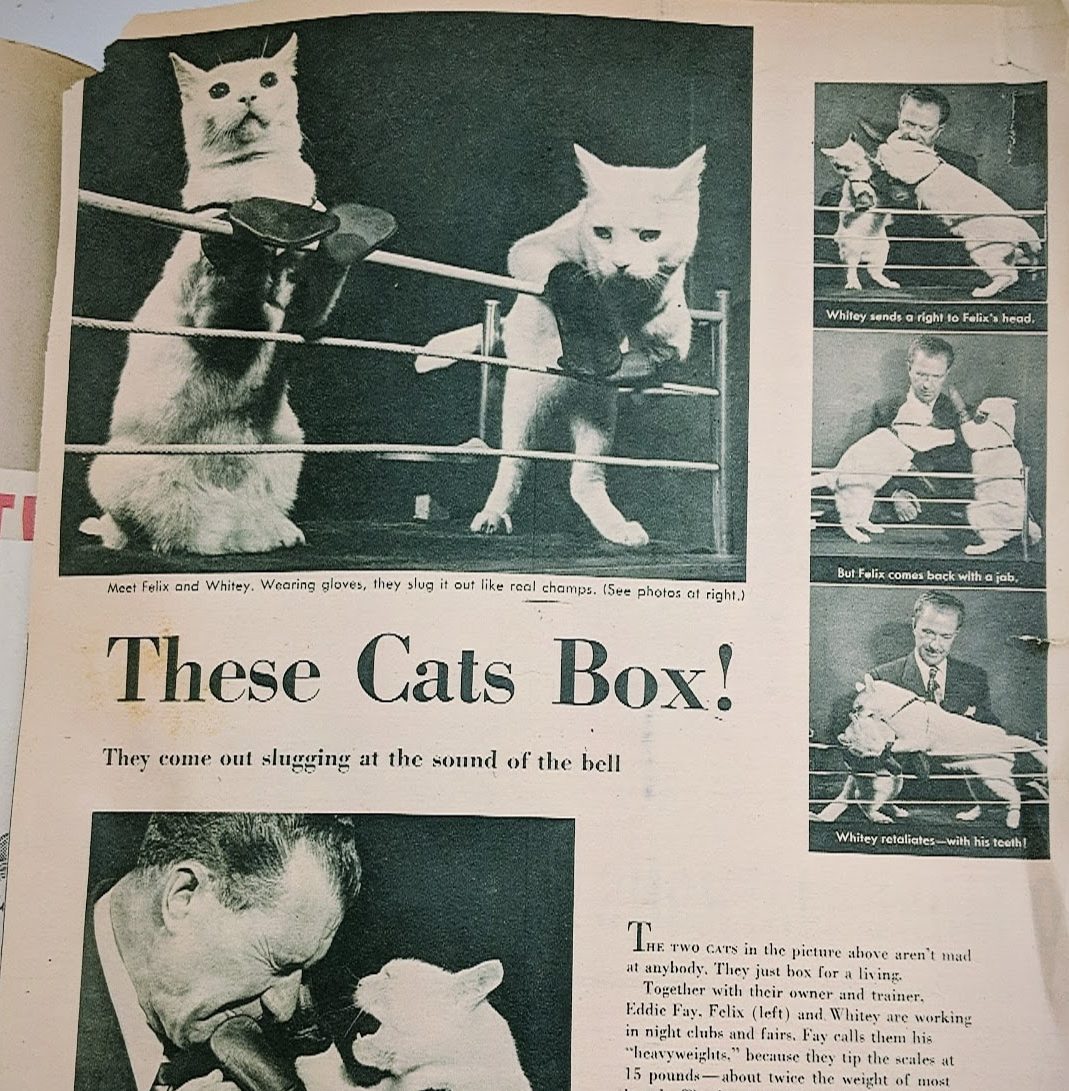
A scrapbook page from Mrs. C. B. Martin, dating from the 1960s, with an article about boxing cats.
A cover from a 1946 issue of Durham Dairy Doings, published by Durham Dairy Products, Inc. These serials are being cataloged separately as a new title in Rubenstein Library.
Post contributed by David Dulceany, Marshall T. Meyer Human Rights Intern and PhD candidate in Romance Studies
El Pueblo Inc. is a Triangle area Latinx organization based in Raleigh, NC. They strive for the local Latinx community “to achieve positive social change by building consciousness, capacity, and community action.” [1] El Pueblo Inc. has been involved in policy change by lobbying state and national politicians and pushing for legislation that benefits the Latinx community, raising health awareness, and especially, spearheading public safety campaigns. For example, in past campaigns, they have focused on reducing drunk driving and encouraging the proper use of child car seats. The organization also specifically focuses on youth issues and youth leadership. They have a separate Youth Program division tasked with running programs for Latino youth that are youth-led. One example is Pueblo Power, a social justice and community-organizing program.
La Fiesta del Pueblo is the organization’s major annual cultural event and it was also the founding event of the organization. [2] La Fiesta del Pueblo features live music, food, arts, and information booths. The event, as well as El Pueblo Inc. itself, has grown exponentially since its inception in 1994. Over the past 25 years, the event has gone from just a few tents and booths to a massive cultural festival spanning several blocks of Downtown Raleigh and boasting tens of thousands of attendees.
A promotional logo for La Fiesta del Pueblo, 2004. From the El Pueblo Inc. Records, 1994-2018, Digital-materials RL11105-SET-0012.
North Carolina, similarly, has seen a tremendous growth in its Latinx population since El Pueblo’s founding. The Latinx population of North Carolina grew by 943% from 1990 to 2010 and it continues to grow: on average, 25% per county from 2010 to 2017. [3] [4] North Carolina now has the 11th largest Latinx population in the United States. [3] Naturally, El Pueblo expanded to meet the needs of the growing community and developed a wide array of programs and campaigns as a result.
I felt an immediate affinity for the material in the archive because of my studies and previous work with Latinx communities and with Latinx literature, art, and culture. As a doctoral candidate in Spanish and Latin American studies, I have had the opportunity both as a student and an instructor to engage in experiential and service learning projects with a number of Latinx organizations. I admired seeing how El Pueblo tirelessly fought for the promotion of Latinx culture and the rights of Latinx workers, students, and families in the state.
One joy of working on an archive containing records from recent history is the ability to directly connect to the ongoing development and work of the organization. For example, I attended La Fiesta del Pueblo 2018 and saw firsthand the successful growth of the event, especially comparing it in my mind to the many old photographs of the early years. Through this experience, I had a more intimate and direct sense of the archival material, being able to engage with it in the present.
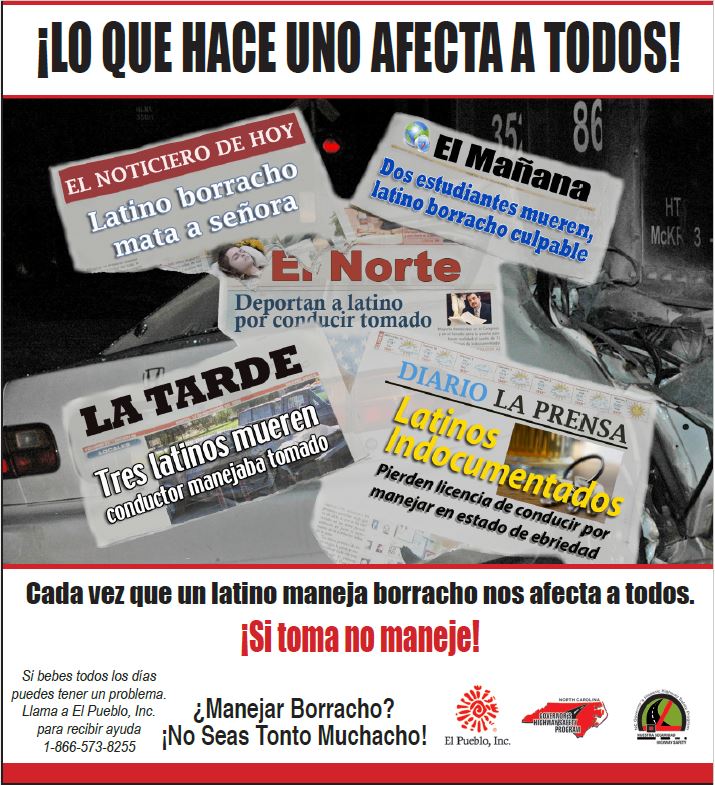
One example of an interesting item from the collection is the Public Service Announcement ads created by El Pueblo as part of their Nuestra Seguridad Public Safety campaign, a collaboration with the NC government. These ads were the direct response to the rise in DWI incidents among the Latinx population and the resultant xenophobic and racist backlash from concerned citizens and local government officials. Their message is clear, one person’s bad judgment or mistake affects the whole community and closes doors to everyone. The aggressive tone of the ads is strongly expressed in its rhyming slogan in Spanish “¿Manejar borracho? ¡No seas tonto muchacho!” or “Driving drunk? Don’t be dumb, man!”. I find these ads fascinating because they show the success of mobilizing a community to create change, to both increase Public Safety and defend against discrimination.
Newspaper ads from the Nuestra Seguridad campaign. El Pueblo Inc. Records, 1994-2018 Digital-materials RL11105-SET-0015.Newspaper ads from the Nuestra Seguridad campaign. El Pueblo Inc. Recods, 1994-2018, Digital-materials RL11105-SET-0015.
I believe that this collection would be of interest to any artists, educators, researchers, students, activists, or non-profit workers that want to learn more about the history of the Latinx population in North Carolina and Latinx culture, non-profit organizations in North Carolina, Youth leadership, and the debate on immigration reform post 9/11. The breadth of audiovisual material could also be used in exhibits or as part of book projects.
In our current context of rising anti-immigrant sentiment and policy, El Pueblo Inc.’s ongoing work is ever more relevant and needed. [5] [6] Their records offer a look into the recent history of the state and how the organization has impacted and strengthened Latinx communities in North Carolina.