Category Archives: Manuscripts

A Tale of Two Archives; or, The Persistence of ‘Girl Land’

Anyone reading this blog knows that archives are full of wonderfully weird ephemera just waiting to be discovered and discussed, of conversations waiting to happen. This is the story of two archives that, it turns out, have a lot to talk about.

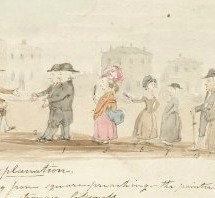
The John Rylands University Library at the University of Manchester has had this drawing on its webpage for some time:

Sunday evening in St. Jame's, Barton
“Sunday evening in St. James’s, Barton,” from the John Rylands University Library

Ostensibly, this is a doodle, maybe an early comic. It depicts an ordinary meeting between preachers and parishioners. Only one thing stands out: the stocky girl just off the center dressed in bright pink and orange, while everyone around her wears drab brown. Look closer and you see that she her awkwardness is not limited to her dress: oblivious to the women gossiping behind her, our young heroine “stands, patiently, while her papa shakes hands with all the colliers, not knowing but she must do so too – a perfect pattern!  Dear lady!” This oblivious fool is also the artist.

Cut to our own archive: Two summers ago, I was working in the Frank Baker Collection of Wesleyana and British Methodism when I came upon some poems. Having cataloged plenty of manuscript materials within the collection, I wouldn’t have thought much of them, except I noticed that they were tied together with string. Fanciful English student that I am, I recalled that Emily Dickinson’s manuscripts had been likewise fashioned together, and so began my grandiose visions: had I stumbled upon the British Emily? Could these poems help to reinvigorate the field of 18th-century women’s poetry – revolutionize it, even? It’s the fantasy held dear by every budding academic: to discover the next Milton or Frost, to shake the scholarly world to its core. Needless to say, literary scholarship remains unshaken, but it does have a new name on its register: Sarah Wesley.

The poems I found were written by our pink-and-orange artiste, the daughter of Charles Wesley, a co-founder of British Methodism. What is so fascinating about Sarah Wesley is her outright resistance to the restrictive practices of her every-day life – and how, perhaps as a result of that resistance, she has since all but disappeared from most histories of British Methodism.
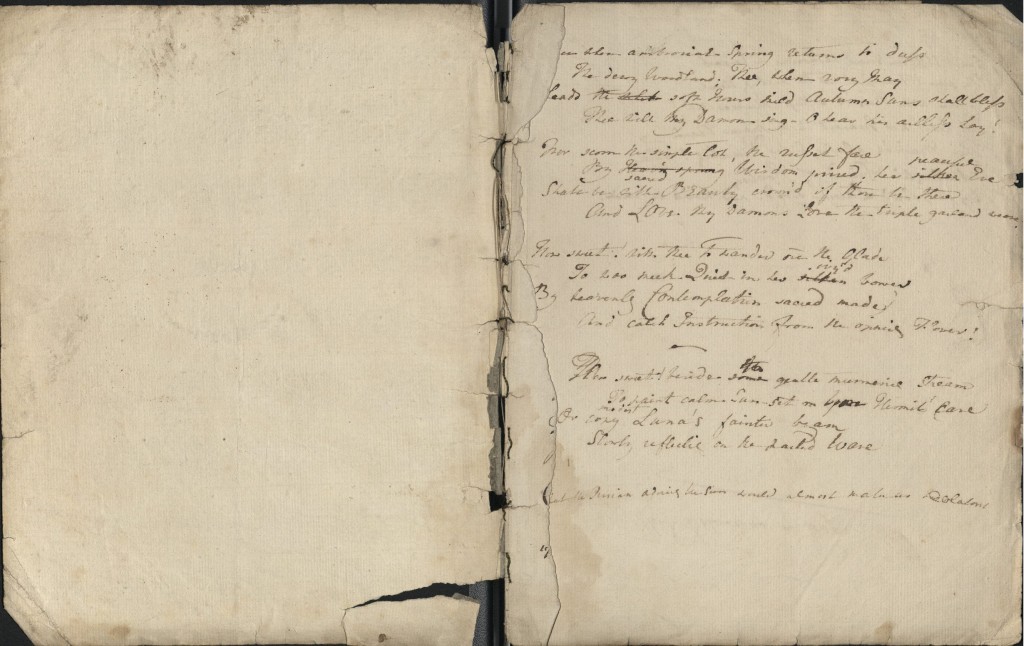
SW_bound manuscript
Bound manuscript with Sarah Wesley’s writings in the Frank Baker Collection.

Her poetry in particular served as an outlet for questioning her father’s religion, as well as engaging with emergent conversations about the rights of women. Even while Wesley’s social commitments were progressive, she remained a devout Methodist throughout her life. But through her writing, most of which she kept hidden away from the judgmental eyes of her community, Wesley takes us to a place we don’t often think of when we read the eighteenth century: the private mind of the teenage girl.

Caitlin Flanagan’s recent book Girl Land (Little, Brown and Co., 2012) makes a compelling case for the fundamental significance of a particular marker of female adolescence: that time when a girl recedes into her room for a few years and emerges a brooding melodramatic for a few more. Flanagan posits that as a society, we take too lightly “a girl’s sudden need to withdraw from the world for a while and inhabit a secret emotional life” (1). But in fact, this is time and space that young girls need in order to come to terms with the world and their place within it. And so, Flanagan urges us to celebrate, rather than denigrate, the importance of this space she calls “girl land.”

Flanagan’s study is predicated on a particular reading of the history of the teenager. But even before “adolescence” became a discrete intellectual category in the twentieth century, Sarah Wesley was, in many ways, a typically modern teenage girl.

She wrote poetry that was evocative, romantic, and highly self-reflexive:

The Pilot Reason stays on Shore,
The boisr’ous Passions more,
Youth is the Ship and Hope the Oar,
And O! the Sea is Love!

~from “Sonnet,” 1770

In particular, much of her work is preoccupied with exploring her budding sexuality:

Her Eyes enraptur’d shall your Beauties own
Her snowy Fingers be your Virgin Lone!
Her Lips shall bid Thee with a sigh Adieu!
Her Lips shall greet Thee with ambrosial Dew!
Descending showers shall fall from Heaven to gaze!
Within your silken Folds shall Graces lie
And panting Zephryss on your Bosom die!
The Muse shall stamp Thee with Idalia’s Crest,
And Venus court Thee to adorn her Breast.

~from “On receiving a Nosegay,” n.d.

However, she was not without some snark when it came to matters of romance:

Both Truth and Malice on one point agree
That my outside is the worst part of me
Small is the censure, whilst it stands confest
Bad as it is, thy outside is the Best!

~“Epigram: on receiving a rude Speech from a Crooked Gentleman,” 1777
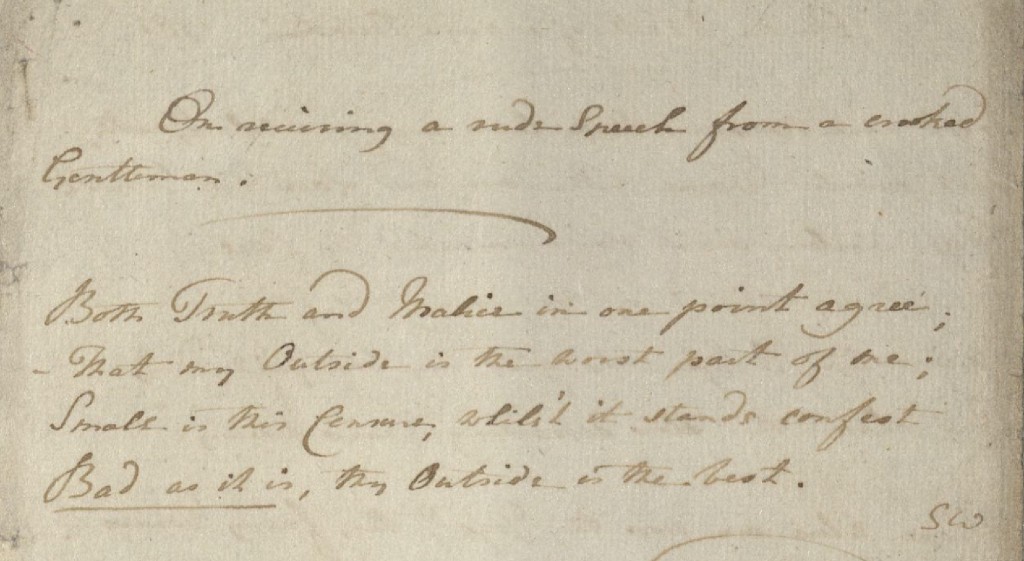
SW_rude speech

As we saw in the drawing from the Manchester archive, she held some anxiety over her appearance and the perceptions of others.

And in perhaps the defining feature of “girl land,” she was adamant about challenging the values she inherited from her family in order to come to her own understanding of her world (for more on the particulars of Wesley’s intellectual rebellion, see my essay in the Winter 2013 volume of Eighteenth-Century Studies, which expounds on her feminist and abolitionist interests).
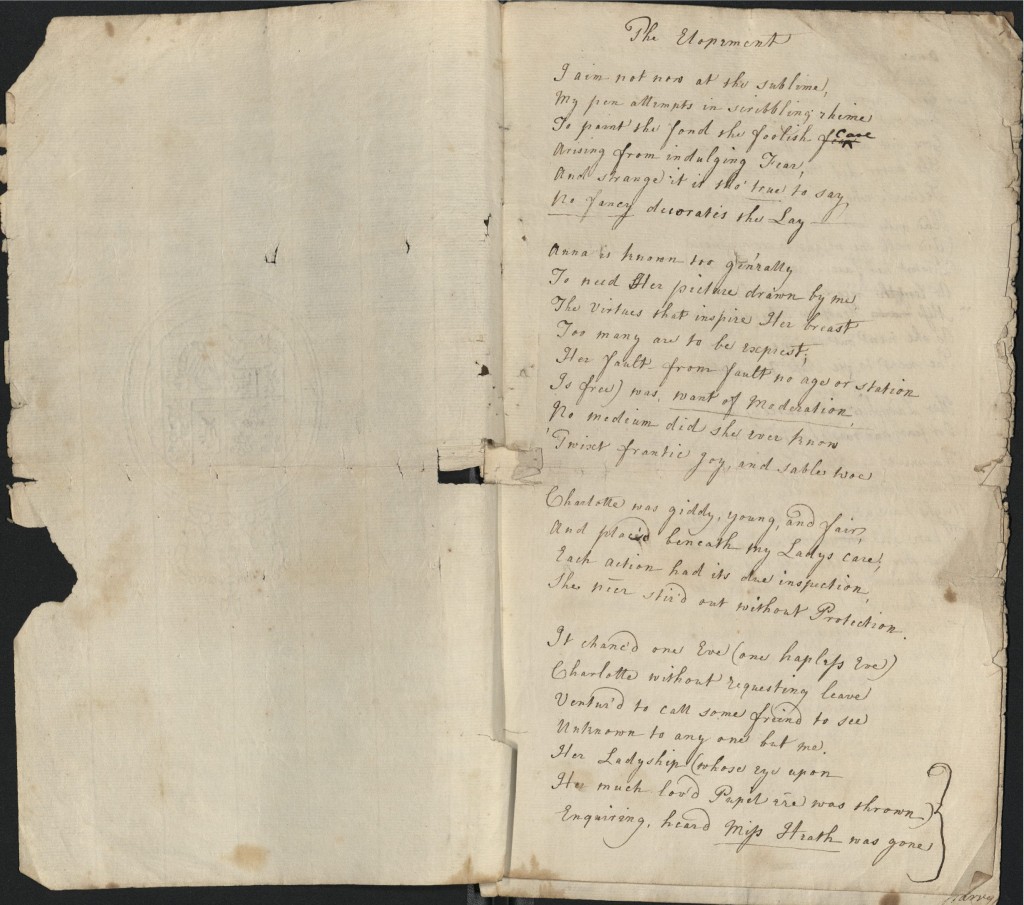
SW_elopement
“The Elopement” figures prominently in Koretsky’s article, “Sarah Wesley, British Methodism, and the Feminist Question, Again,” Eighteenth-Century Studies 46.2 (Winter 2013), pages 223-237.

So did my work in the Frank Baker Collection yield the next Emily Dickinson? Not exactly. At the level of versification, Wesley’s poetry is derivative at best. But in the connections she asks us to draw between religion and the secular discourses of the key social issues at the end of the eighteenth century, Wesley’s voice raises many productive questions, which I hope eighteenth-century scholars will continue to engage. And further still, the familiar tenor of her poetry demonstrates the persistence of “girl land,” and how productive that sometimes alien-seeming place can be.

Post contributed by Deanna Koretsky, a Ph.D. candidate in the Duke English Dept. and a graduate student assistant in Technical Services.
Down the Rabbit Hole with a Book about Popes

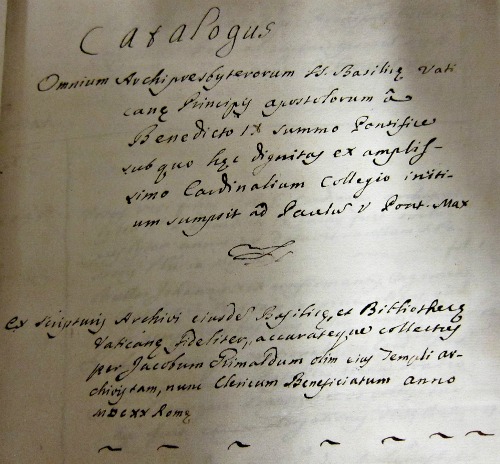
Vatican history is not something the Rubenstein Library actively collects, but it is always fun to discover how our materials relate to current events, like the election of a new pope. Over lunch one day last week, several of us archivists began wondering what sort of collections we have related to popes. A quick search in our catalog uncovered this volume, the Basilica di San Pietro in Vaticano Records, which is described as “Copies of records in Latin and Italian, including the catalogue of all archpriests of the Vatican Basilica of St. Peter from Pope Benedict (1032-1045) to Pope Paul V (1605-1621); the succession of canons in the Vatican Basilica of St. Peter; and decrees of the council for propagating the faith.”

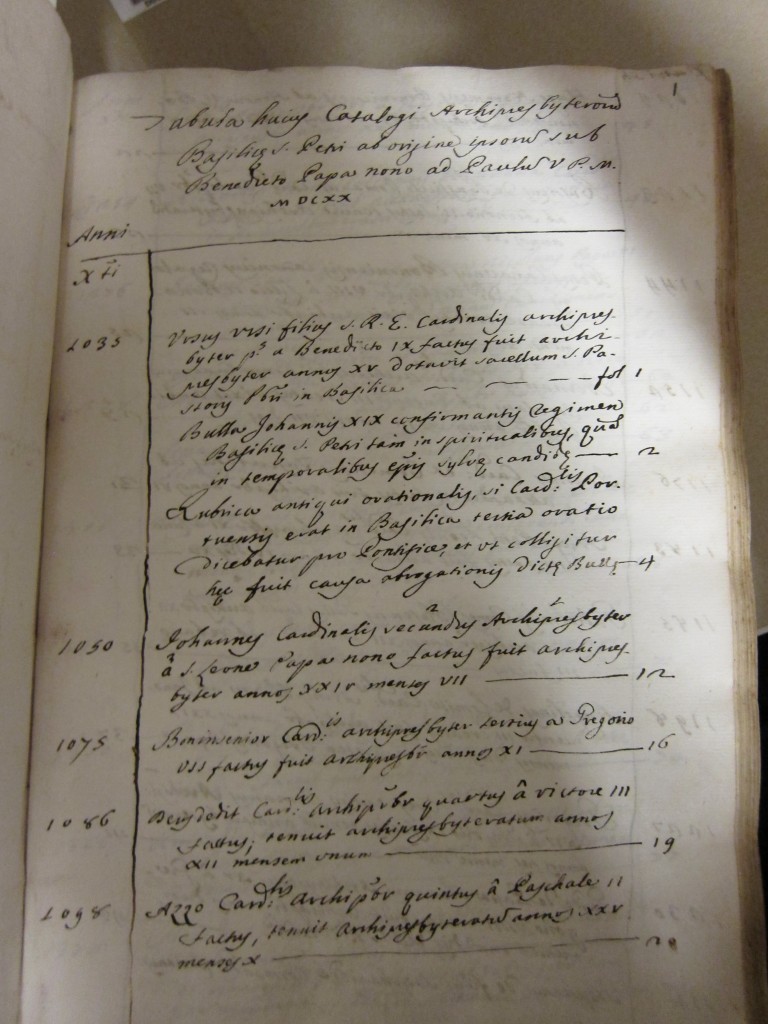
“Copies of records” normally don’t bring a pitter-patter to the archivist’s heart, but the fact that the volume was dated 1620-1751 made it seem worth taking a look. We called back the item from the Library Service Center. It is a hefty vellum-bound tome, about two-thirds blank, interspersed with pages of handwritten Italian and Latin. The first part of the book has a list of popes, beginning in 1035 and ending in 1620. Later entries date from the 18th century, explaining where the 1751 date came from in the original catalog record.IMG_0658

Now that we had the book in hand, we were curious about its origins. Who wrote the book? The spine’s label reads “Miscellan. MS.,” and the date span, different handwriting styles, and numerous blank pages suggest that there are multiple authors within the text. However, the only name we came across (other than various names of popes) was Jacobum Grimaldum, on the first page. The book’s title page appears to say that “From the writings of the archive and the Basilica and from the library of the Vatican, the catalogue[?] was collected by Jacobum Grimaldum, once the archivist of the temple, now a distinguished cleric. 1620 Rome.”

IMG_0661

Research by our rare book cataloger revealed that what at first looked like Jacobum Grimaldum is probably a version of Giacomo Grimaldi (1560-1623), an archivist at the Vatican. Grimaldi authored hundreds of unpublished texts on the history and artwork of the Vatican. His drawings are some of the only evidence remaining of certain tombs, mosaics, and monuments following renovations of St. Peter’s Basilica under Pope Paul V. The more we learned about Grimaldi, the more we liked him. Grimaldi’s research and conservation efforts preserved many of the early church’s altars, tombs, and artwork in the Vatican grottoes, still accessible today.

Although this manuscript is only a part of the larger bound miscellany, circumstantial evidence supports the theory that this part of the book was authored by Grimaldi. For one thing, the content matches Grimaldi’s interests in Vatican history and records. Also, according to Oxford Art Online, Grimaldi was elected notary and archivist of St. Peter’s in 1581 and died in 1623, putting this work’s date of 1620 within his lifespan. Of course, at this point there is no way to know whether what we have at Duke is something written in Grimaldi’s hand, or whether it is just a copy of his work by some random monk. If someone out there is an expert on Grimaldi handwriting, we’d love to hear from you.

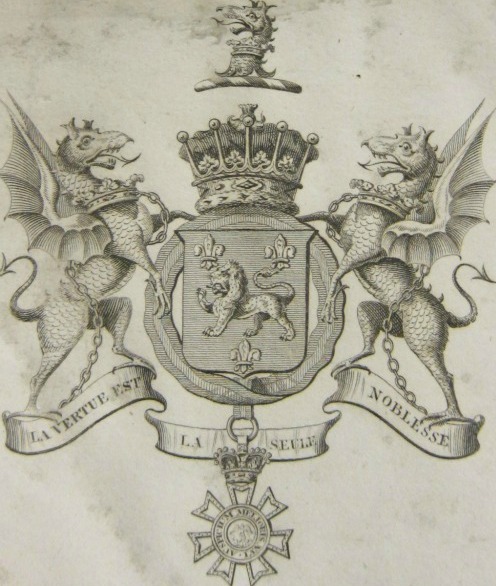
We were also curious about how Duke came to own this miscellany. All we knew about it was that it had been owned by the library for a long time. Our curator of collections checked the records, and found it was purchased from a book dealer in London for $25.00 in the 1950s. Good deal, but a dead end in terms of provenance. We decided to try the bookplate.

IMG_0659

Fortunately, Google helped us here: A search of the motto got lots of hits, all directing to the Earl of Guilford. But which one? This helpful page narrowed it down to Frederick North, 5th Earl of Guilford, by pointing out the medal at the bottom of the bookplate was not established until 1818. Guilford must have owned this volume at some point between 1818 and his death in 1827. Additional searches uncovered the British Library’s Guilford Project, which describes the Library’s attempts to digitize and catalog its holdings of Guilford’s manuscripts. The project website mentions that following his death, Guilford’s vast collection of manuscripts were sold at several auctions, including a “large number of early modern manuscripts relating to Italian history and European diplomacy, with particular emphasis on Venice and the Papacy.” This would explain how this volume of miscellaneous manuscripts came to the market in England, and how Duke eventually acquired it. Furthermore, surely the good Earl of Guilford had the knowledge and expertise to buy an original Grimaldi manuscript, not someone else’s copy. Right?

Post contributed by Meghan Lyon, Technical Services Archivist.

Update: An earlier version of the post led with the phrase that Vatican history is not something Duke actively collects, but that is inaccurate: plenty of Vatican history is available in the Divinity School Library.

New Acquisitions Week, Day Five: Exploring Africa

We’re celebrating the beginning of a new fiscal year with a week’s worth of new acquisitions from the first half of 2012.  Two newly acquired selections have been featured in a post every day this week.  All of these amazing resources are available for today’s scholars, and for future generations of researchers in the Rubenstein Library!

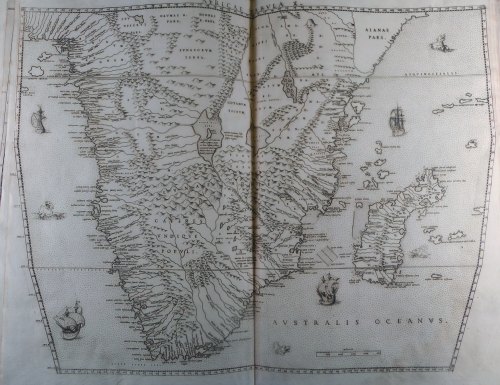
  • Livio Sanuto, Geografia: This work, published in 1588 in Venice, is the first edition of the first printed atlas of Africa.  It contains twelve double-page engraved maps showing the continent; for its date, the maps are surprisingly detailed and accurate, correcting many of the earlier errors in French and German maps.  Nevertheless, Sanuto also kept many preconceived European notions about Africa, and introduced new errors in the text of the atlas, making the work a fascinating case study of European views of Africa in the sixteenth century.  The work is foundational for the study of European depictions of Africa, and will be a cornerstone for African collections in the John Hope Franklin Research Center for African and African-American History and Culture.
Map of southern Africa, from Livio Sanuto, Geografia (1588).
  • Ezekiel Skinner Papers: Ezekiel Skinner (1777-1855) was a missionary and physician who worked in Monrovia, Liberia for the American Colonization Society during the 1830s. Although almost 60 years old, Skinner believed it was his duty to continue the work of his son, Benjamin Rush Skinner (named for the famous physician Benjamin Rush, under whom Ezekiel had studied), who had died in Liberia a few years before. The papers contain correspondence and other documents written by Dr. Skinner during his time in Liberia, including a description of a “slave factory” and other details of the slave trade, and discussion of medical treatment of Liberian colonists, including treatment of a fellow doctor, the African-American Charles Webb.  The Skinner papers enrich the collections of both the John Hope Franklin Research Center and the History of Medicine Collections.

Previous posts:

New Acquisitions Week, Day Three: Calligraphic Devotion and Haitian Rights

We’re celebrating the beginning of a new fiscal year with a week’s worth of new acquisitions from the first half of 2012.  Two newly acquired selections will be featured in a post every day this week.  All of these amazing resources are available for today’s scholars, and for future generations of researchers in the Rubenstein Library!

  •  Kitab Dala’il al-Khairat wa Shawariq al-Anwar fi Dhikr al-Salah ‘ala al-Nabi al-Mukhtar [Guidebook of Benefits and Illuminations of Prayers to the Chosen Prophet].  The Dala’il al-Khairat of al-Jazuli (Al-Jazuli, Abu ‘Abdallah Muhammad ibn Sulaymana, d. 1465) is one of the most popular devotional works in Islam, comprising a cycle of prayers to the prophet Muhammad.  The manuscript now at Duke is Arabic written in the Maghrebi script, and likely was created in North Africa in the late eighteenth or early nineteenth century.  The manuscript also contains other prayers and devotional texts.  Its calligraphy and ornamentation are beautiful witnesses to a text of surpassing importance in the Muslim faith.
Opening from the newly acquired manuscript of the Dala’il al-Khayrat. Arabic in Maghrebi script.
  • National Coalition for Haitian Rights Records: This organization is dedicated to furthering the civil and international human rights of the Haitian community in the US and helping influence US policy over Haiti to support human rights.  In over 146 linear feet of material, the records document the activity of the Coalition from 1981 to 2003.  This adds to a growing collection of material in the Human Rights Archive related to human rights in Haiti; see the Human Rights Archive’s LibGuide for more information on other collections related to human rights in Latin America.

Previous posts:


A Thoroughly Forgotten Duke Figure

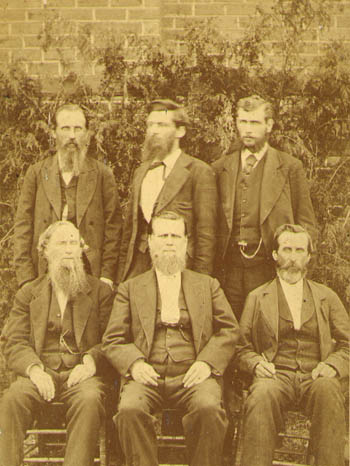
Trinity College Faculty, 1878-1879
Trinity College faculty for the 1878-1879 academic year. Lemuel Johnson is seated to the right of President Braxton Craven.

LEMUEL JOHNSON (15 January 1828 – 29 April 1900) taught for more than thirty years the entire mathematics curriculum at Trinity College when it was a fledgling institution located in Randolph County, North Carolina.

Though there is no present building or other monument to his name at Duke, the Rubenstein Library holds in various collections a small memorial to this pioneer faculty member in the form of four manuscript letters, a mathematics primer that was widely distributed during the Civil War era, a carte de visite of him and another of the Trinity faculty of the late 1870s, and an 1887 map of Durham County printed from his own manuscript map, the first published presentation of the bounds of this county after its formation in 1881 from sections of Orange, Wake, and Granville.

He was the second graduate of Normal College, Trinity’s predecessor, when it was a very humble institution situated in a rural, red clay, Quaker-Methodist corner of the Carolina piedmont. There, beginning in 1852, he taught courses in arithmetic, mensuration, algebra, geometry, trigonometry, and calculus as well as performing the duties of college treasurer, librarian, and first president of the Trinity College alumni association.

Among his most memorable achievements as an educator was his tutoring of the gifted Giles sisters, every evening in his parlor after a full day of classroom teaching. Mary Z. Giles, Persis P. Giles, and Theresa Giles were graduated with the Trinity class of 1878 (although segregated into a “Ladies” column with less than full membership), an event that the Wilmington Morning Star reported as “unprecedented in the history of North Carolina colleges.” Indeed, the celebrated Sallie Walker Stockard, early historian of Alamance county and first female matriculate at the University of North Carolina, received her diploma in Chapel Hill in 1898.

In the last years of his life, Professor Johnson supported himself through hard times by teaching in rural high schools and by working intermittently as a civil engineer, and his maps of Randolph and Davidson counties are available online via the NC Maps site.

Post contributed by David Southern, Rubenstein Library researcher and Managing Editor for the Collected Letters of Thomas and Jane Welsh Carlyle at the Duke University Press.

Digitizing the LCRM: Update #2

We’re going to start our second update on Duke’s participation in the CCC Project with exciting news: the first three CCC-digitized collections are now available online!  You can now find digitized content directly through each collection’s finding aid.  Take a minute and check out the digitized portions of the Basil Lee Whitener Papers, the Rencher Nicholas Harris Papers, and the Women-in-Action for the Prevention of Violence and Its Causes Records.

This month, we feature an item from the Basil Lee Whitener Papers. Whitener was a Democratic Congressman representing Mecklenburg County (N.C.) from 1957 through 1968. Like many other Democrats from the South (who collectively became known as “Dixiecrats”), Whitener was a vehement opponent of integration and any federal action intended to address civil rights issues.

His papers contain a great deal of correspondence, speeches, bills, and other materials that reflect both the views of constituents regarding civil rights and how he acted in the House of Representatives to try to derail reform-minded legislation.

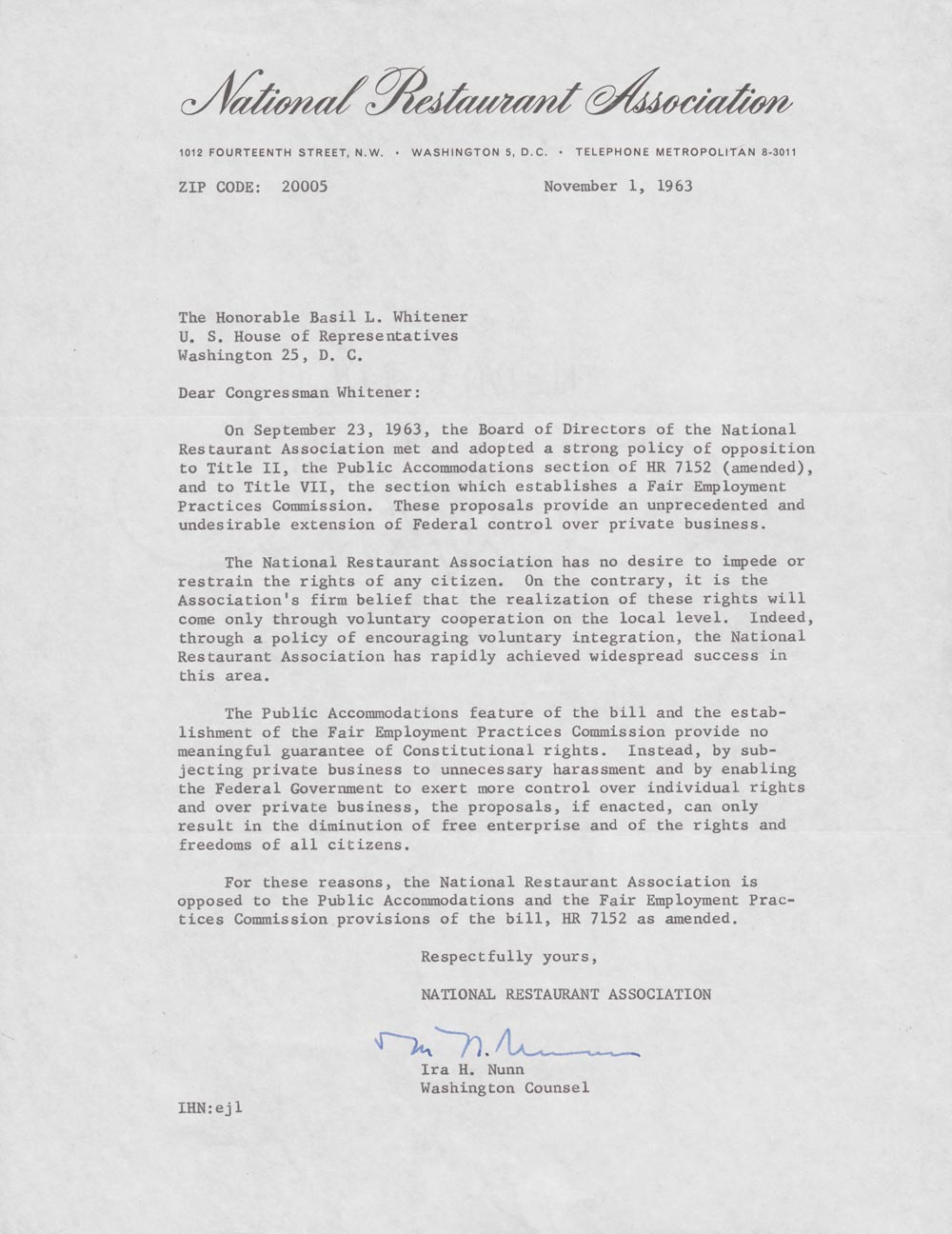
Whitener’s opposition was firm, but such groups as the NAACP and the North Carolina Baptist Student Union sent telegrams and letters to the Congressman arguing for strong civil rights legislation. Knowing that these efforts fell on deaf ears, who then actually lobbied against civil rights legislation? The answer is the NRA . . . but not that NRA. The organization in question is the National Restaurant Association; the letter that their representative Ira Nunn sent to Whitener in opposition to what would become the Civil Rights Act of 1964 is presented below.

Letter, Ira H. Nunn of the National Restaurant Association to Basil Lee Whitener, November 1, 1963. From the Basil Lee Whitener Papers. (Click to enlarge.)

The given reason for the NRA’s opposition to H.R. 7152 was that its proposals “can only result in the diminution of free enterprise and of the rights and freedoms of all citizens.” Decode this political jargon and you will see that the NRA disapproved of the proposed ability of the federal government to mandate the integration of all public dining spaces.

Instead, the NRA offered the solution of voluntary integration. In his letter, Nunn claimed that voluntary integration had been a “widespread success.” While Nunn’s claim was literally true insofar as a certain percentage of restaurant owners had chosen to integrate their establishments voluntarily, the spirit of the argument is false. Restaurateurs were not en masse choosing to integrate their establishments, especially in the South. For example, only forty percent of businesses in Greensboro were integrated by the end of 1963. Nationally, out of a possible 60,000 districts where mandated integration could have existed, only 1,000 had integrated facilities. It is understandable that Nunn would like to present his industry as reform-minded while preserving laissez-faire standards, but the historical reality does not corroborate his argument.

Why would Nunn and restaurateurs more broadly oppose civil rights reform? While a culture of segregation may have contributed to the NRA’s opposition, it is much more likely that members of the NRA feared the potential loss of business that forced integration would entail, especially in the South. Therefore, at its core, the NRA’s argument against integration was primarily economic rather than cultural or social, making it stand out from most anti-integration documentation from the early 1960s. Furthermore, in an ironic twist given Whitener’s role as a representative of North Carolina, it is probable that the NRA’s economic argument was in part inspired by the events of the 1960 Greensboro Sit-In and subsequent protests across the South. In fact, such protests provided strong evidence of the social role of restaurants and the necessity for integrating their dining counters, even if the members NRA could only see the possibility of losing customers and profit.

The grant-funded CCC Project is designed to digitize selected manuscripts and photographs relating to the long civil rights movement. For more information on this project, including updates on the progress of digitization, please check out the CCC website. As part of the outreach efforts of the CCC Project, monthly blog posts to The Devil’s Tale will provide updates on the latest Rubenstein Library collections to be digitized for the project. Stay tuned!

Post contributed by Josh Hager, CCC Graduate Assistant.

In the Lab: Housing Papyri and Early Manuscripts

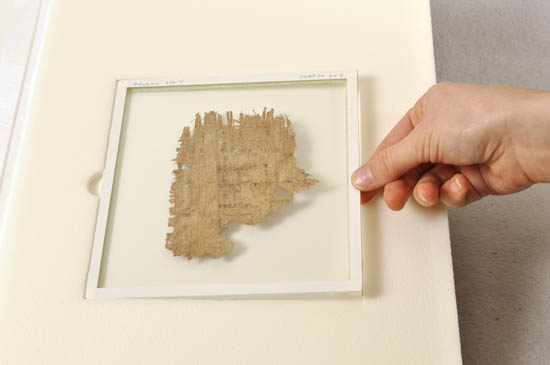
Two big rehousing projects have been underway in the conservation lab for several months now.  One, the papyrus project, has been mentioned in the conservation department’s own blog, Preservation Underground.

Duke’s papyri collection is one of the largest in the country with approximately 1400 items, each housed between sheets of glass.  Until now, those glass “sandwiches” have been loosely stored in boxes.  The conservation team is now making individual folders for them, made of mat board and padded with Volara (polyethylene foam), each clearly labeled for safer, easier access.

Once a month, everyone in the department joins in to make hundreds of these customized folders which will go into storage boxes to return to the stacks.  Such a big project is a logistical challenge, necessitating lists, spreadsheets, careful documentation, and also cooperation.  As a department, we are becoming a well-oiled papyrus-housing machine.

Papyri housings, before and after
Papyrus item in its new folder

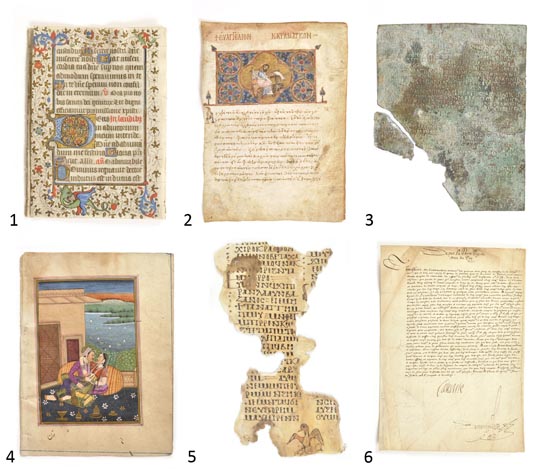
A similar logistical challenge has been the early manuscript housing project, of which the papyrus collection is a subset.  As well as books, the collection includes a wide variety of loose materials, from ancient Roman metal tablets, Ethiopic scrolls, pages from Greek Bibles, papal bulls, and oversized sheets from choral books.

Like the papyri, many of these flat items can go in our own customized mat board folders with either a paper pocket or a clear polyester sleeve.  But items that are oversized, three-dimensional, or particularly fragile have required special solutions.  Some examples can be seen below!

Group of Early Manuscripts
1. Breviary, French 15th century 2. Gospel of Mark, Greek 14th century 3. Roman diploma on bronze, A.D. 209 4. Persian illuminated manuscript page 5. Coptic homily, Egypt 6. Catherine de Medici letter
Housings for Early Manuscripts
Examples of housings for early manuscripts

Post contributed by Grace White, Conservator for Special Collections, as part of our ongoing “In the Conservation Lab” series.


Peeking at Paris in 1841: The Private Journal of Thomas R. Spencer

There’s something satisfying about reading a journal, and I don’t think it has much to do with the fact that a lot of journals try to discourage readers from exploring their contents, either. Instead, what I think appeals to me about journals is the familiar and candid tone of an author writing to him or herself. It’s thrilling to feel like the secret confidante of someone whom you’ve never met. There’s a lot of honesty in a journal, and that honesty transcends time to resonate with people totally outside of the context of the author’s life.

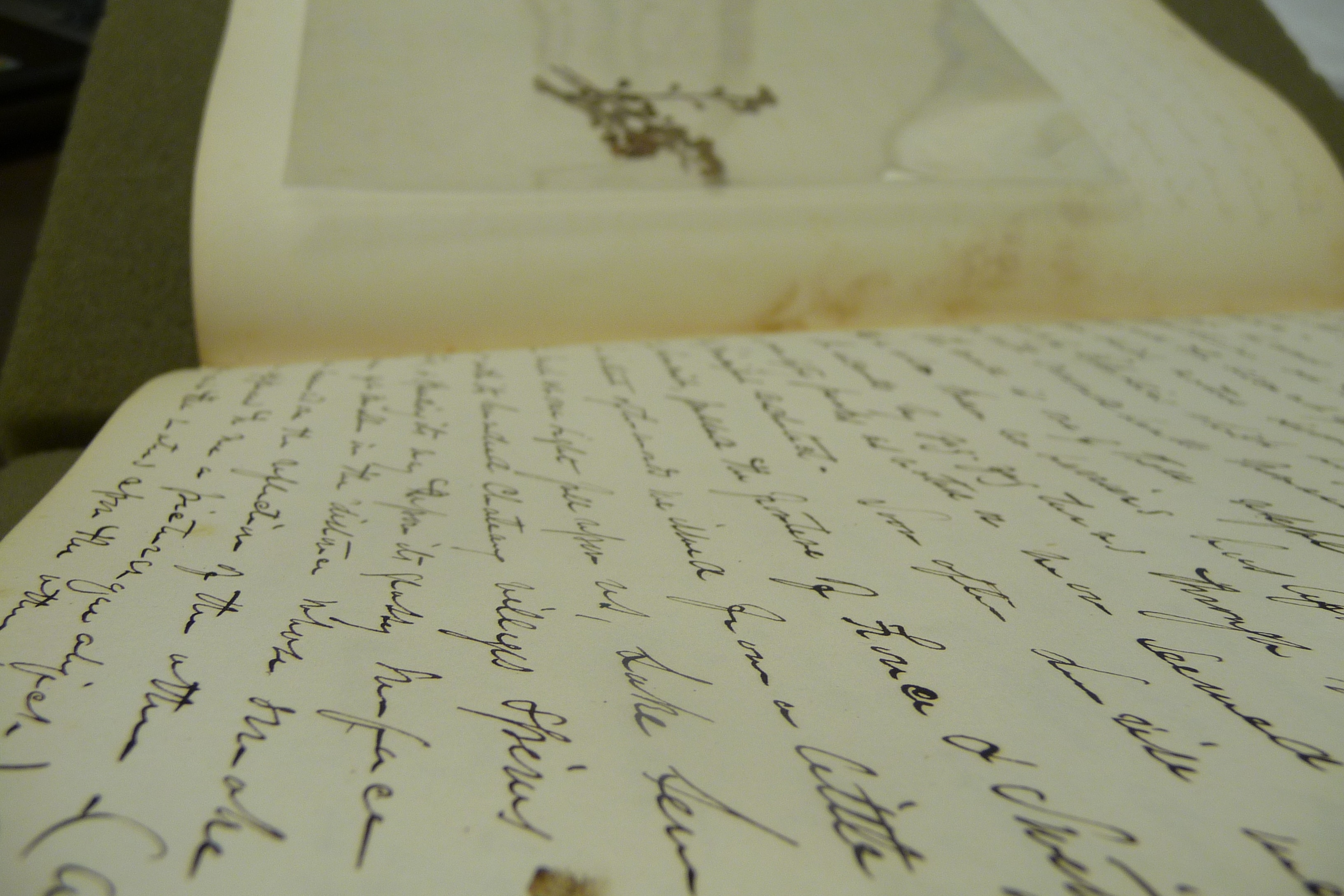
I’ve been privileged to work with the History of Medicine Collection in the Rubenstein Library this semester, and in the course of my project came across the journals of a young American medical student living in Paris, France in the early 1840s. Before I had really been able to familiarize myself with the contents of the journals – barriers mainly being Spencer’s handwriting – I imagined that the writing would be fraught with tales of the revolutions and political upheaval that characterized French politics in the 19th Century. What I found instead, though, was a window into the daily life of a bright, detail-oriented young medical student living in beautiful and romantic Paris, France even before the iconic Eiffel Tower was built.

The first entry in the journal is almost 30 pages long and describes a tour of Parisian monuments. Spencer starts with a jaunt around the grounds of the Palais des Tuileries and ends with a visit to the Arche de Triomphe on the Champs Elysées. When I said detail oriented, I was referring to things like the fact that Spencer recorded in yards the length and breadth of the Palais des Tuileries and described the arrangement and structure of the gardens there, too. The level of attention to detail, while surprising for a modern reader like yours truly, is likely because outside of recording the dimensions himself, Spencer would not easily be able to either recall or discover that information elsewhere. Another thing to remember is that photography hadn’t been really popularized yet, though it existed. 1840 is approximately contemporary with the birth of the Daguerrotype, an early photographic process. In 1840, if you wanted to remember something, you had to take down the facts yourself.

Even though it’s hard to imagine a Paris without the Eiffel Tower, some things in Spencer’s journals make him really accessible. For example, I was happy to find that he had an appreciation for puns; Spencer hearteningly described a fête happening down by the river as the “Seine of the action.” I totally LOL’d in the reading room at Perkins for that one, but then I do love a good pun.

The tidbits that make Spencer seems so contemporary exist right alongside descriptions of things that make his experiences totally foreign. He writes about doing rounds with a physician and watching amputations. As you might imagine, the practice of surgery has changed rather a lot since 1840. From Spencer’s descriptions, amputation was a considerable part of a surgeon’s practice at that time. Spencer also describes a side-show that he saw in Paris in terms of the various medical ailments that were afflicting the performers. Spencer recorded his ideas about what was wrong with the four-legged man and the level of approximate curvature of the spine of a man with dwarfism. I thought it was fascinating to see these people through the lens of his medical training. The journals also hold some botanical specimens that Spencer collected during his time in France. One of them makes an appearance in the image posted here.

The History of Medicine Collection has another later manuscript by Thomas Spencer, too. We learn from it that upon his return to the United States, he took up practice as a pathologist in Philadelphia, PA. The records from Spencer’s practice are taken with the same careful attention to detail and in the same beautiful script as his journals.

The journals tell what Spencer saw. They are his carefully collected memories from the two years he spent based in Paris. His experiences, which are so different from our own, lay out the scope of history, but his personality, humor, and opinions make him seem like a peer.

Nathalie Baudrand was the History of Medicine Collections Intern for Spring 2012 and is a graduate student at UNC’s School of Information and Library Science.

E-Records in the Reading Room

Special Collections Library reading rooms often require special equipment to view non-traditional record formats such as VHS players, cassette players, microfilm readers, etc. The Rubenstein Library recently welcomed a new piece to the set: a desktop computer.

Rubenstein Library Research Services staff check out the reading room's new e-records computer work station.

Though public computers have been available in our reference room for a long time to assist in finding and requesting physical materials in the reading room this new machine has been designed to support providing local access to electronic records and audio/video materials.

Some of the materials you can explore on the computer include:

Visit the reading room today and start that e-research!

Post contributed by Seth Shaw, Electronic Records Archivist.

Discovering Winter Watercolors

Like most everyone else, I’ve been enjoying our beautiful spring weather. However, part of me still yearns for the winter I never experienced. So I’m returning to a manuscript I cataloged last year that contains illustrations I now associate with the chillier months.

Surgeon Major A. F. Elliot served several tours of duty with the 2nd West India Regiment in West Africa, primarily in Sierra Leone, Guinea-Bissau, and Ghana. He maintained diaries for six of those tours, from 1866-1881, and used calligraphy for all month titles. There are also watercolor paintings, photographs, and charts.

I don’t read manuscript volumes I’m cataloging in their entirety or I’d never be able to keep pace with the new acquisitions arriving. Duke Alumni Magazine had also published an article on this volume. After I finished my catalog record, I reviewed the volume again to see if we had missed anything. That’s when I came across this title for September 1874.

September, 1874: The men stayed in Elliot’s tent because of rain.

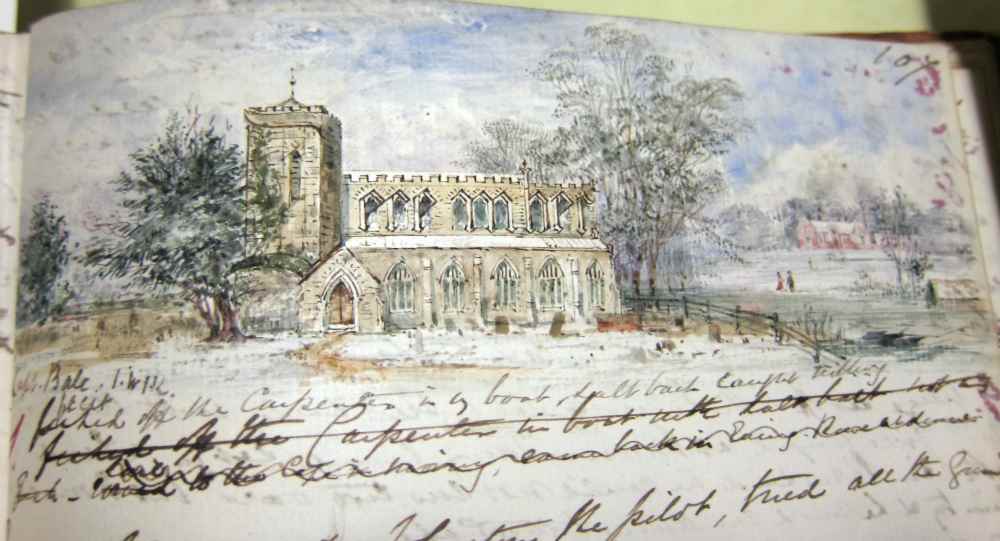
Elliot’s first entry for the month states “Rain & drizzle in the morning—Bale has drawn the heading this month[,] emblematical weather—rain all day.” I continued my perusal. October’s heading was fun, but November’s was stunning in both its design and detail.

The watercolor paintings by John Edward Bale in the volume are 7”x3” in size.

My student assistant, Sophia Durand, and I recently did a little research and found that these watercolors were painted by Elliot’s friend John Edward Bale, who was a member of the 1st. West India Regiment. Bale was promoted from Lieutenant to Captain during the months he created these paintings, and his signature changed accordingly. He retired from the Army as a Major, continued painting in both oil and watercolors, and several of those works have been sold at auction houses.

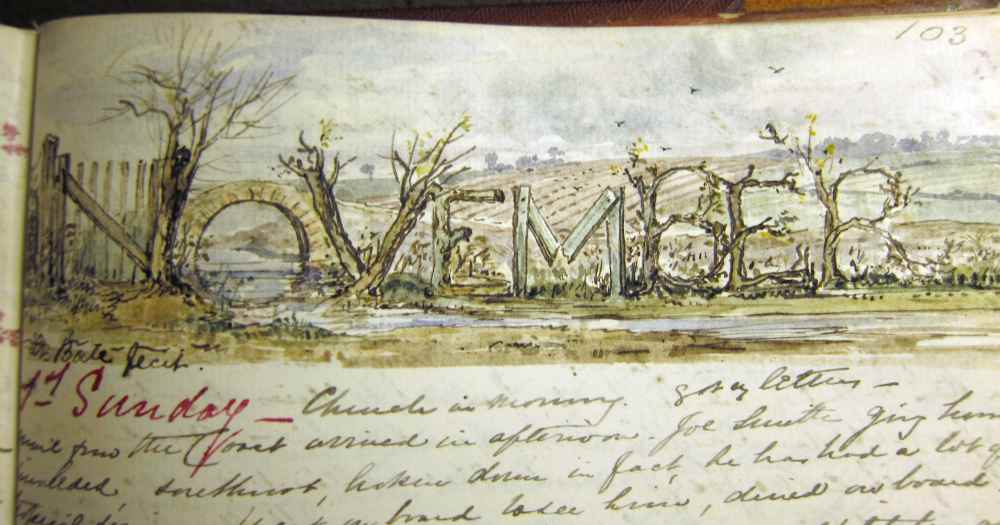
Do you see “December?” Hint: If this was a painting of Perkins Library, look at the Gothic Reading Room windows.

At the time I admit I was a tad disappointed that Bale painted only an accompanying illustration for Elliot’s December entry, rather than incorporating the month into it. To compensate, it pleased me that the church looks somewhat like the original Perkins Library building we are now in the process of renovating.

Imagine my astonishment when I discovered I was wrong about the absence of the month in the painting. I only became aware of it after I took a digital image of it for this blog post. Do you see “December”?

I’ve showed the paintings to my colleagues in Technical Services, and many of us rank these watercolors among our most amazing discoveries made while processing a manuscript collection.

Post contributed by Alice Poffinberger, Archivist/Original Cataloger in the Technical Services Dept..