RL Magazine, Issue 2

RL winter2013The second issue of RL Magazine is now in print and online (pdf, 3MB).

In it you’ll find:

  • Passionate Wisdom: Abraham Joshua Heschel
  • India Through a British Lens: The Photographs of Samuel Bourne
  • Out of the Shadows: Economist Anna Schwartz
  • A Historian Who Made History: John Hope Franklin
  • Digitizing the Long Civil Rights Movement
  • Madison Avenue Icons Help Celebrate Milestones
  • MacArthur “Genius” Visits Duke in Filmmaker Series

We hope you enjoy learning more about our collections and the ways they are being used in teaching, research, business, and the arts!

Mandy Carter, Peace Walker

Since starting my internship with the Sallie Bingham Center last August, I’ve spent time each week processing the papers of Mandy Carter, a self-described “southern out black lesbian social justice activist.”

This year Carter celebrates 45 years of social, racial, and lesbigaytrans justice organizing, and it’s almost impossible to summarize all that she has done—beginning with peace activism in the late 1960s and continuing today in her role as National Coordinator for the Bayard Rustin Commemoration Project of the National Black Justice Coalition. So instead, here’s one small peek.

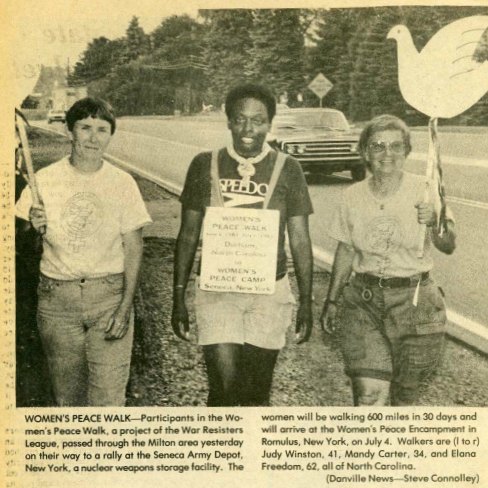
Though based in Durham for much of her career, Carter has traveled up, down, and around the country in support of her activism–and in the summer of 1983, she walked from Durham, North Carolina to Seneca, New York as part of the Women’s Peace Walk.

From left to right: Judy Winston, Mandy Carter, Elana Freedom. The trio completed the entire 600+ mile walk. Along the way, other women joined for a day, weekend, week, or longer. Newspaper clipping, 1983, Mandy Carter Papers
From left to right: Judy Winston, Mandy Carter, Elana Freedom. The trio completed the entire 600+ mile walk. Along the way, other women joined for a day, weekend, week, or longer. Newspaper clipping, 1983, from the Mandy Carter Papers.

Organized by the Southeast Regional Office of the War Resisters League—where Carter worked at the time—the Women’s Peace Walk aimed to draw attention to and protest the build-up of nuclear arms and specifically, the planned deployment of Cruise and Pershing II missiles to Europe later that year.

Women’s Peace Walk brochure, 1983.  From the Mandy Carter Papers.
Women’s Peace Walk brochure, 1983. From the Mandy Carter Papers.

Organizers timed the end of the walk to coincide with the beginning of the Women’s Encampment for a Future of Peace and Justice, and the destination itself held particular significance. The area was not only home to the Seneca Army Depot, a nuclear bomb and missile storage site, it was also where women of the Iroquois Nation met in 1590 to demand an end to war among the tribes and where more than 300 men and women came together in 1848 for the nation’s first women’s rights convention.

If you’re interested in learning more about Mandy Carter, her lifelong activism, and social change in Durham over the past 30 years, head down to the Durham County Library at 5:30pm on Wednesday for a panel discussion featuring Carter, Caitlin Breedlove (Co-Director, Southerners On New Ground) and Steve Schewel (Founder, Independent Weekly). Event details are available here.

Post contributed by Stephanie Barnwell, Bingham Center Intern.

Before Game of Thrones

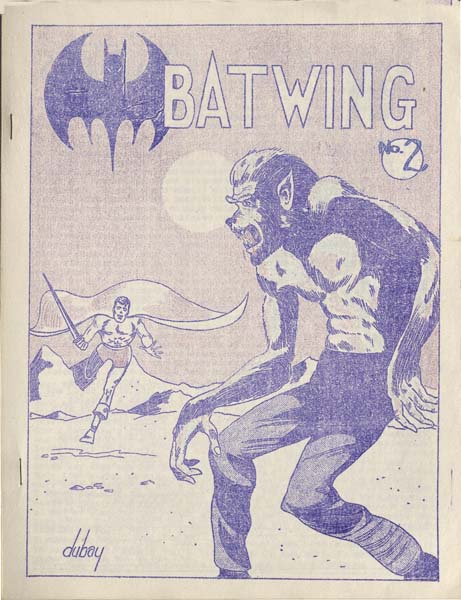
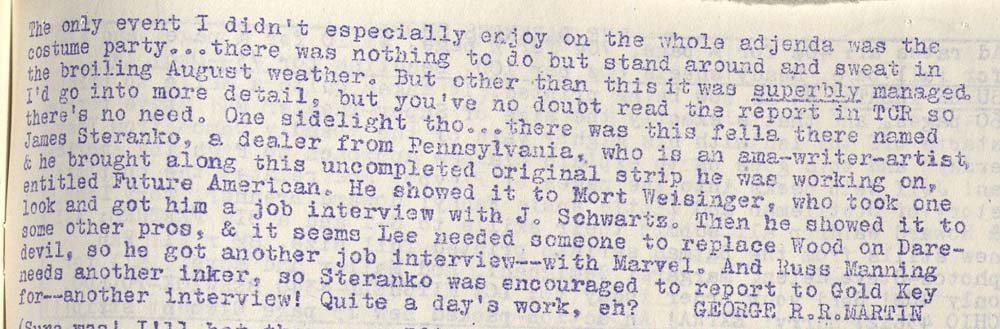
Before Game of Thrones, renowned fantasy author George R. R. Martin was a fan of all things nerd, just like you (and me)!  Check out this 1965 fan letter written by a 16 year-old Martin to Batwing, a fanzine published in Texas  by prolific fanzine writer Larry Herndon (and now included in our Edwin and Terry Murray Fanzine Collection).

Cover of Batwing #2


Batwing Letter, page 1
Click to enlarge.
Click to enlarge.
Click to enlarge.

Post contributed by Josh Larkin-Rowley, Research Services Coordinator.

Nevermind: The Concert That Wasn’t

Hello again from the Duke University Union records!  When last we met, I told you about a mysterious memorandum concerning CORE and the fact that it was not known to suffer from any communist infiltration.  Now, I have an equally interesting tale, involving an unlikely cast of characters: President Keith Brodie, Coach K, and Nirvana.

This undated paper was in a folder titled simply “Concerts Lost.”  It details the negotiations that apparently took place before it was decided not to book the willing-to-play Nirvana at Duke.

Notes about possible Nirvana concert, 1991? From the Duke University Union Records.
Notes about possible Nirvana concert, 1991? From the Duke University Union Records. (Click to enlarge.)

While the document more or less speaks for itself, I will highlight two of my favorite excerpts:

“Even [President] Brodie is unable to make Krzyzewski move practice.”

“If we could talk them into one of the other dates, Brodie would buy tix for senior class.”

Buried deep within the record is a notation that helps us to date the document as being from 1991: “talked to Brodie today; he’s excited about Nirvana because that’s one of the bands they tried for last year.”  This is a key clue in dating the record for the following reasons:

  1. In May, 1990, Nirvana played both in Chapel Hill (at Cat’s Cradle) and Charlotte.  Because of the proximity, it would be reasonable that Duke would have also tried to get a date on their first major headliner tour.
  2. Nevermind, Nirvana’s first major label success album was released in the fall of 1991.  Based on the fact that Durham is not located in suburban Seattle, it seems like a safe bet that they were relatively unknown in the area until they started to play the college circuit in 1990, and then they were catapulted into the spotlight with the release of the international hit album Nevermind.

Nirvana, of course was a band that was riddled with both controversy and tragedy.  Frontman Kurt Cobain famously battled a heroin addiction and, in 1994, committed suicide.  However, Nirvana is also largely credited with expanding the grunge—and later, alternative—rock genre beyond the Pacific Northwest.

Unfortunately, the story of Nirvana at Duke is found only in records of the Duke University Union, in a folder entitled “Concerts Lost.”  A final note about this record: Duke won the 1991-1992 seasons National Championship for men’s basketball.  Apparently those unmoveable practices paid off that year.

Post contributed by Maureen McCormick Harlow, Drill Intern for the Duke University Archives.

Digitizing the LCRM Update #9: Remembering the Allen Building Takeover

This month’s Digitizing the Long Civil Rights Movement update pauses to look back into Duke’s own past struggles with racial equality.  On February 13, 1969, students in the Afro-American Society occupied the Allen Building where the university’s primary administration offices were (and still are) located.  These students demanded that Duke take steps to enact racial equality on campus, including the founding of an African-American Studies department, the hiring of more African-American professors, and the establishment of an African-American cultural center on campus.  Similar demands had been made before from members of the Black Studies Program, as featured in our fourth update in this blog series.

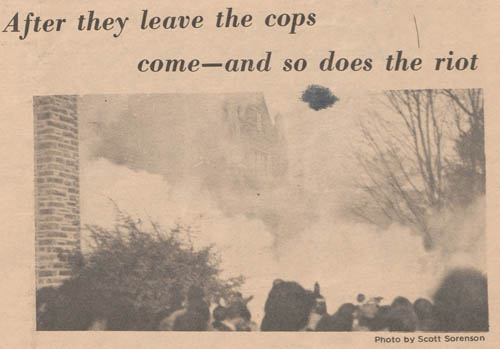
What distinguished the Allen Building Takeover from the previous efforts for reform was its forcefulness—on both sides of the debate.  The Takeover marked the first such occupation by students in Duke’s history.  The administration’s response also became notable for what some members of the student body perceived to be its brutality.  Police officers dispatched to the scene used tear gas to disperse a crowd that had gathered around the building, leading to a “riot” on the main quad of West Campus.

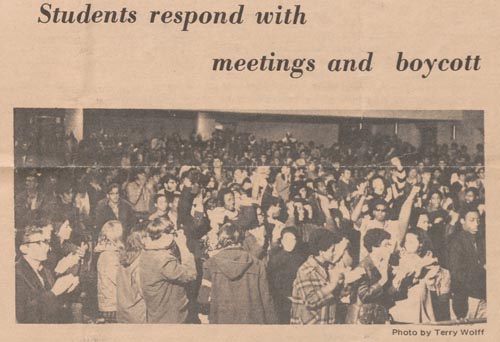
Photos from <i>The Chronicle</i>, February 16, 1969.

Photos from <i>The Chronicle</i>, February 16, 1969.
Both photos from The Chronicle, February 16, 1969.
Allen Building Takeover Collection, Box 1, Folder 10: abtms01010035

In the wake of the Takeover, students rallied to enact the suggested agenda of the original occupiers.  Eventually, most of the demands did become standard practice at Duke, but the change occurred more gradually than what the galvanized student body had wanted in February 1969.  The items selected above are from a photo essay published by The Chronicle (Duke’s independent student newspaper) that encapsulated the events of Takeover.

We are happy to announce that the Allen Building Takeover Collection and its wealth of primary documents and remembrances of the important event will soon become available online to researchers.

For more information on the Content, Context, and Capacity Project for Digitizing the LCRM, please visit our website or like us on Facebook.

The grant-funded CCC Project is designed to digitize selected manuscripts and photographs relating to the long civil rights movement. For more about Rubenstein Library materials being digitized through the CCC Project, check out previous progress updates posted here at The Devil’s Tale

Post contributed by Josh Hager, CCC Graduate Assistant.

Race, Gender and Identity in Artists’ Books

Date: Monday, March 25, 2013
Time: 6:30 p.m.
Location: Perkins Library, Room 318 (Rubenstein Library Classroom)
Contact Information: Kelly Wooten, kelly.wooten(at)duke.edu

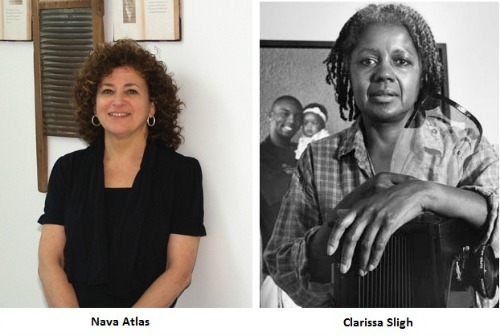
The book form can become a vehicle for personal histories and obsessions. Please join us for a discussion of how Clarissa Sligh and Nava Atlas have explored their own experiences of race, gender, and identity through book arts. Both artists have placed their papers at the Sallie Bingham Center, which also has a collection of over 300 artists’ books by women.

Photos of Nava Atlas and Clarissa Sligh

Clarissa Sligh  is a visual artist, writer, and lecturer. When she was 15 years old she became the lead plaintiff in the 1955 school desegregation case in Virginia. After working in math and science with NASA and later in business, she began a career as an artist, using photographs, drawings, text, and personal stories to explore themes of transformation and social justice.

Nava Atlas is known both as a vegetarian cookbook author and as a fine artist. Her artists’ books engage images, text, and structure to explore themes of social justice and women’s roles. Many of her works re-appropriate found materials and challenge the language and images used to reinforce gender roles and stereotypes.

Read more about Atlas and Sligh in the Spring 2012 issue of Women at the Center.


Post contributed by Kelly Wooten, Research Services and Collection Development Librarian, Sallie Bingham Center

Family “Letter” Donated to the Franklin Research Center


Braun Family
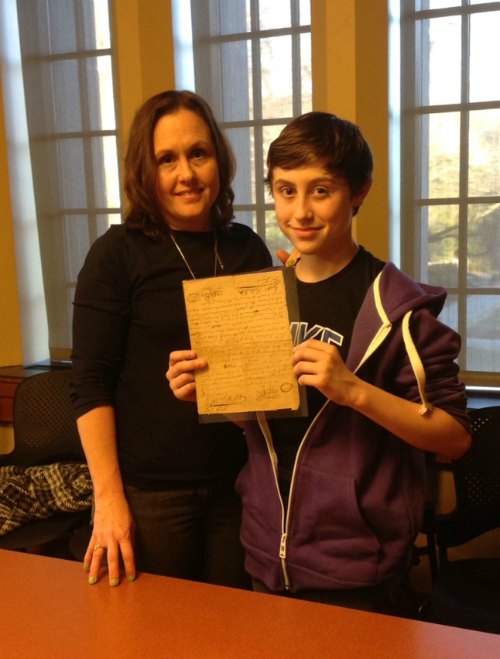
Marley and Jason Braun donate Slave Bill of Sale to the Rubenstein Library

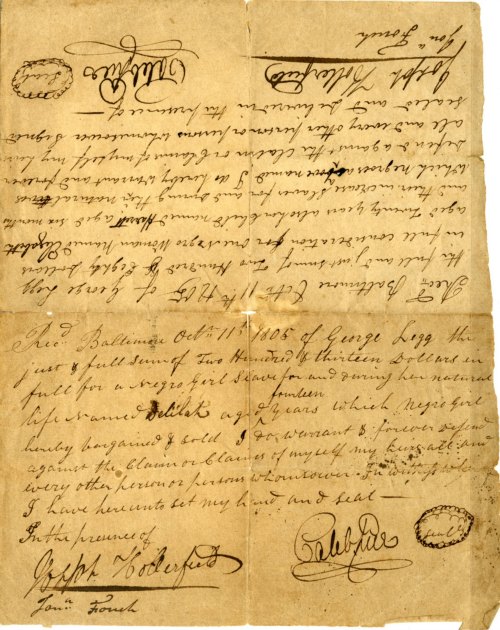
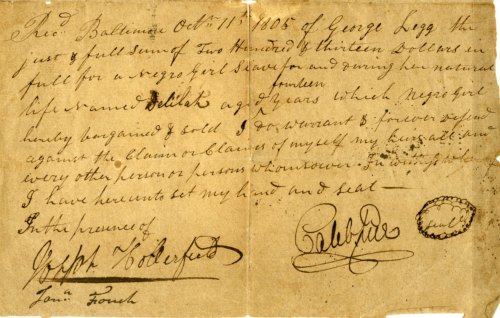
Marley Braun recently contacted the Rubenstein Library because she wanted to find a proper home for a very peculiar “letter” that belonged to her great-grandmother, Mrs. Edna Balderston. Perhaps Mrs. Balderston was shocked when she opened the “letter” envelope to find that it actually contained two bills of sale for 3 slaves in Baltimore dated October 11, 1805. The slaves listed in the bills were named Elizabeth, age 20, Harriet (her daughter), 6 months, and Delilah, age 14, for a total of $493.

Bill of Sale, October 11, 1805

The slave bills stayed in the family for a few generations behind glass until Marley, a former 10-year Duke employee, and her husband Andy, ’92 Duke alum, decided the bill deserved a place where it could not only be cared for but shared with people interested in its history. Marley and her son Jason came to the Rubenstein this past week to donate the bill of sale and view other bills of sale currently held by the Rubenstein in the African American Miscellany Collection. The bills within this collection span from 1757-1863 and this new addition will further help document the experience of African Americans during the era of slavery; thanks to the Braun family, Marley, Andy, Jason, and Hayley for this fascinating addition to our collections.


Bill of Sale, Delilah, age 14


Bill of Sale, Delilah, age 14


Post contributed by John Gartrell, John Hope Franklin Research Center Director.

Down the Rabbit Hole with a Book about Popes

Vatican history is not something the Rubenstein Library actively collects, but it is always fun to discover how our materials relate to current events, like the election of a new pope. Over lunch one day last week, several of us archivists began wondering what sort of collections we have related to popes. A quick search in our catalog uncovered this volume, the Basilica di San Pietro in Vaticano Records, which is described as “Copies of records in Latin and Italian, including the catalogue of all archpriests of the Vatican Basilica of St. Peter from Pope Benedict (1032-1045) to Pope Paul V (1605-1621); the succession of canons in the Vatican Basilica of St. Peter; and decrees of the council for propagating the faith.”

“Copies of records” normally don’t bring a pitter-patter to the archivist’s heart, but the fact that the volume was dated 1620-1751 made it seem worth taking a look. We called back the item from the Library Service Center. It is a hefty vellum-bound tome, about two-thirds blank, interspersed with pages of handwritten Italian and Latin. The first part of the book has a list of popes, beginning in 1035 and ending in 1620. Later entries date from the 18th century, explaining where the 1751 date came from in the original catalog record.IMG_0658
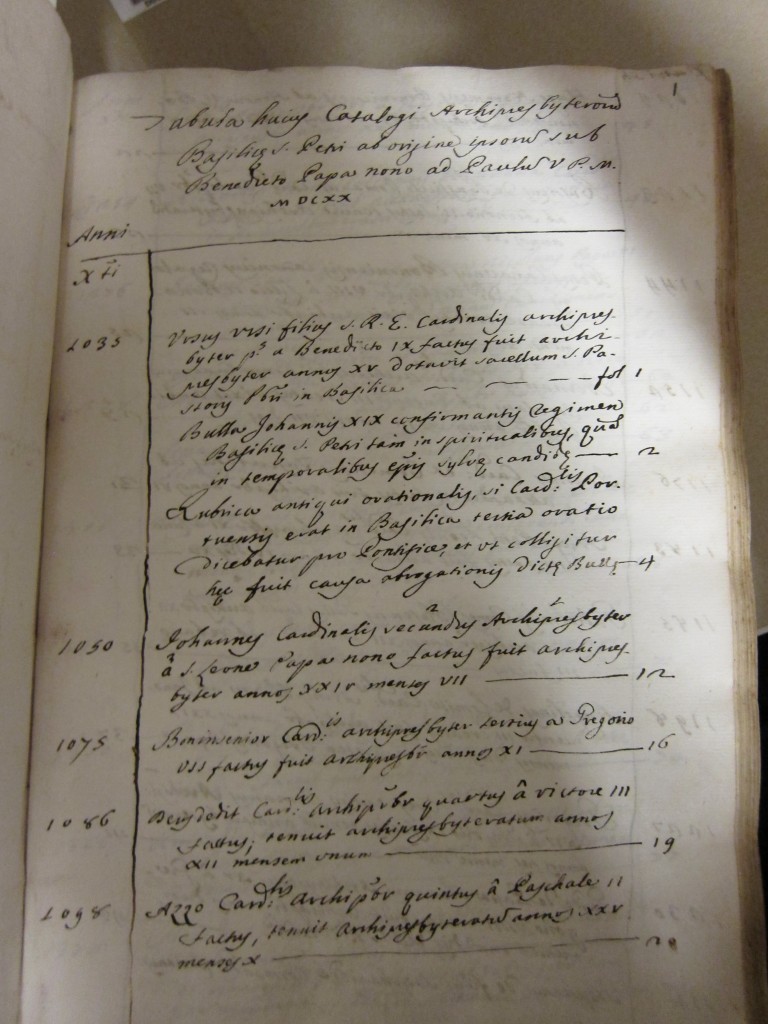
Now that we had the book in hand, we were curious about its origins. Who wrote the book? The spine’s label reads “Miscellan. MS.,” and the date span, different handwriting styles, and numerous blank pages suggest that there are multiple authors within the text. However, the only name we came across (other than various names of popes) was Jacobum Grimaldum, on the first page. The book’s title page appears to say that “From the writings of the archive and the Basilica and from the library of the Vatican, the catalogue[?] was collected by Jacobum Grimaldum, once the archivist of the temple, now a distinguished cleric. 1620 Rome.”
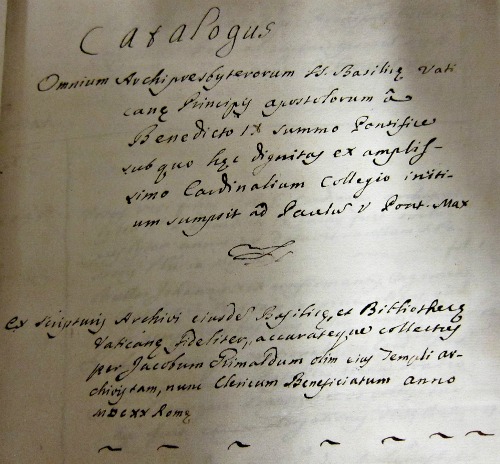
IMG_0661

Research by our rare book cataloger revealed that what at first looked like Jacobum Grimaldum is probably a version of Giacomo Grimaldi (1560-1623), an archivist at the Vatican. Grimaldi authored hundreds of unpublished texts on the history and artwork of the Vatican. His drawings are some of the only evidence remaining of certain tombs, mosaics, and monuments following renovations of St. Peter’s Basilica under Pope Paul V. The more we learned about Grimaldi, the more we liked him. Grimaldi’s research and conservation efforts preserved many of the early church’s altars, tombs, and artwork in the Vatican grottoes, still accessible today.

Although this manuscript is only a part of the larger bound miscellany, circumstantial evidence supports the theory that this part of the book was authored by Grimaldi. For one thing, the content matches Grimaldi’s interests in Vatican history and records. Also, according to Oxford Art Online, Grimaldi was elected notary and archivist of St. Peter’s in 1581 and died in 1623, putting this work’s date of 1620 within his lifespan. Of course, at this point there is no way to know whether what we have at Duke is something written in Grimaldi’s hand, or whether it is just a copy of his work by some random monk. If someone out there is an expert on Grimaldi handwriting, we’d love to hear from you.

We were also curious about how Duke came to own this miscellany. All we knew about it was that it had been owned by the library for a long time. Our curator of collections checked the records, and found it was purchased from a book dealer in London for $25.00 in the 1950s. Good deal, but a dead end in terms of provenance. We decided to try the bookplate.
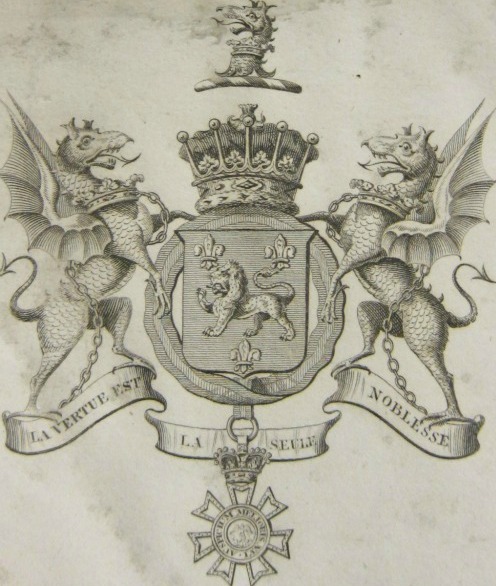
IMG_0659

Fortunately, Google helped us here: A search of the motto got lots of hits, all directing to the Earl of Guilford. But which one? This helpful page narrowed it down to Frederick North, 5th Earl of Guilford, by pointing out the medal at the bottom of the bookplate was not established until 1818. Guilford must have owned this volume at some point between 1818 and his death in 1827. Additional searches uncovered the British Library’s Guilford Project, which describes the Library’s attempts to digitize and catalog its holdings of Guilford’s manuscripts. The project website mentions that following his death, Guilford’s vast collection of manuscripts were sold at several auctions, including a “large number of early modern manuscripts relating to Italian history and European diplomacy, with particular emphasis on Venice and the Papacy.” This would explain how this volume of miscellaneous manuscripts came to the market in England, and how Duke eventually acquired it. Furthermore, surely the good Earl of Guilford had the knowledge and expertise to buy an original Grimaldi manuscript, not someone else’s copy. Right?

Post contributed by Meghan Lyon, Technical Services Archivist.

Update: An earlier version of the post led with the phrase that Vatican history is not something Duke actively collects, but that is inaccurate: plenty of Vatican history is available in the Divinity School Library.


Fascinating Finds in the Stacks: Women’s Lib?

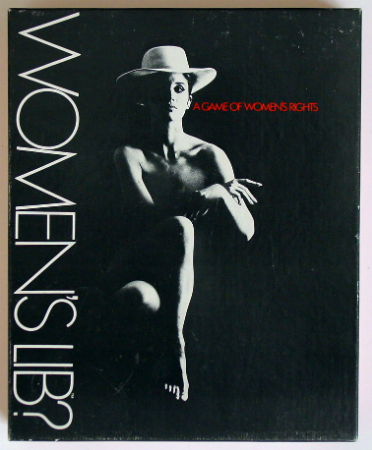
In the wake of our collections move, I came across a board game, “Women’s Lib? A Game of Women’s Rights.” As a child of the seventies, the box’s Bob Fosse-esque cover image caught my eye, as did the oh-so-1970 line drawings that reminded me of Schoolhouse Rock and other educational cartoons of my youth. However, this board game has a decidedly adult theme.

WomensLibGame

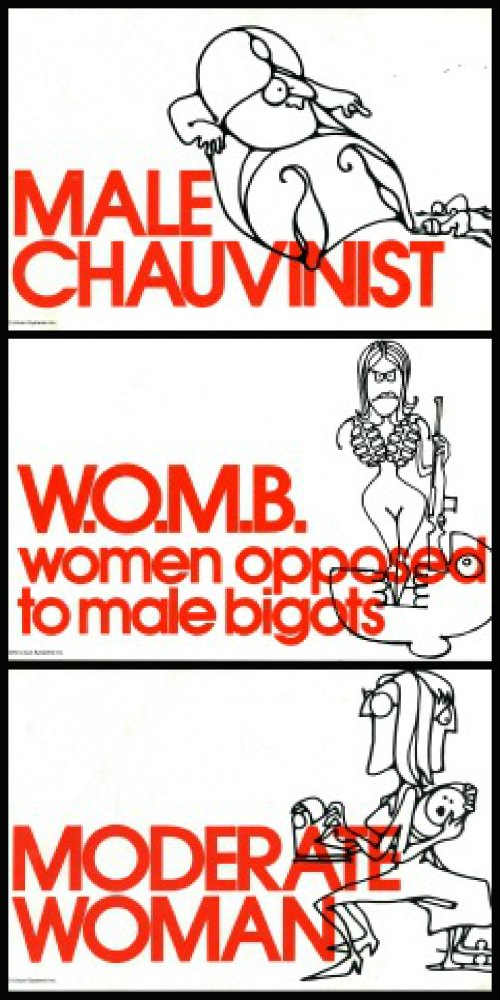
womenslibEach player selects a character that represents one of six different stances on the Women’s Liberation Movement, ranging from “Male Chauvinist” to “Moderate Woman,” to “W.O.M.B. (Women Opposed to Male Bigots).” Characters then vote on contemporary issues as prompted by playing cards. These topics are familiar to us over 40 years later:  Abortion, Day Care, Employment Equality, Women’ Legislation and Domestic Issues. In fact, the only category on the election docket that we don’t hear much about today is “Male Contraception.”

Points are awarded to players who successfully campaign and debate to achieve the goals favored by the character they represent. The game sets out to educate players about controversial gender issues in a rapidly changing world. Although this piece of memorabilia seems anachronistic today, the topics it addresses are still extremely relevant.

This board game joins a number of other games and playing cards held by the Bingham Center that explore issues related to women and gender. For even more fun and games in the Rubenstein Library, check out the Richard Pollay Collection of Advertising-Related Board Games, or the Edwin and Terry Murray Collection of Role-Playing Games.

Post contributed by Megan Lewis, Technical Services Archivist for the Sallie Bingham Center for Women’s History and Culture.

Dispatches from the German Judaica Project

Usually catalogers spend most of our time thinking about appropriate subject headings, title added entries, transcription of titles and other useful information. We have developed efficient ways to do this quickly and accurately and aren’t often conscious of our role in preserving a book because it is an historical object. Sometimes, however, there is something about a book that brings the cataloging process to a temporary standstill.

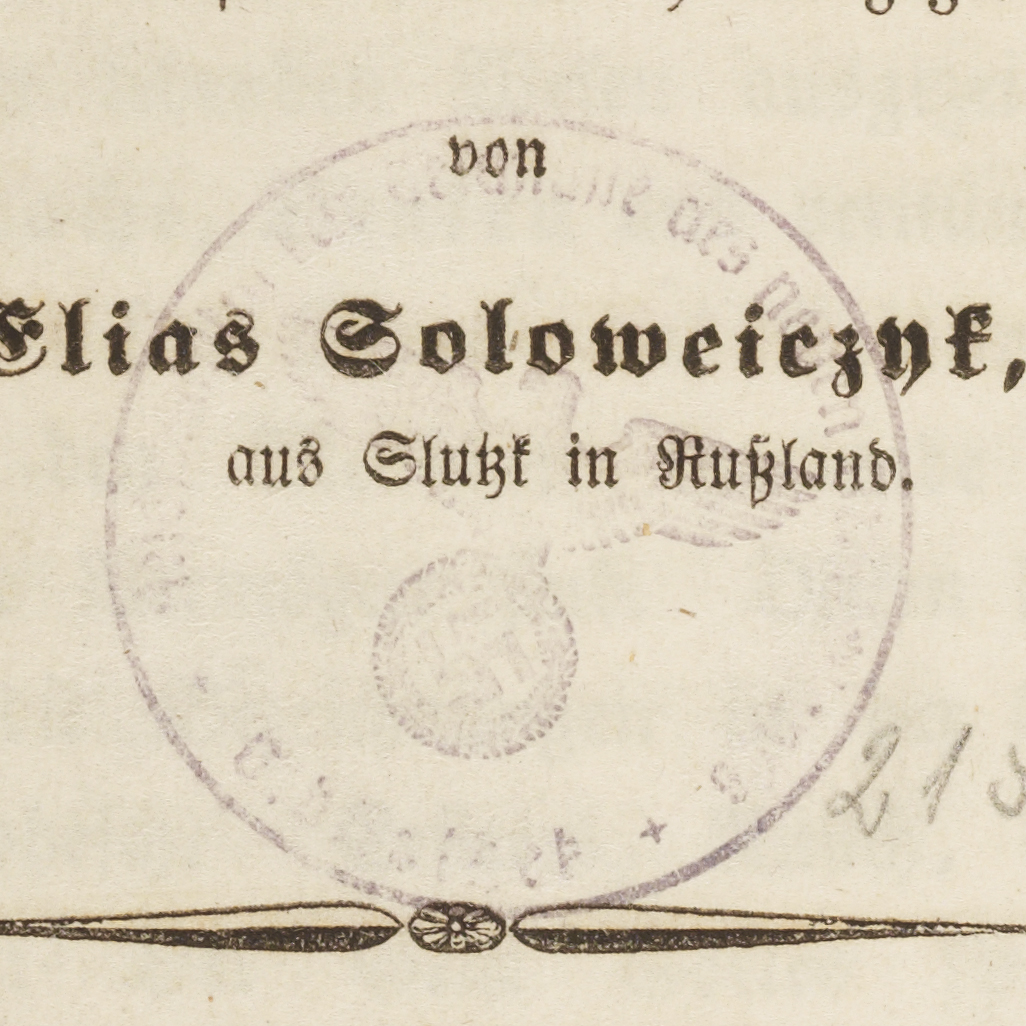
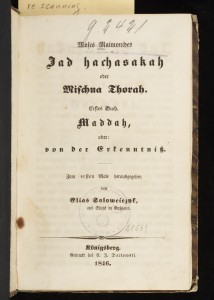
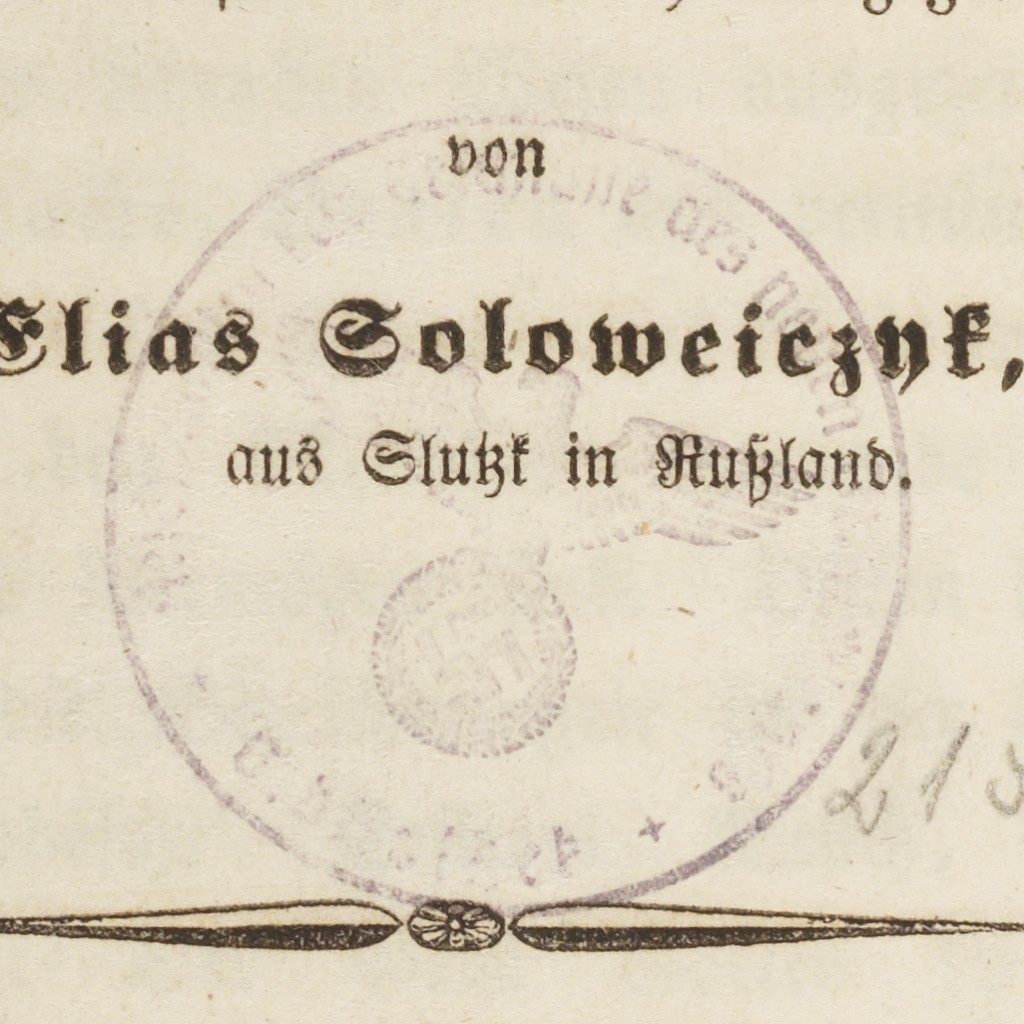
lois blog post fullA book that was acquired recently as part of the German Judaica Project suddenly made me stop and think about the history of Europe during the Nazi period. The particular title in question is Jad hachasakah, oder Mischna Thorah, 1. Buch. Maddah, published in 1846 by E.J. Dalkowski in Königsberg (once the capital of Prussia, now known as Kaliningrad). It was edited by Elias Soloweiczyk “aus Slutzk in Russland.” (Slutzk, or Slutsk, is a town near St. Petersburg.) There are hundreds of editions and commentaries of Moses Maimonides works, edited by a wide variety of authors and there isn’t anything too unusual about the text of the book. It isn’t even extremely rare, as there is at least one other copy in the United States. What is very interesting is that, clearly stamped on the title page, is the ownership mark of one of the libraries of the Nationalsozialistische Deutsche Arbeiter-Partei Schutzstaffel or “SS.” It’s unfortunate that the identity of the specific library is not quite clear, but the central symbol is distinctive.

close-up_01

So many questions came to my mind as I cataloged: How did this little volume manage to survive the war at all, since Jewish libraries were systematically destroyed? How did it arrive in the hands of the SS, who were definitely part of the destruction? Why did they save it? Did it possibly serve a purpose in the officer training schools as an example of why Judaism should be destroyed? How did this it survive the destruction of the SS libraries after the war and find its way first to the United States and finally to Duke?

This little ownership stamp also reminded me of a cataloging project that I completed in the 1980s. It was a large collection of pamphlets that was given to the library following World War II. They were materials literally picked up from the streets or plucked from the waste bins as the libraries belonging to the Nazis were dismantled. They remain a treasure-trove of everything from official Nazi propaganda on race to manuals for pistols. Many of the items had ownership stamps similar to the one in the Maimonides work described above. In order to more easily locate these resources, we devised two categories of locally developed subject headings: Nazi period (further subdivided by place of publication and date) and Provenance (followed by the former owner).

It seems serendipitous that I would catalog the new title because I am probably the only cataloger who would realize the philosophical connection to the earlier project and create the same type of subject added entries.

Post contributed by Lois Schultz, Catalog Librarian for Monographic Resources in Perkins Technical Services.

Dispatches from the David M. Rubenstein Rare Book and Manuscript Library at Duke University