Category Archives: From Our Collections

The Curious Case of Frances Benjamin Johnston

FrancesBenjaminJohnstonBlogsizedThe Library recently acquired a small album of photographs taken in Virginia’s Tidewater region. It contains six cyanotypes depicting work at the freight docks of Newport News and other subjects.  Of particular interest is a laid-in cyanotype which appears to be a portrait of Frances Benjamin Johnston, a pioneering female American photographer.

Johnston was a remarkable photographer.  She took portraits of American presidents and the high society of the turn of the nineteenth century from her Washington, D.C. studio, but also participated in ambitious documentary projects, such as her architectural photographs of Southern states.  For one of her best-known commissions, she traveled to Virginia to document the students of the Hampton Normal and Agricultural Institute in 1899-1900.  Her photographs of this important education institution for African Americans and Native Americans are preserved in her collection at the Library of Congress.

Based on the probable identification of the woman in the photograph as Johnston and the photographs of the area around Hampton in the album, these photographs have been dated to the first decade of the 1900s.  However, no information about the photographer is yet known.  Were they a student or colleague of Johnston?  Is it possible that the photographs (or some of the photographs) are by Johnston herself?
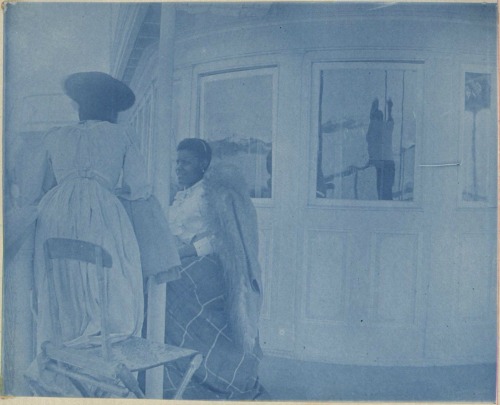
African American women aboard a steamboat, from the Tidewater album, ca. 1900.

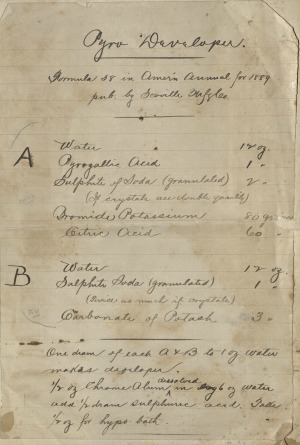
TidewaterAlbumPyroDeveloperBlogsizeThe album is also accompanied by handwritten directions for making “Pyro Developer” and a “fixing bath for platinum prints,” which may provide further evidence that the creator may have been a student or novice photographer.  (The large initial “B” on the “Pyro Developer” formula bears some resemblance to Johnston’s handwriting, but the handwriting of the rest of the formula does not appear to be similar to hers.)

If anyone has clues or guesses to contribute to the mystery of the photographer’s identity, please share them in the comments section below!

Post contributed by Will Hansen, Assistant Curator of Collections.
In the Lab: Boxing Challenges

heschelrockblogSome of our recent interesting conservation projects have involved housing.  Not only do we repair damaged books and paper items in the conservation lab, but we also make many boxes and enclosures to house them, and occasionally our box-making expertise is called upon for rather unusual items.

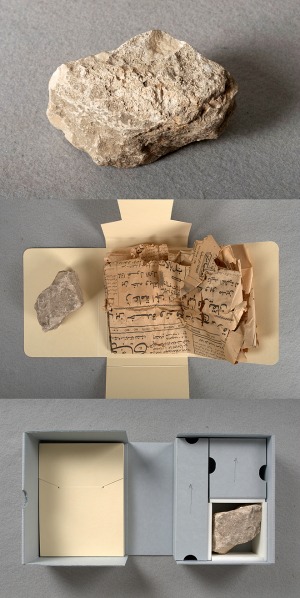
For example, from the Abraham Joshua Heschel Papers: a rock.  Little is known about this small piece of rock except that it is a souvenir of a trip that Heschel made to Israel.  The rock was originally wrapped in a newspaper.  Tedd Anderson made a four-flap enclosure for the newspaper and a box to house both the rock and the newspaper enclosure.

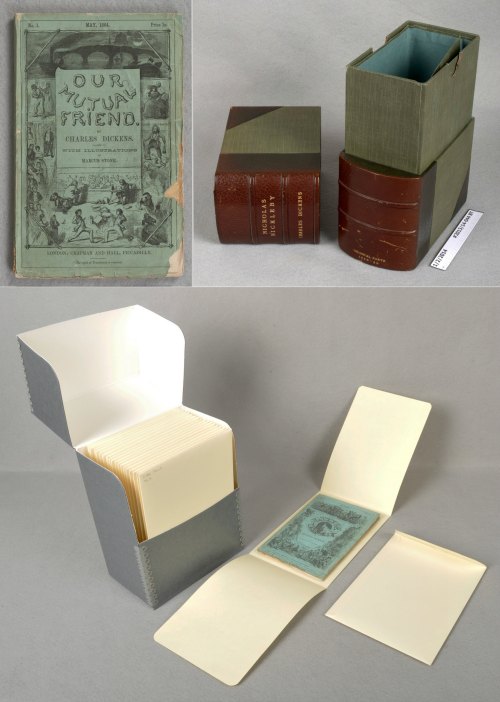
Rachel Penniman has been working on a set of Charles Dickens’s publications, the original short segments of his novels that came out in serial form.  These serials had been housed in custom boxes that someone must have made for their personal collection.  Although the boxes were attractive with leather spines and stamped titles, they were not safe for the serials. The boxes caused creases and abrasions each time one of the pamphlets was removed or reinserted.  Rachel made individual enclosures for each serial issue, and the enclosures were housed together in larger boxes, one for each title.  Access to the serials is now much easier and safer.

dickensblog

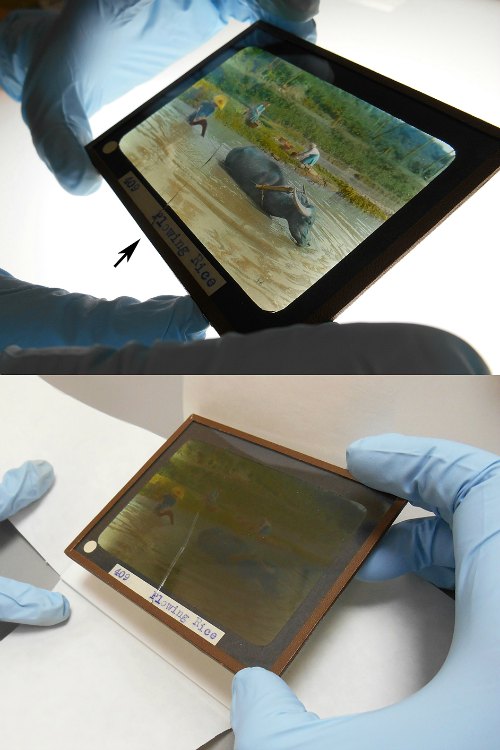
The Digital Production Center (DPC) is in the process of scanning glass lantern slides of scenes of daily life in China made by Sidney Gamble in the early 20th century.  Many of the slides are hand-colored, some have existing cracks, and all are very fragile because of the glass support. Erin Hammeke has been working to stabilize their housings.  Each slide is housed in a labeled four-flap paper wrapper, and in the case of cracked slides, she adds a piece of mat board as an extra stiffener.

lanternslides crackedblog

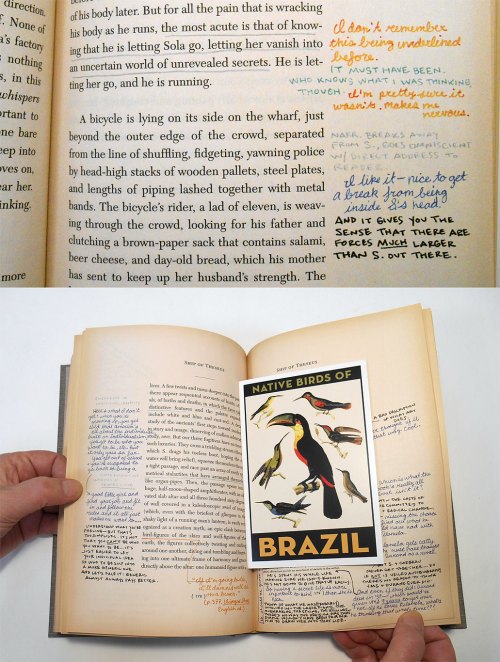
The conservation department creates housings for circulating collections as well.  Mary Yordy has an upcoming housing project for the fascinating new book S by J.J. Abrams and Doug Dorst.  The book is beautifully made to look old and well used with notes in the margins and numerous loose paper inserts.  Mary is planning to make a box for the book that will prevent loose materials from falling out and getting lost, and the book will be kept in the locked stacks.  While we chose to leave the inserts untreated and as published, the Preservation Lab at the Public Library of Cincinnati/University of Cincinnati decided on another route with this title. 

s book comboblog

More images of these and other housing projects can be seen on Flickr.

Post contributed by Grace White, Conservator for Special Collections, as part of our ongoing “In the Conservation Lab” series.

An Interview About a Duke University Pioneer

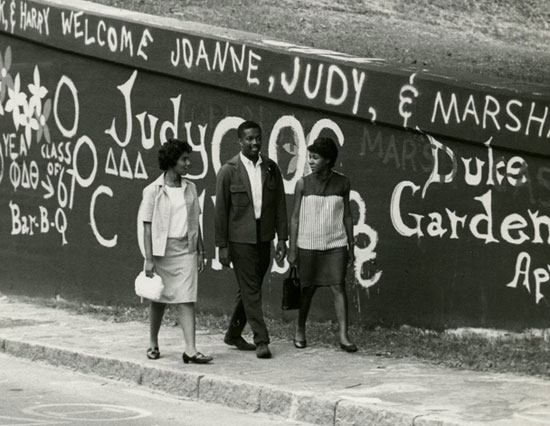
Nathaniel White, Jr was among the first five black students to attend Duke University in 1963. He was not, however, the first person in his family to attend college. His father, Nathaniel White, Sr., had attended Hampton Institute prior to founding his own printing business in Durham. In a newly-digitized interview, White, Sr. discusses his life, his memories, and his experience as a black man living in Virginia and North Carolina during the 20th century.

White’s interview is part of the Behind the Veil digital project, which has just added over 300 new interviews with North Carolinians, including many from Durham. The interviews capture details of what life was like in the Jim Crow South for African Americans. In White’s interview, he shares the story of his childhood, the black business community in Durham, and the influence of scouting on his life. Of particular interest to local researchers, he describes individuals and businesses in the Durham black community in the mid-20th century, providing deep insight into Durham’s history.

Nathaniel White, Jr., center, was a native of Durham and one of the first three African-American students to graduate in 1967.

He also briefly discusses his son’s pioneering role at Duke. He mentions that White, Jr., had considered Hampton Institute himself, but then had the opportunity to attend Duke. His father candidly remarks in the interview, “There’s one thing about a situation like that, it’s more like the real world than some other places that you might go and everything seems like it’s alright but it’s not training you for what you’re going to meet when you get outside. It’s a real struggle out there. The sooner you learn that, the better off you might be. . . . In other words, every day he had what it’s like to be an African American citizen in this country. So he didn’t have to learn that after he graduated. He learned it every day at Duke.”

Learn more about the fascinating Behind the Veil project on Bitstreams, the blog of the digital collections department of Duke University Libraries.

Post contributed by Val Gillispie, Duke University Archivist.

Preserving a Cork-Covered Scrapbook

I’ll soon be meeting with Conservation staff to discuss the preservation issues surrounding a few collections I’ve cataloged recently, including this one, a scrapbook I felt I had to catalog before it absolutely fell to pieces.

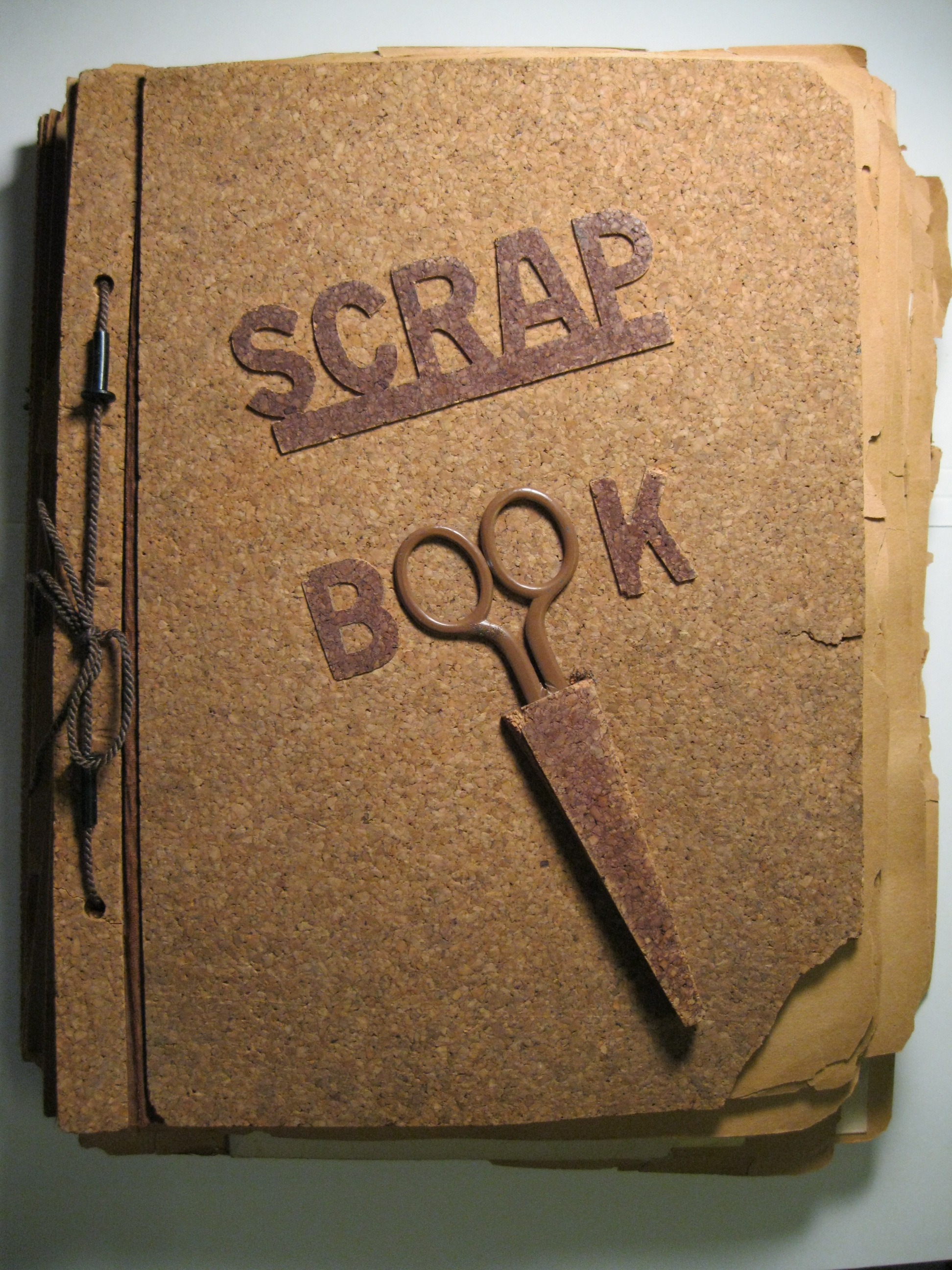
rothholz cover
It is likely that Marianne “Nan” Rothholz created this unique cork cover for her scrapbook that contains 69 letters, 22 V-mails, 6 postcards, and 37 black-and-white photographs.

Nan Rothholz began this scrapbook during World War II, when she served as a member of the National Jewish Welfare Board and the Baltimore United Service Organizations (USO). She and her family hosted servicemen, generally medical professionals stationed at Fort Meade, in their Baltimore home. She became especially close to and followed 5 of the men during the final years of the war in Europe, and to me this scrapbook represents her “filing cabinet” for their V-mail, letters, photographs, postcards, and clippings, rather than a traditional scrapbook.

rothholz page
Rothholz recorded personal details about each serviceman in ink, then pasted in their related material around it. The paper in the scrapbook is of astoundingly poor quality, and breaks into pieces as the pages are turned.

Our challenge here will be how to keep related material together yet preserve the individual items, all before these brittle pages crumble to bits. Conservation staff will advise me on this, and perhaps digitization will be considered to help preserve the relationships in material that Rothholz initiated. Both the National Jewish Welfare Board and the USO commended her on her work, and our work will honor her as well.

Post contributed by Alice Poffinberger, Original Cataloger.

Fortunes Told at the Rubenstein

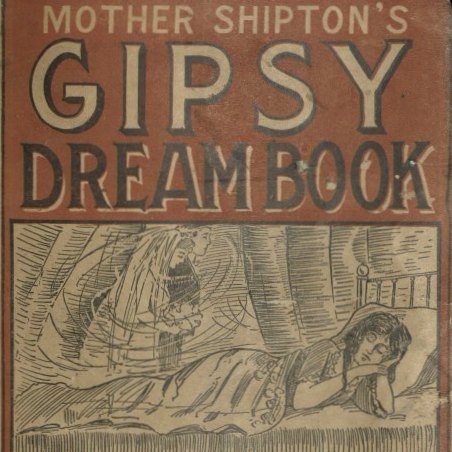
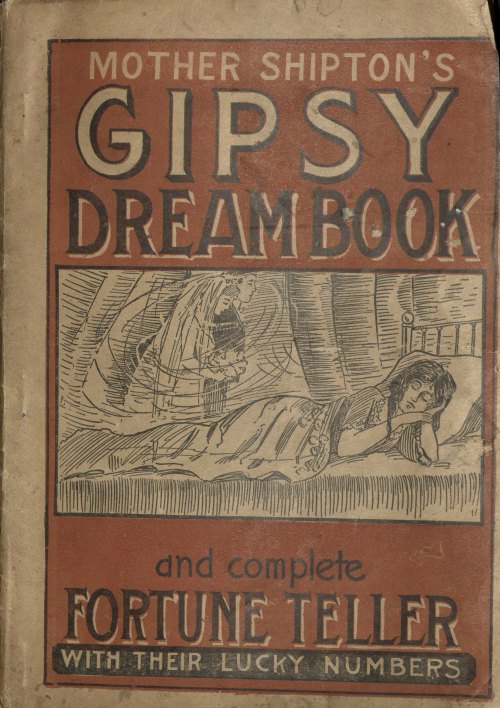
Did Valentine’s Day leave you with more questions than answers? Wondering who sent you that sweet Valentine? Want to know when you’ll meet your own Rapturous Codfish? Perhaps Mother Shipton’s Gipsy Fortune Teller and Dream Book can be of help.

Shipton - Cover


Not which of your many admirers sent you that “love token?” Get your crow quill ready and try this spell on Friday:

Valentine


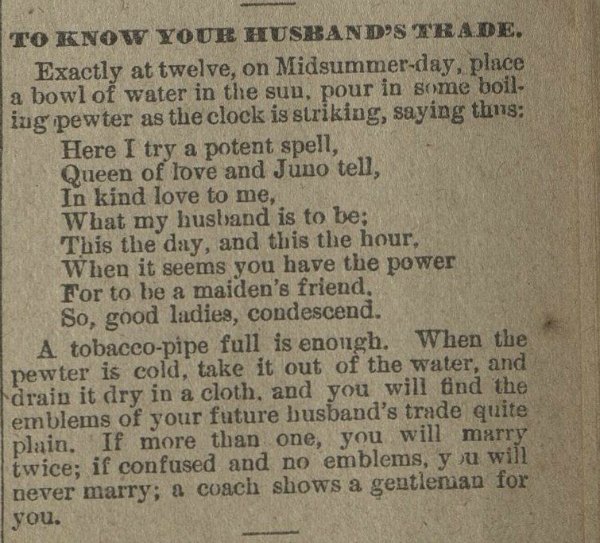
You’ll have to wait until June to try this one – plenty of time to find a tobacco pipe full of pewter so you can augur your future husband’s career:
 
know your husband's trade


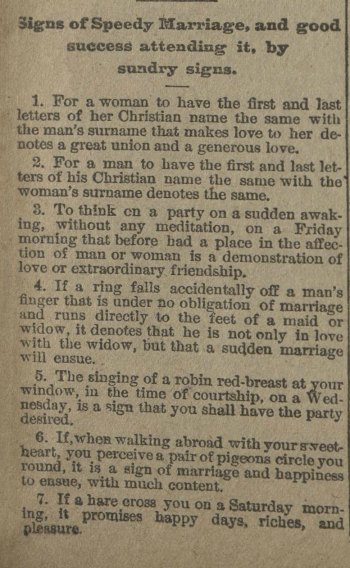
Did two pigeons fly around your and your darling’s heads this weekend? Or maybe a rabbit crossed your path on Saturday morning? Both good signs:
 
speedy marriage

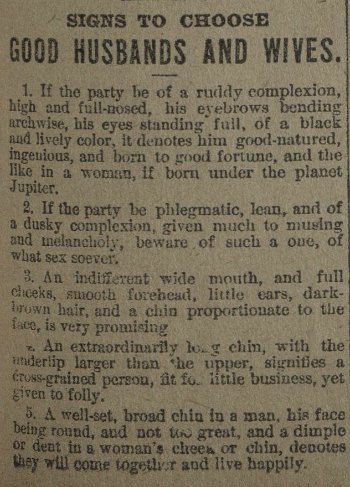
But Mother Shipton thinks you should be careful if your love is the quiet mysterious type “given to musing and melancholy.”
 

signs to choose

Happy Valentine’s Day, My Rapturous Codfish!

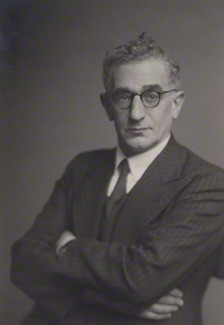
Image of Leon Simon, taken from London's National Portrait Gallery.
Image of Leon Simon, taken from London’s National Portrait Gallery.

As my student assistant, Sophia Durand, began the physical processing of the 131 letters in the Leon Simon collection (1915-1916, 1918), she noticed something intriguing. Leon Simon addressed each letter to his future wife, Esther Ellen Umanski, differently. Until they made official plans to marry, she was “My Dear Nellie.” But once the date was set, Simon became creative and effusive, his word choices sometimes questionable as endearments.

Romantics everywhere tend to be sugary in their pet phrases. Simon was no different, perhaps just more over-the-top. He addressed his letters to: My essence of honeycomb, My exquisite Peach Melba, My lump of sweetness, My peachiest apricot, My succulent meringue, My belovedest mimosa, My jujubious confection, My sweet Sugar plum(p).

As you can already tell, Simon was quite fond of food and cooking. Other highlights in the letters include My stewed apricot, My eversweet parsnip, My most succulent kipper, My pickled herring (You know how I love them!), My pickledest onion (=on’y ‘n  =only one), My own dumpling, My coo (k) ing dove, My rapturous codfish, My toasted crumpet, and–my personal favorite–My incandescent soup-tureen.

Simon
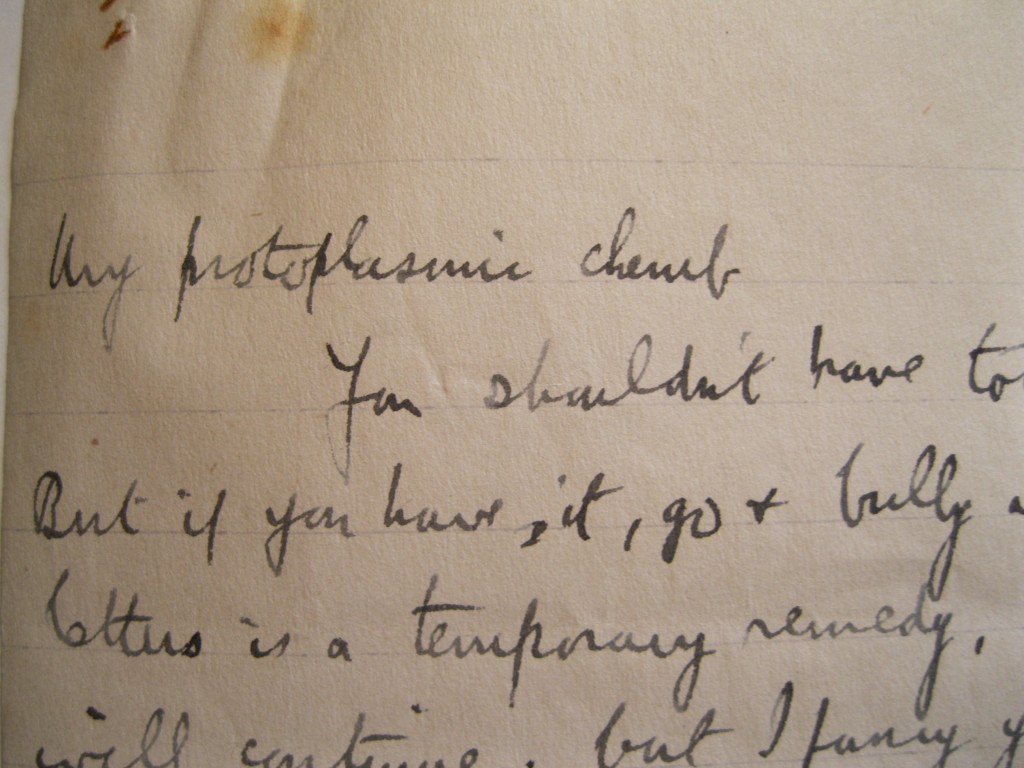
Simon wrote Nellie at least once a week. On October 12, 1915, he called her “My protoplasmic cherub.”

Occasionally, Simon sought to be reassuring about his odd turns of phrase. On October 20, 1915, he wrote to Nellie, who was studying German, “My most exquisite Stumpfenbach, (Don’t worry about the meaning of this; it is a term of endearment invented for the occasion & means nothing at all except that all recognized terms of endearment are hopelessly inadequate)…” A Duke German professor says that he was unwittingly referring to a city in Bavaria.

So, if on this Valentine’s Day your terms of affection seem stale, why not borrow one coined by Simon: My adorable whelk, My kitchy-kooish boo-woo, My jokaceous blue bottle, My bilingual Scaramouche, My unique joy, My tender flamingo, My early paradise, My copious ink-pot, My imperative necessity, My darlingpetangelanddelightallrolledintoone. Perhaps you and your loved one will then share in one of his closings, a “Quintessence of hugs & kisses ad lib.”

Sheesh.

Post contributed by Alice Poffinberger, Original Cataloger.

Jefferson Davis’s Hair Revisited

One of my favorite Rubenstein collections is the C.C. Clay Papers, which document the life and times of Clement Claiborne Clay and his family. The Clays lived in Alabama in the nineteenth century, and sided with the Confederacy during the Civil War. In the war’s early years, C.C. Clay served as a Confederate States senator. His opposition to raising soldiers’ pay (it would have been too expensive!) led to his being voted out of office in 1863. Clay and Confederate States President Jefferson Davis were good friends, however — Clay was godfather to Davis’s son Joseph — and rather than send Clay back to his plantation, Davis sent him on a secret mission to Canada to spy, bribe, and generally foment rebellion. (Clay’s mission did not end up helping the C.S.A.)

Clay was in Canada from mid-1864 through early 1865. He returned to the South just in time for the Confederacy to surrender. President Lincoln was assassinated shortly after his return, and both Davis and Clay were arrested by the Federal government on suspicions of treason relating to Lincoln’s assassination. (Clay’s time in Canada looked extremely suspicious.) The men were imprisoned in Fortress Monroe, Virginia. Clay was held for about a year without being charged until finally his wife, Virginia Clay, convinced President Andrew Johnson to pardon him. (She was a cool lady. You can read her 1905 memoir here.) Davis was imprisoned until 1867 before finally being released on bail.

jefferson_davis_hair-blog
This is only a selected portion of the Davis hairball held in the Clay Papers.

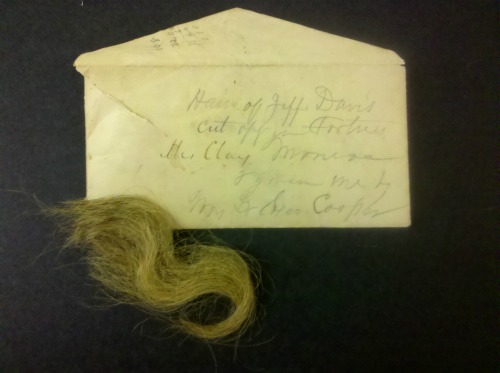
What does all this backstory have to do with Jefferson Davis’s hair? Well, there are giant clumps of it in the Clay Papers, and for years we did not know why. The mystery behind the hair did not stop us from displaying it in a Perkins Library exhibit three years ago. The only clue was from an envelope, where Virginia Clay had written, “Hair of Jefferson Davis cut off in Fortress Monroe, given me by Mrs. Dr. Elva Cooper.”

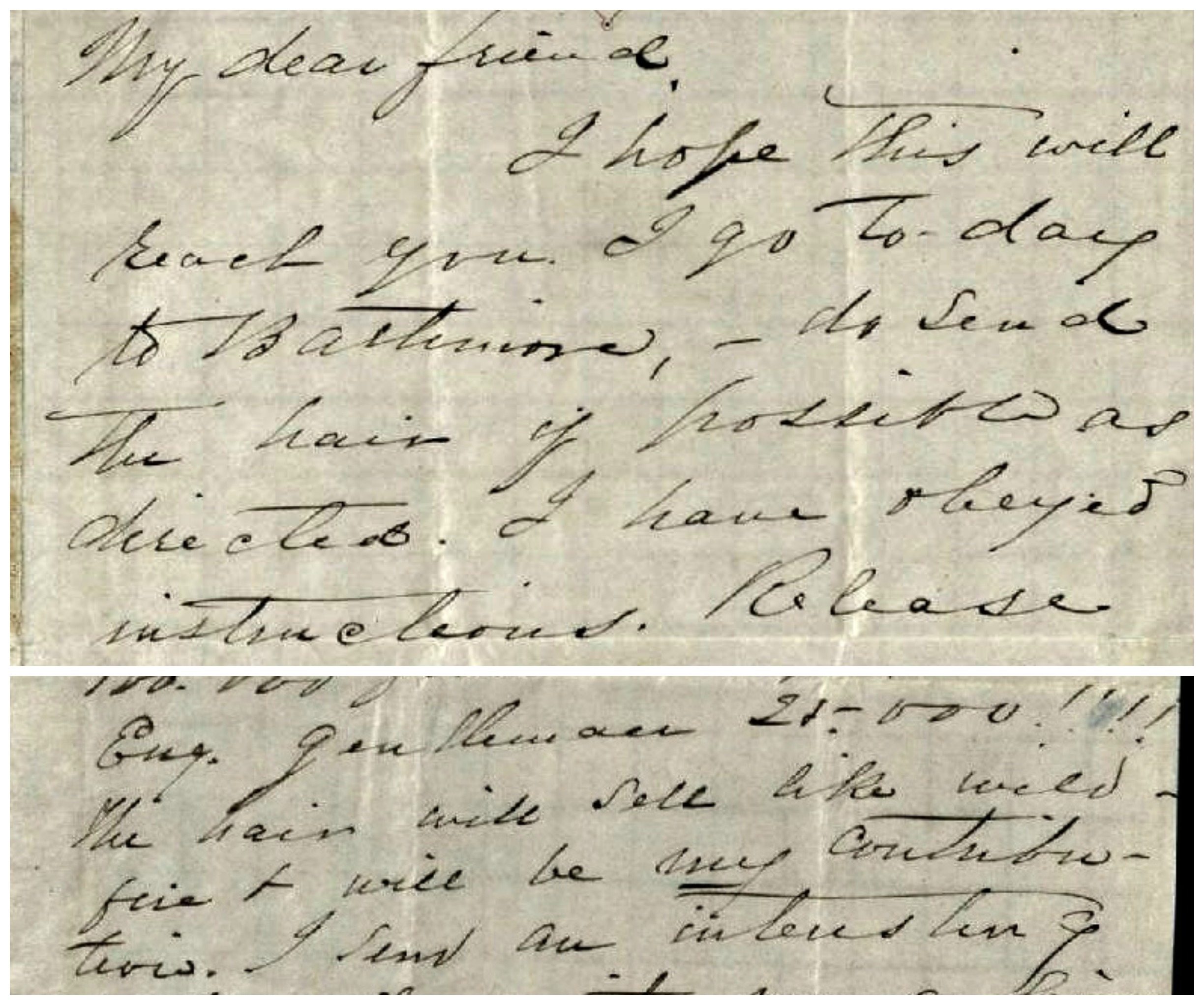
Recently, in reading through the Clay Papers correspondence, I came across the letter that explains it all. Virginia Clay wrote to Elva Cooper in April 1866, days before receiving Johnson’s pardon for C.C. Clay, asking her to “do send the hair if possible as directed.” Later on in the letter, Virginia recounted the number of donations received toward Jefferson Davis’s bail, adding that “the hair will sell like wildfire + will be my contribution.”

davisCollageIt appears that the plan was for the clumps of hair to be sold to Davis supporters as souvenirs, raising money for his aid. This explanation makes a lot more sense than the various reasons we had thought up over the years. Hair tokens are not rare in manuscript collections, but the fact that the Clays had so much of it struck us as a little odd. Fortunately, the story doesn’t end there. An annotation from Ada Sterling, the editor for Virginia’s memoir, offers this extra gem:

davis3Even Davis’s contemporaries were not interested in purchasing locks of his hair! Sterling explained that as she helped write the memoir in the early 1900s, the hair was still lying in “‘mussy’ bundles, among Mrs. C’s things.”And so it now remains forever in the Rubenstein. Mystery solved!

Post contributed by Meghan Lyon, Technical Services Archivist.

North Carolina Interviews added to Behind the Veil Digital Collections

The John Hope Franklin Research Center for African and African American History and Culture is pleased to announce the addition of 310 oral history interviews to the Behind the Veil Digital Collection. The addition to the collection documents the lives of African Americans from the state of North Carolina who lived through the era of Jim Crow in the Charlotte, Durham, Endfield, New Bern and Wilmington areas. The digitization efforts were made possible by the Triangle Research Libraries Network’s Content, Context and Capacity grant project to document the Long Civil Rights Movement in the state. Researchers now have access over 400 digitized interviews from the collection from states throughout the American South.

behindtheveil

To listen to the digitized interviews please visit – http://library.duke.edu/digitalcollections/behindtheveil/

To view the entire collection, please visit – http://library.duke.edu/rubenstein/findingaids/btv/

To learn more about the making of digital collection, please visit the Digital Collections blog: http://blogs.library.duke.edu/bitstreams/2014/02/07/announcing-310-new-behind-the-veil-interviews-and-a-new-blog/

For more information, contact, John B. Gartrell, Director, Franklin Research Center.

Fear and Loathing in Page Auditorium

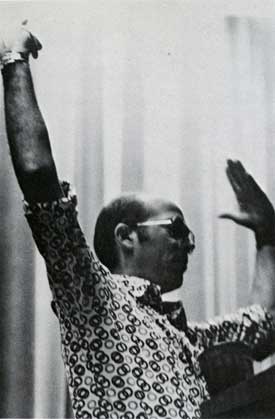
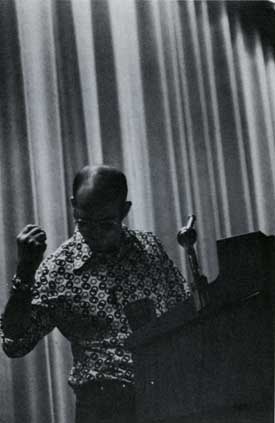
Hunter S. Thompson at Page AuditoriumHunter S. Thompson took the stage at Page Auditorium on October 22nd, 1974 at 8:50 PM. He was thirty five minutes late, visibly inebriated, and apparently quite unhappy to be there. He began his remarks to the packed auditorium of 1,500 saying, “I have no speech, nothing to say; I feel like a piece of meat.”

According to newspaper articles and editorials following the event, throughout the forty minutes Thompson remained onstage he dipped in and out of comprehensibility, exchanged insults and invectives with the audience, wrestled with a microphone, and bemoaned the lack of substance apparent in the questions written by the audience on 3×5 index cards. He read off one of the questions, “What is the happiest experience you’ve had in the past two weeks?” “That’s crap,” was the reply as he tossed the cards to the floor.

“Are you serious? The level of questions from this audience makes any sort of exchange completely impossible.”

As Thompson’s behavior appeared to become increasingly erratic, including asking himself questions and mumbling incomprehensible answers, worried administrators were having frantic discussions backstage attempting to decide how to handle the situation. At 9:05 they decided to let the speech continue and reevaluate the situation at 9:30. As 9:30 approached, Thompson began attempting to remove a fixed microphone from the podium in an effort to give it to an audience member asking a largely inaudible question about the rise of consumer politics. In failing to separate the microphone, he began wrestling with it, kicking the podium and the chairs onstage, and flung his bourbon onto the stage curtain. The bourbon was the final straw, and Linda Simmons, the Union program director, came on stage and asked him to leave. Although a third of the students attending had already left the auditorium, those remaining booed as Thompson left the stage, accusing the administration of curtailing free speech.

Hunter S. Thompson at Page AuditoriumOut on the lawn behind the auditorium after the event, Thompson sat with over a hundred students for an hour and a half in a more informal setting before leaving the campus.

Over the next few days, several newspaper articles were written on the event, and many students sent letters to the editor both praising and decrying the appearance. The University refused to pay the speaking fee, claiming that Thompson had violated the terms of his contract. The decision was not contested by the marketing firm who had contracted Thompson for the event.

One letter to the editor, however, never saw the light of day: Thompson’s himself. Thompson’s side of the story, in all of its gonzo glory, is part of the records of the Major Speakers committee.

He starts with a description of his state of intoxication while writing the letter, and discloses his state of intoxication while getting onstage at Page. Settling down, he states he wants to set the record straight as to exactly what happened at “J.B. Duke’s carcinogenic citadel. . . . [his] Southern Sanctuary for wayward New Jersey lads.”

Surveying the audience, I found 3,000 youthful, transvestite politicos, clutching their law boards and caressing their left legs. I decided to hallucinate them into 3,000 animated (and horny) Okra plants so I could begin my speech, speaking Okraese (Too-Maa-Too) in my best drawl. . . . Suddenly I realized the microphone was a local cottonmouth with heparin-filled fangs. While wrestling with the snake, I sensed danger from the rear and quickly lit my handy glass of Bacardi 151 and ether and launched it at the curtain, ran outdoors and evacuated the Nicotinic city.

If you want to see Thompson’s full letter, the newspaper articles and editorials the appearance sparked, or any of the other Major Speakers records, they, and much more, are accessible at the Duke University Archives.

Post contributed by Matt Schaefer, Drill Intern for the Duke University Archives.

Researching Black Health in the South

It was a great pleasure to conduct research at the Rubenstein Rare Book & Manuscript Library at Duke. As a recipient of the John Hope Franklin Research Center for African and African American History and Culture travel grant, I looked forward to exploring the Library’s holdings that would advance my understanding of black women’s history.

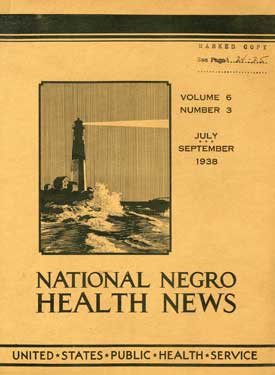
National Negro Health News. From the Alliance for Guidance of Rural Youth Records.
National Negro Health News, Vol. 6, no. 3. From the Alliance for Guidance of Rural Youth Records.

My dissertation project, “Mind, Soul, Body, and Race: Black Women’s Physical Culture, 1900-1939,” investigates the structural barriers to health and fitness for black women and the ways in which they circumvented those barriers and engaged in the physical culture movement. I examine how black women used purposeful exercise to create a new, fit vision of black womanhood that had implications for public health, recreation, and ideas of beauty, citizenship, and racial uplift. As a national project, I want to capture how Southern women, who had even less resources and access to physical culture, participated in the movement.

A significant portion of my dissertation discusses the state of black health and the Library proved to be a valuable repository for exploring the public health aspects of black southern history. The archivists were informed and genuinely interested in assisting researchers and with their help; I consulted about a half a dozen collections in all including the African American Photo Collection, the Alliance for Guidance of Rural Youth records, and the North Carolina Mutual Life Insurance Company archives.

One of the most useful collections was the Alliance for Guidance of Rural Youth. Although the Alliance was primarily a vocational guidance service organization, it sought to address several issues affecting poor, rural young people in the first half of the twentieth century including health issues. I found several documents from the collection related to health campaigns and the barriers to health for black people in the South. For example, a note in the 1934 National Conference on Negro Education proceedings indicated that “environmental rather than racial factors” compromised black health including low income, insufficient housing, and limited access to hospitals, preventive care, and recreational facilities. As it relates to black women’s health, the collection describes some of the difficulties black women had in accessing health information and clinics for their obstetric needs. The collection also contains sources on black unemployment, the black nursing profession, diet and malnutrition, and leisure during the New Deal era.

Additional records at the Library on black health in the twentieth century include William J. Covington’s physician account books and the thesis, Black Health in Segregated Durham.

Post contributed by Ava Purkiss, PhD candidate, University of Texas at Austin and 2012-2013 Franklin Travel Grant recipient.