Category Archives: From Our Collections

W. E. B. DuBois in the Charles N. Hunter Papers

Post contributed by Lucy Dong, T’20,  Middlesworth Social Media and Outreach Fellow (2019-2020)

Back in February, I was busy combing the archives for cool stories and important figures in black history to share on our social media (follow us on Instagram!) That’s when Dr. Trudi Abel,  Research Services Archivist, tipped me off to an interesting find in the Charles N. Hunter Papers, 1850s-1932 , a black educator, journalist, and reformer from Raleigh, North Carolina. The Hunter papers are all digitized, so you can check them out even while the Rubenstein is closed.

Dr. Abel has taught a course called Digital Durham for many years, and she’s found that the Charles N. Hunter Papers are especially underutilized for what it reveals about education of black students in Durham. For example, in some of his correspondence, we get insight into the beginning days of what was called the Durham Colored Graded School. Later named the Whitted School after their principal Rev. James A. Whitted (Durham’s first black principal), the Durham Colored Graded School was created in response to the earlier Durham Graded School which gave only white students access to the modern graded model of teaching by age group.

Among letters to other educators, the nation’s first black congressmen, and more personal family matters, there’s a letter from prominent black scholar W. E. B Du Bois.  Du Bois and Booker T. Washington happened to visit Durham in the same year, both commenting on the rich culture and entrepreneurial spirit of its black community during Reconstruction. One primary symbol of that prosperity was North Carolina Mutual Insurance, created by black entrepreneurs to serve their community, which established (white) insurance companies refused to service. NC Mutual paved the way for a flourishing, though segregated, black business district.

Washington saw Durham as a great example of black people helping themselves out of poverty and saw segregation as a reasonable means to achieve “racial self-help and uplift.” Du Bois celebrated the success of Durham’s black community, but generally pushed harder to demand full civil rights. In this letter, Du Bois is seeking recommendations for someone to help him do some sociological studies on social improvement in black communities, especially pertaining to the South.
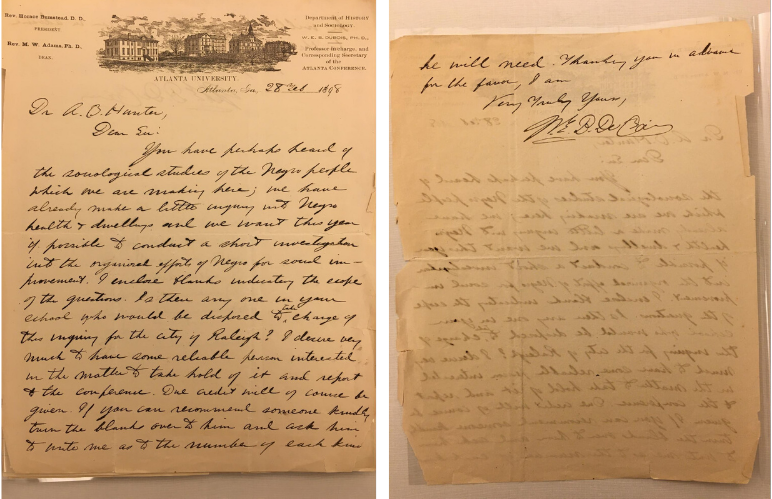
Front and back of handwritten letter from DuBois to Hunter. On letterhead from Atlanta University.

Can you make out all the words here? Dr. Abel regularly has her students do transcription projects to become familiar with reading older documents. The handwriting is not the easiest thing to read, but thanks to contextual clues and some corrections by Dr. Abel, I came up with the following:

Dr. A.B. Hunter, Dear Sir:

You have perhaps heard of the sociological studies of the Negro people which we are making here; we have already made a little inquiry with Negro health and dwellings and we want this year if possible to conduct a short investigation into the organizational efforts of Negro [sic] for social improvement. I enclose blanks [survey forms] indicating the scope of the questions. Is there anyone in your school who would be disposed to take charge of the inquiry for the city of Raleigh? I desire very much to have some reliable person interested in the matter to take hold of it and report to the conference. Due credit will of course be given. If you recommend someone kindly turn the blanks over to him and ask him to write me as to the number of each kind he will need. Thanking you in advance for the favor, I am

Very Truly Yours,
W. E. B DuBois

But wait, I thought these were the records of Charles N. Hunter, not A. B. Hunter. Were they related? Why was this piece of correspondence included in Charles N. Hunter’s personal records? A separate letter provides our missing link:

Handwritten letter from A.B. Hunter to Charles Hunter, on letterhead for St. Augustines School in Raleigh, NC.

My dear Mr. Hunter,

I enclose Prof. DuBois’ letter and have written him that you were hopefully most familiar with the societies he indicated in his letter. I hope you will be able to undertake the work. I regard his investigation as of very great importance. Will you kindly write him.

Very truly yours,
A.B. Hunter

Rev A. B. Hunter, Dean of St. Augustine’s School – now St. Augustine’s University, a historically black college in Raleigh – recommended Charles N. Hunter to help with Du Bois’ study. Quick searches into ancestry records and census documents did not indicate a familial connection.

Thanks to Dr. Abel for this fun experience piecing together the context and the connections between these three black educators. It was exciting to first interpret the handwritten letter, then search for the reason it was included in this collection and learn a little more about Durham’s past. Such are the small thrills of doing work in the archives–turning over fragile pieces of history to uncover things I didn’t know I didn’t know.
So Many Dates! : Rubenstein Library Test Kitchen

Post contributed by Lucy VanderKamp, Stacks Manager (Library Associate for Research Services)

Cover of Foods from Suny Lands, feautring a man in the foreground wearing a head covering and carrying a large basket of dates, behind him are two camels, a palm tree, and a boat on a canal.
.

I came across this 1925 cookbook – Foods from Sunny Lands – and it struck a chord: I had just made a date and nut bar to keep me eating healthy snacks. It seems we may not be the only household requiring gummy bears to fill some sort of stay-at-home-related need for sugary, fruity, chewy wads (out of stock on Amazon!). Dates could be a good alternative!

As may be expected from an American cookbook from 1925, this book depicts people of color one-dimensionally and seems to romanticize and exoticize Middle Eastern culture and foods.

The authors also make many grandiose claims about health and diet. There are a couple statements that seem imminently modern, though! This from page 12: “If we were to reduce our quota of white bread, cane sugar, candy and often too generous meat ration… substituting more green vegetables and sun-ripened fruits… we should pay the doctor and dentist a great deal less.” Same story 100 years later!Page opening from the cookbook, it is illustrated with images of Middle Eastern workers loading crates onto or off of a boat. .

On to the recipes! I tried the three below thinking I’d only have to “cut small” pieces of dates one time. I also felt the need for muffins and two types of cookies – don’t ask me why.

Rich Date Muffins

Recipe for Rich Date Muffins

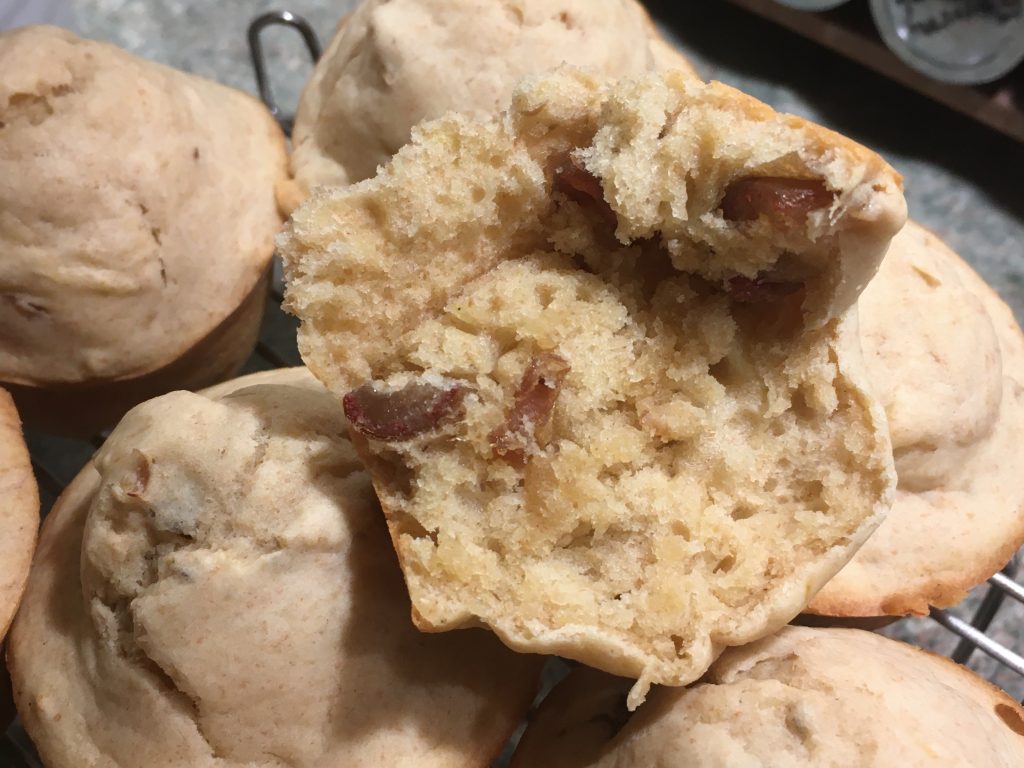
For the muffins, I opted to not use 4 teaspoons of baking powder. I bake muffins often and none of my recipes call for anywhere near this amount. Maybe there was something different about baking powder 100 years ago? I went with 2 teaspoons. Also, I added one mashed banana for some additional sweetness (2 tablespoons of sugar isn’t very much!). These turned out fine, a little doughy, not what I would call “rich,” but fine.

Photo of the interior of one of the date muffins

Date Crisps

Recipe for Date Crisps

The crisps turned out tasty but definitely not “crisp.” I even tried letting a few get very dark to see if they’d crisp up. They didn’t.

The dough was super hard to work with, too. I tried chilling it for 20 minutes to see if it’d be less wet but that didn’t really help. I added a ton of flour to keep it from sticking during the rolling out but I wasn’t able to get it very thin. Maybe ¼ inch. They also needed to cook about twice as long as the recipe said. Maybe because they were too thick? Oh and also, it’s hard to cut out rounds when there are chunks of dates in the cookies! But I might recommend these. Very sweet and a nice soft texture.

Collage showing a not-so crispy crisp on the left and eight crisps from above on the right, they look a little like chocolate chip cookies


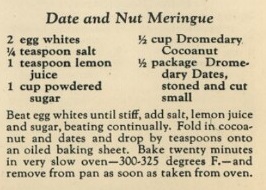
Date and Nut Meringue

Date and Nut Meringue Recipe

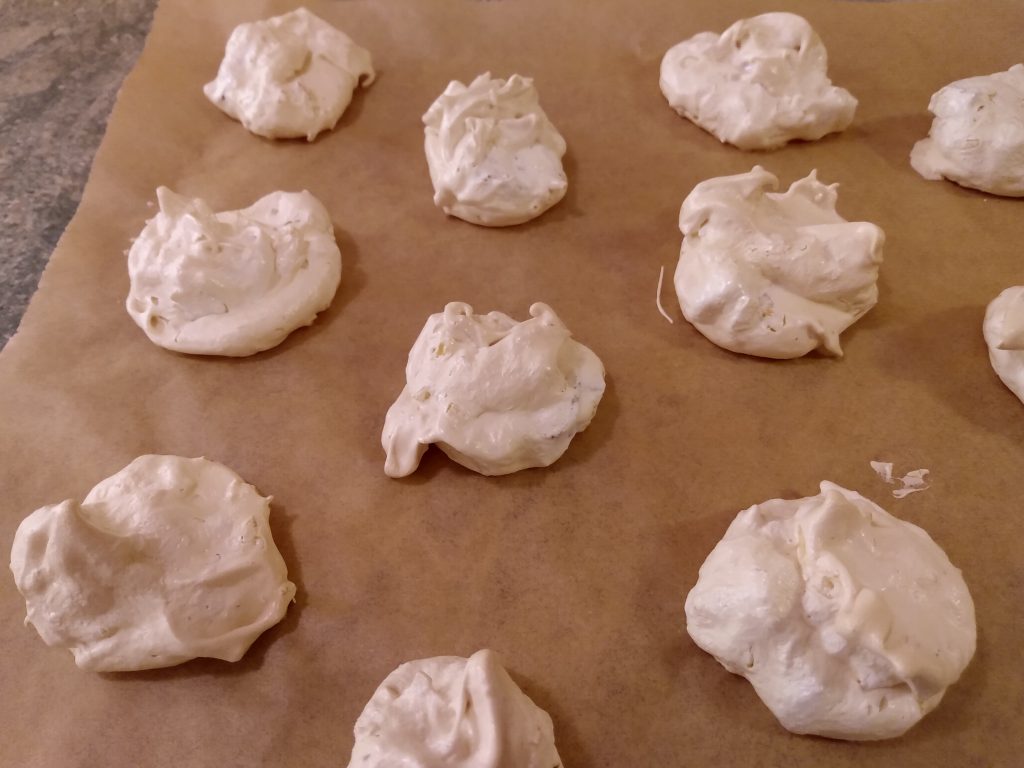
And the meringues… these turned out good! I used ½ cup chopped dates as I didn’t know what “½ package” would’ve been. Also, I’ve made meringues a couple times and had usually left them to cool in the oven so I did that. I took them out after about 20-30 minutes in the turned-off oven.

Cooked meringues on parchment paper

A few things I learned as a result of this cookbook:

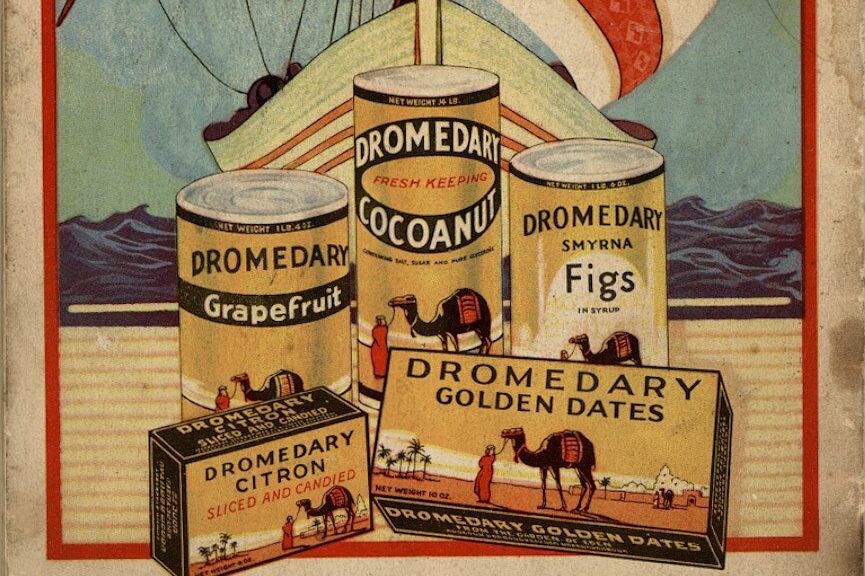
    1. This Hills Brothers Company (think cans of terrible coffee) created Dromedary Food Products in the early 1900s.
    2. Dromedary is the word for Arabian Camel.
    3. One of the main factors in the success of Dromedary Food Products was an effort to alter the American consumer’s view of “packaged food.” Prior to this, when fresh food was wrapped up in a package it was because it was damaged, unattractive, or slightly old. The advertising campaigns for Dromedary focused on the usefulness of varying sizes of packages and the freshness they provided.
    4. Dates were touted as a good source of “lime” on page 4 of this cookbook by Dr. John Harvey Kellogg – famous corn flakes inventor also known for his pro-Eugenics views and for running a tuberculosis sanitarium. Lime starvation was noted as a harbinger to or result of tuberculosis.

Back cover of the cookbook with an illustrated ad for Dromedary products including figs, coconut, and dates.

X Marks the Spot: Adding Coordinates to Rare Maps’ Catalog Records

Blog Post Contributed by Liz Adams, Rare Materials Cataloger

The Rubenstein Library has 2,142 individually cataloged printed maps, collectively covering nearly the entire world. There are aerial views of Alexandria, Egypt and Venice, Italy; fire insurance maps of our own North Carolina and ones of nearby Tennessee and Virginia; and pre-1800 (or what we call “early”) maps of what is now the United States. We have maps charting rivers in Southeast Asia and thematic ones related to public health and nuclear proliferation. Our maps perform dual functions: they orient users to particular places and ideas in particular times and reveal the beliefs of the map creators about those places and the wider world.

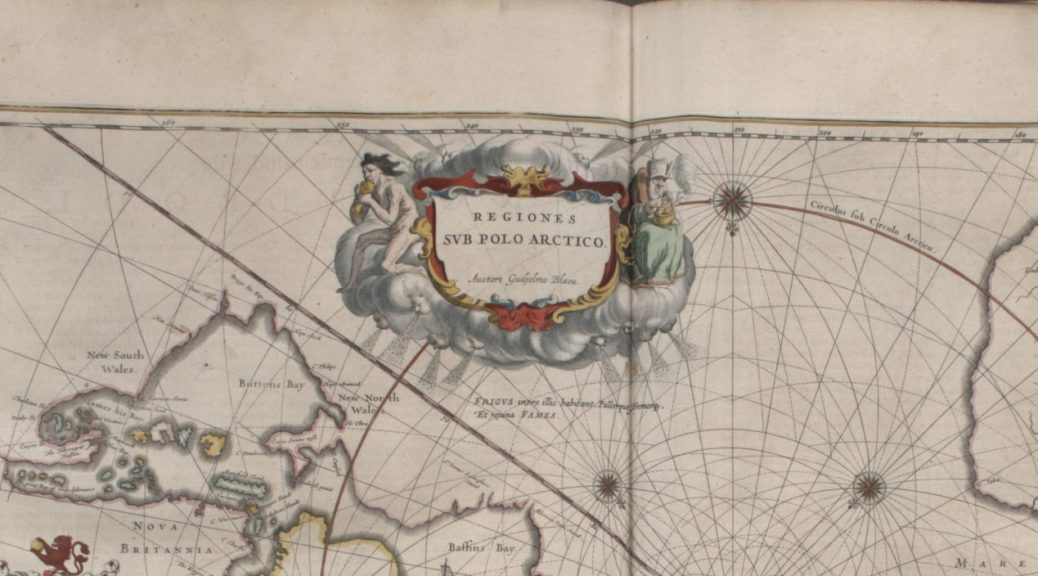
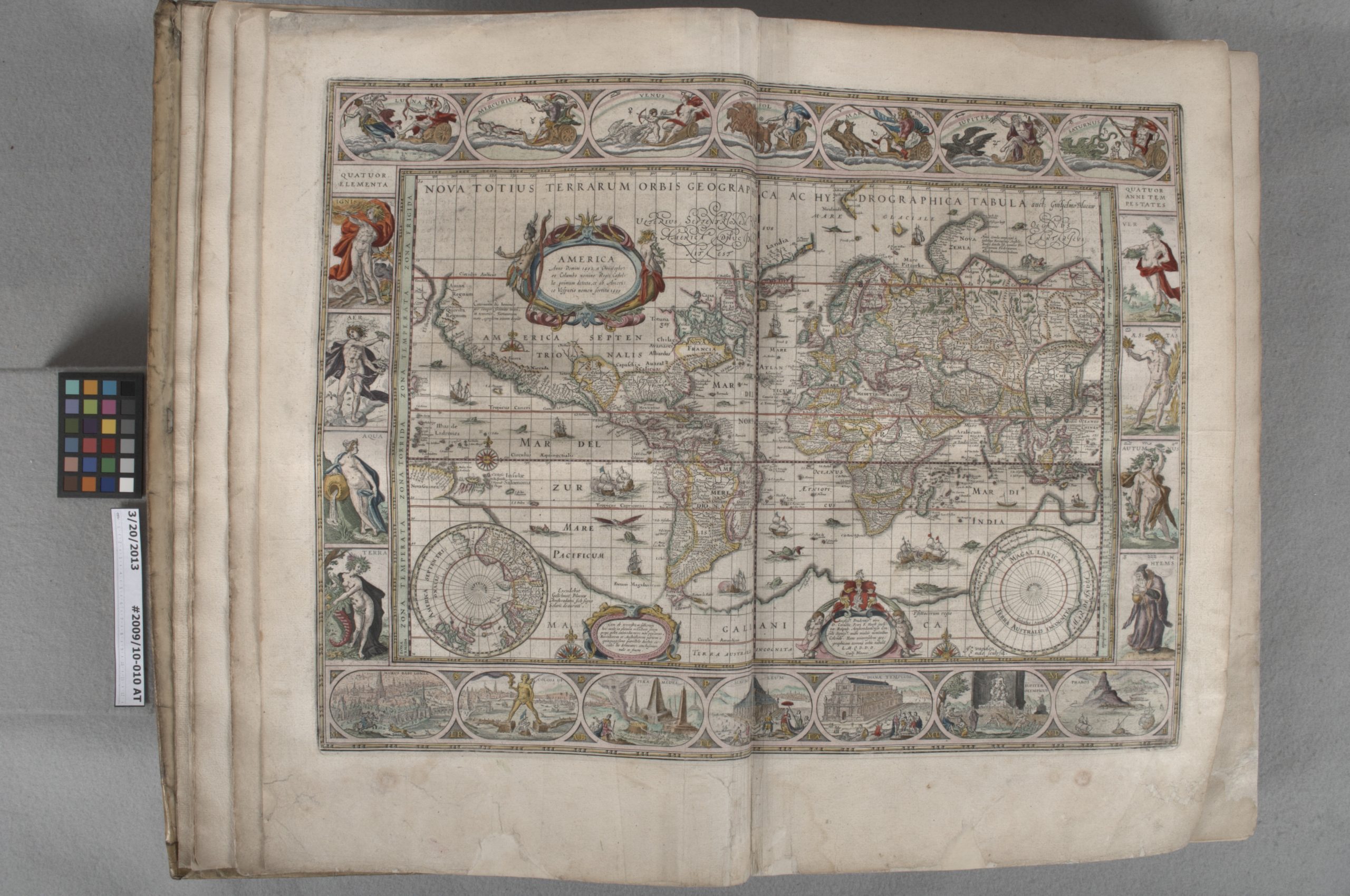
Elaborate printed map showing an early depiction of North and South America
Map of America from Blaeu’s Toonneel des aerdriicx, ofte nievwe atlas, dat is Beschryving van alle landen; nu nieulycx uytgegeven, 1648.

It’s a truism that early printed maps look a little different to modern eyes. This is partly the result of imprecise mathematical knowledge prior to the 18th century. According to David Woodward in The history of cartography, “before careful measurement, distances from place to place could be roughly paced” (13). “Roughly” is the key word. These differences are also bound up in the original goals of the maps, which in the case of Western European countries, often included economic, religious, and political expansion nearby and into faraway places (that is, colonialism) (Woodward 19). And finally, and very much related to the first two points, the world has never been static. For example, there was once a province called Carolina that included North Carolina and South Carolina as well as parts of Florida, Georgia, Alabama, Tennessee, and Mississippi. Things change.

A map catalog record with coordinates under Scale.

I’m a cataloger, and catalogers want to describe those early maps accurately. But how do we do that when distance was “roughly” measured, or when place names and boundaries have changed? For example, how do we document a map showing that Texas once “included much of what later became Kansas, Colorado, Wyoming, New Mexico, and Oklahoma” (Lepore 222)? Subject headings do some of that work in a catalog record, but geographic headings specifically relate to modern boundaries, not historic. The real heavy lifting comes from including bounding coordinates, the easternmost and westernmost longitudes and northernmost and southernmost latitudes seen on a map. We provide those coordinates in two places in the record, one more visible than the other. If you look at one of our catalog records online, you’ll see the coordinates under “Scale.” We also include those same coordinates as coded data in a separate area in the MARC record (see row below beginning with “=034”). This coded data is very precisely structured data. You can’t see it in our online catalog, but if you ever need access to it, let us know! We’re here and happy to help.

A record in our data editing software. The added coordinate data is circled in red.
A section of the United States with it's coordinates listed below.
Finding the coordinates using Bounding Box.

Adding coordinates to map records is a relatively new practice, and not all Rubenstein Library maps include that data. We’re trying to change that. Using a combination of data editing software, and digitized versions of maps, we’ve begun adding that data point to our early printed map records. Doing this work today has an immediate impact for researchers. In our online records, you can see the coordinates and use that data to make research decisions. It also serves an important task for the future. Coordinate data is easily accessible to librarians and can be changed into other data standards for use in digital humanities projects (Kiser & Smeltekop). Without coordinates, this work may be at a standstill.

Since we began this project a few weeks ago, we’ve made changes to over 100 hundred records, with no plans to stop. We still have several hundred to go!

Want to know more about maps? We don’t blame you! In 2013, Duke students in Borderworks Lab curated “Mapping the City: a stranger’s guide,” an exhibit featuring maps and atlases held by the Rubenstein Library. The exhibit is online and is very cool.


Works Cited

Kiser, Tim, and Nicole Smeltekop. “A Method for Creating Scanned Map Metadata for Geoportals, Library Catalogs, and Digital Repositories: Reworking Existing MARC Records of Paper Maps to Create New Records for Their Scanned Counterparts.” Journal of Map & Geography Libraries, vol. 14, no. 2-3, Feb. 2018, pp. 109–131. Library, Information Science & Technology Abstracts with Full Text, doi:10.1080/15420353.2019.1640166.

Lepore, Jill. These Truths: a History of the United States. W.W. Norton & Company, 2019.

Woodward, David. “Cartography and the Renaissance: Continuity and Change.” History of Cartography, vol. 3:1, University of Chicago Press, 2007, pp. 3–24.

What’s Inside That Thing?: Scarificators and Medical Instrument Design

Post contributed by Brooke Guthrie, Research Services Librarian

There’s no denying it: artifacts are more fun when they come with sharp blades! And, in the History of Medicine Collections, we have a lot of sharp things! From giant amputation saws (for your less precise cutting needs) to more modern surgical kits, it’s a wonder we still have all of our fingers!

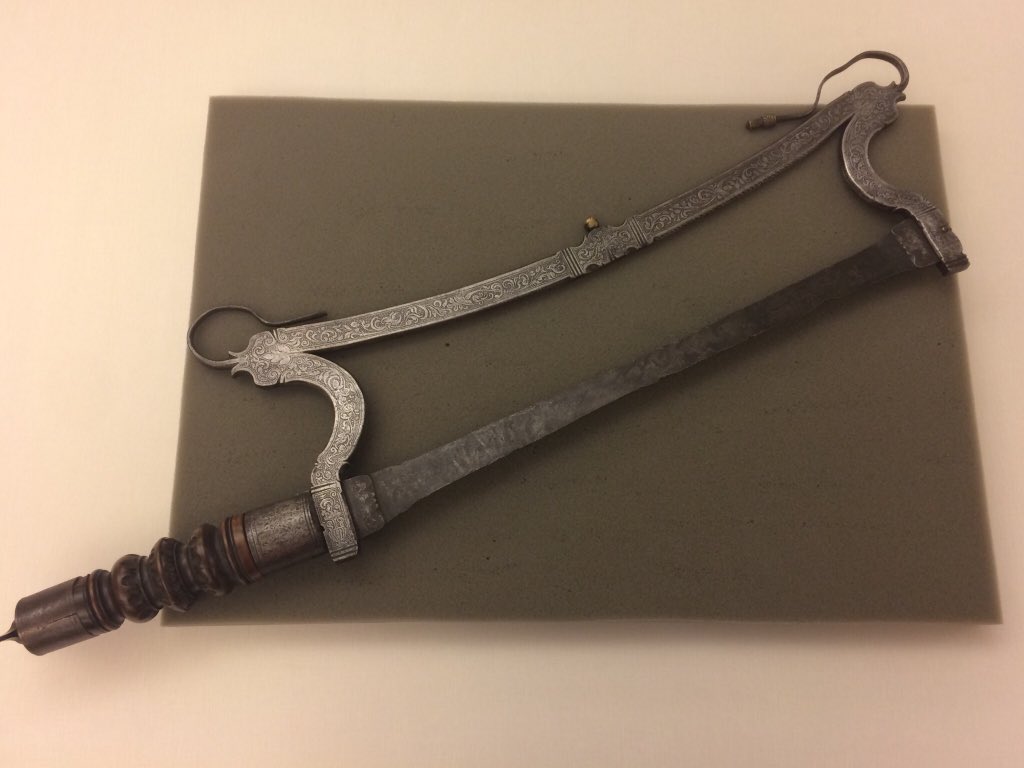
Image of large amputation saw.
Large amputation saw dating from the late 16th or early 17th century.

Not all of our blades are for such extreme procedures as amputations. We have many examples of smaller (but no less sharp) cutting tools intended for the once-popular procedure of bloodletting. Intended to balance the body’s humors and restore a patient to health, bloodletting was a standard medical procedure for centuries. Used to cure a range of ailments, bloodletting could involve draining a patient of large quantities of blood. Benjamin Rush, prominent physician and signer of the Declaration of Independence, recommended bloodletting as a treatment during the 1793 yellow fever outbreak in Philadelphia. [The Benjamin and Julia Stockton Rush papers, which document Rush’s medical work, have been digitized and are available online.]

If, for some reason, you needed to bleed someone, you could choose from a number of tools in our collection like three-bladed fleams, lancets with tortoiseshell handles, and scarificators with as many as sixteen blades. We even have bleeding bowls to keep all of that blood from dripping onto your carpet.  [Disclaimer: As appealing as it may sound, the Rubenstein Library does not recommend bloodletting. We recommend getting your medical advice from a medical professional and not a library blog.]

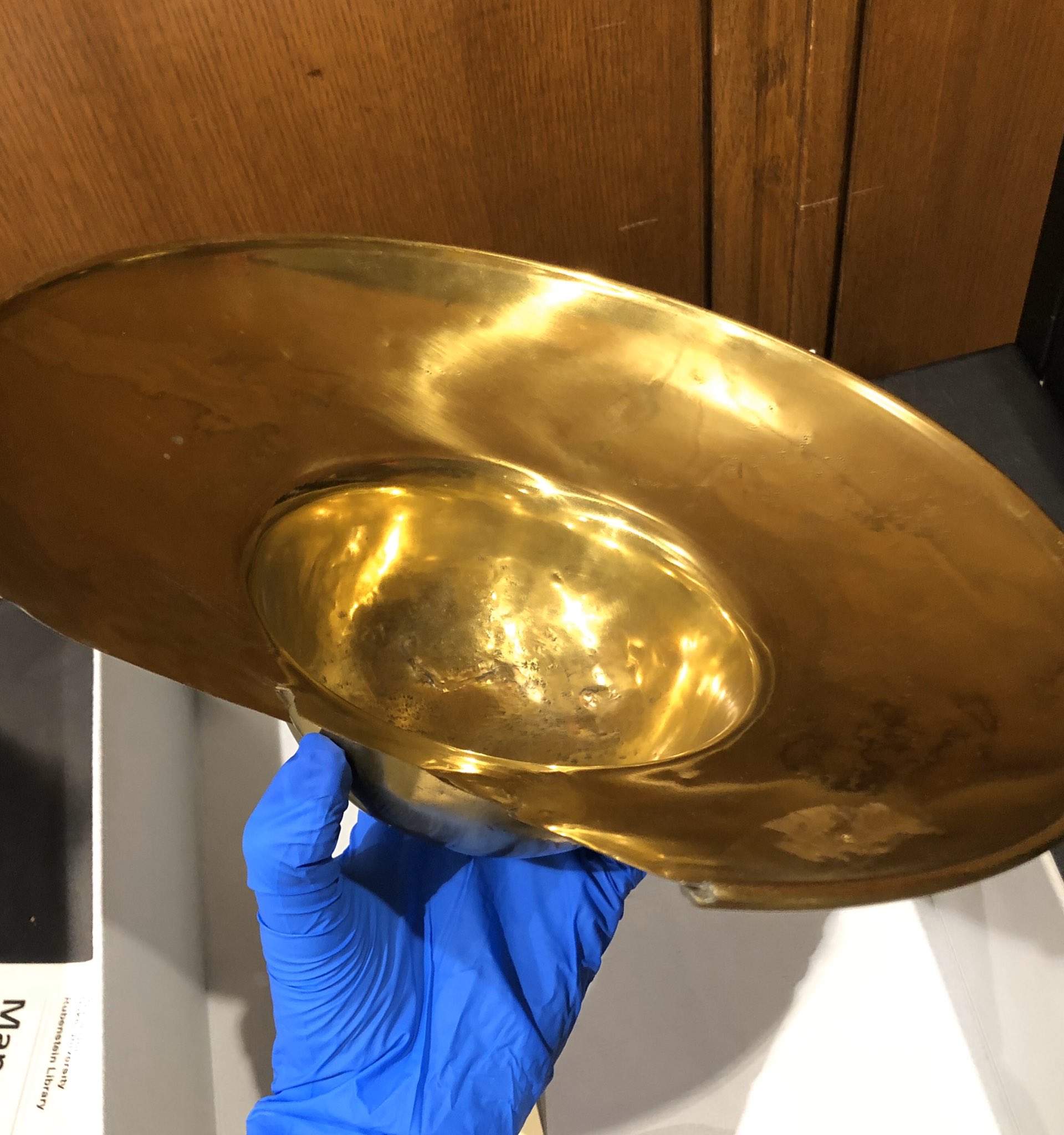
image of bloodletting bowl.
Bleeding bowl.

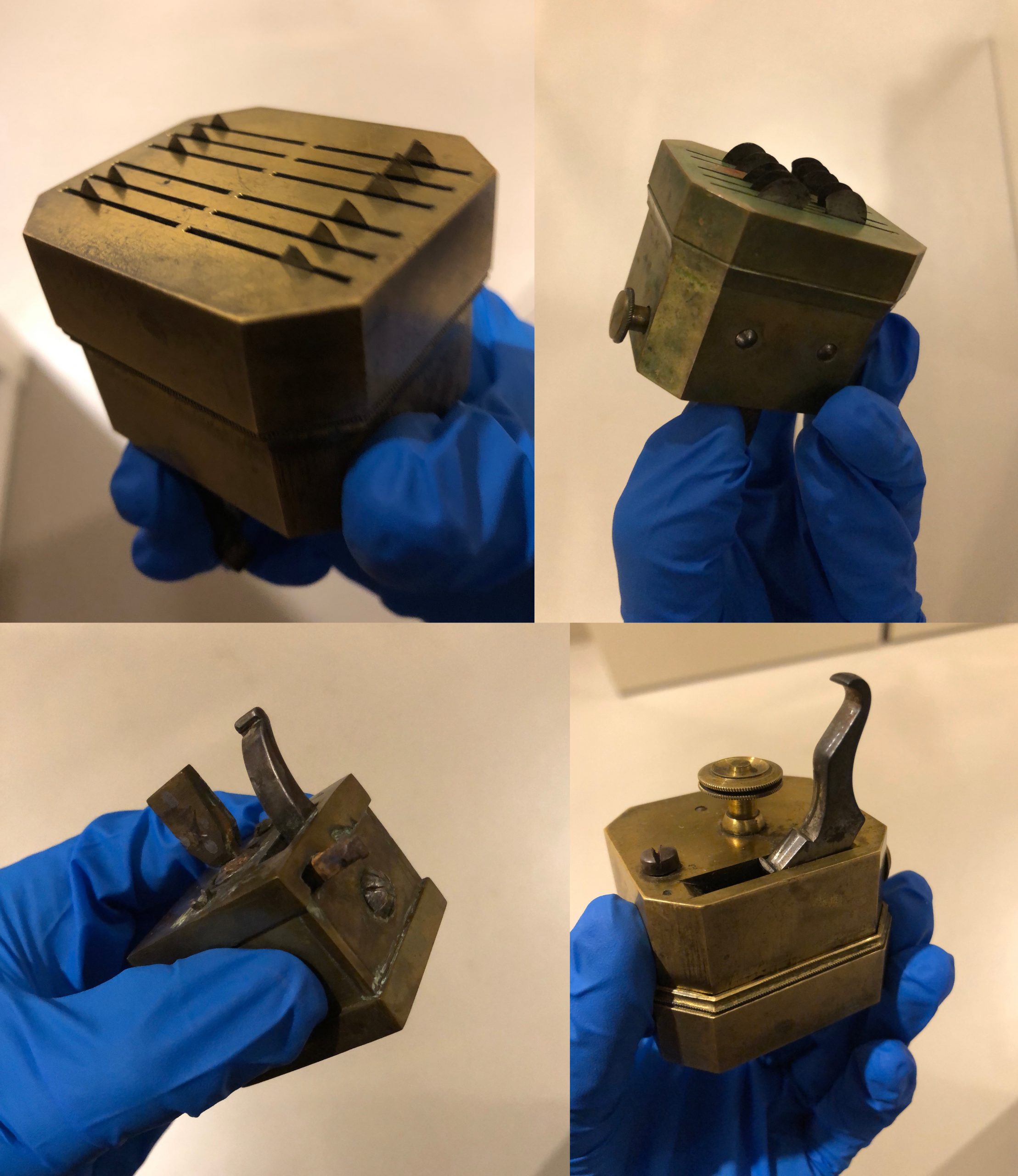
The many-bladed scarificator is an interesting device and we have several examples in our collection. Designed to create multiple cuts simultaneously, the narrow and quickly-delivered punctures produced by the scarificator made it a (supposedly) less painful bloodletting technique.

Images of several scarificator examples.
Some scarificator examples from our collection!

To use the scarificator, a doctor would retract the blades and cock them into position using the lever seen in the images above. The device would then be placed blade-side down on a patient’s arm and the button used to release the blades into the skin. [For an excellent demonstration, see this video from the Mütter Museum.]

The frustrating thing about the scarificator is that the inner workings are hidden. What’s going on in that little brass box? As you might imagine, we prefer that people not pry apart our artifacts to find out. Luckily, other items in the History of Medicine Collections can fill in details about the design of medical instruments as well as the thought process behind the design.

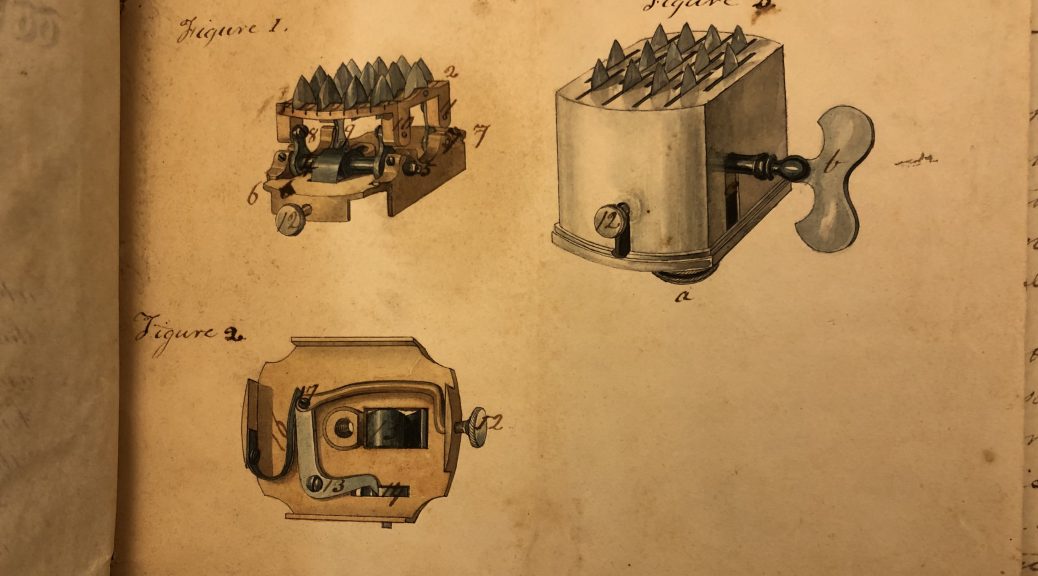
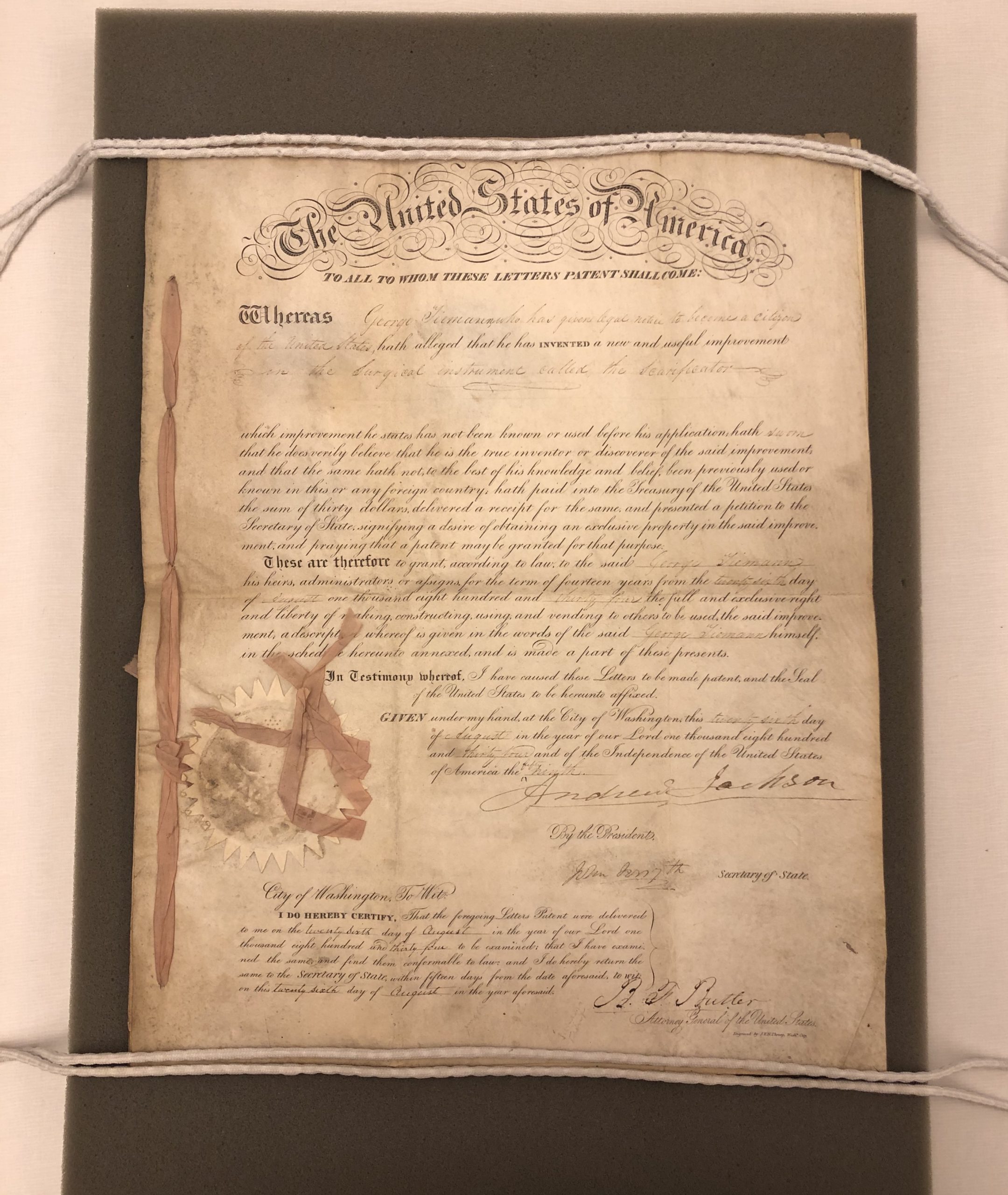
A patent is one way to learn more and we hold a patent granted to George Tiemann in 1834 for a scarificator. The patent is an impressive document: it is signed by President Andrew Jackson and includes several hand drawn images of Tiemann’s device along with Tiemann’s very detailed description of how the device works and is constructed.

image of patent text
Front page of George Tiemann’s patent with Andrew Jackson’s signature.
image of patent text and illustrations
George Tiemann’s illustrations and description of his scarificator design.

This is only a quick look at George Tiemann’s patent and we encourage further research into scarificators and other medical instruments (we have over 800 and many have been described and photographed). Maybe, if you are handy type of person, you could try to recreate Tiemann’s design!

Announcing our 2020-2021 Travel Grant Recipients

1946 magazine advertisement for american airlinesThe Rubenstein Rare Book & Manuscript Library is pleased to announce the recipients of the 2020-2021 travel grants. Our research centers annually award travel grants to students, scholars, and independent researches through a competitive application process. We extend a warm congratulations to this year’s awardees. We look forward to meeting and working with you!
Please note that due to widespread travel restrictions, the dates for completing travel during this grant cycle have been extended through December 2021.

Sallie Bingham Center for Women’s History and Culture (Mary Lily Research Grants):

Dena Aufseeser, Faculty, Department of Geography and Environmental Systems, University of Maryland, “Family Labor, Care, and Deservingness in the US.”

Elvis Bakaitis, Adjunct Reference Librarian, The Graduate Center, CUNY, “The Queer Legacy of Dyke Zines.”

Emily Larned, Faculty, Art and Art History, University of Connecticut, “The Efemmera Reissue Project.”

Sarah Heying, Ph.D. candidate, University of Mississippi, “An Examination of the Relationship Between Reproductive Politics and Southern Lesbian Literature Since 1970.”

Susana Sepulveda, Ph.D. candidate, Department of Gender and Women’s Studies, University of Arizona, “Travesando Chicana Punk”, an examination of Chicana punk identity formations through the production of cultural texts.

Tiana Wilson, Ph.D. candidate, University of Texas at Austin, “No Freedom Without All of Us: Recovering the Lasting Legacy of the Third World Women’s Alliance.”

John Hope Franklin Center for African and African American History and Culture:

Brandon Render, Ph.D. candidate, Department of History, University of Texas at Austin, “Color-Blind University: Race and Higher Education in the Twentieth Century.”

Erin Runions, Faculty, Department of Religious Studies, Pomona College, “Religious Instruction of Slaves on Fallen Angels and Hell in the Antebellum Period.”

Katherine Burns, Ph.D. candidate, Department of History, University of Edinburgh, “‘Keep this Unwritten History:’ Mapping African American Family Histories in ‘Information Wanted’ Advertisements, 1880-1902.”

Leonne Hudson, Faculty, Department of History, Kent State University, “Black American in Mourning: Their Reactions to the Assassination of Abraham Lincoln.”

Matthew Gordon, Ph.D. candidate, Department of History, University of Georgia, “American Memory and Martin Luther King, 1968-1983.”

Michael LeMahieu, Faculty, Department of English, “Post ‘54: The Reconstruction of Civil War Memory in American Literature after Brown v. Board.”

Harry H. Harkins T’73 Travel Grants for Lesbian, Gay, Bisexual, and Transgender History:

Amanda Stafford, Ph.D. candidate, School of History, University of Leeds, “The Radical Press and the New Left in Georgia, 1968-1976.”

Caitlyn Parker, Ph.D. candidate, American Studies Department, Purdue University, “Lesbians Politically Organizing Against the Carceral State from 1970-2000.”

John W. Hartman Center for Sales, Advertising, and Marketing History:

Andrew Wasserman, Independent Scholar, “The Public Art of Public Relations: Creating the New American City.”

Austin Porter, Faculty, Department of Art History and American Studies, Kenyon College, “Bankrolling Bombs: How Advertisers Helped Finance World War II.”

Elizabeth Zanoni, Faculty, Department of History, Old Dominion University, “Flight Fuel: A History of Airline Cuisine, 1945-1990.”

Hossain Shahriar, Ph.D. candidate, Department of Business Administration, School of Economics & Management, Lund University, “Gender Transgressive Advertising: A Multi-Sited Exploration of Fluid Gender Constructions in Market-Mediated Representations.”

Jesse Ritner, Ph.D. candidate, Department of History, University of Texas at Austin, “Making Snow: Weather, Technology, and the Rise of the American Ski Industry, 1900-Present.”

Joseph Larnerd, Faculty, Department of Art History, Drexel University, “Undercut: Rich Cut Glass in Working-Class Life in the Gilded Age.”

Katherine Parkin, Faculty, Department of History and Anthropology, Monmouth University, “Asian Automakers in the United States, 1970-1990.”

Meg Jones, Faculty, Communication, Culture & Technology, Georgetown University, “Cookies: The Story of Digital Consent, Consumer Privacy, and Transatlantic Computing.”

Ricardo Neuner, Ph.D. candidate, University of Konstanz, “Inside the American Consumer: The Psychology of Buying in Behavioral Research, 1950-1980.”

Stanley Fonseca, Ph.D. candidate, Department of History, University of Southern California, “Cruising: Capitalism, Sexuality, and Environment in Cruise Ship Tourism, 1930-2000.”

History of Medicine Collections:

Jackson Davidow, Theory and History of Art and Design, Rhode Island School of Design, “Picturing a Pandemic: South African AIDS Cultural Activism in a Global Context.”

Lisa Pruitt, Faculty, Department of History, Middle Tennessee State University, “Crippled: A History of Childhood Disability in America, 1860-1980.”

Morgan McCullough, Ph.D. candidate, Lyon G. Tyler Department of History, William and Mary, “Material Bodies: Race, Gender, and Women in the Early American South.”

Human Rights Archive:

Andrew Seber, Ph.D. candidate, Department of History, University of Chicago, “Neither Factory nor Farm: The Fallout of Late-Industrial Animal Agriculture in America, 1970-2000.”

Eugene (Charlie) Fanning, Ph.D. candidate, Department of History, University of Maryland, College Park, “Empire of The Everglades: A Global History of Agribusiness, Labor, and the Land in 20th Century South Florida.”

Jennifer Leigh, Ph.D. candidate, Department of Sociology, New York University, “Public Health vs. Pro-gun Politics: The Role of Racism in the Silencing of Research on Gun Violence, 1970-1996.”

Richard Branscomb, Ph.D. candidate, Department of English, Carnegie Mellon University, “Defending the Self, Preserving Community: Gun Rights, Paramilitarization, and the Radical Right, 1990-2005.”

Pan Am Innovations: Creating Pleasant Airline Travel

Post contributed by Leah Tams, Pan Am CLIR Grant Intern

With the outbreak of COVID-19 and the subsequent implementation of travel restrictions, social distancing, and quarantines, one of the industries being significantly affected is the airline industry. How airlines and the larger travel industry will recover from current events remains to be seen, but we can look back at the history of Pan American Airways (Pan Am) to see how they introduced innovations in order to overcome contemporary challenges and appeal to American travelers.

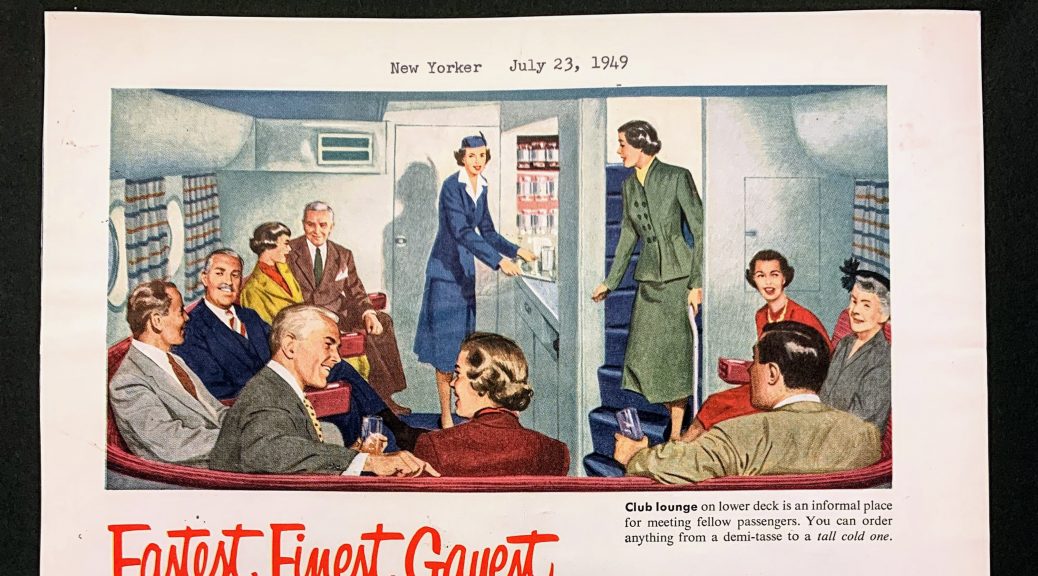
Advertisement for Pan Am’s Club Lounge, 1949.

A couple of Pan Am’s earlier innovations (late 1940s to early 1950s) in passenger service between the continental U.S. and other places—predominantly Hawaii, the Caribbean, and Europe—was the introduction of “Sleeperette Service” and “Club Lounges” on Boeing 377 flights (more popularly known as Pan Am’s Stratocruisers, specifically “The President” or “El Presidente” service). Pan Am’s Sleeperette Service featured large, comfortable armchair seats during the daylight portion of a flight, and at night the seats converted to bed-length compartments, complete with curtains for passenger privacy. Also available on Boeing 377 flights was Pan Am’s “Club Lounge,” which was located on the lower deck of the airplane. The Club Lounge was an informal place where passengers could congregate, socialize, and order “anything from a demi-tasse to a tall cold one.” In an era where airline travel still remained far more time-consuming and uncomfortable than it is today, these innovations from Pan Am were instrumental in creating comfortable environments and positive experiences for its passengers.

Before and after the flight, Pan Am endeavored to make flying as convenient as possible for its customers. One way in which they tried to accomplish this was with the construction of the Pan Am Terminal, later renamed the Worldport, at JFK Airport. The terminal had a large, saucer-like roof that extended far beyond the building and allowed aircraft to be parked underneath it. The impetus behind this design was to bring the plane to the passenger, thus creating proximity and convenience for Pan Am’s travelers.

Pan Am’s Worldport terminal at JFK airport.

Another innovation that Pan Am introduced to make travel more convenient was its helicopter flights. In 1965 they partnered with New York Airways to provide helicopter service between the Pan Am Building (now the MetLife Building) in Manhattan and JFK Airport in Queens. Later, Newark Airport was also added to this rotation. Despite the convenience that the helicopter service added for some passengers, Pan Am stopped these flights in the late 1970s after a series of fatal crashes on the route.

In the 1980s, Pan Am debuted its WorldExpress program, which allowed their passengers to bypass the hassles that came with connecting flights. Pan Am advertised WorldExpress as “One Ticket. One Check-In. One Baggage Claim. To The World,” and they made sure that connecting flights for their passengers were “just steps away, not terminals away.” Pan Am’s WorldExpress program thus strove to make airline travel as easy and convenient as possible for its passengers by eliminating some of the logistical barriers that continue to make travel difficult today.

Advertisement for Pan Am’s “Weatherproof Vacation” insurance, 1970s.

After creating good airline experiences, of course, came the actual vacation or occasion for travel. While we would probably all agree that the post-flight experience is completely out of airlines’ hands, in the 1970s Pan Am decided to team up with an insurance agency and guarantee its passengers a pleasant post-flight experience. In 1971 Pan Am introduced the “Weatherproof Vacation,” which it accomplished through a partnership with the American Home Insurance Company. For an “attractive” premium, Pan Am’s passengers could purchase Vacation Weather Insurance. This insurance plan ensured that if Pan Am’s passengers experienced rain or otherwise adverse weather on their vacations, they could receive a portion of their expenditures back. With its global reach well established by the 1970s, the assurance of a pleasant vacation was an innovative way for Pan Am to ensure that its passengers’ positive experience extended beyond that of the flight.

Outliving Outbreaks: Exploring Early Efforts to Fight Epidemics

Post contributed by Brooke Guthrie, Research Services Librarian and Rachel Ingold, Curator, History of Medicine Collections.

Philadelphia in 1793. New York in 1795. Gloucestershire in 1798. London in 1854. Crimean Peninsula in 1855.

This may seem like an unrelated list of places and dates, but each represents a particular moment in the history of our fight against infectious disease. From the earliest days of epidemiology to the experiments that launched our vaccinated world, these moments continue to resonate today. While most of us have more immediate concerns – from job security to our own physical and mental health – it is worth considering the roots of now-common disease maps or the idea of “social distancing” to slow infection rates.

The Rubenstein Library’s History of Medicine Collections has material related to the history of epidemics, pandemics, and infectious disease. Below you’ll find a sample of sources from us as well as resources from other institutions.

Yellow Fever, 1790s

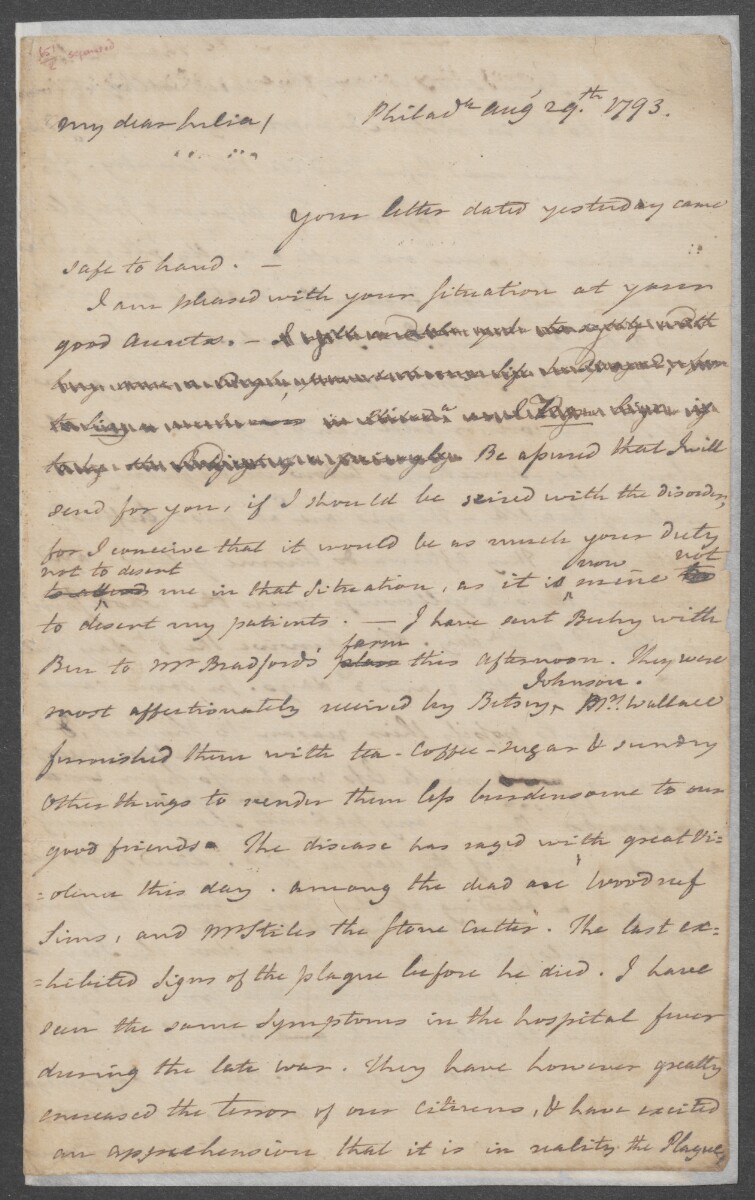
When yellow fever struck Philadelphia in 1793, nearly a tenth of the city’s population perished during the outbreak. Physicians struggled to understand how the disease spread and struggled to effectively treat the growing number of ill Philadelphians. One physician, Benjamin Rush, wrote to his wife throughout the outbreak and their letters offer a look at life during an epidemic.

These letters, part of the Benjamin and Julia Stockton Rush papers, are digitized and available online. A companion digital exhibit, Malignant Fever, curated by Mandy Cooper, provides more information about Rush and includes additional resources for understanding the 1793 outbreak.

Letter from Benjamin Rush to Julia Stockton Rush describing the symptoms of yellow fever and noting that all common remedies have failed. August 29, 1793.


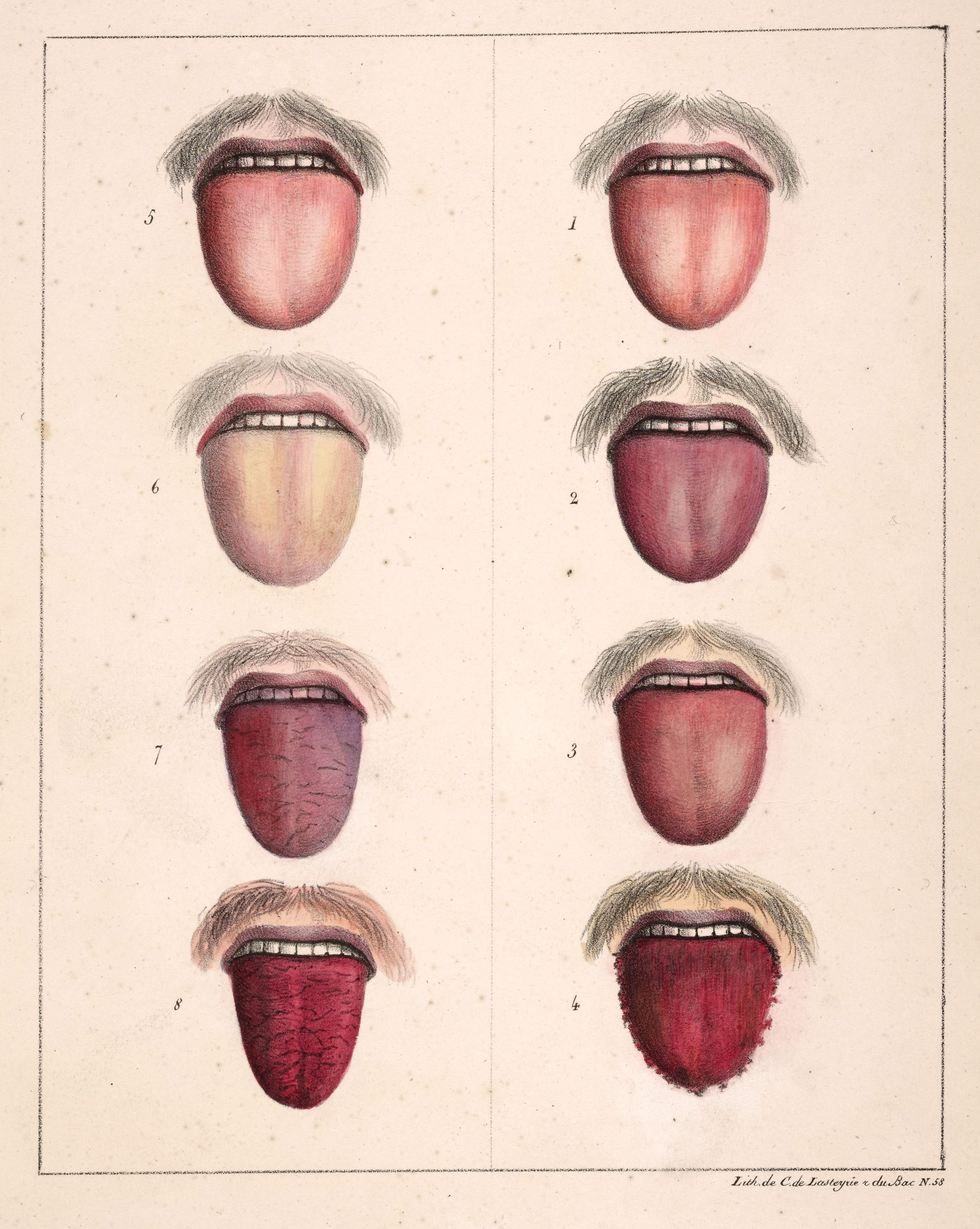
Image of the tongue during different stages of yellow fever, by Etienne Pariset, 1820.


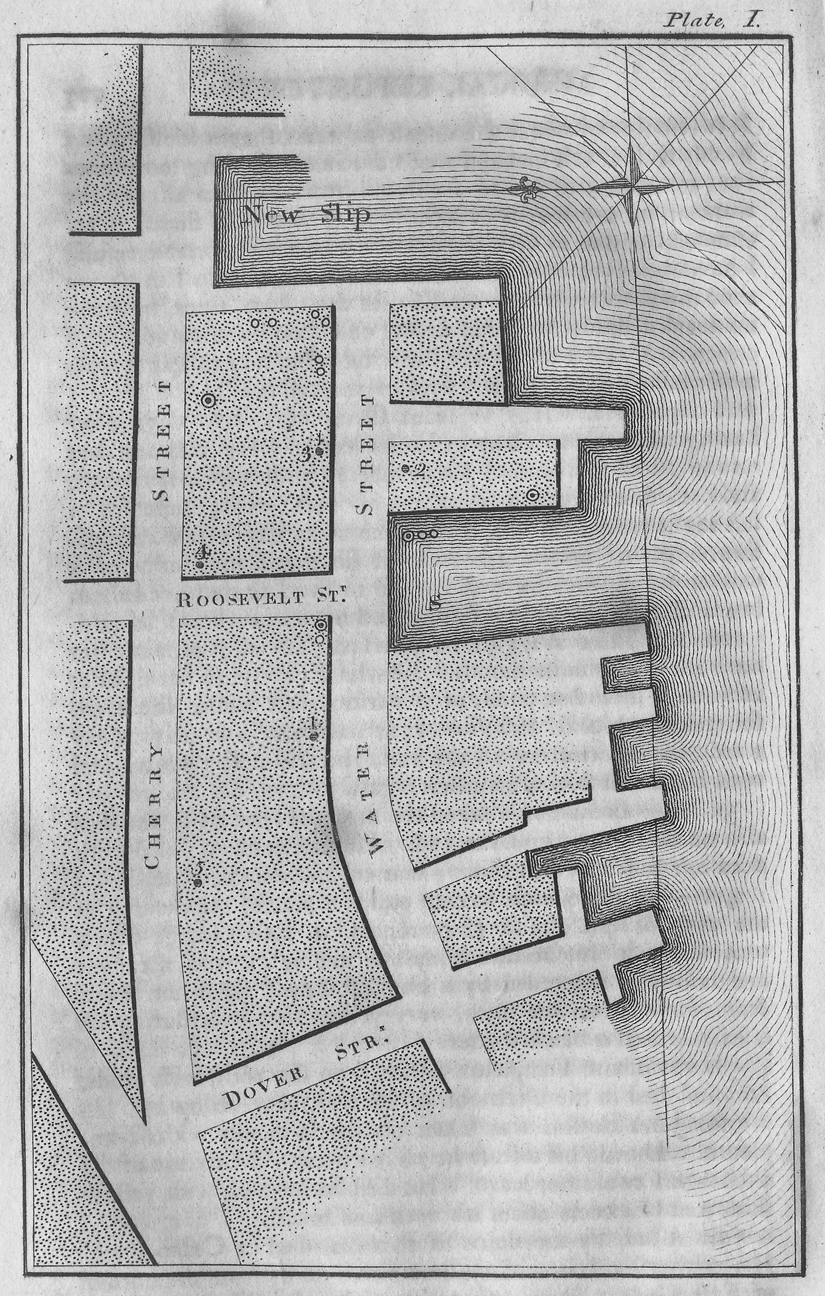
Other American cities were not immune to yellow fever and New York City saw an outbreak in 1795. Local physician Valentine Seamen, trying to locate the source of the disease, collected information about each case and created an early disease map using this data.

Valentine Seaman’s yellow fever map where the dots represent known cases of yellow fever and an “S” represents areas with waste or filth.

Seaman, despite his efforts, did not correctly identify the cause of yellow fever. He did note the presence of mosquitoes, but concluded that the accumulated filth near the city’s docks were to blame. Seaman’s case data, maps, and his analysis were published in The Medical Repository. The Rubenstein Library has a copy and a digitized version can be accessed through HathiTrust.

Cholera, London, 1854

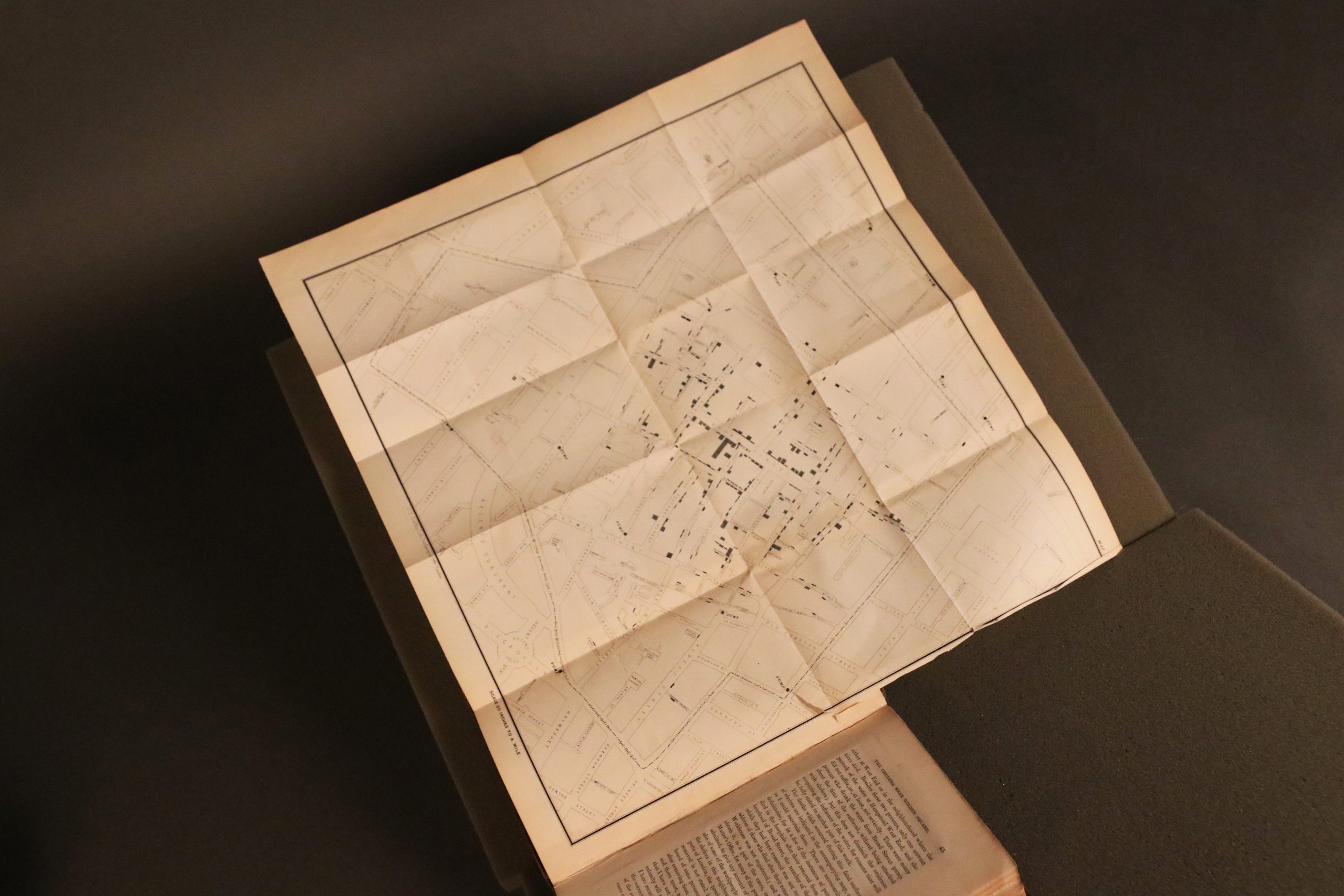
A later attempt to trace the source of a contagion through mapping was more successful. John Snow suspected that contaminated water was to blame for a cholera outbreak in London. Snow investigated each case and noted which water pump the infected individual used. He marked the cases on a map published in the 1855 edition of On the mode of communication of cholera.

John Snow’s map showing the spread of cholera in the Soho area of London.
Detail of cholera map showing the concentration of cases around the contaminated Broad Street pump.

Fortunately, Snow was right about the source of cholera. His data was convincing enough to have the water pump at the center of the outbreak disabled. The Rubenstein Library holds a rare copy of On the mode of communication of cholera (shown above).

Smallpox, 1790s

Decades before John Snow’s map, Edward Jenner investigated smallpox, a widespread and dangerous disease in the eighteenth century. Jenner created an early vaccine using material taken from a fresh cowpox lesion after observing that cowpox infection prevented subsequent smallpox infection. Jenner shared his discovery in An Inquiry into the causes and effects of the variolae vaccinae (1798). The library holds a copy of this book containing surprisingly lovely illustrations of infected arms. The library also holds a small collection of Edward Jenner’s papers that include letters discussing vaccination and a diary containing vaccination records.

Illustration of a cowpox infected arm from Jenner’s An inquiry into the causes and effects.


Camp Diseases, Crimean Peninsula, 1854-1855

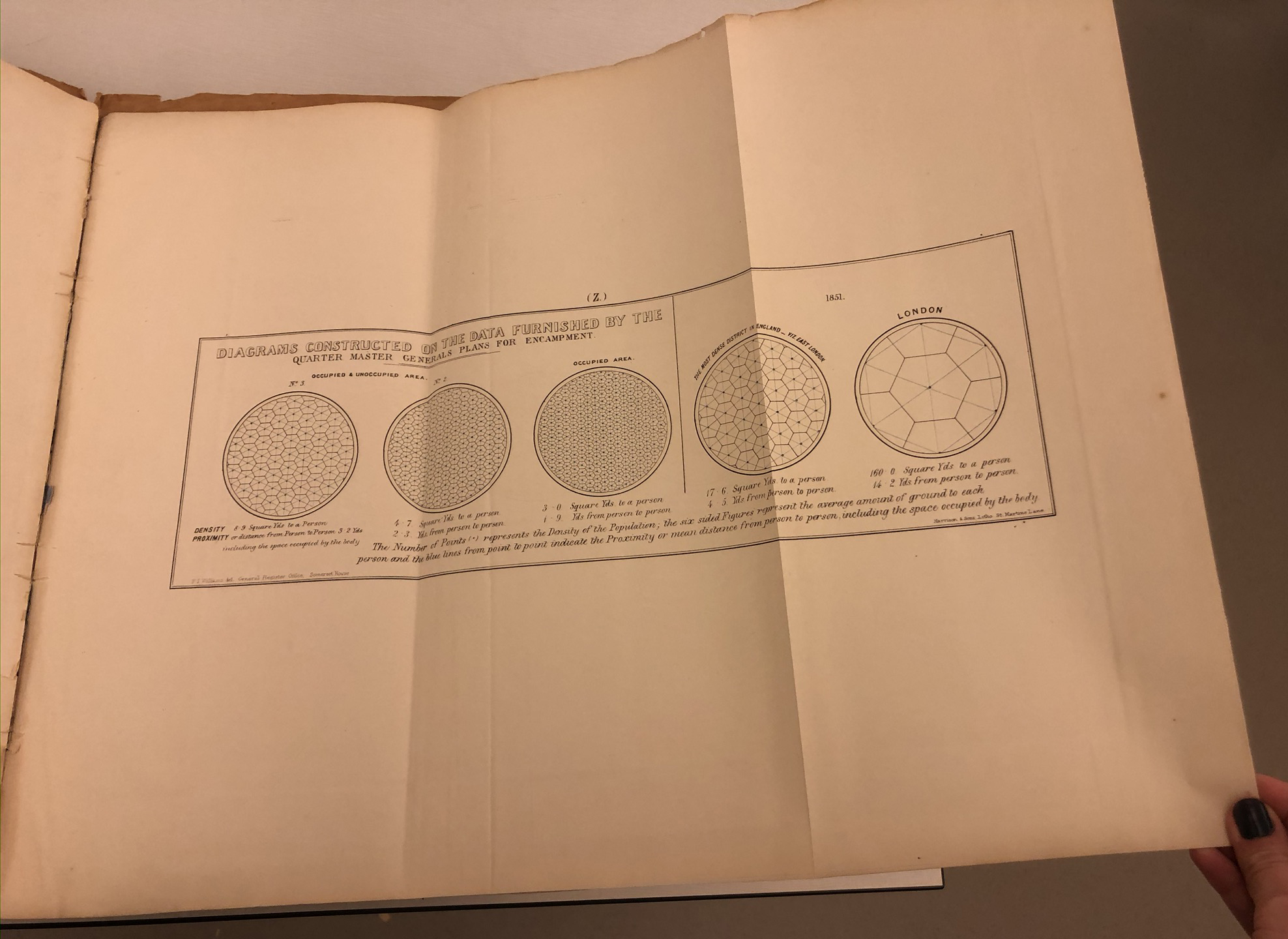
As a nurse during the Crimean War, Florence Nightingale saw large numbers of soldiers die from diseases like cholera, dysentery, tuberculosis, and typhus. Linking these deaths to poor sanitation, Nightingale worked to clean up military camps while also collecting data about the impact of disease on British soldiers.

In Mortality of the British Army (1858), Nightingale’s data is used to create visualizations that illustrate the poor camp conditions and make the case for sanitation reform. One visualization stands out as we practice “social distancing.” The image below compares the population densities in various locations and notes the amount of space per person. Densities in military camps, where disease was widespread, were noticeably higher than even places like urban London where people had more distance from their neighbors.

We hold a copy of this work (that is definitely worth seeing in person) and a digital copy is available through Internet Archive.

Diagrams of densities in military camps compared to those in London.


From our colleagues at other institutions, you can find other excellent resources on this topic:

Contagion: Historical Views of Diseases and Epidemics is a digital collection of sources from Harvard libraries. As their site explains, the goal is to provide historical context to current epidemiology and contribute to the understanding of the global, social-history, and public policy implications of disease. Materials include digitized books, manuscripts, pamphlets, and more. The site is organized around momentous historical outbreaks such as the 1793 Yellow Fever epidemic in Philadelphia and the 1918 Influenza outbreak in North America.

The National Library of Medicine and National Institute of Health also have a number of resources, such as health information guides from past pandemics. The National Library of Medicine hosts the  Global Health Events web archive, a resource that has archived selected websites from 2014 around major global health events such as Ebola and Zika.  The collection includes both websites and social media with the goal of offering a diverse and global perspective ranging from government and NGOs to healthcare workers and journalists.

This is by no means an exhaustive list of resources related to infectious disease and the attempts to stop its spread. If you want to explore more of these materials in the Rubenstein or find additional online resources, our “Guide to Researching Epidemics in the Rubenstein” is a good place to get started.

We encourage you to visit us when we reopen to the public! In the meantime, get in touch and let us know if you have questions!


Clydie F. Scarborough and the Scarborough Nursery School

Post contributed by John B. Gartrell, Director, John Hope Franklin Research Center

Born in 1899, Clydie Fullwood Scarborough was a native of Opelika, AL, and the daughter of former slaves who had no formal education. After studying chemistry and education at Talladega College, Clydie, moved to Durham upon graduation and received a position at Hillside High School to teach science and history. Her marriage to John C. Scarborough, owner of Scarborough Funeral Home and a leader among Durham’s African American businessmen, further immersed her in the affairs and interests of Durham’s African American community.

Scarborough with class
Clydie Scarborough (center) pictured with a group of nursery children (c. 1930s)

In 1925, John Scarborough purchased the old Lincoln Hospital building with plans to open a day care home for young children, many of whom resided in the African American community of Hayti. Scarborough felt a deep charitable need to provide better health conditions and care in his community. The home served infants, preschoolers, and school-age children, and Clydie served as one of the key caregivers in the early days of the home.

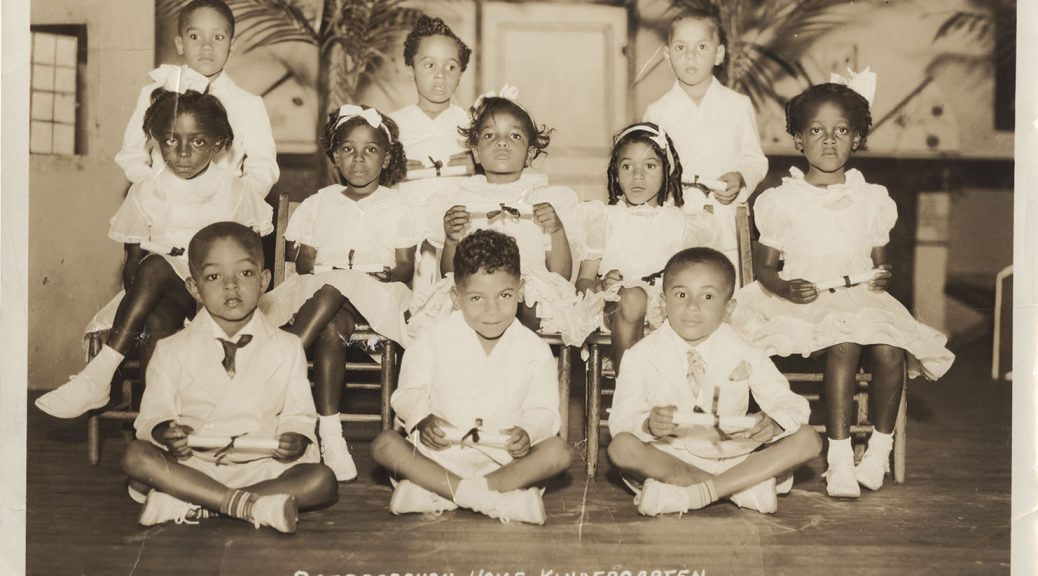
The creation of the Scarborough Nursery Home allowed Mrs. Scarborough to resume her career as an educator. In 1932 she became executive director of the home and instituted kindergarten facilities. By 1938, she was pressing for the home’s expansion and formal licensing by the North Carolina Department of Social Services. Through the 1940s, she found additional support for the school through federal funding and foundation entities including the United Way. The home became known as the Scarborough Nursery School, Inc.

Scarborough class grads 1937
Scarborough kindergarten class graduates (1937/8)

Under her 50 years of leadership, the school would nurture generations of Durham’s youth in their formative years while providing working families with reliable child care. Mrs. Scarborough’s dedication to service also extended far beyond her work with the school. She was a member of the YWCA, Durham Committee of Negro Affairs, NAACP, North Carolina Association for the Education of Young Children, and the Women-in-Action for the Prevention of Violence and its Causes Inc.

Now over 90 years old, Scarborough Nursery School, Inc. continues its mission today. It is the oldest licensed nursery school in the state of North Carolina. The Clydie F. Scarborough Papers are available for research in the David M. Rubenstein Rare Book & Manuscript Library at Duke.

Digital Opening Day

Post contributed by Josh Larkin Rowley, Reference Archivist for the John W. Hartman Center for Sales, Advertising, and Marketing History

If—like myself—you’re unaffiliated with the Communist Party, you’re no doubt mourning the absence of America’s Pastime today: baseball.  Today, March 26th, would have been Opening Day of the Major League Baseball season, replete with a slate of coast-to-coast televised games lasting nearly twelve hours.  To satiate some of the angst that I’m feeling, I decided to honor today by taking a tour through some baseball-related material in our incredible digital collections repository.  It’s not the same as hearing the crack of a bat, the slap of a ball hitting leather, or a wiener with a cold beer.  But in these difficult times, it will have to suffice.

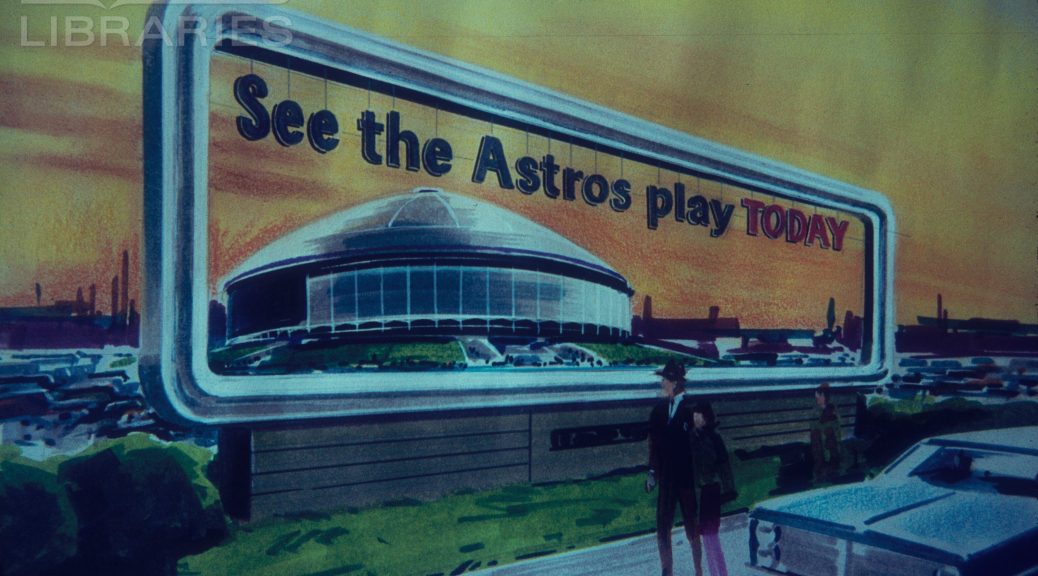
I love this artist’s rendering of a painted sign advertising the new Astrodome and the very commanding copy that accompanies it.  Completed in 1965 and home to the Houston Astros until 1999, the Astrodome was considered an architectural marvel and the “eighth wonder of the world.”  One major design flaw, though: how does one keep grass alive in a domed structure?

Painted sign advertising the new Astrodome.

I’ve never wanted to be with an imaginary family more than this one right now, sitting in front of a 12-inch staticky, black-and-white television.  And when the ballgame’s over, Pops can put on some Time Life Swing Era compilation records and fire up the grill.

Capehart Television advertisement, 1950.


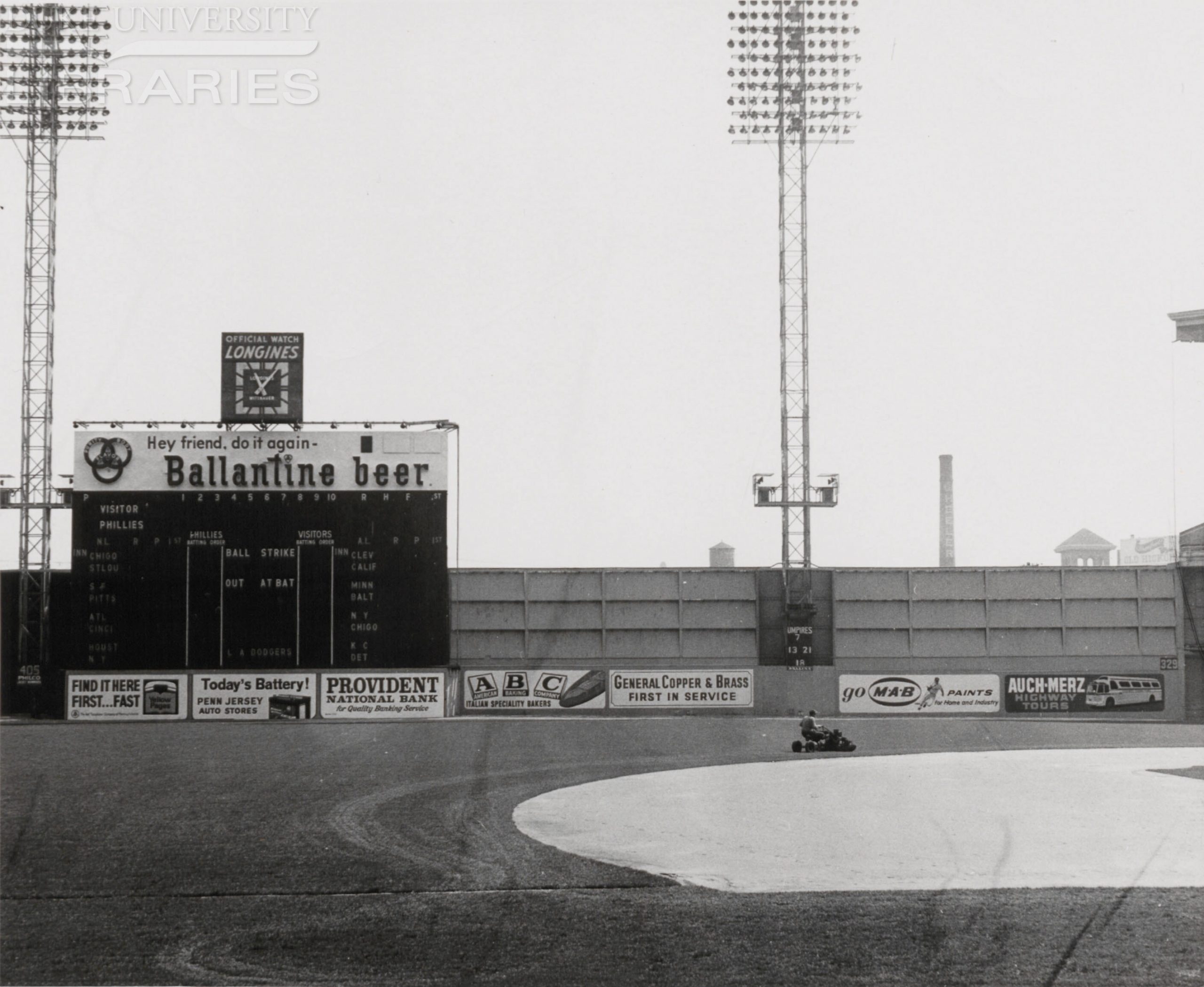
And I can almost smell the Cracker Jack when I look at these old photographs of Connie Mack Stadium in Philadelphia, home to the Philadelphia Phillies until 1970.  I can also smell the cigarette smoke from 25,000 men in trench coats and fedoras with newspapers tucked beneath their arms.  Those were the days…

Photographs of Connie Mack Stadium in Philadelphia


Finally, this post wouldn’t be complete without a photograph of two members of the Women’s Athletic Association, a group of Duke Woman’s College students that planned, organized, and hosted sporting events on campus such as tennis tournaments, bowling leagues, and ping-pong.  And yes, they played baseball too!

Duke students playing baseball, 1941.

If you’re interested in checking out more baseball stuff in our outstanding digital collections—broadsides, tobacco cards, billboards, photos of Duke players and more, just click here to peruse.


Searching for Records (Management)

Post contributed by Hillary Gatlin, Records Manager.

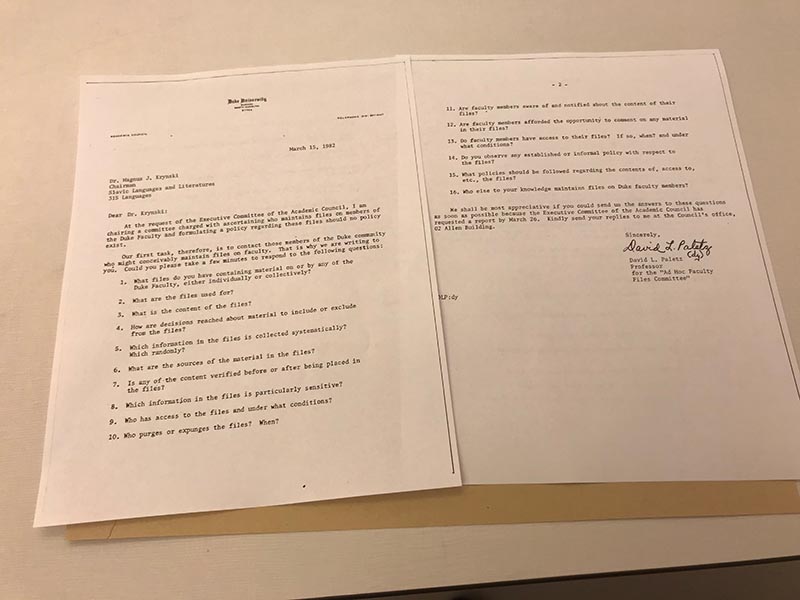
When one of my Duke University Archives’ colleagues alerted me to the presence of an Academic Council memo from 1982 requesting information on the management of faculty records, I was intrigued. Though often critical to an organization’s well-being, issues of records management rarely make headlines, and an administrative body like Academic Council taking an interest in records management was a big deal. I sought out the Academic Council records and unearthed the story behind the memo.

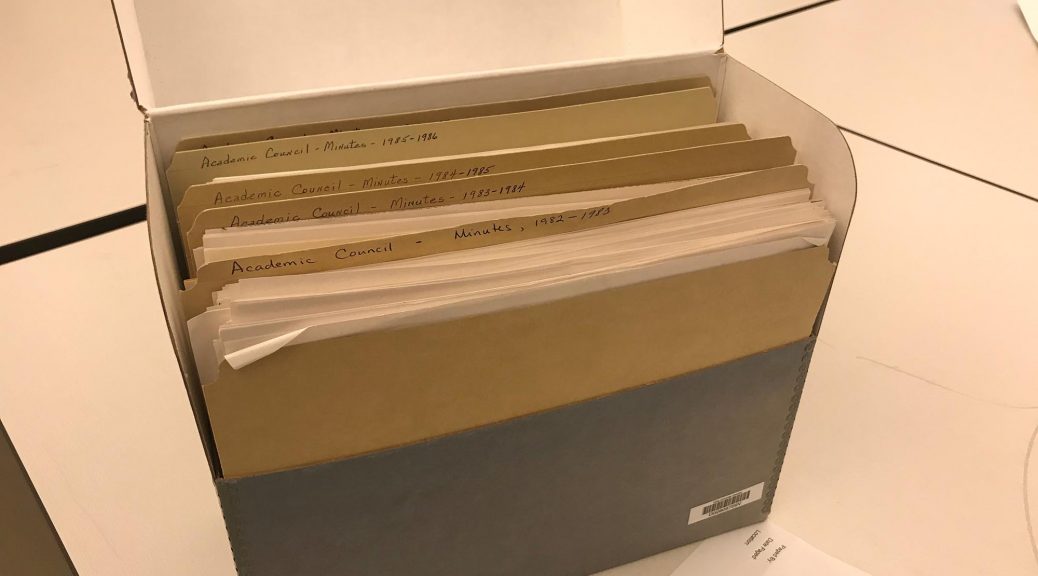
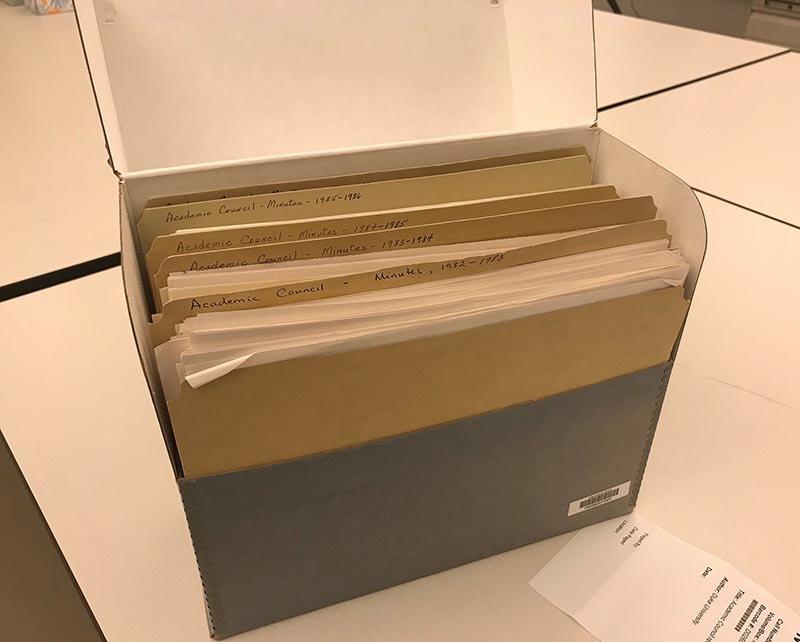
An opened Hollinger box showing folders from the Academic Council records.
Box 4 of Academic Council Records

Academic Council first indicated their interest in faculty files and records management with an announcement at the January 21, 1982 meeting, declaring that “the Executive Committee will shortly appoint a three-person ad hoc committee to ascertain what university files are kept on faculty members and who has access to them.” The Ad Hoc Committee on Faculty Files was established the following month at the February 18, 1982 meeting and consisted of committee chair Professor Paletz (Political Science), Professor Weistart (Law), and Professor Dearlove (English). The focus of the committee was on identifying university files that contained information on the faculty, including whom had access to those files.

As part of their work, the Committee drafted and sent out the aforementioned memo to university departments, seeking data to report back to Academic Council. Some of the questions asked in the survey are still asked by records managers today including: Who has access to the files and under what conditions? What is the content of the files? Who purges or expunges files? When are they purged?

This survey was sent to campus administrators in 1982, asking for information on records management.

While an initial report from the Ad Hoc Committee on Faculty Files was expected in March 1982, it was not filed with Academic Council until May 25, 1982.  Sadly, the actual report, including the results of the records survey, appears to have been lost to time. The Executive Committee of Academic Council provided a brief update on the report at the September 16, 1982 meeting, with the promise that further discussion would take place once the report had been more closely reviewed. This update did clarify the reason for Academic Council’s interest in faculty files: “the concern is with faculty rights to access of their personnel files, the ability to correct factual or other errors contained in those files,” and the absence of a clear University policy on faculty files.

The development of this policy stayed on Academic Council’s radar, and at the May 5, 1983 meeting, they reviewed a proposed policy draft. This review resulted in over five pages of documented discussion on faculty records issues. Major issues touched on during the discussion included the number of files to be maintained by the administration, who within the administration should be responsible for maintaining files, and whether information should ever be removed from files, and if so, under what conditions. There was also an in-depth discussion of confidentiality, particularly as it relates to faculty recommendations and the university’s procedures for appointment, promotion, and tenure.

After this substantial discussion, Academic Council agreed that a clearer policy was needed and decided to resume talks again in the next academic year. As far as the Academic Council records show, the policy discussion never resumed at this level.

Duke University has since developed guidelines regarding records management and retention of university records, including personnel files. Please review the Human Resources records retention guidelines for more information on managing personnel files.

The Records Management program is happy to assist University departments and offices with managing their university records and preserving their university history. To schedule a consultation with the Records Manager, please contact hillary.gatlin@duke.edu.