Maybe if it had tables full of researchers and some lovely teal carpeting?
That’s right, it’s our old reading room! As you can see it has undergone quite a change since renovation began earlier this summer. Not only is that teal carpeting gone, but steel bracing has been installed for extra structural support. Check out theRubenstein Library Renovation blog for more pictures and updates on our ongoing renovation.
The recent Moral Monday civil protests being held at the state legislature in Raleigh has becomenational news. Since late April, roughly 700 more protestors have been arrested at the civil disobedience demonstrations. The leadership of clergy within the Moral Monday movement–including Rev. William Barber II, President of the North Carolina State Conference of the NAACP–calls attention to the historical role of the church in civil disobedience and racial justice struggles, both in North Carolina and nationally.
The Frederick Herzog Papers at the Rubenstein Library provide just such a history. A review of the collection situates the Moral Monday protests within the radical traditions of clergy–particularly Protestant ministers but also rabbis and priests–established during the civil rights era and the ability of the Church to organize and influence direct action. Herzog was a liberation theologist and, from 1960 until his death in 1995, a professor at Duke Divinity. Ordained in the ministry of the United Church of Christ, Herzog played an active role in the civil rights struggles in North Carolina in the 60s. His papers give detailed accounts of not only his reflections but also reflections by various others on “wrestling with the role of the church in the face of current racial tensions . . .” (Letter from A.M. Pennybacker, a minister with Heights Christian Church in Shaker Heights, Ohio).
On January 3, 1964, Herzog and ten others were arrested on trespass charges for participating in a sit-in demonstration at a restaurant just outside Chapel Hill to protest segregation. They were beaten and hosed and spent a night in jail. The court offered to commute the sentences of several of the protestors if they affirmed that they would not take part in such demonstrations again. Herzog’s colleagues, William Wynn of the University of North Carolina and Robert Osborn of Duke University refused to say, for theological and moral reasons, that they felt they did not have the right to break the law. They were sentenced to 90 days in the county jail. Herzog, however, affirmed that he could not take part in such action again.
Herzog writes in a brief statement “Christian Witness and a Sit-In” (filed in the Papers under Writings and Speeches) that he initially understood his civil disobedience as an attempt “to fulfill rather than to break the law,” turning to both the Gospels and Rev. Martin Luther King Jr. for justification of his act. Yet Herzog goes on to observe that the arrests of the apostles and Christ’s persecution were “not part of a technique of nonviolence or a planned civil disobedience campaign. It was the result of taking seriously the obligation to witness to Christ.” Their acts were not, in other words, a “crusade against only one specific injustice or wrong.” Herzog comes to the conclusion that this articulation of the Gospel was missing from his “attempt on January 3rd to witness to greater social justice.”
In his statement, Herzog further distinguishes between the refusal to obey a direct requirement of the state and the direct testing of existing laws, the latter which, he argues, characterized his participation in the sit-in. “Is it possible that civil disobedience is a misnomer when applied to this type of activity?” Herzog nevertheless affirms the necessity of reexamining “the forms in which the Christian witness finds expression in the protest movement” and concludes that marching to jail with our fellow men is only a partial solution. We must also, he states, become personally responsible for one another: “The person to person effort has to be tied to new political groups that in the democratic process openly engage in reshaping the societal structures.”
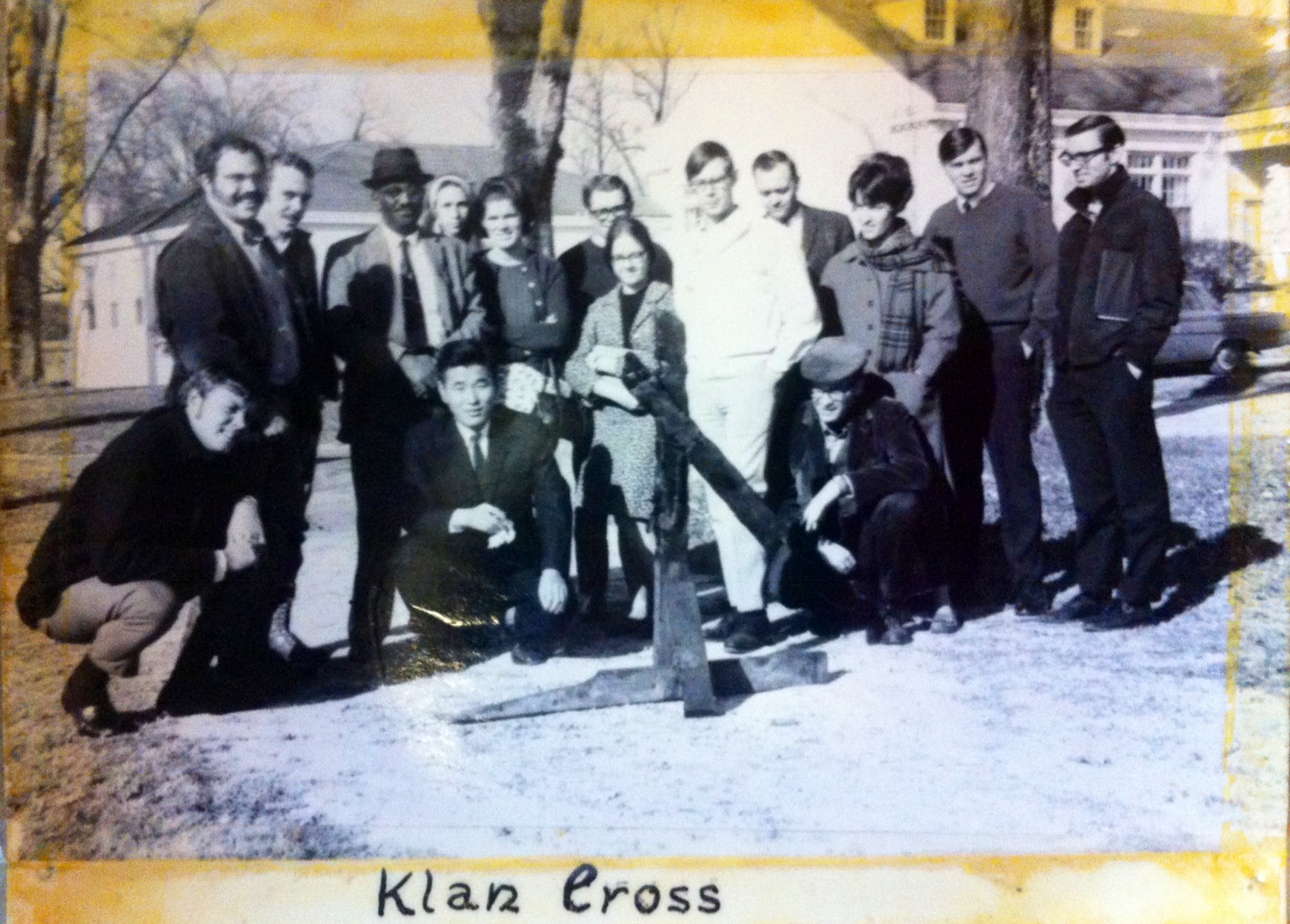
Photograph of a KKK Cross in North Carolina, from the Frederick Herzog Papers.
Moral Mondays do not constitute a crusade against one specific injustice but rather employ the broader language of offering a place in society to our most disenfranchised citizens. Herzog’s statement nevertheless complicates and deepens the relationship between theology and protest, and prompts me to ask where Moral Mondays fall within his distinction between refusing to obey and direct testing? Would Herzog classify the occupation of the Capitol as civil disobedience?
Post contributed by Clare Callahan, Rubenstein Technical Services student assistant.
Welcome to the first post in a series documenting the processing of the Abraham Joshua Heschel Papers.
Photographs and documents from the Abraham Joshua Heschel Papers.
In 1965, Rabbi Abraham Joshua Heschel, professor of Jewish Ethics and Mysticism at the Jewish Theological Seminary of America, accepted as position as the Harry Emerson Fosdick Visiting Professor at Union Theological Seminary (UTS). Newspapers reported this occasion with headlines that proclaimed “Rabbi to Teach Christians” and “Seminary Gives Post to Heschel.” The prestigious visiting position speaks to Heschel’s influence in Christian-Jewish relations at the time. As we begin processing the Abraham Joshua Heschel Papers, there is evidence that Heschel’s dedication to interfaith work also made him a controversial figure in some Jewish circles. I recently processed a large folder of materials that Heschel collected during his tenure at UTS and discovered that Heschel preserved the views of his dissenters, tucked in alongside his lecture notes and grade records.
In a folder that contains programs from events honoring Heschel at UTS and Eden Theological Seminary and an excerpt from Reinhold Niebuhr’s Pious and Secular America, I found a fascinating newspaper clipping. The article, “Scholar Delimits Interfaith Talks,” discusses another rabbi’s view on interfaith relations. The article explains that Rabbi Joseph B. Soloveitchik, professor of Talmud at Yeshiva University, argued that Jews should avoid discussing theological issues in their relations with Christians. This article provides an intriguing counterpoint to the documents promoting Heschel’s theological lectures at Christian Seminaries.
In another folder, which Heschel labeled “Interfaith,” he included an excerpt from a letter written by the Lubavitcher Rebbe, Rabbi Menachem M. Schneerson. In the letter, Schneerson writes, “there is no need for us whatever to have any religious dialogues with non-Jews, nor any interfaith activities in the form of religious discussions, interchange of pulpits, and the like” (2). Schneerson concludes, “religious dialogue with non-Jews has no place in Jewish life, least of all here and now” (4). This letter rests alongside an article written by UTS President John C. Bennett and Heschel’s itinerary for the Spring Semester of 1966 which included lectures at the Indiana Pastors’ Conference and eleven different Christian seminaries.
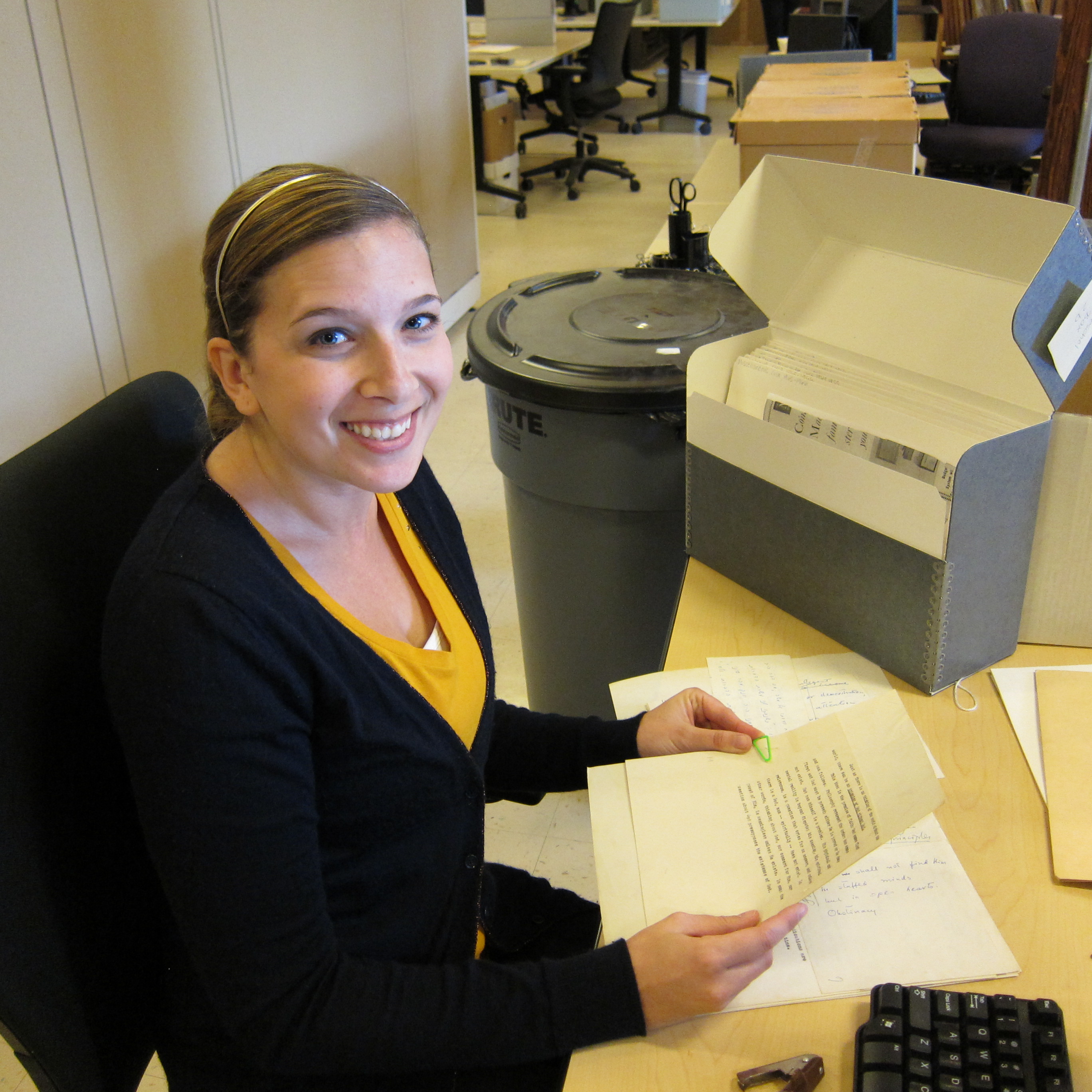
Adrienne and the Heschel Papers.
These dissenting opinions preserved by Heschel and included in folders that highlight his interfaith work provide an intriguing glimpse into Heschel’s world. We will leave it up to future researchers to discover the meaning behind Heschel’s inclusion of these opposition opinions in these particular folders!
Post contributed by Adrienne Krone, Heschel Project Assistant in Rubenstein Technical Services.
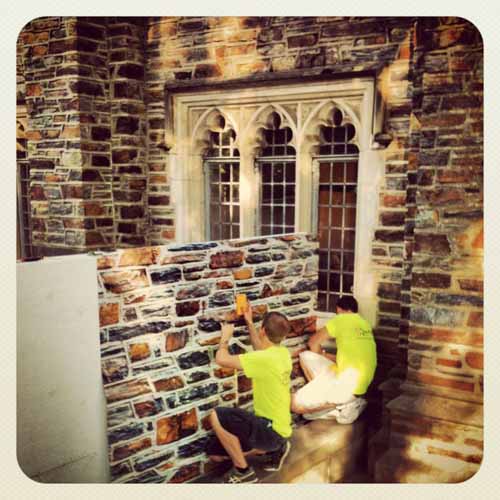
Last week, we watched “Duke Stone” panels going up on the construction fence surrounding the Rubenstein Library and the West Campus Union. So we thought we’d take a few moments to write about the real Duke Stone!
Duke Stone panels being applied. Photo by Aaron Welborn.
Did you know that Duke Stone comes from a quarry in Hillsborough, North Carolina, just about 10 miles away from campus? Or that there are 24 distinct colors in the stone: 7 primary colors with 17 distinct variants of the primary colors? Or that, before choosing the Hillsborough stone, there were several other stone contenders?
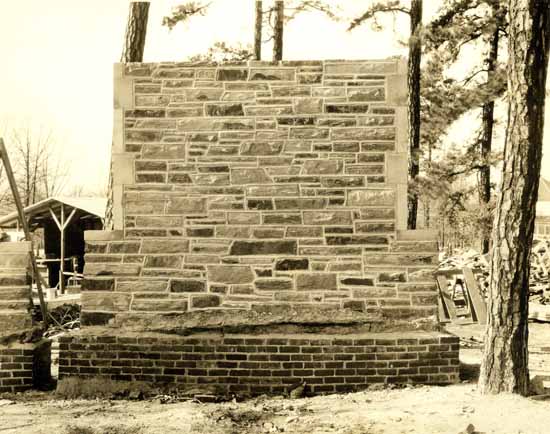
Before the Hillsborough stone was chosen to construct West Campus, and before it was known simply as “Duke Stone,” the architects, designers, builders, and James B. Duke himself looked at many different stone samples. They even constructed test walls of stone from other quarries on the East Coast to determine which one they liked the best. Here’s one of the test walls constructed during that phase:
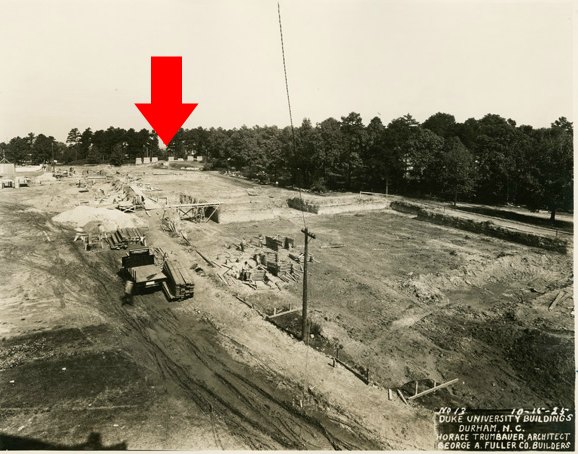
And in this October 15, 1925 photo of construction on East Campus, the test walls are visible off in the distance.
It’s safe to say that we all know and love Duke Stone today—so much so that the panels are going up on the construction wall so that we don’t have to be without the look of it for too long. Next time you’re on campus, see how many primary and variant colors you can find in the stone. Let us know how you do!
Post contributed by Maureen McCormick Harlow, 175th Anniversary Intern for the Duke University Archives.
In June and July we’re celebrating the beginning of a new fiscal year by highlighting new acquisitions from the past year. All of these amazing resources will be available for today’s scholars, and for future generations of researchers in the Rubenstein Library! Today’s post features a remarkable addition to the Sallie Bingham Center for Women’s History and Culture. Check out additional posts in the series here.
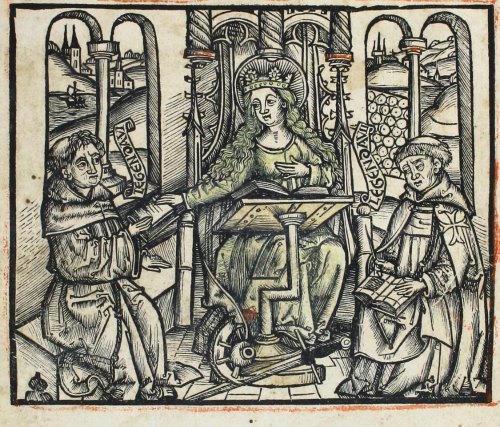
The Library has acquired a rare incunable (item printed from moveable type in Europe before 1501), the Legenda de Vita S. Catharinae by Frater Petrus, published in Strasbourg on April 6, 1500. It tells the story of St. Catherine of Alexandria, one of the most popular and important saints in late medieval Europe, and an enduring icon of women’s learning. She was said to have won a debate with the Roman emperor’s elite philosophers over the value of Christianity, leading to her imprisonment and torture on the breaking wheel, now often called the Catherine wheel.
This edition includes seventeen beautiful woodcuts attributed to the artist known as the “Master of Terence,” who worked frequently for the book’s publisher, Johann Grüninger. The copy now in the Rubenstein Library, just the third known copy in an American institution, also features a contemporary binding with elaborate tooling and a brass clasp, and extensive rubrication both in the text and bordering the woodcuts. It will reward a variety of research approaches, from literary scholars interested in book history and the popular medieval genre of saints’ lives to those working in women’s history, religious history, and art history.
In June and July we’re celebrating the beginning of a new fiscal year by highlighting new acquisitions from the past year. All of these amazing resources will be available for today’s scholars, and for future generations of researchers in the Rubenstein Library! Today’s post features new items in the Library’s Negley Collection of Utopian Literature and its comic book collections. Check out additional posts in the series here.
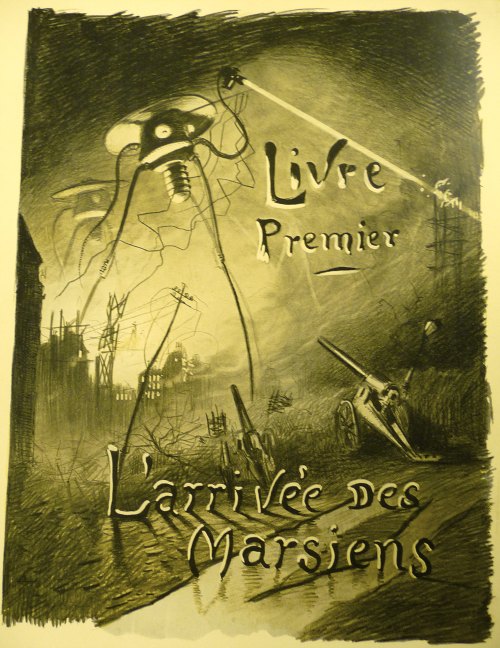
One of the most influential books in science fiction history, H. G. Wells’s The War of the Worlds, was an immediate sensation upon its publication in 1898. Famously adapted for radio, film, and television, the work received perhaps its most beautiful visual interpretation in the limited edition of Henry Davray’s French translation, La Guerre des Mondes, published in Brussels in 1906 with stunning illustrations by Henrique Alvim Corrêa.
The book features 32 plates as well as over 100 illustrations within the text. Corrêa, a Brazilian painter and illustrator who lived in Belgium for most of his life, captured the intensity, grand scope, and wonder of Wells’s vision of interplanetary invasion in his atmospheric, energetic compositions.
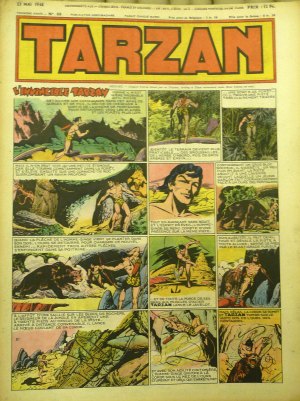
Another new acquisition demonstrates, in a different format, the burgeoning global appeal of genre fiction adapted to visual form in the twentieth century. A complete run of 293 issues of Tarzan, a comics series published in Paris between 1946 and 1952, features the adventures of Edgar Rice Burroughs’s famous creation in vivid color.
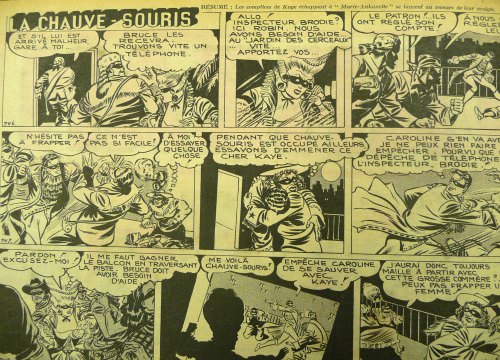
The first 71 issues also feature a French adaptation of the newspaper comic strip featuring Batman, La Chauve-Souris (The Bat), by the famous French science fiction illustrator, René Brantonne. These American adaptations ran alongside comics adaptations of French classics such as Les Miserables.
The Rubenstein Library now holds the only known copy of this periodical in the United States, which appears to be very rare in institutional holdings even in France.
A French adventure of Batman and Robin. dressed as Louis XIV and Marie Antoinette.
In June and July we’re celebrating the beginning of a new fiscal year by highlighting new acquisitions from the past year. All of these amazing resources will be available for today’s scholars, and for future generations of researchers in the Rubenstein Library! Today’s post features a new collection in the Library’s History of Medicine Collections. Check out additional posts in the series here.
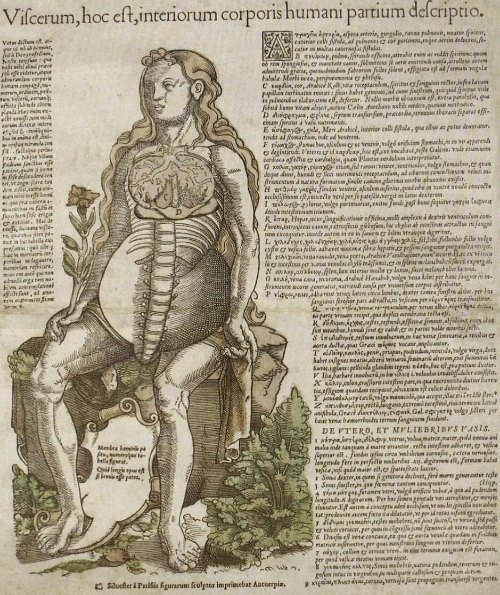
The History of Medicine Collections has acquired two anatomical fugitive sheets, elevating our holdings to now include ten of these magnificent items. Anatomical fugitive sheets are single sheets, similar to broadsides, that are printed on one side. Illustrations of the human body accompany text that was written in Latin, and later in the vernacular. Dating from the sixteenth century, this pair of fugitive sheets, titled Viscerum hoc Est Interiorum Corporis Humani Partium Descriptio and published in Antwerp in the sixteenth century, includes hand colored illustrations with accompanying text in Latin.
Besides being incredibly rare—these are the only known copies of these sheets—the sheets are noteworthy for many reasons, including the depiction of the human body using three-dimensional flaps that lift to reveal internal organs, as the title suggests. This particular pair of fugitive sheets has lost most of its flaps. While the male figure only retains a fragment of one flap, the female figure retains one full flap of the inner organs in entirety. Such loss is common since most of these fugitive sheets date to the sixteenth and seventeenth centuries and were printed as single sheets.
Theories abound as to who would own such items. Were they created for physicians, barber surgeons, or the lay person wanting to know more about the human body? Were they hung in apothecaries, medical university classrooms, or the gentleman’s library? Any sheets that remain today are incredibly rare and worthy of study and analysis. These appeal not only to the medical student who wants to see what inaccuracies exist, but to those interested in the history of science, printing history, and art history.
Post contributed by Rachel Ingold, Curator, History of Medicine Collections.
In June and July we’re celebrating the beginning of a new fiscal year by highlighting new acquisitions from the past year. All of these amazing resources will be available for today’s scholars, and for future generations of researchers in the Rubenstein Library! Today’s post features a new collection in the Library’s Hartman Center for Sales, Advertising, and Marketing History. Check out additional posts in the series here.
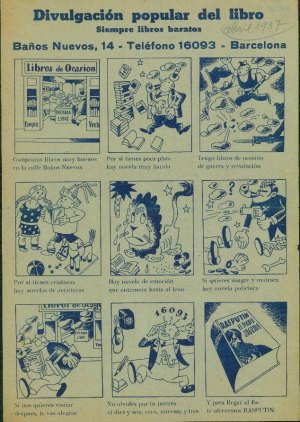
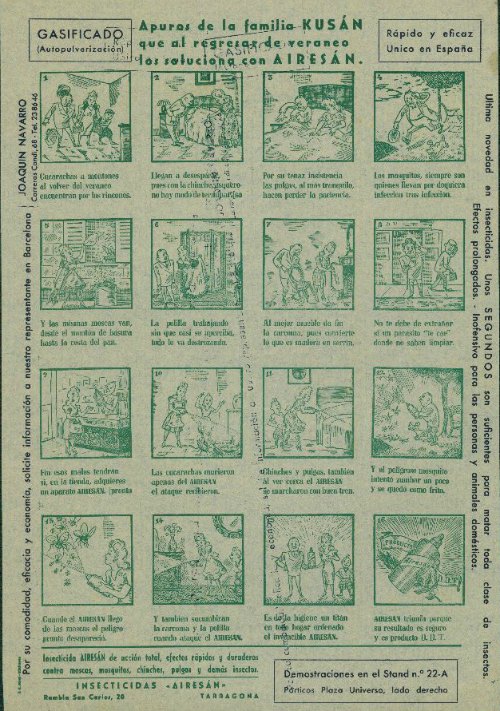
Since being banned as a tool for gambling in the seventeenth and eighteenth centuries, the auca has become one of the cultural touchstones of the Catalonia region of Spain. Aucas are a kind of comic strip with a standardized format of panels (often 48, or another multiple of four) accompanied by rhyming verse. The Hartman Center recently acquired a collection of more than fifty of these original broadsides, all produced and distributed for the purposes of advertising products or communicating a service. Aucas were traditionally used for communication of religious, literary, or civic information, but advertisers saw the value in taking the broadside format and using it for commercial purposes.
Auca for an insecticide containing D.D.T., Tarragona, ca. 1960.
The numerous examples here of aucas published in Barcelona or nearby cities in the Catalan language during the 1940s and 1950s, run counter to the accepted belief that the Franco regime had completely suppressed the Catalan language. As these aucas show, the language still had a public presence (and perhaps the Regime tolerated its use in this particular fashion because the aucas were intended to generate commerce, which Spain desperately needed).
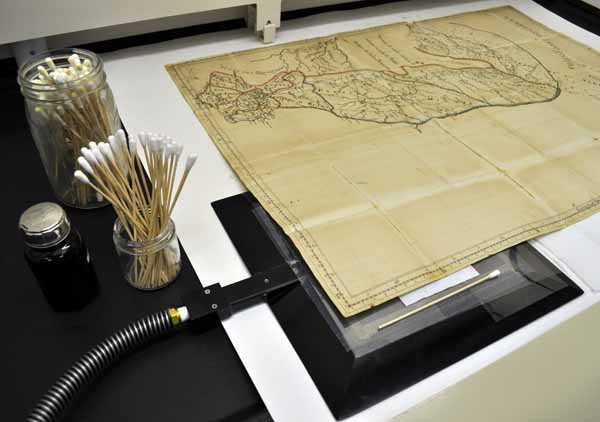
My latest conservation project has been one involving chemicals and special equipment, doing something that we conservators face far too often—tape removal. But fortunately, our lab is well equipped with tools and materials specifically for that purpose.
In September there will be a new exhibit at the Nasher Museum of Art on empire and cartography, organized by the BorderWork(s) Lab here at Duke. Seventeen maps and books from the Rubenstein Library were selected for the exhibit, but many of them required treatment first. Rachel Penniman, Erin Hammeke, and I have been working to make sure the items will be in safe condition before they make the short journey across campus to the museum.
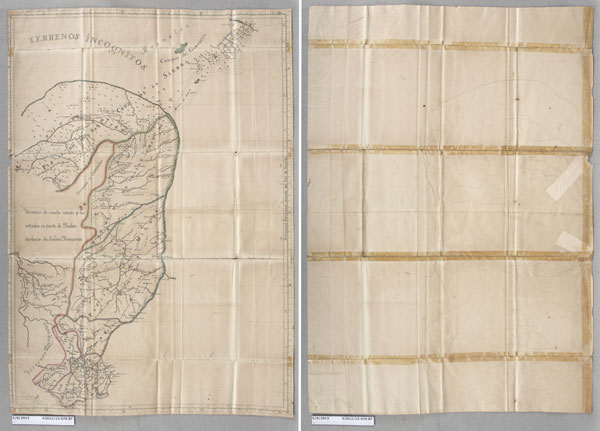
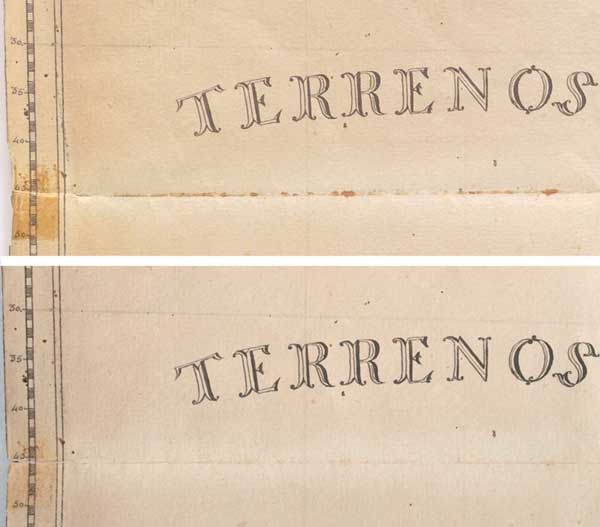
One item that has required the most work for me is an early 19th century hand-colored manuscript map from South America labeled “Terrenos Incognito” (above, front and back). Although on good quality, strong paper, the map was previously folded so many times that it began to break along the folds, and so some well-intentioned person in the past reinforced the folds with strips of tape on the back. Over time, the adhesive turned yellow and seeped through the paper, leaving stains along all of those fold lines. And not only is the staining unsightly, but the adhesive is also chemically destructive to the paper, making it brittle and more liable to break. So now, as is often the case, I am spending many hours undoing someone’s quick fix that turned out to do more harm than good.
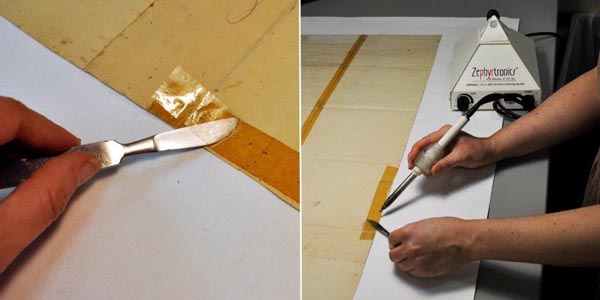
Before using any chemicals I tried mechanical means to remove the tape. First I had to remove the carrier, the plastic part of the tape that the adhesive is attached to. For that I used a hot air tool to soften the adhesive and an unsharpened dissection scalpel (my favorite tool) to lift the carrier off. But there was a lot of residual adhesive left on (and in) the paper.
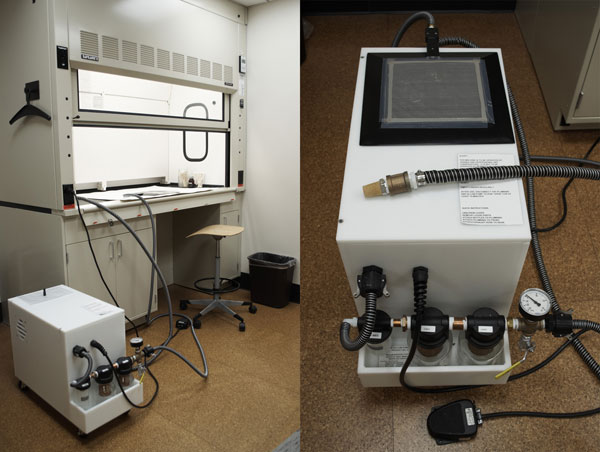
After testing the adhesive’s solubility in various chemicals, I selected the most appropriate solvent. In conjunction with the use of chemicals I have been using our excellent vacuum pump and manuscript suction device, also officially known as a Stealth Sucker. I work in the fume hood to avoid breathing solvent fumes. I lay my map on the suction platen and use solvent to dissolve the adhesive, then the vacuum action draws it out of the paper. I can only treat an inch at a time and the work is very slow, but the effect is rewarding . Although there will always be some staining visible, the map’s appearance is beginning to improve dramatically. Soon I hope to have it finished, and visitors at the Nasher will be able to appreciate its beauty without the distraction of adhesive stains.
Detail of “Terrenos Incognito,” Before and After TreatmentDetail of “Terrenos Incognito,” Before and After Treatment
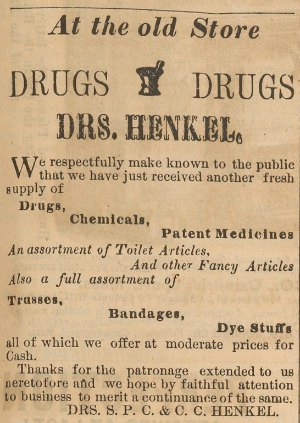
Advertisement for products sold by the Henkel physicians, from the Shenandoah Valley newspaper, 7 September 1877.
The Medical Center Library & Archives is excited to announce its new exhibit, “The Henkel Physicians: A Family’s Life in Letters.” Produced by the National Library of Medicine (NLM), the exhibit traces the daily lives of a family of physicians in the Shenandoah Valley during the nineteenth century, serving in their community, on the battleground, and in the nation’s courts of law.
The Medical Center Library also collaborated with the Rubenstein Library on an exhibit to complement the NLM display. “From the Rubenstein Collections: The Henkel Family Physicians” features rare books and manuscripts along with materials from the History of Medicine Collections. It includes letters written by the Henkels, books and broadsides published by the Henkel Press, and nineteenth-century medical instruments and artifacts.
The NLM Exhibit will be on display through August 24th on Level 3 of the Medical Center Library & Archives. The Medical Center Library and Rubenstein collaboration will available through October on Level 1. To learn more about the Henkel family and nineteenth-century medicine, visit the NLM’s digital companion to the display.
Dispatches from the David M. Rubenstein Rare Book and Manuscript Library at Duke University