Reflections from the Marshall T. Meyer Human Rights Archive Intern

Post contributed by Heather McGowan, Marshall T. Meyer Human Rights Archive intern

Hello! I’m Heather McGowan, a second-year student at UNC SILS in the Masters of Library Science Program, and since January I have worked as the Marshall T. Meyer Human Rights Archive Intern at the Rubenstein. I was interested in this internship with the Human Rights Archive because I have always been interested in the ways archival work interacts with social justice and human rights. Working on a collection that revealed the voices of those people who have often been silenced in the record, was my initial interest in this internship, but it has become much more. The work that ICTJ has done to preserve the voices of even the lowest in society, the abused and impoverished, fueled my treatment and work on this collection. Keeping the people at the center has created a collection that reveals the life changing work of ICTJ and its partners, as well as the stories of those who lived, and those who died fighting to see truth and reconciliation.

ICTJ staff members Vasuki Nesiah, Mark Freeman and Priscilla Hayner in Uganda

The International Center for Transitional Justice (ICTJ) founded in 2001, is a global non-profit that works with partners in post-conflict, conflict, and democratic countries to pursue accountability, truth, and reconciliation for massive human right abuses. Through a series of measures including criminal prosecutions, truth commissions, reparations programs, and institutional reforms, ICTJ and its partners strive to bring justice and strength to victims, activists, state leaders, and international policy makers.

When I began working on the collection at the beginning of this year, the ICTJ records consisted of a small fully processed collection of about 40 archival boxes and three large unprocessed accessions of about 160 shipping boxes. Throughout the last six months the collection has begun to take shape and become a powerful testament to ICTJ’s global work.
The largest part of the ICTJ records is the Geographic Series. The Geographic Series is comprised of files representing about 100 countries and forms the backbone of ICTJ’s collection. The country files include ICTJ reports, journal articles, publications about governance, rule of law, political stability, reparations, and human rights violations, as well as materials from various country’s Truth and Reconciliation Commissions. These materials are unique to each country and provide insight into the impact ICTJ’s work has on every citizen, from victims to perpetrators, children and women to ex-combatants. These files highlight ICTJ’s mission to support peace, truth, and transparency in each country they work with.

A conference on national reconciliation in Ghana

Closely related to the Geographic Series is the Administrative Series, which contains a Staff Files sub-series. These are the files of 16 prominent staff members of ICTJ; former presidents and co-founders, program directors and prosecution unit leaders. The staff files narrate the story of ICTJ from its initial creation to it developing into a strong, influential, global leader in transitional justice. I found one of the highlights of this series to be the files of Priscilla Hayner, one of the co-founders of ICTJ. The initial grants for ICTJ, the architecture plans for their space, the original program units, and the founding mission are all captured in her files. Her work in Ghana, Peru and Sierra Leone is richly detailed with trip reports, mission updates, and research about the best ways to develop transitional justice mechanisms in these countries. Her personal notes, correspondence, writings, and even meeting minutes offer a glimpse into the minds at work in ICTJ.

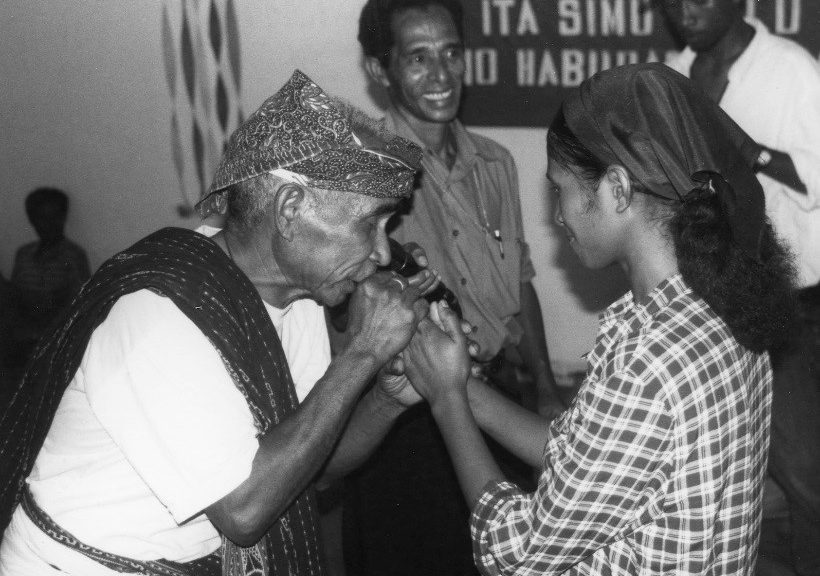
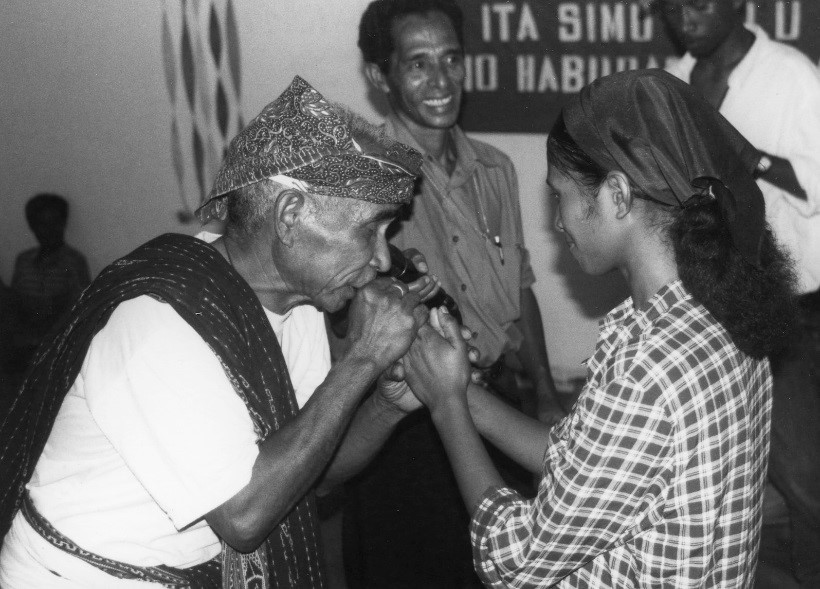
ICTJ staff members and local truth commission leaders in Ghana

The other half of the hands-on work of ICTJ is documented in the Program Series. ICTJ is organized into program units that each focus on a different thematic subject, such as gender, as well as into units by region. One of the most robust units is the Middle East/North Africa (MENA) Program. In the past decade, MENA has worked in Iraq as the country transitions from the tyrannical rule of Saddam Hussein into a democratic nation. In 2004, MENA and ICTJ conducted interviews with Iraqi citizens. The transcripts of these interviews are now housed in the ICTJ archive and are filled with details about human rights in the Iraqi context; about what is was like for Iraqis to live in fear of their livelihood and about the hope for reconciliation.

In addition to the hands-on work they do, ICTJ has a robust research unit captured in the Reference and Reports Series. These materials were collected by ICTJ and formerly housed in their Documentation Center and Library at their New York headquarters. The publications include annual reports from human rights NGOs as well as thematic publications about children and women in conflict, displacement, refugees, disappearances, human trafficking, judicial reform, economic issues, security and conflict analysis, genocide and torture, accountability and human rights.


In processing this collection, I was struck by the details of ICTJ’s work. Before working with this collection, I had a vague idea of the work that ICTJ did throughout the world, but in processing, arranging, and describing the ICTJ records, I have come to understand the complexities of trying to bring peace to victims of human rights abuses. The most interesting part of the collection, for me, are the truth and reconciliation commission files. The whole process involved in creating, executing, and continuing the legacy of TRCs is much more complex than I ever conceived. For example, the Rwandan genocide occurred in the 1990s, but the work of the TRC continued well into the mid to late 2000s. By taking statements from victims, disarming and demobilizing former soldiers, creating spaces to have hearings, and putting in place new policies the TRC sought to heal the pain caused by the Rwandan genocide. Another, lesser known genocide, took place in Guatemala over the land to build the Chixoy Dam. From 1980 to 1983 in the village of Rio Negro, about 5,000 indigenous Mayan people were slaughtered and dumped in mass graves by the government. The loss of life and the relative unknown nature of this case made it even more shocking when I uncovered it. ICTJ worked with Mayan communities and the Inter-American Court of Human Rights to initiate a human rights case against the Guatemalan military in 2005. This case and the work toward reparations for the people of Rio Negro has faced challenges from the corrupt government of Guatemala, but it has seen success as military dictators have been sentenced to prison. ICTJ engages in complex work often with uncertain outcomes, but it is work that I believe takes the right steps towards healing.

The ICTJ records will be fully processed by the end of the summer, including the audiovisual and electronic records components.
New Acquisitions – Photobooks in the Archive of Documentary Arts

Post contributed by Lisa McCarty, Curator, Archive of Documentary Arts


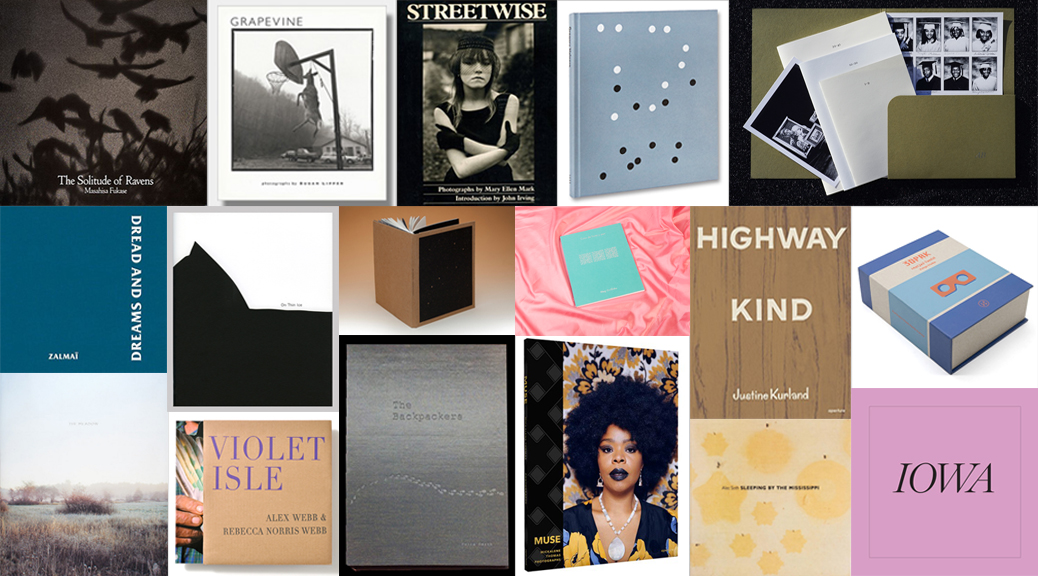
Over the past three years the Archive of Documentary Arts (ADA) has focused on building its collection of photobooks. The ADA is most interested in photobooks in which images are the primary content, or are considered co-equal with a text. Much like artists’ books, photobooks are conceived as artworks in their own right and can be considered art objects. Photobooks are often the primary medium for a series of photographs and as such, attention to the interaction between form and content, as well as the relationship between text and image, are central concerns to the artist.
Photobooks first emerged soon after the advent of photography in the 1840’s. Anna Atkins’ handmade book Photographs of British Algae: Cyanotype Impressions from 1843 is credited as the first book illustrated with photographs and William Henry Fox Talbot’s Pencil of Nature followed soon after in 1844. Since the nineteenth century, photobooks have proliferated as a medium which allows for artistic exploration and as means to circulate photographs to a wider audience. Today artists continue to make photobooks both in small editions by hand or using print-on-demand services, and at a large scale, most often through partnerships with academic and independent publishers.

In the 2016-2017 academic year the ADA welcomed over 100 photobooks to the collection. This included historic and contemporary photobooks by individual artists such as Zalmaï Ahad, Barbara Bosworth, Alvin Langdon Coburn, Petra Barth, Andre Bradley, William Christenberry, Masahisa Fukase, Juan Giraldo, Meg Griffiths, Gregory Halpern, Justine Kurland, Susan Lipper, Mary Ellen Mark, Paula McCartney, Cristina de Middel, Nancy Rexroth, Alec Soth, Matjaz Tancic, Mickalene Thomas, Alex Webb and Rebecca Norris Webb.

The ADA also collects the complete output of several publishers who specialize in photobooks, including Aperture, Daylight Books, Horse and Buggy Press, and Radius Books.

All ADA photobooks are available to researchers in the Rubenstein Library.

Browse our photobook holdings in the online catalog >

Tales of Provenance: Una Vincenzo Revealed in Three Inscriptions

Post contributed by Liz Adams, Special Collections Cataloger

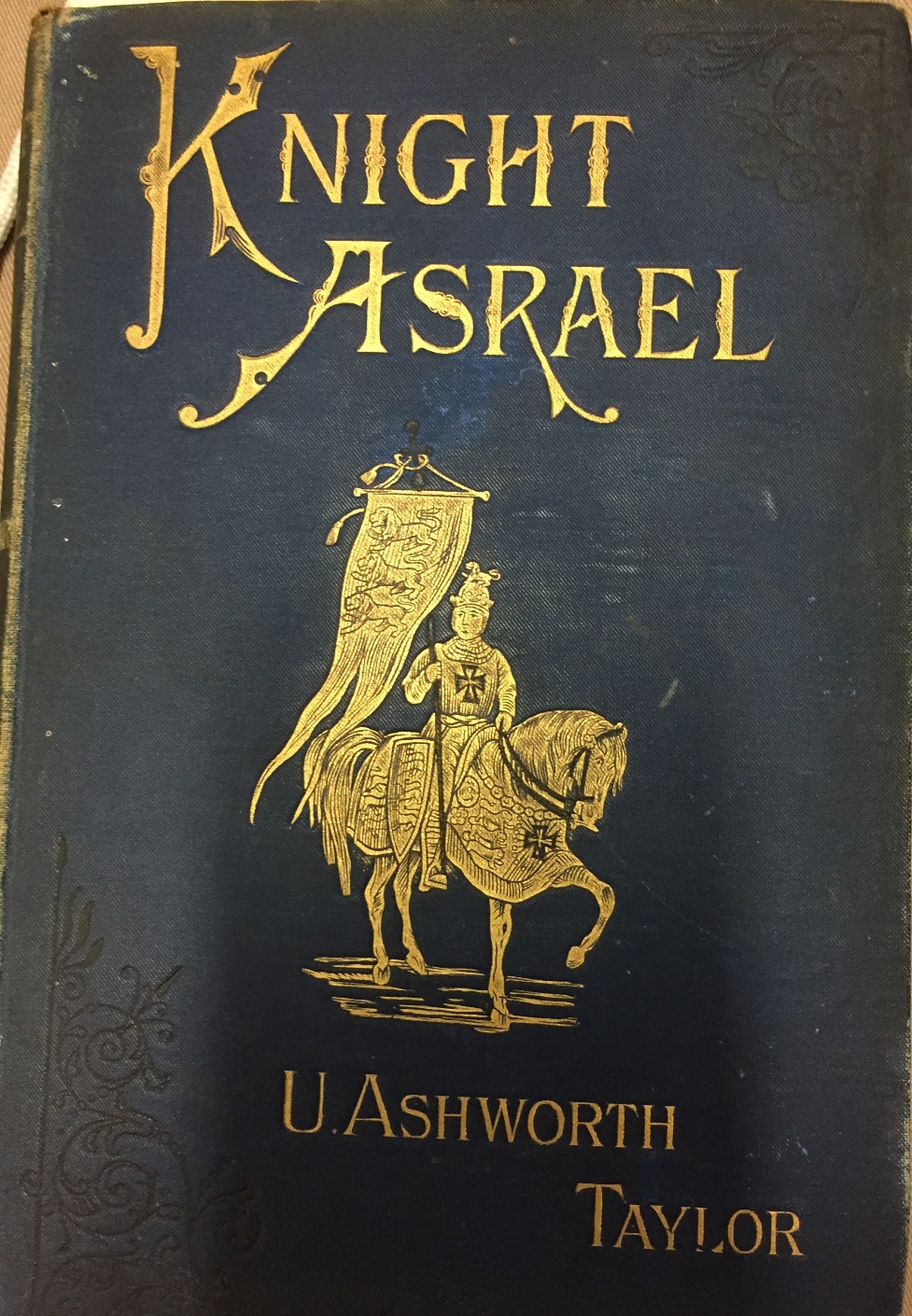
Cover of Knight Asrael: and Other Stories, written by Una Ashworth Taylor and newly cataloged as part of the Lisa Unger Baskin collection.

When I open books, one of my favorite things to do is look for small signs of its previous owners, its provenance: Was the book a gift, with a thoughtful note to the recipient? Did the owner write her name, big and bold, on a flyleaf? Sometimes there are so many signs that a separate story, that of the owner, begins to emerge. This was the case with Una Vincenzo, Lady Troubridge and her copy of Knight Asrael: and Other Stories, written by her aunt Una Ashworth Taylor.

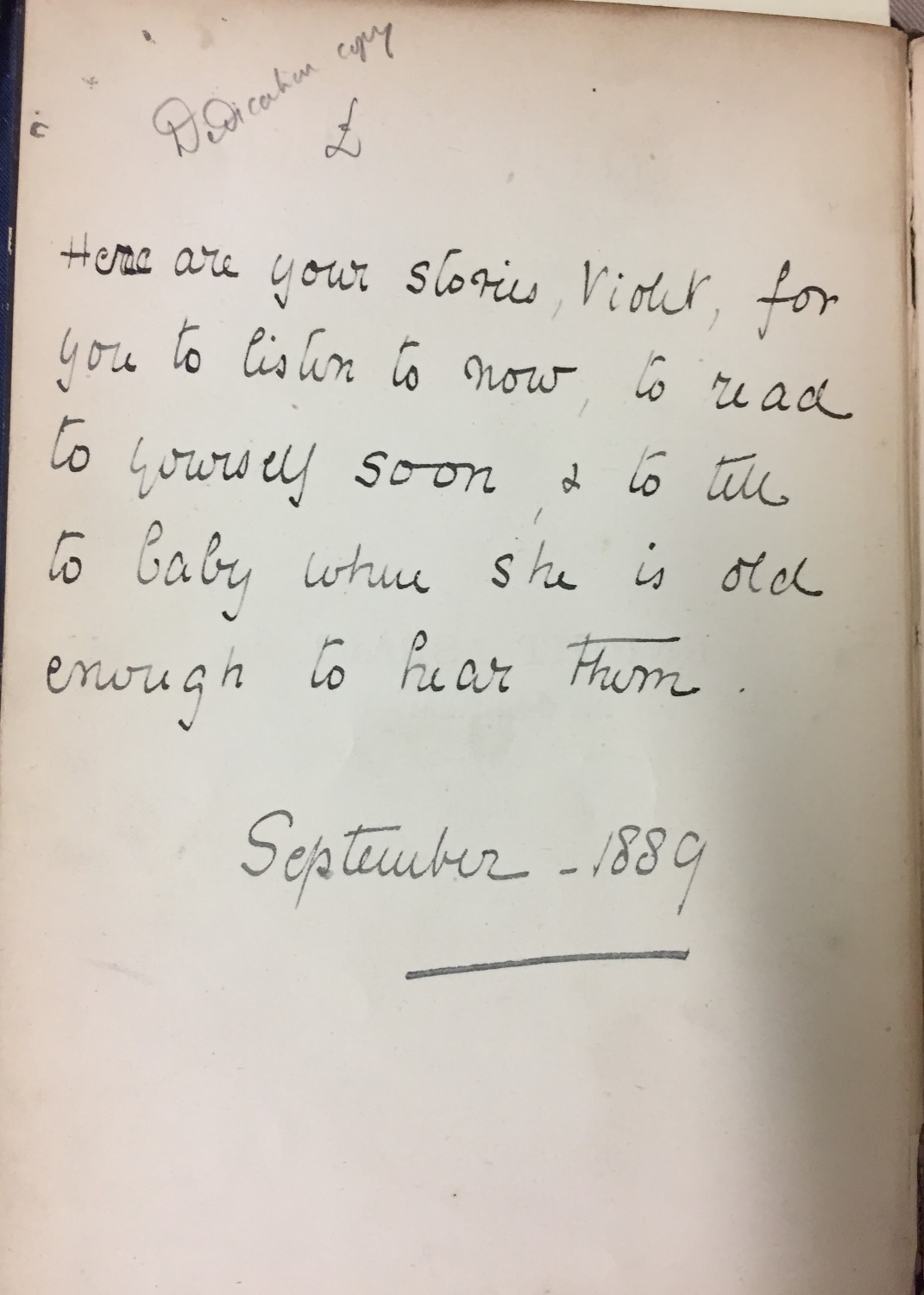
Inscription by author Una Ashworth Taylor.

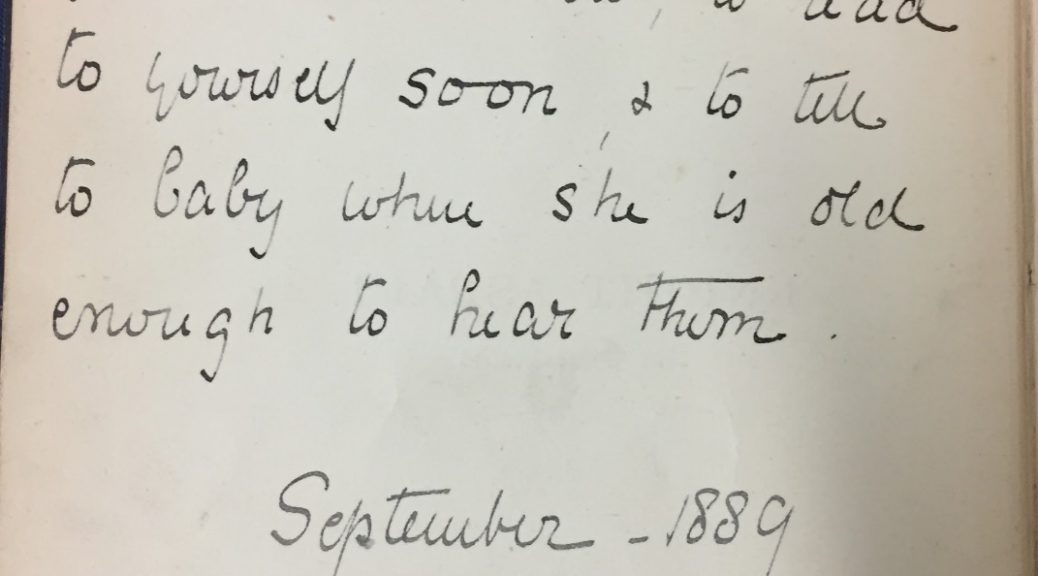
Una Vincenzo, Lady Troubridge was born in 1887 to a family steeped in literary culture. Not only did her aunt Una write Knight Asrael, but her other aunt Ida wrote several novels, contributed regularly to 19th century magazines, and published biographies on Lady Jane Gray, Queen Hortense, and Madame Roland (Palumbo-De Simone, 2004). Her grandfather, Sir Henry Taylor,  was a well-known dramatist and poet (Reger, 2004). This literary heritage is felt early on in Una Vincenzo’s copy of Knight Asrael. Una Ashworth Taylor wrote a deeply personal inscription to her nieces, one explicitly connecting baby Una and her older sister Violet to literature, to the power of reading:  “Here are your stories, Violet, for you to listen to now, to read to yourself soon, & to tell to baby when she is old enough to hear them. September-1889.”

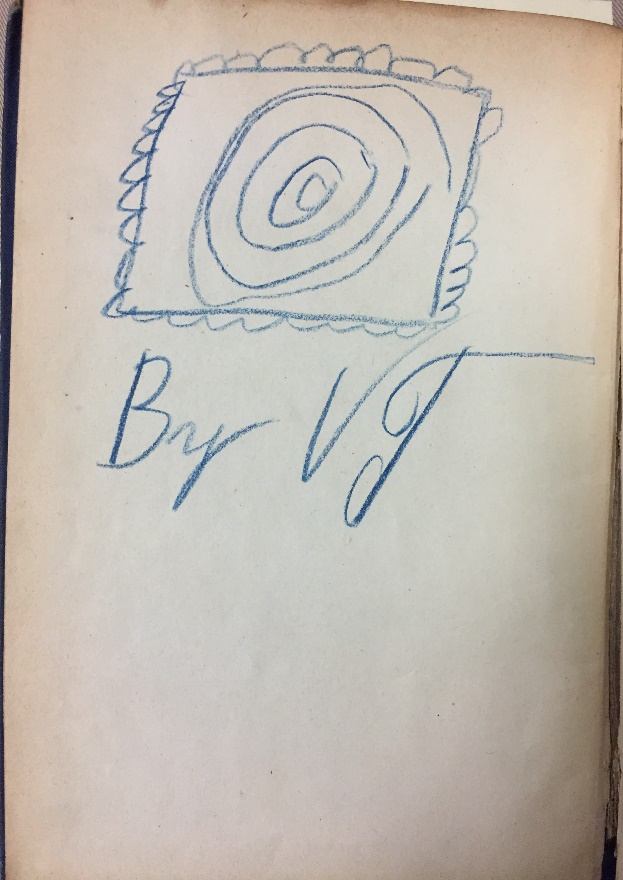
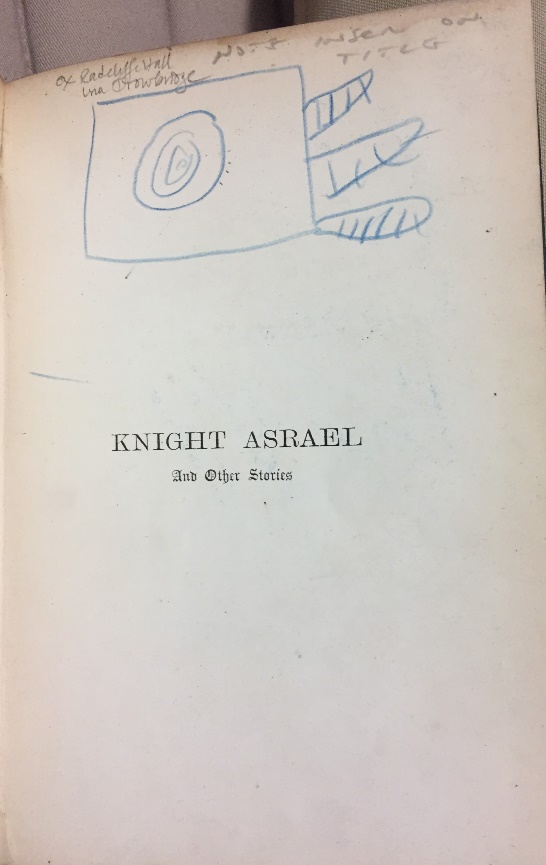
Although it’s unclear if Violet read the chivalric stories in Knight Asrael, Una seems to have, or at the very least, she enjoyed its opening pages. On the front pages of Knight Asrael, there are exuberant blue drawings, signed by their artist: U.T.

Drawings in the opening pages of Knight Asrael.

While these drawings might be some of the earliest known Una Vincenzo works, they are not the last: Una trained at the Royal College of Art, ultimately focusing on sculptural works (Ormrod, 1984, p. 29). A bust of the famed Russian ballet dancer Vaslav Nijinsky cast by Una now lives at the  Victoria and Albert Museum

Drawings in the opening pages of Knight Asrael.

Una Vincenzo left one more sign in Knight Asrael, an inscription of her own on the title page: “Radclyffe-Hall & Troubridge, Chip Chase, Hadley Wood, Herts.”

Radclyffe Hall is the author of several novels, most notably The Well of Loneliness, an influential work in lesbian literature.  She and Una met in 1915 and moved in together in 1919—after Una formally separated from her husband, Admiral Ernest Troubridge (Ormrod, 2004, p. 65, p.133).   Una and Radclyffe (also known as John) were romantic partners for 28 years, living together at Chip Chase and abroad, until Radclyffe’s death in 1943 (Baker, 2004). Una documented their lives together through photography

Inscription connecting Una Vincenzo with Radclyffe Hall and noting where they once lived together at Chip Chase.

and a biography published after Radclyffe’s death, The Life and Death of Radclyffe Hall. And even after death, Una continued to write letters to her beloved (Ormrod, 2004, p. 286).

When the provenance in Knight Asrael is taken together, the life and loves of Una Vincenzo, Lady Troubridge begins to break through: her artistic endeavors, her literary nature, and her deep love for Radclyffe Hall. Una ultimately lived to the age of 76, dying in 1963 in Rome, Italy (Ormrod, 2004, p.313).

The Rubenstein Library acquired its copy of Knight Asrael as part of the Lisa Unger Baskin Collection, a transformative collection documenting the lives and work of women across several centuries.


Works Cited

Baker, M. (2004). ‘Hall, Marguerite Antonia Radclyffe- (1880–1943)’, Oxford Dictionary of National Biography, Oxford University Press; online edn, May 2015 [http://www.oxforddnb.com/view/article/37878, accessed 21 July 2017]

Ormrod, R. (1985). Una Troubridge: the friend of Radclyffe Hall. New York: Carroll & Graf.

Palumbo-De Simone, C. (2004). ‘Taylor, Ida Alice Ashworth (1847–1929)’, Oxford Dictionary of National Biography, Oxford University Press; online edn. May 2015  http://www.oxforddnb.com/view/article/46564, accessed 21 July 2017]

Reger, M. (2004). ‘Taylor, Sir Henry (1800–1886)’, Oxford Dictionary of National Biography, Oxford University Press; online edn. May 2015 [http://www.oxforddnb.com/view/article/27030, accessed 21 July 2017]

New Acquisitions – From the Library of Two Presidents

Post contributed by Thomas Gillan, Rubenstein Library volunteer, PhD candidate, College of William & Mary

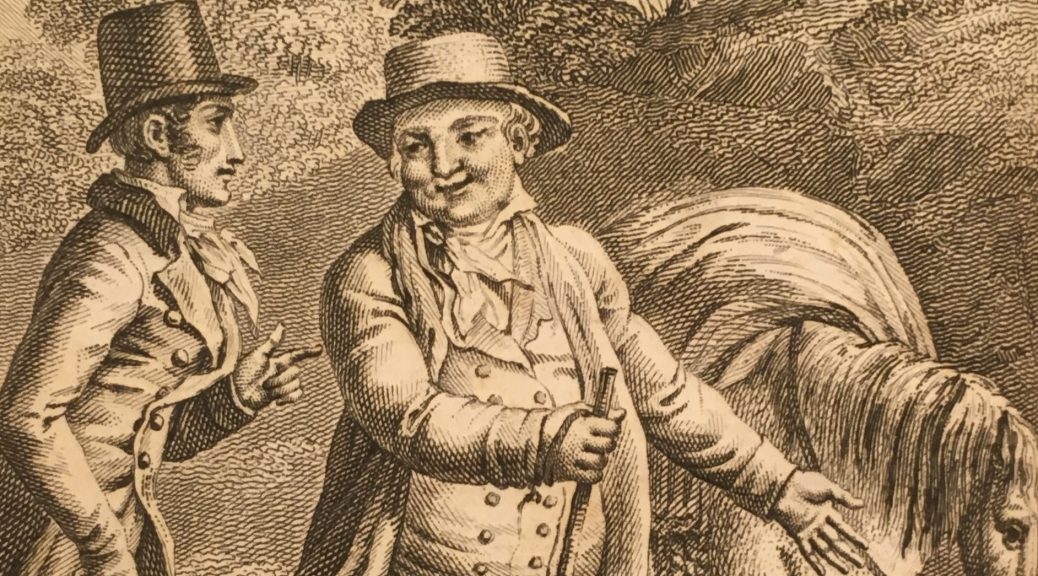
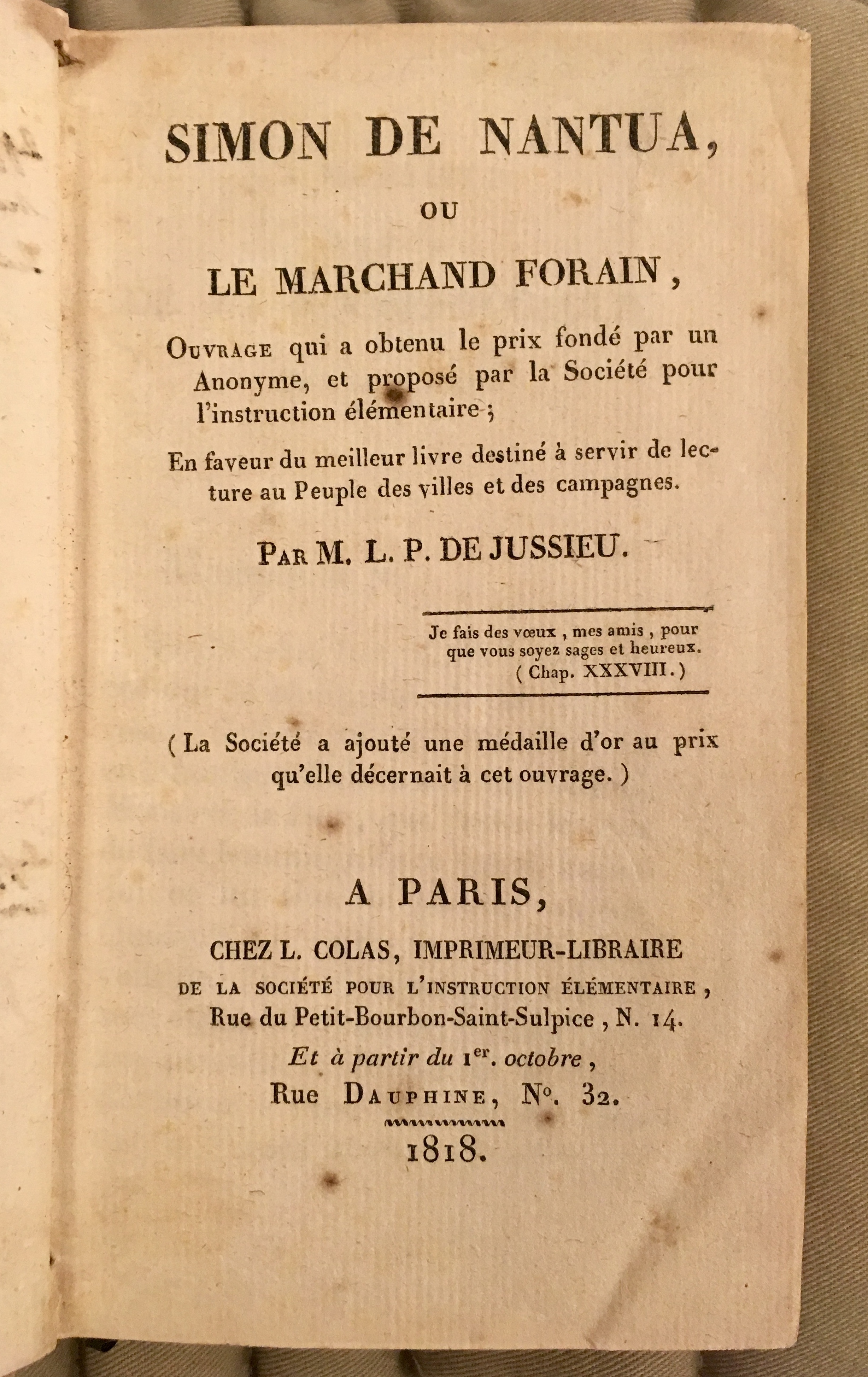
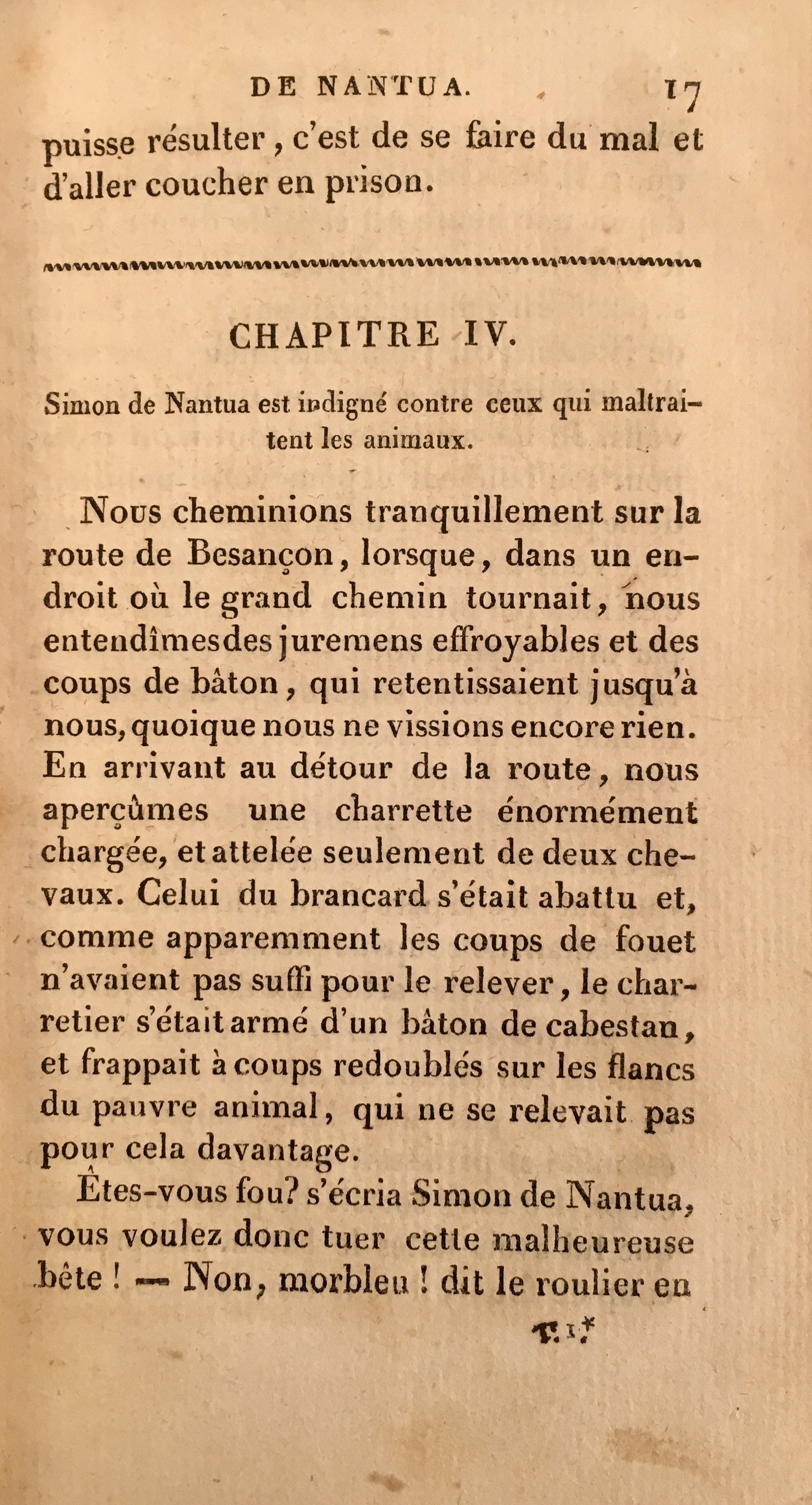
The Rubenstein Library has recently acquired an important gift from the Brand Family, descendants from the notable book collector and Duke graduate Harry L. Dalton, class of 1916. This is a French work, Simon de Nantua, written by the French moralist Laurent-Pierre de Jussieu and published in Paris in 1818. It tells the story of its title character, Simon de Nantua, a travelling merchant who trades as much in wisdom as in goods. The book, which was published under the auspices of the Société pour l’instruction élémentaire, was awarded the society’s prize medal in 1818.


The library’s copy would be less remarkable were it not for its noteworthy provenance. Thomas Jefferson received the book in 1819 along with a number of other books from his Paris booksellers DeBures Freres. This is one of the books he purchased after selling much of his library to the Library of Congress in 1815. According to an invoice, Jefferson paid 3 francs for the book, which bears his ownership mark on page 17, signified in this case by the block letter “T” written in ink in front of the publisher’s signature mark “1*.”[1] According to James A. Bear, Jefferson employed this system of ownership marks, with slight variations, over a period of about fifty years.


In a letter to Philadelphia publisher Mathew Carey, Jefferson praised the “school book” as “undoubtedly one of the best for young learners to read that I have ever known,” and even considered having the book translated into English, “so valuable” would it be “to our Elementary schools.”[3] The book was among those sold at auction in 1829 by Nathaniel Poor and is included in Poor’s catalog of Jefferson’s books.[4] Later in its history, this volume was owned by President William Taft.


Nearly 200 years after its publication it seems that there are only two copies held by libraries in the United States, and both of these copies have a Jefferson connection. The Duke copy is Jefferson’s own copy, and the other copy is held by the University of Virginia. Jefferson in 1825 recommended a number of items to the University of Virginia library of which this was one.  This volume is now available in the Rubenstein Library reading room.


[1] DeBures Freres to Thomas Jefferson, 11 September 1819, Founders Online, National Archives, http://founders.archives.gov/documents/Jefferson/98-01-02-0741.

[2] James A. Bear, Thomas Jefferson’s Book-Marks (Charlottesville, VA: Alderman Library, University of Virginia, 1958), 8.

[3] Thomas Jefferson to Mathew Carey, 13 March 1820, Founders Online, National Archives, http://founders.archives.gov/documents/Jefferson/98-01-02-1143.

[4] Nathaniel P. Poor, Catalogue, President Jefferson’s Library (Washington, 1829), 9.

Uncovering a Coordinated Effort to Defend Human Rights in 1980s Nicaragua

Post contributed by Erik A. Moore  Ph.D. student in the History Department at the University of Oklahoma, is recipient of a 2017 Marshall T. Meyer Research Travel Grant.

Letter from Rep. David Bonior to Alex Wilde, 1988

This summer I had the privilege of visiting the David M. Rubenstein Rare Book & Manuscript Library to conduct research in the collection of the Washington Office on Latin America (WOLA) records. WOLA’s records are held in the Duke Human Rights Archive. My research was made possible through generous funding from the library through the Marshall T. Meyer Research Travel Grant. Durham is a wonderful city to visit, and the facilities and the staff at the library were great. And the research was fascinating.


I am working on my doctoral dissertation that examines how non-governmental organizations (NGOs) such as WOLA used arguments based on human rights to contest U.S. support of counterrevolutionaries (the Contras) in Nicaragua in the 1980s. The Reagan administration claimed the Sandinista government in Nicaragua was an ally of the Soviet Union and wanted to spread communist revolution throughout the hemisphere. Reagan used the Contras to pressure the Sandinistas to adopt democratic reforms, but, in doing so, Reagan funded and armed a guerrilla force that was accused of committing atrocities against the Nicaraguan people. I am investigating how successful NGOs were at using human rights advocacy to influence U.S. foreign policy. WOLA is as one of NGOs on which I focus in the dissertation.


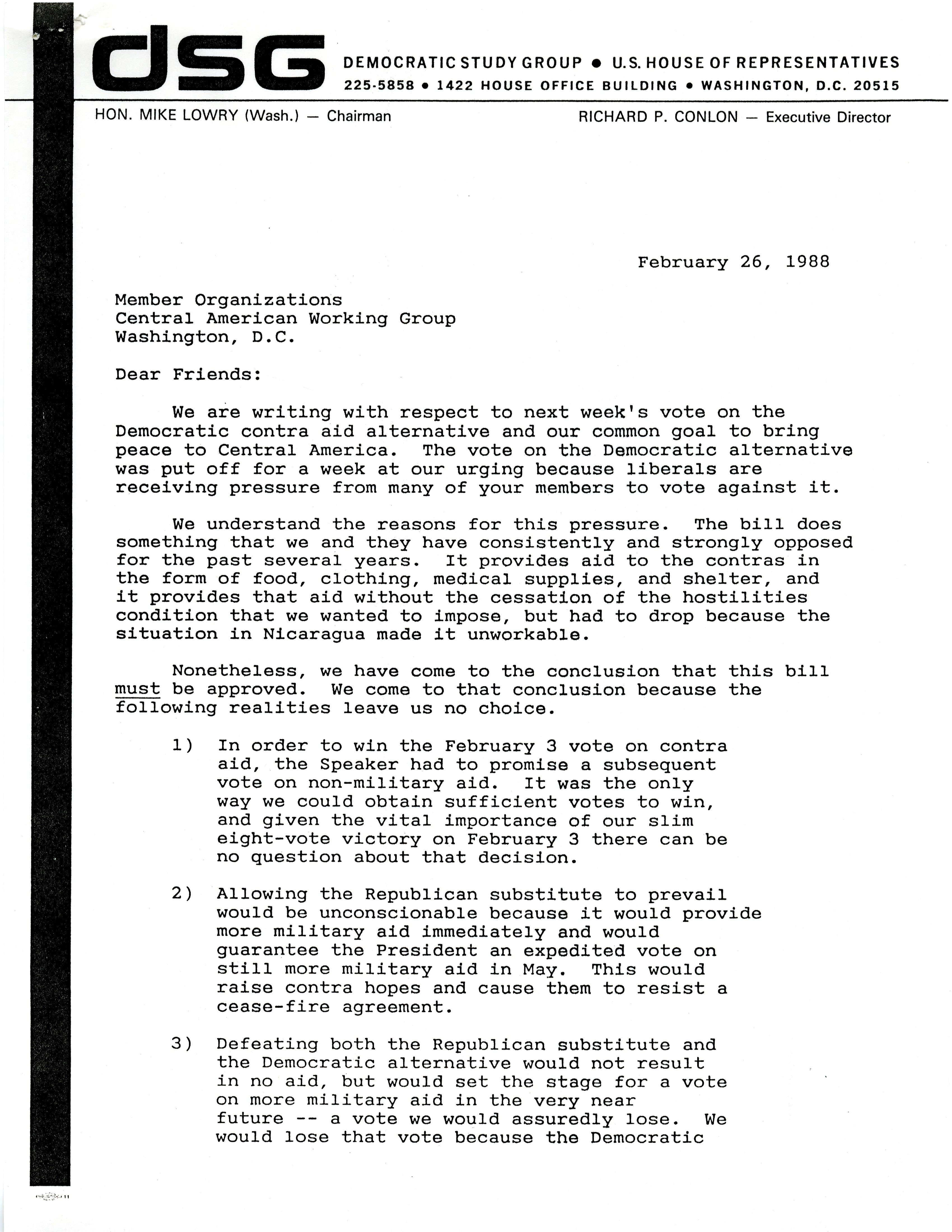
Letter from U.S. House of Representatives Democratic Study Group, 1988

My work at the library revealed a surprising level of coordination among not only NGOs, but also government officials and Congressional staff members who opposed U.S. support of the Contras. Members of Congress such as Representative David Bonior (D-MI) worked closely with WOLA and other human rights NGOs on issues facing Nicaragua and lobbying other members of Congress to support legislation.[1] I also found a memo from a Congressional staff member, Holly Burkhalter, to the Human Rights Working Group in which she provided analysis of the then-current functioning of the State Department’s Bureau of Human Rights.[2] The Human Rights Working Group was a coalition of national organizations, including WOLA, that periodically met to coordinate efforts toward common goals. WOLA seems to have operated within a large community of progressive human rights-conscious NGOs that often pooled their resources and expertise to influence debates in Congress over U.S. foreign policy. Often, representatives from various organizations met to discuss pending issues and how they could all work together.[3]

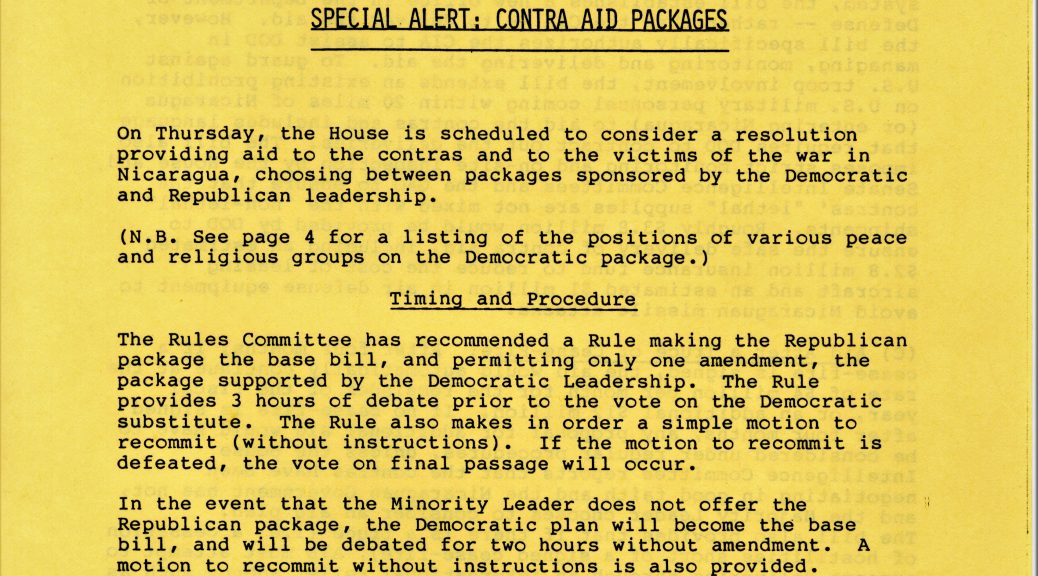
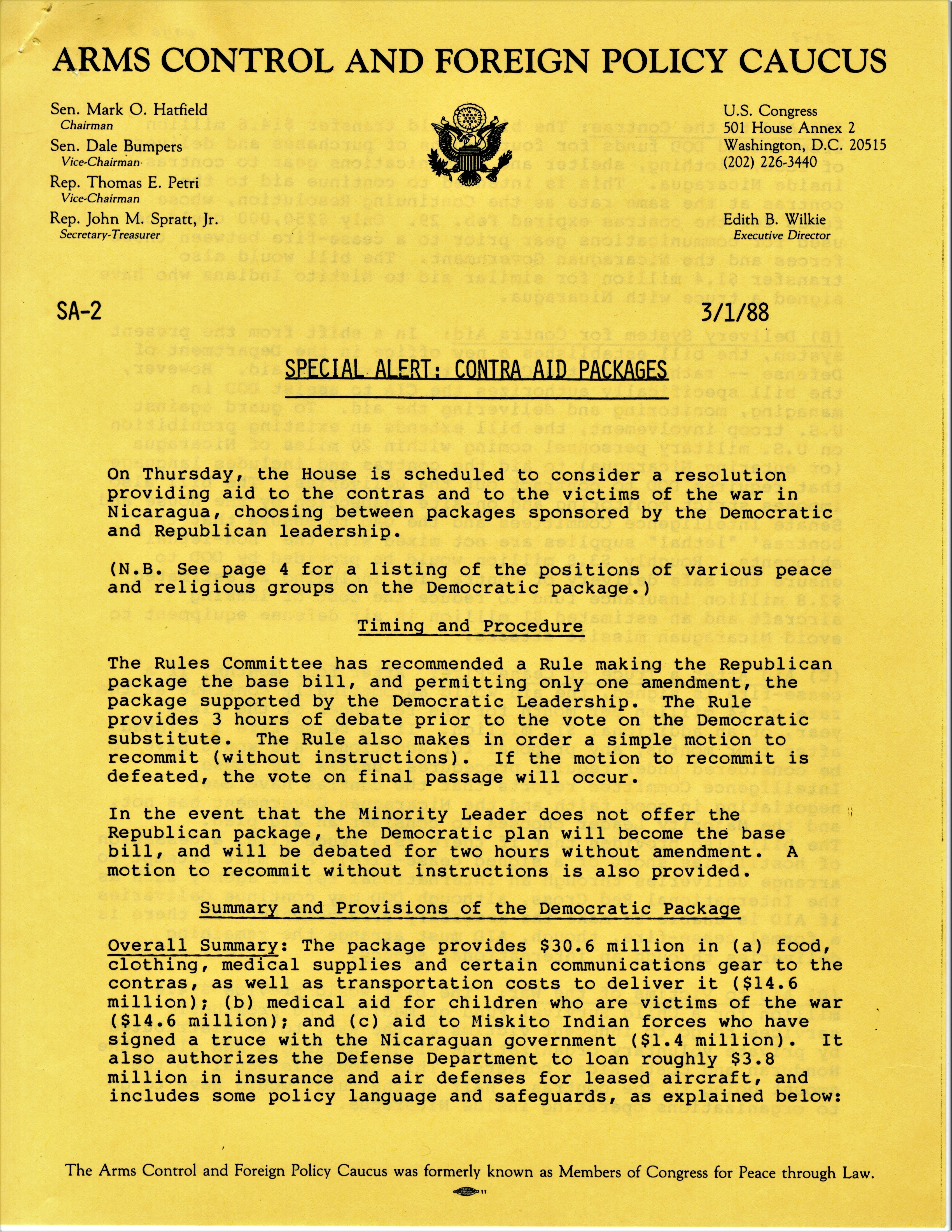
Memo from the Arms Control and Foreign Policy Caucus, U.S. Congress, 1988

This coordination is particularly fascinating for my research because I have found that many of these organizations operated with different agendas, though not necessarily conflicting agendas. One such instance that I found in which the community of human rights NGOs split was over a Contra aid proposal in 1988. Democrats offered a package based on humanitarian non-military aid that served as an alternative to what Reagan and Republicans wanted to offer. The Republican proposal would have centered on military aid. WOLA supported the Democratic aid package in order to bring humanitarian aid to Nicaragua and the rest of Central America and to prevent the Republican plan from coming to a vote and likely passing. Other NGOs, such as the Nicaragua Network, Witness for Peace, and Quest for Peace, all of which worked closely with WOLA throughout the 1980s, opposed any form of aid to the Contras and rejected the Democratic alternative.[4]

My research will continue to investigate strategies and coordination of NGOs opposing the Contra War and how the different interpretations given to human rights influenced the decisions and advocacy of these NGO in lobbying Congress

[1] David E. Bonior to Alex Wilde, Letter, (March 14, 1988), Box 27, Folder: Democratic Contra Alternative, Washington Office on Latin America Records, David M. Rubenstein Rare Books & Manuscript Library, Duke University.

[2] Holly Burkhalter to Human Rights Working Group/Coalition, “The Bureau of Human Rights: Law and Implementation,” Memorandum, (June 24, 1981), Box 433, Folder: Human Rights Working Group 1981, Washington Office on Latin America Records, David M. Rubenstein Rare Books & Manuscript Library, Duke University.

[3] Holly Burkhalter to Human Rights Working Group/Coalition, “The Bureau of Human Rights: Law and Implementation,” Memorandum, (June 24, 1981), Box 433, Folder: Human Rights Working Group 1981, Washington Office on Latin America Records, David M. Rubenstein Rare Books & Manuscript Library, Duke University.

[4] “Special Alert: Contra Aid Packages” (Washington, D.C.: Arms Control and Foreign Policy Caucus, March 1, 1988), Box 27, Folder: Democratic Contra Alternative, Washington Office on Latin America Records, David M. Rubenstein Rare Books & Manuscript Library, Duke University.

New Acquisitions – Rev. Caroline Bartlett Crane Pamphlets

Post Contributed by Laura Micham, Merle Hoffman Director, Sallie Bingham Center for Women’s History & Culture

Caroline Bartlett Crane: “America’s Housekeeper,” Renaissance Woman

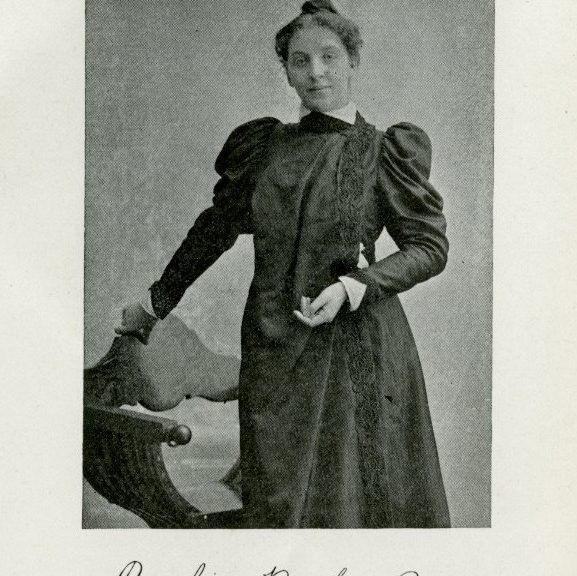
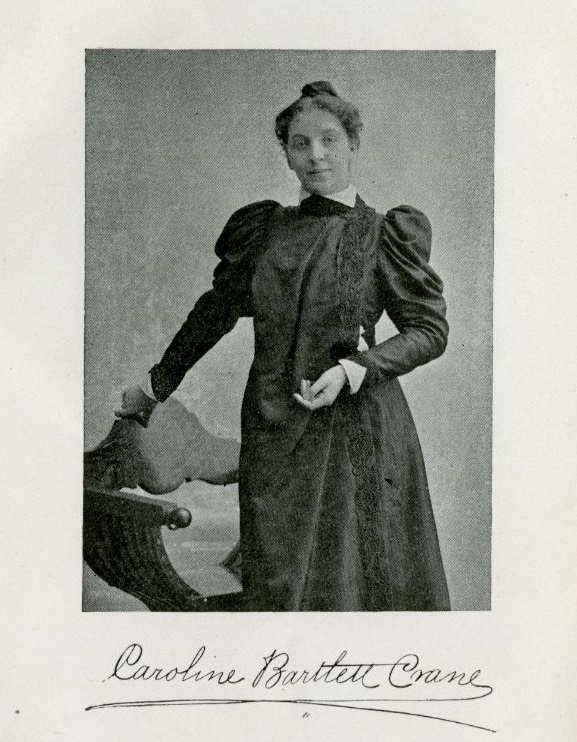
Portrait from Is God Responsible? A Sermon, Kalamazoo, Mich. 1898.

Caroline Bartlett Crane (1858-1935) was an American Unitarian minister, suffragist, civic reformer, educator, and journalist. Among the first wave of college-educated women in the U.S., she worked as a teacher, school principal, and newspaper reporter before pursuing the call to ministry she first experienced as a teenager.

Bartlett Crane was accepted as a candidate for the ministry at the Iowa State Unitarian Conference in the 1880s. In 1889, after ordination and completion of her first church assignment, she began work at the Unitarian church in Kalamazoo, Michigan. Within a short time she led the church to open the first free public kindergarten, a school of manual training and domestic science, a gymnasium for women, a day nursery, a cafeteria, and the Frederick Douglass Club for the “young colored people of the city.” The church continued to expand until it outgrew its building. In 1894 a new one was built and renamed “People’s Church.”  In 1898, after illness and differences with the board, she resigned her ministry.

Published by The Young Men’s Union of the People’s Church of Kalamazoo, Mich., 1896.


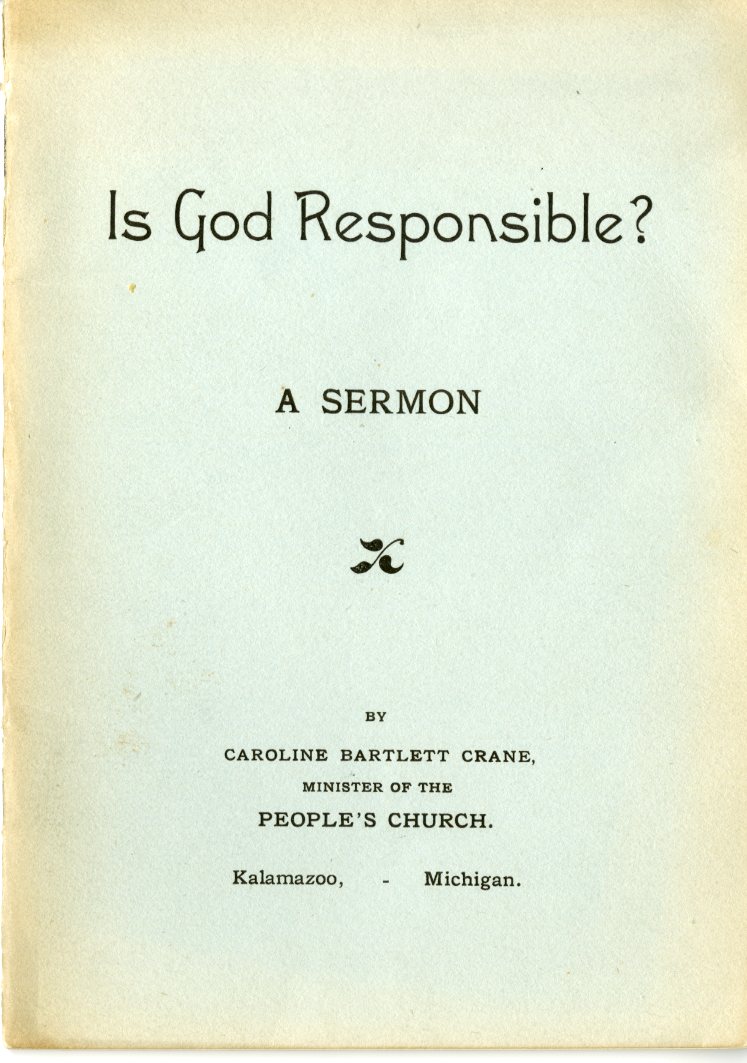
The Sallie Bingham Center has recently acquired three rare pamphlets written by Rev. Bartlett Crane between 1896 and 1898. Two are sermons delivered in the People’s Church. Why the People’s Church…, published in 1896, outlines Bartlett Crane’s philosophy regarding opening church membership to “any human being who is willing to join in the work of helping the world.” The second, Is God Responsible?, published in 1898, is a reflection and expression of sympathy and support for her congregants after a tragic fire and explosion in a local chemical plant.

Published by The Young Published by The Young Men’s Union of the People’s Church of Kalamazoo, Mich., 1898.

The third pamphlet, If I Were Twenty Again!, also published in 1898, offers the accumulated wisdom of a woman who had already had four successful careers and was about to embark on her fifth and final career. Turning to public health and sanitation reform at the turn of the 20th century, Bartlett Crane successfully campaigned for meat inspection ordinances after discovering unsanitary conditions in local slaughterhouses. She founded the Women’s Civic Improvement League in 1903-4. By 1917 Bartlett Crane had inspected facilities in sixty-two cities in fourteen states. As a result of her work to improve urban sanitation, she was known as “America’s housekeeper.”

A tribute to Caroline Bartlett Crane is a small house in Kalamazoo, Michigan which won first place in the Better Homes in America contest in 1925. Bartlett Crane headed a local committee that designed the house to be functional and affordable for a family of moderate income. Called “Everyman’s House,” it was built by volunteers and received national attention. Almost sixty years later Bartlett Crane’s achievements were recognized by her induction, in 1984, into the Michigan Women’s Hall of Fame. The pamphlets are available for researchers in the Rubenstein Library.

New Acquisitions – Two Significant Gatherings of Black Activists and Intellectuals

Post contributed by John B. Gartrell, Director, John Hope Franklin Research Center for African and African American History and Culture

The Amenia Conference, 1925

This past year the John Hope Franklin Research Center has added to its collections materials that document significant public gatherings of black intellectuals during the 20th century.  The first is a publication authored by seminal black scholar W.E.B.DuBois, The Amenia Conference, an Historic Negro Gathering. Published in 1925, DuBois wrote his reflections of a notable meeting held in 1916 in Amenia, NY that was called by the fledgling NAACP, designed to bring black intellectuals who were working to solve, what DuBois referred to in his Souls’ of Black Folk (1910), as the “problem of the color-line.” With close to 60 attendees, this small publication is one of the few, if not only, documents that provides descriptions of the meeting as DuBois noted no record was kept of the conversations. Held one year after the death of Booker T. Washington, in many ways the dean of black leadership at the turn of the 20th century, DuBois stated that “…the Amenia Conference was a symbol. It not only the end of the old things and the old thoughts and the old ways of attacking the race problem, but in addition to this it was the beginning of the new things.”


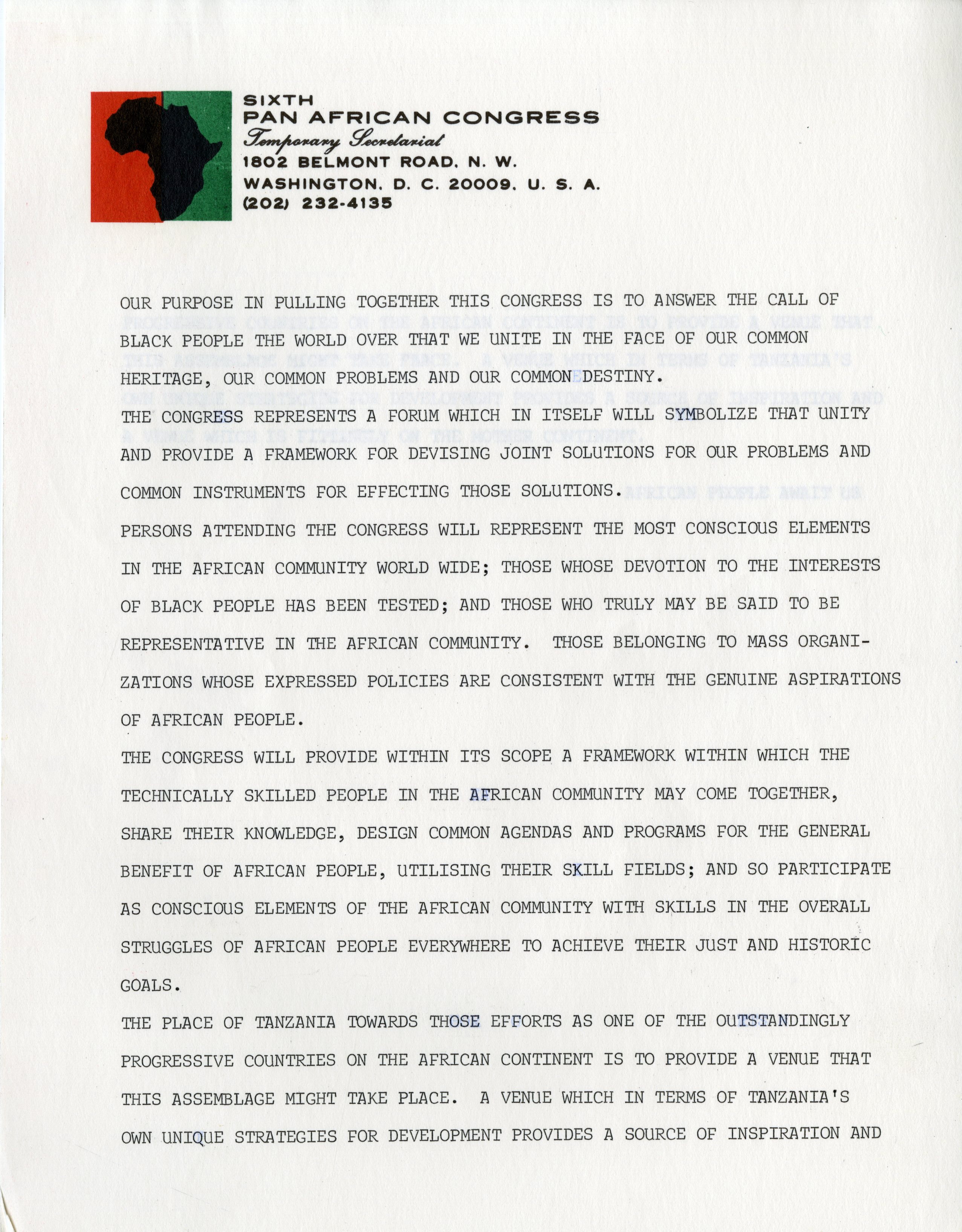
6PAC Press Release

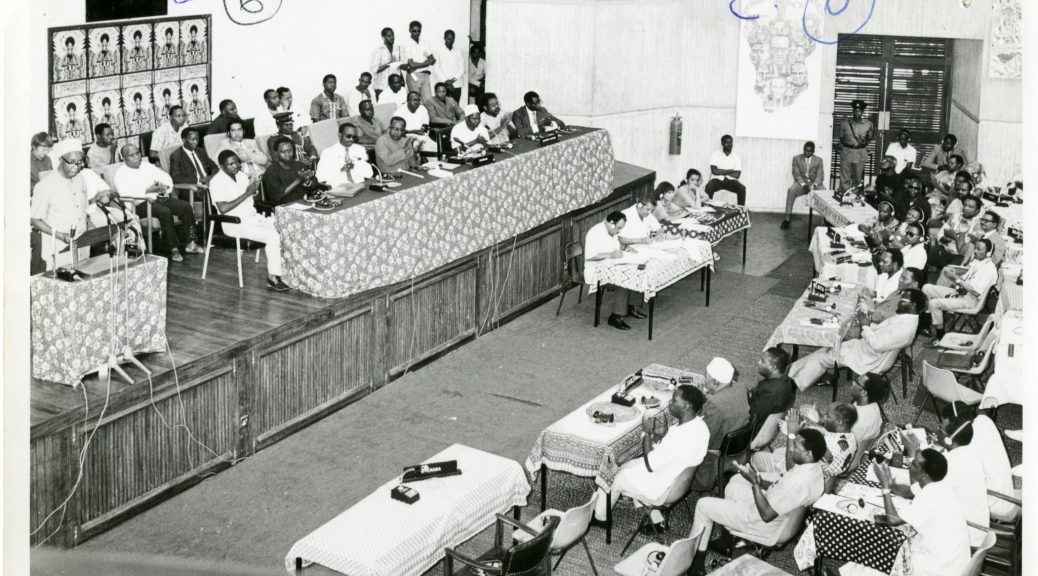
Later in the century, after the wave of black activism in the form of the Civil Rights Movement in the US and waves of independence movements in Africa and the Caribbean during the 1960s, the 6th Pan-African Congress (6PAC) was held in Dar es Salaam, Tanzania in 1974. The Courtland Cox Papers document the planning and programs held during the week long meeting that was the first Pan-African Congress held in Africa. Cox himself left Howard University in the early 1960’s to a join the Student Nonviolent Coordinating Committee (SNCC) and organize against disenfranchisement and poverty in America’s Deep South. Coming out of SNCC, he and a number of SNCC activists became involved in organizing around black consciousness and black solidarity on the global level.

Photograph of 6PAC Meeting

Cox spent time in Tanzania in the early 1970’s and served as secretary-general for the 6th Pan-African Congress, a conference whose history dated back to 1900, although it was the first held after World War II. Over the course of the week in Dar es Salaam, sessions were held to discuss everything from economic empowerment in Africa, environmental issues in black communities, and the meaning of black solidarity around the world.

Both collections are open and available to researchers in the Rubenstein Library.

Frankfurter Kranz: A Frankly Extravagant Cake (1969) – Rubenstein Library Test Kitchen

Post contributed by Brooke Guthrie, Research Services Coordinator

For my last Test Kitchen post , I attempted a Mexican-Italian fusion recipe from the 1940s. That mostly worked out (destroyed spatula notwithstanding) so I decided to continue with the international cooking theme. Luckily, the Rubenstein Library is a very worldly place. The library has 27 cookbooks  published by Time-Life Books as part of their Foods of the World  series in the 1960s and 1970s. These heavily illustrated books combine cooking instructions with travelogues and food histories. The books usually cover each region of a country and describe how to properly throw a party there.

Our Foods of the World holdings include cookbooks covering the foods of the great American West, Africa, France, the Middle East, China, and the British Isles. With so many choices, making a recipe decision was tough. I briefly considered a kulebiaka (a flaky cabbage loaf from Russia) which is, apparently, considered a “food of the people.” The Russian cookbook also contained a decent amount of beet-based recipes that were pretty hard to pass up. The cuisine of nearby Scandinavia (also lots of beets) piqued my interest. It involved a lot of pickled things, dishes served with a side of raw eggs, and much of it was described as “food for a man’s appetite.” Could I even handle that? I wasn’t sure.

Ultimately, I decided to tackle the food of the German people. I don’t really know much about German cuisine. I know that sausages and beer are important, but I assume they eat other things from time to time.

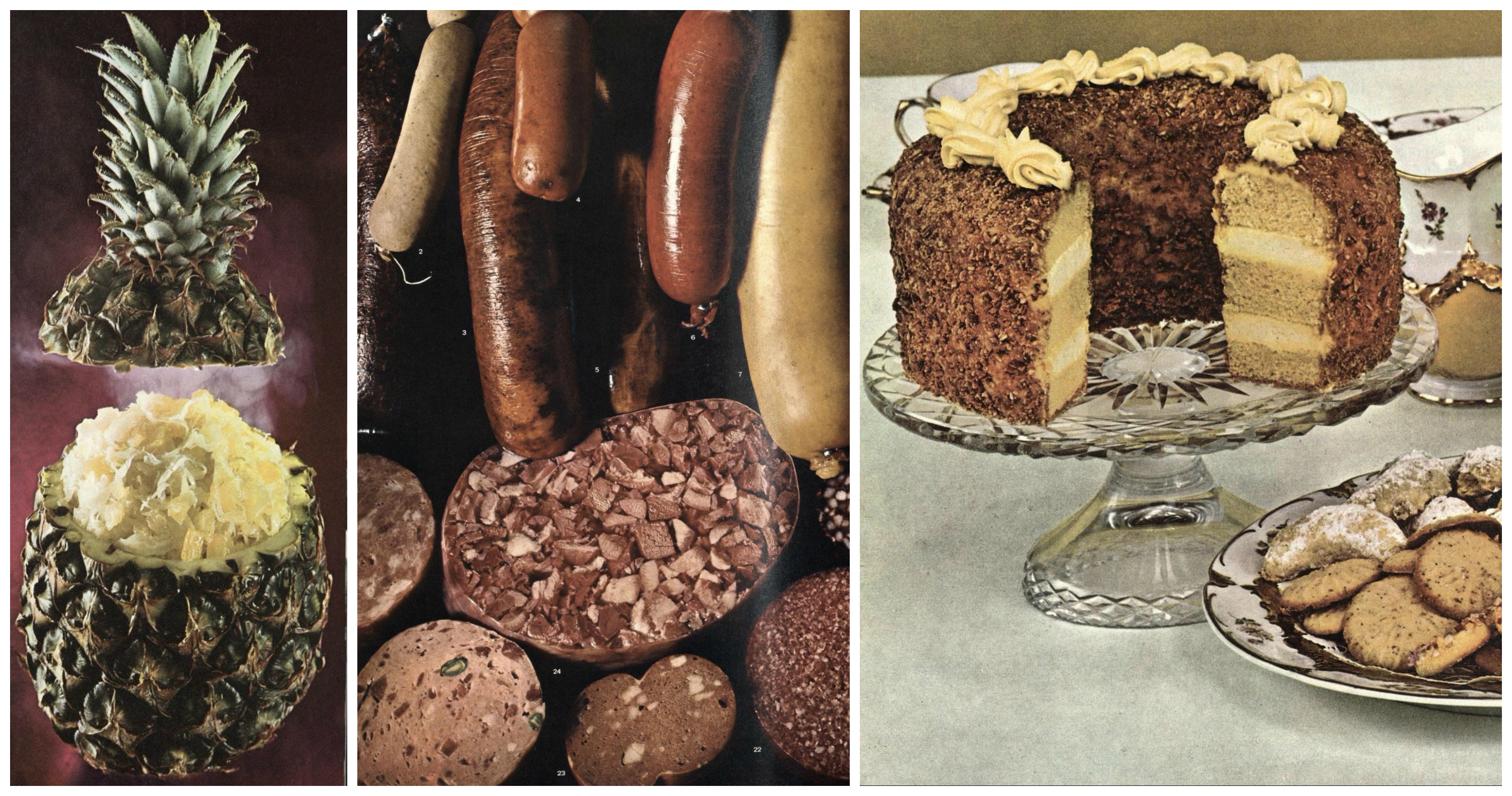
Three images of food: sauerkraut served in a pineapple, German sausages, and a cake

Despite the appealing pictures of meat and sauerkraut artfully served in a pineapple, a hearty German cake called a “Frankfurter Kranz” seemed like the way to go. This cake is described as a layer cake with butter-cream filling and a praline-topping. The cookbook goes on to say that this cake “is a frankly extravagant cake” and “it is a special treat served only on the most elegant occasions.”

Continue reading Frankfurter Kranz: A Frankly Extravagant Cake (1969) – Rubenstein Library Test Kitchen

Notes from Durham’s Musical Past: Polonaises and Mazurkas on Main Street

Post contributed by Paula Jeannet Mangiafico, Visual Materials Processing Archivist

There are many music-related collections in the Rubenstein Library, but the Gilmore Ward Bryant papers are special to the history of Durham, North Carolina.  This small collection of diaries, photographs, school records, and sheet music documents a time when turn-of-the-century citizens held cultural aspirations that included unleashing the terpsichorean muse on Durham—hoping perhaps that arpeggios and arias would temper the roughness of the tobacco town (population 18,241 in 1910).

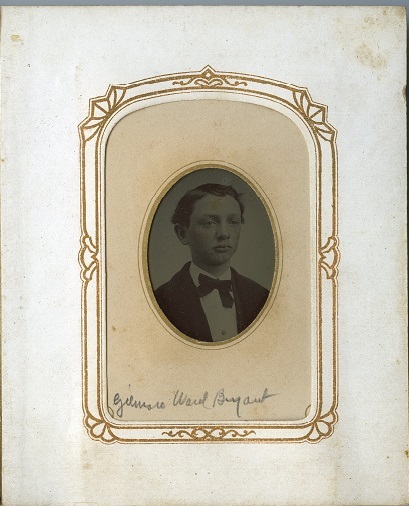
Enter Gilmore Ward Bryant, born in 1859 and raised in Bethel, Vermont.

Gilmore W. Bryant, circa 1870, from the Gilmore Ward Bryant papers

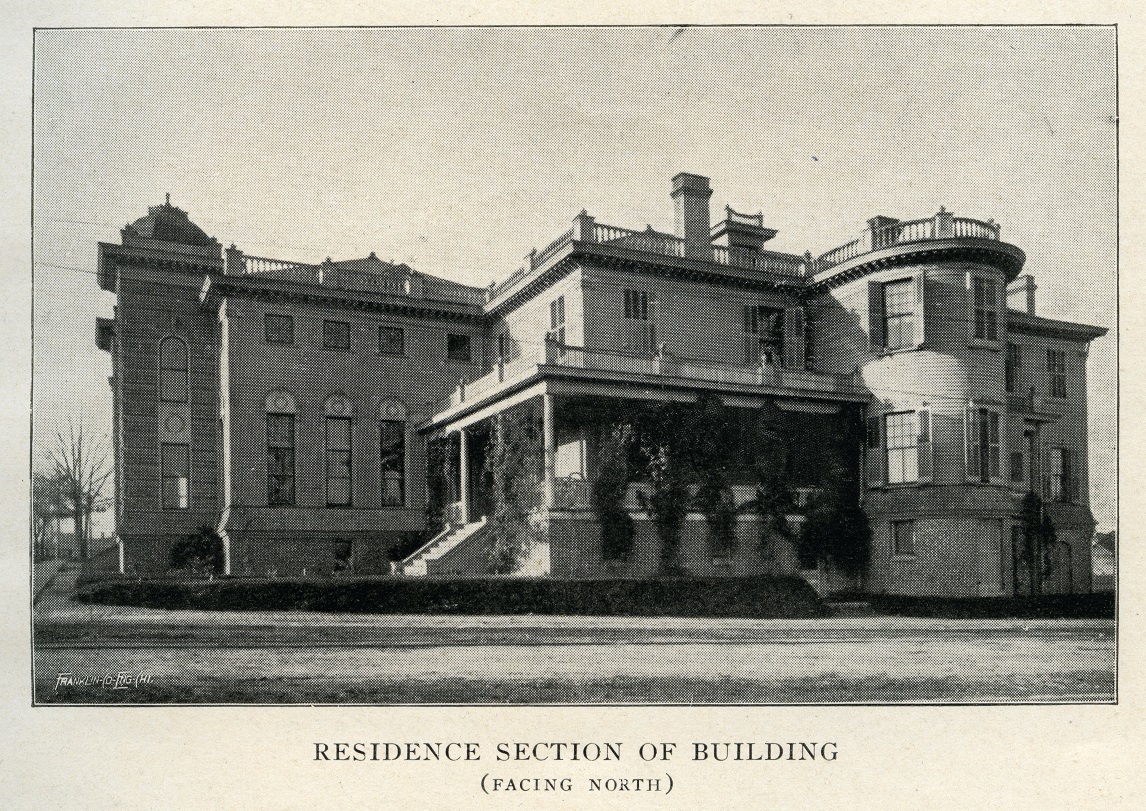
After a successful musical career in New England and Virginia, he was reportedly lured to the Southern upstart town of Durham by the Duke family, who financed the design and construction for what was to become the Southern Conservatory of Music.  Finished in 1898, the grand Italianate-style building stood on the corner of Main and Duke Street, across from the Liggett Myers Building, on land that today belongs to the Brightleaf Square parking lot.

Here is a view of the Conservatory.  This is what you would have seen if you stood at Toreros Mexican restaurant and looked across the street:

Conservatory Calendar, 1920-1921, Gilmore Ward Bryant papers

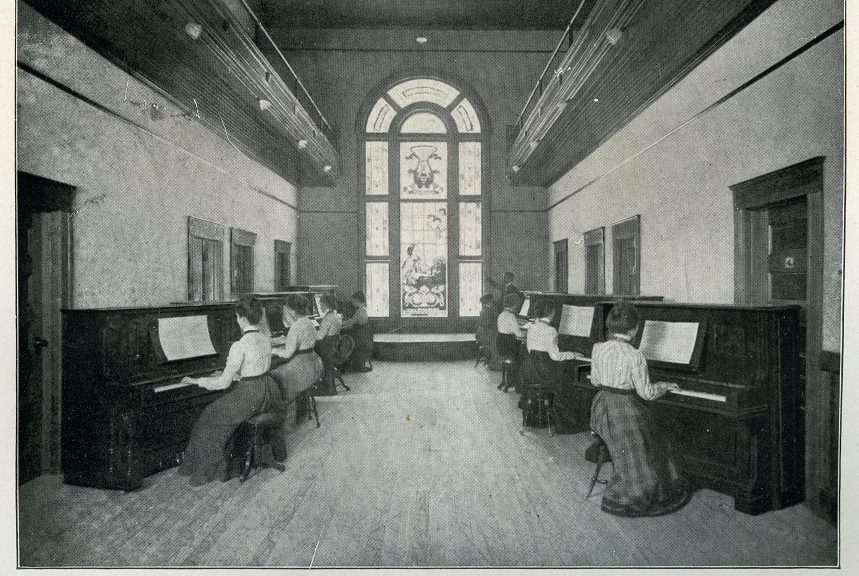
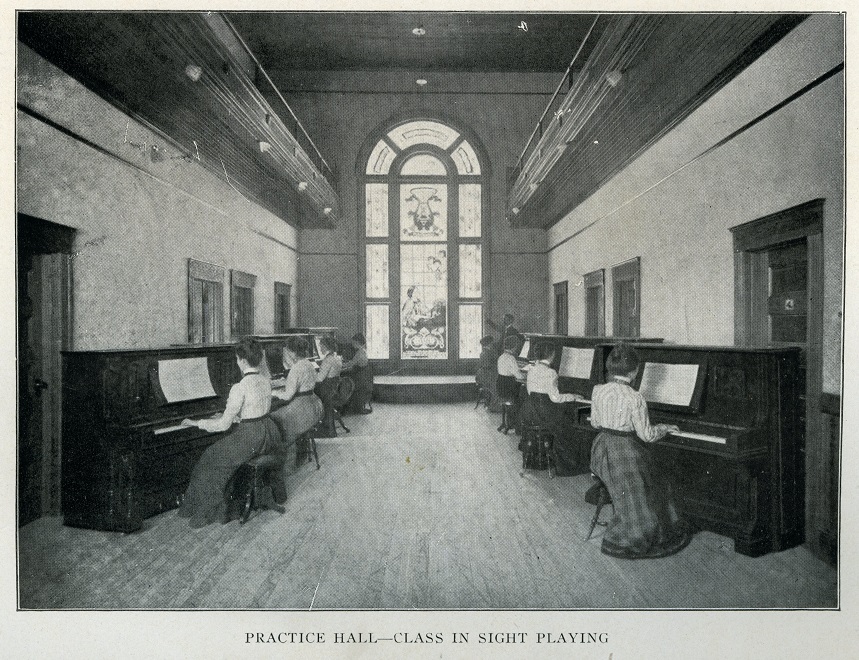
Its auditorium, practice rooms, and parlors were classically grand in scale—the reverberations must have been amazing, to say the least:

Conservatory Calendar, 1920-1921, Gilmore Ward Bryant papers
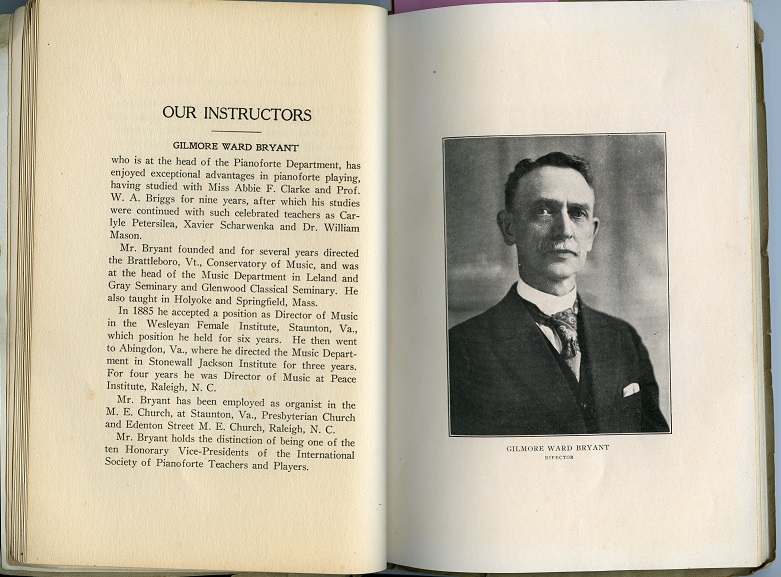
Gilmore Ward Bryant, circa 1920, Conservatory Calendar, 1920-1921

“G.W.” Bryant served as Director of the Conservatory, and along with his partner and wife, Mattie Emily Bullard Bryant, the head of the Voice Department (his daughter-in-law also taught piano), kept the undoubtedly expensive venture thriving for many decades.  The school was a huge success, hosting large concerts, alumni dinners, and recitals several times a year.

Bryant was also a composer, penning scores as early as 1895 and continuing into the 1930s.  He wrote and published many pieces, including a “Tiny Waltz” and another piece entitled “Topsy Turvy.”

Sheet Music Series, Gilmore Bryant papers
Sheet Music Series, Gilmore Ward Bryant papers

Eventually, perhaps due to a familiar pattern of rising downtown rents, the Bryants laid the cornerstone for a new Conservatory on South Alston Avenue, then open countryside, in summer 1923, and the old Conservatory was demolished in 1924.  Bryant’s wife writes in her 1923 diary on December 31: “Went up & thru the old Conservatory— was terrible—nearly dropped to pieces.”

Today Durham hosts several music schools, but the era of grand edifices and classical conservatory training has yet to return.  In the meantime, we applaud the Bryants’ vision for and dedication to their adopted Southern hometown.  Luckily, some of the Conservatory’s records and the Bryant family’s personal papers and photographs have been preserved for researchers at the Durham County Library and the David M. Rubenstein Rare Book & Manuscripts Library.  You can see the inventory for the Rubenstein collection here:

http://library.duke.edu/rubenstein/findingaids/bryantgilmore/

(Thanks to the Open Durham and Durham County Library websites for background information.)


Raphael Lemkin’s Contribution to Describing Duke University Library’s Collection of Soviet Posters

Post contributed by Ernest A. Zitser, Ph.D., Librarian for Slavic and East European Studies 

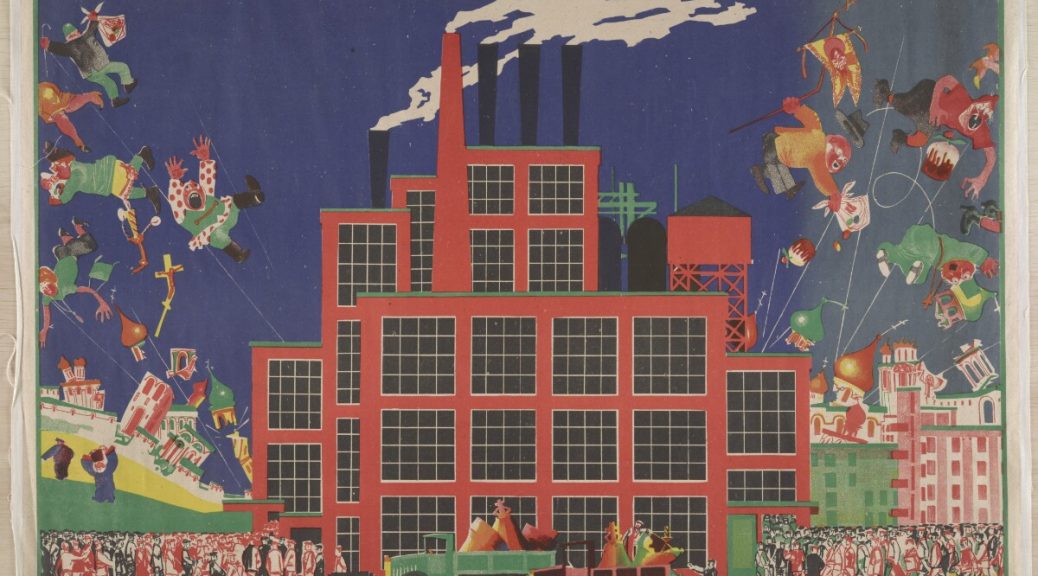
In 2009, while conducting research for a proposal to digitize Duke University Library’s collection of Soviet-era propaganda posters, I uncovered evidence that the handwritten, English-language titles/summaries found at the top of the thirty items in the original, “General Political Poster Series,” were penciled-in by none other than Raphael Lemkin (1900-1959), “the man who criminalized genocide.”

It is well known that, from April 1941 to June 1942, while serving as a “visiting lecturer” at Duke’s Law School, Lemkin worked on the book in which he coined the term “genocide.” Less well-known is the fact that sometime during that same period, the Polish-Jewish jurist was asked to translate/describe the posters that Professor Calvin Bryce Hoover (1897-1974)—chairman of the Department of Economics and Dean of the Graduate School—had purchased a decade earlier, during his research trip to the Soviet Union (1929-1930).

Until recently, it was believed that there were “no documents …in the collection [at Duke] directly relating to his tenure at the university” and that “Duke Archives does not contain material relating to Lemkin except for a biographical file.” However, an accession record created in 1984, during the transfer of the Russian poster collection from Duke’s Manuscript Division to its Rare Book Room, specifies not only that the first thirty items were “the gift of Dean Calvin B. Hoover,” but also that the “titles of the broadsides were translated by Professor Raphael Lemkin of Duke University Law School.”

Scan of typewritten accession record for the Russian Posters Collection, stating they were a gift of Calvin B. Hoover
Accession record, Russian Posters Collection, David M. Rubenstein Rare Book & Manuscript Library, Duke University.

A comparison of the handwriting on Duke’s Russian posters to surviving examples of items known to be written by Lemkin—such as the draft of a telegram from Lemkin to Mrs. William Dick Sporberg, a member of the United States Committee for a United Nations Genocide Convention, asking her to organize a cable campaign aimed at influencing the American delegation to the UN to support a genocide convention—confirms the veracity of this archival annotation.

scan of handwritten draft of telegram
Draft of a telegram from Raphael Lemkin in Paris to Mrs. William Dick Sporberg (1948)


Close crop of one of the library's Russian Posters showing Lemkin's hand written annotation
“Long Live the First of May, Moscow & Leningrad” Lemkin’s handwritten annotation to a 1929 Soviet poster (ca. 1941) View the full poster in our digital repository. 


Close up photograph of Lemkin's handwritten annotation on one of the library's Soviet Posters
“Easter. Contrast of joyous Easter of Long Ago with Serious Workers of Com.[munist] Russia.” Lemkin’s annotation to an undated Soviet poster (ca. 1941) View the full poster in our digital repository. 
Closeup photograph of Lemkin's handwritten annotation on one of the library's Soviet Posters
“Capitalistic and Communistic Conceptions of the Army”
Lemkin’s handwritten annotation to a Soviet poster from 1927 (ca. 1941). View the full poster in our digital repository. 

Juxtaposing the hand-written, English-language translations with the posters’ original, Russian-language titles not only reveals Lemkin’s command of both languages—two of the eight that were supposedly at his disposal—but also demonstrates his understanding of communist Russia, and of how the “new, Soviet man” might be different from his capitalist counterpart. This information was undoubtedly very useful to Hoover, the acknowledged founder of the field of comparative economic systems.

The posters, together with Lemkin’s handwritten annotations, can be viewed on the new and improved site of Duke’s Russian poster collection, which was migrated to the Duke Digital Repository in April 2017.

Dispatches from the David M. Rubenstein Rare Book and Manuscript Library at Duke University