Post contributed by Haleigh Yaspan, Independent Researcher
Pregnancy and birth, as universal and unvarying phenomena, can offer a revealing and reflective view into a specific historical chapter. Careful attention to the dynamic nature of the circumstances that have historically defined the experiences of pregnant and birthing women can help us contextualize and better understand our present moment. The relationship is bidirectional: so too does an exploration of historical factors help shed light on the rationale for trends in the medicalization of birth. The aid of a generous History of Medicine travel grant allowed me to spend time with a number of fascinating collections at Duke’s David M. Rubenstein Rare Book & Manuscript Library that can offer such insight. These included, for example, the collection of medical instruments from the practice of Dr. LM Draper, the Louise Hortense Branscomb papers, and the Wilton G. Fritz Collection Artifacts.
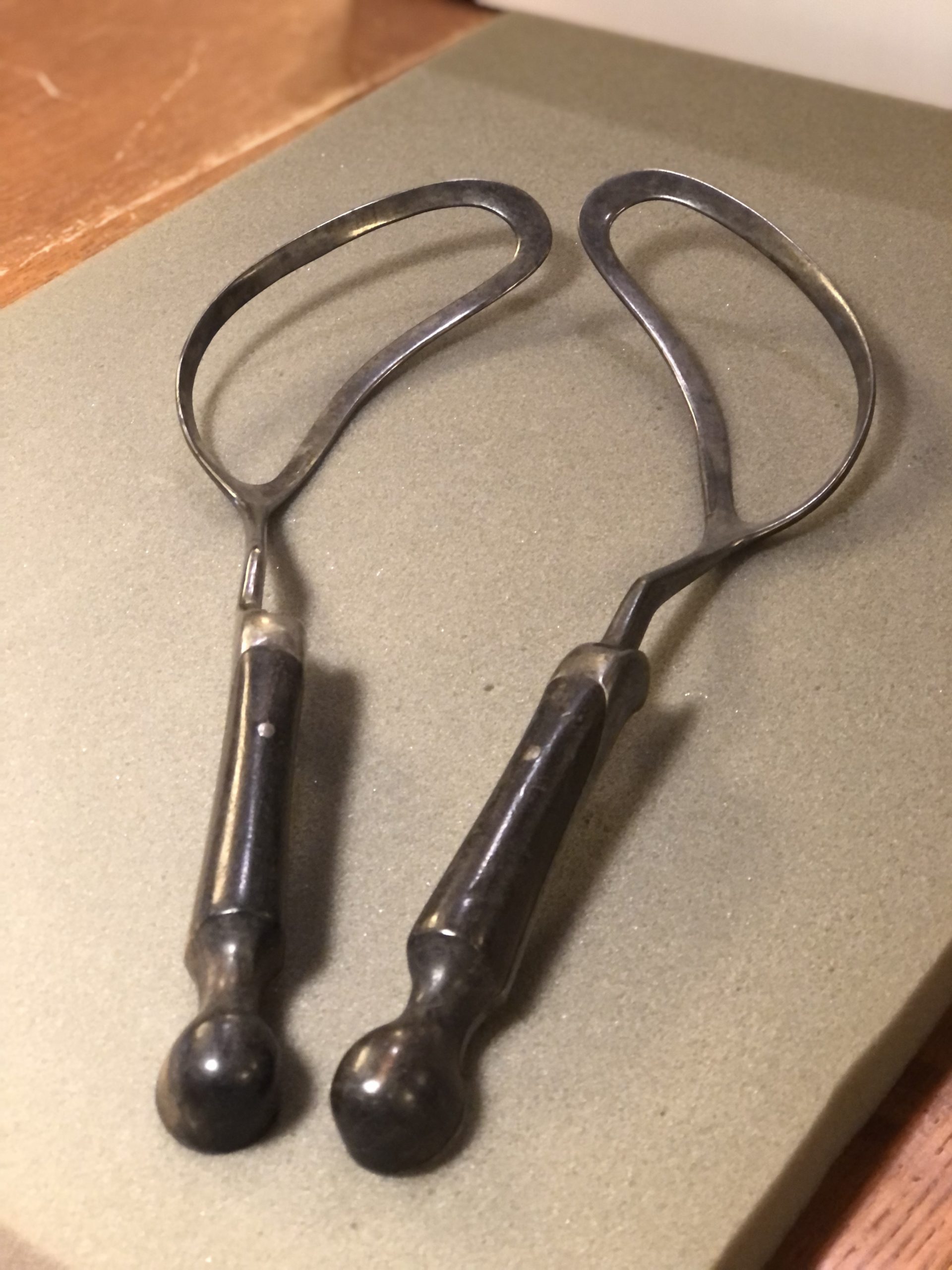
In the United States, the circumstances of birth changed dramatically toward the end of the Progressive Era. Prior to the twentieth century, the care of pregnant and birthing women was most commonly the domain of midwives and other female practitioners, who were not incorporated into a recognized professional body. The shift toward a physician-centric approach can be traced back to a revolution within the medical profession, beginning in the late 1800s and continuing well into the following century. The wide variety of obstetrical tools surviving from Dr. LM Draper’s twentieth-century collection offers insight into standard practices of American physicians of the day. I was particularly intrigued by the array of various iterations of forceps, insinuated as they are in the medical profession’s early- and mid-century proclivity toward instrumental intervention in labor, an intentional move to set physicians apart from low-interventionist midwives.
Obstetrical forceps had been invented in the seventeenth century, although their use was not widespread until much later.
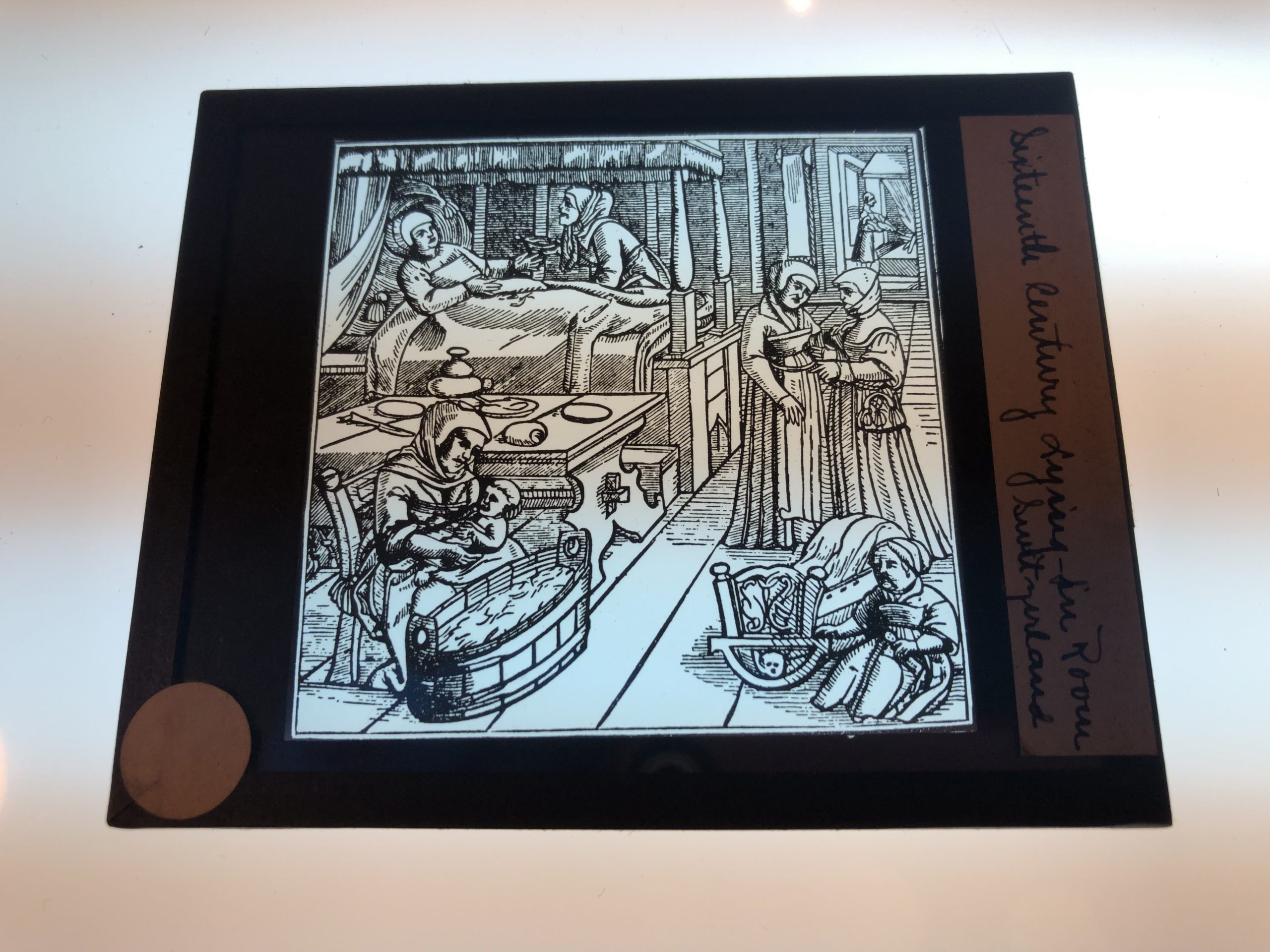
The glass slides for Dr. Carter’s OB/GYN lectures provided a window into the education aspect of the medical approach to obstetrics. Such primary sources set forth the gold standard of mid-century medical education of the day. The use of visuals in the slides informs an understanding of the historical pedagogical practices in this field, while the language employed clues us into the sociocultural milieu that circumscribed and defined medical education of the day.
American medical students learned about the history of childbirth, which had not traditionally been considered the purview of medical practitioners.
The medicalization of birth that took shape in the early twentieth century has attracted both celebration and criticism. Many have critiqued physicians, both in this period and since, for their quickness to instrumentally intervene in birth and their failure to outperform more hands-off midwives in terms of clinical outcomes. In the early twentieth century, Abraham Flexner, under the aegis of the Carnegie Foundation, set out to survey the state of medical education in the United States and Canada. His 1910 report eviscerated the medical profession, suggesting that a vast majority of American doctors were woefully unqualified and had received what little education they possessed from institutions of highly dubious rigor and quality. “But the very worst showing,” he noted, “is made in the matter of obstetrics.”
Post contributed by Joshua Larkin Rowley, Reference Archivist, John W. Hartman Center for Sales, Advertising & Marketing History
The Hartman Center for Sales, Advertising & Marketing History acquired the archive of Consumer Reports, the consumer advocacy and education non-profit, in October of 2019. Staff were thrilled with the new acquisition and eager to make these fabulous collections available to researchers as soon as possible. Then…the pandemic hit.
Finally, after nearly three years and hours of work by staff and interns in the Rubenstein Library’s Technical Services Dept. approximately 65 individual collections have been fully described and made available. To mark the occasion we’ve published a website dedicated to highlighting the breadth of the Consumer Reports Archive, the history of the organization, a selection of archival collections, recently cataloged print items, and its interdisciplinary potential in teaching. Explore the site here and check out some highlights from the collection below.
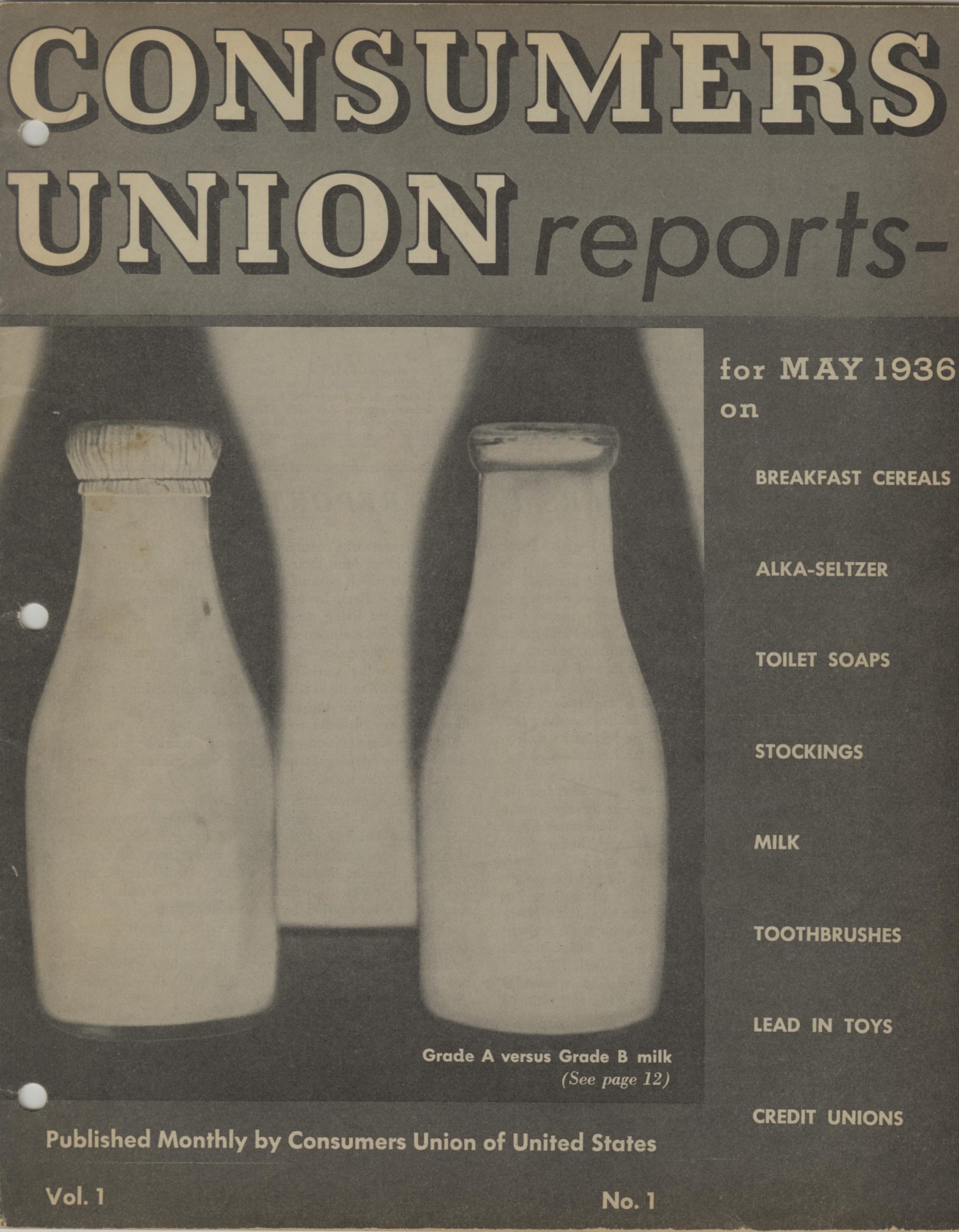
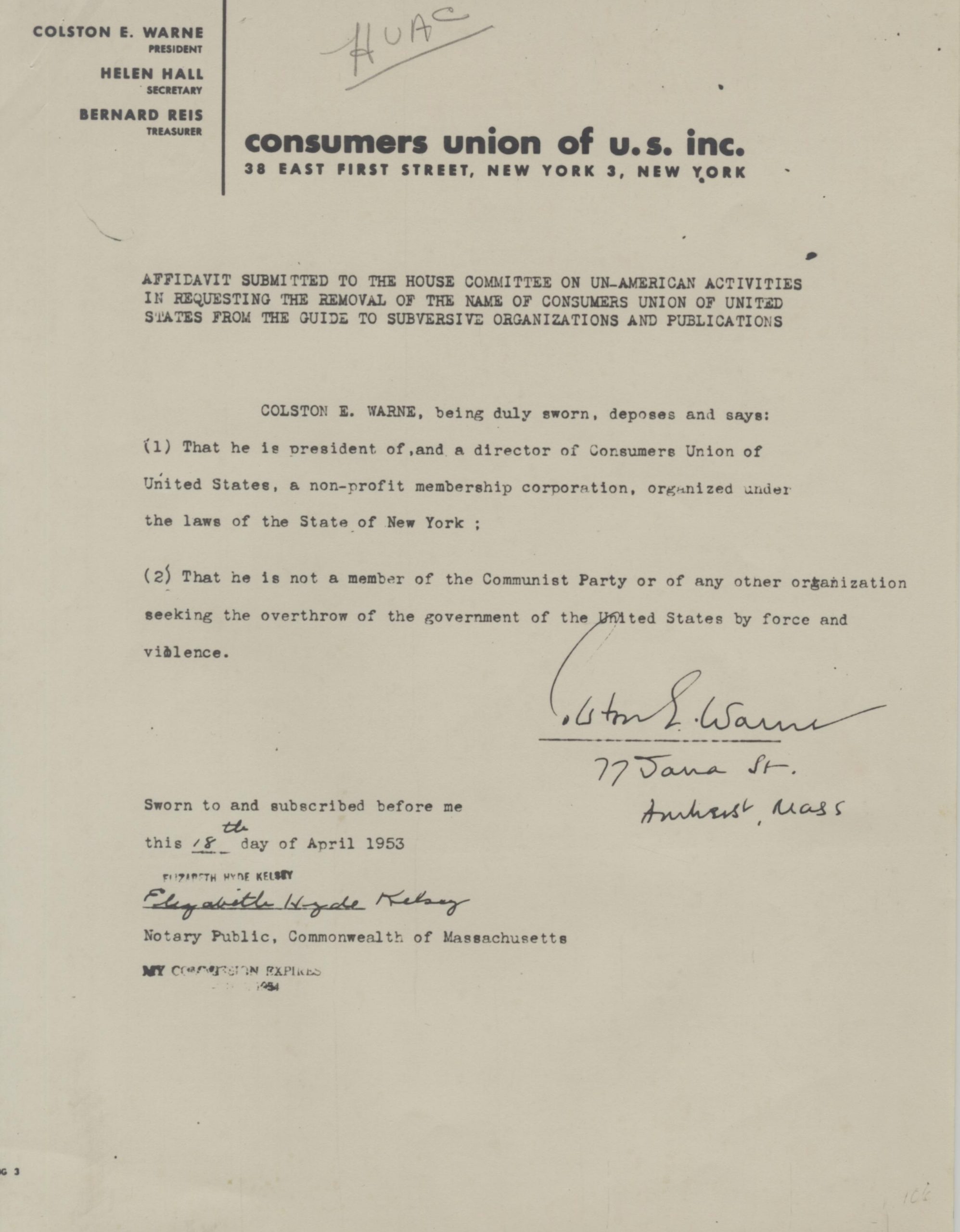
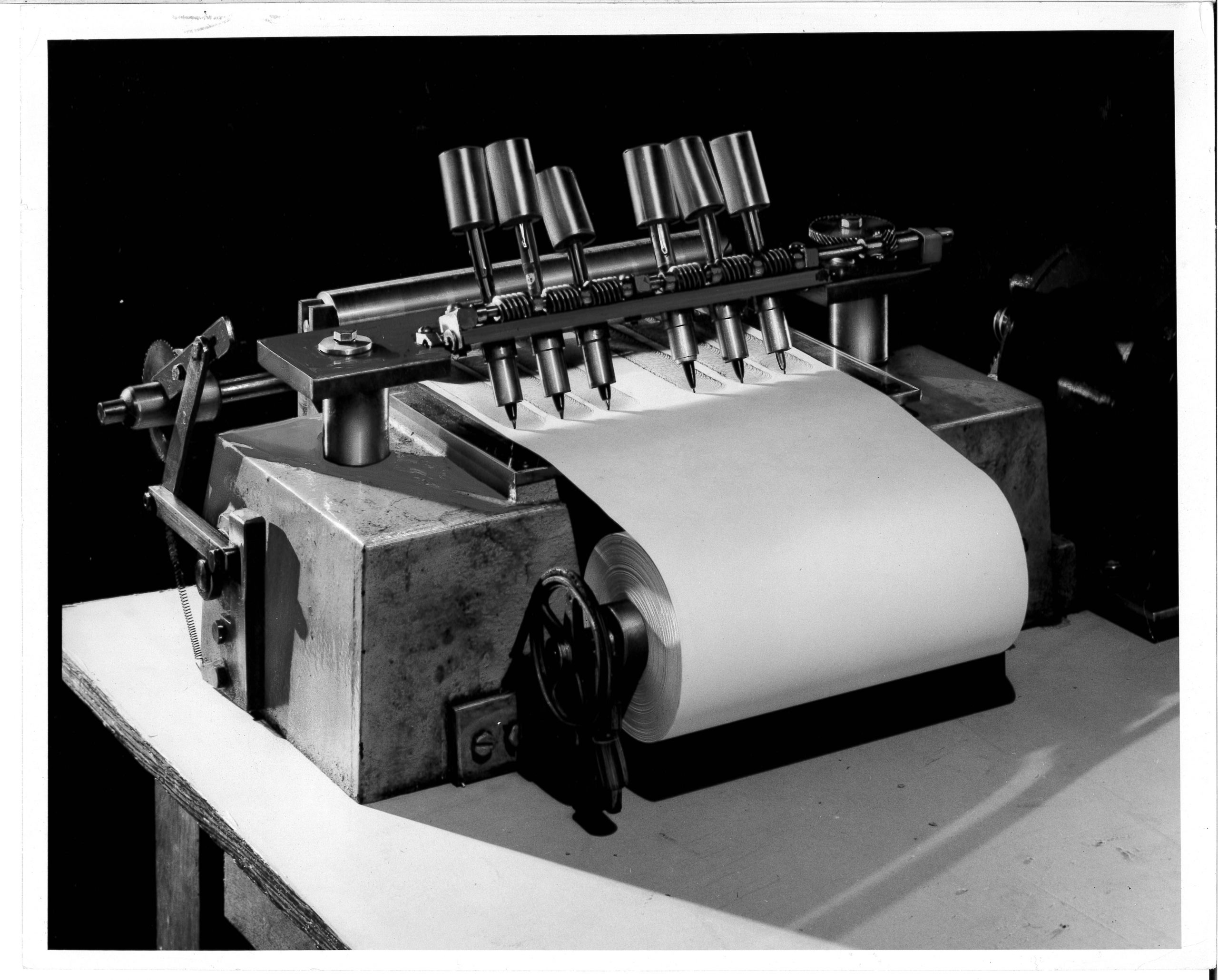
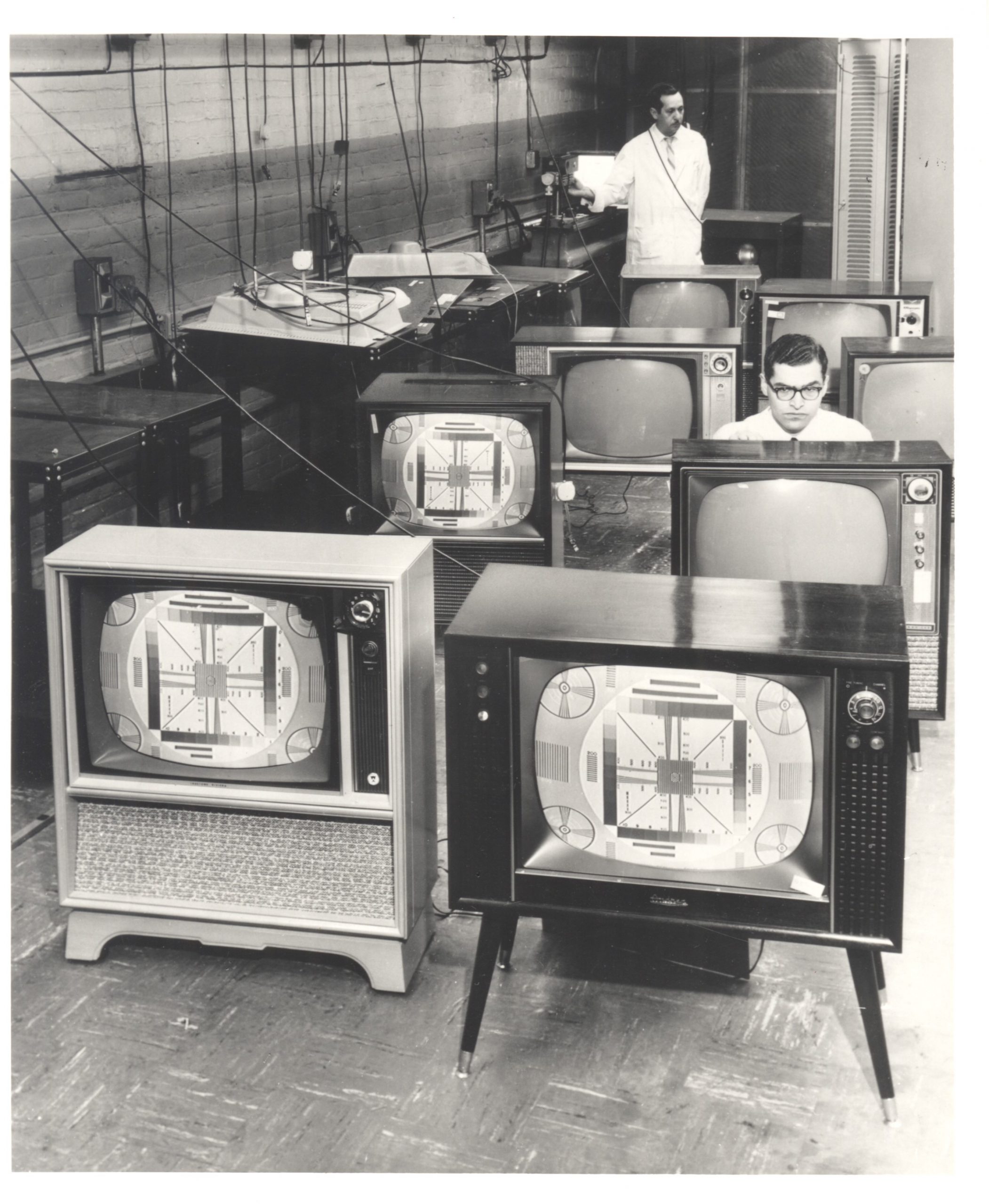
Lipstick tester from the testing equipment collection.First issue of Consumer Reports, May 1936.Consumer Reports founder Colston Warne’s sworn statement that he’s never been a member of the Communist Party, April 1953, from the Colston Warne PapersPen tester from Consumer Reports Iconographic Collection.Television set test from the Consumer Reports Iconographic Collection.
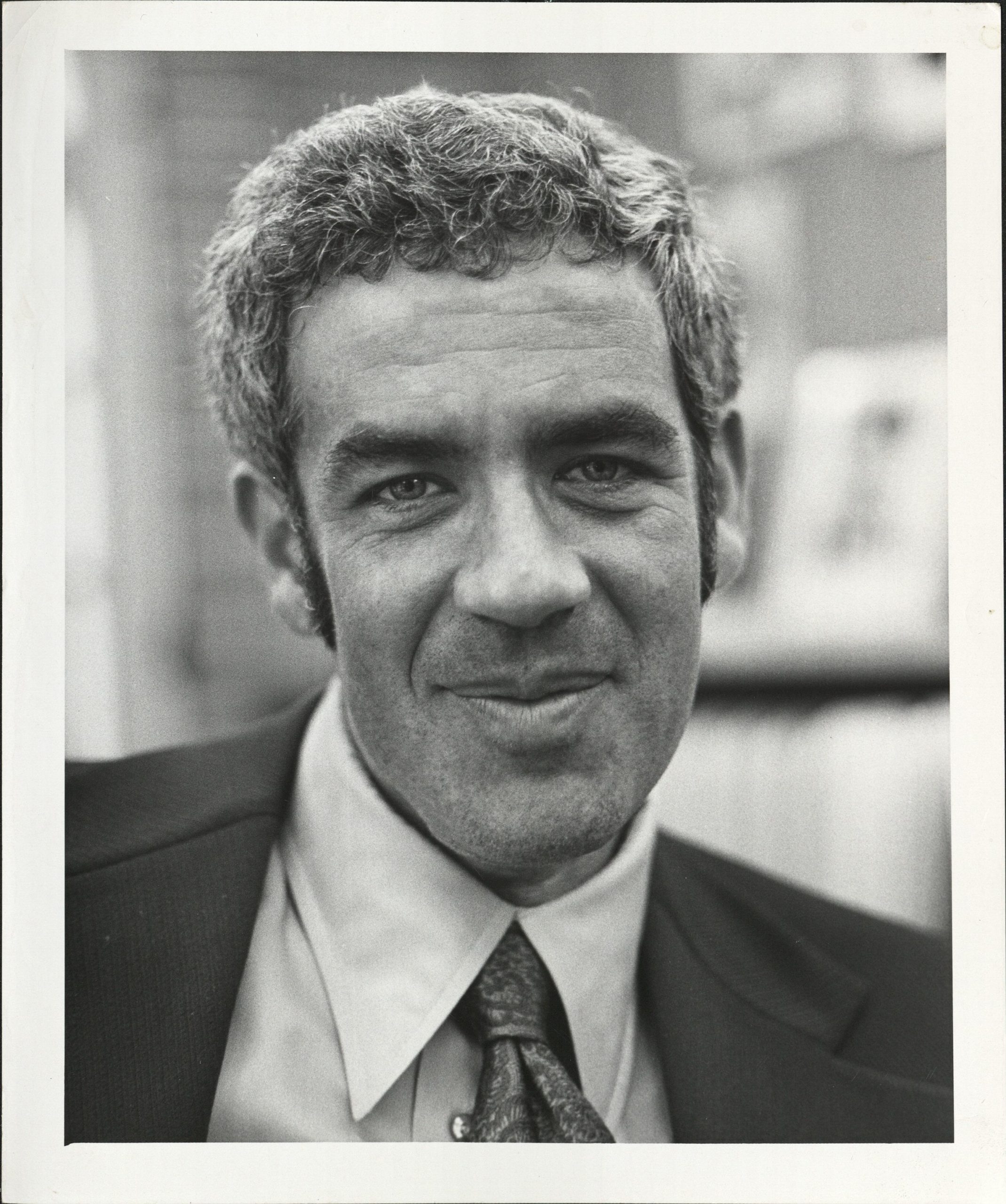
Marc Nerlove, circa 1972-1974, photograph, 8 x 10 in., Box 91, Folder Requests for Publications, 1972-1974.
Post contributed by Zachary Tumlin, Project Archivist for the Economists’ Papers Archive.
The Marc L. Nerlove papers are now open for research as part of the Economists’ Papers Archive, a joint venture between the Rubenstein Library and the Center for the History of Political Economy. Marc Leon Nerlove is a white American agricultural economist and econometrician who was awarded the John Bates Clark Medal from the American Economic Association (AEA) in 1969 and held appointments at eight different universities from 1958-2016: Johns Hopkins (where he earned his PhD), Minnesota, Stanford, Yale, Chicago (where he earned his BA), Northwestern, Pennsylvania, and Maryland. The Clark Medal is awarded to an economist under the age of 40 who “is judged to have made the most significant contribution to economic thought and knowledge,” and when the AEA appointed him as a Distinguished Fellow in 2012, they cited his development of widely used econometric methods across a range of subjects, including supply and demand, time series analysis, production functions, panel analysis, and family demography.
Nerlove was born and raised in Chicago and credits his father, S. H. (Samuel Henry) Nerlove, for his interest in economics. In addition to being a business economist at Chicago and a founding member of the Econometric Society (of which Marc would become President in 1981), S. H. “inadvertently” became the trustee of a large, bankrupt midwestern life insurance company in 1933 during the Great Depression. This company “held mostly foreclosed farm mortgages,” with the farms now being “operated by their former owners as tenants.” S. H. would share stories around the dinner table of his visits to these farms, since the family did not have one of their own in Hyde Park.
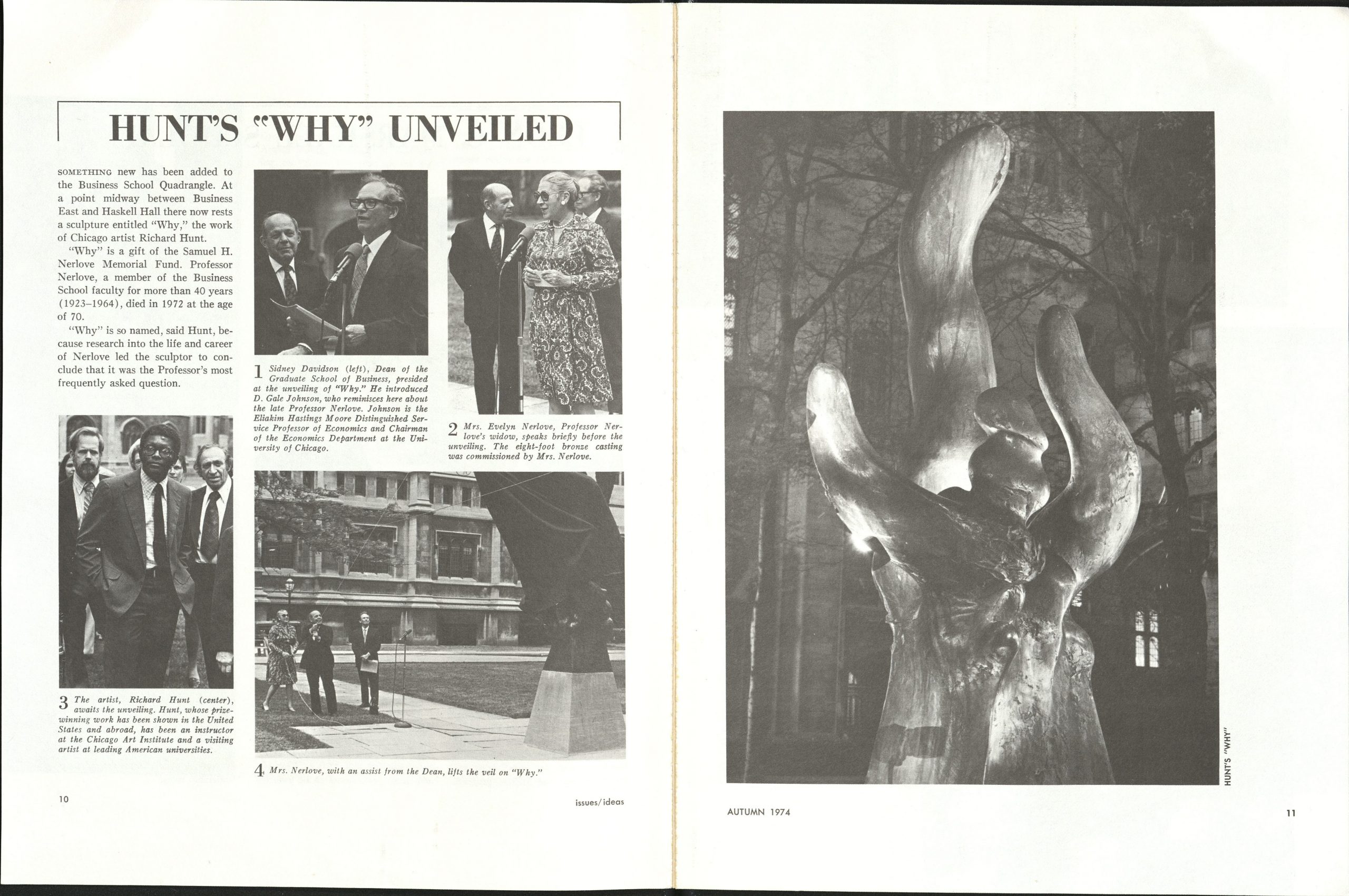
“Hunt’s ‘Why’ Unveiled,” issues/ideas, 1974, 10-11. Located in Box 91, Folder Issues/Ideas, 1974. This is a sculpture on campus at Chicago that was commissioned by S. H.’s widow and Marc’s mother Evelyn in S. H.’s memory.
The Nerlove papers consist of 195 linear feet (137 boxes) of physical material and a little over 0.1 gigabytes of digital material that primarily document Nerlove’s professional life through his correspondence, writings, teaching, research, and professional service. Other economists who appear most frequently in the papers include Kenneth Arrow, José Carvalho (student), Carl Christ (dissertation supervisor), David Grether (student), Zvi Griliches, Lawrence Klein, Tjalling Koopmans, Ta-Chung Liu (teacher), Theodore Schultz (teacher), and Lester Telser. To a lesser extent, there is some correspondence, teaching material, and two writings from Milton Friedman (teacher) and one handwritten letter from John Nash.
John Nash to Marc Nerlove, March 1953, Box 2, Folder Nash, John, 1953.
One unique aspect of the collection is how much of it comes from others besides Nerlove. There are 134 files of teaching material from others, 228 files of dissertations, and 343 files of writings by others, compared to 143 and 421 files of his own teaching material and writings, respectively. Although his own files are richer, the files from others give us a sense of what was happening around him and his professional interests and network.
The teaching material from others was acquired from coworkers and professional colleagues for reasons such as Nerlove teaching/researching a similar course/subject or sent in exchange for his own teaching material. The dissertations are not only ones that Nerlove supervised or sat on the committee for, but that he received from his department for review as a faculty member, received from the author due to citation/similar research interest, or personally requested. While it is not unusual for there to be writings by others/reprint files, what was unusual was the quantity of them—they were originally around a quarter of the collection/90 linear feet and occupied 20 filing cabinets in a separate room on campus at Maryland. These files were thoroughly weeded to focus only on items with correspondence, annotations, or that appeared to be unpublished (primarily pre-1990).
Lastly, 11 items from these papers will occupy a large case in an upcoming exhibit on administrative assistants scheduled to be installed in the Michael and Karen Stone Family Gallery. These items are from the early 1970s and related to three of Nerlove’s secretaries at Chicago and Northwestern: Elizabeth “Betty” Ann Percell (1936-2005), Gloria Feigenbaum (1922-2006), and Stina Leander Hirsch (1919-2008). Such staff members have job duties that include basic records management—maintaining working files while they are still held by their creator before they are donated—and it is important to name them when they appear in the archival record because they are essential workers. A “good” secretary gives professors the ability to focus more on their research, and they make it easier for archivists to prepare these papers for long-term preservation (which ultimately benefits the archival user).
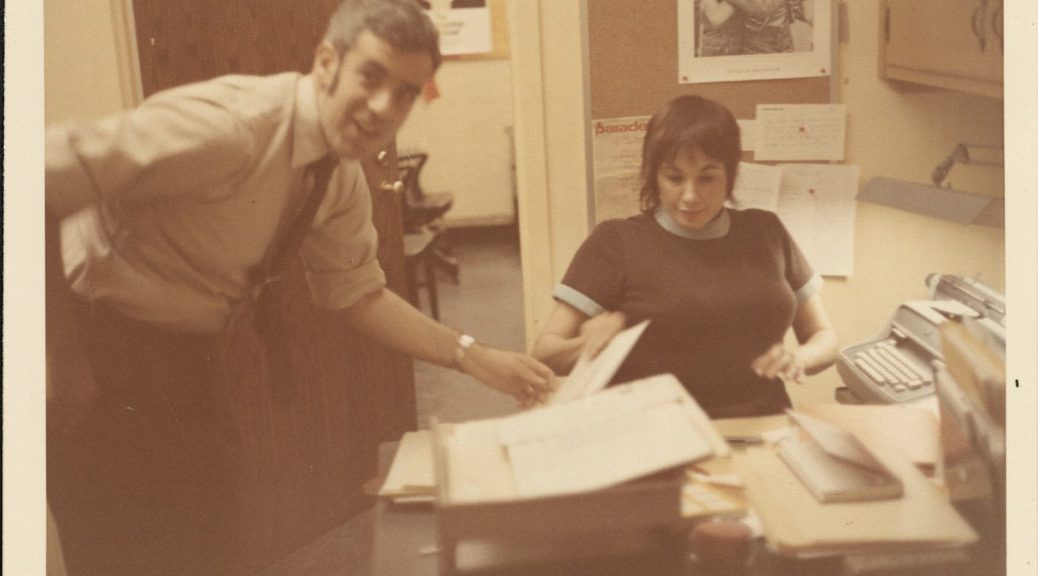
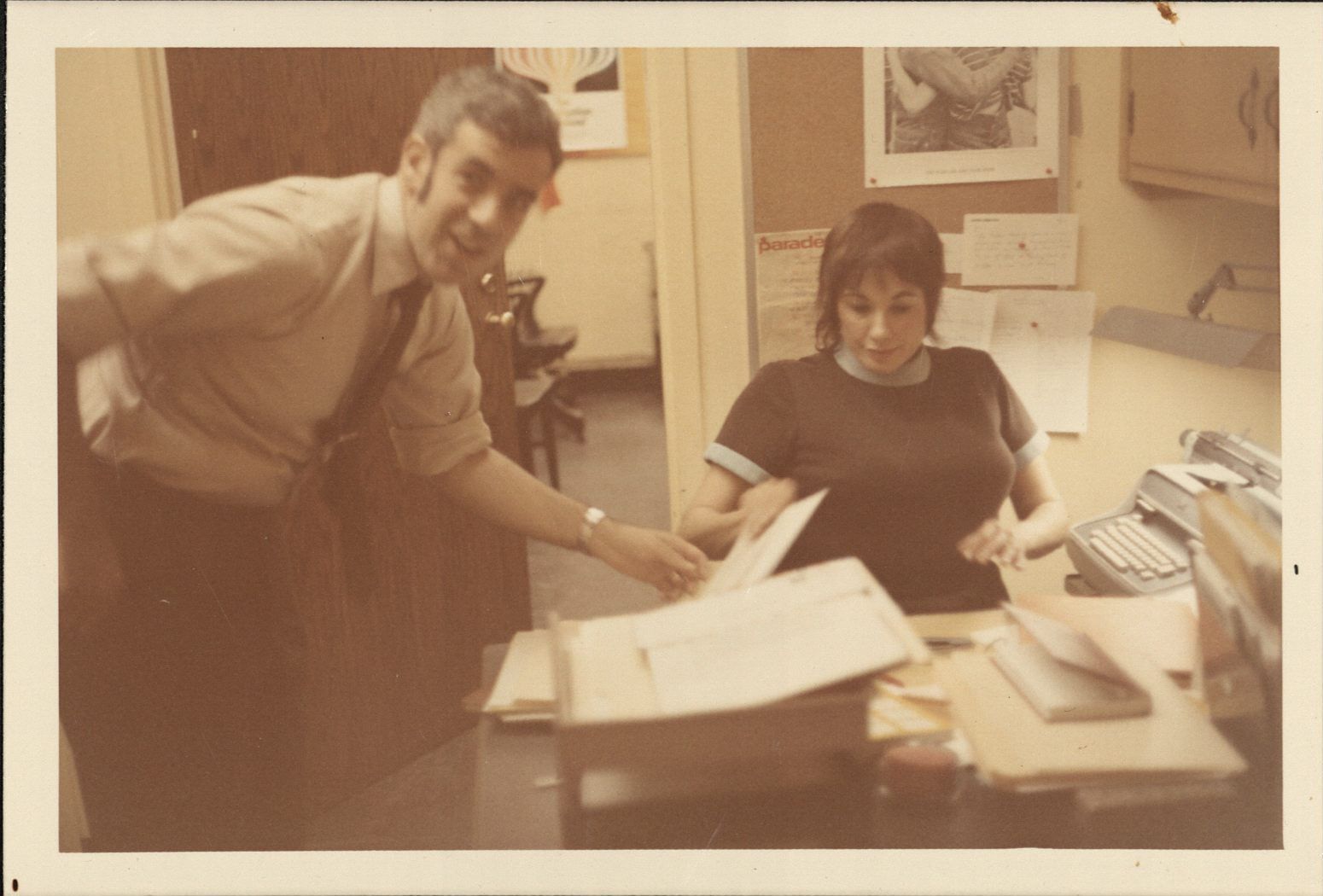
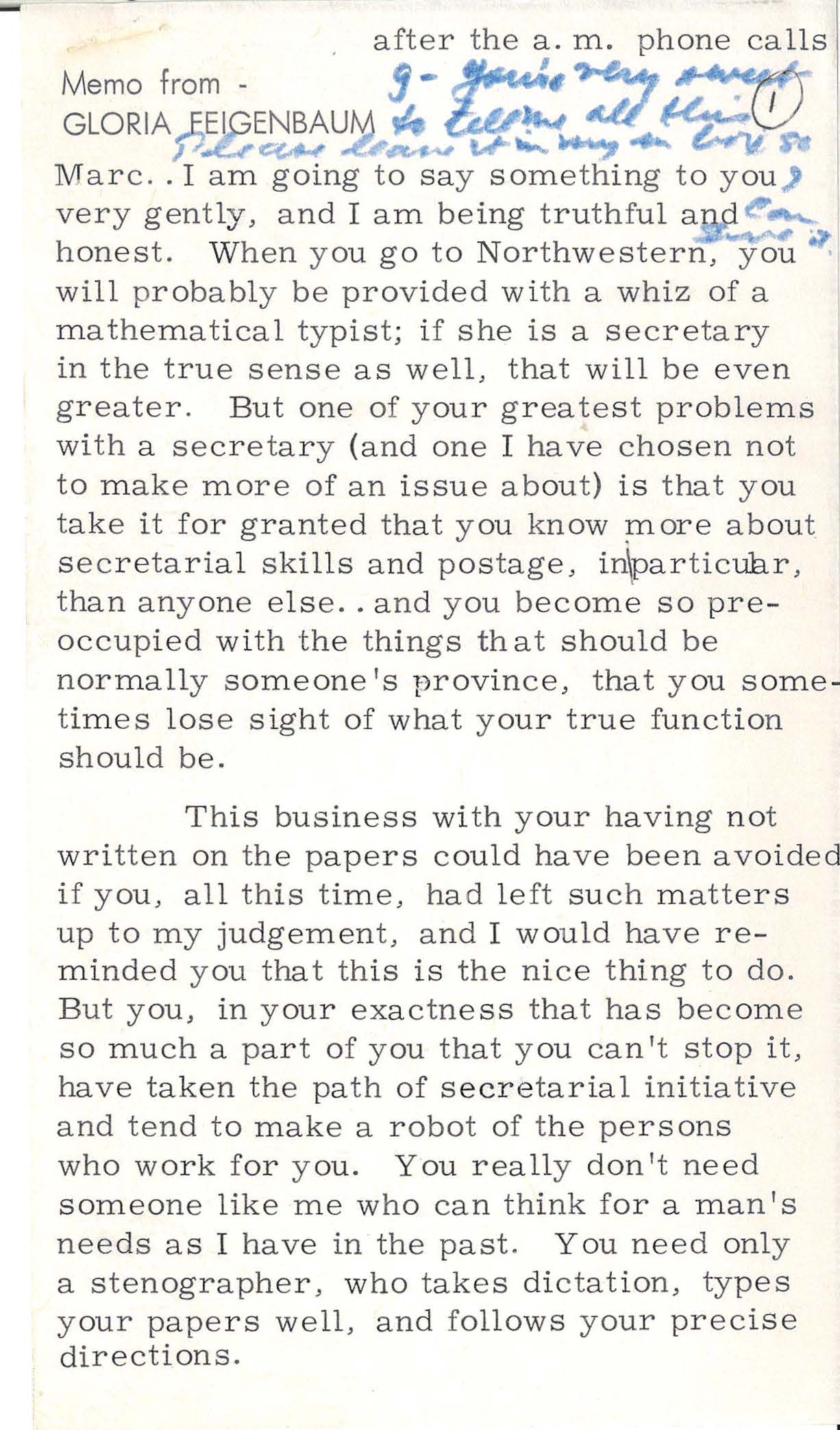
Gloria Feigenbaum and Marc Nerlove, circa 1972-1973, photograph, 3.5 x 5 in., Box 1, Folder Feigenbaum, Gloria, 1972-1973.
Post contributed by Janet Stiles Tyson, independent researcher.
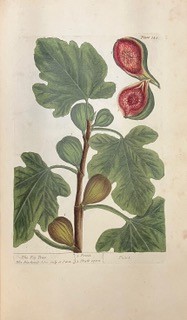
Hand-colored etching of fig, from Rubenstein copy of A Curious Herbal. Photo credit Janet Stiles Tyson.
This blog post concerns a copy of a historically significant English herbal, held by the Rubenstein Library. Along with its producer Elizabeth Blackwell, A Curious Herbal[1] comprised the topic of my PhD thesis for Birkbeck College, University of London. It remains the focus of my post-doctoral research.
She was born in London in 1699 as Elizabeth Simpson, and married to a Scotsman named Alexander Blackwell. She made 500 life-size watercolor drawings of medicinal plants and translated those drawings on to etching plates, which were then sent to a printer to be produced as black-and-white multiples. After printing, Blackwell used watercolor paint to color many of the imprinted images. Between mid-1735 and mid-1739, those images were sold in fascicules or gatherings of four pages each. Each fascicule also included a page of text explaining the use of the four illustrated plants. Gatherings that contained four uncolored images cost one shilling; each group containing four colored images cost two shillings. Buyers compiled their pages (along with title pages, indexes, and other leaves that were printed and distributed) and had them bound—typically into two folio-format volumes.
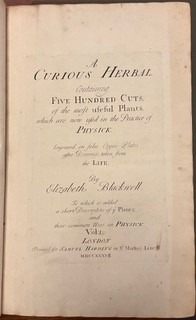
Volume One title page from Rubenstein copy of A Curious Herbal. Photo credit Janet Stiles Tyson.
Blackwell’s first publisher was Samuel Harding, whose name is found on title pages dated 1737. The name of Blackwell’s second publisher, John Nourse, is found on title pages dated 1739 and 1751. Copies also exist that were published under the name of Charles Nourse and dated 1782. However, composition and dating of extant copies isn’t as straightforward as this summary suggests, which is why much of my ongoing research involves finding and viewing as many copies as I can. Thus far, I have found about 110 copies, and have examined every single page of about sixty-five.
This brings me to the Rubenstein Library copy, which I visited in early August of this year [2022]. I first learned of it from catalogues for auctions held by Sotheby’s and Christie’s between 1981 and 2017. Online color photographs and verbal descriptions left me in no doubt about its beauty and importance. It was printed on extra-large folio sheets of paper, such that it measured about 18-by-12 inches in height and breadth. Pictures showed that its two volumes were bound in gold-stamped black morocco leather, and that the edges of its pages had been finished in gold. It also was evident that the plates had been colored with great care and subtly.
It originally had been owned by a London apothecary named Josiah Messer (1753-1830), whose signature was inscribed on the verso of the title page. A watercolor drawing and a hand-colored etching had been inserted at the back of volume one. Bookplates for another, presumably later, owner named George Hubbard were affixed to the marble endpapers in each volume. Assuming that its last sale at auction had been to a private collection, it seemed that I would never see Josiah Messer’s copy of A Curious Herbal.
Thus I watched, incredulously, as Rubenstein librarians removed the two volumes of the Messer copy from their archival boxes.
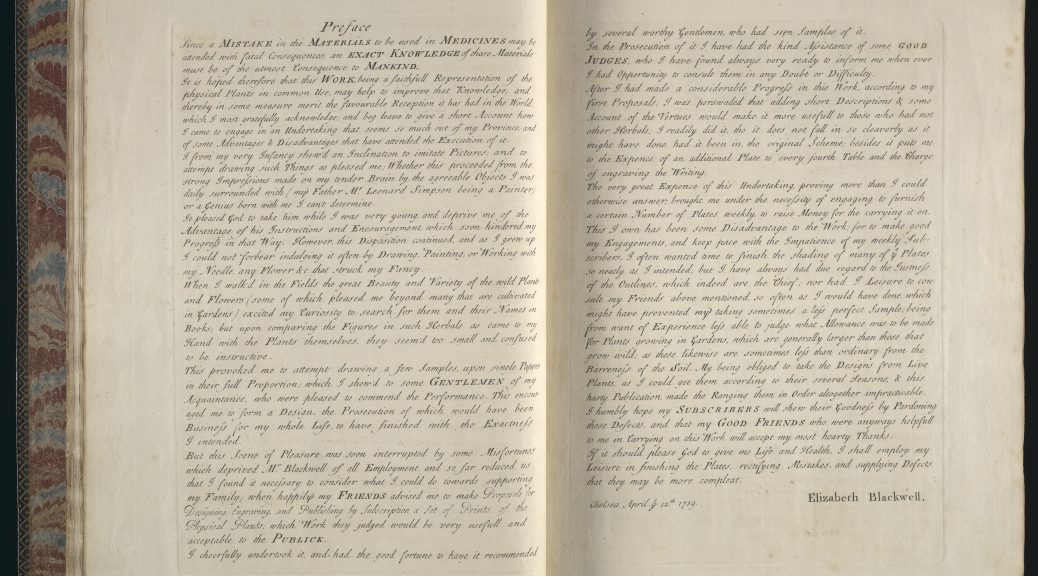
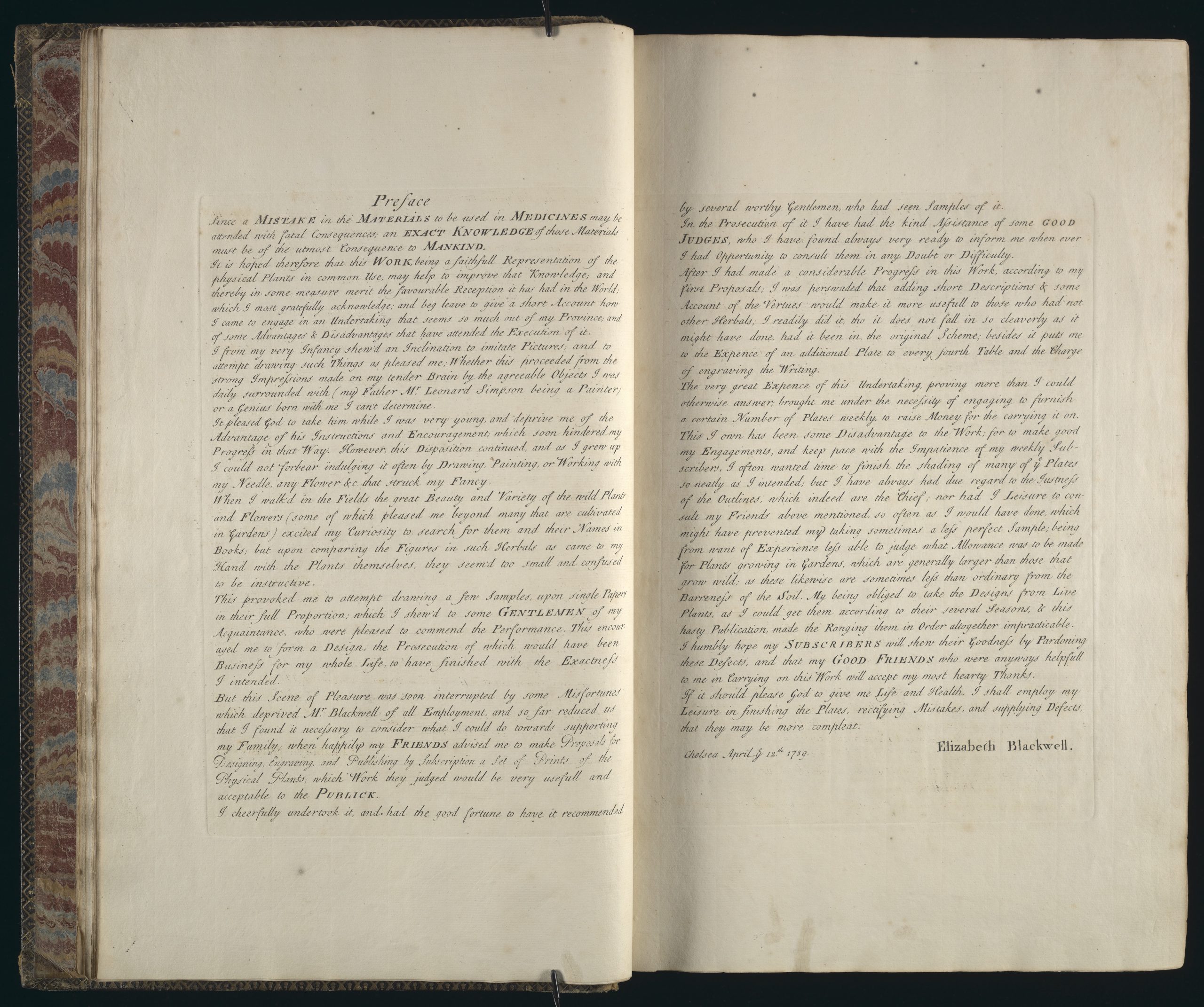
Blackwell preface from Rubenstein copy of A Curious Herbal.
I began carefully turning its pages. Messer’s signature was on the reverse of the title page. There were the customary two pages of endorsements by various medical men. There were five lavishly etched and engraved dedicatory leaves that I knew from other copies. And there was a blank leaf where the first explanatory page should have been. Briefly perplexed, I decided that explanatory pages had been arranged to face the first image of each group of four. I’d seen that in other copies and would duly note.
I turned the page to find its verso filled with words from top to bottom, facing the front of another densely printed page. The word ‘Preface’ topped the first, and at the bottom of the second was the name ‘Elizabeth Blackwell’, and the legend: ‘Chelsea April ye 12th 1739’. After some preliminaries were the words:
I from my very Infancy shew’d an Inclination to imitate Pictures and
to attempt drawing such Things as pleased me; Whether this
proceeded from the strong impressions made on my tender Brain by
the agreeable Objects I was daily surrounded with (my Father Mr.
Leonard Simpson being a Painter) or a Genius born with me I can’t
determine.
A shiver of excitement shot from my head to my fingertips at ‘my Father Mr. Leonard Simpson being a Painter’. Hurriedly I told the librarians about this discovery, then returned to my table to email my Birkbeck supervisors, Vanessa Harding and Carmen Mangion. Both promptly messaged their kudos. Then, as I finished reading Blackwell’s preface and proceeded to examine and photograph further pages, Harding sent me another email.
Applying decades of research experience, Harding quickly found two other documents that cited Leonard Simpson by name. One announced the birth of a daughter to ‘Mr Leonard Simpson Designer in Paintings’, who lodged with a ‘Mr Simpson shoomaker of the Parish of St Mary Woolchurchhaw’. Dated ‘Aprill 1699’, it stated that daughter Elizabeth was born on the ‘three and twentith day of this moneth’ and ‘baptized the 4th of May following’. The second document further noted that shoomaker Simpson’s dwelling was ‘next door to the White Horse in Poultry’.
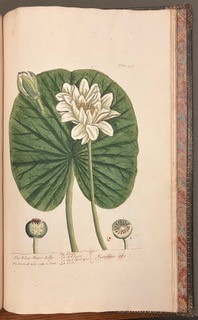
Hand-colored etching of white waterlily from Rubenstein copy of A Curious Herbal. Photo credit Janet Stiles Tyson.
Over the years, I’ve found other Simpson references, including information that identified Blackwell’s mother’s name as Alice. But the Rubenstein copy holds the key to confirming Elizabeth Blackwell’s birth date and place. So much more could be said about this book and its illustrations, and the myriad curious tales of Elizabeth Blackwell. And perhaps further research will find further copies of that preface. For now, however, I hope that I have communicated the importance of this object at Duke University.
Works cited
Blackwell, Elizabeth (1737). A Curious Herbal. Containing Five Hundred Cuts of the most useful Plants, which are now used in the Practice of Physick. Engraved on folio Copper Plates, after Drawings, taken from the Life. By Elizabeth Blackwell. To which is added a short Description of ye Plants; and their common Uses in Physick. London: Printed for Samuel Harding in St Martin’s Lane, MDCCXXXVII (1737) Rubenstein QK99.A1 B53 1737 folio v.1 c.1.
London Metropolitan Archives. Parchment register of the parish of St Mary Woolnoth, 1686-1726: LMA, P69/MRY15/A002/MS07636.
London Metropolitan Archives. Paper register of the parish of St Mary Woolnoth, 1695-1706: LMA, P69/MRY15/A/002/MSo7636.
[1] Full title: A Curious Herbal. Containing Five Hundred Cuts of the most useful Plants, which are now used in the Practice of Physick. Engraved on folio Copper Plates, after Drawings, taken from the Life. By Elizabeth Blackwell. To which is added a short Description of ye Plants; and their common Uses in Physick.
Post contributed by Zachary Tumlin (Project Archivist for the Economists’ Papers Archive), Andrew Armacost (Head of Collection Development), Laura Micham (Director of the Sallie Bingham Center for Women’s History and Culture), and Vincent Carret (2021-2022 HOPE Center Visiting Scholar and 2022 Summer in the Archives Fellow).
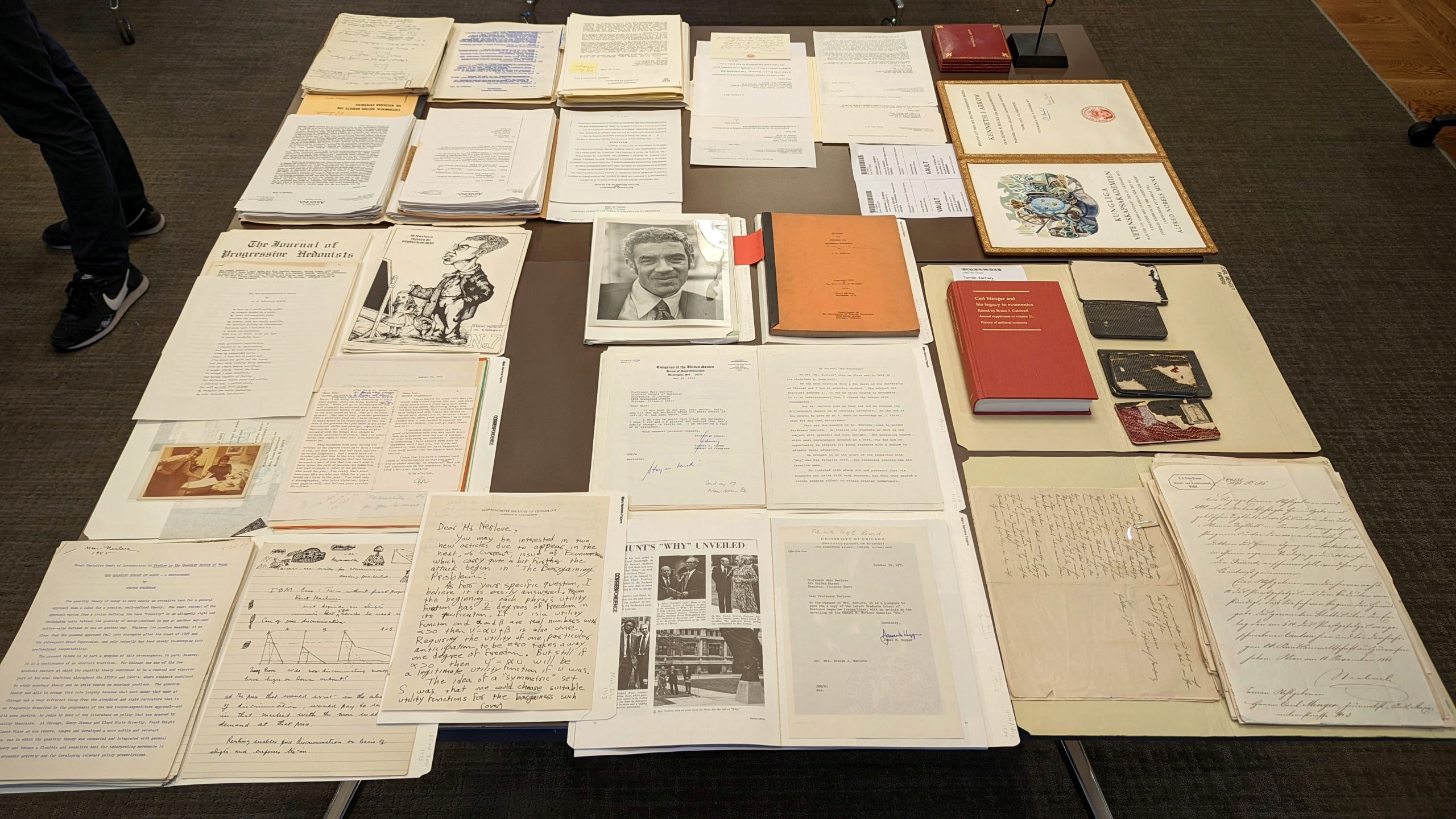
On Monday, June 27th, around two dozen participants in the Center for the History of Political Economy’s (HOPE Center) 2022 Summer Institute met with four staff members from the David M. Rubenstein Rare Book and Manuscript Library for a showing of items from the Economists’ Papers Archive (a joint venture between the HOPE Center and Rubenstein Library). The Summer Institute was started in 2010 with funding from the National Endowment for the Humanities (NEH) and is a two-week long annual event that brings together faculty and PhD students in economics to examine various topics in the history of the field. This year’s focus was on preparing participants to design and teach their own undergraduate-level course on the history of economic thought, along with showing how such concepts and ideas might be introduced into other classes. The instructors were Duke faculty members Bruce Caldwell (HOPE Center Director), Steven Medema, and Jason Brent.
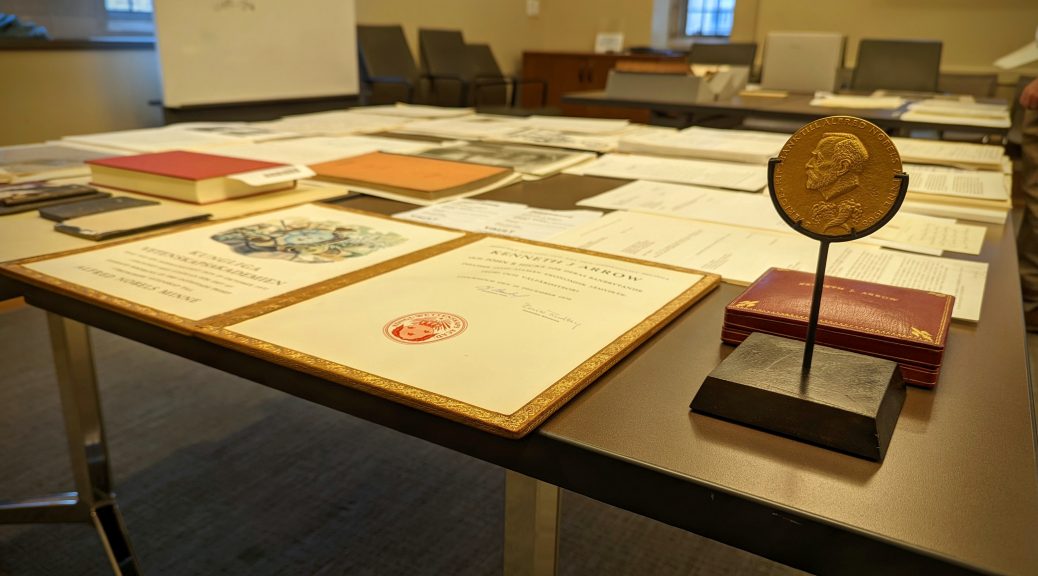
Kenneth Arrow’s 1972 Nobel Prize medal and certificate.
What follows are contributions from Andrew Armacost (Head of Collection Development), Laura Micham (Director of the Sallie Bingham Center for Women’s History and Culture), Zachary Tumlin (Project Archivist for the Economists’ Papers Archive), and Vincent Carret (2021-2022 HOPE Center Visiting Scholar and 2022 Summer in the Archives Fellow) about what they displayed during this event.
Andrew Armacost
While many of the collections in the Economists’ Papers Archive relate to documenting the careers of individual economists, the archive also holds some related collections that offer a larger context for the history and range of work that encompasses this discipline.
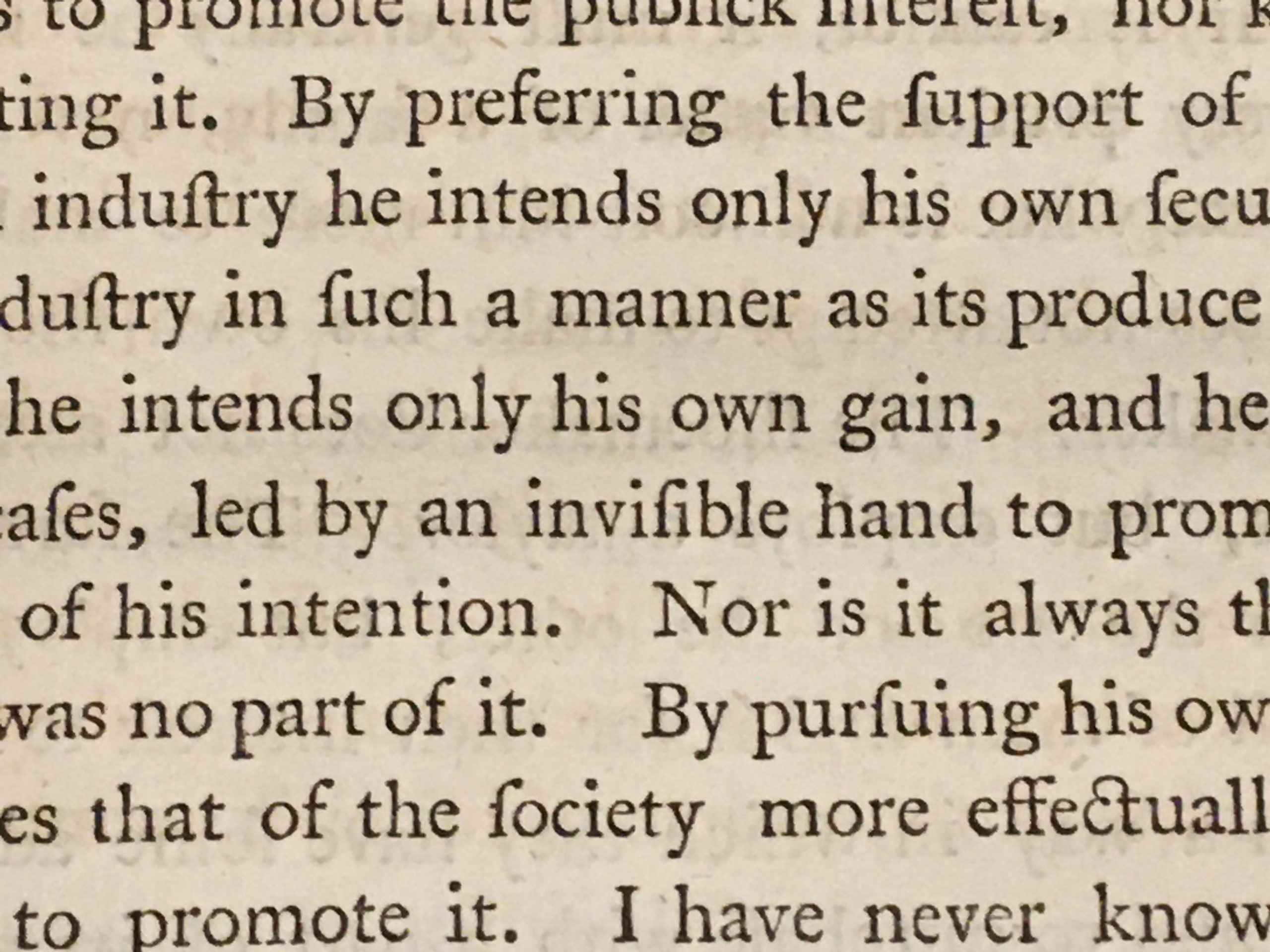
Starting at the bottom right and going clockwise, one goal of the Archive is to chronicle the historical development of the field, and a key early work in this narrative is Adam Smith’s An Inquiry into the Nature and Causes of the Wealth of Nations, published in 1776. This work explores the role of markets, international trade, and economic decision making. In it, Smith famously describes market forces acting as an “invisible hand” that guides economic decision making.
Place in text where “invisible hand” appears.
The Archive also holds organizational papers, including those of the American Economic Association (AEA; founded in 1885) and its journal American Economic Review. These papers represent more than a century of economic thought and the participation of a broad range of economists, and include correspondence from international economists like John Maynard Keynes, who corresponded on behalf of the Royal Economic Society.
The Archive also holds the papers of economists working in government, such as Federal Reserve Chairman Arthur Burns, who served during the Nixon administration. This collection preserves correspondence between the President and Chairman and their discussions related to economic policy and decisions related to the administration’s ending of the gold standard for US currency.
Laura Micham
The Economists’ Papers Archive holds the papers of several prominent women economists, such as Anita Arrow Summers, Anna Schwartz, Juanita Morris Kreps, Charlotte Phelps, and Barbara Bergmann. Though these scholars emerged from a range of backgrounds and intellectual traditions, and each took different professional paths, they all seem to have been animated by an interest in living independent lives and a realization that financial independence was crucial to that goal.
During this event, I shared materials from each of these collections that offer a window into these women’s contributions to the field of economics and to society:
Bottom left: Professor Arrow Summers’s graduate student work during the mid-1940s in the University of Chicago Economics Department.
Bottom right: Detailed correspondence between Professor Schwartz and Milton Friedman related to their groundbreaking work, A Monetary History of the United States, 1867-1960 (Princeton University Press, 1963).
Top right: Memos and other correspondence between Professor Kreps and President Jimmy Carter when she served as Secretary of Commerce in his administration.
Top left: Heavily annotated writings of Professor Phelps documenting her contributions to behavioral economics.
Top middle: Handwritten manuscripts detailing Professor Bergmann’s groundbreaking scholarship on women and children.
Page 1 of “A ‘cost-sharing’ formula for child support payments,” n.d. by Barbara Bergmann from the Barbara Bergmann papers, 1942-2015.
Bergmann’s archival collection consists of published writings, including congressional testimony, as well as research and project files, and a selection of career awards and books from her library. One of the manuscripts included in the display is “A ‘cost-sharing’ formula for child support payments.” This undated piece was written in pencil on sheets from a legal pad, copiously revised, meticulously calculated, and thoroughly argued. She published several scholarly and journalistic articles on the topic of child support, some likely emerging from this piece, including an article co-authored with Professor Sherry Wetchler in Family Law Quarterly, Fall 1995, Vol. 29, No. 3, “Child Support Awards: State Guidelines vs. Public Opinion” [Duke NetID required for access].
Since I began in February, I have been processing a new acquisition: the Marc L. Nerlove papers. The papers primarily document the professional career of economist Marc Nerlove, who specializes in agricultural economics and econometrics (the use of economic theory, mathematics, and statistics to quantify economic phenomena). Upon his election to the AEA as a Distinguished Fellow in 2012, he was recognized for creating a widely used template having to do with the dynamics of agricultural supply, pioneering the development of modern time series methods and the analysis of panel data in econometrics, and being the first to apply duality theory to estimate production functions. During his 60-year career, he held appointments at Johns Hopkins, Minnesota, Stanford, Yale, Chicago, Northwestern, Pennsylvania, and Maryland; worked as a consultant at the World Bank, International Food Policy Research Institute, and RAND Corporation; and was awarded the 1969 John Bates Clark Medal from the AEA.
Like what Vincent will detail next about the highly influential economics department at Chicago, I chose material that showcases his own connections there:
Material related to his father, Samuel H. Nerlove, who came to the U. S. from Russia as a toddler in 1904 with his parents, who settled in Chicago; Samuel was a professor in business economics at Chicago from 1923-1965:
1939 syllabus for Business Economics 1.
1972 letter and eulogy from former student and then U. S. House Representative Sidney Yates.
Volume 22, number 2 of issues/ideas (Graduate School of Business magazine) from 1974, sent by Dean James Harper at the request of Nerlove’s mother Evelyn (with letter indicating this); includes article “Hunt’s ‘Why’ Unveiled” about unveiling of artist Richard’s Hunt sculpture “Why”, commissioned by the Samuel H. Nerlove Memorial Fund.
Material from his time as a student at Chicago and Johns Hopkins:
1953 letter from economist John Nash (subject of the book and filmA Beautiful Mind), apparently in response to a letter from Nerlove with a question about utility function.
Draft of introduction to Studies in the Quantity Theory of Money by Milton Friedman (published in 1956) and class notes for Friedman’s 1955 course on the same topic (including doddles of trains, a subject Nerlove would write about early in his career in the context of railroads).
Material from his time as a professor at Chicago from 1969-1974:
8×10 inch black and white headshot.
Letter from his secretary Gloria Feigenbaum upon his departure for Northwestern (pictued right), as well as a candid print of the two of them. Such staff maintained his on-campus files, which are now part of this archival collection, but these people can become invisible without thoughtful description. In this letter, she expresses how he had occasionally forgotten his purpose (research), interfered in matters that were her responsibility (administrative), and prevented her from exercising the degree of initiative that she was used to and capable of, but that she chosen to remain quiet to preserve their good working relationship.
Folder of early 1970s material from the Political Economy Club at Chicago (graduate student group). It includes three issues of their Journal of Progressive Hedonists Against Rational Thought (JPHART), a caricature of Nerlove that has him beside the White Rabbit and someone as Alice from one of his favorite books—Alice in Wonderland (these sketches appeared at the end of each issue of JPHART), a script of a skit set in the department that mentions Nerlove, and a copy of Sir Dennis H. Robertson’s poem “The Non-Econometrician’s Lament.”
Vincent Carret
What brings together Leonid Hurwicz, Paul Samuelson, Don Patinkin, and Oskar Lange? Apart from the fact that they were all major economists by any standard (two of them received the Nobel Prize), they were also all affiliated with the University of Chicago at some point.
In the material I presented, this connection is the link between them. Starting at the bottom right and going counterclockwise are a few of Patinkin’s student notebooks, of which there are dozens. At Chicago, Patinkin attended classes taught by the likes of Jacob Viner, Frank Knight, Jacob Marschak, and Oskar Lange—in particular, Lange’s course on Mathematical Economics and Stability Analysis held during the first half of the 1940s.
It was on this very subject of economic stability that Lange corresponded with Samuelson, who earned his undergraduate degree from Chicago. Their letters on the stability of an economic model called general equilibrium were exchanged in 1942, before Lange published his 1944 Cowles Commission monograph on Price Flexibility and Full Employment. These letters, shown here next to Patinkin’s notes, were duly kept by Samuelson and are now available in his collection of papers, rich in hundreds of folders of correspondence with almost every economist of the 20th century.
At one point in their correspondence, Samuelson asks Lange if he could name a few outstanding graduate students at Chicago, as he was looking for a new assistant. The first name on Lange’s list was that of Leonid Hurwicz, a young Polish immigrant who had arrived in Chicago at the beginning of the 1940s after fleeing Europe. Hurwicz became the assistant of Samuelson, now an Assistant Professor at MIT, in 1941, before coming back to Chicago to work in the Meteorology Department during the war. His papers, which I am currently reprocessing, trace his distinguished career at the University of Minnesota, where he stayed at for more than a half century after being recruited in 1951. For his creation of the field of mechanism design theory (the study of efficient allocation of resources), Hurwicz was jointly awarded the 2007 Nobel Prize at age 90.
In addition to Hurwicz’s correspondence and early manuscripts of his publications, I found in his papers the dissertation of Patinkin, which he annotated [this finding aid will be updated in September after reprocessing is completed]. Among Hurwicz’s many notes taken at seminars and conferences, one often finds more or less elaborate doodles—although the word doodle does not do justice to the intricacies of the abstract geometrical forms that are peppered throughout sixty years of thinking about economics!
One of the more elaborate “doodles” by Hurwicz, drawn during a 1965 meeting of the National Science Foundation Commission on Weather Modification.
Post contributed by Rachael Brittain, Harry H. Harkins, Jr. Intern for the Duke Centennial at the Duke University Archives.
As the Harry Harkins Intern, I have been working with the Duke Photography collection to rehouse materials; assist on reference questions; create timestamps for archival films; and help identify collections at Duke related to its early history. My primary focus has been the Duke Photography Job Numbers Collection. which contains original photographs taken by Duke Photography from 1960 until 2018.
Capturing unique images and perspectives of Duke University as well as operating as a hired service to photograph faculty, staff, and student headshots, Duke Photography was present at many major university events, including basketball, lacrosse, football, and other athletics; visiting lecturers and guest speakers; building construction and grand openings; campus scenes, and other aspects of campus life at Duke. The time frame that Duke Photography was active means that there is a mix of analog and digital files, switching to primarily digital in the early 2000s.
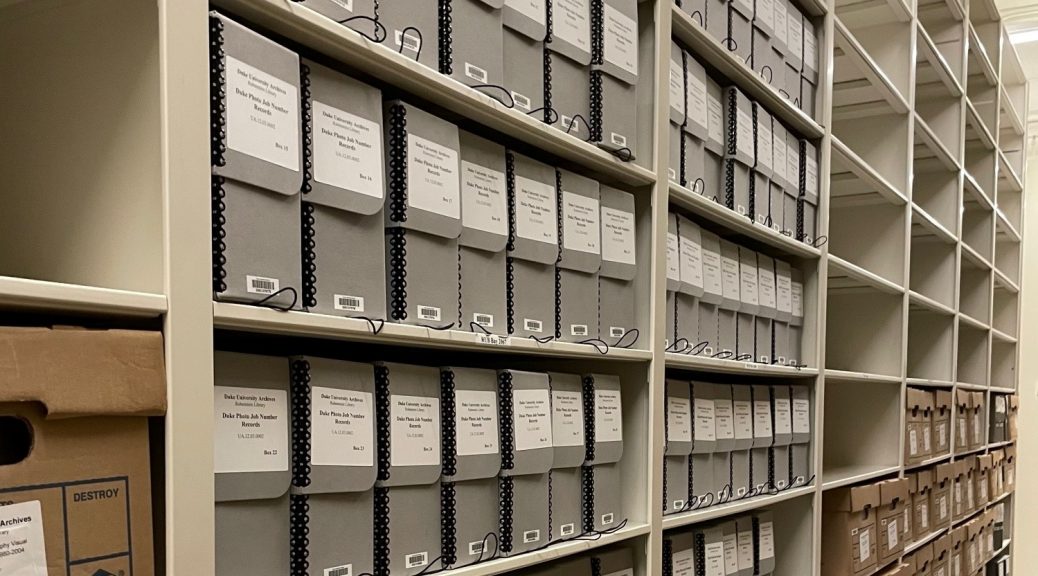
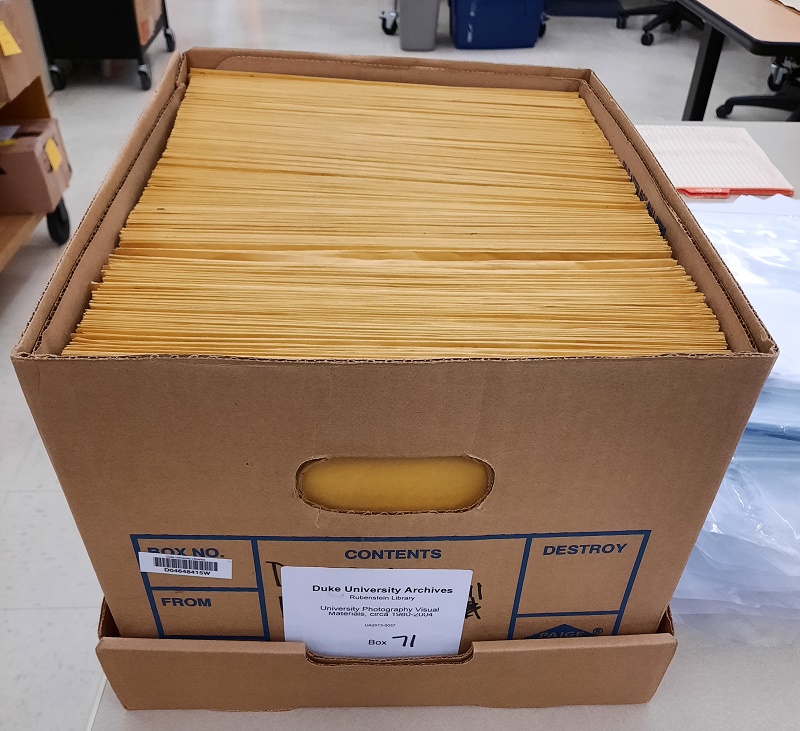
The Duke Photography Job Numbers Collection before processing. Look at all those manila envelopes!
As the University prepares for the 2024 Duke Centennial, we wanted to make sure our photograph collections were as accessible as possible. The years between 1988 and 1994 have presented a unique challenge as many of the images are stored in old manila envelopes, some of which are missing. The manila envelopes are a less than ideal way of storing photographs and negatives due to the amount of acid present in the envelopes. Eventually, this would cause the images to yellow. The items stored in these envelopes must be rehoused into safer, archival materials. Across 28 boxes and over 11,000 manila envelopes, I have found 35 mm, 120 mm, 4 x 5″ negatives, contact sheets, prints, and occasionally slide film.
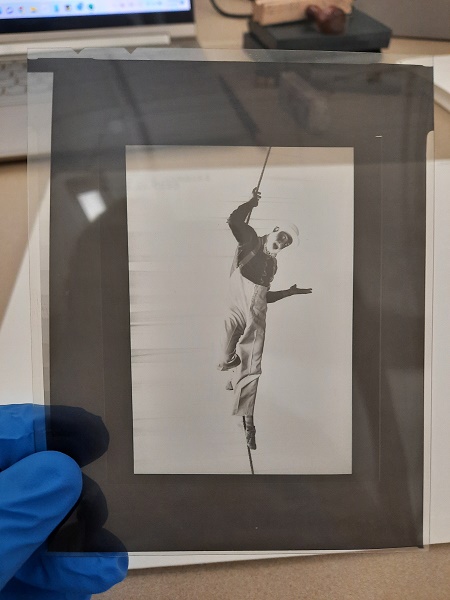
A negative of Avner the Eccentric performing at Duke in 1990.
The variety of materials used by the photographers largely depended on the purpose and printing needs of the subjects. 35 mm film, both black and white and color, was standard for most events due to its ease of use and availability. 120 mm film, also in black and white and color, produced a larger negative allowing the photographers to print larger, with greater detail, and with less film grain (a granular texture that is left on film when over enlarged). 4 x 5” negatives created an even larger negative and were frequently used to make copies of images. Once an image was printed from 35- or 120-mm film and corrected properly, it was faster for photographers to photograph the final image and print from the new negative, creating a copy negative, these make it faster and easier for an image to be reprinted at different sizes and at a consistent quality.
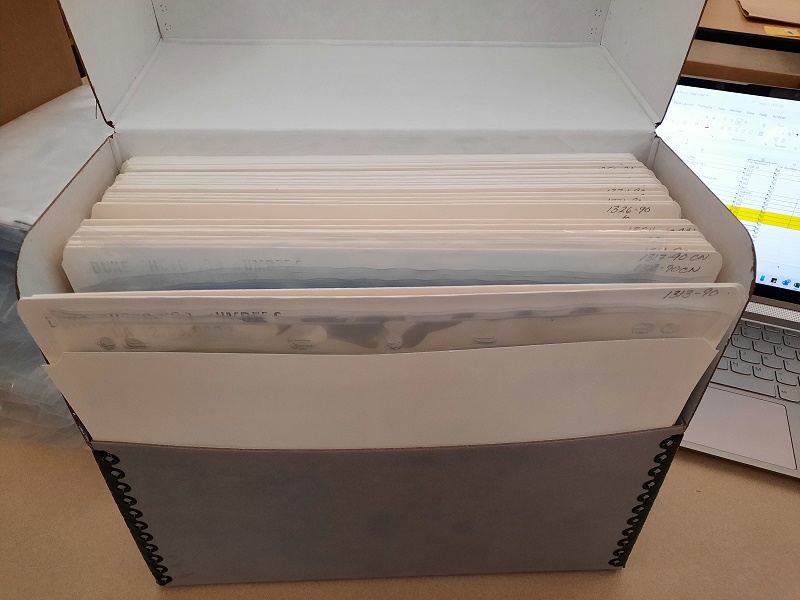
Negatives need to be stored in specialized plastic sleeves to keep them organized, protect them from fingerprints, dust, and getting scratched, all of which would permanently damage the images and make future use more difficult. Contact sheets—which were created by laying an entire roll of film across a page and helped the photographers to get a quick glance at what photos were on the roll of film and determine which they wanted to print—are being transferred to acid free folders. When more than one page or print is in an envelope, plastic sleeves are used to keep them separated and prevent scratches. This will also make it easier for future researchers and library staff to use the folders without having to use gloves to handle the materials. The Duke University photographers would make contact prints and send them to the different Duke departments so the subjects themselves could select which images they wanted printed.
As I’ve processed the collection, I’ve noted that not every envelope contains prints, as the prints were usually sent off to whichever department requested them. However, there are occasionally black and white prints, done in-house by Duke as well as envelopes full of 3.5 x 5” color prints that came from specialized color printing labs. Occasionally, there are notes left in with the photos, stating who is in each frame, what the event was for, letters requesting images, and notes scribbled on the back of event programs. By capturing events, staff, and students, this collection provides visual documentation of Duke’s recent history and will be made accessible through improved storage and descriptions.
After processing: the work of Duke photographers, stored in archival sleeving and folders.
Post contributed by Elliot Mamet, Ph.D. Candidate in Political Science at Duke and Archival Processing Intern at the Rubenstein Library.
The papers of Nick Meglin, longtime editor of MAD Magazine, are now available and open for research at the Rubenstein Library.
Meglin was affiliated with MAD Magazine for decades. As a newly-minted graduate of the School of Visual Arts, Meglin was hired at MAD Magazine in 1956. Over the course of his life he held various titles at MAD, including Idea Man, War Correspondent, Associate Editor, Tennis Editor, Co-Editor, and, upon his retirement in 2004, Contributing Editor. Meglin played a central role in shaping MAD’s editorial voice and recruiting artists to join the “Usual Gang of Idiots.”
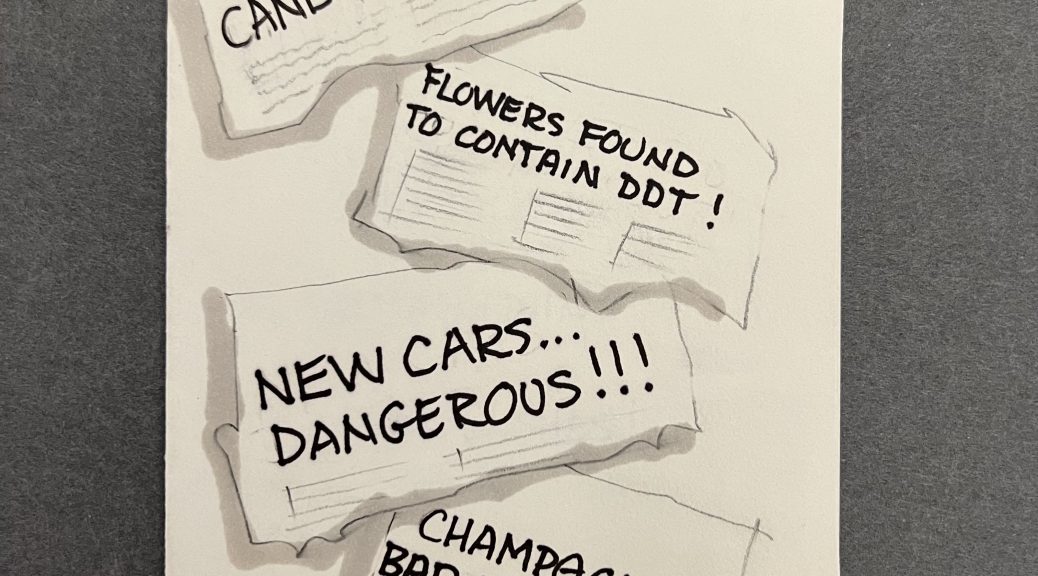
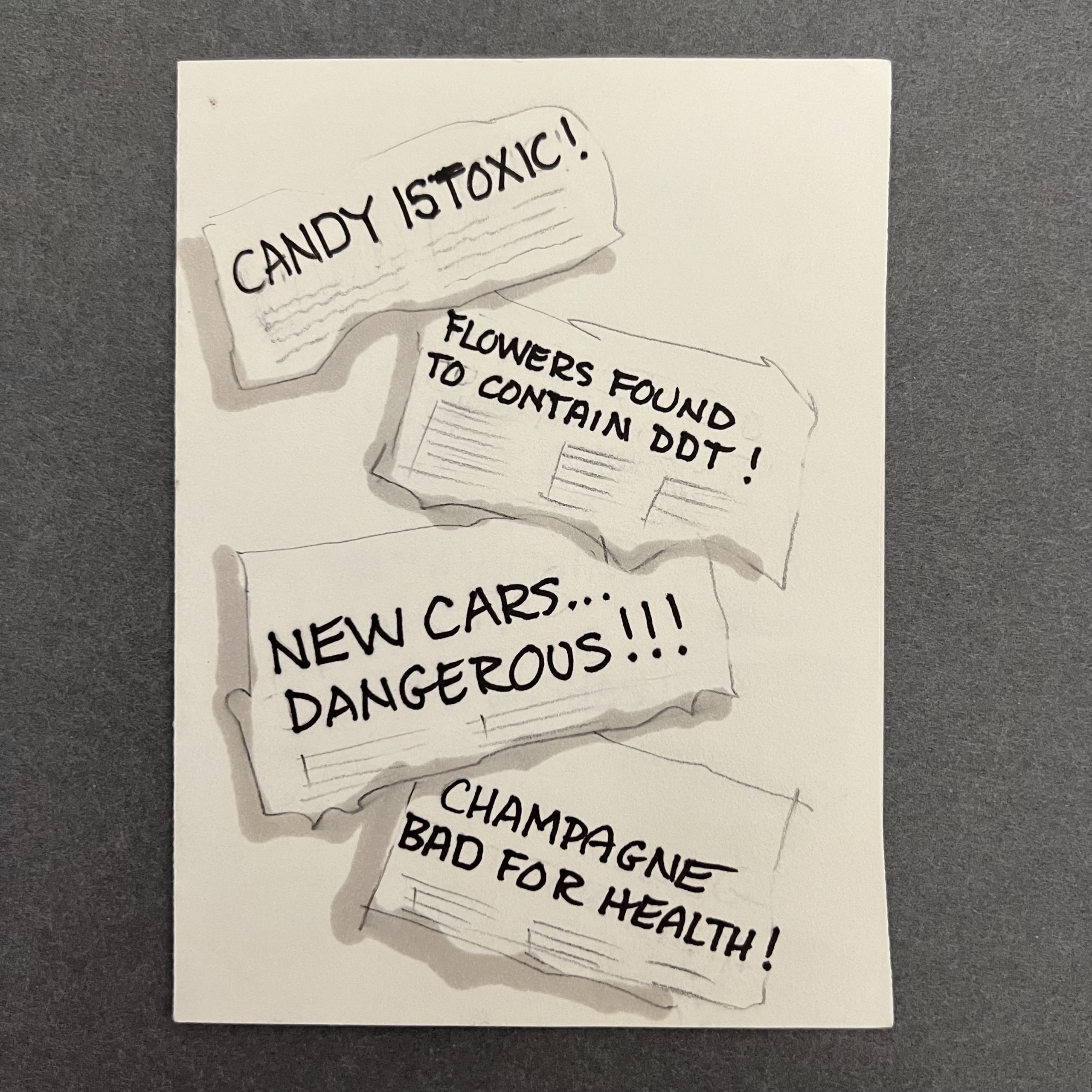
The Nick Meglin Papers include extensive material which convey how MAD Magazine was edited and produced, such as layout art, ideas for features, inside jokes between editors, parodies, celebrity correspondence, and detailed accounts of the yearly MAD staff trips. One folder, “Horrifying Cliches,” includes “a freak accident,” “a flaming passion,” “a blessing in disguise,” “a gross understatement,” and “a bloodless coup,” among others.[1] Another folder, Typewritoons, chronicles a 1965 reader contest to generate cartoons from the script of a typewriter.[2]
Meglin’s creative pursuits expanded far beyond MAD Magazine, and the Nick Meglin Papers gives a sense of his enormous output. The collection includes Meglin’s illustrations, many of his essays, song lyrics, and two musicals he wrote, Tim and Scrooge and Grumpy Old Men. It also includes Nick’s greeting card ideas, some of which he sold, including “See, I didn’t forget the occasion!… only the date! Sorry I’m late…” and “happy birthday to the best looking, brightest, and most talented person in the world…me!”[3]
A greeting card designed by Meglin.The inside of Meglin’s greeting card.
Upon his 2004 retirement, Meglin moved to Durham. While living here, he volunteered for WCPE, creating 84 original sketches of composers and musicians, he taught illustration, and he formed a “usual suspects” lunch club of fellow illustrators and creatives. It is exciting for researchers to be able to access the papers of Nick Meglin at the Rubenstein Library, and to learn more about the colorful life and career of Nick Meglin, who was an illustrator, cartoonist, art instructor, essayist, lyricist, writer of musicals – and always a humorist, too.
[1] Horrifying Cliches, 1971. Box 1, MAD Magazine Series, Editorial and Administrative Files Subseries. In the Nick Meglin Papers, David M. Rubenstein Rare Book & Manuscript Library, Duke University.
[2] Typewritoons. Box 2, MAD Magazine Series, Editorial and Administrative Files Subseries. In the Nick Meglin Papers, David M. Rubenstein Rare Book & Manuscript Library, Duke University.
[3] Greeting Card Ideas. Box 8, Other Professional Materials Series, Other Projects Subseries. In the Nick Meglin Papers, David M. Rubenstein Rare Book & Manuscript Library, Duke University.
Post contributed by Roger Peña, Trent History of Medicine Intern for 2021-2022, and Rachel Ingold, Curator of the History of Medicine Collections.
Roger Peña, Trent History of Medicine Intern, stands by the exhibit “Good Vibrations” that he curated.
Tell us a bit about yourself.
I’m Roger, and I grew up in the Boston area. I attended Syracuse University as an undergraduate and earned a Master’s degree in education at Lesley University in Massachusetts. I moved down to North Carolina in 2013 and have served as an educator in private and public schools. I’m currently in my last year at UNC Greensboro’s MLIS program with a specialization in special collections and archives.
My wife and I have two children—ages 3 and 2 months—and we live in Durham. I love all things history and our house is filled with books and magazines related to several historic topics. I really love to cook and try new recipes. We are HUGE Boston sports fans so you will usually find us watching one of my sports teams on TV.
What interests you in working in a library setting, specifically in the History of Medicine Collections?
I’m 35 and a career changer. I had always thought about going back to school to earn an MLIS but never thought I had the time. The COVID-19 pandemic, school closures, and having some extra time to think about career goals rekindled my interest in earning my degree. I’ve always wanted to work in special collections and archives and hope to continue this work after graduation.
As a teenager, I “lived” at libraries and museums in my hometown of Boston. I love studying all things history and being able to handle old artifacts and primary sources—holding history in my hand! I’m that person at museums and historic sites asking questions, trying to touch everything and reading as many labels as possible. Being a history teacher, sharing stories of the past, and having students research and explore topics that interest them has always been important to me.
I love reading, instruction and all things history so I jumped at the chance to work at the Rubenstein Library. The history of medicine is always present when studying other historic topics and the History of Medicine (HoM) collection encompasses that. Even after months as the HoM intern, I’m still blown away by how vast and diverse the History of Medicine collection is and how much it has to offer. I’ve been able to hold manuscripts, artifacts, and books that are centuries old. There’s a special feeling when you pick up these resources; and you can’t help but feel a connection to the past and the individuals who used or created these materials.
The Josiah C. Trent HoM Internship has allowed me to explore the research aspect of special collections; and I’ve also been able to create and plan exhibits, helped with reference services and instructional support, and collaborated with other collections at the Rubenstein Library! It’s been a fantastic learning experience.
Can you share a memorable experience from your internship?
It’s really hard to choose just one memorable experience. I’ve enjoyed getting to know other Rubenstein Library staff and meeting researchers from across the world. Walking into the stacks makes me feel right at home and I always have to take a step back and appreciate how special the collection is. Being able to immerse yourself with the material and learning the ins and outs of academic libraries has been especially rewarding.
Participating and helping to coordinate Anatomy Day and researching and curating physical and online exhibits, like Good Vibrations, have been just a few of my favorite moments. Helping with instructional support is always fun as I was able to combine my past experience as an educator and help students interact with primary sources. It’s always fun to see a student’s reaction when something has caught their interest.
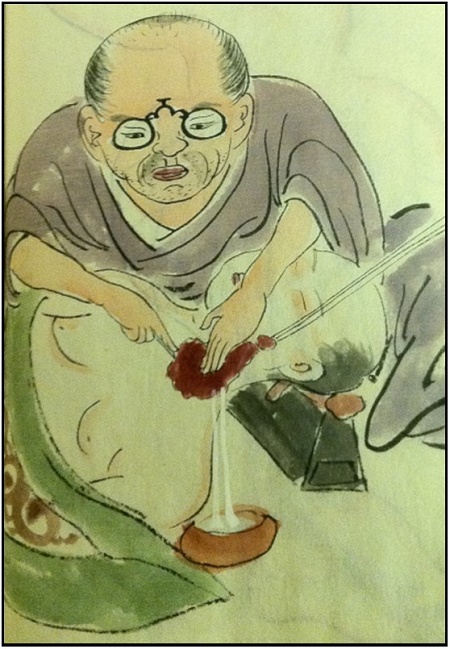
Hand colored illustration from Shunrinken kasho in the Japanese medical manuscript notebooks collection.
Do you have a favorite item you would like to share?
Again, hard to choose just one. The anatomical flap books and the Four Seasons are quite a sight to see and exemplify how people have always had a curiosity to touch and personally interact with materials. I really loved the East Asian medical books featured at Anatomy Day: Shunrinken kasho (Shunrinken school family book)from the Japanese medical manuscripts notebooks and Shinkan Geka Seisō新刊外科正宗. The illustrations in these books are phenomenal.
The amputation set from the mid-19th centuryhas probably been the item I spent the most time with. It’s one of those artifacts that you can’t help but want to learn more about. Being a student of American history and an aficionado of learning about the Civil War, the amputation set from the mid 19th century called my name. I first came across the saw when I was assisting Dr. Jeff Baker and Brooke Guthrie with a History of Surgery class and Dr. Baker asked me if I could handle student questions related to Civil War medicine – which I was more than happy to do!
I was fortunate enough to have a blog post published on The Devil’s Tale and Duke Daily where I was able to investigate the history of the saw and its origins. Holding the amputation saw in your hand, you can easily imagine a world where physicians grappled with decisions regarding the need for an amputation and the thousands of soldiers whose lives were forever changed by the war and surgical procedure. It was an eye-opening experience and allowed me to explore the unique but very complicated role that North Carolina played in the Civil War.
Post contributed by Laura Micham, Director, Sallie Bingham Center for Women’s History and Culture and Curator
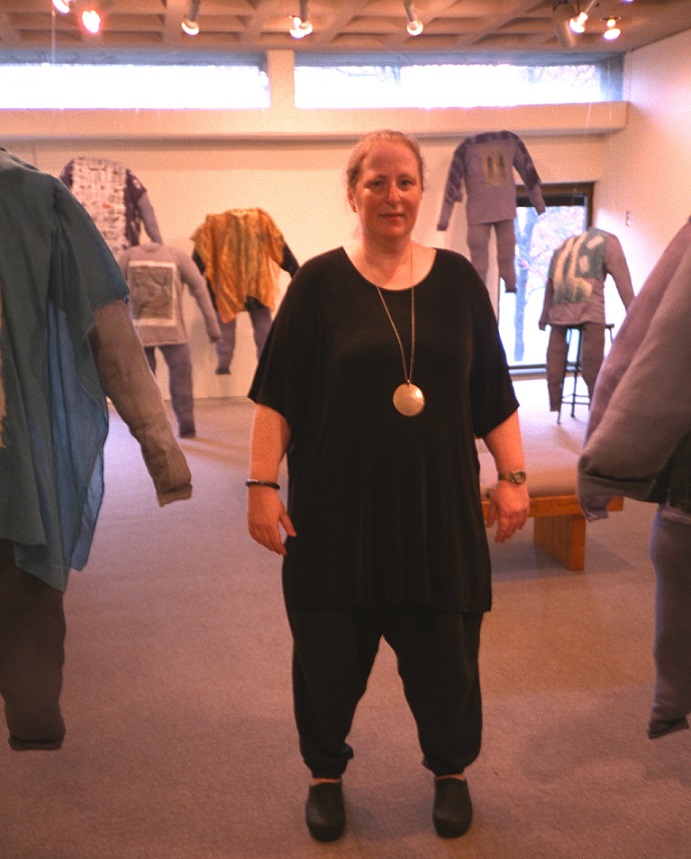
Eve Kosofsky Sedgwick at an exhibition of her artwork titled “In the Bardo,” at Stony Brook University, The State University of New York, 1999. Photographed by H.A. Sedgwick.
The Sallie Bingham Center for Women’s History and Culture is pleased to announce that the Eve Kosofsky Sedgwick Papers are now available and open for research. Sedgwick (1950-2009) was a poet, artist, literary critic, and teacher. As a faculty member in the English Department at Duke from 1988-1997, her work helped establish this institution as an intellectual leader in the critical study of sexuality.
Sedgwick is best known as one of the founders of the field of Queer Theory, a field of critical theory that emerged in the early 1990s. Her call for reparative work and for reading practices grounded in affect and performance have transformed our understandings of intimacy, identity, and politics. She published several groundbreaking books such as Between Men: English Literature and Male Homosocial Desire (1985), Epistemology of the Closet (1990), and Tendencies (1993). Her works and her collection reflect an interest in a range of issues including queer performativity; experimental critical writing; the works of Marcel Proust; non-Lacanian psychoanalysis; artists’ books; Buddhism and pedagogy; and material culture, especially textiles and texture.
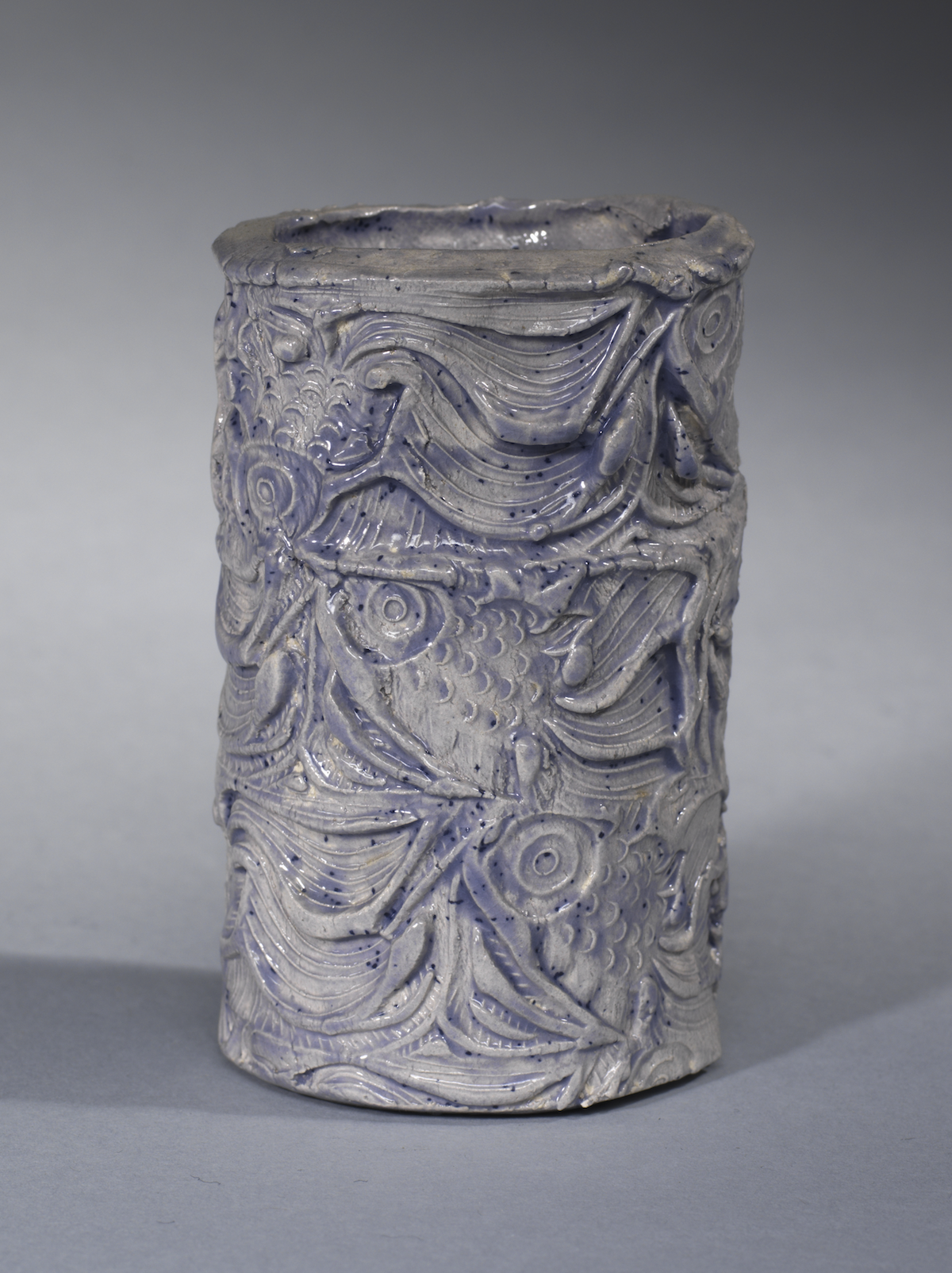
Hand-built purple ceramic vessel by Eve Kosofsky Sedgwick, ca. 2001. Photographed by Kevin Ryan.
The Eve Kosofsky Sedgwick Papers are comprised of 130 linear feet of materials that document Sedgwick’s scholarly career, her artistic expression, and her personal life. Researchers will find Sedgwick’s writings and speeches as well as the writings of others; her notebooks and calendars; research, teaching, and activism files; event and travel files; correspondence, photographs, and memorabilia; legal, medical, and financial materials; and books and other published material. The collection also includes Sedgwick’s art such as works on paper, textile, clay, glass, ceramic, and other works which are currently being carefully housed by our conservation department.
In order to facilitate the use of the collection, the Eve Kosofsky Sedgwick Foundation is generously funding research travel grants. In addition to supporting academic research aimed at producing publications and dissertations, the Eve Kosofsky Sedgwick Grants will support a wide range of other creative projects such as educational initiatives, exhibitions, films, multimedia products, and other artistic works. The grants are administered by the Sallie Bingham Center for Women’s History and Culture. The deadline for the first grant cycle is April 30, 2022. For more information please visit our Grants and Fellowships site.
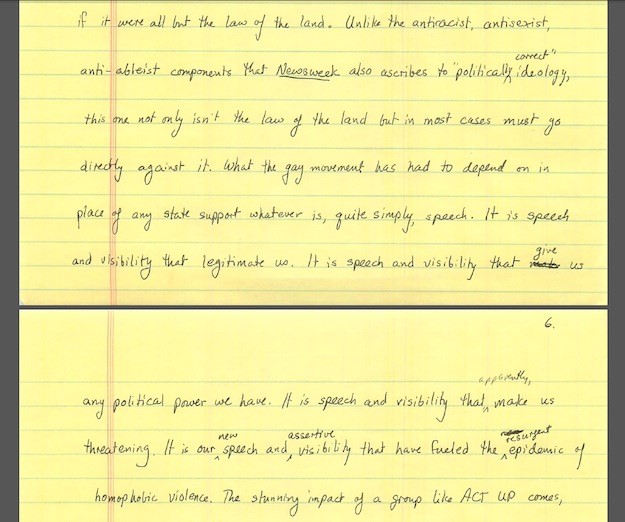
“It is speech and visibility that give us any political power we have. It is speech and visibility that apparently make us threatening.” Detail from a manuscript essay by Eve Kosofsky Sedgwick that was published in 2014 with the title, “Censorship & Homophobia,” by Gullotine, New York, NY. The publisher, printer, and binder, Sarah McCarry, discovered the manuscript during her work helping to prepare the collection to come to Duke.
It is truly thrilling to us in the Rubenstein Library, as well as to faculty across the university, that Eve Kosofsky Sedgwick’s papers have come back to Duke. During her time here she left an indelible mark on our community and her work continues to have a significant effect in shaping the lives and thought of many people.
What I’m proudest of, I guess, is having a life where work and love are impossible to tell apart.
– Eve Kosofsky Sedgwick
Post contributed by Kelsey Zavelo, Doctoral Candidate in History and Eleonore Jantz Reference Intern 2021-2022.
Chapter 2: Digging Deeper
In my previous post on this blog, I wrote about finding an 1847 letter written by Jacob Chiles, a formerly enslaved person, in the Joseph Ingram Sr. Family papers here at the Rubenstein Library. In his letter, Chiles explains what slavery and freedom meant to him and his family.
This week I dig deeper into Chiles’s story by exploring what other documents in and beyond the Ingram papers can tell us about him.
Donated to the Duke University Library’s Manuscript Department (now the Rubenstein Library) in 1953, the Joseph Ingram Sr. papers includes approximately 1130 items covering 2.5 linear feet. The bulk of the collection consists of family, business, and transactional correspondence as well as bills and receipts, arranged chronologically, primarily dating to the first half of the nineteenth century.
Chiles, Thomas, bill of sale to Joseph Ingram, Sr., 13 June 1803, Anson County, North Carolina, Folder 2, Box 5, Joseph Ingram Sr. papers, 1795-1935 and undated, David M. Rubenstein Rare Book & Manuscript Library, Duke University.
Based on his reference to having spent “some three score years” in bondage, Chiles may have been around sixty years old by the time of his writing. With Chiles’s possible age and surname in mind, a bill of sale dated June 13, 1803 could be the beginning of his paper trail in the Ingram papers.
The bill details the purchase by Joseph Ingram, Sr. of Anson County, “two certain negroes named Jacob and, other named Ruth, and one horse named Ball for the sum of six hundred Dollars” from a friend of the family, Thomas L. Chiles. The purchase agreement included a clause that essentially boils down to a rent-to-buy-back scheme: Chiles agreed to pay Ingram $60/year to hire Jacob and Ruth on an annual basis, with the understanding that if he were to do this for at least 10 years, thereby paying Ingram up to the original $600, Ingram would “return the said negroes to the said Chiles.” It is likely that Jacob Chiles continued to live in close proximity to both families after 1803, which might explain why he kept Chiles as a surname. In his Last Will and Testament dated 1820, Thomas L. Chiles reaffirmed his agreement to sell Jacob to Joseph Ingram, stating, “It is my will and desire that the Bills of sale I gave Jos. Ingram Sr. for Jacob…to stand good…” Perhaps it was only after this time that Jacob came to live permanently on the Ingram plantation.
The John Hope Franklin Center has digitized scores of similar bills of sale and other items documenting the sales, escapes, and emancipations of enslaved people from colonial times through the Civil War. Browse the American Slavery Documents Collection.
In his letter, Chiles mentions that his two sons, one named Walter, started attending Harveysburg High School during their first winter in Ohio. Founded by Quakers Jesse and Elizabeth Harvey—the latter of whom was also an abolitionist—the Harveysburg School was established in 1831 as the first free school for African Americans in Ohio. Since 1977, it has been listed in the National Register of Historic Places as “Harvey, Elizabeth, Free Negro School.” In addition to telling us something about his dreams for his children’s future and possible educational training prior to leaving North Carolina, Chiles’s naming of the school provides a solid foundation upon which historians and others might dig deeper into the historical record to find more traces of him and his family after slavery.