Category Archives: From Our Collections

Achenbaum Dedicates Papers, Endows Hartman Center Travel Grants

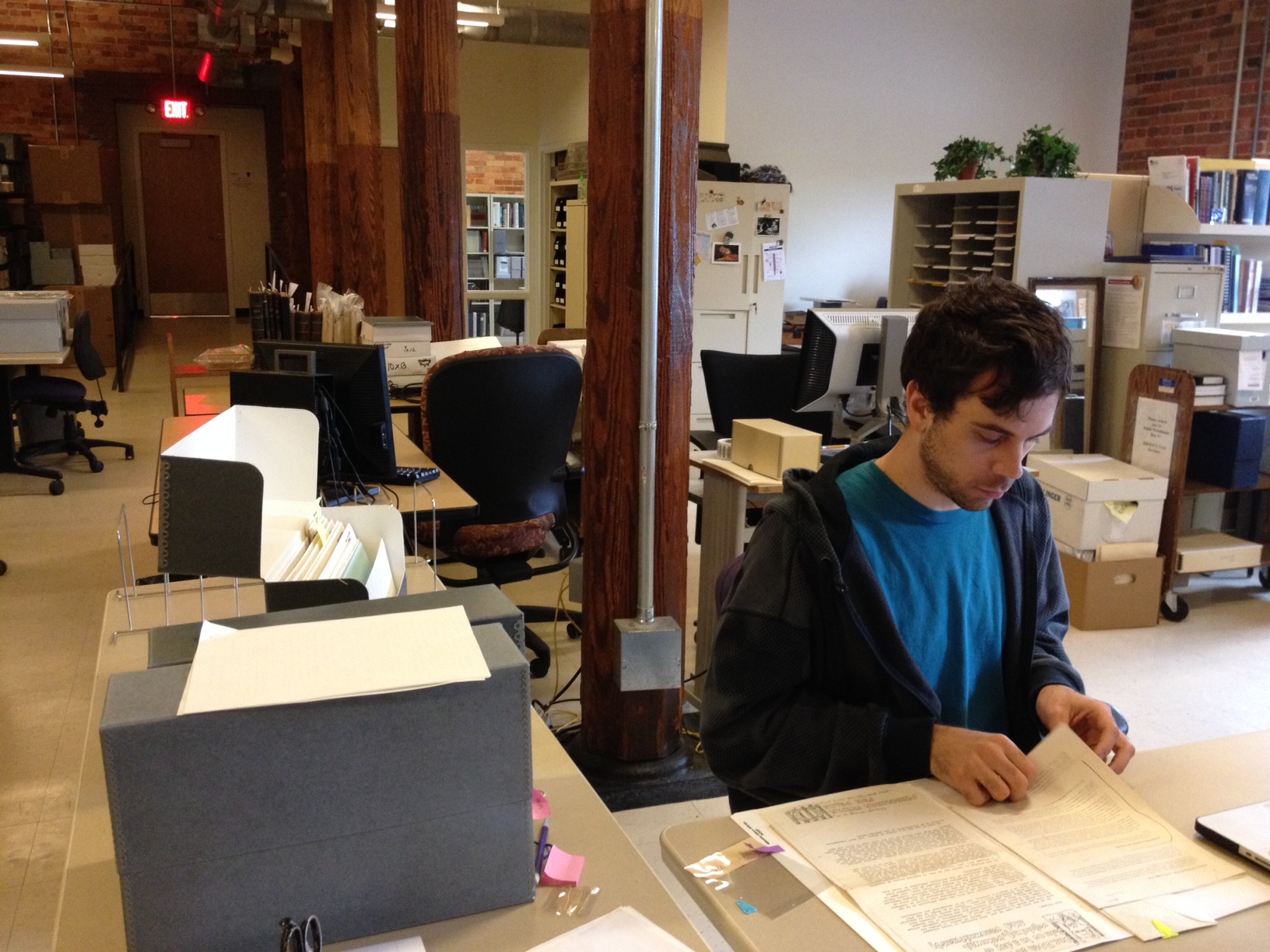
On Thursday, November 7th, twenty of Al Achenbaum’s family and close friends joined Duke library staff and faculty in a ceremony to dedicate his papers as part of the John W. Hartman Center for Sales, Advertising & Marketing History. In a series of comments given by Hartman Center staff, Achenbaum’s papers were lauded for their unique insight into building brand equity, strategic marketing planning, maximizing advertising agency-client relationships, and using systematic quantitative research as a guide to effective decision-making.
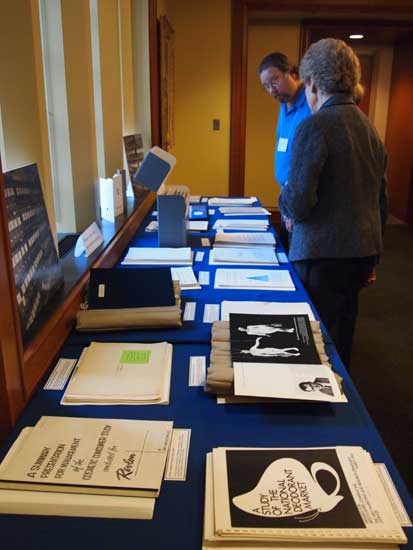
A display of materials from the Alvin Achenbaum Papers.
A display of materials from the Alvin A, Achenbaum Papers.

Over a remarkable 60-year career, he advised leading global marketers, including Procter & Gamble, GE, Toyota and Nestlé, on how to use marketing tools to improve the economic value of their businesses.  He held senior executive positions at four major advertising agencies in New York, and was chairman of a series of leading marketing consulting firms which provided over 150 companies with systematic tools for addressing complex business challenges.

This 233-box collection will enrich the experiences of many students and scholars interested in the evolution of the advertising industry in the second half of the 20th century or the career of Al Achenbaum, known to many as the “Einstein of Advertising” and one of Advertising Age’s  100 most influential advertising people of the 20th century. Al’s son, Jon Achenbaum, described his father as the reason he started his own career in marketing, applying many of the marketing innovations that Al brought into the business world and read two passages from Al’s upcoming book.

Rounding out the event were remarks by Al Achenbaum himself, in which he stated that “marketing is the single most important driver of our modern economy” and that it will “continue to play a critical role in economic success – both in the U.S. and abroad.”  He expressed his gratitude to his family and friends for supporting him throughout his life and career and expressed his enthusiasm for donating his papers to Duke and the Hartman Center.
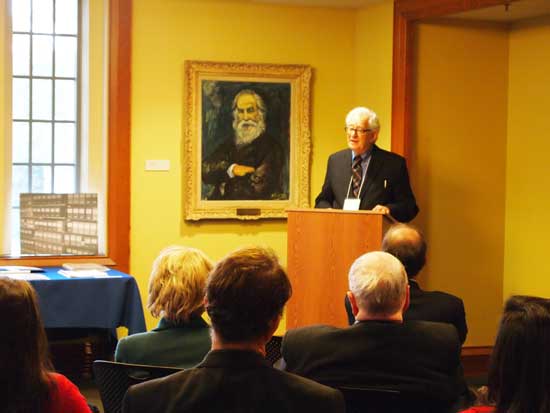
P1011531-web

To top off the ceremony, he announced that he is endowing the Hartman Center’s travel grant program, which will be named the Alvin A. Achenbaum Travel Grants.  These travel grants will enable students and scholars to come from afar to use Hartman Center collections as part of their research each year. Since Achenbaum is in many ways a scholar of advertising and marketing himself, this is a wonderful way to continue his legacy in perpetuity.
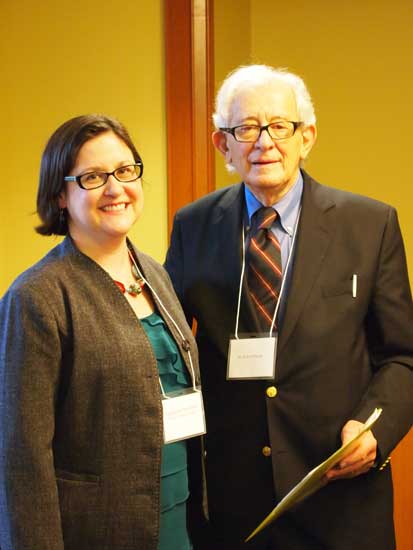
Hartman Center director Jackie Reid Wachholz and Al Achenbaum.

Post contributed by Jackie Reid Wachholz, director of the John W. Hartman Center for Sales, Advertising & Marketing History.
The African Americans: Rubenstein Recap #2

Each Tuesday, PBS is showing the next installment of a six-part series, The African Americans: Many Rivers to Cross. Written and narrated by Dr. Henry Louis Gates, Jr., the documentary traces African American history from the shores of West Africa to the election of Barack Obama. Join us each week as we feature documents from the John Hope Franklin Research Center that resonate with the previous week’s episode.

Last Tuesday’s episode  focused on the slavery at its height in the American South. Episode 2: The Age of Slavery (1800 – 1860) began at the end of the Revolutionary War, a time when slavery was still legal in all thirteen states. While the demands of enslaved African Americans for freedom and mounting moral appeals helped end human bondage in the North, the exploding international demand for cotton only deepened the South’s reliance on slave labor.

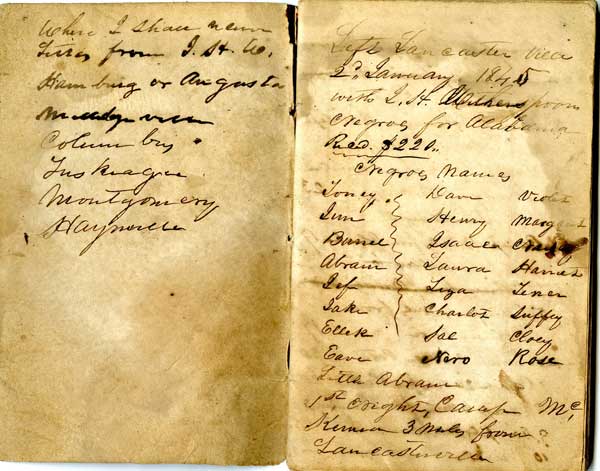
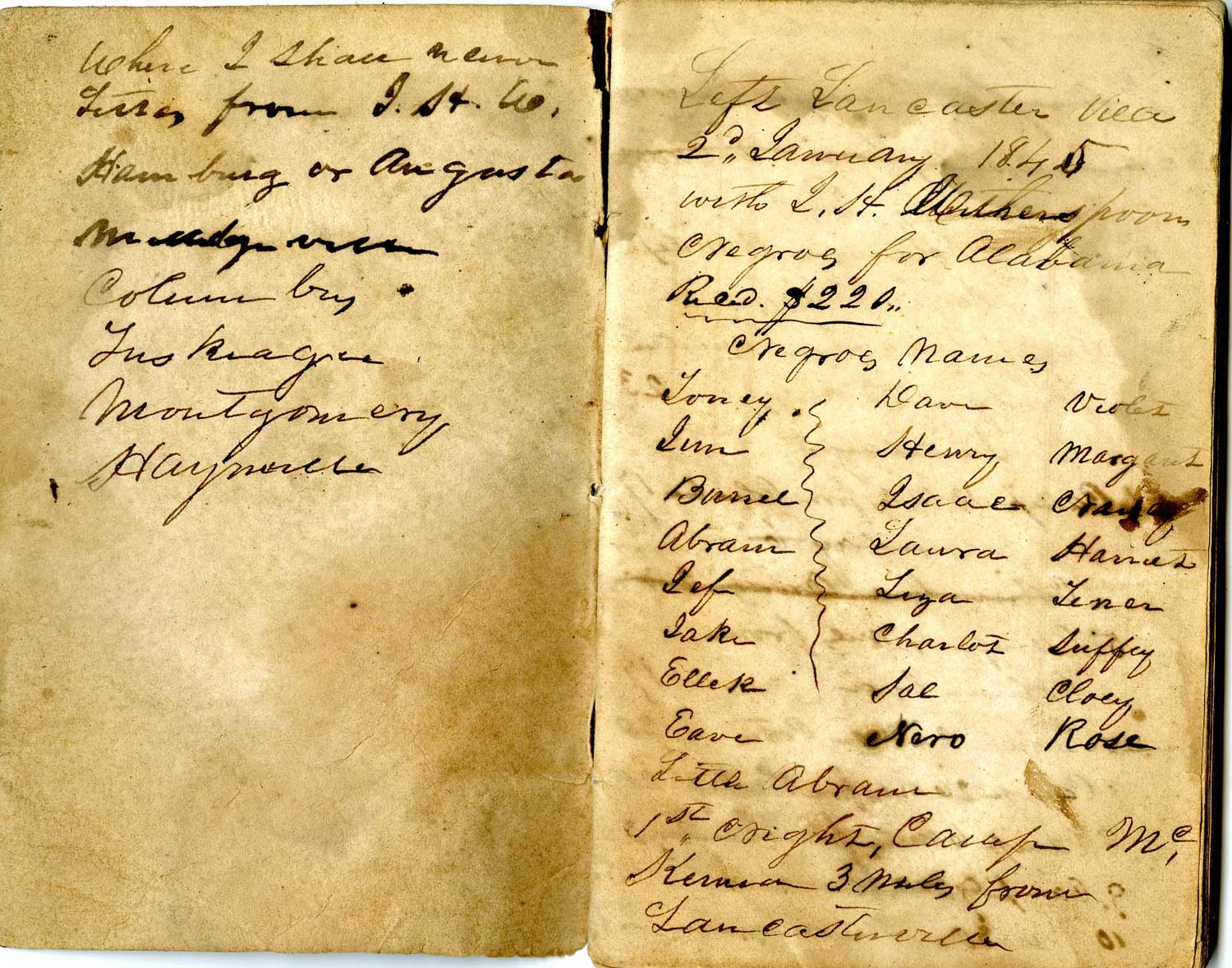
The notebook of a slave transporter who delivered twenty-five slaves from Lancaster, South Carolina to Montgomery, Alabama in 1845.
The notebook of a slave transporter who delivered twenty-five slaves from Lancaster, South Carolina to Montgomery, Alabama in 1845. (Slave transporter’s notebook, 1845). Click to enlarge.


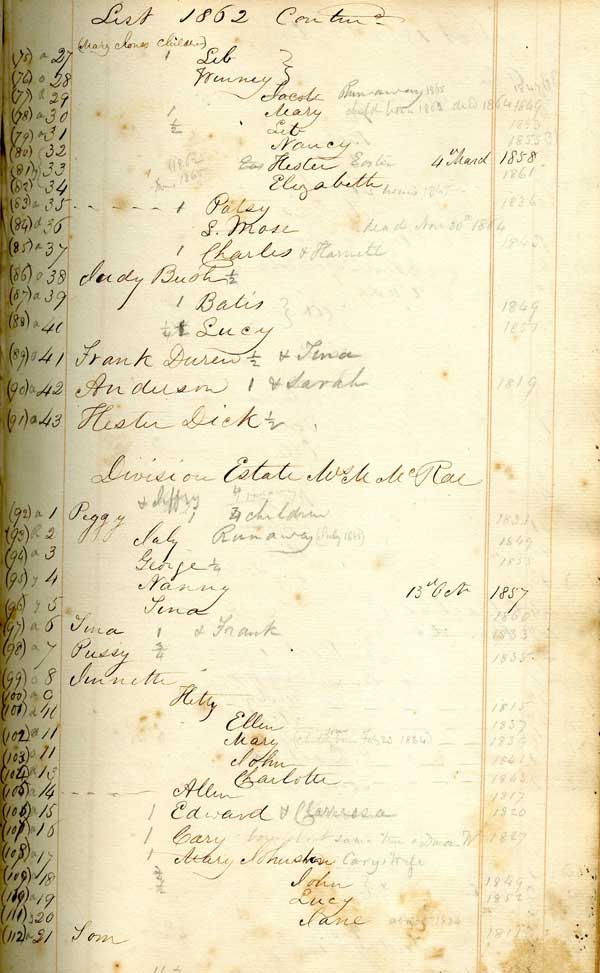
Lineage of slave families on the McRae Plantation near Camden, South Carolina in the 1800s. Jacob and July are noted as runaways.
Lineage of slave families on the McRae Plantation near Camden, South Carolina in the 1800s. Jacob and July are noted as runaways. (Plantation Memorandum Book, McRae Plantation)

Enslaved men and women ran away, revolted, and resisted this brutal system in any way they could. The luckiest made their way to freedom in Canada, but the vast majority had little chance of escaping the cotton fields.

List of black men and women emigrating from Essex County, Canada to Haiti in 1861.
List of black men and women emigrating from Essex County, Canada to Haiti in 1861. Alexander Proctor and his wife Margaret were born free in the South and migrated to Ohio before moving to Canada and finally Haiti. Also on the list is William Turner, who is noted as a fugitive. (Alexander Proctor Papers, 1837-1895).
Click to enlarge.

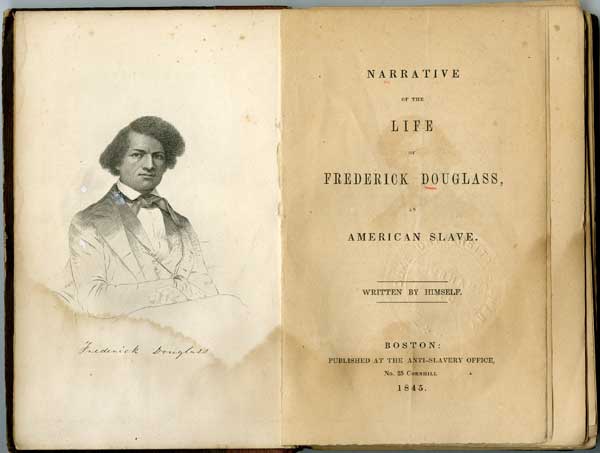
By the mid-19th century, abolitionists and free black citizens, like escaped slave Frederick Douglass, had launched a passionate battle to end slavery in the United States.

Narrative of the Life of Frederick Douglass, an American Slave (1845)

Post contributed by Karlyn Forner, John Hope Franklin Research Center Graduate Student Intern and John Gartrell, John Hope Franklin Research Center Director

The African Americans: Rubenstein Recap

Last Tuesday, PBS premiered the first episode of the six-part series, The African Americans: Many Rivers to Cross. Written and narrated by Dr. Henry Louis Gates, Jr., the documentary traces African American history from the shores of West Africa to the election of Barack Obama. Join us as we feature documents from our Rubenstein Library that resonate with the previous week’s episode.

Episode 1: The Black Atlantic (1500 – 1800) began with the complicated routes of the transatlantic slave trade connecting ports across three continents from Africa to the West Indies, London to South Carolina. The dehumanizing conditions of the Middle Passage and the capital made from human bondage were just some of the factors that made the institution of slavery in the western world so different from any other in world history.

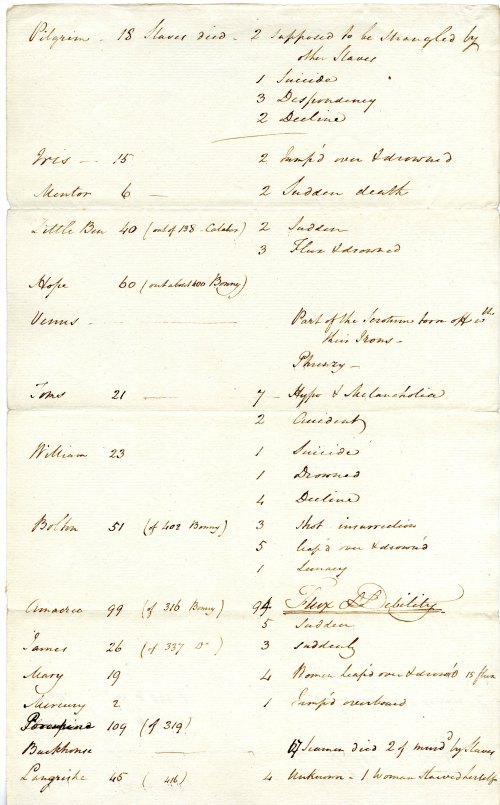
A list of slave ships from the 1790s, detailing the number of slaves that died in route to the western world. (l to r, name of Ship, number of slaves dead, special cause of death):

 William Smith papers, 1785-1860., Box 3, Miscellaneous Papers, Printed Material “Pilgrim - 18 slaves died”
William Smith papers, 1785-1860., Box 3, Miscellaneous Papers, Printed Material “Pilgrim – 18 slaves died”


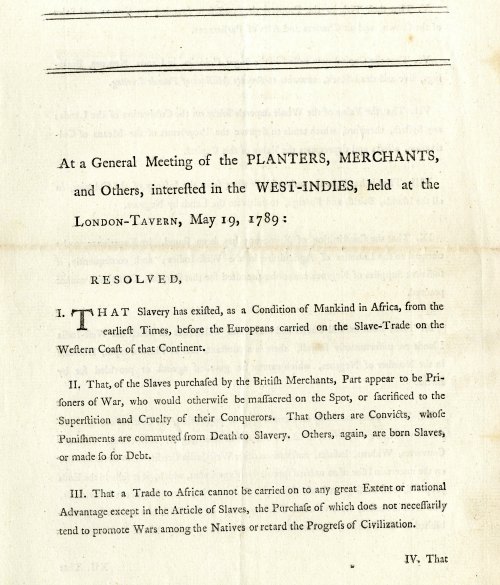
Arguments for the continuation of the African slave trade:

Resolutions West Indies Planters & Merchants, 1789 of why slave trade should be continued (arguments for property rights, capital reasons, European “constitutions” not be adapted to clearing agricultural land), William Smith Papers, Box 3, Folder (Printed Material, 1788 - 1822)
Resolutions West Indies Planters & Merchants, 1789 of why slave trade should be continued (arguments for property rights, capital reasons, European “constitutions” not be adapted to clearing agricultural land), William Smith Papers, Box 3, Folder (Printed Material, 1788 – 1822)


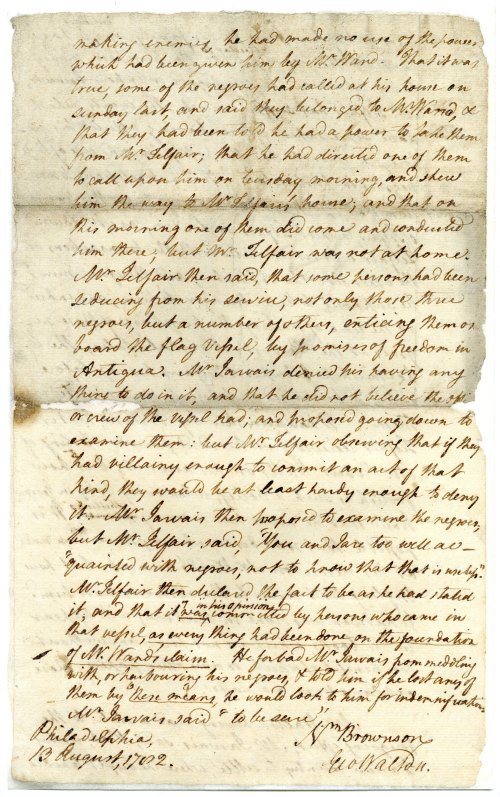
Episode 1 concluded by contextualizing the importance of the American, French, and Haitian Revolutions. The rhetoric of liberty and freedom at the heart of these movement ignited the entire Atlantic world in the late 18th century, especially the lives of enslaved African Americans, slaves wanted some of that freedom for themselves. This letter from the Edward Telfair papers details an incident where Telfair accuses a white man from British Antigua of “enticing” his slaves away with promises of freedom. Telfair fails to understand that the 3 slaves had reasons enough of their own, especially with liberty in the air.

Edward Telfair Papers
Edward Telfair Papers, Box 2, Folder 1780 – 1783, Letter on Aug. 13, 1782 from N. Brownson & E. Walton: “Mr. Telfair then said that some persons had been seducing from his service, not only those three negroes, but a number of others, enticing them on board the flag vessel, by promises of freedom in Antigua. Mr. Jarvais denied his having any thing to do in it, and that he did not believe the officers or crew of the vessel had; and proposed going down to examine them: but Mr. Telfair observing that if they had villainy enough to commit an act of that kind, they would be at least handy enough to deny it.[…] [Mr. Telfair] forbade Mr. Jarvis from meddling with or harbouring his negroes, and told him if he lost any of them by those means, he would look to him for indemnification. Mr. Jarvis said, ‘to be sure.’

Post contributed by Karlyn Forner, John Hope Franklin Research Center Graduate Student Intern and John Gartrell, John Hope Franklin Research Center Director

Heschel Highlights, Part 3

(Un)obsequiously Yours: An Out-of-the-Blue Letter from the Spiritual Master Alfred R. Pulyan

Welcome to the third post in a series documenting the processing of the Abraham Joshua Heschel Papers.

One of the most intriguing features of the Abraham Joshua Heschel collection is its ability not only to shed light, by virtue of the abundance and diversity of the materials it contains, on his intellectual biography, private persona, and scholarly and political work, but also to comment widely on a variety of issues related to the contemporary public and private sphere in the United States. Among such issues are certainly the socialization of the function of secular and religious thinkers and the material importance of correspondence in the establishment and furthering of social networks and intellectual affinities.

More particularly, in the case of as prominent and publicly exposed a figure as Heschel, it is interesting to notice the recurrence with which individuals of different persuasions, professions and social standing, struck by the reading of his works, spontaneously set out to address him letters. They often did so in order to offer their perspective on an issue they deemed dear to him, expose their views about various religious problems, or simply secure an opportunity to meet him in person. The particular sub-genre emerging from these “first letters,” in which an awkwardly deferential act of addressing turns into a self-conscious emergence from anonymity, may yield some insights into the relationship that links writing, and particularly epistolary writing, to the processes of subjectivation.

One exceptional, aberrant instance of such messages-out-of-the-blue genre can be cited. It is a neatly-penned and beautifully-styled letter, spanning five columns and three sheets of paper, addressed to Heschel by Alfred R. Pulyan, one of those figures whose relative notoriety derives in part by the respectable legitimacy with which the adjective “obscure” can be attached to their names. Writing to Heschel in 1964, ostensibly about Cardinal Augustin Bea’s draft of the declaration Nostra aetate (but really about Judaism, Christianity, the awakening, and the sense of existence), Pulyan, a spiritual teacher based in South Kent, Connecticut, by the end of his letter makes no mystery of his intentions: to turn the Polish-born rabbi into one of his pupils.

Processing Intern Emanuel works with the Heschel Papers.

The esoteric teacher seems aware of the unlikelihood that his proposition hit its mark: “In your [i.e. Heschel’s] case,” he writes, “the rejoinder I judge will be neglect or rejection (the great “no” of [Constantine P.] Cavafy), unless you childishly fear I am trying to edge you into Christianity by a back door.” Whether or not the lures of Pulyan’s coquettishly uncompromising tone did indeed fall flat is difficult to tell, in the absence (for the time being) of other messages from this tough-sounding enlightened master. What the reader is left with is the charm of an unpredictably effective hortatory prose and, as is often the case with this collection, an indecipherable piece of archive, through whose very recalcitrant oracularity a glimmer of a whole universe of meaning is revealed.

Post contributed by Emanuel Fiano, processing intern for the Abraham Joshua Heschel Papers in Technical Services.

A “Surprise Box” from Judy Malloy

MalloyBoxOpenWhile the staff here at the Rubenstein Library often travels to bring collections back to Durham, we also receive a great many packages from around the world.  For us, there’s nothing like opening those newly arrived boxes to assess the contents’ research value and find their place within the context of the collection to which they belong, and within our holdings as a whole.

Judy Malloy, the pioneering author of electronic literature such as Uncle Roger (1986), one of the first hypertext fictions, recently sent us a “surprise box” of additions to her papers here.  It was, indeed, full of wonderful surprises!  They included a painted notebook from her work Paths of Memory and Painting, a portrait of Malloy by Irene Dogmatic, and some documentation of recent online works.

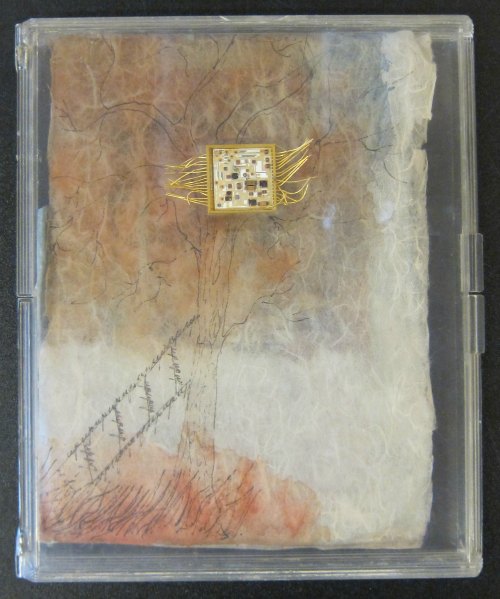
The box also contained a couple of Malloy’s early artist’s books, including “up”, from around 1975, which incorporates a computer chip into its design.

MalloyUp
Judy Malloy, “up”, from the Judy Malloy Papers.

Documentation of some of Malloy’s performances and art projects from the 1970s to the 1990s is also included.  A hand-painted sign captures her passion for both the freedom of expression online and the tactile enjoyment of physical artwork.

MalloyCyberLiberties
Sign from a Cyber Liberties event at the University of California, circa 2004.

We look forward to many more surprises, both from Judy Malloy and other authors of electronic literature and from the many other boxes we crack open every week!

Post contributed by Will Hansen, Assistant Curator of Collections.

A Family with a Mission: The McGee Family Papers

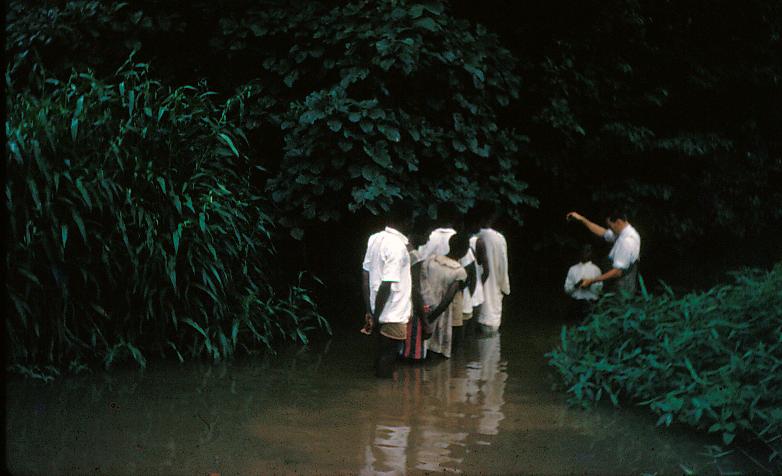
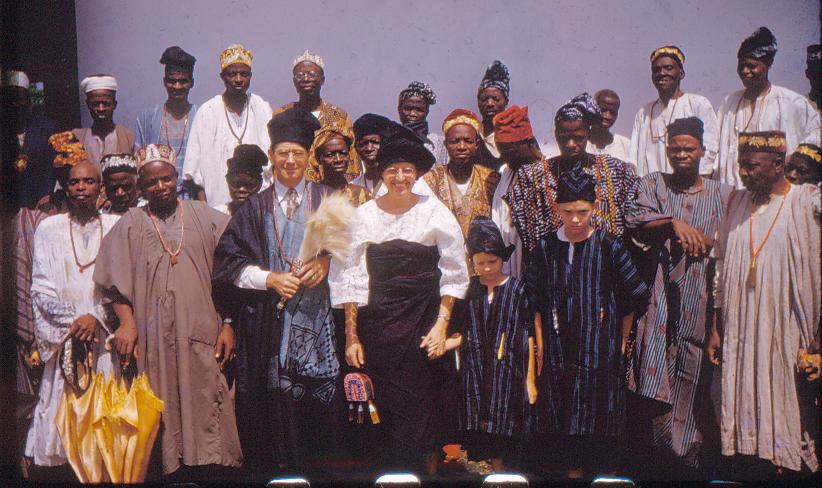
We just wrapped up processing an exciting new addition to the McGee Family Papers. John S. and Doris McGee were Baptist missionaries to Nigeria in 1945, where they served until their retirement in 1977. Their two sons, John David and Sidney, joined them in Africa for their formative years before finishing their education in America. During the McGee family’s time in Nigeria, they served at the Baptist College of Iwo and the Baptist Mission in Igede-Ekiti and Ikogosi, and they helped found the sixth Baptist high school in Nigeria–the Ekiti Baptist High School in Igede. They were made “Chief Gbaiyegun of Igede” by the Onigede and Chiefs of Igede-Ekiti, the paramount chief by the Ewi of Ado, and “Chief Akorewolu of Ikogosi” by Loja and Chiefs of Ikogosi-Ekiti.

McGees and chiefs, Gbaiyegun event, 1957
McGees and Nigerian chiefs, Gbaiyegun event, 1957

Some of the items in the new accession include correspondence (as well as reel-to-reel “audio letters”) between the family members while they were separated  during their various Nigerian tours; Doris’ many prayer diaries; and seven beautiful 16×20 color prints documenting life in various Nigerian missionary camps.

John S. McGee baptizing believers in Nigeria

The collection offers fascinating insight into the lives and histories of a family on a Baptist Mission to Nigeria in the mid-twentieth century.

Rights! Camera! Action!: We Still Live Here / Âs Nutayuneân

Date: Thursday, September 19, 2013
Time: 7:00 p.m.
Location: FHI Garage, Bay 4, Smith Warehouse (directions & parking information)
Contact: Patrick Stawski, patrick.stawski(at)duke.edu

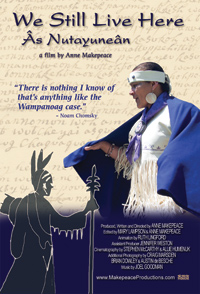
Poster for We Still Live HereWinner of the Full Frame Inspiration Award, We Still Live Here/ Âs Nutayuneân (TRT 56:00) tells the story of the revival of the language of the Wampanoag people of New England. All speakers of the language had died out when in 1994 Jessie Little Doe, a Wampanoag social worker, began to wonder if it could be recovered.

With M.I.T. linguist Ken Hale, with whom she earned a Master’s degree, she and other linguists pieced the language together from old documents and related Native American languages. Through community-wide efforts among the Aquinnah and Mashpee Wampanoag, the language is being spoken again, and Jessie’s young daughter is the first native speaker of Wampanoag in more than a hundred years.

The screening will be followed by a panel discussion featuring Dr. Liliana Paredes and Dr. Benjamin Frey.

Dr. Liliana Paredes is Associate Professor of the Practice of Spanish and Director of the Duke Spanish Language Program. She holds expertise in the areas of sociolinguistics, minority languages, and Amerindian languages.

Dr. Benjamin Frey is a Fellow in the Carolina Postdoctoral Program for Faculty Diversity at UNC. He completed his Ph.D. in Germanic linguistics at the University of Wisconsin – Madison in August 2013. His research examines language shift among minority communities in the United States from their traditional languages to English, with specific focus on German in Wisconsin and Cherokee in North Carolina. Frey is a member of the Eastern Band of Cherokee Indians.

Rights!Camera!Action is sponsored by the Archive of Documentary Arts and the Human Rights Archive in the Rubenstein Library, the Duke Human Rights Center @ FHI, and the Program in the Arts of the Moving Image.

Post contributed by Patrick Stawski, Human Rights Archivist.

Revisiting the Allen Building Takeover

In 2013, Duke University is commemorating the 50 year anniversary of its first black undergraduate students. Events, exhibits, and performances have been taking place over the year, and will culminate during the weekend of October 3-6.

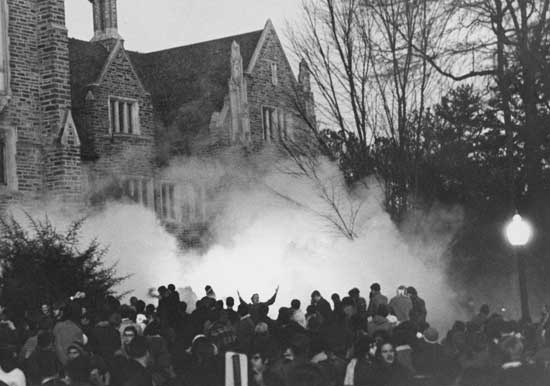
As we reflect on the milestone of integration, we must also consider the challenges faced by African American students at Duke, especially during the 1960s. This upcoming February will mark 45 years since the Allen Building Takeover of 1969. The Takeover was a seminal event in which nearly 100 black students occupied the administrative building for a day, demanding changes to a number of policies. After leaving peacefully, a crowd gathered outside the building confronted police, and teargas was fired on the crowd.

Allen Building Takeover, 1969

A new exhibit on the Takeover, curated by Caitlin M. Johnson, Trinity ’12, is now on display on the first floor of the Allen Building. Thirty panels describe the build-up to the protest, the events of that day, and the outcome of the Takeover. Featuring many images from the University Archives and the Durham Morning Herald and Durham Sun, Johnson’s exhibit forms a powerful narrative about Duke’s path toward real integration.

An opening reception for the exhibit will be held on Thursday, September 12 from 3:30 to 5:00 p.m. in the Allen Building.

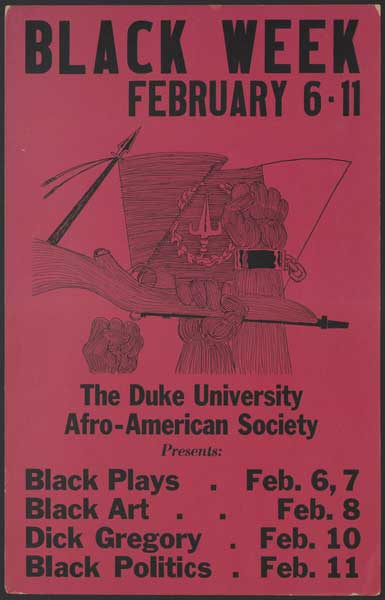
At 6:00 p.m. that evening, Dr. Jack Preiss, Professor Emeritus at Duke, will be speaking at the School of Nursing about desegregation at the University. Dr. Preiss was intimately involved in encouraging the Board of Trustees to change its policies on admissions. The University Archives holds a collection of his papers, including this poster from Black Week, which immediately preceded the Allen Building Takeover.

Black Week Poster, 1969

Email sharon.caple@duke.edu to RSVP for the Sept. 12 exhibit reception or the talk by Dr. Preiss.

Post contributed by Val Gillispie, University Archivist.

Summer in the Archives with Oskar Morgenstern and Robert Solow

Summer in the Archives is a collaborative initiative of two institutions at Duke – the Center for the History of Political Economy and the David M. Rubenstein Rare Book and Manuscript Library — focusing on Rubenstein’s Economists’ Papers Project. It is based on joint work of Rubenstein’s staff and outside experts, who are often Ph.D. students in economics. The goal of Summer in the Archives is to improve the availability of the economists’ collections to the research community, as well as to allow young researchers to get hands-on experience with archival work.

Rubenstein Technical Services staff worked closely with myself and Crystal Wong, Ph.D. candidate at University of Washington. Our task was to improve description and organize the existing collections of distinguished economist Oskar Morgenstern and Nobel Prize winner Robert Solow. I would now like to share a couple of interesting “bits and pieces” that we came across while working with the collections.

Oskar_Morgenstern1
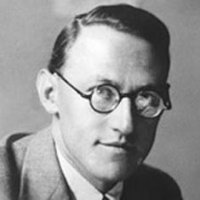
Oskar Morgenstern

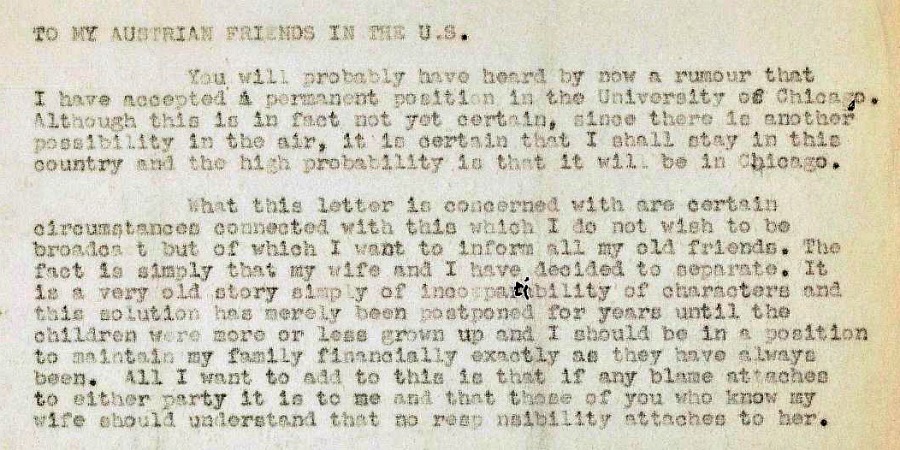
Oskar Morgenstern was born in today’s Austria and left his home country in the late 1930s to join Princeton University.  Among many other activities and contributions, Morgenstern was a co-founder of the Game Theory and an important force behind the rise of the Economics Department at NYU, which was one of his last projects before he lost his battle with cancer in the late 1970s.  The document that I want to bring the attention to is a 1950 letter from F.A. Hayek, another economist with Austrian roots, who received the Nobel Prize in 1974.

morgto_hayek_1941-page-002x
Economist Scandal: A letter from Hayek explaining his divorce. He went on to marry his cousin.

The letter is confidential and Hayek addresses it to his “Austrian friends in the U.S.,” listing five other addressees besides Morgenstern – Mises, Haberler, Furth, Machlup, and Schutz. In the letter, Hayek explains that he and his wife are separated because of the incompatibility of their characters. Hayek is taking the full blame for the separation and he also notes that his personal situation is related to his decision to move from London to the U.S. While other copies of the letter might still exist, I am not aware of them and it is possible that this is the only surviving copy. Whether that is the case or not, the letter certainly documents an interesting part of Hayek’s personal life – his divorce, his subsequent marriage to his cousin, and his related move from a comfortable professorial position at London School of Economics to the U.S.

solow
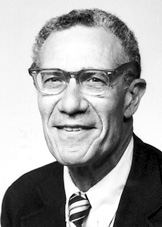
Robert Solow

Crystal and I also spent a lot of time improving the description of the Robert Solow Papers’ correspondence series. One interesting exchange I found is from 1982, between Solow and Ronald Coase, another economics Nobel Prize winner. Both Solow and Coase put their finger on a critical issue of difference between social sciences and natural sciences.  It is no wonder, Coase says, that economists are so notoriously known for disagreeing with each other – an issue that was particularly noticeable during the recent economic crisis.  Unlike physicists, economists often cannot run controlled experiments and therefore cannot repeat such experiments to check conclusions of each-other’s research.  According to Coase, it is thereby much harder for economists to resolve their disagreements than it is for natural scientists.

The material that we went through is in many ways breathtaking. The quality and the quantity of thoughts and conversations in the collections lead an aspiring scholar towards humility. Indeed, greatness is hard to achieve; but there is no better inspiration than interaction with great minds – whether it is in person, or through their archives.

Post contributed by Dr. Simon Bilo, Assistant Professor in Economics at Allegheny College, PA.

Remembering the March before the “March”

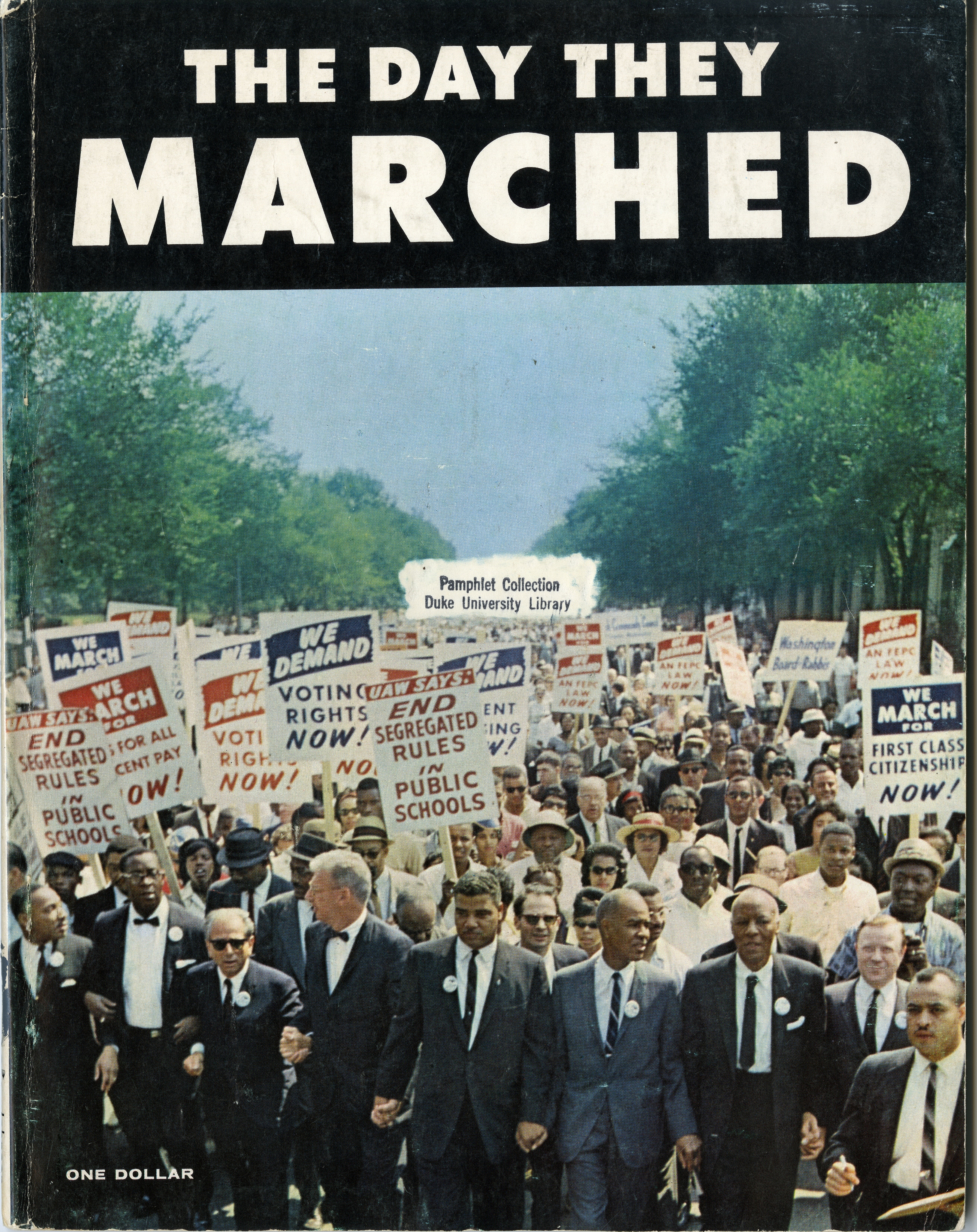
As the nation pauses and acknowledges the 50th anniversary of the August 28, 1963 March on Washington for Jobs and Freedom, it is important to remember that this was not the first African American organized mass march movement on the National Mall. The leaders of the March on Washington of ’63, Bayard Rustin, Andrew Young, Roy Wilkins, and others, used a blueprint established by another notable African American leader, A. Phillip Randolph, only a generation before them.

Bennett Lerone_mow_005While serving as head of the Brotherhood of Sleeping Car Porters, Randolph proposed a March on Washington on July 1, 1941 to protest the lack of opportunities given to African Americans in a recovering American economy. As World War II waged in Europe and Asia, American industry saw remarkable growth as suppliers of arms and supplies to their diplomatic allies, but African Americans were largely shut out of both federal and private jobs. Randolph believed that a march on the nation’s capital would provide a stage to give voice to African Americans suffering from both economic and social prejudice. As the March on Washington movement grew, Randolph threatened President Franklin Roosevelt that close to 100,000 people would descend on the nation’s capital if change did not occur. The March was ultimately called off by Randolph after Roosevelt passed Executive Order 8801, ordering the prohibition of discrimination in defense industries.

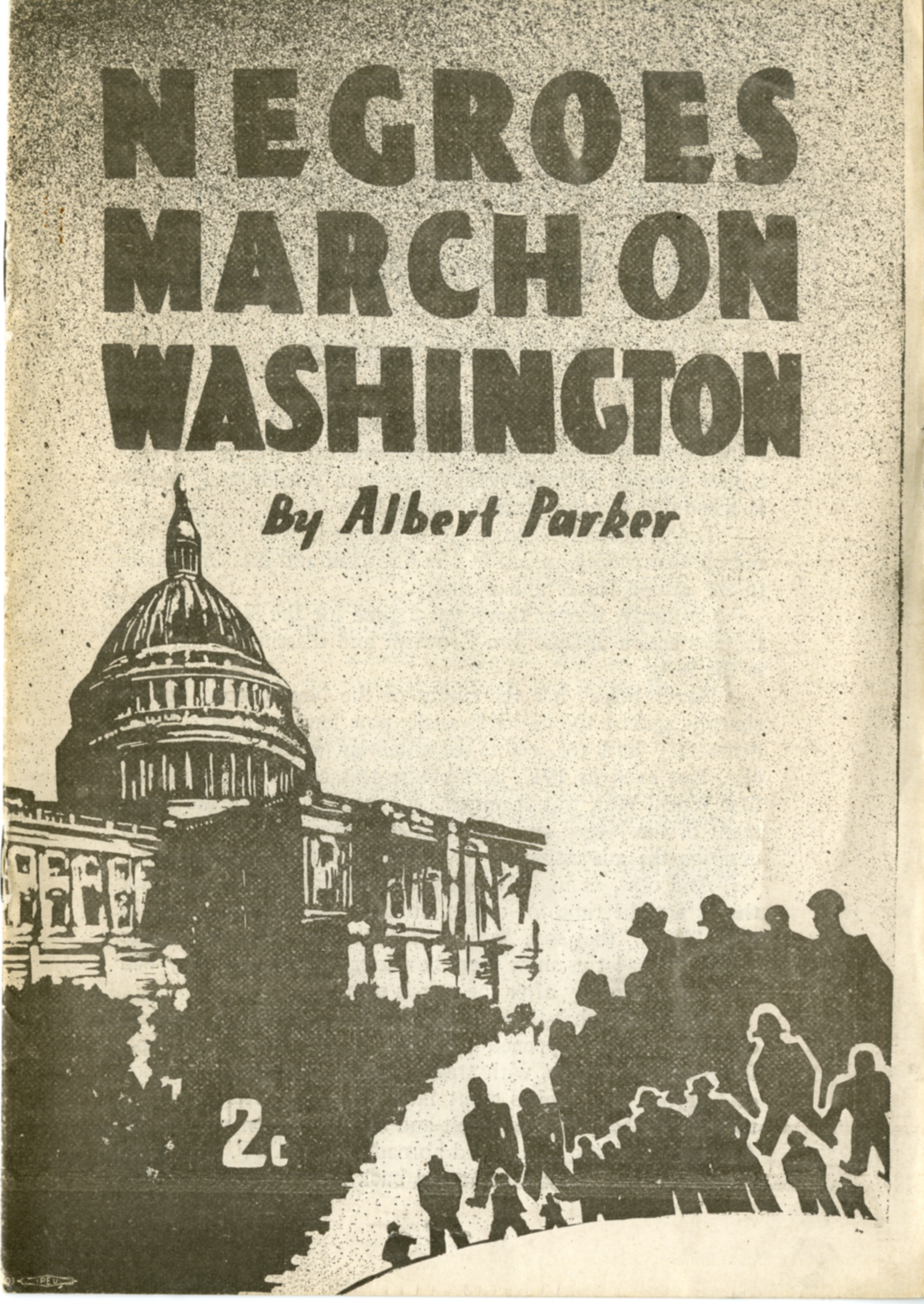
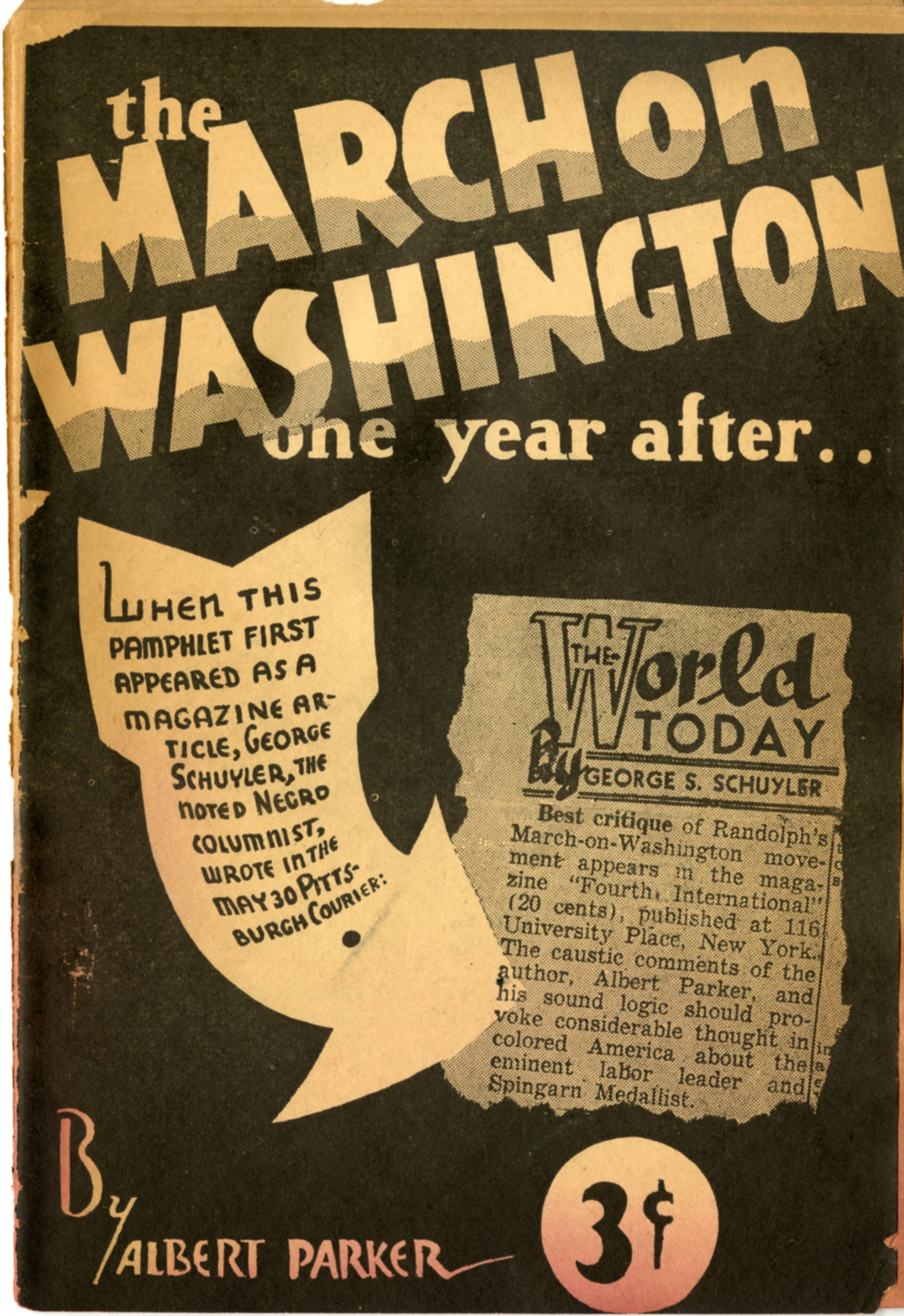
LSC 6865_004E Pam 12mo_12551_003Albert Parker’s Negroes March on Washington (1941) and The March on Washington, One Year After (1942), recount the MOW movement from that time. Parker, a staunch socialist, was indeed excited at the prospects of the March in 1941 and continual organization of African Americans against the federal government. But his 1942 publication reflected disappointment with Randolph’s actions in cancelling the march and acceptance of the Executive Order that was slow to desegregate the military and open jobs in the private sector.

Post contributed by John Gartrell, John Hope Franklin Research Center Director.