Category Archives: From Our Collections

‘Tis the Season: Gifts to the Rubenstein Library, Day One

OBrienDJTo celebrate the holiday season this week, we’re highlighting a few of the many wonderful books that the Rubenstein Library has received as gifts over the past year.  We are truly grateful for the generosity of our donors.  A hearty “Happy holidays” and thanks and to all of those who have contributed to making 2013 a wonderful year for the Rubenstein Library!

A donation from Duke Professor of French Studies Helen Solterer features rare and iconic works of Irish and American literature.  These volumes came from the library of Elizabeth Solterer, whose father, Constantine Curran, was a friend of James Joyce, W. B. Yeats, and other important figures in twentieth-century Irish literature.

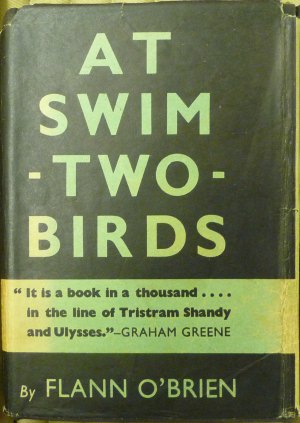
The donation includes a very rare first edition, first printing of At Swim-Two-Birds by Flann O’Brien (the pseudonym of Brian O’Nolan).  The book’s publication was poorly timed, appearing a few months before Great Britain declared war on Germany in 1939.  Only 240 or so copies were sold before most of the unsold stock was destroyed in a London bombing raid by the German Luftwaffe in 1940.  Its reputation as a groundbreaking and hilarious work of comedic metafiction has grown from a small cult following, and it now features regularly in lists of best English-language novels and novels of the twentieth century.  Copies of the edition printed before World War II are exceptionally rare, especially in the original dust jacket, present on the copy now at the Rubenstein Library.

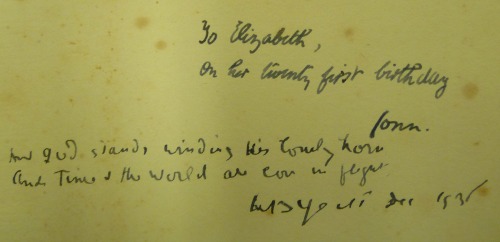
Another highlight of the donation is a 1934 edition of the Collected Poems of William Butler Yeats featuring two handwritten lines of his poem “Into the Twilight” and his signature, dated to December 1935.
YeatsInscriptionOther books in the donation include signed works by Robert Frost and Henry James.  We thank Prof. Solterer for this marvelous donation!
In Memoriam: Nelson Rolihlahla Mandela, 1918-2013

Perhaps no world leader in recent time has served as a symbol for his country and cause than Nelson Mandela. We honor his life and legacy by sharing some of our materials related to his impact on the world.

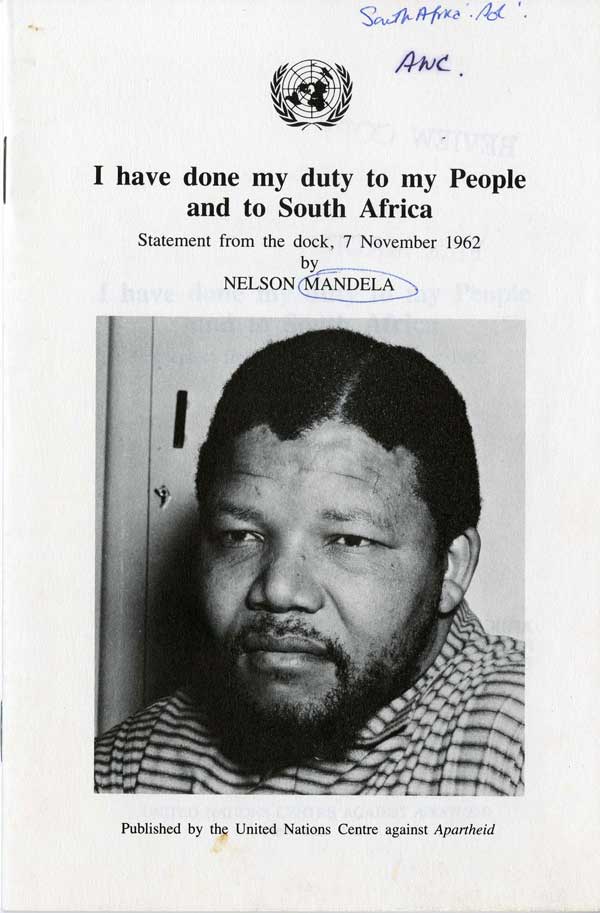
“I have done my duty to my People and South Africa,” pamphlet by Nelson Mandela, 1962, Leroy T. Walker Africa News Service Archive
“I have done my duty to my People and South Africa,” pamphlet by Nelson Mandela, 1962. Leroy T. Walker Africa News Service Archive


South African provincial election ballots, 1994, Nelson Mandela is listed as the candidate for the African National Congress
South African provincial election ballots, 1994. Nelson Mandela is listed as the candidate for the African National Congress.


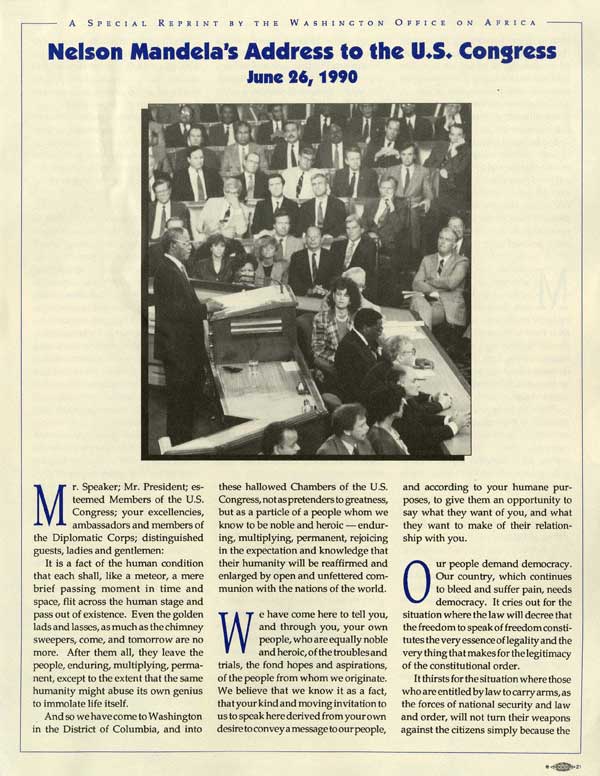
“Nelson Mandela’s Address to the US Congress,” article June 1990, Leroy T. Walker Africa News Service Archive
“Nelson Mandela’s Address to the US Congress,” article June 1990. Leroy T. Walker Africa News Service Archive.


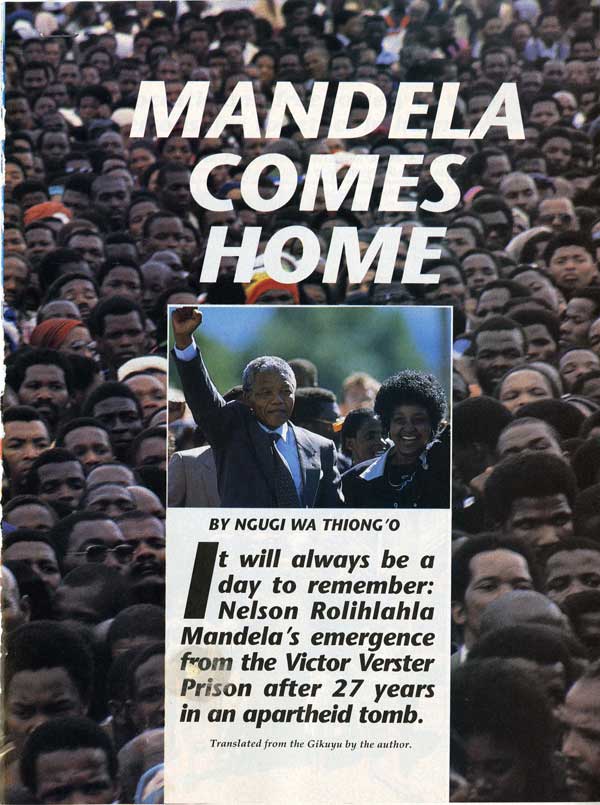
“Mandela Comes Home,” Time Magazine, Feb. 1990, Leroy T. Walker Africa News Service Archive
“Mandela Comes Home,” Time Magazine, Feb. 1990. Leroy T. Walker Africa News Service Archive.

Post contributed by John Gartrell, director of the John Hope Franklin Research Center for African and African American History and Culture.

The African Americans: Rubenstein Recap #6

Each Tuesday, PBS is showing the next installment of a six-part series, The African Americans: Many Rivers to Cross. Written and narrated by Dr. Henry Louis Gates, Jr., the documentary traces African American history from the shores of West Africa to the election of Barack Obama. Join us each week as we feature documents from the John Hope Franklin Research Center that resonate with the previous week’s episode.

The final episode of The African Americans: Many Rivers to Cross, “A More Perfect Union (1968 – 2013),” explored African Americans’ strides in the wake of the civil rights movement against the backdrop of deeply rooted inequalities that persist into the present. The extraordinary civil rights gains of the 1960s did little to undo the economic barriers facing black Americans. Black power – the dream to empower African Americans political and economically – became the rallying cry of the 1970s. During that decade, the Black Panther Party for Self Defense started community programs in Oakland, CA, while cultural nationalists embraced African heritage and art to spread the message that black was beautiful.

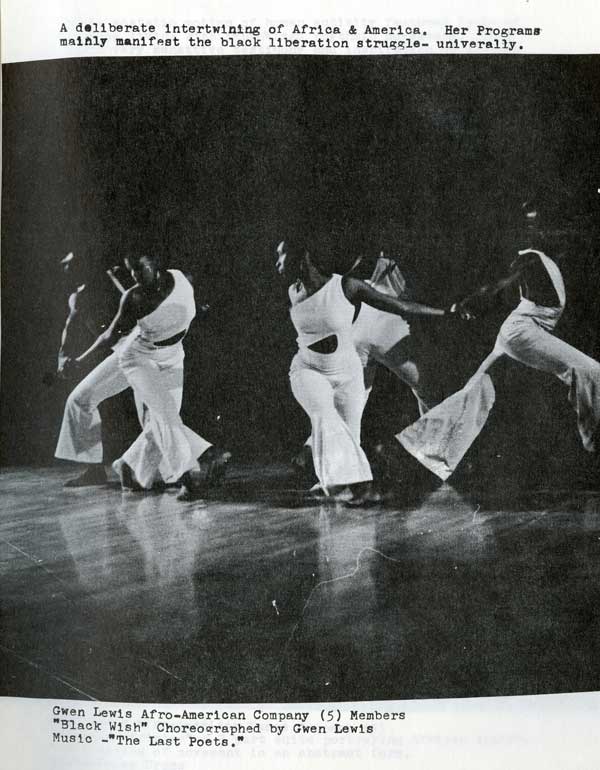
The Gwen Lewis Afro-American Company, a dance company in Oakland, was part of a flourishing black arts movement in the 1970s that saw reclaiming African heritage as part of the liberation struggle.
The Gwen Lewis Afro-American Company, a dance company in Oakland, was part of a flourishing black arts movement in the 1970s that saw reclaiming African heritage as part of the liberation struggle. Walter J. Taylor Papers, 1934 – 2000.

Affirmative action programs gave some African Americans the chance to attend elite colleges and climb corporate ladders and helped fuel a growing black middle class.

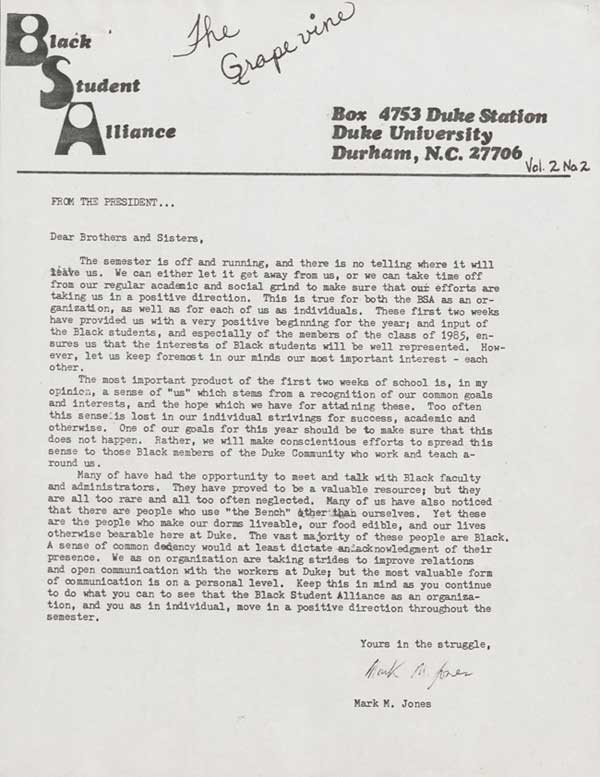
The Black Student Alliance at Duke was formed in 1969 and continued to provide support and represent the interest of African American students throughout the following decades. This 1981 newsletter, called The Grapevine, reminding black students that they are part of a community and urging them to reach out to both black faculty and black workers on Duke’s Campus.
The Black Student Alliance at Duke was formed in 1969 and continued to provide support and represent the interest of African American students throughout the following decades. This 1981 newsletter, called The Grapevine, reminding black students that they are part of a community and urging them to reach out to both black faculty and black workers on Duke’s Campus. Black Student Alliance records, 1969 – 2006.

But throughout the 1980s, the majority of black Americans found no escape from the poverty and unemployment that confined them to abandoned inner cities and rural areas.


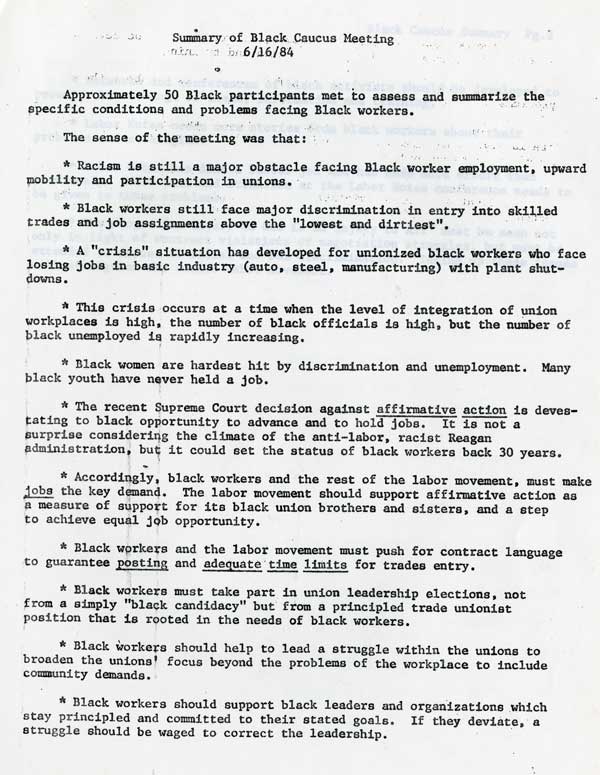
This list of observations drawn up by the Black Caucus, a labor group focused on African American workers, in 1984 laid out the tremendous barriers facing black workers twenty years after the civil rights movement.
This list of observations drawn up by the Black Caucus, a labor group focused on African American workers, in 1984 laid out the tremendous barriers facing black workers twenty years after the civil rights movement. Theresa El-Amin Papers, 1960s – 2010.


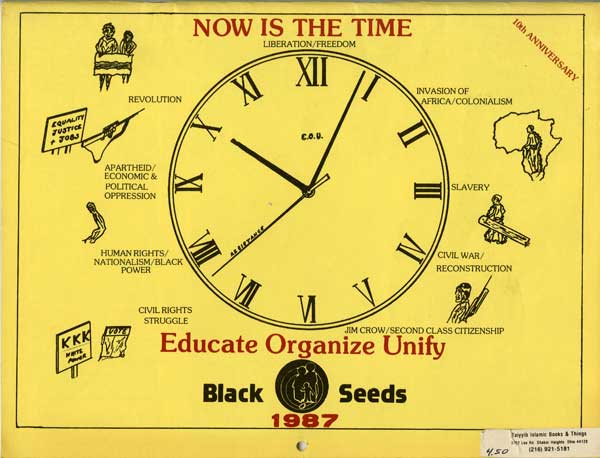
This 1987 calendar, published by the Black Seed organization, maps out the progression of the black liberation struggle. After the rising poverty and drug wars of the 1980s, the arms of the clock read that it’s revolution time.
This 1987 calendar, published by the Black Seed organization, maps out the progression of the black liberation struggle. After the rising poverty and drug wars of the 1980s, the arms of the clock read that it’s revolution time. Theresa El-Amin Papers, 1960s – 2010.

Ronald Reagan’s War on Drugs then targeted poor black neighborhoods and sent hundreds of thousands of black men to prison with harsh sentencing laws, a reality that lead to numerous legal battles in the last thirty years. Yet when Barack Obama was elected president in 2008, he fulfilled the dreams of centuries of African Americans. But as the effects of the disaster of Hurricane Katrina (2005) and controversy over the death of Trayvon Martin (2013) made clear, continuing racial inequality run deeper than one black president could solve.

Post contributed by Karlyn Forner, John Hope Franklin Research Center Graduate Intern.

The African Americans: Rubenstein Recap #5

Each Tuesday, PBS is showing the next installment of a six-part series, The African Americans: Many Rivers to Cross. Written and narrated by Dr. Henry Louis Gates, Jr., the documentary traces African American history from the shores of West Africa to the election of Barack Obama. Join us each week as we feature documents from the John Hope Franklin Research Center that resonate with the previous week’s episode.

From the outbreak of war in Europe to the chants of black power in Mississippi, Episode 5: Rise! (1940 – 1968), told the story of how African Americans came together in a mass movement for freedom. During World War II, black citizens used the rallying cry of patriotism to demand both victory abroad and victory at home over racism. However, Jim Crow followed black soldiers overseas, while the South’s commitment to white supremacy only grew deeper.

In 1940, Claudia Jones, a black woman and a member of the communist party, wrote about the United States’ history of racial discrimination and its influence on the war in Jim Crow in Uniform.  Claudia Jones. Jim Crow in Uniform. New York: New Age Publishers, 1940.
In 1940, Claudia Jones, a black woman and a member of the communist party, wrote about the United States’ history of racial discrimination and its influence on the war in Jim Crow in Uniform. Claudia Jones. Jim Crow in Uniform. New York: New Age Publishers, 1940.

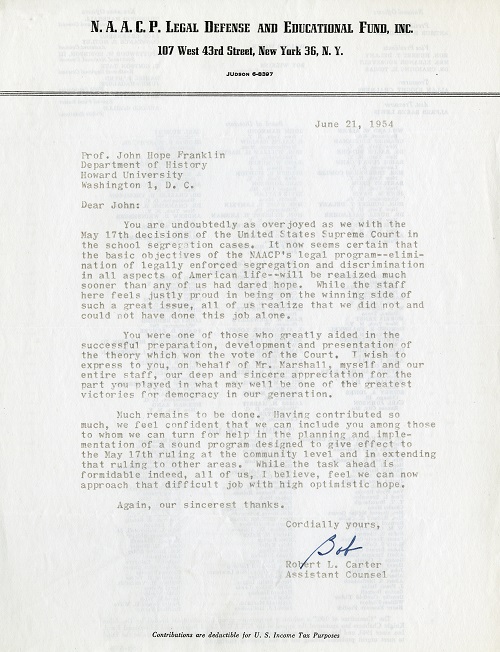
But the mobilization of black veterans and activists fueled new possibilities. Shortly after the 1954 Brown v. Board of Education decision struck down segregation, black men and women in Montgomery took to the streets, demanding an end to racial discrimination on the city’s buses.

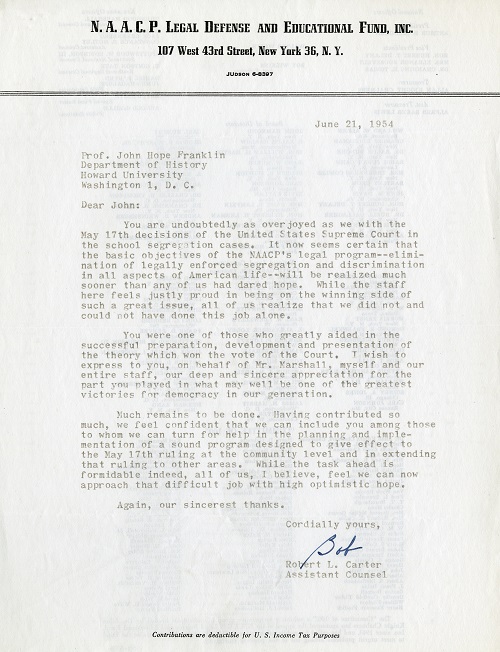
Brown v. Board decision marked the culmination of nearly two decades of effort by the NAACP to legally dismantle segregation. In this June 1954 letter to historian John Hope Franklin, the assistant counsel of the NAACP expresses his thanks to Franklin as one of the many who contributed to the landmark decision. John Hope Franklin papers.
Brown v. Board decision marked the culmination of nearly two decades of effort by the NAACP to legally dismantle segregation. In this June 1954 letter to historian John Hope Franklin, the assistant counsel of the NAACP expresses his thanks to Franklin as one of the many who contributed to the landmark decision. John Hope Franklin PapersClick to Enlarge.

With Martin Luther King Jr. and the Student Nonviolent Coordinating Committee (SNCC) serving key leadership roles, nonviolent protests and voter registration drives spread across the South.

AAMR, 5, FranklinJohnHope002
Faith Holsaert, a white SNCC member, was an organizer in Southwest Georgia during the early 1960s. In this letter to a friend, she describes the multitude of difficulties – personal, physical, and political – that movement activists faced in the rural South. Faith Holsaert PapersClick to Enlarge.

The brutal retaliation against protesters was broadcast into America’s living rooms. For the first time since Reconstruction, the federal government stood to protect the civil rights of black Americans. As nonviolence and federal action failed to uproot black poverty and exclusion, a rising consciousness of black power in the late sixties pushed the freedom struggle in new directions.

AAMR, 5, HolsaertFaith001
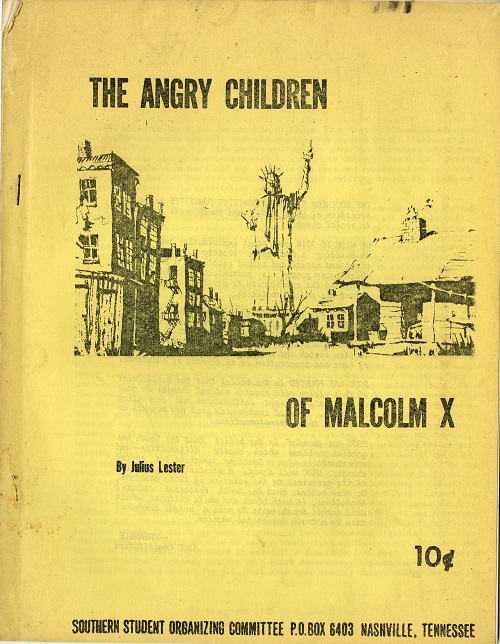
In The Angry Children of Malcolm X (1966), Julius Lester discusses the failure of nonviolence and argues that black power, or self-sufficiency and self-government for black people, was the only direction for African Americans to turn. Faith Holsaert papers.

Post contributed by Karlyn Forner, John Hope Franklin Research Center, Graduate Intern

Hot Off the Democratic Party Press

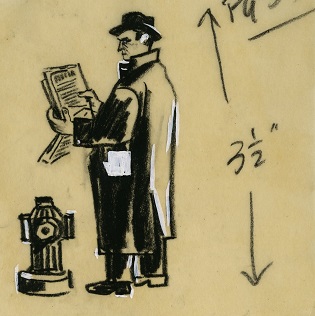
DemoDigestManandHydrantThe typewriters and linotype machines were furiously clacking away… Cigarette smoke turned the air blue…  The year was 1960, Nixon and Kennedy were running for President, and the cartoonists, layout staff, copy editors, and office runners of the Democratic Digest were working hard to beat a deadline and push out the next issue of irreverent, energetic political opinion, news, and satire.

You can examine the content being prepared for the 1960 campaign issue as well as many other issues from 1955-1961 in a Rubenstein Library collection, the Democratic Digest Records. The Washington, D.C. publication, headed by Sam Brightman, was the official monthly of the Democratic Party, and the 28 boxes of its records, acquired by the library in 1961, are filled with drafts of editorial columns, political cartoons and other original artwork, and reprinted articles and opinion pieces from pro-Democratic U.S. newspapers across the country.

DemoDigestNixon

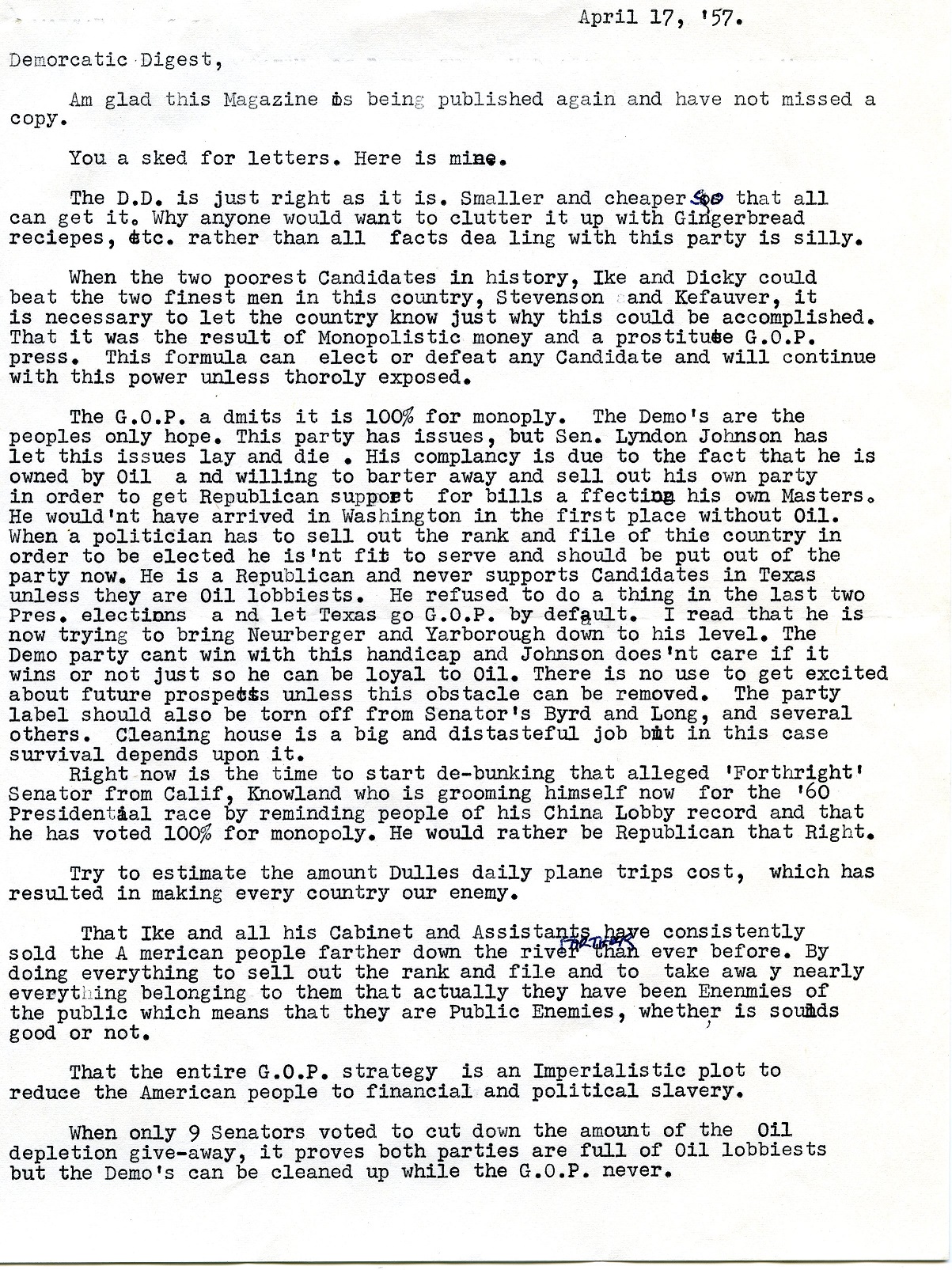
DemoDigestGraveyardThe correspondence files house provocative and eloquent letters sent in from readers, critics, and Democratic Senators and Governors, addressing the many turbulent political issues of the day: McCarthyism, scandals and corruption, civil rights, labor issues, farm subsidies, the U.S. economy, nuclear weapons, and of course, elections.  You’ll hear voices from ordinary citizens facing hard times: “Now that we have the D.D. [Democratic Digest],” writes one reader from Willifor, Arkansas in 1957, “I just don’t see how we could or ever did do without it. My work keeps me on the move and depend on getting it on the new-stands and believe under this new plan it will be easire [sic] done. While I have a wife and 7 children and not year round work, I will plan to get a Sub [subscription] or two for someone that will do something about it. They may do a good deed too.”

DemoDigest-letter1The materials in this collection cover a time of intense change and fragmentation in American society. Whether it’s a letter from a labor leader, cartoons featuring donkeys and elephants, or articles about big business being cozy with the government, the Democratic Digest files tell a fascinating tale of American politics and society.

DemoDigestcoverPost contributed by Paula Jeannet Mangiafico, Visual Materials Processing Archivist.

Celebrating 175 Years of Duke History

Date: Friday, December 6, 2013
Time: 3:00-5:00 PM
Location: Perkins Gallery
Contact Information: Amy McDonald, amy.mcdonald(at)duke.edu

Join the staff of the Duke University Archives for a reception celebrating the exhibit, “Outrageous Ambitions: How a One-Room Schoolhouse Became a Research University,” currently on display in the Perkins Gallery.

175th Exhibit Banner, part 1

Enjoy light refreshments while you trace Duke University’s 175-year history through fascinating artifacts, photographs, architectural drawings, and other historical materials. The reception will also be an excellent chance to get a look at some of the University Archives’ recent acquisitions, which will be on display for the first time.

The exhibit will be on display through February 16, 2014 and was curated by Maureen McCormick Harlow, 175th Anniversary Intern in University Archives, and Valerie Gillispie, University Archivist.

Unable to make the reception? Visit the online exhibit!

175th Exhibit Banner, part 2

Heschel Highlights, Part 4

Welcome to the fourth post in a series documenting the processing of the Abraham Joshua Heschel Papers.

In 1939, Julian Morgenstern helped Abraham Joshua Heschel travel from Warsaw to London just six weeks before Germany invaded Poland. In 1940, upon his arrival in the United States, Heschel began teaching at Hebrew Union College (HUC) where Julian Morgenstern was President. HUC was the main seminary for Reform Judaism in the United States and Heschel was the Associate Professor of Jewish Philosophy and Rabbinics there for five years. Heschel resigned from the HUC faculty on May 18, 1945 over ideological differences. As we process the Abraham Joshua Heschel papers, we learn more about the complex relationship between Heschel, HUC, and the leaders of Reform Judaism. Through letters, essays, handwritten notes, and his books, Heschel expressed concerns about the role of God, spirituality and adherence to Jewish law among Reform Jews. At a few points in Heschel’s life, these concerns bubbled up and he took action as part of his larger effort to infuse American Judaism with spirituality.

Photographs and documents from the Heschel Papers.

In 1945, Heschel’s theological divergence from HUC became a serious issue for him and he resigned his position. In a handwritten draft of his resignation letter to Morgenstern Heschel wrote “from the beginning of my affiliation with the college I fully realized that the HUC stands for a distinctive philosophy of Judaism which it tries to realize in practice and with which my own interpretation of Judaism is not in full accord.” Heschel’s resignation was accepted with sadness and respect on the part of Julian Morgenstern. In a letter dated May 19, 1945, Morgenstern wrote that he and the HUC Board of Governors wished to express their feeling that he was doing the “right and honorable thing.” A number of letters related to Heschel’s resignation echo this sentiment. Heschel’s students, colleagues and friends approved of Heschel’s decision and wished him well. Despite his issues with the philosophy of HUC, Heschel expressed an interest in sustaining his friendship with Morgenstern in his resignation letter: “I earnestly hope and wish, however, that the cordiality and warmth of our friendship will not be impaired by my leaving this institution.” It is clear from the amount of correspondence from Morgenstern that their friendship continued until Heschel’s death. From the correspondence surrounding Heschel’s resignation from HUC (and subsequent acceptance of a position as Associate Professor of Jewish Ethics and Mysticism at the Jewish Theological Seminary) it seems that Heschel continued to be on good terms with many of the acquaintances and friends that he made during his time at HUC. However, his ideological differences remained.

In 1953, Heschel caused a stir among his Reform colleagues when he gave an address to the Reform Rabbinic Organization, the Central Conference of American Rabbis (CCAR), entitled “Towards an Understanding of Halacha.” Heschel appears to have denounced the CCAR for failing to hold to the doctrine of Halacha (Jewish law) in this address. From the correspondence we have surrounding the address and its subsequent publication by the CCAR, it is clear that Heschel earned himself both admirers and detractors as a result. However, even the harshest letters reveal a great deal of respect for Heschel. A 1954 letter that begins with the exclamation “I am profoundly shocked by your persistent misinterpretation of Reform’s position on practice” concludes with the author, a reform rabbi, noting that Heschel could be helpful to the Reform movement as they move forward. Another letter from a Reform rabbi seems wary of Heschel’s denunciation of the CCAR but the author also wrote that “all your papers have a few extra calories of spiritual warmth which lift the heart.” And yet another rabbi’s letter reveals the power of a meeting with Heschel to assuage anger: “But of my prior disturbance, I can say ‘gam zu l’tovah’ [this is also for good] for it provided the occasion for a most stimulating and edifying chat with you.” Heschel remained in constant communication with Reform Rabbis and the leaders of the Reform movement throughout his life and his correspondence reveals that this exchange was beneficial to Heschel, to many Reform rabbis and perhaps even to Reform Judaism.

Post contributed by Adrienne Krone, Heschel Project Assistant in Rubenstein Technical Services.


The African Americans: Rubenstein Recap #4

Episode 4: Making a Way Out of No Way (1897 – 1940)

Last Tuesday’s episode, “Making a Way Out of No Way (1897 -1940),” began at the dawn of the Jim Crow era. Having already been forcibly removed from voting rolls, black southerners lived under the ever-present threats of violence, limited opportunities, and daily injustices of white supremacy.

The Behind the Veil project captured the experiences of hundreds of African Americans in the South living under Jim Crow. Listen to some of their stories here.

Many took a chance, abandoning the South in hopes of something better. By the end of the First World War, a massive influx of African Americans had transformed cities across the North and West. The freedom that they found in urban centers, like Harlem, inspired an explosion of black artistic creativity. The vibrant music, writing, films, and dancing of the Harlem Renaissance helped defy the rampant stereotypes of African Americans.

AAMR, 4, AfAmsinFilm001
African Americans in Film, Box 3, Folder: LoveBug, 1919.

This movie poster for the 1921, The Green Eyed Monster, promotes the film’s all-black cast, assuring readers that there is nothing of “the usual mimicry of the Negro” in the show.

But cultural richness did not end the second-class citizenship that limited all black Americans. During the Jim Crow era, black insurance agencies, grocery stores, doctors, educational institutions, and clubs and organizations multiplied, as black Americans turned inward, utilizing the resources they had.

AAMR, 4, NCMutual003
North Carolina Mutual Archives, Box 78, Folder: The Negro’s Adventure in the Field of Life Insurance, by W.J. Kennedy, Jr., 1934.

The North Carolina Mutual Life Insurance Company opened its doors in Durham in 1899. It grew into the largest black-run financial institution in the country and helped support the city’s sizable black middle class. This 1934 booklet, “The Negro’s Adventure in Life Insurance” explains how life insurance policies benefited African Americans.

From Booker T. Washington’s plans for economic development to W.E.B. DuBois’ ideas of racial uplift, black Americans continually sought new and sometimes conflicting strategies to secure full citizenship in the years before World War II.

AAMR, 4, BookerWashington001
Booker T. Washington Papers.

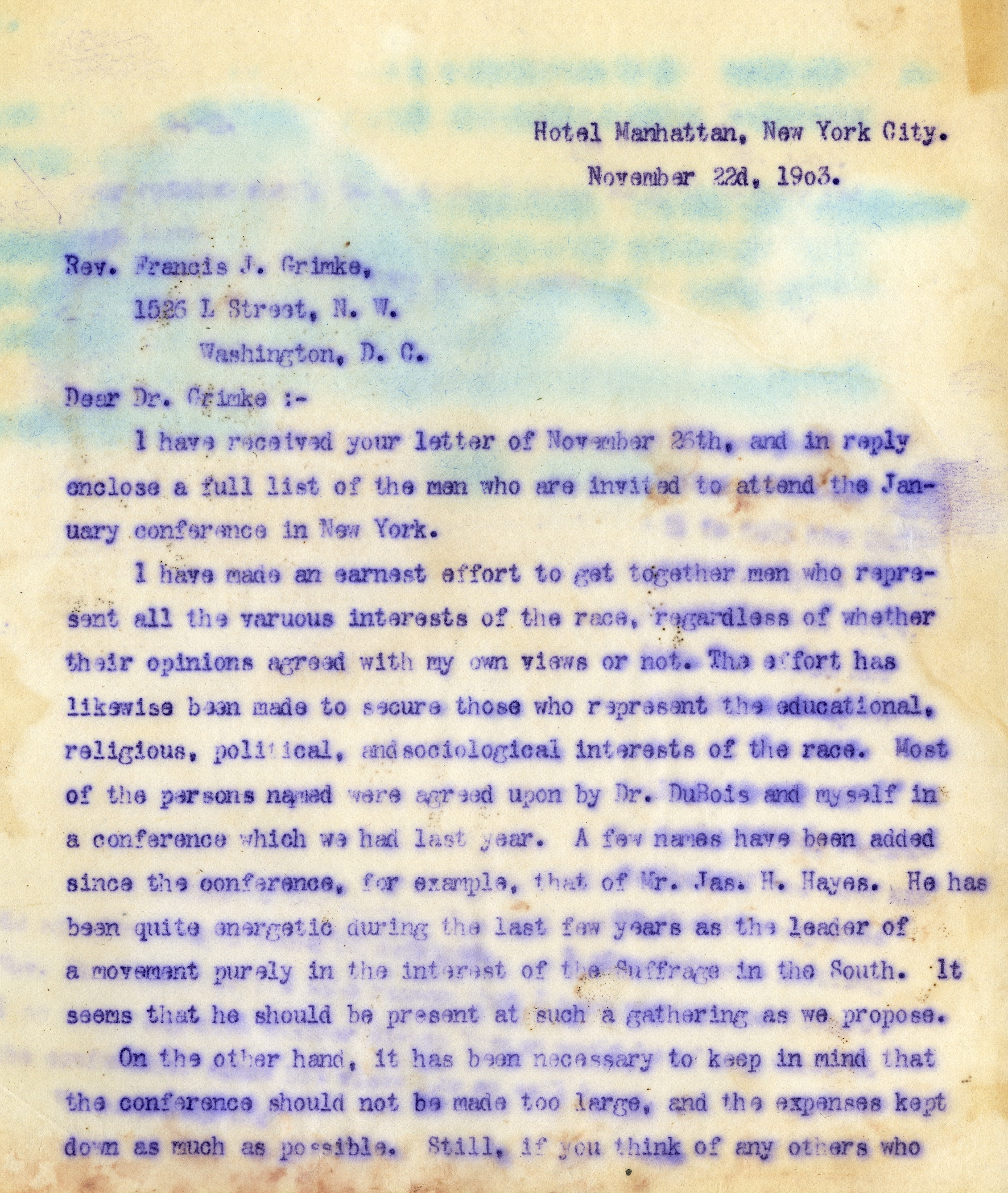
In 1904, Booker T. Washington, with assistance from W.E.B. DuBois, gathered leading black men in New York City to discuss the dire conditions facing African Americans. Washington explains his idea for the conference and the importance of including a variety of opinions in this 1903 letter to activist and Presbyterian minister, Francis Grimke. 

Post contributed by Karlyn Forner, John Hope Franklin Research Center Graduate Intern.

The African Americans: Rubenstein Recap #3

Each Tuesday, PBS is showing the next installment of a six-part series, The African Americans: Many Rivers to Cross. Written and narrated by Dr. Henry Louis Gates, Jr., the documentary traces African American history from the shores of West Africa to the election of Barack Obama. Join us each week as we feature documents from the John Hope Franklin Research Center that resonate with the previous week’s episode.

Episode 3: Into the Fire (1861 – 1896) traced the tumultuous journeys of African Americans from slavery to freedom in the second half of the nineteenth century. The Civil War opened as a battle to preserve the Union, but as enslaved men and women flocked to Union lines searching for freedom, their actions transformed the war into one for emancipation.

Kate Foster, a white woman from Adams County, Mississippi, kept a diary during the Civil War. In this entry from July 16th, 1863, she writes about the slaves who abandoned their masters in pursuit of freedom with the union army.

AAMR 3 FosterKate003blog
“The negroes are flocking to the enemy in town and the Yanks are cussing them and saying they wished they had never seen a negro. They are an ungrateful set and we are all tired of them.” (Kate D. Foster Diary)

At the conclusion of the war, freed black men and women set out to build new lives learning to read, buying land, building institutions, and raising families.

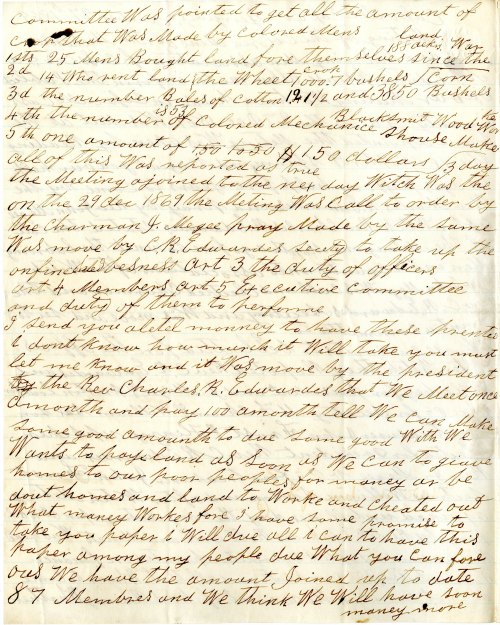
In this 1869 letter, African American minister Charles R. Edwardes introduces the Colored Men of the Mechanics and Laboring Men Association to John Emory Bryant, editor of radical Republican newspaper in Georgia. Rev. Edwardes explains how the organization wanted to help freed people buy land and homes.

John Emory Bryant Papers

After the 15th Amendment guaranteed black citizens’ right to vote, they used the ballot to elect African American city councilmen, state legislators, and congressmen to office. But white southern Democrats swiftly retaliated against these challenges through lynch mobs and violence at the ballot box, eroding African Americans’ newfound citizenship.

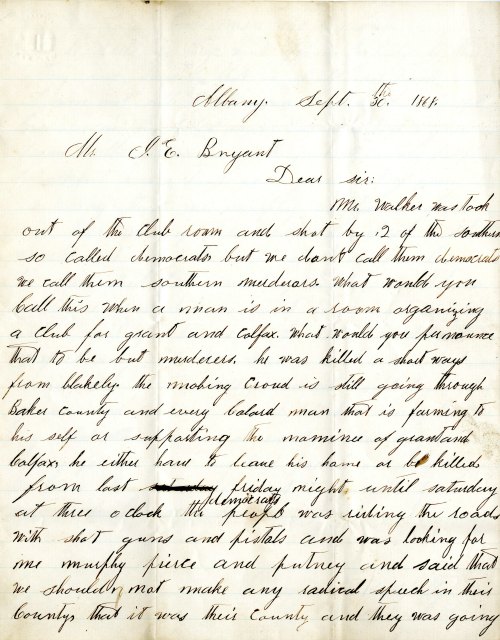
Mr. P. Joiner writes to Editor John Bryant in 1868 reporting the shooting of a black man by white democrats near Albany, Georgia. The white mob then continued on a rampage through the countryside, warning African Americans that it was “their country and they was going to rule it.” (John Emory Bryant Papers)

Mr. P. Joiner writes to Editor John Bryant in 1868 reporting the shooting of a black man by white democrats near Albany, Georgia. The white mob then continued on a rampage through the countryside, warning African Americans that it was “their country and they was going to rule it.” (John Emory Bryant Papers)
John Emory Bryant Papers

The 1890s brought a wave of state constitutional conventions across the South, aimed at systematically disfranchising black residents. These actions were buttressed by the Supreme Court’s Plessy v. Ferguson 1896 decision, supporting the principal of a separate but equal society and paving the way for legal racial segregation. As the twentieth century dawned, the full citizenship black Americans had so briefly experienced seemed like a distant hope.

Charles Hunter was born a slave in Raleigh in 1851 and spent his life pushing for the advancement of African Americans. In 1889, Hunter writes to the Postmaster General in Washington, D.C., protesting the white Raleigh postmaster’s refusal to appoint Hunter due to his race.

Charles N. Hunter Papers

Post contributed by Karlyn Forner, John Hope Franklin Research Center Graduate Student Intern and John Gartrell, John Hope Franklin Research Center Director.