Working in an archive, you can come across a lot of exciting material and constantly learn something new. When the Rubenstein recently augmented its collection of World War II propaganda leaflets, we took the occasion to reorganize the whole collection. The collection now contains about 270 leaflets as well as some examples of propaganda magazines (most of the non-English documents include English translations). The material was disseminated between 1941 and 1945 with the aim of damaging enemy morale and sustaining the morale of the occupied countries. The collection includes examples of German and Japanese propaganda, aimed at Allied soldiers. Included also are German-language leaflets that were dropped over Germany by a clandestine British intelligence body—the Political Warfare Executive (PWE)—, as well as French-language leaflets, prepared by the French exile government in London and dropped over Vichy France (calling on the French population to not collaborate with the German occupiers or the Vichy regime).
Leaflet with text in Tok Pisi
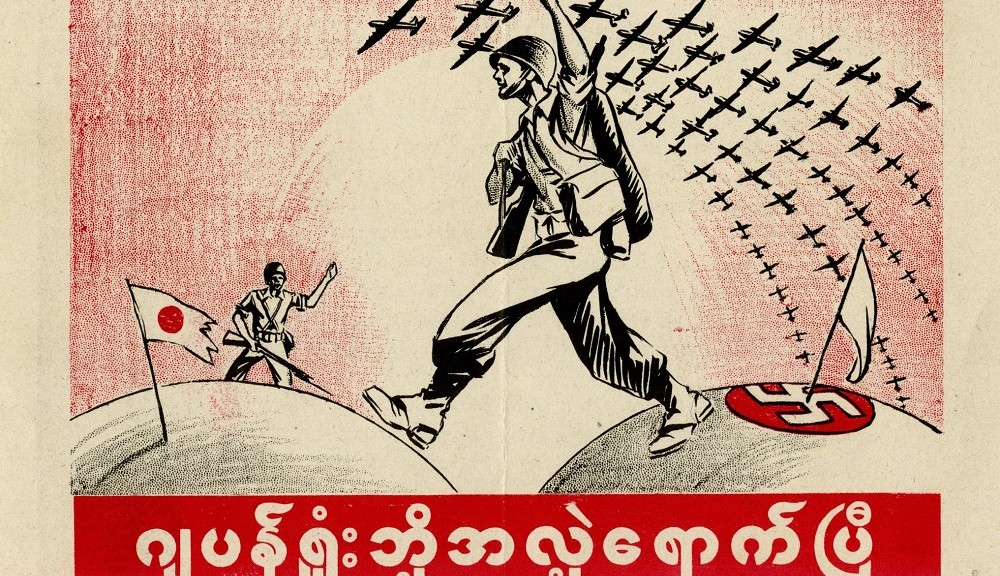
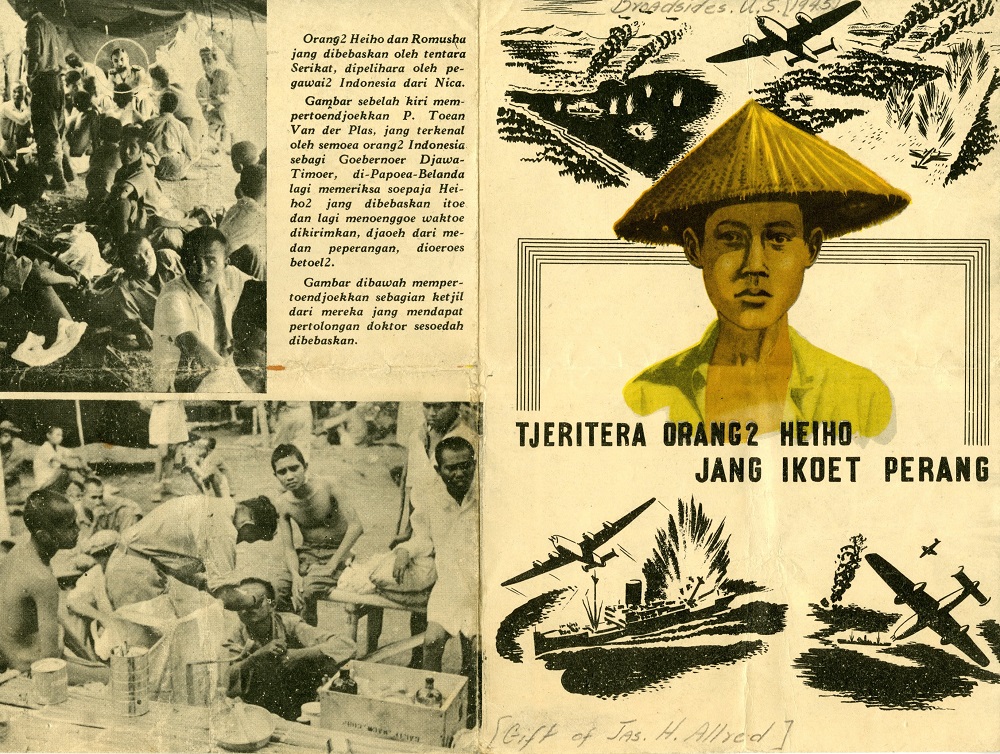
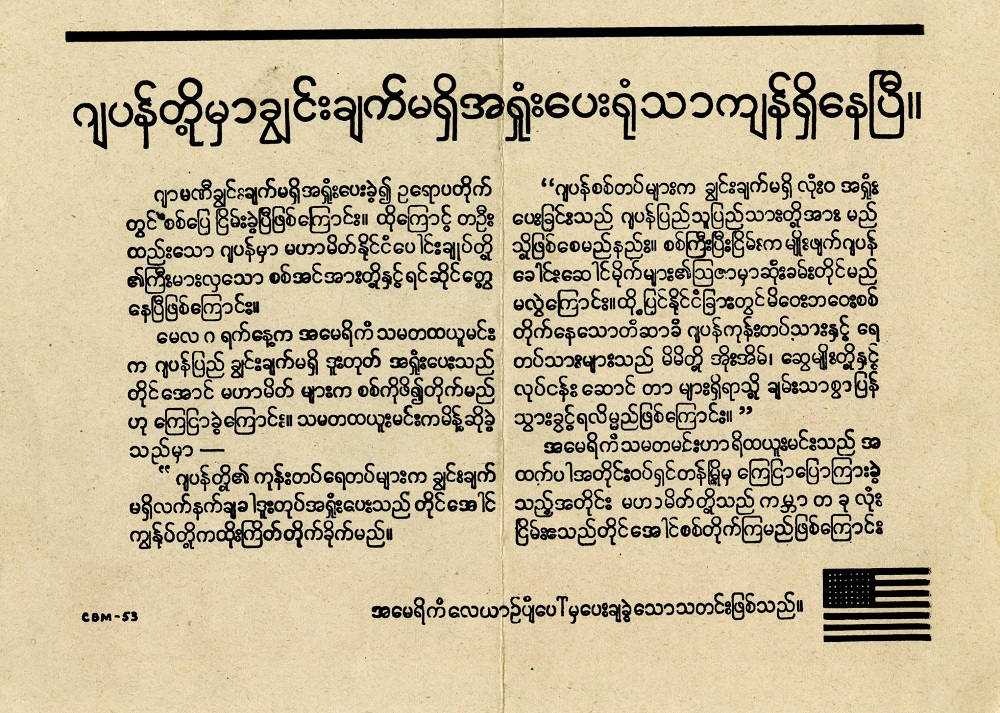
A large portion of the leaflets were aimed at the Pacific area and dropped by the Psychological Warfare Branch of the U.S. Army Forces. Most of them area are in Japanese. Some of them, however, are written in less well-known languages like Tok Pisin and Burmese. A creole language spoken throughout Papa New Guinea, Tok Pisin is commonly known in English as New Guinean Pidgin or Melanesian Pidgin. By trying to identify the languages of the leaflets, I learned that the New Guinea Campaign from 1942 to 1945 was one of the major military campaigns in the Pacific War and that leaflets in Tok Pisin—the most widely spoken language in New Guinea—were dropped by the Allies in order to encourage the population not to collaborate with the enemy. Likewise, material in Burmese was dropped over Burma (since 1989 Myanmar) in 1944 and 1945 during the Burma Campaign—the Allies’s fight against the Empire of Japan, which was supported to some degree by Thailand, the Burmese Independent Army, and the Indian National Army.
Leaflet in Burmese dropped during the Burma Campaign, 1944-1945
Leaflet in Burmese (back)
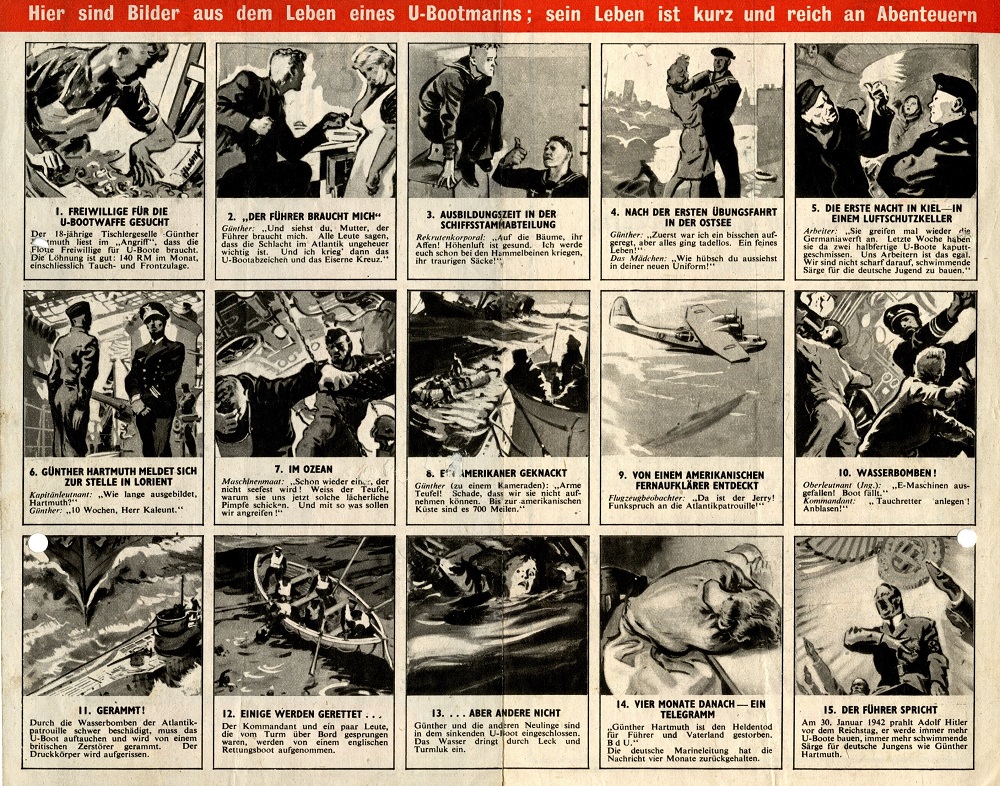
Finally, one might discover personal connections and be reminded of very familiar places, even when far from home. I am from Kiel, the capital of the state of Schleswig-Holstein in northern Germany. I spent many vacations and weekends in Laboe, a little town at the coast of the Baltic Sea, right at the outskirts of Kiel. Kiel/Laboe was one of the main naval bases and is the location of the Laboe Naval Memorial, a memorial for the deaf of World War I built from 1927 to 1936. As such, it was a natural target for propaganda against the German marine like the leaflet found in our collection shows. Imagine my surprise to see a leaflet showing such a familiar sight while processing! The naval memorial still stands today and attracts many tourists (https://en.wikipedia.org/wiki/Laboe_Naval_Memorial).
Leaflet depicting Laboe Naval Memorial (front)Leaflet depicting Laboe Naval Memorial (back)
On November 28, 1980, the Duvalier regime unleashed a campaign of violent repression on the independent press and human rights activists, destroying the Radio Haiti station on Rue du Quai in downtown Port-au-Prince. The crackdown was not unexpected: in October of that year, Jean-Claude Duvalier had decreed on the National Radio station that only state media would be permitted, that “the party is over” (“le bal est terminé”) for independent Haitian media. In response, Jean Dominique composed his prophetic (and beloved) editorial Bon appétit, messieurs, in which he sardonically declares, “gentlemen, journalists of the official press — the country is yours and yours alone from now on. And all will be beautiful, all will be peaceful, all will be idyllic, all will be pink and wonderful!” and warns these “official journalists” of what will befall Haiti when the independent press is silenced. Ronald Reagan’s triumph in the US presidential election that November meant decreased international pressure on Duvalier’s government – which was largely dependent on US aid – to respect human rights. And so, on November 28, the inevitable crackdown occurred. More than a dozen of Radio Haiti’s journalists were imprisoned, tortured, and expelled. The regime issued an order to kill Jean Dominique on sight; he escaped to the Venezuelan embassy and later went into exile with Michèle Montas in New York. In the years that followed, resistance to the regime spread throughout the country, as economic conditions worsened for the majority of Haitian citizens while the Duvalier family’s lifestyle grew more ostentatious, lavish and dissipated.
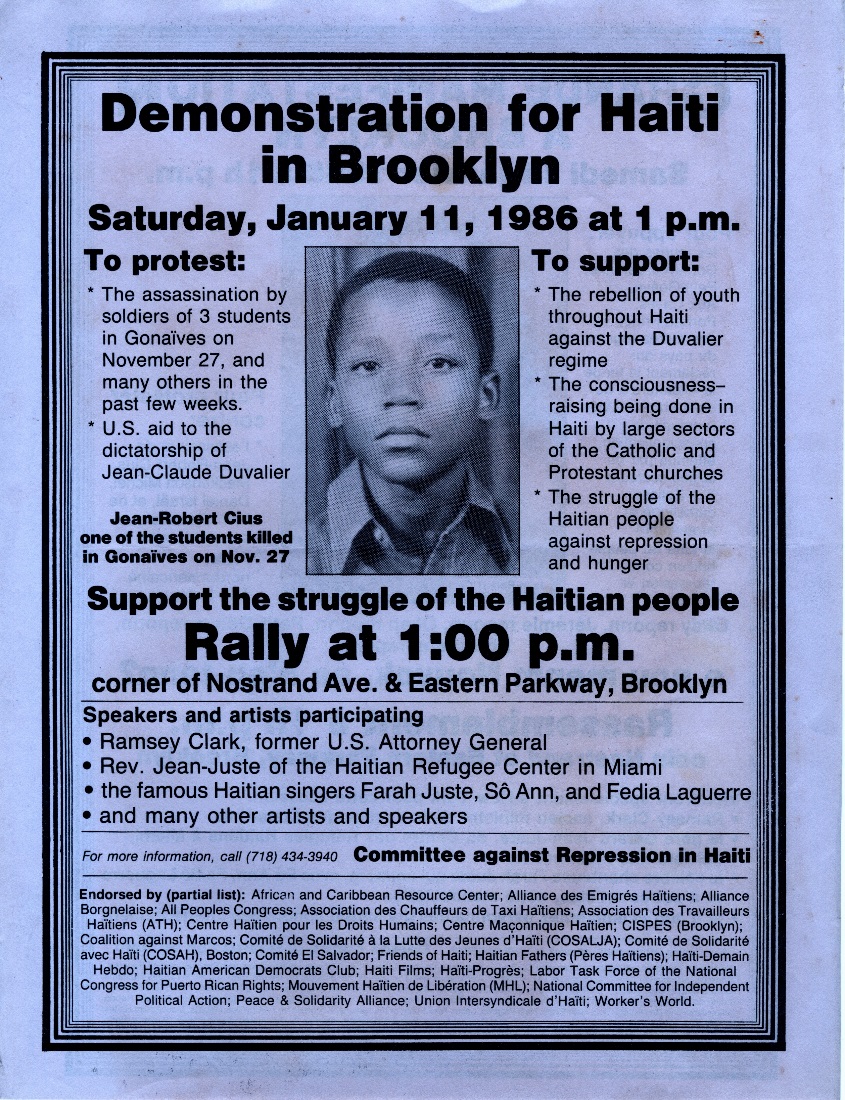
On November 28, 1985, five years to the day after the 1980 crackdown on the independent media, protests broke out in Haiti’s third-largest city, Gonaïves. Three high school students — Jean-Robert Cius, Mackenson Michel, and Daniel Israël – were gunned down by Duvalier’s forces. In photos, they are heartbreakingly young – boys, not yet men. The teenaged martyrs were christened the “Twa Flè Lespwa” (Three Flowers of Hope), and their deaths catalyzed outrage and resistance to the regime, both within Haiti and in Haitian communities abroad.
Flier for Brooklyn protest against Duvalier and the killing of the Twa Flè Lespwa. Radio Haiti Archive.
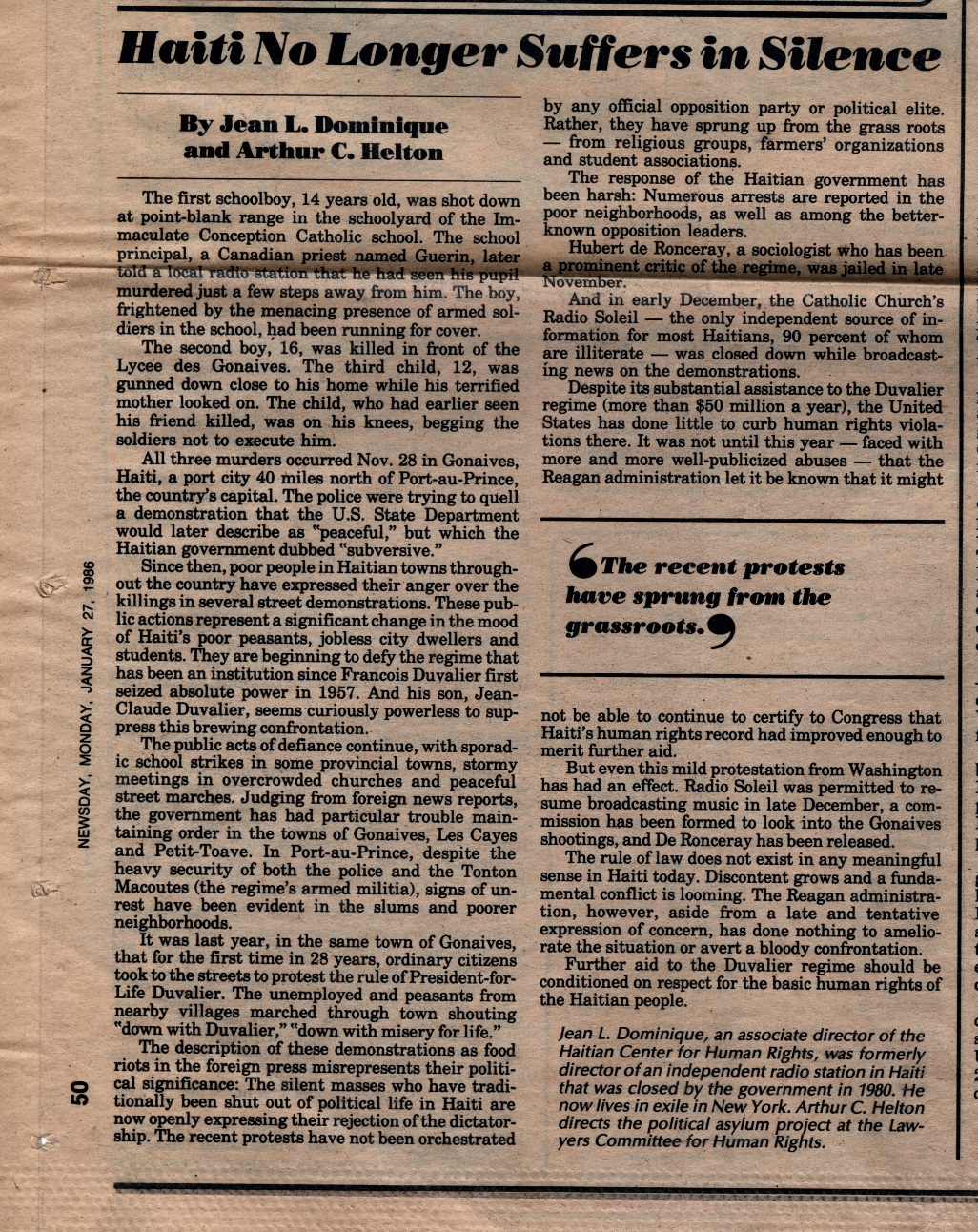
In January 1986, Jean Dominique co-authored a short op ed in Newsday with lawyer and human rights advocate Arthur Helton, discussing the deaths of the Twa Flè Lespwa, the grassroots agitation provoked by their murders, and the United States’ complicity in supporting the Duvalier regime.
“Haiti No Longer Suffers in Silence” by Jean L. Dominique and Arthur C. Helton. Newsday, January 27, 1986. Radio Haiti Archive.
They warn, perhaps cautiously: “Discontent grows and a fundamental conflict is looming.” The conflict was indeed looming, but it was not yet clear how imminent it might be.
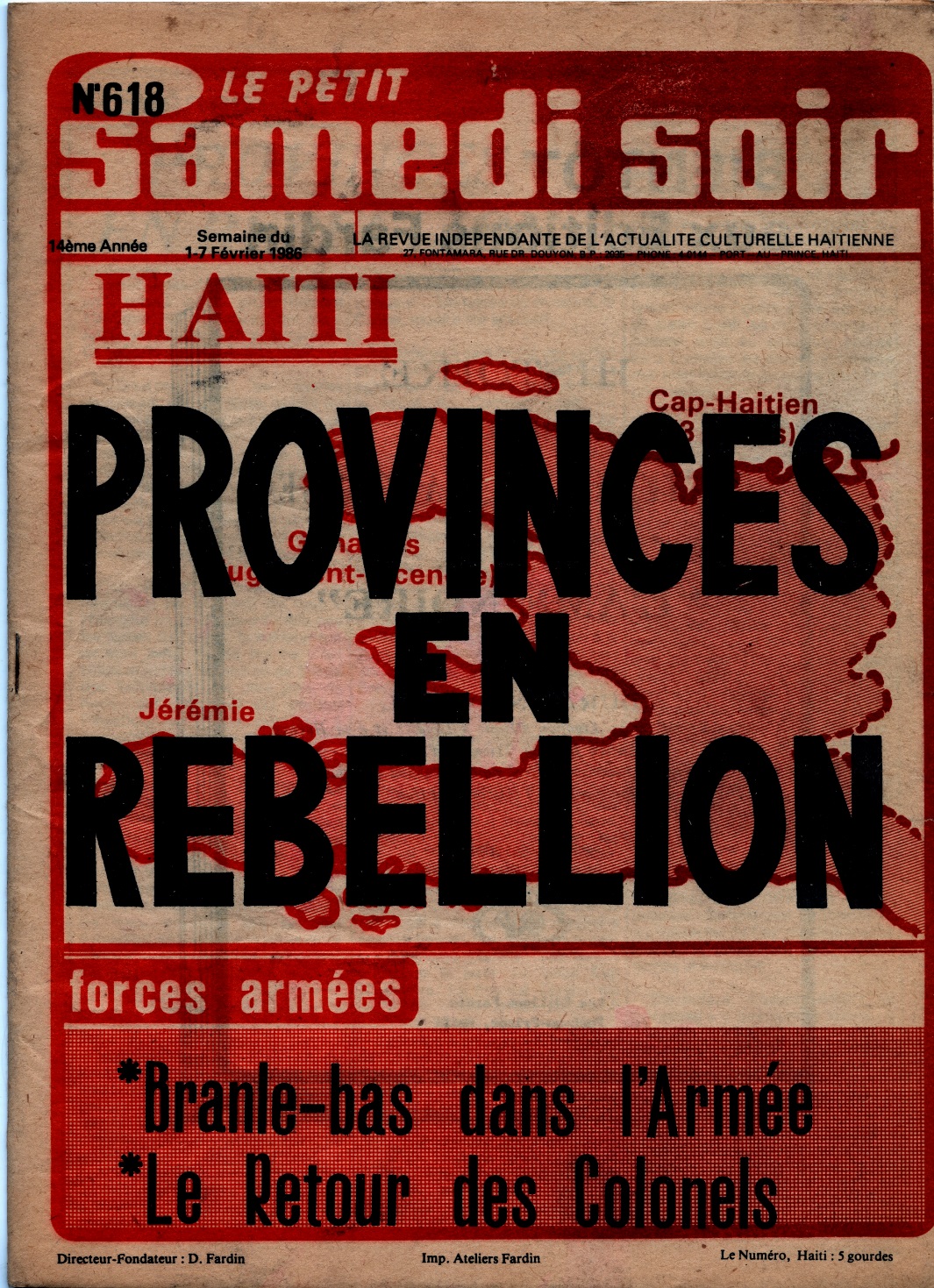
Le Petit Samedi Soir, Haitian independent magazine, for February 1-7, 1986. Radio Haiti Archive.
But on February 7, 1986, just over a week after Jean Dominique’s and Arthur Helton’s editorial was published, it happened: Jean-Claude Duvalier and his family boarded a US Air Force cargo plane and fled to France. On March 4, Jean Dominique and Michèle Montas returned to Port-au-Prince, where many thousands of people – “une masse en délire,” a delirious crowd, according to the Haitian newspaper Le Nouvelliste – received them at the airport and nearly carried them to the old Radio Haiti station on Rue du Quai.
Photocopy of Nouvelliste story on return of Jean Dominique and Michèle Montas to Haiti. March 5, 1986. Radio Haiti Archive.
The station had been ravaged, their equipment smashed. But the recordings, miraculously, had survived. J.J. Dominique – Jean’s eldest daughter, who became the station manager after 1986 — explains: “We always said, ‘The Macoutes, they may destroy, but they don’t know the true value of so many things’… They didn’t think, they didn’t understand that the most valuable thing at the station was the work contained in the station’s archive.”
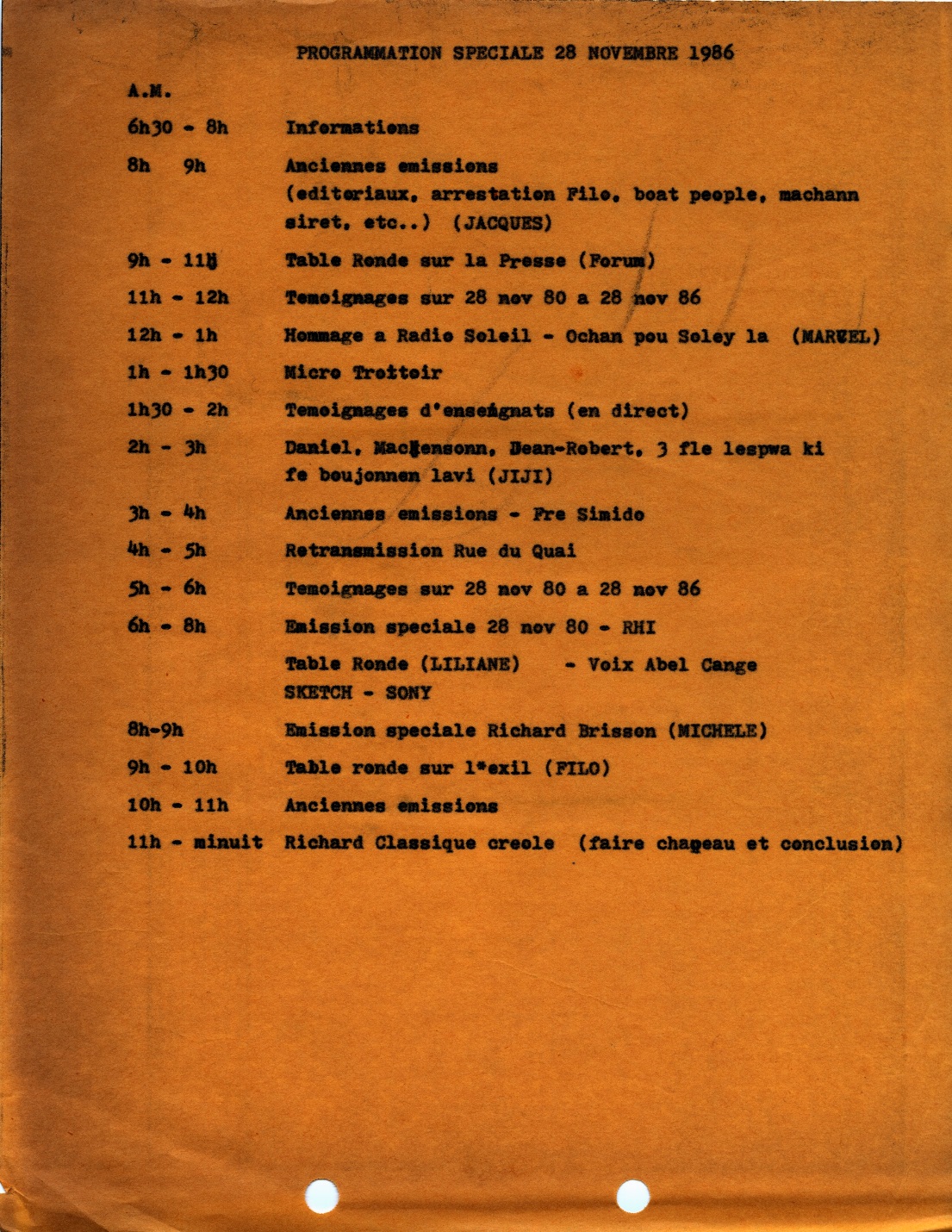
With assistance from the Haitian people – many of whom, though very poor, gave what little money they could afford — the station reopened in 1986. On November 28 of that year, Radio Haiti held a day-long commemoration of November 28, 1980 and November 28, 1985. It included tributes to the Twa Flè Lespwa and to station manager Richard Brisson who had been killed in 1982.
Radio Haiti’s November 28, 1986 special programming. Radio Haiti Archive.
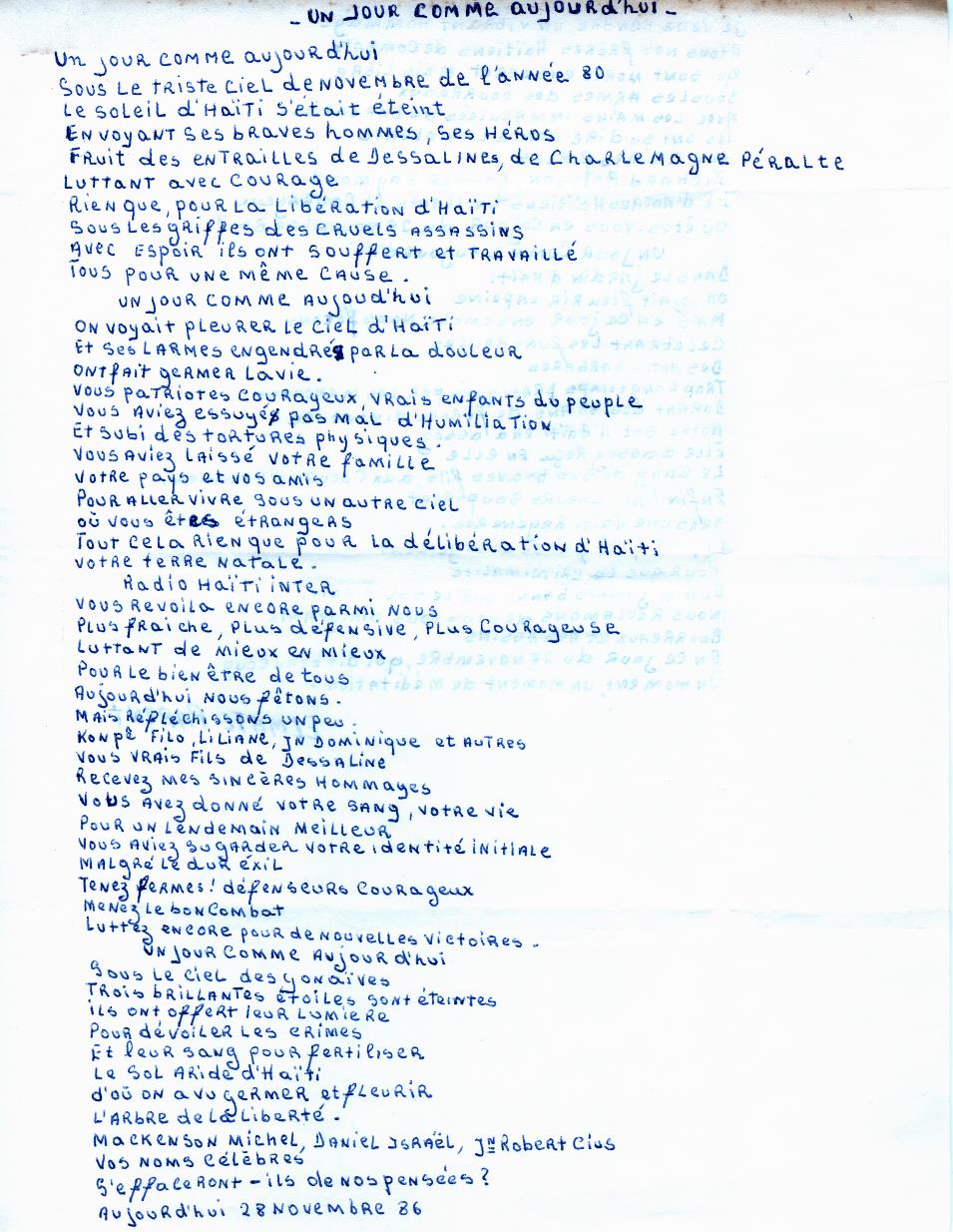
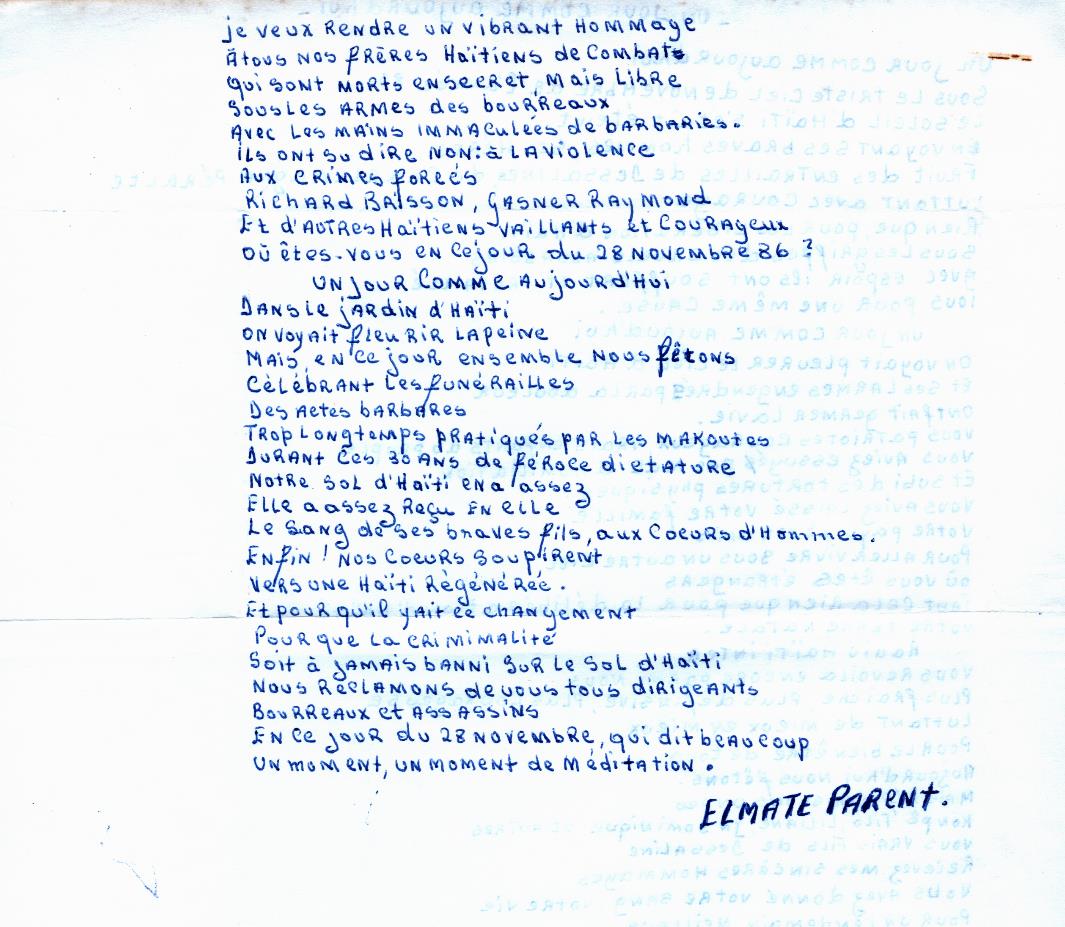
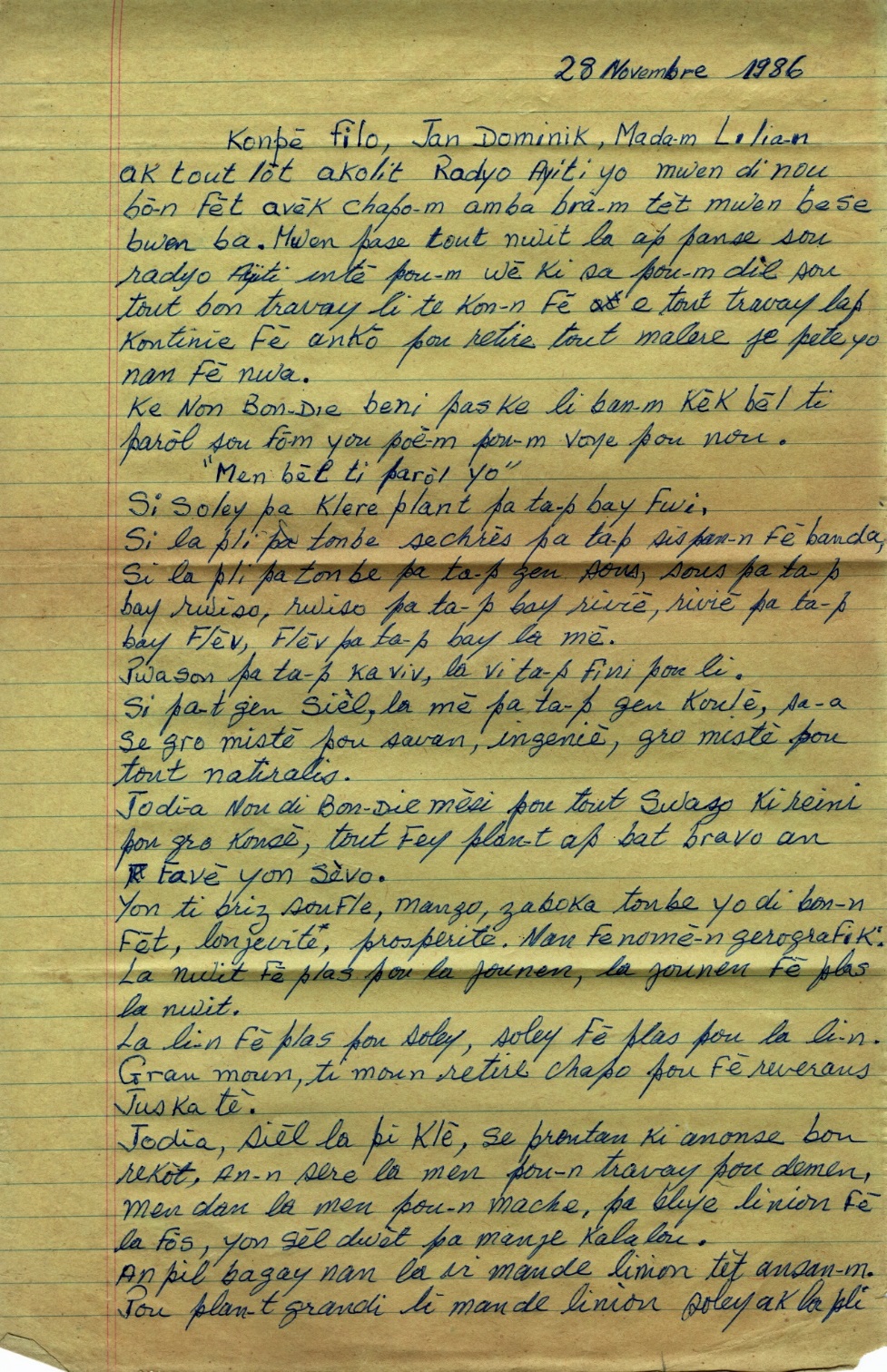
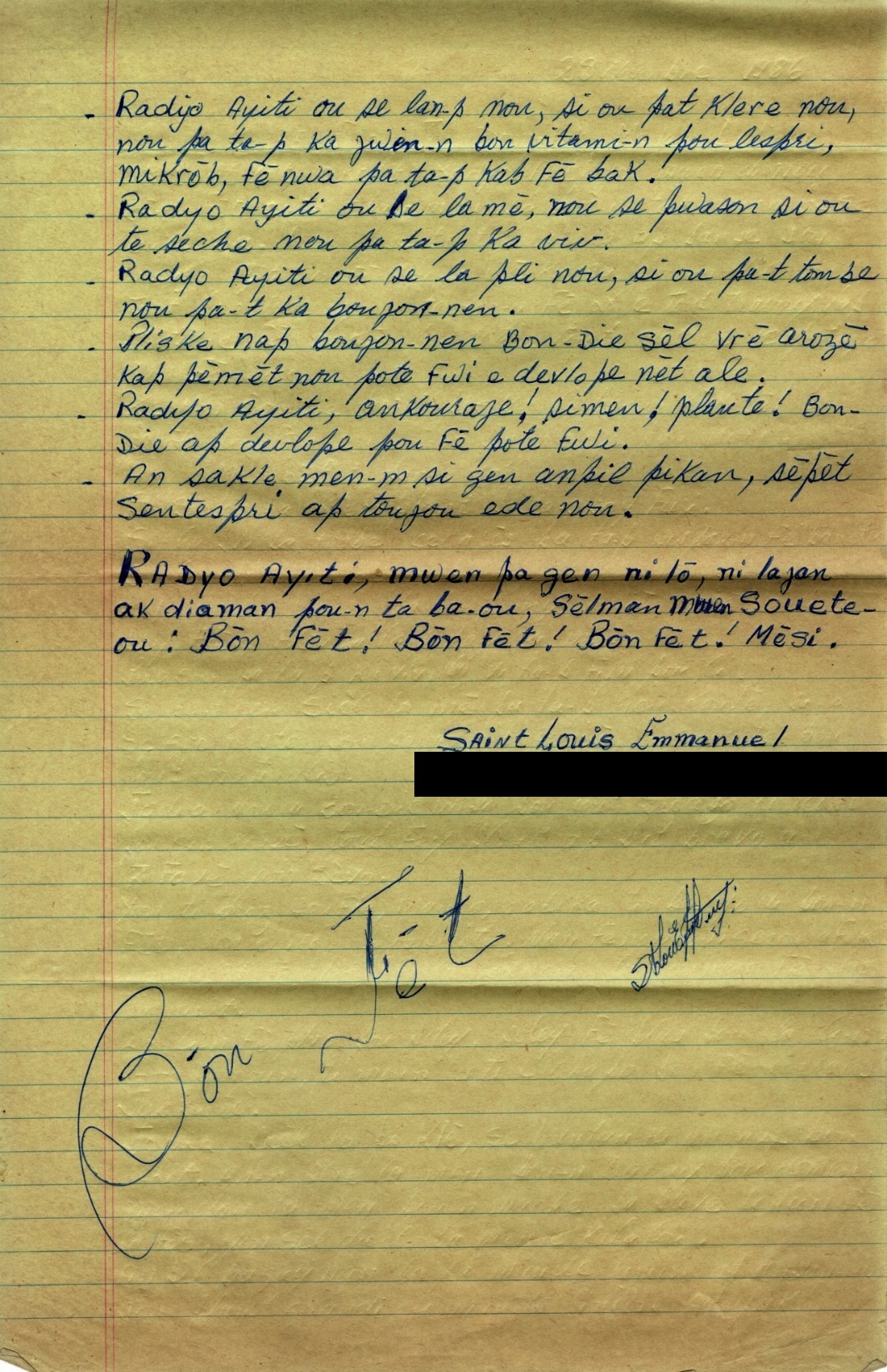
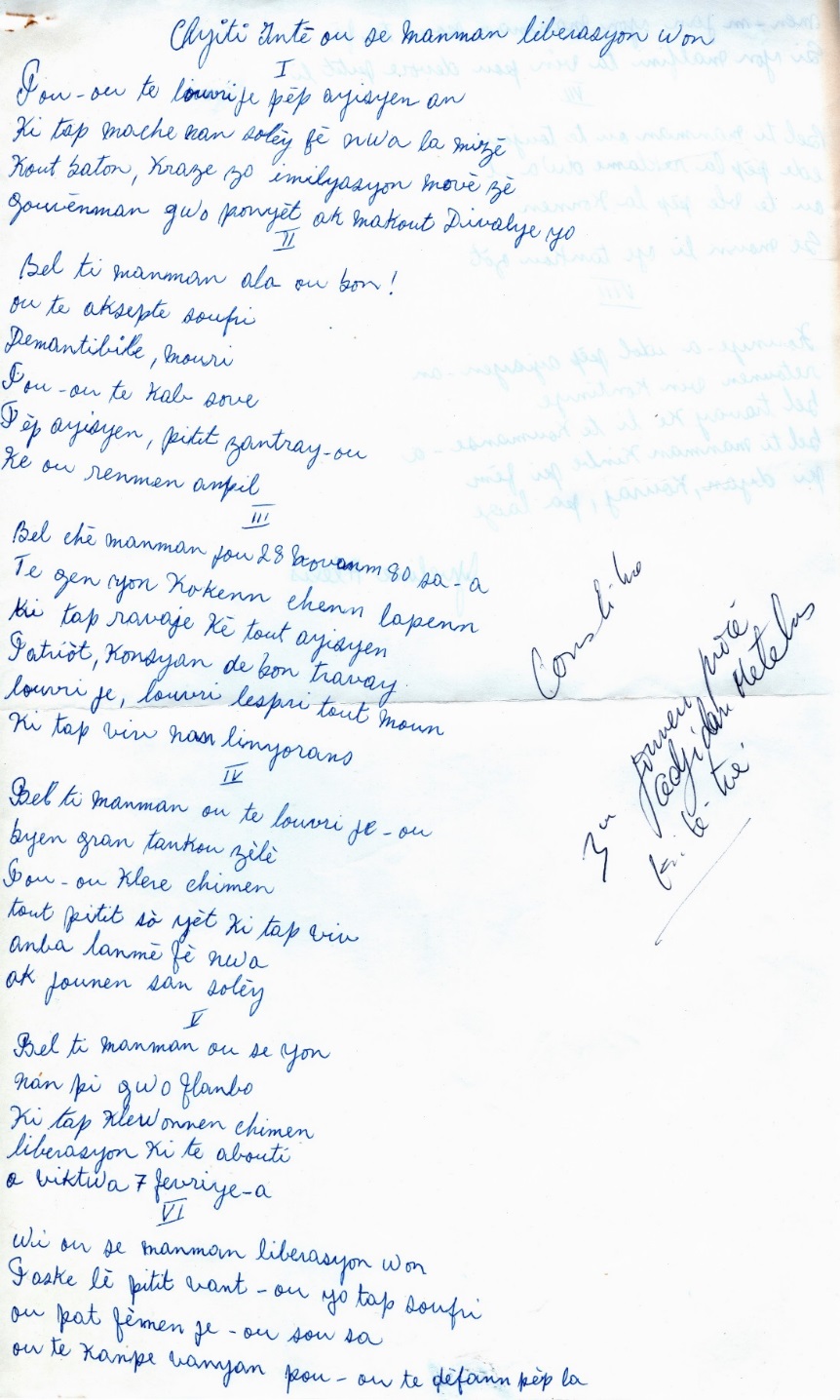
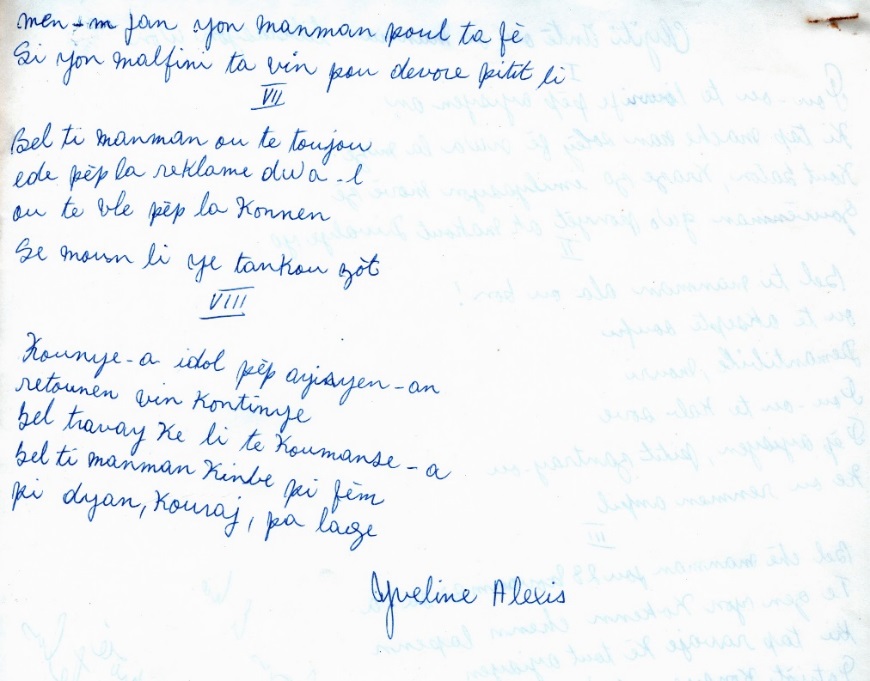
The archive also contains many pages of poetry written by Radio Haiti’s listeners, in Haitian Creole and French, on the Twa Flè Lespwa, the reopening of the station and the return of the journalists. The heartfelt, earnest intensity of these poems (these love letters, really) evinces the public’s devotion to Radio Haiti. For Radio Haiti’s listeners, the station was more than a station; it was a symbol of liberty, grassroots democracy, and freedom of expression. For Radio Haiti’s listeners, the journalists were more than journalists; they were heirs to the revolutionary legacy of Haitian heroes who had fought against French colonizers and US occupiers. For me, as the project archivist, finding these poems is a reminder of how irreplaceable and beloved Radio Haiti was and still remains, and how important this archive is.
Un Jour Comme Aujourd’hui” by Elmate Parent. Radio Haiti Archive.
A day like today
Under the sorrowful sky of November 28 in the year ‘80
Haiti’s sun went out
Sending these brave men, these heroes,
Fruit of the body of Dessalines, of Charlemagne Péralte
Fighting with courage,
For nothing more than the liberation of Haiti,
Upon the claws of assassins cruel
With hope they suffered and toiled
All for the same cause.
A day like today
The skies of Haiti wept,
And her tears, borne of pain,
Allowed life to germinate.
You, brave patriots, true offspring of the people,
You have suffered such humiliation
And endured physical torture.
You left your families
Your country and your friends
To go and live under another sky
Where you were strangers
All of this for nothing more than the deliberation of Haiti
Your native land…
A day like today
In the heavens over Gonaïves,
Three brilliant stars burned out
They gave their light
To reveal crimes
And their blood to fertilize
The arid soil of Haiti
Whereupon shall sprout and grow
The tree of freedom.
Mackenson Michel, Daniel Israël, Jean Robert Cius
Will your famous names,
Be erased from our thoughts?
Today, 28 November ’86…
“Men bèl ti paròl yo” by Emmanuel St. Louis. Radio Haiti Archive.
“Men bèl ti paròl yo” (“Some lovely little words”) draws on metaphors of nature and harvest befitting Jean Dominique, a man who was, after all, an agronomist before he was a journalist and activist. The poet touchingly explains that he “spent all night thinking about Radio Haïti-Inter” before setting pen to paper.
If the sun didn’t shine, plants would not give fruit
If the rain didn’t fall, drought would never stop dancing,
If the rain didn’t fall, there would be no springs
Springs would not give rise to rivulets
Rivulets would not become streams
Streams would not become rivers,
Rivers would not become the sea…
Radio Haiti, you are the sea, we are the fish
If you were to dry up, we could not live.
Radio Haiti, you are our rain,
If you didn’t fall, we could not bloom…
Radio Haiti, be encouraged! Sow! Plant!
God will bring it to fruition.
Let us weed, even if the thorns are many,
The pruning shears of the Holy Spirit will aid us always.
“Ayiti Intè ou se manman liberasyon won” by Gueline Alexis. Radio Haiti Archive.
From “Haiti-Inter, You are the Mother of Liberation”:
Yes, you are the mother of liberation
Because when the children of your womb were suffering
You never closed your eyes to it
You stood bravely to defend the people
Just as a mother hen would do
If a vulture came to devour her children…
Now the idol of the Haitian people
Has returned to continue
The wonderful work it began
Beautiful mama, hold on tighter
Stronger – courage — never give up.
Post contributed by Laura Wagner, PhD, Radio Haiti Project Archivist.
The Voices of Change project was made possible through a generous grant from the National Endowment of the Humanities.
A manuscript (i.e. handwritten) cookbook can tell us a great deal about its creator. What foods were available to her? How would her family have celebrated holidays and birthdays? Was she an elite woman with a cook who could prepare elaborate dishes, or a farm wife who had to prepare simple, hearty fare and preserve her harvest to feed her family? Do the recipes reflect a particular ethnic or religious background or geographical location? As is the case today, routine meals do not require a recipe. It is the special occasion recipes, especially those that require careful measurements to work properly, that are recorded for future reference.
We know, based on the ingredients, that Rubenstein Library’s New England Manuscript Recipe Book, [ca. 1860]-[1900] comes from the northeastern United States. It is no surprise that the little book includes a page of maple recipes, since maple is such a distinctive regional product.
I was intrigued by the Maple Ice Cream Recipe, in part because I am the proud owner of a fancy electric ice cream maker, so much easier than the hand-crank models that would have been available when the recipe was recorded. There is also the nostalgia of tasting maple: Santa always left a maple sugar woman in my Christmas stocking.
This is an extremely simple recipe, with just three ingredients: eggs, maple syrup, and cream:
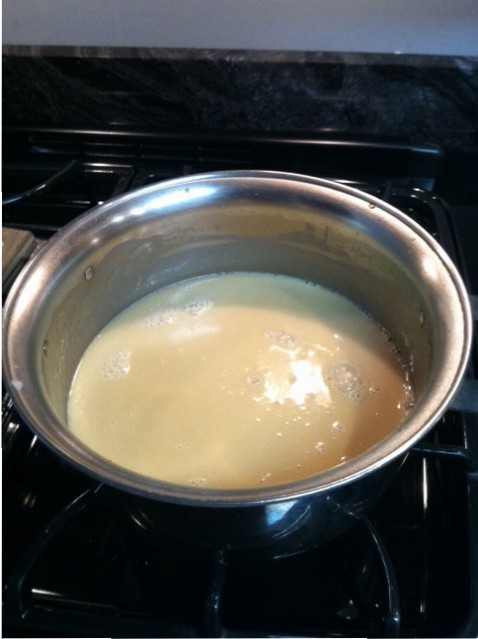
I made a couple of changes. Given concerns about salmonella, I was not comfortable leaving the egg whites uncooked. I was also worried that mixing the eggs and syrup and boiling the mixture would result in curdled eggs. Instead, I boiled the syrup for about ten minutes to reduce it slightly, thereby intensifying the flavor. In a separate bowl, I beat the whole eggs. Then I slowly dribbled in about a cup of hot syrup, whisking the egg mixture constantly before whisking the egg mixture into the pot of hot syrup. Then I brought the mixture to 170 degrees, turned off the heat, and stirred in the cream.
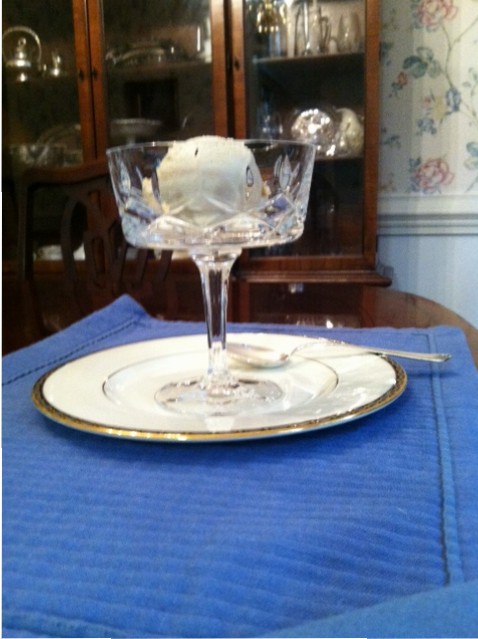
Finally, I strained the mixture through a sieve to remove any solids and chilled it overnight before freezing, emptying into a plastic container, and leaving it in the freezer for a few hours to firm it up. The result: an absolutely luscious and elegant frozen dessert.
How did it taste? I brought in the whole container to share with my Rubenstein colleagues and it got rave reviews. It is very rich (note the quart of heavy cream!), but delicious.
Intrigued by the annotations (1896, Mrs. Kimber Thomas, Ladies Uplift Club), I did some searching and found a Morrisville, Vermont Uplift Club in The Register of Women’s Clubs (1922). I wondered whether Mrs. Kimber Thomas was given the recipe for Maple Ice Cream in 1896 and contributed it to an Uplift Club fund-raising cookbook and was thrilled to find a reference to this 53-page cookbook: Tried and Proven Recipes from Many Households. Morristown, Vt. : Ladies of the Uplift Club. The one known copy is in the Janice Bluestein Longone Culinary Archive at the University of Michigan in Ann Arbor. Staff have dated it to 1921, based on advertisements printed in the cookbook. As I write this, I am waiting for scans that I hope will confirm my hunches about the Maple Ice Cream recipe’s provenance. The tradition of noting the source and date of a recipe is a lovely way to link culinary creations to a vast network of friends, family, community, and history. The additional information would also allow us to more precisely identify the origins of this precious little cookbook.
Post contributed by Elizabeth Dunn, Research Services Librarian
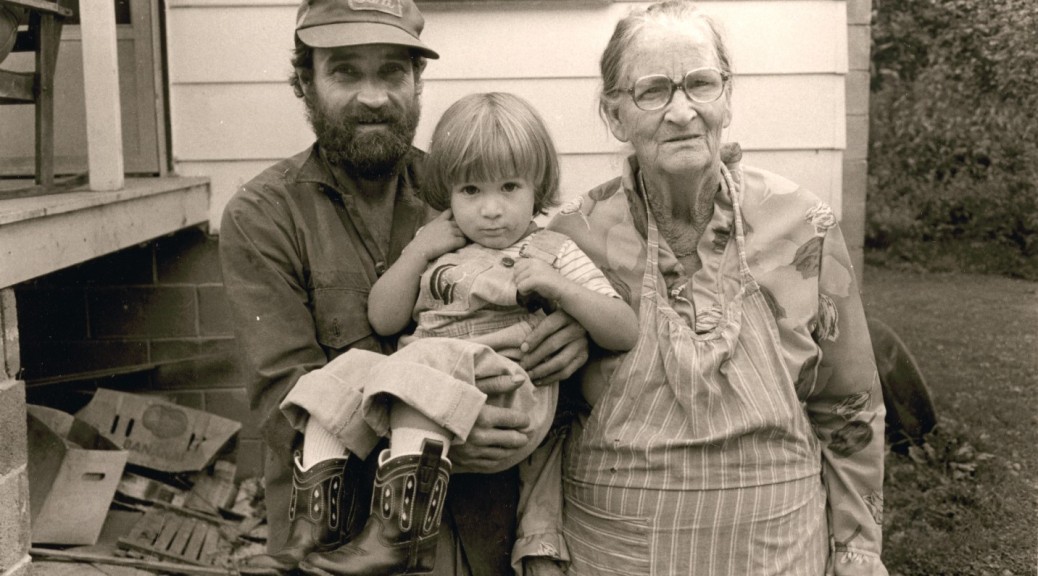
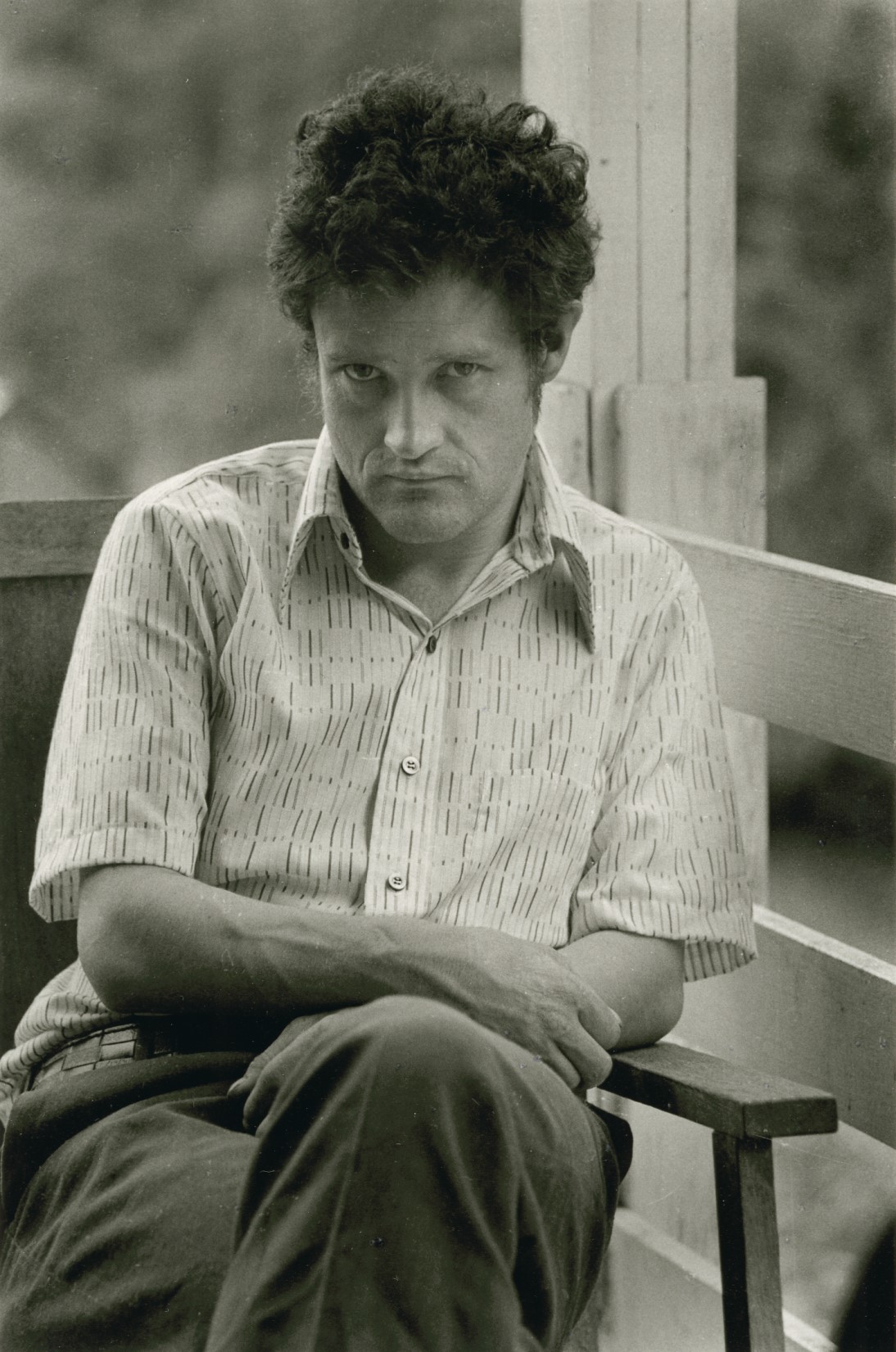
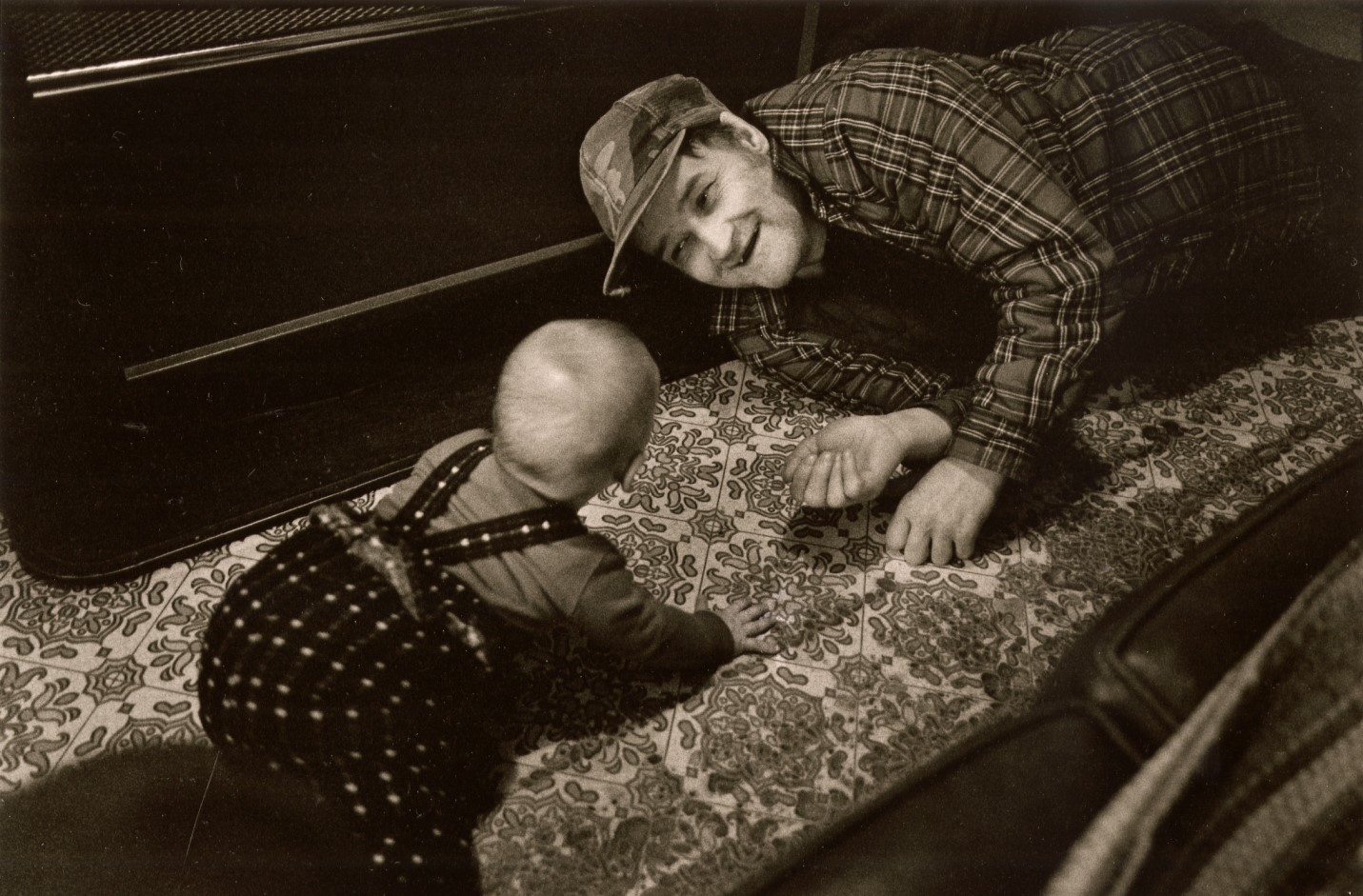
Joyce Chandler, Joe Ross Chandler’s wife, 1976.* Copyright, Rob Amberg
Rob Amberg journeyed to the Appalachian mountains of North Carolina during the height of the back-to-land movement. It was a time when hippies and artists took John Prine’s advice and “blew up [their] TVs, threw away [their] papers, went to the country, and built [them] a house.” All kinds of folks retreated to the mountains back then, and Amberg arrived in 1973 with the suspicious title of documentary photographer.
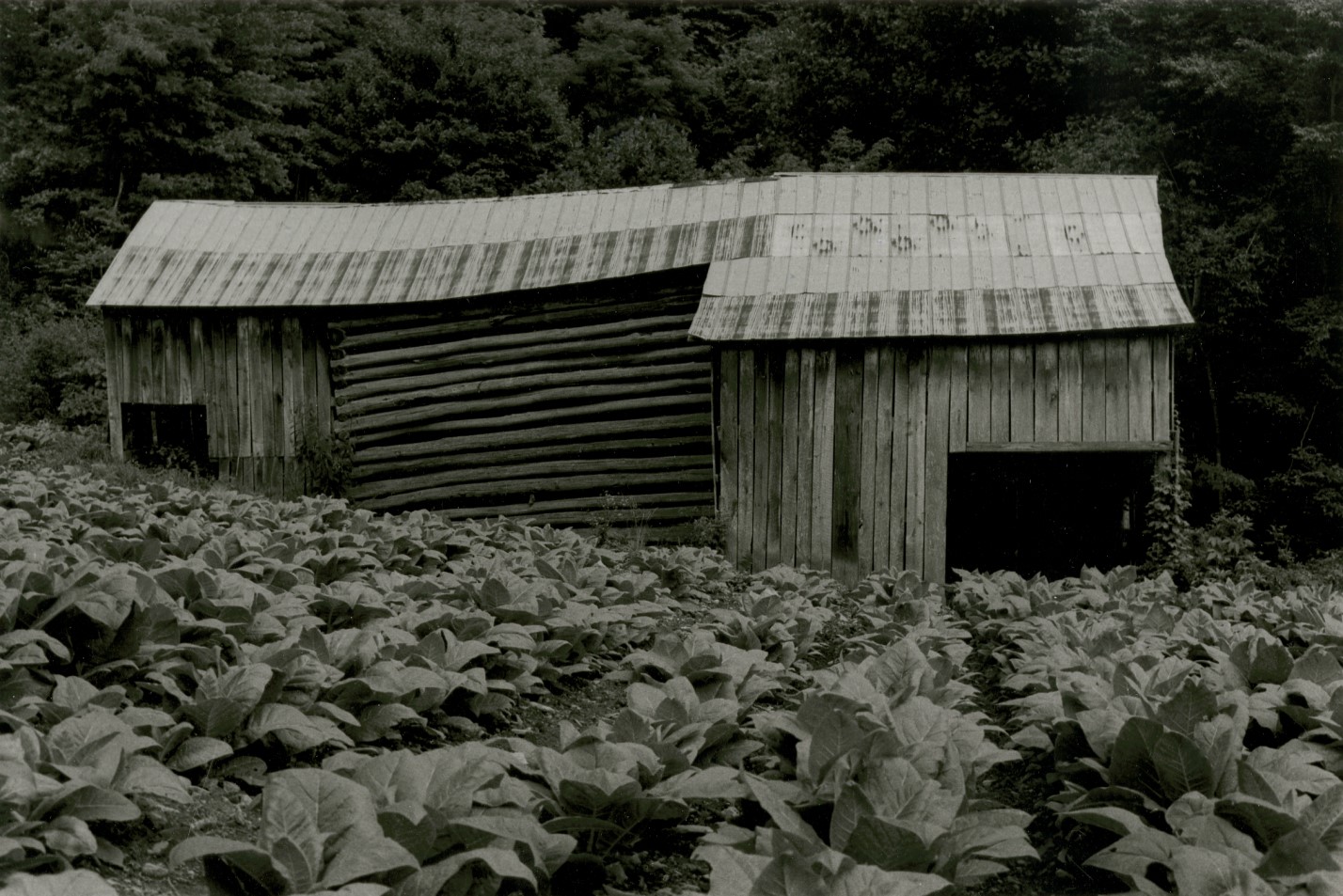
Tillman Chandler’s barn and tobacco crop, 1975. Copyright, Rob Amberg
I say suspicious because Appalachia has been a favorite testing ground for ambitious artists for more than a century. These artists, documentarians, and musicologists act as arbiters and preservationists for what they view as culturally interesting and valuable, and Madison County in particular, where Amberg found himself and where I grew up, is not always portrayed in a nuanced light.
Joe Ross Chandler and Bobby Cantrell, 1977. Copyright, Rob Amberg.
It’s easy though for artists to fall into the trap of reproducing certain convenient and sometimes sensational tropes. My personal favorite is the proliferation of snake handler portraits. A recent comment on a Vice Magazine series called “Two Days in Appalachia,” a series that provoked much conversation and criticism, pointed out that “poverty porn” has been a long standing tradition of documentary artists creating work from the Appalachian region. So, yes, I think it’s fair to initially approach any stranger with a camera in the mountains with suspicion.
The first picture I made of Junior, 1975. Copyright, Rob Amberg
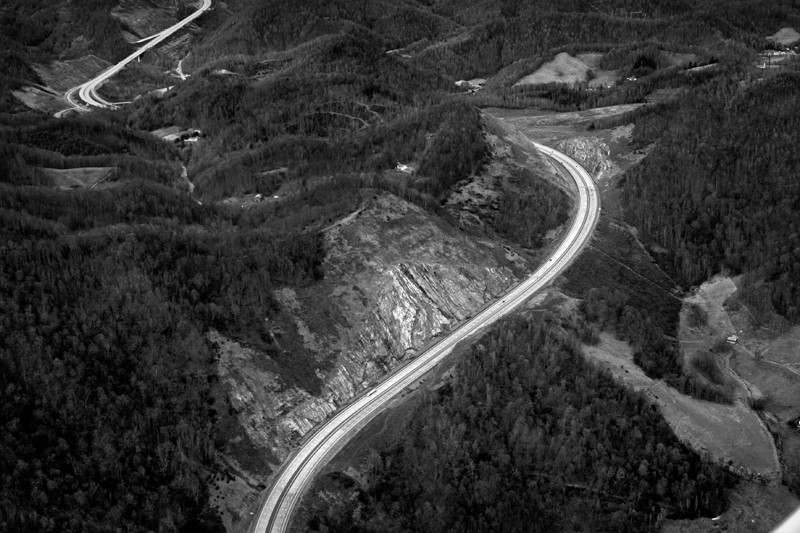
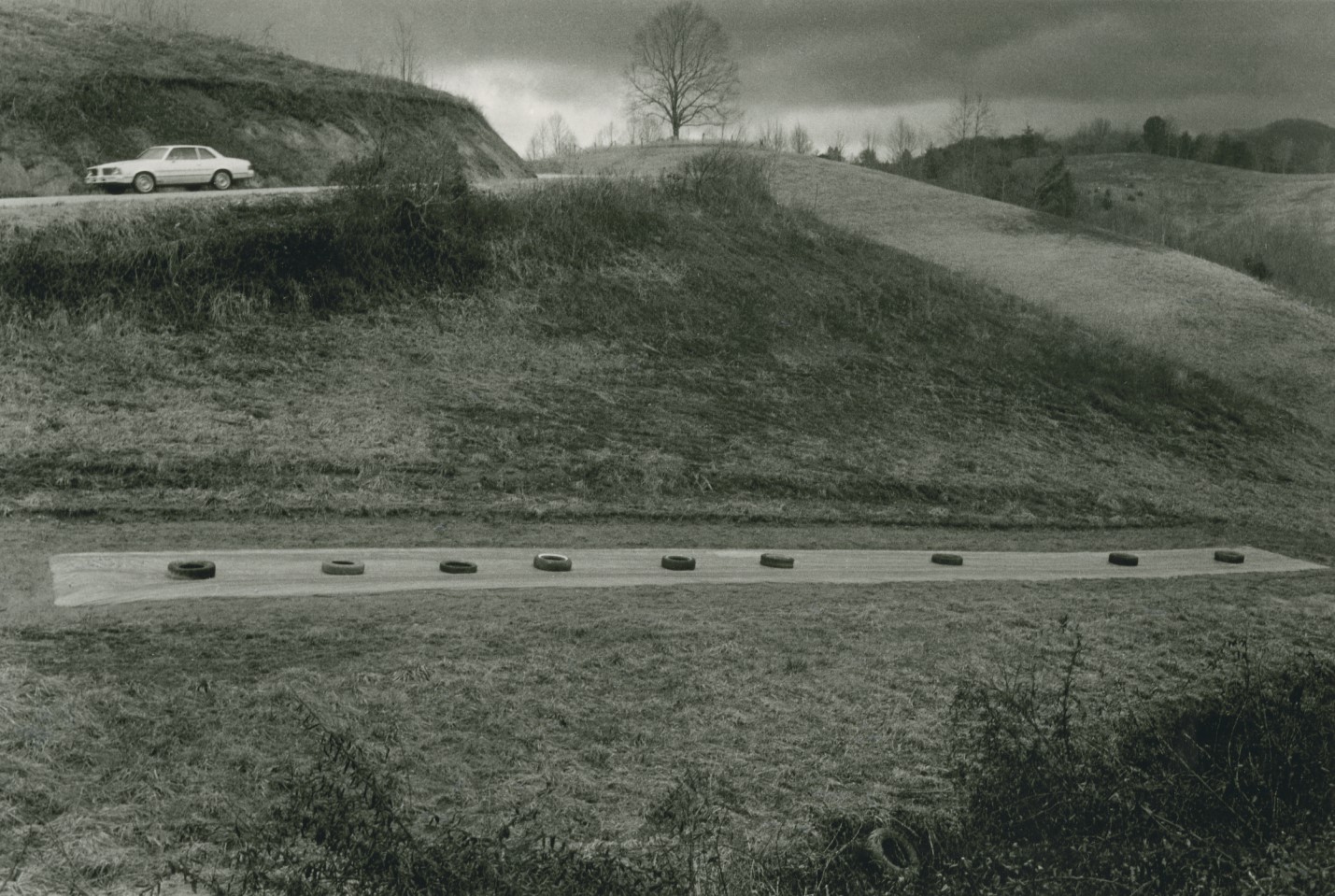
All of this is to say that Rob Amberg has created a complex, beautiful, and compassionate body of work. Of the many aspects of his work that I find remarkable, I will mention two here: first, when he moved to Madison County in 1973, he came to stay. His photographs, whether documenting the small community of Sodom Laurel, the expansion of I-26, or the continual influx of new people, follow long-term changes in the landscape, a landscape that he calls “ShatterZone.” Amberg defines ShatterZone this way:
Shatter zone is an 18th-century term that refers to an area of fissured or cracked rock that forms a network of veins that are often filled with mineral deposits. The phrase took on new meaning after World War II when anthropologists and political scientists began using it to speak of borderlands. In this modern definition shatter zones are places of refuge from, and resistance to, capitalist economies, state making, and state rule. Appalachia and Madison County have always fit that definition.
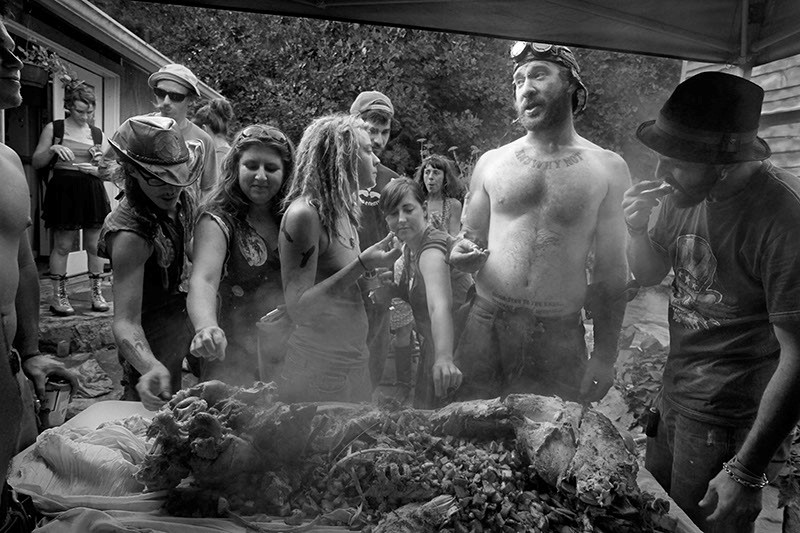
At Cricket’s birthday party, Big Pine, 2011. Copyright, Rob Amberg.I-26 at Buckner Gap, Madison County, N.C. 2008. Copyright, Rob Amberg.
For four decades, Amberg has acted as a witness and interpreter of both the visible and invisible fissures of a changing landscape, and he has captured moments that could not be experienced, let alone appreciated, by someone who was merely passing through. When viewing his photographs, I often ask myself, how did he get there? He got there because he has dedicated the majority of his life to being in Madison County.
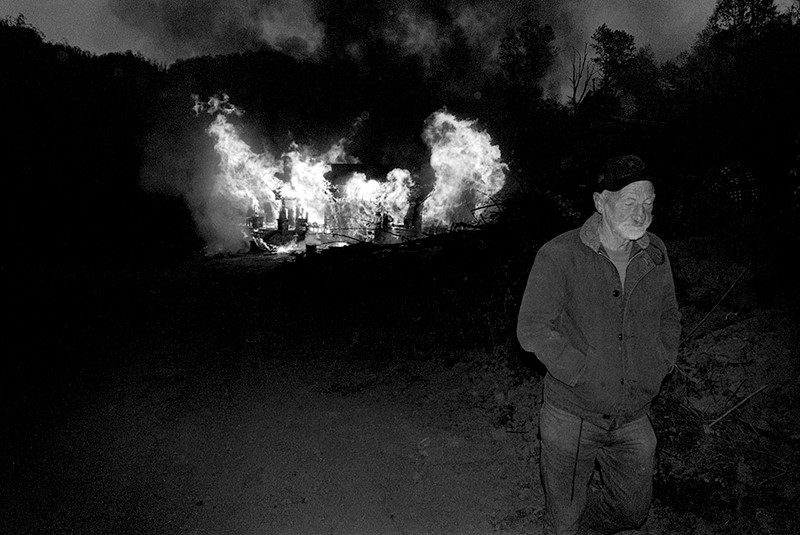
J.D. Thomas walking away from his burning home place, Sprinkle Creek, Madison County, N.C., 1997. Copyright, Rob Amberg
The second aspect of his work that greatly interests me, which is related to the longitudinal nature of his project, is Amberg’s own increasingly entangled role in the community. Once, over lunch, Amberg and I talked about all the goings on in Madison County, and it became clear that he knew more about the land and the people than I did. I was born and raised there, but I left when I was sixteen and now live in Hillsborough. As I have become more of an outsider to the community, Amberg’s intimacy with the land and people continues to grow. And as this intimacy grows, he becomes more implicated in the narratives that he weaves, in the lives that he portrays. And, curiously, as his subjects view his work, they are informed and changed by the stories he tells. All is changing as the work goes on.
Ben Amberg, Rob’s son, with Dellie and Junior, 1982. Copyright, Rob AmbergJunior playing with my daughter Kate, 1992. Copyright, Rob Amberg
To me, Amberg’s photographs are one continuous conversation. I keep going back to them; they keep speaking to one another and to me. It’s an amazing time to be able to view his work, in medias res. In fact, I’ve never quite had this kind of experience with an artist, one who so profoundly shapes my view of the place I grew up. It’s my hope that he continues to work for many years, and I am excited to follow his efforts as he contributes his photographs and papers to the Rubenstein Library.
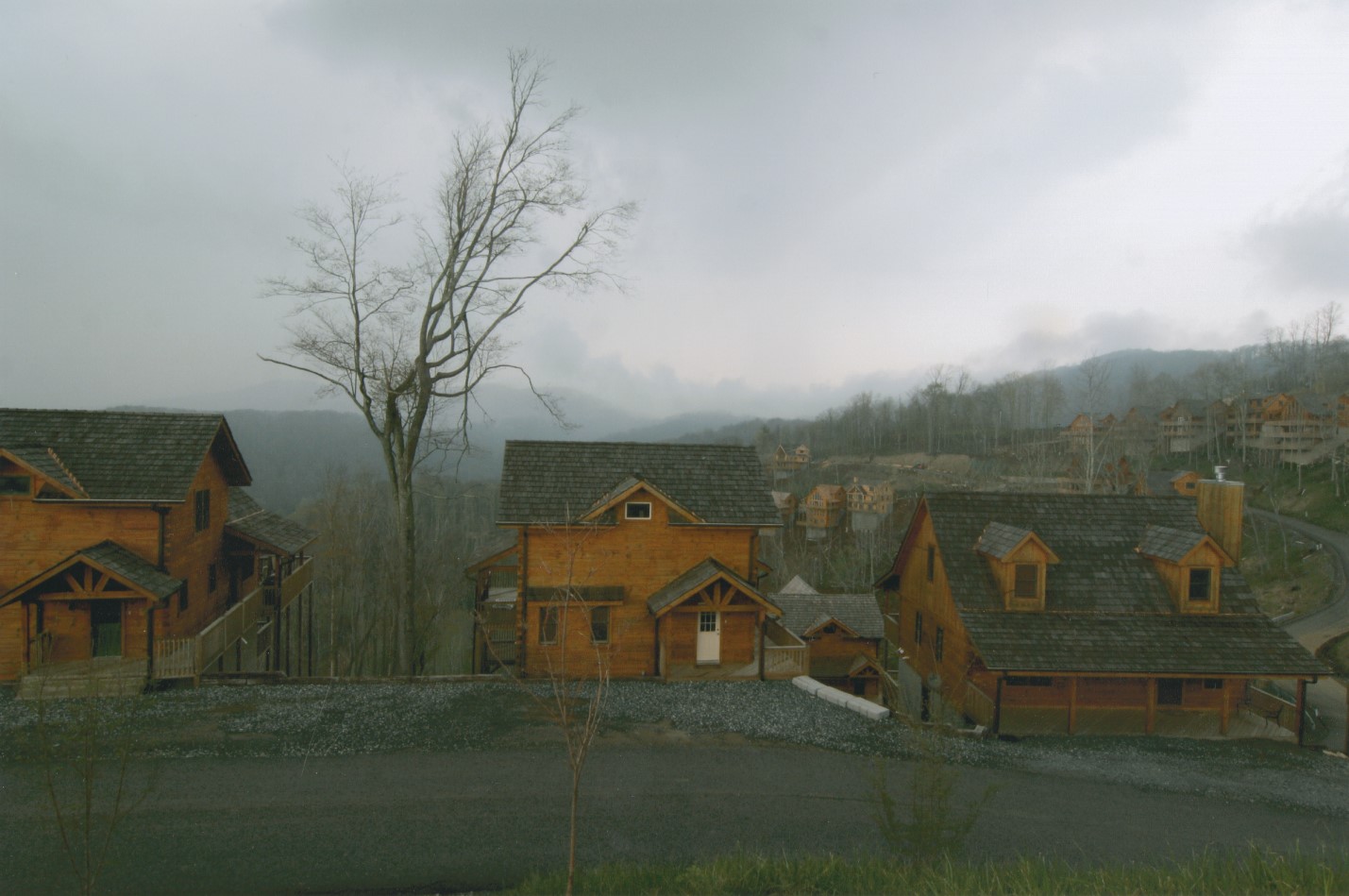
Isaac Gunter’s tobacco bed and cemetery, 1982. Copyright, Rob Amberg.Migrant farmworker cutting and spudding tobacco, 1993. Copyright, Rob AmbergNew condominiums at the Wolf Ridge Resort. Upper Laurel, Madison County, N.C., 2007. Copyright, Rob Amberg
As an addendum, I should mention that Amberg’s photographs reach well beyond Appalachia, and you can follow his current projects on his blog: http://robamberg.com/. Also, you can view the collection guide to learn more about the Rubenstein Library’s holdings.
*I have kept Amberg’s original captions, which reveal a glimmer of how he views the photographs, the people, and the land.
Post contributed by Laurin Penland, Research Services Assistant.
Post contributed by Amelia Holmes, Josiah Charles Trent Intern for the History of Medicine Collections.
Anatomical specimens emerged as an art form near the end of the seventeenth century. Although they may seem morbid today, at the time of creation, they were viewed as striking a balance between the scientific and the artistic. They served to educate people on human anatomy as well as to remind them of the fleeting nature of life.
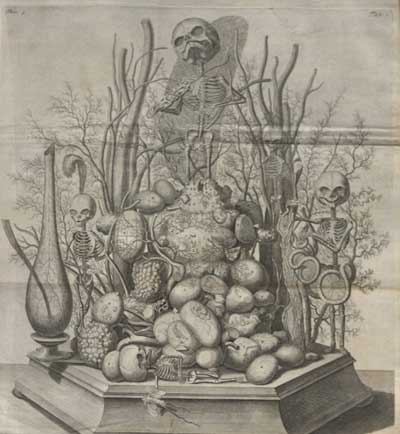
Illustration from Opera Omnia Anatomico-Medico-Chirurgica, ca. 1737.
One of the more notable creators of anatomical art is Frederik Ruysch, a Dutch botanist and anatomist who lived from 1638 to 1731—an impressive 93 years in a time when many died young. A capable researcher, Ruysch was the first to describe bronchial blood vessels, the vascular plexus of the heart, and the valves of the lymphatics. However, his real interest lay in anatomical preparations, and he has been described by a recent biographer as “probably the most skilled and knowledgeable preparator in the history of anatomy” (Gould, p. 20). Ruysch served as the chief instructor to midwives and the “legal doctor” to the court of Amsterdam. Through these positions, he had easy (and legal) access to the bodies of stillborns and dead babies.
The preparations were initially created to use in his classes, but they eventually gained an interest from the public. To showcase his vast collection (he created more than 2,000 from 1665 to 1717 alone), he opened his own cabinet of curiosities to the public, which for many marked the first time they were able to see human internal organs. The collection was also noteworthy because of the lengths to which Ruysch went in an effort to make the specimens appear more natural. For example, embalmed children were clothed or held bouquets of preserved flowers. In 1717, Peter the Great, who was an admirer of Ruysch, purchased the entire cabinet of curiosities for 30,000 guilders. The collection was then shipped to St. Petersburg, and along with the cabinet of curiosities formed by Albertus Seba, they became the core of the Kunstkammer—the Academy of Sciences of Russia’s first public museum.
Although a number of Ruysch’s wet preparations still exist today (a fact which he would find unsurprising), none of his dry specimens have been located. He used fetal skeletons and other body parts to create multi-specimen scenes. These scenes served as the centerpieces for each of the literal cabinets within the rooms of his museum. As Gould points out, these tableaux were focused on allegorical themes such as death and the transience of life. The small skeletons are decorated with symbols of death and short life: mayflies rest in hands, skulls weep into handkerchiefs made of mesentery, and snakes made of intestine wine their way through bones. Today, these still-life scenes exist for us only through second-hand descriptions and, fortunately, through a number of engravings.
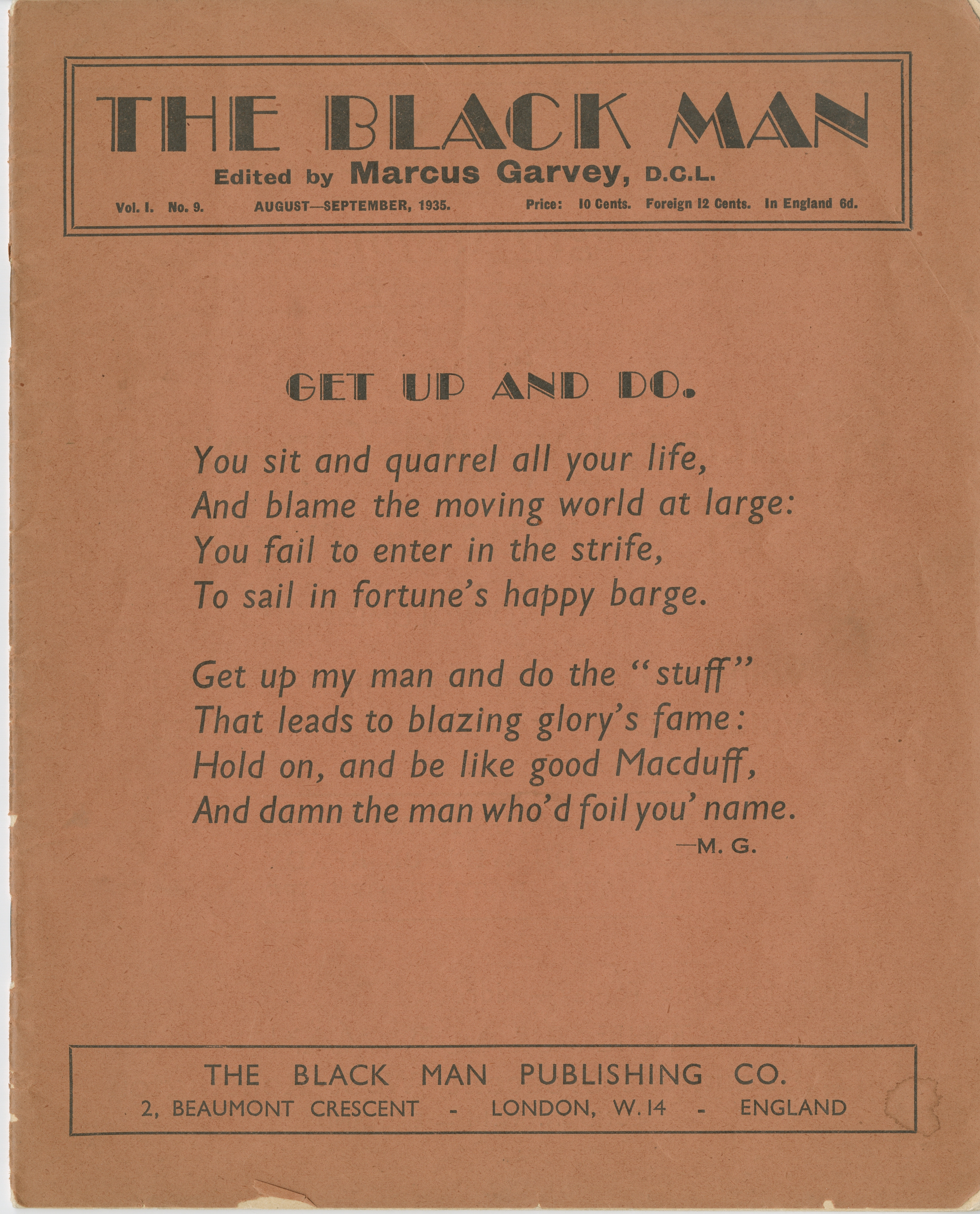
The John Hope Franklin Research Center has acquired the Robert A. Hill Collection of the Marcus Garvey and Universal Negro Improvement Association Papers Project Records. Hill is an Emeritus Professor of History at UCLA and a renowned historian and expert on the life and legacy of Garvey and his impact throughout the African Diaspora. The collection includes the research materials and documents collected to compose the twelve-volume Marcus Garvey and Universal Negro Improvement Association (UNIA) Papers (University of California and Duke University Press), which began publication in 1983 focusing on the Garvey and UNIA movement in Africa, America and Caribbean, with Hill serving as editor.
The Black Man magazine, edited by Marcus Garvey, 1935
Many of the materials compiled by Hill were not able to be included in the published editions and the records of the Garvey and UNIA papers project, one of a handful of academic papers projects on a person of African descent, are one of the largest research collections of documents on Garvey and his followers in the world. The collection, which contains over three hundred boxes, is currently being processed in order to be opened to the public.
Universal Negro Improvement Association Minutes of Proceedings, London, England meeting, 1928
A native of Kingston, Jamaica, Hill is currently an emeritus faculty at UCLA and has held appointments at Dartmouth College, the Institute of the Black World, and Northwestern University, Evanston. He began compiling materials related to Garvey in 1970 and subsequently expanded his collecting interests into the history of the African Diaspora throughout the western world. From Nov. 2-6, Professor Hill will be visiting the Rubenstein Library and will officially begin service as Scholarly Consultant & Adviser for the collection; assisting staff with understanding the collection’s organization, participating in an oral history about the genesis and growth of the collection, and delivering a public lecture on campus on November 4, 2015 at 4:00pm in the Holsti-Anderson Family Assembly Room, Rubenstein Library.
Black Star Line stock certificate, 1919
Post submitted by John B. Gartrell, Director, John Hope Franklin Research Center
Date: Thursday, October 29, 2015 Time: 2:00-4:00 PM Location: Holsti-Anderson Family Assembly Room Contact: Amy McDonald, amy.mcdonald@duke.edu
Y’all, we hear you. The semester is getting more and more intense and sometimes Duke is just so . . . gothic, you know? Sometimes you just need to eat some free candy and look at cute things. And what better time to do that than in celebration of that traditionally cute holiday, Halloween?
Your cuddly Rubenstein librarians would like to invite you to visit us for Screamfest III, an open house featuring creepy ADORABLE things from our collections.
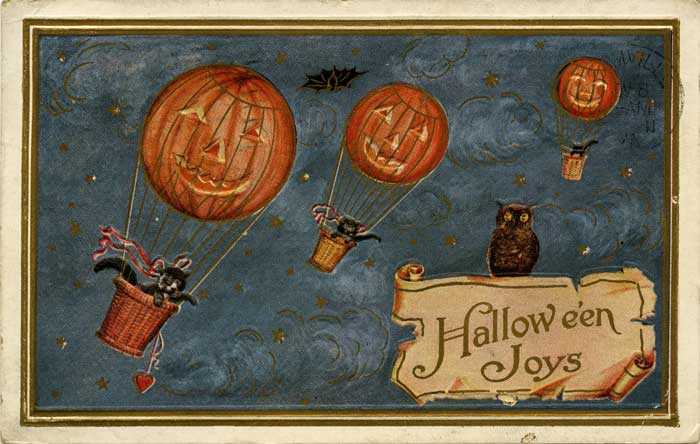
Like this postcard of these sweet black kitty-cats, bringing you Halloween joys in their happy hot air pumpkins.
Or this illustration of these precious babies from our History of Medicine Collection’s Opera Omnia Anatomico-Medico-Chirurgica by Frederik Ruysch. Yes, fine, they’re skeleton babies, and they’re standing on a pile of human organs, but they’re totally listening to a song by The Wiggles.
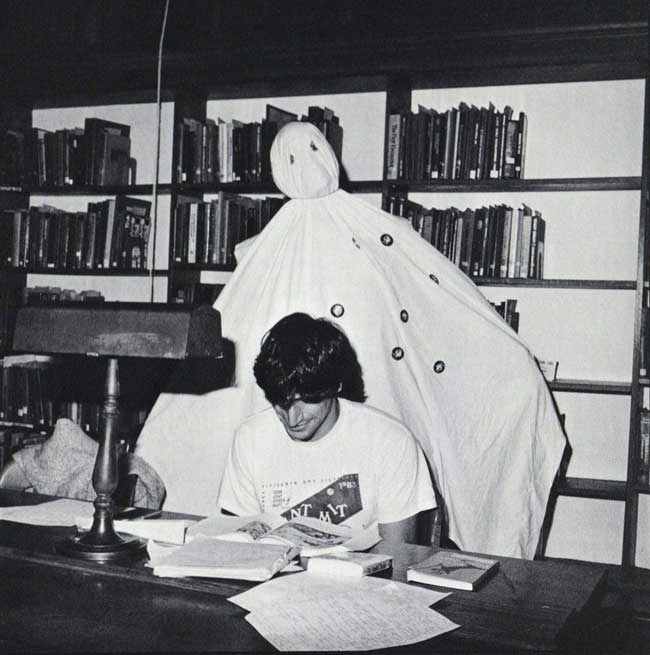
You can also page through the 1984 Chanticleer to view the photos of this friendly library ghost, who just wants to bring you fuzzy slippers so you can study comfortably.
And sure, scourge and sword-wielding demons are very scary when they’re life-sized. But swing by our open house and you’ll be able to bravely make kissy-faces at this little dude (paperclip for scale) from the Edwin and Terry Murray Collection of Role-Playing Games.
In fact, we promise that there will be so much cuteness (and candy) that, well, you might die. See you there!
With so many meetings, events, exhibits, performances, and games each day, it might seem difficult to set aside time to learn about your Duke student organization’s history. The University Archives, which collects student organization materials, knows how busy you are and we want to help!
Starting on October 20th, we’ll be holding a series of pop-up displays on student organization history, featuring historical materials from our collections. We’re calling this YOLO@UA: Your Organizations Live on @ the University Archives.
Each Tuesday, you’ll find us at a table just outside the Von der Heyden Pavilion from 2-3 PM, ready to show some cool stuff and answer your questions about student organization history.
We’ll be changing the display focus each time, so here’s the schedule:
October 20: Cultural Groups
October 27: Arts Groups
November 3: Student Government & Political Groups (Happy Election Day!)
November 10: Sororities, Fraternities, & Living Groups
November 17: Student Publications
Don’t worry if your organization isn’t covered with this schedule. We’ll plan more pop-up displays with different focuses during the spring semester. And you’re always welcome to get in touch with us to discuss how you can research your organization’s history at the University Archives!
P.S. Do you have student group materials that you’d like to archive at the University Archives? Learn more, and complete a form to let us know about your materials, here!
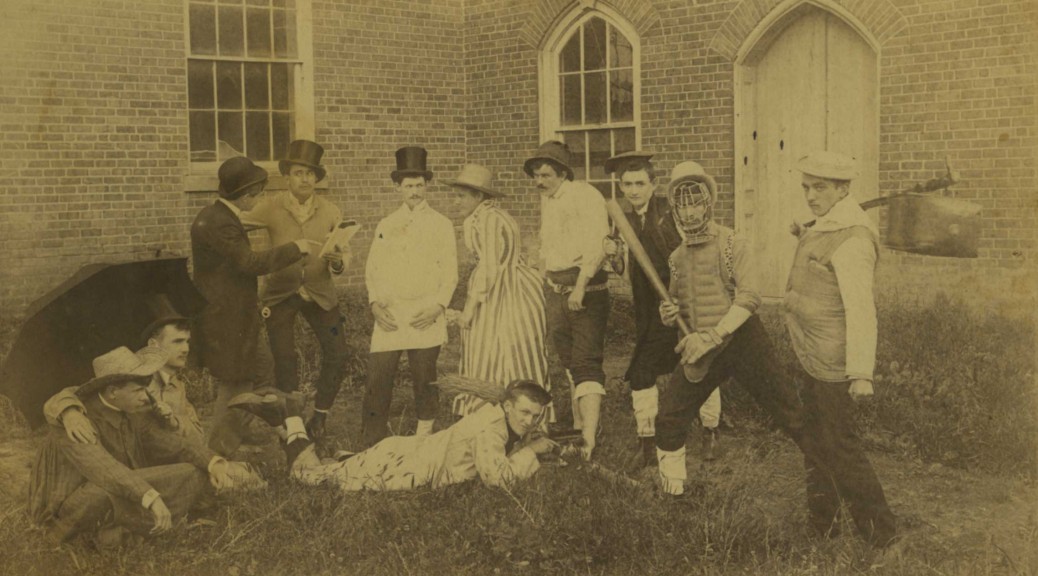
Cast of Theatrical Performance at Trinity College, before 1892
What can we learn from the gaps, absences, and silences in an archive? What are the stories that are hidden between the lines?
From September 1991 to October 1994, Haiti was ruled by a military junta that overthrew the democratically-elected government only a few months after it came into power. The military regime was a particularly unjust and brutal era in Haiti’s unjust and brutal history, in which dissidents, pro-democracy and human rights activists, and journalists were beaten, raped, imprisoned, and killed by military and paramilitary forces. The politically-engaged poor were especially targeted, and subjected to physical and psychological terror. The US responded by imposing a trade embargo on the de facto regime, in the hope that economic sanctions would force the coup leaders from power, but the embargo hurt the poorest and most marginalized Haitians the most. Fearing political persecution and struggling under a suffocated economy, tens of thousands of people fled on boats seeking refuge in the United States. Much as Reagan had done in the early 1980s, the Bush administration claimed that the Haitian refugees were not victims of human rights violations, and therefore the US would not grant them political asylum. Many died at sea; others were incarcerated at detention camps at Guantanamo; most were repatriated to Haiti (where some were indeed killed for their politics).
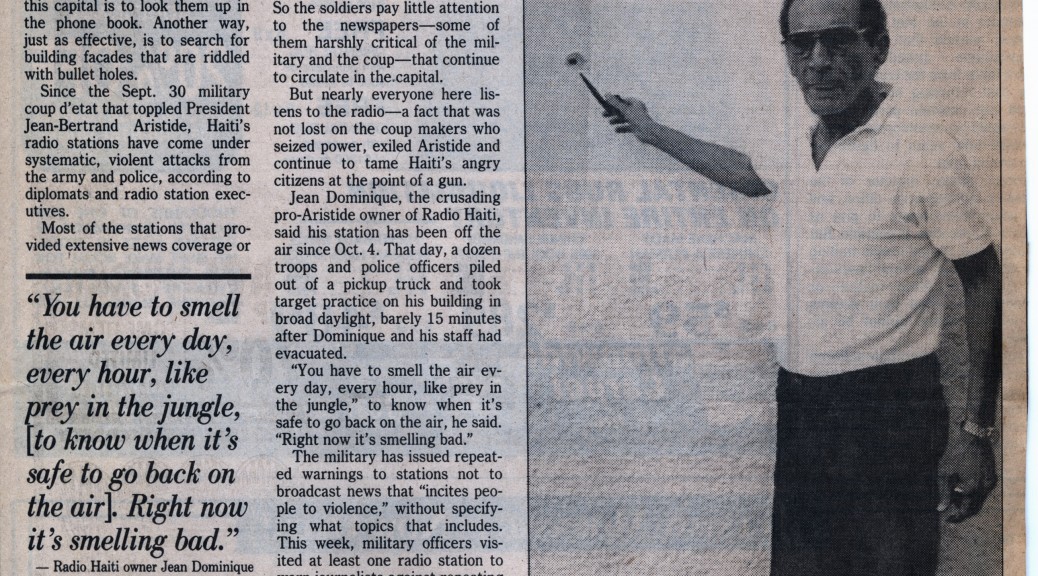
Radio Haiti stopped broadcasting on October 4, 1991, five days after the coup d’état, after the military regime cracked down on independent media. Soon after, Jean Dominique and Michèle Montas went into exile in New York for the second time. The station did not open again until 1994.
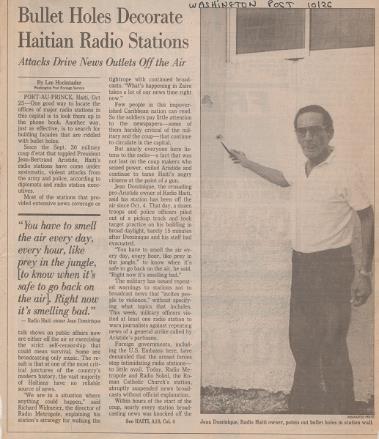
Jean Dominique uses his famous pipe to point to the bullet holes in the façade of the Radio Haiti building. Washington Post, October 25, 1991. Radio Haiti Collection, paper archive.
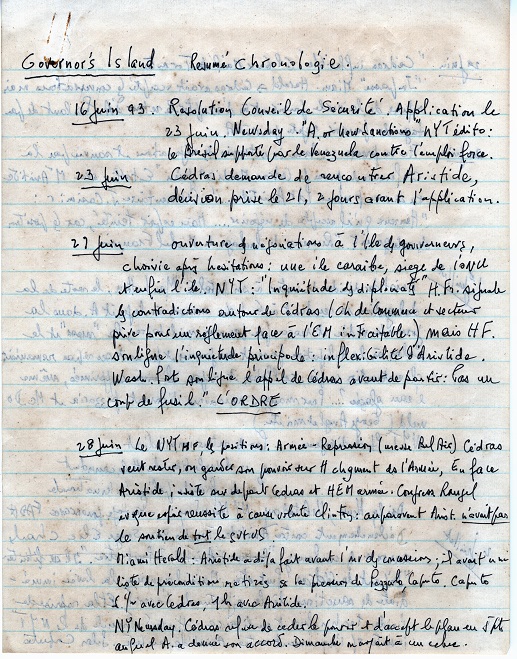
We have no tapes from that time, save one – a recording of the July 1993 meeting at Governors Island in New York, where US officials attempted to broker an agreement between deposed president Jean-Bertrand Aristide and junta leader Raoul Cédras. When Radio Haiti was on the air, the paper materials reflect the audio materials: on-air scripts and journalists’ notes, and printed material from Haitian organizations. By contrast, the paper archive contains no notes and no scripts from the coup years, except for Jean Dominique’s assiduously detailed handwritten chronology of the Governors Island meeting.
The first page of Jean Dominique’s notes on the 1993 Governors Island meeting. Radio Haiti collection, paper archive.
But it is not a passive silence; it is a fraught and frustrated silence, an absence that draws attention to itself. Radio Haiti’s paper archive gives us a glimpse of Jean Dominique’s experience of exile – of a time when he, like the Haitian masses, could not speak freely in his homeland; of a time before the Internet and long before social media, when reliable firsthand information coming from Haiti was scant, terrifying, and tragic. For a Haitian in exile from Haiti, a journalist exiled from his microphone, the distance must have been unbearable.
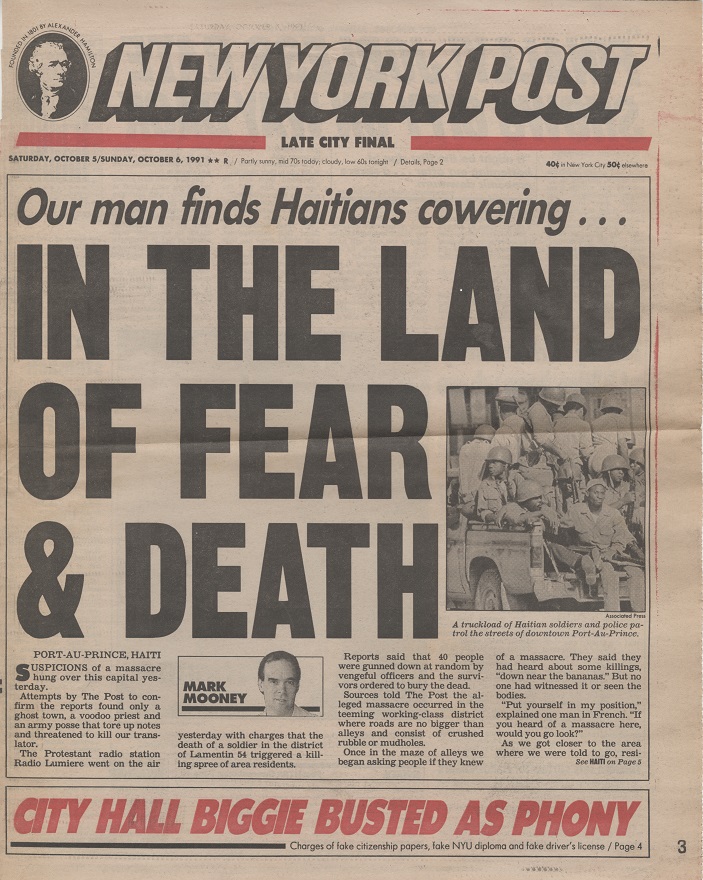
The volume of secondary printed material from 1991 to 1994 testifies to an archive passionately and scrupulously amassed. There are several fat, overstuffed folders filled with tightly-bound news clippings, most of them from American media – the New York Times, Newsweek, the Christian Science Monitor, the Washington Post the Nation. We have several artifacts from the reliably nuanced and thoughtful New YorkPost.
New York Post, October 6, 1991, Radio Haiti collection, paper archive.
There are also clippings from smaller publications, such as college newspapers and newspapers of the Haitian and Caribbean communities in New York. There are in-depth articles, photo spreads, short op eds, brief marginal asides. They were cut out of newspapers, mailed by friends and family (often with notes attached). These articles detail the mounting violence in Haiti, the effects of the embargo, the plight of refugees at sea and incarcerated at Guantanamo, the Bush administration’s refusal to grant asylum, and pro-Aristide demonstrations in New York, Miami, Washington DC, and elsewhere.
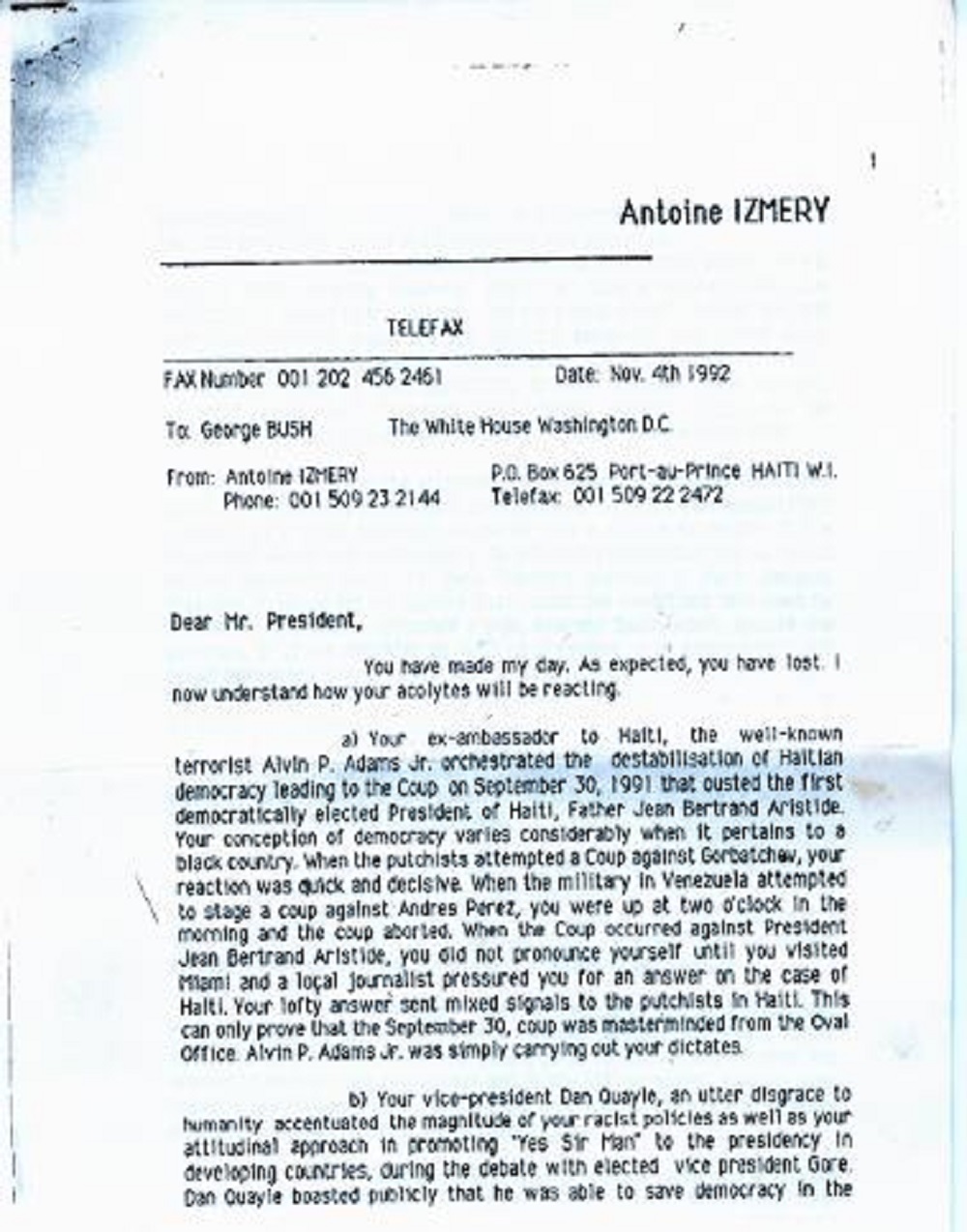
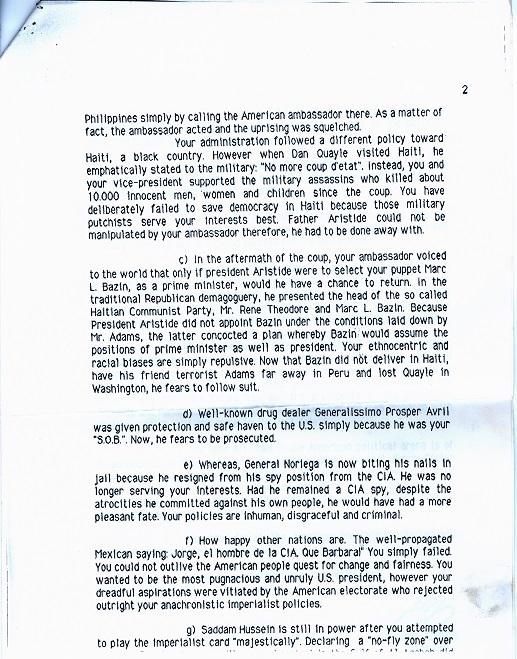
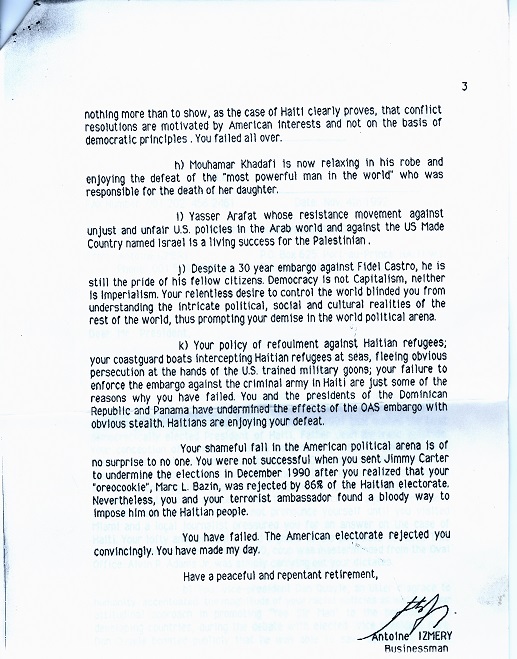
The collection features some rather extraordinary documents. There is this acerbic fax from pro-democracy activist Antoine Izméry, dripping with unconcealed disdain, congratulating Bush on his loss in the 1992 presidential election. “You failed all over,” Izméry declares. He decries the Bush administration’s racism, hypocrisy, and self-interest and blames the US for engineering the 1991 coup, before wishing the departing president a “peaceful and repentant retirement.”
Antoine Izméry’s fax to George H.W. Bush, November 4, 1992. Radio Haiti collection, paper archive.
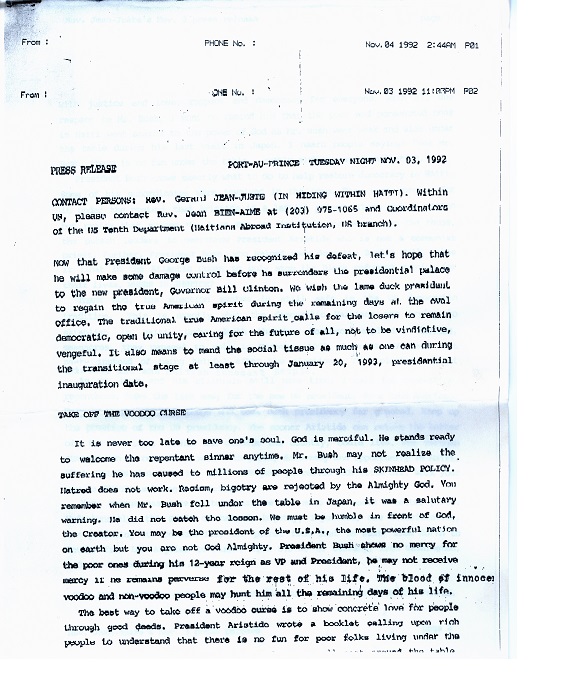
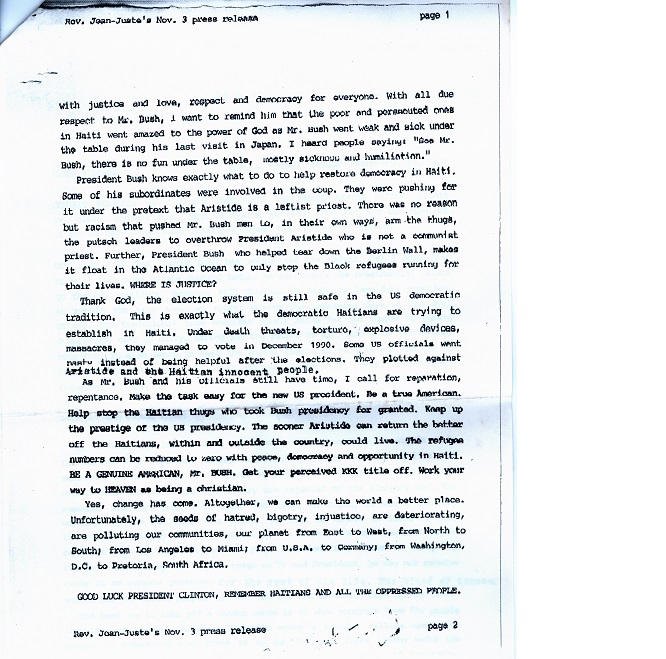
Also in the archive is a copy of this press release from Father Gérard Jean-Juste, a liberation theology priest and prominent Aristide supporter. Jean-Juste, “in hiding in Haiti,” refers to Bush’s “skinhead policy,” suggests that Bush’s sudden illness at a state dinner in Japan earlier that year was the result of a
“voodoo curse,” and implores him to “BE A GENUINE AMERICAN, Mr. BUSH. Get your perceived KKK titles off. Work your way to HEAVEN as being a christian.”
Gérard Jean-Juste press release, November 3, 1992. Radio Haiti collection, paper archive
Haiti’s beleaguered pro-democracy movement was hopeful that the election of Bill Clinton would lead to more just and humane policies toward Haitian refugees and the restoration of the Aristide government. But Clinton ultimately did little to improve conditions for Haitian refugees, and Aristide would not return to power until nearly two years later, after armed intervention by the United States. By then, Antoine Izméry would be dead. He was dragged from Sacre Coeur church by plainclothes police and shot dead in the street on September 11, 1993 in full view of parishioners and human rights observers attending a commemoration of the 1988 St. Jean Bosco massacre.
In late 1994, after Aristide was restored to power, Radio Haïti reopened. The three years of radio silence were broken by a new series of jubilant jingles and slogans: Nou tounen! Nou la pi rèd![We’re back! We’re here stronger than ever!] But the damage wrought by the coup years and the conditions of Aristide’s return was enduring; the pro-democracy movement would never again possess the same momentum or clear emancipatory promise that it had in 1991.
Post contributed by Laura Wagner, Ph.D., Radio Haiti Project Archivist.
The Voices of Change project was made possible through a generous grant from the National Endowment of the Humanities.







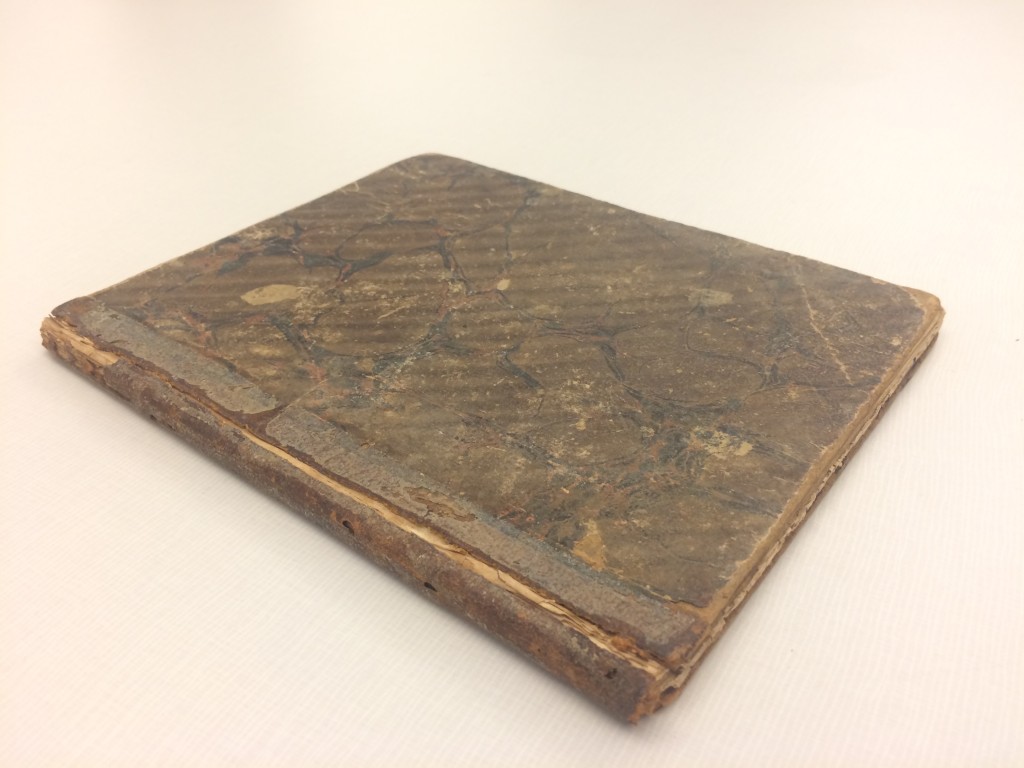 A manuscript (i.e. handwritten) cookbook can tell us a great deal about its creator. What foods were available to her? How would her family have celebrated holidays and birthdays? Was she an elite woman with a cook who could prepare elaborate dishes, or a farm wife who had to prepare simple, hearty fare and preserve her harvest to feed her family? Do the recipes reflect a particular ethnic or religious background or geographical location? As is the case today, routine meals do not require a recipe. It is the special occasion recipes, especially those that require careful measurements to work properly, that are recorded for future reference.