Category Archives: From Our Collections

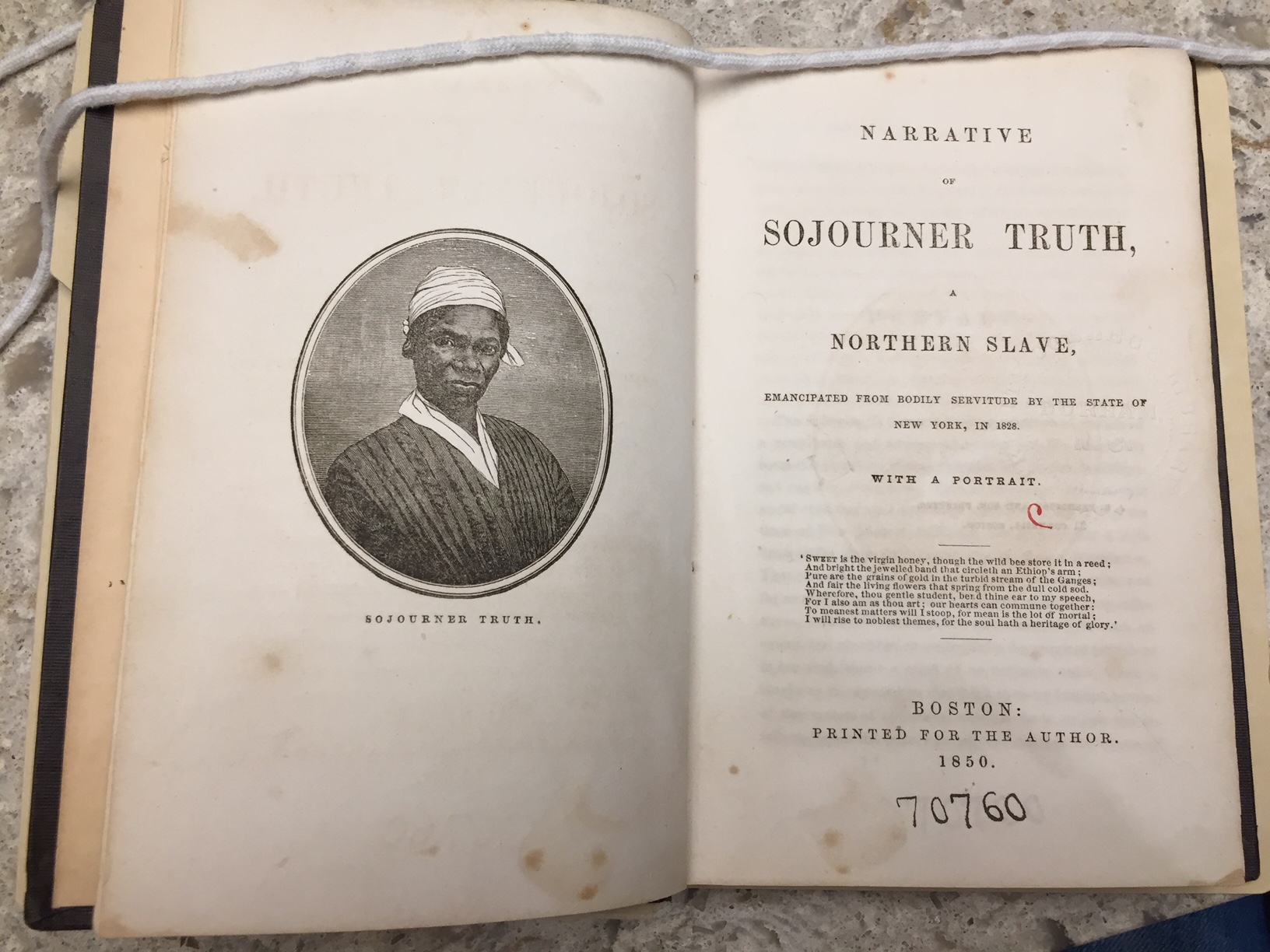
Glimpses of Freedom, Love, and Struggle in the American Slavery Documents Collection

Post contributed by Jessica Janecki, Rare Materials Cataloger

The Project

Over 200 items—bills of sale, rental agreements, “free papers,” and even one arrest warrant—make up the American Slavery Documents collection held in the Rubenstein. In Technical Services, rare materials catalogers are in the process of individually cataloging the documents in the collection.

An important part of the cataloging process involves researching the names we find in the documents so that we can correctly identify people and either associate them with their Library of Congress Name Authority File heading or create an authorized heading for them. In attempting to describe enslaved or formerly enslaved persons, the majority of whom did not have last names, we tried to do as much research as possible (is the Sue mentioned in one document the same Sue mentioned in another document? If not, how can we distinguish them?) Our hope is that by identifying and describing these individuals researchers may be able to connect them to other parts of their stories that may be contained in other repositories.

However, even with the addition of subject headings, authorized name headings, genre/form terms, and other helpful metadata, there are just some things that cannot be easily encapsulated in a catalog record. One example is the story of Lott and Frankey.

Lott and Frankey
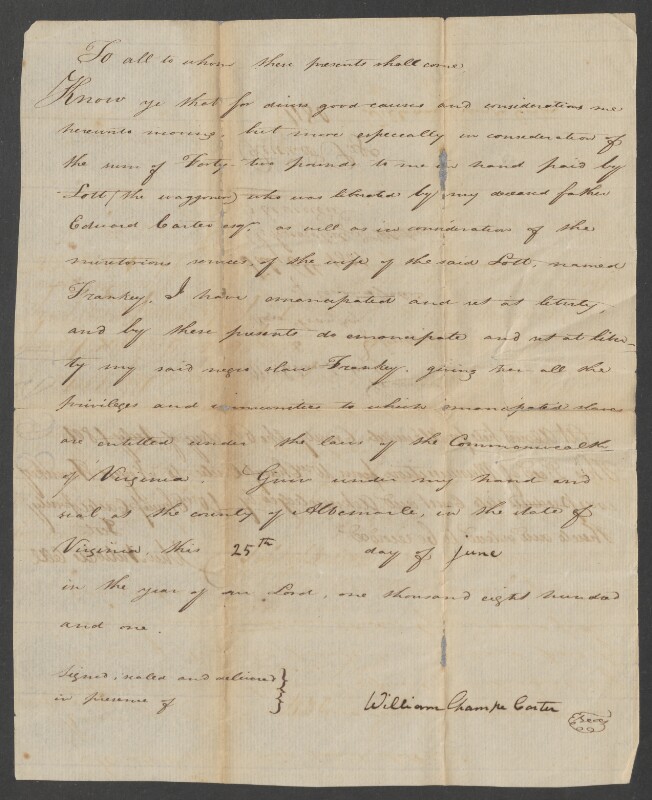
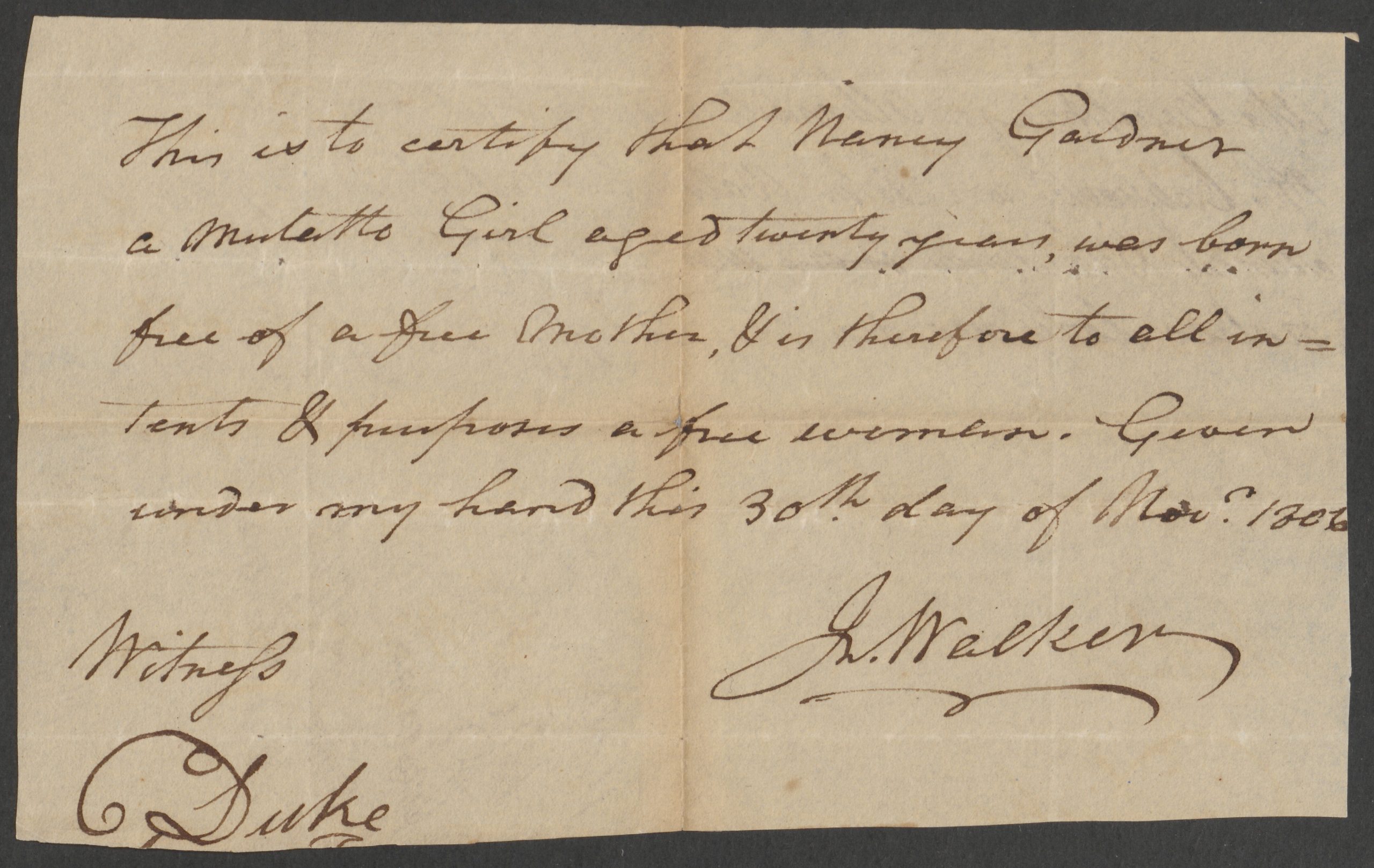
Hand-written record of emancipation
Deed of manumission for Frankey, 1801

To begin this project of individually cataloging the American Slavery Documents collection, I deliberately chose one of the happier document types: this deed of manumission freeing an enslaved woman named Frankey. It is dated June 25, 1801 and was recorded at the court of Albemarle County, Virginia by clerk of court John Nicholas.

In it, William Champe Carter, Frankey’s enslaver, declares:

…in consideration of the sum of forty two pounds to me in hand paid by Lott (the waggoner) who was liberated by my deceased father Edward Carter, esq., as well as in consideration of the meritorious services of she, the wife of the said Lott, named Frankey, I have emancipated and set at liberty, and by these presents do emancipate and set at liberty my said negro slave Frankey…

In other words, Frankey’s husband Lott purchased her freedom for 42 pounds.

From this deed we know nothing else about Frankey other than her name, the name of her husband, and that in June 1801 she lived in Albemarle County, Virginia. In my research I have not been able to discover how she came to be enslaved by William Champe Carter, which of the many Carter family plantations she might have lived at, or even her approximate age.

The deed actually tells us more about Lott than Frankey. We learn that Lott had been enslaved by William Champe Carter’s father Edward Carter, who also emancipated him. When Edward Carter died in 1792, he left instructions in his will to emancipate Lott,[1] one of the few enslaved persons he mentioned by name in his will. We also learn Lott’s profession as William Champe Carter refers to Lott as “the waggoner,” which means wagon driver.

If Lott was a free man by 1792, what might he have been doing between his emancipation and when he purchased Frankey’s freedom in 1801? In the deed he is referred to as Lott “the waggoner,” suggesting that he found employment after his emancipation. I searched early Virginia property tax records (available here) and found 2 promising entries in Albemarle County. The first from 1795 reads: Negro Lott emancipated by Edwd Carter decd [ie deceased] 1 tithe 2 horses and the second from 1797 reads: Wagoner Lott free negro 1 tithe 1 horse. These entries show that the commonwealth of Virginia recognized Lott as a free man, and one who owned enough personal property to owe property taxes. The 1797 entry helpfully confirms that he worked as a wagon driver. That these tax records are from Albemarle County also shows that Lott stayed close to Frankey during the 9 years he worked to earn the 42 pounds to buy her freedom.

What happened to Frankey and Lott after 1801? In the tax records for 1803, 1805, 1806, and 1807 there are references to Lott Saunders, a “free negro.” Is this the same Lott? Unfortunately, we have no way of knowing for certain and after that the trail grows cold. Searching for any traces of Frankey are especially difficult as court documents from a lawsuit in 1821 between members of the Carter family show that at least two women still enslaved on Carter plantations were named Frankey.

If Frankey and Lott remained in Virginia after Frankey’s emancipation they would have faced challenges. William Champe Carter refers to the “privileges” to which “emancipated slaves are entitled under the laws of the Commonwealth of Virginia.” One of those “privileges” was constantly having to prove their freedom. The 1793 state law An Act for Regulating the Police of Towns in this Commonwealth, and to Restrain the Practice of Negroes Going at Large required free people of color to register with the towns where they worked or lived and pay a fee for a copy of their certificate of registration. This registration had to be renewed every year. If they could not produce their certificate they could be jailed indefinitely.

Future Connections

The story of Frankey and Lott is one of many glimpses of humanity and struggle (as well as oppression and cruelty) that can be found in the American Slavery documents collection. It is our hope that our efforts to individually catalog the documents will improve access and allow users to discover materials (and the lives that they reveal) by searching names, places, subjects, and document types in addition to browsing the digital collection. And in this process of discovery, connections will continue to be made, so that the humanity of lives lived, such as Frankey’s and Lott’s, will continue to be revealed and remembered.


Full transcription of Deed of Manumission

Transcript of recto:

To all whom these presents shall come, know ye that for divers good causes and considerations me hereunto moving, but more especially in consideration of the sum of forty two pounds to me in hand paid by Lott (the waggoner) who was liberated by my deceased father Edward Carter, esq., as well as in consideration of the meritorious services of she, the wife of the said Lott, named Frankey, I have emancipated and set at liberty, and by these presents do emancipate and set at liberty my said negro slave Frankey, giving her all the privileges and [?] to which emancipated slaves are entitled under the laws of the Commonwealth of Virginia, given under my hand and seal, at the county of Albemarle, in the state of Virginia, this 25th day of June in the year of our Lord, one thousand eight hundred and one.

Signed, sealed, and delivered in the presence of [blanks for witnesses]

William Champe Carter

Transcript of verso:

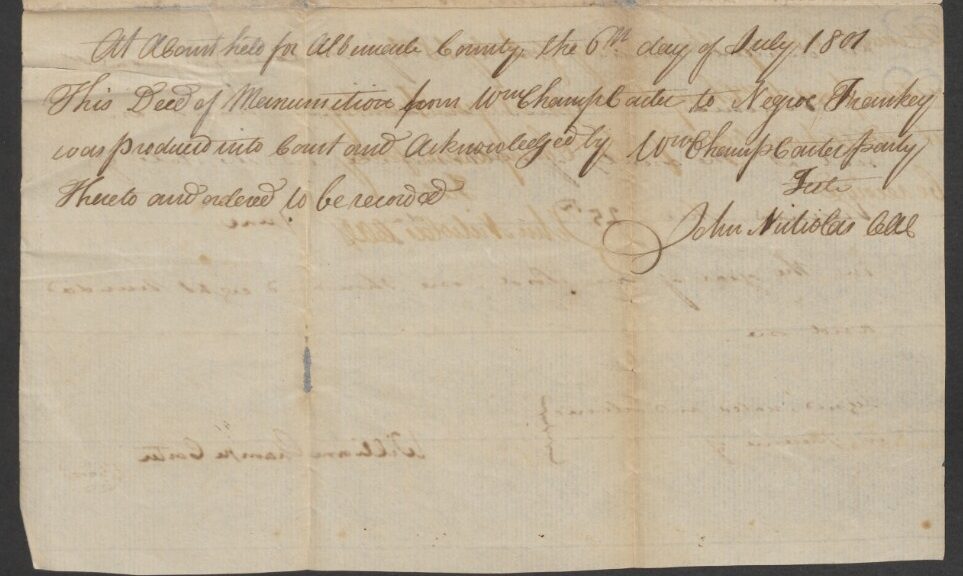
At a court held for Albemarle County the 6th day of July 1801 this deed of manumission from Wm Champe Carter to Negroe Frankey was produced into court and acknowledged by Wm Champe Carter party thereto and ordered to be recorded

Teste

John Nicholas


[1] The Carters of Blenheim: a genealogy of Edward and Sarah Champe Carter of “Blenheim” Albemarle County, Virginia. [Richmond, Va. : Garrett & Massie], 1955.

 

The Enduring Power of Witness

Post Contributed by Caitlin Margaret Kelly, Curator, Archive of Documentary Arts & Director, Power Plant Gallery

Spider Martin Photographs

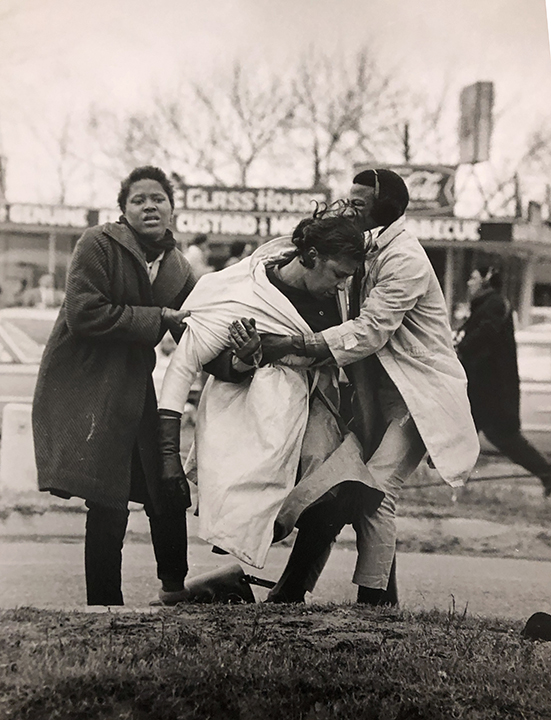
When I opened the newly arrived box the first photograph on top of the stack was one of the few with a title, called, “Two Minute Warning.” It is an iconic image taken on March 7, 1965 in Selma, Alabama, by a young photojournalist for the Birmingham News, James ‘Spider’ Martin. This print is among the more than 40 gelatin silver prints by Martin recently acquired by the Archive of Documentary Arts at the David M. Rubenstein Rare Book & Manuscript Library. The prints depict the violence of Bloody Sunday, the men and women of the Selma to Montgomery March, and George Wallace on the campaign trail. There are photographs of Dr. Martin Luther King, Jr., John Lewis, and Ralph Abernathy, among many others.

But in among the well-known visages, are many unknown faces, all marching through the landscape. It wasn’t long into my inspection of these prints that I started to notice the suitcases, the socks, a backpack worn by John Lewis, and the straining hands holding up Amelia Boynton – grasping for the fabric of her coat.

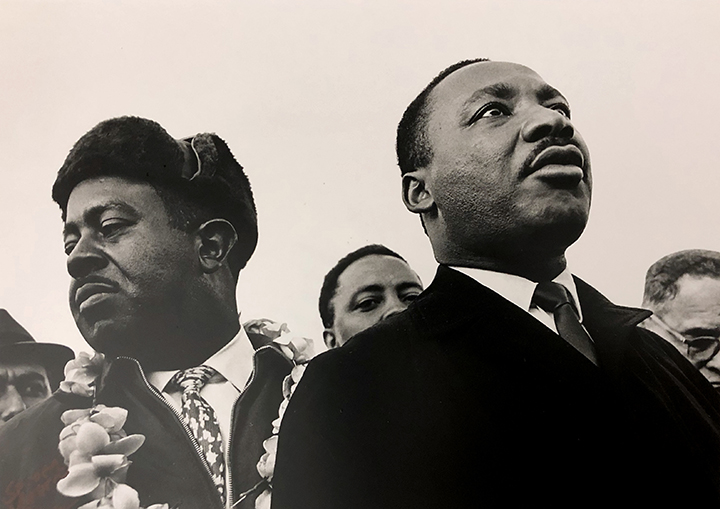
While a few of the prints were made in 1965, most were reprinted by Martin between 1993-1999. Some of the later prints come with handwritten reflections. On the back of a photograph of Ralph Abernathy and M.L.K. at the Selma March, Martin writes:

Spider Martin Photographs

“Dr. King knew he was a target. Many times I was tipped off that he might be assassinated. I look at this picture and think that Dr. King is looking towards heaven and thinking that it is enevitable (sic) that he will die fighting for the struggle. I think of the gospel song “Commin’ Home (sic).”

As a member of the news media, Spider Martin was on site to cover a march. It wasn’t until the foot of the Edmund Pettus Bridge that he also became a witness to the violence of Bloody Sunday. John Lewis is quoted as saying, “he left, through the power of his camera and with a quick eye, images that will educate and sensitize unborn generations.”[1].

Spider Martin Photographs

The particular print, which I mentioned at the start of this blog post, came with a note from Martin’s daughter, Tracy, “He would make a perfect print and send to the client which was common a long while back, but he would always make them a titch darker and contrastier because he thought all printed publications lost that in the print process.” This particular print, now part of the ADA, may have been destined for publication in the book ‘Weary Feet, Rested Souls’ by Townsend Davis.

In addition to the newly added photographs by Spider Martin the Archive of Documentary arts, also holds the work of photographer James H. Karales,[2] and his coverage of the Civil Rights Movement in the 1960s. They are joined by various other collections at the Rubenstein Library including the Abraham Joshua Heschel papers documenting his participation in the Selma to Montgomery March.[3]

[1] http://www.spidermartin.com/new-page-1


[2] https://repository.duke.edu/dc/karales


[3] https://archives.lib.duke.edu/catalog/heschelabraham


Pull for Your Candidate

Post contributed by Kaylee P. Alexander, Eleonore Jantz Reference Intern 2020-2021.

Bumper stickers, a MAGA hat, a Hillary Clinton nutcracker, ads for Dick Nixon jewelry, and a Barry Goldwater beer can are just some of the relics of past presidential campaigns to be found in the over thirty boxes of the Kenneth Hubbard Collection of Presidential Campaign Ephemera at the Rubenstein Library. Gimmicky, kitschy and teeming with bad puns, objects such as these have become somewhat ubiquitous in American campaign culture, and the Hubbard Collection covers nearly every presidential campaign that took place between 1828 and 2016. Representing Republicans and Democrats—both winners and losers—as well as candidates running with the U.S. Socialist and Prohibitionist parties, the Hubbard collection provides interesting material and visual cultural insights in the history of American elections by demonstrating a wide range of strategies for advertising and showing support for would-be U.S. presidents.

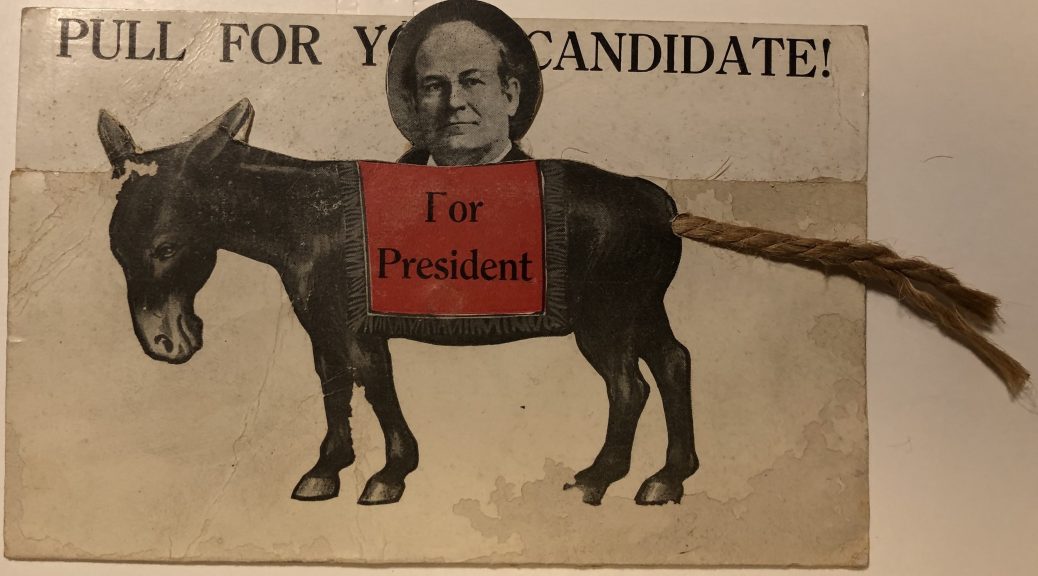
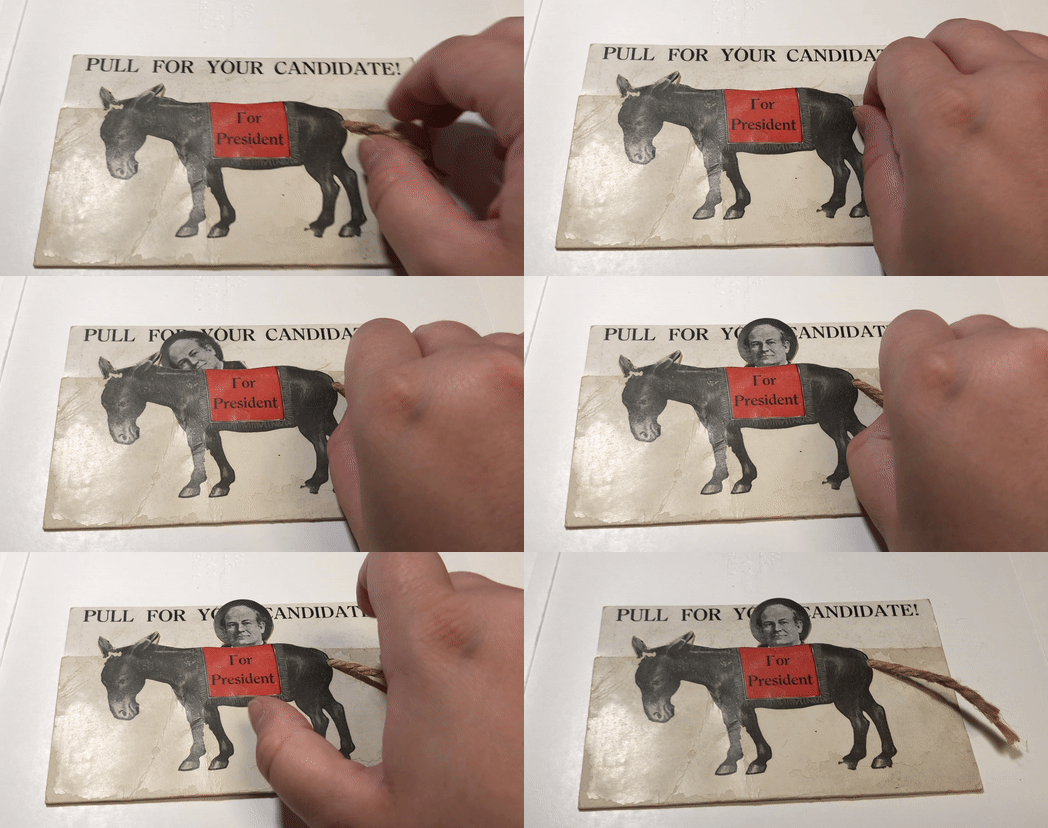
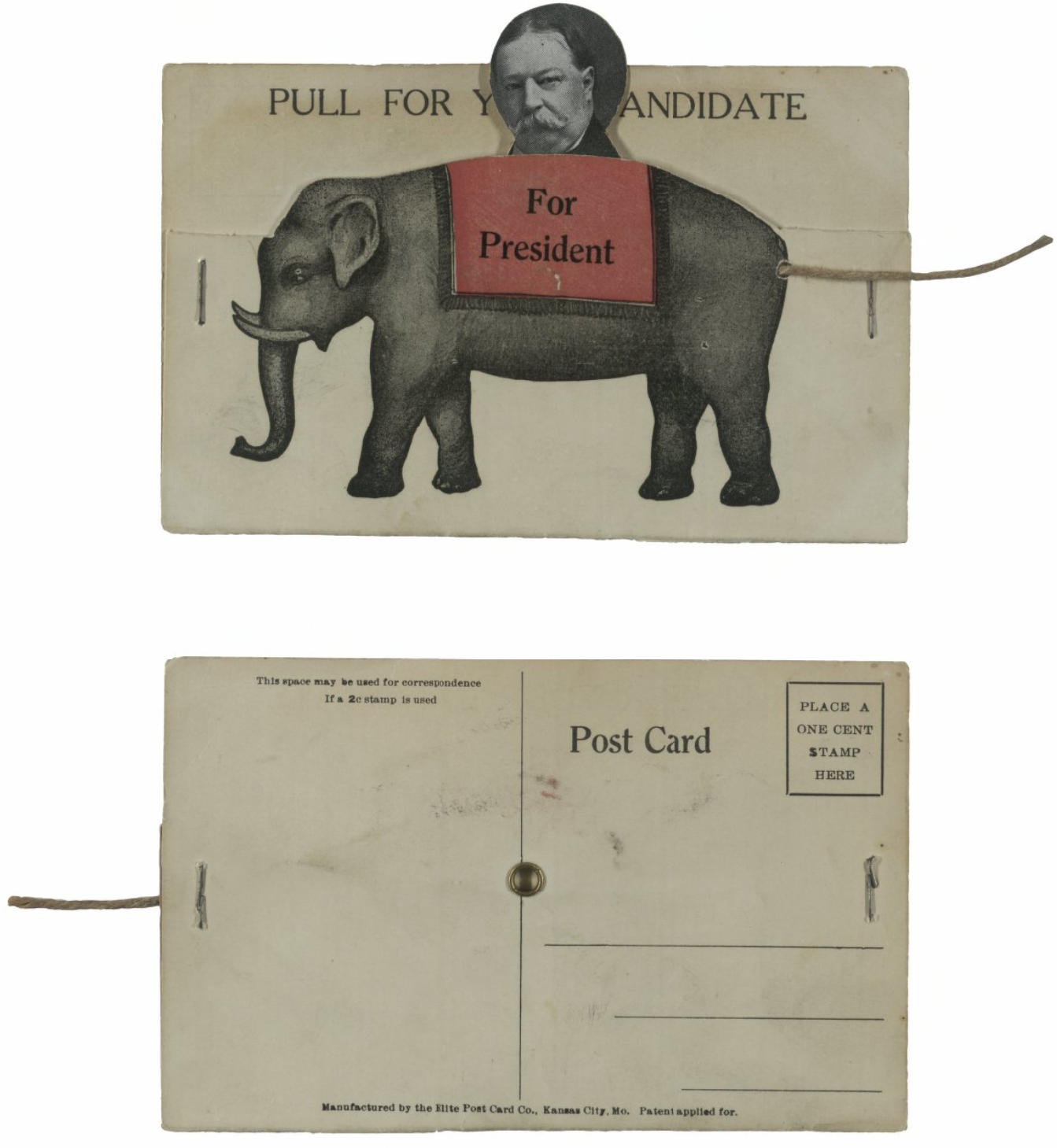
Going through these boxes over the past month, I was not shocked to find what seemed like an endless supply of buttons, pins and ribbons. Nor was I very surprised to find objects such as that Hillary nutcracker, or the Bill Clinton tie that was kept in the box alongside it; these ridiculous artifacts seemed somewhat logical to me, having seen the bizarre assortment of collectibles—from bobble heads and action figures to, most recently, facemasks—for candidates who have run in my lifetime. No matter how many objects or documents I came across in the collection, however, I couldn’t stop thinking about the first folder I had pulled: a folder containing just one postcard, with a donkey illustration and twine tail. “Pull for Your Candidate,” the postcard instructed, and, in an oddly amusing sort of way, a portrait of William Jennings Bryan (1860–1925) emerged above the donkey as you pulled on its tail. I couldn’t help but chuckle.

GIF of the postcard showing William Jennings Bryan's head pop out from behind a donkey when the tail is pulled.
“Pull for Your Candidate” Postcard for William Jennings Bryan campaign (1908), Kenneth Hubbard Collection of Presidential Campaign Ephemera, David M. Rubenstein Rare Book & Manuscript Library, Duke University.

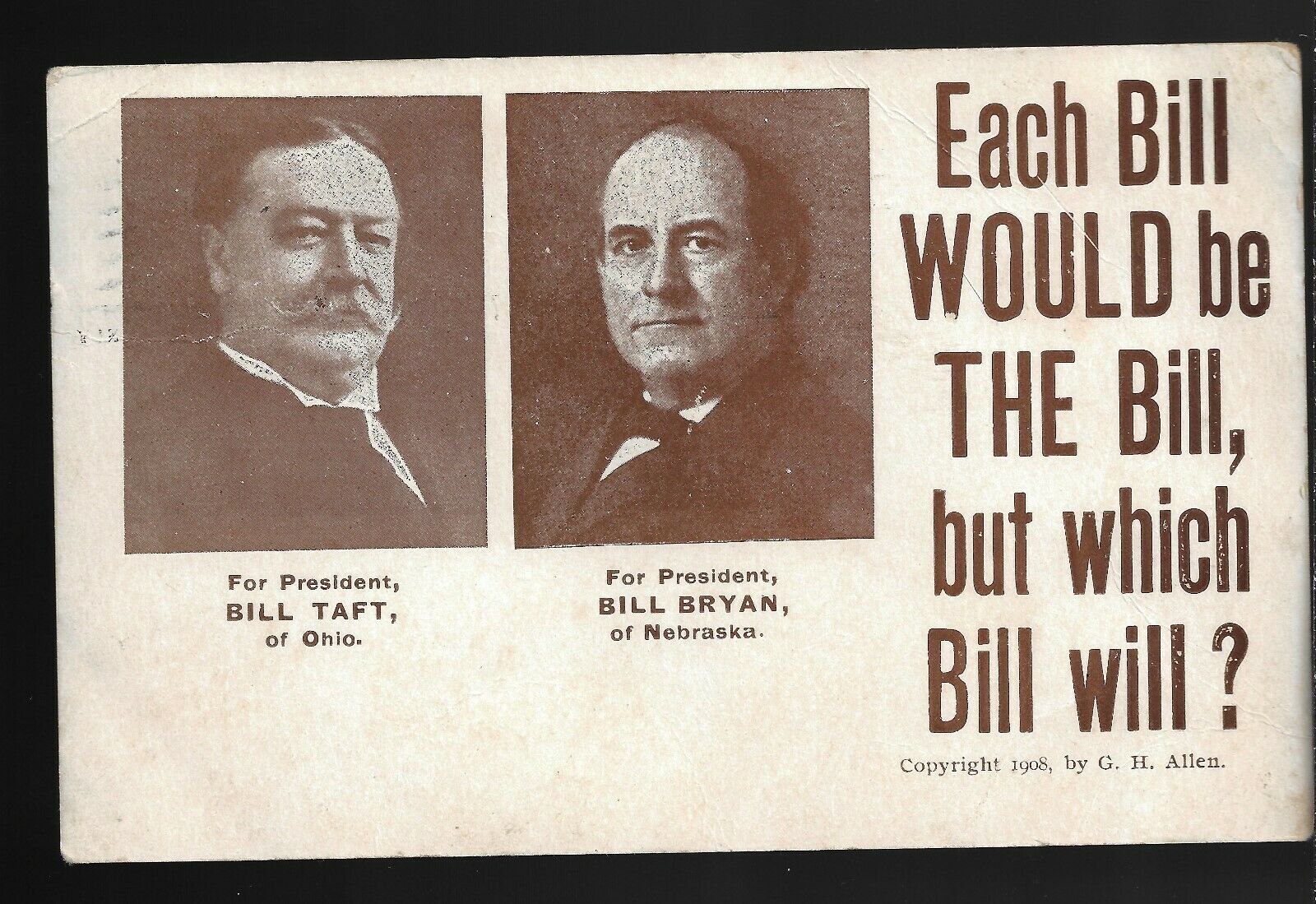
Printed by the Elite Post Card Company of Kansas City, Missouri, the verso provided space for you to compose your own message and address the card to whomever you wanted to send it to. Designed for the 1908 presidential election, in which Bryan faced off against Theodore Roosevelt’s Secretary of War, William H. Taft in a “battle of the Bills,” the postcard provided an attention-grabbing method of advocating for one’s presidential pick, not unlike today’s letter writing campaigns, or even contemporary social media activity urging folks to get out and vote.

1908 election postcard with pictures of William Taft and William Jennings Bryan and the caption “Each Bill Would be THE Bill, But which Bill will?”
G. H. Allen, “Each Bill Would be THE Bill, But which Bill will?” Postcard for the 1908 Presidential Election.

A proponent of a progressive income tax and stronger antitrust laws, Bryan was hailed “The great Commoner.” 1908 would be the third and final time that Bryan, formerly Nebraska’s 1st District Representative, would run for president. Unfortunately, it would also be his biggest defeat, earning just 162 electoral votes to Taft’s 321. With Taft’s defeat after one term by New Jersey Governor Woodrow Wilson, Bryan would serve as Secretary of State from 1913 to 1915. Despite his presidential losses, however, Bryan is still considered to be one of the most influential, albeit somewhat controversial, politicians of the Progressive Era.

A bit of digging revealed that a Republican version of the 1908 postcard, featuring an elephant in place of the donkey, had also been produced for Taft, an example of which can be found in the Dr. Allen B. and Helen S. Shopmaker American Political Collection of the St. Louis Mercantile Library Art Museum at the University of Missouri-St. Louis. With both of these postcards available to potential voters, one would have been able to literally and figuratively pull for their candidate and motivate others to do so as well.

Postcard for the William Taft campaign featuring a picture of Taft.
“Pull for Your Candidate” Postcard for William H. Taft campaign (1908), Dr. Allen B. and Helen S. Shopmaker American Political Collection, St. Louis Mercantile Library Art Museum, University of Missouri-St. Louis.


So, with a few days to go before Election Day, be sure to take a lesson from the Elite Postcard Company and pull for your candidate. Every vote matters.

Cookies for the Dead

Post contributed by Kaylee P. Alexander, Eleonore Jantz Reference Intern, 2020-2021

Man dies to live, and lives to die no more…until then, we eat cookies.

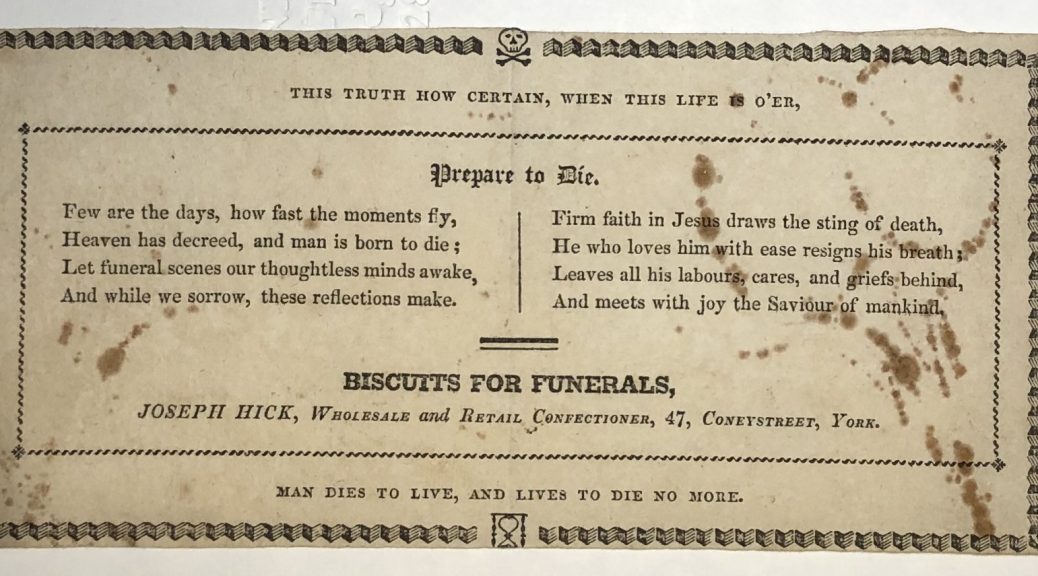
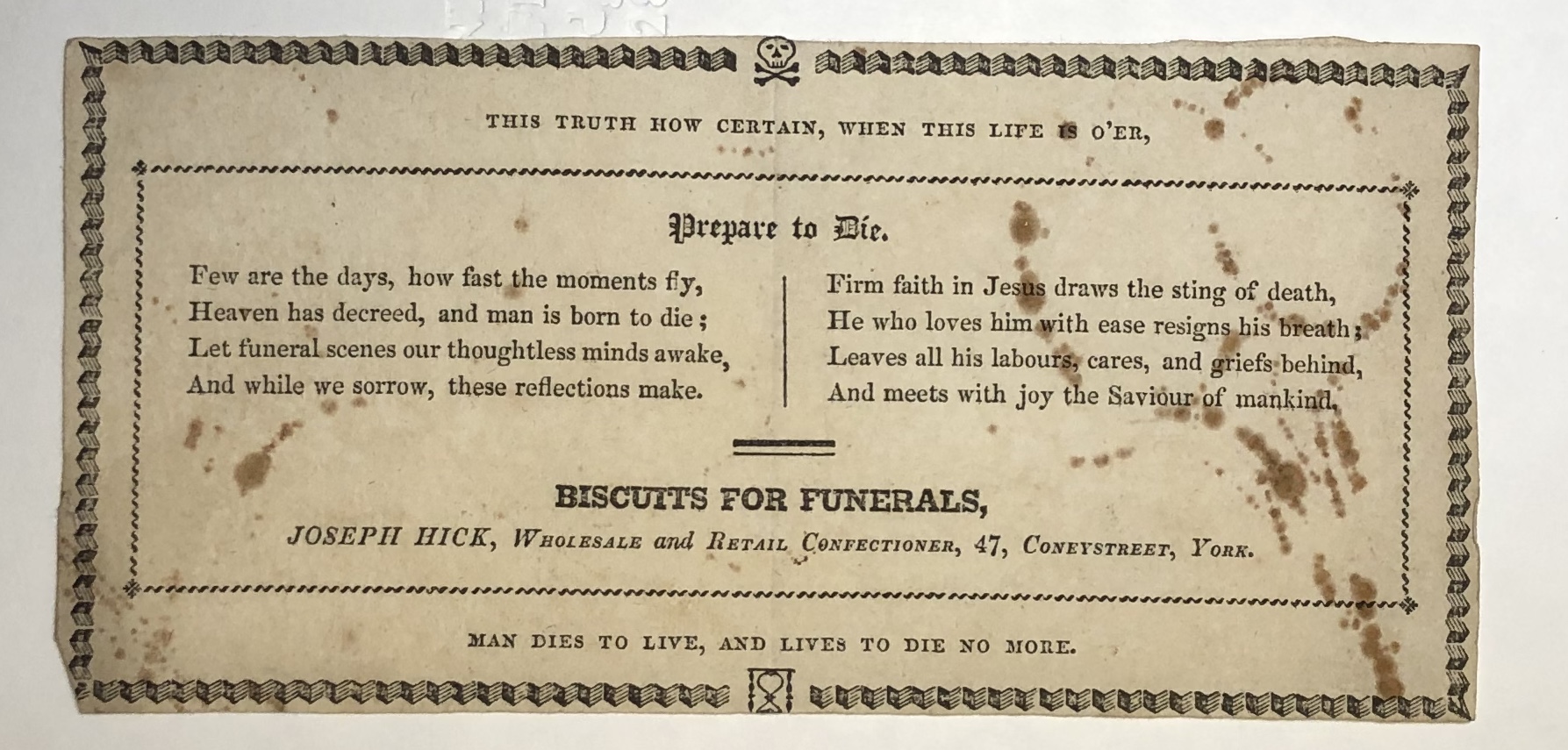
Tucked away in the Rubenstein Library’s box of memorial cards, ribbons, notices and ephemera in the Leona Bowman Carpenter Collection of English and American Literature is a lone advertisement for a curious confection: funeral biscuits. Imploring the reader to prepare for death, the ad suggests that one’s funerary arrangements simply cannot be complete without Hick’s biscuits.

Advertisement for funeral buscuits with decorative elements and a short poem.
Advertisement for Joseph Hick’s Funeral Biscuits (n.d.), Leona Bowman Carpenter Collection of English and American Literature, David M. Rubenstein Rare Book & Manuscript Library, Duke University.

Joseph Hick was a Yorkshire confectioner. In 1803, he had opened his first confectionery in partnership with Richard Kilner. In 1822, Kilner dissolved the partnership, leaving sole ownership to Hick, who relocated the business to 47 Coney Street. Hick operated his own confectionary until his death in 1860, when his estate and confectionery were left to his three children. Hick’s youngest daughter was Mary Ann Craven, the wife of Thomas Craven whose confectionery at 19 High Ousegate had been in operation since 1840. When Thomas died in 1862, Mary Ann was left in control of both confectioneries, which she merged and renamed M.A. Craven. In 1881, her son, Joseph William, joined the firm and the company was renamed M.A. Craven & Son.

With its thick black border, Hick’s advertisement mimics the design of early obituaries while inclusion of the elegy, “Prepare to Die,” hints towards the tradition of funeral cards. It is most likely, however, that the advertisement was intended to provide the reader with a sample design of what they might expect to encounter on the paper wrapper of Hick’s funeral biscuits.

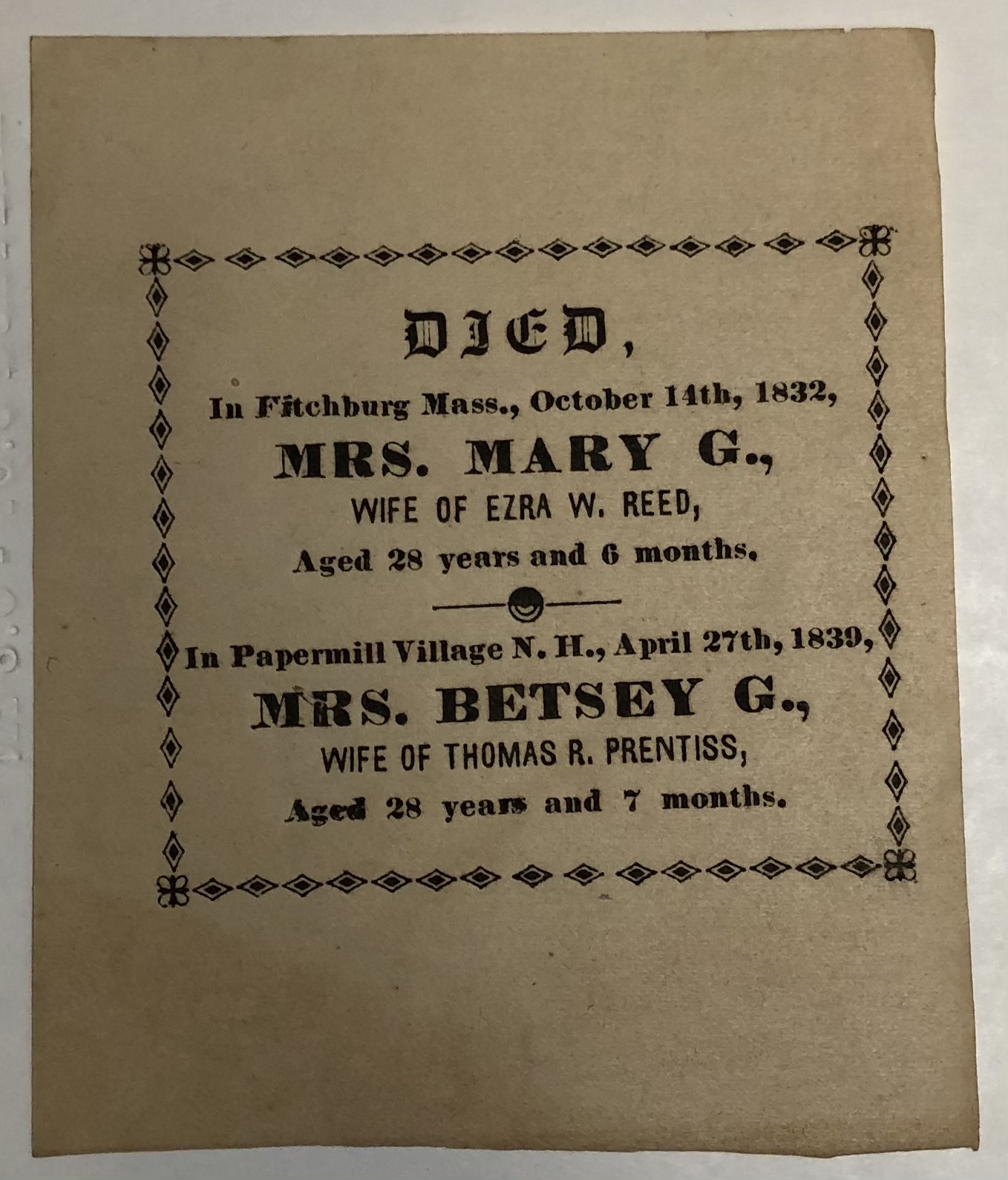
small accouncement for the funeral of Mary Reed from October 14, 1832
Funeral Announcement for Mrs. Mary G. Reed (1832), Leona Bowman Carpenter Collection of English and American Literature, David M. Rubenstein Rare Book & Manuscript Library, Duke University.
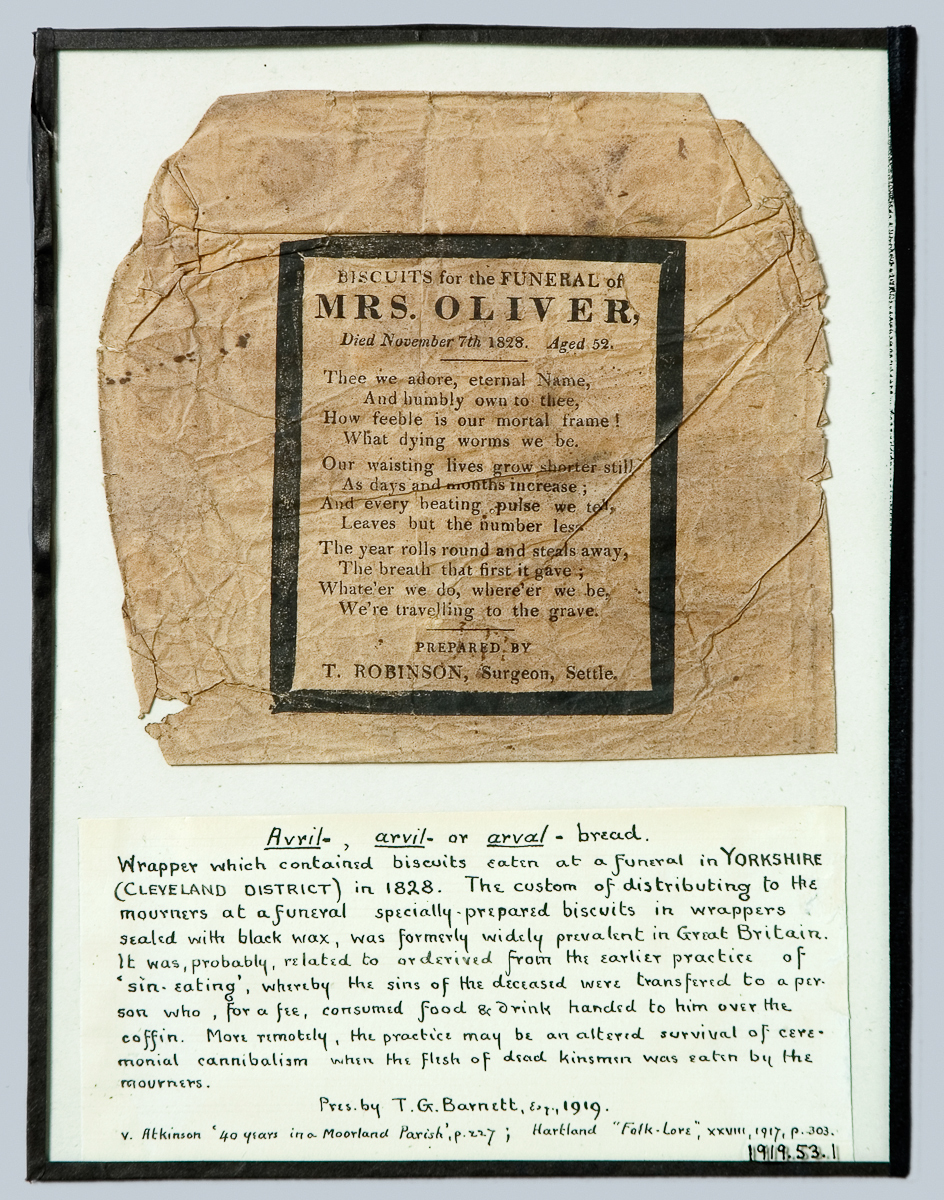
Brown paper biscuit wrapper with text from the funeral of Mrs. Oliver.
Biscuit wrapper for the funeral of Mrs. Oliver, Collection of the Pitt Rivers Museum, University of Oxford, Oxford, England.

In nineteenth-century England—particularly in Yorkshire and Lancashire—it was customary to send funeral biscuits to the family and friends of the recently deceased. These confections would often be served with wine to funeral guests, and the wrappers, which frequently bore the name of the deceased, became souvenirs for those who had been in attendance. While the collecting of funeral tokens, from gloves to spoons, was commonplace well before the nineteenth century, the distribution and collection of funeral biscuit wrappers seems to most closely anticipate—in design, materials, and text—contemporary practices surrounding funeral cards.

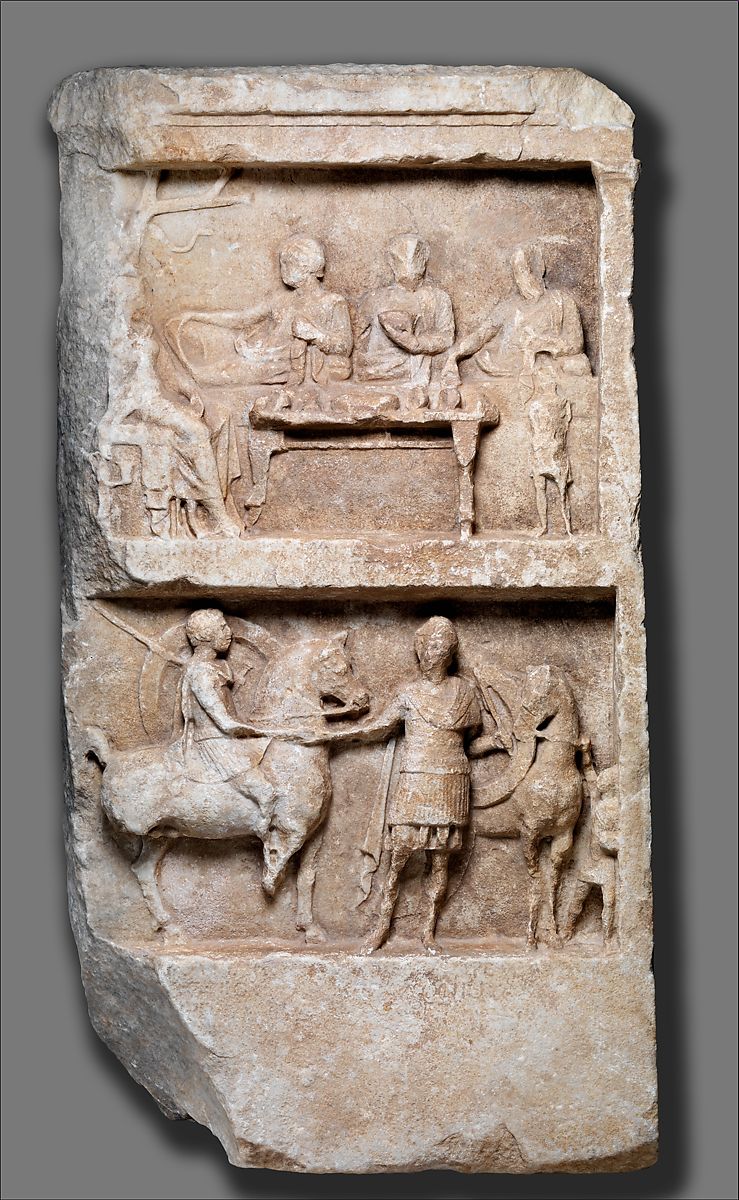
artwork on marble showing funerary banquet
Marble grave relief with a funerary banquet and departing warriors (2nd century B.C.), Collection of the Metropolitan Museum of Art, New York.

The custom has typically been seen as a relic of Antique practices in which funerary banquets and offerings of wine and cakes for the dead were standard commemorative practices. The English tradition has also been likened to the Welsh practice of sin-eating, in which a designated sin-eater would consume a ritual meal, passed to him over the coffin, in order to absorb the sins of the deceased.

An 1896 text on English customs describes the use of funeral biscuits as follows:

At a funeral near Market Drayton in 1893, the body was brought downstairs, a short service was performed, and then glasses of wine and funeral biscuits were handed to each bearer across the coffin. The clergyman, who had lately come from Pembrokeshire, remarked that he was sorry to see that pagan custom still observed, and that he had put an end to it in his former cure. […] At Padiham wine and funeral biscuits are always given before the funeral, and the clergyman is always expected to go to the house, and hold a service before the funeral party goes to church. Arval bread is eat at funerals at Accrington, and there the guests are expected to put one shilling on the plate used for handing round the funeral biscuits. (Ditchfield, 202-203)

This tradition was not limited to the British Isles. Variants could also be found in other countries of Northern Europe, and was carried to the American colonies in the seventeenth century by the English and Dutch settlers. Here, the life of the funeral cookie lasted through the nineteenth century, before crumbling in the twentieth. The tradition lives one, however, in the passing out of funeral cards that, like the packing of the funeral biscuit, function as mementos of the deceased.

Though the original recipe(s) for funeral biscuits seem to have been lost to time, some have suggested that ginger or molasses cookies would have been the go-to flavors in the eighteenth and nineteenth centuries. So, if you’re, like me, interested in resurrecting this uncanny confection, check out these historical and contemporary recipes!

Selected References:
Paul Chrystal, Confectionery in Yorkshire Through Time (Gloucestershire: Amberley Publishing, 2009).

Margaret Coffin, Death in Early America: The History and Folklore of Customs and Superstitions of Early Medicine, Funerals, Burials, and Mourning (New York: Elsevier/Nelson Books, 1976).

H. Ditchfield. Old English Customs Extant at the Present Time: An Account of Local Observances, Festival Customs, and Ancient Ceremonies yet Surviving in Great Britain (London: George Redway, 1896).

Robin M. Jensen, “Dining with the Dead: From the Mensa to the Altar in Christian Late Antiquity,” in Commemorating the Dead: Texts and Artifacts in Context, Studies of Roman, Jewish, and Christian Burials, eds. Laurie Brink and Deborah Green (New York: Walter de Gruyter, 2008)

Summer Strevens, The Birth of The Chocolate City: Life in Georgian York (Gloucestershire: Amberley Publishing, 2014).


‘Physician Heal Thyself!’: The Dr. Percy E. Ryberg Papers

Post contributed by Matthew Barrett, Graphic Artist and Historian at the Canadian War Museum

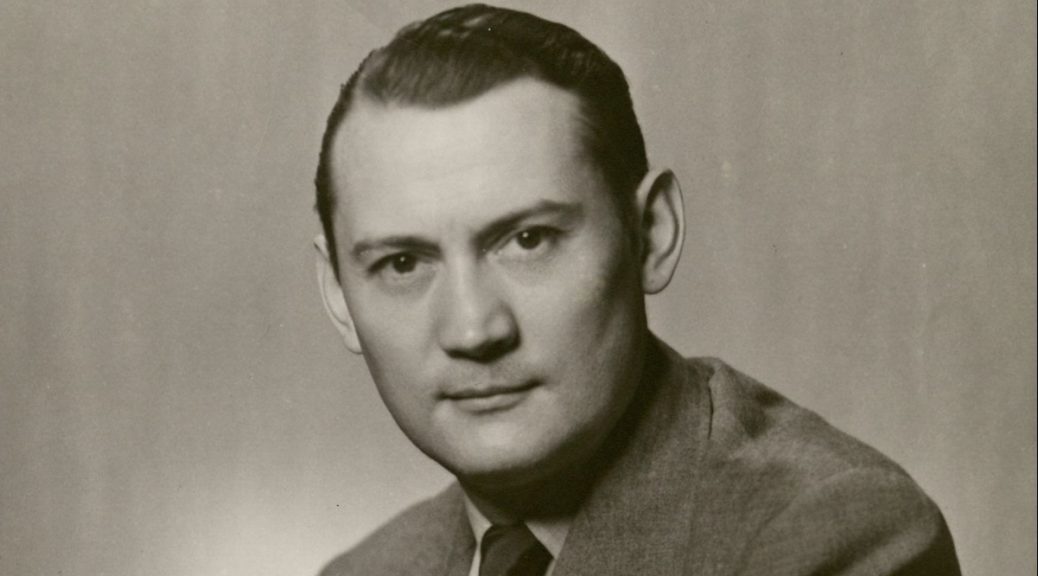
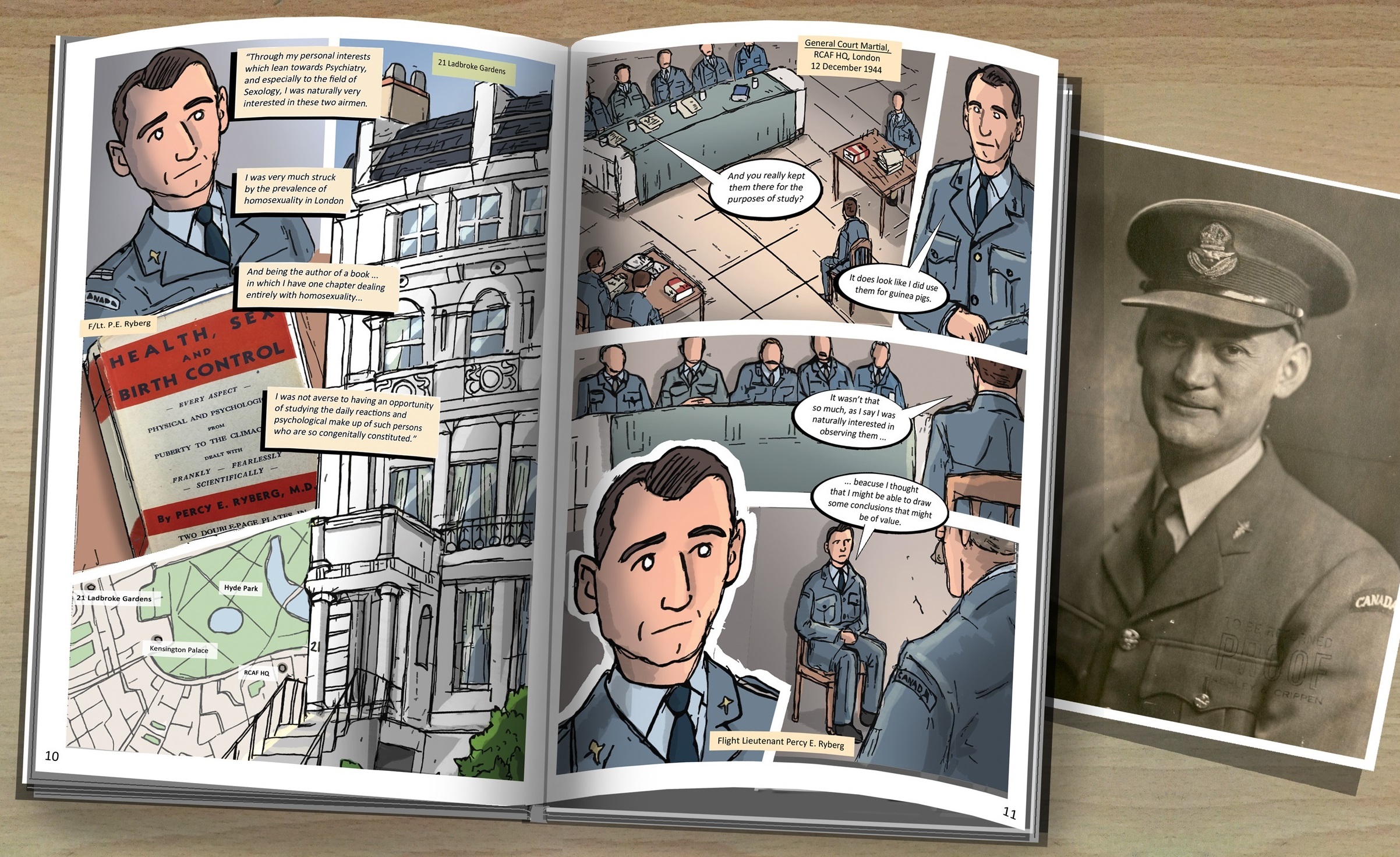
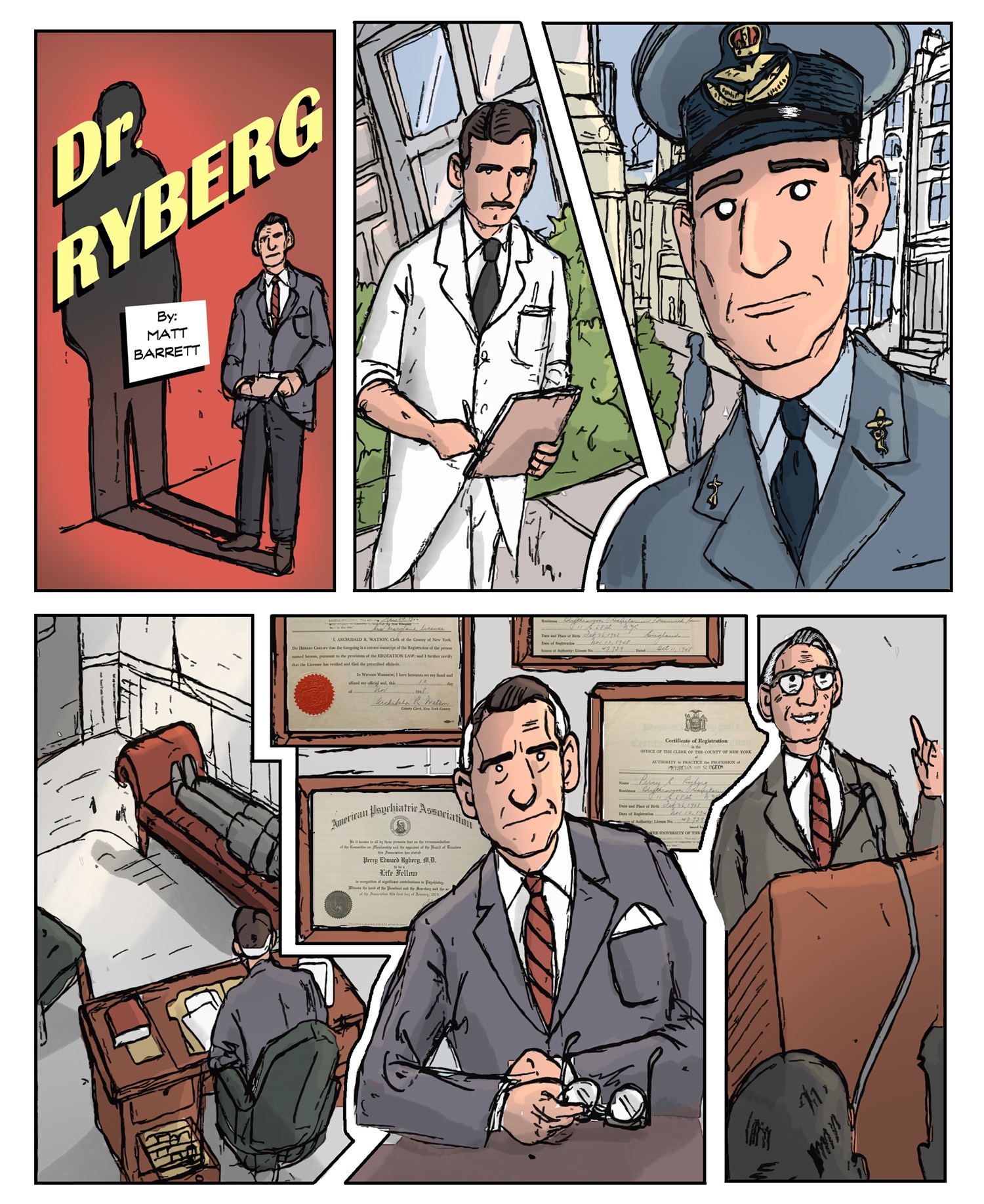
In December 1944, Flight Lieutenant Percy Edward Ryberg was sentenced to dismissal from the Royal Canadian Air Force (RCAF) for renting a London apartment with two airmen accused of homosexuality. Ryberg, a medical officer, had earlier published a book, Health, Sex and Birth Control (1942), which included a chapter devoted to understanding homosexuality. The circumstances of the case left me with many questions about Ryberg. I was intrigued to learn that the Rubenstein Library held Dr. Ryberg’s papers.

comic book showing Dr. Ryberg
Graphic history of Ryberg’s court martial, drawn by the author

Thanks to a History of Medicine Collections travel grant from Duke, in September 2019, I was able to explore Ryberg’s history in far more depth. The visit was well worth the trip as his writings and correspondence offered unique insights into his professional career and private life.

Ryberg was born on February 26, 1908 in England but grew up in Argentina. After graduating with a medical degree from the University of Buenos Aires in 1935, Ryberg worked as a physician in the city. Then in 1938 he earned a three-year fellowship to the Mayo Clinic. Following the outbreak of WWII, he joined the RCAF as a medical officer. He served overseas in England until his dismissal in December 1944.

After the end of his military service, Ryberg took up a position in psychiatry at Johns Hopkins University in June 1945. Within a few years he opened a private psychiatric practice in New York where he also received appointments to various clinics and hospitals. After a medical career that spanned seven decades, Ryberg died on December 16, 2001 at the age of ninety-three.

Despite having read thousands of pages from his diaries, letters, and memos, Ryberg remains something of an enigma to me. His papers reveal the complexity and contradictions of a private life that departed from the ideal he promoted. He wrote about sexual health and rejected judgmental morality but since teenage years he was deeply ambivalent about sex and tried to repress homoerotic feelings. He upheld marriage as the most important and profound experience in life, but privately called his own marriage a “convenience” that he said brought nothing but regret.[1] A constant theme in Ryberg’s life was the ambiguous definition of “normal.” It is a question that the doctor attempted to answer his entire career and was in part what led him to study medicine.

Page from graphic history
Graphic history (in style of Dr. Kildare comics) of Ryberg’s career, drawn by author

Ryberg sometimes acknowledged the contradictions at the center of his own life and professional identity. He complained that the public placed physicians and psychiatrists on pedestals only to express “spiteful triumph” when revered medical authorities are exposed for human faults and thereby “reveal their feet of clay.” He resented such sayings as “‘Practice what you preach!’ Or, ‘Physician, heal thyself!'” Ryberg argued that “the psychiatrist who is honest with himself and with others tries very hard to practice what he preaches, though he, like other people, may not always succeed.”[2]

I have only highlighted a few of the contradictions between his professional advocacy and private life, but his long career and contributions to psychiatry deserve far deeper analysis. I continue to work through his papers to better understand his life and experiences.

For more detail on Ryberg’s court martial and his medical career see my article, “Conduct Unbecoming an Officer and a Doctor: Medical Attitudes toward Homosexuality and the Court Martial of Dr. Percy Ryberg,” recently published in the Canadian Journal of History. It is freely available for a limited time at: https://utpjournals.press/doi/full/10.3138/cjh-2019-0053

Matthew Barrett is a SSHRC postdoctoral fellow at the Canadian War Museum. As an artist and historian his postdoc project explores graphic and illustrative storytelling as forms of historical interpretation and analysis.

[1] “Sample Column,” October 1954. Ryberg papers, box 3.

[2] Percy Ryberg, to Barbara Ryberg, 30 Oct 1953. Ryberg papers, box 2.

Early Birds for Lady Bird

Post contributed by Liz Adams, Rare Materials Cataloger

“I don’t know when I’ve ever been so flattered to see so many people getting up this early in the morning.”

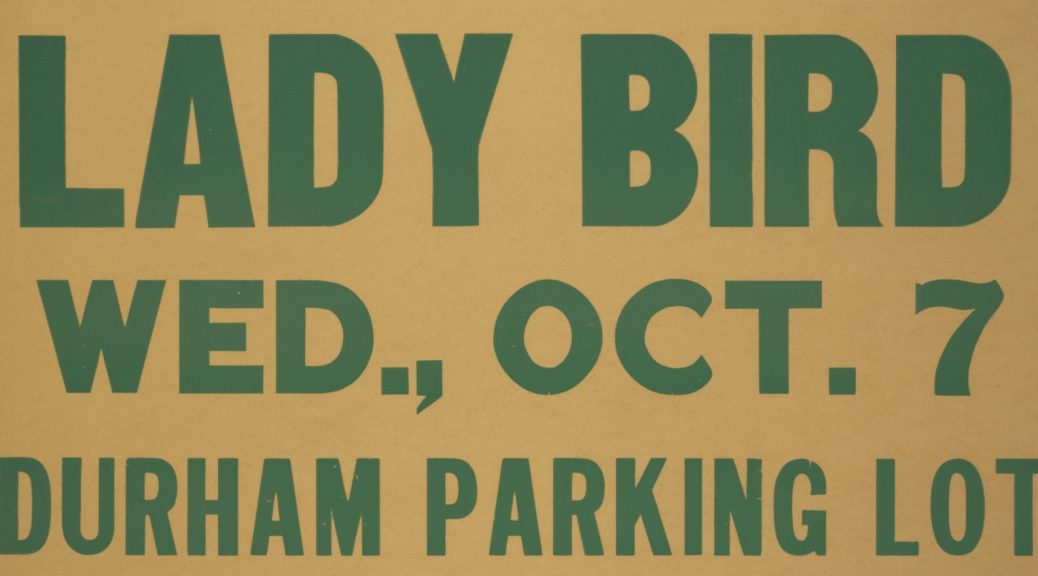
Lady Bird Johnson wasn’t exaggerating when she stumped for her husband’s presidential campaign in front of a crowd of 12,000 Durhamites on Wednesday, October 7th, 1964.  It was 6:45 AM when a group of “early birds for Lady Bird” congregated to meet her at the Durham Parking Lot, brandishing free coffee and donuts. It was 7:04 AM when North Carolina politicians—including Terry Sanford  (the governor and future president of Duke)—began their remarks. And it was 7:11 AM when the woman of the hour spoke behind Thalhimer’s department store in downtown Durham, highlighting the “present prosperity” of North Carolina, Lyndon B. Johnson’s familial connections to the state, and the Great Society he planned for the country.

Early Bird for Lady Bird poster
A flyer held by the Rubenstein Library offering free coffee and “do-nuts” for those waking up early to meet Lady Bird Johnson in downtown Durham.

To understand why Lady Bird Johnson stopped in Durham 56 years ago, we need to frame our story: It was 1964, and the Civil Rights Act (CRA) had just gone into effect on July 2nd. According to Hersch & Shinall (2014), the CRA “sought to improve access to voting, public accommodations, and employment as well as improve the overall status of individuals discriminated against on the basis of race, color, religion, sex, and national origin” (p. 425). At its heart, the CRA sought to create equalities where none existed, especially for Black Americans. It was and is an important, imperfect piece of legislation, one that only passed after years of tragedy and occasional triumph, including the 16th Street Baptist Church bombing, the March on Washington, and the assassination of John F. Kennedy, Jr. Relying on an uneasy coalition of Republican and Democrat votes, Lyndon B. Johnson plowed the CRA through Congress. Southern Democrats and the Republican nominee for president, Barry Goldwater, stood in opposition (Hersch & Shinall, 2014).

Lady Bird Johnson believed in the CRA and her husband. Just as relevant to our story, she was also a native Texan and is quoted saying—in a piece for PBS NewsHour by Judy Woodruff—that she was “proud of the South” and “proud that [she was] part of the South” (2014). Lady Bird Johnson thus knew she needed to act. And so as Meredith Hindley documents in “Lady Bird Special,” on October 6th, she climbed aboard a train named the Lady Bird Special and embarked on a Whistle Stop Tour, a four-day trip winding through eight Southern states. Liaising with local politicians and their partners, she shored up support for the CRA, defended her husband’s past decisions, and fought for his future plans. In total, she gave 47 speeches and traveled over 1600 miles. Occasionally her path intersected with Lyndon B. Johnson’s campaign trail, but for the most part, she travelled alone or with her daughters. Finally, on October 9th, 1964, the Lady Bird Special arrived in New Orleans, La., and the President and First Lady of the United States reunited (Hindley, 2013).

28 days later, on Tuesday, November 3rd, 1964, Americans went to the polls. In a landslide victory, Lyndon B. Johnson won 44 states (and Washington, D.C.), 15 million more votes than Barry Goldwater, and 486 Electoral College votes (Levy, 2019). And although five of the six states he lost were in the South, there was a southern state he didn’t lose: North Carolina (Levy, 2019).

Interested in hearing Lady Bird Johnson’s speech in Durham? The Lyndon B. Johnson Presidential Library has made the audio recording available on YouTube: https://www.youtube.com/watch?v=7fyDOFkmGg8


Citations

Hersch, J., & Shinall, J. B. (2014). Fifty Years Later: The Legacy of the Civil Rights Act of 1964. SSRN Electronic Journal. doi:10.2139/ssrn.2523481

Hindley, M. (2013, May/June). Lady Bird Special. Humanities, the Magazine of the National Endowment for the Humanities, 34(3). https://www.neh.gov/humanities/2013/mayjune/feature/lady-bird-special

Lady Bird’s Whistle Stop: Durham, NC: 10/7/64, 7:04 AM, Sound Recordings of Lady Bird Johnson’s   Whistle Stop Campaign Tour, 10/6/1964-10/9/1965, Records of the White House Communications Agency, LBJ Presidential Library, viewed via YouTube:  https://www.youtube.com/watch?v=7fyDOFkmGg8

Levy, M. (2019, October 27). United States presidential election of 1964. In Encyclopædia Britannica. Retrieved October 6, 2020, from https://www.britannica.com/event/United-States-presidential-election-of-1964

NewsHour, P. (2014, October 06). Remembering Lady Bird Johnson’s whistle-stop tour for civil rights. Retrieved October 06, 2020, from https://www.pbs.org/newshour/show/remembering-lady-bird-johnsons-whistle-stop-tour-civil-rights

Duke’s May Queen

Post contributed by Theodore D. Segal, guest contributor1

On September 26, 2020, Duke University announced that the Sociology-Psychology Building on its West Campus was renamed the Wilhelmina Reuben-Cooke Building to recognize Reuben-Cooke’s role as one of the “First Five” Black undergraduates at Duke and her many contributions to the university. A fitting honor, this recognition recalls a different time at Duke, one when Reuben-Cooke’s election as the school’s first Black May Queen stirred controversy.

* * * * * * * * *

Although by 1967 a number of longstanding traditions at Duke had been set aside, the annual practice of crowning a “May Queen” endured. Selection of the “Queen” was a centerpiece of popular “May Day” celebrations, a holiday whose origins date back to the ancient world. Villagers throughout Europe would collect flowers and participate in games, pageants, and dances throughout the day. It became customary to crown a young woman “May Queen” to oversee the festivities. During the early 20th century, selection of a May Queen became common at women’s colleges in the United States and had acquired a special meaning in the South. “The crowning of the May Queen as the ritual incantation of Southern society’s ideal of femininity,” historian Christie Anne Farnham wrote, “was a traditional event at Southern female schools. . . . The queen was usually elected by the students on the basis of ‘sweetness’ and beauty,” Farnham explained, although the father’s status often played a role.

May Queen traditions at Duke dated back to 1921 when the school was still known as Trinity College. The Trinity Chronicle reported that 2000 spectators attended May Day festivities that first year, and that the two-day celebration was spent “in gaiety and amusement.” Undergraduate Martha Wiggins was crowned Queen of May that year. The school newspaper wrote that she, “wore a lovely costume of shimmering white, bearing a corsage of white roses with her golden hair cascading in waves down her back, making a charming picture of perfect grace and absolute loveliness.”

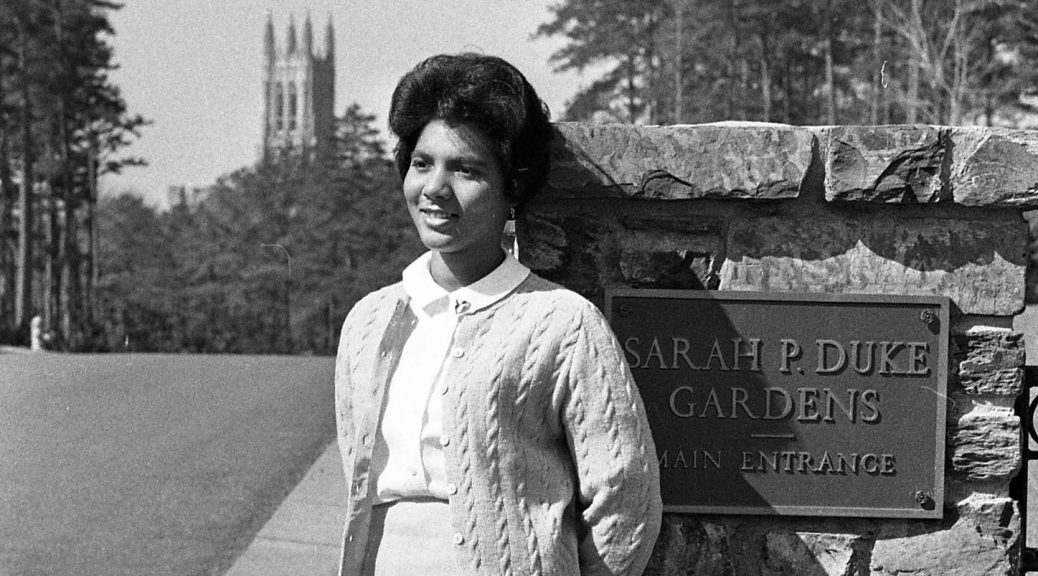
Wilhelmina Reuben-Cooke poses at the Anderson Street entrance to the Sarah P. Duke Gardens in 1967. She wears a cardigan and skirt, and the Duke Chapel is visible in the distance behind her.Given this context, it was newsworthy when Wilhelmina Reuben, a member of Duke’s first class of Black undergraduates, was selected as the Woman’s College May Queen in spring 1967. As runners up in the voting, white coeds Mary Earle and Jo Humphreys were designated to serve as Reuben’s “court.” The Associated Press picked up the news, reporting that “Mimi, as she is known to her friends, is a Negro—the first of her race to receive the honor at the women’s[sic] college of the university.” Chosen for her character, leadership, campus service, and beauty, Reuben had been selected May Queen by a vote of students in the woman’s college. A fact sheet on Reuben prepared by Mary Grace Wilson, dean of women, described her as “warm, friendly, perceptive and sensitive to the feelings of others.” Wilson called her “one of the most admired and highly respected students on the campus.” Reuben was a member of the freshman honor society and was elected to Phi Beta Kappa as a junior. A student intern at the State Department, she was listed in “Who’s Who Among Students in American Universities and Colleges. For her part, Reuben was pleased by her selection. “I’m still trying to adjust to it,” she told the Associated Press. “I’ve been walking around in a delightful haze of disbelief and excitement.”
Many at Duke were pleased with the news. Randolph C. Harrison, Jr., an alumnus from Richmond, Virginia, wrote to Douglas Knight, Duke’s president, that the “undergraduates’ choice of Miss Reuben as May Queen attests once more to Duke’s greatness. What a step towards inter-racial accord.”

If Reuben’s election represented progress to some, however, the prospect of a Black May Queen flanked by two white members of her “court” felt like a violation of the established social order to others. Jonathan Kinney, president of the Duke student government, saw the reaction when he had the responsibility of “crowning” the queen and her court. “I kissed all the rest of the panel,” he recalled, “so I kissed [Wilhelmina Reuben]. There were a lot of boos in that stadium at that time.” An anonymous alumnus sent the Duke president pictures of the “pretty May Queens chosen at Peace, St. Mary’s, and Meredith Colleges,” all of whom were white, along with a picture of Reuben, “a colored girl who was chosen May Queen at our Dear Ole Duke University.” The alumnus noted the “deplorable contrast between the May Queens of other colleges and the stunning representative from Duke.” He told Knight “Duke Alumni everywhere were stunned and several in South Carolina had strokes.” One correspondent, identified as a “lifelong, respected citizen of Wilmington, North Carolina,” outlined with exasperation the problems that Reuben’s election was creating at the city’s annual Azalea Festival where May Queens from throughout North Carolina were invited to attend:

The Sprunt’s annual garden party at Orton [Plantation] for the college queens (held for the past 20 years) has been cancelled; the Coastguard Academy, which was supposed to furnish her escort, says they don’t have a colored boy available; the private home in which she was supposed to stay is not now available; and there are all sorts of complications.

“The crowd who elected her has done a disservice to her,” the writer opined, “and placed a no doubt nice girl in an embarrassing situation.”

Finally, two trustees weighed in. C. B. Houck told Knight that he liked and respected “the colored people” and wanted them to have “every opportunity that the white people have.” Still, he thought Reuben’s election was in “bad taste” and that the “East Campus girls were leaning over backwards to be nice.” For Houck, the symbolism was deeply troubling. “To select a colored person for May Queen and have white maids of honor flanking her on either side,” he concluded, “makes for poor and critical relationship [sic] among many people, particularly in the South.” Trustee George Ivey was also deeply concerned. Writing from Bangkok, Thailand, he called Reuben’s selection “very upsetting to me.” Even if the selection was by Duke’s coeds, Ivey regretted “that the University has attracted the type of students that would vote for a Negro girl as a ‘beauty’ to represent the student body. It is nauseating to contemplate.”

By spring 1967, Duke had eliminated most of the school’s de jure discriminatory policies and practices. Reuben’s election as May Queen could be seen as another positive sign of racial progress. But the episode also shined a spotlight on the depth of attachment some still had to traditional racist ideas. These attitudes would become even more pronounced in the months to come as Black student activism accelerated on campus.

1Ted Segal is a Duke graduate (A.B. 1977), retired lawyer, and a board member of the Center for Documentary Studies at the school.  His book, POINT OF RECKONING: The Fight for Racial Justice at Duke University, will be published by Duke University Press in February 2021. Special thanks to the Duke University Archives for preserving the historical records quoted in this piece and for making them readily accessible.

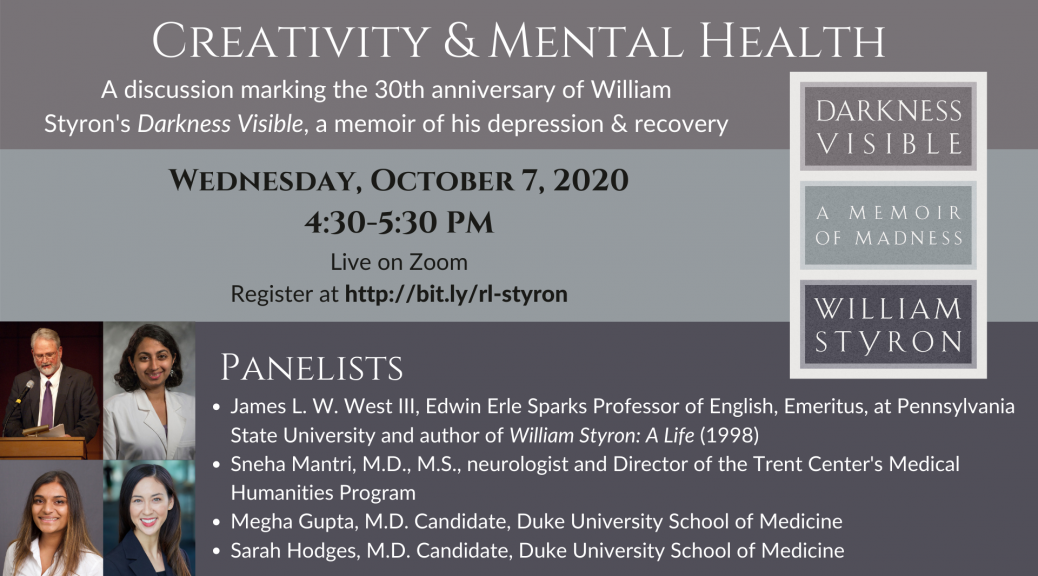
Oct. 7th ONLINE: Creativity and Mental Health

Date: Wednesday, October 7, 2020
Time: 4:30-5:30 PM
Register: http://bit.ly/rl-styron (Registration required to receive Zoom link)

Please join the staff of the David M. Rubenstein Rare Book & Manuscript Library for a free ONLINE event on creativity and mental health.

This event recognizes the 30th anniversary publication of William Styron’s Darkness Visible, a memoir of his depression and recovery. Along with discussing Styron’s work, our panelists will speak to the role of creativity, writing, and mental health.

Talks will be provided by:

  • James L.W. West III, Edwin Erle Sparks Professor of English, Emeritus, Pennsylvania State University, author of William Styron: A Life (1998)
  • Sneha Mantri, M.D., M.S., neurologist and Director of the Trent Center’s Medical Humanities Program
  • Megha Gupta, M.D. Candidate, Duke University School of Medicine
  • Sarah Hodges, M.D. Candidate, Duke University School of Medicine

OUCH! : Over a Century of Getting Vaccinated at Duke

Post contributed by Brooke Guthrie, Research Services Librarian.

You may have noticed (and we really hope that you have) that campus life is a bit different in Fall 2020. We’re all wearing masks, washing our hands, and obsessively monitoring our symptoms. We’ve also spent at least a few minutes speculating on the many unknowns—including the possibility of a coronavirus vaccine and how it might be distributed to the Duke community. The Duke Compact asks students, staff, and faculty to pledge to “Get the flu shot and other required vaccinations by designated deadlines.” And that made us wonder about the history of vaccinations at Duke.

You can learn a lot about Duke history from the Duke Chronicle and its predecessor, the Trinity Chronicle. Luckily for us, issues of the newspaper from 1905 to 2000 have been digitized by Duke University Libraries and can be fairly easily searched. Searching the newspaper reveals that campus-wide vaccination efforts are nothing new to Duke. Here are a few of the examples we found.

We’ll start by going way, way back to a time before Duke was called Duke. In 1914, during the Trinity College days, a vaccine against typhoid fever was offered to students, faculty, and their families. In addition to announcing the availability of the vaccine, the Trinity Chronicle published information on the effectiveness and safety of the vaccine as well as the number of deaths caused by typhoid in the state (about 1,200 each year). The article ends by noting that the administration “is anxious to see a large number of students avail themselves of the opportunity to obtain immunity from typhoid.”

The front page of the October 7, 1914 Trinity College. The headline to the relevant article reads "Typhoid Vaccine is Offered Trinity Men."
October 7, 1914 front page of the Trinity Chronicle with article discussing typhoid vaccine. Read article.

A little over a decade later, in 1928, students were asked to get a smallpox vaccine. The very short announcement suggests that vaccination is no big deal: “the nurse will give the vaccines in a few minutes, and it will all be over.” Although noting that there were no serious cases on campus, the article says that six students were confined and lists their names. (Reporting campus illnesses and including the names of the ill was a fairly common practice back then.)

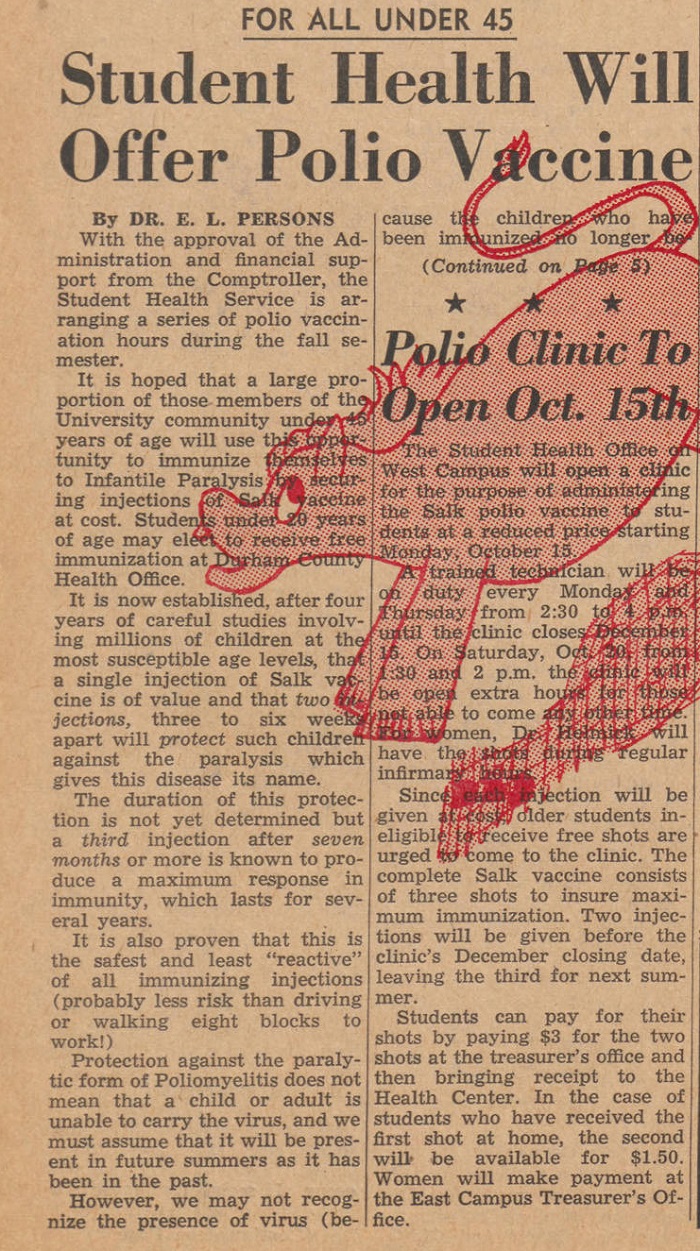
Polio was perhaps one of the most troubling diseases in the mid-twentieth century and the widespread concern was justified. In 1948, the worst year for polio in North Carolina, 2,516 cases and 143 deaths were reported in the state. In October of 1950, a Duke undergraduate named Daniel Rathbun died after contracting polio and spending two weeks in an iron lung at Duke Hospital. When a polio vaccine became available in 1955, vaccination campaigns were held throughout the country. In October of 1956, the Duke Chronicle announced that student health would offer the vaccine to all under 45 years old. For students, the vaccine cost $3.00. The article discusses what is known about the relatively new vaccine, emphasizes the importance of getting vaccinated, and notes that previously most college students were required to get vaccinated for typhoid fever (as if to say “why should this be any different?”).

October 12, 1956 Duke Chronicle article announcing polio vaccinations on campus. The headline reads "For All Under 45: Student Health Will Offer Polio Vaccine."
October 12, 1956 Duke Chronicle article announcing polio vaccinations on campus. Read article.

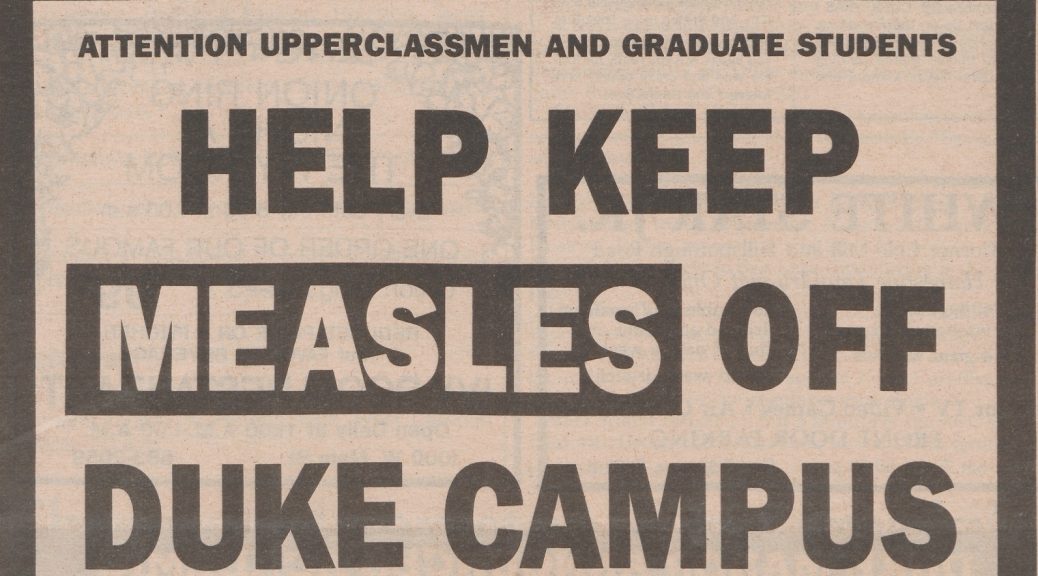
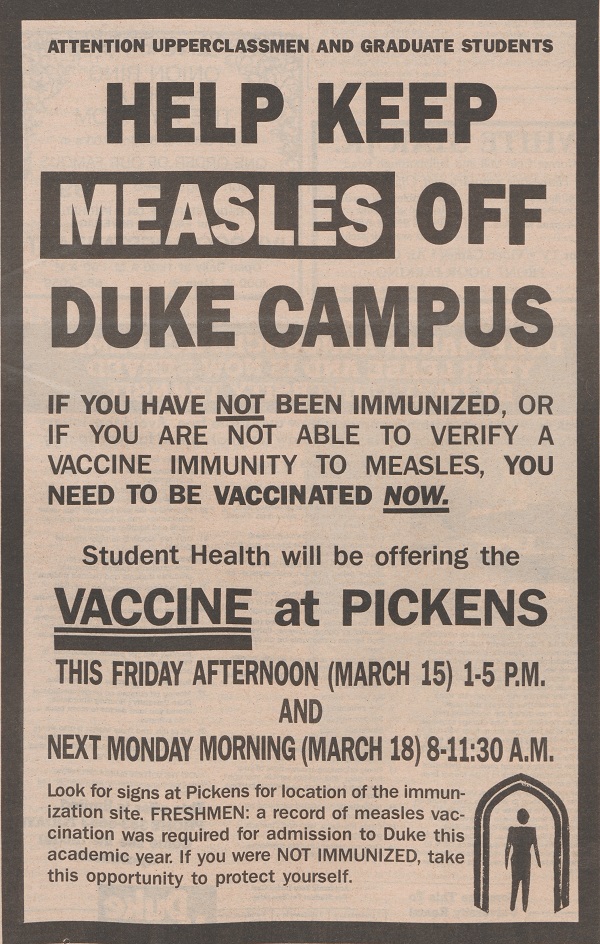
Efforts to vaccinate campus continued through the rest of the 20th century. In the mid-1970s, an outbreak of swine flu in the United States led to a nationwide vaccination drive. In November of 1976, Duke announced that it had 5,000 shots available to students and staff. In the 1980s, measles was a cause for concern on campus. In March 1985, the Chronicle published a large notice to let unvaccinated students know that “YOU NEED TO BE VACCINATED NOW.” A few years later in January 1989, a statewide outbreak spread to campus and Duke quickly “issued more stringent vaccination requirements” for both students and staff. Soon after Duke issued the new requirements, all unvaccinated students and staff were excluded from campus for two weeks. Staff were told to stay home. Students were barred from campus housing and had their Duke cards deactivated.

Notice published in the March 15, 1985 Duke Chronicle directing students to get the measles vaccine. The ad begins: "Attention Upperclassmen and Graduate Students: Help Keep Measles Off Duke Campus."
Notice published in the March 15, 1985 Duke Chronicle directing students to get the measles vaccine.

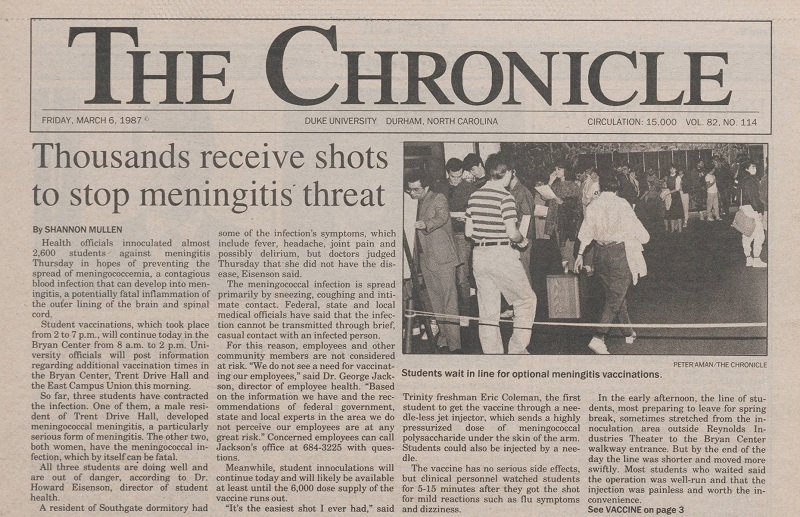
Concerns around meningitis in 1987 brought similar calls for large scale vaccination after a small number of students were infected. The Chronicle reported that mandatory vaccination was possible and, in March of 1987, thousands of students received a vaccine in a single day as part of the administration’s goal to distribute 6,000 doses.

Article on the front page of the March 6, 1987 Chronicle. The headline reads "Thousands receive shots to stop meningitis threat." A black-and-white photo of students waiting in line for the vaccinations accompanies the article.
Coverage of the 1987 meningitis vaccine effort of campus. Read article.

There are many other examples of vaccination efforts in Duke’s history—the campus-wide distribution of the annual flu vaccine is one we’re all familiar with and, in 1999, students were encouraged to get a hepatitis B vaccine with a hip Chronicle advertisement that said “Hepatitis B is a very uncool thing” and the vaccine will keep you from “turning an embarrassing shade of yellow.”

If you’re interested in exploring this history more, try searching digitized issues of the Duke Chronicle or get in touch with our helpful staff. And, while we have your attention, make sure to get your flu vaccine this year!