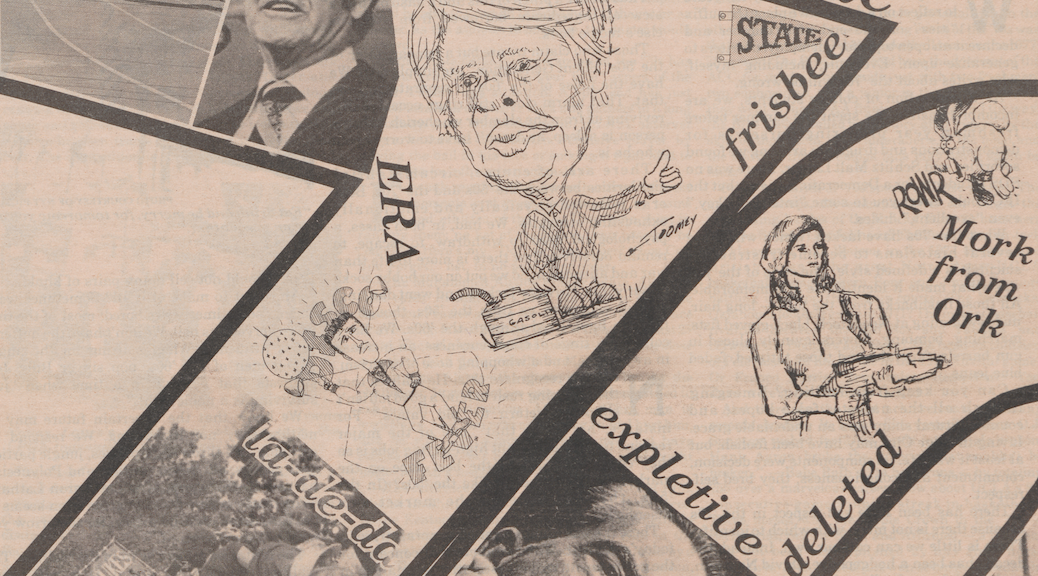
The 1970s are here! That is, in digital form. The Duke Chronicle digital collection now includes issues from the grooviest decade of the twentieth century.
The American memory of the 1970s is complex, wavering from carefree love to Vietnam and civil rights. As the social turmoil of the 1960s flowed into the 1970s, Terry Sanford was sworn in as president of Duke University. This marked the beginning of his sixteen-year term, but also marked the decade in which Sanford twice ran for president and partook in heated debates with Alabama governor George Wallace. He presided over the university In the midst of the Vietnam War and national protests, the Watergate scandal, and the aftermath of the Allen Building occupation in 1969.
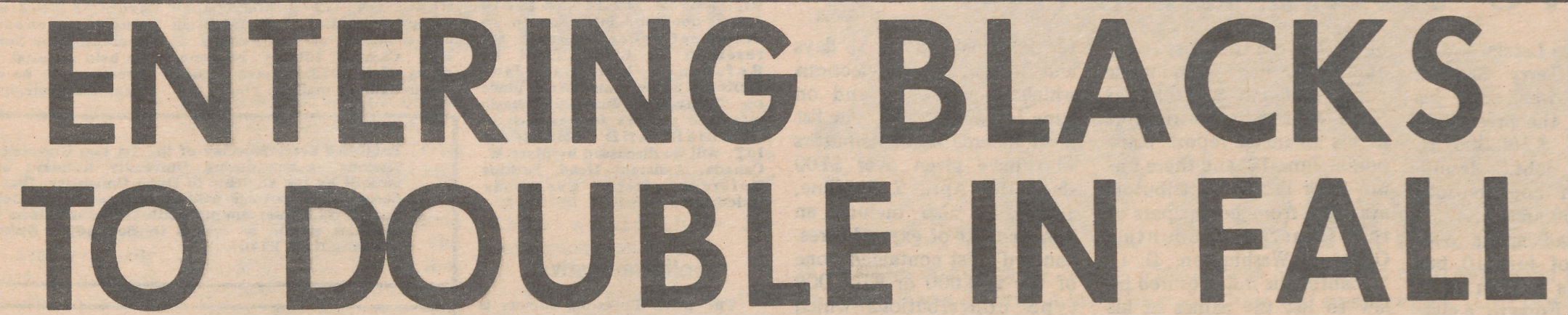
In response to the demands from the Allen Building takeover, the Duke University community worked to improve social inequalities on campus. The 1972 incoming freshman class boasted more than twice as many black students than ever before in university history. Black Studies Program faculty and students struggle to create their own department, which became a controversial event on campus throughout the ‘70s. One Chronicle article even tentatively labeled 1976 as “The Year of the Black at Duke,” reflecting the strides made to incorporate black students and faculty into campus life and academics.
The 1970s was also a decade of change for women at Duke. In 1972, Trinity College and the Woman’s College merged, and not all constituents agreed with the move. Women’s athletics were also shaken by the application of Title IX implemented by the Department of Health, Education and Welfare (HEW), that prohibited discrimination on the basis of sex. This regulation significantly impacted the future of the Physical Education Department as well as women’s sports at Duke.
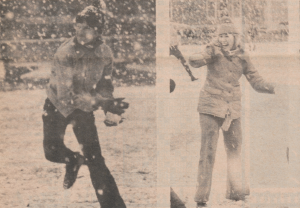
Look Familiar? Amidst this sea of change at Duke, there were many things that brought students joy — like the Blue Devils defeating UNC 92-84 in basketball, and snowball fights in November.
The addition of the 1970s to the Duke Chronicle digital collection marks a milestone for the Digital Projects and Production Services Department. We can now provide you with a complete run of issues from 1959 to 1989, and the 1950s will be heading your way soon! We invite you to explore the 1970s issues and see for yourself how history unfolded across the nation and across Duke campus.
Q: How is a silent H. Lee Waters film like an oral history recording?
A: Neither is text searchable.
But, leave it to oral historians to construct solutions for access to audiovisual resources of all stripes. No mistake, they’ve been thinking about it for a long time. Purposefully, profoundly non-textual at their creation, oral histories have since their postwar genesis contended with a central irony: as research they are exploited almost exclusively via textual transcription. Oral histories that don’t get transcribed get, instead, infamously ignored. So as the online floodgates have opened and digital media recorders and players have kept pace, oral historians have seen an opportunity to grapple meaningfully with closing the gap between the text and its source, and perhaps at the same time free the interview from the expectation that it should be transcribed.
Enter OHMS (http://www.oralhistoryonline.org/). In 2013, Doug Boyd at the University of Kentucky debuted the results of an IMLS-funded project to create the Oral History Metadata Synchronizer. A free, open-source tool, OHMS empowers even the smallest oral history archive to encode its media with textual information. The OHMS editor enables the oral historian to easily create item level metadata for an oral history recording, including an index or subject list that can drop a researcher into an interview at that selected point. OHMS can also timestamp an existing transcript, so that researchers can track the audio via the text. In its short life, OHMS has demonstrated a way to bridge the great divide among oral history theorists, which reads something like this: Should our focus be the audio or the transcript?
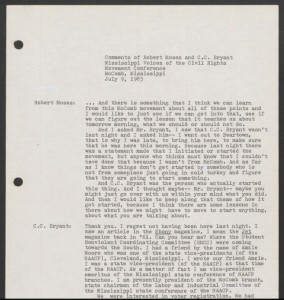
While it springs from the minds of oral historians, OHMS might more accurately be termed the Media Metadata Synchronizer. When I saw Doug’s presentation on OHMS at the Oral History Association meeting in 2013, two alternative uses immediately came to mind: OHMS had the potential to help us provide bilingual entry to the 3,500+ recordings in our Radio Haiti Collection (currently being digitzed), and it could dramatically enhance access to one of Duke’s great collections, the H. Lee Waters Films. Waters filmed his Movies of Local People in mostly smaller communities around North Carolina from 1936-1942, using silent reversal film stock. Waters’ effort to supplement his family’s income has over the intervening years become a major historical document of the state during the Great Depression. And yet as rich as the collection is, it is difficult for students, scholars, and filmmakers to find specific scenes or subjects among the thousands of two-second shots Waters put to film. Several years ago, an intern in the archive created shotlists for some of the films, but these existed independently of the films and were not terribly accurate in matching times since they were created using VHS tapes (and VHS players are notorious for displaying incorrect times). OHMS would give us the opportunity to update the shotlists we had and create some new ones, linking description to precise points within the films.
Implementing OHMS at Duke Libraries was a pleasure, mostly because I had the opportunity to work with my colleagues in Digital Projects and Production Services, an outstanding team that can do amazing things with our equally amazing archival resources. Recognizing the open-source spirit of OHMS, Sean Aery, Will Sexton, and Molly Bragg immediately saw how the system could help us get deeper into the Waters films without having to build out a complex infrastructure (or lay out lots of cash). And so, when the H. Lee Waters website went live last year with 35 hours of mostly undescribed digital video (although we did post those older shotlists too, where we had them), it was generally agreed that a phase two would happen sooner rather than later and include a pilot for OHMS shotlists. Rubenstein Audiovisual Intern Olivia Carteaux worked diligently through the spring to normalize existing shotlists and create new ones where possible. This necessitated breaking down the descriptive data we had into spreadsheets, so we could then “crosswalk” the description into the OHMS xml file that is at the heart of the system.
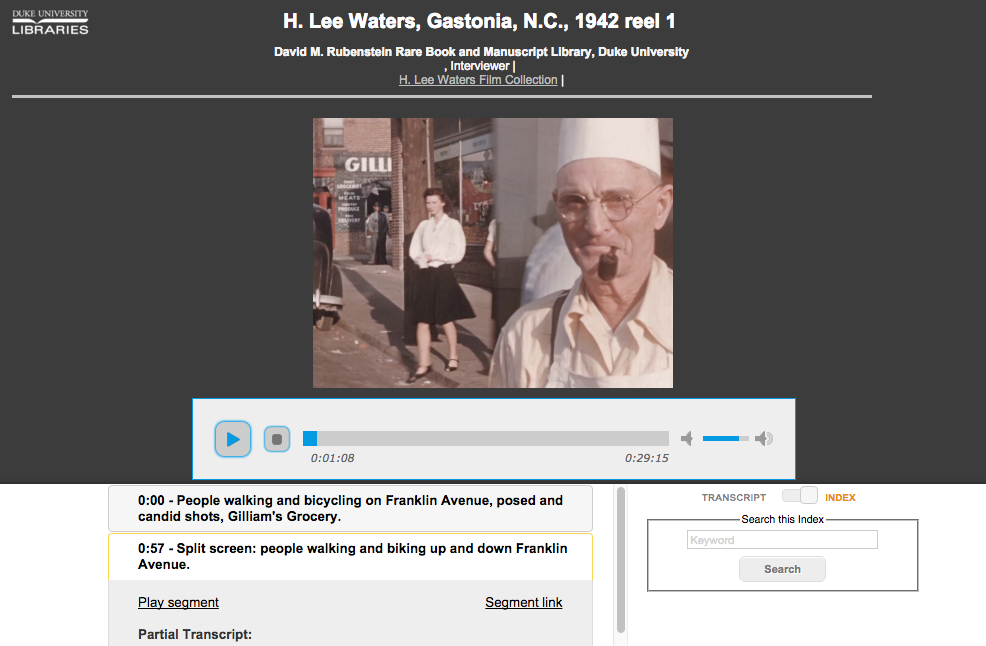
While the OHMS index viewer allows for metadata including title or description, partial transcript, segment synopsis, keywords, subjects, GPS coordinates and a link to a map, we concentrated on providing a descriptive sentence as the title and, where it was easy to find, the location of the action.
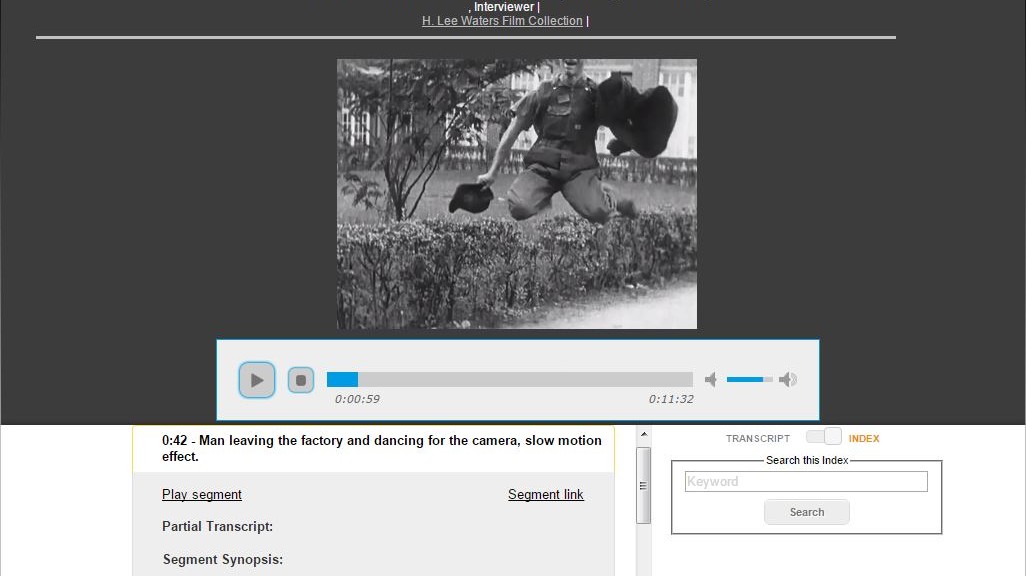
The OHMS interface in action
While on the face of it generating description for the H. Lee Waters films might seem fairly straightforward, we found a number of challenges in describing his silent moving images. For starters, given Waters’ quick edits, what would adequate frequency of description look like? A new descriptive entry at every cut would be extremely unwieldy. At the same time we recognized that without a spoken or textual counterpart to the image, every time we chose not to describe would deprive potential users of a “way in.” We settled on creating entries whenever the general scene or action changed; for instance, when Waters shifts from a scene on main street to one in front of a mill or school, or within the scene at a school when the action goes from schoolyard play to the pledge of allegiance. Sometimes the shifts are obvious, other times they are more subtle, so watching the action with a deep focus is necessary. We also created new entries whenever Waters created a trick shot, such as a split screen, a speed up or slow down of the action, a reverse shot, or a masking shot. Additionally, storefront signs, buildings, and landmarks also became good places to create entries, depending on their prominence; for these, too, we attempted to create GPS coordinates where we could easily do so.
Our second challenge was how much to invest in each description. “A picture is worth a thousand words” and “every picture tells a story” sum up much of the Waters footage, but brevity was of value to the workflow. One sentence, which did not have to be properly complete — a sort of descriptive bullet point — was decided on as our rule of thumb. In the next phase of this process I hope to use the keywords field more effectively, but that requires a controlled vocabulary, which brings me to our third challenge: normalizing description was the most difficult single piece of describing the films. Turns out there’s not a lot of library-based methodology for describing moving images, although there are general recommended approaches for describing images for the visually impaired. Then, of course, there’s the difficulty in deciding how to represent nuanced factors such as race, ethnicity, class, and gender. It is clear that in the event we undertake to create shotlists for all the Waters films, the first order of business will be to create a thesaurus of terms, to provide consistent description across the films.
When we felt like we had enough transformed shotlists for a pilot OHMS project for the Waters website, the OHMS player was loaded onto a server and the playlists uploaded. Links to the 29 shotlists were then placed below the video windows on their respective pages. To access the video and synchronized description, simply click on the link that says “Synchronized Shot List.” In this initial run we’re hoping to upload about 20 more shotlists, and at that point take a breath and see how we can improve on what we’ve accomplished. Given the challenges of presenting audiovisual resources online, there’s never really a “done,” only steady improvement. OHMS has provided what I believe is a clear step forward on access to the Waters films, and has the potential to help us transform other audiovisual collections into deeply mined treasures of the archive.
Post contributed by Craig Breaden, Audiovisual Archivist, Rubenstein Library
Yesterday was Back to the Future day, and the Internet had a lot of fun with it. I guess now it falls to each and every one of us, to determine whether or not today begins a new future. It’s certainly true for Duke Digital Collections.
Today we roll out – softly – the first release of Tripod3, the next-generation platform for digital collections. For now, the current version supports a single, new collection, the W. Duke, Sons & Co. Advertising Materials, 1880-1910. We’re excited about both the collection – which Noah Huffman previewed in this blog almost exactly a year ago – and the platform, which represents a major milestone in a project that began nearly a year ago.
The next few months will see a great deal more work on the project. We have new collections scheduled for December and the first quarter of 2016, we’ll gradually migrate the collections from our existing site, and we’ll be developing the features and the look of the new site in an iterative process of feedback, analysis, and implementation. Our current plan is to have nearly all of the content of Duke Digital Collections available in the new platform by the end of March, 2016.
The completion of the Tripod3 project will mean the end of life for the current-generation platform, which we call, to no one’s surprise, Tripod2. However, we have not set an exact timeline for sunsetting Tripod2. During the transitional phase, we will do everything we can to make the architecture of Duke Digital Collections transparent, and our plans clear.
After the jump, I’ll spend the rest of this post going into a little more depth about the project, but want to express my pride and gratitude to an excellent team – you know who you are – who helped us achieve this milestone.
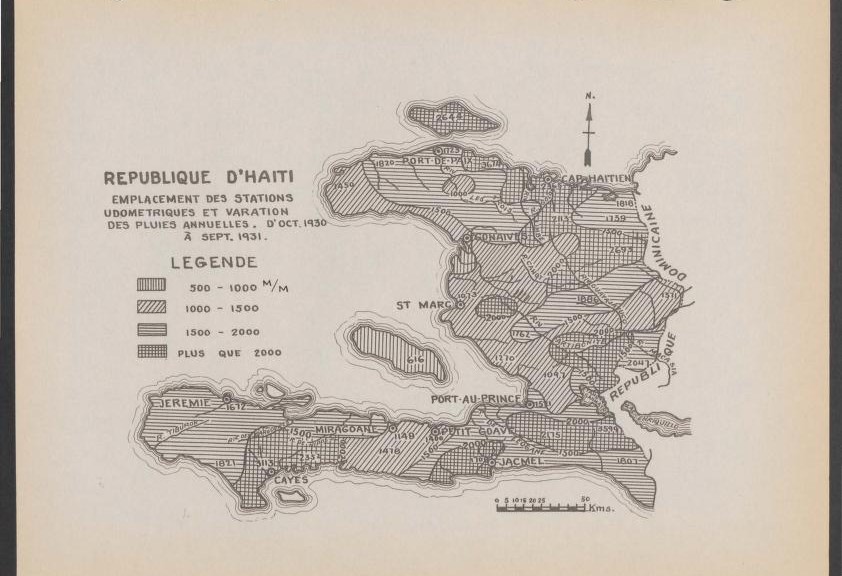
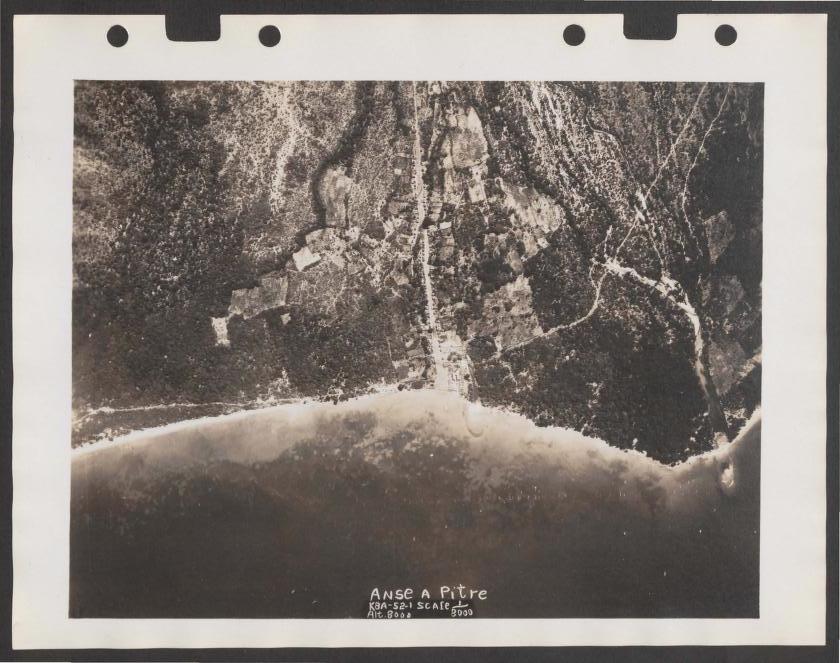
In 2014 the Rubenstein Library acquired the Monograph of Haiti, an aggregation of intelligence information gathered by the U.S. Marine Corps during their occupation of the country between 1915-1934. This item has recently been digitized, and this week guest bloggers Holly Ackerman and Sara Seten Berghausen introduce us to the monograph and its provenance.
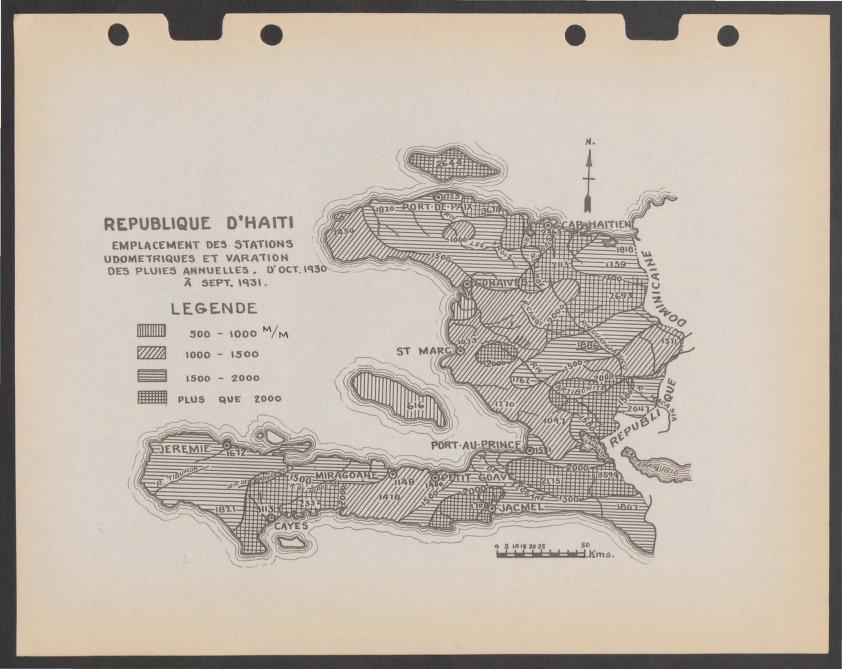
Interior image from the Monograph of Haiti
The catalog of the U.S. Marine Corps Archives is not publically available. Marine regulations make it necessary for researchers wanting to explore the Archives’ holdings to physically go to Quantico, Virginia. Once there, they must rely on expert staff to conduct a search for them. Researchers are then free to look at the materials.
Like any prohibition, the lack of direct access creates both frustration and allure. As the number of Duke faculty and students studying Haiti increased over the last five years, Holly Ackerman, Duke’s Librarian for Latin American and Caribbean Studies, felt the pull of possible treasure and traveled to Quantico. Since the U.S. Marines had occupied Haiti from 1915 – 1934, it seemed likely that there would be significant collections that might interest our scholars.
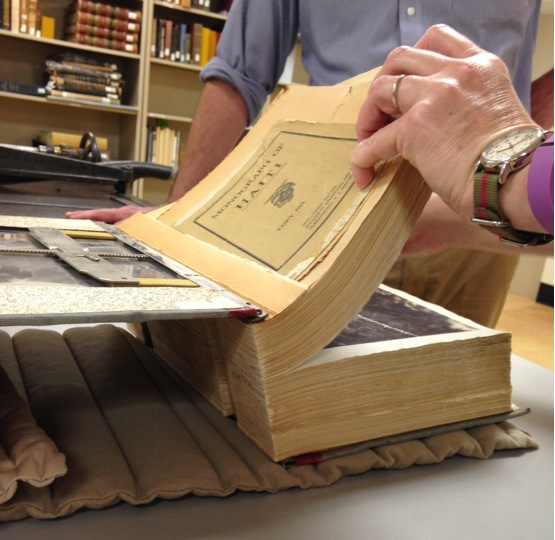
An image of the Monograph prior to digitization.
The archives did not disappoint. Chief among the treasures was The Monograph of the Republic of Haiti, a book that looks more like an old accountant’s ledger than the accumulation of intelligence information from the U.S. occupation era that it really is. On its opening page the Monograph declares its purpose,
“The object of this book is to provide operative and war information upon the Republic of Haiti. A monograph aims to be so thorough a description of the country upon which it is written that the Commander of any Expedition approaching its coasts will have at his disposal all the information obtainable to commence active operations in case of a hostile invasion or a peaceful occupation, and to facilitate his diplomatic routine mission in time of peace.”
Since the Marine Corps Archive owned two of only six known copies of the Monograph, they offered to donate one to the Rubenstein Library at Duke. It was received in the Spring of 2014. The intent of the Marine Corps Archive was to share the monograph as widely as possible. To fulfill that pledge, the Duke Libraries’ Digital Production Center cataloged, conserved and digitized the Monograph in 2015, making it available worldwide via the Internet Archive. Scholars in Haiti and the U.S. have begun using the resource for research and teaching.
Image of an interior page from the Monograph of Haiti
Post Contributed by Holly Ackerman, Librarian for Latin American, Iberian and Latino/a Studies and Sara Seten Berghausen, Associate Curator of Collections, Rubenstein Library
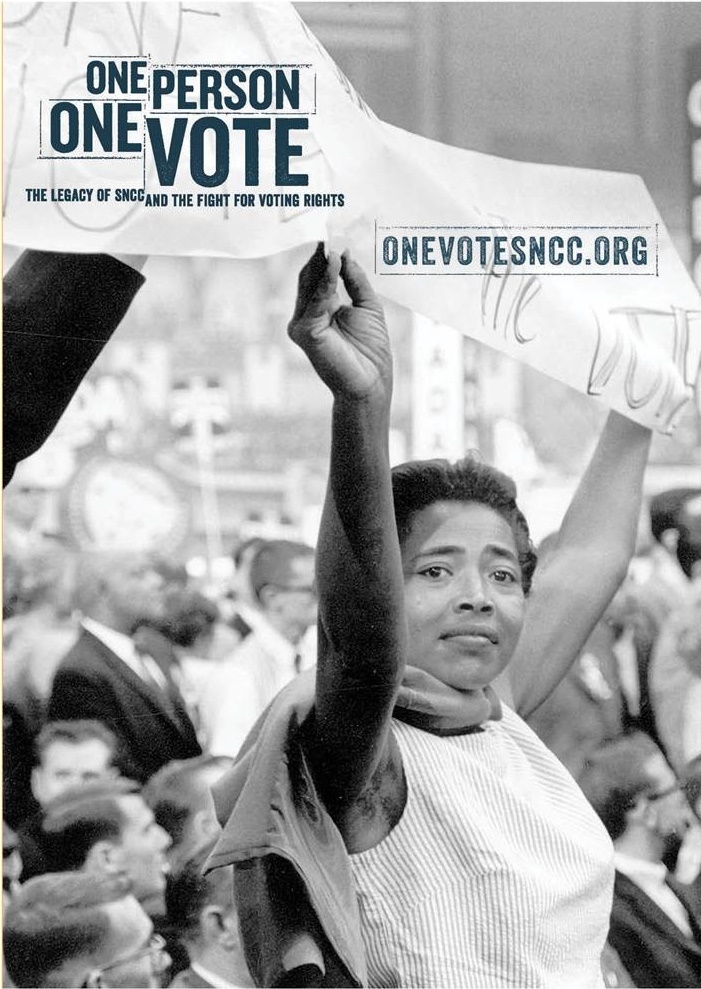
Promotional postcard for One Person, One Vote site.
Last year we at Duke University Libraries circulated a prospectus for our still-young partnership with the SNCC Legacy Project, seeking bids from web contractors to help with developing the web site that we rolled out last March as One Person, One Vote (OPOV). Now, almost 18 months later, we’re back – but wiser – hoping to do it again – but bigger.
Thanks to a grant from the Mellon Foundation, we’ll be moving to a new phase of our partnership with the SNCC Legacy Project and the Center for Documentary Studies. The SNCC Digital Gateway will build on the success of the OPOV pilot, bringing Visiting Activist Scholars to campus to work with Duke undergraduates and graduates on documenting the historic drive for voting rights, and the work of the Student Nonviolent Coordinating Committee.
As before, we seek an experienced and talented contractor to join with our project team to design and build a compelling site. If you think your outfit might be right for the job, please review the RFP embedded below and get in touch.
Ah, the 1980s…a decade of perms, the Walkman, Jelly shoes, and Ziggy Stardust. It was a time of fashion statements I personally look back on in wonderment.
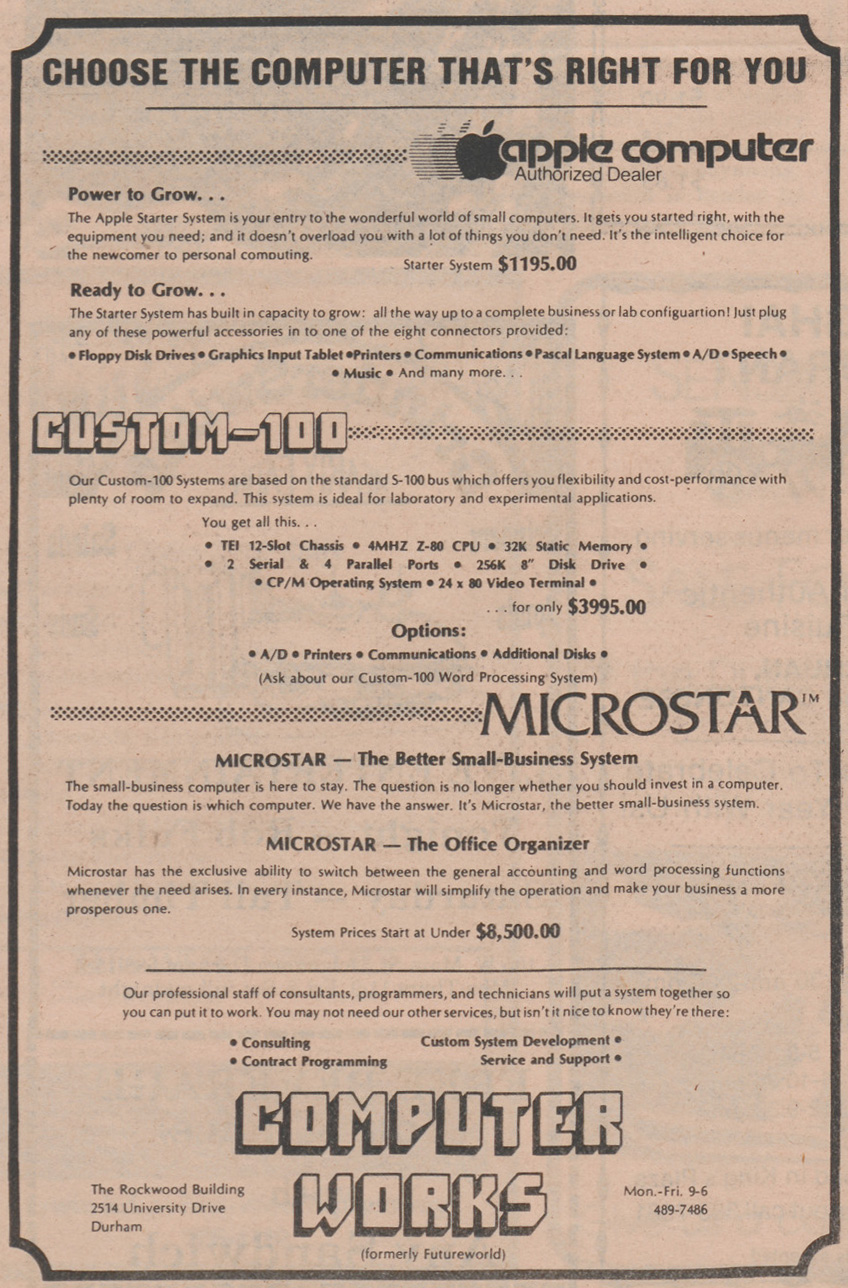
Personal Computer Ad, 1980
Fashionable leotards, shoulder pads, and stirrup pants were all the rage. And can we say parachute pants? Thanks, MC Hammer. If you’re craving a blast from the past, we’ve got you covered. The digitized 1980s Duke Chronicle has arrived! Now you can relive that decade of Hill Street Blues and Magnum P.I. from your own personal computer (hopefully,you’re not still using one of these models!).
As Duke University’s student-run newspaper for over 100 years, the Duke Chronicle is a window into the history of the university, North Carolina, and the world. It may even be a window into your own past if you had the privilege of living through those totally rad years. If you didn’t get the chance to live it firsthand, you may find great joy in experiencing it vicariously through the pages of the Chronicle, or at least find irony in the fact that ’80s fashion has made a comeback.
The 1980s also saw racial unrest in North Carolina, and The Duke Chronicle headlines reflected these tense feelings. Many articles illustrate a reawakened civil rights movement. From a call to increase the number of black professors at Duke, to the marching of KKK members down the streets of Greensboro, Durham, and Chapel Hill, North Carolinians found themselves in a continued struggle for equality. Students and faculty at Duke were no exception. Unfortunately, these thirty-year-old Chronicle headlines would seem right at home in today’s newspapers.
The 1980s Chronicle issues can inform us of fashion and pop culture, whether we look back at it with distaste or fondness. But it also enlightens us to the broader social atmosphere that defined the 1980s. It was a time of change and self-expression, and I invite you to explore the pages of the Duke Chronicle to learn more.
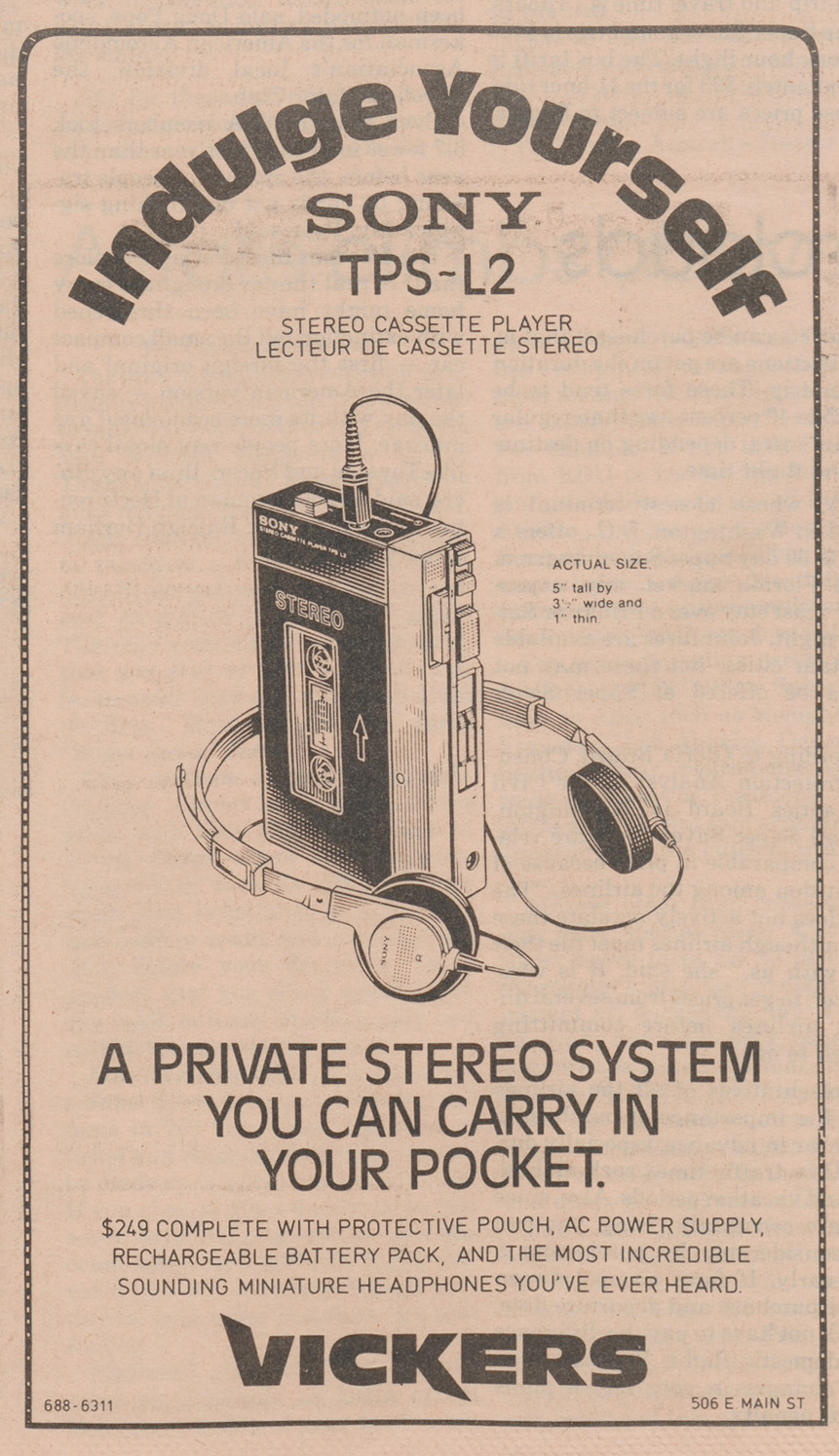
Fashion Ad, May 10, 1984
The addition of the 1980s issues to the online Duke Chronicle digital collection is part of an ongoing effort to provide digital access to all Chronicle issues from 1905 to 1989. The next decades to look forward to are the 1970s and 1950s. Also, stay tuned to Bitstreams for a more in-depth exploration of the newspaper digitization process. You can learn how we turn the pages of the Duke Chronicle into online digital gold. At least, that’s what I like to think we do here at the Digital Production Center. Until then, transport yourself back to the 1980s, Duke Chronicle style (no DeLorean or flux capacitor necessary).
As Curator for the History of Medicine Collections in the Rubenstein Rare Book & Manuscript Library, I have the opportunity to work with incredible items, including Renaissance era amputation saws, physician case books from the nineteenth century, and anatomical illustrations with moveable parts, just to name a few.
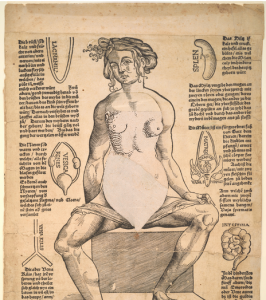
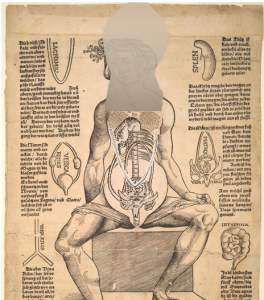
One of the Anatomical Fugitive Sheets with flap down.Same image as the previous one, but with top flap up.
In my opinion, our holdings of anatomical fugitive sheets are some of the most remarkable and rare items one can find in historical medical collections. Our collection includes ten of these sheets, and each one is fascinating for its own reasons.
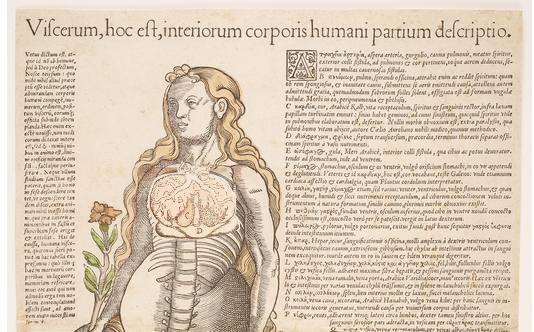
These anatomical fugitive sheets, which date from the early sixteenth to the mid-seventeenth centuries, are single sheets, similar to broadsides, that are unique in that they contain overlays or flaps that lift to reveal the inside of the human body.
I have read arguments that such items would have been used by barber surgeons or medical students, but others say these were hung in apothecary shops or purchased and kept by individuals with an interest in knowing what was inside their body. After almost 500 years, it is amazing that these anatomical fugitive sheets still exist. While we do have a few sheets that have lost some or all of their flaps, I think it’s fascinating to examine where flaps are broken. Somehow these broken and missing parts make these sheets more real to me – a reminder that each one has a story to tell. How and when did the flap get torn? How would this have really been used in 1539?
After the success of our Animated Anatomies exhibit, many of my colleagues and I have been discussing how to make our materials that contain flaps available online. I can tell you, it’s no easy task, but I am thrilled that we now have a digital version of our collection of anatomical fugitive sheets. With funding from the Elon Clark Endowment, a local custom web design firm, Cuberis, was outsourced to create the code, making these items interactive. Our own amazing Digital Collections Team not only photographed each overlay, but also took the code and applied it to DUL’s digital collection site, making it all work freely to a public audience.
There are so many people involved in making something like this happen. Thanks to Mark Olson, Cordelia and William Laverack Family Assistant Professor of Art, Art History & Visual Studies here at Duke University, for his role in getting this project started. And here in the DUL – a huge thanks to Erin Hammeke (Conservation), Mike Adamo and Molly Bragg (Digital Production Center), Noah Huffman and Lauren Reno (Rubenstein Library Technical Services), Will Sexton, Cory Lown, and especially Sean Aery (Digital Projects Department). They are an incredible team that makes beautiful things happen. Obviously.
2015 has been a banner year for Duke Digital Collections, and its only January! We have already published a new collection, broken records and expanded our audience. Truth be told, we have been on quite a roll for the last several months, and with the holidays we haven’t had a chance to share every new digital collection with you. Today on Bitstreams, we highlight digital collection news that didn’t quite make the headlines in the past few months.
H. Lee Watersmania
Compare normal Digital Collections traffic to our Waters spike on Monday January 19th.
Before touching on news you haven’t about, we must continue the H. Lee Waters PR Blitz. Last week, we launched the H. Lee Waters digital collection. We and the Rubenstein Library knew there was a fair amount of pent-up demand for this collection, however we have been amazed by the reaction of the public. Within a few days of launch, site visits hit what we believe (though cannot say with 100% certainty) to be an all time high of 17,000 visits and 37,000 pageviews on Jan 19. We even suspect that the intensity of the traffic has contributed to some recent server performance issues (apologies if you have had trouble viewing the films – we and campus IT are working on it).
We have also seen more than 20 new user comments left on Water’s films pages, 6 comments left on the launch blog post, and 40+ new likes on the Duke Digital Collections Facebook page since last week. The Rubenstein Library has also received a surge of inquiries about the collection. These may not be “official” stats, but we have never seen this much direct public reaction to one of our new digital collections, and we could not be more excited about it.
Early Greek Manuscripts
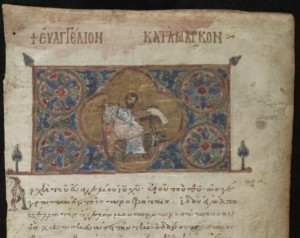
An example from the early Greek Manuscript collection.
In November we quietly made 38 early Greek manuscripts available online, one of which is the digital copy of a manuscript since returned to the Greek government. These beautiful volumes are part of the Rubenstein Library and date from the 9th – 17th centuries. We are still digitizing volumes from this collection, and hope to publish more in the late Spring. At that time we will make some changes to the look and feel of the digital collection. Our goal will be to further expose the general public to the beauty of these volumes while also increasing discoverability to multiple scholarly communities.
Medicine bottles and glasses from the HOM artifacts collection.
Curious about bone saws, blood letting or other historic medical instruments? Look no further than the Rubenstein Libraries History of Medicine Artifact’s Collection Guide. In December we published over 300 images of historic medical artifacts embedded in the collection guide. Its an incredible and sometimes frightening treasure trove of images.
These are legacy images taken by the History of Medicine. While we didn’t shoot these items in the Digital Production Center, the digital collections team still took a hands on approach to normalizing the filenames and overall structure of the image set so we could publish them. This project was part of our larger efforts to make more media types embeddable in Rubenstein collection guides, a deceptively difficult process that will likely be covered more in depth in a future Bitstreams post.
Digitization to Support the Student Nonviolent Coordinating Committee (SNCC) Legacy Project Partnership
Transcript from an oral history in the Joseph Sinsheimer papers.
This one is hot off the digital presses. Digital Collections partnered with University Archives to publish Coach K’s very first win at Duke just this week in anticipation of victory # 1000.
What’s Next for Duke Digital Collections?
The short answer is, a lot! We have very ambitious plans for 2015. We will be developing the next version of our digital collections platform, hiring an intern (thank you University Archives), restarting digitization of the Gedney collection, and of course publishing more of your favorite digital collections. Stay tuned!
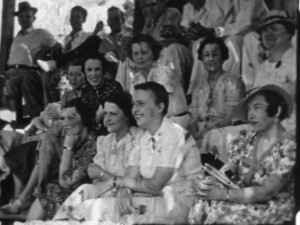
The motion picture films in the H. Lee Waters Collection play out a history of North Carolina (and Virginia, and South Carolina) in the late 1930s and early 1940s unparalleled in scope and vision. But what would eventually become such a grand gift to the citizens and scholars and artists of the region did not begin with that in mind. Like fellow commercial photographer and North Carolinian Hugh Mangum, Waters might be considered an accidental documentarian, taking to the road in the depths of the Depression as a resourceful businessman, filling theatre seats with audiences who paid to see themselves in the movies. And yet, a natural behind the camera, Waters knew composition and how to frame a shot; more importantly, he knew people, loved to be around them, and could draw from his subjects positive reactions to this unexpected man with a camera, outside the mill, on main street, in front of the school, in the shop. As Waters biographer and documentarian Tom Whiteside has noted, Waters’ quick-cut aesthetic managed the immediate goal of getting as many townsfolk into the movie as possible while achieving, in the long-term, an archive of still image frames that is vast in its scope and ripe for investigation. From this perspective, the vernacular of his art puts him in the company of the prominent documentary photographers of his day.
A still from “Clayton (N.C.), circa 1936-1937 (Reel 1),” one of the films in H. Lee Waters Digital Collection.
Waters used reversal film, and the film he projected was the same film he shot in the camera, edited for length and his beloved special effects. He worked quickly, didn’t make copies, and after coming off the road in 1942 shelved the films until, later in life, he started selling them to their respective communities. Duke’s collection of H. Lee Waters films therefore owes a debt to the towns, libraries, and historical societies who over the years have sent, and continue to send, Waters’ legacy to Duke, recognizing that centralizing these resources works in favor of the region’s cultural heritage. It also means that over the years Duke has accrued film in all conditions and states of preservation. There is film in the collection that is literally turning to dust; there is also beautiful Kodachrome that could have been shot yesterday. Since 1988, too, audiovisual preservation has changed dramatically. Thankfully, and with the help of the National Film Preservation Foundation, a substantial number of the films have received full film-to-film preservation; nevertheless, earlier, heroic attempts at saving some films to videotape, some formulations of which are now severely degrading, have left us in a few cases with only a blurred shadow of what must have been on that original film. So our digital project reflects the films and their creator, but also the history of the collection at Duke.
A still from “Kannapolis (N.C.), 1941 (Reel 1),” one of the films in the H. Lee Waters Digital Collection.
Many at Duke Libraries have made the Waters collection what it is today, and those of us working on bringing the films online build on the efforts of librarians, archivists, and technical staff who were as passionate about these movies as we are. Ever in transition, the collection is marked by growth, an element that we see as integral to the website. In fact we are already adding to it. In addition to the films and (for some of them) shotlists, there are oral history interviews with the children of H. Lee Waters. Tom Waters and Mary Waters Spaulding have not only been essential in bringing their father’s films online, they have a unique perspective on a talented man whose contribution to the history of North Carolina was only beginning to be appreciated when he died in 1997. Waters’ home movies will be added to the site soon, and we anticipate presenting select work inspired by the Waters films, because, in addition to their own sublime artistry, the movies remain a magnet for artists and documentarians mining archival sources. One such work will debut March 20 for Duke Performances, as Jenny Scheinman premieres her work “Kannapolis: A Moving Portrait,” based around film from the collection.
A still from “Smithfield (N.C.) and Selma (N.C.), 1937 (Reel 1),” one of the films in the H. Lee Waters Digital Collection.
Of course, we also hope the site might draw other Movies of Local People out of hiding, because while Duke and the State Archives hold a good number of the films, we still don’t know the whereabouts of some of them. So when you visit the site, take advantage of the embed and share functions accompanying each of the videos, use them on your blog or Facebook page, guide people to H. Lee Waters at Duke, and who knows? It may lead them to investigate further, to liberate that can of film that’s been sitting in the closet or biding its time at the local library.
Post Contributed by Craig Breaden, Audiovisual Archivist, David M. Rubenstein Rare Book & Manuscript Library.
Anatomical fugitive sheets are single sheets, very similar to items such as broadsides [early printed advertisements] that date from the sixteenth and seventeenth centuries and are incredibly rare and fragile. Eight of the ten sheets in our collections have overlays or moveable parts adding to the complexity of creating an online presence that allows a user to open or lift the flap digitally.
The primary deliverable for the design contractor of this project will be an online surrogate of the fugitive sheets and any accompanying plugins. Skills needed include JavaScript and CSS.
We’re looking for a talented design team to help us connect the past to the present. See the prospectus for candidate contractors linked below.


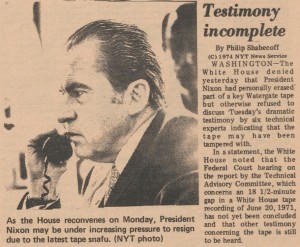 The American memory of the 1970s is complex, wavering from carefree love to Vietnam and civil rights. As the social turmoil of the 1960s flowed into the 1970s, Terry Sanford was sworn in as president of Duke University. This marked the beginning of his sixteen-year term, but also marked the decade in which Sanford twice ran for president and partook in heated debates with Alabama governor George Wallace. He presided over the university In the midst of the Vietnam War and national protests, the Watergate scandal, and the aftermath of the Allen Building occupation in 1969.