Controversy vs. Benefits: Vivisection Items in the History of Medicine Collections

As a volunteer for the History of Medicine (HOM) Collections, one of my projects was to create subject guides for several of the Collections’ strengths. I focused on collection strengths in areas of anesthesia, human sexuality, materia medica, pediatrics, psychiatry, vivisection, and yellow fever. I spent the past few weeks gathering sources and images to highlight the HOM’s interesting collection of vivisection materials, many of which come from the large vivisection pamphlet collection.

A significant amount of the collection features philosophical debates between those who regard surgery on live animals for experimental purposes as cruelty and those who support vivisection for benefits stemming from progress and advancements in medical science (e.g., creation of immunizations and vaccines).

Many photographs and drawings in the vivisection pamphlet collection show how dogs were used as test subjects for medical experiments. In one photograph, it is evident from its posture that a dog that had its pituitary gland removed is undergoing discomfort; the image was taken hours before its death. In another drawing, a dog appears to have had its hind legs bound and one of its forelegs sealed. The caption underneath reads, “They who know the pain of a limb even a short time in a cramped position can imagine the sufferings of this dog.”


On the other hand, animal experimentation has played a crucial role in helping to develop immunizations against infectious diseases, such as polio and diphtheria. The photographs below feature children whose lives were saved by antitoxin discovered through medical research using animals. In an attempt to appeal to people’s emotions and gain acceptance for animal experimentation, one of the captions contains a suggestion for others to imagine their own child as one of the pictured victims of infantile paralysis. The question is asked, “Would you hesitate to sacrifice under ether one or more animals if through the knowledge gained the disease could have been prevented, or your child could have recovered without being crippled?”


The vivisection controversy brings up other provocative questions: Is animal experimentation justifiable if it results in the possibility of a cure/immunization/vaccine for a disease (e.g., cancer, HIV/AIDS)? Do the benefits of eradicating diseases for humans outweigh the suffering and pain caused to animals in medical research? Does the use of anesthesia make vivisection more acceptable? Are there parallels between animal vivisection and human vivisection as historically conducted by the Nazi and Imperial Japanese armies? Come examine the materials in the History of Medicine Collections and develop your own conclusions.

Post contributed by Christine Cheng, former volunteer for the History of Medicine Collections. Christine is now the Research Services Coordinator for George Mason University Libraries Special Collections & Archives.

Digitizing the LCRM: Duke’s Dept. of African & African-American Studies

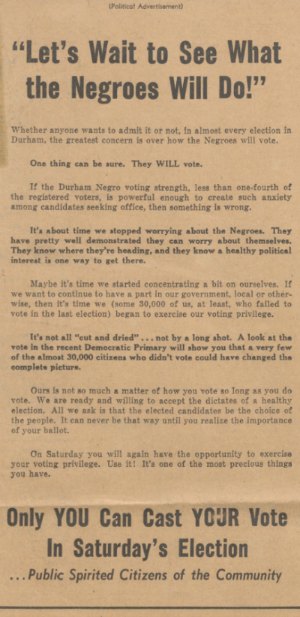
In this month’s update of the CCC Project at Duke University, we are happy to announce the publication online of the records of Duke’s Department of African and African-American Studies.  The items included in this collection document the beginnings of the department, the research and teaching of its faculty members, and the various social and cultural movements occurring within the African-American community during the 1970s and later.  We encourage researchers to peruse the digitized documents, accessible from the collection inventory, to find a host of items sure to add to the scholarship of the long civil rights movement.

Our document spotlight for the month highlights the struggles that the African and African-American Studies Department, then known as the Black Studies Program, experienced in its earliest days.  From its inception in 1969, the Black Studies Program had been offering several courses through adjunct faculty.  Still, the Program lacked a director and its course slate remained minimal, although the Program did offer a major.

In addition, members of the African-American community at Duke contended that the university’s administration did not implement programs to encourage “black cultural representation.”  The document shown below is a draft petition from late 1979 written by members of the African-American community at Duke asking the administration to ameliorate both the academic and cultural issues that hampered the growth of the African-American community at the university.

Draft Petition to Duke Administration Regarding Cultural Representation of the Black Community, 1979
Draft Petition to Duke Administration Regarding Cultural Representation of the Black Community. Department of African and African-American Studies Records, Box 1, folder 30 (File ID daams01030169)

Although we do not have a completed petition in the Department’s records, the goals of the document did eventually become Duke’s policy.  University administration would create new standards to recruit more African-American faculty members.  In addition, the Program would soon become a fully-staffed Department.  In terms of cultural engagement, the establishment of the Mary Lou Williams Center for Black Culture in 1983 helped to fulfill the demands listed in the petition.  Researchers will now have the opportunity to learn even more about the beginnings of African-American Studies at Duke and how struggles for recognition led to a strong academic and cultural presence on campus.

The grant-funded CCC Project is designed to digitize selected manuscripts and photographs relating to the long civil rights movement. For more about Rubenstein Library materials being digitized through the CCC Project, check out previous progress updates posted here at The Devil’s Tale

Post contributed by Josh Hager, CCC Graduate Assistant.
North Korean Propaganda in the Selig Harrison Papers

The Selig Harrison Papers is a recent accession to the Center for International Policy (CIP) Records. Selig Harrison, the director of the CIP’s Asia Project, has specialized in South Asia and East Asia for fifty years as a journalist and scholar. These papers comprise a broad survey of the political and economic relations throughout Asia and between the U.S. and Asia, providing the birds-eye view from which Harrison’s research was conducted. They are concerned with public men and women – leaders and governments, the structures and organizations that most visibly influence the course of history. Likewise, these papers are very much bound up in the problem of representation, not only because they examine the institutions that are most often represented in the media and in political discourse, but because the project of the Center for International Policy is to shape the way such institutions get represented in the media and in political discourse. The Selig Harrison Papers offer a sense of the high stakes of the practice of representation, and at stake for Harrison is international policy and the course of history itself.  Thus, one aspect of these papers that struck me was the degree to which Harrison was and is invested in anticipating the behavior of political actors and the consequences of that behavior so as to affect it. Some of his original files were even labeled as questions (e.g. “Should Pakistan survive?” or “Is Musharraf backing down?”).

The Selig Harrison Papers most heavily focus on the Korean Peninsula, especially North Korea. The majority of these papers are dated from within the last 20 years, though the series contains a few documents as early as 1960. Particularly notable are some North Korean materials from 1965-1972 on women and children (see “Women and children in the DPRK” folder in the Geographic Subseries) and two North Korean children’s books from 1987 (see “Children’s tales – Pyongyang” folder in the Geographic Subseries).

“Statue of Premier Kim Il Sung,” from a North Korean pamphlet in the Selig Harrison Papers, Center for International Policy Records.

The material on women and children includes some fascinating propaganda from 1965, promoting Kim Il Sung’s affinity for and fostering of North Korea’s children. Kim Il Sung saw in children the continuance of revolutionary politics given that they were raised as revolutionaries (hence the importance of women in the DPRK).  The particular chapter, called “Give the Children the Best,” from this 1965 text begins,  “Children, to Comrade Kim Il Sung, are irreplaceable objects of love, for whom it is his basic and inviolable principle that they must have the best. His warm heart and deep care for the children are unlimited.” The sentimental language of love and the valorization of a particular politics of care that is often seen as distinguishing of communist governments (which should be further distinguished from communism as a political theory) is manifest in this passage and throughout the text. The child is representative because it comes to stand for the general relationship of the government to its people. This text asks us to think of love not as a private emotion but as a political concept, as an essential element for transforming the objectified child into a fully formed political subject, which is to say, a subject educated in the “revolutionary ideology and the indomitable fighting spirit of the working class.”

This propaganda reveals, more specifically, the orphan to be the national symbol of North Korea, the figure, it seems, most capable of being revolutionary.  After all, just as the orphan is a broken link in a chain, so revolutions seek to create a radical break with history. “None can call them orphans any longer,” the text reads. “Comrade Kim Il Sung is in truth a father to all those children who have lost their fathers and mothers.”

Children’s Palace and School, Pyongyang, from a North Korean pamphlet in the Selig Harrison Papers, Center for International Policy Records.

Kim Il Sung named the child “king of the land” and in 1963 built the Children’s Palace and School in Pyongyang. The Palace offers, according to the pamphlet from which the above photographs were borrowed, an education that incorporates the arts and crafts, such as sculpture, embroidery and drawing, history (according to the ideology of the Worker’s Party) and the sciences, as well as and perhaps most importantly engineering for the production of a population capable of (re)building a nation.

Reading about the palace in Pyongyang raised a few questions for me – what work is the language of sovereignty (the children as kings who attend school in a palace) doing within a communist regime devoted to the Workers’ Party? In other words, what valences does such language have within this seemingly counter ideology? The language of sovereignty seems as if it should be opposed to, not aligned with, the way the text writes of the child as not yet fully formed subjects but rather as objects of love and care. Instead, it is as if the language of the sovereign, here, is meant to denote the potential itself for a being objectified by care to become revolutionary and to care, finally not as kings but as political subjects, in turn.

Image from North Korean children’s book in the Selig Harrison Papers, Center for International Policy Records.

A second and related set of materials are the two childrens’ books, published by the Foreign Languages Publishing House in Pyongyang in 1989, titled A Tale of Two Generals and A Winged Horse. These books, fairy tales “told by the great leader Comrade Kim Il Sung,” are illustrated and were translated from North Korean. Both of these fairy tales are stories of militarization about defending the land from foreign invaders. Indeed, within both of these books there exists a constant threat of the foreign. The lessons of these books are consistent with those expressed in Kim Il Sung’s vision of the Children’s Palace and School – strength and courage for one’s country only bear value if matched by intelligence and a sentimental identification with the land. In A Winged Horse, the youngest son who has cultivated himself most roundly is the only son able to ride the winged horse that allows him to save his village from foreign invaders.

There isn’t anything exceptional in these lessons themselves; they are similar to the lessons many of us were given as children. But what interests me in both the propaganda material and the children’s stories is, first, that they are all highly invested in the problem and, more importantly, the stakes of self-representation, which seems to be essentially what Selig Harrison studies as a journalist and scholar.  Second, in both sets of materials the pervasive devastation of North Korea during the Korean War always shadows the representational figure of the child – the redeemer. Because the child is conceived of as the one who can redeem North Korea, Kim Il Sung wanted to call attention to his investments in children’s schools even in the midst of the wreckage of the Fatherland Liberation War (Korean War). These materials thus juxtapose the reality of famine and large-scale devastation with what is rendered as the comfort and even the luxuries provided to North Korean children as the nation anticipates the time of reconstruction.

Post contributed by Clare Callahan, graduate student assistant in Rubenstein Technical Services and the Human Rights Archive.

Introducing RL Magazine

As you can tell if you’ve been reading the Devil’s Tale, there is a lot going on at the Rubenstein Library.   Our new magazine, RL, gathers the highlights between two covers.  The first issue includes articles on the upcoming renovation, notable gifts and acquisitions, and new initiatives.  We’ve also included a list of upcoming events.  We invite you to read RL online [pdf, 2MB] or to pick up a copy next time you visit.  We welcome your feedback and suggestions.  The next issue will come out this winter, followed by two issues every year (summer and winter).

America’s First Vocarillon Recital

It’s a busy Friday afternoon, and many of us are eagerly anticipating the 5:00 PM ringing of the Duke Chapel carillon. Then, university carillonneur J. Samuel Hammond will play Dear Old Duke to send us off for two days of rest and relaxation.

On this day in 1939, though, the carillon drew 5,000 people to campus on a drizzly evening, as then-university carillonneur Anton Brees and visiting mezzo-soprano Mary Frances Lehnerts prepared to perform what Duke’s Alumni Register termed “America’s first vocarillon recital.”

The vocarillon concert (voice + carillon=vocarillon) was an innovation that Brees had brought with him from his native Antwerp, where he (and his father before him) served as carillonneur of that city’s cathedral. Brees, who gave the carillon’s inaugural performance as part of the 1932 commencement celebrations, spent his summers at Duke–he spent the remainder of the year as carillonneur at the Bok Singing Tower in Lake Wales, Florida–presenting popular weekly carillon concerts that drew visitors from all over the area.

A view of the crowd at the 1939 vocarillon concert.

On that August night in 1939, the concert-going crowd filled West Campus’s quadrangles, spilling all the way down Chapel Drive. Lehnerts sang five pieces, accompanied by Brees on the carillon, from the Chapel’s balcony, some 175 feet above her audience. The Durham Morning Herald reported that she “sang with no more effort than would be required in a small concert hall,” and yet concertgoers sitting by Few Quadrangle could hear her clearly.

Mary Frances Lehnerts performs during the 1939 vocarillon concert.

In between each of Lehnerts’s performances, Brees played solo pieces for the carillon. Here’s the evening’s program:

  • America (for carillon)
  • Somewhere a Voice is Calling by Arthur Tate (for voice and carillon)
  • Maryland, My Maryland (for carillon)
  • Homing by Teresa del Riego (for voice and carillon)
  • Gavotte in G minor by Johann Sebastian Bach (for carillon)
  • Holy Night by Franz Gruber (for voice and carillon)
  • I Can Hear My Savior Calling by Philip P. Bliss (for carillon)

Encores:

  • Only a Rose by Rudolph Friml (for voice and carillon)
  • Roses of Picardy by Haydn Wood (for voice and carillon)
  • Moonlight and Roses by Edwin Lamare (for voice and carillon)
  • The Last Rose of Summer by Friedrich von Flotow (for voice and carillon)
  • The Old Refrain by Fritz Kreisler (for carillon)
  • Dear Old Duke by R. H. James (for carillon)

Yes, that many encores. We wish we could have been there.

Introducing our new registration and requesting system!

Today, the Rubenstein Library launched a new online registration and item requesting system!

Some of the exciting features of this new system:

  • No more paper forms! New researchers will register online and returning researchers will re-register in our new system. (Don’t worry: it’s quick & easy!)
  • Registration is shared with UNC’s Wilson Library, so you can register just once at either location!
  • Request your books and manuscripts directly through links in the library catalog, from anywhere: at home, in the office, or on a bus!
  • Manage your requests directly in your user account.
Account screen for the new registration and item requesting system.

The registration and item requesting system is called Aeon, and is used at several other special collections libraries. Once you’ve used it at Duke, you’ll be well prepared to use collections at Harvard, Yale, Chicago, Texas, and many other universities!

Please ask staff at the public service desk if you have any questions about using this new system. We’ll happily help you to register and request your materials.

Get a Group (Number)!

What is one way to become an expert in all things Duke? Go through all of its records!

Ashley Brown, the University Archives' King Intern, reviews Duke organizational charts.
Ashley Brown, the University Archives’ King Intern, reviews Duke organizational charts.

OK, claiming to be an expert in all things Duke may be a little ambitious, but I was able to learn a lot as the William E. King intern at the Duke University Archives. My name is Ashley and this summer I was tasked with creating a records group system for the University Archives.

A record group is “a collection of records that share the same provenance and are of a convenient size for administration.”  To simplify this definition from the Society of American Archivists, a record group numbering system is one way for archivists to show how records originate within one entity such as Duke University. Each record group can be broken down into a subgroup, which corresponds to an organizational subdivision; and then the individual record makes up the smallest unit known as a series.  Each record, subgroup, and series is given a number and the combination of those three numbers gives each record its unique identifier.  Sound complicated? Here’s an example:

Let’s take this record: Dept. of Zoology records, 1905-1997.

First, each college within the University is assigned its own record group and each department within each college is assigned its own subgroup.  So, my first step for this record is to determine which college the Department of Zoology resides in.  After a little research, I discover that Zoology no longer exists as a formal department but has been combined with Botany inside the Biology Department at Trinity College of Arts and Science.   Therefore, this record would fall under the Trinity College record group, which happens to be record group 25, and the Biology subgroup (.11).

So, the record group identifier for this record would be: 25.11.001.  The first number tells you the record group; the second number tells you the subgroup; and the third number is the individual series number.

Now let’s take the Botany records: Dept. of Botany records, 1932-1978 and assign it a number.  It, too, is in Trinity College under Biology. So it would also begin 25.11 but its series number would be different to distinguish it as a separate collection.  Its number is 25.11.002.

It is important to note that each record group will include the records of its current organizational structure and any forms of that organization or department’s predecessors.  For example, prior to the 1960s, the Provost position was titled “Vice President of Education.”  Any records pertaining to the Vice President of Education or individuals who held that title will fall under the Office of the Provost Records Group (RG 5).

There are over 1,000 record collections at University Archives that span over 174 years.  Each record collection needed be assigned a record number based on its provenance or origin of creation. This was no easy feat.  So I spent my summer researching Duke history, examining organizational charts that go back over sixty years, and reading the finding aids of each collection.  In doing so, I was introduced to an impressive array of presidents, faculty, staff, alumni, student groups, and others who have transformed Duke into the innovative institution that it is today. I also now have 32 record groups that help tell the story of Duke and its evolution through its records.

Over the next several weeks, I will be working alongside other University Archives and Rubenstein Technical Services staff to unveil the new numbering system.  Stay tuned for my blog post, part two to hear about how we implement this project!

Post contributed by Ashley Brown, William E. King intern at the Duke University Archives.

Feeling hot, hot, hot

Happy Friday! Preparing for our upcoming renovation continues at the Rubenstein. This book’s title made us giggle, especially considering the high temperatures we’ve been facing lately in Durham. If you’d like to learn more about Spontaneous Combustion: A Literary Curiosity, you can check out the catalog record. It is a 1937 medical publication discussing cases of spontaneous combustion in literature.

For more photos of our favorite renovation discoveries, visit the Rubenstein’s Flickr page.

John Wetmore Hinsdale, Heartthrob

Every generation has its heartthrobs.  Think Justin Bieber, Robert Pattinson, Tristan Wilds, and Chris Hemsworth. History junkies realize that handsome dudes are nothing new, as demonstrated by the tumblr site My Daguerreotype Boyfriend.

Those of us in the Rubenstein find our own John Wetmore Hinsdale pretty irresistible. In 1861 he left The University of North Carolina to enlist in the Confederate Army and served with distinction under Generals Holmes, Pettigrew, Pender and Price before being elected colonel of the Third Regiment Junior Reserves.

Daguerreotype of John Wetmore Hinsdale
John Wetmore Hinsdale, Hunk. Click to enlarge!

He went on to attend Columbia University Law School, pursue a successful legal career, and serve as president of the North Carolina Bar Association. John Wetmore Hinsdale was clearly more than just a pretty face.

My thanks to Walter Hilderman, for bringing this photo to my attention.  Mr. Hilderman is in the final stages of his Lieutenant General Theophilus Hunter Holmes, C.S.A., forthcoming from McFarland Publishers in late 2013.

This photograph is from the Hinsdale Family Papers.  We’re submitting it to My Daguerreotype Boyfriend, and we hope to see it there soon!

Post contributed by Elizabeth Dunn, Research Services Librarian.

Duke Acquires Papers of Rabbi Heschel, Influential Religious Leader

The Rubenstein Library at Duke University will acquire the papers of Rabbi Abraham Joshua Heschel, a scholar, writer and theologian who is widely recognized as one of the most influential religious leaders of the 20thcentury, the school announced Monday.

Photographs and other items from the Abraham Joshua Heschel Papers.

Heschel was a highly visible and charismatic leader in the civil rights and anti-Vietnam War movements. He co-founded Clergy Concerned About Vietnam and served as a Jewish liaison with the Vatican during the Second Vatican Council, also known as Vatican II.

The collection, which has never before been available to scholars, consists of manuscripts, correspondence, publications, documents and photographs spanning five decades and at least four languages. Included among the papers are notes and drafts for nearly all of Heschel’s published works, as well as intimate and extensive correspondence with some of the leading religious figures of his time, including Martin Buber, Thomas Merton, Eugen Rosenstock-Huessy and Reinhold Niebuhr. The papers also contain extensive documentation on Heschel’s life-long commitment to social justice, including planning documents, correspondence with organizers, speeches and even hate mail.

The archive will open for research after conservation review and archival processing are complete.

For more information, visit the full press release!

Dispatches from the David M. Rubenstein Rare Book and Manuscript Library at Duke University