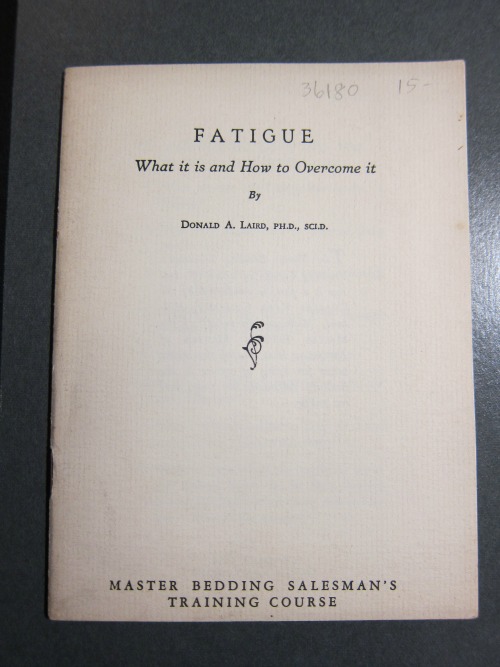
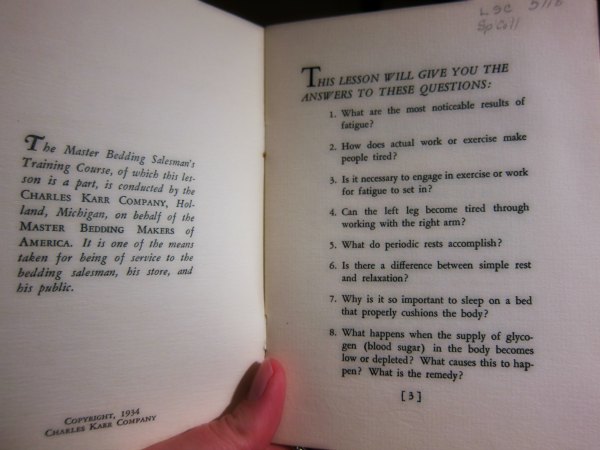
Dr. Laird describes fatigue as “a diminished capacity for doing work, and diminished capacity for enjoying life,” and describes symptoms as irritability, bad temper, nervousness, and peplessness.
If you are pepless or suffering from other symptoms of late-semester fatigue, here are some suggestions from the booklet:
“The bed equipment should be used by the housewife for a few minutes several times during the day. It is not essential to sleep, but to lie down on a cushion that makes it possible to relax.”
“Sometimes excitement from the day makes it difficult to relax, even on a well-designed sleep cushion. The condition will be helped by a sleeping room that is designed and decorated to promote calming down emotionally by the judicious use of blues and greens.”
“The muscular relaxation coaxed by the bed cushion, in fact, will help mental calming down, just as a good way to overcome anger is to try to smile and not act angry.”
While this pamphlet was published almost 80 years ago and some of the advice seems less than scientific, this section seemed especially appropriate even today:
“The present generation probably needs at least better sleep than the previous generations. Radio programs, sleep-disturbing night noises from traffic, a greater assortment of time and energy consuming evening pleasures made possible by electricity all probably keep us from getting as much sleep as our fathers did. Then the emotional strain of modern high speed automobile traffic, and the present gnawing apprehension caused by the depression, also conspire to make us need the safety-valve of dreams as never before.”
Replace “radio programs” with “the internet” and “evening pleasures made possible by electricity” with “smartphones,” and that sentence is quite modern sounding.
The final section of the pamphlet gives advice to the Master Bedding salesman on prescribing the appropriate kind of mattress just as a doctor would prescribe a medicine. Naturally, the booklet warns against selling the cheapest mattress: “One’s bed is in reality one’s best friend, and to practice false economy at its expense is indeed false reasoning.” You wouldn’t be cheap with your best friend, would you?
Smile, paint your bedroom blue, and lie down for a bit. Doctor’s orders.
If you’d like to learn more, the Rubenstein Library also holds the companion pamphlet in the Master Bedding salesman’s training course: A New Mattress Era by Marvin C. Lindeman.
Post contributed by Rachel Penniman, Rubenstein Library Assistant for Research and Technical Services.
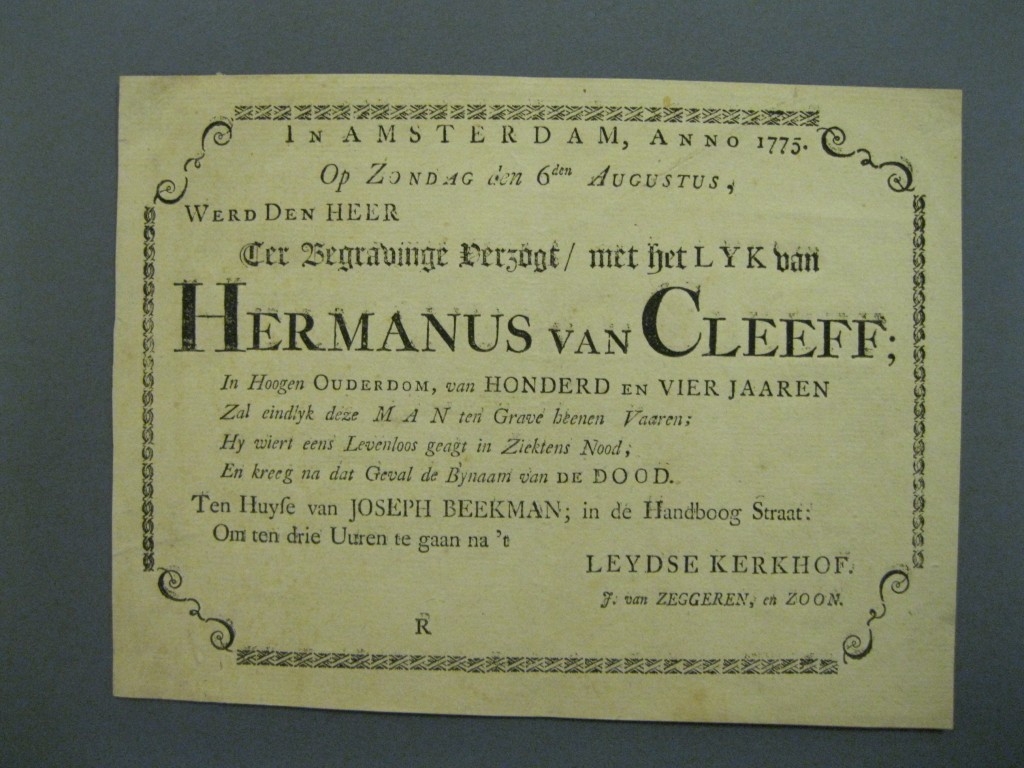
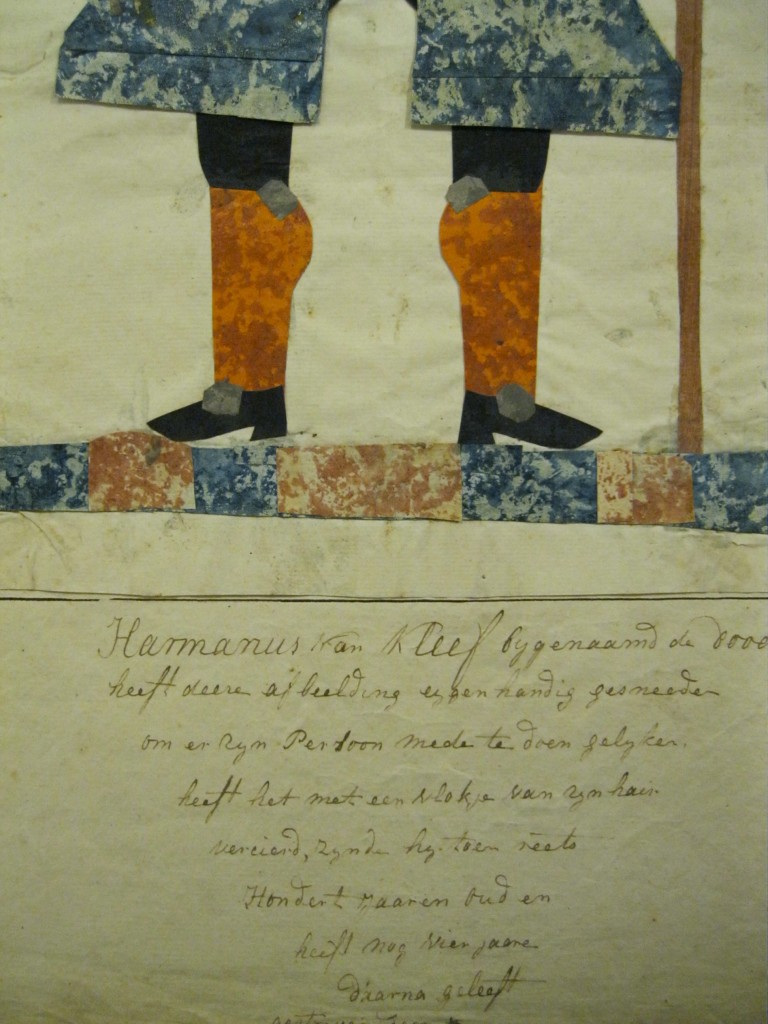
In Amsterdam, in the year 1775, on Sunday, the 6th of August, will be interred the body of Hermanus van Cleeff; in high old age, 104 years, shall finally this MAN be put into his grave; he was once lifeless, in dire need, but revived; and acquired after that event the nickname of Death.
Thus begins a burial announcement that found its way into the History of Medicine Collection Picture File, an assembly of posters, cartoons, engravings, and caricatures all relating to the practice of medicine. The collection is currently being arranged and described, and there are some interesting finds throughout.
In actuality there are three pieces to this funerary group, which was purchased from the Shuman family – rare book and manuscript dealers from whom Dr. Josiah Trent, surgeon and Duke Medical School faculty member, acquired most of his rich collection in medical history.
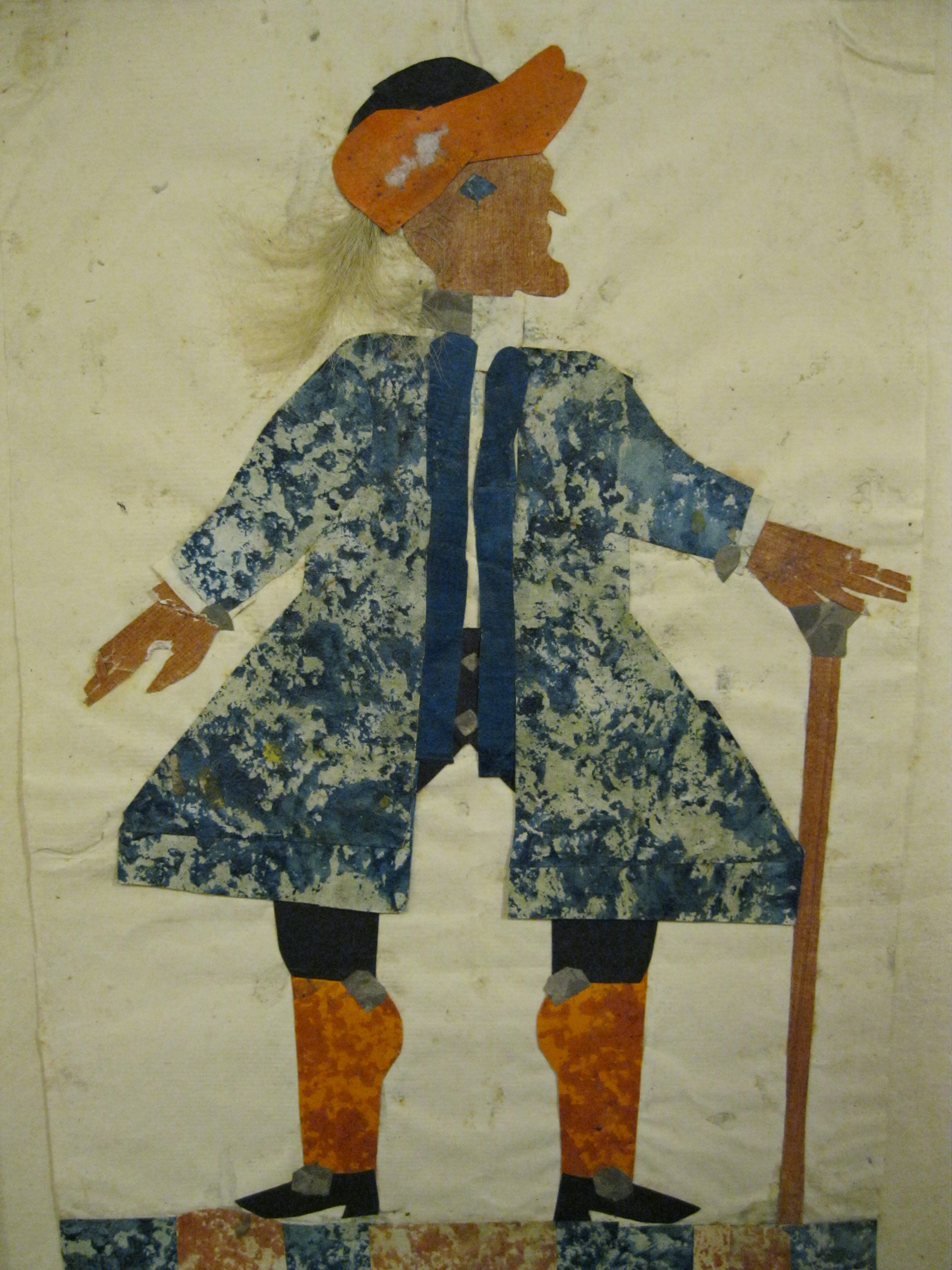
The first two items – the printed burial notice, and its English translation on University of Chicago letterhead – are intriguing enough. But the third piece captivates the imagination: a lively self-portrait of an old man with a cane, allegedly the centenarian himself, fashioned from colored paper and finished off with a real lock of white hair (ostensibly human).
The English translation to the caption under the silhouette states that “Hermanus van Kleef, nicknamed Death, has cut out his picture with his own hand, made it look like his own person, provided it with a lock of his hair. One hundred years old and lived yet four years thereafter…”
I haven’t been able to discover who Hermanus van Kleef (or Cleeff) was – he may have been an ancestor of the famous Jewish family that later founded the jewelers Van Cleef and Arpels. As I gaze at this little figure triumphantly standing his ground, I congratulate him for cheating death through this wonderful piece of self-expression!
Post contributed by Paula Jeannet Mangiafico, Senior Processing Archivist in Rubenstein Technical Services.
Anyone reading this blog knows that archives are full of wonderfully weird ephemera just waiting to be discovered and discussed, of conversations waiting to happen. This is the story of two archives that, it turns out, have a lot to talk about.
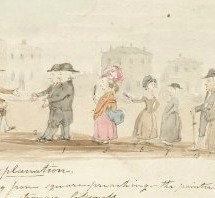
“Sunday evening in St. James’s, Barton,” from the John Rylands University Library
Ostensibly, this is a doodle, maybe an early comic. It depicts an ordinary meeting between preachers and parishioners. Only one thing stands out: the stocky girl just off the center dressed in bright pink and orange, while everyone around her wears drab brown. Look closer and you see that she her awkwardness is not limited to her dress: oblivious to the women gossiping behind her, our young heroine “stands, patiently, while her papa shakes hands with all the colliers, not knowing but she must do so too – a perfect pattern! Dear lady!” This oblivious fool is also the artist.
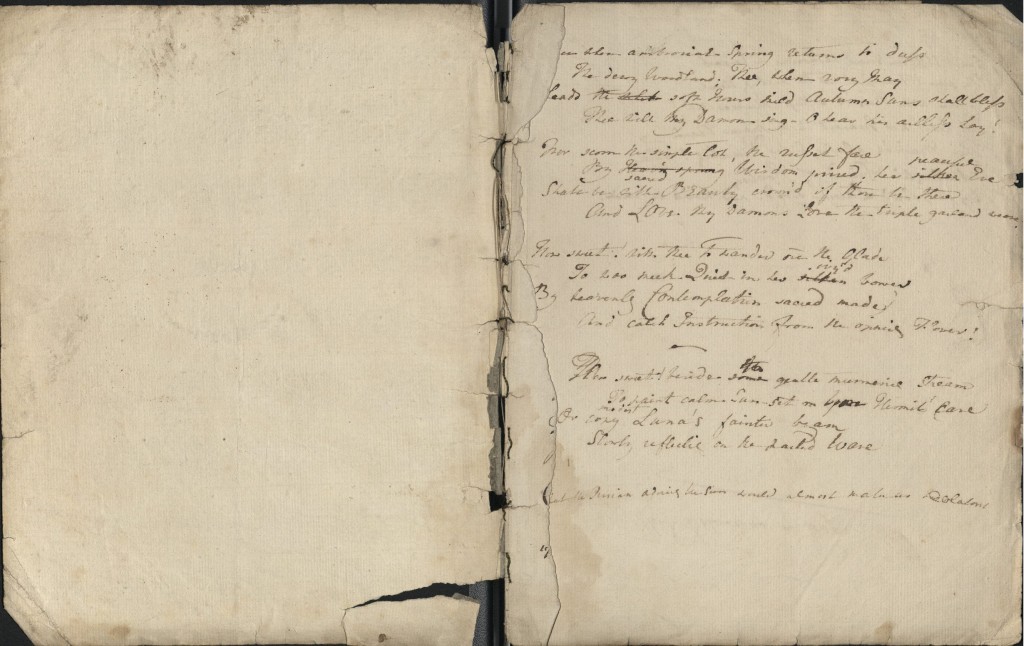
Cut to our own archive: Two summers ago, I was working in the Frank Baker Collection of Wesleyana and British Methodism when I came upon some poems. Having cataloged plenty of manuscript materials within the collection, I wouldn’t have thought much of them, except I noticed that they were tied together with string. Fanciful English student that I am, I recalled that Emily Dickinson’s manuscripts had been likewise fashioned together, and so began my grandiose visions: had I stumbled upon the British Emily? Could these poems help to reinvigorate the field of 18th-century women’s poetry – revolutionize it, even? It’s the fantasy held dear by every budding academic: to discover the next Milton or Frost, to shake the scholarly world to its core. Needless to say, literary scholarship remains unshaken, but it does have a new name on its register: Sarah Wesley.
The poems I found were written by our pink-and-orange artiste, the daughter of Charles Wesley, a co-founder of British Methodism. What is so fascinating about Sarah Wesley is her outright resistance to the restrictive practices of her every-day life – and how, perhaps as a result of that resistance, she has since all but disappeared from most histories of British Methodism.
Bound manuscript with Sarah Wesley’s writings in the Frank Baker Collection.
Her poetry in particular served as an outlet for questioning her father’s religion, as well as engaging with emergent conversations about the rights of women. Even while Wesley’s social commitments were progressive, she remained a devout Methodist throughout her life. But through her writing, most of which she kept hidden away from the judgmental eyes of her community, Wesley takes us to a place we don’t often think of when we read the eighteenth century: the private mind of the teenage girl.
Caitlin Flanagan’s recent book Girl Land (Little, Brown and Co., 2012) makes a compelling case for the fundamental significance of a particular marker of female adolescence: that time when a girl recedes into her room for a few years and emerges a brooding melodramatic for a few more. Flanagan posits that as a society, we take too lightly “a girl’s sudden need to withdraw from the world for a while and inhabit a secret emotional life” (1). But in fact, this is time and space that young girls need in order to come to terms with the world and their place within it. And so, Flanagan urges us to celebrate, rather than denigrate, the importance of this space she calls “girl land.”
Flanagan’s study is predicated on a particular reading of the history of the teenager. But even before “adolescence” became a discrete intellectual category in the twentieth century, Sarah Wesley was, in many ways, a typically modern teenage girl.
She wrote poetry that was evocative, romantic, and highly self-reflexive:
The Pilot Reason stays on Shore, The boisr’ous Passions more, Youth is the Ship and Hope the Oar, And O! the Sea is Love!
~from “Sonnet,” 1770
In particular, much of her work is preoccupied with exploring her budding sexuality:
Her Eyes enraptur’d shall your Beauties own Her snowy Fingers be your Virgin Lone! Her Lips shall bid Thee with a sigh Adieu! Her Lips shall greet Thee with ambrosial Dew! Descending showers shall fall from Heaven to gaze! Within your silken Folds shall Graces lie And panting Zephryss on your Bosom die! The Muse shall stamp Thee with Idalia’s Crest, And Venus court Thee to adorn her Breast.
~from “On receiving a Nosegay,” n.d.
However, she was not without some snark when it came to matters of romance:
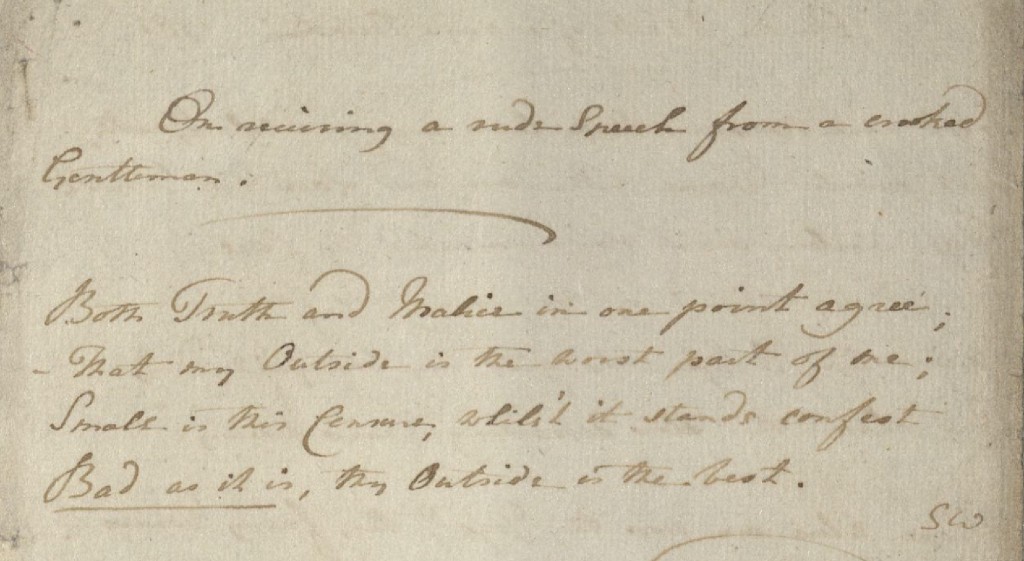
Both Truth and Malice on one point agree That my outside is the worst part of me Small is the censure, whilst it stands confest Bad as it is, thy outside is the Best!
~“Epigram: on receiving a rude Speech from a Crooked Gentleman,” 1777
As we saw in the drawing from the Manchester archive, she held some anxiety over her appearance and the perceptions of others.
And in perhaps the defining feature of “girl land,” she was adamant about challenging the values she inherited from her family in order to come to her own understanding of her world (for more on the particulars of Wesley’s intellectual rebellion, see my essay in the Winter 2013 volume of Eighteenth-Century Studies, which expounds on her feminist and abolitionist interests).
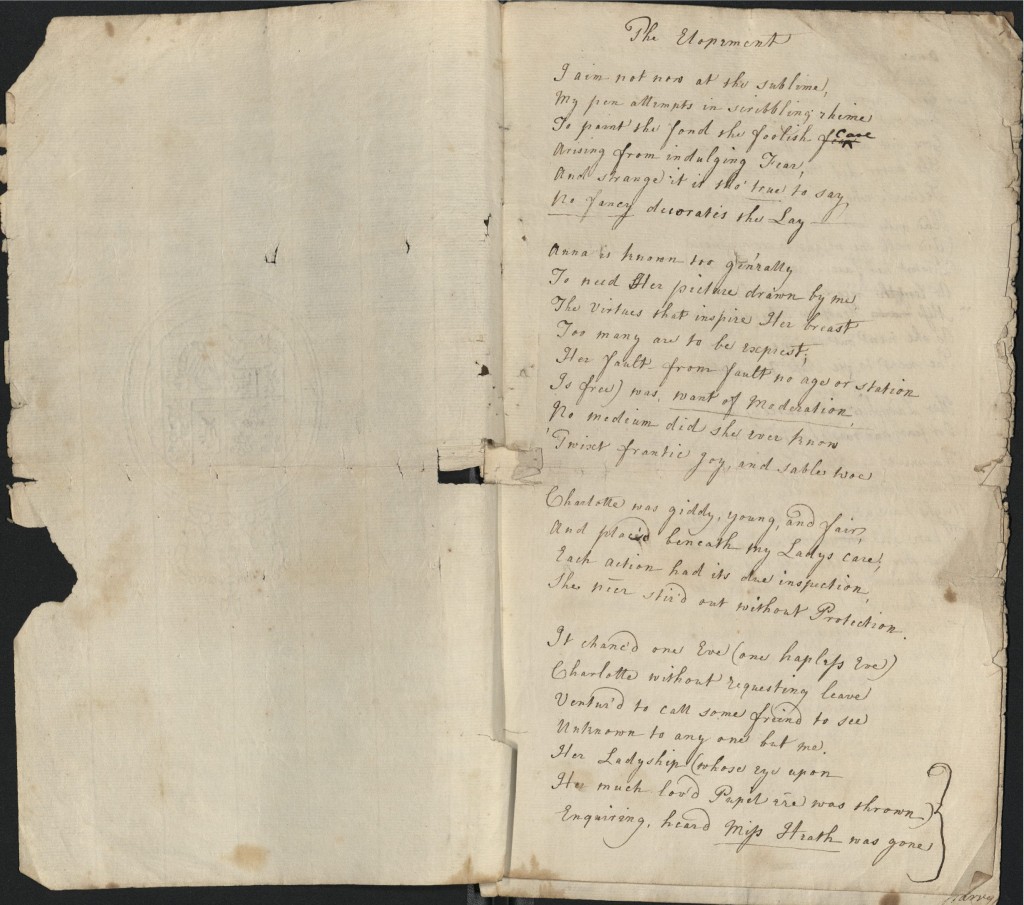
“The Elopement” figures prominently in Koretsky’s article, “Sarah Wesley, British Methodism, and the Feminist Question, Again,” Eighteenth-Century Studies 46.2 (Winter 2013), pages 223-237.
So did my work in the Frank Baker Collection yield the next Emily Dickinson? Not exactly. At the level of versification, Wesley’s poetry is derivative at best. But in the connections she asks us to draw between religion and the secular discourses of the key social issues at the end of the eighteenth century, Wesley’s voice raises many productive questions, which I hope eighteenth-century scholars will continue to engage. And further still, the familiar tenor of her poetry demonstrates the persistence of “girl land,” and how productive that sometimes alien-seeming place can be.
Post contributed by Deanna Koretsky, a Ph.D. candidate in the Duke English Dept. and a graduate student assistant in Technical Services.
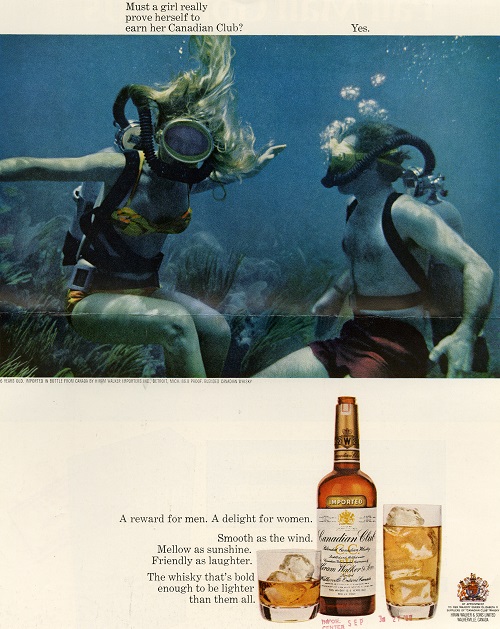
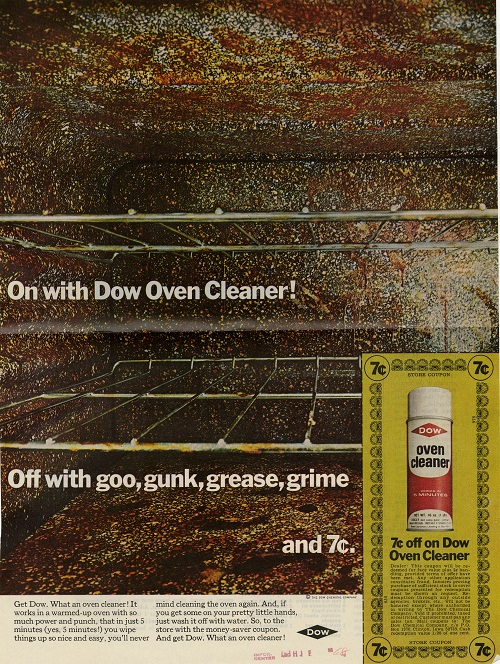
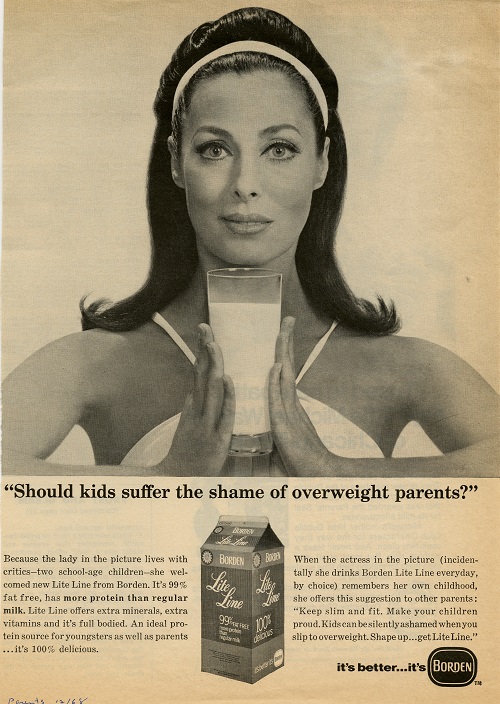
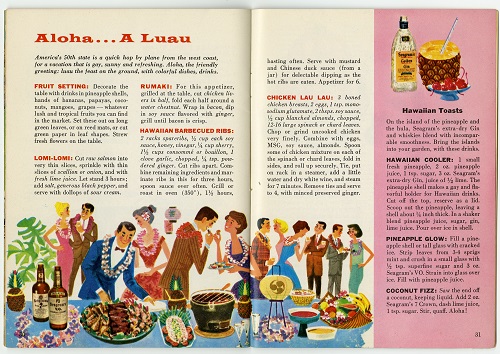
Don Draper and the whole gang were back last night with the premiere of Mad Men’s Season Six. If you are big fans of the show, like us, then join us as we look back at some ads that resonate with each episode of the new season in what we are calling Mad Men Mondays.
Last night’s episode featured references to the Royal Hawaiian Sheraton, Dow Oven Cleaner, fondue, Canadian Club Whiskey, and dieting, among other things. Enjoy our selection of highlighted ads and advertising cookbooks that reflect the brands and themes that Mad Men characters interacted with last night. A gallery of our selected images can also be found on Pinterest and Flickr.
Since starting my internship with the Sallie Bingham Center last August, I’ve spent time each week processing the papers of Mandy Carter, a self-described “southern out black lesbian social justice activist.”
This year Carter celebrates 45 years of social, racial, and lesbigaytrans justice organizing, and it’s almost impossible to summarize all that she has done—beginning with peace activism in the late 1960s and continuing today in her role as National Coordinator for the Bayard Rustin Commemoration Project of the National Black Justice Coalition. So instead, here’s one small peek.
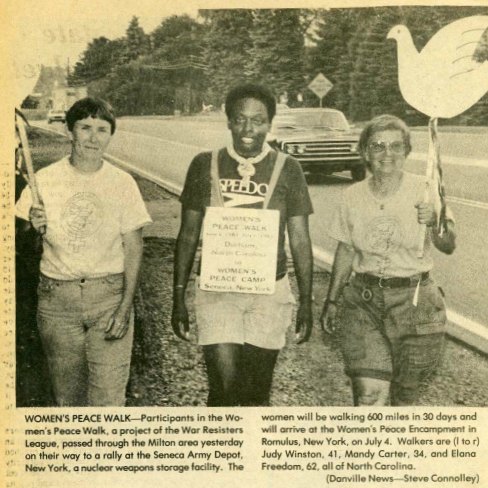
Though based in Durham for much of her career, Carter has traveled up, down, and around the country in support of her activism–and in the summer of 1983, she walked from Durham, North Carolina to Seneca, New York as part of the Women’s Peace Walk.
From left to right: Judy Winston, Mandy Carter, Elana Freedom. The trio completed the entire 600+ mile walk. Along the way, other women joined for a day, weekend, week, or longer. Newspaper clipping, 1983, from the Mandy Carter Papers.
Organized by the Southeast Regional Office of the War Resisters League—where Carter worked at the time—the Women’s Peace Walk aimed to draw attention to and protest the build-up of nuclear arms and specifically, the planned deployment of Cruise and Pershing II missiles to Europe later that year.
Women’s Peace Walk brochure, 1983. From the Mandy Carter Papers.
Organizers timed the end of the walk to coincide with the beginning of the Women’s Encampment for a Future of Peace and Justice, and the destination itself held particular significance. The area was not only home to the Seneca Army Depot, a nuclear bomb and missile storage site, it was also where women of the Iroquois Nation met in 1590 to demand an end to war among the tribes and where more than 300 men and women came together in 1848 for the nation’s first women’s rights convention.
If you’re interested in learning more about Mandy Carter, her lifelong activism, and social change in Durham over the past 30 years, head down to the Durham County Library at 5:30pm on Wednesday for a panel discussion featuring Carter, Caitlin Breedlove (Co-Director, Southerners On New Ground) and Steve Schewel (Founder, Independent Weekly). Event details are available here.
Post contributed by Stephanie Barnwell, Bingham Center Intern.
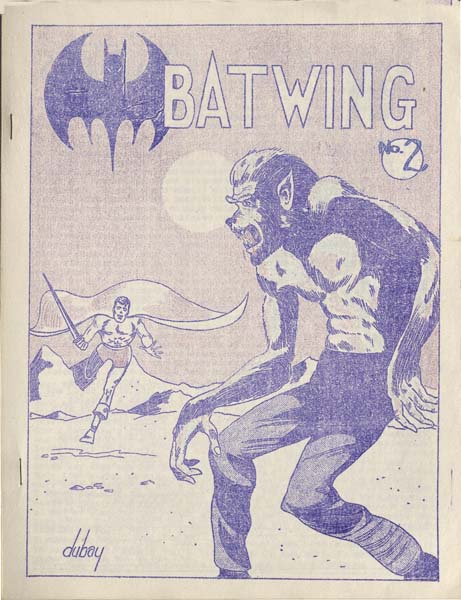
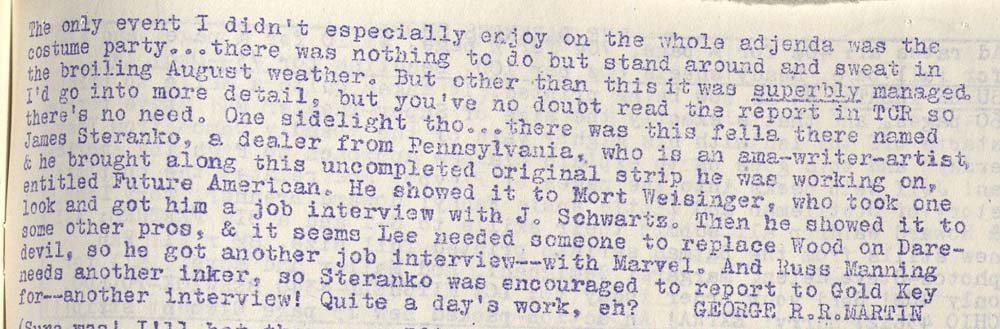
Before Game of Thrones, renowned fantasy author George R. R. Martin was a fan of all things nerd, just like you (and me)! Check out this 1965 fan letter written by a 16 year-old Martin to Batwing, a fanzine published in Texas by prolific fanzine writer Larry Herndon (and now included in our Edwin and Terry Murray Fanzine Collection).
Click to enlarge.Click to enlarge.
Post contributed by Josh Larkin-Rowley, Research Services Coordinator.
This undated paper was in a folder titled simply “Concerts Lost.” It details the negotiations that apparently took place before it was decided not to book the willing-to-play Nirvana at Duke.
Notes about possible Nirvana concert, 1991? From the Duke University Union Records. (Click to enlarge.)
While the document more or less speaks for itself, I will highlight two of my favorite excerpts:
“Even [President] Brodie is unable to make Krzyzewski move practice.”
“If we could talk them into one of the other dates, Brodie would buy tix for senior class.”
Buried deep within the record is a notation that helps us to date the document as being from 1991: “talked to Brodie today; he’s excited about Nirvana because that’s one of the bands they tried for last year.” This is a key clue in dating the record for the following reasons:
In May, 1990, Nirvana played both in Chapel Hill (at Cat’s Cradle) and Charlotte. Because of the proximity, it would be reasonable that Duke would have also tried to get a date on their first major headliner tour.
Nevermind, Nirvana’s first major label success album was released in the fall of 1991. Based on the fact that Durham is not located in suburban Seattle, it seems like a safe bet that they were relatively unknown in the area until they started to play the college circuit in 1990, and then they were catapulted into the spotlight with the release of the international hit album Nevermind.
Nirvana, of course was a band that was riddled with both controversy and tragedy. Frontman Kurt Cobain famously battled a heroin addiction and, in 1994, committed suicide. However, Nirvana is also largely credited with expanding the grunge—and later, alternative—rock genre beyond the Pacific Northwest.
Unfortunately, the story of Nirvana at Duke is found only in records of the Duke University Union, in a folder entitled “Concerts Lost.” A final note about this record: Duke won the 1991-1992 seasons National Championship for men’s basketball. Apparently those unmoveable practices paid off that year.
This month’s Digitizing the Long Civil Rights Movement update pauses to look back into Duke’s own past struggles with racial equality. On February 13, 1969, students in the Afro-American Society occupied the Allen Building where the university’s primary administration offices were (and still are) located. These students demanded that Duke take steps to enact racial equality on campus, including the founding of an African-American Studies department, the hiring of more African-American professors, and the establishment of an African-American cultural center on campus. Similar demands had been made before from members of the Black Studies Program, as featured in our fourth update in this blog series.
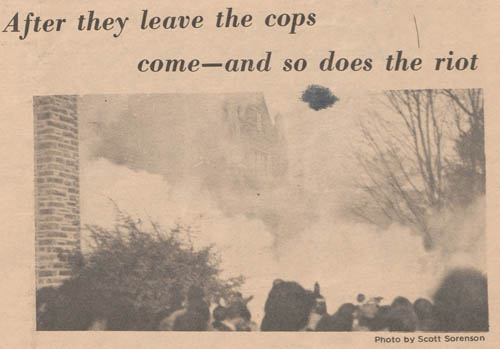
What distinguished the Allen Building Takeover from the previous efforts for reform was its forcefulness—on both sides of the debate. The Takeover marked the first such occupation by students in Duke’s history. The administration’s response also became notable for what some members of the student body perceived to be its brutality. Police officers dispatched to the scene used tear gas to disperse a crowd that had gathered around the building, leading to a “riot” on the main quad of West Campus.
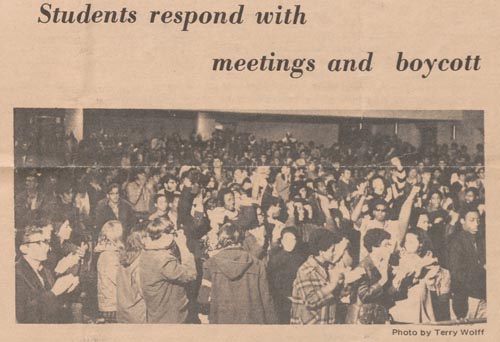
Both photos from The Chronicle, February 16, 1969. Allen Building Takeover Collection, Box 1, Folder 10: abtms01010035
In the wake of the Takeover, students rallied to enact the suggested agenda of the original occupiers. Eventually, most of the demands did become standard practice at Duke, but the change occurred more gradually than what the galvanized student body had wanted in February 1969. The items selected above are from a photo essay published by The Chronicle (Duke’s independent student newspaper) that encapsulated the events of Takeover.
We are happy to announce that the Allen Building Takeover Collection and its wealth of primary documents and remembrances of the important event will soon become available online to researchers.
For more information on the Content, Context, and Capacity Project for Digitizing the LCRM, please visit our website or like us on Facebook.
The grant-funded CCC Project is designed to digitize selected manuscripts and photographs relating to the long civil rights movement. For more about Rubenstein Library materials being digitized through the CCC Project, check out previous progress updates posted here at The Devil’s Tale!
Post contributed by Josh Hager, CCC Graduate Assistant.
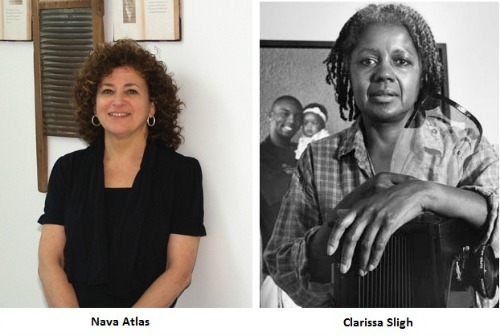
The book form can become a vehicle for personal histories and obsessions. Please join us for a discussion of how Clarissa Sligh and Nava Atlas have explored their own experiences of race, gender, and identity through book arts. Both artists have placed their papers at the Sallie Bingham Center, which also has a collection of over 300 artists’ books by women.
Clarissa Sligh is a visual artist, writer, and lecturer. When she was 15 years old she became the lead plaintiff in the 1955 school desegregation case in Virginia. After working in math and science with NASA and later in business, she began a career as an artist, using photographs, drawings, text, and personal stories to explore themes of transformation and social justice.
Nava Atlas is known both as a vegetarian cookbook author and as a fine artist. Her artists’ books engage images, text, and structure to explore themes of social justice and women’s roles. Many of her works re-appropriate found materials and challenge the language and images used to reinforce gender roles and stereotypes.
Read more about Atlas and Sligh in the Spring 2012 issue of Women at the Center.
Post contributed by Kelly Wooten, Research Services and Collection Development Librarian, Sallie Bingham Center
Dispatches from the David M. Rubenstein Rare Book and Manuscript Library at Duke University