In June and July we’ll celebrate the beginning of a new fiscal year by highlighting new acquisitions from the past year. All of these amazing resources will be available for today’s scholars, and for future generations of researchers in the Rubenstein Library! Today’s post features additions to the collection of artists’ books by women in the Library’s Sallie Bingham Center for Women’s History and Culture. Check out additional posts in the series here.
Image courtesy of Nava Atlas.
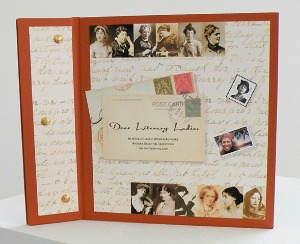
Dear Literary Ladies by Nava Atlas. New Paltz, New York: Amberwood Press, Inc., 2010. Edition of 15. Gift of the author.
According to Atlas, “this artist’s book fancifully poses questions on writing and the writing life, with the replies derived from classic authors’ letters, journals, and autobiographies. Reaching back to answer contemporary questions with voices from literary history reveals the timeless concerns and challenges of writers, with a particular emphasis on these issues from a female perspective.” The book was also produced in a trade edition.
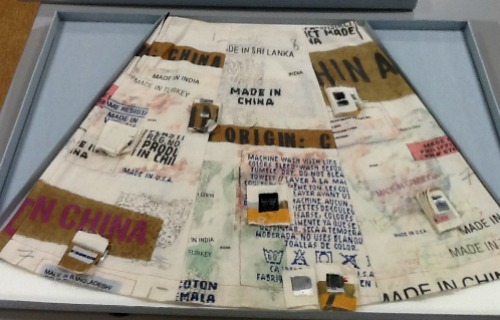
This unique artists’ book is made in the form of a skirt with custom fabric printed with scans of country of origin tags from clothing. Booklets made from fabric remnants and original textile tags are sewn on around the garment.
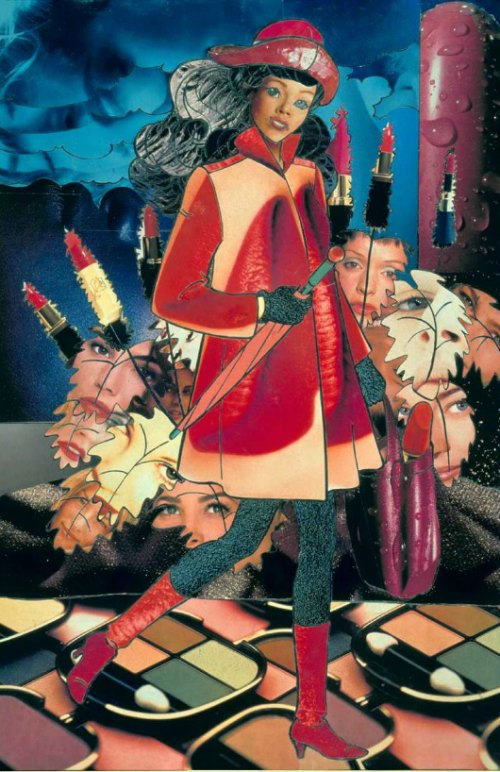
The images in this book were originally created from magazine collages overlayed on the pages of an over-sized Barbie coloring book. According to the artist, “it was created as a painstaking labor of love and reveals untold ways that Barbie is interlaced with modern American culture.”
“Barbie’s Makeover.” Image courtesy of Dana F. Smith.
Post contributed by Kelly Wooten, Research Services and Collection Development Librarian, Sallie Bingham Center for Women’s History and Culture.
In June and July we’ll celebrate the beginning of a new fiscal year by highlighting new acquisitions from the past year. All of these amazing resources will be available for today’s scholars, and for future generations of researchers in the Rubenstein Library! Today’s post features a key early work in the development of the concept of human rights.
Bartolomé de las Casas, a Dominican friar and one of the first Spanish colonists in the Caribbean, is best known today for his exposé of the horrifying treatment of indigenous peoples by Spanish settlers during the first decades of colonization. First published in a 1550s series of tracts in Seville, the tracts represented the first argument for the rights of American Indians to be treated as fellow human beings, the first argument for the abolition of slavery in the New World, and one of the first attempts to appeal to a universal code of human rights.
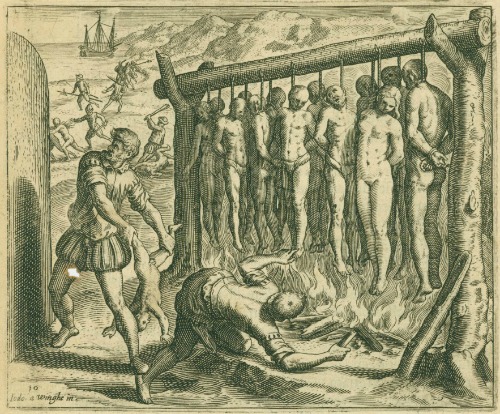
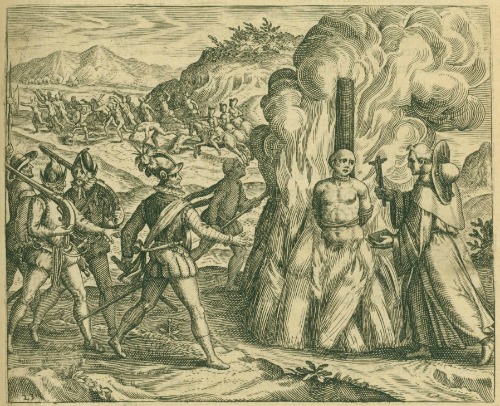
The tracts, especially the sensational details of torture, abuse, and murder, spread throughout Europe as evidence of the Spanish abuse of power in the New World. The Library’s new acquisition is the first Latin translation and first illustrated edition of Las Casas’ text, entitled Narratio Regionum Indicarum per Hispanos Quosdam Devastarum Verissimi…, published in Frankfurt in 1598. The work features a powerful series of eighteen copper engravings by Theodor de Bry, depicting abuses of the native peoples.
Image courtesy Dorothy Sloan Books.
De Bry never visited the New World, and the images can be seen as prime examples of the “Black Legend” of sensationalistic, anti-Spanish (and anti-Catholic) propaganda used to curb the might of the Spanish empire. This edition of the work of Las Casas advocating for basic human rights for the native populations of the Americas was wildly popular and influential, thanks in part to the images, which retain some of their original power to shock and provoke thought about the treatment of the original inhabitants of the New World.
Image courtesy Dorothy Sloan Books.
Post contributed by Will Hansen, Assistant Curator of Collections.
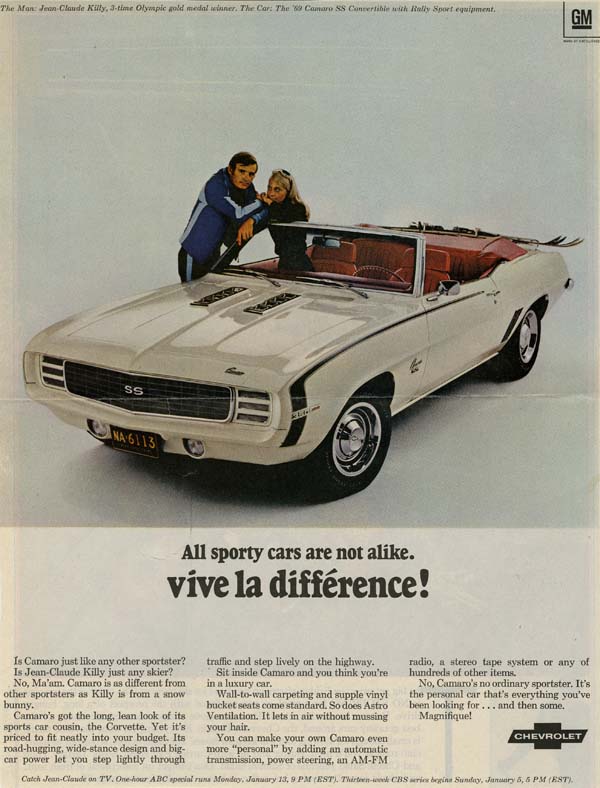
The season finale delivered many memorable moments that will keep us guessing until next year. Stan tells Don that he wants to be the one that goes to Los Angeles to open a satellite office that will service the Sunkist account. After a bad phone conversation with Sally, Don gets drunk at a bar when he is supposed to be at work. Later he wakes up in jail. Pete is horrified to find out that his mother is lost at sea. She married Manolo on a cruise and it is presumed that he threw her overboard in order to inherit her money. When Don comes home the next morning he pours out all of the liquor bottles and tells Megan that he wants them to go to Los Angeles so he can start the new SC&P office. She is thrilled and resigns her soap opera job. Peggy changes into a revealing dress and tells Ted, Jim, and Harry that she is leaving early because she has plans. In Detroit, Bob encourages Pete to test drive a stick shift Camaro Z28. Pete knocks over a GM sign in the process and is subsequently taken off the Chevy account. Peggy comes home after her date and finds Ted at her door. He says that he loves her and will leave his wife. They sleep together and make plans for the future. Betty calls Don in the middle of the night to say that Sally bought beer and got drunk with some classmates and is suspended from Miss Porter’s. Ted tells Don that he wants to go to Los Angeles so he can start over with his family. Don makes a great campaign pitch to Hershey’s, but then ruins it by telling them his true story of growing up in a whorehouse and stealing money from the johns to get Hershey’s chocolate. That night Don tells Megan that they are not going to Los Angeles after all. She is upset and talks about leaving him since she already set up meetings in Hollywood to further her acting career. Pete and his brother decide not to pursue an investigation into their mother’s disappearance. They clean out her house and Pete brings some furniture over to Trudy’s house. He tells her and Tammy goodbye, as he is going to California. Ted tells Peggy that he will stay with his wife to protect his kids. She is upset and tells him to get out. Don attends a partners meeting and they confront him about his questionable behavior. They tell him to take some time off and regroup, but refuse to give him a return date. On his way out he sees Duck Phillips bring Lou Avery in, presumably as a replacement. The episode ends when Don picks up his kids for Thanksgiving and shows them the dilapidated house where he grew up.
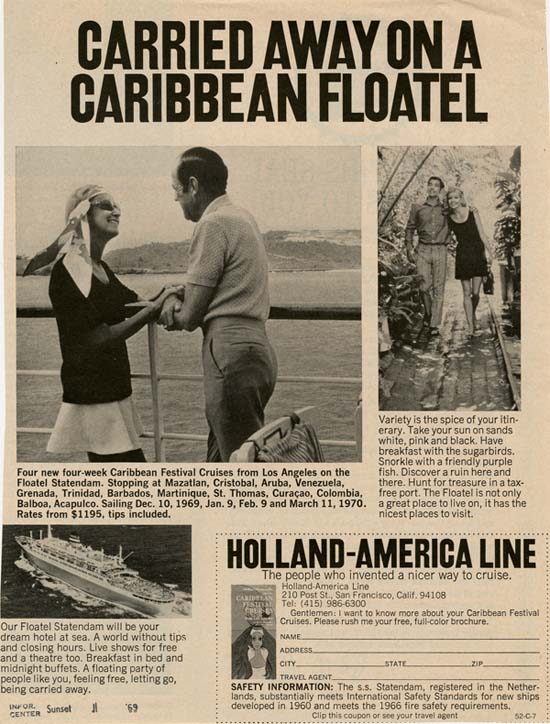
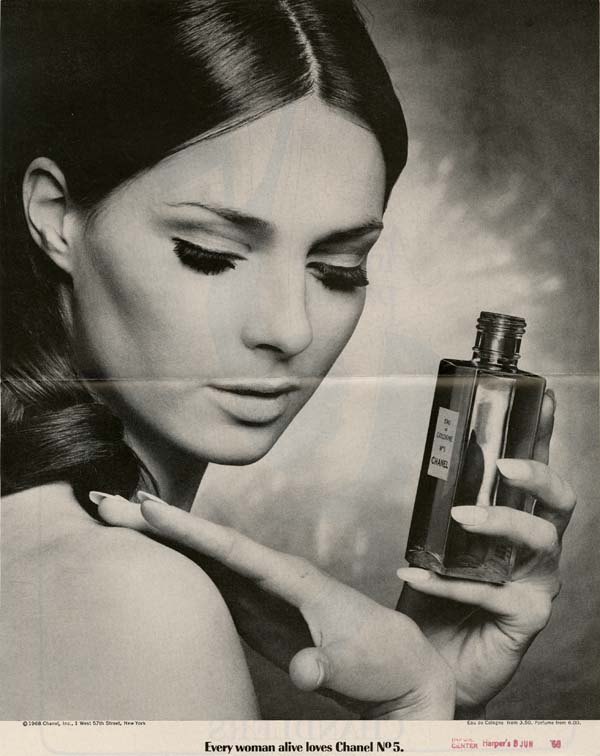
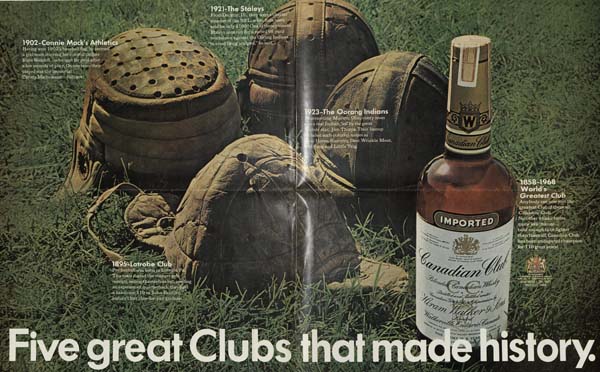
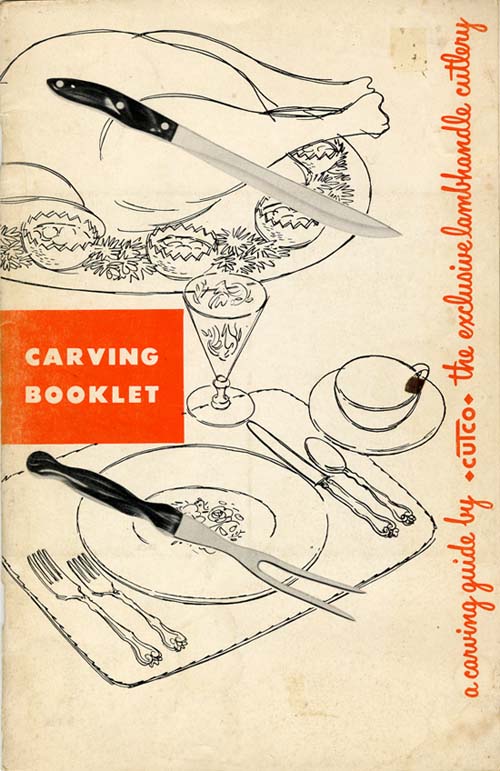
Episode thirteen referred to Chanel #5, Camaros, Thanksgiving, cranberry sauce, and cruises, among other things. Here is a selection of ads and images that illustrate some of the products and cultural references mentioned in last night’s Mad Men. A gallery of our highlighted images may also be found on Pinterest and Flickr.
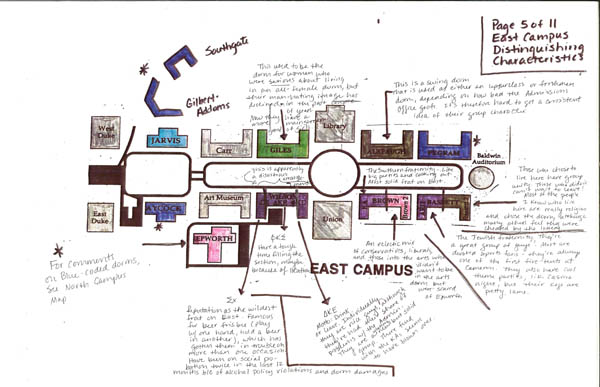
This spring I assisted my supervisor in processing the Duke Student Government (DSG) Records. One day he called me over to look at a report he had found called “A Color-Coded Guide to Campus Living Groups.” Prepared in the summer of 1992 by Adrianne G. Threatt, this report truly was colorful. It was divided in two parts with maps of the campus living groups on Main West Campus, Edens Quadrangle, East Campus, and North Campus. Part II was straightforward, with four maps showing the approximate number of residents per living group. But Part I showed the same four maps with hand-written commentary about the “distinguishing characteristics” of each living group. Looking at these comments reminded me of my own experience with Duke dorms and their “distinguishing characteristics.”
Click to enlarge!
One day shortly after my freshman year began, I walked into my dorm, Giles, to find all my friends crowded around a single laptop. My roommate was pointing to the screen animatedly, so I stopped to see what all the girls were looking at: it was a list of all the dorms on East Campus, with blurbs about the reputations of each. Giles, it said, was “home to pretty girls who like to have a good time.” Being freshmen, we of course knew everything on the internet is true: we all must have been placed in Giles because the all-knowing, all-seeing Duke housing lottery deemed us pretty girls who liked to have a good time.
Seeing the color-coded maps, then, I was eager to find out the “distinguishing characteristics” for Giles in 1992. According to the guide, Giles was “the dorm for women who were serious about living in an all-female dorm, but their man-hating image has declined in the past couple of years. Now they have a more main-stream group of girls.” To say the least, a far cry from what my friends and I had read 18 years later, in the fall of 2010.
What else had changed about East Campus? The first thing I noticed was that East was not an all-freshman campus. There were fraternity sections, for one thing, and “swing dorms,” which were used as either upper-class or freshman dorms.. In Wilson, there were three fraternity sections—ΣX (Sigma Chi), ΦKΣ (Phi Kappa Sigma), and ΔKE (Delta Kappa Epsilon)—which the author of the maps noted as “apparently a disastrous arrangement.” The “artsy dorm” in 1992 was Epworth, whereas Pegram had that title by my freshman year. Half of Bassett in 1992 was AEΠ’s (Alpha Epsilon Pi) section and the people who chose to live on the other half of Bassett were described as having “group unity” and as being “really religious.” I have only known Bassett as the dorm where all the basketball players lived.
Despite all these changes, many things have stayed the same. In 1992, KA’s (Kappa Alpha) section was in half of Brown; the author described KA as “the Southern fraternity,” who likes “big parties and cooking out.” This reputation holds true today. AEΠ was known as “the Jewish fraternity” and as a “great group of guys” who had “cool theme parties, like Casino night, but their kegs are pretty lame.” AEΠ is still the Jewish fraternity and still considered to be a great group of guys who have fun parties. As to their current kegs quality—no comment.
Being at Duke is exciting because the history that is everywhere makes us feel like part of a much bigger legacy. Yet, we are still able to make that legacy our own. This is why we see both reputations that persist through the years and reputations that constantly change. I would be interested to hear how other students and alums feel about Duke’s “distinguishing characteristics” over the years.
Do you see your Duke in the color-coded guide to the Duke of 1992?
The Duke University Libraries are proud to announce the completion of the still image digitization for the Duke-held collections of the Content, Context, and Capacity (CCC) Project.
This inter-institutional collaborative project of Duke, UNC Chapel Hill, NC State, and NC Central is digitizing records relating to the Long Civil Rights Movement. The Long Civil Rights Movement is a term used by historians to expand the traditional definition of the Civil Rights Movement of the 1950s and 1960s both further into the past and into more recent times. Collections from this project date back to as early as the 1880s and to as late as the first decade of the 2000s.
In total, all four institutions will digitize over 350,000 documents. Duke’s share of that total is approximately 66,000 scans from eight archival collections from the David M. Rubenstein Rare Book & Manuscript Library. In addition, during the next (final) year of the project, the CCC staff will transition to the digitization of audio collections. Duke will focus on the digitization of the North Carolina tapes from the Behind the Veil Oral History Collection, which is scheduled for publication in 2014.
Check out the gallery of selected documents digitized as part of the project (click to enlarge) and browse each of the eight collection’s finding aids, now containing the embedded digitized documents, below.
Flyer in opposition to Allen Building Takeover Questionnaire, February 1969. From the Allen Building Takeover Collection.
First Page of Civil Rights Act of 1957 (H.R. 6127), July 8, 1957. From the Basil Lee Whitener Papers.
Flyer for student life discussion, Black Student Alliance, January 1998. From the Black Student Alliance Records.
“An Important Work”, G.A. Mebane, 1885. From the Charles N. Hunter Papers.
“Black Studies termed progressive for area”, The Chronicle, September 12, 1972. From the Department of African and African-American Studies Records.
Photograph, Elna Spaulding is sworn in as Durham County Commissioner, undated. From the Asa and Elna Spaulding Papers.
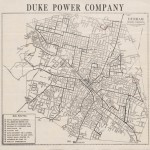
Map of Durham, Duke Power Company, May 1, 1948. From the Rencher Nicholas Harris Papers.
Letter, Patricia Nixon to Elna Spaulding, June 30, 1969. From the Women-In-Action for the Prevention of Violence and Its Causes Records.
Collection descriptions and links to finding aids (containing digitized materials):
Charles N. Hunter Papers, 1850s-1932 and undated: An educator and reformer ahead of his time, Charles N. Hunter’s papers feature valuable writings and speeches as well as correspondence with many luminaries, including Booker T. Washington.
Asa and Elna Spaulding Papers, 1909-1997 and undated, bulk 1935-1983: Elna Spaulding was a Durham civic leader who served as a County Commissioner and as the present of Women-in-Action for the Prevention of Violence and Its Causes. Her papers include correspondence and records of her civic life with many organizations.
Basil Lee Whitener Papers, 1889-1968: Basil Lee Whitener was a Democratic member of the U.S. House of Representatives from 1957 to 1968 from Mecklenburg County, North Carolina. His papers document his opposition to civil rights legislation as well as his activities as a member of the House Judiciary Committee.
Allen Building Takeover Collection, 1969-2002: This collection documents the events and the remembrances of the February 1969 Allen Building Takeover, during which students occupied Duke’s administrative building demanding improvement of African-American life on campus and skirmishes between sympathizers and the police on the quad became violent.
Black Student Alliance Records, 1969-2006: The Black Student Alliance is a Duke African-American student advocacy organization. Its records include evidence of the organization’s projects as well as their publications and compiled scrapbooks illustrating student life.
Researchers will find a great deal of material to analyze in these eight collections. The CCC staff encourages you to visit the finding aids of each collection and start exploring the varied perspectives, narratives, and memories that help to comprise the Long Civil Rights Movement.
The grant-funded CCC Project is designed to digitize selected manuscripts and photographs relating to the long civil rights movement. Funding is provided by the federal Institute of Museum and Library Services (IMLS) under the provisions of the Library Services and Technology Act (LSTA), as administered by the State Library of North Carolina, a division on the Department of Cultural Resources. For more about Rubenstein Library materials being digitized through the CCC Project, check out previous progress updates posted here at The Devil’s Tale!
Post contributed by Josh Hager, CCC Graduate Assistant.
Don stays home from work feigning illness and drinking too much, as he mourns what happened with Sally. Ken goes hunting with two Chevy executives and accidentally gets shot in the face. Betty tells Don that Sally doesn’t want to visit him anymore and that she wants to go to boarding school. Ted and Peggy’s fondness for each other becomes apparent to others in the office. Harry calls Don to tell him that Sunkist has approved a large media budget. Megan and Don go to the movies to see Rosemary’s Baby and run into Ted and Peggy.
Ken steps down from the Chevy account and Pete offers to take his place in Detroit. All of the partners except Ted are excited about the Sunkist news, but agree they need to start working more coherently on new business. Ted is angry that Ocean Spray will be resigned, but is conflicted since Sunkist is a bigger account. Pete is thwarted when he tries to move Bob off of the Chevy account. Duck Phillips tells Pete that Bob has lied about his education and work history.
Sally stays overnight at Miss Porter’s Boarding School and her student hosts demand alcohol and cigarettes. She calls her friend Glen, who arrives with liquor and a friend, Rolo, who has marijuana. Glen fights with Rolo when Sally accuses him of trying to force her to get physical, which makes her smile. The next day, a pleased Betty offers Sally a cigarette during the drive home from the boarding school visit.
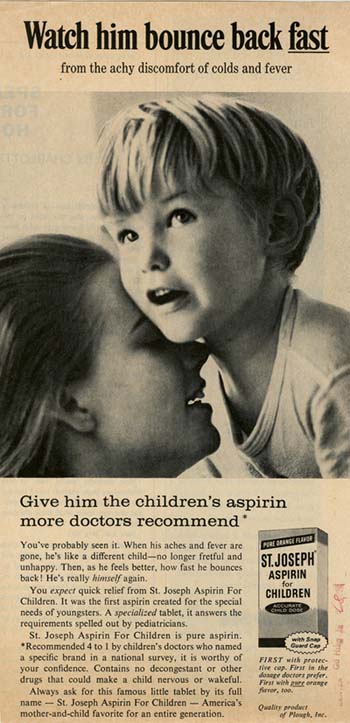
Don tells a St Joseph’s aspirin executive that their expensive commercial was Frank Gleason’s last idea, which gets the client to approve a budget increase, but undermines Ted and Peggy. Later Don tells Ted that his feelings for Peggy are impairing Ted’s judgement. Pete confronts Bob about his identity fraud, but offers a truce so they can work together, as long as Pete is “off limits.” Peggy yells at Don for ruining the St. Joseph’s situation for her and Ted.
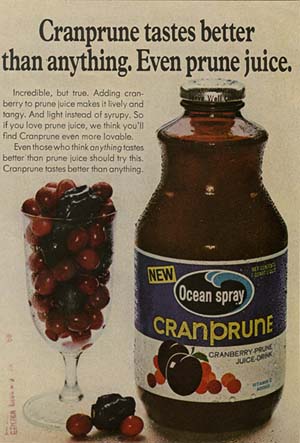
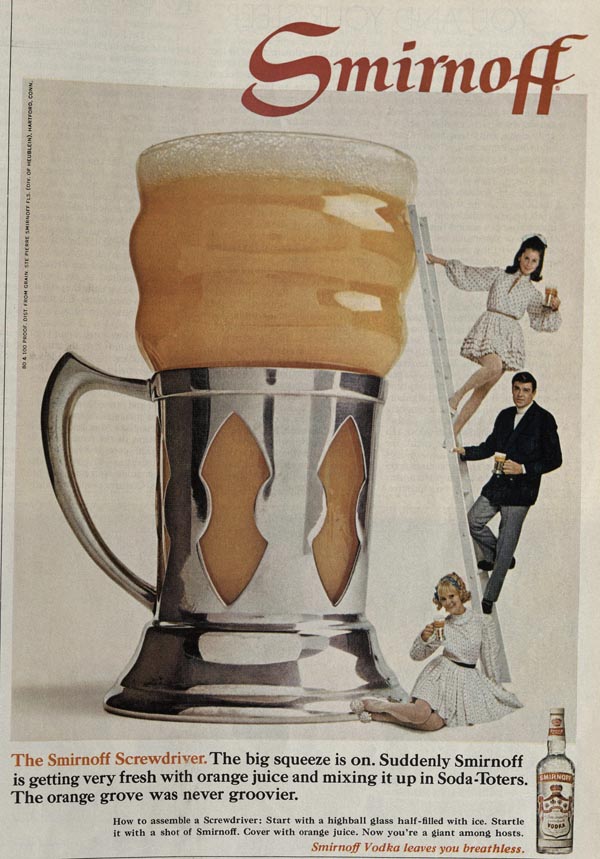
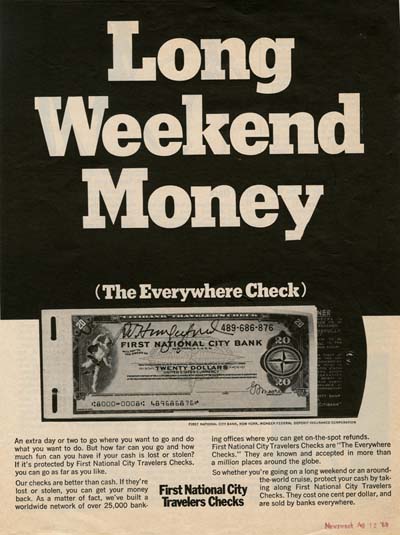
Episode twelve referred to vodka and orange juice, hunting, Nixon’s campaign, Cranprune juice, travelers checks, and Rosemary’s Baby, among other things. Here is a selection of ads and images that illustrate some of the products and cultural references mentioned in last night’s Mad Men. A gallery of our highlighted images may also be found on Pinterest and Flickr.
The Rubenstein Library’s three research center annually award travel grants to undergraduate and graduate students, faculty, and independent scholars through a competitive application process. Congratulations to this year’s recipients, we look forward to working with all of you!
John Hope Franklin Research Center for African and African American History and Culture Travel Grant Recipients
Dr. Richard Bell, Associate Professor, Department of History, University of Maryland, College Park; Project: “Slavery’s Market: A Microhistory.”
Dr. Frederick Carroll, Instructor, Department of History, Norfolk State University; Project: “Race News: How Black Reporters and Readers Shaped the Fight for Racial Injustice, 1910-1978.”
Ms. Mandy Jolly, Undergraduate, Department of History, Lenoir-Ryhne University; Project: “Journalistic Racism from Early Travel/Exploration Logs from the 19th and 20th Century.”
Dr. Phillip Misevich, Assistant Professor of History, St. John’s University; Project: “On the Frontier of Freedom: Abolition and the Growth of Atlantic Commerce in Southern Sierra Leone, c1790s to 1880s.”
Ms. Marie Stango, PhD Candidate, Department of History, University of Michigan; Project: “Antislavery and Colonization: African American Women in Nineteenth Century West Africa.”
Dr. Shirley Thompson, Associate Professor of African and African Diaspora Studies, University of Texas at Austin; Project: “No More Auction Block for Me: African Americans and the Problem of Property.”
Dr. Charlotte Walker-Said, Theodore W. Lentz Fellow in Peace Studies and Human Rights, Webster University; Project: “Traditional Marriage for the Modern Nation: Family Formation and the Politics of Religion in Colonial and Postcolonial Africa.”
Mr. James Wall, PhD Candidate, Department of History, University of Georgia; Project: “Redefining Success: The Strule for Freedom Rights in Southwest Georgia, 1945-1985”
John W. Hartman Center for Sales, Advertising & Marketing History Fellowship and Travel Grant Recipients
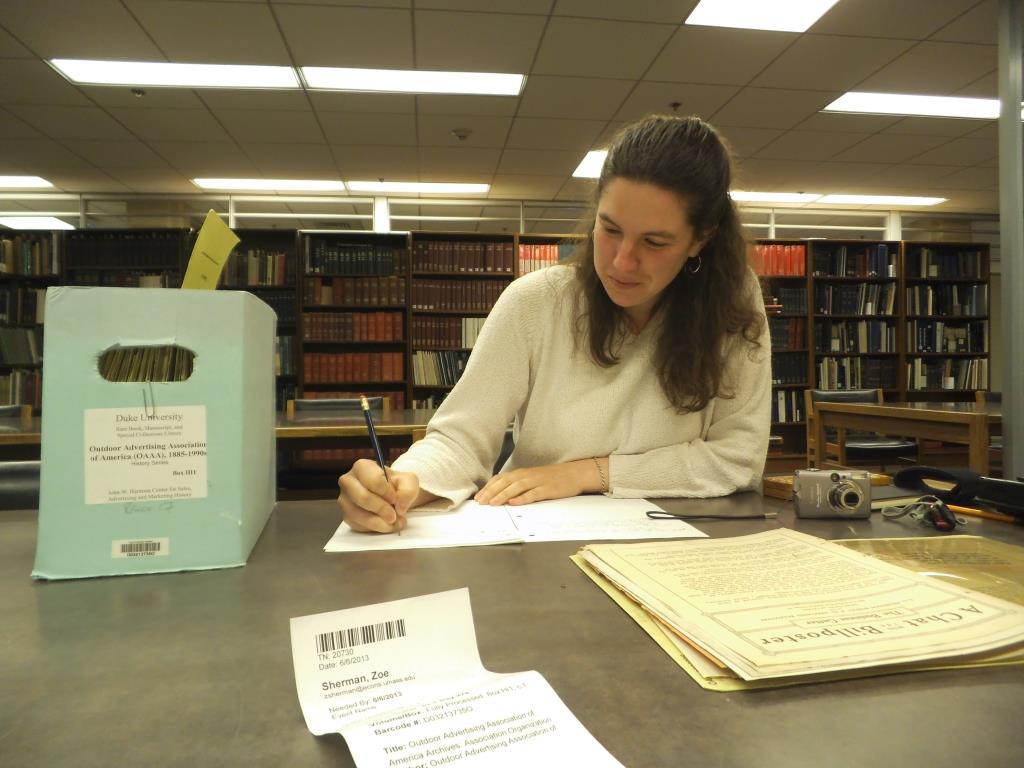
Zoe Sherman uses the Outdoor Advertising Association of America Records
FOARE Fellowships for Outdoor Advertising Research:
Elizabeth Semler: History of Science, Technology and Medicine, University of Minnesota, “’Got Milk?’: Dairy Advertising and Scientific Authority in the late 20th Century”
Zoe Sherman: Economics, University of Massachusetts – Amherst, “The Commodification of Audience Attention in the US, 1865-1920”
John Furr Fellowships for JWT Research:
Ai Hisano: History, University of Delaware, “A History of Food Color in the United States, 1880s-1970s”
Cristina Sánchez-Blanco: Media Management, University of Navarra (Spain), “Advertising Account Planning in JWT”
Hartman Center Travel Grants:
Francesca Russello Ammon: American Academy of Arts & Sciences, “Culture of Clearance: Waging War on the Landscape in Postwar America”
Leslie Anderson: University of California – Merced, “The Politics of Domesticity” (Senior Thesis)
Mary Bridges: International Studies, Yale University, “Global Infrastructure of US Business Activities in the Interwar and World War II Periods”
Jessica Burch: History Department, Vanderbilt University, “Soap and Hope: culture, Capitalism, and Direct Sales in World War II America”
Dr. Andrew Case: Nelson Institute for Environmental Studies, University of Wisconsin – Madison, “Dear Friend: Direct Mail Marketing and the Transformation of Buying and Selling in Postwar America”
Kristi Whitfield Johnson: Baton Rouge, LA, “Canning Foods and Selling Modernity: The Canned Food Industry and Consumer Culture, 1898-1945”
Dr. Richard K. Popp: Journalism, Advertising and Media Studies, University of Wisconsin – Milwaukee, “Direct Marketing, Communication Networks, and the Remaking of consumer Culture, 1960-2000”
Sallie Bingham Center for Women’s History and Culture Travel Grant Recipients
Valerie Behrer, English, University of Minnesota, for dissertation research on the connections between girls’ subjectivities, autobiographical practices, and the development of American radical feminism from the late 1960s to the 1970s.
Erin Leigh Durban-Albrecht, Gender & Women’s Studies, University of Arizona, for a set of related projects—including a film and her dissertation—that use Kathy Acker’s Kathy Goes to Haiti to explore racialized gender and sexuality, cultural production, and U.S.‐Haiti relations in the 20th and early 21st century.
Dr. Lauren Gutterman, Center for Gender and Sexuality Law, Columbia Law School, for a book that will examine the personal experiences and public representation of American wives who desired women, 1945 to 1979.
Monica Miller, English and Women’s & Gender Studies, Louisiana State University, for dissertation research on the use of ugly women as characters that defy the stereotype of the beautiful belle in the work of 20th century Southern women writers.
Michelle Pronovost, Fashion Institute of Technology, for research on the confrontational fashion of riot grrrls in zines from the 1990s.
Dr. Andrea Walton, Department of Educational Leadership and Policy Studies, Indiana University Bloomington, for research supporting an article and book chapter on philanthropist Eleanor Thomas Elliott.
Kelly Weber, History, Rice University, for dissertation research related to the politics of daughterhood in the New South, 1880 to 1920.
Stacy J. Williams, Sociology, University of California, San Diego, for dissertation research on how social movements have affected feminist discourse about cooking, 1874 to 2013.
Dr. Mary Ziegler, St. Louis University, for a book about how abortion providers helped define lay understandings of the constitutional, statutory, and common law concerning abortion in the United States.
Eleanore and Harold Jantz Fellowship
The first recipient of the Eleanore and Harold Jantz Fellowship is Chunjie Zhang, Assistant Professor of German at the University of California, Davis. Dr. Zhang is a graduate of Duke (PhD 2010). Her project is “Representations of non-European cultures in the German discourse in the eighteenth century.”
The title of last night’s show accurately sums up a major theme seen in the episode. Many characters need or give favors, though not without consequences. The SC&P staff realizes that they are competing for two similar clients, Sunkist and Ocean Spray, so one will have to be resigned. While talking to Peggy, Pete’s mother claims she is in love with her nurse Manolo, and implies that their relationship is sexual. Sylvia and Arnold are afraid because their son Mitchell is reclassified 1A by the draft after dropping out of school and sending back his draft card in protest. Peggy tells Pete what his mother said to her over a friendly post client meeting dinner. Later Pete argues with his mother about Manolo. Don awkwardly brings up Mitchell’s draft status at a client dinner with Chevy. Peggy calls Stan to remove a dying rat from her apartment but he refuses to help. Sally and her friend Julie stay at Don and Megan’s apartment while attending the Model UN. They meet Mitchell in the lobby and swoon over him. Ted gets mad at Don for the uncomfortable moment during the Chevy dinner. He offers to help get Mitchell into the Air National Guard if Don will agree to drop Sunkist in favor of Ocean Spray. Don agrees and calls Sylvia to tell her the good news. Julie signs Sally’s name on a love note slipped under Mitchell’s door. Sally returns to retrieve the note from the Rosen’s apartment, only to find Sylvia and Don about to have sex. She runs away and Don tries to follow. Bob tries to reassure Pete about Manolo and touches his knee to Pete’s suggestively. Pete rebuffs Bob and fires Manolo. Don comes home drunk and Megan tells him that he is the “sweetest man” for helping Mitchell. Sally shouts “you make me sick!” and runs off to her room. Don tries to talk to Sally but makes up a weak excuse.
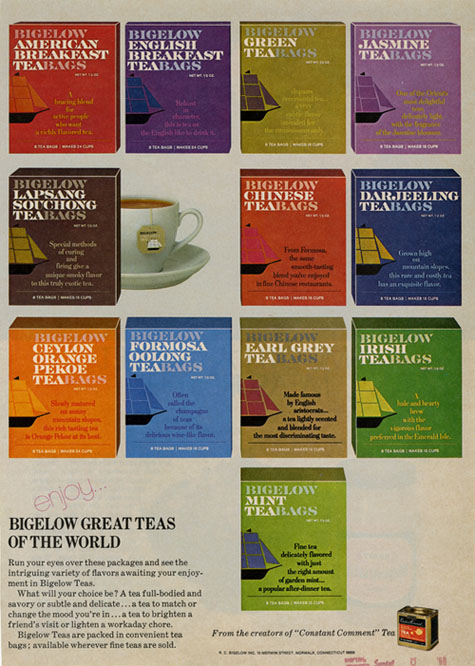
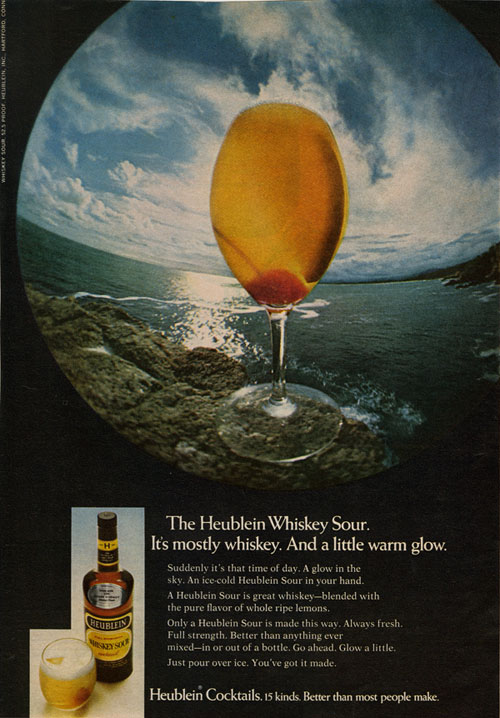
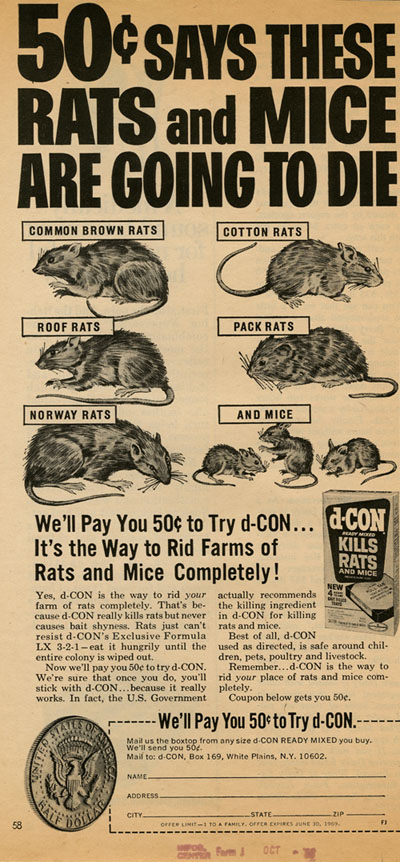
Episode nine’s plot referred to Post cereals, whiskey sours, rat traps, tea, and Ocean Spray, among other things. Here is a selection of ads that illustrate some of the products and cultural references mentioned in Sunday night’s Mad Men. A gallery of our highlighted images may also be found on Pinterest and Flickr.
This year, Duke commemorates the 50th anniversary of racial integration at the university, when in 1963 five African American students matriculated into the undergraduate program. Also in 1963, Pepsi sponsored the production of a record album, “Adventures in Negro History,” recently acquired by the John W. Hartman Center as part of the Douglass Alligood Papers. Alligood was one of the first black executives in the advertising industry, and is currently a Senior Vice President at BBDO agency. Long a champion for minority inclusion in the advertising business, Alligood chairs the BBDO’s Diversity Council, which advises management on diversity policies. He has also worked at RCA and for the minority-owned agency UniWorld Group. The record album contains dramatic readings by Detroit-based actors, including Jerry Blocker, Burniece Avery and Jiam Desjardins, which depicts the contributions of people of color to American history. Included are both the famous (Crispus Attucks, Phyllis Wheatley, Ralphe Bunche) and lesser known figures: Christopher Columbus’s pilot, Pedro Nino; Revolutionary War hero Salem Poor; and philanthropist Paul Cuffe.
Post contributed by Rick Collier, Technical Services Archivist.
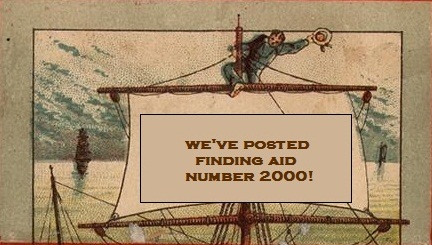
Any day now, the ticker at the top of the Rubenstein’s finding aids page will turn over and mark a milestone 2000th online finding aid. Doesn’t sound like much, especially when you consider that the Rubenstein Library holds more than 6,000 manuscript collections. But those 2,000 finding aids – narrative maps that guide a researcher through the contents of a manuscript collection’s boxes and folders – also represent thousands of hours of interpretive labor supplied by library staff. The first of these online collection guides debuted around 1996. They are encoded with an XML-derivative called EAD, and are now discoverable to a worldwide audience through any online keyword search. But finding aids – or inventories – or collection guides – go back a lot further than their online counterparts.
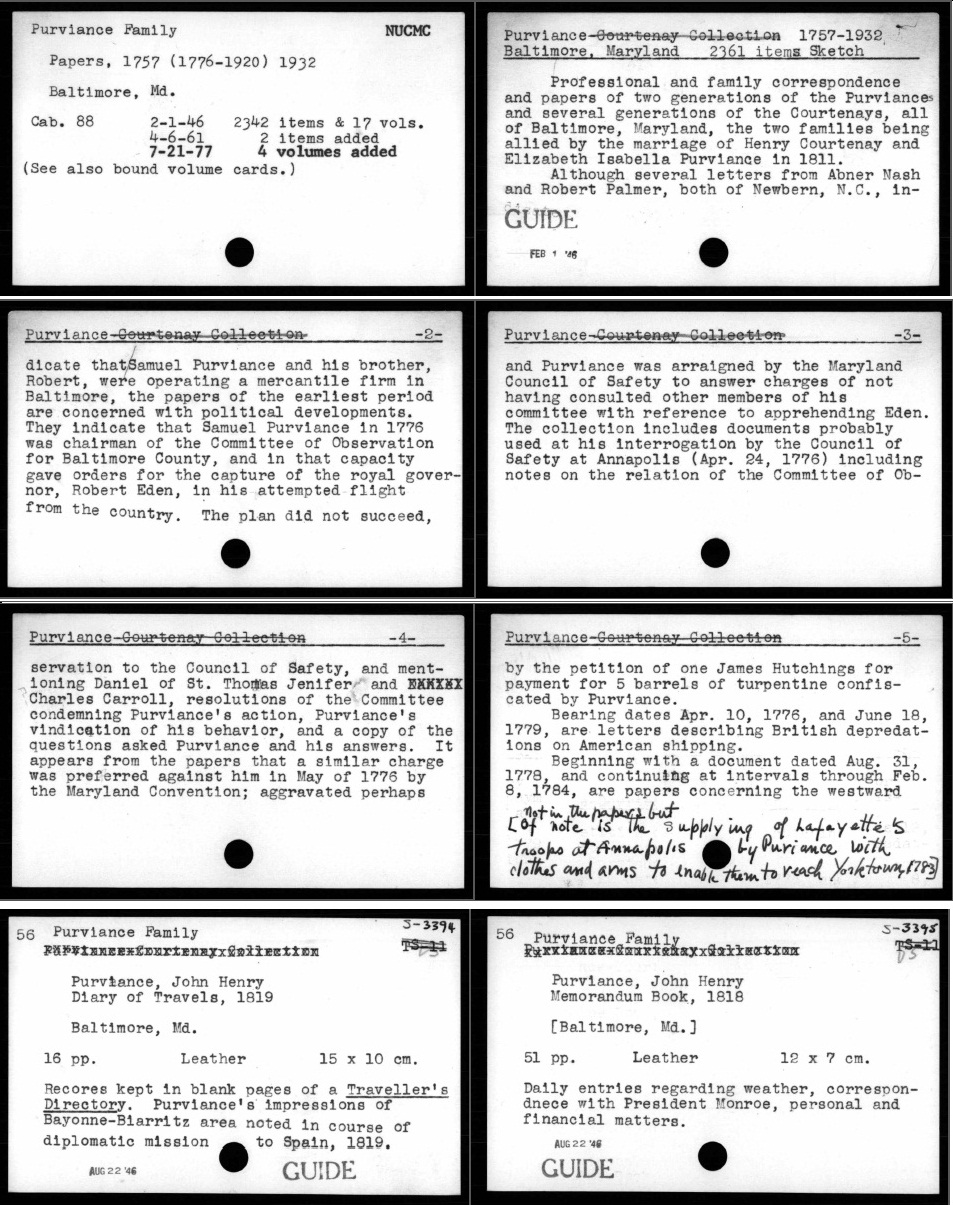
The winner of the 2,000th finding aid spot belongs to the Purviance Family Papers. Acquired as either a purchase or a gift by the Duke University Manuscripts Department in 1943 from an S. S. Barnes in Baltimore, the collection offers over 2300 manuscripts and 10 photographs, 4 maps, and 21 volumes (including an anonymous Civil War diary) belonging to a prominent Revolutionary-era Baltimore family with a compelling history. Shortly after it was received, a Manuscript Department archivist researched the collection and typed up a set of catalog cards: the Purviance Papers “finding aid.”
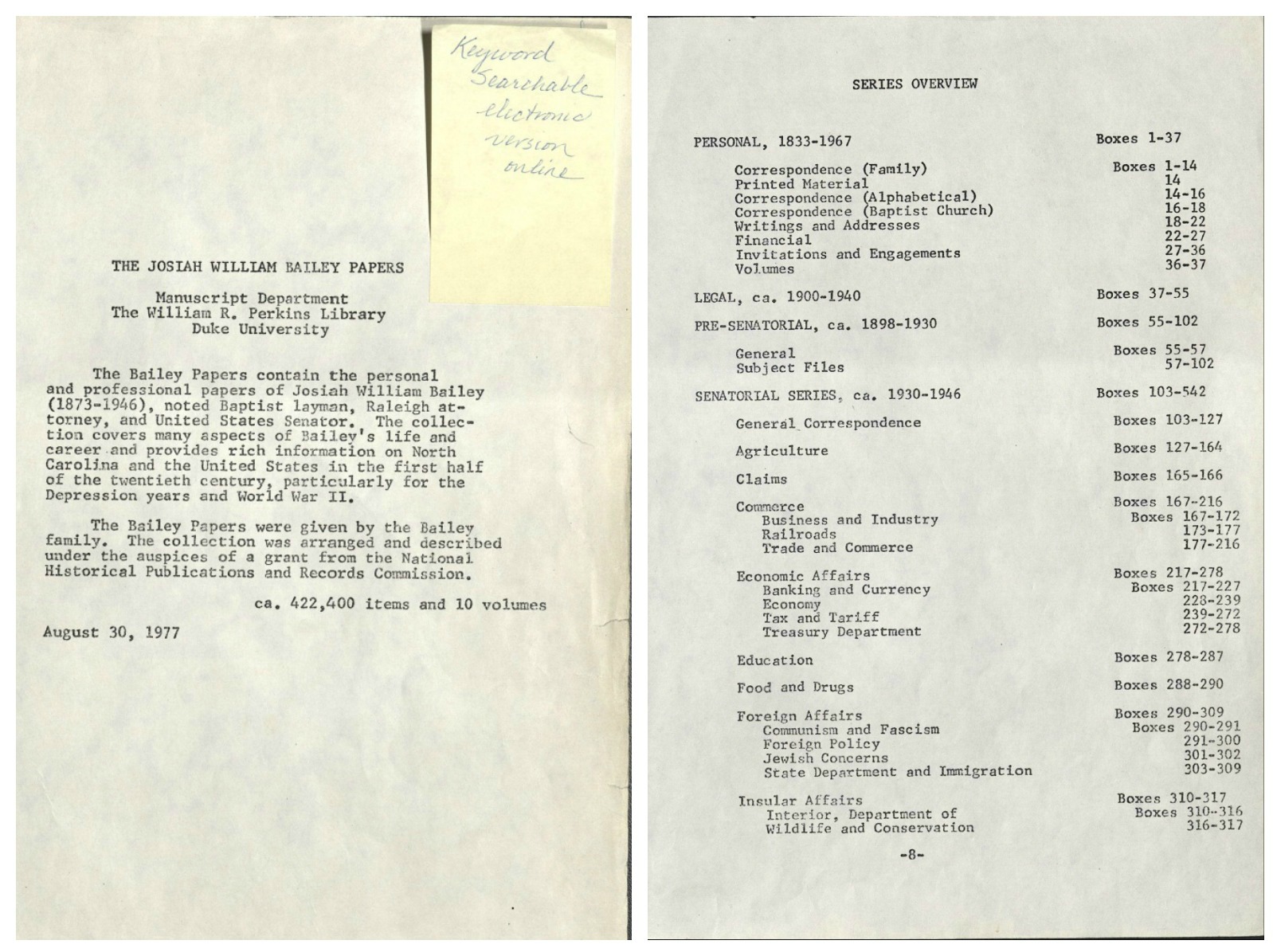
Defined most broadly, archivists consider a finding aid to be any document that assists in charting a path through the contents and topics of an archival collection – a big help when you’re dealing with a very large collection! In the 1940s at Duke, this was the role of the card catalog. Of course, you could only consult the cards if you traveled to the library, or if you could ask a reference archivist to help. Some collections were represented by three or four cards; some had close to a hundred. In 2012 – to the shock of older librarians who never thought they’d see the day – the entire card catalog was digitized and is currently being used as a resource for the reference archivists. Here is a sample of the 92 Purviance cards: Collections were typically a lot smaller back then. As collections grew larger, a new generation of archivists started using more productive strategies for describing thousands of folders of manuscript items, and as part of this effort, they turned to creating more-portable paper inventories (but still on typewriters). Here’s an example of one, with a post-it note that marks a turning point in library history:
Enter the computer and Microsoft Word. When I started working in the library in 1992, the staff was thinking big about the power of computing. Gopher and Mosaic and were on the horizon. More prosaically, electronic-format finding aids could be corrected and added to, and printed out anytime (no more liquid white-out) or viewed online – goodbye, paper (well, sort of). The description for the Purviance Family Papers were still described on cards in the card catalog and in a paper box list until a few months ago. As part of a project to make all of our longer legacy descriptions available online, a library intern, Bob Malme, encoded the Purviance Family Papers collection guide – the Rubenstein Library’s 2,000th finding aid. And it is especially fitting that this inventory was the work of one of our interns: an integral part of our library practically since our founding, they have provided a huge amount of support for our collections and their finding aids – in every format.
As a member of the Technical Services Department, whose job it is to crank out all these finding aids, I was – and still am, I guess – an EAD Warrior. That moniker comes from a Duke Special Collections Library group whose early work on standards for Duke online finding aids would shape our goal for total online access for all of our finding aids – cards and paper. How many finding aids will that eventually be? Oh, another 4,000 at least. We’re working on it already!
Post contributed by Paula Jeannet Mangiafico, Senior Processing Archivist.
Dispatches from the David M. Rubenstein Rare Book and Manuscript Library at Duke University