Heschel Highlights, Part 4

Welcome to the fourth post in a series documenting the processing of the Abraham Joshua Heschel Papers.

In 1939, Julian Morgenstern helped Abraham Joshua Heschel travel from Warsaw to London just six weeks before Germany invaded Poland. In 1940, upon his arrival in the United States, Heschel began teaching at Hebrew Union College (HUC) where Julian Morgenstern was President. HUC was the main seminary for Reform Judaism in the United States and Heschel was the Associate Professor of Jewish Philosophy and Rabbinics there for five years. Heschel resigned from the HUC faculty on May 18, 1945 over ideological differences. As we process the Abraham Joshua Heschel papers, we learn more about the complex relationship between Heschel, HUC, and the leaders of Reform Judaism. Through letters, essays, handwritten notes, and his books, Heschel expressed concerns about the role of God, spirituality and adherence to Jewish law among Reform Jews. At a few points in Heschel’s life, these concerns bubbled up and he took action as part of his larger effort to infuse American Judaism with spirituality.

Photographs and documents from the Heschel Papers.

In 1945, Heschel’s theological divergence from HUC became a serious issue for him and he resigned his position. In a handwritten draft of his resignation letter to Morgenstern Heschel wrote “from the beginning of my affiliation with the college I fully realized that the HUC stands for a distinctive philosophy of Judaism which it tries to realize in practice and with which my own interpretation of Judaism is not in full accord.” Heschel’s resignation was accepted with sadness and respect on the part of Julian Morgenstern. In a letter dated May 19, 1945, Morgenstern wrote that he and the HUC Board of Governors wished to express their feeling that he was doing the “right and honorable thing.” A number of letters related to Heschel’s resignation echo this sentiment. Heschel’s students, colleagues and friends approved of Heschel’s decision and wished him well. Despite his issues with the philosophy of HUC, Heschel expressed an interest in sustaining his friendship with Morgenstern in his resignation letter: “I earnestly hope and wish, however, that the cordiality and warmth of our friendship will not be impaired by my leaving this institution.” It is clear from the amount of correspondence from Morgenstern that their friendship continued until Heschel’s death. From the correspondence surrounding Heschel’s resignation from HUC (and subsequent acceptance of a position as Associate Professor of Jewish Ethics and Mysticism at the Jewish Theological Seminary) it seems that Heschel continued to be on good terms with many of the acquaintances and friends that he made during his time at HUC. However, his ideological differences remained.

In 1953, Heschel caused a stir among his Reform colleagues when he gave an address to the Reform Rabbinic Organization, the Central Conference of American Rabbis (CCAR), entitled “Towards an Understanding of Halacha.” Heschel appears to have denounced the CCAR for failing to hold to the doctrine of Halacha (Jewish law) in this address. From the correspondence we have surrounding the address and its subsequent publication by the CCAR, it is clear that Heschel earned himself both admirers and detractors as a result. However, even the harshest letters reveal a great deal of respect for Heschel. A 1954 letter that begins with the exclamation “I am profoundly shocked by your persistent misinterpretation of Reform’s position on practice” concludes with the author, a reform rabbi, noting that Heschel could be helpful to the Reform movement as they move forward. Another letter from a Reform rabbi seems wary of Heschel’s denunciation of the CCAR but the author also wrote that “all your papers have a few extra calories of spiritual warmth which lift the heart.” And yet another rabbi’s letter reveals the power of a meeting with Heschel to assuage anger: “But of my prior disturbance, I can say ‘gam zu l’tovah’ [this is also for good] for it provided the occasion for a most stimulating and edifying chat with you.” Heschel remained in constant communication with Reform Rabbis and the leaders of the Reform movement throughout his life and his correspondence reveals that this exchange was beneficial to Heschel, to many Reform rabbis and perhaps even to Reform Judaism.

Post contributed by Adrienne Krone, Heschel Project Assistant in Rubenstein Technical Services.


The African Americans: Rubenstein Recap #4

Episode 4: Making a Way Out of No Way (1897 – 1940)

Last Tuesday’s episode, “Making a Way Out of No Way (1897 -1940),” began at the dawn of the Jim Crow era. Having already been forcibly removed from voting rolls, black southerners lived under the ever-present threats of violence, limited opportunities, and daily injustices of white supremacy.

The Behind the Veil project captured the experiences of hundreds of African Americans in the South living under Jim Crow. Listen to some of their stories here.

Many took a chance, abandoning the South in hopes of something better. By the end of the First World War, a massive influx of African Americans had transformed cities across the North and West. The freedom that they found in urban centers, like Harlem, inspired an explosion of black artistic creativity. The vibrant music, writing, films, and dancing of the Harlem Renaissance helped defy the rampant stereotypes of African Americans.

AAMR, 4, AfAmsinFilm001
African Americans in Film, Box 3, Folder: LoveBug, 1919.

This movie poster for the 1921, The Green Eyed Monster, promotes the film’s all-black cast, assuring readers that there is nothing of “the usual mimicry of the Negro” in the show.

But cultural richness did not end the second-class citizenship that limited all black Americans. During the Jim Crow era, black insurance agencies, grocery stores, doctors, educational institutions, and clubs and organizations multiplied, as black Americans turned inward, utilizing the resources they had.

AAMR, 4, NCMutual003
North Carolina Mutual Archives, Box 78, Folder: The Negro’s Adventure in the Field of Life Insurance, by W.J. Kennedy, Jr., 1934.

The North Carolina Mutual Life Insurance Company opened its doors in Durham in 1899. It grew into the largest black-run financial institution in the country and helped support the city’s sizable black middle class. This 1934 booklet, “The Negro’s Adventure in Life Insurance” explains how life insurance policies benefited African Americans.

From Booker T. Washington’s plans for economic development to W.E.B. DuBois’ ideas of racial uplift, black Americans continually sought new and sometimes conflicting strategies to secure full citizenship in the years before World War II.

AAMR, 4, BookerWashington001
Booker T. Washington Papers.

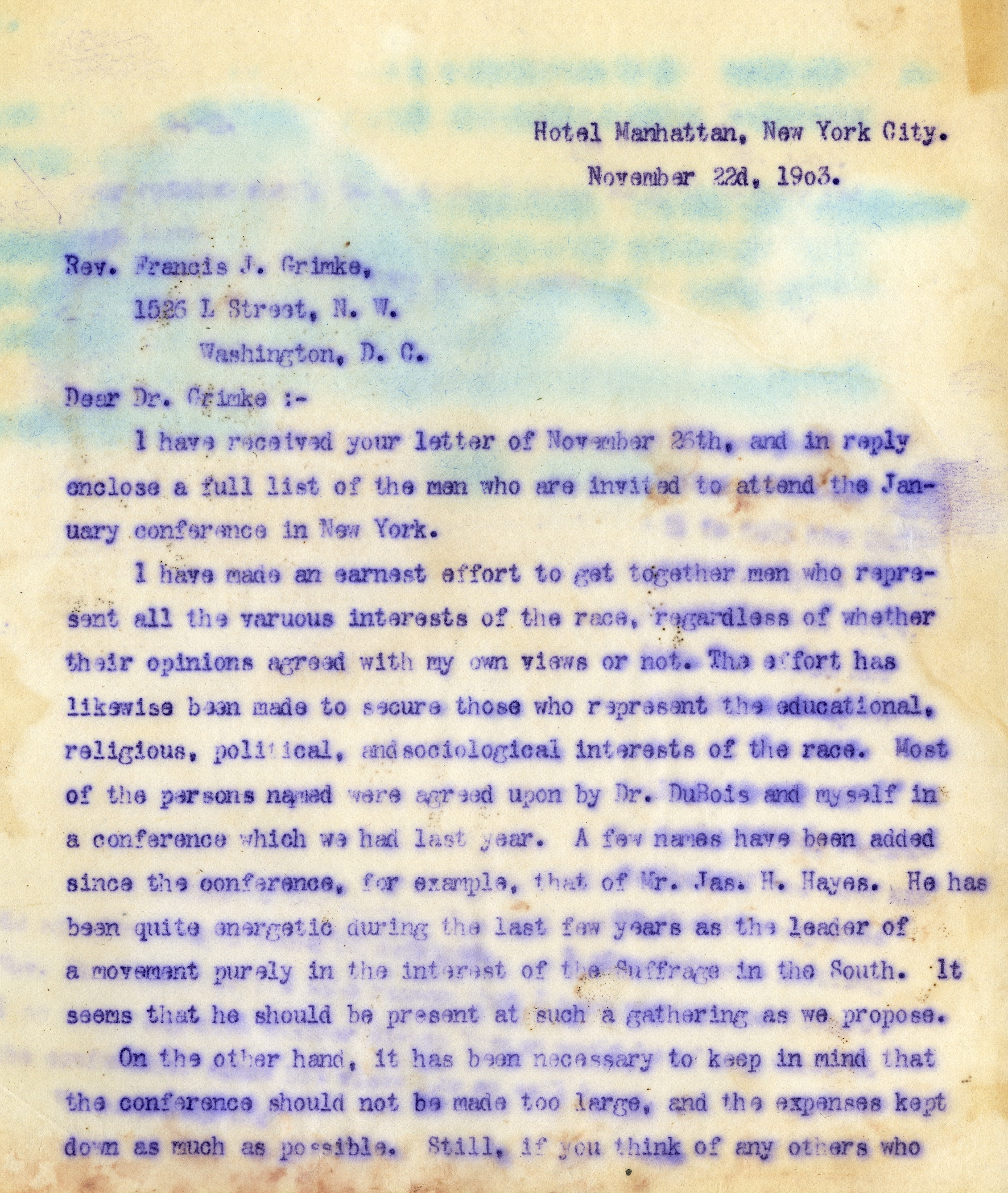
In 1904, Booker T. Washington, with assistance from W.E.B. DuBois, gathered leading black men in New York City to discuss the dire conditions facing African Americans. Washington explains his idea for the conference and the importance of including a variety of opinions in this 1903 letter to activist and Presbyterian minister, Francis Grimke. 

Post contributed by Karlyn Forner, John Hope Franklin Research Center Graduate Intern.

The African Americans: Rubenstein Recap #3

Each Tuesday, PBS is showing the next installment of a six-part series, The African Americans: Many Rivers to Cross. Written and narrated by Dr. Henry Louis Gates, Jr., the documentary traces African American history from the shores of West Africa to the election of Barack Obama. Join us each week as we feature documents from the John Hope Franklin Research Center that resonate with the previous week’s episode.

Episode 3: Into the Fire (1861 – 1896) traced the tumultuous journeys of African Americans from slavery to freedom in the second half of the nineteenth century. The Civil War opened as a battle to preserve the Union, but as enslaved men and women flocked to Union lines searching for freedom, their actions transformed the war into one for emancipation.

Kate Foster, a white woman from Adams County, Mississippi, kept a diary during the Civil War. In this entry from July 16th, 1863, she writes about the slaves who abandoned their masters in pursuit of freedom with the union army.

AAMR 3 FosterKate003blog
“The negroes are flocking to the enemy in town and the Yanks are cussing them and saying they wished they had never seen a negro. They are an ungrateful set and we are all tired of them.” (Kate D. Foster Diary)

At the conclusion of the war, freed black men and women set out to build new lives learning to read, buying land, building institutions, and raising families.

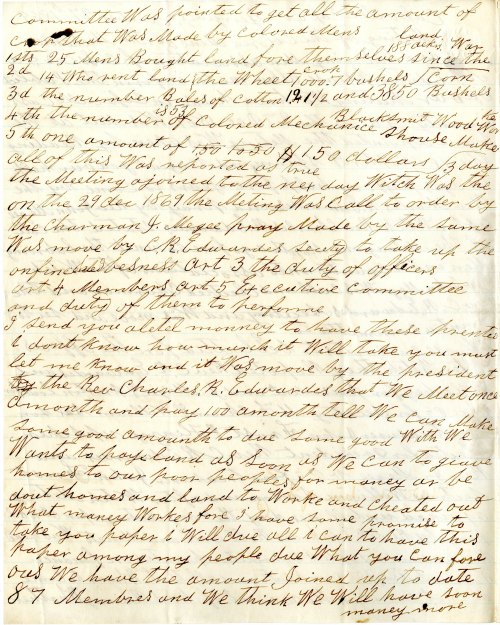
In this 1869 letter, African American minister Charles R. Edwardes introduces the Colored Men of the Mechanics and Laboring Men Association to John Emory Bryant, editor of radical Republican newspaper in Georgia. Rev. Edwardes explains how the organization wanted to help freed people buy land and homes.

John Emory Bryant Papers

After the 15th Amendment guaranteed black citizens’ right to vote, they used the ballot to elect African American city councilmen, state legislators, and congressmen to office. But white southern Democrats swiftly retaliated against these challenges through lynch mobs and violence at the ballot box, eroding African Americans’ newfound citizenship.

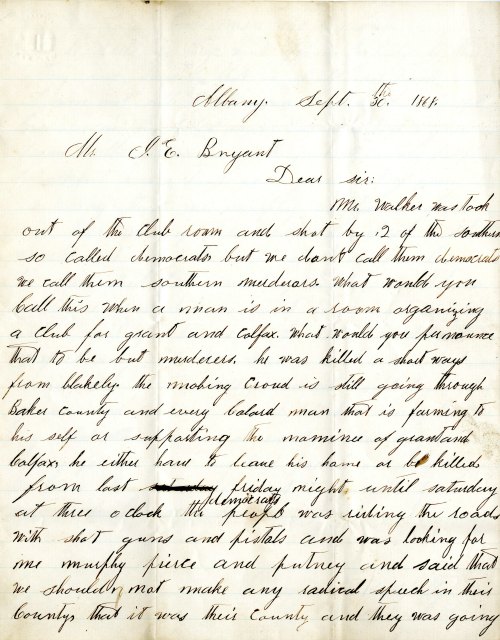
Mr. P. Joiner writes to Editor John Bryant in 1868 reporting the shooting of a black man by white democrats near Albany, Georgia. The white mob then continued on a rampage through the countryside, warning African Americans that it was “their country and they was going to rule it.” (John Emory Bryant Papers)

Mr. P. Joiner writes to Editor John Bryant in 1868 reporting the shooting of a black man by white democrats near Albany, Georgia. The white mob then continued on a rampage through the countryside, warning African Americans that it was “their country and they was going to rule it.” (John Emory Bryant Papers)
John Emory Bryant Papers

The 1890s brought a wave of state constitutional conventions across the South, aimed at systematically disfranchising black residents. These actions were buttressed by the Supreme Court’s Plessy v. Ferguson 1896 decision, supporting the principal of a separate but equal society and paving the way for legal racial segregation. As the twentieth century dawned, the full citizenship black Americans had so briefly experienced seemed like a distant hope.

Charles Hunter was born a slave in Raleigh in 1851 and spent his life pushing for the advancement of African Americans. In 1889, Hunter writes to the Postmaster General in Washington, D.C., protesting the white Raleigh postmaster’s refusal to appoint Hunter due to his race.

Charles N. Hunter Papers

Post contributed by Karlyn Forner, John Hope Franklin Research Center Graduate Student Intern and John Gartrell, John Hope Franklin Research Center Director.


Achenbaum Dedicates Papers, Endows Hartman Center Travel Grants

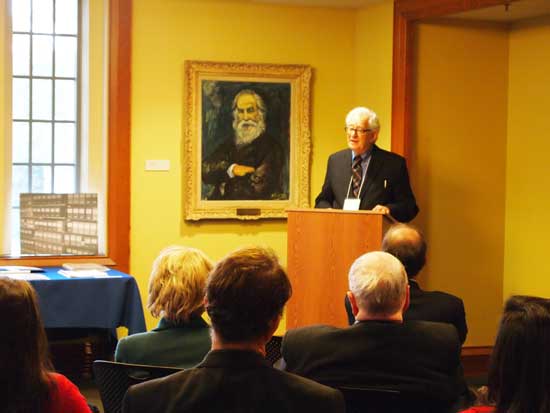
On Thursday, November 7th, twenty of Al Achenbaum’s family and close friends joined Duke library staff and faculty in a ceremony to dedicate his papers as part of the John W. Hartman Center for Sales, Advertising & Marketing History. In a series of comments given by Hartman Center staff, Achenbaum’s papers were lauded for their unique insight into building brand equity, strategic marketing planning, maximizing advertising agency-client relationships, and using systematic quantitative research as a guide to effective decision-making.

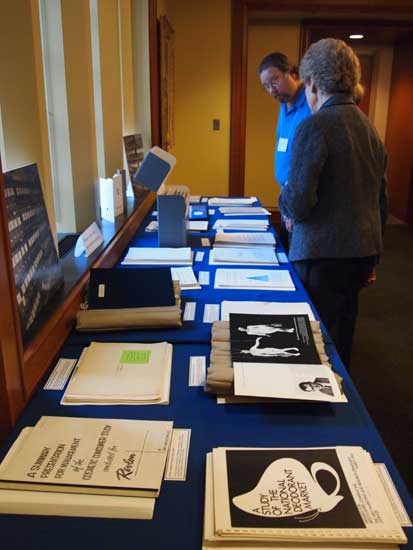
A display of materials from the Alvin Achenbaum Papers.
A display of materials from the Alvin A, Achenbaum Papers.

Over a remarkable 60-year career, he advised leading global marketers, including Procter & Gamble, GE, Toyota and Nestlé, on how to use marketing tools to improve the economic value of their businesses.  He held senior executive positions at four major advertising agencies in New York, and was chairman of a series of leading marketing consulting firms which provided over 150 companies with systematic tools for addressing complex business challenges.

This 233-box collection will enrich the experiences of many students and scholars interested in the evolution of the advertising industry in the second half of the 20th century or the career of Al Achenbaum, known to many as the “Einstein of Advertising” and one of Advertising Age’s  100 most influential advertising people of the 20th century. Al’s son, Jon Achenbaum, described his father as the reason he started his own career in marketing, applying many of the marketing innovations that Al brought into the business world and read two passages from Al’s upcoming book.

Rounding out the event were remarks by Al Achenbaum himself, in which he stated that “marketing is the single most important driver of our modern economy” and that it will “continue to play a critical role in economic success – both in the U.S. and abroad.”  He expressed his gratitude to his family and friends for supporting him throughout his life and career and expressed his enthusiasm for donating his papers to Duke and the Hartman Center.

P1011531-web

To top off the ceremony, he announced that he is endowing the Hartman Center’s travel grant program, which will be named the Alvin A. Achenbaum Travel Grants.  These travel grants will enable students and scholars to come from afar to use Hartman Center collections as part of their research each year. Since Achenbaum is in many ways a scholar of advertising and marketing himself, this is a wonderful way to continue his legacy in perpetuity.

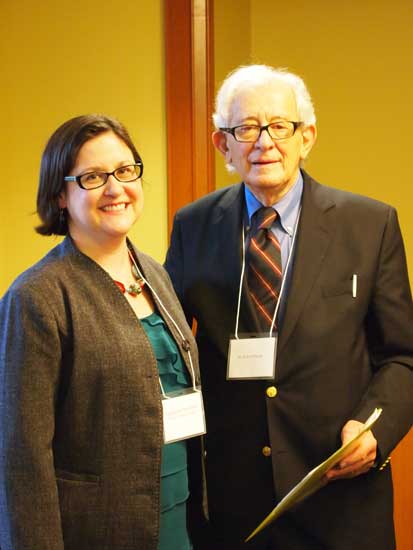
Hartman Center director Jackie Reid Wachholz and Al Achenbaum.

Post contributed by Jackie Reid Wachholz, director of the John W. Hartman Center for Sales, Advertising & Marketing History.

The African Americans: Rubenstein Recap #2

Each Tuesday, PBS is showing the next installment of a six-part series, The African Americans: Many Rivers to Cross. Written and narrated by Dr. Henry Louis Gates, Jr., the documentary traces African American history from the shores of West Africa to the election of Barack Obama. Join us each week as we feature documents from the John Hope Franklin Research Center that resonate with the previous week’s episode.

Last Tuesday’s episode  focused on the slavery at its height in the American South. Episode 2: The Age of Slavery (1800 – 1860) began at the end of the Revolutionary War, a time when slavery was still legal in all thirteen states. While the demands of enslaved African Americans for freedom and mounting moral appeals helped end human bondage in the North, the exploding international demand for cotton only deepened the South’s reliance on slave labor.

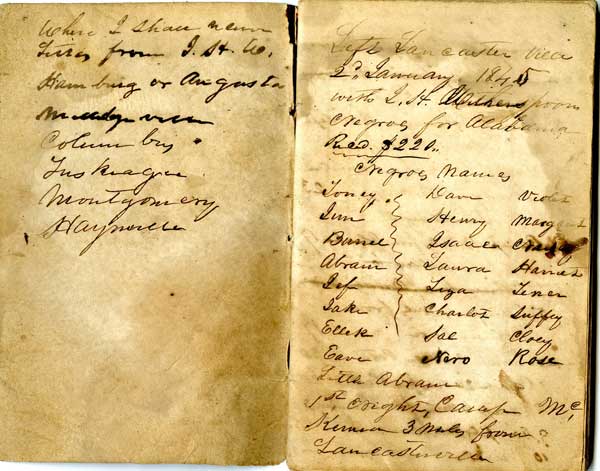
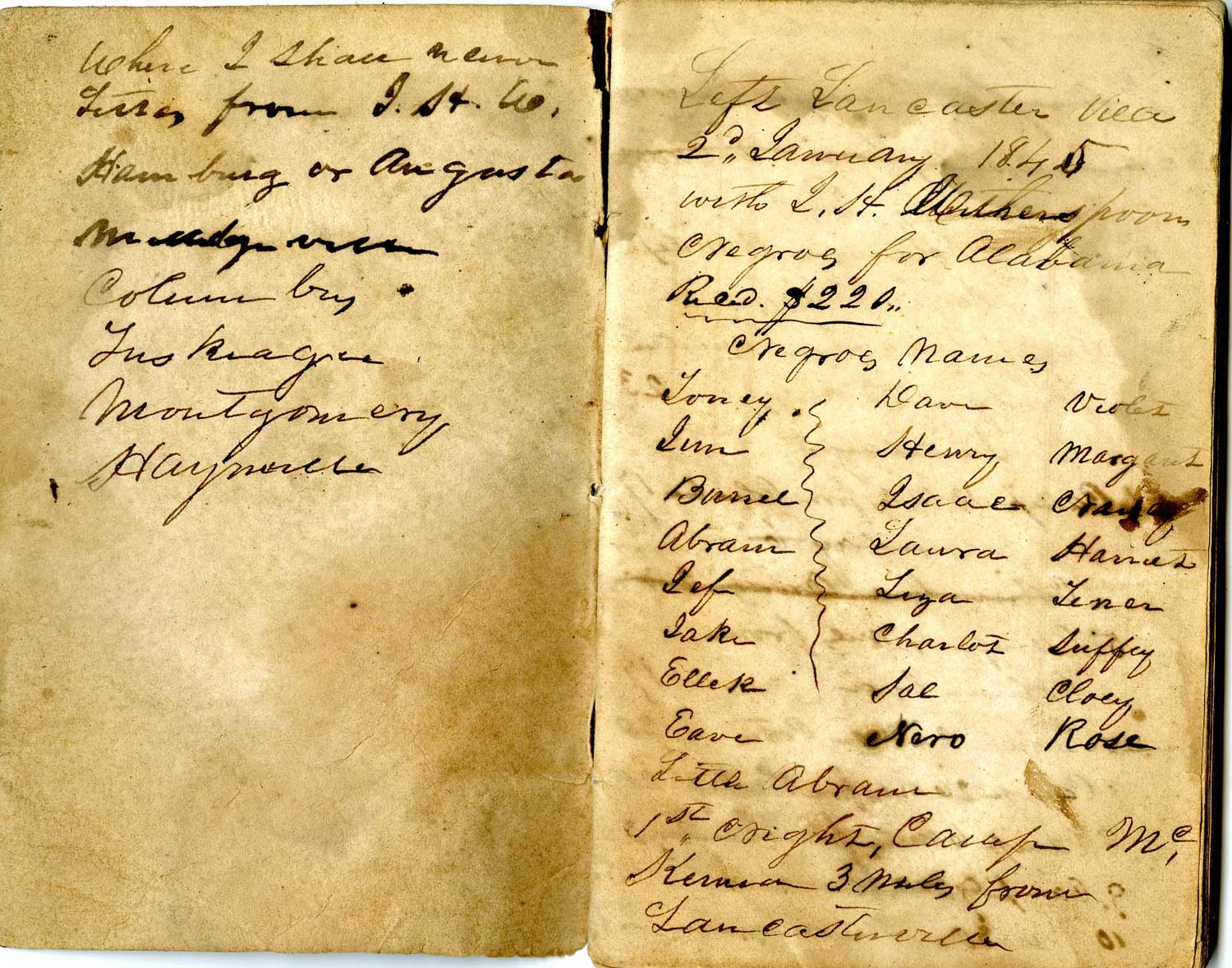
The notebook of a slave transporter who delivered twenty-five slaves from Lancaster, South Carolina to Montgomery, Alabama in 1845.
The notebook of a slave transporter who delivered twenty-five slaves from Lancaster, South Carolina to Montgomery, Alabama in 1845. (Slave transporter’s notebook, 1845). Click to enlarge.


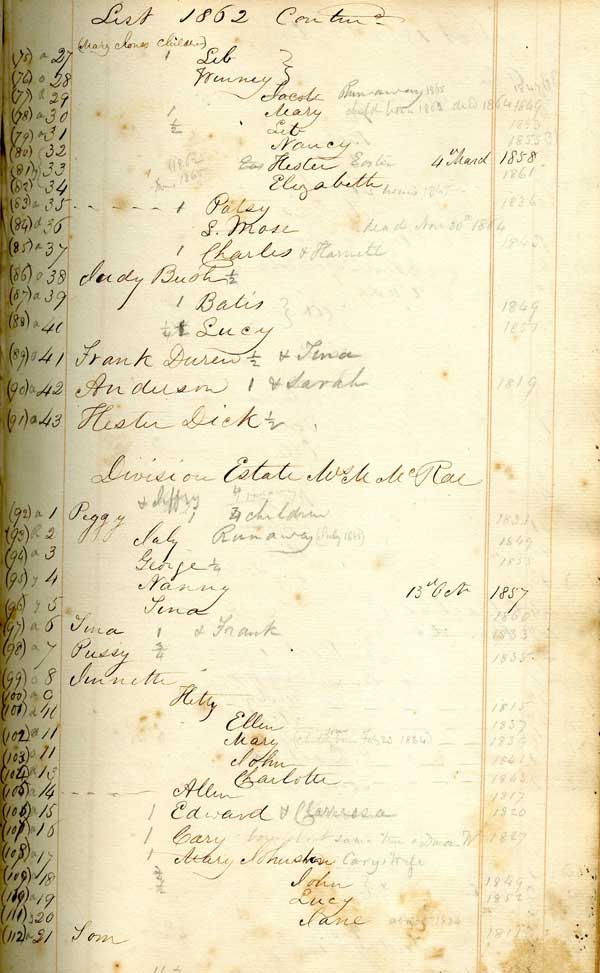
Lineage of slave families on the McRae Plantation near Camden, South Carolina in the 1800s. Jacob and July are noted as runaways.
Lineage of slave families on the McRae Plantation near Camden, South Carolina in the 1800s. Jacob and July are noted as runaways. (Plantation Memorandum Book, McRae Plantation)

Enslaved men and women ran away, revolted, and resisted this brutal system in any way they could. The luckiest made their way to freedom in Canada, but the vast majority had little chance of escaping the cotton fields.

List of black men and women emigrating from Essex County, Canada to Haiti in 1861.
List of black men and women emigrating from Essex County, Canada to Haiti in 1861. Alexander Proctor and his wife Margaret were born free in the South and migrated to Ohio before moving to Canada and finally Haiti. Also on the list is William Turner, who is noted as a fugitive. (Alexander Proctor Papers, 1837-1895).
Click to enlarge.

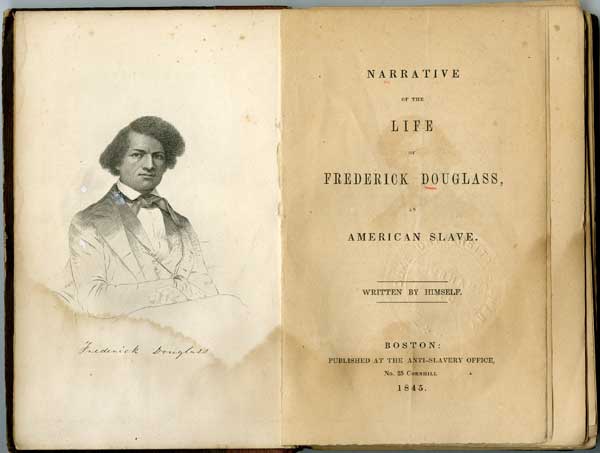
By the mid-19th century, abolitionists and free black citizens, like escaped slave Frederick Douglass, had launched a passionate battle to end slavery in the United States.

Narrative of the Life of Frederick Douglass, an American Slave (1845)

Post contributed by Karlyn Forner, John Hope Franklin Research Center Graduate Student Intern and John Gartrell, John Hope Franklin Research Center Director

Screamfest in Pictures

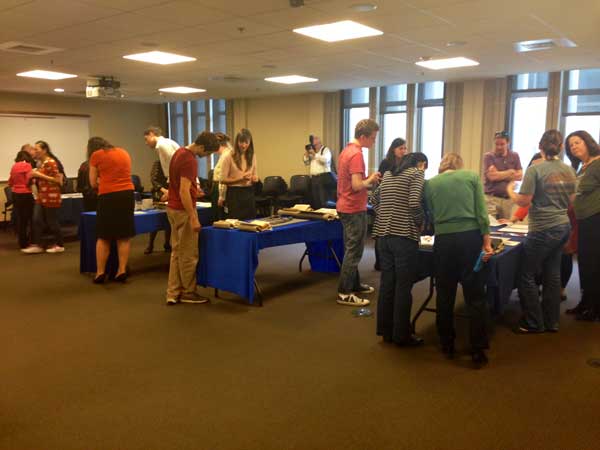
Look at all of the boys and ghouls (sorry, we had to) at our Haunted Library Screamfest!

Screamfest Visitors

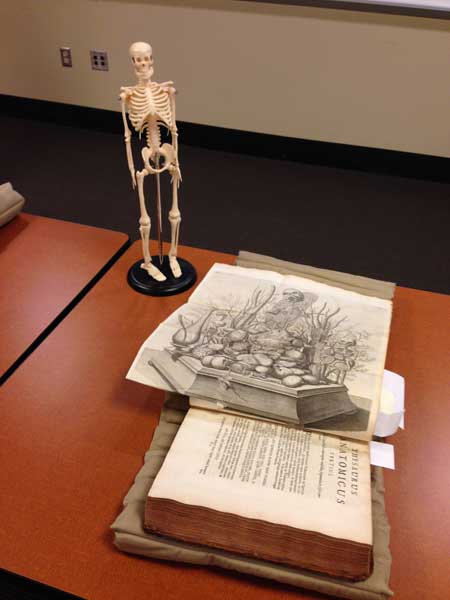
We had materials on display from all of the creepy, spooky corners of the Rubenstein Library, including these items from the History of Medicine Collections:

History of Medicine Collections Materials at Screamfest

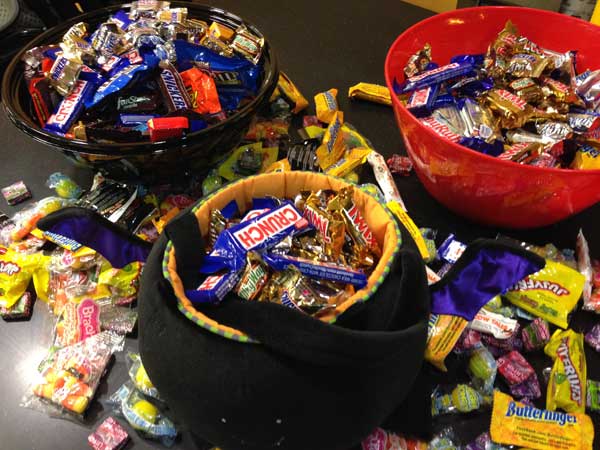
And no, the skeleton wasn’t made of white chocolate. Although some of this was!

Screamfest Candy

Visit the Screamfest 2013 set on the Duke University Libraries’s Flickr photostream for more pictures of the fun. And check out Duke Today’s report!

Honickman First Book Prize in Photography Reception and Artist’s Talk

gaskinDate: November 7, 2013
Time: 5:30-8:00 p.m.
Location: Center for Documentary Studies, 1317 W. Pettigrew Street, Durham, NC 27705
Contact: Kirston Johnson, kirston.johnson@duke.edu

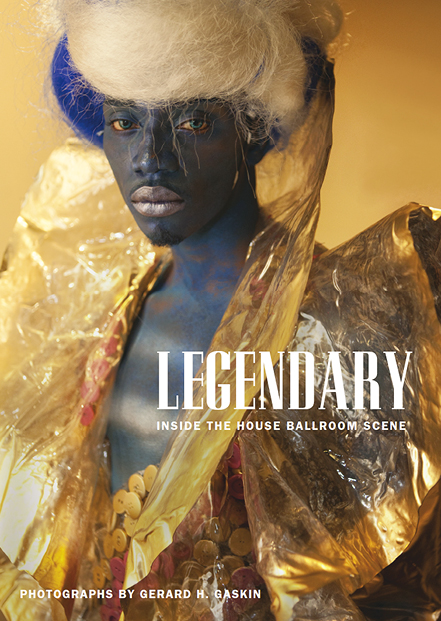
Please join us on November 7 at 5:30pm for an artist’s talk and reception for the book and exhibit Legendary: Inside the House Ballroom Scene photographs by Gerard Gaskin.  The event will take place at the Center for Documentary Studies and is co-sponsored by the Archive of Documentary Arts.

Gerard H. Gaskin is the winner of the 2012 Center for Documentary Studies/Honickman First Book Prize in Photography. Renowned curator and photographer Deborah Willis chose Gaskin’s longtime project for the prestigious biennial prize: color and black-and-white photographs that document the world of house balls, underground pageants where gay and transgender men and women, mostly African American and Latino, celebrate their most vibrant, spectacular selves as they “walk,” competing for trophies based on costume, attitude, dance moves, and “realness.”

The exhibition, in the Juanita Kreps Gallery at the Center for Documentary Studies, is on view from November 4, 2013, through Februrary 22, 2014.  The photographs will then be placed in the Archive of Documentary Arts in Duke University’s Rubenstein Library.

Gaskin’s book, Legendary: Inside the House Ballroom Scene, published in Fall 2013 by Duke University Press in association with CDS Books of the Center for Documentary Studies, will be available for purchase and signing at the event.

For more information about the prize and to see images from Legendary: firstbookprizephoto.com

Learn more about the Archive of Documentary Arts.

Reading by Jonathan Katz, 2013 WOLA-Duke Human Rights Book Award Winner

the-big-truck-that-went-by-how-the-world-came-to-save-haiti-and-left-behind-a-disasterDate: November 6, 2013
Time: 5:00 p.m.
Location: FHI Garage at the Smith Warehouse, Bay 4
Contact: Patrick Stawski, 919-660-5823 or patrick.stawski@duke.edu

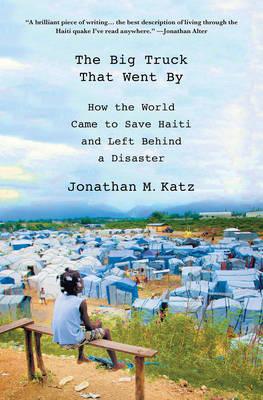
The Washington Office on Latin America (WOLA) and Duke University have named Jonathan Katz’s book The Big Truck that Went by: How the World Came to Save Haiti and Left Behind a Disaster (Palgrave Macmillan, 2013) as the winner of the 2013 WOLA-Duke Human Rights Book Award.

On November 6 at 5:00pm, Katz will be in Durham, North Carolina to do a reading of his book at the FHI Garage at the Smith Warehouse, Bay 4. An award presentation is planned for March 2014 in Washington, DC.

Katz, who currently lives in Durham, NC,  was a correspondent for the Associated Press on January 12, 2010, when the deadliest earthquake ever recorded in the Western Hemisphere struck the island nation of Haiti. The Big Truck that Went By recounts Katz personal experience when the earthquake hit, and—drawing on his groundbreaking reporting during the period that followed—traces the relief response that poured from the international community and where those efforts went tremendously wrong.

Award judge Roger Atwood states that “Katz’s book brings together everything a winner of this award should have: brave and groundbreaking research, lucid writing, freshness in both form and content, and (best of all) genuine policy applications.”

Describing the book, Dr. Kathryn Sikkink—a member of the 2013 judging panel and winner of the 2011 WOLA-Duke Human Rights Book Award—says that “Katz has written a gripping, well-written book, full of moving stories of the people of Haiti and the tragedies and triumphs of their life during the adversity of the earthquake and the cholera epidemic, and vivid cameos of the very mixed bag of foreigners who seemed compelled to try to make things better there.”

According to Leonor Blum, the chair of this year’s award judging panel and emerita professor of history and political science at Notre Dame of Maryland University, explains that “[Katz’s] easy style, his dramatic presentation of  Haiti’s devastating earthquake, his deep understanding of Haiti and its problems, his willingness to criticize Haiti’s governments as well as the international governmental and non-governmental community, all make The Big Truck that Went By worthy of the WOLA/Duke prize.”

According to judge Holly Ackerman, Librarian for Latin America and Iberia at Duke University Libraries, “The book is a crucial case study of what is wrong with current NGO process and international donor councils. It offers lessons on what is happening with aid/investment but, most important, it unplugs myths for the general public who sent their dollars to the Red Cross and similar organizations at the time of the quake and naturally ask, “Why is Haiti not progressing despite so much aid?”

The judges also listed an honorable mention for Kimberly Theidon’s Intimate Enemies: Violence and Reconciliation in Peru.

About the Award:

Started in 2008, the WOLA-Duke Human Rights Book Award is a joint venture of Duke University and WOLA, a leading advocacy organization based in Washington, DC. The award honors the best current, non-fiction book published in English on human rights, democracy, and social justice in contemporary Latin America. The books are evaluated by a panel of expert judges drawn from academia, journalism, and public policy circles. The 2013 judging panel included:

Holly Ackerman, Librarian for Latin America and Iberia, Duke University
Roger Atwood, Journalist, Author, and Former Communications Director, WOLA
Leonor Blum, WOLA Board Member and Emerita Associate Professor, History and Political Science, Notre Dame of Maryland University
Robin Kirk, Faculty Co-Chair, Duke Human Rights Center at the Franklin Humanities Institute, Duke University
Kathryn Sikkink, Professor of Political Science at the University of Minnesota

Previous WOLA-Duke Human Rights Book Award recipients include: Hector Abad for Oblivion: A Memoir in 2012; Katherine Sikkink for The Justice Cascade in 2011; Victoria Bruce and Karin Hayes, with Jorge Enrique Botero for Hostage Nation in 2010; Ambassador Heraldo Muñoz for The Dictator’s Shadow: Life Under Augusto Pinochet in 2009; and Francisco Goldman for The Art of Political Murder: Who Killed the Bishop? in 2008.

Contact:

Kelly McLaughlin, WOLA
202-797-2171
kmclaughlin@wola.org

Patrick Stawski, Duke University Libraries
919-660-5823
patrick.stawski@duke.edu

The African Americans: Rubenstein Recap

Last Tuesday, PBS premiered the first episode of the six-part series, The African Americans: Many Rivers to Cross. Written and narrated by Dr. Henry Louis Gates, Jr., the documentary traces African American history from the shores of West Africa to the election of Barack Obama. Join us as we feature documents from our Rubenstein Library that resonate with the previous week’s episode.

Episode 1: The Black Atlantic (1500 – 1800) began with the complicated routes of the transatlantic slave trade connecting ports across three continents from Africa to the West Indies, London to South Carolina. The dehumanizing conditions of the Middle Passage and the capital made from human bondage were just some of the factors that made the institution of slavery in the western world so different from any other in world history.

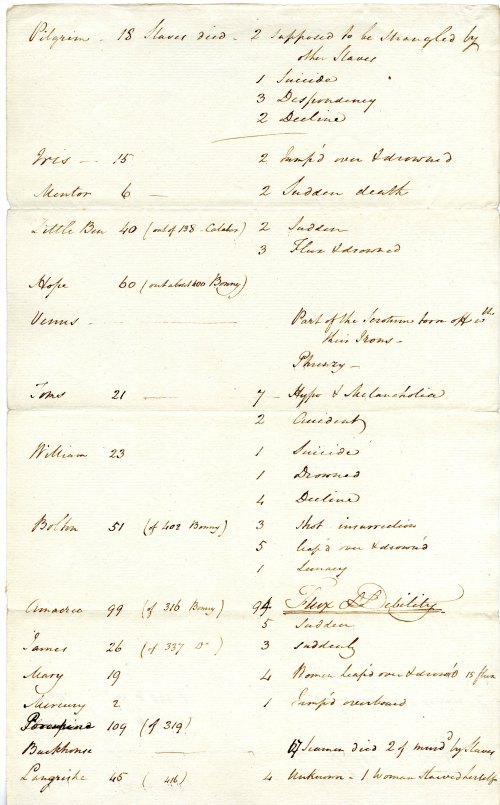
A list of slave ships from the 1790s, detailing the number of slaves that died in route to the western world. (l to r, name of Ship, number of slaves dead, special cause of death):

 William Smith papers, 1785-1860., Box 3, Miscellaneous Papers, Printed Material “Pilgrim - 18 slaves died”
William Smith papers, 1785-1860., Box 3, Miscellaneous Papers, Printed Material “Pilgrim – 18 slaves died”


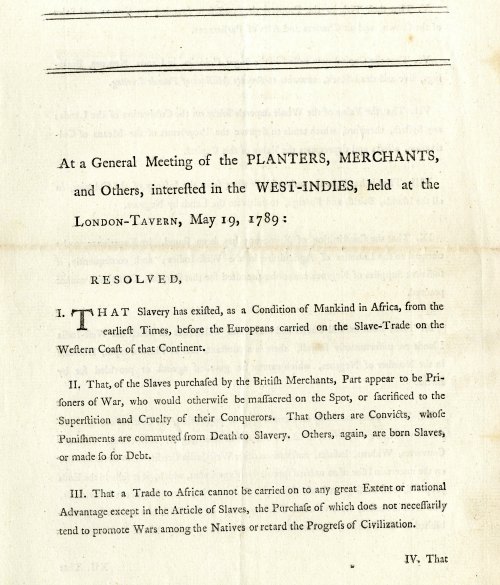
Arguments for the continuation of the African slave trade:

Resolutions West Indies Planters & Merchants, 1789 of why slave trade should be continued (arguments for property rights, capital reasons, European “constitutions” not be adapted to clearing agricultural land), William Smith Papers, Box 3, Folder (Printed Material, 1788 - 1822)
Resolutions West Indies Planters & Merchants, 1789 of why slave trade should be continued (arguments for property rights, capital reasons, European “constitutions” not be adapted to clearing agricultural land), William Smith Papers, Box 3, Folder (Printed Material, 1788 – 1822)


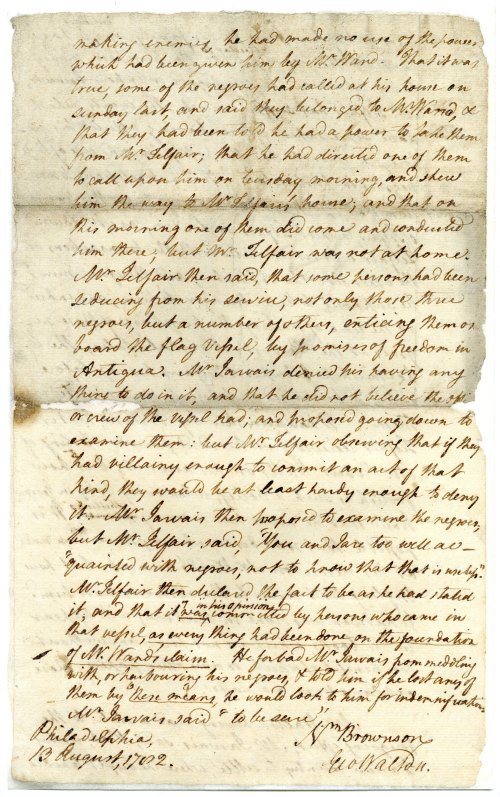
Episode 1 concluded by contextualizing the importance of the American, French, and Haitian Revolutions. The rhetoric of liberty and freedom at the heart of these movement ignited the entire Atlantic world in the late 18th century, especially the lives of enslaved African Americans, slaves wanted some of that freedom for themselves. This letter from the Edward Telfair papers details an incident where Telfair accuses a white man from British Antigua of “enticing” his slaves away with promises of freedom. Telfair fails to understand that the 3 slaves had reasons enough of their own, especially with liberty in the air.

Edward Telfair Papers
Edward Telfair Papers, Box 2, Folder 1780 – 1783, Letter on Aug. 13, 1782 from N. Brownson & E. Walton: “Mr. Telfair then said that some persons had been seducing from his service, not only those three negroes, but a number of others, enticing them on board the flag vessel, by promises of freedom in Antigua. Mr. Jarvais denied his having any thing to do in it, and that he did not believe the officers or crew of the vessel had; and proposed going down to examine them: but Mr. Telfair observing that if they had villainy enough to commit an act of that kind, they would be at least handy enough to deny it.[…] [Mr. Telfair] forbade Mr. Jarvis from meddling with or harbouring his negroes, and told him if he lost any of them by those means, he would look to him for indemnification. Mr. Jarvis said, ‘to be sure.’

Post contributed by Karlyn Forner, John Hope Franklin Research Center Graduate Student Intern and John Gartrell, John Hope Franklin Research Center Director

Playing Around

For several months now, I have been working my way through several thousand acetate negatives transferred to the University Archives from the Sports Information Office.

Dinkey and Jap reenact William Tell.

Several weeks ago, I wrote about finding negatives of women students playing baseball, which was an unexpected, yet welcomed, find. Today I came across another unexpected image, seen above. Described as “football miscellany,” it features football players, Leonard “Dinkey” Darnell and Jasper “Jap” Davis, in an iconic archery pose, dated July 1939. I wish I knew the story behind this image. Was it from a physical education class on archery? The Women’s Athletic Association had an archery season. Maybe the men joined them one afternoon for a bit of fun? I hope you enjoy the image as much as I do.

Post contributed by Kim Sims, Technical Services Archivist for University Archives.

Dispatches from the David M. Rubenstein Rare Book and Manuscript Library at Duke University