Category Archives: Technical Stuff

Charles N. Hunter Papers: Full of Surprises

When I began processing the Charles N. Hunter Papers, I had just completed my work on the N.C. Mutual Collection, which was full of incredible material concerning Durham’s Black business community throughout the 1900s. The Hunter papers constituted a much smaller collection and, as such, I was not prepared to find such a rich and varied amount of information regarding a time period (mainly 1870s-1930s) that is often under-explored and underrepresented in general historical accounts of African Americans in the United States.

The collection paints a broad picture of the evolution of race relations and racial thought during Hunter’s lifetime, including a change in the tone of his beliefs concerning the best way for Blacks to seek equality and dignity within the United States (a change which appears to coincide with increasingly strained race relations in the 1920s). Given Hunter’s extensive experience as an educator in North Carolina, the collection also provides unique insights into the daily workings of the education system for Black children in the post-war, rural South. Additionally, Hunter’s extensive personal correspondence can be found intermingled with the amazing sociological and historical perspectives that are present within his business and community papers. The placement of his personal triumphs and tragedies amidst his professional and community commitments gives his papers a uniquely human dimension. In examining the collection, it was personally difficult for me to see so many personal family tragedies unfold in what seemed like a short period; however, this allowed me to connect with the Hunter by way of seeing the relationship between his public and private life.
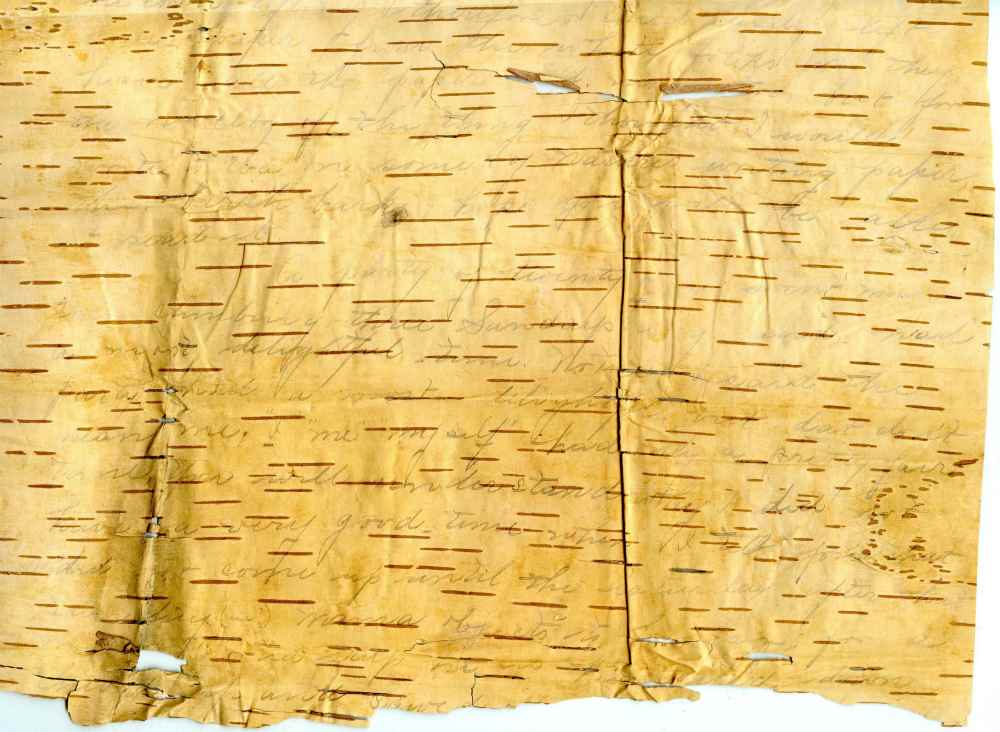
Birchbark letter
The bark from a Birch tree, collected and used as writing paper.

Within the Hunter papers, there are a wide variety of interesting artifacts, some of which include: a letter from a friend written on Birchbark (an amazing piece that is now quite thin and fragile); letters that provide greater elucidation of the daily business aspects of the operation of NC Mutual during the early 1900s; Hunter’s affectionate correspondence with the Haywood family, which owned his family prior to emancipation; and a blank 1850s “Slave Application” for the N.C. Mutual Life Insurance Company of Raleigh.

Slave Policy Insurance Form
An application for an insurance policy covering a slave, 1850s.

The latter company is one that was distinct from the N.C. Mutual that began its operations in Durham just before the turn of the 20th century, and the history of the Raleigh company is largely unknown or forgotten. In addition to offering general life and property insurance,  N.C. Mutual of Raleigh also allowed slave owners to take out policies covering their slaves for a limited number of years. It is unclear how or when Hunter came by this form, but the presence of this document within the collection brings forth the great irony of both a pre-Civil War N.C. Mutual that insured the lives of slaves and a completely separate post-Civil War N.C. Mutual that was created, owned, and operated solely by former slaves and the children of former slaves.

Post contributed by Jessica Carew, a Ph.D. candidate in the Political Science Department at Duke University and an intern in the John Hope Franklin Research Center for African and African American History and Culture.
Vive la France! et Manuscripts!

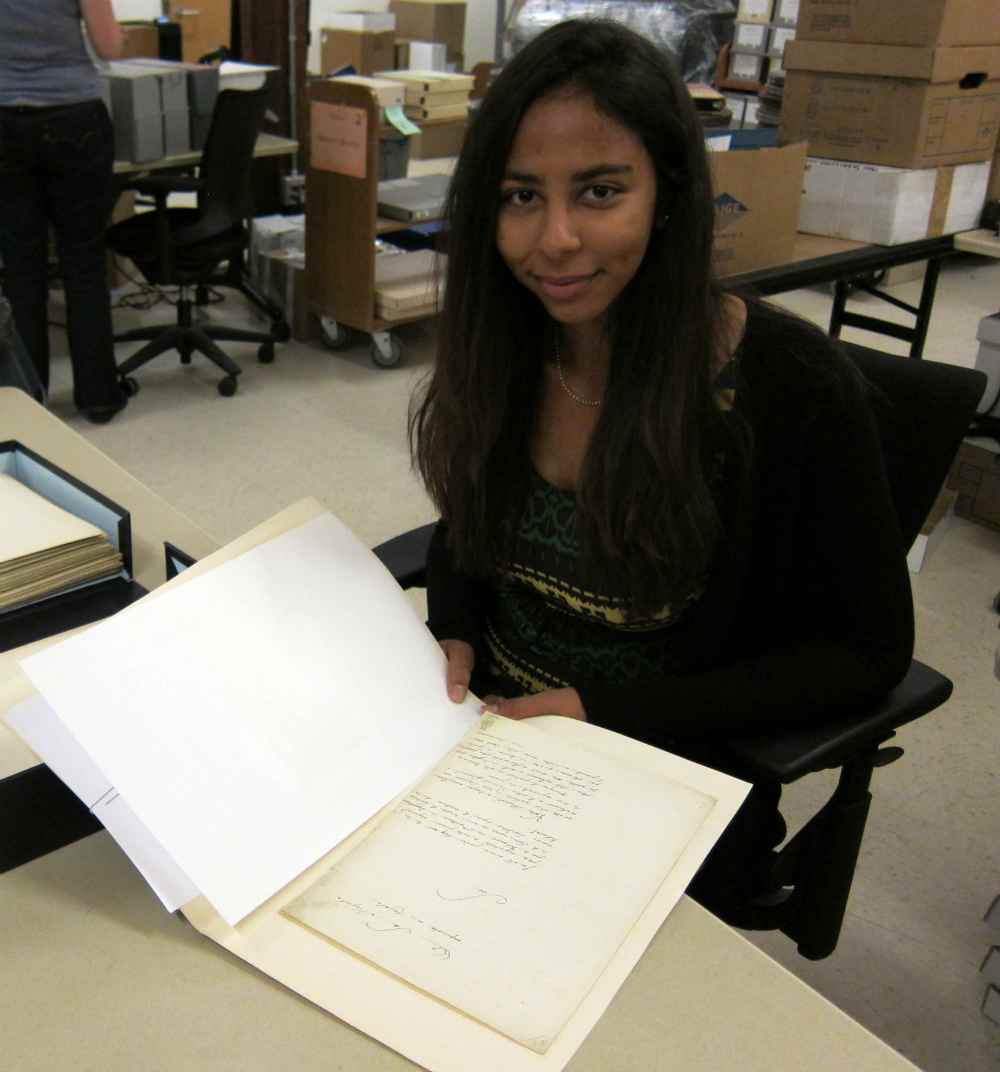
A few months ago, I processed the James Ludovic Lindsay Collection of French Manuscripts, which is by far the largest collection I have processed since I started working in Technical Services in October. As a freshman, I was incredibly excited to work on this collection. The collection is composed of 223 items, mostly letters and administrative papers, all dating to the French Revolutionary era (late 18th and early 19th century). Though the collection may not seem extremely appealing, unless you are an administrative papers-type person, it did have a few gems that are worth noting.

Let me begin with a little background on the collection. The collection was assembled by James Ludovic Lindsay, the 26th Earl of Crawford, and formed part of the larger “Bibliotheca Lindesiana,” a sizeable private library that Lindsay inherited from his father, Alexander, in the mid-1800s.  Like his father, Lindsay had a passion for French Revolutionary writings. While Duke does not hold Lindsay’s entire collection (it was auctioned to many different entities), we have acquired a few items that are quite unique.

Sophia and French manuscripts
Processing the Lindsay Collection of French Manuscripts

For example, scattered amongst mostly legal and administrative papers, I discovered a letter addressed to the Emperor Napoleon from a lawyer, Arnoud Joubert. The document was in perfect state, with no visible damage at all. I was most surprised by Joubert’s writing style (we also possess other letters from him). One would think that writing to an Emperor, especially once the monarchy had fallen, would require extreme politeness. However, Joubert did not make an extra effort towards Napoleon. This document, Box 3, Folder 160, made me wonder if there were other items of interest in the collection.

One such letter, from Cardinal Albani addressed to Alexander I, Emperor of Russia, requests the Emperor’s protection from French authorities. What is most interesting about this letter is that it is well-known that Alexander I and Napoleon had a tense relationship, and that Alexander often referred to Napoleon as “the oppressor of Europe and the disturber of the world’s peace.”  This just shows that despite the fall of the monarchy, which hypothetically should have lessened tensions in France, and pleased most French citizens, certain individuals still searched for asylum in other foreign countries.

Another thing that I was not prepared for was how the documents were dated. Many of them used the old French Republican calendar. Unlike our Gregorian calendar, this calendar began with the fall of the French Republic in 1789, which was then renamed Year I. For a little over 12 years, this calendar replaced the commonly used Gregorian calendar in France.

Processing this collection definitely improved my knowledge of older French, and I am confident I can now read any sort of handwriting. Some of the pieces were near illegible, and it was sometimes difficult to decipher what was being said. But do not worry: if you ever have to write a paper on this period, or even if you are just curious about old French manuscripts, you should take a look at these documents.

Post contributed by Sophia Durand, Technical Services student assistant and Trinity ’15.

Text Messages of Love

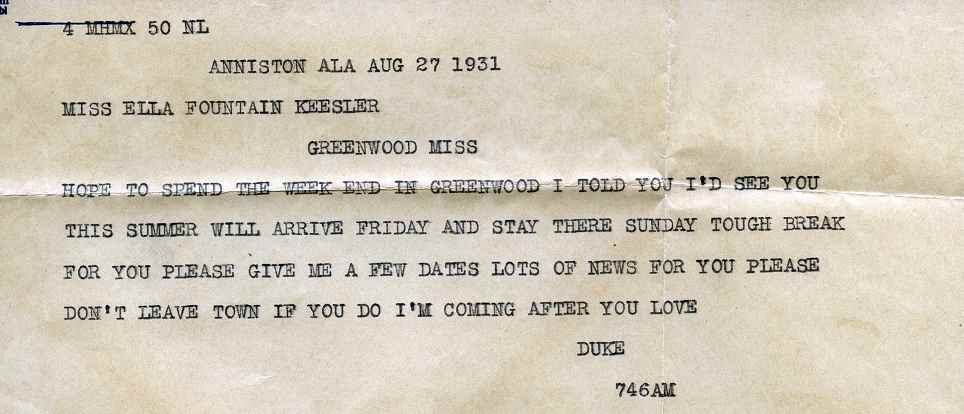
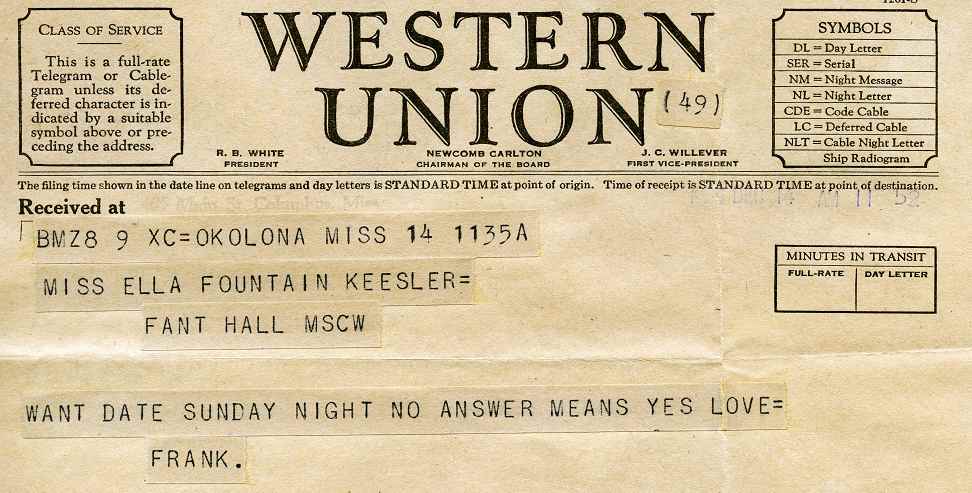
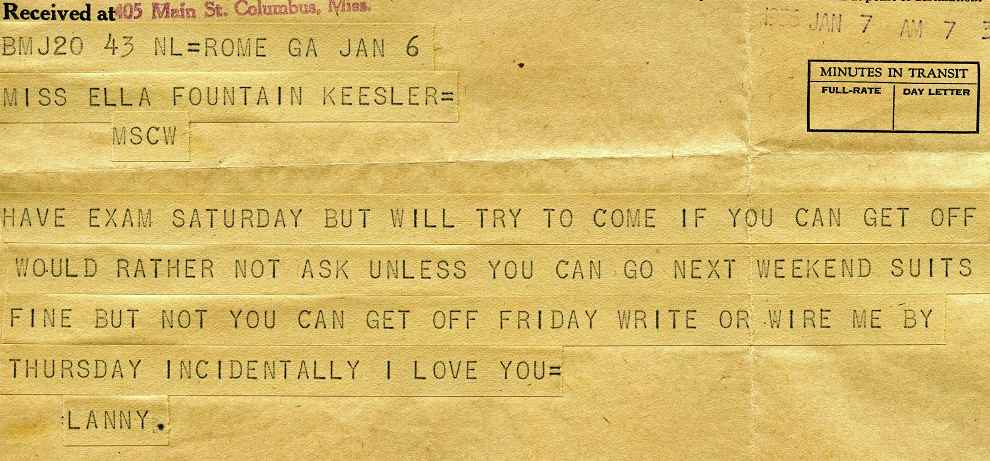
While this Valentine’s Day might result in many short love notes being traded via smartphones and Facebook walls, sweethearts sometimes used a different method in the early 20th century: the telegram. Ella Fountain Keesler Pratt, a Duke employee for almost thirty years (1956-1984), was the recipient of several sugar-coated missives delivered by Western Union in the 1930s. These are a few of the loveliest love letters, found while processing Ella’s papers.

Telegram from Duke
Duke begged, "Please give me a few dates ... Don't leave town if you do I'm coming after you."
Telegram from Frank
"Want date Sunday night No answer means Yes Love, Frank."
Valentine's Day telegram
A secret admirer rhymed, "Than my skeeter none is sweeter if she'd only write."
Telegram from Lanny
"Incidentally I Love You," signs Lanny.

Ms. Pratt eventually married Lanier “Lanny” Pratt in 1938; he attended graduate classes and then taught at Duke University until his death in 1956. He must have said something right!

Post contributed by Rosemary K. J. Davis, Drill Intern, University Archives.

Barbaralee Diamonstein-Spielvogel

A monthly series highlighting the Barbaralee Diamonstein-Spielvogel Collection Project and the woman behind the documents.

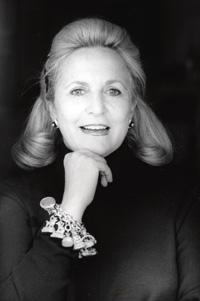
Diamonstein-Spielvogel

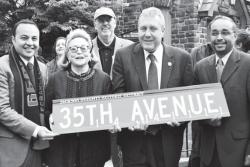
Barbaralee Diamonstein-Spielvogel is an advocate for art in fashion, design and architecture and a leading voice on some of the defining urban issues of our time, including preservation of the historic built environment of the United States. The impact of her work is all around us.  Have you been inside re-adapted buildings?  Diamonstein-Spielvogel was one of the pioneers of adaptive reuse of buildings throughout the country.  Have you seen “Historic neighborhood” medallions on street signs in numerous major cities?  She pushed for those (and still does).  As we start the New Year, we are excited to announce the Barbaralee Diamonstein-Spielvogel Collection, a new addition to the Rubenstein’s Archive for Documentary Arts.

Barbaralee Diamonstein-Spielvogel helps to commemorate the inventor of Scrabble with an historic street sign.

Diamonstein-Spielvogel’s interest in the relationship among the arts, public policy, community and politics has charted the course of her career, fostered her involvement in national and local institutions and organizations, and earned her many awards and honors. As the first Director of Cultural Affairs for New York City, she brought the first public art to Bryant Park in 1987 and the first public performance by the Metropolitan Opera to Central Park. Diamonstein-Spielvogel was appointed by President Reagan to the board of the U.S. Holocaust Memorial Museum in Washington, D.C., and by President Clinton to the U.S. Commission of Fine Arts, where she was elected its first woman vice chair in 2002. In 2010, Barack Obama appointed her as a commissioner of the American Battle Monuments Commission. She has written 20 books and dozens of magazine and newspaper articles and has served as interviewer/producer of nine television series for the Arts and Entertainment Network plus several programs for other national networks, many of which Duke has made available in the Diamonstein-Spielvogel Video Archive.

Diamonstein-Spielvogel’s latest book, Landmarks of New York: An Illustrated Record of the City’s Historic Buildings

As part of the two-year Diamonstein-Spielvogel Collection Project, we will be processing the 200-plus boxes of manuscripts pertaining to her life and career.  The project will culminate in an exciting exhibit in 2013. In our next post, look for information on Diamonstein-Spielvogel’s work with famous designers and artists including Calvin Klein, Adolfo, Robert Rauschenberg, Louise Nevelson, Jeanne-Claude and Christo, Roy Lichtenstein, and Sam Maloof.

Post contributed by Ruth Cody and Caroline Muglia, Graduate Interns for the Barbaralee Diamonstein-Spielvogel Collection Project.

It Takes a Village to House a Village

Sorting through the unprocessed contents of an archival collection can be compared to a treasure hunt – sometimes you find an unexpected gem that produces an impromptu “ooh,” but then after the initial excitement wears off, you have to figure out what you’re actually looking at and then decide what to do with it.

Box of "Foundation Models"
A mystery box of Foundation Models (100 scale)

A small box marked “Foundation Models (100 scale)” found in one of the unprocessed boxes of the Foundation for Southeast Asian Art and Culture (SEAAC) records was one of those discoveries. Inside the box were fourteen miniature buildings, ranging from about ½ inch to 1¼ inches in size and elaborately constructed from a thin cardboard material. After a bit of investigative work using the other records in the collection, I found that the miniatures were part of a model of a Thai Village Complex that Doris Duke planned to build in Hawaii during the 1960s. The set of miniatures were quickly dubbed the “Tiny Thai Village.”

3 pieces from the Tiny Thai Village

An avid world traveler, Doris Duke fell in love with the art and culture of Thailand during a trip to the country in 1957. It is likely that this visit inspired her to create a Thai village in Hawaii with houses similar to those she had seen. The establishment of SEAAC in June of 1961 resulted in a project that Doris Duke saw as a gift to the people of Hawaii, and one that occupied her for many years. At least five sites in Hawaii were considered for the Thai Village and it was the choice of an appropriate location that ultimately proved the stumbling block to completion of the project. Her dream of a Thai Village was never realized, however Doris Duke’s interest in Asia continued and she purchased art objects right up until her death in 1993.

Now that I knew what these miniatures were, I needed to determine how to make them accessible to researchers. As both the size and delicacy of the objects were obvious barriers, the need for expertise help in creating practical housing for the Tiny Thai Village was essential. Fortunately for the Rubenstein Library, we have a crack team of conservators who like a good challenge. To read how the puzzle of the Tiny Thai Village was resolved, see the Preservation Underground blog.

Post contributed by Mary Samouelian, Doris Duke Collection Archivist.

A Day in the Life: Rubenstein vs. “The Brain” Virus

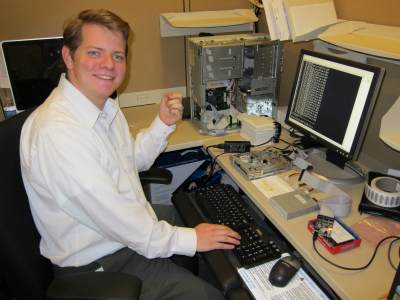
Earlier this year, the Rubenstein Library purchased a KryoFlux floppy-drive controller to help retrieve data from the numerous floppy disks we receive. The University Archives had an obsolete machine with a 5.25″ drive that didn’t work and I hoped the Kryoflux could breathe new life into the drive. After some effort the equipment was installed and the initial self-check tests were successful. A stack of 48 5.25″ floppy disks from the Alvin Roth Papers were close at hand and thus served as the inaugural batch of media to test copying. The copying process was quick, simple, and more importantly, seemed to work. Finally it was time to take KryoFlux’s closing avocation to heart: “enjoy [my] shiny new disk image” and test the results.

Seth and the KryoFlux machine
Seth and the KyroFlux

Mounting the disk copy showed a list of files, but their contents seemed wrong. The documents would start and end at seemingly random points of prose mid-sentence. The seemingly random beginnings and ends were too regular to be a simple case of digital rot. I wondered if I had done the capture wrong (the point of testing) but it might be something else too. I had to dig deeper for more evidence, past the file structure to the data itself for more clues.

In addition to finding problem, I found something much more interesting: “(c) Brain,” a bit of text that tied this disk to a bit of computing history. The Brain virus, written in 1986, is widely accepted as the first MS-DOS virus and, ironically, was an honest mistake. Two brothers, Basit & Amjads, wrote Brain as a means to protect their heart-monitoring software from piracy but ended up having a greater reach than they expected. Just like many others, Brain somehow found its way onto this disk apart from the software it was protecting. Unfortunately this disk doesn’t have a complete copy of the virus; although I am glad there was enough to open the door on an interesting piece of computing history.

New equipment and old media, combined with new puzzles and old viruses, certainly made for an interesting day. While this virus doesn’t pose any real threat to us now, it does serve as a reminder to be careful with the records we receive.

Post contributed by Seth Shaw, Electronic Records Archivist for the Rubenstein Library.

Juanita Kreps and the Merger of the Duke Woman’s College, 1972

Working on the Economists Papers Project at the Rubenstein Library this summer introduced two Duke economics graduate students to an inspiring and impressive figure who shaped the histories of both Duke University and the United States: Juanita Morris Kreps.  The description and arrangement of 58 boxes of her professional papers was made possible in summer 2011 by Matthew Panhans and Nori Takami, with funding from the Center for the History of Political Economy.

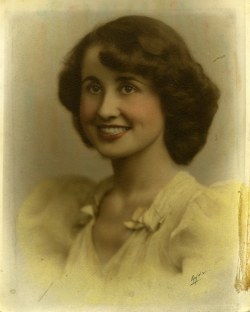
Krep's senior portraitBorn into a childhood of poverty in the small mining town of Lynch, Kentucky in 1921, Juanita Kreps emerged as one of the top students at Berea College, earning her a scholarship to study economics at Duke University, where she completed her M.A. and Ph.D.  She joined the faculty at Duke in 1955 and served as Dean of the Woman’s College and as Associate Provost; in these roles she oversaw the controversial 1972 merger of the Woman’s College and the men’s Trinity College to form the present coeducational undergraduate Trinity College of Arts and Sciences.  As we celebrate the 40th anniversary of that merger in 2012, many of us may not be aware of its deep significance to the history of Duke and to the future for women in higher education. Kreps’ papers hold many files of correspondence from alumna who responded to her calls for comments, accompanied by letters, speeches, and memoranda written by Kreps which reveal her own insights into this monumental change.

In 1972 Kreps became the first woman to hold the prestigious James B. Duke chair, and in 1973, Kreps was named a Vice President of the University.  In 1976 she left Duke to serve as the first female Secretary of Commerce under President Carter, also the first academic to serve in this role and the fourth woman ever to be a part of the Cabinet.  As the Secretary of Commerce, she was an advocate for the business community while also encouraging business to look beyond profits and towards social responsibility to workers, consumers, and the public.

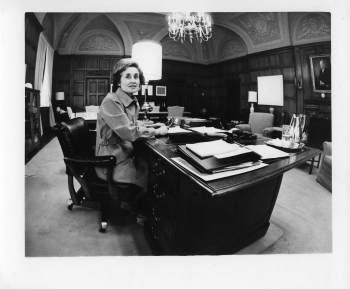
Kreps at her deskPerhaps rooted in her humble beginnings in Kentucky, her academic research maintained real-world relevance.  Much of her work was on the value of women’s work, women’s education, and labor issues related to aging populations.  These and other topics that remain relevant today pervade her speeches, which are both witty and moving.  The plethora of thank you notes accompanying each speech offers clear evidence of the power of her words and ideas – but if this is not enough to convince you, come to the Rubenstein Rare Book & Manuscript Library and read them for yourself!

Post contributed by Paula Mangiafico, Senior Processing Archivist for the Rubenstein Library. Matthew Panhans is an M.A. student in Duke’s Department of Economics. Norikazu Takami is a post-doctoral fellow at Duke’s Center for the History of Political Economy.

One for the Refrigerator Door

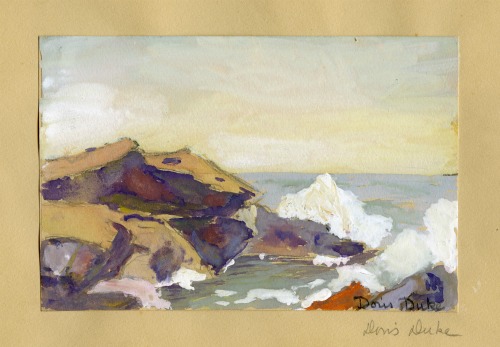
Painting by Doris Duke, 1924

Doris Duke—the only daughter of Duke University benefactor James Buchanan Duke and noted philanthropist and patron of the arts—painted this lovely scene in 1924 at the age of eleven. It is part of the Doris Duke Papers, donated to the Rubenstein Library in 2009 by the Doris Duke Charitable Foundation and now open for public research.

Further details about the extraordinary collection may be found in the official press release, or by reviewing the collection’s finding aid.

Open for Business: NC Mutual Archives

The North Carolina Mutual Life Insurance Company Archives (collection guide here), now available for research at the RBMSCL and North Carolina Central University’s University Archives, Records and History Center, contains nearly 100,000 items documenting more than a century of service for this prominent African American business.

This archives include corporate office files, annual statements, reports, surveys, memos, legal and financial papers, training material, programs, memorabilia, and an exceptional number of historical photographs of staff and their families, offices, buildings, and Durham scenes (including a visit from Booker T. Washington).

The collection offers a window into the inner workings of the company, the legacy of Durham’s Black Wall Street, and over a century’s worth of community and organization building. The archivists and librarians of both institutions are looking forward to the scholarship that will result from the use of the North Carolina Mutual Life Insurance Company Archives.

Group in front of The Mutual Building. From the North Carolina Mutual Life Insurance Company Archives.

Over one hundred selected digitized images, like the one above, as well as several historical documents, are also currently available in an online exhibit.

Researchers wishing to use the North Carolina Mutual Life Insurance Company Archives should note that the entire collection is stored in our off-site storage facility. Please contact the University Archives, Records and History Center at North Carolina Central University or the RBMSCL (“Ask a Question” website) at Duke University at least 48 hours before your visit so that staff can request the material you would like to see.

For more information about the North Carolina Mutual Life Insurance Company Archives, check out the Duke University Libraries’ press release.

Post contributed by Jennifer Thompson, John Hope Franklin Research Center Librarian.

All in a Day’s Processing

As the archivist that handles accessioning, I receive collections into the RBMSCL’s Technical Services department that range in condition from “perfectly arranged upon arrival” to “dumped in a box and shaken up a bit in transit.” The Hypes Family Papers, an expansion upon a small collection of World War I photographs by Samuel Loomis Hypes, came to us in envelopes and a box that had seen better days.

To begin processing the collection, I first had to find out what it contained. Each envelope revealed another surprise—various family photographs, including a daguerreotype; tickets from the World’s Columbian Exposition in 1893; postcards the family collected from their trips around the world; family history research; and a lot of Y.M.C.A. materials (at least two generations of Hypes men worked for the organization). By the time I had spread it all out to sort it, my table was looking particularly messy.

I decided to arrange the collection by family member, which allowed me to keep it in basic chronological order while still grouping each person’s activities together within the collection. Photographs and tickets were sleeved, clippings were photocopied, and the daguerreotype was housed in its own envelope for protection. Things were looking much better on my processing table.


Next, I created a finding aid for the collection, folding in the original collection of World War I photographs. Using the collection’s family history materials, I was able to loosely reconstruct the family tree. An updated catalog record finished up the collection. Now ready to use, the Hypes Family Papers offer a fascinating glimpse into one family’s activities around the world in the late nineteenth and early twentieth centuries.

Post contributed by Meghan Lyon, Accessioning Associate.