This week and next, we’ll be celebrating the beginning of a new fiscal year by reviewing some notable items and collections that arrived here at the Rubenstein Library in the past year.
The Hartman Center recently acquired a collection of 16 different trade cards for two brands of soap, all designed by Charlotte Perkins Gilman circa 1880-1884, constituting her first published works. Gilman is better known for writing The Yellow Wall Paper and Women and Economics, published in the 1890s, but in 1880, at age twenty, she partnered with her cousin, Robert Brown, and designed trade cards for several soap companies. She had written some stories at the age of ten or eleven, and was a serious diarist, but had never seen her work published. When her mother moved the family in 1873, they began a long period in which they lived on the brink of poverty in various “cooperative housework” households, with little or no support from her estranged father. By the time she was a teenager she had already shown signs of social and economic independence and this venture into business blended that desire with her artistic ambitions.
These examples, all in very good to fine condition, show a genuine artistic talent, a sense of humor, an appreciation for fantasy and the absurd, literary symbolism, and many depict women working like slaves at their domestic chores. Advertising was a relatively friendly field for women, who often showed talent for illustration and copywriting, and it was also a field that provided some income to up and coming writers and artists. These cards are excellent examples of exactly that scenario for a woman who was destined for fame in other ways.
Post contributed by Jacqueline Reid Wachholz, Director of the Hartman Center for Sales, Advertising & Marketing History
This week and next, we’ll be celebrating the beginning of a new fiscal year by reviewing some notable items and collections that arrived here at the Rubenstein Library in the past year.
The Haytian Papers volume presents a compilation of fascinating state documents, including correspondence between Christophe and French officials addressing France’s attempts to retake Haiti after the independence revolution that took place nearly ten years prior to the book’s publication. Saunders is especially careful to articulate in his introduction that the Haytian Papers are also proof of the intelligence and capacity of the black leadership and citizens of the country.
This recent acquisition by the John Hope Franklin Research Center for African and African American History and Culture is now available for use.
Post Contributed by John B. Gartrell, Director, John Hope Franklin Research Center
Over the next two weeks, we’ll be celebrating the beginning of a new fiscal year by reviewing some notable items and collections that arrived here at the Rubenstein Library in the past year.
Building upon the success of our 2011 exhibit Animated Anatomies, our anatomical flap book collection in the History of Medicine continues to grow with the acquisition of an eighteenth century work by Christoph von Hellwig.
This work is the second revised edition by the German professor Christoph von Hellwig (1663-1721) of Johann Remmelin’s Catoptrum microcosmicum first printed in 1619 and includes over 90 very small and fragile moving parts of the human body. Hellwig’s four plates illustrate the skin, nerves, vessels, muscles, and bones; the female reproductive system; the male viscera and cranium; and the female viscera and cranium. The images depict intricate details through lifting the flaps. This particular item has a later addition of modesty flaps over the genitalia in facsimile. A student of philosophy and later medicine, Hellwig authored and edited over forty medical and pharmaceutical works, including household medical guides and reports of unusual cases.
Post Contributed by Rachel Ingold, Curator of the History of Medicine Collections
Over the next two weeks, we’ll be celebrating the beginning of a new fiscal year by reviewing some notable items and collections that arrived here at the Rubenstein Library in the past year.
Photograph by Dorothea Lange from Portfolio of 10 photographs by Walker Evans, Dorthea Lange, Ben Shahn, and Arthur Rothstein, selected and printed by Arthur Rothstein.
The photographs made for the Farm Security Administration form a profound pictorial record of American life during and following the Great Depression. Between 1935-1944 the FSA commissioned photographers including Walker Evans, Dorothea Lange, Russell Lee, Arthur Rothstein, Ben Shahn, Jack Delano, Marion Post Wolcott, Gordon Parks, and Carl Mydans initially to document the challenges facing farmers and migratory agricultural workers as part of the New Deal. The project eventually expanded to include documentation of urban living conditions across the U.S. as well. This collective work for the FSA made a major contribution to the then burgeoning practice of documentary photography and many FSA contributors ultimately became icons of 20th century photography.
This portfolio includes 10 images that Rothstein believed were representative of the FSA’s overall output including the now iconic “Migrant Mother” photograph by Dorthea Lange.
See a comprehensive visualization of FSA photography on Photogrammar.
Post contributed by Lisa McCarty, Curator of the Archive of Documentary Arts
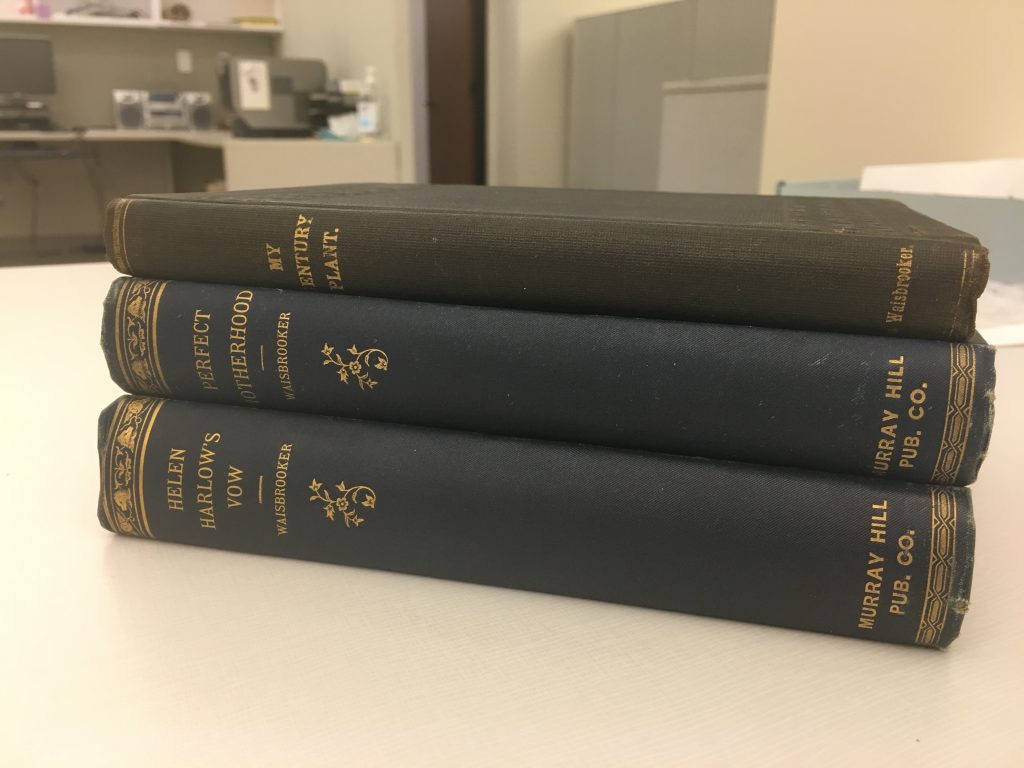
The Lisa Unger Baskin Collection is filled with well-known names and gorgeous examples of books, but as I was looking through the recently cataloged books from the collection, I was excited to see three rather plain-looking books written by Lois Waisbrooker in the late-nineteenth century: Helen Harlow’s Vow, Perfect Motherhood, and My Century Plant. Never heard of them? Don’t worry, that’s kind of the point. Back in college as a history major, I studied Waisbrooker, and while she was never particularly well-known, she’s a fascinating example of how writing and books impacted women’s lives in the nineteenth century.
Portrait of Waisbrooker from Helen Harlow’s Vow
Historian Joanne Passet has done an excellent job tracing Waisbrooker’s life in her book Sex Radicals and the Quest for Women’s Equality. Waisbrooker was born to a poor family in Upstate New York in 1826, and by age twenty she had been pressured into a marriage she didn’t want after getting pregnant, widowed, and forced to place her two children with other families as she didn’t have the economic means to care for them.1 These early experiences shaped Waisbrooker’s political views and her work: she was a spiritualist and then became interested in free love and sex radicalism.
Without a well-off family to fall back on, Waisbrooker struggled to make a life that allowed her to commit fully to advancing the cause of free love and women’s right to self-determination.2 It was never easy for Waisbrooker, but through writing she was at least able to eke out a living. These are just three of more than a dozen books she published, in addition to number of periodicals she founded or helped edit.
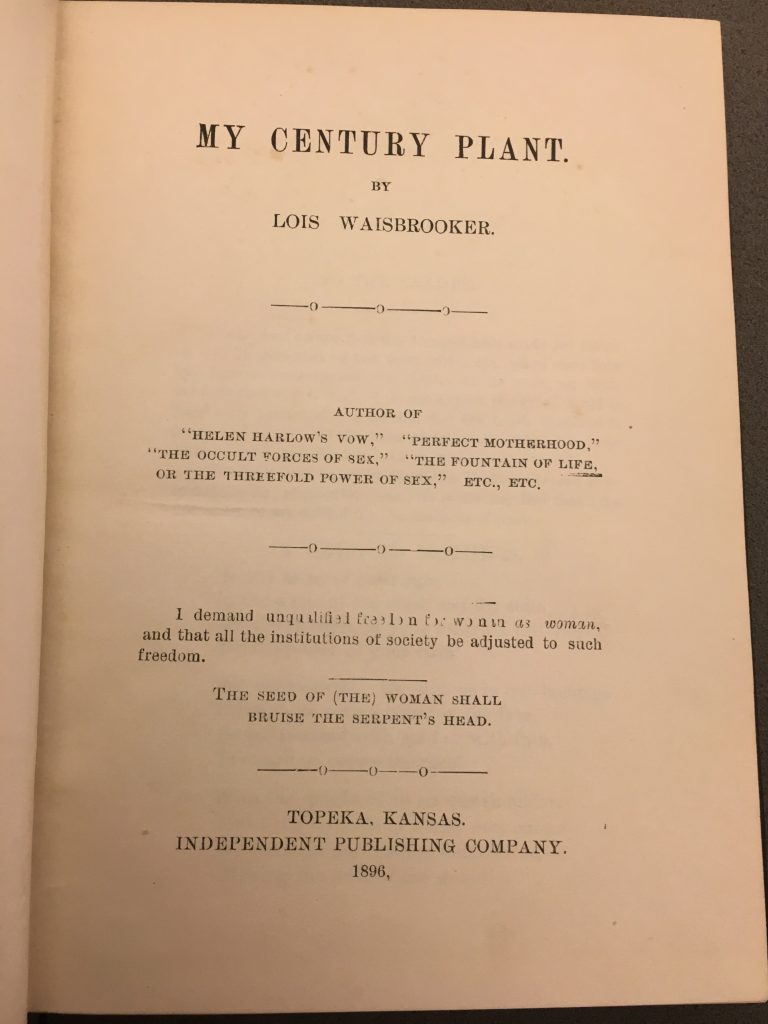
Title page of My Century Plant. Waisbrooker founded Independent Publishing Company herself after struggling to find publishers willing to publish books dealing with sex.
Of course, the life Waisbrooker forged was possible because there were readers eager to read what she wrote. Waisbrooker’s writings validated their own experiences and helped these women connect with a community of people whose views aligned with their own. In her analysis of readers’ letters published in the newspapers and journals founded or edited by Waisbrooker, Passet found that most of the women writing were working-class and rural, commonly from Midwestern and Western states.3 Isolated in their home communities, Waisbrooker’s work gave these women room to discuss topics like marital rape and women’s sexual fulfillment, literature that resonated with their experiences, and a way to imagine new economic and social models.4
Newspaper clipping about Waisbrooker’s arrest on obscenity charges that was pasted in Perfect Motherhood
We get a glimpse of Waisbrooker’s readers in this copy of Perfect Motherhood: Or Mabel Raymond’s Resolve. A previous owner has pasted in a newspaper clipping describing Waisbrooker’s arrest in Topeka, Kansas “on the charging of sending obscene material through the mails.” This suggests the owner was not just a casual reader, but someone who followed Waisbrooker’s career and thought this clipping worth saving with Waisbrooker’s writings.
Having Waisbrooker’s works along side books like Of the Friendship of Amis and Amile speaks to the depth of the Lisa Unger Baskin Collection and to the variety of ways women have engaged with books and the written word. For Waisbrooker these books were a means of survival, for both herself financially and the ideas she championed. For women readers, these books offered a vital intellectual connection with like-minded women and a path towards their own sexual and economic liberation.
Footnotes 1. Joanne Passet, Sex Radicals and The Quest for Women’s Equality (Urbana,Illinois: University of Illinois Press, 2003), 112-113. 2. Ibid., 116. 3. Ibid., 47, 55, 119. 4. Ibid., 153.
Post contributed by Kate Collins, Research Services Librarian
With constant access to moving images via your cell phone, laptop, or tablet, I expect it is difficult to imagine when even simple movement in a book was revolutionary. But just image the impact of being able to manipulate part of a page in a book in the 18th century!
It is difficult to know less about an author!
The Rubenstein’s History of Medicine Collection features many early movable books, which were usually intended for scholars. These were generally the “turn-up” style, often used by students of anatomy, where separate leaves, each featuring a different section of the body, were hinged together and attached to a page. One of the best examples, De humani corporis fabrica librorum epitome was printed by Andreas Vesalius in 1543.
It wasn’t until the late 1700s that movable books intended for entertainment were produced, usually for children. In 1765, Robert Sayer created a movable book that involved lifting a flap. Ann Montanaro explains the construction of these books in her “A Concise History of Pop-up and Movable Books:”
[the] books were composed of single, printed sheets folded perpendicularly into four. Hinged at the top and bottom of each fold, the picture was cut through horizontally across the center to make two flaps that could be opened up or down. When raised, the pages disclosed another hidden picture underneath, each having a few lines of verse.
These books quickly became popular and had different names based on their content or composition of illustrations, including “metamorphoses,” “harlequinades,” as well as the unfortunately-named “toilet books.”
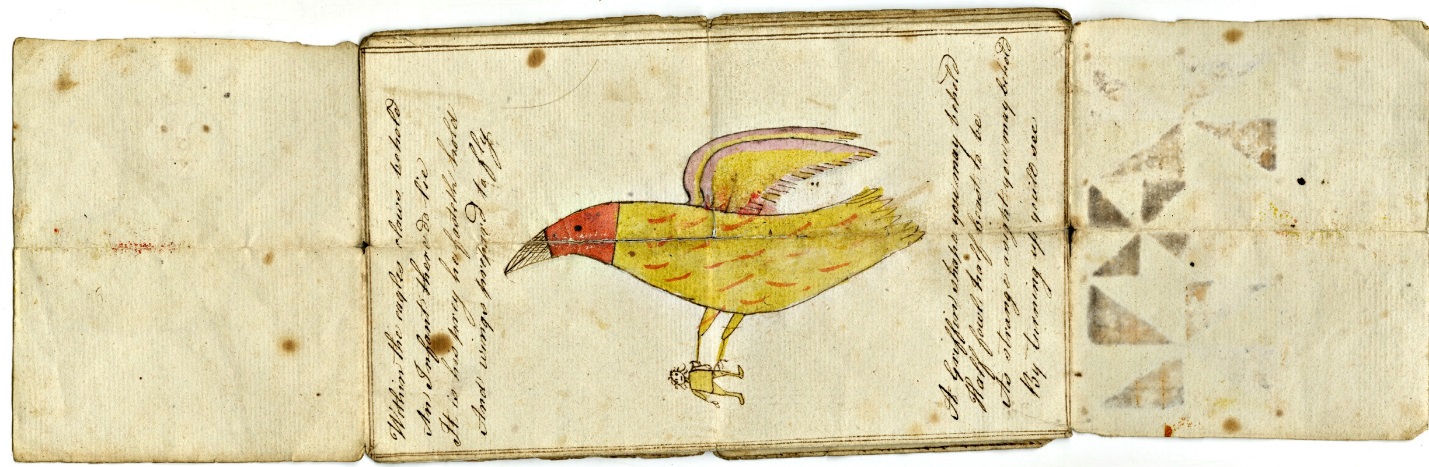
My favorite page features a lion that transforms into a griffin, that transforms into an eagle.
As part of the Lisa Unger Baskin Collection, we recently received one of these metamorphoses books, handmade by Elizabeth Winspear in 1799. Unfortunately, that is the limit of all we know about her. The book features just four pages in full color with accompanying verse, each page with two flaps that reveal a new drawing underneath, in stages. The verses include instructions for how to move the flaps. One reads: The Lion Roaring from his Den / with porpose [sic] for to rainge [sic] / He’s turn’d into another shape / Turn down & see the sight so strange
The Lion Roaring from his Den / with porpose [sic] for to rainge [sic] / He’s turn’d into another shape / Turn down & see the sight so strangeEach fold of the page must be carefully calculated.
I don’t want to give everything away! There is immense entertainment value to this little item. Initially we are introduced to Adam, whose Eve is not what one has come to expect. However, it is clear that Winspear also intended some instruction or moral training to occur by reading this book, for all does not end well, despite a character’s obtaining gold and silver. The piece ends as a cautionary tale.
The eagle holds its prey, an unfortunate infant, in its grasp.
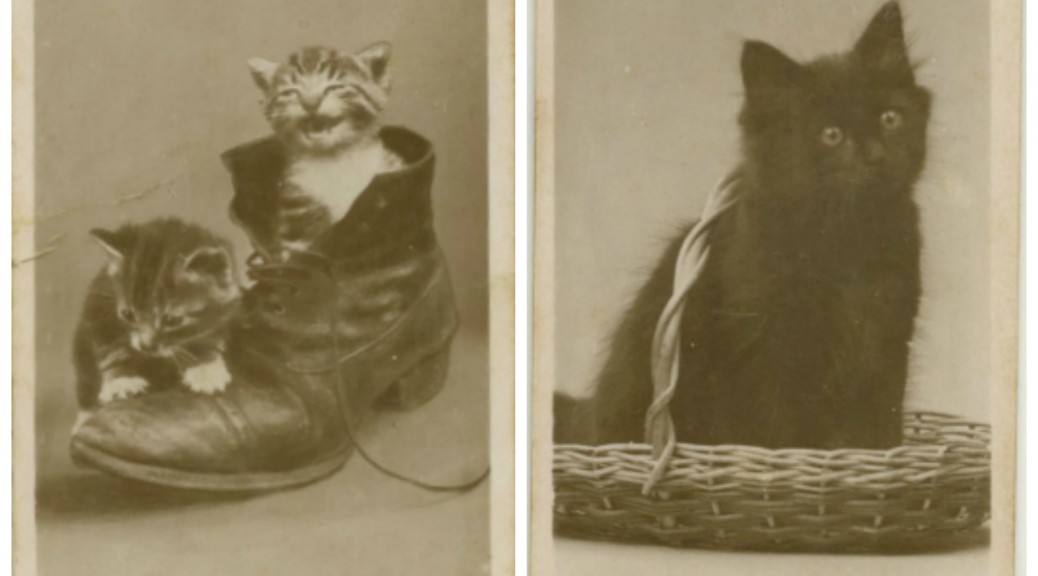
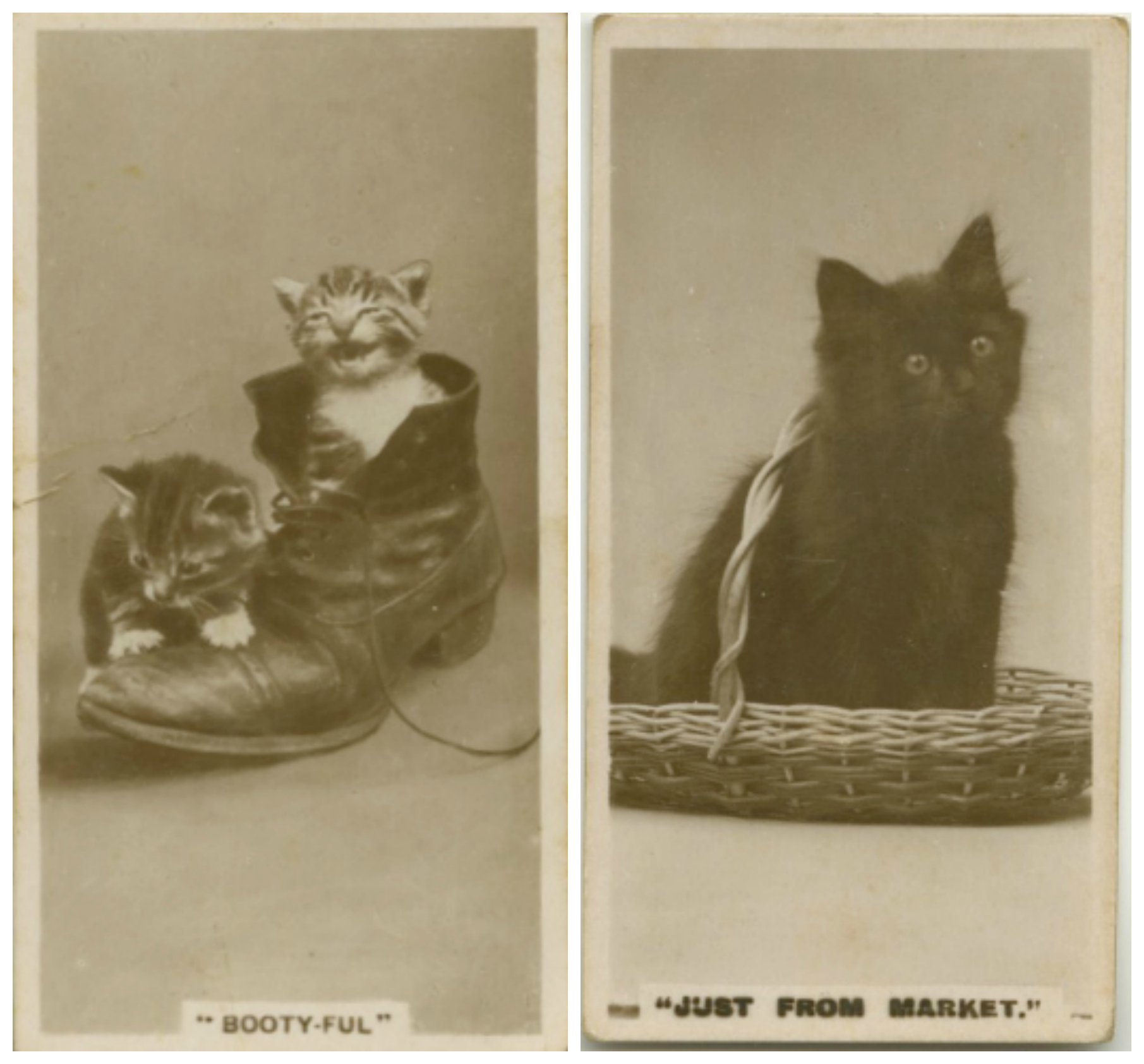
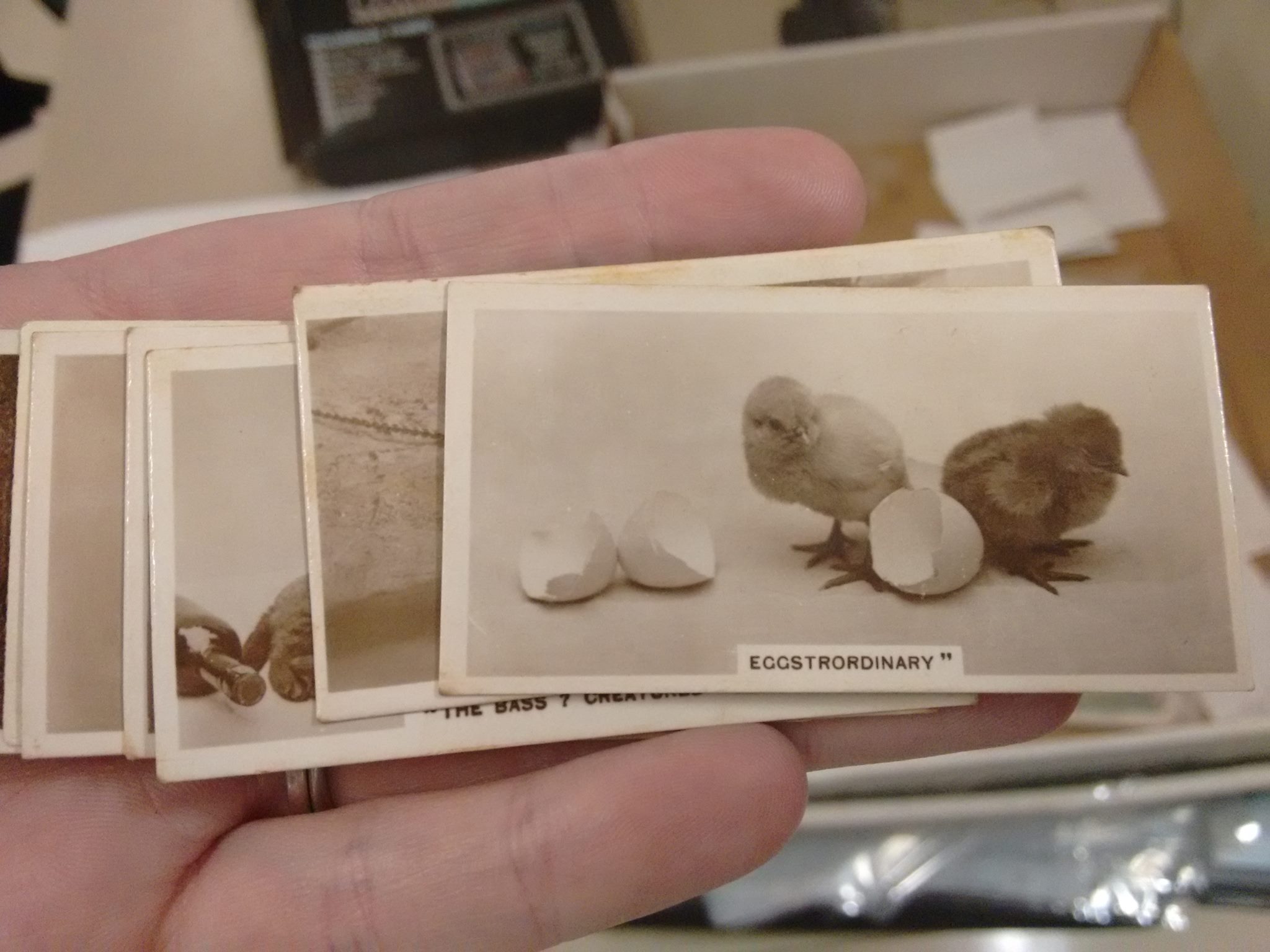
I was delighted to find that one of our newest collections, the Terence Mitchell Collection of Tobacco Advertising, includes a run of Real Photographs, a series for the De Reszke cigarettes produced by J. Millhoff & Co. in England. These tiny cards feature animals posed in funny ways, doing adorable things, with cute captions. They are basically the tobacco card version of today’s Internet cat memes.
These tobacco cards gave me an excuse to look into the history of cat photography, particularly pictures of funny cats with captions. It turns out that posing cats in outfits is not a new trend, despite the persistent popularity of Internet memes like LOLcats and I Can Haz Cheezburger. Matthew Hussey’s 2012 article on A History of LOLcats explains that early photographers quickly discovered the marketability of cats, and began selling cat postcards and cartes de visite as early as 1870. Harry Pointer, the first known photographer of cats posed in silly ways, marketed his photos as The Brighton Cats – so named for his Brighton, England, photography studio. A later photographer who was even more commercially successful was American Harry Whittier Frees (1879-1953), whose postcards and children’s books featured animals, especially cats, doing funny things. Frees was so talented in posing and photographing his animals that some questioned their authenticity. In his preface to The Little Folks of Animal Land (1915), he explained his techniques, saying, “The difficulties encountered in posing kittens and puppies for pictures of this kind have been overcome only by the exercise of great patience and invariable kindness.” After their photoshoot, Frees writes, “my little models … enjoy nothing better than a frolic about the studio.” The Library of Congress now holds a collection of Frees’ photographs. You can view them here.
I think that the tobacco card industry jumped on the funny animal pose trend, which explains why the run featured here is the fourth of five runs of Real Photographs produced by J. Millhoff & Co. between 1931 and 1935. The fourth run that I found in the Mitchell Collection dates to 1932. (It could be that the other runs are also present! We are continuing to process these tobacco cards – there are several thousand of them.) It makes sense that tobacco companies would have realized the marketability of cute animals. They were also smart enough to recognize the popularity of baseball players and pretty actresses. (Check out the newly digitized W. Duke and Sons collection of tobacco cards.)
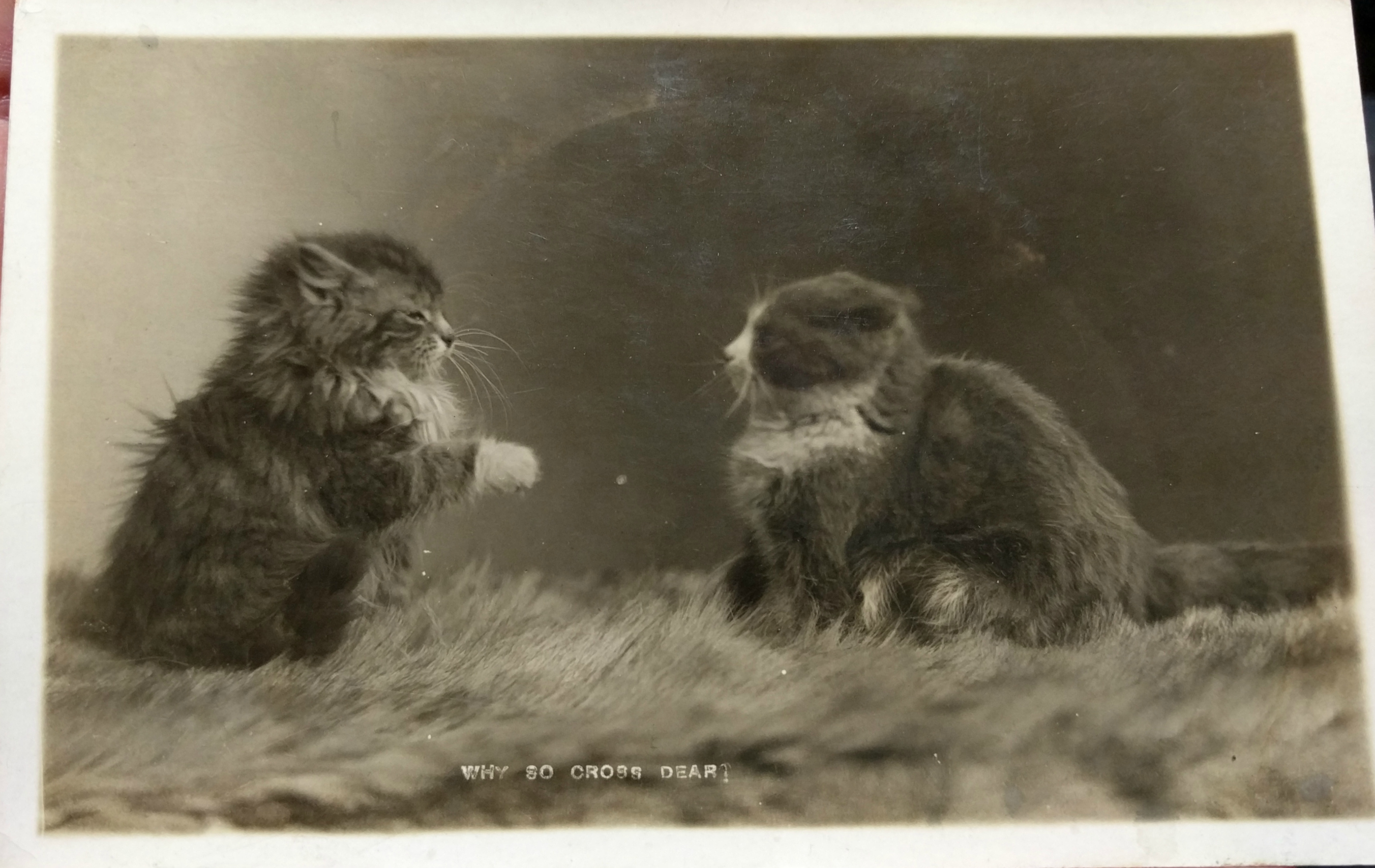
Looking at all of Harry Whittier Frees’ photographs online led to me wonder what sort of cute cat pictures we hold in Rubenstein. You’ll be pleased to know we have several in our vast Postcard Collection. Here are some of my favorites, all from the early 20th century.
Caption reads: Why So Cross Dear? Photograph by E.D. Putnam & Son, Anich, N.H.Photomechanical print. No known photographer.Salt print postcard. No known photographer.Caption: Little Miss White. Copyright by C.E. Bullard. Published by M.T. Sheahan, Boston, Mass.
This last one is by Charles E. Bullard, another early twentieth century photographer who wisely copyrighted his cat pictures, and then worked with publishers to distribute them widely. This 1915 profile of Bullard in The American Magazine is truly hilarious and details his methods for capturing the perfect LOLcat. Here’s an excerpt:
“It is no easy job to photograph a cat. He is very unreasonable as to staying where he is put, and the only system is to use infinite patience. I have worked half a day trying to photograph a cat in a particular pose, and then had to give up in despair.”
I am on the lookout for other photographs of historical LOLcats, especially those held in Rubenstein collections. If you find some, let me know!
Post contributed by Meghan Lyon, Section Head Manuscript Processing.
There are many “firsts” in the Lisa Unger Baskin collection, and this early work is one of my favorites. It is one of the first books we know to be typeset by women.
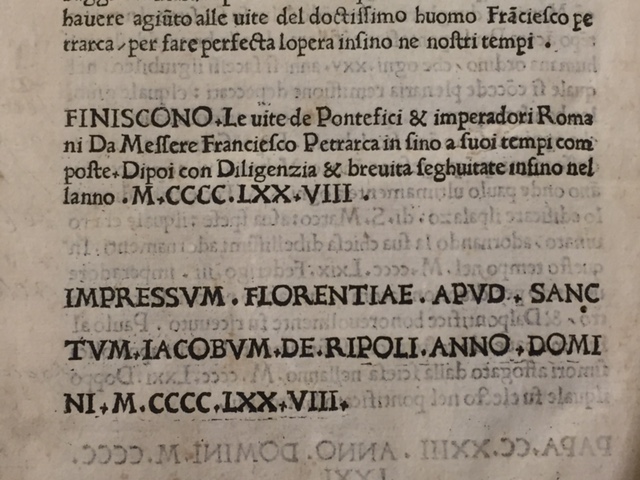
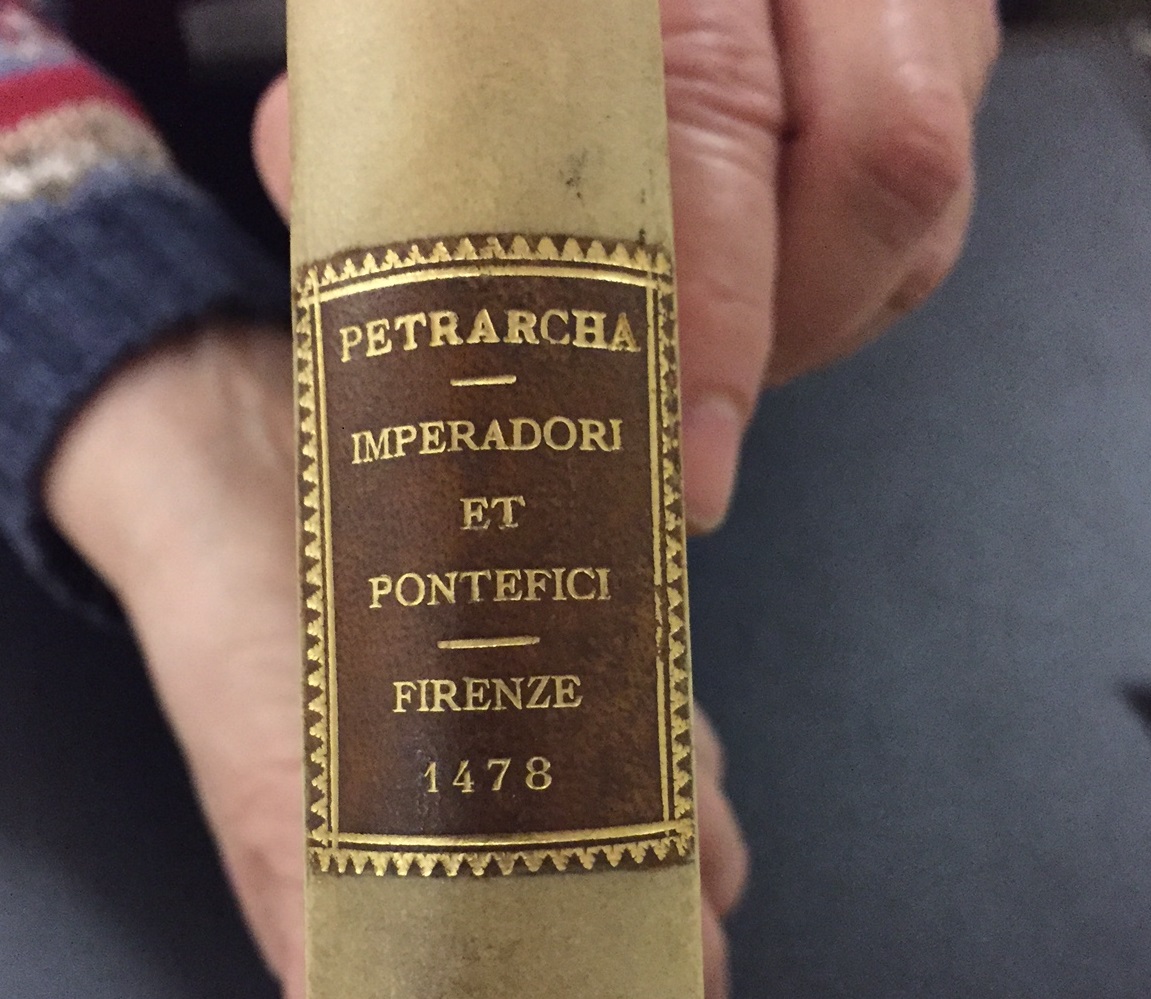
Incominciano Le uite de Pontefici et imperadori Romani [Lives of the Popes and Roman Emperors] was published by the press at the Convent of San Jacopo Di Ripoli in Florence in 1478. The Baskin Collection includes two copies. They are incunabula [cradle books], a term traditionally used to indicate works that were printed before 1501, when printing technology was still in its infancy.
Over the course of nine years (1476-1484), the Ripoli press issued around one hundred different titles, half of which were secular. The convent’s diario (daybook) notes that the Dominican sisters received modest wages for their labor, which were contributed to a common fund to support the convent.
The nuns work as typesetters was in keeping with the order’s rules. The Dominican constitutions directed the nuns to copy manuscripts for religious use, and the new technology of typesetting accomplished the same end. I have to wonder what it was like for them to literally retool with this new technology.
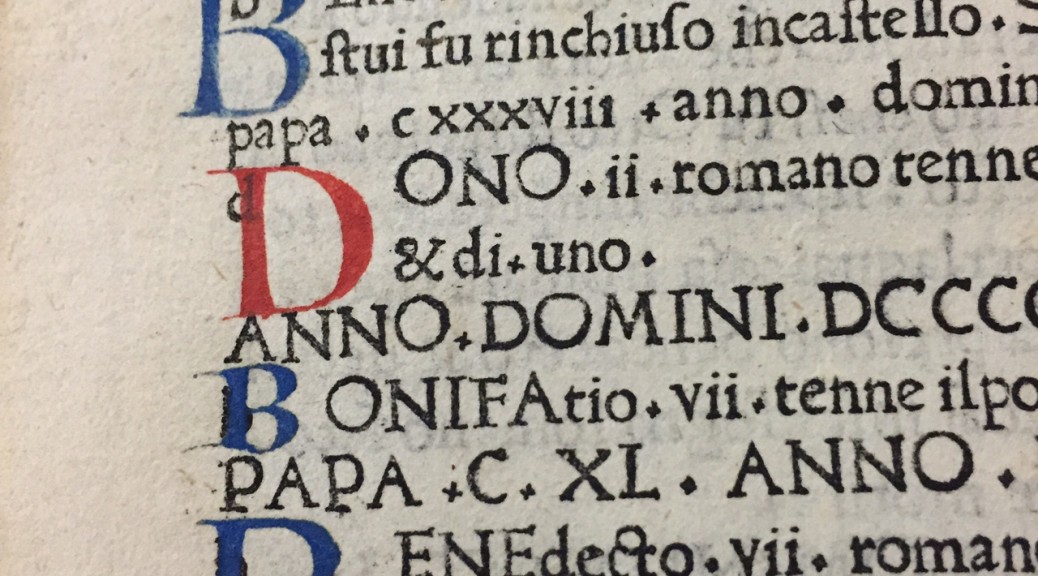
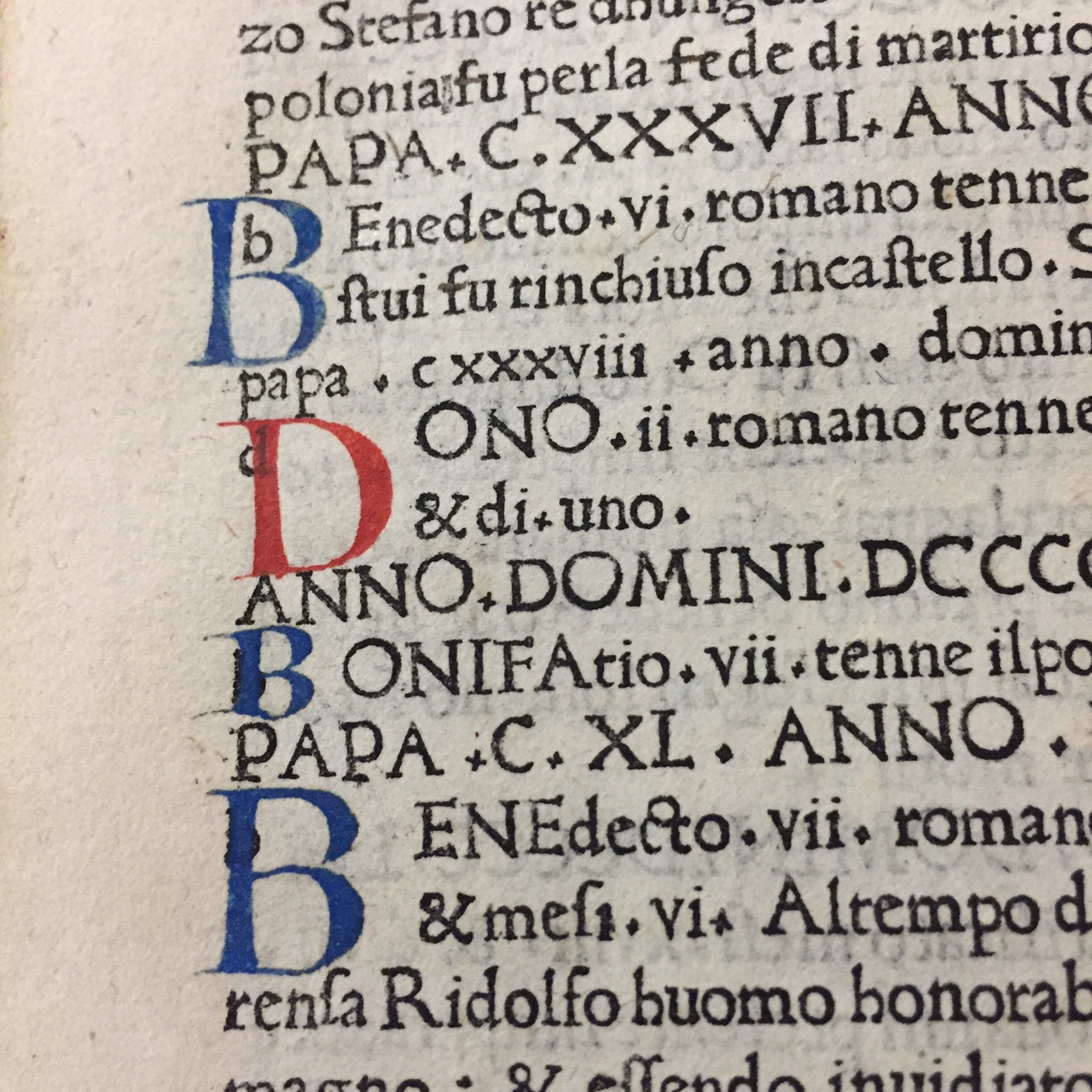
Rubrication on copy 1
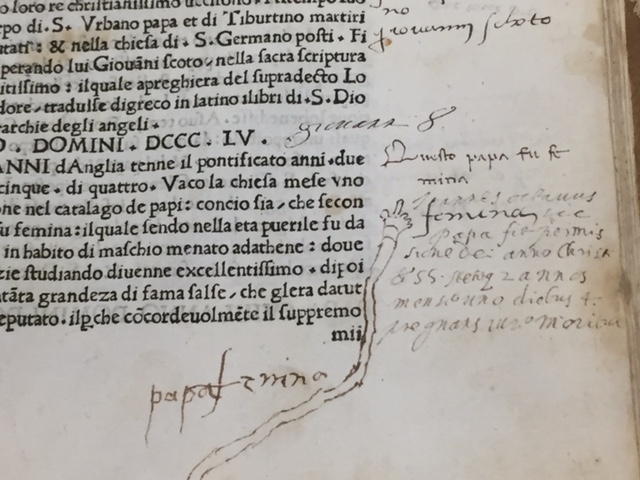
The first copy in the Baskin Collection is complete and is decorated with hand-colored initials called rubrication. Copy two lacks the first six leaves and has not yet had the decorative initials added. It is untrimmed, and over the years comments have been added in several hands and inks. Most interesting is the extensive marginalia around the entry for the (most likely) fictional Pope Joan with its long manicule and notation “papa femina.”
“papa feminina” marginalia on copy 2Handwritten section headercolophonSpine of copy 2
I look forward to sharing these volumes with students and visitors. If you run your fingers gently over the pages, you can feel the impressions made by the thousands of pieces of moveable type the nuns of Ripoli carefully set by hand.
To learn more about the work of the Convent of San Jacopo Di Ripoli consult:
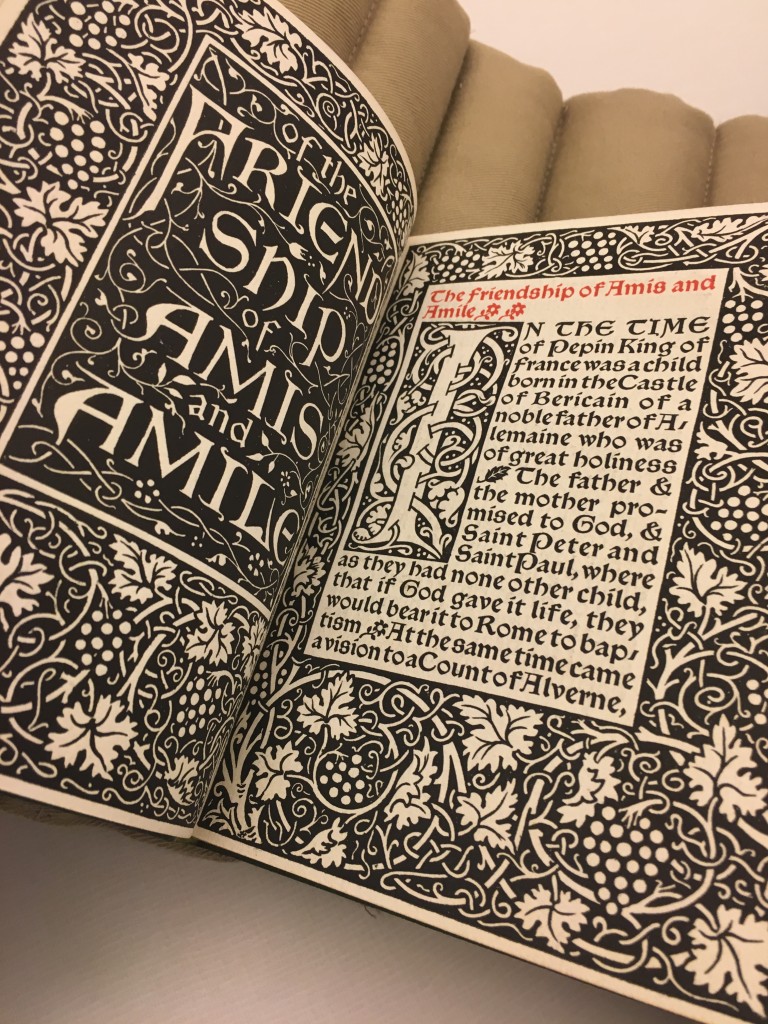
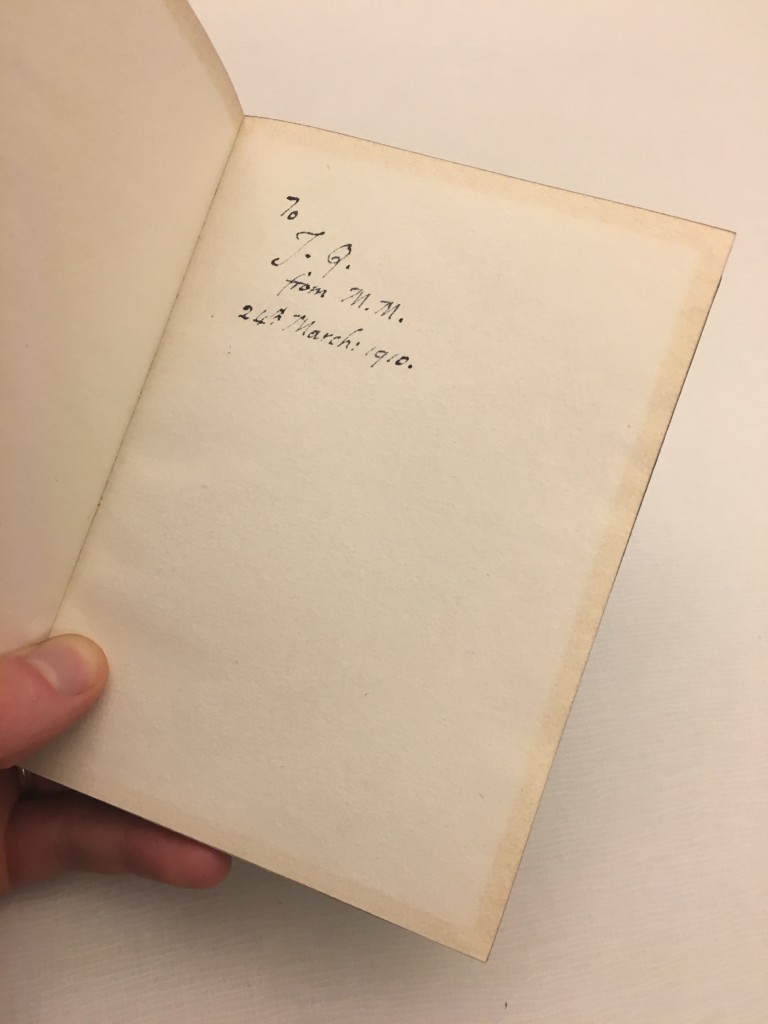
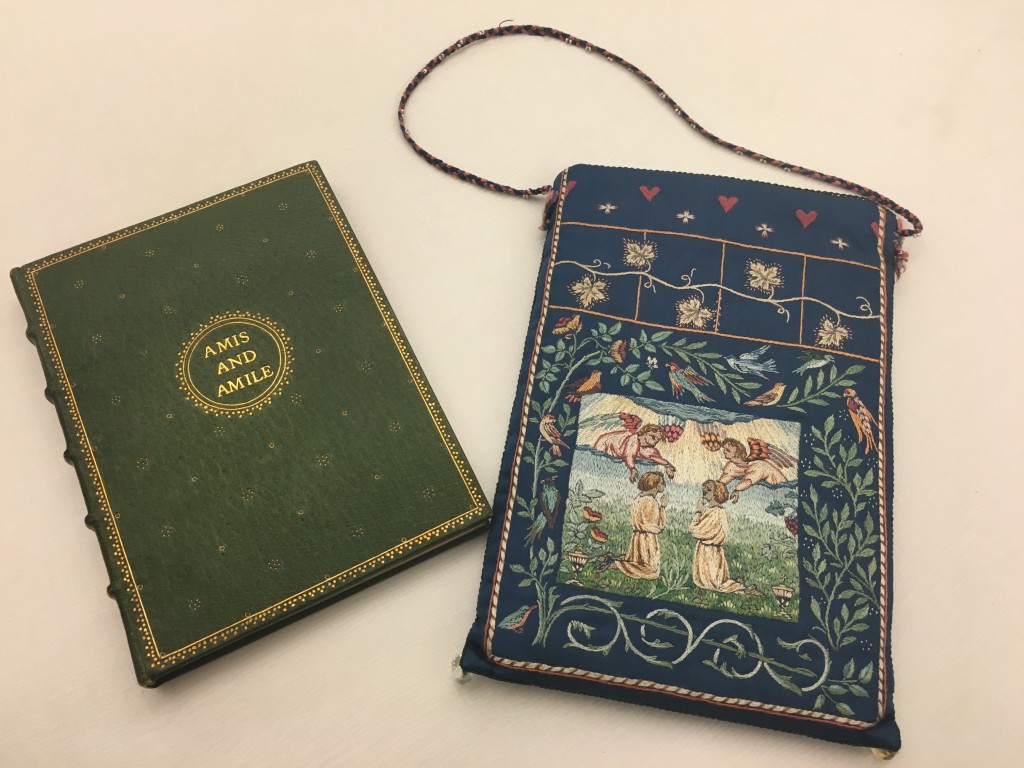
This beautiful copy of Of the Friendship of Amis and Amile, part of the Lisa Unger Baskin Collection, was given by May Morris to her beloved, John Quinn, in 1910. It was printed in 1894 at Kelmscott Press, which May Morris’s father William Morris founded. The green morocco leather binding with delicate gold tooling is the work of May Morris’s friend Katharine Adams.
On its own this would have been an touching gift for any book lover, as Quinn, a patron and collector of art and literature, certainly was. But Morris went beyond that. An accomplished needlework artist, Morris created a detailed hand-stitched silk book pouch to go along with Amis and Amile. The centerpiece of her work features a kneeling couple with angels flying above in a sunbeam lit sky. It is surrounded by foliage and birds, with hearts sewn along the top. The final details are seed pearls and glass beads at the corners. The back of the pouch is signed in stitching by Morris with a small “M” in a circle.
Sadly, I cannot tell you that this is a love story has a happy ending. It was a rather one-sided relationship. Whatever romantic interest Quinn had in Morris quickly cooled, despite a gift like this and the loving letters she wrote him. For more insight into Morris and Quinn’s relationship, see On Poetry, Painting, and Politics: The Letters of May Morris and John Quinn edited by Janis Londraville (1997), or Londraville’s article “No Idle Singers of Empty Days: The Unpublished Correspondence of John Quinn and May Morris” in Journal of Modern Literature (Summer, 1994).
Post Contributed by Kate Collins, Research Services Librarian.
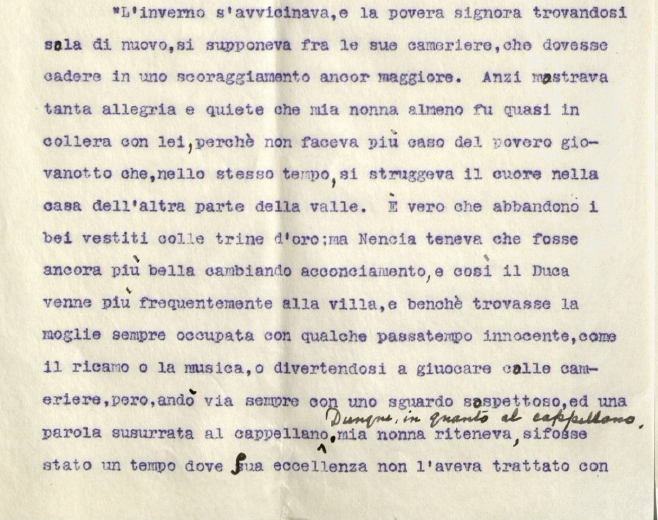
As a Humanities Writ Large Fellow at Duke this year, one of my goals was to explore the archives in the Rubenstein Rare Book and Manuscript Collection, extending work I had done at the Kislak Center for Special Collections at University of Pennsylvania creating archival research exercises for undergraduate humanities students.My scholarship focuses on late nineteenth- and early-twentieth-century American women’s writing, so I knew that exploring the Lisa Unger Baskin Collection, currently undergoing processing, would be especially exciting. But little did I know that I would uncover a genuine “find”—an Italian-language typescript of a short story by Edith Wharton, translated by the author and featuring corrections in her own hand.
The typescript, the only piece in the collection by Wharton, is a translation from English into Italian of Wharton’s story “The Duchess at Prayer” (“La Duchessa in Preghiera”). The textual history of this story is complicated: Wharton first published the story in Scribner’s in August 1900, where it featured illustrations by Maxfield Parrish (full text at hathitrust.org)and then republished it in the short story volume, Crucial Instances(1901).The translation in the Rubenstein appears to have been made after the 1900 publication. Drawing on Honoré de Balzac’s “La Grande Bretèche” (1831) and likely Robert Browning’s “My Last Duchess” (1842), Wharton’s tale recounts the story of a seventeenth-century Italian Duchess whose cruel husband discovers her adulterous affair. To taunt and threaten his wife, the Duke gives her a Bernini statue crafted in her image, and, as Emily Orlando has argued in Edith Wharton and the Visual Arts, in the conclusion of the tale, the woman “becomes a statue chiseled in marble at her husband’s command” (45). The typescript in the Rubenstein appears to be a word-for-word Italian translation of the Scribner’s version, though that will have to be confirmed against the version of the short story in Crucial Instances.
Figure 1
“La Duchessa in Preghiera” attests to Wharton’s linguistic expertise. The author, who spent much of her childhood in Italy and adulthood in France, was fluent in multiple languages. There’s no evidence that the story was published in Italian periodicals of the day; rather, it seems most likely that Wharton translated the story as a language exercise. In this translation, Wharton’s sophisticated Italian reveals her careful self-education; for example, she uses the passato remoto to refer to events in the distant historical past, where a less experienced Italian writer might use the passato prossimo. On the typescript pages, we see how Wharton added accent marks that were not available on English-language typewriters at the time (figure 1; no Microsoft Word symbols here!). Wharton used her own work as a source of language practice several times during her career: she first conceived the novella Ethan Frome as a French exercise and translated some of her stories from English to French for publication in French periodicals. The typescript in the Lisa Unger Baskin Collection reveals her immersion in Italian culture as well her mastery of two languages. Just a year after the publication of Crucial Instances, she would publish her first novel, The Valley of Decision (1902), set in eighteenth-century Italy.
While “La Duchessa in Preghiera” deepens our appreciation of Wharton’s multilingualism, it also advances the scholarly record in another way. I am one of a number of volume editors contributing to The Complete Works of Edith Wharton, to be published by Oxford University Press. To date, there is no authoritative scholarly edition of Wharton’s complete works. In the process of editing Wharton’s extensive corpus, volume editors must locate extant manuscripts and typescripts for all the works in their purview. “La Duchessa in Preghiera” suggests that Whartonites should expect to find her work in unexpected places.
For example, after finding the typescript in the Rubenstein, I learned that an additional copy of “La Duchessa in Preghiera” has been located in the Matilda Gay papers at the Frick Museum in New York. Matilda Gay was a friend and neighbor of Wharton’s in Paris and two women came from a similar social class in New York. The next step would be to compare the Rubenstein typescript with the version in the Frick. The existence of these translations elicits multiple questions: did Wharton share a translation with her friend, and for what purpose? Do the two versions differ in any way? What do these translations tell us not simply about the author, but about the sharing of texts between friends, two female expatriates, at a particular historical moment, grappling with life and literature in another language? As with many forays into the archives, this initial exploration of the Lisa Unger Baskin Collection reminds us of how much we still have to learn.
Post Contributed by Meredith Goldsmith, Humanities Writ Large Fellow 2015-2016 (Associate Professor of English, Ursinus College)
Dispatches from the David M. Rubenstein Rare Book and Manuscript Library at Duke University



![cpgsoap004[1]](https://blogs.library.duke.edu/rubenstein/files/2016/07/cpgsoap0041-1024x681.jpg)
![cpgsoap002[1]](https://blogs.library.duke.edu/rubenstein/files/2016/07/cpgsoap0021-1024x700.jpg)

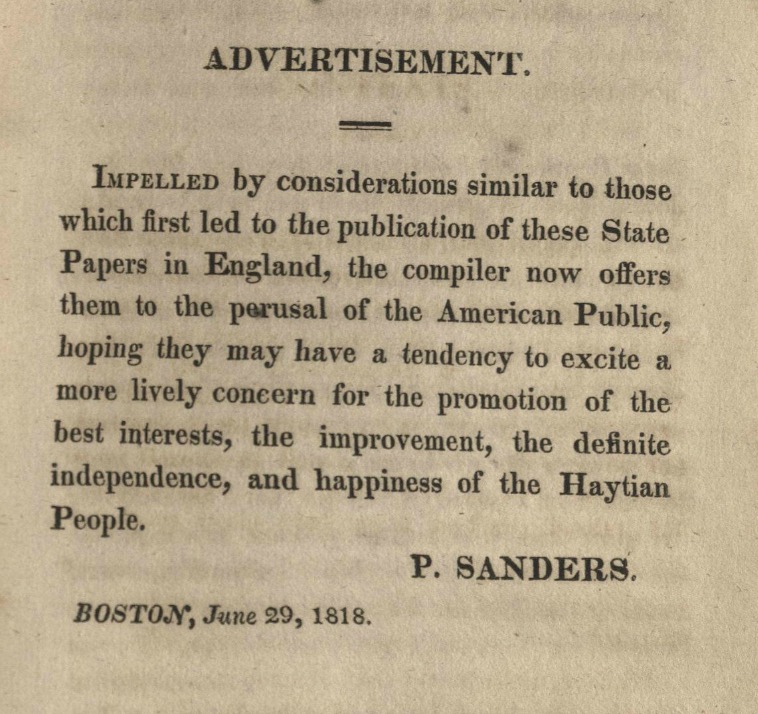
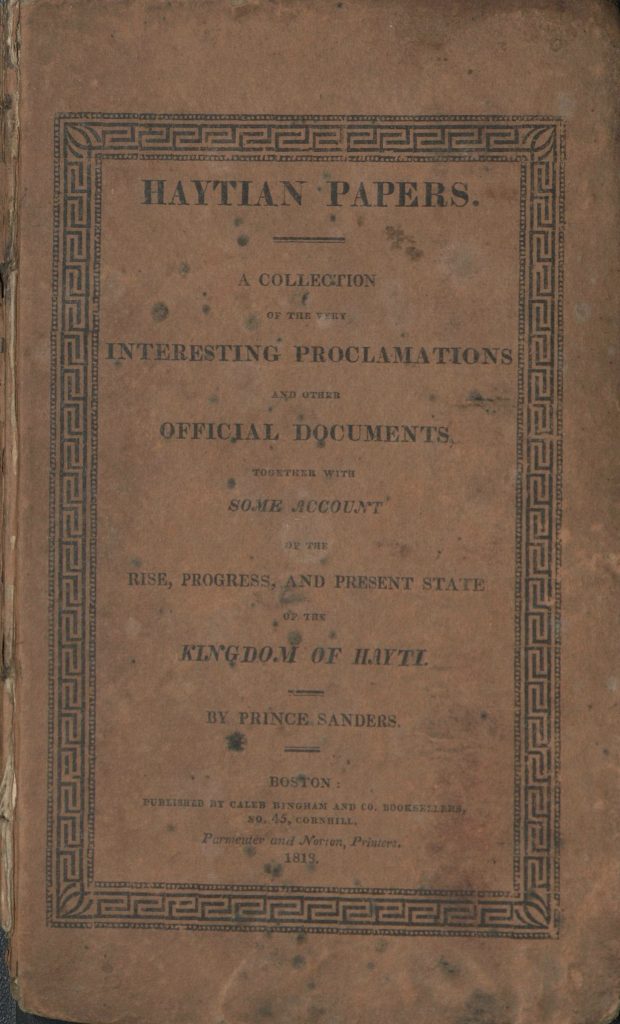 The Haytian Papers volume presents a compilation of fascinating state documents, including correspondence between Christophe and French officials addressing France’s attempts to retake Haiti after the independence revolution that took place nearly ten years prior to the book’s publication. Saunders is especially careful to articulate in his introduction that the Haytian Papers are also proof of the intelligence and capacity of the black leadership and citizens of the country.


 The
The 







 This beautiful copy of