Category Archives: Bingham Center

New Acquisitions Week, Day Two: Self-Portraits in Image and Word

We’re celebrating the beginning of a new fiscal year with a week’s worth of new acquisitions from the first half of 2012.  Two newly acquired selections will be featured in a post every day this week.  All of these amazing resources will be available for today’s scholars, and for future generations of researchers in the Rubenstein Library!

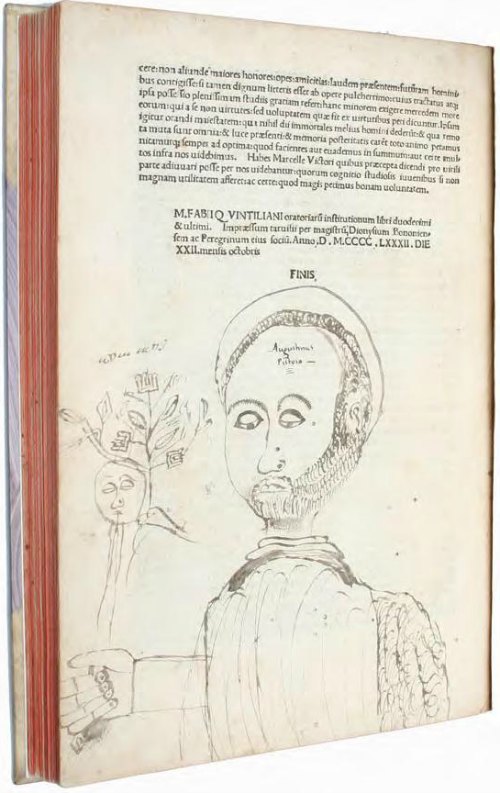
  • Quintilian, Institutiones Oratoriae: This 1482 incunable (or book printed in Europe before 1501) printed in Tarvisio, Italy, is a rare edition of one of the great Renaissance guides to rhetoric.  The remarkable copy now at Duke is unique, bearing the extensive handwritten annotations of a 16th-century scholar, Augustino Pistoia (or Agostino da Pistoia).  In addition, Pistoia drew two self-portraits at the end of the text, and noted the date on which he finished reading the work: “On the 20th of October [?] 1583 I Augostino Pistoia have read this book by Quintiliano under the teaching of mag. Pompeo Gilante my master/ 1583 1584.”
Self-portrait by Augustino Pistoia, in Quintilian, Institutiones Orationae (1482).
  • Edith Ella Baldwin Papers: Born in 1870 in Worcester, Massachusetts, Ms. Baldwin was an artist, craftswoman, and author.  Frustrated in her early attempts to publish her writings, Baldwin decided instead to keep one copy of each of her works for posterity, making a binding for each herself.  The collection consists of 38 unpublished volumes of stories, novels, poetry, lecture notes, and family history, including a novel about sex education for women, diary excerpts describing her visits with painter Mary Cassatt in 1890s Paris, and copies of letters from her aunt, Ellen Frances Baldwin, dating from 1848 to 1854. Edith Baldwin’s writings tend to cover timeless themes of religion and love, although many compositions feature contemporary issues such as automobiles, labor strikes, and women’s rights. The Baldwin Papers add to the rich body of materials documenting women’s literary expression in the Sallie Bingham Center for Women’s History and Culture.

Previous posts:


E-Records in the Reading Room

Special Collections Library reading rooms often require special equipment to view non-traditional record formats such as VHS players, cassette players, microfilm readers, etc. The Rubenstein Library recently welcomed a new piece to the set: a desktop computer.

Rubenstein Library Research Services staff check out the reading room's new e-records computer work station.

Though public computers have been available in our reference room for a long time to assist in finding and requesting physical materials in the reading room this new machine has been designed to support providing local access to electronic records and audio/video materials.

Some of the materials you can explore on the computer include:

Visit the reading room today and start that e-research!

Post contributed by Seth Shaw, Electronic Records Archivist.

Black Feminist Filmmaking: The Early Works of Cheryl Dunye

Black Feminist FilmmakingDate: Thursday, April 19, 2012
Time: 5:00 PM **Please note new time!**
Location: FHI Garage, Bay 4, Smith Warehouse, Duke University
Contact: Kelly Wooten, kelly.wooten(at)duke.edu

Cheryl Dunye’s work as a Black lesbian filmmaker has challenged, transformed and sometimes even stood in for a conversation about race, feminism, lesbianism, the archive and the practice of contemporary film.

This program will include a screening of selected shorts from the often neglected early work of Cheryl Dunye followed by a panel discussion featuring local Black lesbian and queer filmmakers Yvonne Welbon, Katina Parker and Julia Roxanne Wallace, moderated by Alexis Pauline Gumbs. This program coincides with the public launch of Eternal Summer of the Black Feminist Mind‘s new Black Feminist Film School. Light refreshments will be served.

Co-sponsored by African and African American Studies, the program in Women’s Studies, the program in the Study of Sexualities, the program in the Arts of the Moving Image, and the Sallie Bingham Center for Women’s History and Culture.

A Decidedly Feminist Taxonomy: Meredith Tax Comes to the Sallie Bingham Center

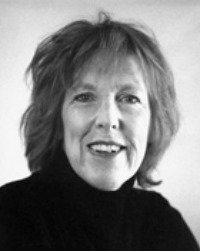
Meredith Tax, taken by Miriam Berkeley

The personal and professional papers of writer, organizer, and leading women’s movement activist Meredith Tax came to the Sallie Bingham Center in 2010. To celebrate the acquisition of this extensive collection the Center will host a symposium in Tax’s honor on April 13 and 14 called Acting Across Borders: The Future of the Feminist 1970s. Along with Meredith Tax, distinguished African scholar and activist Patricia McFadden will present the keynote address of an event that aims to grapple with how the interventions and methodologies of the women’s liberation movement inform current and future social justice movements. In anticipation of her trip to Duke, Meredith took a few minutes to share her reasons for putting her papers here and to give a sense of what people can expect to learn at the symposium.

Why did you decide to put your papers in the Bingham Center?

I investigated several feminist archives and chose the Bingham Center because it had a much more energetic and activist approach to archival work than I saw elsewhere. I want my papers to be used not only by scholars but by young people who want to learn from the history of earlier social movements. Because the Bingham Center does outreach to inform students about its collections and gives fellowships for researchers to work in its archive, I think my papers will be most accessible there.

What would you tell students about the upcoming symposium celebrating your work?

We are at the dawn of a period of increasing political activism. Attendees at this symposium will learn from the life stories of people who shaped the women’s movement here and internationally. Speakers will talk about their own work and life experiences. They will discuss the way issues of race and class impacted the relationship between feminism and the left, the development of ecofeminism and international women’s movements, and the centrality of questions of sexuality, gender, and LGBT rights. Feminists from Southern Africa, Algeria, and India will discuss their own rich and complex confrontations with sexism, nationalism and religious fundamentalism. These stories will show that, contrary to the right wing myth that feminists are white middle class women who are just out for themselves, feminists in the US and elsewhere have always grappled with issues of race and class, war and peace, nationalism and the environment, and that these efforts continue from one generation to the next.

Frances Ansley and Meredith Tax at a Bread & Roses-organized protest in 1970. Ansley will also speak at the upcoming symposium.
Frances Ansley and Meredith Tax at a Bread & Roses-organized protest in 1970.

What are some of the topics you plan to address in your keynote speech at the symposium?

I will tell the story of my life, from a childhood shaped by the sexism of the 50s to the early days of the Boston women’s movement, battles within the left and my own struggle to overcome the ignorance resulting from class and race privilege, my participation in the reproductive rights movement, and my work in International PEN (Postsecondary Education Network International) as part of a global movement for women’s human rights which must go on in this new period to link the struggle for social and economic justice and sustainability with the fight against all forms of fundamentalism.

For more information on Meredith Tax, check out her website. And be sure to register here to come to the Acting Across Borders symposium on April 13 and 14, 2012. Registration is free and open to the public!

New Acquisition: Panko Playing Cards

When you hear the word “Panko,” do you think of Japanese bread crumbs?

Box cover for Panko, or, Votes for Women: The Great Card Game

I did, until the Sallie Bingham Center acquired this deck of Panko playing cards. It’s named for the leader of the British suffrage movement, Emmeline Pankhurst  (1858-1928), and pits opponents and supporters of suffrage against each other in a game similar to rummy. The advertisement for the game claimed, “Not only is each picture in itself an interesting memento, but the game produces intense excitement without the slightest taint of bitterness.”

Pank! Pank! Pank! for Emmeline Pankhurst

This translation of the women’s suffrage movement into card games, and also board games, helped bring the message of the cause into domestic circles where more overt forms of propaganda might not have been welcomed. These cards were designed by the well-known Punch cartoonist E. T. Reed, and published by Peter Gurney in 1909.

Votes for Women.
Votes for Women, say the suffragettes.

These particular playing cards are owned by only three other libraries and are an important, rare piece of suffragette memorabilia that joins a number of other decks of cards held by the Bingham Center that explore issues related to women and gender. Check out the Panko catalog record here!

Post contributed by Megan Lewis, Technical Services Archivist for the Sallie Bingham Center for Women’s History and Culture.

Acting Across Borders: Celebrating the Meredith Tax Papers

Date: Friday, April 13- Saturday, April 14, 2012
Location: Friday: White Lecture Hall, East Campus; Saturday: Gothic Reading Room, Perkins Library
Registration  and Schedule:  http://library.duke.edu/rubenstein/bingham/borders
Contact Information: Kelly Wooten, (919) 660-5967, kelly.wooten[at]duke.edu

Meredith Tax, writer and political activist since the late 1960s, has founded or co-founded a series of feminist and social justice organizations starting with Bread and Roses, an early socialist-feminist group in Boston. Her 1970 essay, “Woman and Her Mind: The Story of Everyday Life,” is considered a foundational text of the U.S. women’s liberation movement. “Acting Across Borders” will focus on the main questions Tax explored in this essay and throughout her work as a feminist: race, class, and internationalism.

This fifth symposium of the Sallie Bingham Center for Women’s History and Culture will feature notable feminist activists, writers, and scholars:

Meredith Tax, writer and political activist

Patricia McFadden, radical African feminist, sociologist, writer, educator, and publisher

Anissa Helie, John Jay College of Criminal Justice, CUNY

Ann Snitow, Director, Gender Studies Program, Eugene Lang College

Mandy Carter, National Coordinator, Bayard Rustin Centennial 2012 Project, National Black Justice Coalition

Amber Hollibaugh, Interim Director, Queers for Economic Justice

Mia Herndon, Executive Director, Third Wave Foundation

Gita Sahgal, Women’s and Human Rights Activist; former head of Amnesty International’s Gender Unit

Ynestra King, Writer and Eco-feminist

Jaclyn Friedman, Writer, Activist, Co-Founder & Executive Director, Women, Action & the Media

Free and open to the public.  Co-sponsored by the Office of the President, the Office of the Provost, the  Dean of Arts and Sciences, Duke University Libraries, African and African American Studies, Franklin Humanities Institute, the Program in Women’s Studies,  the Women’s Center, David M.  Rubenstein Rare Book & Manuscript Library, and the Sallie Bingham Center for Women’s History and Culture. Part of the Future of the Feminist 70s series hosted by the Program in Women’s Studies.

Mending: A Reading with Sallie Bingham

Date: Wednesday, March 14, 2012
Time: 4:00 PM
Location: Biddle Rare Book Room
Contact information: Kelly Wooten, 919-660-5967 or kelly.wooten[at]duke.edu

Sallie Bingham’s Mending: New & Selected Stories spans a career of 50 years, ranging from the fecund Kentucky of her youth to the starker landscapes of New Mexico.  In addition to reading selections from this volume, Sallie will discuss her current project, The Blue Box: Three Lives in Letters based on letters from her maternal forebears. Books will be available for purchase courtesy of the Gothic Bookshop.

Sponsored by the Sallie Bingham Center for Women’s History and Culture.

Rights! Camera! Action!: 12th & Delaware

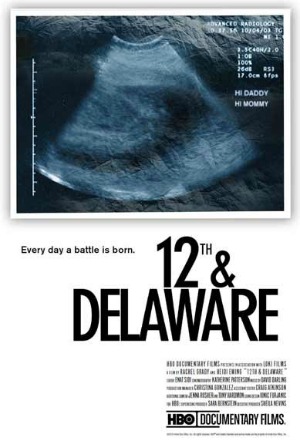
Twelfth and Delaware posterDate: Tuesday, March 13, 2012
Time: 7:00 PM
Location: The FHI Garage, Smith Warehouse Bay 4, 114 S. Buchanan St. (map)
Contact information: Patrick Stawski, 919-660-5823 or patrick.stawski(at)duke.edu

Co-Director Heidi Ewing and Carey Pope (Executive Director of NARAL Pro-Choice North Carolina) will lead a discussion following the film.

12th and Delaware takes its name from an intersection in Fort Pierce, Florida, where an abortion clinic named A Woman’s World sits across the street from the pro-life Pregnancy Care Center. Pregnant teenagers and women often mistake the pro-life center for the abortion clinic, and are patiently and persuasively counseled by its staff, often with deceptive tactics, to keep their pregnancies. Meanwhile, the medical staff of the clinic try to counsel patients to make their own choices and to perform their work as pro-life protesters walk the sidewalk in front of the clinic day and night. Turning a non-judgmental lens on both camps, filmmakers Rachel Grady and Heidi Ewing use the extraordinary access they gained to practitioners, protestors, and patients to show us a conflict with seemingly no possible resolution.

The screening will be followed by a discussion panel. Heidi Ewing has been making critically acclaimed documentary films and television programs with co-director and -producer Rachel Grady for over ten years. Their film Jesus Camp, a candid look at Pentecostal children in America, was nominated for a 2007 Academy Award for best documentary feature. Two years earlier, The Boys of Baraka, about a group of “at-risk” pre-teens from Baltimore who attend an experimental boarding school in Kenya, was nominated for an Emmy. 12th and Delaware premiered at the 2010 Sundance Film Festival and, among other honors, won the Kathleen Bryan Edwards Award for Human Rights at the 2010 Full Frame Documentary Film Festival.

Carey Pope is the Executive Director of NARAL Pro-Choice North Carolina. She has worked in the fields of reproductive and sexual health education, research and advocacy for more than eight years in Houston, Washington, DC, and North Carolina. She holds a master’s degree in public policy and women’s studies from The George Washington University and a B.A. in English and women’s studies from North Carolina State University.

About Rights! Camera! Action!: Featuring award-winning documentaries about human rights themes from Durham’s annual Full Frame Documentary Film Festival, the series explores issues ranging from the immigration and refugee rights to the justice system and the environment. All films featured in the series are archived at the Duke Library and are part of a rich and expanding collection of human rights materials. Co-sponsors include The Human Rights Archive, the Duke Human Rights Center, the Archive of Documentary Arts, the Franklin Humanities Institute and the Program in Arts of the Moving Image (AMI).  Special co-sponsor for this screening: Sallie Bingham Center for Women’s History and Culture.


Merle Hoffman Reads from Intimate Wars

Date: Tuesday, February 7, 2012
Time: 4:00 PM
Location: Biddle Rare Book Room
Contact Information: Kelly Wooten, 919-660-5967 or kelly.wooten(at)duke.edu

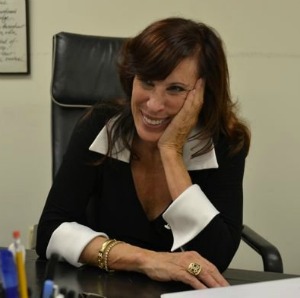
Merle HoffmanNext Tuesday, Merle Hoffman reads from her new memoir, Intimate Wars: The Life and Times of the Woman Who Brought Abortion from the Back Alley to the Boardroom.

Hoffman is a pioneer in developing and providing women’s health services; an award-winning writer; and a fearless advocate for women who has been in the forefront of cutting edge issues for over 40 years.

This past fall, Hoffman pledged $1 million to endow the directorship of the Sallie Bingham Center for Women’s History and Culture at the Rubenstein Library. Her papers are part of the Bingham Center’s collections.

The reading is co-sponsored by the Sallie Bingham Center for Women’s History and Culture and Duke’s Program in Women’s Studies as part of this spring’s “Future of the Feminist 70s” series of events.

New Year, New Acquisitions

What better way to ring in the new year (okay, we’re a couple of weeks late) than with a roundup of exciting new acquisitions from the second half of 2011?   All of these amazing resources will be available for researchers in the Rubenstein Library in 2012 and for years to come!

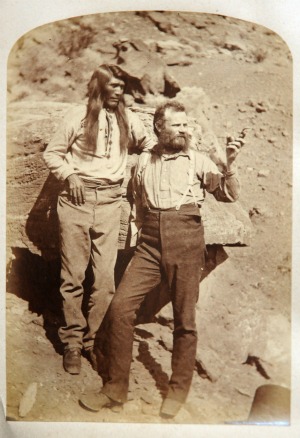
  • Stereograph of John Wesley Powell with a Native American. From the Powell Expedition Photograph Album.

    Powell Expedition Photograph Album: A remarkable album of 539 photographs taken during John Wesley Powell’s Second Expedition along the Colorado River in 1871-75 by John K. Hillers, E. O. Beaman, and James Fennemore.  The photographs include landscapes of the Western states and documentary photographs of Native Americans, especially the Paiute tribe.  Part of the Archive of Documentary Arts.  Look for more information on this album in the Biblio-file column in the January-February 2012 Duke Magazine.

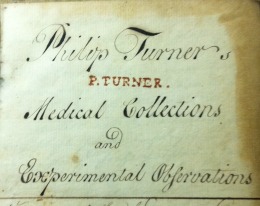
  • Case book of Dr. Philip Turner. From the Philip Turner Papers.

    Philip Turner Papers: Documents from the life and career of Dr. Philip Turner (1740-1815), Surgeon General for the Eastern Department of the Continental Army during the Revolutionary War.  The manuscript collection contains correspondence, medical returns, printed materials, records from northeastern field and city hospitals, and ledgers documenting Turner’s career as a surgeon in private practice, in the Continental Army, and in the United States Army. Part of the History of Medicine Collections.  More information about this important collection of early American medical history is coming soon!

  • The Door in the Wall, And Other Stories, by H. G. Wells: This 1911 limited edition of Wells’s science fiction and fantasy stories features stunning photogravure illustrations by the vorticist photographer Alvin Langdon Coburn.