Post contributed by Sierra Moore, Library Assistant for Research Services
Date: Tuesday, October 31, 2017 Time: 1:30-3:30 PM Location: Holsti-Anderson Family Assembly Room Contact: Rubenstein Library front desk, 919-660-5822
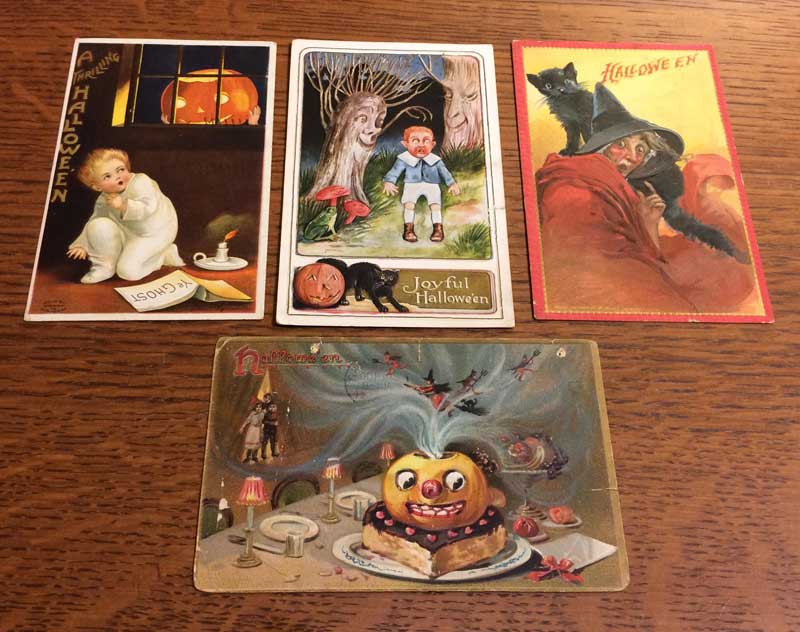
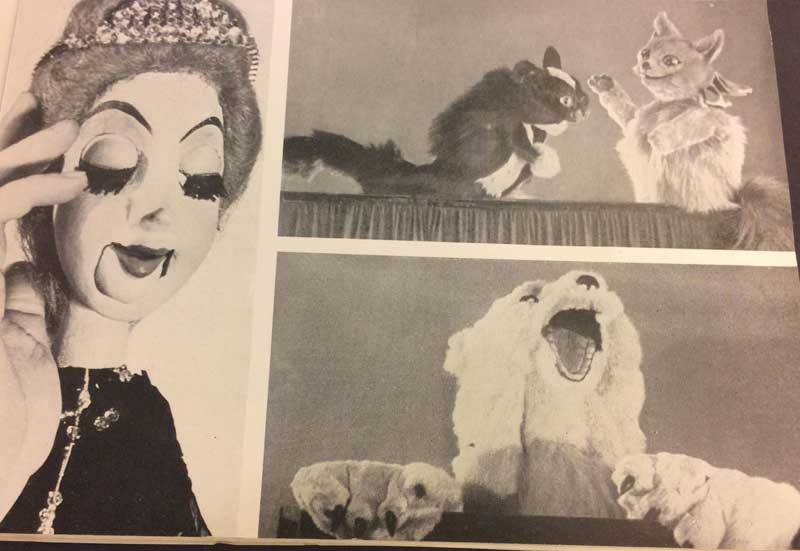
As all Hallows’ Eve draws near there are a multitude of reasons why you might traipse through all places dark, gloomy, and strange. Here at the Rubenstein Library your travels will be far less perilous. Nonetheless, we have compiled samples from collections containing chilling texts and photographs certain to both entertain, enchant, and imbibe the type of intrigue you seek. Here is a brief preview of what we have in store:
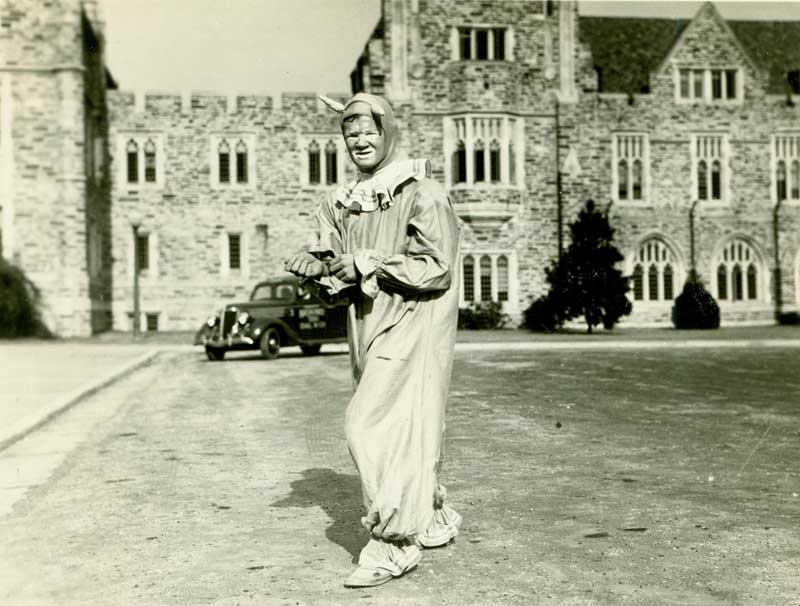
An early version of our very own Blue Devil mascot lingers before the Chapel.
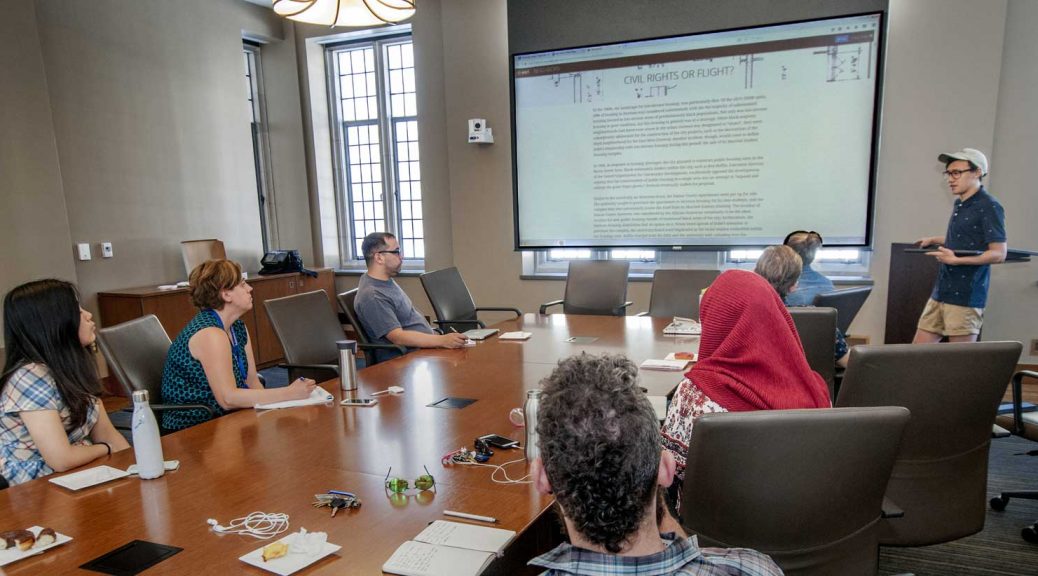
Please join the History of Medicine Collections for our next Trent History of Medicine Lecture Series event. Todd Savitt, Ph.D. will present Race, Medicine, Authorship and the ‘Discovery’ of Sickle Cell Disease in 1910-1911.
The first two case histories of sickle cell disease (SCD) appeared in the medical literature within three months of each other in 1910 and 1911. The very divergent stories of the first two sickle-cell patients and their physicians are told against the backdrop of a racially divided America and of a highly competitive scientific community. Dr. Savitt’s talk will discuss how race and class affected the discovery of SCD and how credit for the two discoveries were apportioned. Dr. Savitt will also talk about his own “adventures” in tracking down the identities and backgrounds of these first two SCD patients.
Dr. Savitt is a medical historian and professor in the Department of Bioethics and Interdisciplinary Studies in the Brody School of Medicine at East Carolina University.
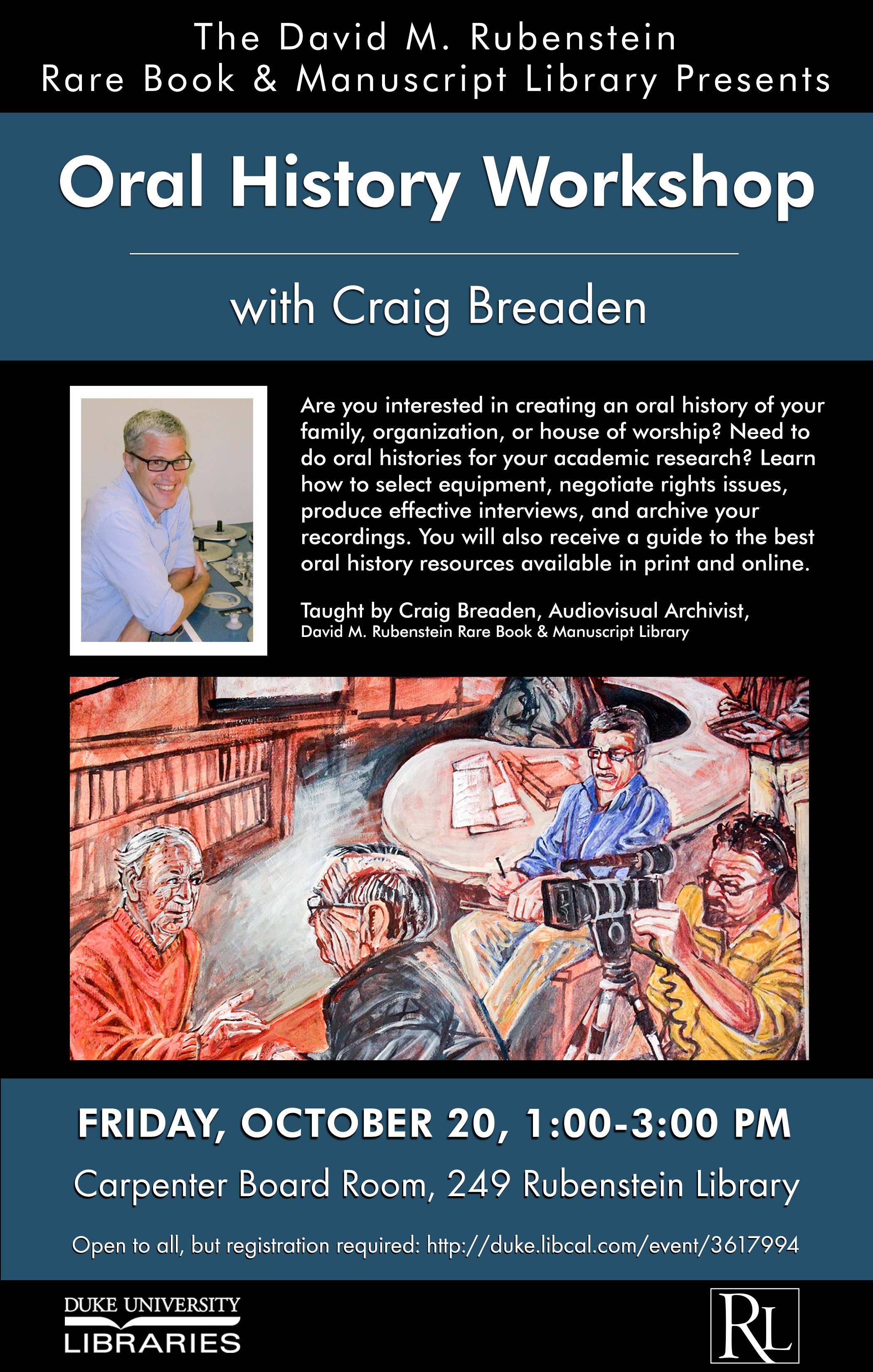
Date: Friday, October 20, 2017 Time: 1:00pm – 3:00pm Location: Rubenstein Library 249 (Carpenter Conference Room) Contact: Elizabeth Dunn, elizabeth.dunn@duke.edu
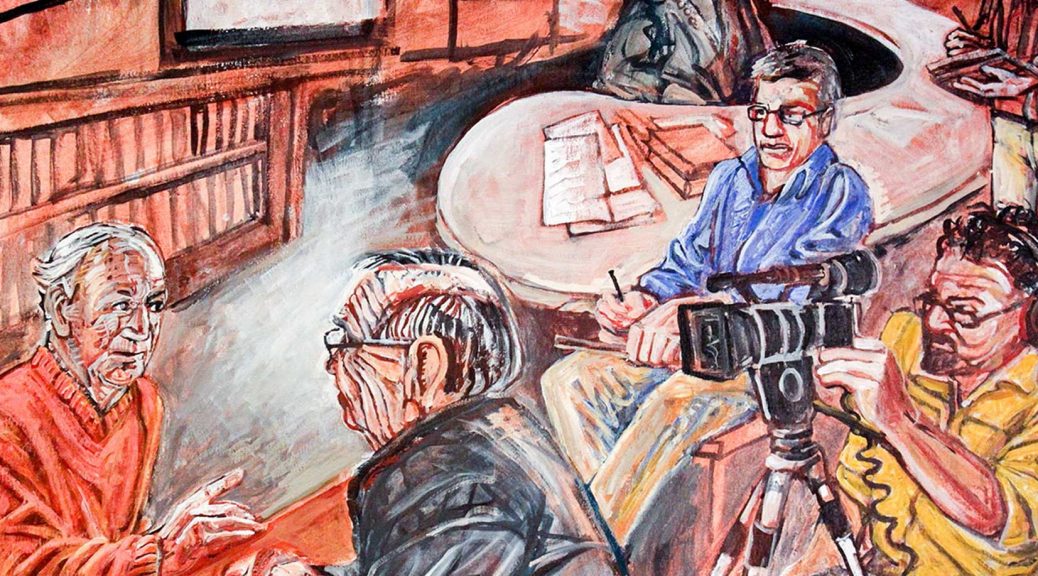
Are you interested in creating an oral history of your family, organization, or house of worship? Do you need to do oral histories for your academic research?
In this free workshop–taught by Craig Breaden, the Rubenstein Library’s Audiovisual Archivist–you’ll learn how to select equipment, negotiate rights issues, produce effective interviews, and archive your recordings. You will also receive a guide to the best oral history resources available in print and online.
Date: Tuesday, October 24, 2017 Time: 5:30-6:30 PM Location: Holsti-Anderson Family Assembly Room, Rubenstein Library Room 153 Contact: Laura Micham,
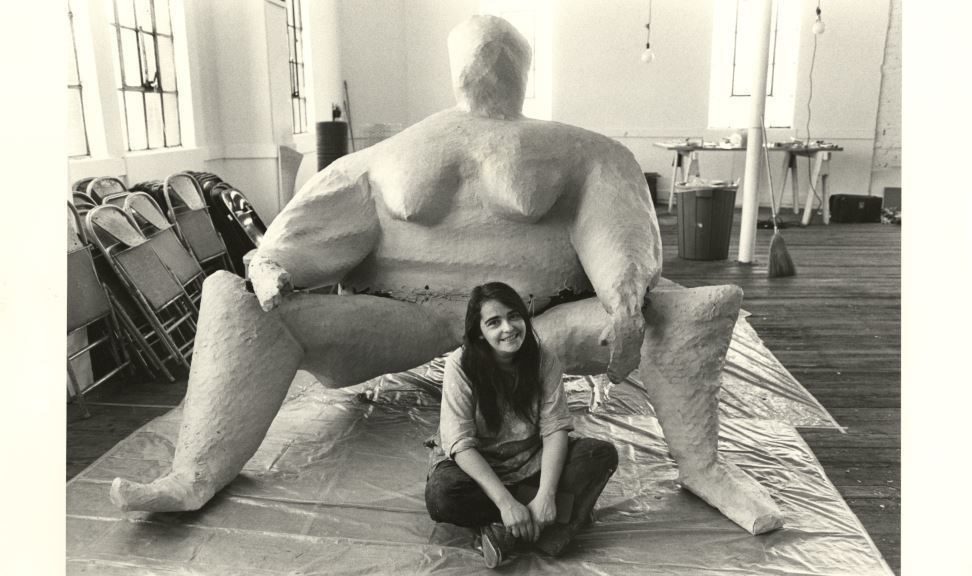
Please join the Sallie Bingham Center for Women’s History and Culture for a program honoring the memory of feminist writer, artist, and activist Kate Millett (1934-2017) with readings and reflections.
Kate Millett’s papers have been at the heart of the Bingham Center’s collections since 2000, and have inspired much scholarship, enhancing our understanding of the world. (Read more.)
Speakers will include Kimberly Lamm, Toril Moi, Sylvia Herbold, Heather McGowan, Kathy Rudy, Naomi Nelson, and others.
This summer, our second class of Duke History Revisited students dug into the University’s history, developing individual research projects that tell the stories of people and events that are not widely known.
On October 11th at 5 PM, five of the program’s students will come together to recap their projects. During this public event, each student will briefly introduce their topic, highlight their research discoveries, and offer their own insight into Duke’s history. The presentations will be followed by refreshments and an opportunity to talk with the students in more detail.
Post contributed by Valerie Gillispie, University Archivist
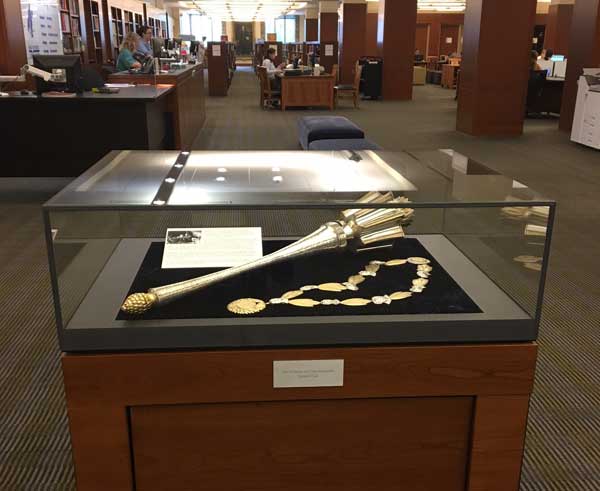
Have you ever wondered about the fancy chain that the president wears during commencement? Or about that big scepter that the chair of Academic Council carries during convocation? For the next month, get an up close look at the official Duke University chain of office and mace, on display near the service desk in Perkins Library.
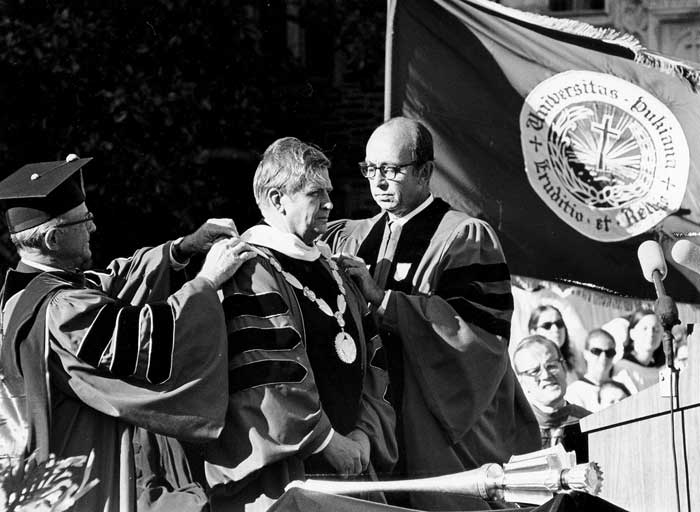
Created in 1970, the mace and chain of office were formally debuted at Terry Sanford’s presidential inauguration on October 18, 1970. Both items are traditional symbols of leadership, and Duke’s versions feature distinctly Duke and North Carolinian decorations: pinecones, tobacco leaves, the school motto “Eruditio et Religio,” and the Duke family coat of arms.
The mace and chain in action at Terry Sanford’s inauguration, October 18, 1970
The chain of office and mace will be on display until October 5, when they will be used during the inauguration of President Vincent Price, the University’s tenth president.
Post contributed by Elizabeth Dunn, Research Services Librarian
The Rubenstein Library’s Economists’ Papers Archive attracts numerous scholars from around the globe. This summer, it has also attracted one very special scholar: rising eighth grader Benjamin Knight. Nearly every day, he has been a quiet presence in our reading room, working his way diligently through boxes of our Oskar Morgenstern Papers.
Although we often welcome even very small children whose families make a pilgrimage to see our first edition Book of Mormon, Benjamin is the youngest serious researcher anyone can remember. Those of us on the Research Services staff found his interest in this important Austrian American economist intriguing. He was kind enough to take time out of his work to grant me an interview.
Benjamin Knight in the Rubenstein Library reading room. Photo by Elizabeth Dunn.
Asked how he became interested in Morgenstern, Benjamin replied that he had read an article about Von Neumann and Morgenstern. (The two economists overlapped at the Institute for Advanced Study in Princeton from 1938 until 1954. Morgenstern, an economist trained at the University of Vienna and influenced by Carl Menger, was grappling with the challenges of economic prediction. He knew John Von Neumann’s 1928 paper on the theory of games and the two collaborated on their influential 1944 book, Theory of Games and Economic Behavior.1) Benjamin was pleased to discover that we hold the Morgenstern Papers, and is using them to tease out the sources of Morgenstern’s key ideas: the University of Vienna or Princeton. More generally, he is interested in the application of game theory to the analysis of social interactions and political decision-making. Some of the Morgenstern documents are hand-written in German. Asked whether those were challenging, Benjamin replied that the handwriting is a little problematic, but translating the German, which he has never studied, is more difficult.
Benjamin has many other interests besides game theory. He represented Brazil (and, with partner Claire Thananopavarn, won Best Delegation) in the Eighth Annual Chapel Hill-Carrboro Middle School Model United Nations Conference in April. He was part of the Smith team at this year’s Middle School National Academic Quiz Championship Tournament and placed among the top twenty-five competitors in the 2017 Wake Technical Community College Regional State Math Contest. When not competing, Benjamin enjoys reading fiction, history, and politics.
Benjamin comes by his interest in social and political analysis naturally. His mother, cultural anthropologist Margaret “Lou” Brown, is Senior Research Scholar and Director of Programs at Duke University’s Forum for Scholars and Publics. His father Jack Knight is Frederic Cleaveland Professor of Law and Political Science and holds a joint appointment in Duke’s School of Law and Trinity College of Arts and Sciences. Benjamin has not yet decided on a particular career path, but all of us in the Rubenstein are happy that he found us and look forward to following his continued successes.
Post contributed by Tracy Jackson, Technical Services Archivist for the Duke University Archives.
The University Archives recently completed processing of the Jay Carl Anderson Photographs and Papers, a collection with many images of Duke’s campus, students, and athletic events, as well as politicians, scenes of Durham and elsewhere in North Carolina, and many other locations and subjects, mostly dating from the 1970s and 1980s. The collection is a rich new resource for researchers interested in Blue Devils men’s basketball, student life, campus protests, the city of Durham, political campaigning in NC, and photojournalism, and it offers many beautiful and fascinating new views of familiar subjects.
East Campus pavilion, circa 1980
Jay Anderson was a native of New York State who enrolled at Duke in 1974. He first published a photograph in his local newspaper at 16, and by the time he was a Duke student he was working as a freelance photographer submitting images to the New York Times. He took pictures for the Chronicle and then became involved with the Chanticleer, serving as editor for the 1978 Chanticleer during his senior year. He photographed many aspects of life at Duke, taking pictures of students, classes, events, and scenes on campus, as well as representing life off campus, snapping pictures of life in the surrounding neighborhoods, downtown Durham, and elsewhere in the Triangle. He also traveled, spending about six months in Europe and going as far east as Moscow, photographing life in the Soviet Union in 1977. He brought many of these images back to the Duke community, publishing spreads in the Chronicle and showing his work in exhibits and contests.
Anderson also photographed political persons and events, attending and photographing the 1976 Democratic National Convention in New York City and capturing presidential candidates and politicians, both on and off the campaign trail.
Jimmy Carter at a 1976 Presidential Debate on the campus of the College of William and Mary.
A resident of Pegram dormitory, he took a number of photos of friends and residents. New to Durham and the South when he arrived at Duke, he took an interest in life off campus and in the surrounding areas, including residents in nearby neighborhoods, events downtown, and the State Fair in Raleigh. He documented campus protests and performances, including visits from celebrities and politicians. And he lovingly captured athletics, particularly men’s basketball, capturing many of the players and fans mid-action.
UNC-Chapel Hill vs. Duke Men’s Basketball Game, January 14, 1978.
Johnny Dawkins, Colorado vs. Duke Men’s Basketball Game, December 21, 1983.
Many of the images are not labeled or identified, or have only general topical labels. As with many photographic collections, identifying information can sometimes be found in the image itself. Anderson also kept copies of many publications featuring his work, which include additional description.
1980 Duke/UNC basketball game, image submitted to New York Times.
After graduation, Jay Anderson remained in Durham for many years, and continued to photograph Duke events, particularly men’s basketball, and he remained involved with the Chanticleer for several years. He became the official photographer for the American Dance Festival and worked as a freelance photographer for a variety of publications as well as for private commercial work (his ADF photographs can be found in the Jay Anderson Papers in the American Dance Festival Archives, also housed here at Duke).
We’re excited to make this collection available to researchers. For anyone with an interest in Duke, politics, photography, or any number of related topics, the Jay Carl Anderson Photographs and Papers offers a lot to explore.
Post contributed by Thomas Gillan, the Josiah Charles Trent Intern in the History of Medicine Collections.
Given its designation as the David M. Rubenstein Rare Book & Manuscript Library, you might assume, correctly, that the library’s History of Medicine Collections consist primarily of books and manuscripts, but did you know that they also boast a large collection of historical medical instruments and artifacts? Some of these objects are reassuringly familiar. Others, however, can seem somewhat more baffling.
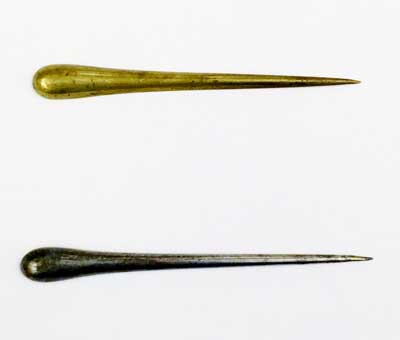
Take, for instance, the objects identified in the collection guide as “Perkins’s tractors.” At first glance, they are often mistaken for horseshoe nails. Historian James Delbourgo, who has written extensively about these so-called tractors, notes that they “were disarmingly simple things. A set consisted of two three-inch metallic rods made of brass and iron, and they sold for twenty-five continental dollars in North America, five guineas in Britain.”[1] According to Delbourgo, their very simplicity was what made the tractors so appealing.[2] At a time when doctors regularly resorted to such “heroic” measures as bleeding, blistering, vomiting, and purging, Perkins’s tractors offered a painless alternative, one that was less invasive but no less controversial.
The man behind these seemingly strange instruments was one Elisha Perkins of Connecticut. Born in 1741, Perkins received his medical training from his father, a physician in Norwich, before establishing his own practice in Plainfield. There, in the course of his practice, Perkins “discovered that, by drawing over the parts [of the body] affected in particular directions certain instruments which he formed from metallic substances into certain shapes, he could remove . . . most kinds of painful topical affections, which came under his care and observation.”[3]
Perkins, it turns out, was quite the salesman. In 1796, he patented his tractors. Thereafter, Perkins and his son took to promoting them. Together, they published a series of pamphlets touting the tractors’ efficacy. These pamphlets invariably included testimonials from satisfied clients. Prominent among them were Jedidiah Morse, a Congregational minister; John Marshall, Chief Justice of the United States Supreme Court; and Josiah Meigs, professor of natural philosophy at Yale.[4] Even George Washington himself is reputed to have owned a set.[5]
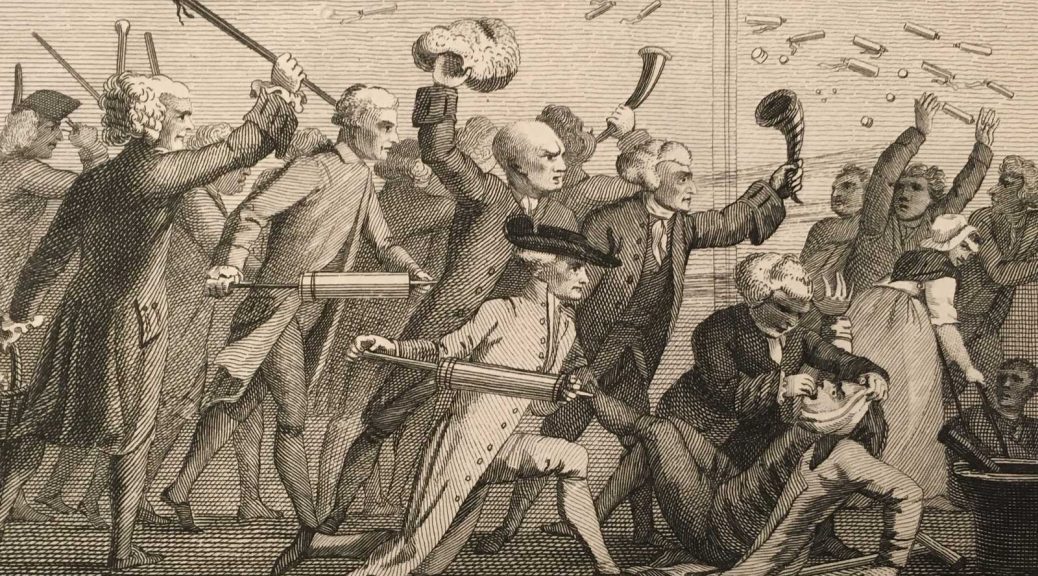
Like other novel medical therapies, such as Galvanism and Mesmerism, Perkins’s were the subject of much popular attention, not all of it positive. Most regular physicians were skeptical of Perkins’s claims, so much so that in May of 1797, the Connecticut Medical Society expelled Perkins on grounds of quackery. Still other physicians sought to make sense of the tractors’ mysterious workings.
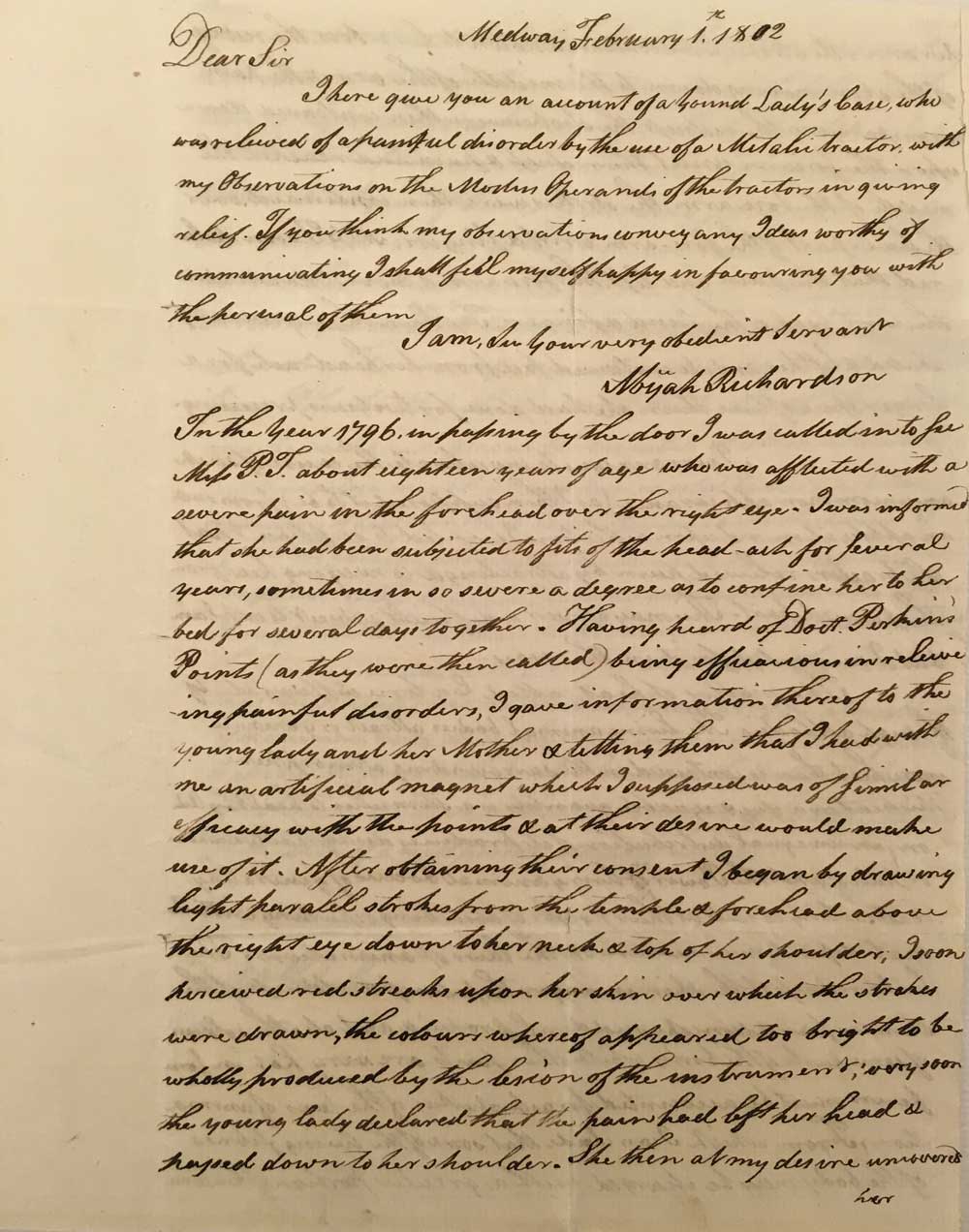
One such account can be found among the Benjamin Waterhouse papers. In a letter dated February 1, 1802, Abijah Richardson, a physician in Medway, Massachusetts, wrote to Benjamin Waterhouse, then a professor of medicine at Harvard, relating “an account of a Young Lady’s Case, who was relieved of a painful disorder by the use of a Metelic tractor.”[6] In 1796, Richardson explained, he had been “called in to see Miss P.T. about eighteen years of age” who for several years “had been subjected to fits of the head-ach.”[7] Having heard of Perkins’s tractors “being efficacious in relieving painful disorders,” Richardson decided to put the tractors to the test.
Abijah Richardson to Benjamin Waterhouse. 1 February 1802. Box 1, Folder 2, Benjamin Waterhouse papers, 1782-1841. David M. Rubenstein Rare Book & Manuscript Library, Duke University. (Click image to enlarge!)
Without access, however, to a real set of tractors—he apparently did not have a set of his own—Richardson offered up “an artificial magnet which I supposed was of similar efficacy with the points.”[8] After obtaining his patient’s consent, Richardson proceeded to draw “light parallel strokes from the temple & forehead above the right eye down to her neck & top of her shoulder.”[9] Richardson here followed the method laid out by Perkins himself of “drawing the Points of the Tractors over the Parts affected, and continuing them along on the Skin to a considerable Distance from the Complaint, usually towards the Extremities.”[10] Richardson went on to recount how, in the course of her treatment, his patient’s pain, following the strokes of the tractors, “gradually abated & left her.”[11] From this, Richardson “was led to suppose that the tractors relieved pain by attracting & conveying heat from the pained part.”[12]
Title page to John Haygarth’s experiment involving Perkins’s tractors.
In 1800, John Haygarth, a physician in Bath, England, published the results of an experiment that cast doubt on the tractors’ efficacy. In 1799, having “contrived two wooden Tractors of nearly the same shape as the metallick, and paints to resemble them in colour,” Haygarth set out to test whether these “fictitious tractors” could produce the same effect as “the true metalliack Tractors of Perkins.”[13]
Much to his surprise, both sets of tractors “were employed exactly in like manner, and with similar effects,” leading Haygarth to conclude that the “whole effect undoubtedly depends upon the impression which can be made upon the patient’s Imagination.”[14] Haygarth’s experiment was one of the first documented demonstrations of what later came to be known as the placebo effect.
Despite their critics, Perkins’s tractors continued to be commercially successful, even after the death of their inventor in 1799. They even went on to become the subject of a poem satirizing the medical profession.
To explore these and other items from the History of Medicine Artifacts Collection, check out the collection guide, which contains descriptions and images for many of the items. Also, stop by the Josiah Charles Trent History of Medicine Room at the Rubenstein Library to see a rotating selection of items from the collection on permanent exhibit.
Footnotes:
[1] James Delbourgo, A Most Amazing Scene of Wonders: Electricity and Enlightenment in Early America (Cambridge, MA: Harvard University Press, 2006), 240.
[6] Abijah Richardson to Benjamin Waterhouse, 1 February 1802, Box 1, Folder 2, Benjamin Waterhouse papers, 1782-1841, David M. Rubenstein Rare Book & Manuscript Library, Duke University.
[13] John Haygarth, Of the Imagination, as a Cause and as a Cure of Disorders of the Body; Exemplified by Fictitious Tractors and Epidemical Convulsions (Bath, 1800), 3.
Post contributed by Liz Adams, Special Collections Cataloger.
Aldine Press printer’s device found in front of Lucretius’s De rerum natura.
At the end of 2016, we bid a fond farewell to a long-gestating project at the Rubenstein: the Aldine Press metadata project, a deep dive into our holdings printed by the famous Aldine Press during the Hand-Press Era.
Started by Aldo Manuzio (also known as Aldus Manutius) during the dawn of the printing press and continued by his relatives for over 100 years, the Aldine Press is renowned for its editions of Greek and Latin classics and dictionaries; its dolphin and anchor printer’s device; and its creation of italic font, allowing us to appropriately emphasize our language for 500+ years. Today, we celebrate the 500th anniversary of Aldo’s death and attend sessions at conferences highlighting the continued relevance of a press that has long ceased production.1
It’s thus not entirely hyperbolic to describe the Aldine Press as one of themost significant, the most studied presses of all time. (How’s that for italics?) And prior to mid-2016, we didn’t know the exact number of Aldine Press books the Rubenstein held. Moreover, our catalog records often didn’t have more granular information about which Manuzio worked on which text and where additional resources about a specific title could be found.
Our Aldine Press metadata project therefore sought to 1) collocate all of our Aldine Press records through our catalog and 2) supplement our existing records, providing additional access points for specific Manuzio family members and citing published descriptions of the works we hold.
All this took a bit of finessing over the course of several months. My colleague Andy Armacost first created a truly magnificent Boolean search, which allowed us to search our back-end database to get the exact number we owned:
Held by: Special Collections
Publishing Date: 1450-1600
Keywords = Aldine OR Alde OR Aldi OR Aldus OR Aldo OR Aldvs OR Aldum OR Aldvm OR Aldina OR Manutius OR Manuzio OR Manvtivm OR Manuties OR Manvtio OR Manutianis OR Manvtii
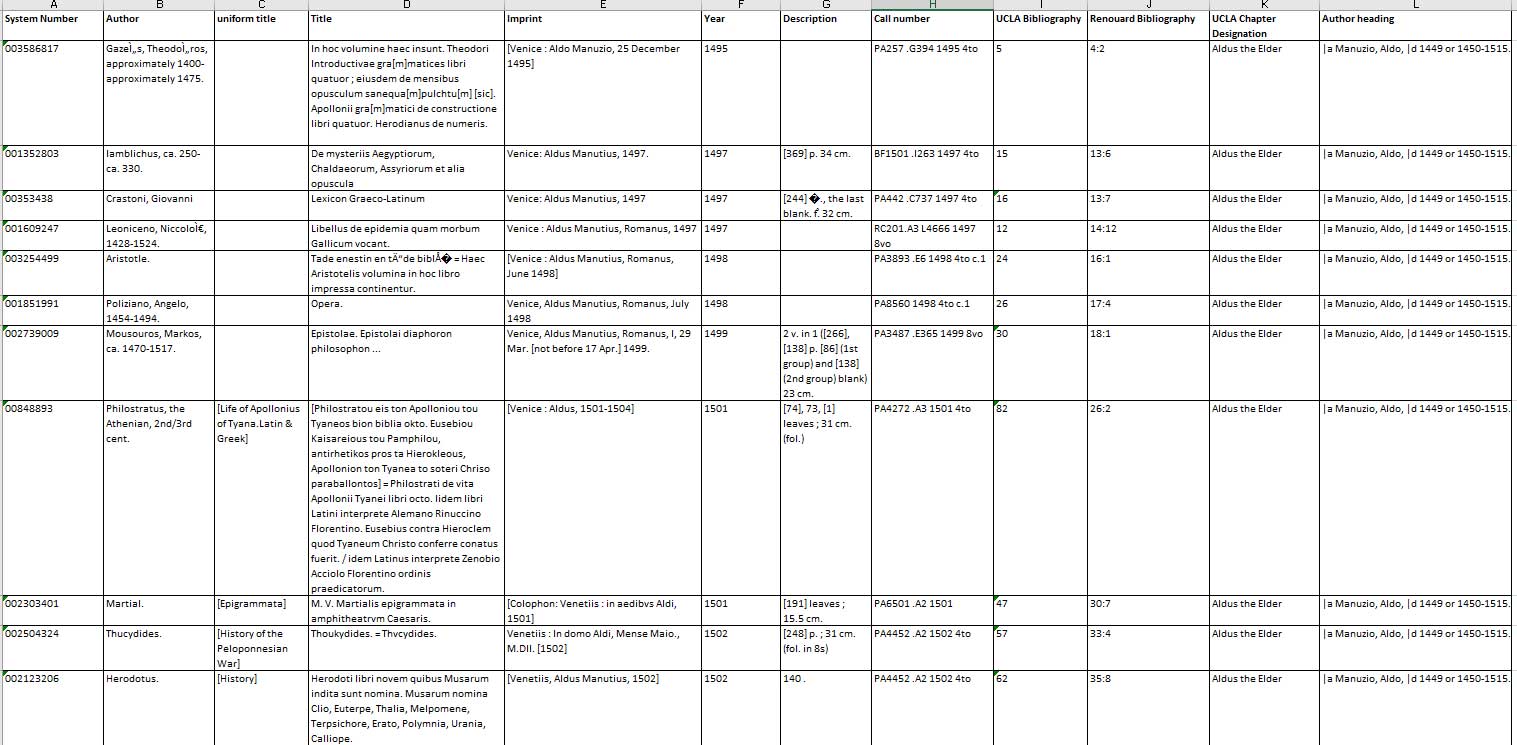
Using these bibliographies, Mike added citation numbers and authorized access points for individual printers when known, including the elder and younger Aldo Manuzios, and Paulo Manuzio, to my original spreadsheet.
This spreadsheet bears witness to the cumulative efforts of three people over four months! (Click image to enlarge!)
Finally, we were ready to create an artificial collection name for our 165 Aldine Press titles and to add a lot of metadata to our existing records in batches:
All 165 titles can now be found by searching Aldine Press Collection (David M. Rubenstein Rare Book & Manuscript Library) in our catalog.
You can also search by authors, including Paulo Manuzio and Manuzio family.
In the “Details” section of a title, you will find citations for bibliographies referencing that specific title.
We’re all very excited about these changes, as they allow us to help our researchers locate material much more efficiently!





 Please join the