All posts by Amy McDonald

Opening Reception for “Iraq | Perspectives”

Date: Thursday, November 10, 2011
Time: 5:30 PM
Location: Biddle Rare Book Room
Contact Information: Karen Glynn, 919-660-5968 or karen.glynn(at)duke.edu

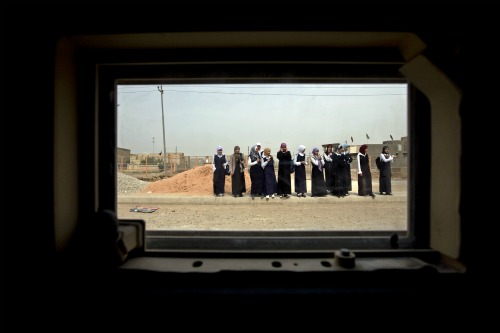
Join the staff of the Archive of Documentary Arts and the Center for Documentary Studies for an opening reception for our new exhibit, “Iraq | Perspectives: Photographs by Benjamin Lowy.”

Lowy is the winner of the fifth Center for Documentary Studies/Honickman First Book Prize in Photography. During tomorrow night’s reception, he will speak about his work and sign copies of his book, Iraq | Perspectives, published by Duke University Press and the Center for Documentary Studies

Lowy’s powerful and arresting color photographs taken through Humvee windows and military-issue night vision goggles capture the desolation of a war-ravaged Iraq as well as the tension and anxiety of both U.S. soldiers and Iraqi civilians.

Lowy received a BFA from Washington University in St. Louis in 2002 and began his career in 2003 when he joined Corbis and embedded with the U.S. Army’s 101st Airborne Division to cover the Iraq War. In 2005 Photo District News chose Lowy’s Iraq images as some of the most iconic of the start of the 21st century. Lowy’s photographs appear regularly in national and international such publications as the New York Times Magazine, Newsweek, Fortune, the New Yorker, Vanity Fair, Stern, and Rolling Stone. His work has been exhibited at San Francisco MOMA, Tate Modern, Open Society Institute’s Moving Walls, Noorderlicht Photofestival, Battlespace, and the Houston Center for Photography, among others.

For more details about the exhibit, on display through December 11th in the Rubenstein Library Gallery, visit this blog post or view the online exhibit.

Rights! Camera! Action!: Good Times

Date: Tuesday, November 15, 2011
Time: 7:00 PM
Location: Franklin Humanities Institute Garage, Bay 4, Smith Warehouse (map)
Contact Information: Patrick Stawski, 919-660-5823 or patrick.stawski(at)duke.edu, or Kirston Johnson, 919-681-7963 or kirston.johnson(at)duke.edu

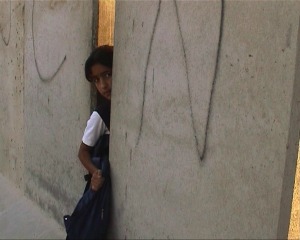
Still from Good TimesJoin us for a screening of Good Times (31 minutes, Hebrew/ Arabic/ English with English subtitles), the second film in the 2011-2012 Rights! Camera! Action! series and the winner of the 2004 Full Frame Jury Award for Best Short.

Good Times was shot in Abu Dis, a small Palestinian village divided in two by a wall built by the Israeli government. The film follows the villagers’ lives before the wall was built and through the construction of a temporary, then a permanent, wall. Moving in colliding microcosms, the inhabitants of the village and the Israeli soldiers protecting the border create an absurd routine of mutual respect and resentment.

Following the film, students from Duke’s BorderWork(s) Humanities Lab will give a presentation on their work this semester.

The screening is free and open to the public, and free popcorn will be provided!

The Rights! Camera! Action! film series, which is sponsored by the Archive for Human Rights, the Archive of Documentary Arts, the Duke Human Rights Center, the Franklin Humanities Institute, and Screen/Society at Duke’s Arts of the Moving Image Program, features documentaries on human rights themes that were award winners at the annual Full Frame Documentary Film Festival. The films are archived at the Rubenstein Library, where they form part of a rich and expanding collection of human rights materials. This screening is also co-sponsored by the BorderWork(s) Humanities Lab at the Franklin Humanities Institute.

“Iraq | Perspectives: Photographs by Benjamin Lowy”

Date: October 24-December 11, 2011
Location and Time: Rubenstein Library Gallery during library hours
Contact Information: Karen Glynn, 919-660-5968 or karen.glynn(at)duke.edu

Benjamin Lowy’s powerful and arresting color photographs, taken through Humvee windows and military-issue night vision goggles, capture the desolation of a war-ravaged Iraq, as well as the tension and anxiety of both U.S. soldiers and Iraqi civilians.

To photograph on the streets unprotected was impossible for Lowy, so he came up with the brilliant approach of making images that illuminate this difficulty by shooting through the windows and goggles meant to help him, and soldiers, to see. In doing so he provides us with a new way of looking at the war—an entirely different framework for regarding and thinking about the everyday activities of Iraqis in a devastated landscape and the movements of soldiers on patrol, as well as the alarm and apprehension of nighttime raids.


Lowy’s work was selected from over two hundred entries in the fifth biennial Center for Documentary Studies/Honickman First Book Prize in Photography competition, judged by William Eggleston. Lowy will speak about his work during the exhibit’s opening reception on Thursday, November 10th at 5:30 PM in the Rare Book Room.

An online exhibit is available on the Libraries’ website as well.

Lowy received a BFA from Washington University in St. Louis in 2002 and began his career in 2003 when he joined Corbis and embedded with the U.S. Army’s 101st Airborne Division to cover the Iraq War. In 2005 Photo District News chose Lowy’s Iraq images as some of the most iconic of the start of the 21st century. Lowy’s photographs appear regularly in national and international such publications as the New York Times Magazine, Newsweek, Fortune, the New Yorker, Vanity Fair, Stern, and Rolling Stone. His work has been exhibited at San Francisco MOMA, Tate Modern, Open Society Institute’s Moving Walls, Noorderlicht Photofestival, Battlespace, and the Houston Center for Photography, among others.

The Archive of Documentary Arts at the Rubenstein Library acquired the exhibit photographs through the generosity of the Honickman Foundation established by Lynne Honickman.  Harold Honickman sits on the board of the Honickman Foundation and is a member of the Duke University Library Advisory Board. The gift of Benjamin Lowy’s photographs supports the Rubenstein Library’s commitment to acquiring photographic collections that have artistic merit and that reflect the visionary purposes and documentary impulses of their creators.

Post contributed by Karen Glynn, Photography Archivist for the Archive of Documentary Arts.

Decasia

Our Archive of Documentary Arts is co-sponsoring two events with filmmaker Bill Morrison.

Film Screening

Date: Monday, November 7, 2011
Time: 7:00 PM
Location: Carolina Theatre (309 W. Morgan St.; directions and parking information)
Contact Information: Duke Performances

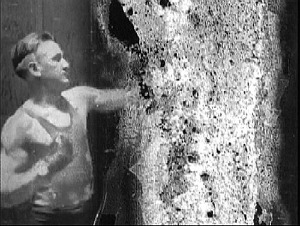
Still from DecasiaMade from deteriorating reels of film, Bill Morrison’s experimental film Decasia is a symphony in decay. With a score composed by Bang on a Can’s Michael Gordon, this “haunting modern masterpiece” (The Guardian) will be presented in a rare screening, followed by a Q & A with Morrison. Tickets are $5 at the Carolina Theatre box office.

Conversation

Date: Tuesday, November 8, 2011
Time: 12:00 PM
Location: Bone Hall, Mary Duke Biddle Music Building 019
Contact Information: Duke Performances

Filmmaker and artist Bill Morrison will talk with Duke graduate composers about the process of collaborating with composers scoring for film. Morrison has collaborated with an impressive line-up of composers, including John Adams, Bill Frisell, Steve Reich, and Vijay Iyer. This event is free and open to the public.

Morrison created a film for Bill Frisell’s new work, The Great Flood, which Duke Performances presented this past Saturday.

Both events are co-sponsored by Duke Performances, Duke’s Master of Fine Arts in Experimental & Documentary Arts, and the Archive of Documentary Arts.

One for the Refrigerator Door

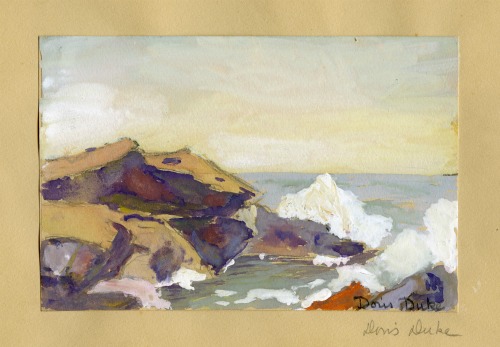
Painting by Doris Duke, 1924

Doris Duke—the only daughter of Duke University benefactor James Buchanan Duke and noted philanthropist and patron of the arts—painted this lovely scene in 1924 at the age of eleven. It is part of the Doris Duke Papers, donated to the Rubenstein Library in 2009 by the Doris Duke Charitable Foundation and now open for public research.

Further details about the extraordinary collection may be found in the official press release, or by reviewing the collection’s finding aid.

Travel Grant Season is Open!

Wish you were here? We do too! The David M. Rubenstein Rare Book & Manuscript Library is now accepting applications for our 2012-2013 travel grants.

The Sallie Bingham Center for Women’s History and Culture, the John Hope Franklin Research Center for African and African American History and Culture, and the John W. Hartman Center for Sales, Advertising & Marketing History will award up to $1,000 per recipient to fund travel and other expenses related to visiting the Rubenstein Library.

The grants are open to undergraduate and graduate students, faculty, independent scholars, artists, and activists living outside a 100-mile radius from Durham, NC with research projects that would benefit from access to the centers’ collections.

More details—and the grant application—may be found on our grants website. Applications must be postmarked or e-mailed no later than 5:00 PM EST on January 31, 2012. Recipients will be announced in March 2012.

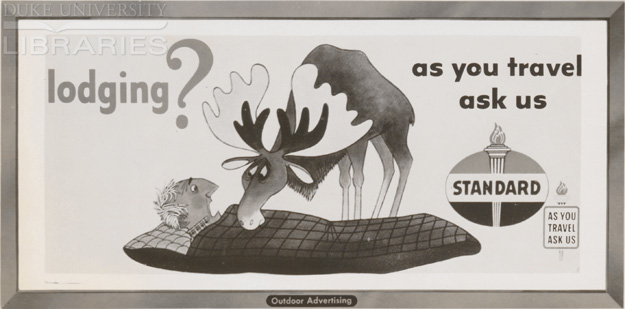
Standard Gas Stations Billboard Proof.
Standard Gas Stations Billboard Proof. From the Outdoor Advertising Association of America Archives.

Some of last year’s recipients include:

At the Sallie Bingham Center for Women’s History and Culture:

  • Marika Cifor, a master’s student in History and Library and Information Science at Simmons College, who used the Bingham Center’s lesbian pulp fiction collection for master’s thesis research on the historical relationships of lesbians and prostitutes in the United States, 1869-1969.
  • Jennifer Nelson, Associate Professor of Women’s and Gender Studies at University of Redland, visited the Bingham Center to conduct research for a book on community health reform movements from the mid-1960s to the present using the Feminist Women’s Health Center Records.
  • Emily Thuma, a Visiting Scholar at the Center for Race and Gender at University of California, Berkeley is visiting this week for post-doctoral research to revise her dissertation, “Not a Wedge, But a Bridge”: Prisons, Feminist Activism, and the Politics of Gendered Violence, 1968-1987. (Check out this blog post for details about Emily Thuma’s upcoming talk.)

At the John Hope Franklin Research Center for African and African American History and Culture:

  • Ira Dworkin, Assistant Professor, Department of English and Comparative Literature, The American University in Cairo, for research on African Americans in the Congo, particularly George Washington Williams.
  • Nina Ehrlich, master’s student, Department of History, Colorado State University, for a study of relationships between black and white women during the Civil Rights Movement.
  • Tyler D. Parry, Ph.D. candidate and master’s student, Department of History, University of South Carolina, for dissertation and article exploring slave kinship in the Antebellum South.

At the John W. Hartman Center for Sales, Advertising, and Marketing History:

  • Leif Frederickson, an independent researcher from Missoula, MT for research on “From Public Pedagogy to Business Branding: The Development of Green Advertising, 1950-1995.”
  • Janet Golden Professor at the Department of History, Rutgers University to research “The History of American Babies.”
  • Laura Phillip, a Ph.D. candidate at the Corcoran Department of History, University of Virginia for research on “Marketing of the Fair Trade Message.”

Post contributed by Kate Collins, Bingham Center intern.

“From Campus to Cockpit”

Date: October 26, 2011-January 22, 2012
Location and Time: Rare Book Room cases during library hours
Contact Information: Valerie Gillispie, 919-684-8929 or valerie.gillispie(at)duke.edu

  • Did you know that Duke hosted the only Rose Bowl played outside of Pasadena, CA?
  • Did you know that Duke chemistry students and professors created special bullets for training soldiers?
  • Did you know that Duke women played a pivotal role in wartime service and morale-raising?
  • Did you know that the Tarheels once liked the Blue Devils so much they were willing to loan them their football bleachers?

You can learn more about all these things (and even more!) by visiting “From Campus to Cockpit: Duke during World War II,” currently on display in the hallway cases outside the Rare Book Room.

The exhibit documents the academic, military, and humanitarian accomplishments of the Duke University community during World War II. Photographs, papers, artifacts, and archival film footage tell the story of the university’s spirited efforts to support the nation during a turbulent time of war—including hosting the 1942 Rose Bowl, expanding the possibilities for women in the academic realm, and cooperating with the city of Durham to host fundraising events.

Highlights of the exhibition include images of the first women engineering students at Duke, an original 1942 Rose Bowl ticket, a Red Cross bandage, memorabilia from “Rose Bowl Week” in Durham, and a variety of 1940’s-era military patches and insignia.

If you can’t stop by the display, you can also see many of the artifacts—along with Rose Bowl game footage, bonus materials and research resources—in our online exhibition.

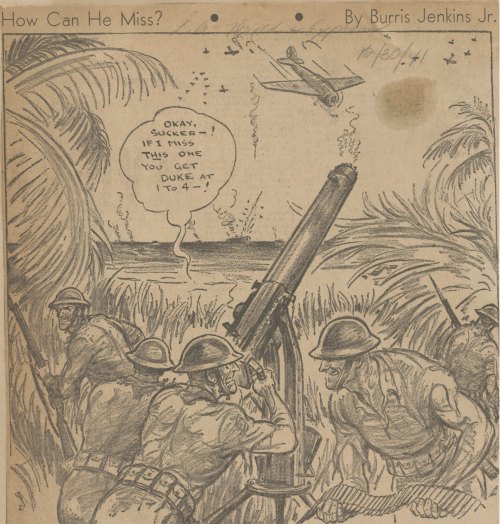
Editorial cartoon from the Los Angeles Herald & Express, December 30, 1941.

Post contributed by exhibit curators Rosemary K. J. Davis, Isobel Craven Drill Intern, and Jessica Wood, William E. King Reference Intern.

The Justice Cascade Receives WOLA-Duke Book Award

Kathryn Sikkink’s ground-breaking book, The Justice Cascade: How Human Rights Prosecutions are Changing World Politics (W.W. Norton), won the Washington Office on Latin America (WOLA)-Duke University Human Rights Book Award for 2011.
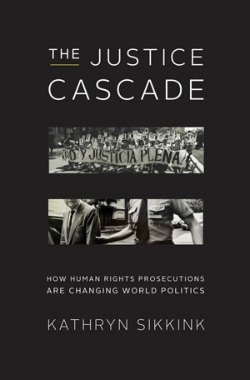
Cover of "The Justice Cascade"Around the world, former government and security force officials accused of human rights crimes are facing prosecutions in unprecedented numbers. In Chile, for example, the number of court cases has sharply increased and now involve the highest ranks of the security forces. Prosecutions have also expanded beyond deaths and disappearances to torture and forced exile.

For Sikkink, Chile is part of what she calls “the justice cascade,” a very new development in world politics. “Only 30 years ago, it was virtually unheard of, almost unimaginable, for a national or international tribunal to hold state officials criminally accountable for human rights violations,” Sikkink notes.

The Justice Cascade opens with a look at Sikkink’s own experience living in Uruguay during its brutal military dictatorship in the 1970s, when few could imagine officers ever being held accountable. She explores the political effects of this change in accountability, emphasizing the need to ensure that prosecutions have their intended impact of long-term justice and respect for human rights.

This year’s panel of judges called The Justice Cascade “compelling” and “eye-opening,” recognizing it for its important contribution to the field of human rights, Latin American studies and accountability.

The chair of the WOLA/Duke Book Award judges committee, Leonor Blum, a professor of History and Political Science at Notre Dame of Maryland University, said Sikkink’s work “shows not only the progress made in bringing human rights violators to justice, but also how such progress can impact subsequent governments and even neighboring countries.”

Fellow judge Holly Ackerman praised Sikkink for her excellent application of comparative political theory and detailed case studies, while keeping the book inviting and understandable. Fellow judge Roger Atwood calls it “an important book that will help the reading public understand an issue that we see every day in the news.”

Sikkink is a Regents Professor and the McKnight Presidential Chair in Political Science at the University of Minnesota.  She has a Ph.D. in political science from Columbia University.  Her publications include Mixed Signals: U.S. Human Rights Policy and Latin America; Activists Beyond Borders: Advocacy Networks in International Politics (co-authored with Margaret Keck and awarded the Grawemeyer Award for Ideas for Improving World Order, and the ISA Chadwick Alger Award for Best Book in the area of International Organizations); and The Power of Human Rights: International Norms and Domestic Change (co-edited with Thomas Risse and Stephen Ropp).

Started in 2008, the WOLA-Duke Human Rights Book Award is a joint venture of Duke University and WOLA, a leading advocacy organization based in Washington, DC. The award honors the best current, non-fiction book published in English on human rights, democracy, and social justice in contemporary Latin America. The books are evaluated by a panel of expert judges drawn from academia, journalism, and public policy circles.

This year’s judges included:

  • Holly Ackerman, Librarian for Latin America and Iberia, Duke University
  • Roger Atwood, Journalist, Author, and Former Communications Director, WOLA
  • Leonor Blum, WOLA Board Member and Associate Professor, History and Political Science, Notre Dame of Maryland University
  • Robin Kirk, Program Director, Duke Human Rights Center, Duke University
  • Juan Mendez, UN Special Rapporteur on Torture and Other Cruel, Inhuman and Degrading Treatment or Punishment

Previous WOLA-Duke Human Rights Book Award recipients:

  • 2010: Victoria Bruce and Karin Hayes, with Jorge Enrique Botero, for Hostage Nation: Colombia’s Guerrilla Army and America’s Failed War on Drugs (press release)
  • 2009:Ambassador Heraldo Muñoz for The Dictator’s Shadow: Life Under Augusto Pinochet (event blog post)
  • 2008: Francisco Goldman for The Art of Political Murder: Who Killed the Bishop?

On November 2 at 5:00pm, Sikkink will read from The Justice Cascade in the Rubenstein Library’s Rare Book Room. For more information, visit this blog post about the event.

Kathryn Sikkink Reads from The Justice Cascade

Date: Wednesday, November 2, 2011
Time: 5:00 PM
Location: Rare Book Room
Contact Information: Patrick Stawski, 919-660-5823 or patrick.stawski(at)duke.edu

Kathryn SikkinkKathryn Sikkink, recipient of this year’s Washington Office on Latin America (WOLA)-Duke University Human Rights Book Award, will read from and discuss her award-winning book, The Justice Cascade: How Human Rights Prosecutions are Changing World Politics during tomorrow’s award presentation. A reception and book signing will follow.

Sikkink’s book examines what she calls “the justice cascade,” a very new development in world politics. “Only 30 years ago, it was virtually unheard of, almost unimaginable, for a national or international tribunal to hold state officials criminally accountable for human rights violations,” Sikkink notes.

Now, around the world, former government and security force officials accused of human rights crimes are facing prosecutions in unprecedented numbers. In Chile, for example, the number of court cases has sharply increased and now involve the highest ranks of the security forces. Prosecutions have also expanded beyond deaths and disappearances to torture and forced exile.

This year’s panel of judges called The Justice Cascade “compelling” and “eye-opening,” recognizing it for its important contribution to the field of human rights, Latin American studies and accountability.

For further information about the book and the award, visit the related Devil’s Tale blog post or the WOLA press release.

Sikkink is a Regents Professor and the McKnight Presidential Chair in Political Science at the University of Minnesota. She has a Ph.D. in political science from Columbia University. Her publications include Mixed Signals: U.S. Human Rights Policy and Latin America; Activists Beyond Borders: Advocacy Networks in International Politics (co-authored with Margaret Keck and awarded the Grawemeyer Award for Ideas for Improving World Order and the ISA Chadwick Alger Award for Best Book in the area of International Organizations); and The Power of Human Rights: International Norms and Domestic Change (co-edited with Thomas Risse and Stephen Ropp).

Duke sponsors for the event include the Rubenstein Library’s Human Rights Archive, the Duke Human Rights Center, the Office of the Vice Provost for International Studies, and the Center for Latin American & Caribbean Studies.