Special Collections Library reading rooms often require special equipment to view non-traditional record formats such as VHS players, cassette players, microfilm readers, etc. The Rubenstein Library recently welcomed a new piece to the set: a desktop computer.
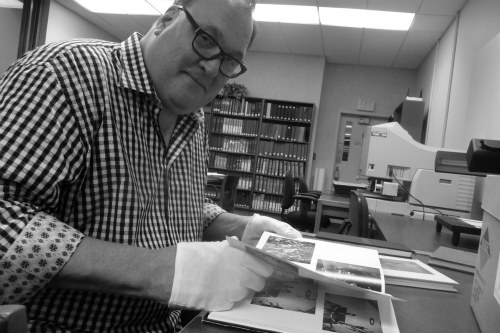
Rubenstein Library Research Services staff check out the reading room's new e-records computer work station.
Though public computers have been available in our reference room for a long time to assist in finding and requesting physical materials in the reading room this new machine has been designed to support providing local access to electronic records and audio/video materials.
Some of the materials you can explore on the computer include:
Please join us next Tuesday for the second talk in the series. Charlotte Beers, former CEO of Ogilvy & Mather and Under Secretary of State for Public Diplomacy and Public Affairs will talk about women, leadership and advertising. She will also sign copies of her new book, I’d Rather Be in Charge, which will be available for purchase. The event is free and open to the public.
The 20th Anniversary Lecture Series is sponsored by the Duke University Office of the Provost, Fuqua School of Business, Trinity College of Arts & Sciences, Markets & Management Studies, Duke Marketing Club, Alpha Kappa Psi, American Advertising Federation-Raleigh Durham, Association of Women in Business, Baldwin Scholars, and the Duke Administrative Women’s Network.
Post contributed by Jacqueline Reid Wachholz, Director of the John W. Hartman Center for Sales, Advertising, and Marketing History.
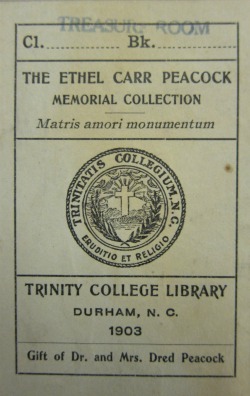
An Ethel Carr Peacock Memorial Collection Bookplate
Last fall, The Devil’s Tale posted “What’s in a Name,” where readers were asked to vote on their favorite name from a list accumulated from across our collections. The winner (although votes are still being accepted!) was Dred Peacock.
Peacock graduated from Trinity College (now Duke University), married the daughter of a Trinity professor, and eventually became President of the Greensboro Female College. Peacock and his wife, Ella, created an immense library which they established at the Greensboro Female College in memory of their daughter Ethel, who’d died at a young age. The Peacocks stipulated that should the College close, they could remove their collection and establish it elsewhere. Years later, when it appeared the College would in fact close its doors, the Peacocks moved their library to Trinity College, which by this time had moved from Randolph County to Durham.
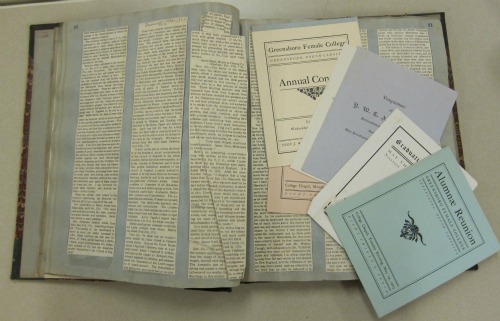
We recently uncovered several scrapbooks created by the Peacocks. They contain clippings, programs, and invitations from the late 19th century and largely relate to events and news regarding Greensboro Female College and Trinity College. One clipping that caught my eye highlights the professions of Trinity graduates by 1887: 275 graduates went into the ministry, 49 went into law, 66 went into teaching, 20 went into medicine, 11 went to the quill, and the rest to merchandising and agriculture. Of its alumni, 5 were judges, 7 were solicitors, 11 were either presidents or professors of leading colleges, 49 were members of legislatures of different states and territories, and several were in congress from 2-8 years.
Pages and Loose Programs from the one of the Peacock Scrapbooks
Curious about the other fascinating items contained in the scrapbooks? They are now available for use in the Rubenstein Library’s reading room. Check out the online finding aid for more details about the scrapbooks1
Working on the History of Medicine (HOM) Trent Manuscripts Grant Project has revealed quite a few items of interest—but most recently, I discovered something that fits rather well into the Memories of the Civil War exhibit currently on display in the Perkins Exhibit Gallery.
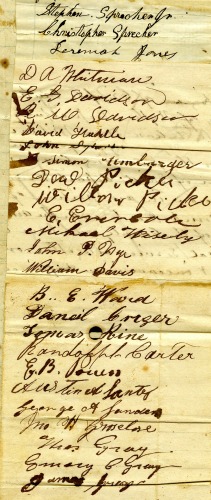
Signatures to the 1864 Petition from the Citizens of Cripple Creek. From the Trent Manuscripts Collection.
You may have seen the grisly amputation kit from the HOM collection, which might be the kind of war-related artifact that you would expect out of a collection on the history of medicine. But here, instead, is not an example of progressive advances in medicine, nor a relic of past practice: instead, a simple plea for a family doctor to remain in service to his community by being excused for service in the Confederate Army:
“We the undersigned Citizens of Cripple Creek, Wythe County, VA earnestly petition that our family physician, Dr. C. C. Campbell, who is a conscript under the late act of Congress and whose services are indispensable to this portion of the county, be exempt, or detailed, and left with us.”
This singular petition to the President of the Confederacy, Jefferson Davis, dated February 15, 1864, was accompanied by two pages of signatures by the residents of Cripple Creek. Did it ever reach its destination? Do any historians or local residents know the fate of Dr. C. C. Campbell and his patients in Cripple Creek, Virginia? If so, we’d love to hear from you!
Jacqueline Chapman, a graduate student at UNC-Chapel Hill’s School of Information and Library Science, was History of Medicine Intern at the Rubenstein Library from September 2011 to January 2012.
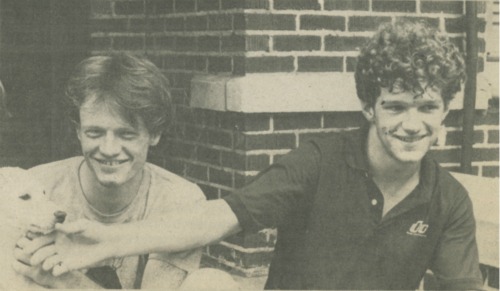
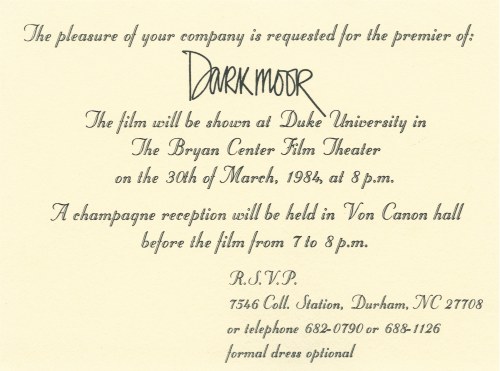
On March 30, 1984, he was a Trinity senior, premiering his and classmate Jeff Bennett’s feature-length film, Darkmoor, at the Bryan Center. Supported by Freewater Films, the film was his senior thesis and ended up requiring a budget of $60,000, owing in part to the fact that three-quarters of the film had to be re-shot after the lead actor graduated and wasn’t able to complete his final scenes.
Jared Harris and Jeff Bennett (and dog), The Chronicle, September 23, 1982
In interviews, Mr. Harris describes the film only as a “psychological thriller.” There’s an orphaned boy who shows up just at the right moment and a father who doesn’t. There’s a Bryan Center art show with a painting by Picasso and a psychiatric ward somewhere in Duke Hospital. There are references to Carl Jung’s theories and T. S. Eliot’s poetry (Harris’ Program II curriculum included English literature classes), as well as so many hints at the power of advertising and subliminal messages that we wonder if Harris knew where he’d end up 28 years later.
There’s also former Duke President Terry Sanford in a cameo as a jaded psychology professor.
Reviews from The Chronicle and the Durham Sun suggest that Sanford proved quite the capable actor, but we can’t offer our own opinion, because the Duke University Archives doesn’t have a copy of the film. The records of the Duke University Union contain only a not-quite-final draft of the script that suggests that Darkmoor Shaw, the film’s main character, started out as Darkmoor Kilgore.
Here’s the scene, early in the film, where Darkmoor acquires his first name.
SCENE
EXT. A HOUSE WITH A LAWN. DAY.
Alex is on the lawn with her child, who is crawling around in front of her. She picks the child up, sets him on the ground in front of her, and gives him a little push. The child waddles off away from the mother. Alexandra starts to call names after him.
ALEX
“William, Richard, Joseph, Randy—no wait, I take that back, Philip, Arthur, Nicholas, Archibald (she winces) Robert, Jeff. . . (she stops) Martin, Perrygwyne, Darkmoor. . .”
The child turns around and looks inquiringly at his mother.
ALEX
“Darkmoor?”
The child starts to crawl to his mother. She goes over to him and picks him up.
ALEX
“What a strange name to choose for yourself, you funny little fellow, but I like it. Alright, then, Darkmoor it is.”
According to Mr. Harris, the idea for this scene came from his (late) father, Richard Harris, the venerated British actor. With such an impressive pedigree, we’re relieved that a copy of the script exists in the Duke University Archives. And Mr. Harris, if you still have a copy of the film, could we please borrow it?
Invitation to Darkmoor premiere, March 30, 1984.
And, for those of you who can’t get enough Mad Men, watch The Devil’s Tale over the next few weeks for news about the next event in the John W. Hartman Center for Sales, Advertising & Marketing History’s 25th Anniversary Lecture Series. On April 10th, the center will be welcoming Charlotte Beers, former Chairman/CEO of Ogilvy & Mather and Under Secretary of State for public diplomacy and public affairs. Find more information on the Hartman Center’s homepage!
For those of you who are just tuning in, the Duke University Archives has entered into a friendly competition with our colleagues at the UNC University Archives. The challenge: whose Facebook page can get the most new “likes” by tip-off (7:00 PM) of the March 3rd UNC vs. Duke game. That’s Saturday night!
Our standings, as of noon today:
Duke University Archives: 371 new “likes” (446 total “likes”)
UNC University Archives: 749 new “likes” (794 total “likes”)
Uh-oh.
So ask your friends and your friends’ friends and your friends’ friends’ great-grandparents to “like” us on Facebook! The stakes are huge: the loser has to post a photo of the winner’s choosing (and from the winner’s collection) as their Facebook profile photo for one week. Do you really want to see a photo of Dean Smith (happy belated birthday, by the way!) on the Duke University Archives’ Facebook page?
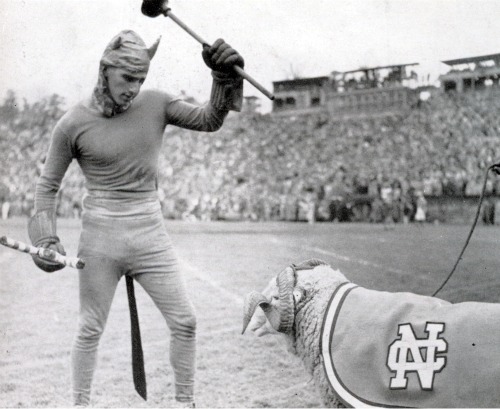
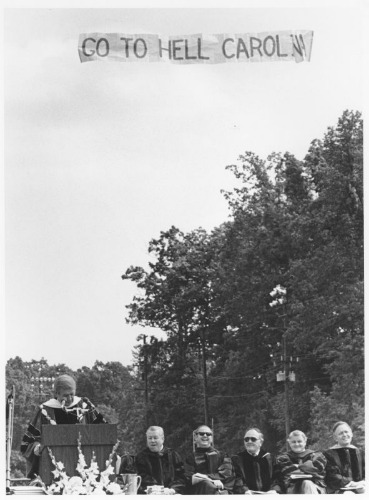
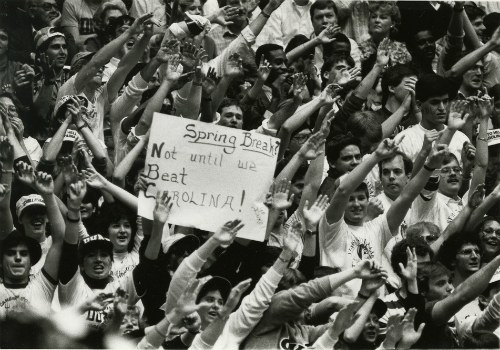
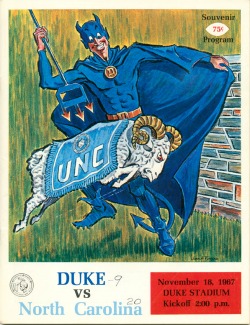
We’re staying positive here at the Duke University Archives, though. We’d like to ask you, our stalwart and loyal fans, to help us pick the photo we’ll send over to the UNC University Archives Facebook page on Saturday. Below, you’ll find the contenders and a poll.
#1
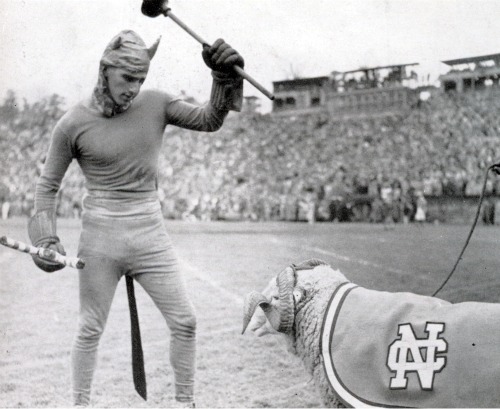
Duke’s Blue Devil and UNC’s Ramses play nicely at a 1957 football game.
An Adorable Rivalry, 1957
#2
Duke president Terry Sanford (speaking at the podium) doesn’t look too pleased. Perhaps that’s because he received his bachelor’s degree from UNC?
Duke University Commencement, 1979
#3
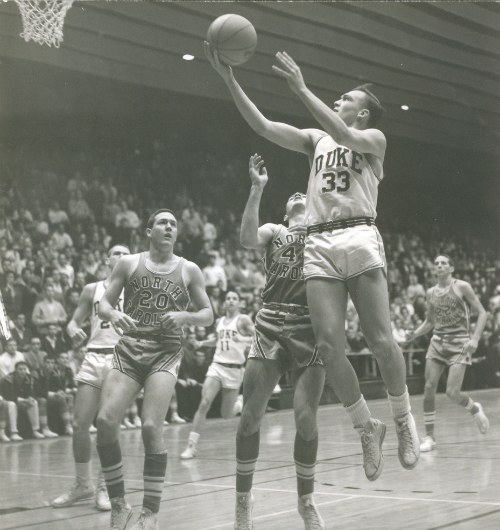
Duke guard Steve Vacendak rises above his UNC rivals.
The fighting spirit of Blue Devil competitiveness doesn’t apply to only basketball and other sports—we’re staging a little (Facebook) battle royale of our own:
The rules are very simple. Whichever institution gets the most NEW “Likes” for their Facebook page between today and tipoff (7:00 PM) for the March 3rd Duke vs. UNC basketball game wins! The winner will bask in electronic glory, while the loser will be required to change their Facebook profile to an image of their opponent’s choice. Big stakes, indeed.
So if you haven’t already, pop over to Facebook and “Like” the Duke University Archives page. Share the word with your friends so we can defeat our powder blue foes! Of course, you’ll also get the pleasure of learning more about Duke history while you’re at it—seems like a win/win all around.
Go Duke University Archives!
Historical Blue Devil vs. Historical Ramses, 1957. From the 1958 Chanticleer.
Post contributed by Rosemary K. J. Davis, Duke University Archives Drill Intern.
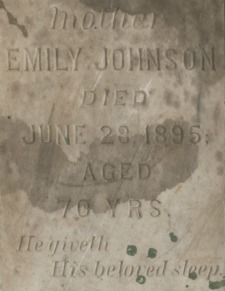
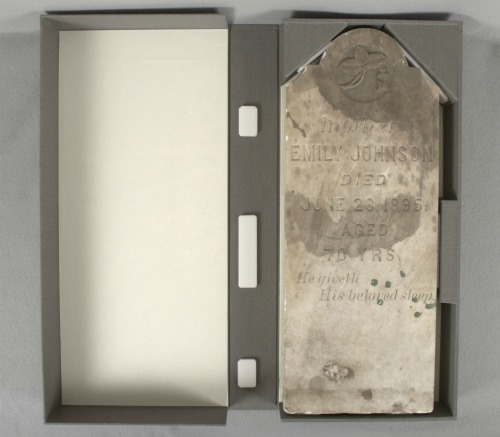
According to oral tradition, Emily Johnson’s headstone was discovered in the 1960s at the construction site of the Divinity School addition. It remained in a closet there until 1993, when it was transferred to the custody of the Duke University Archives. How the headstone ended up on campus and where it originally resided remain a mystery to this day.
Over the years, several attempts were made by William King, University Archivist Emeritus, to locate information about Johnson and or her descendants in an effort to relocate the headstone to its appropriate resting place. He found no record of any real estate transaction between the University and the Johnson family, indicating that it’s likely the headstone did not originally reside on West Campus land, most of which had been family farmsteads.
There are also no listings for Emily Johnson in nearby Durham cemeteries, such as Maplewood. While death certificates usually provide burial location for the decedent, they were not regularly issued in North Carolina until 1913, eighteen years after Johnson’s death.
Duke University Archives staff would love to know where Emily Johnson’s headstone belongs. If any blog readers would like to help take up the cause, your efforts would be most appreciated (contact us!). Until such time as the headstone can be returned to its rightful place, Duke University Archives will continue to serve as its custodian.
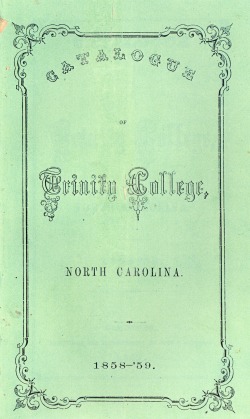
Now, the yearly catalogs, known as Bulletins, are being digitized thanks to the Internet Archive’s Scribe machine located here at the Duke University Libraries. These newly-searchable resources provide more and better access to historical information about Duke University. The catalogs include information like courses offered, of course, but they are also full of other useful facts.
For instance:
What was the Trinity College undergraduate tuition for the 1892-1893 academic year (the college’s first year in Durham)? ($25.00 per term)
How many bound volumes did the Library contain at the end of the 1923-1924 academic year? (71,520)
Who was the Director of Physical Education and Athletics for the 1947-1948 academic year? (Edmund “Eddie” Cameron)
In addition, there were specialized catalogs for graduate and professional education, so that someone researching the School of Medicine, for example, can learn more about that program in particular. There are even fun extras like aerial views of campus from the 1930s.
Virtually turning the pages of these historical catalogs provides a wealth of information. In the 1934-1935 Law School bulletin, for example, it lists the current students. One, Richard Milhous Nixon of Whittier, California, was a first-year student at the time. We can also tell from the catalog that school started on September 19 that year, and that “in addition to concert programs, recitals, and lectures, motion pictures are shown in the campus auditorium twice a week.” Sounds like a pretty interesting place to get an education!
Find links to Chanticleers and Bulletins at the Duke University Archives section of the Internet Archive. Additional Bulletins will be digitized in the near future, along with other Duke University resources.
Post contributed by Val Gillispie, Duke University Archivist.
Dispatches from the David M. Rubenstein Rare Book and Manuscript Library at Duke University