Category Archives: From Our Collections

Eating at the Rubenstein Library

We are still digesting the feast that was Wednesday’s Rubenstein Library Test Kitchen tasting event, but the bloating has died down enough for us to be able to share some photos from the celebration!

The Desserts!

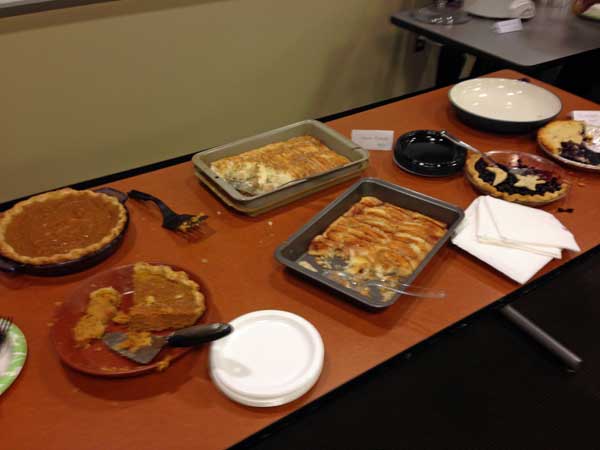
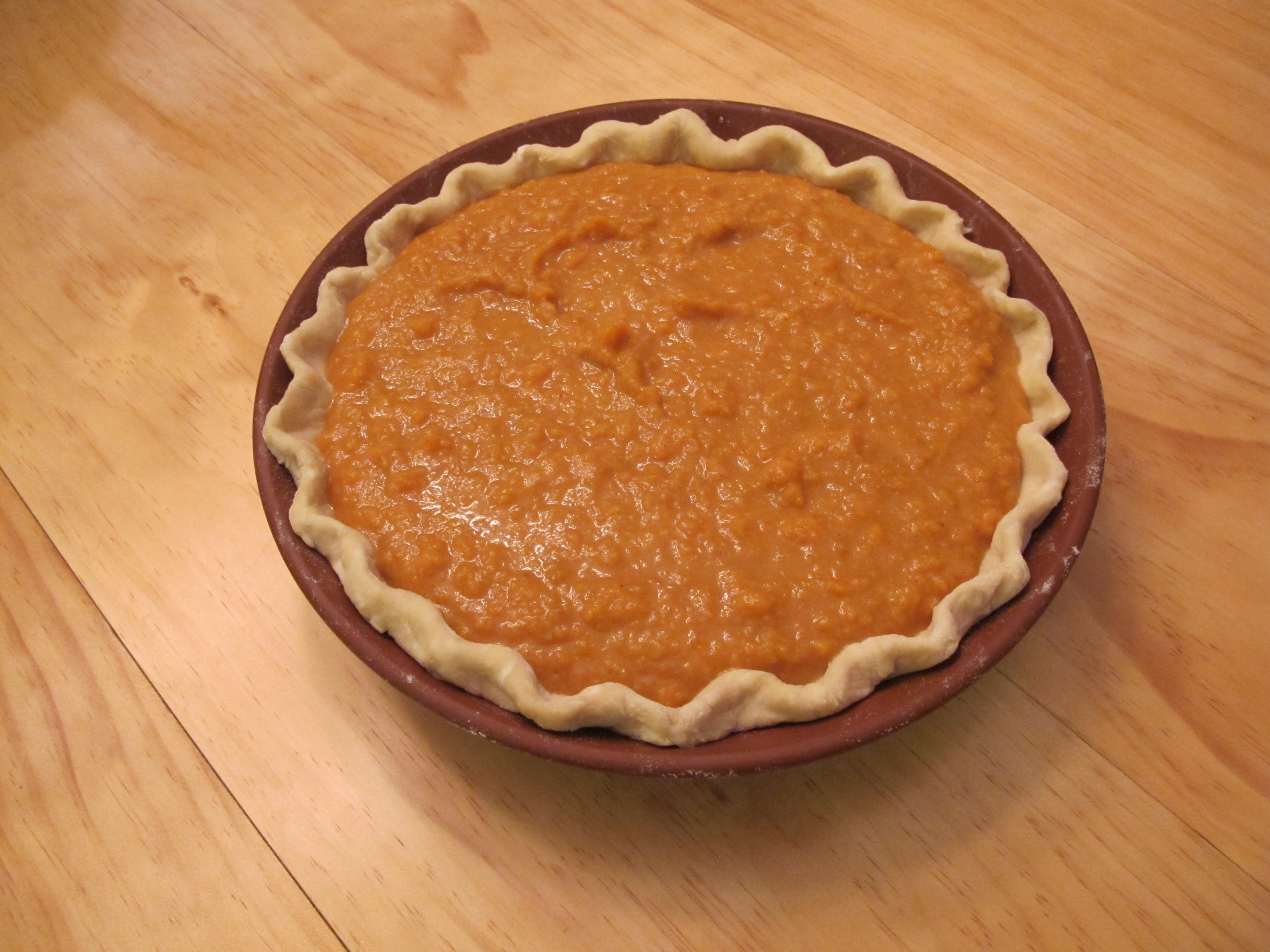
Delicious sweet potato custard pie, apple kuchen, and blueberry pie, ready and waiting to be devoured! And we’d only just recovered from Thanksgiving!

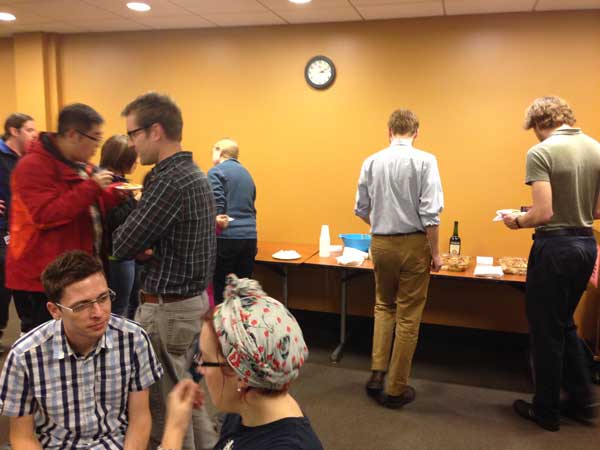
There was so much eating to be done, but Duke people are very determined people.

Getting food!So much eating!

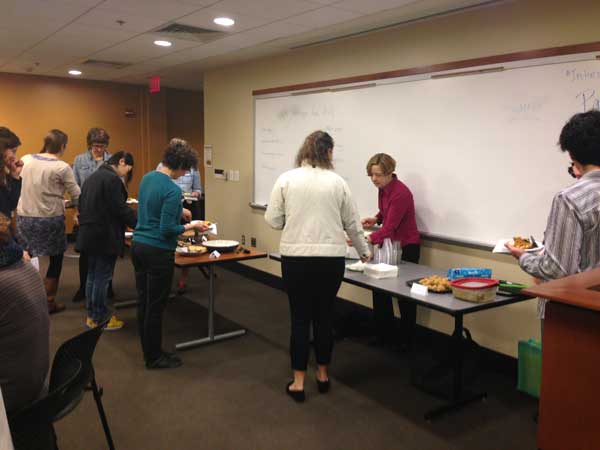
Here’s Rubenstein librarian Elizabeth Dunn serving Soldier Soup!

Serving soup!

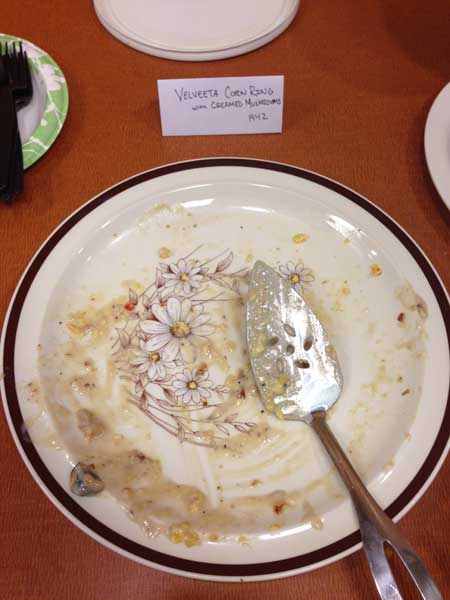
And, to our very great surprise, the Velveeta-creamed corn ring was gone in the first half hour of the event. We’d even made two! We retract any previous skepticism about the appeal of this most excellent “cheese food.”

No more Velveeta!

Of course, we had the historical cookbooks and advertisements that provided the sources for our wonderful recipes out on display (with the stipulation that there could be no simultaneous browsing and eating; goblin sandwich filling would be tough to get off a 1777 cookbook…..).

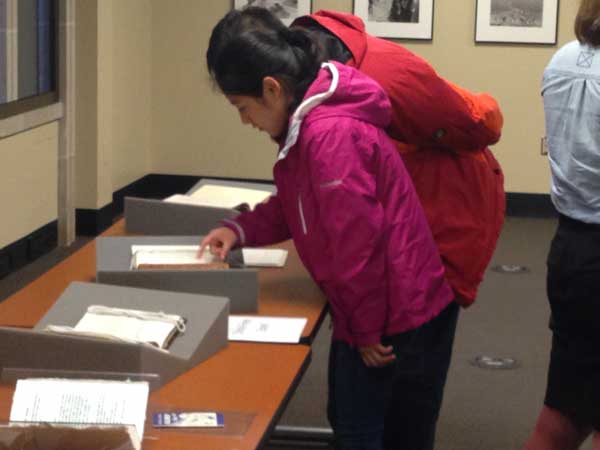
Students looking at Rubenstein Library cookbooks!

Our intrepid taste-testers received zines containing all of the recipes and made by Rubenstein Library staff. If you couldn’t make the event, you can download a PDF copy of the zine here: Test-Kitchen-Zine-2014

Thanks to everyone who attended! We’ll have another tasting event—featuring recipes from our next round of test kitchen blog posts—in the late spring!

150 Years of J. Walter Thompson Co. History

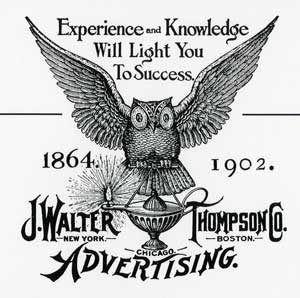
J. Walter Thompson owl logoOn this day in 1864, William J. Carlton and Edmund Smith established the Carlton & Smith advertising business in New York, NY. A few short years later, the agency hired a young man by the name of James Walter Thompson. Initially hired as a bookkeeper, Thompson would ultimately purchase the company from Carlton in 1878 and change the agencies name to the J. Walter Thompson Co. It would go on to be one of the largest and most enduring advertising agencies in the world with more than 200 offices in 90 countries around the world.

In 1987, the agency placed its corporate archive in the Rubenstein Rare Book and Manuscript Library here at Duke University. The archive consists of roughly 5,000 linear feet of material and 160 individual collections including the papers of nearly 60 former executives, the records of six offices, 25 departments and functional centers, and over a dozen “artificial” collections such as writings and speeches, agency publications, and newsletters. Navigating this web of interconnected collections is enough to intimidate the most seasoned archival researcher, including library staff.

To help tame the wilderness of the JWT archives, Hartman Center staff, led by Technical Services Archivist Richard Collier, along with our colleagues in Digital Project Services, created an online portal to the JWT archive. We hope the portal will facilitate researcher navigation and discovery of material within the archive and help JWT commemorate its 150th year of operation.

Screen capture of the J. Walter Thompson timeline.
J. Walter Thompson Co. timeline

The portal consists of three major features: an interactive timeline (part 1 and part 2); an administrative history of JWT; and a list of collections associated with JWT in the Rubenstein Library. The timeline feature marks important dates in the history of JWT. You can scroll from event to event using the arrows or—if you were interested in learning about the agency during World War II for instance—you can scroll through the timeline bar and select a specific event.

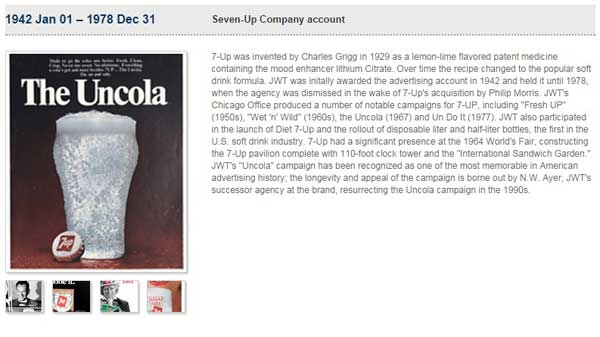
7 Up's timeline entry.
7 Up’s timeline entry.

The second feature of the portal is an in-depth administrative history of JWT. This portion of the portal presents the history of JWT in a more linear fashion. Entries in the administrative history cover several basic topics: people, accounts, offices, innovations, and general company history. Researchers can trace when the company hired important personnel; acquired large, long-term clients such as Unilever, Ford, Kraft, Eastman Kodak, Kellogg, RCA, and the United States Marine Corps; opened national and international offices; technical achievements and innovations in radio, television, and print advertising; and other tidbits of company history such as milestones in billings and the history of the agency’s corporate branding. Each entry is illustrated with relevant photographs, advertisements, and internal documents.

Screen capture of Associated Collections featureThe final feature of the portal is perhaps the most important component of the timeline. To further assist researchers in making connections between JWT’s corporate history and collections in the archive, we have included a list of associated collections with published online guides.

The timeline has been split into two sections: the first covering 1864 through 1930 and the second into the 2000s. We encourage you to explore the images, advertisements, records, and archival collections documenting the agency’s 150 years of operation. And, of course, Happy Birthday, JWT!

Post contributed by Josh Larkin Rowley, Reference Archivist for the John W. Hartman Center for Sales, Advertising & Marketing History.

Durham’s Beardy Bros

We have collections and rare books from so many far-flung locations, but we occasionally come across historical materials documenting life right here in Durham.

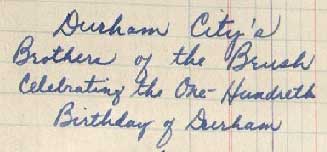
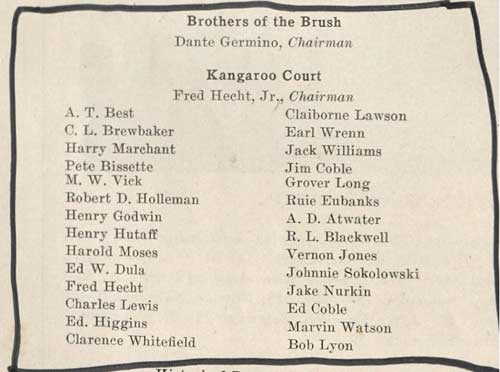
Brush Brothers Plege BookThe city of Durham’s centennial celebrations took place from April 26th through May 2nd of 1953, and people were excited! Excited to reflect on how much Durham had progressed and also on what changes might or should take place in the next hundred years. A particularly strange way in which some chose to celebrate the occasion was to join the Brothers of the Brush. Never heard of ‘em?

Spearheaded by Dante Germino, an engaged Durham resident who worked for the Herald-Sun Co. at the time, the fund-raising effort collected $1.00 per member; and the 3093 members pledged to do their “civic duty” by growing and maintaining a “moustache, full beard, goat-tee, or side-burns” throughout the celebrations. If a member failed to keep his promise he was brought before a Kangaroo Court of his peers.

Roster of the Brothers of the Brush

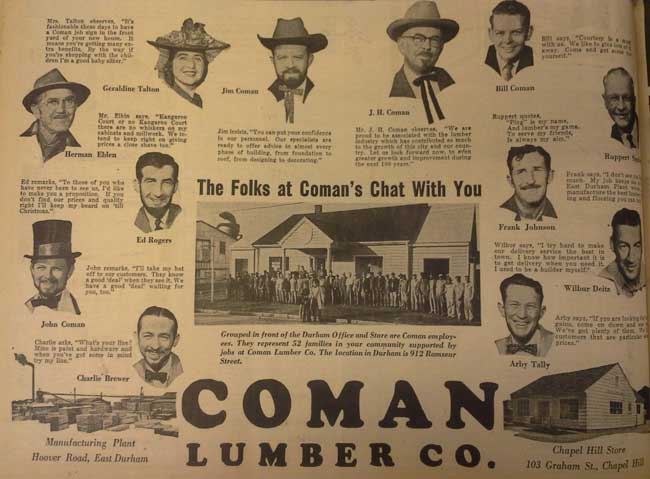
Evidence from newspapers at the time show that many local businesses took up the challenge. Check out these fellows at Coman Lumber.

Coman Lumber Advertisement, Durham Herald-Sun, April 26, 1953.
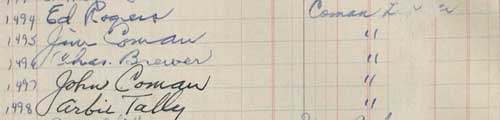
Coman Lumber Signatures from the Brothers of the Brush Registry.

Want to find out if a local family member of yours was an official Brother of the Brush? We’ve got the registry in our holdings for you to peruse; and we’ve also got local newspapers from that time.

Times have changed. These days, with so many hipsters out and about in Durham, we’d have an easy time collecting funds from bearded folks throughout the city. We could use Duke Libraries’ button-maker to make buttons for participants! We’ll have to wait until 2053 for the next centennial, though.

Dominique has a lovely beard!Post contributed by Dominique Dery, Research Services Intern, who may or may not have the lustrous and full beard pictured at right.

Building the Gottmensch: The Library of Ordensburg Sonthofen

A grim symbol is stamped inside nearly 60 books at the Rubenstein Library: the eagle and swastika; symbols of the German Nazi Party. The markings also indicate that the volumes belonged to “Ordensburg Sonthofen.” What was this place, what constituted its library, and furthermore, what happened to its holdings?

KIC Image 1
Der Wille zum Kind

In 1933, the same year Adolf Hitler’s party came to power, the Ordensburgen were built as elite training facilities for high-ranking officers in the military called Junker. The program was under the direction of Robert Ley, and the purpose of instruction was, as he stated in Der Weg zur Ordensburg, for the “spiritual and philosophical education of the NSDAP.” Qualifying candidates between the ages of 25 and 30 were sent to three facilities and spent a year at each: Vogelsang in the Eifel, Krössinsee in Pomerania, and Sonthofen in Allgäu. Each facility had its own training focus. The focus of instruction at Sonthofen, intended to be the third and final year of training, was diplomacy and administrative tasks. The libraries at each location would have facilitated such research and instruction.

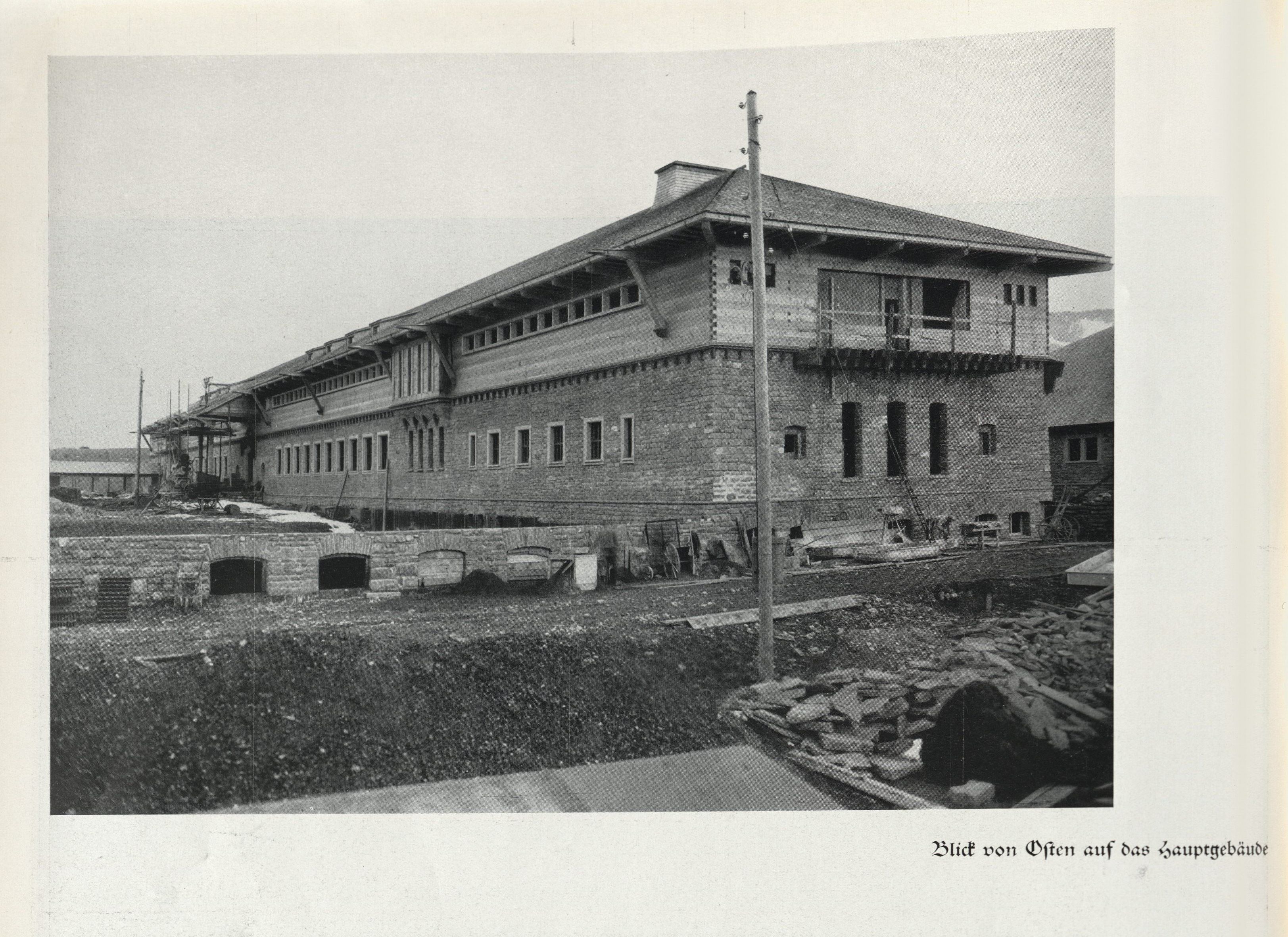
Construction of the main building at Sonthofen, from Der Weg zur Ordensburg by Robert Ley, 1936

Although the exact story of how Sonthofen’s books ended up at the Rubenstein is unknown, Nazi-related material did come to the United States through the efforts of the Library of Congress and were then distributed to institutions throughout the country, including Duke University. The program was called the “Cooperative Acquisitions Project for Wartime Publications,” and details about the program can be found in Volume 16, number 2 of the Duke University Libraries magazine. Parts of German libraries and archives, if not destroyed outright at the end of the war, were broken up and distributed. Tracking down the remainders of the collections, which can be aided by the ownership stamps, and analyzing the content, is invaluable for understanding the operations of facilities such as Sonthofen.

Rohstoffe und Kolonien

Analyzing the stamps and markings in the Rubenstein’s collection can help to at least partially recreate the library at Sonthofen and give insight into its functioning. Some books are marked “Hauptbücherei” (main library), while others are marked with specific group or class designations such as “Seminar Völkische Behauptung” (racial assertions). This shows, for example, that the instruction at Sonthofen was not strictly limited to understanding military strategy. Titles in the collection also indicate a variety of subjects, including Was wir vom Weltkrieg nicht wissen (What We Don’t Know About the World War), a justification of rapid militarization after World War I, and Der Wille zum Kind (The Will to Child), part of a series called “Political Biology,” which encourages procreation to build the perfect Aryan race.

The opening of Vogelsang in 2006, held until then by the Belgian military, created the opportunity to investigate the ultimate destination of its library. For example, Michael Schröder (article in German) reveals that of what is thought to be almost 70,000 items, 40,000 were probably plundered or destroyed, and the rest ultimately ended up at the University of Bonn. The opportunity is here for a similar investigation to be conducted regarding Sonthofen, also now a historical site, and its 57 books held by the Rubenstein present a window to view its history. This material is also just a small part of the rich German language holdings at the Rubenstein Library, which also include the extensive Harold Jantz collection.

Post contributed by Sarah Carrier, Research Services Coordinator

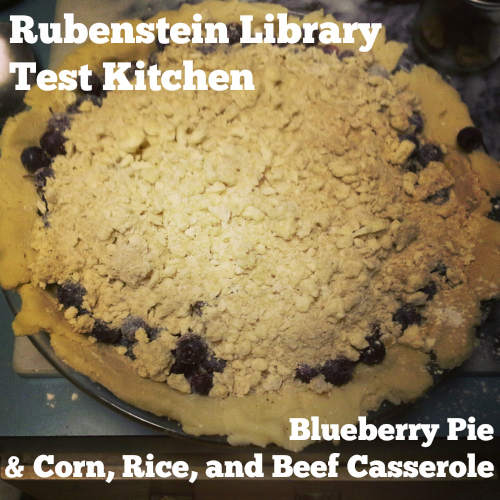
Corn, Rice, and Beef Casserole & Blueberry Pie (1982)

This is the last post in our pre-Thanksgiving Rubenstein Library Test Kitchen series. We hope you’ve enjoyed exploring our collections through food and found some find some historical inspiration for your own Thanksgiving. If you’re local  join us on December 3rd from 3-4:30 in Perkins 217 for our tasting event and a chance to sample these recipes!

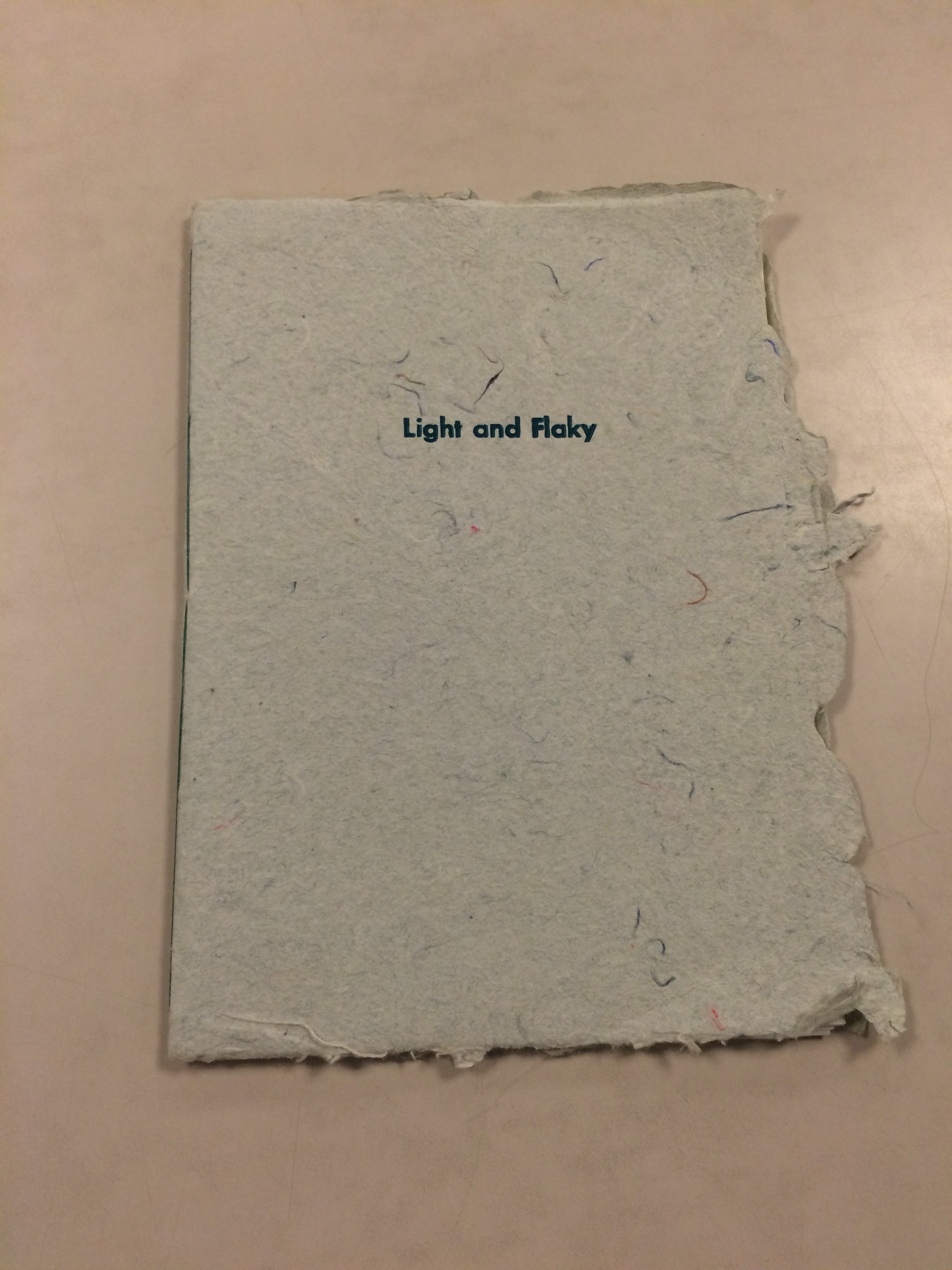
FullSizeRenderWhen I set off on my hunt for a recipe for my turn in the Rubenstein Library Test Kitchen, I knew only that I wanted a fun challenge. For a search that began with nothing in particular to guide it, I found a very lovely little book that seemed perfectly suited for me in my task. One thing I love about working in the Rubenstein Library is that I’m never sure what I’ll come across in a day’s work but I’m always delighted or intrigued by what I find, and this book was no exception! It is an artists’ book called Light and Flaky: Portrait of the Artist’s Mother: a Cookbook (1982) and was made by Lise Melhorn-Boe. The work combines Melhorn-Boe’s mother’s memories of experiences and adventures in cooking along with recipes from these stories and photographs of her mother throughout her life. And the handmade paper that covers the book is made from tea towels, aprons, tablecloths and dish cloths. The book was collected by the Sallie Bingham Center for Women’s History and Culture here at the Rubenstein.

In the spirit of the book’s many memories about cooking for a large family, I chose two recipes to make for the lovely family that lives next door to me. The recipes I chose also give a good sense of the work as a whole, since these recipes are accompanied by touching and silly remembrances and photographs. I made a Corn, Rice, and Beef Casserole and a Blueberry Pie for my friend, her parents, and her two boys (4 and 8 years old respectively).

CasseroleRecipe

BlueberryPieRecipe


I began my cooking adventure as soon as I returned home from the Rubenstein one evening: I first made the pie crust. The recipe calls for an all-Crisco crust, and I just happened to have a very very old tin of it in my cupboard. Perfect! Also slightly disturbing, since I couldn’t figure out where it came from. I didn’t tell my guests that, though! I let the crust chill for a while as I assembled the casserole.

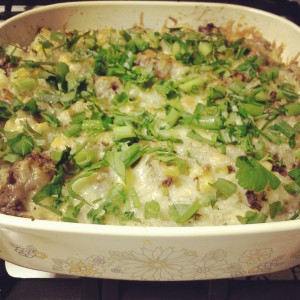
CasseroleDish2It’s an extremely simple recipe. I cooked up a cup of rice, opened a can of corn, browned a pound of ground beef, and threw everything together in a dish to bake for 20 minutes at 350. I thought I’d jazz up this plain casserole just a bit for my special guests, and added onions and a dash of ground cloves (a flavor sensation that I picked up from my own mom) to the meat, and threw a bunch of cheddar on top towards the end of its baking. When the dish was cooked, I also chopped up some parsley and chives from my porch for a tasty garnish. This was an easy and fast recipe to fix for a bunch of folks at a moment’s notice, and there could be endless improvisation depending on what you had on hand.

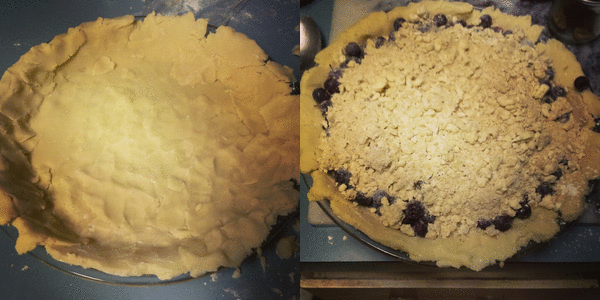
Back to the pie: When the time came during my preparations to roll out my crust, I had a lot of trouble keeping it together. My guess is that I hadn’t given it enough time to chill. But I was determined to have everything done in time, so I pressed shards of it into my pie dish anyway, in a slapdash and frantic fashion, and poured in 3 cups of blueberries that I’d frozen from the summer (tossed with flour, sugar, butter, lemon juice, cinnamon, and nutmeg, as the recipe suggests). Although the recipe noted that this crust would be enough for two, I didn’t find that to be the case, so I also whipped up a crumble topping with flour, brown sugar, butter, and spices.

output_CeVEHb

Things came together just in time after all. The casserole was warming and hearty, and a good reminder that cooking for friends doesn’t have to be complicated or fancy. I noticed that one of my young taste-testers ate it up in a flash and quickly disappeared under the table to begin tying guests’ shoelaces together. I took this as an excellent review.

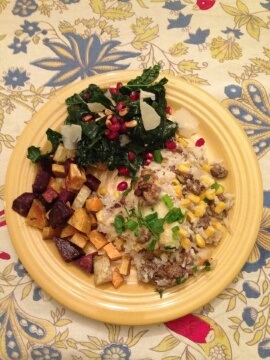
DinnerPlate

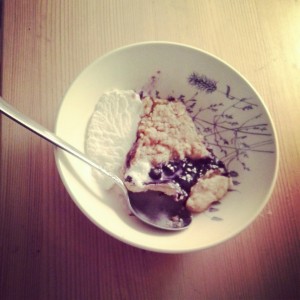
The pie wasn’t done until after the boys’ bedtime, which means that I had a lot leftover and have been enjoying it with ice cream for breakfast ever since. Despite small disasters in its making, and although it won’t supplant my tried and true butter-only pastry crust recipe, it was pretty delicious. It was also fitting that it would give me trouble since, in one of the stories in this book, Lise’s mother Pauline recalls summers when she would bake wild blueberry pies with her aunt; on one such occasion, her aunt mistakenly uses salt instead of sugar. Even in their attempts to hide the evidence of their error from an angry mother, they are beset with trials: “We tried burning [it] in a little old iron stove – we just had enormous clumps of large crystals, which we dragged out to the garden, and covered with earth and tears.” Luckily, no tears were shed in the making of my pie misshapen though it was.

DessertPlate

I looked at this book alongside another by Melhorn-Boe called Recipes (2001), also part of the Sallie Bingham Center’s collection. It is housed in an old recipe card tin, and contains memories and reflections of several women about family and food, typed on recipe cards and divided by topic — including “Atmosphere” (stern, relaxed, in silence, in front of the television), “The Cook” (stories about mothers and fathers and how they shared kitchen work, or didn’t), “Force-feeding” (thoughts about weight, body image, and abhorrent foods forced upon the writers – like lima beans!), and “Manners” (mouths closed, guests served first, elbows off the table).

RecipesBook

Both works are funny and sweet (and sometimes bittersweet), and contain much food for thought about women’s roles in the kitchen and in the domestic labour of family life generally, and how these have changed over time.

Post contributed by Dominique Dery, Research Services Intern

Rubenstein Library Test Kitchen: Sweet Potato Custard (1870)

recipes cropFor this week’s test kitchen, I made a Sweet Potato Custard from a recipe in the November 1870 issue of The Rural Carolinian. The Rural Carolinian was “An Illustrated Magazine of Agriculture, Horticulture, and the Arts” published out of Charleston, South Carolina that provided advice and information on a number of topics that would have been of interest to farmers. Other articles in this issue include “How to Utilize Forest Leaves,” “Prickly Pear or Cactus,” and “How to Prune a Peach Tree” as well as more general interest reading such as “Anesthesia — What Is It? And to Whom are we Indebted for it?”

Each issue of The Rural Carolinian also included recipes, part of the magazine’s “Literary and Home Department,” which was intended to appeal to women, broadening the magazine’s audience. They sought submissions from women, asking them “Will not our dear friends, the ladies, interest themselves in our behalf and help us to make this department an attractive feature of The Rural Carolinian.”  The recipes included aren’t necessarily what we think of as recipes, under recipes this issue has instructions on how to make “family glue” and lamp wicks. However, this is in line with the older sense of the word which encompasses any “statement of the ingredients and procedure required for making something,” per the Oxford English Dictionary.

When I originally saw this recipe, I was interested, thinking, “I’ve never had sweet potato custard before!” Especially next to recipes like family glue, pumpkin chips, and apple water, it seemed unusual and intriguing. I didn’t read the recipe all the way through at first, and I missed the part where you put it in a pie crust, making it a not-so exotic sweet potato pie. Even still, I wanted to see how it compared to our modern sweet potato pies.
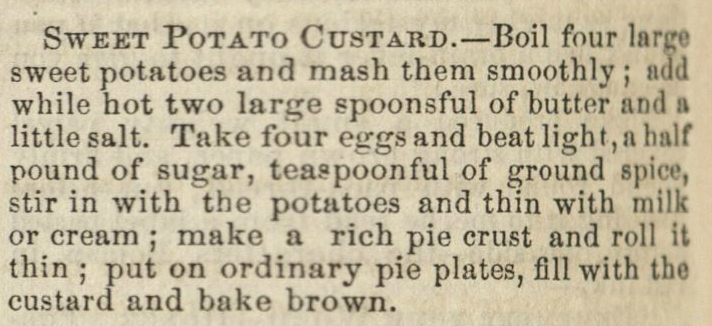
sweet potato custard crop

Like a lot of pre-twentieth century recipes, the recipe is minimalist in its approach and doesn’t offer detailed directions. The recipe calls for four sweet potatoes, and I bought four originally, but I think the sweet potatoes sold at my farmers market are monsters compared to what was available in 1870, so I used only two of them.
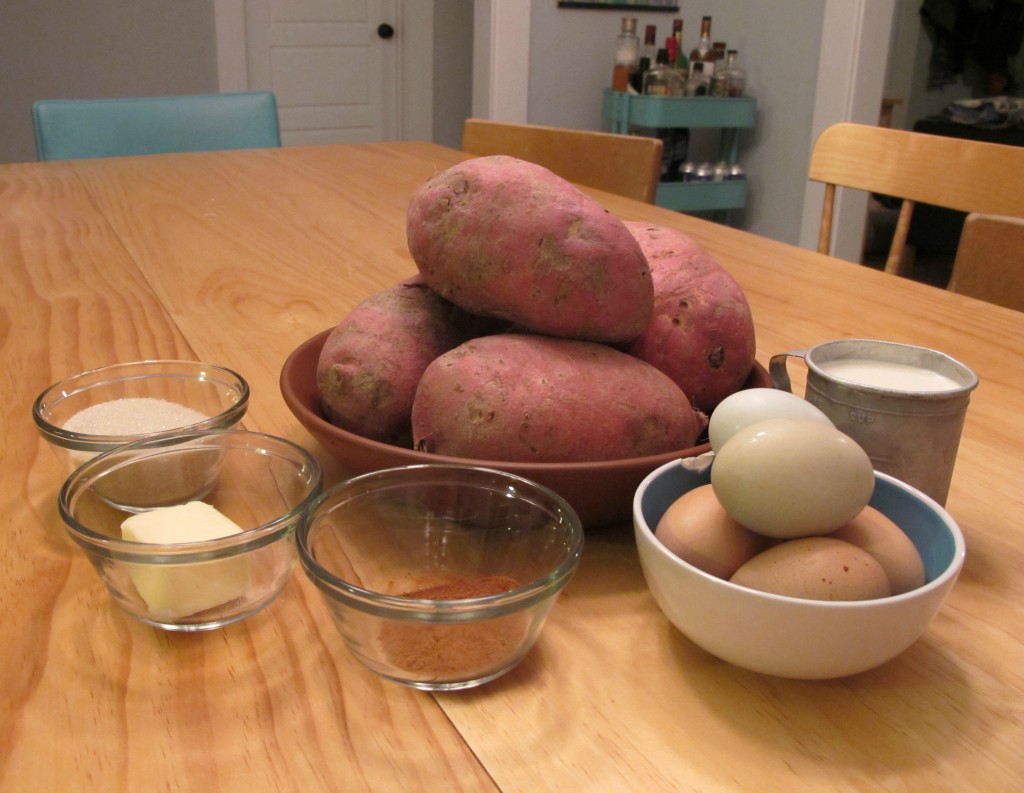
all ingredients

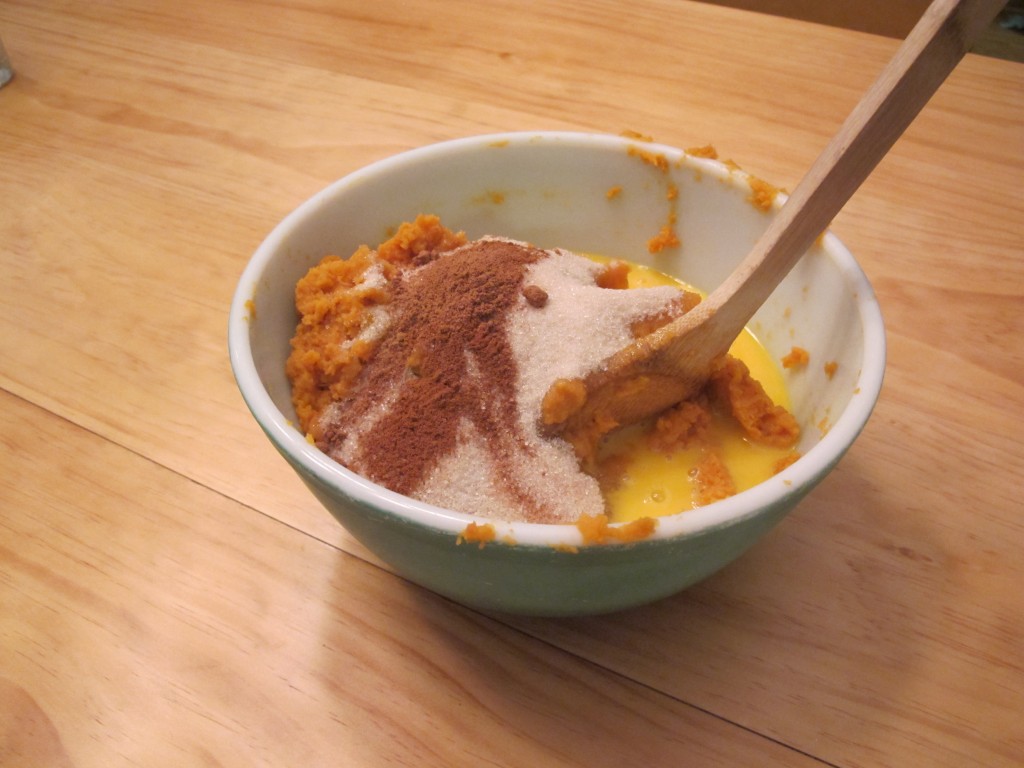
The recipe didn’t specify what to do with them beyond boiling and mashing, so I peeled and cubed them first before tossing them in a pot of boiling water until they were soft, about twenty minutes. After that I added the “two large spoonsful of butter,” which I interpreted as just over two tablespoons of butter, as well as a little salt. Then I got to use my potato masher, which only gets used at Thanksgiving. This gave me two cups of mashed sweet potato, which ended up being enough to fill my pie and then some.

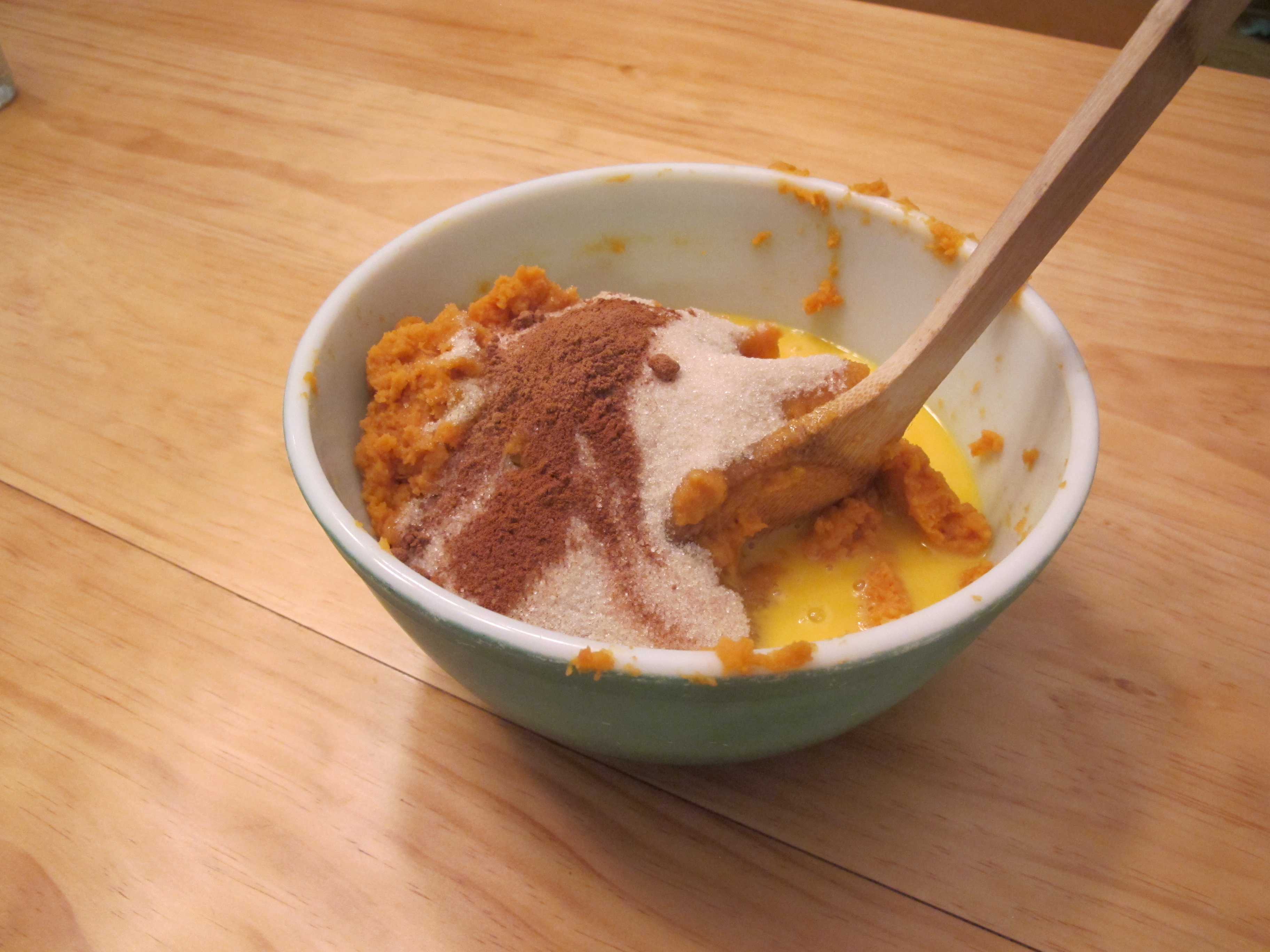
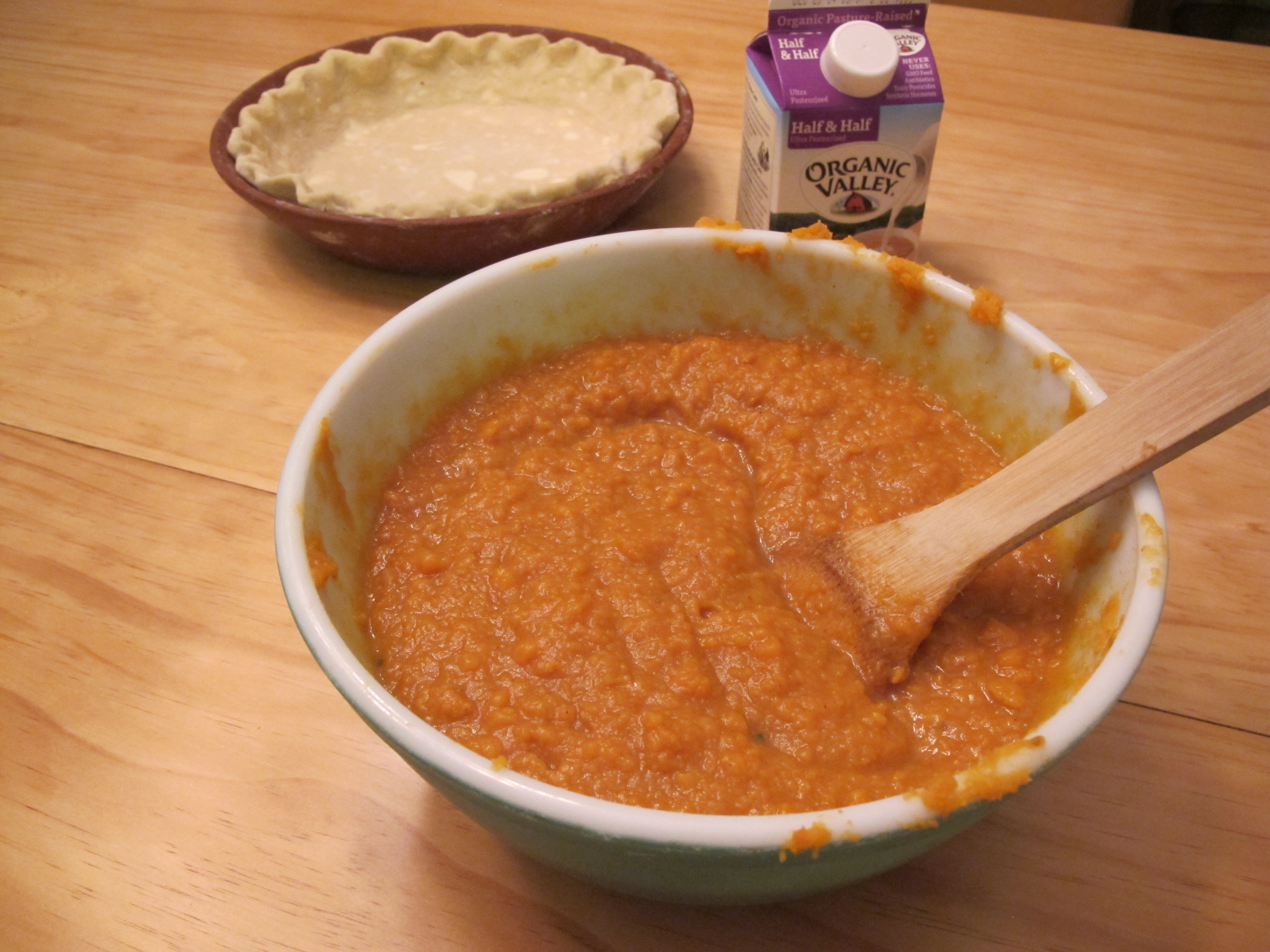
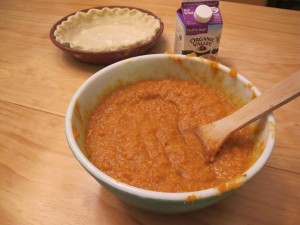
Next four eggs “beat light,” sugar, spice, and milk or cream are mixed in with the mashed sweet potatoes. As Aaron noted in his post about rice apples, the lack of specifics in a recipe would have allowed for flexibility and improvisation based around what you had in your pantry. I appreciated this when the recipe called for milk or cream to thin it out, since all I had in the house was half-and-half. But I was a little flummoxed by the “teaspoonful of ground spice” called for. Was this referring to some particular spice that if I were cooking in 1870 would have just known? As a good librarian, I did some more primary source research and looked at other recipes from the era. As far as I could tell “spice” didn’t mean any particular spice, and there wasn’t one spice that dominated recipes of this time period. Cinnamon, nutmeg, mace, and cloves all come up frequently. I settled on half a teaspoon of cinnamon and half a teaspoon of nutmeg which was a tasty choice, but I think any common spices would be good.
IMG_1760

There was also the matter of a half-pound of sugar.  Before Fannie Farmer popularized standard and level measurements of cups, tablespoons, and teaspoons in her 1896 Boston Cooking-School Cook Book, recipes offered looser measurements (hopefully your household cups and spoons were similar in size to the recipe author’s!) or if you were lucky weights. But I don’t have a scale and had to do a little converting. According to Farmer, one pound of sugar is equal to two cups, so I added a cup of sugar to my potato mixture.
IMG_1762IMG_1765

After combining all this, it is to be poured into a “rich pie crust” that had been rolled thin and put in a pie plate. Interestingly, no pie crust recipe was offered, which makes me think the author thought everyone would have had a pie crust recipe at the ready. I went with a basic all-butter crust. Given the number of other recipes in The Rural Carolinian that call for lard, a crust with lard would have been more authentic, but I wanted my vegetarian friends to be able to partake.

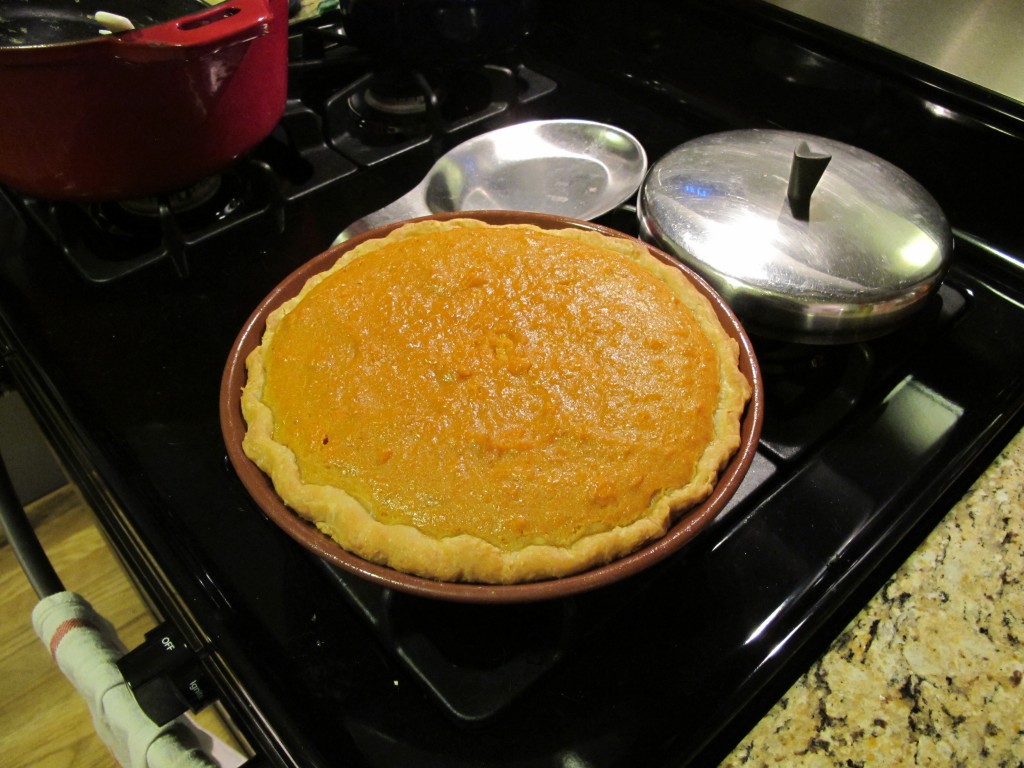
The final direction is to “bake brown.” Grateful for a modern oven where I have the ability to set a temperature, I went with 350.  I kept waiting for my pie to get “brown” and it never quite got there, so I took it out after an hour. This may have been a little too long; it did crack once it cooled.  Next time, I’d check it at 45 minutes and if the center seemed cooked thoroughly, I wouldn’t worry about it getting brown.
IMG_1766

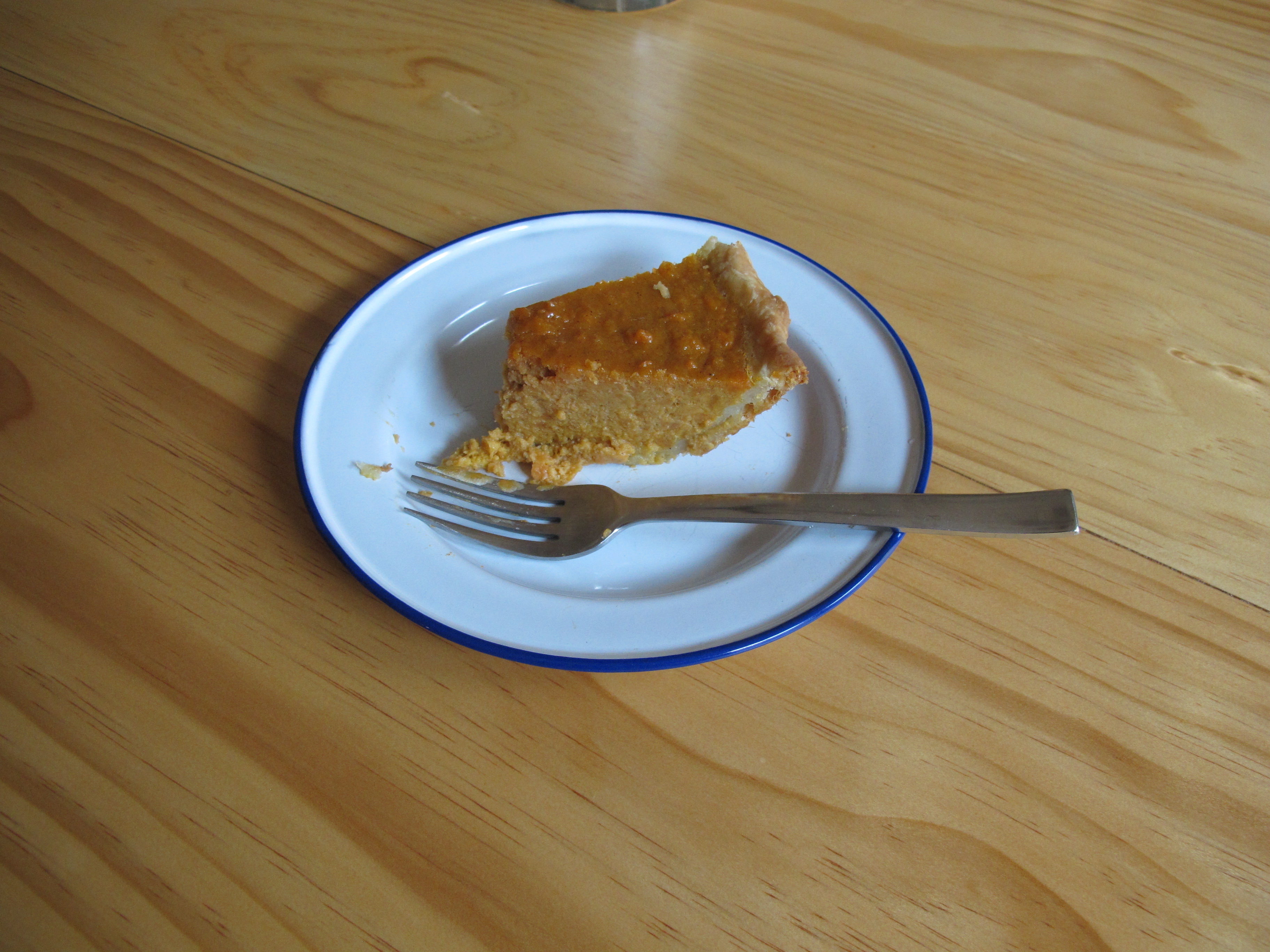
Despite the slight overcooking, this was a very good sweet potato pie. There was nothing that distinguished it from any more modern sweet potato pies I’ve eaten though.  I took a look at some modern recipes and they’re remarkably similar, though they usually have more butter and fewer eggs in them. I think I’ll actually fix this again for Thanksgiving, though I want to try pairing it with an ahistorical maple bourbon whipped cream.
IMG_1767

Want to make history this Thanksgiving? Every Friday between now and Thanksgiving, we’ll be sharing a recipe from our collections that one of our staff members has found, prepared, and tasted. We’re excited to bring these recipes out of their archival boxes and into our kitchens (metaphorically, of course!), and we hope you’ll find some historical inspiration for your own Thanksgiving.

Post contributed by Kate Collins, Research Services Librarian

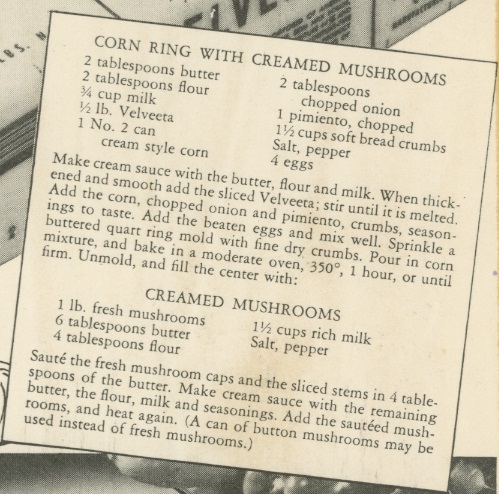
Rubenstein Library Test Kitchen: Velveeta Corn Ring with Creamed Mushrooms (1942)

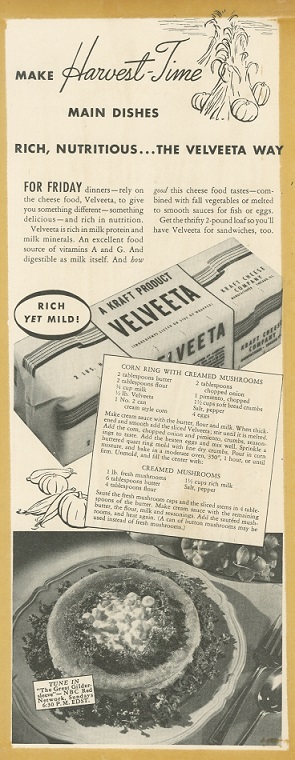
Corn_Ring_RecipeThis is a food story that begins in a laboratory.  Imagine white coats, goggles, beakers, hastily written formulas on a chalk board, and vapors with odd odors.  No, this is not the kitchen-lab of a trendy restaurant specializing in molecular gastronomy.  This is a lab at the Kraft Cheese Company and the year is 1915.  This is the beginning of Velveeta.

According to a 1930 advertisement from Kraft’s Educational Department titled “The Story Behind the Product,” in the year 1915, Kraft research scientists, uncomfortable with the amount of valuable milk nutrients lost in the traditional cheese making process, embarked on a food quest: to create a cheese product that would retain all of these nutrients without losing all of the desirable characteristics of ordinary cheese.  Ladies and gentlemen, the results of that noble inspiration are, in my mind, truly a food miracle.  Named for its smooth, velvety texture when melted, Velveeta is a dairy-based product composed of cheddar cheese, whey concentrate, skim milk solids, cream, sodium phosphate, and salt (the 1930 ingredients list).  But how would the company sell this miracle cheese food to American consumers?  How would they transform this product from a science experiment to a staple of the American table?  This would be a task assigned to Kraft’s advertising agency of record, the J. Walter Thompson Co. (JWT).

With slogans such as “Let Them Eat it Freely!” and “As Digestible as Milk Itself!,” Velveeta’s  early advertisements were educational with a focus on the product’s nutritional benefits, particularly for growing children.  A 1932 advertisement that appeared in several women’s magazines boasted of the product’s endorsement by the Food Committee of the American Medical Association and its award of a nutritional rating of “Triple-Plus.”  Velveeta’s balance of vitamins and minerals would effectively build up “resistance to colds, throat and lung infections,” act as a “safeguard against unsound teeth and bones,” and contribute to the “building of firm flesh.”  With Velveeta’s nutritiousness established, by the mid-1930s JWT’s campaigns for Velveeta began to focus on the product’s versatility in the kitchen.

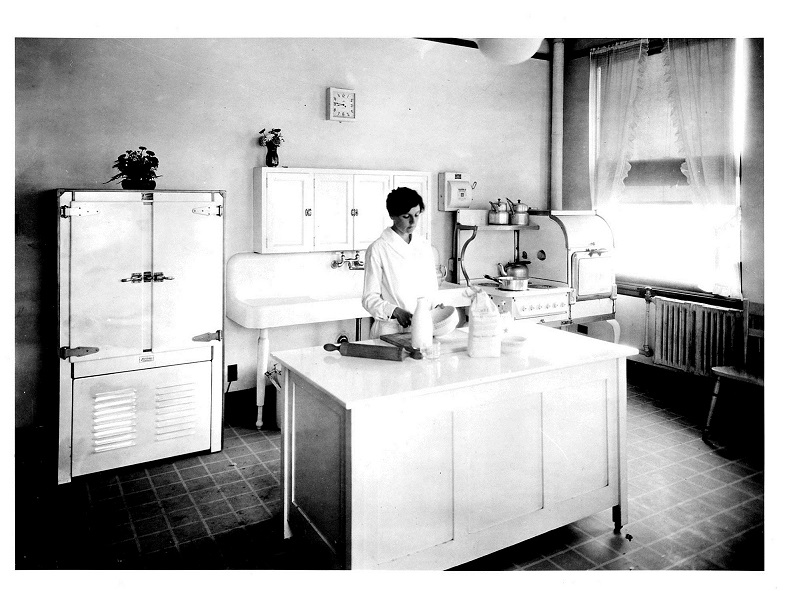
JWT’s Chicago office test kitchen, ca. 1920.

In order to instruct American consumers on the myriad culinary uses of Velveeta JWT began to introduce recipes in the advertisements, a practice pioneered by the agency in the 1910s for another Chicago-based food client, Libby, McNeil & Libby.  In 1918, JWT opened a test kitchen in its Chicago office in part to develop recipes that featured their client’s products as central ingredients.  It was in this kitchen that JWT developed hundreds of recipes incorporating not just Velveeta but many other clients’ brands.  As the home of the Archives of the J. Walter Thompson Co. the Rubenstein Library has hundreds if not thousands of these advertisements.

My obvious enthusiasm for Velveeta aside, I chose this recipe for a harvest-time corn ring with creamed mushroom sauce for several reasons.  First of all, despite the fact that the recipe is devoid of any harvest fresh ingredients, the fall harvest theme seemed appropriate for this time of year.  Secondly, mushrooms.  I also wanted to see what this thing looked like in color—I had a feeling the black and white photo wasn’t doing the dish any justice.  Lastly, with winter approaching I felt myself in need of some firm flesh building, one of the many benefits of a steady Velveeta diet.

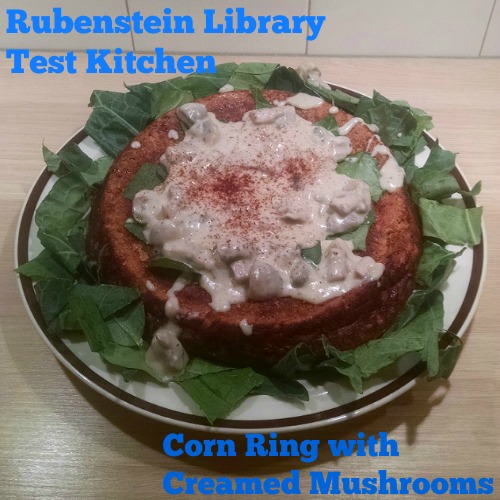
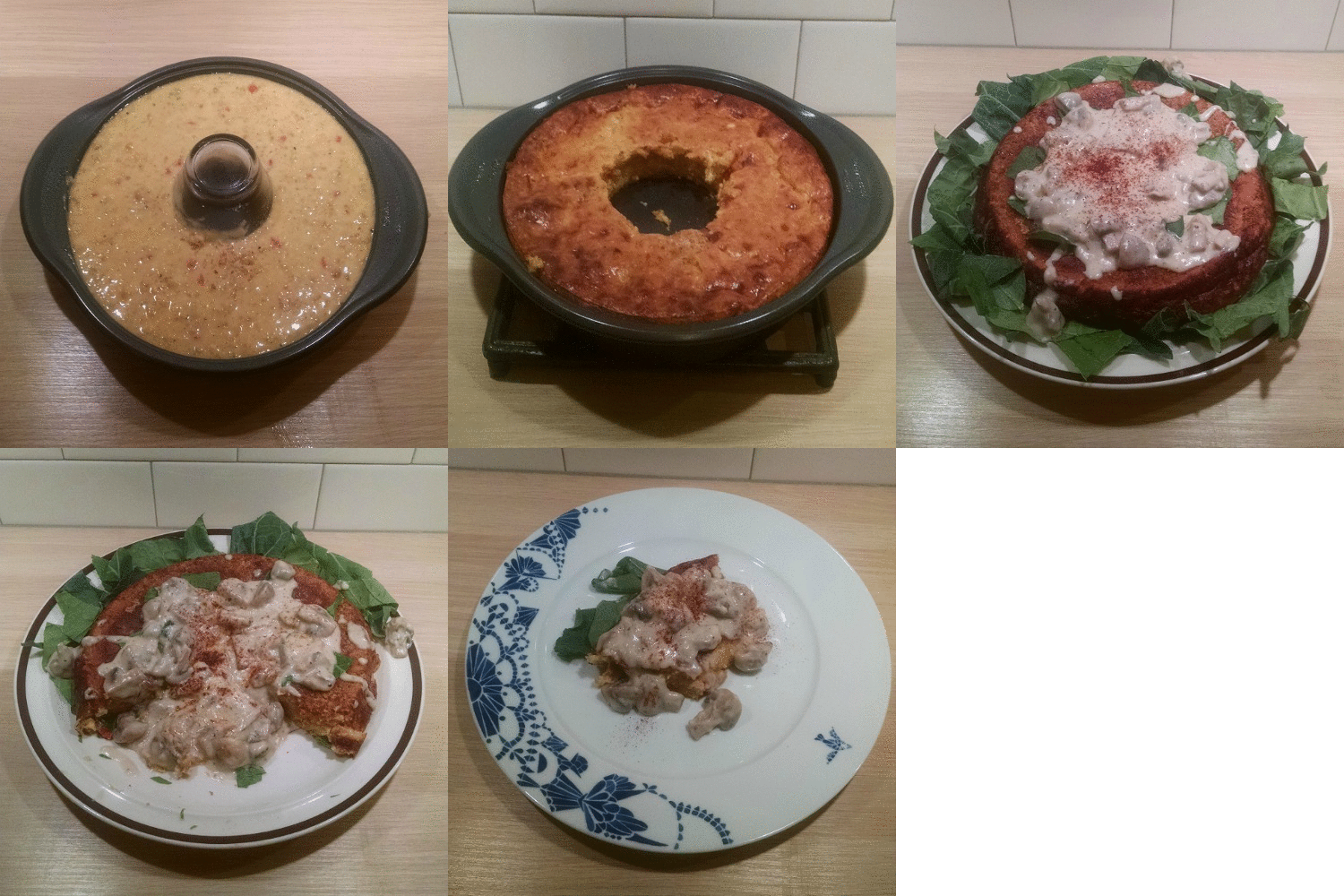
I more or less stuck to the recipe in the ad with only slight modifications.  I at least tripled the amount of diced onion, added a pinch of paprika to the corn ring batter, and used crushed croutons rather than fresh bread crumbs.  Additionally, despite the fact that everything from our grandparent’s kitchens is now trendy again, I do not possess a ring mold.  To mimic a ring mold I used an upside-down glass ramekin in the middle of a 9-inch pie pan.  Although this rig lacked the authenticity of a 1940s ring mold I felt it to be sufficient.  I also opted against the recommendation of the recipe that I purchase the economical 2lb. loaf of Velveeta, opting instead for the 16oz. package.  Other than dicing the onion and quartering the mushrooms there was minimal prep.

Recipe_Closeup

The corn ring actually smelled wonderful while baking, filling the house with a warm cheesy aroma.  After plating the corn ring with the mushroom sauce I began to understand why they opted for a black and white photo in the ad.  Aside from the decorative greens, the brown and grey color palette of the dish wasn’t exactly photogenic so I sprinkled a dash of paprika on top to give it a bit of color.  There were also no serving instructions so we sliced it like a pie and watched the creamy mushroom sauce flow.  Although extremely rich the dish was actually quite good overall.  This is one instance at least where the product lives up to the promise of the ad.

output_tc933P

Every Friday between now and Thanksgiving, we’ll be sharing a recipe from our collections that one of our staff members has found, prepared, and tasted. We’re excited to bring these recipes out of their archival boxes and into our kitchens (metaphorically, of course!), and we hope you’ll find some historical inspiration for your own Thanksgiving.

Post contributed by Josh Larkin Rowley, Reference Archivist, John W. Hartman Center for Sales, Advertising, and Marketing History

Rubenstein Library Test Kitchen: Goblin Sandwiches (1946)

Adolph Levitt was the developer of the automatic donut making machine and father of the modern American donut industry. In 1920 he founded the Doughnut Machine Company to make and market the machine across the United States and to sell donuts under the name “Mayflower.”  Soon the company began preparing and selling standardized mixes for the machine, and acquired bakeries to produce the donuts. In 1931, the company opened the first Mayflower donut shop in New York City; 17 other shops followed across the country, making the first retail doughnut chain. The company changed its name to the Doughnut Corporation of America, dominating the industry with a range of products and equipment.

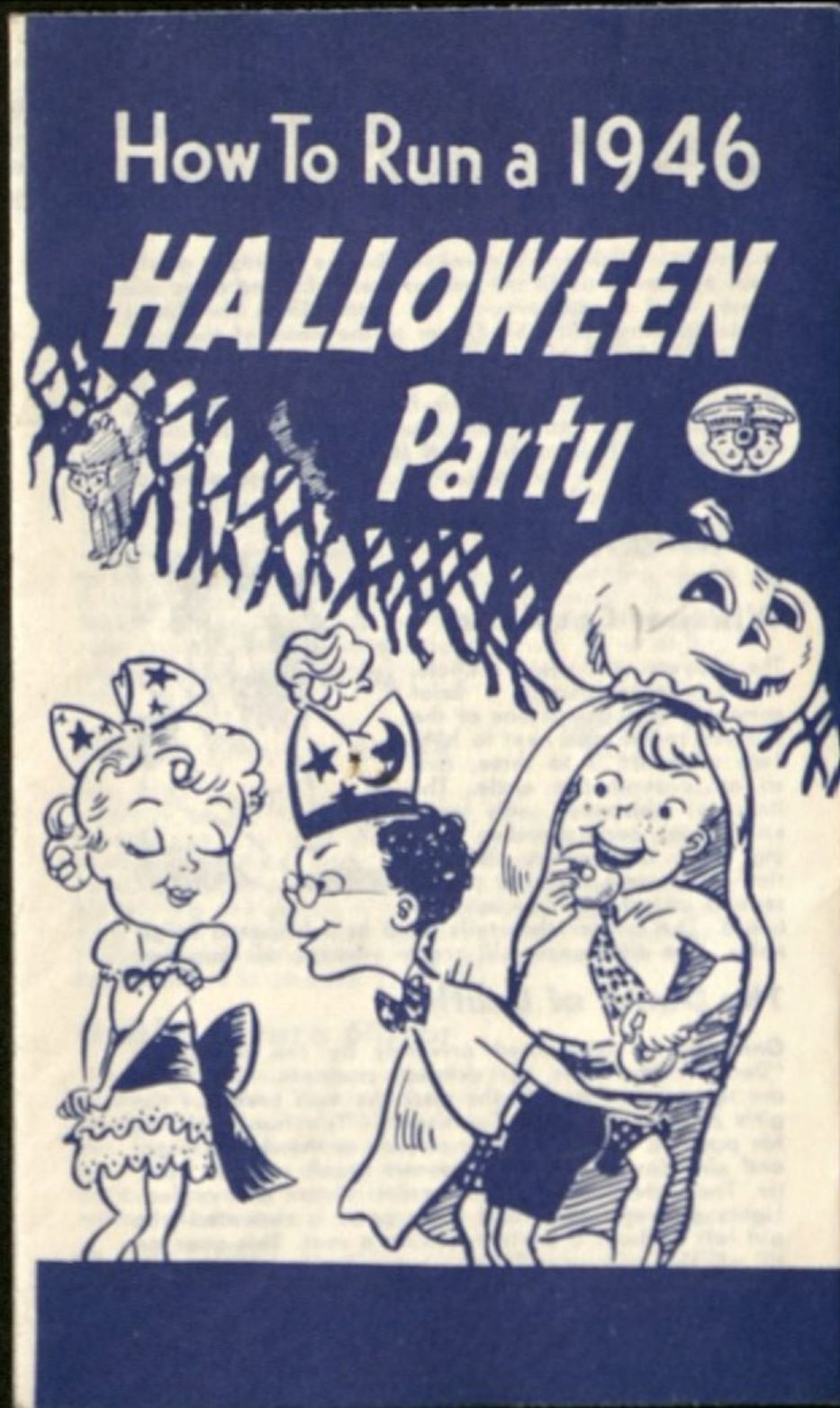
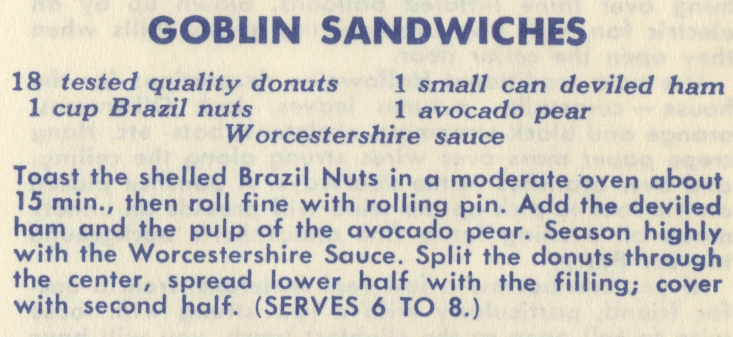
In the 1940s the Doughnut Corporation of America distributed pamphlet style cookbooks encouraging the use of donuts as the main ingredient in a variety of recipes recommended for serving at a Halloween party. I found one of these in the Nicole Di Bona Peterson Advertising Cookbook Collection entitled How to Run a 1946 Halloween Party. Looking for a Halloween themed recipe for the RL Test Kitchen, I was drawn in by the idea of using donuts in place of other bread products. There are several intriguing recipes included in this pamphlet, but the one that stood out above the others was for Goblin Sandwiches. It is worth noting that despite the fact that the company name includes the word “doughnut,” the recipes use the more layman spelling, “donut.”

Goblin Sandwiches

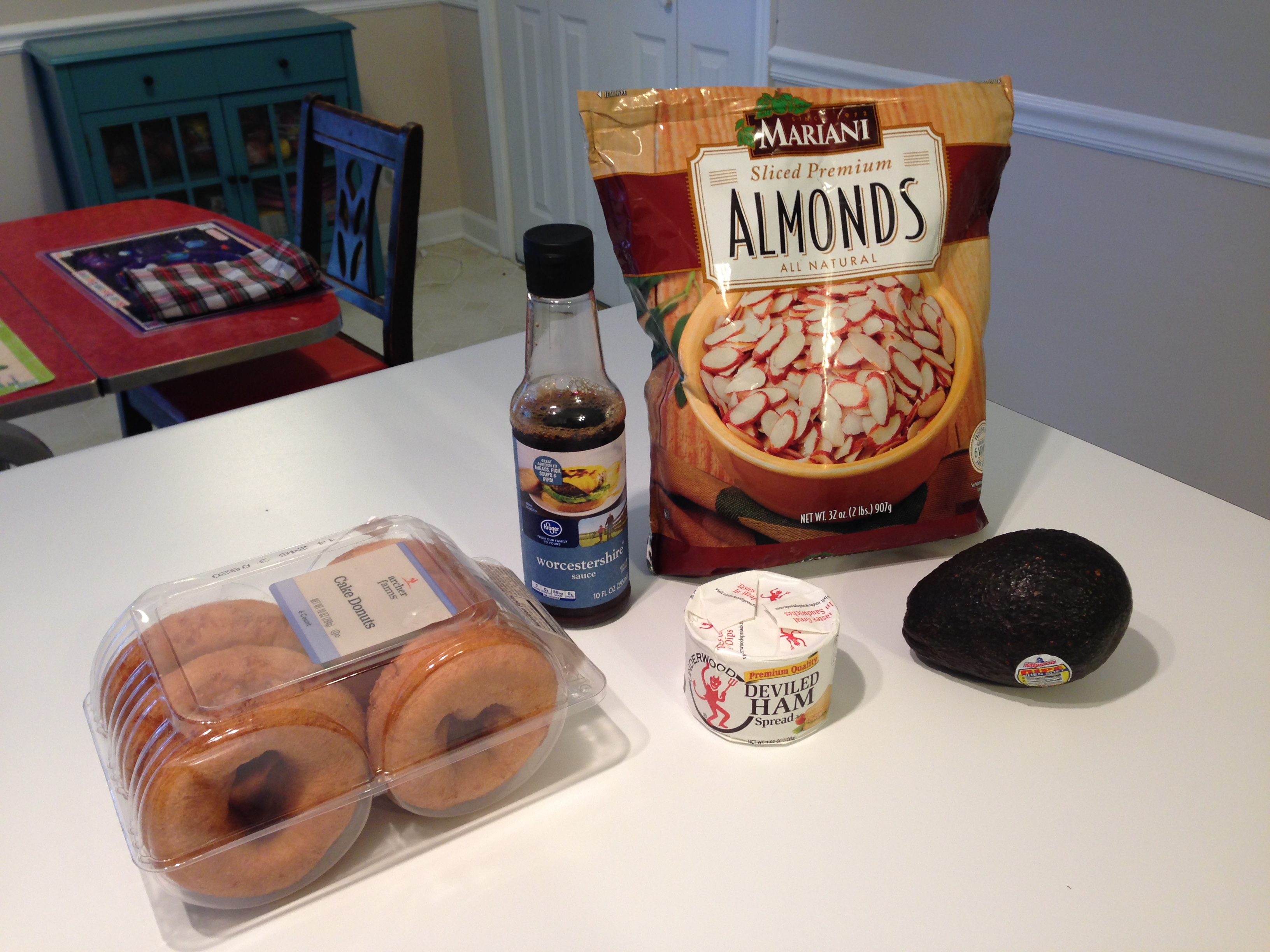
My only deviation from the core recipe was the substitution of toasted almonds for the requested Brazil nuts. Brazil nuts proved elusive in the two grocery stores I visited in preparation. A quick internet search showed that almonds (or most any other common tree nut) are an acceptable substitute. I toasted sliced almonds and chopped them using a small food processor rather than using the rolling pin technique described in the recipe.  Woe is the 1940s cook who has to roll her nuts finely using only a rolling pin.  Also worth noting is that an “avocado pear” is really just another name for avocado.

IMG_0756

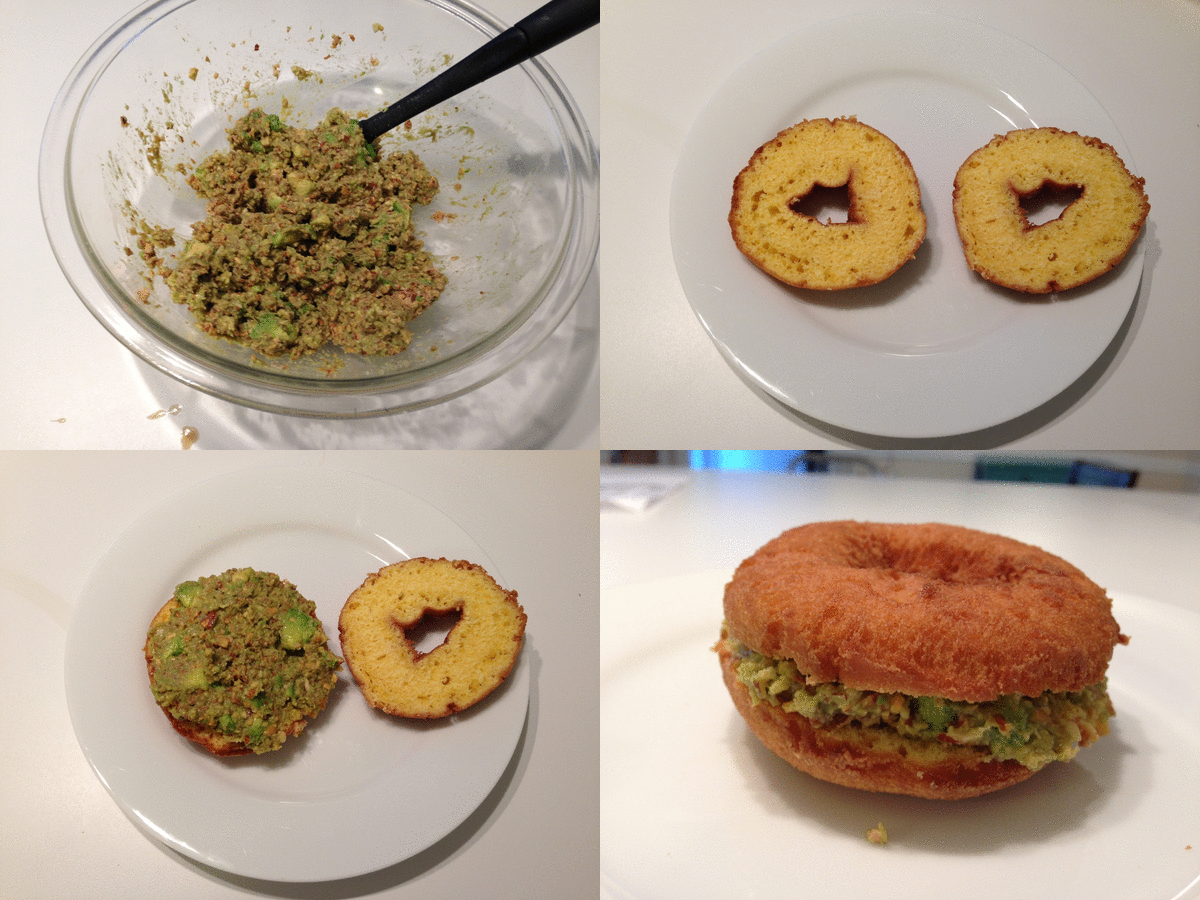
Once the nuts were toasted and chopped this recipe came together very quickly with only five ingredients. I’ve always wondered what Deviled Ham was like having seen the cans in the grocery store.  Now I can tell you that the smell is not unlike dog food and the consistency is finely minced meat with a layer of yellowish water on top. I added the chopped avocado and almonds and mixed well.  The instructions said to “season highly” with Worchester sauce, which gave me a moment of pause.  I added a teaspoon, reasoning that more could be added to taste.  Once everything was mixed together it was quite green in color.  Cans of Deviled Ham are actually quite small at only 4.25 ounces each.  The cup of chopped almonds and an entire avocado actually were much larger in volume in this recipe, which probably diluted the pet food like taste of the ham. I imagine that the strong green of the avocado inspired the goblin name.  I spread the filling onto a typical plain cake donut sliced in half, making the traditional sandwich shape.

output_LvzilL

My willing taste testers included my husband Steve and colleague Josh, both of whom profess willingness to try anything.  Steve said that the filling was quite bland and was over shadowed by the sweet taste of the donut. When he tried just a spoonful of the filling he reconfirmed its blandness and added several more shakes of Worchester sauce to the mix. Josh also confirmed that the sweetness of the donut overpowered the taste of the spread.  He acknowledged the crunch of the nuts and an occasional chunk of avocado, but felt that it was better suited for little rye toast rather than a donut. Should you decide to test this recipe at home, I recommend cutting and adding the chopped avocado as close to serving time as possible to retain the bright green color, which turns to an olive drab over time.

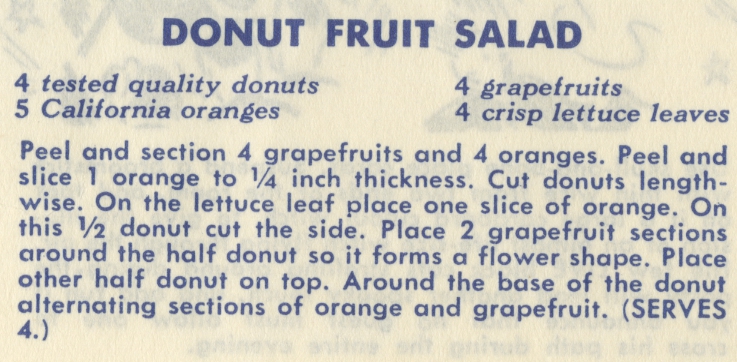
One other recipe to note is the Donut Fruit Salad.  I really wanted to make this recipe as well, but I have to admit that I could not follow the recipe and visualize what the end product should resemble.  Perhaps you, gentle reader, might have better luck.  We’d love to see if you can successfully follow the directions in this recipe and scare up a good time with this Donut Fruit Salad.  Tweet your pictures to @hartmancenter and @rubensteinlib.

Donut Fruit Salad

Besides the notable recipes, this small pamphlet also includes a number of Halloween Party activities to add spooky fun to your celebration.  Ideas include making place holders with donuts and donut horse centerpieces.  Both use quite a few toothpicks to achieve the desired effect, so make sure you have plenty on hand.  One game idea is called Donuts on a String and calls for contestants to try and eat a donut dangling on a string while their hands are tied behind their backs.  “First to finish and whistle the first two lines of ‘Dixie’ wins.”

Donut Horse

Perhaps these recipes and activities will give you some ideas for a last minute Halloween party tonight.  Just make sure you have plenty of donuts on hand and have a spooktacular night! Happy Halloween from the RL Test Kitchen!

 Every Friday between now and Thanksgiving, we’ll be sharing a recipe from our collections that one of our staff members has found, prepared, and tasted. We’re excited to bring these recipes out of their archival boxes and into our kitchens (metaphorically, of course!), and we hope you’ll find some historical inspiration for your own Thanksgiving.

Post contributed by Jacqueline Reid Wachholz, Director, John W. Hartman Center for Sales, Advertising, and Marketing History

Rights! Camera! Action! presents “Wasteland”

waste_land_ver21

Rights!Camera!Action! Presents “Wasteland” (2010)
Director: Lucy Walker Producers: Angus Aynsley and Hank Levine
Full Frame Audience Award 2010
Total running time: 95:00

Artist Vik Muniz, known for painting with nontraditional materials, returned to his native Brazil to portray workers in one of the world’s largest garbage dumps, Jardim Gramacho, on the outskirts of Rio de Janeiro. He collaborated with these “catadores”–self-designated scavengers of recyclable materials–to create portraits of them made entirely of garbage, returning the profits from their sale to his subjects. Over three years, the filmmakers followed Muniz and this eclectic band of catadores, revealing both the dignity and despair of their lives, in a multivalent collaborative work engaging with issues of artistic process, social justice, responsibility to one’s subjects, class mobility, activism, and beauty. In English and Portuguese with English subtitles.

There will be a reception at 6:30 p.m. and the screening will begin at 7 p.m. A panel discussion with Professor Pedro Lasch follows the screening.

Date: Thursday October 30th, 2014
Time: 6:30pm-8:30pm
Location: Smith Warehouse, Bay 4, Franklin Garage

Sponsors: The Duke Human Rights Center@ FHI, the Human Rights Archive, and the Archive of Documentary Arts and Screen/Society. Co-sponsored by the Global Brazil Humanities Lab.

For further information contact Patrick Stawski, Duke University patrick.stawski@duke.edu 919-660-5823.

Rubenstein Library Test Kitchen: World War I Soldiers’ Soup

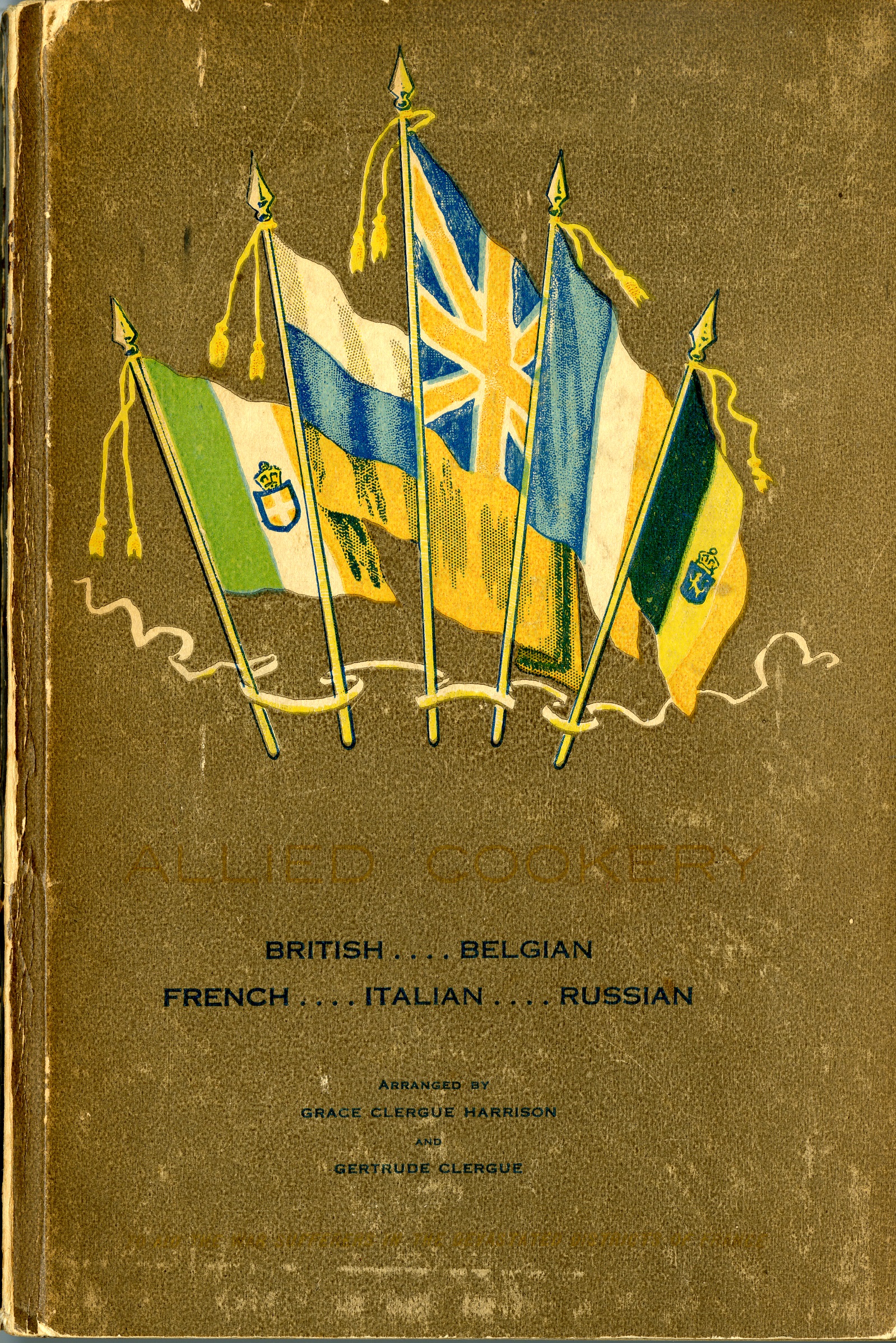
Allied Cookery Cover
Grace Glergue Harrison. Allied Cookery: British, French, Italian, Belgian, Russian.  New York and London: G.P. Putnam’s Sons, 1916.

A century ago, the Great War was causing massive casualties and destruction in France. Allied Cookery, the product of an international collaboration, was written as a fundraiser. The proceeds were distributed by Le Secours National, the French organization created immediately after war was declared in 1914. The brainchild of banker and arts patron Albert Kahn, Le Secours raised funds to provide food and warm clothing to French soldiers and their families and to civilians in the country’s devastated regions. The cookbook’s introduction explains that any money raised will go to those areas that had been invaded by the Germans and subsequently retaken by the Allied forces. The impact of the damage was all the more horrific because these were France’s most fertile agricultural regions. With the buildings destroyed and the farm implements, livestock, and food stores seized, the surviving farmers could not produce food. With armies to supply, shortages were a real danger. Allied propaganda posters encouraged citizens to grow vegetable gardens and to restrict their consumption of wheat, meat, sugar, fats, and fuel. (French propaganda posters included the wine and tobacco products so badly needed by the military!) Fittingly, the recipes in this cookbook emphasize vegetables, beans, and soups. The section on meats includes many dishes using the less choice bits:  tripe, kidneys, sheep’s head and the like.

In addition to the countries listed in the title, Allied Cookery includes recipes from Commonwealth countries and Eastern Europe. Hence, there is a whole section on curries and dishes such as Pilau (pilaf) and Serbian Cake. I decided to try the Soldiers’ Soup (Soupe à la Battaille); it seemed altogether fitting when highlighting a World War I cookbook and also potentially tasty.

Soldiers' Soup Recipe

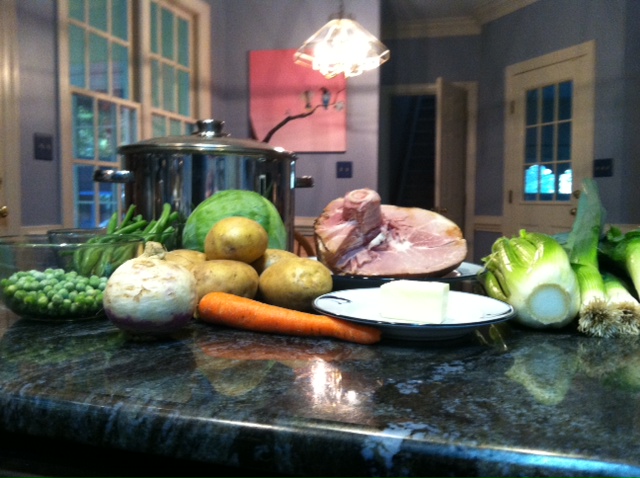
The ingredients were, for the most part, easily obtained at my usual supermarket. I was unable to find chervil for the garnish, and so simply left it out. The note at the bottom suggests that “a bone of ham or the remains of bacon improve this soup immensely.” I therefore purchased a bone of ham from our local HoneyBaked Ham. The instructions were extremely simple to follow and it is easy to imagine an army cook preparing the soup over an open fire using vegetables that had been requisitioned from nearby farms.

Mise en place

There was a great deal of washing, peeling, and chopping and I needed to use my largest cooking pot. After everything was added, I left the soup to simmer, with only occasional stirring, for two hours. I pulled out the ham bone and skimmed the fat. The recipe says that the mixture should be quite smooth at that point, and if it is not, the cook should “beat it well with a whisk.” Mine was not smooth, so I cheated a bit and used my 21st century immersion blender. The result was a beautiful jade green silky concoction.

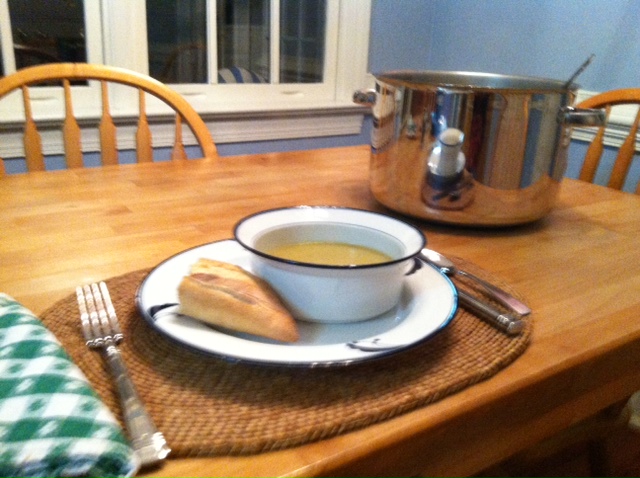
Finished product

The flavor was absolutely delightful—a fresh vegetable taste with a little smoky depth from the ham and a creaminess from the potatoes. I shredded the ham and served it on the side, but the soup was delicious without it. My husband ate three full bowls. I would rate this soup a five out of five. Without the ham, it would be a perfect vegan dish. It makes so much that I refrigerated enough for another two or three meals and froze several large containers for later consumption. Civilians were called upon to sacrifice for the war effort, but preparing and eating this soup was no sacrifice whatsoever!

You can explore Allied Cookery in the Rubenstein Library or on the Internet Archive.

 Every Friday between now and Thanksgiving, we’ll be sharing a recipe from our collections that one of our staff members has found, prepared, and tasted. We’re excited to bring these recipes out of their archival boxes and into our kitchens (metaphorically, of course!), and we hope you’ll find some historical inspiration for your own Thanksgiving.

Post contributed by Elizabeth Dunn, Research Services Librarian.