Category Archives: New at the Rubenstein Library

‘Tis the Season: Gifts to the Rubenstein Library, Day Three

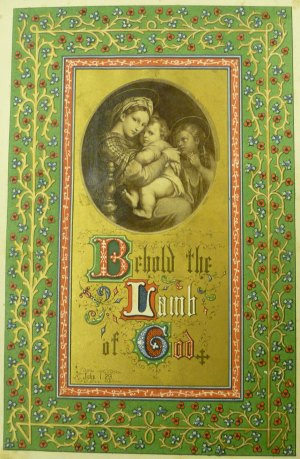
Frontispiece of Holy Bible, with circular photographic onlay.

To celebrate the holiday season this week, we’re highlighting a few of the many wonderful books that the Rubenstein Library has received as gifts over the past year.  We are truly grateful for the generosity of our donors.  A hearty “Happy holidays” and thanks and to all of those who have contributed to making 2013 a wonderful year for the Rubenstein Library!

Funds donated to the Rubenstein Library in 2013 facilitated the purchase of two very different books featuring photographs.  One, the Holy Bible published by Eyre and Spottiswoode in 1865, features twenty mounted photographs by Francis Frith.  Frith, an Englishman, was a pioneering photographer of the Middle East in the 1850s, and some of the early photographic views of Holy Land sites such as Bethlehem and Jerusalem are included in this Bible.  This purchase was made possible by the addition of funds to the Leland Phelps Rare Book Endowment Fund.

"Bethlehem with Church of the Nativity," by Francis Frith, from Holy Bible.
“Bethlehem with Church of the Nativity,” by Francis Frith, from Holy Bible, 1865.

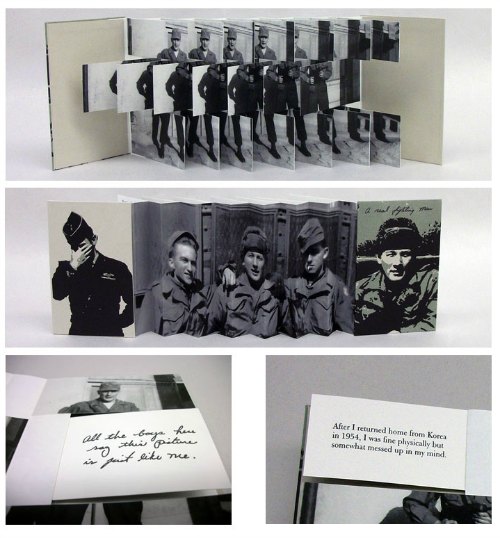
A generous donation of funds for materials related to military history facilitated the acquisition of Lee and Amy Pirkle’s work A Real Fighting Man.  Published in an edition of twenty copies in 2012, A Real Fighting Man is an artist’s book that combines art based on snapshots sent home by Lee Pirkle (Amy’s grandfather) from the Korean War with text chosen by Amy from an essay that Lee wrote about his wartime experience.
PirkleRealFightingMan
Lee and Amy Pirkle, A Real Fighting Man. Image courtesy of Vamp & Tramp Booksellers.

A Real Fighting Man‘s flag book structure, as seen above, allows the reader to juxtapose sections of image and text in many revealing ways.
‘Tis the Season: Gifts to the Rubenstein Library, Day Two

MagnaChartaBindingTo celebrate the holiday season this week, we’re highlighting a few of the many wonderful books that the Rubenstein Library has received as gifts over the past year.  We are truly grateful for the generosity of our donors.  A hearty “Happy holidays” and thanks and to all of those who have contributed to making 2013 a wonderful year for the Rubenstein Library!

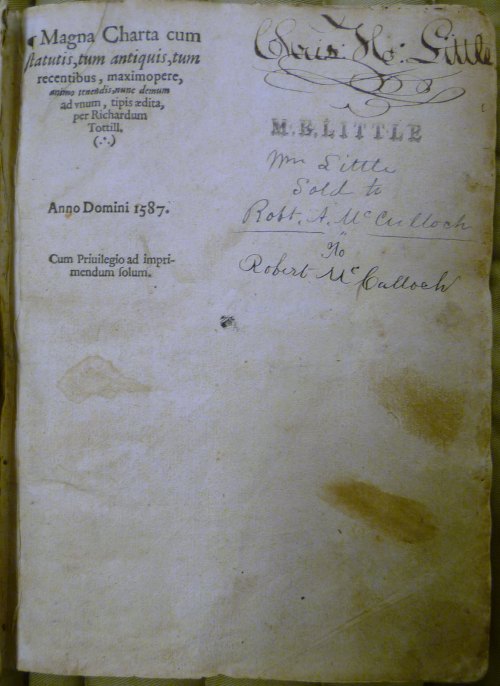
Richard Heitzenrater, William Kellon Quick Professor Emeritus of Church History and Wesley Studies in Duke’s Divinity School, donated a number of books in the fields of law, religion, and literature to the Rubenstein Library this year.  Among them is an early printing of the Magna Carta and other laws of England, Magna Charta cum Statutis tum Antiquis tum Recentibus, published in 1587 by Richard Tottell, the foremost printer and bookseller of law books in Elizabethan London.

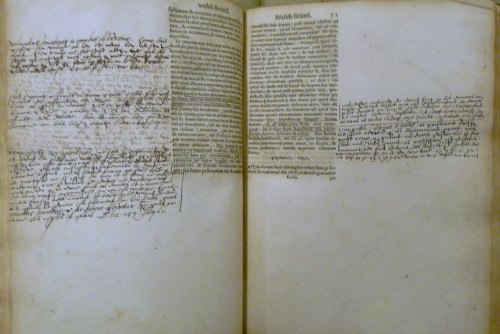
A rare and important book in any condition, the copy donated by Prof. Heitzenrater is particularly notable for its unusual format: the paper is much larger than in typical copies of the book, and the printing confined to one upper corner of each page, as seen on the title page below.

MagnaChartaTitlePageThis format allowed for very large margins in which those in the legal professions could record their notes and cite additional or updated statutes.  Indeed, this copy contains many early (probably seventeenth-century) handwritten notes and citations throughout the text.

MagnaChartaMarginaliaOur thanks to Prof. Heitzenrater for this important document of the Elizabethan era!

‘Tis the Season: Gifts to the Rubenstein Library, Day One

OBrienDJTo celebrate the holiday season this week, we’re highlighting a few of the many wonderful books that the Rubenstein Library has received as gifts over the past year.  We are truly grateful for the generosity of our donors.  A hearty “Happy holidays” and thanks and to all of those who have contributed to making 2013 a wonderful year for the Rubenstein Library!

A donation from Duke Professor of French Studies Helen Solterer features rare and iconic works of Irish and American literature.  These volumes came from the library of Elizabeth Solterer, whose father, Constantine Curran, was a friend of James Joyce, W. B. Yeats, and other important figures in twentieth-century Irish literature.

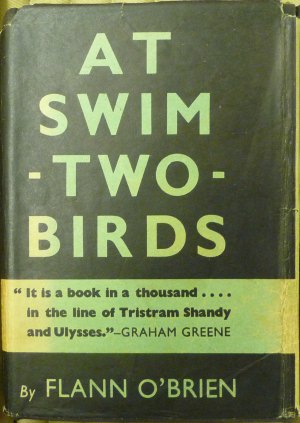
The donation includes a very rare first edition, first printing of At Swim-Two-Birds by Flann O’Brien (the pseudonym of Brian O’Nolan).  The book’s publication was poorly timed, appearing a few months before Great Britain declared war on Germany in 1939.  Only 240 or so copies were sold before most of the unsold stock was destroyed in a London bombing raid by the German Luftwaffe in 1940.  Its reputation as a groundbreaking and hilarious work of comedic metafiction has grown from a small cult following, and it now features regularly in lists of best English-language novels and novels of the twentieth century.  Copies of the edition printed before World War II are exceptionally rare, especially in the original dust jacket, present on the copy now at the Rubenstein Library.

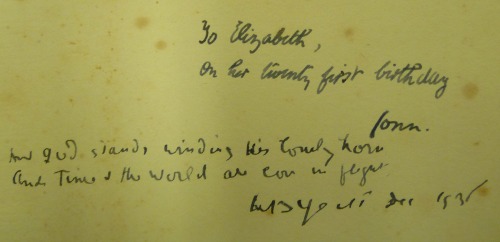
Another highlight of the donation is a 1934 edition of the Collected Poems of William Butler Yeats featuring two handwritten lines of his poem “Into the Twilight” and his signature, dated to December 1935.

YeatsInscriptionOther books in the donation include signed works by Robert Frost and Henry James.  We thank Prof. Solterer for this marvelous donation!

Achenbaum Dedicates Papers, Endows Hartman Center Travel Grants

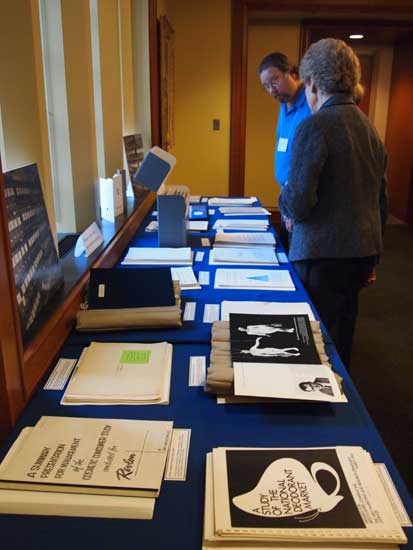
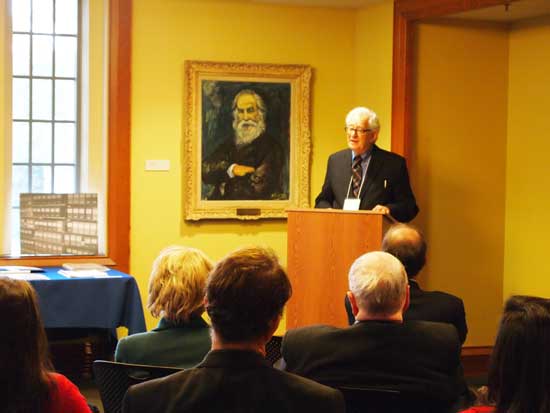
On Thursday, November 7th, twenty of Al Achenbaum’s family and close friends joined Duke library staff and faculty in a ceremony to dedicate his papers as part of the John W. Hartman Center for Sales, Advertising & Marketing History. In a series of comments given by Hartman Center staff, Achenbaum’s papers were lauded for their unique insight into building brand equity, strategic marketing planning, maximizing advertising agency-client relationships, and using systematic quantitative research as a guide to effective decision-making.

A display of materials from the Alvin Achenbaum Papers.
A display of materials from the Alvin A, Achenbaum Papers.

Over a remarkable 60-year career, he advised leading global marketers, including Procter & Gamble, GE, Toyota and Nestlé, on how to use marketing tools to improve the economic value of their businesses.  He held senior executive positions at four major advertising agencies in New York, and was chairman of a series of leading marketing consulting firms which provided over 150 companies with systematic tools for addressing complex business challenges.

This 233-box collection will enrich the experiences of many students and scholars interested in the evolution of the advertising industry in the second half of the 20th century or the career of Al Achenbaum, known to many as the “Einstein of Advertising” and one of Advertising Age’s  100 most influential advertising people of the 20th century. Al’s son, Jon Achenbaum, described his father as the reason he started his own career in marketing, applying many of the marketing innovations that Al brought into the business world and read two passages from Al’s upcoming book.

Rounding out the event were remarks by Al Achenbaum himself, in which he stated that “marketing is the single most important driver of our modern economy” and that it will “continue to play a critical role in economic success – both in the U.S. and abroad.”  He expressed his gratitude to his family and friends for supporting him throughout his life and career and expressed his enthusiasm for donating his papers to Duke and the Hartman Center.

P1011531-web

To top off the ceremony, he announced that he is endowing the Hartman Center’s travel grant program, which will be named the Alvin A. Achenbaum Travel Grants.  These travel grants will enable students and scholars to come from afar to use Hartman Center collections as part of their research each year. Since Achenbaum is in many ways a scholar of advertising and marketing himself, this is a wonderful way to continue his legacy in perpetuity.

Hartman Center director Jackie Reid Wachholz and Al Achenbaum.

Post contributed by Jackie Reid Wachholz, director of the John W. Hartman Center for Sales, Advertising & Marketing History.

A “Surprise Box” from Judy Malloy

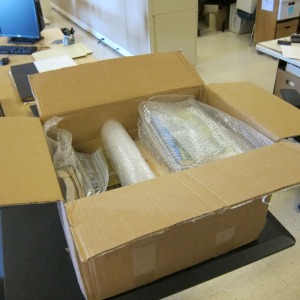
MalloyBoxOpenWhile the staff here at the Rubenstein Library often travels to bring collections back to Durham, we also receive a great many packages from around the world.  For us, there’s nothing like opening those newly arrived boxes to assess the contents’ research value and find their place within the context of the collection to which they belong, and within our holdings as a whole.

Judy Malloy, the pioneering author of electronic literature such as Uncle Roger (1986), one of the first hypertext fictions, recently sent us a “surprise box” of additions to her papers here.  It was, indeed, full of wonderful surprises!  They included a painted notebook from her work Paths of Memory and Painting, a portrait of Malloy by Irene Dogmatic, and some documentation of recent online works.

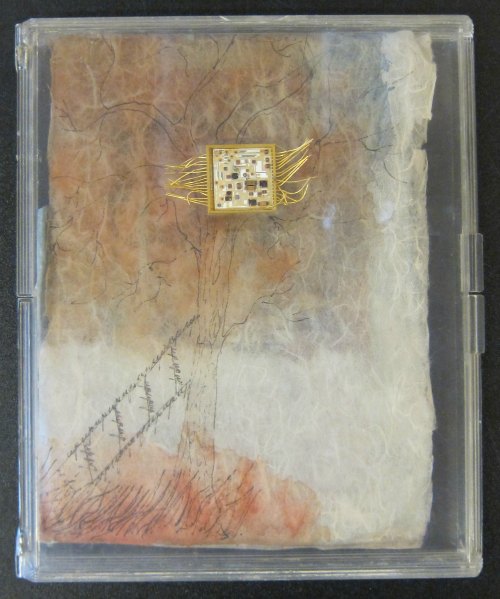
The box also contained a couple of Malloy’s early artist’s books, including “up”, from around 1975, which incorporates a computer chip into its design.

MalloyUp
Judy Malloy, “up”, from the Judy Malloy Papers.

Documentation of some of Malloy’s performances and art projects from the 1970s to the 1990s is also included.  A hand-painted sign captures her passion for both the freedom of expression online and the tactile enjoyment of physical artwork.

MalloyCyberLiberties
Sign from a Cyber Liberties event at the University of California, circa 2004.

We look forward to many more surprises, both from Judy Malloy and other authors of electronic literature and from the many other boxes we crack open every week!

Post contributed by Will Hansen, Assistant Curator of Collections.

A Family with a Mission: The McGee Family Papers

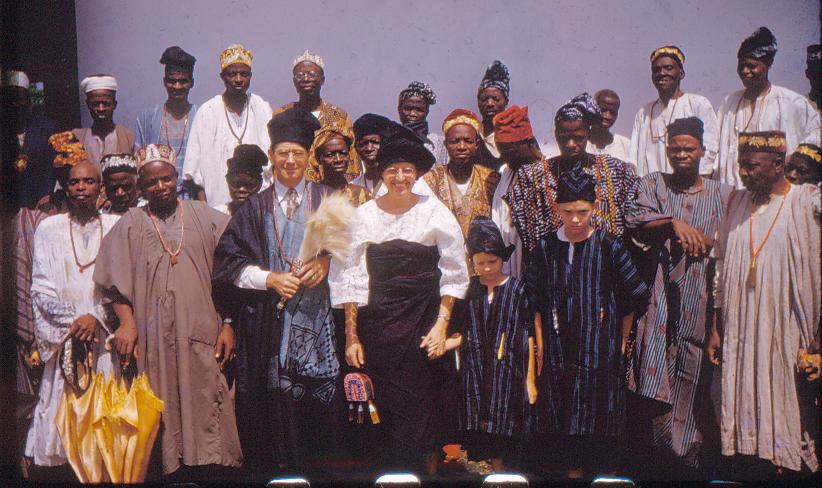
We just wrapped up processing an exciting new addition to the McGee Family Papers. John S. and Doris McGee were Baptist missionaries to Nigeria in 1945, where they served until their retirement in 1977. Their two sons, John David and Sidney, joined them in Africa for their formative years before finishing their education in America. During the McGee family’s time in Nigeria, they served at the Baptist College of Iwo and the Baptist Mission in Igede-Ekiti and Ikogosi, and they helped found the sixth Baptist high school in Nigeria–the Ekiti Baptist High School in Igede. They were made “Chief Gbaiyegun of Igede” by the Onigede and Chiefs of Igede-Ekiti, the paramount chief by the Ewi of Ado, and “Chief Akorewolu of Ikogosi” by Loja and Chiefs of Ikogosi-Ekiti.

McGees and chiefs, Gbaiyegun event, 1957
McGees and Nigerian chiefs, Gbaiyegun event, 1957

Some of the items in the new accession include correspondence (as well as reel-to-reel “audio letters”) between the family members while they were separated  during their various Nigerian tours; Doris’ many prayer diaries; and seven beautiful 16×20 color prints documenting life in various Nigerian missionary camps.

John S. McGee baptizing believers in Nigeria

The collection offers fascinating insight into the lives and histories of a family on a Baptist Mission to Nigeria in the mid-twentieth century.

New Acquisitions: A Gender and Sexuality Side Show with Beat Connections

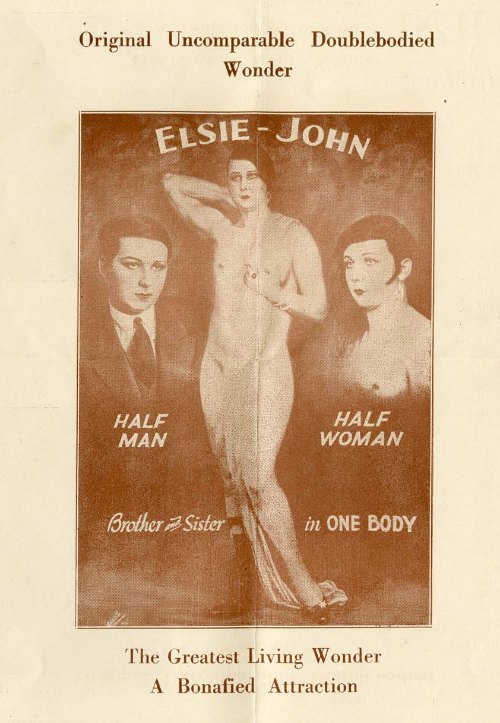
The Sallie Bingham Center for Women’s History and Culture recently acquired a rare ephemeral promotional pamphlet, possibly published in Chicago in the 1930’s, European Enigma, International Sensation: Elsie-John, Half Man, Half Woman: Brother and Sister in One Body: Widely Imitated, Never Successfully Duplicated.  The pamphlet promotes a German-born “hermaphrodite” performer, also known as a “half-and-half” in the parlance of the side show or “freak” show trade because of the custom of presenting one of half of the body with attributes of a typical male and the other half female.

elsie john back web

Beginning as a popular pastime in seventeenth-century Europe, freak shows featured performances intended to shock viewers such as exhibitions of biological rarities or heavily tattooed or pierced people, as well as extreme activities like fire-eating and sword-swallowing. Performers could be physically unusual humans such as those uncommonly large or small, those with both male and female secondary sexual characteristics, and people with other extraordinary diseases and conditions. As attitudes changed about physical differences and previously mysterious anomalies were scientifically explained, laws were passed restricting the freak show resulting in a decline in this form of entertainment.

The pamphlet includes six halftone views of Elsie-John as a man and as a woman as well as an autobiographical sketch. Elsie John, a performer in Chicago in the 1930s and 1940s, was connected to the Beat Generation of writers. The poet Herbert Huncke (1915-1996), who appears as a thinly-veiled character in both William S. Burroughs’ 1953 novel Junkie and Jack Kerouac’s On the Road, and was by some accounts the source of the term “Beat,” wrote that he had been taken at an early age under the wing of Elsie John, who appears to have introduced Huncke both to heroin and to the gay underground of 1930s Chicago. Huncke’s short memoir “Elsie John” is an unsentimental but affectionate sketch of the performer.

Post contributed by Laura Micham, Merle Hoffman Director, Sallie Bingham Center for Women’s History and Culture and Curator, Gender and Sexuality History Collections.

A Woman’s Place is on Home, First, Second, and Third

The title of this blog post comes from one of the taglines for the 1992 film A League of Their Own, a fictionalized account of the formation of the All-American Girls Professional Baseball League.

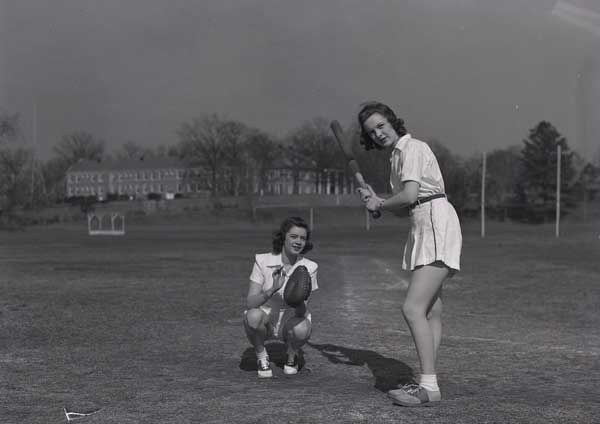
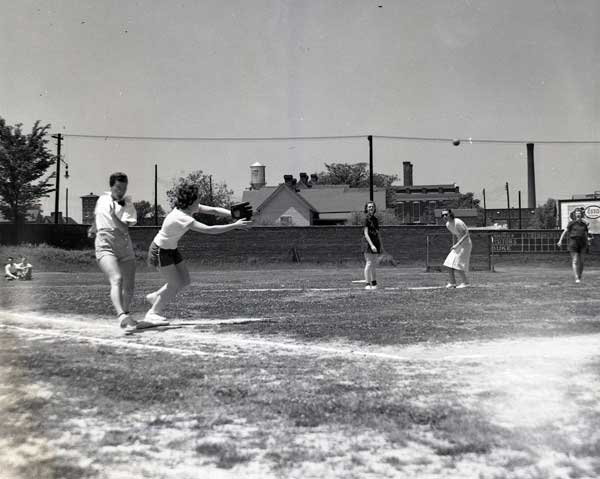
I’m currently working to inventory approximately 28,000 acetate negatives of Duke athletics from circa 1928-1982 and recently came across a few images of women playing baseball from as early as 1934 to as late as 1941.

Baseball, Women's Athletic Association, 1941
Baseball, Women’s Athletic Association, 1941

In the decades before Title IX, Duke women participated in sports activities organized by the Women’s Athletic Association.  The W.A.A. formed in 1929 as an “outlet for the athletic urge than the physical education classes were able to offer” and to provide a “program of sports activity for women, similar to that afforded to the men by the intramural athletic program.”   The W.A.A.’s purpose was to “stimulate interest in athletics, to provide a chance for those interested in sports to develop more skill, and to give the women opportunities for fellowship and recreation.”

Baseball, Women's Athletic Association, May 6, 1939
Baseball, Women’s Athletic Association, May 6, 1939

In addition to baseball (not softball), women competed in tennis, golf, track & field, equestrian events, field hockey, soccer, fencing, swimming, basketball, and archery. The W.A.A. also sponsored several events and activities, including dances, weekend parties, hikes, and open houses in the gym.  It also used a point system to determine which 10 seniors received a blue “D.”  The 7 seniors who accrued the highest number of points received white sweaters with the blue “D” attached.

Post contributed by Kim Sims, Technical Services Archivist for the Duke University Archives.

New Acquisitions: Scenes from the Life of St. Catherine

In June and July we’re celebrating the beginning of a new fiscal year by highlighting new acquisitions from the past year. All of these amazing resources will be available for today’s scholars, and for future generations of researchers in the Rubenstein Library!  Today’s post features a remarkable addition to the Sallie Bingham Center for Women’s History and Culture. Check out additional posts in the series here.

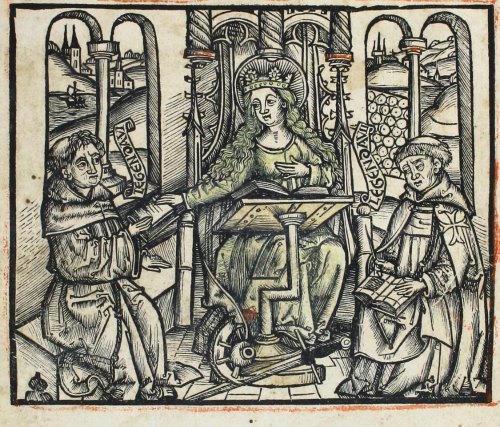
The Library has acquired a rare incunable (item printed from moveable type in Europe before 1501), the Legenda de Vita S. Catharinae by Frater Petrus, published in Strasbourg on April 6, 1500.  It tells the story of St. Catherine of Binding of Legenda Vita de s. Catharinae, Strasbourg, 1500Alexandria, one of the most popular and important saints in late medieval Europe, and an enduring icon of women’s learning.  She was said to have won a debate with the Roman emperor’s elite philosophers over the value of Christianity, leading to her imprisonment and torture on the breaking wheel, now often called the Catherine wheel.

This edition includes seventeen beautiful woodcuts attributed to the artist known as the “Master of Terence,” who worked frequently for the book’s publisher, Johann Grüninger. The copy now in the Rubenstein Library, just the third known copy in an American institution, also features a contemporary binding with elaborate tooling and a brass clasp, and extensive rubrication both in the text and bordering the woodcuts.  It will reward a variety of research approaches, from literary scholars interested in book history and the popular medieval genre of saints’ lives to those working in women’s history, religious history, and art history.

New Acquisitions: Tarzan, Batman, and Alien Invaders, En Français

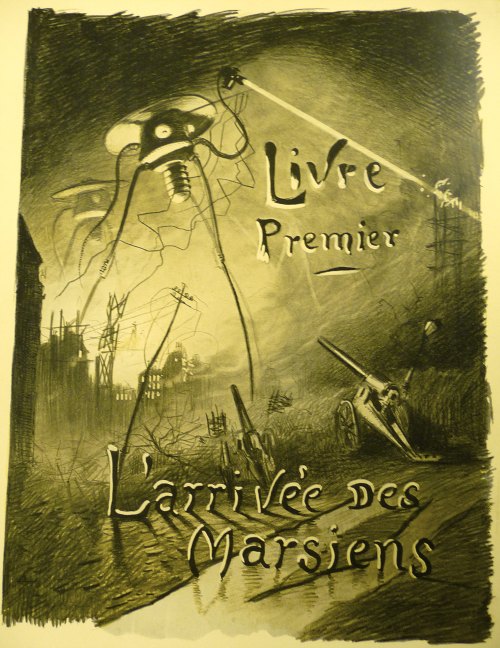
CorreaWarWorlds1In June and July we’re celebrating the beginning of a new fiscal year by highlighting new acquisitions from the past year. All of these amazing resources will be available for today’s scholars, and for future generations of researchers in the Rubenstein Library! Today’s post features new items in the Library’s Negley Collection of Utopian Literature and its comic book collections. Check out additional posts in the series here.

One of the most influential books in science fiction history, H. G. Wells’s The War of the Worlds, was an immediate sensation upon its publication in 1898.  Famously adapted for radio, film, and television, the work received perhaps its most beautiful visual interpretation in the limited edition of Henry Davray’s French translation, La Guerre des Mondes, published in Brussels in 1906 with stunning illustrations by Henrique Alvim Corrêa.

The book features 32 plates as well as over 100 illustrations within the text.  Corrêa, a Brazilian painter and illustrator who lived in Belgium for most of his life, captured the intensity, grand scope, and wonder of Wells’s vision of interplanetary invasion in his atmospheric, energetic compositions.

CorreaWarWorlds2

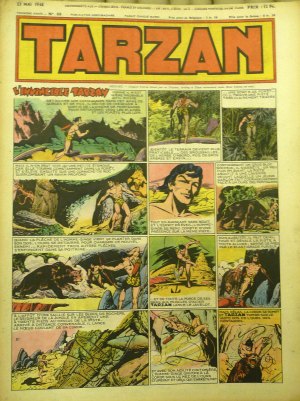
tarzan1Another new acquisition demonstrates, in a different format, the burgeoning global appeal of genre fiction adapted to visual form in the twentieth century.  A complete run of 293 issues of Tarzan, a comics series published in Paris between 1946 and 1952, features the adventures of Edgar Rice Burroughs’s famous creation in vivid color.

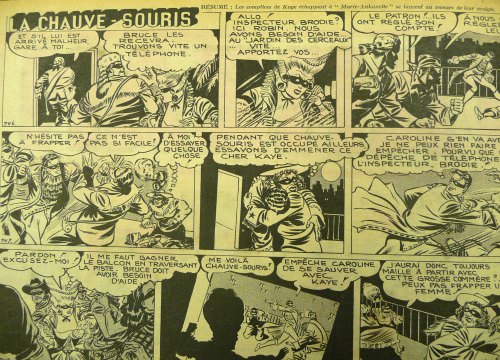
The first 71 issues also feature a French adaptation of the newspaper comic strip featuring Batman, La Chauve-Souris (The Bat), by the famous French science fiction illustrator, René Brantonne.   These American adaptations ran alongside comics adaptations of French classics such as Les Miserables.

The Rubenstein Library now holds the only known copy of this periodical in the United States, which appears to be very rare in institutional holdings even in France.

A French adventure of Batman and Robin. dressed as Louis XIV and Marie Antoinette.