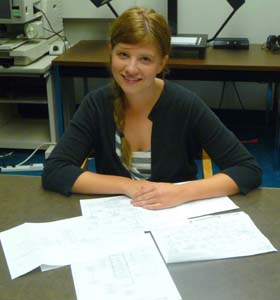
Ann Mack, Director of Trendspotting at JWT will talk about 10 Trends that will Shape the World in 2012 and Beyond, sharing details on some of the key trends that brands will need to understand in the years ahead. Mack will outline these changes in the global zeitgeist, explain what’s driving them, and detail how they’re starting to play out in society. She will also discuss the role of trends at JWT and her process, as well as her career trajectory.
The event is free and open to the public. For more information, visit the lecture series website.
This 20th Anniversary Lecture Series event is sponsored by the Duke University Office of the Provost, Fuqua School of Business, Trinity College of Arts & Sciences, Markets & Management Studies, Duke Marketing Club, and JWT.
Post contributed by Jacqueline Reid Wachholz, Director of the John W. Hartman Center for Sales, Advertising, and Marketing History.
In an earlier blog post, we mentioned that we’ve been processing thousands of sports-related negatives and prints transferred to the Duke University Archives by Duke’s Sports Information Office.
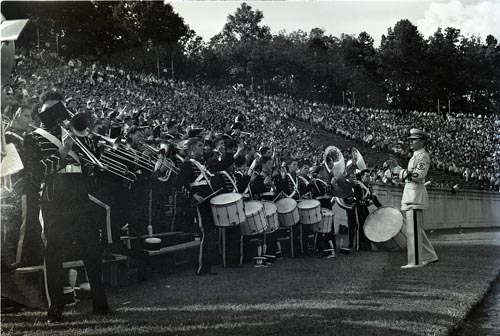
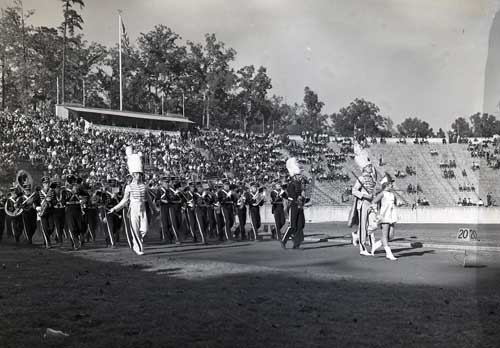
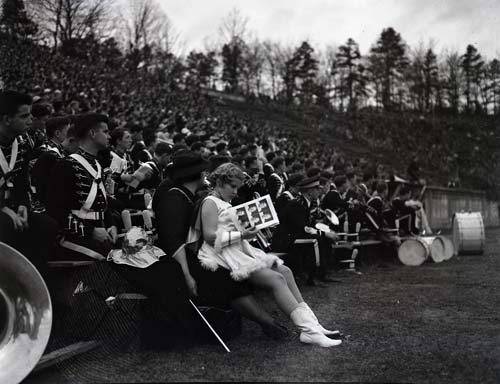
I recently began reviewing images from the 1930s and 1940s. In envelopes labeled “football sidelights” are negatives of the Duke University Marching Band, fondly known as DUMB.
In existence since the early 1900s, DUMB is an integral part of Duke sports, providing music and vocal support at games, and has established a reputation for performing creative and highly entertaining halftime shows. For more information, take a look at the finding aid to DUMB’s own records, part of the University Archives’s collections. Below are a few of my favorite images.
Duke University Marching Band, October 7, 1939Duke University Marching Band Drum Line, October 21, 1939Duke University Marching Band, October 28, 1939Majorette Lucille King and her Mother, November 19, 1938Duke University Marching Band and Blue Devil, 1940
This past Saturday, Duke’s football team defeated Wake Forest, 34-27 (Go, Duke!).
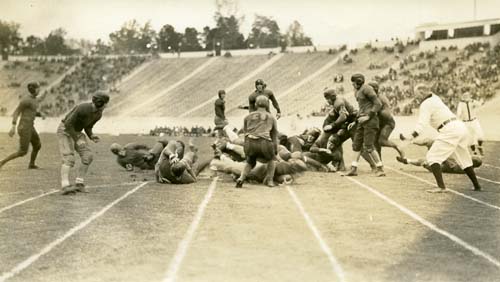
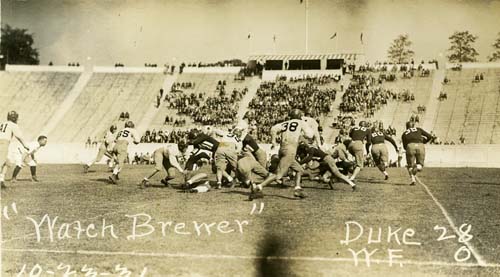
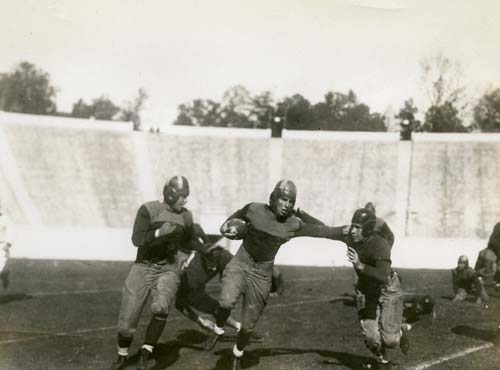
In honor of this victory, the Duke University Archives thought it would be fun to share some historical photos we recently received from the Sports Information Office. These action shots are from football games in 1931 and 1932 show Duke playing (and defeating: 28-0 in 1931 and 9-0 in 1932) Wake Forest.
Duke vs. Wake Forest, October 1931Duke vs. Wake Forest, October 1931Duke vs. Wake Forest, October 1932Duke vs. Wake Forest, October 1932
For the last two months, I have been processing a large accession of materials from the Duke Sports Information Office. The vast majority of the accession consists of photographs and negatives from Duke football teams, served with a side of basketball and seasoned with photos of other teams and individual athletes. As you can imagine, I have gone through many generations of athletes, coaches, and of course, fashion trends. This post is dedicated to a few assistant football coaches who weren’t afraid to show add some fashion flair to their official photos.
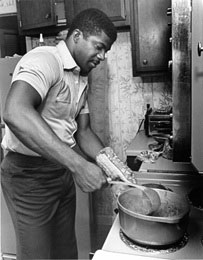
Assistant Football Coach John Guy shows us his kitchen style. The no-apron look was very in that season.
I should also say outright: I love sports, particularly college athletics. I did my undergraduate work at a football school. I have free t-shirts from at least a dozen other athletic teams at my undergrad school. My graduate degrees are from . . . well, another school in the Triangle with a basketball team. As a result, processing this collection has been a lot of fun for me.
Assistant Football Coach David Holton is a man who is not afraid of mixing patterns and textures in his outfits. Stripes, plaid, and corduroy: very boho-chic.
During my time processing the Sports Information Collection, I’ve noticed something about the coaching staff photos: although the head coaches by and large have fairly tame outfits, the assistant coaches most certainly do not. Perhaps they want to ensure that players can see them on the sideline/courtside? Maybe they just love mythologically-inspired ties? We’ll probably never know for sure!
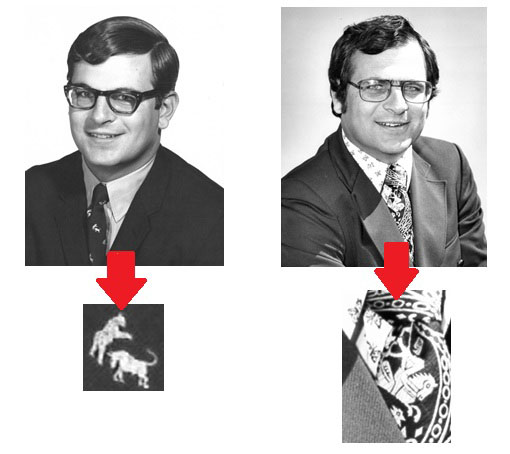
The photos above showcase the ties of Freshman Football Coach John Gutekunst. I’ve taken the liberty of calling out the patterns on both so that you can see in better detail. Clearly, Gutekunst stayed with the animal theme over the course of his career—by the later picture, he even ventured to wear a butterfly shirt with the mythological tie!
To close out this post, I think we should all tip our hats to the adventurous styles of these assistant football coaches. They have showed us how to look cool on the sidelines, in the kitchen, and in your formal yearbook photos. Keep up the great work!
Now tell me: who’s your style icon? Are you channeling Guy’s daring “no-apron” look, Holton’s mixed patterns and textures, or Gutekunst’s animal-themed accessories?
In the end, we created 32 record groups to represent the history, the administrative departments, and the schools of Duke University. Each group speaks to the breadth of material that tells the story of Duke University and its distinguished alums. While going through each record, and carefully determining its placement in the records groups, I uncovered some fascinating collections. Here are some of my favorites:
1. Sarah P. Duke Gardens Records, 1932-2002. The Duke Gardens is a horticulturist’s sanctuary. As a garden hobbyist, I have enjoyed spending time marveling over its beautiful design of plant life and winding paths. This collection shows the vision of the gardens from the beginning when Mary Duke Biddle donated the land in 1932. Included are blueprints and planting plans that any gardener would relish viewing first hand.
2. Randall Frattini Papers, 1974. University Archives has a copy of Frattini’s eyewitness account of students streaking on campus on the nights of February 28 and March 1, 1974. Albeit comical, this collection also suggests the wide variety of records that document student life at Duke in the Duke University Archives’ collections.
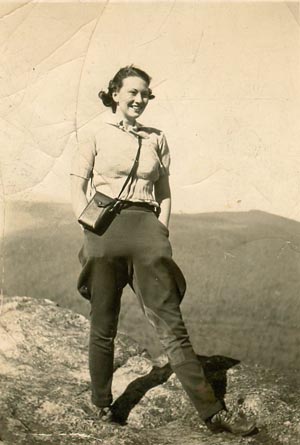
Elizabeth Hatcher Conner on an Explorers Club Outing, ca. late 1930s
3. Elizabeth Hatcher Conner Photograph Collection. Elizabeth Hatcher Conner attended the Woman’s College during the late 1930s. During that time, she was an active photographer and she often documented the outdoor adventures of the Explorer’s Club. The Explorer’s Club was a group of faculty and students who use to go hiking throughout North Carolina. Her photos give a glimpse into the lives of students at Duke during this time period. Check out some of her photographs on our Flickr site!
These three collections only scratch the surface of the hundreds of records documenting the institutional memory of the University. If you are interested in learning more about the University’s history including a particular school, student life, or athletics; contact University Archives and they can help you uncover your own record gems.
Several other contributors to this volume have Bingham Center connections, including co-editor Lyz Bly, Alison Piepmeier, and Kate Eichhorn, all Mary Lily Research Grant recipients; Sarah Dyer, donor of the ground-breaking Sarah Dyer Zine Collection; and Angela DiVeglia, former intern.
Make Your Own History has chapters about colleting zines; documenting the LGBT community: the future of collecting electronic and online records; and a look at how the Second Wave continues to contribute to the feminist movement. Read more about this book or buy a copy online from Litwin Books.
Post contributed by Laura Micham, Merle Hoffman Director of the Sallie Bingham Center for Women’s History and Culture.h
Dixon wrote in an email to Bingham Center archivists:
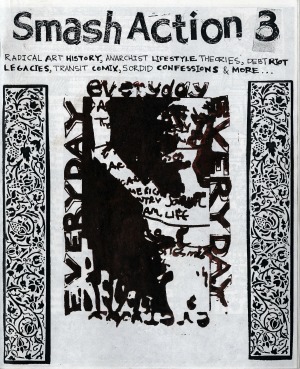
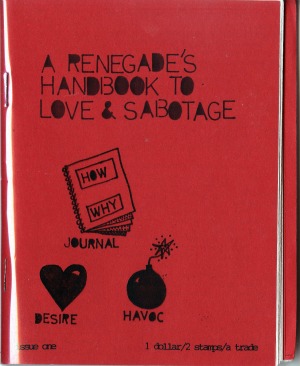
While DJing a party last night at a professor’s house, I was told by a faculty member in the Music Dept that my zine collection was being used by a grad instructor teaching a course on punk history. I was so thrilled, as you can imagine, and it inspired me to unbox the last treasured horde of zines. I must confess I held the best in reserve in my initial donation. I have approx. 68 zines that are aesthetically, politically, and creatively rich. Hand-screened covers, some of the best zine writing ever, and incendiary politics that changed my life. I want others to be moved, too—by Mimi Nguyen’s Slander zine, by [anonymous’] Quiet Nights of Quiet Stars zine, by the dense tangle of punk and race and gender and a changing America of the last 2 decades.
As Dixon mentions in his note, classes frequently use zines as a resource for learning. As with any other historical manuscript or artifact, zines help illuminate specific aspects of culture through their method of creation and their content. Zine authors use the freedom of the medium to confront important cultural issues as well as to divulge their own reflections and emotions. The handmade nature of zines also allows for more artistic presentations of information, creating visually engaging objects that also serve as reading material.
While zine culture still exists in a variety of vibrant formats, the movement was at its most powerful from the late 1980’s to the mid-1990’s. During that time, Dixon snapped up a great number of these publications and eventually gifted them to the Bingham Center in 2001 with an initial donation of over a hundred zines. Including the latest addition, the Dixon collection now contains almost two hundred zines chronicling topics such as body image, depression, politics, racial inequality, history, and personal exploration.
The new addition has been added to the finding aid and is now available for research. Come take a look!
Post contributed by Rosemary K. J. Davis, Bingham Center volunteer.
In this month’s update of the CCC Project at Duke University, we are happy to announce the publication online of the records of Duke’s Department of African and African-American Studies. The items included in this collection document the beginnings of the department, the research and teaching of its faculty members, and the various social and cultural movements occurring within the African-American community during the 1970s and later. We encourage researchers to peruse the digitized documents, accessible from the collection inventory, to find a host of items sure to add to the scholarship of the long civil rights movement.
Our document spotlight for the month highlights the struggles that the African and African-American Studies Department, then known as the Black Studies Program, experienced in its earliest days. From its inception in 1969, the Black Studies Program had been offering several courses through adjunct faculty. Still, the Program lacked a director and its course slate remained minimal, although the Program did offer a major.
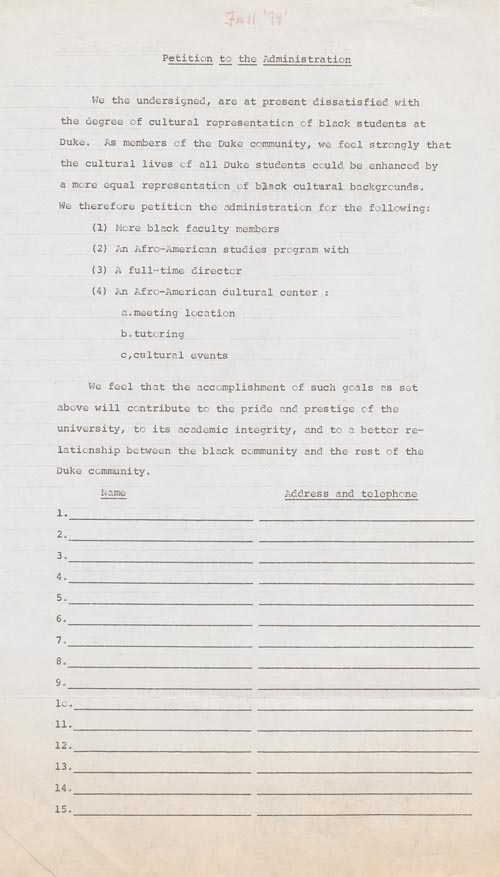
In addition, members of the African-American community at Duke contended that the university’s administration did not implement programs to encourage “black cultural representation.” The document shown below is a draft petition from late 1979 written by members of the African-American community at Duke asking the administration to ameliorate both the academic and cultural issues that hampered the growth of the African-American community at the university.
Draft Petition to Duke Administration Regarding Cultural Representation of the Black Community. Department of African and African-American Studies Records, Box 1, folder 30 (File ID daams01030169)
Although we do not have a completed petition in the Department’s records, the goals of the document did eventually become Duke’s policy. University administration would create new standards to recruit more African-American faculty members. In addition, the Program would soon become a fully-staffed Department. In terms of cultural engagement, the establishment of the Mary Lou Williams Center for Black Culture in 1983 helped to fulfill the demands listed in the petition. Researchers will now have the opportunity to learn even more about the beginnings of African-American Studies at Duke and how struggles for recognition led to a strong academic and cultural presence on campus.
The grant-funded CCC Project is designed to digitize selected manuscripts and photographs relating to the long civil rights movement. For more about Rubenstein Library materials being digitized through the CCC Project, check out previous progress updates posted here at The Devil’s Tale!
Post contributed by Josh Hager, CCC Graduate Assistant.
It’s a busy Friday afternoon, and many of us are eagerly anticipating the 5:00 PM ringing of the Duke Chapel carillon. Then, university carillonneur J. Samuel Hammond will play Dear Old Duke to send us off for two days of rest and relaxation.
On this day in 1939, though, the carillon drew 5,000 people to campus on a drizzly evening, as then-university carillonneur Anton Brees and visiting mezzo-soprano Mary Frances Lehnerts prepared to perform what Duke’s Alumni Register termed “America’s first vocarillon recital.”
The vocarillon concert (voice + carillon=vocarillon) was an innovation that Brees had brought with him from his native Antwerp, where he (and his father before him) served as carillonneur of that city’s cathedral. Brees, who gave the carillon’s inaugural performance as part of the 1932 commencement celebrations, spent his summers at Duke–he spent the remainder of the year as carillonneur at the Bok Singing Tower in Lake Wales, Florida–presenting popular weekly carillon concerts that drew visitors from all over the area.
A view of the crowd at the 1939 vocarillon concert.
On that August night in 1939, the concert-going crowd filled West Campus’s quadrangles, spilling all the way down Chapel Drive. Lehnerts sang five pieces, accompanied by Brees on the carillon, from the Chapel’s balcony, some 175 feet above her audience. The Durham Morning Herald reported that she “sang with no more effort than would be required in a small concert hall,” and yet concertgoers sitting by Few Quadrangle could hear her clearly.
Mary Frances Lehnerts performs during the 1939 vocarillon concert.
In between each of Lehnerts’s performances, Brees played solo pieces for the carillon. Here’s the evening’s program:
America (for carillon)
Somewhere a Voice is Calling by Arthur Tate (for voice and carillon)
Maryland, My Maryland (for carillon)
Homing by Teresa del Riego (for voice and carillon)
Gavotte in G minor by Johann Sebastian Bach (for carillon)
Holy Night by Franz Gruber (for voice and carillon)
I Can Hear My Savior Calling by Philip P. Bliss (for carillon)
Encores:
Only a Rose by Rudolph Friml (for voice and carillon)
Roses of Picardy by Haydn Wood (for voice and carillon)
Moonlight and Roses by Edwin Lamare (for voice and carillon)
The Last Rose of Summer by Friedrich von Flotow (for voice and carillon)
The Old Refrain by Fritz Kreisler (for carillon)
Dear Old Duke by R. H. James (for carillon)
Yes, that many encores. We wish we could have been there.
What is one way to become an expert in all things Duke? Go through all of its records!
Ashley Brown, the University Archives’ King Intern, reviews Duke organizational charts.
OK, claiming to be an expert in all things Duke may be a little ambitious, but I was able to learn a lot as the William E. King intern at the Duke University Archives. My name is Ashley and this summer I was tasked with creating a records group system for the University Archives.
A record group is “a collection of records that share the same provenance and are of a convenient size for administration.” To simplify this definition from the Society of American Archivists, a record group numbering system is one way for archivists to show how records originate within one entity such as Duke University. Each record group can be broken down into a subgroup, which corresponds to an organizational subdivision; and then the individual record makes up the smallest unit known as a series. Each record, subgroup, and series is given a number and the combination of those three numbers gives each record its unique identifier. Sound complicated? Here’s an example:
First, each college within the University is assigned its own record group and each department within each college is assigned its own subgroup. So, my first step for this record is to determine which college the Department of Zoology resides in. After a little research, I discover that Zoology no longer exists as a formal department but has been combined with Botany inside the Biology Department at Trinity College of Arts and Science. Therefore, this record would fall under the Trinity College record group, which happens to be record group 25, and the Biology subgroup (.11).
So, the record group identifier for this record would be: 25.11.001. The first number tells you the record group; the second number tells you the subgroup; and the third number is the individual series number.
Now let’s take the Botany records: Dept. of Botany records, 1932-1978 and assign it a number. It, too, is in Trinity College under Biology. So it would also begin 25.11 but its series number would be different to distinguish it as a separate collection. Its number is 25.11.002.
It is important to note thateach record group will include the records of its current organizational structure and any forms of that organization or department’s predecessors. For example, prior to the 1960s, the Provost position was titled “Vice President of Education.” Any records pertaining to the Vice President of Education or individuals who held that title will fall under the Office of the Provost Records Group (RG 5).
There are over 1,000 record collections at University Archives that span over 174 years. Each record collection needed be assigned a record number based on its provenance or origin of creation. This was no easy feat. So I spent my summer researching Duke history, examining organizational charts that go back over sixty years, and reading the finding aids of each collection. In doing so, I was introduced to an impressive array of presidents, faculty, staff, alumni, student groups, and others who have transformed Duke into the innovative institution that it is today. I also now have 32 record groups that help tell the story of Duke and its evolution through its records.
Over the next several weeks, I will be working alongside other University Archives and Rubenstein Technical Services staff to unveil the new numbering system. Stay tuned for my blog post, part two to hear about how we implement this project!


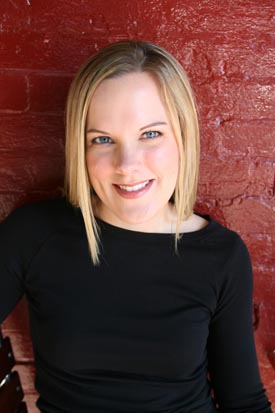
 Ann Mack, Director of Trendspotting at JWT will talk about 10 Trends that will Shape the World in 2012 and Beyond, sharing details on some of the key trends that brands will need to understand in the years ahead. Mack will outline these changes in the global zeitgeist, explain what’s driving them, and detail how they’re starting to play out in society. She will also discuss the role of trends at JWT and her process, as well as her career trajectory.