

 Things happen. Sometimes spectacularly and beautifully.
We hope your new year is off to a fine start.
All posts by Beth Doyle
Adopt A Book: The Perfect Gift
Looking for the perfect gift for the winter holidays? Look no further. Donating to the Duke Libraries Adopt-a-Book program not only helps the Library preserve its collections, it makes a great gift for family or friends. Donations are also calorie-free and don’t take up closet space! We have a few new items up for adoption, and a few other titles that are worthy of adoption that have been on the list for a bit.
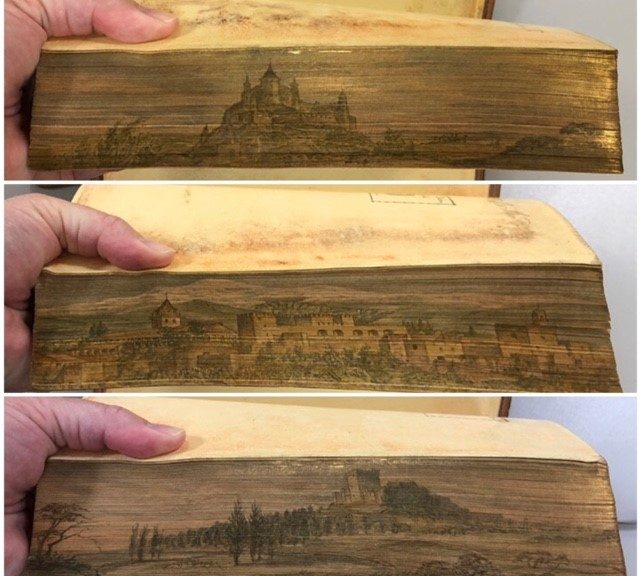
These three volumes of Don Quioxte have remarkable edge paintings that are still quite vibrant.
This collection of four titles are all in excellent condition but need custom enclosures to keep them that way. Matthew Alexander Henson‘s A Negro Explorer at the North Pole recounts his 1909 voyage to the North Pole with Robert Peary, where he may have been the first to reach the geographic North Pole. This voyage was one of seven voyages to the Arctic where he served as a navigator and craftsman for Peary.

Still in need of adopting are two sets of bindings by H. McLanahan. These may all be written by Bernard Shaw, but the McLanahan bindings are what make these books stunning.

If you are feeling really generous, there are the beautiful and stunning elephant folio Birds of American by John James Audubon. These bindings are huge, and three are in need of repair. A true statement gift!
 |

There are plenty more available for adoption. See our website for the complete list and benefits of adoption. If you can’t decide on a particular item, let us decide with a “Adopt a Box: Conservator’s Choice.” We always have great stuff in the lab that needs attention. We will choose something wonderful for you.
Preservation Underground will be on hiatus until January so that we can rest, recharge, and spend time with our families over the holidays. We hope to see you in 2022. Thanks for reading!

What’s In the Lab: Lovely Illustrations
We have had so many books come through recently with amazing illustrations. From butterflies to coral, travel images to bee flies, our eyes have feasted on some truly lovely images this week.
 |
 |
“The Natural History of Foreign Butterflies” by James Duncan is a beautifully illustrated book filled with vibrantly colorful butterflies. They look real enough to flutter off of the page.
 “Le Voyage de L’Isabella au Centre de la Terre” by Léon Creux and illustrated by Paul Coze is a beautiful book inside and out. We fell for this highly illustrated cover depicting a fanciful above- and below-ground image.
 “東海道五拾三次 / Tōkaidō gojūsantsugi” by 歌川国盛 / Kunimori Utagawa, is a lovely book of woodcuts of Tōkaidō printed circa 1840’s. The original outer box is a traditional Japanese book box with bone clasps, lined with printed paper. These two structures were some of the first I learned as a bookbinder.
 |
 |
“Plances de Sebe, Locupletissimi rerum natrualium thesauri” by Albertus Seba is filled with all sorts of amazing creatures. Coral and puffer fish are regulars on the Coral City Camera, a live underwater camera in Miami, Florida. The scientists behind this camera are studying urban coral growth and the effects of shipping traffic on the waterway in Biscayne Bay. I think they would like this book.
 Lest you think the only cool stuff we get is from special collections, check out the “Manual of Central American Diptera” edited by B.V. Brown, et. al. Who knew fly parts would be so intriguing.*
Some of these books are are here because the boxing was funded through our Adopt-a-Book Program. Others came from the Rubenstein Library reading room. This has been one of those weeks where we get to appreciate how beautiful books are as objects. We love our jobs!
*Bonus insect pic from the bookplate in “Plances de Sebe, Locupletissimi rerum natrualium thesauri” by Albertus Seba.

Things Come Apart–On Purpose
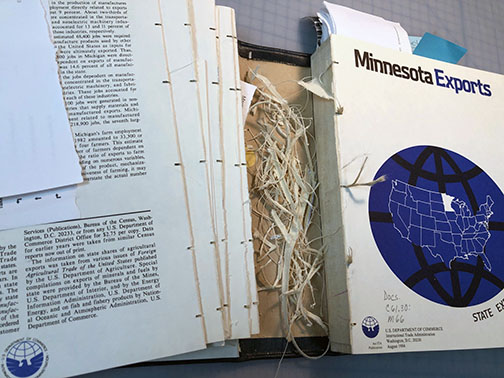
Occasionally we are asked to disbind books. Sometimes that is an easy task, but when it comes to library-bound serials from the mid 1980’s it isn’t so easy.
 Library binding is a specific process, there is even a NISO Standard for it. It’s a tough, made-to-last binding that includes sewing signatures around sawn-in cords, gluing the spine and applying a heavy spine lining, and creating a cover of heavy boards and durable buckram cloth. I love library bindings, they are indestructible by design and have a utilitarian-ness about them.
 But when you have to take one apart it can be challenging, and time consuming. Cutting the threads and carefully cutting through the spine lining between issues takes patience. There is always some damage that must be repaired later. The paper scarfs, or your knife slips and cuts the outer folio.
 Issue by issue I take it apart. I see the small knots in the thread where the person who sewed this added a new piece so she could keep going. It took time to bind this, and it was probably one of a thousand books that she bound that year.
 The evidence of her hand is a reminder that a skilled trades person put this together. Her sewing is still tight. She made that small knot, trimmed it carefully, and kept going until she had a three-inch thick volume sewn together, ready for casing in. Taking this apart is a reminder that not everything we do in Conservation is permanent. Sometimes we undo hours of care and labor. I honor the labor that it took to create this volume, even as I take it apart, smiling at each small knot I come across.
A Sticky Situation
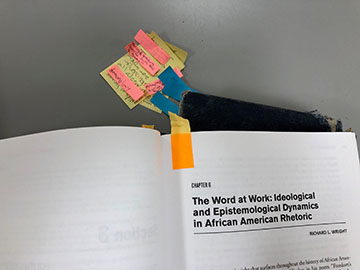
Sticky notes. We know they are useful for conveying information…

They can be good for taking notes…

But they can stain and leave adhesive residue…
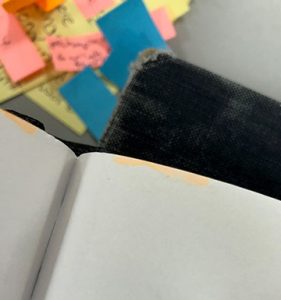
The dyes are also not particularly stable…
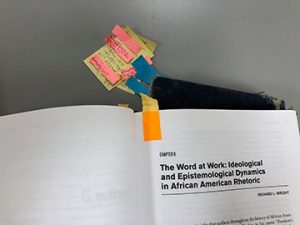
Although some sticky notes are dang cute…they really can damage paper by bleeding onto the text block, leaving behind a sticky residue, or causing tears in brittle paper when they are removed.
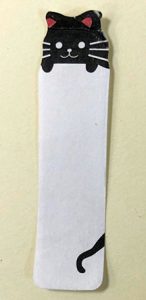
So please, if you use sticky notes in library books, please remove them as soon as you are finished with the book. That will reduce the damage down the road.

FY2021: By The Numbers
It’s annual statistics time! As you can imagine Covid-19 influenced our stats for this year. I don’t think any of us anticipated we would spend the first few months of the fiscal year working exclusively from home, and when we did return it was on a staggered schedule to avoid too many people in the lab at the same time. That said, we did get a lot done. While treatment numbers are down as expected, we did get a lot of training, conference attendance, and administrative work done from home.
FY2021 Statistics
409 Book repairs
503 Pamphlet bindings
0 Treatments: Other (objects, textiles, etc.)
410 Flat Paper repairs
1,293 Protective enclosures
300 Disaster recovery
2 Exhibit mounts
48 Hours in support of Exhibits (meetings, treatment, installation, etc.)
443 Digital preparation repairs
23.25 Hours in support of Digital Projects (meetings, consultations, handling, etc.)
41 % of production was for Special Collections
59 % of production was for Circulating Collections
62.2% of work was Level 1 [less than 15 minutes to complete; 1813 items]
34.2% of work was Level 2 [15 minutes – 2 hours to complete; 998 items]
3.2% of work was Level 3 [2 – 5 hours to complete; 94 items]
0.3% of work was Level 4 [more than 5 hours; 10 items]
This is the first year that we added a Level 4 treatment (5+ hours). This differs from the old ARL/ALA Preservation Statistics where Level 3 (3+ hours) was the longest hourly bucket you could put treatments into. We felt this didn’t give us enough of an idea of how very lengthy treatments fit in to our overall output.

Creating custom enclosures has always been a large percentage of our yearly output. This year the total percentage of work that were enclosures was 44%, very close to the historical percent average. With the Lilly Renovation Project ramping up again, we expect to see larger numbers in this category for the next couple of years.

Other Things We Did Last Year
- We hosted 0 tours of the lab totaling 0 people
- We presented 7 Care and Handling Training sessions to DUL staff totaling 5 people
- We hosted our third HBCU Library Alliance/University of Delaware-Winterthur conservation intern.
- We worked on some cool things like moving some paintings in preparation of the Lilly Library renovation, expanding our environmental monitoring program, creating some awesome sewing models, finding the time to finish repairs, disaster recovery, and we found some new uses for tools.
- We spent our Work From Home hours teaching ourselves new bindings, reviewing our documentation, and taking advantage of all the resources that were opened up in 2020. We really value the sharing that happened in 2020/2021 and hope we have learned that we don’t need to hide our all our professional resources behind paywalls forever.
- Unfortunately we didn’t hire student assistants this year. Fingers crossed for spring of 2022.
- We also said goodbye to Mary Yordy, who retired after many years of service to the Library.
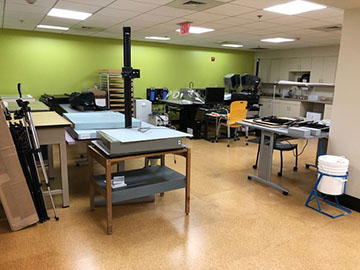
It Takes a Village to Clean the Floors
This week was a very busy week in Conservation. We had the floors cleaned and sealed. “Easy enough,” you say? It literally took one week, a moving company, the flooring company, Facilities, Housekeeping, Facilities and Distribution Services, and of course a lot of work from Conservation staff.
Phase 1: Move half of all the things!
Before the equipment could be moved, lab staff had to shift all the books onto carts, label all the equipment and furniture, move sensitive equipment like the encapsulator, etc. Once that was done, the movers came and shifted half the lab to one end.

The fun part was uncovering the floors that have never seen light. This is what the cork looked like when it was installed in 2008!

Even with the light differences you can really see how the cleaning and sealing has improved the look of the floors. They feel so much better, too.

Phase 2: Move all the things to the other side of the room!
Once the first half of the cork floors were cleaned, all the furniture and equipment had to move to the opposite side of the room. We decided not to move heavy things like the two board shears and the flat files.

Mid-week we helped move some paintings. We also worked on several projects that were not located in the lab including some work for the Lilly renovation and helping in Technical Services with some boxing.

Phase 3: Move all the things back, then move some more things!
Lastly, the floors in the store room and photo documentation room got cleaned. To facilitate that work we moved what we could out of those rooms into the lab.

Those floors are now nicely cleaned thanks to Housekeeping. They have never looked this shiny even when they were new!

We are so happy to have this work done. We know it took a lot of coordination and time, and the disruption was real for all the departments involved. Thanks to everyone who helped make this happen!
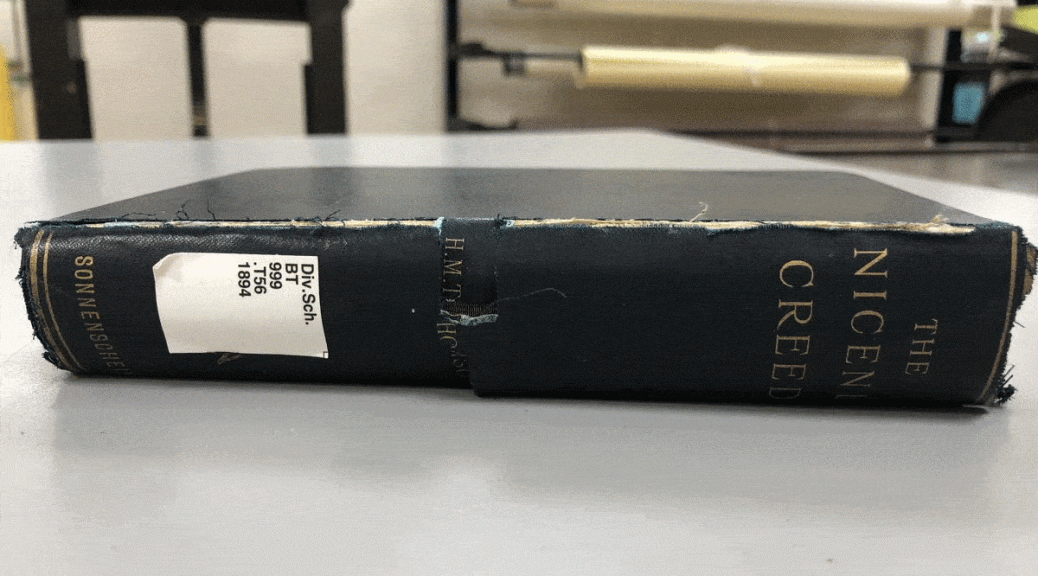
Quick Pic: Conservation Peek-a-Boo
Guess who we found today. Click on the picture to find out. 
A Mysterious Leather Technique
By Mary Yordy, Senior Conservation Technician
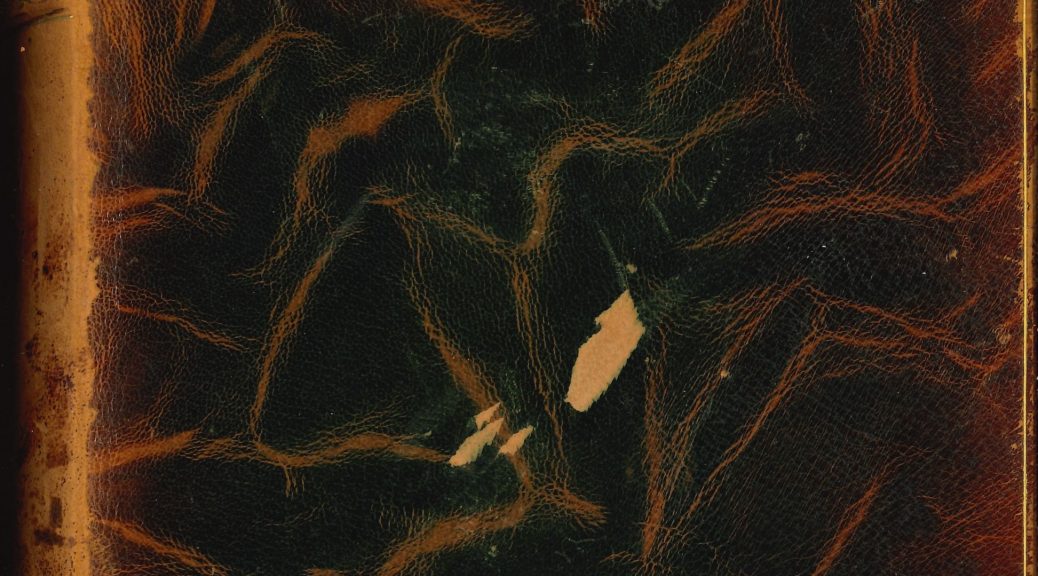
The ghostly, rhythmic creased pattern in the leather covering this volume caught my eye when the set came through the lab for boxing. I wondered how it was done and if the technique had a name. I consulted with coworkers, but no one had seen anything quite like it. This first suggestion of the rarity of the technique was born out by additional efforts to share this image on social media and search down any leads in the literature on leather decoration. I was invited to compose a blog post about this unanswered question, which we present as an invitation to any of our followers who could shed light on the subject.
For lack of a known and accepted, term, I am calling the leather effect ‘crazed,’ indicating it’s similarity to finishes seen in ceramics and paint finishes. Inside the volume, the leather around the paste down and the leather hinge material are dark green, so this was presumably the original color of the leather, difficult to determine on the more degraded exterior. The leather must have been given this crazing prior to application to the structure.
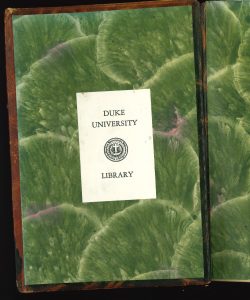
The book is in Russian, v. 3 of an 8 volume set of Works of Pushkin published in St. Petersburg from 1903-1905. Oddly, only this one volume is full leather with ‘made’ end sheets using an inner hinge of the same leather and paste paper—the volumes before and after v. 3 are quarter bindings using the same leather on the spine and corners with book cloth sides and standard printed end sheets.
A member of a group to which I posted the image shared a photo revealing similar creasing in the leather covering a Spanish binding (Rosy Gray, on Bookbinding Art and Conservation on Facebook). The image she shared was of a much more colorful leather volume, and from an earlier historical period, but looking closely I could see that creasing was indeed part of the effect. She was experimenting to create the effect but had found little to guide her in the available literature.
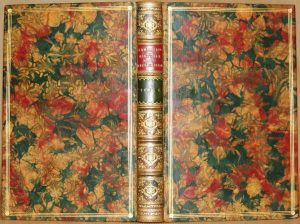
Most embellishments of leather in binding (such as tree calf) occur after binding, but the crazing of this leather must have occurred prior to the application of the leather. If the methods used in Spanish Calf Marbling of the 17th-18th came more fully to light I suspect this would be true of it as well. Without knowing if I was getting warmer or colder I took the time to track down what information I could find about what is variously termed Pasta Espanola, Spanish Marbling, and Spanish Calf Marbling. English language materials on Spanish bookbinding history are scarce, with just a few examples of this style available for view online and no concrete descriptions of methods.
So the question remains. Has anyone seen this form of leather decoration before? Do you know of a term for it or how it was executed? An interesting question that might follow a definite identification of the technique as Spanish in origin would be how it happened to be used in Russia in the early 20th Century. Dissemination of a technique isn’t always how things come about—sometimes we are seeing completely separate iterations of an idea. It could be worth considering the fact that this volume was bound in a historical period that hosted the International Workingmen’s Association (Second) and various experiments in organizing industrial and trade work across borders, as well as significant industrial strikes.
Mary Yordy, Senior Conservation Technician, is retiring after over 30 years of service to the Libraries, almost 20 of those in Conservation. She leaves us with this unanswered question, and tens of thousands of items that have been repaired or boxed by her hands. You can see the impact of her work on every floor of the library. We will miss her presence in the lab. Thanks Mary! –Beth
Here’s a few of our favorite posts from and about Mary:
Sewing Models: Pandemic Edition
Look it up: The Encyclopedia Britannica 11th edition
Learning Together: Leather repair
10 Years, 10 People: Mary Yordy, Senior Conservation Technician
Preservation Week: Maintaining the circulating collections
Welcome to Our New Intern Justus Jenkins
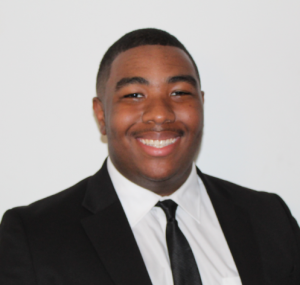
We would like to welcome Justus Jenkins, our summer HBCU Library Alliance intern. Justus is a student at Claflin University. He is one of eight students studying preservation this summer through the University of Delaware/HBCU-LA internship program.
This year the program is again being presented online due to COVID-19 restrictions. Interns will be meeting together twice a week with their cohort. Each session will be taught by one of the host sites. We are teaching a class on Archives Conservation Issues, and co-teaching with staff from the Library of Congress to teach some simple bookbinding structures. We will be teaching the Metamorphosis, and this zine.
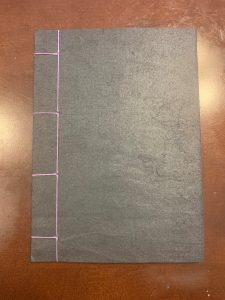
For his capstone project, Justus has decided to create a portfolio of bookbinding models. Over the next several weeks he will work with Conservation staff to learn Japanese stab bindings, Longstitch binding, Coptic binding, pamphlets, and zines. The University of Delaware sent all eight interns a box of tools and supplies for the term. We put together a box of materials and bookbinding kits and sent that to Justus.

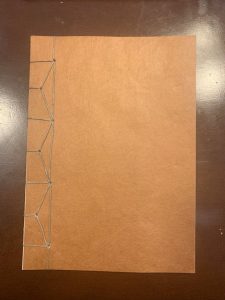
We started last week with a simple pamphlet, and the Japanese stab bindings.
|
|
|
|---|---|
|
|
|


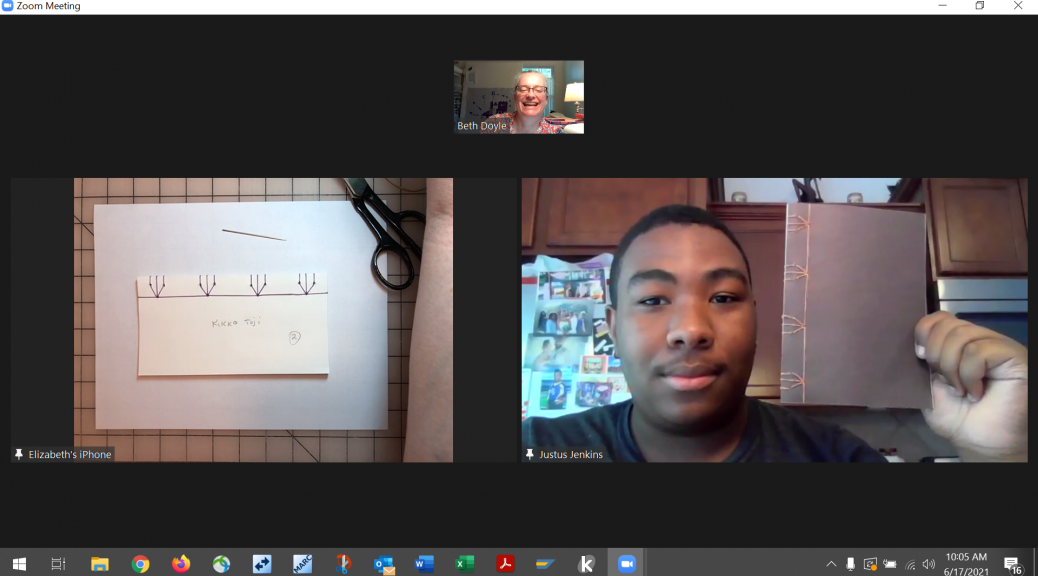
This was the first time I taught a bookbinding class over Zoom. I don’t have a fancy set up at home, but I was able to use a variety of boxes and crates to set up my laptop and phone in a way that worked. I used the laptop camera for my head shot, and set up my phone so that it hovered over the work area. By pinning my “hand cam” and Justus’ cam, I could see both at the same time.


Justus did a great job on his first bindings. He was a patient student as I learned how to do this along with him. We look forward to seeing his next book!