
Introducing the 2012 Nobel Laureate Economist’s Papers

Alvin Roth, from http://scholar.harvard.edu/roth.

The 2012 Sveriges Riksbank Prize in Economic Sciences in Honor of Alfred Nobel (commonly known as the Nobel Prize) was awarded yesterday to Alvin Roth and Lloyd Shapley “for the theory of stable allocations and the practice of market design.”  We in the Rubenstein Library were delighted to hear this, as the Alvin Roth Papers arrived here last year and are now available for scholarly use as part of the Economists’ Papers Project.

Much of Roth’s work involves decision-making and matching within markets; perhaps the most important real-world application of his ideas involves more efficiently matching organ donors to those in need of a transplant.  His papers at the Rubenstein include drafts of his writings on these and other topics, a wealth of information from Roth’s early career at the University of Pittsburgh, and correspondence with dozens of economists including his fellow Nobel laureate Lloyd Shapley, Robert Aumann, and many more.

The Alvin Roth Papers join many other important collections in the Economists’ Papers Project in game theory and market design, including the papers of Leonid Hurwicz, Oskar Morgenstern, Martin Shubik, and Vernon Smith.  Congratulations, Professor Roth!

Post contributed by Will Hansen, Assistant Curator of Collections. 

A Conversation with 2012 MacArthur Fellow Laura Poitras

Date: Wednesday, October 24, 2012
Time: 6:00 PM talk, 7:00 PM reception
Location: Nasher Museum of Art at Duke University
Contact information: Kirston Johnson, 919-681-7963 or kirston.johnson(at)duke.edu

Join us for an evening with documentary filmmaker and MacArthur “Genius Award” recipient Laura Poitras at Duke’s Nasher Museum. Known for her incisive and nuanced portraits of individuals that emerge in and from wartime in the Middle East and New York City, Poitras is an Emmy and Academy award nominated filmmaker. Her films, My Country, My Country and The Oath won numerous awards including the Inspiration Award and the Special Jury Award at the Full Frame Documentary Film Festival respectively.

Arts advocate, historic preservationist, author and accomplished television interviewer Barbaralee Diamonstein-Spielvogel will facilitate the discussion.

Duke University has established the Barbaralee Diamonstein-Spielvogel Visiting Filmmaker Series to feature artists whose work addresses significant contemporary topics of social, political, economic, and cultural urgency.  Filmmakers chosen to participate have a recognized body of work and show promise of future contributions to documentary filmmaking.  Visiting filmmakers are invited to Duke for a two-day residency.

The Diamonstein-Spielvogel series is unique in its exclusive attention to documentary filmmakers with a global perspective.  By giving Duke faculty and their students an opportunity to explore the films of socially engaged filmmakers and discuss the work with them, this new series hopes to inspire and encourage the next generation of young documentarians.

Co-sponsored by the Rubenstein Library, the Program in the Arts of the Moving Image, Screen Society and the Center for Documentary Studies.

The Future of Trendspotting: JWT’s Ann Mack

Date: Thursday, October 18, 2012
Time: 5:00 PM reception, 6:00 PM talk
Location: Gothic Reading Room, Perkins Library
Contact information: Jacqueline Reid Wachholz, 919-660-5836 or j.reid(at)duke.edu.

The John W. Hartman Center for Sales, Advertising & Marketing History at Duke University celebrates its 20th Anniversary in 2012 with a lecture series of advertising luminaries. Please join us next Thursday for the third talk in the series.

Ann MackAnn Mack, Director of Trendspotting at JWT will talk about 10 Trends that will Shape the World in 2012 and Beyond, sharing details on some of the key trends that brands will need to understand in the years ahead. Mack will outline these changes in the global zeitgeist, explain what’s driving them, and detail how they’re starting to play out in society. She will also discuss the role of trends at JWT and her process, as well as her career trajectory.

The event is free and open to the public. For more information, visit the lecture series website.

This 20th Anniversary Lecture Series event is sponsored by the Duke University Office of the Provost, Fuqua School of Business, Trinity College of Arts & Sciences, Markets & Management Studies, Duke Marketing Club, and JWT.

Post contributed by Jacqueline Reid Wachholz, Director of the John W. Hartman Center for Sales, Advertising, and Marketing History.

This Post is DUMB

In an earlier blog post, we mentioned that we’ve been processing thousands of sports-related negatives and prints transferred to the Duke University Archives by Duke’s Sports Information Office.

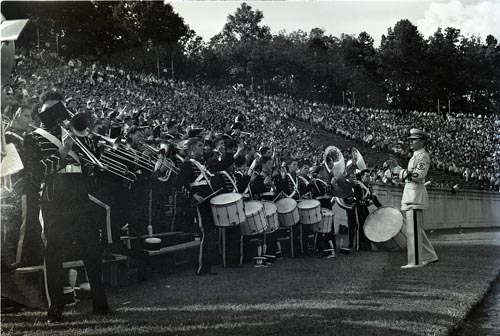
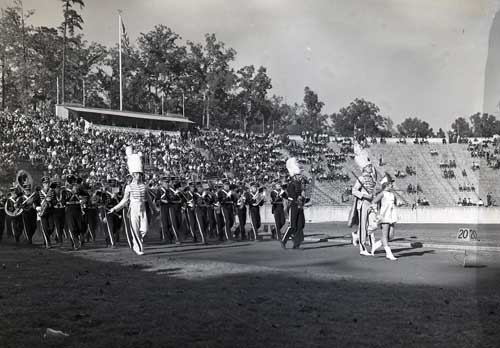
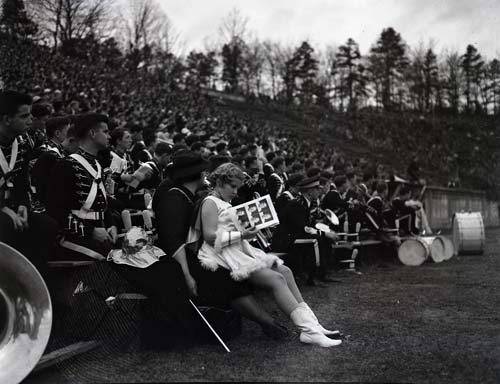
I recently began reviewing images from the 1930s and 1940s.  In envelopes labeled “football sidelights” are negatives of the Duke University Marching Band, fondly known as DUMB.

In existence since the early 1900s, DUMB is an integral part of Duke sports, providing music and vocal support at games, and has established a reputation for performing creative and highly entertaining halftime shows.  For more information, take a look at the finding aid to DUMB’s own records, part of the University Archives’s collections.  Below are a few of my favorite images.
Duke University Marching Band, October 7, 1939
Duke University Marching Band Drum Line, October 21, 1939
Duke University Marching Band, October 28, 1939
Majorette Lucille King and her Mother, November 19, 1938
Duke University Marching Band and Blue Devil, 1940

Post contributed by Kimberly Sims, Technical Services Archivist for Duke University Archives.

Defeating the Demon Deacons in the 1930s

This past Saturday, Duke’s football team defeated Wake Forest, 34-27 (Go, Duke!).

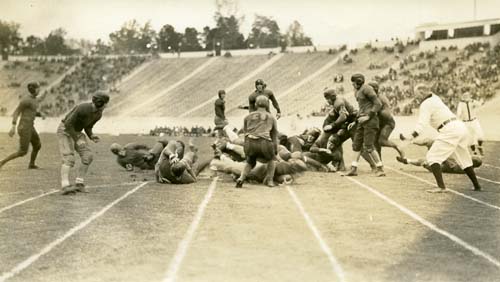
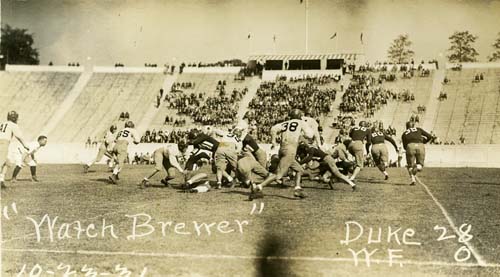
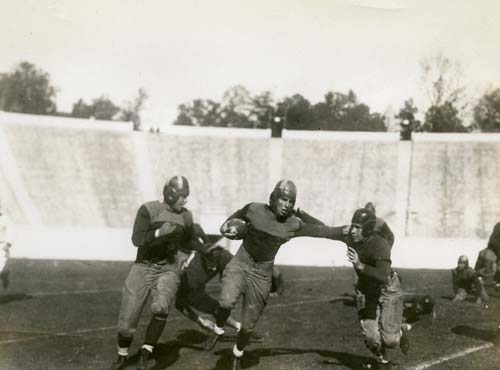
In honor of this victory, the Duke University Archives thought it would be fun to share some historical photos we recently received from the Sports Information Office.  These action shots are from football games in 1931 and 1932 show Duke playing (and defeating: 28-0 in 1931 and 9-0 in 1932) Wake Forest.

Duke vs. Wake Forest, 1931
Duke vs. Wake Forest, October 1931
Duke vs. Wake Forest, October 1932

For more Duke football, check out our digital collection of Duke football game program covers or our set of football team photos on Flickr. Or, stop by the University Archives and look through the Football Records!

Post contributed by Kimberly Sims, Technical Services Archivist for Duke University Archives.

Digitizing the LCRM: Update #5, Getting Out the Vote

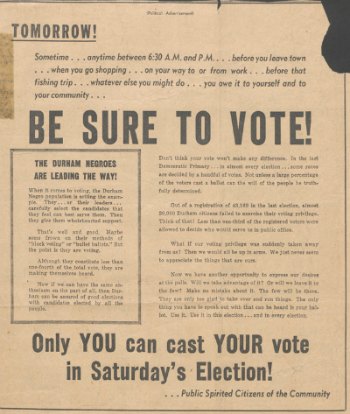
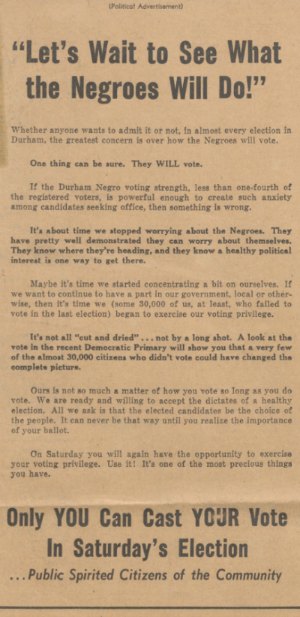
With election fever infecting a large part of the country, it is only appropriate that this month’s featured documents from Duke’s CCC Project digitized collections are newspaper advertisements about voter turnout from the Rencher Nicholas Harris Papers.  What makes these documents particularly interesting—and disturbing—is the demographic group that they targeted:  white voters frightened about the perceived usurpation of power by an African-American voting bloc.

Political Advertisement, Undetermined Newspaper, [May 1949?]:
Rencher Nicholas Harris Papers, Box 10, Folder 2.
Political Advertisements, Undetermined Newspaper, [May 1949?]:
Rencher Nicholas Harris Papers, Box 10, Folder 2.
These advertisements likely appeared in one of Durham’s newspapers in the days before the local elections of May 1949.  I determined the probable date by looking at the other materials in the Harris Papers located near these clippings.  Two possible dates emerged—May 1949 and November 1956.  While both dates are plausible, the fact that the advertisements speak specifically to Durham’s leadership rather than a presidential or gubernatorial election makes 1949 more likely.  In addition, the fact that Election Day was a Saturday is another strike against 1956.  We encourage readers of this blog to decipher the exact date of these advertisements as well as their original newspaper(s) and the persons behind the generically-named “Public Spirited Citizens of the Community.”

Beyond determining the provenance of these advertisements, we anticipate that most readers will find these advertisements most interesting for their racial arguments.  The fears that undergirded these advertisements relied on the two-pronged belief that African-American voters would turn out in large numbers and that all of those voters would cast their ballots monolithically.  While the language in the advertisements is clearly prejudiced, its reliance upon believing that African-American leaders were successfully organizing get-out-the-vote efforts is an oddly-backhanded compliment to Harris and his political allies.  The language in these advertisements is ripe for further analysis, so we encourage our readers to dive in and become immersed in the racial and political history of Rencher Nicholas Harris’s time on the Durham City Council.

The grant-funded CCC Project is designed to digitize selected manuscripts and photographs relating to the long civil rights movement. For more about Rubenstein Library materials being digitized through the CCC Project, check out previous progress updates posted here at The Devil’s Tale

Post contributed by Josh Hager, CCC Graduate Assistant.

Boxy Lady

Figuring out suitable storage for historical artifacts in a collection is a daily challenge for archivists in the Rubenstein Library’s Technical Services Dept. Our goal is to provide easy access to the artifacts while protecting them in a safe and secure manner. Many times we can manage this with the standard boxes and padding materials we have on hand. However, there are times when the artifacts, because of their unusual shape or fragile condition, don’t quite fit the standard. This is when we call on our friends in the Conservation Services Department to find the best storage solution.

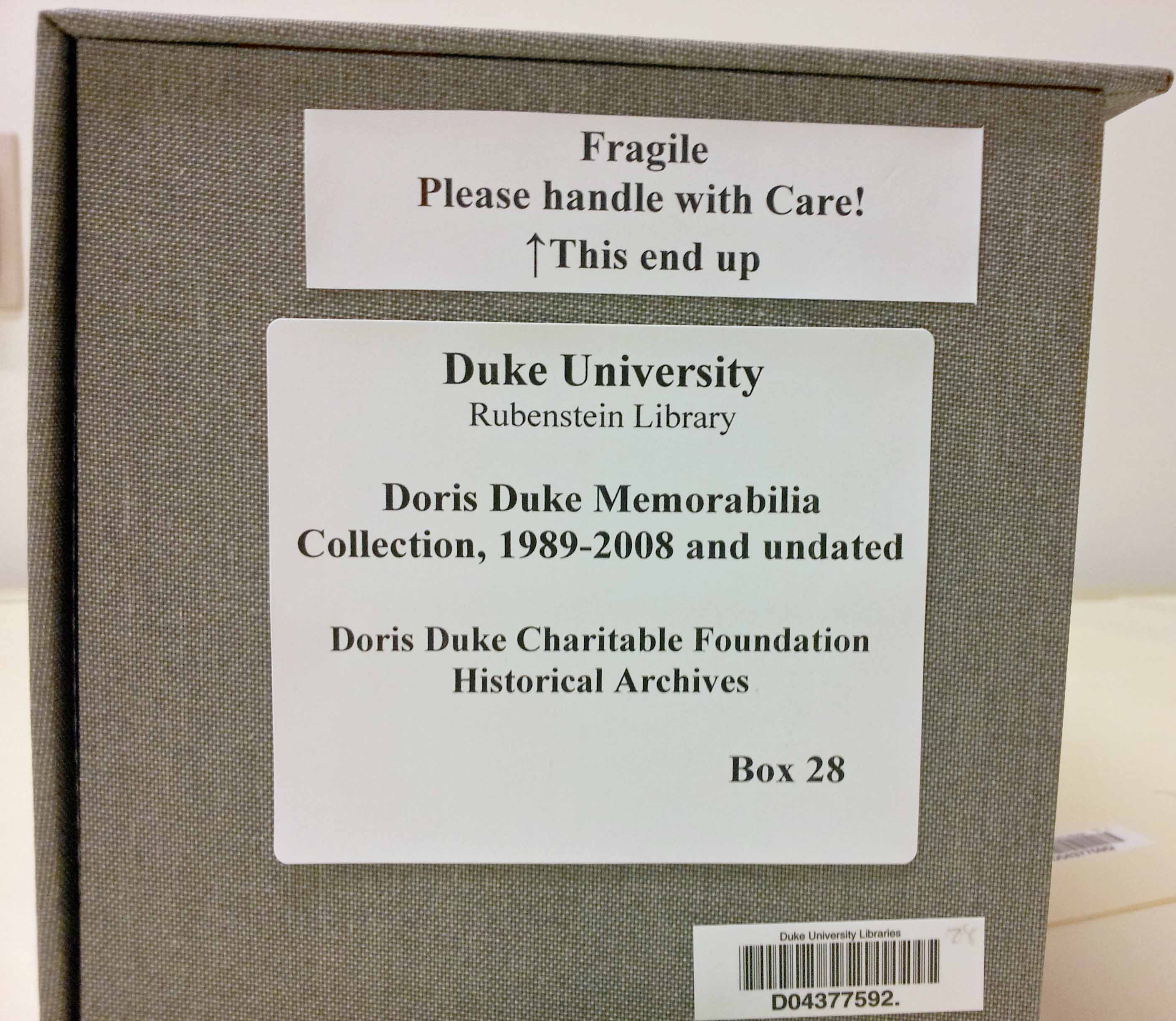
Such was the case with three artifacts in the Doris Duke Memorabilia Collection. A baseball bat with Doris Duke’ name carved through it, a football to Miss Duke from the coaches and players of the Midgets football team that she sponsored, and a partial weathervane believed to be from Duke Farms were prime candidates for Conservation’s resourceful storage solutions. I didn’t know what to expect, but when the newly boxed artifacts safely arrived back to Technical Services for labeling and barcoding, I was truly impressed at the results.

Is this weathervane from the Coach Barn at Duke Farms the same as the one in the Memorabilia collection? It’s up to researchers to find out!

Because of Conservation’s thoughtful and inventive solutions, these three artifacts are now available to researchers. To view the final results and to read how Conservation created these boxes, see the Preservation Underground blog.

All ready for research use!

Post contributed by Mary Samouelian, Doris Duke Collections Archivist.

Dispatches from the German Judaica Project

A cataloger with a photographic  memory could be a source of endless fragments of information. We have only a few minutes with each of the thousands of books that pass through our hands, and much of that time is taking up with verification of details of the title, the imprint, the author’s authorized heading, etc. Subject analysis is often a quick selection from an endless list of dry headings and academic buzzwords—Economic development, Queer theory, Postcolonialism, Lie groups, Wachiperi language—and their associated classification. Some subjects appear over and over. The catalog has 179 entries under “Egypt—History—Protests, 2011-” and more under that heading with subdivisions. In other cases, the cataloger is amazed that even one book has been written on the topic.  The author of a slim volume on Hedjhotep, the Egyptian god of weaving, admitted that this deity is “little known, even among Egyptologists.”

As my memory is far from photographic, sometimes at the end of the day I am hard pressed to remember what parts of the river of human knowledge I have seen flow by. Determining what a book is about, though a fascinating process, gives just a snapshot of the content, and varied snapshots blur together in my mind. After more than thirty years of cataloging as a generalist, I have been exposed to bits and pieces of a wide range of subjects, but questions about any detail send me to Google.

A selection of Jewish prayer books, one for each holiday.

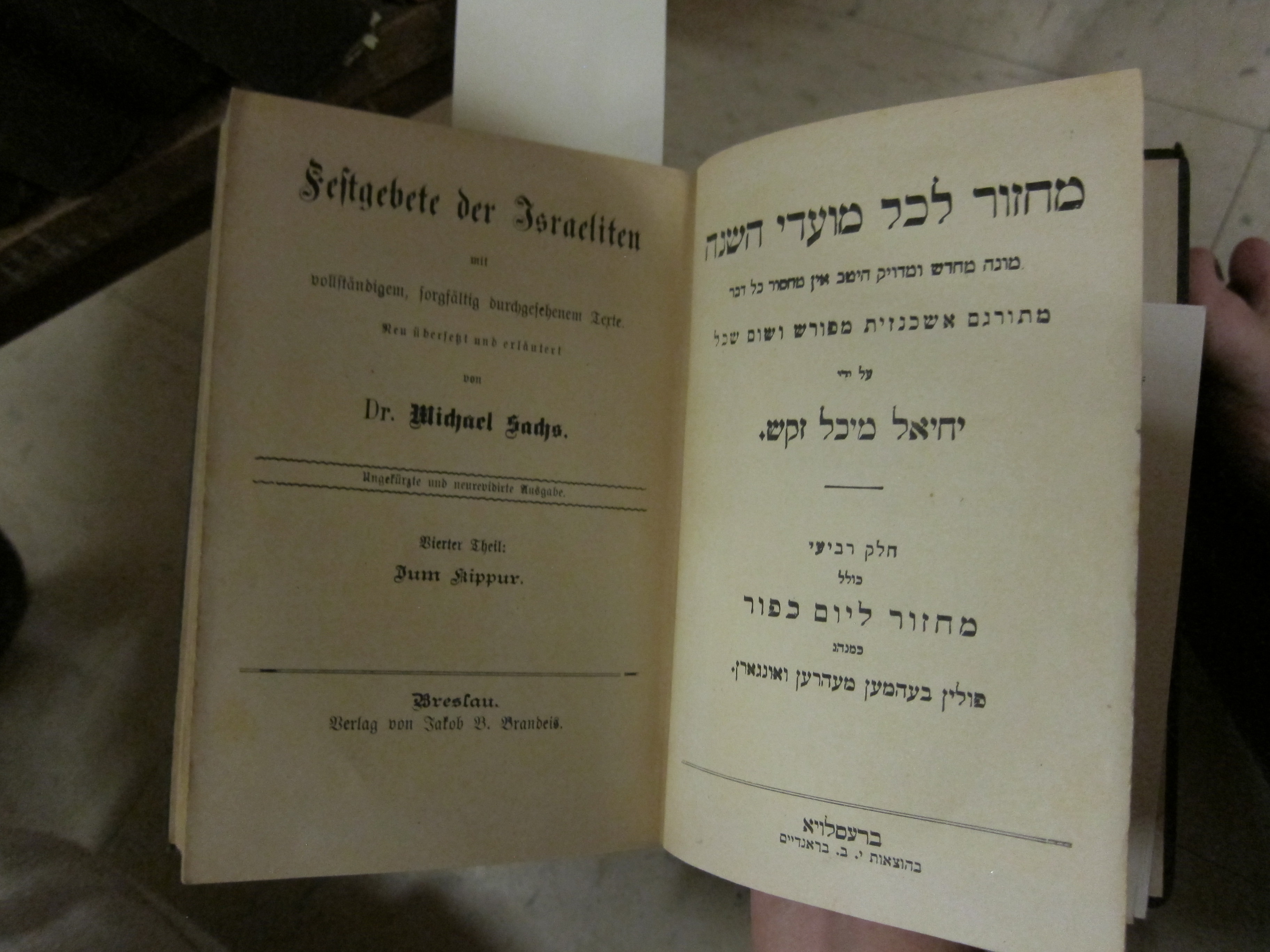
Recently, the library acquired a Judaica collection of more than 6000 late 18th century to early 20th century books. Most are in German, with some Hebrew and Yiddish. As part of a team of catalogers working with this material, I have been able to spend days on end with interrelated books. Questions about the context of a work or an author’s identity send me to Wikipedia, and what I learn there brings more life to the books, which creep into corners of my consciousness not inhabited by my usual work. Opening one dusty anti-Semitic tract after another can be as bone-chilling as the movie Schindler’s List. After cataloging dozens of editions of the Siddur (Jewish daily prayers) I somehow feel that I could step into a German synagogue and pick up a worn black prayer book, and be part of the recitation of words that have comforted so many generations.

This prayer book for Yom Kippur has a title page in both Hebrew and German.

Post contributed by Amy Turner, Original Cataloger in the Cataloging and Metadata Services Dept.

Welcome New Staff!

We are excited to introduce TWO new staff members! First we have Rachel Penniman, a transplant from Vermont who is our new Library Assistant for Technical Services and Research Services. She will be accessioning new archival collections, ordering and wrangling our vast number of archival supplies, and managing ILL requests in Research Services. In her spare time, Rachel likes to roller derby.

We’re also pleased to introduce Lauren Reno, a rare materials cataloger from the Newberry Library in Chicago who will now be cataloging for us here at Duke. We have lots of rare books and maps that are ready and waiting for her. When she’s not cataloging, Lauren enjoys studying German and running.

New Staff: Lauren Reno and Rachel Penniman

Rachel is splitting her time between Rubenstein’s Smith Warehouse and Perkins Library locations. Lauren is based at Smith fulltime. We are thrilled that both are here to help us keep things moving in the Rubenstein!


Introducing the Anna Schwartz Papers

Anna Schwartz in the New York Times, 1982.

I am pleased to announce a new finding aid for one of our newest collections, the Anna Schwartz Papers. Schwartz was an economist at the National Bureau for Economic Research, and collaborated with Milton Friedman on numerous works, including A Monetary History of the United States, 1867-1960. She also served as the executive director of the United States Gold Commission from 1981 to 1982. Her papers are an exciting addition to the Rubenstein’s Economists’ Papers Project.

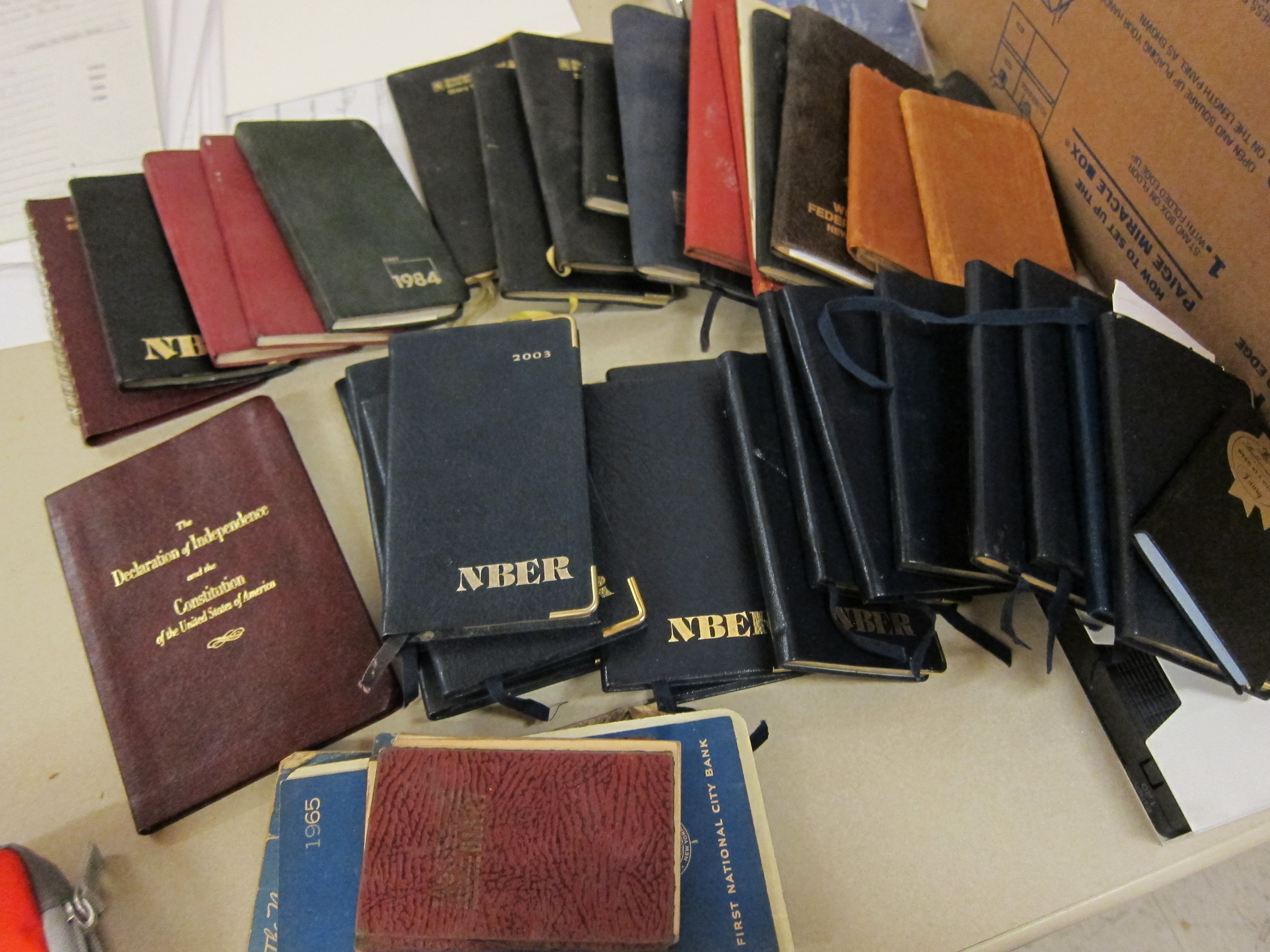
The vast majority of the Anna Schwartz Papers are all business: her research and subject files on banking, monetary policy, currency, and the Federal Reserve; Gold Commission materials, including correspondence with fellow commissioner Ron Paul; collaborations and correspondence between Schwartz and Milton Friedman; and numerous articles and lectures by Schwartz from throughout her 70-year career. One bit of material that shows a more personal side of Schwartz are her many datebooks, from the 1950s to 2012, which help document her appointments, schedule, and contacts over the course of her life. I also really enjoyed seeing material from her time at Barnard College in the 1930s. She seemed to constantly win honors there, including Phi Beta Kappa.

Dozens of datebooks from the Anna Schwartz Papers
Dozens of datebooks from the Anna Schwartz Papers.

Upon Schwartz’s death earlier this year, her New York Times obituary described her as “a research economist who wrote monumental works on American financial history in collaboration with the Nobel laureate Milton Friedman while remaining largely in his shadow.” Now, with the opening of this collection, Anna Schwartz’s contributions and scholarship are finally out of the shadows, so to say, and freely available for everyone to use.

Post contributed by Meghan Lyon, Technical Services Archivist.

Dispatches from the David M. Rubenstein Rare Book and Manuscript Library at Duke University