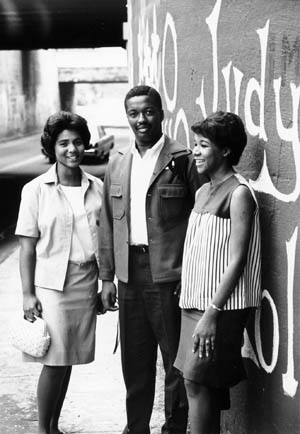
Wilhelmina Reuben-Cooke, Nathaniel White, Jr., and Mary Mitchell Harris, the first African-American undergraduates to receive degrees from Duke University. From the University Archives Photograph Collection.
Fifty years ago, Duke University first admitted African-American students into its undergraduate classes. Drawing upon the collections of the Duke University Archives, “The Road to Desegregation at Duke” uses historic photographs, correspondence, flyers, newspapers, and more to tell the story of how Duke became a more diverse university.
The exhibit examines the contributions of African Americans at Duke prior to integration, the process of desegregation at the University, and the ways in which black students have shaped Duke since 1963.
Part of a larger, campus-wide commemoration of this milestone anniversary, “The Road to Desegregation” is a thought-provoking look at why Duke changed, and what it meant to become a truly integrated university.
If you’re not able to visit the Duke University Libraries to see the exhibit, please have a look at the online exhibit!
Post contributed by exhibit curators Valerie Gillispie, University Archivist, and Maureen McCormick, Isobel Craven Drill Intern.
In 2013, Duke will mark 50 years since the desegregation of the undergraduate student body. The campus-wide theme, “Celebrating the Past, Charting the Future: Commemorating 50 Years of Black Students at Duke University” will be woven into annual events, like commencement, reunion, and Founder’s Day, and will also be a topic of reflection through exhibits, speakers, and service opportunities. Working together across the University, this milestone year offers all of us the opportunity to learn more about Duke’s history.
The University Archives has a rich photographic collection, and we have added a number of photos on Flickr as part of the anniversary celebration. They show us moments of protest and performance, as well as celebration. The photographs are featured on a new website dedicated to this fiftieth anniversary commemoration.
The University Archives contains many collections that provide historical context and primary source documentation on the desegregation of the school, the black student experience at Duke, and much more. Interested in diving in? A new guide to conducting research on African-American history at Duke is now available, and the UA staff is glad to consult on particular questions or projects. (Contact us here!)
Post contributed by Val Gillispie, University Archivist.
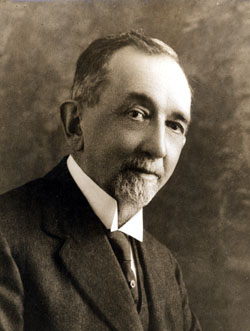
Benjamin Newton Duke. From the University Archives Photograph Collection.
Recently, I was tasked with the job of researching and learning about the life of Benjamin Newton Duke, affectionately known as “Mr. Ben.” Mr. Ben was the older brother of James B. Duke, and one of tobacco tycoon Washington Duke’s children.
J.B. was placed in charge of many of the family’s business ventures and became famous for his role in running American Tobacco and other Duke ventures, but Ben was the Duke family’s chief philanthropist. He gave away copious amounts of the family’s sizeable wealth, and was known for his generosity. He also served on several charitable boards, such as the Oxford Orphan Asylum north of Durham.
The purpose of my assignment was to create a timeline (coming soon!) that tells the story of Ben Duke’s remarkable life through words and pictures. In creating the timeline, I looked through boxes upon boxes of photos, letters, and ledgers related to his life. Among the photos that I looked at was a series of interior shots of his home in Durham, “Four Acres,” before it was demolished.
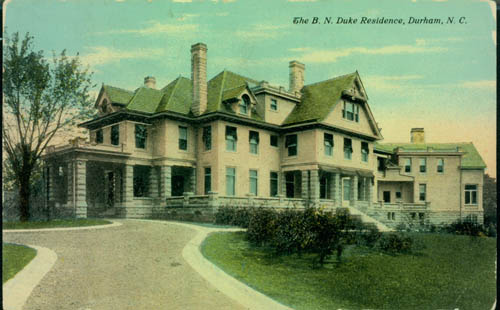
Postcard of Four Acres, the home of Benjamin Newton Duke. From the University Archives Postcard Collection.
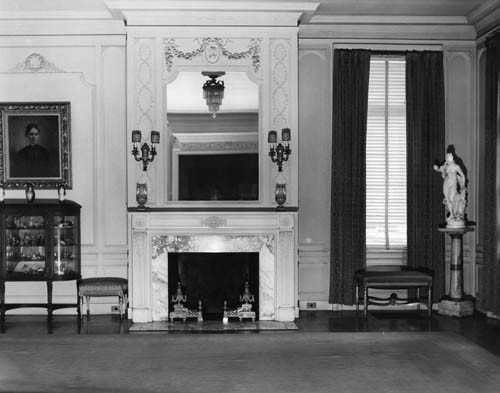
Somewhere in the lot was this photo, a look at one of the rooms in Four Acres. If you look closely at the photo, you’ll notice a statue on a pedestal on the right side.
Interior of Four Acres. From the Benjamin Newton Duke Papers.
As part of our ongoing renovation preparation work, we have been researching the origins and provenance of some artifacts in our possession. One of these was a statue that has been residing in the office of the Duke University Libraries’ Exhibits Curator for a decade. We had documentation that the statue came from Four Acres, but we had no photographic evidence to prove it: until now. This series of previously unexamined photographs helped us confirm that the statue in the Exhibits Curator’s office is, in fact, the statue from Four Acres.
It’s nice to know that this simple project of learning about Mr. Ben has connected us so tangibly to all that he did for Duke University.
When Senator John F. Kennedy’s plane landed in Raleigh on December 2nd—one hour before he was due to speak at Duke University—he hadn’t yet declared his candidacy for the 1960 presidential election. Writing about that evening’s address, the Duke Chronicle wrote simply that the “boyish John Kennedy” was the “leading unannounced candidate for the Democratic presidential nomination” and noted a recent decrease in his popularity, especially when compared with potential Republican candidates New York Governor Nelson Rockefeller and Vice President Richard M. Nixon.
Kennedy’s aspirations were, however, clear. The arrangements for the speech were made by J. Leonard Reinsch, then a member of the Democratic National Committee and director of the 1960 Democratic National Convention, whose two children were students at Duke. WUNC-TV filmed the evening—necessitating that the speech be given in the smaller Page Auditorium, rather than Duke Indoor Stadium (not yet known as Cameron)—and the WUNC radio station recorded it for later broadcast.
Kennedy spoke as part of the Major Speakers Series planned by the Student Union’s Educational Affairs Committee. For the 1959-1960 academic year, the student committee, led by chair Byron Battle, attempted to build a non-partisan slate of candidates for high public office. According to their meeting minutes, their efforts to secure Duke alumnus Richard Nixon involved “a constant barage [sic] of letters” from Duke administrators, including President A. Hollis Edens. They also considered extending an invitation to Hubert Humphrey, but decided against it, on the grounds of “a possible preponderance of Democrats, and a fear that he might not have anything worthwhile to say.” (Humphrey did eventually speak at Duke in 1965.)
Letter, Byron Battle to John F. Kennedy, June 23, 1959. From the Duke University Union Records. Click to enlarge.
Local newspaper accounts indicate that the speech, titled “The Challenge to American Colleges” and ranging over key national and regional issues like the space race, North Carolina’s progress toward integration, and Kennedy’s position on birth control, was well-received.
But we’re less sure of the Duke student body’s reaction to the speech, perhaps because the campus’s attention turned almost immediately to a different election. In the same issue of the Duke Chronicle that looked forward to Kennedy’s speech, a undergraduate student reporter named Steve Cohen published the first part of a satire that set the nativity story in World War II-era Poland. Tipped off by the paper’s printer, and worried that the piece would cause controversy damaging to Duke’s reputation, President Edens acted swiftly, suspending publication of the Duke Chronicle until the editorial board could be reorganized.
Senator John F. Kennedy before his address in Page Auditorium, December 2, 1959. Kennedy is standing in the Flowers Building’s Music Room. From the University Archives Photograph Collection.
The Duke Chronicle published its next issue on December 14, 1959, 11 days later. The issue carries only a brief mention of Kennedy’s speech, in an editorial from new editor-in-chief hopeful Jim Brown, who wrote:
We are constantly in danger of focusing all our attention on the sensational. Significant events often pass unnoticed. People all over the nation know of the Chronicle incident. But how many of them heard about the speech that Senator Kennedy made the day after the Cohen article was published. . . . Senator Kennedy’s masterful presentation had a considerable impact on the student body. But compared with “A Christmas Story” the attention that it received was negligible.
Later that afternoon, Marian Sapp was elected by the University Publications Board as the Duke Chronicle’s new editor-in-chief. Kennedy declared his candidacy for president on January 2, 1960. We’re not definitively certain what happened to Steve Cohen, but Sapp herself alluded in her own December 14th editorial to the “destruction . . . of one boy’s right of expression in any University publication.”
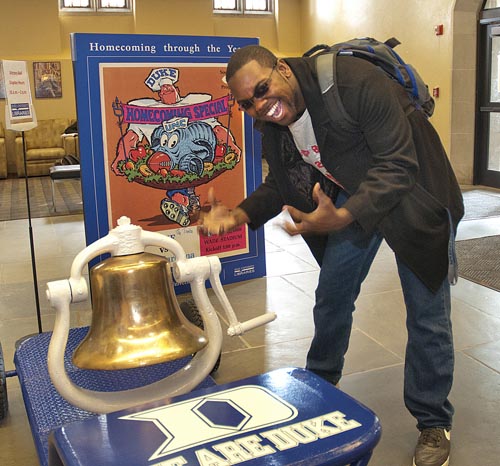
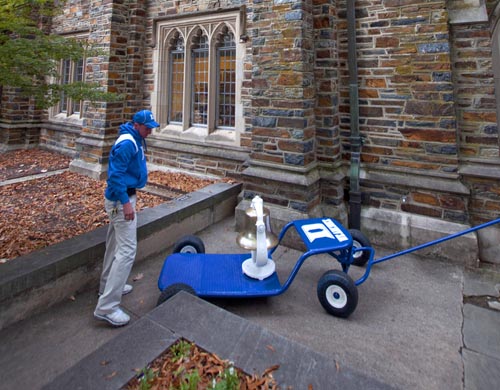
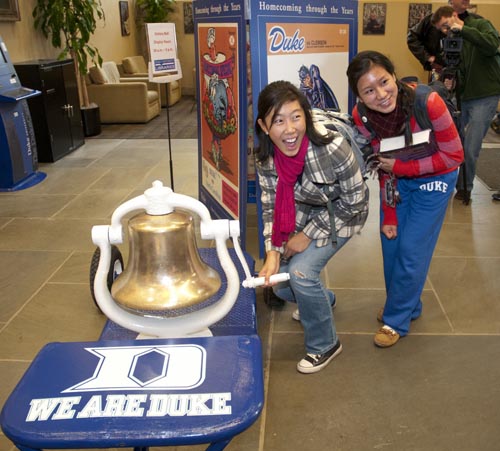
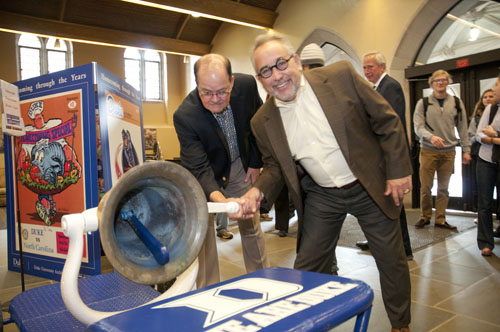
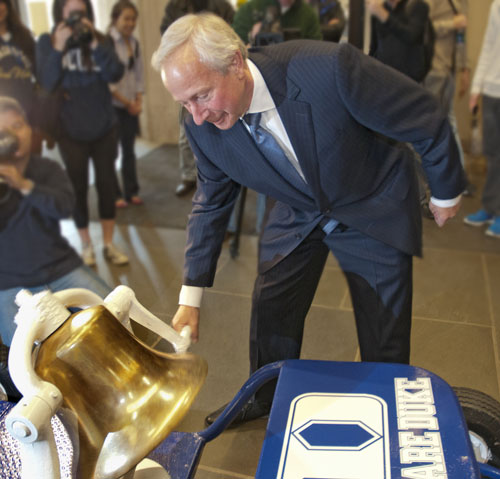
Shortly after Duke’s football win over the University of North Carolina on October 20th, the Duke University Libraries’ Communications and Development Departments and the Duke University Archives had an idea: why not bring the Victory Bell to Perkins Library? The University Archives has tons of historical material about Duke’s football team and the Victory Bell—including the bell’s original clapper, “liberated” from a UNC gymnasium in 1964—and, well, how much fun would it be to ring a bell in a quiet library?
After a few phone calls to our friends in Duke Athletics, the Victory Bell’s cart rolled over to Perkins Library this past Friday morning. Here are a few pictures from what proved to be a very fun—and occasionally very noisy—day. And, no, even though we’re librarians, we didn’t shush any of our bell ringers!
The Victory Bell arrives at Perkins Library!An excited student reacts after ringing the Victory Bell.Two more students get ready to ring the Victory Bell.Coach David Cutcliffe and Provost Peter Lange share a turn. Note some remaining blue spray paint on the inside of the bell.President Brodhead rings the Victory Bell.
So what do you think, Coach Cutcliffe? Shall we do this again next year?
This summer, I began processing a collection of the Office of Student Activities and Facilities’ (OSAF) records. While processing this collection, I stumbled upon a folder simply titled “IFC Functions.” In a haze of student group folders, ASDU folders, DSG folders, etc., I was not particularly struck by this folder. This was a mistake. Upon opening this folder, I found pure gold. This folder contained memories of the 1970s that I am sure our parents, at least mine, have willfully chosen to forget.
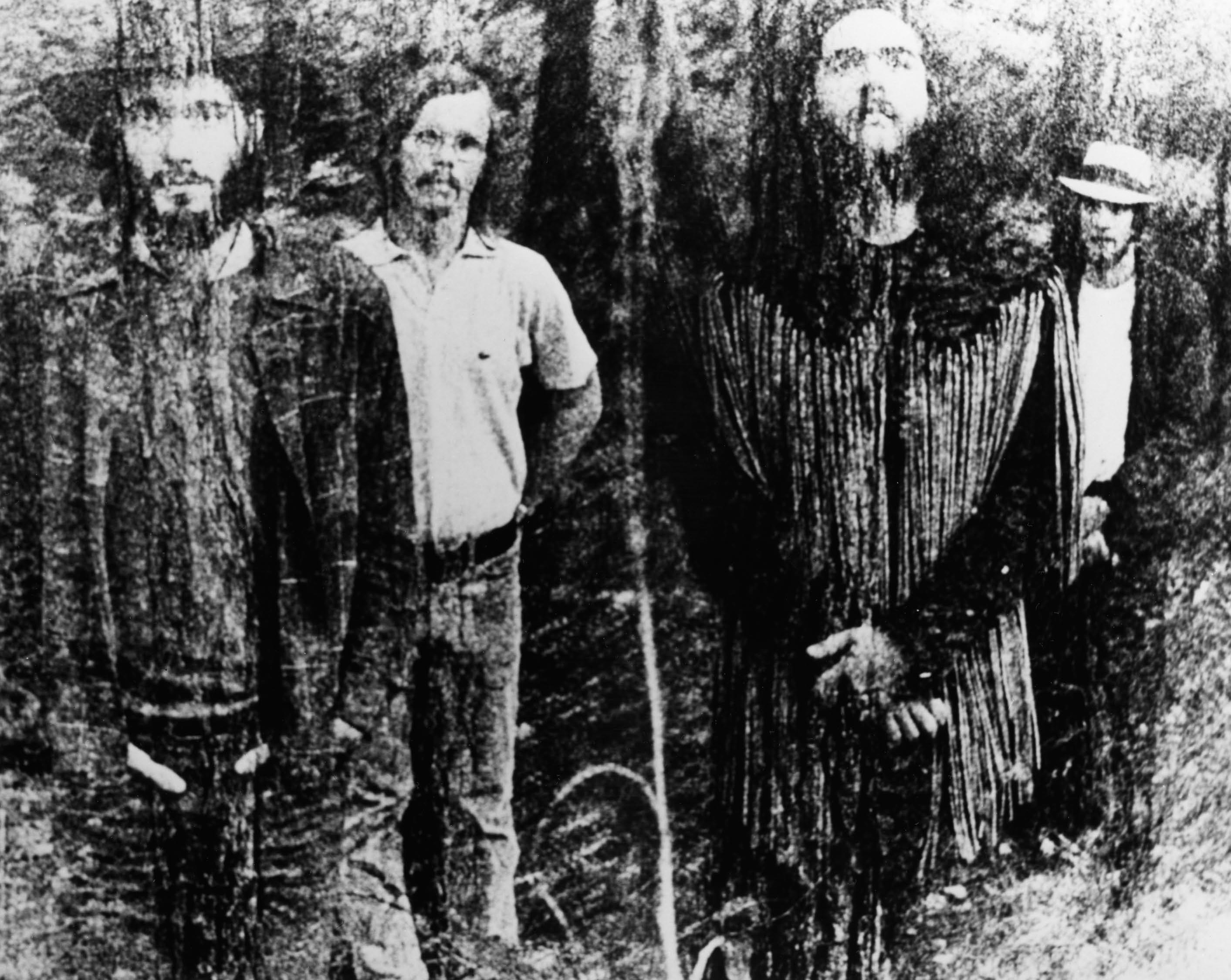
This folder contained information sent to the Inter-Fraternity Council (IFC) of cover bands who wanted to play at Duke. These band promotion packets contained blurbs and publicity about the bands, such as this quote from the promotion pack of a band that called “Hydra”: “Hydra is unquestionably the finest heavy hard rock band in the Southeast. They are also the most danceable group you will find anywhere.”
So I was intrigued and wanted to learn more. That is when I found the most amazing thing of all. Every band sent a picture of themselves with their packets; these photos chronicled the outstanding fashion trends of the 70s.
Each band had a different look, a different style, and everyone was fantastic. There were such bands as “Hydra,” who was 70s Goth; “Radar,” who was bohemian rock; “Brother Bait,” who was a 70s version of what I would call hippy chic; and “Choice,” who struck me as a 70s version of the Jonas Brothers.
Hydra, “the finest heavy hard metal rock band in the Southeast” and “the most danceable group you will find anywhere.”Radar, more relaxed than Hydra.Brother Bait: fashionable hippies.Choice, aka The Jonas Brothers of the 1970s.
This folder was so interesting because it really allowed me to catch a glimpse of such an iconic era. I thoroughly enjoyed working on this collection as it enabled me to take a step back in time and learn about a fascinating part of Duke’s rich student history.
Post contributed by Julia Eads, Trinity College ’14 and student assistant in Technical Services.
In an earlier blog post, we mentioned that we’ve been processing thousands of sports-related negatives and prints transferred to the Duke University Archives by Duke’s Sports Information Office.
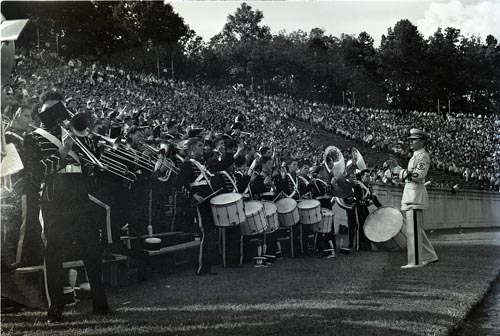
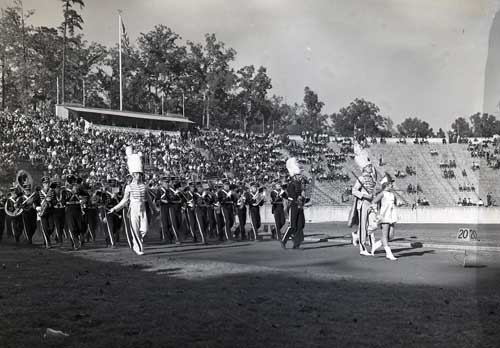
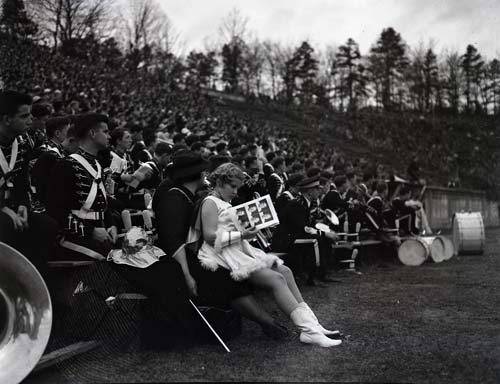
I recently began reviewing images from the 1930s and 1940s. In envelopes labeled “football sidelights” are negatives of the Duke University Marching Band, fondly known as DUMB.
In existence since the early 1900s, DUMB is an integral part of Duke sports, providing music and vocal support at games, and has established a reputation for performing creative and highly entertaining halftime shows. For more information, take a look at the finding aid to DUMB’s own records, part of the University Archives’s collections. Below are a few of my favorite images.
Duke University Marching Band, October 7, 1939Duke University Marching Band Drum Line, October 21, 1939Duke University Marching Band, October 28, 1939Majorette Lucille King and her Mother, November 19, 1938Duke University Marching Band and Blue Devil, 1940
This past Saturday, Duke’s football team defeated Wake Forest, 34-27 (Go, Duke!).
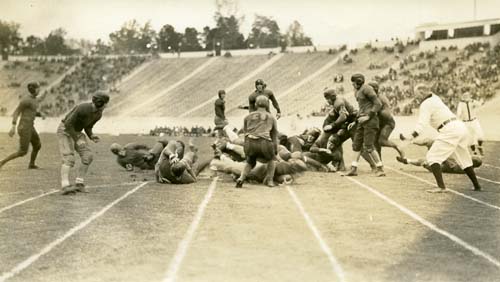
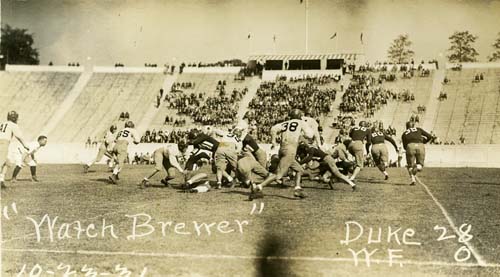
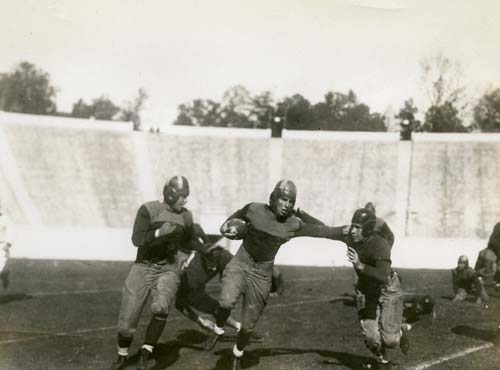
In honor of this victory, the Duke University Archives thought it would be fun to share some historical photos we recently received from the Sports Information Office. These action shots are from football games in 1931 and 1932 show Duke playing (and defeating: 28-0 in 1931 and 9-0 in 1932) Wake Forest.
Duke vs. Wake Forest, October 1931Duke vs. Wake Forest, October 1931Duke vs. Wake Forest, October 1932Duke vs. Wake Forest, October 1932
For the last two months, I have been processing a large accession of materials from the Duke Sports Information Office. The vast majority of the accession consists of photographs and negatives from Duke football teams, served with a side of basketball and seasoned with photos of other teams and individual athletes. As you can imagine, I have gone through many generations of athletes, coaches, and of course, fashion trends. This post is dedicated to a few assistant football coaches who weren’t afraid to show add some fashion flair to their official photos.
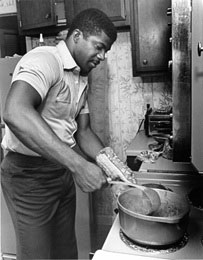
Assistant Football Coach John Guy shows us his kitchen style. The no-apron look was very in that season.
I should also say outright: I love sports, particularly college athletics. I did my undergraduate work at a football school. I have free t-shirts from at least a dozen other athletic teams at my undergrad school. My graduate degrees are from . . . well, another school in the Triangle with a basketball team. As a result, processing this collection has been a lot of fun for me.
Assistant Football Coach David Holton is a man who is not afraid of mixing patterns and textures in his outfits. Stripes, plaid, and corduroy: very boho-chic.
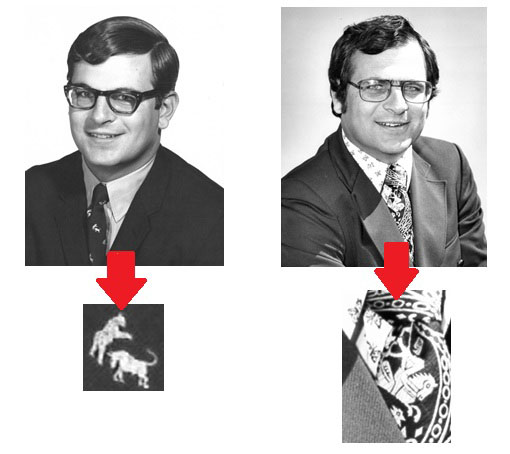
During my time processing the Sports Information Collection, I’ve noticed something about the coaching staff photos: although the head coaches by and large have fairly tame outfits, the assistant coaches most certainly do not. Perhaps they want to ensure that players can see them on the sideline/courtside? Maybe they just love mythologically-inspired ties? We’ll probably never know for sure!
The photos above showcase the ties of Freshman Football Coach John Gutekunst. I’ve taken the liberty of calling out the patterns on both so that you can see in better detail. Clearly, Gutekunst stayed with the animal theme over the course of his career—by the later picture, he even ventured to wear a butterfly shirt with the mythological tie!
To close out this post, I think we should all tip our hats to the adventurous styles of these assistant football coaches. They have showed us how to look cool on the sidelines, in the kitchen, and in your formal yearbook photos. Keep up the great work!
Now tell me: who’s your style icon? Are you channeling Guy’s daring “no-apron” look, Holton’s mixed patterns and textures, or Gutekunst’s animal-themed accessories?
In the end, we created 32 record groups to represent the history, the administrative departments, and the schools of Duke University. Each group speaks to the breadth of material that tells the story of Duke University and its distinguished alums. While going through each record, and carefully determining its placement in the records groups, I uncovered some fascinating collections. Here are some of my favorites:
1. Sarah P. Duke Gardens Records, 1932-2002. The Duke Gardens is a horticulturist’s sanctuary. As a garden hobbyist, I have enjoyed spending time marveling over its beautiful design of plant life and winding paths. This collection shows the vision of the gardens from the beginning when Mary Duke Biddle donated the land in 1932. Included are blueprints and planting plans that any gardener would relish viewing first hand.
2. Randall Frattini Papers, 1974. University Archives has a copy of Frattini’s eyewitness account of students streaking on campus on the nights of February 28 and March 1, 1974. Albeit comical, this collection also suggests the wide variety of records that document student life at Duke in the Duke University Archives’ collections.
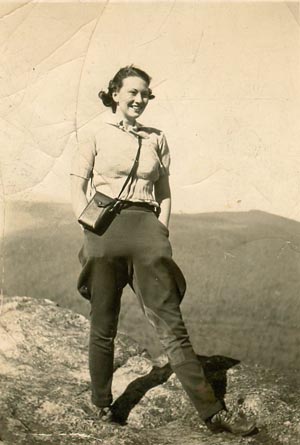
Elizabeth Hatcher Conner on an Explorers Club Outing, ca. late 1930s
3. Elizabeth Hatcher Conner Photograph Collection. Elizabeth Hatcher Conner attended the Woman’s College during the late 1930s. During that time, she was an active photographer and she often documented the outdoor adventures of the Explorer’s Club. The Explorer’s Club was a group of faculty and students who use to go hiking throughout North Carolina. Her photos give a glimpse into the lives of students at Duke during this time period. Check out some of her photographs on our Flickr site!
These three collections only scratch the surface of the hundreds of records documenting the institutional memory of the University. If you are interested in learning more about the University’s history including a particular school, student life, or athletics; contact University Archives and they can help you uncover your own record gems.