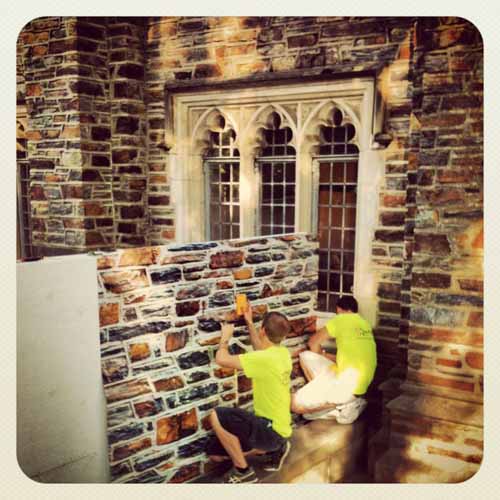
Last week, we watched “Duke Stone” panels going up on the construction fence surrounding the Rubenstein Library and the West Campus Union. So we thought we’d take a few moments to write about the real Duke Stone!
Duke Stone panels being applied. Photo by Aaron Welborn.
Did you know that Duke Stone comes from a quarry in Hillsborough, North Carolina, just about 10 miles away from campus? Or that there are 24 distinct colors in the stone: 7 primary colors with 17 distinct variants of the primary colors? Or that, before choosing the Hillsborough stone, there were several other stone contenders?
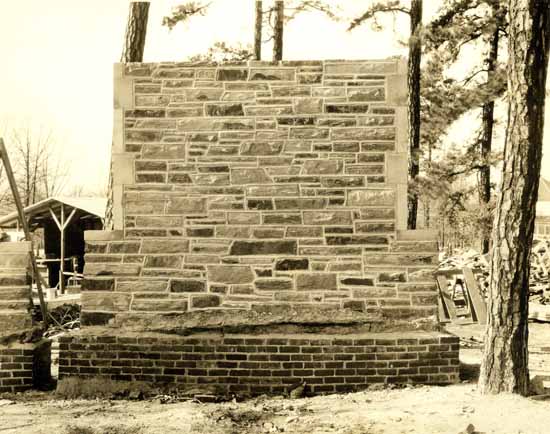
Before the Hillsborough stone was chosen to construct West Campus, and before it was known simply as “Duke Stone,” the architects, designers, builders, and James B. Duke himself looked at many different stone samples. They even constructed test walls of stone from other quarries on the East Coast to determine which one they liked the best. Here’s one of the test walls constructed during that phase:
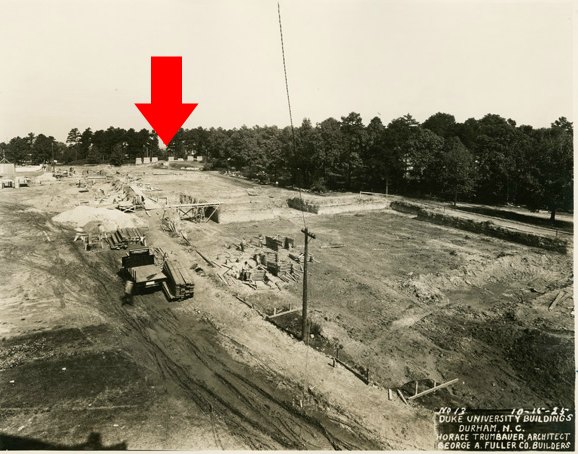
And in this October 15, 1925 photo of construction on East Campus, the test walls are visible off in the distance.
It’s safe to say that we all know and love Duke Stone today—so much so that the panels are going up on the construction wall so that we don’t have to be without the look of it for too long. Next time you’re on campus, see how many primary and variant colors you can find in the stone. Let us know how you do!
Post contributed by Maureen McCormick Harlow, 175th Anniversary Intern for the Duke University Archives.
My latest conservation project has been one involving chemicals and special equipment, doing something that we conservators face far too often—tape removal. But fortunately, our lab is well equipped with tools and materials specifically for that purpose.
In September there will be a new exhibit at the Nasher Museum of Art on empire and cartography, organized by the BorderWork(s) Lab here at Duke. Seventeen maps and books from the Rubenstein Library were selected for the exhibit, but many of them required treatment first. Rachel Penniman, Erin Hammeke, and I have been working to make sure the items will be in safe condition before they make the short journey across campus to the museum.
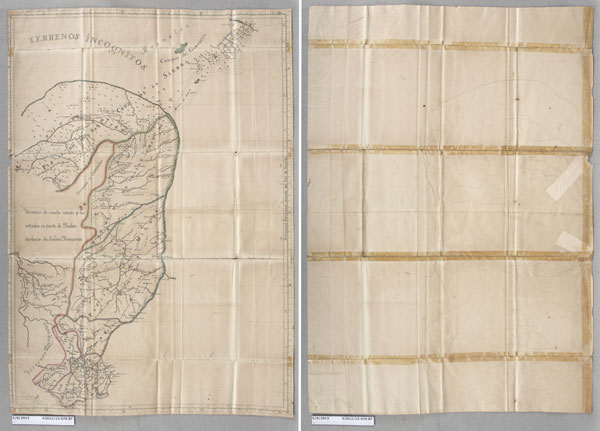
One item that has required the most work for me is an early 19th century hand-colored manuscript map from South America labeled “Terrenos Incognito” (above, front and back). Although on good quality, strong paper, the map was previously folded so many times that it began to break along the folds, and so some well-intentioned person in the past reinforced the folds with strips of tape on the back. Over time, the adhesive turned yellow and seeped through the paper, leaving stains along all of those fold lines. And not only is the staining unsightly, but the adhesive is also chemically destructive to the paper, making it brittle and more liable to break. So now, as is often the case, I am spending many hours undoing someone’s quick fix that turned out to do more harm than good.
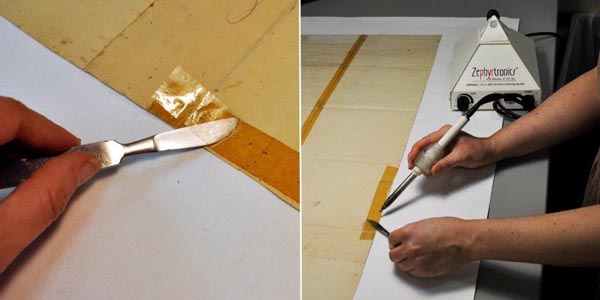
Before using any chemicals I tried mechanical means to remove the tape. First I had to remove the carrier, the plastic part of the tape that the adhesive is attached to. For that I used a hot air tool to soften the adhesive and an unsharpened dissection scalpel (my favorite tool) to lift the carrier off. But there was a lot of residual adhesive left on (and in) the paper.
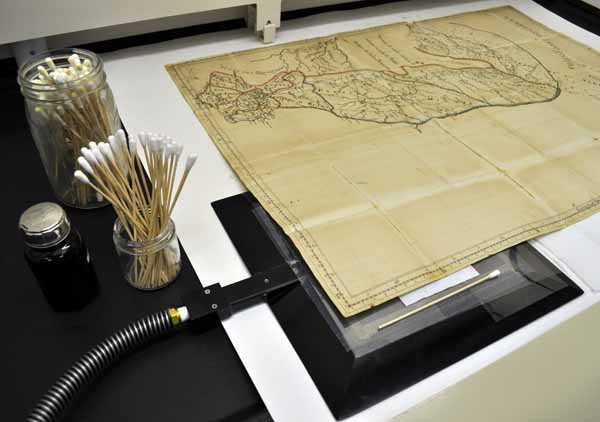
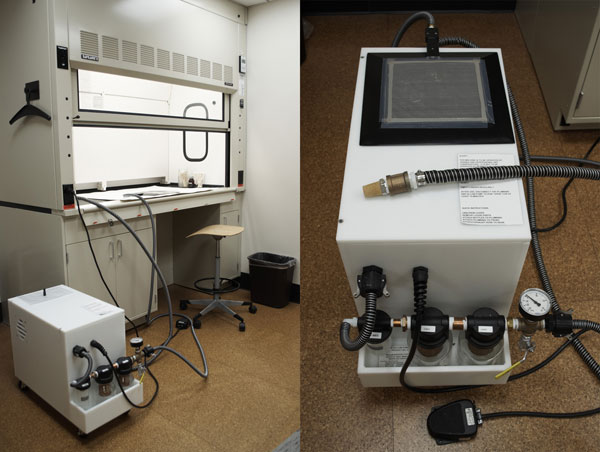
After testing the adhesive’s solubility in various chemicals, I selected the most appropriate solvent. In conjunction with the use of chemicals I have been using our excellent vacuum pump and manuscript suction device, also officially known as a Stealth Sucker. I work in the fume hood to avoid breathing solvent fumes. I lay my map on the suction platen and use solvent to dissolve the adhesive, then the vacuum action draws it out of the paper. I can only treat an inch at a time and the work is very slow, but the effect is rewarding . Although there will always be some staining visible, the map’s appearance is beginning to improve dramatically. Soon I hope to have it finished, and visitors at the Nasher will be able to appreciate its beauty without the distraction of adhesive stains.
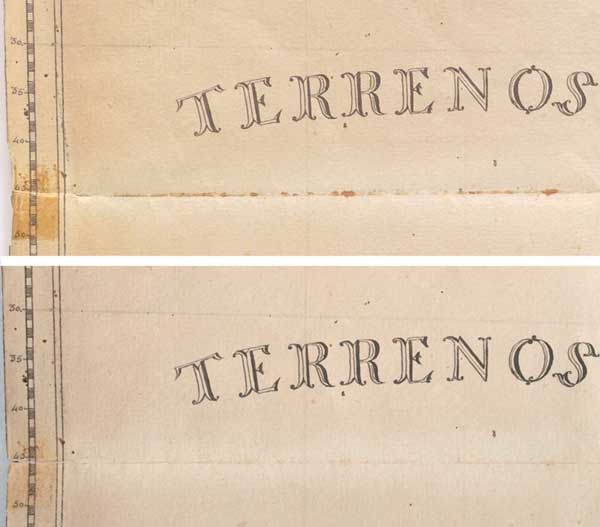
Detail of “Terrenos Incognito,” Before and After TreatmentDetail of “Terrenos Incognito,” Before and After Treatment
Workers are removing shelving and hazardous building materials from the rear entrance of Rubenstein Library.
Visitors to the Rubenstein Library may notice things are a little noisy in the library as renovation work begins. In the next few weeks interior demolition of our former space will continue and the tower crane for the renovation project will be installed. Since we’re on the other side of the building now, it shouldn’t be too loud in our reading room, but, as always, we’ll have foam earplugs available for researchers. Further details and updates are available on the Rubenstein Library Renovation blog.
One of the most frequently used items in the Duke University Archives is The Chronicle, particularly the 1960s issues. Many students are interested in the decade—which was one of great change in the student body, the curriculum, and in social life—and alumni and other researchers use it to find out details about particular events. This year, as Duke commemorates 50 years of desegregation among the undergraduate class, The Chronicle is especially helpful as a source of information about desegregation and later student protests like the Vigil and the Allen Building Takeover.
Thanks to the work of the Duke University Libraries’ Conservation Department, Digital Production Center, and Digital Projects Services, we now have eleven complete years (fall 1959-spring 1970) of The Chronicle digitized at http://library.duke.edu/digitalcollections/dukechronicle/. The issues are browsable by year and date and keyword searchable.
Although it will be extremely helpful for research on desegregation and student protest, it will also be helpful for researching topics ranging from the Duke-UNC rivalry to women on campus to ads for local restaurants. Through even small stories and announcements, we learn a lot about campus.
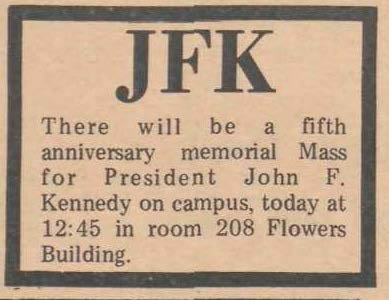
For example, on November 22, 1968, we read that a memorial mass was held to commemorate the 5th anniversary of the passing of John F. Kennedy, Jr.:
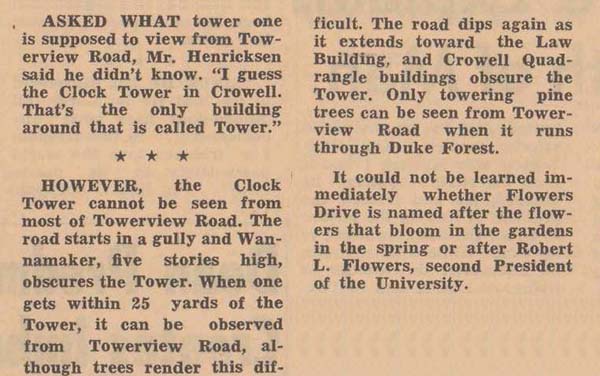
On March 1, 1963, we learn of the mysterious origins of the name of Towerview Road:
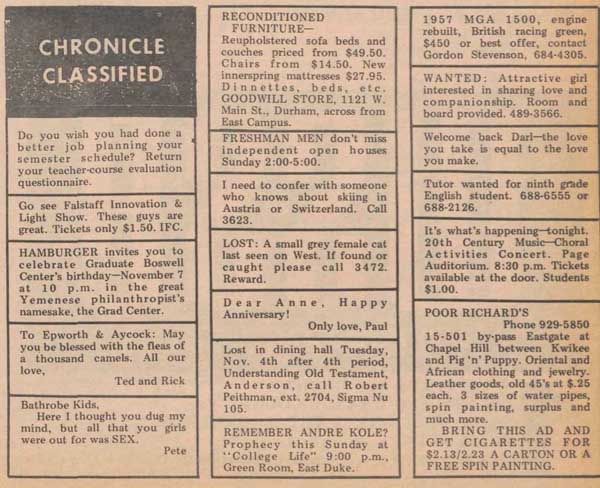
And on November 7, 1969, we find 1969 at Duke, perfectly preserved:
There are 868 issues of editorials, news stories, sports writing, advertisements, and much more. Let us know what you think, and how you will use the digitized decade of The Chronicle!
Post contributed by Valerie Gillispie, Duke University Archivist.
This week marked the final chapter of the Rubenstein Library relocation project of 2013, when the Library’s portrait collection was relocated from the Gothic Reading Room to the Rubenstein Library’s temporary space on the third floor of Perkins.It was a poignant and, at moments, spirited end to a process that began many months ago.
The portrait collection has been with the Gothic since the very beginning. Upon the library’s opening in 1930, the well-known artist Douglas Chandor was commissioned to paint portraits of The Duke Endowment trustees, Mary Duke Biddle and Nanaline Duke, and the architect and builder of the campus, Horace Trumbauer. These portraits were completed between 1930 and 1932 and hung in the Gothic, then functioning as the library’s general reference room.Over the years, portraits of the University’s founders and presidents were added, along with those of other notable figures in the University’s history.By the time of our move, 32 auspicious figures awaited the careful attention of the professional art handlers we brought in for this assignment.
Because of the scale of the room, scaffolding was needed to even reach the pictures.After that came rebacking the canvases, vacuuming the gilded frames, and replacing the hanging hardware.Finally, the portraits were ready for their voyage across the library and to their new spots, all purposefully selected to allow for their safe storage during the time of the Gothic’s renovation.
While most of them are now in staff-only spaces, visitors who wish to see a particular portrait can do so by contacting the Rubenstein Library to make an appointment. Portraits of Washington, James B., and Benjamin N. Duke are hanging outside the Rubenstein classroom, and are viewable during regular Rubenstein hours without an appointment.
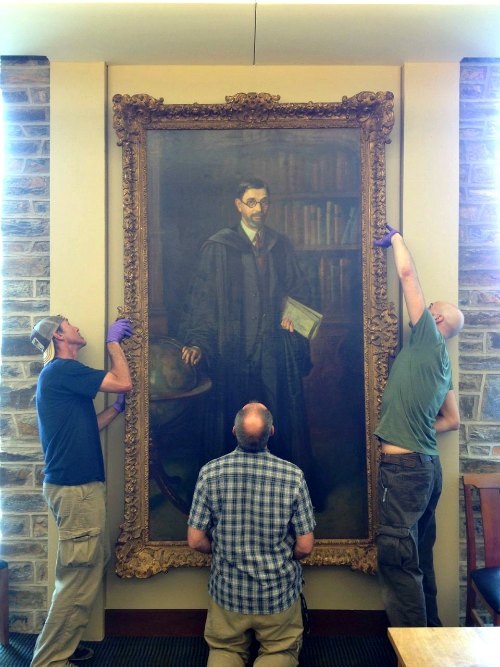
One painting, however, did not go so quietly to storage—a life-size, full-body portrait of President Few. It took scaffolding, ladders, and five people to remove him from his long-time rest, and once on the ground it became immediately clear that the portrait is nearly a half foot taller than the ceilings on the third floor of Perkins, where he was headed.An alternative spot was needed and quick!Thanks to the University Librarian, a suitable location was soon found.President Few now greets guests on the main floor of the Library, immediately behind the Perkins reference desk. It is perhaps fitting that the visage of the man who presided over the Gothic Room’s opening in 1930 was the last and most dramatic to take his leave from this room.
Post contributed by Kat Stefko, Head of Technical Services, Rubenstein Library.
Well, it’s finally happened. The 2,065 newspaper boxes and volumes and 8,526 pamphlets, books, and ledgers that could not move in January or February have finally been sent to the LSC. We also moved our framed art collection from the stacks to our swing space, where we have an ingenious new storage solution (stay tuned for further blog coverage on our art move). Now all of that work is complete, and with the exception of books and portraits in the Gothic Reading Room, our collections have officially moved out of the old stacks space.
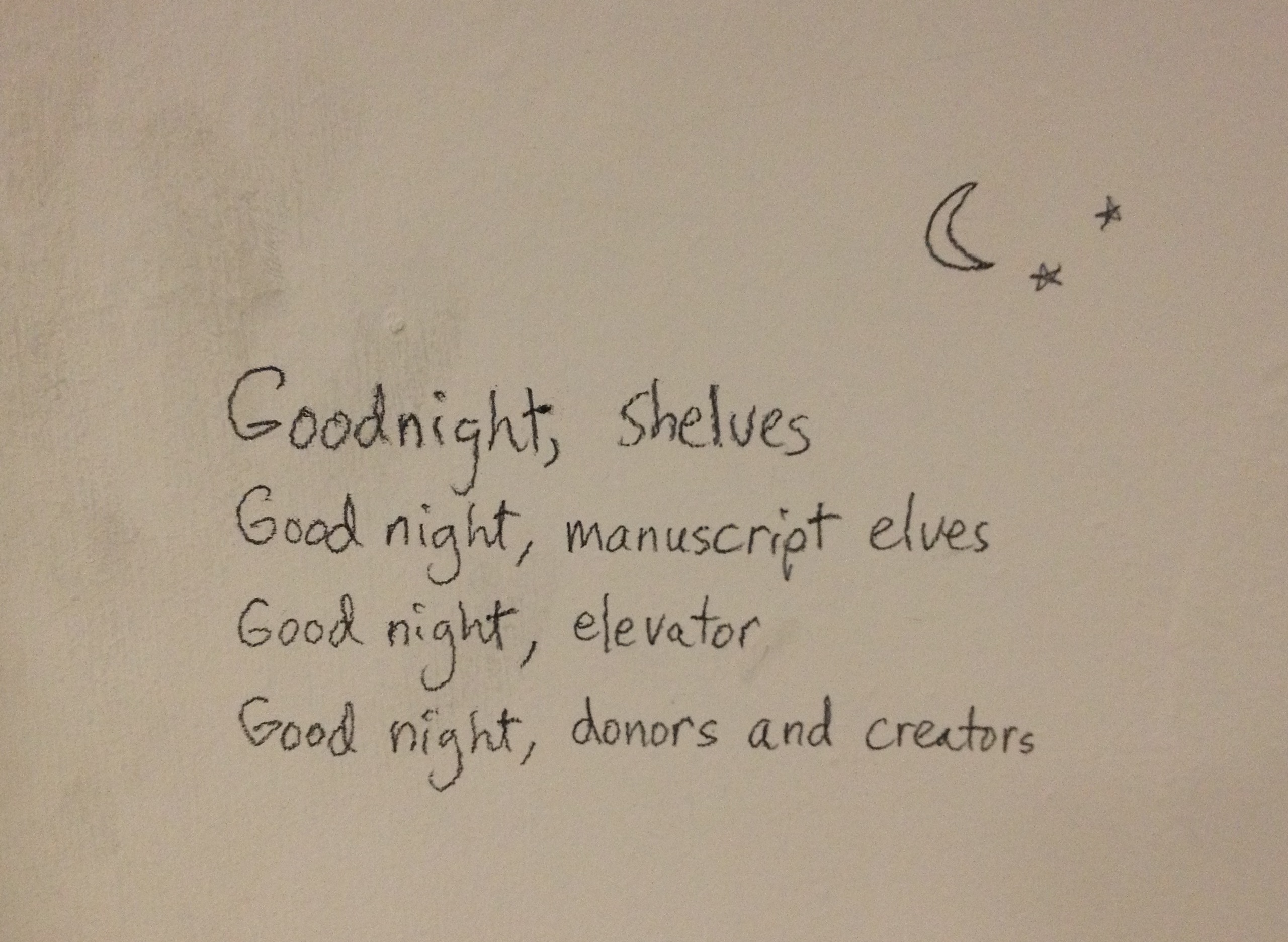
Our last day in the 1928 stacks was Friday, April 26. We checked under the 1928 elevator and took one last look at every shelf on our 8 labyrinth-like levels to make sure we left nothing behind. And so now we say good-bye. While cleaning up the last of the collections I found this appropriate bit of graffiti on the stack walls. What a lovely way to bid our old stacks farewell. Goodnight 1928 stacks!
Post contributed by Molly Bragg, Collections Move Coordinator in Rubenstein Technical Services.
Anyone reading this blog knows that archives are full of wonderfully weird ephemera just waiting to be discovered and discussed, of conversations waiting to happen. This is the story of two archives that, it turns out, have a lot to talk about.
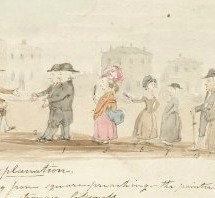
“Sunday evening in St. James’s, Barton,” from the John Rylands University Library
Ostensibly, this is a doodle, maybe an early comic. It depicts an ordinary meeting between preachers and parishioners. Only one thing stands out: the stocky girl just off the center dressed in bright pink and orange, while everyone around her wears drab brown. Look closer and you see that she her awkwardness is not limited to her dress: oblivious to the women gossiping behind her, our young heroine “stands, patiently, while her papa shakes hands with all the colliers, not knowing but she must do so too – a perfect pattern! Dear lady!” This oblivious fool is also the artist.
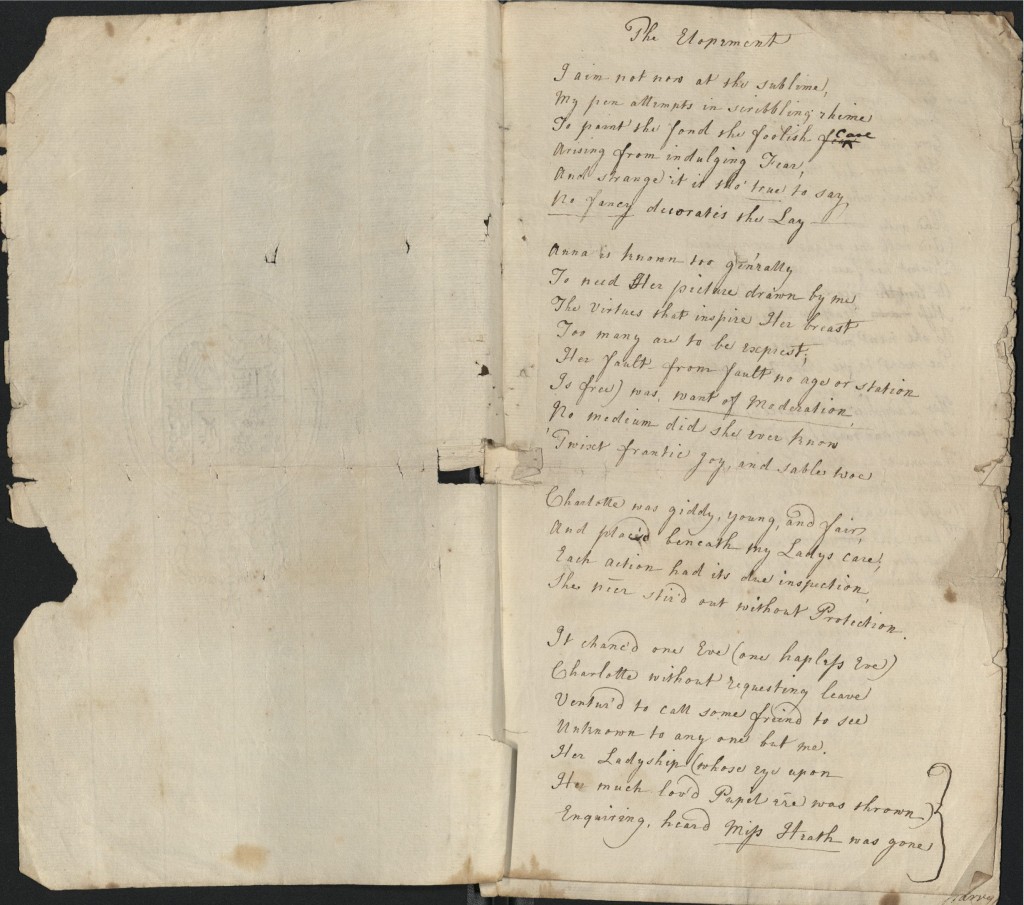
Cut to our own archive: Two summers ago, I was working in the Frank Baker Collection of Wesleyana and British Methodism when I came upon some poems. Having cataloged plenty of manuscript materials within the collection, I wouldn’t have thought much of them, except I noticed that they were tied together with string. Fanciful English student that I am, I recalled that Emily Dickinson’s manuscripts had been likewise fashioned together, and so began my grandiose visions: had I stumbled upon the British Emily? Could these poems help to reinvigorate the field of 18th-century women’s poetry – revolutionize it, even? It’s the fantasy held dear by every budding academic: to discover the next Milton or Frost, to shake the scholarly world to its core. Needless to say, literary scholarship remains unshaken, but it does have a new name on its register: Sarah Wesley.
The poems I found were written by our pink-and-orange artiste, the daughter of Charles Wesley, a co-founder of British Methodism. What is so fascinating about Sarah Wesley is her outright resistance to the restrictive practices of her every-day life – and how, perhaps as a result of that resistance, she has since all but disappeared from most histories of British Methodism.
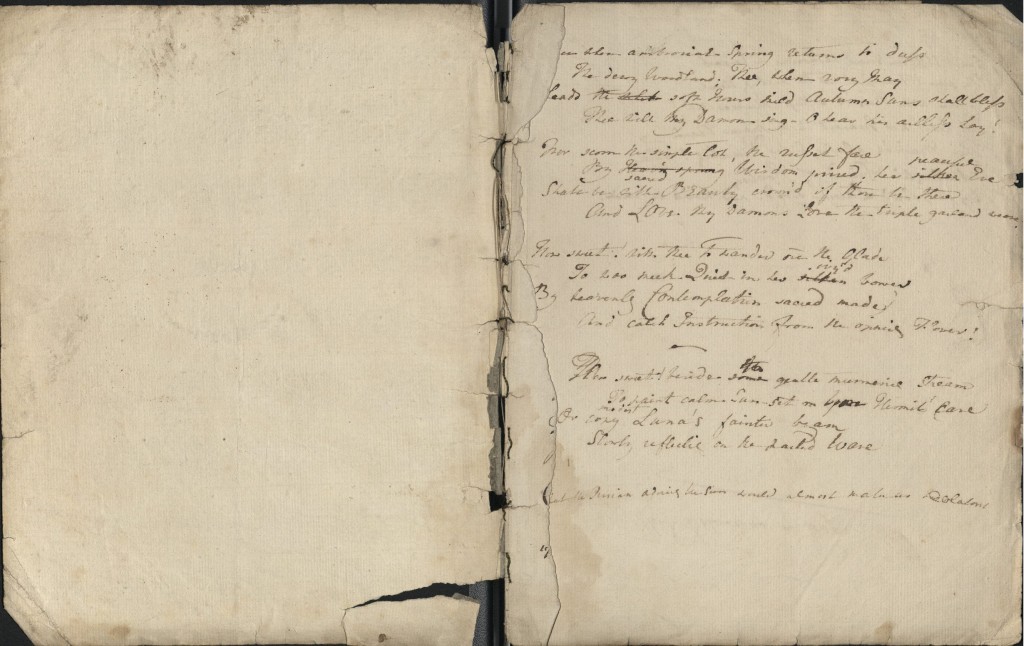
Bound manuscript with Sarah Wesley’s writings in the Frank Baker Collection.
Her poetry in particular served as an outlet for questioning her father’s religion, as well as engaging with emergent conversations about the rights of women. Even while Wesley’s social commitments were progressive, she remained a devout Methodist throughout her life. But through her writing, most of which she kept hidden away from the judgmental eyes of her community, Wesley takes us to a place we don’t often think of when we read the eighteenth century: the private mind of the teenage girl.
Caitlin Flanagan’s recent book Girl Land (Little, Brown and Co., 2012) makes a compelling case for the fundamental significance of a particular marker of female adolescence: that time when a girl recedes into her room for a few years and emerges a brooding melodramatic for a few more. Flanagan posits that as a society, we take too lightly “a girl’s sudden need to withdraw from the world for a while and inhabit a secret emotional life” (1). But in fact, this is time and space that young girls need in order to come to terms with the world and their place within it. And so, Flanagan urges us to celebrate, rather than denigrate, the importance of this space she calls “girl land.”
Flanagan’s study is predicated on a particular reading of the history of the teenager. But even before “adolescence” became a discrete intellectual category in the twentieth century, Sarah Wesley was, in many ways, a typically modern teenage girl.
She wrote poetry that was evocative, romantic, and highly self-reflexive:
The Pilot Reason stays on Shore, The boisr’ous Passions more, Youth is the Ship and Hope the Oar, And O! the Sea is Love!
~from “Sonnet,” 1770
In particular, much of her work is preoccupied with exploring her budding sexuality:
Her Eyes enraptur’d shall your Beauties own Her snowy Fingers be your Virgin Lone! Her Lips shall bid Thee with a sigh Adieu! Her Lips shall greet Thee with ambrosial Dew! Descending showers shall fall from Heaven to gaze! Within your silken Folds shall Graces lie And panting Zephryss on your Bosom die! The Muse shall stamp Thee with Idalia’s Crest, And Venus court Thee to adorn her Breast.
~from “On receiving a Nosegay,” n.d.
However, she was not without some snark when it came to matters of romance:
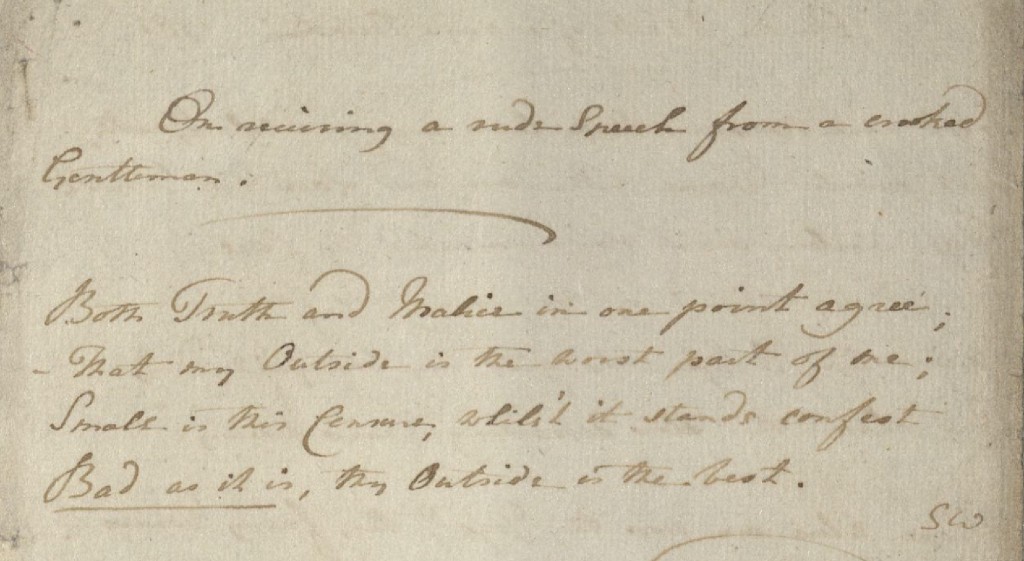
Both Truth and Malice on one point agree That my outside is the worst part of me Small is the censure, whilst it stands confest Bad as it is, thy outside is the Best!
~“Epigram: on receiving a rude Speech from a Crooked Gentleman,” 1777
As we saw in the drawing from the Manchester archive, she held some anxiety over her appearance and the perceptions of others.
And in perhaps the defining feature of “girl land,” she was adamant about challenging the values she inherited from her family in order to come to her own understanding of her world (for more on the particulars of Wesley’s intellectual rebellion, see my essay in the Winter 2013 volume of Eighteenth-Century Studies, which expounds on her feminist and abolitionist interests).
“The Elopement” figures prominently in Koretsky’s article, “Sarah Wesley, British Methodism, and the Feminist Question, Again,” Eighteenth-Century Studies 46.2 (Winter 2013), pages 223-237.
So did my work in the Frank Baker Collection yield the next Emily Dickinson? Not exactly. At the level of versification, Wesley’s poetry is derivative at best. But in the connections she asks us to draw between religion and the secular discourses of the key social issues at the end of the eighteenth century, Wesley’s voice raises many productive questions, which I hope eighteenth-century scholars will continue to engage. And further still, the familiar tenor of her poetry demonstrates the persistence of “girl land,” and how productive that sometimes alien-seeming place can be.
Post contributed by Deanna Koretsky, a Ph.D. candidate in the Duke English Dept. and a graduate student assistant in Technical Services.
This delightful manuscript item came to conservation for some minor repairs and housing. It is an eighteenth-century card game with a sheet of instructions describing itself as “The Mad Dog, or Take Care of Yourself: A Company Play with coloured Plates on 12 Cards in a Paper Case.”
The faces of the cards are delightfully hand-drawn and painted in watercolors. The instructions describe them thus:
To this play belong 6 principal Cards and a few vacant ones, the latter distinguished only by 2 different colours…. The objects represent: 1. The Courthouse, 2. The Police Officer, 3. The Hunter, 4. The Physician, 5. A man bit by a mad dog and 6. The mad dog itself, represented exactly with all the symptoms of madness.
Cards and instructions for “The Mad Dog,” ca. late 1700s.
The game consists of a person bit by a dog making a complaint to the court, asking for monetary restitution and seeking to have the dog killed, either by the police officer, the hunter, or the physician, all with various fines and rewards. The winner seems to be the person who ends up with the most money.
The cards and instruction page were in good condition, having only a few minor tears, but the little box was in a poorer state. It had split at the seams, and at some point in its history someone with good intentions had neatly sewn it together with thread (which I like much better than tape)! It was interesting to peek inside and see that the box was made of discarded print and manuscript papers layered together.
I removed the threads and hinged the broken sides back together, mended the instruction page, and provided a polyester “sling” for the cards to slide in and out of the box without abrasion. Then I made a thick new folder to house the case in a recessed opening and the instructions in a polyester sleeve. The folder will go back into the manuscript box it came from. This was such a fun little project!
The grants are open to undergraduate and graduate students, faculty, independent scholars, artists, and activists who live more than 100 miles from Durham, NC and whose research projects would benefit from access to collections held by one of the centers.
More details—and the grant application—may be found on our grants website. Applications must be postmarked or e-mailed no later than 5:00 PM EST on March 29, 2013. Recipients will be announced in April 2013.
NC Travel Billboard, “Only a Day’s Drive,” undated. From the Outdoor Advertising Association of America Archives.
Some of last year’s recipients include:
At the Sallie Bingham Center for Women’s History and Culture:
Bridget Collins, a graduate student in the History of Science, Medicine, and Technology at the University of Wisconsin-Madison, used prescriptive literature held by the Bingham Center as part of her research for her dissertation, “From the Cradle to the Grave: Infectious Disease in the Twentieth Century American Home.”
Laura Foxworth, a graduate student in the Department of History at the University of South Carolina, for research for her dissertation, “The Spiritual is Political: How the Southern Baptist Convention Debated Feminism and Found the New Right.” You can read more about her visit here.
Jessica Lancia, a graduate student at the University of Florida, conducted research for her dissertation, “Borderless Feminisms: A Transnational History of the U.S. Women’s Movement, 1967-1985.” You can read more about her visit in the Fall 2012 issue of the Bingham Center newsletter.
At the John Hope Franklin Research Center for African and African American History and Culture:
Brooke N. Newman, Assistant Professor in the Department of History at Virginia Commonwealth University, for a study on gender, race, and power in the eighteenth century British Caribbean.
Kathryn Banks, Assistant Professor in the History and Political Science Department at Andrews University, for an examination of African-American employment in the Southern textile industry from 1895 to 1945.
Max L. Grivno, Associate Professor from the Department of History at the University of Southern Mississippi, for an analysis of slavery in Mississippi, 1690-1865.
At the John W. Hartman Center for Sales, Advertising, and Marketing History:
Anne Schmidt of the Max Planck Institute for Human Development in Berlin, Germany, for research for her book about the meaning and importance of emotions in advertising throughout the twentieth century in Germany and ways emotions were a constitutive element of capitalist practices of production and consumption.
Marcia Chatelain, Assistant Professor in the Department of History at Georgetown University, conducted research on the ways in which segregation shaped African-American food culture in the South for her book, A Taste of Freedom: African-American Dining Culture and the Struggle for Civil Rights.
Rochelle Pereira-Alvares, a graduate student in the Department of History at the University of Guelph, Canada, exploring how the marketing and advertising initiatives of Hiram Walker and Seagram influenced the way in which consumers purchased and imbibed spirits, and the impact consumers’ changing tastes had on the companies’ marketing and product development decisions, 1950-1990.
Bryce C. Lowery, a graduate student in Public Policy at the University of Southern California, for research for his dissertation, “The Consumable Landscapes of Los Angeles: How the Spatial Ecology of Outdoor Advertising Influences the Quality of Life.”
Post contributed by Stephanie Barnwell, Bingham Center intern.
Dispatches from the David M. Rubenstein Rare Book and Manuscript Library at Duke University