Category Archives: Hartman Center

Look Boys and Girls!

Date: May 5-July 25, 2011
Location and Time: Rare Book Room cases during library hours
Contact Information: Jackie Reid, 919-660 5836 or j.reid(at)duke.edu
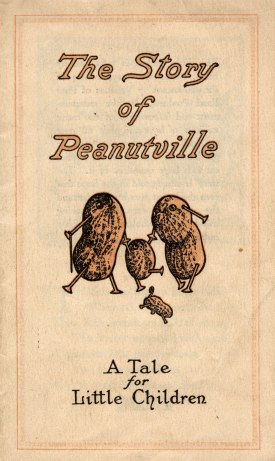
Cover of The Story of PeanutvilleOver the last 30 years, the explosion of Saturday morning cartoons and children’s television programming has caused American parents no shortage of worry about their children’s exposure to advertising. As the Hartman Center for Sales, Advertising & Marketing History’s new exhibit, “Look Boys and Girls! Advertising to Children in the 20th Century,” shows, this advertising is anything but a new phenomenon: advertisers started selling directly to kids, rather than their parents, in the early 20th century. Companies like Heinz and Palmolive published children’s stories (like The Story of Peanutville at right) that positively portrayed their products.

Advertising to Children: A Timeline

1910s: Companies like the Winchester Rifle Company established contests to encourage the use of their products.

Late 1920s: Kids could join “clubs” and might receive prizes and higher status if they consumed more of the sponsoring company’s product. Some companies promoted products through sponsored radio shows and even through schools.

1930s: Comic strip advertising was used to target children and played off the popularity of this section of the newspaper.

1953: Two of the first television shows aimed exclusively at preschoolers, “Baby Sitter” and “Ding Dong School,” were broadcast.
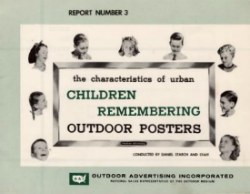
Outdoor Advertising Incorporated Report1960s: As interest in young consumers increased, advertisers consulted the latest psychological studies about how best to target children. This segmentation of the market has continued to narrow, with children now broken into two-year age groups like “tweens” or “explorers.”

1962: McDonald’s ran its first print advertising campaign and used cartoon-like characters to appeal to children.

1979: Well-known children’s advocate, Peggy Charren, testifies before congress, stating that “children’s advertising should be considered, per se, an unfair commercial practice.” Cable station Nickelodeon launches.

Late 1990s: Advertisers continued to expand their reach to these influential customers through the Internet, re-emphasizing “old-fashioned” ways of appealing to children through contests and loyalty clubs.

If you can’t visit the exhibit in person, be sure to check out the online exhibit!

We’d also like to welcome Julian, son of Hartman Center intern Katharine French-Fuller. He made his first visit to the library today (which included a visit to this exhibit)!
Instruction is Sweet!

Bill Fick's "Art of the Comic Book and Zines" Class
Photo by Bill Fick.

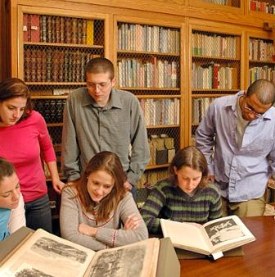
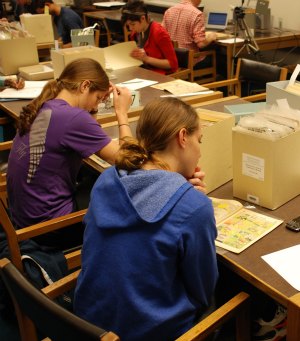
85 classes! The RBMSCL had another packed semester of instruction, as our librarians welcomed a group of fledgling Walt Whitman scholars from North Carolina State University, two classes from the Trinity School, and even a local Girl Scout troop—in addition to scores of Duke undergraduate and graduate students. We couldn’t have been more pleased when a student from Bill Fick’s “Art of the Comic Book and Zines” class (pictured at right) observed, “this place is like a candy shop—only it’s free!”

Here’s a goodie grab bag of some of the classes we taught this past semester:

  • Architectural Theory from Antiquity to the Renaissance
  • Art of the Comic Book and Zines
  • Cannibalism to Anorexia:  Embodying Social Meaning (Writing 20)
  • Digital Durham
  • Documenting the South
  • The Family in Documentary Photography
  • From Huck Finn to Miley Cyrus: Children’s History Through Popular Culture (Writing 20)
  • History of Punk
  • Introduction to Contemporary Latin America
  • Introduction to Oral History
  • Language in Immigrant America
  • Legal Documents: Yesterday & Today (Writing 20)
  • Looking In, Looking Out: The Language of Photographic Texts (Writing 20)
  • Major Italian Authors
  • Maps, Exploration, and Empire
  • Martin Luther King, Jr.
  • Photographing South Africa
  • Play, Games, and Culture (Writing 20)
  • Reading the Qur’an
  • Religion and Politics
  • Russian Art and Politics
  • Staging Sexualities
  • Suburbs, Malls, Office Buildings
  • Weimar and Nazi Germany
  • Women as Leaders

Wondering if the RBMSCL could support your Fall 2011 course? Send us an e-mail at special-collections(at)duke.edu!

Mad Library

Are you a Mad Men fan? Do you like ’60s themed parties? Then come on out to the Mad Men & Mad Women library party on February 25th from 9PM-12AM!

Mad Men & Mad Women Party LogoThe party will highlight the best of the Duke Marketing Club and the Perkins-Bostock library, with special emphasis on the John W. Hartman Center for Sales, Advertising, and Marketing History. It’s open to the whole Duke community and faculty and staff are encouraged to attend.

I’m Tammy Leung, a junior at Duke and decorations chair for the upcoming party, and I am delighted to have used the Competitive Ads Collection provided by the Hartman Center for a majority of the party’s decorations.

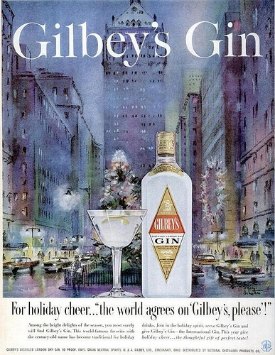
Gilbey's Gin Ad
Gilbey's Gin Advertisement. From the Competitive Ads Collection.

In the past few months, I frequented the Rare Book, Manuscript, and Special Collections Library searching for vintage ads to use as decorations for the party. Going through dozens of boxes of newspaper and magazine ads arranged by product category, I discovered a plethora of ads for the occasion. The ads ranged from funny, classy, unique, and sometimes strange (some of the things they made with Jell-O back in the day are downright disgusting) and gave me unexpectedly great insight into life during the ’60s. The ads I picked out for the party ultimately gives guests a similar glimpse of the ’60s, touching upon sexism, dietary habits, fashion, technology, and mindset during the time.

Without the Hartman Center, the content for our party would’ve been extremely lackluster and I would’ve never been aware of such a rich resource here on campus. I hope that other students will also take advantage of this resource after seeing all of the vintage ads at the party.

Instruction-a-Go-Go

Instruction Session in the Rare Book RoomThis past semester, RBMSCL librarians led over 90 instruction sessions with students from Duke University and beyond—including students taking courses on advertising history at Elon University and Johnson & Wales University. We’ve pulled together a mere sampling of the courses we’ve supported over the past few months. We think you’ll see that the RBMSCL has something for every research interest!

  • Advertising in Society
  • The Age of Jim Crow: Racial Segregation from Plessy to Brown
  • African American Women and History
  • American Business History
  • Animals and Ethics: Welfare, Rights, Utilitarianism, and Beyond
  • Book Art: Text as Image (videos produced by students in the class)
  • Citizen Organizing, 1776-Present
  • Classics of American Literature, 1860 to1915
  • Consumerism in Great Britain and the U.S.
  • Documenting Race, Class, and Gender (Writing 20)
  • Enlightenment Orientalism
  • Globalization in Writing (Writing 20)
  • Hidden Children: Children and Childhood in U.S. History and Across Cultures Cultures (Writing 20)
  • History of Photography, 1839 to the Present
  • Human Rights Activism
  • Intermediate German Conversation
  • Introduction to German Literature
  • Introduction to Old English
  • Methods of Social Research
  • Native American History through Autobiography
  • New Media, Memory, and the Visual Archive
  • New Testament Greek Reading
  • Photography in Context: Photographic Meaning and the Archive of Documentary Arts
  • The Politics and Obligations of Memory
  • Reading Gender, Writing Technoscience (Writing 20)
  • Southern History
  • Witchcraft in Comparative Perspective
  • Writing Sound and Sound Writing: Hearing Race (Writing 20)
  • Writing the Self (Writing 20)

Wondering if the RBMSCL could support your Spring 2011 course? Send us an e-mail at special-collections(at)duke.edu!

Scrapbooking for Victory

“Every Girl Pulling for Victory.” 
“Back Up the Boys.” 
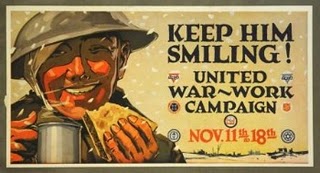
“Keep Him Smiling!” 
“Morale is Winning the War.”

These chipper slogans grace the 20 posters, handbills, brochures, stickers, song lyrics, newspaper ads, and cartoons found in a United War Work Campaign Scrapbook recently acquired by the John W. Hartman Center for Sales, Advertising & Marketing History. This collection of fundraising and morale-boosting materials was produced for a multi-institutional drive during the final months of World War I. Only one other copy is known to exist at Stanford University’s Hoover Institution Archives.

On September 9, 1918, President Woodrow Wilson wrote to Raymond Fosdick, coordinator of the War Department’s Training Camp Activities, requesting that aid organizations pool their resources on a massive single campaign to raise funds for soldier morale programs “in order that the spirit of the country in this matter may be expressed without distinction of race or religious opinion in support of what is in reality a common service.”

The campaign coordinated the efforts of seven organizations that had previously managed individual fundraising drives: the YMCA, YWCA, American Library Association, War Camp Community Service, National Catholic War Council (Knights of Columbus), Jewish Welfare Board, and Salvation Army. Each organization would continue to address their traditional demographic or service focus (for example, the Knights of Columbus worked primarily with Catholic communities, and the American Library Association sent books to soldier encampments) while organizing their activities around a central set of promotional messages.

The goal was to raise $170 million during a campaign scheduled for the week of November 11-18, 1918 (whether prescient or brilliantly planned, November 11 was also the day that Germany signed the Armistice, officially ending hostilities.) The end of the war was already in sight during the campaign-planning period, but it was estimated that the demobilization of nearly four million U.S. troops would require at least two years and a staggering sum for programs to maintain the morale of returning soldiers. With a nearly $1 million operating budget, a National Publicity Committee was formed and chaired by Bruce Barton, a journalist and magazine editor who had been an active official with the YMCA. All media would be employed: print, outdoor advertising, leaflets, stickers, lapel pins, radio spots, motion picture shorts, even a women-run telephone brigade. The campaign was a resounding success, raising over $203 million dollars that funded soldier aid programs through 1920. It was hailed in the press at the time as the largest fundraising event in human history.

As an advertising history-related aside, the United War Work Campaign may have been the launching platform for one of America’s most successful advertising agencies. Ad men Roy Durstine and Alexander Osborn worked on the campaign alongside Bruce Barton. In early 1919, just a few months after the campaign wrapped up, the three men founded ad agency Barton Durstine & Osborn, which merged in 1928 to become Batton, Barton, Durstine & Osborn (BBDO). BBDO rapidly grew to become one of the largest and most respected advertising agencies in the United States. The Hartman Center is proud to add this important scrapbook to its growing collection of war-related advertising materials.

For more photos from the scrapbook, take a look at the scrapbook’s set on the RBMSCL’s Flickr photostream.

Post contributed by Rick Collier, Technical Services Archivist for the John W. Hartman Center for Sales, Advertising & Marketing History.

RBMSCL Travel Grants: $$$ to Visit Us!

Photo by Mark Zupan.

Good news, researchers! The RBMSCL is now accepting applications for our 2011-2012 travel grants.

The Sallie Bingham Center for Women’s History and Culture, the John Hope Franklin Research Center for African and African American History and Culture, and the John W. Hartman Center for Sales, Advertising & Marketing History will award up to $1,000 per recipient to fund travel and other expenses related to visiting the RBMSCL. The grants are open to undergraduate and graduate students, faculty, independent scholars, artists, and activists living outside a 100-mile radius from Durham, NC with research projects that would benefit from access to the centers’ collections.

More details—and the grant application—may be found on our grants website. Applications must be postmarked or e-mailed no later than 5:00 PM EST on January 31, 2011. Recipients will be announced in March 2011.

We’re also excited to announce that the RBMSCL will be offering three new grants this year for scholars interested in using our German Studies and Judaica collections. Additional information about applying for one of these three grants will be available on our grants website soon. These new grants will have a later deadline.

Selling a Coke and a Smile

Photo by Mark Zupan.

As the adage goes, Coca-Cola sells itself. The John W. Hartman Center for Sales, Advertising and Marketing History’s recently-acquired Coca-Cola Star Salesman Kit might just suggest otherwise. This collection of training materials—including scripted manuals, 35mm film strips with accompanying phonographs, and other training memorabilia housed in a special green suitcase—was created by the Coca-Cola Company’s Sales Promotion Department between 1949 and 1951. The company encouraged route managers to purchase the Star Salesman Kit as a subscription program to educate their salesmen in the latest marketing techniques.

Designed as a series of one hour sessions, the Star Salesman Kit covers eight topics relevant to the company’s goal of increasing route sales, such as merchandising (“It’s Got to Be Sold”), and advertising (“What’s on Your Mind”). In addition, the kit includes training material for best practices in stocking product, refrigeration, and the use of the “red cooler” and vending machines in various outlets.

While most of the Star Salesman Kit is geared toward increasing sales to vendors, the materials do give special attention to instructing route salesmen how to promote Coca-Cola sales to the home market—particularly to the housewife. The session, “The Woman in Your Life,” encouraged the route salesman to market directly to women through techniques such as floor displays and product placement in outlets where women shopped for the home.

The Star Salesman Kit provides a glimpse into the sales and marketing culture of the Coca-Cola Company, the organization of its sales department, training practices, and even refrigeration technology. At the same time, the Star Salesman Kit offers some insights into mid-20th-century social and cultural issues, demonstrating, perhaps, why no other consumer product is a more iconic symbol of American culture than Coca-Cola.

Post contributed by Diana Poythress, RBMSCL Technical Services graduate student volunteer. Thanks to Alexandra Bickel, RBMSCL Technical Services graduate student volunteer, for her assistance with this post.

From the RBMSCL Wire

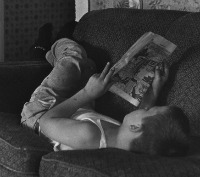
Boy lying on couch, reading comics. From the William Gedney Photographs and Writings, 1950s-1989.

Sure, you could lie on a couch and read comic books, but why not have a look at some of the articles and blog posts about the RBMSCL that have been published recently?

A profile of Susie King Taylor appears at TheAtlantic.com. (Read the post here). Taylor’s Reminiscences of My Life in Camp is part of the John Hope Franklin Research Center for African and African American History and Culture’s Black Voices Collection.

Our new exhibit, “‘As Far as Possible from Forgetfulness’: The Trinity College Historical Society,” found itself on the front page of the Durham Herald-Sun. (Read the article online.)

And Hartman Center travel grant recipient Ari Samsky wrote about his two-week research visit to the RBMSCL for web magazine Splice Today. You’ll find his essay—which makes us glad that Durham’s cooled off considerably in the past few days—here.

Let us know if you find any other mentions of the RBMSCL during your wanderings across the Internet and through print.

New and Improved AdViews!

Just in time for the premiere of the fourth season of Mad Men, the last batch of 3,200 newly digitized D’Arcy Masius Benton & Bowles (DMB&B) commercials has been uploaded to AdViews!

More commercials than ever! Now there are almost 8,800 commercials in AdViews.

Essential new products! New ads for Oreo, Continental Airlines, Raisin Bran, Mattel, Fresca, Pop Rocks, Legos, Clearasil, Volkswagen, Budweiser, Hardee’s and so much more!

Act now and see expert interviews! Professors Jason Chambers of the University of Illinois and Peggy Kreshel of the University of Georgia give context to advertising targeted towards African Americans and women.

But wait, there’s more! Highlighted content includes a 20-minute film about the creation of a 1970s Post Grape Nuts commercial featuring Euell Gibbons.

After you’ve checked out AdViews, stop back here and let us know your favorite commercials!