Category Archives: From Our Collections

New and Improved AdViews!

Just in time for the premiere of the fourth season of Mad Men, the last batch of 3,200 newly digitized D’Arcy Masius Benton & Bowles (DMB&B) commercials has been uploaded to AdViews!

More commercials than ever! Now there are almost 8,800 commercials in AdViews.

Essential new products! New ads for Oreo, Continental Airlines, Raisin Bran, Mattel, Fresca, Pop Rocks, Legos, Clearasil, Volkswagen, Budweiser, Hardee’s and so much more!

Act now and see expert interviews! Professors Jason Chambers of the University of Illinois and Peggy Kreshel of the University of Georgia give context to advertising targeted towards African Americans and women.

But wait, there’s more! Highlighted content includes a 20-minute film about the creation of a 1970s Post Grape Nuts commercial featuring Euell Gibbons.

After you’ve checked out AdViews, stop back here and let us know your favorite commercials!

Hot New Finding Aids!

Is the heat wave getting to be too much to bear? Head on over to the RBMSCL and do some research in our cool reading room!

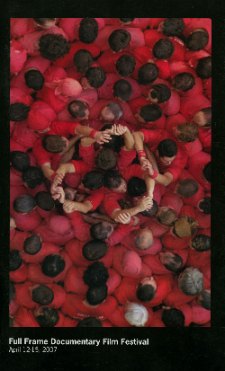
Full Frame Festival Program, 2007. From the Full Frame Archive Film Collection.

Full Frame Archive Film Collection, 1998-2010

The largest film festival in the United States entirely devoted to documentary film, the Full Frame Documentary Film Festival has been an annual highlight of Durham’s cultural scene since 1998.

In 2007, Duke University Libraries and Full Frame, with support from Eastman Kodak and Alpha Cine Labs in Seattle, announced the creation of the Full Frame Archive, to be housed at the RBMSCL, with the aim of acquiring, archiving, and preserving copies of all of the Festival’s award-winning films. The Full Frame Archive Film Collection comprises preservation masters of documentary films that won awards at the Full Frame Film Festival between 1998 and 2010. Each year’s festival will bring new additions to the collection!

Confederate States of America Collection, 1850-1876

One of our older collections has a brand new finding aid. This perennially-popular collection includes a wide variety of records from the administrative bodies within the Confederate States of America, including original and typed copies of acts and statutes of the C.S.A. Congress, Army soldiers’ correspondence and papers of several Army units, and records from the Treasury Department. There might even be a clue about the lost Confederate gold!

Rights! Camera! Action!: Trouble the Water

Date: Tuesday, 13 July 2010
Time: 7:00 PM
Location: Sarah P. Duke Gardens (map and directions)
Contact Information: Patrick Stawski, 919-660-5823 or patrick.stawski(at)duke.edu, or Kirston Johnson, 919-681-7963 or kirston.johnson(at)duke.edu

As Hurricane Katrina bore down on New Orleans, 9th Ward resident Kimberly Rivers Roberts, an aspiring rap artist, and her husband Scott, used their Hi 8 camera to film their experience of the storm, from the trepidation of the day before the storm’s landfall to the failing of the levees. Trouble the Water weaves this home movie footage with archival news segments and verite footage shot over the next two years to tell the story of a community struggling to rebuild itself.

The film screening will be preceded by a panel discussion with Wahneema Lubiano and Mark Anthony Neal, both of Duke’s Department of African and African American Studies.

The Rights! Camera! Action! film series, which is sponsored by the Archive for Human Rights, the Archive of Documentary Arts, the Duke Human Rights Center, the Franklin Humanities Institute, and Screen/Society at Duke’s Arts of the Moving Image Program, features documentaries on human rights themes that were award winners at the annual Full Frame Documentary Film Festival. The films are archived at the RBMSCL, where they form part of a rich and expanding collection of human rights materials.

The Star-Spangled Cucumber

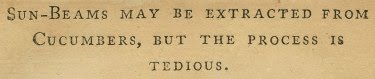
As archivists, we know that we’re supposed to mark the Fourth of July with a remembrance of that most celebrated of documents, our Declaration of Independence. We think, though, that we’ll leave the remembering and celebrating to our fine colleagues at the National Archives, and give some attention to a document of a completely different sort—a pamphlet bearing one of the most wonderful titles we’ve ever come across:

Lest you think we’re joking, here’s a link to the catalog record. The pamphlet reprints an oration delivered by David Daggett to the citizens of New Haven, Connecticut on the Fourth of July, 1799.

Of course, at the risk of spoiling the fun, we have to note that the title is actually a reference to Jonathan Swift’s Gulliver’s Travels. Since Swift was a pretty funny guy himself, we’re hoping you’ll forgive us.

Happy Fourth of July from the RBMSCL!

Thanks to Beth Ann Koelsch, who brought this treasure to our attention many years ago.

Happy United Nations Charter Day!

The United Nations Conference on International Organization officially convened between April 25 and June 26, 1945 in San Francisco. On 26 June 1945, delegations from 50 countries signed the United Nations Charter, a constituent treaty by which all member nations are bound in an international body and in which organization’s mission and commitment to peaceful resolution are defined.

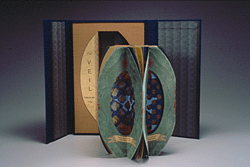
The Veil by Julie Chen, 2002.
Photo courtesy of Vamp and Tramp Booksellers.


Over fifty years later, book artist Julie Chen wove the text of the famously eloquent Preamble into her 2002 free-standing concertina, The Veil. This carousel book offers the artist’s reflections on the political conflicts in the Middle East through both words and abstract visual meditations which unfold over the text of the charter. The Veil will be featured in the Sallie Bingham Center for Women’s History and Culture’s Book + Arts Exhibit this October.

Post contributed by Christine Well, UNC SILS graduate student volunteer, Sallie Bingham Center for Women’s History and Culture.

Commercials in the Classroom

[youtube=http://www.youtube.com/watch?v=BxFv29qzEGc]

How have TV commercials changed over time? The answer to part of that question is found in this video about AdViews. Five Duke undergraduates discuss their small group project using commercials found in AdViews as primary sources for a fall 2009 Markets & Management Studies class taught by George Grody.

Using AdViews, the students compared a number of historic 1960s and 1970s commercials with corresponding ones from today. The students analyzed commercials for Hardees, Schick, Bounce, Pledge, and perfume, finding both interesting similarities and drastic contrasts that reflect the branding strategies of each time period.

AdViews, a digital archive of over 8,000 vintage television commercials dating from the 1950s to the 1980s, is one of the newest resources available from the Hartman Center for Sales, Advertising & Marketing History.

The Hartman Center collects and provides access to commercials, print ads, books, and other documents chronicling the advertising and marketing of products from the mid 19th century to the present. Our staff also provides targeted presentations to a wide range of classes each semester, helping to integrate primary source material into subjects ranging from Anthropology to History to Visual Studies, and most anything in between. Students are able to discover not only how TV commercials have changed, but how advertising tracks the evolution of not only the ad industry but also of society itself.

If you are interested in learning more about AdViews, classroom presentations, or research assistance, please contact the Hartman Center Reference Archivist at hartman-center(at)duke.edu or 919-660-5827.

Post contributed by Lynn Eaton, Hartman Center Reference Archivist.

Calling All Campers!

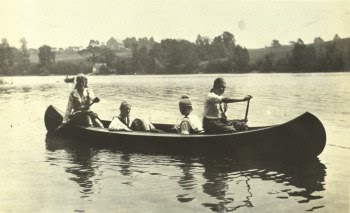
“Canoeing at Camp Teconnet.” From the New England Girls’ Summer Camps Photograph Album.

These days are filled with happiness,
Encouragement, and zest.
Companionship we never lack,
Or chance to play—or rest;
No silly rules there are, and yet,
No doubt of loving care.
Each girl has opportunities
To serve, enjoy, and share.

From a 1917 brochure about Camp Teconnet

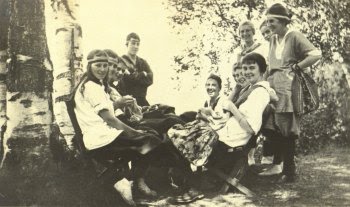
In 2008, we made a lucky find in a rare book dealer’s catalog: a lovely New England girls’ summer camp photograph album. We were utterly charmed by this album of black and white photos of girls at Camp Mascoma, in New Hampshire in 1916 and Camp Teconnet Maine in 1917. The unidentified teenage girl who created this album clearly had a wonderful time swimming, canoeing, and sitting around campfires with the friends she made, each with her own nickname like “Parsnips.”

The album also included material clipped from a promotional brochure about Camp Teconnet, which described camp life as “the wisest and sanest solution of the vacation problem for girls.” The brochure also proclaimed, “Physical measurements are taken at the beginning of the season for each camper and from these the ‘Missus’ and councilors form the foundation for the work with the individual, encouraging here and holding back there, so that the end of the season may bring its own reward in better health and physique.” These girls certainly do look healthy and fit!

You’ll find a detailed description of this album here. If you’d like to look through the album yourself and reminisce about your own days at camp (or if you have any questions about the album), e-mail us at special-collections(at)duke.edu.

Post contributed by Kelly Wooten, Research Services and Collection Development Librarian for the Sallie Bingham Center for Women’s History and Culture.

“Waiting for Dinner.” From the New England Girls’ Summer Camps Photograph Album.

A Jazz Master’s Papers Come to Duke

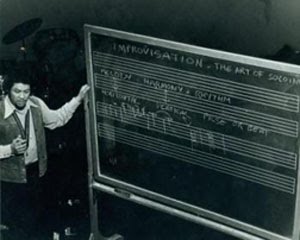
Frank Foster, ca. 1970s. From the Frank Foster Papers.

The Jazz Archive at Duke University announces the recent arrival of the Frank Foster Papers. Foster is one of the leading jazz saxophonists, big band leaders, and composer/arrangers of the post-World War II era. While serving as the primary arranger for the Count Basie Orchestra since the 1950s, Foster continued to compose and arrange for a variety of ensembles, receiving two Grammy Awards in the 1980s for his work. In 2002, Foster received the Jazz Masters Award from the National Endowment for the Arts.

The papers (which range from 1927 to 2009) reveal Foster’s personal and professional lives. Scores and parts composed or arranged by Foster for jazz big bands, as well as business records, publicity, reviews, and news clippings documenting Foster’s career, are complemented by personal correspondence, photographs, and a variety of Foster’s own prose writings. There are also roughly fifty hours of concert recordings featuring various bands Foster performed in.

While portions of the papers are currently open for research, the entire collection should be processed and available for use by the fall of 2010. If you’d like to arrange a visit to view the collection, or if you have any questions, please e-mail us at special-collections(at)duke.edu.

Post contributed by Jeremy Smith, Jazz Archivist.

Your Bloomers Are Showing

Cover of "The Bloomer's Complaint," 1851.

According to an informal and completely unscientific survey, five out of the eight women who work in the RBMSCL’s reading room are wearing pants today. This might not be the case were it not for the efforts of Amelia Bloomer, early feminist and fashion pioneer, who celebrates her 192nd birthday today.

To honor Amelia, we quote from a 6 August 1851 letter from University of North Carolina chemistry professor Benjamin Sherwood Hedrick to his future wife, Mary Ellen Thompson (from our Benjamin Sherwood Hedrick Papers).

Remarking on current cultural matters from his position at the Nautical Almanac in Cambridge, Massachusetts, he writes:

There is something said every day or two about ‘Bloomers.’ I have seen several of them and like them. The young ladies have changed the fashion of putting up their hair, combing it up and back, something like what is vulgarly called a ‘cow-lick.’ I do not like it.

Professor Hedrick’s progressive opinion on the bloomer suit was not widely shared. Witness the chorus of “The Bloomer’s Complaint,” a charming song also from 1851:

I’ll come out next week, with a wide Bloomer flat
Of a shape that I fancy will fright them,
I had not intended to go quite to that,
But I’ll do it now, only to spite them—
With my pants “a la Turque,”
And my skirts two feet long
All fitting of course, most completely
These grumblers shall own after all, they are wrong,
And that I, in a Bloomer, look sweetly,
And that I, in a Bloomer, look sweetly.

Thanks to Mitch Fraas, RBMSCL Research Services intern, for suggesting this post.