Category Archives: Franklin Research Center

Instruction Round-Up!

Dr. Ara Tourian and students
Dr. Ara Tourian presenting at Anatomy Day

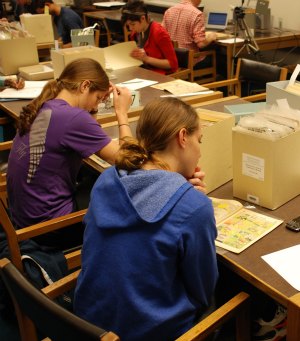
This was another busy semester for Rubenstein librarians, who taught or co-taught more than 70 classes between September and early December! The classes ranged widely in subject, from feminist comics to medical history.

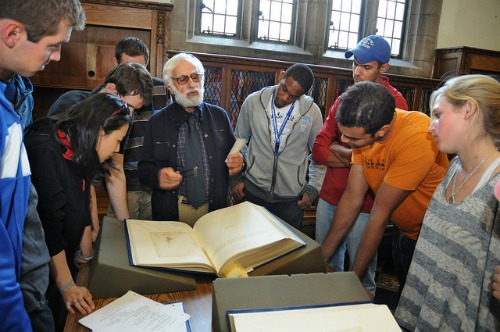
One exciting event, nicknamed “Anatomy Day,” brought 100 medical students to the Gothic Reading Room to investigate historical anatomical atlases and other books and manuscripts from the History of Medicine Collections. Rachel Ingold, Curator of the History of Medicine Collections, led a team of Rubenstein librarians in presenting these treasures to the students.
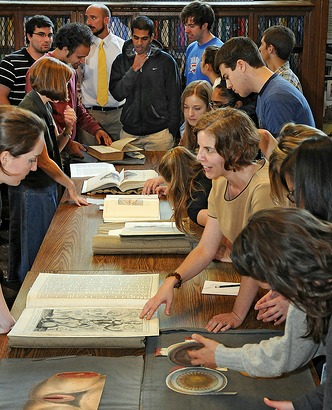
Rachel Ingold and students
Rachel Ingold, Curator of the History of Medicine Collections

A few of the Duke classes that met in the Rubenstein Library this past semester are:

  • Beyond Wonder Women: Comic and Graphic Novel Feminisms
  • History of Photography, 1839 to the Present
  • Documentary Photography and the Southern Culture Landscape
  • Early Soviet Culture 1917-1934
  • American Slavery/Emancipation
  • Accelerated Intermediate Italian
  • On the Boundaries of Medicine
  • The Physician in History
  • Hidden Children
  • Dante and the Afterlife of the Book

We also hosted classes from North Carolina State University and the University of North Carolina – Chapel Hill.

The Rubenstein staff offers a vast array of class instruction and support options. Please contact us to learn more about what the Rubenstein staff can do for your class!

A Busy Week in Archives Education

(L to R) Panelists Holly Smith, Dr. L. Teresa Church, and Jenn Thompson. Photo courtesy SCOSAA-UNC.

Rubenstein Library staff visited our neighbors in Chapel Hill last week to speak on two panels sponsored by UNC-Chapel Hill’s Student Chapter of the Society of American Archivists (SCOSAA).  Jenn Thompson, the Research Services and Collection Development Librarian for the John Hope Franklin Research Center for African and African American History and Culture, spoke on November 7 about the Franklin Center’s collections as part of a panel entitled “Diversifying the Archives.”  Naomi Nelson, the Rubenstein’s Director, spoke on November 10 about reappraisal of archival materials with colleagues from UNC’s Wilson Library.  For more information on the panels, see SCOSAA’s blog (linked above) or their Facebook page.

Naomi Nelson (back row center) with fellow panelists Bill Landis, Tim West, and attendees of panel. Photo by Patrick Michael Brown, courtesy SCOSAA-UNC.

Travel Grant Season is Open!

Wish you were here? We do too! The David M. Rubenstein Rare Book & Manuscript Library is now accepting applications for our 2012-2013 travel grants.

The Sallie Bingham Center for Women’s History and Culture, the John Hope Franklin Research Center for African and African American History and Culture, and the John W. Hartman Center for Sales, Advertising & Marketing History will award up to $1,000 per recipient to fund travel and other expenses related to visiting the Rubenstein Library.

The grants are open to undergraduate and graduate students, faculty, independent scholars, artists, and activists living outside a 100-mile radius from Durham, NC with research projects that would benefit from access to the centers’ collections.

More details—and the grant application—may be found on our grants website. Applications must be postmarked or e-mailed no later than 5:00 PM EST on January 31, 2012. Recipients will be announced in March 2012.

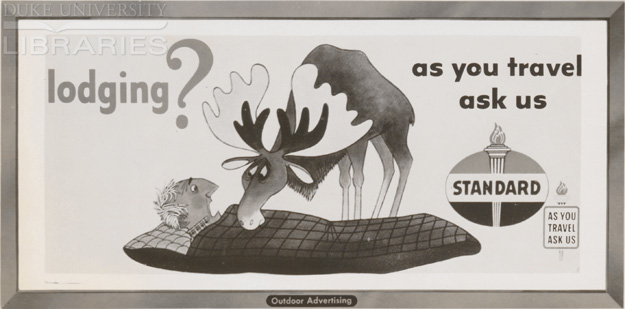
Standard Gas Stations Billboard Proof.
Standard Gas Stations Billboard Proof. From the Outdoor Advertising Association of America Archives.

Some of last year’s recipients include:

At the Sallie Bingham Center for Women’s History and Culture:

  • Marika Cifor, a master’s student in History and Library and Information Science at Simmons College, who used the Bingham Center’s lesbian pulp fiction collection for master’s thesis research on the historical relationships of lesbians and prostitutes in the United States, 1869-1969.
  • Jennifer Nelson, Associate Professor of Women’s and Gender Studies at University of Redland, visited the Bingham Center to conduct research for a book on community health reform movements from the mid-1960s to the present using the Feminist Women’s Health Center Records.
  • Emily Thuma, a Visiting Scholar at the Center for Race and Gender at University of California, Berkeley is visiting this week for post-doctoral research to revise her dissertation, “Not a Wedge, But a Bridge”: Prisons, Feminist Activism, and the Politics of Gendered Violence, 1968-1987. (Check out this blog post for details about Emily Thuma’s upcoming talk.)

At the John Hope Franklin Research Center for African and African American History and Culture:

  • Ira Dworkin, Assistant Professor, Department of English and Comparative Literature, The American University in Cairo, for research on African Americans in the Congo, particularly George Washington Williams.
  • Nina Ehrlich, master’s student, Department of History, Colorado State University, for a study of relationships between black and white women during the Civil Rights Movement.
  • Tyler D. Parry, Ph.D. candidate and master’s student, Department of History, University of South Carolina, for dissertation and article exploring slave kinship in the Antebellum South.

At the John W. Hartman Center for Sales, Advertising, and Marketing History:

  • Leif Frederickson, an independent researcher from Missoula, MT for research on “From Public Pedagogy to Business Branding: The Development of Green Advertising, 1950-1995.”
  • Janet Golden Professor at the Department of History, Rutgers University to research “The History of American Babies.”
  • Laura Phillip, a Ph.D. candidate at the Corcoran Department of History, University of Virginia for research on “Marketing of the Fair Trade Message.”

Post contributed by Kate Collins, Bingham Center intern.

Haunted Library Screamfest

Date: Halloween, Monday, October 31, 2011
Time: 11:00 AM-1:00 PM
Location: Rare Book Room
Contact Information: Rachel Ingold, 919-684-8549 or rachel.ingold(at)duke.edu

Have you ever wandered around a library’s stacks in the dark? Or wondered what might go bump in an archival box?

Stop by the Rubenstein Library’s Rare Book Room for a special Halloween “eeeks”-ibit and open house. We’ll be dragging out some of the creepiest and most macabre items from the shadowy depths of the library’s vaults—including the thirteen unlucky items below.

This event is free and open to the living and the dead. There will be candy. Lots and lots of candy.

49 Glass Eyeballs
49 Glass Eyeballs. From the History of Medicine Collections.

1. A travel diary written by John Buck, a young American who found himself face-to-face with Bram Stoker (before he wrote Dracula)

2. Letters to Duke University’s Parapsychology Laboratory describing the 1949 poltergeist case that became the basis for The Exorcist

3. Opera Omnia Anatomico-Medico-Chirurgica by 18th century Dutch anatomist Frederik Ruysch, featuring illustrations of fetal skeletons playing instruments  among “trees” made of veins and arteries and “rocks and stones” that are actually organs, gallstones, and kidney stones

4. An entire box of glass eyeballs (49, to be exact)

5. “Jack the Ripper” and “Cthulhu by Gaslight,” two board games from the Edwin and Terry Murray Role Playing Game Collection

6. Artists’ books Mountain Dream Tarot by Bea Nettles and Femmes Fatales by Maureen Cummins. Tarot cards and pictures of medieval torture devices!

7. Brochures and advertisements for coffins and other funeral-related paraphernalia from the Advertising Ephemera Collection

8.Two copies of Henry Milner’s 1826 melodramatic adaptation of Mary Shelley’s Frankenstein, with the very first illustration of (the actor portraying) “the Monster”

9. Bela Lugosi’s signature

10. Maps and photographs of the Rigsbee Graveyard (yes, the graveyard in the Blue Zone)

11. Comics Review #1, 1965, which includes  Stephen King’s first published story, “I Was a Teenage Grave Robber,”  from the Edwin and Terry Murray Fanzine Collection

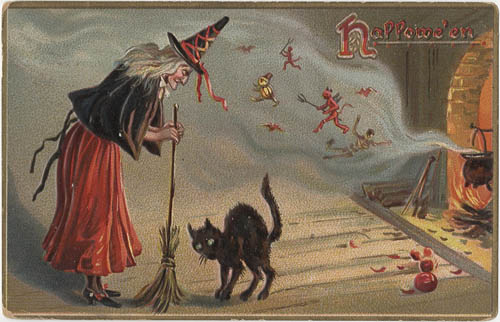
12. Halloween postcards (complete with spooky messages . . . or invitations to Halloween parties) from our Postcard Collection

13. Trixie Belden and the Mystery of the Whispering Witch by Kathryn Kenny, 1980

Which one will give you nightmares come the witching hour?

Halloween Postcard, 1908.
Halloween Postcard, 1908. From the Postcard Collection.

Researching the Civil War?

This has been the most terrific days battle since commincement. The enemy made a terrible charge over our Breastworks with re-inforcementz & succeeded in charging some of our men out of them, capturing many of our Division. All our Regiment that were left from the first days fight were captured.
—from the Henry Beverige Diary, Thursday, May 12, 1864.

Beverige, a soldier and hospital steward with the 25th Virginia Regiment of the Confederate States of America, describes one of the many terrifying, bloody days of the American Civil War. His diary is one of the numerous first person accounts available in the Rubenstein Library. Other perspectives on life during the conflict are offered by fiery teenager Alice Williamson;  Confederate spy Rose O’Neal Greenhow, African Americans such as Edgar Dinsmore, and the many others who experienced the loneliness, losses, and deprivations—and occasional triumphs—of the conflict.

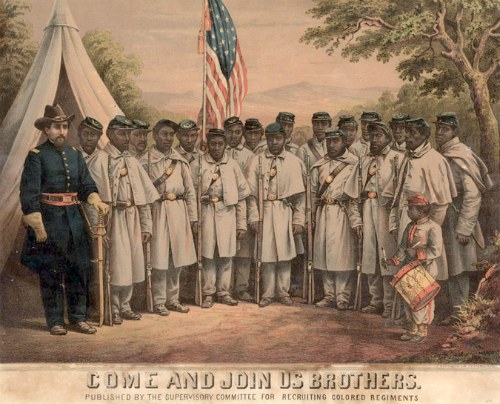
"Come and Join Us Brothers," 1863

To commemorate the sesquicentennial of the Civil War, Rubenstein Library staff have collaborated on a guide to Civil War resources that provides highlights of our rich collections. Special sections describe manuscript and print material related to military history, medicine, women, African Americans, literature, and music in the Rubenstein Library, as well as other library guides and relevant databases and websites.

We anticipate that this guide will be helpful for scholars, genealogists, and anyone with a personal interest in Civil War history. Please contact us if you have questions or comments about our collections.

Post contributed by Elizabeth Dunn, Research Services Librarian.

Nelson Mandela and a Centering of Memory

Date: Monday, October 17, 2011
Time: 6:00 PM
Location: Rare Book Room
Contact Information: Jennifer Thompson, 919-660-5922 or jennifer2.thompson(at)duke.edu

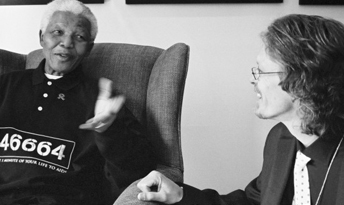
Please join the staff of the John Hope Franklin Research Center for African and African American History and Culture for a program entitled “Nelson Mandela and a Centering of Memory,” with Verne Harris, Head of the Memory Programme at the Nelson Mandela Foundation’s Centre of Memory and Dialogue. A reception will follow.

Nelson Mandela and Verne HarrisVerne Harris has been Nelson Mandela’s archivist since 2004. As Head of the Centre of Memory, he has been the project leader on several publications about Nelson Mandela’s life: Nelson Mandela: Conversations with Myself (Macmillan, Johannesburg, 2010); Nelson Mandela: The Authorised Comic Book (Jonathan Ball, Johannesburg and Cape Town, 2008); and A Prisoner in the Garden: Opening Nelson Mandela’s Prison Archive (Penguin, Cape Town, 2005). He has also written about and presented on a number of topics concerning archives, records management and freedom of information in South Africa.

Verne Harris’ visit to Duke is co-sponsored by the Franklin Humanities Institute, where he will also be speaking on archives and justice on Tuesday, October 18th. Please find more information on this event at http://www.fhi.duke.edu/events/verne-harris-seminar.

Post contributed by Jennifer Thompson, John Hope Franklin Research Center Librarian.

Open for Business: NC Mutual Archives

The North Carolina Mutual Life Insurance Company Archives (collection guide here), now available for research at the RBMSCL and North Carolina Central University’s University Archives, Records and History Center, contains nearly 100,000 items documenting more than a century of service for this prominent African American business.

This archives include corporate office files, annual statements, reports, surveys, memos, legal and financial papers, training material, programs, memorabilia, and an exceptional number of historical photographs of staff and their families, offices, buildings, and Durham scenes (including a visit from Booker T. Washington).

The collection offers a window into the inner workings of the company, the legacy of Durham’s Black Wall Street, and over a century’s worth of community and organization building. The archivists and librarians of both institutions are looking forward to the scholarship that will result from the use of the North Carolina Mutual Life Insurance Company Archives.

Group in front of The Mutual Building. From the North Carolina Mutual Life Insurance Company Archives.

Over one hundred selected digitized images, like the one above, as well as several historical documents, are also currently available in an online exhibit.

Researchers wishing to use the North Carolina Mutual Life Insurance Company Archives should note that the entire collection is stored in our off-site storage facility. Please contact the University Archives, Records and History Center at North Carolina Central University or the RBMSCL (“Ask a Question” website) at Duke University at least 48 hours before your visit so that staff can request the material you would like to see.

For more information about the North Carolina Mutual Life Insurance Company Archives, check out the Duke University Libraries’ press release.

Post contributed by Jennifer Thompson, John Hope Franklin Research Center Librarian.

10 Days, 10 New Acquisitions: Day Seven

We’re celebrating the beginning of a new fiscal year by reviewing some notable items and collections that arrived here at the RBMSCL in the past year. Get ready for announcements of many more exciting acquisitions in 2011-2012!

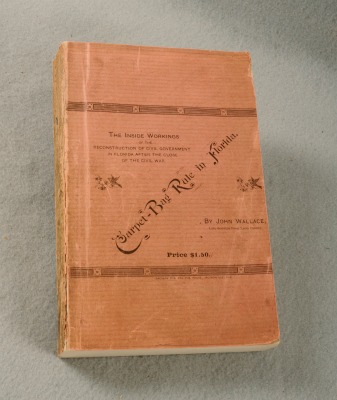
Cover of Carpet Bag Rule in Florida

Carpet Bag Rule in Florida: The Inside Workings of the Reconstruction of Civil Government in Florida After the Close of the Civil War by John Wallace, 1888

John Wallace (1842-1908) was born a slave in North Carolina, served in the Union army during the Civil War, and settled in Florida at the end of the war.  He served in the Florida state House of Representatives and Senate during the Reconstruction era as a Republican, the longest political tenure of any black man in Florida; however, his book, published in 1888, is very critical of his fellow Republicans and Reconstruction rule.  Doubts about Wallace’s authorship emerged quickly, both because of his race and his stance against the Republicans, but proof that the book is not by him remains unfound.

From the John Hope Franklin Research Center for African and African American History and Culture.

For more photos of our new acquisitions (and other materials from the RBMSCL’s collections), check out the “From the RBMSCL’s Collections” set on the Duke University Libraries’ Flickr photostream.

Post contributed by Will Hansen, Assistant Curator of Collections.

Previous posts:

Instruction is Sweet!

Bill Fick's "Art of the Comic Book and Zines" Class
Photo by Bill Fick.

85 classes! The RBMSCL had another packed semester of instruction, as our librarians welcomed a group of fledgling Walt Whitman scholars from North Carolina State University, two classes from the Trinity School, and even a local Girl Scout troop—in addition to scores of Duke undergraduate and graduate students. We couldn’t have been more pleased when a student from Bill Fick’s “Art of the Comic Book and Zines” class (pictured at right) observed, “this place is like a candy shop—only it’s free!”

Here’s a goodie grab bag of some of the classes we taught this past semester:

  • Architectural Theory from Antiquity to the Renaissance
  • Art of the Comic Book and Zines
  • Cannibalism to Anorexia:  Embodying Social Meaning (Writing 20)
  • Digital Durham
  • Documenting the South
  • The Family in Documentary Photography
  • From Huck Finn to Miley Cyrus: Children’s History Through Popular Culture (Writing 20)
  • History of Punk
  • Introduction to Contemporary Latin America
  • Introduction to Oral History
  • Language in Immigrant America
  • Legal Documents: Yesterday & Today (Writing 20)
  • Looking In, Looking Out: The Language of Photographic Texts (Writing 20)
  • Major Italian Authors
  • Maps, Exploration, and Empire
  • Martin Luther King, Jr.
  • Photographing South Africa
  • Play, Games, and Culture (Writing 20)
  • Reading the Qur’an
  • Religion and Politics
  • Russian Art and Politics
  • Staging Sexualities
  • Suburbs, Malls, Office Buildings
  • Weimar and Nazi Germany
  • Women as Leaders

Wondering if the RBMSCL could support your Fall 2011 course? Send us an e-mail at special-collections(at)duke.edu!

2011-2012 Franklin Research Center Travel Grants Awarded

The John Hope Franklin Research Center for African and African American History and Culture is pleased to announce the recipients of this year’s travel grants. These grants support the work of students, scholars, and independent researchers for travel to Durham to conduct research using the Franklin Research Center’s collections.

  • Andrew David Amron, Ph.D. candidate, Department of History, University of Alabama, for his dissertation on black working-class masculinity and identity during the World War I era.
  • Maureen Cummins, independent scholar, for the production of a limited edition artist book concerning slavery in the U.S., mid 19th century.
  • Ira Dworkin, Assistant Professor, Department of English and Comparative Literature, The American University in Cairo, for research on African Americans in the Congo, particularly George Washington Williams.
  • Nina Ehrlich, master’s student, Department of History, Colorado State University, for a study of relationships between black and white women during the Civil Rights Movement.
  • Reginald K. Ellis, Visiting Professor, Department of History, Florida A&M University, for work on a manuscript concerning James Edward Shepard and black North Carolinians in the 20th century.
  • Rebecca Wieters Moake, Ph.D. candidate, Department of History, University of Maryland-College Park, for work on her dissertation concerning the working people of Charleston, S.C., in the late 19th century.
  • Tyler D. Parry, Ph.D. candidate and master’s student, Department of History, University of South Carolina, for dissertation and article exploring slave kinship in the Antebellum South.
  • Ibram H. Rogers, Assistant Professor, Department of History and Africana & Latino Studies, State University of New York College at Oneonta, for a book examining the struggle to diversify higher education, 1965-1972.
  • Daniel Royles, Ph.D. candidate, Department of History, Temple University, for research exploring African American AIDS activism and advocacy in the United States.