Category Archives: Bingham Center

Robin Morgan & Marie Anderson: The Women’s Pages & The Women’s Liberation Movement

Date: Thursday, April 18, 2013
Time: 3:00 p.m.
Location: Perkins Library, Room 318 (Rubenstein Library Classroom)
Contact Information: Kelly Wooten, kelly.wooten(at)duke.edu

robin morgan
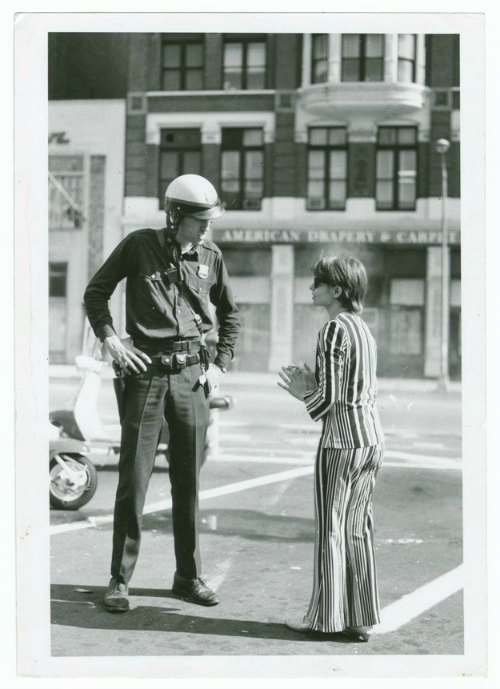
Police officer and Robin Morgan, Miss America protest, Atlantic City, 1968

Please join the staff of Sallie Bingham Center of Women’s History and Culture for a talk by Kimberly Wilmot Voss addressing the intersection of the women’s pages of newspapers and women’s liberation leaders in the 1960s and 70s, and the differences in coverage by those women journalists compared to the mainstream press.

Voss is an Assistant Professor and Area Coordinator of Journalism, University of Central Florida, and is a 2012 recipient of a Mary Lily Research Grant from the Sallie Bingham Center.

Light refreshments will be provided.

Mandy Carter, Peace Walker

Since starting my internship with the Sallie Bingham Center last August, I’ve spent time each week processing the papers of Mandy Carter, a self-described “southern out black lesbian social justice activist.”

This year Carter celebrates 45 years of social, racial, and lesbigaytrans justice organizing, and it’s almost impossible to summarize all that she has done—beginning with peace activism in the late 1960s and continuing today in her role as National Coordinator for the Bayard Rustin Commemoration Project of the National Black Justice Coalition. So instead, here’s one small peek.

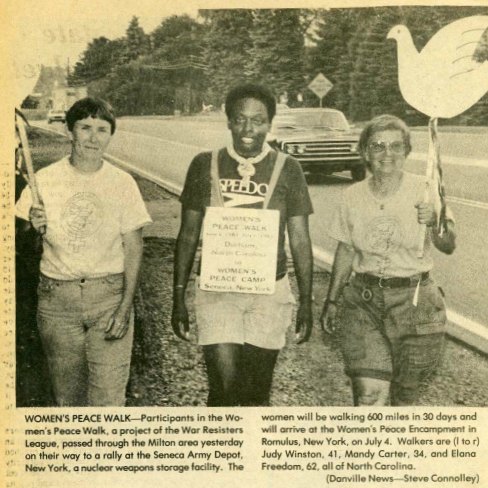
Though based in Durham for much of her career, Carter has traveled up, down, and around the country in support of her activism–and in the summer of 1983, she walked from Durham, North Carolina to Seneca, New York as part of the Women’s Peace Walk.

From left to right: Judy Winston, Mandy Carter, Elana Freedom. The trio completed the entire 600+ mile walk. Along the way, other women joined for a day, weekend, week, or longer. Newspaper clipping, 1983, Mandy Carter Papers
From left to right: Judy Winston, Mandy Carter, Elana Freedom. The trio completed the entire 600+ mile walk. Along the way, other women joined for a day, weekend, week, or longer. Newspaper clipping, 1983, from the Mandy Carter Papers.

Organized by the Southeast Regional Office of the War Resisters League—where Carter worked at the time—the Women’s Peace Walk aimed to draw attention to and protest the build-up of nuclear arms and specifically, the planned deployment of Cruise and Pershing II missiles to Europe later that year.

Women’s Peace Walk brochure, 1983.  From the Mandy Carter Papers.
Women’s Peace Walk brochure, 1983. From the Mandy Carter Papers.

Organizers timed the end of the walk to coincide with the beginning of the Women’s Encampment for a Future of Peace and Justice, and the destination itself held particular significance. The area was not only home to the Seneca Army Depot, a nuclear bomb and missile storage site, it was also where women of the Iroquois Nation met in 1590 to demand an end to war among the tribes and where more than 300 men and women came together in 1848 for the nation’s first women’s rights convention.

If you’re interested in learning more about Mandy Carter, her lifelong activism, and social change in Durham over the past 30 years, head down to the Durham County Library at 5:30pm on Wednesday for a panel discussion featuring Carter, Caitlin Breedlove (Co-Director, Southerners On New Ground) and Steve Schewel (Founder, Independent Weekly). Event details are available here.

Post contributed by Stephanie Barnwell, Bingham Center Intern.

Race, Gender and Identity in Artists’ Books

Date: Monday, March 25, 2013
Time: 6:30 p.m.
Location: Perkins Library, Room 318 (Rubenstein Library Classroom)
Contact Information: Kelly Wooten, kelly.wooten(at)duke.edu

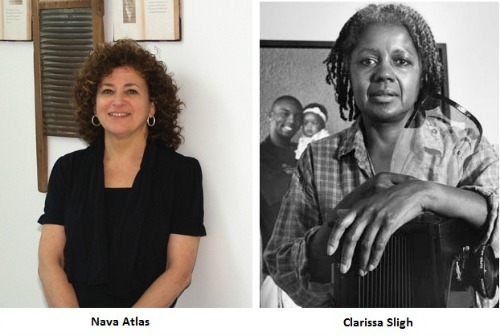
The book form can become a vehicle for personal histories and obsessions. Please join us for a discussion of how Clarissa Sligh and Nava Atlas have explored their own experiences of race, gender, and identity through book arts. Both artists have placed their papers at the Sallie Bingham Center, which also has a collection of over 300 artists’ books by women.

Photos of Nava Atlas and Clarissa Sligh

Clarissa Sligh  is a visual artist, writer, and lecturer. When she was 15 years old she became the lead plaintiff in the 1955 school desegregation case in Virginia. After working in math and science with NASA and later in business, she began a career as an artist, using photographs, drawings, text, and personal stories to explore themes of transformation and social justice.

Nava Atlas is known both as a vegetarian cookbook author and as a fine artist. Her artists’ books engage images, text, and structure to explore themes of social justice and women’s roles. Many of her works re-appropriate found materials and challenge the language and images used to reinforce gender roles and stereotypes.

Read more about Atlas and Sligh in the Spring 2012 issue of Women at the Center.


Post contributed by Kelly Wooten, Research Services and Collection Development Librarian, Sallie Bingham Center

Fascinating Finds in the Stacks: Women’s Lib?

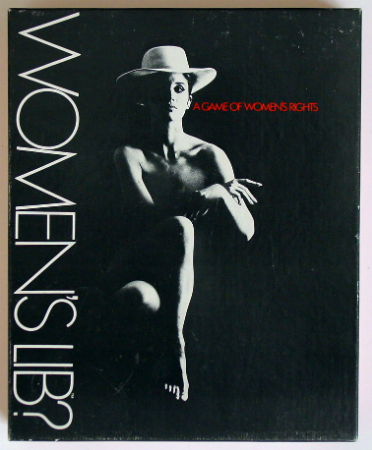
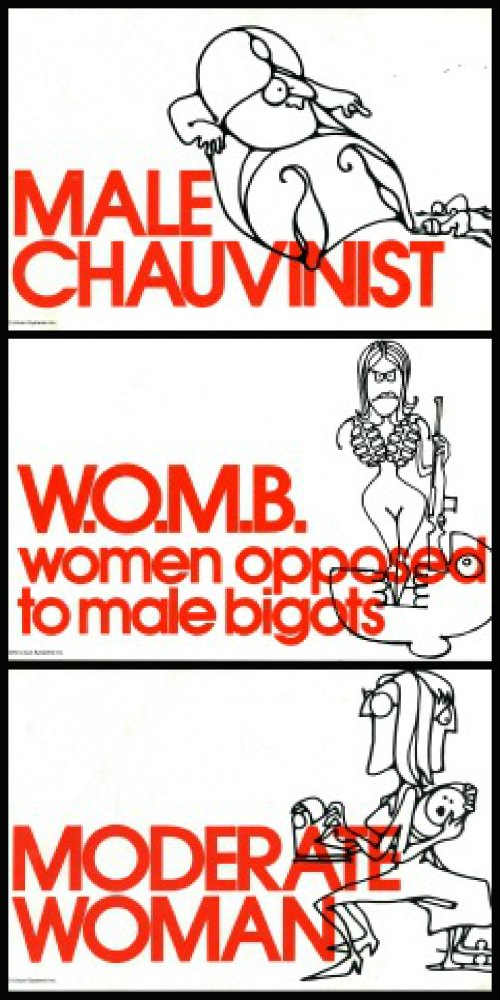
In the wake of our collections move, I came across a board game, “Women’s Lib? A Game of Women’s Rights.” As a child of the seventies, the box’s Bob Fosse-esque cover image caught my eye, as did the oh-so-1970 line drawings that reminded me of Schoolhouse Rock and other educational cartoons of my youth. However, this board game has a decidedly adult theme.

WomensLibGame

womenslibEach player selects a character that represents one of six different stances on the Women’s Liberation Movement, ranging from “Male Chauvinist” to “Moderate Woman,” to “W.O.M.B. (Women Opposed to Male Bigots).” Characters then vote on contemporary issues as prompted by playing cards. These topics are familiar to us over 40 years later:  Abortion, Day Care, Employment Equality, Women’ Legislation and Domestic Issues. In fact, the only category on the election docket that we don’t hear much about today is “Male Contraception.”

Points are awarded to players who successfully campaign and debate to achieve the goals favored by the character they represent. The game sets out to educate players about controversial gender issues in a rapidly changing world. Although this piece of memorabilia seems anachronistic today, the topics it addresses are still extremely relevant.

This board game joins a number of other games and playing cards held by the Bingham Center that explore issues related to women and gender. For even more fun and games in the Rubenstein Library, check out the Richard Pollay Collection of Advertising-Related Board Games, or the Edwin and Terry Murray Collection of Role-Playing Games.

Post contributed by Megan Lewis, Technical Services Archivist for the Sallie Bingham Center for Women’s History and Culture.

Come Visit! We’re Now Taking Applications for Travel Grants

Researchers! The David M. Rubenstein Rare Book & Manuscript Library is now accepting applications for our 2013-2014 travel grants.

The Sallie Bingham Center for Women’s History and Culture, the John Hope Franklin Research Center for African and African American History and Culture, and the John W. Hartman Center for Sales, Advertising & Marketing History will award up to $1,000 per recipient to fund travel and other expenses related to visiting the Rubenstein Library.

The grants are open to undergraduate and graduate students, faculty, independent scholars, artists, and activists who live more than 100 miles from Durham, NC and whose research projects would benefit from access to collections held by one of the centers.

More details—and the grant application—may be found on our grants website. Applications must be postmarked or e-mailed no later than 5:00 PM EST on March 29, 2013. Recipients will be announced in April 2013.

NC Travel Billboard, "Only a Day's Drive," undated. From the Outdoor Advertising Association of America Archives.
NC Travel Billboard, “Only a Day’s Drive,” undated. From the Outdoor Advertising Association of America Archives.

Some of last year’s recipients include:

At the Sallie Bingham Center for Women’s History and Culture:

  • Bridget Collins, a graduate student in the History of Science, Medicine, and Technology at the University of Wisconsin-Madison, used prescriptive literature held by the Bingham Center as part of her research for her dissertation, “From the Cradle to the Grave: Infectious Disease in the Twentieth Century American Home.”
  • Laura Foxworth, a graduate student in the Department of History at the University of South Carolina, for research for her dissertation, “The Spiritual is Political: How the Southern Baptist Convention Debated Feminism and Found the New Right.” You can read more about her visit here.
  • Jessica Lancia, a graduate student at the University of Florida, conducted research for her dissertation, “Borderless Feminisms: A Transnational History of the U.S. Women’s Movement, 1967-1985.” You can read more about her visit in the Fall 2012 issue of the Bingham Center newsletter.

At the John Hope Franklin Research Center for African and African American History and Culture:

  • Brooke N. Newman, Assistant Professor in the Department of History at Virginia Commonwealth University, for a study on gender, race, and power in the eighteenth century British Caribbean.
  • Kathryn Banks, Assistant Professor in the History and Political Science Department at Andrews University, for an examination of African-American employment in the Southern textile industry from 1895 to 1945.
  • Max L. Grivno, Associate Professor from the Department of History at the University of Southern Mississippi, for an analysis of slavery in Mississippi, 1690-1865.

At the John W. Hartman Center for Sales, Advertising, and Marketing History:

  • Anne Schmidt of the Max Planck Institute for Human Development in Berlin, Germany, for research for her book about the meaning and importance of emotions in advertising throughout the twentieth century in Germany and ways emotions were a constitutive element of capitalist practices of production and consumption.
  • Marcia Chatelain, Assistant Professor in the Department of History at Georgetown University, conducted research on the ways in which segregation shaped African-American food culture in the South for her book, A Taste of Freedom: African-American Dining Culture and the Struggle for Civil Rights.
  • Rochelle Pereira-Alvares, a graduate student in the Department of History at the University of Guelph, Canada, exploring how the marketing and advertising initiatives of Hiram Walker and Seagram influenced the way in which consumers purchased and imbibed spirits, and the impact consumers’ changing tastes had on the companies’ marketing and product development decisions, 1950-1990.
  • Bryce C. Lowery, a graduate student in Public Policy at the University of Southern California, for research for his dissertation, “The Consumable Landscapes of Los Angeles: How the Spatial Ecology of Outdoor Advertising Influences the Quality of Life.”

Post contributed by Stephanie Barnwell, Bingham Center intern.

The Power of This Story: Race, Class, Gender, and Sexuality in Durham 1960-1990

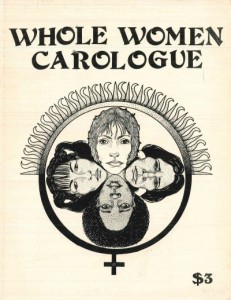
Whole Women Carologue


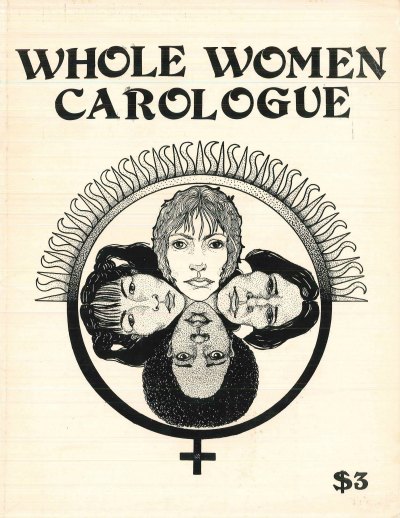
The Sallie Bingham Center has partnered with the Women’s Studies Senior Seminar to present a series of public conversations exploring how social change happened here in Durham. Each panel features individuals and representatives of organizations whose papers are held by the Bingham Center.  Please note the different locations for each panel.


Panel 1:

Joanne Abel, YWCA’s Women Center, Triangle Area Lesbian Feminists, and War Resisters League
Barb Smalley, Ladyslipper Music
David Jolly, NC Lesbian and Gay Health Project

Date: Wednesday, February 27, 2013
Time: 5:30-6:30 p.m. (Reception to follow)
Where: East Duke Parlors, East Campus, Duke University


Panel 2:

Jeanette Stokes, Resource Center for Women and Ministry in the South
Kat Turner, Lesbian Health Resource Center and NC Lesbian and Gay Health Project
Donna Giles, Triangle Area Lesbian Feminists and Feminary

Date: Wednesday, March 20, 2013
Time: 5:30-6:30 p.m. (Reception to follow)
Where: Perkins Library, Room 217, West Campus, Duke University


Panel 3:

Mandy Carter, Southerners On New Ground (SONG) and War Resisters League
Caitlin Breedlove, Southerners on New Ground (SONG)
Steve Schewel, Founder, Independent Weekly

Date: Wednesday, April 3, 2013
Time:  5:30-6:30 p.m. (Reception to follow)
Where: Durham County Library, 300 N. Roxboro Street, Durham, NC


Sponsored by Sallie Bingham Center for Women’s History and Culture, Rubenstein Library; Durham County Library; Duke Program in Women’s Studies; Vice Provost of Academic Affairs; the Pauli Murray Project; and in conjunction with Women’s Studies Senior Seminar.


The Spiritual is Political

With generous assistance from a 2012 Mary Lily Research Grant, I visited the Sallie Bingham Center for Women’s History and Culture this past summer to conduct research for my dissertation, “The Spiritual is Political: How the Southern Baptist Convention Debated Feminism and Found the New Right.”

I focused primarily on records in the Resource Center for Women in Ministry in the South collection.  The Resource Center was founded by Jeanette Stokes in 1977 to provide support for women who were in ministerial leadership roles.  Its extensive archival records at Duke University include back issues of its publication, “South of the Garden,” materials from its annual “Women in Ministry in North Carolina” conferences, and the newsletters and paraphernalia of affiliated religious organizations.

newsletter image
Illustration from the “Southern Baptists for Family and Equal Rights” newsletter. From the Resource Center for Women and Ministry in the South records.

In my examination of the Resource Center files, I came across an interesting collection of newsletters for Southern Baptists in North Carolina who supported feminism in the 1970s and 1980s.  These newsletters were produced by “Southern Baptists for the Family and Equal Rights,” or SBFER, an organization formed in 1981 to create support for the Equal Rights Amendment and issues related to women’s health and welfare in the North Carolina Baptist Convention and in state politics.SBFER was short-lived, lasting less than five years. Though it failed to attract considerable support in the national denomination, it enjoyed limited success as a local organization.  After its efforts to promote the ERA in the state were unsuccessful and the deadline for ERA ratification came and went, the organization turned its focus to women’s ordination and other expressions of feminism in the Southern Baptist Convention.  After 1985, however, the organization began to decline as it became clear that the denomination was not returning to a moderate course.The SBFER’s newsletters are crucial for my dissertation as they provide evidence of grassroots feminism within the Southern Baptist Convention at a time when the denomination was reversing course on many issues regarding gender equality, in full retreat from moderate positions it had taken in the 1970s.  These materials from the early 1980s reveal strong dissenting views, which complicate the narrative of the Southern Baptist Convention’s right turn on social issues.  SBFER aimed to throw a wrench in the plans of the denomination’s new conservative leaders. And while they were unable to stop the Southern Baptist Convention from aligning itself with the Religious Right, they did succeed in keeping women’s issues part of denominational dialogue in the 1980s.

Post contributed by Laura J. Foxworth, Ph.D. candidate,  University of South Carolina, Department of History.

Susan Reverby to Lecture on “Escaping Melodramas”

Date: Thursday, November 1, 2012
Time: Lecture begins at 5:30 p.m.; Reception to follow
Location: Gothic Reading Room, Perkins Library, Duke University, Durham, NC
Contact information: Rachel Ingold at (919) 684-8549 or rachel.ingold@duke.edu


Please join the History of Medicine Collections for our fall lecture to be held on Thursday, November 1, at 5:30 pm in the Gothic Reading Room. Susan Reverby, PhD, will be presenting on “Escaping Melodramas: Reflections on Telling the Histories of the Public Health Service’s Research in Tuskegee and Guatemala.” Susan Reverby is a historian of American women, medicine, and nursing, and is the Marion Butler McLean Professor in the History of Ideas and Professor of Women’s and Gender Studies at Wellesley College.

She has written one book and edited a second on the Tuskegee Syphilis study (1932-72), the longest running non-therapeutic research study in U.S. history that involved the United States Public Health Service and more than 600 African American men in the counties surrounding Tuskegee, Alabama. Her scholarship has appeared in a broad range of publications from scholarly journals to editorials in the popular press. Professor Reverby speaks widely on the history of gender, ethics, and health care issues.

This event is co-sponsored by the Sallie Bingham Center for Women’s History and Culture, Duke University Department of History, and the Trent Center for Bioethics, Humanities, and the History of Medicine.

Make Your Own History Reading, Sept. 19th

Date: Wednesday, September 19, 2012
Time: 3:30 PM
Location: Rare Book Room
Contact Information: Laura Micham, 919-660-5828 or laura.m@duke.edu

Cover of Make Your Own HistoryJoin the staff of the Sallie Bingham Center for Women’s History and Culture for a reading from the new anthology Make Your Own History: Documenting Feminist and Queer Activism in the 21st Century (Litwin Books, 2012) with co-editor Kelly Wooten, research services librarian with the Sallie Bingham Center, and contributor Alexis Gumbs, founder of the Eternal Summer of the Black Feminist Mind multimedia community school and long-time Bingham Center collaborator.

Light refreshments will be served!

Several other contributors to this volume have Bingham Center connections, including co-editor Lyz Bly, Alison Piepmeier, and Kate Eichhorn, all Mary Lily Research Grant recipients; Sarah Dyer, donor of the ground-breaking Sarah Dyer Zine Collection; and Angela DiVeglia,  former intern.

Make Your Own History has chapters about colleting zines; documenting the LGBT community: the future of collecting electronic and online records; and a look at how the Second Wave continues to contribute to the feminist movement. Read more about this book or buy a copy online from Litwin Books.

Post contributed by Laura Micham, Merle Hoffman Director of the Sallie Bingham Center for Women’s History and Culture.h

Dwayne Dixon Zine Collection Expands

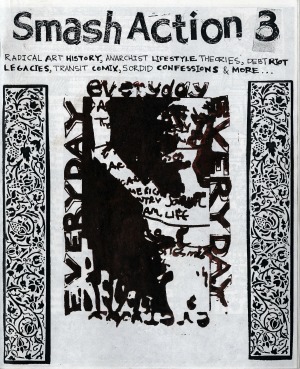
Cover of Smash Action, no. 3Dwayne Dixon, a graduate student in cultural anthropology at Duke,  recently donated a treasure trove of new titles to the his zine collection, part of the Sallie Bingham Center for Women’s History and Culture.

Dixon wrote in an email to Bingham Center archivists:

While DJing a party last night at a professor’s house, I was told by a faculty member in the Music Dept that my zine collection was being used by a grad instructor teaching a course on punk history. I was so thrilled, as you can imagine, and it inspired me to unbox the last treasured horde of zines. I must confess I held the best in reserve in my initial donation. I have approx. 68 zines that are aesthetically, politically, and creatively rich.  Hand-screened covers, some of the best zine writing ever, and incendiary politics that changed my life.  I want others to be moved, too—by Mimi Nguyen’s Slander zine, by [anonymous’] Quiet Nights of Quiet Stars zine, by the dense tangle of punk and race and gender and a changing America of the last 2 decades.

As Dixon mentions in his note, classes frequently use zines as a resource for learning. As with any other historical manuscript or artifact, zines help illuminate specific aspects of culture through their method of creation and their content. Zine authors use the freedom of the medium to confront important cultural issues as well as to divulge their own reflections and emotions. The handmade nature of zines also allows for more artistic presentations of information, creating visually engaging objects that also serve as reading material.

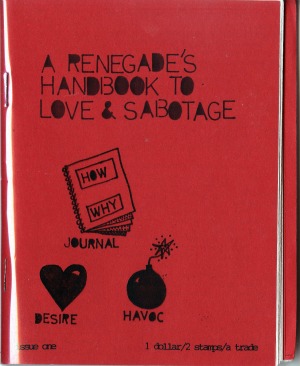
Cover of A Renegade's Handbook to Love & Sabotage, issue 1While zine culture still exists in a variety of vibrant formats, the movement was at its most powerful from the late 1980’s to the mid-1990’s. During that time, Dixon snapped up a great number of these publications and eventually gifted them to the Bingham Center in 2001 with an initial donation of over a hundred zines. Including the latest addition, the Dixon collection now contains almost two hundred zines chronicling topics such as body image, depression, politics, racial inequality, history, and personal exploration.

The new addition has been added to the finding aid and is now available for research.  Come take a look!

Post contributed by Rosemary K. J. Davis,  Bingham Center volunteer.