We have all seen sticky notes peeking out the edge of bindings. I have to say, I’ve never seen them put completely inside a book. It’s almost like they didn’t want to use a pen, pencil, or highlighter. Thanks for that at least.
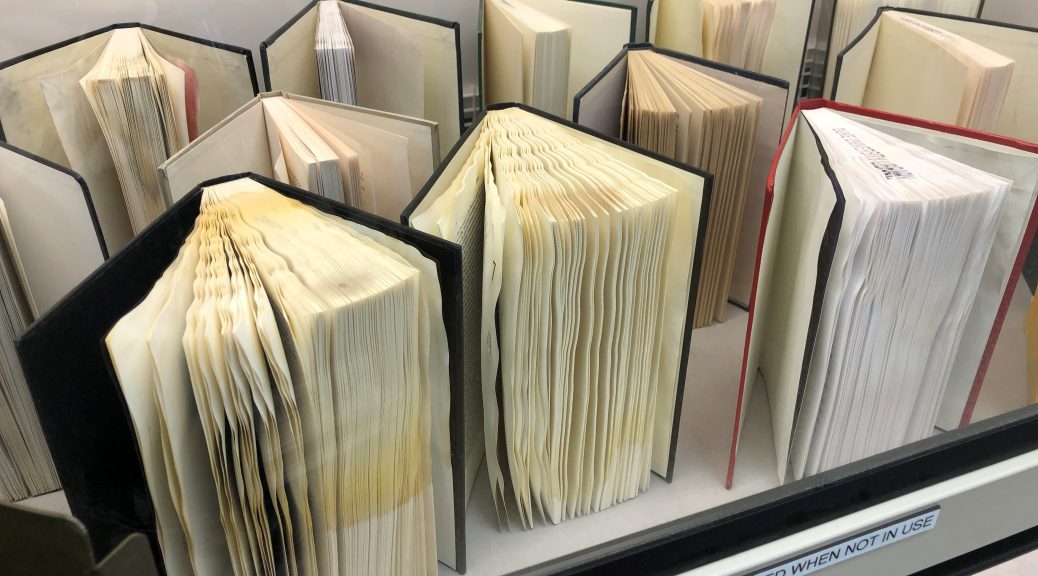
So. Many. Sticky notes. Luckily this paper isn’t very brittle or this would be much worse.
A plea from the underground, if you put sticky notes in a library book, kindly remove them so the next patron can read without distraction.
We are participating in two events for Preservation Week 2021. There is so much happening this year. Make sure you follow #preswk to find other events across the country.
FFV1: The Gains of Lossless (Duke University Libraries)
Monday, April 26, 2021, 2-3 pm Eastern Time (US and Canada)
One of the greatest challenges to digitizing moving-image sources such as videotape and film reels is the enormous file sizes that result, and the high costs associated with storing and maintaining those files for long-term preservation. To help offset this challenge, Duke University Libraries has recently implemented the FFV1 video codec as its primary format for moving image preservation.
FFV1 enables lossless compression of moving image content, and produces a file that is, on average, 1/3 the size of its uncompressed counterpart. Alex Marsh, Digitization Specialist—Video and Craig Braeden, Audiovisual Archivist will give a brief overview of FFV1, and their experience utilizing it to digitize the David M. Rubenstein Rare Book and Manuscript Library’s moving-image assets.
Careers in Preservation: A Panel Discussion (University of Illinois)
Join five preservation professionals as they discuss their education and career paths. The final half of the session will be reserved for questions from the audience.
Panelists:
Jacob Nadal, Director for Preservation, Library of Congress
Miriam Centeno, Preservation and Digitization Strategist, The Ohio State University Libraries
Henry Hébert, Conservator for Special Collections, Duke University Libraries
Daniel Johnson, Digital Preservation Librarian, University of Iowa Libraries
Sarah Mainville, Media Preservation Librarian, Michigan State University Libraries
Duke Libraries lost a beloved colleague yesterday. Sam Hammond passed away Thursday at the age of 73. Sam was many things. He worked in the library for 41 years including as a music librarian, and as a librarian in the Rubenstein Rare Books and Manuscripts Library. Sam was also a campus carillonneur for over 50 years. He started playing the carillon as a first year Duke student in 1964. He retired from that job in 2018. He also walked to work, and used those walks to pick up litter from the roadside. With every step he made the world just a little bit better.
Sam was a kind soul who always had time to help you when you needed information. When I would visit his office to review something, he would share some of the other wondrous things he was working on. I learned a lot from him. Sam had a sharp wit, and when he told a joke his eyes would shine. He was a true gentleman. But above all, he would routinely tell me how much he appreciated Conservation’s work, and that he was happy I was here at Duke . That always made me feel good, and it was a master class in how to treat your colleagues.
To honor Sam and his contributions to campus, Carillonneur Joey Fala played a variety of Sam’s favorites yesterday at 5pm. You can see the full recital online at Duke Today. Recordings of Sam playing the carillon, and more information on his life can be found online here and here.
As I was contemplating this blog post, I looked for items in the lab that would resonate. Flowers are often given to the family after they lose a loved one. This wonderful book on flowers is on our repair shelf. Tulips have many meanings, love, loyalty, peace and forgiveness. Plus, spring is just around the corner, and after the year we have had, who doesn’t need some cheerful spring blooms?
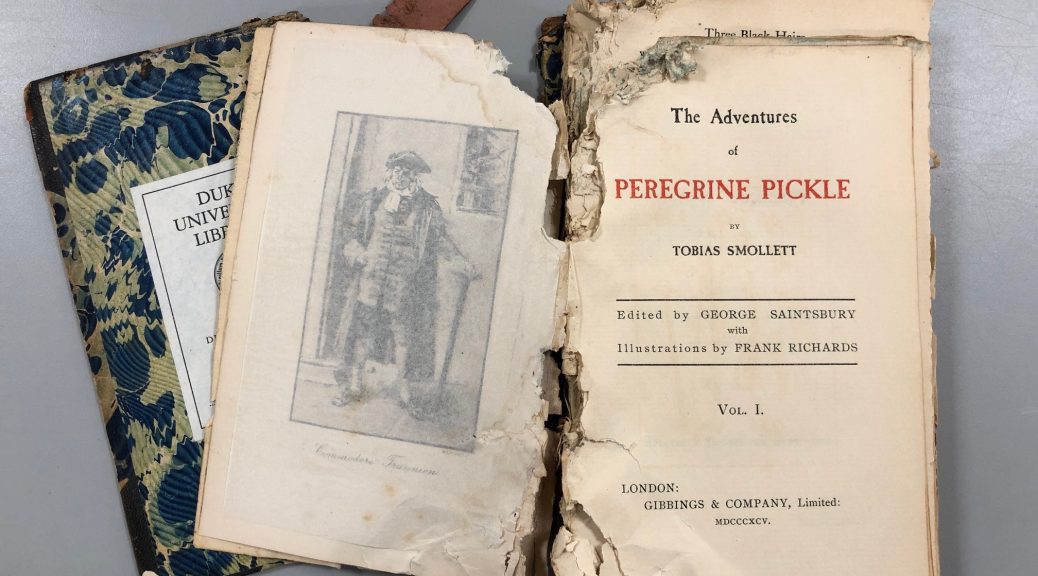
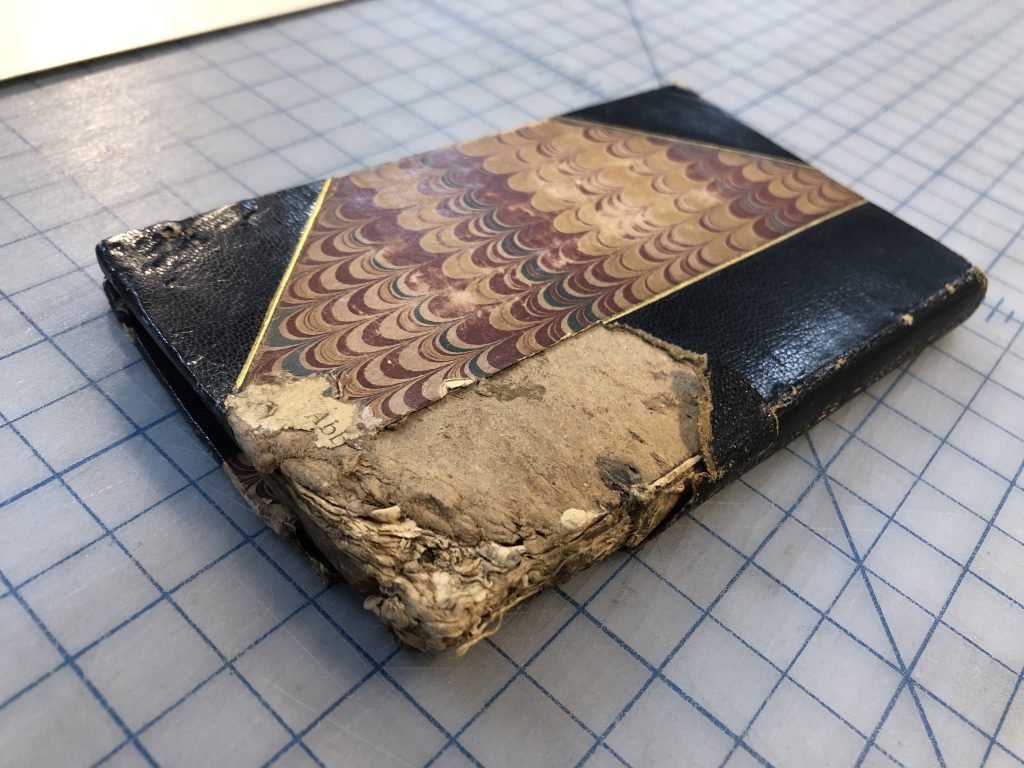
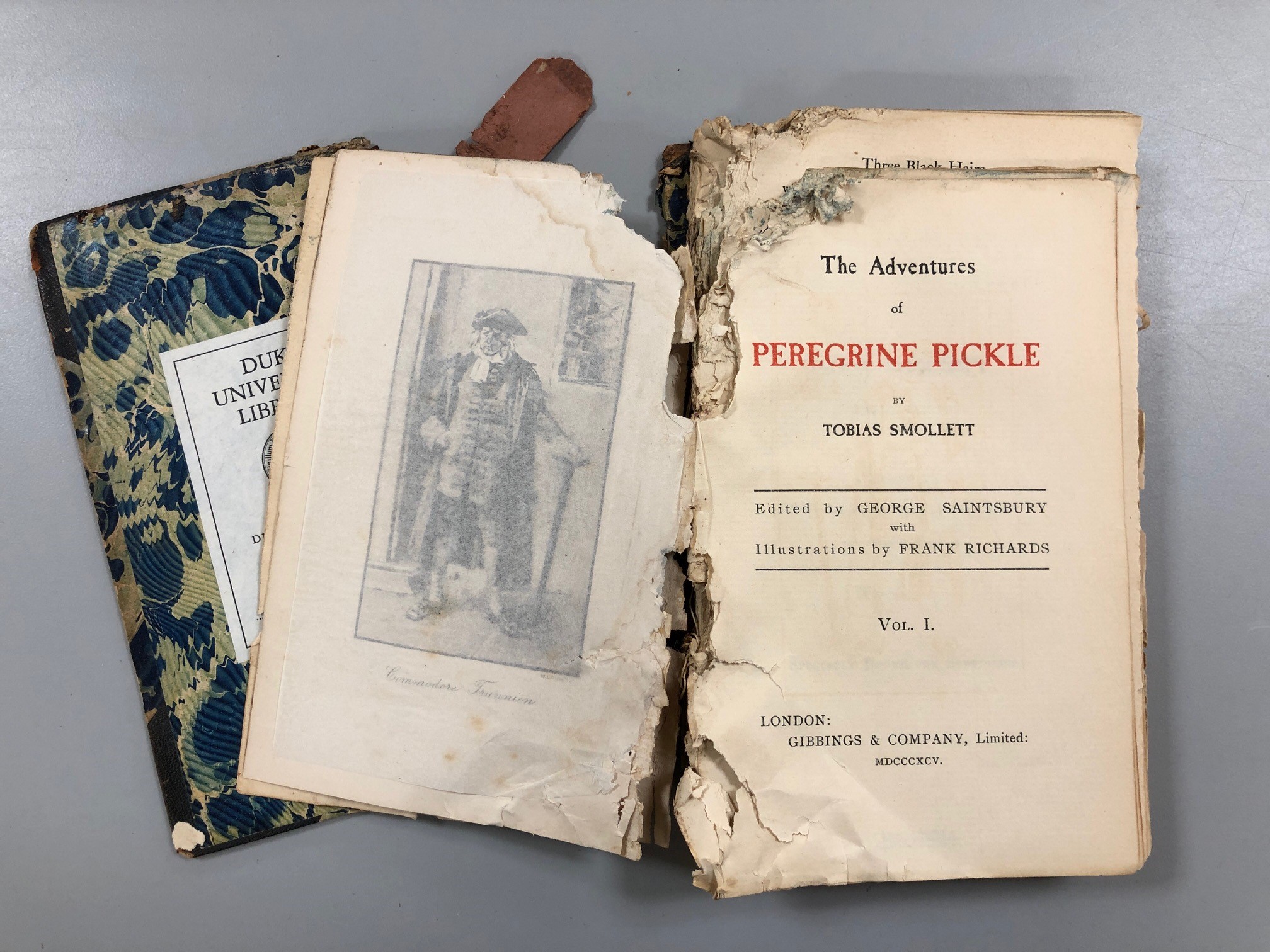
We had two books turned into chew toys come into the lab this week. One is old damage, so I’m not sure we can blame that on the current pandemic.
Book turned leather chew toy.
This one came to us from Circulation this week. Fido is either anxious because her person went back to work, or is upset because her person is spending too much time on Zoom and not enough time on belly rubs.
Peregrine Pickle finds itself in a jam.
Both are half leather volumes. Maybe the leather just tasted good? We may never know.
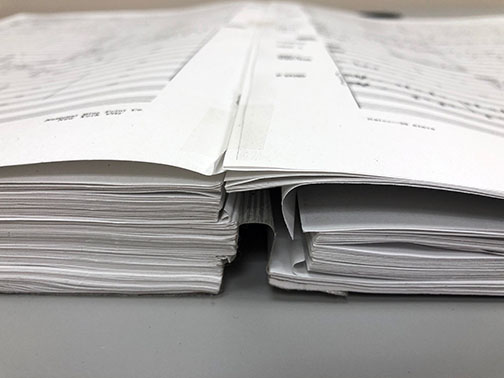
Normally I don’t like to point fingers, but this item came into the lab and I really cannot NOT comment. I don’t know if this is a standard binding method for oversized music scores, but it certainly is a terrible binding for one. “Troubled Island” by William Grant Still is printed in single sheets on 11×17 inch paper and with 339 pages ends up about two inches thick. But the binding…
Does this qualify as a “binding”?
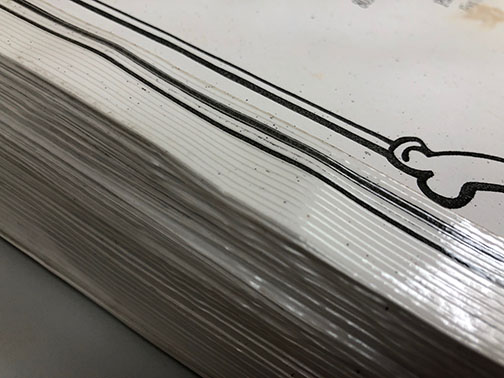
The cataloging record does say “bound with tape,” so warning number one that this is as issued. What the record doesn’t say is that this is bound with strapping tape, the kind with the glass yarn filament embedded in it.
So shiny, so strong.
But wait! There’s more! To create folios the publisher/printer placed three pieces of tape between each single sheet. One at the head, tail, and center of the sheet.
So. Much. Tape.
This is bound for failure on so many levels. And it does not disappoint.
Bound to fail.
I wish I could have a conversation with the publisher about this. Is there a reason this score is bound the way it is? Was the binding meant to be temporary? I really don’t understand any of it, but there must be a reason why they chose to bind this score in this way, right? If anyone knows, please leave the answer in the comments because I am stumped.
End Note 1: “Bound to Fail” would be a great bookbinding contest theme. Or has that been done already?
I love the older starch-filled buckrams you find in the stacks. You can drive a truck over it but you can’t destroy it. Unless you are mold hyphae. Then it is nothing more than a delicious snack.
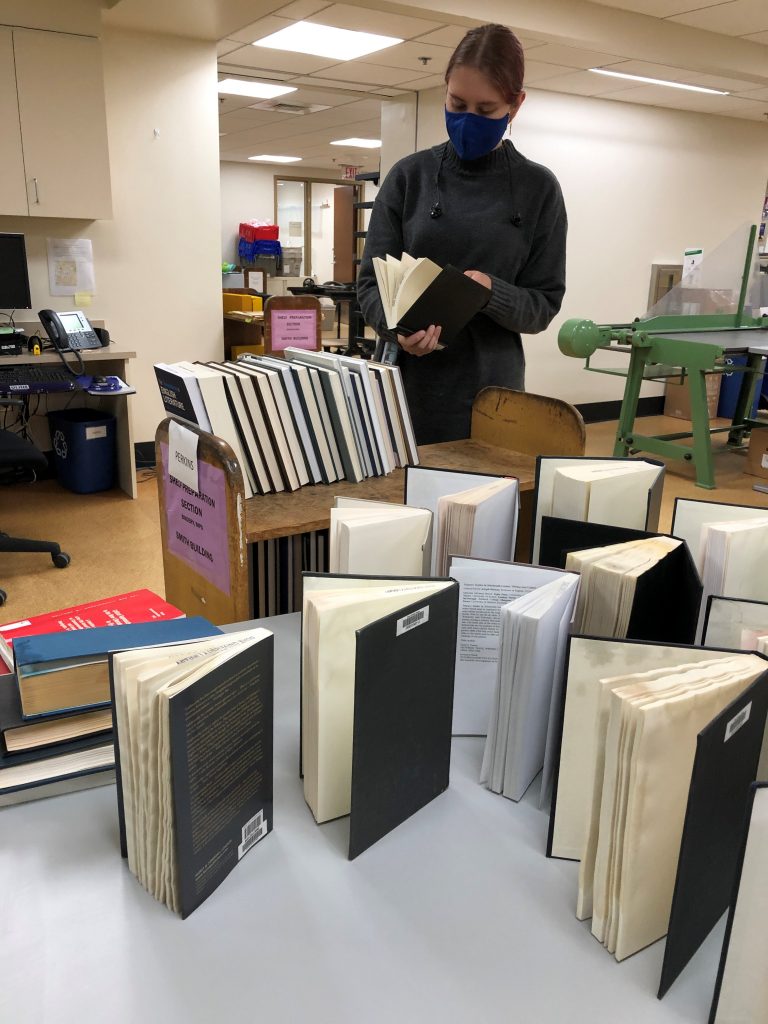
I’ve started a new schedule that includes working at least one day a week at the Smith Warehouse. This beautiful building is where Duke Libraries Technical Services (except Conservation) and the Rubenstein Library Technical Services divisions are located. Working at Smith allows me to answer questions and solve problems in between our bi-monthly scheduled visits to Rubenstein Technical Services.
It’s also nice to see people in person, and to be more present with this side of the library. Technical services can often feel overlooked because it is literally behind the scenes and in another building than the main library. But books wouldn’t get to the shelf without the hard working tech services staff!
What do you do over at Smith?
Today I got a note about pests in Rubenstein Technical Services. While there I looked at some collection materials that had complicated housing needs, downloaded environmental data, and sorted through some circulating materials that I sent back from Conservation. Of course no day as a middle manager is complete without at least one meeting so I attended that.
My work days at Smith allow me to focus on our documentation including updating our collections disaster plan, and writing new workflow documentation for our environmental monitoring program. I am also a short walk from the Lilly Library and the Music Library. On Smith days I can walk over to collect environmental data, or consult with the librarians on East Campus if they have questions for Conservation.
But one of the best parts about working here is that I get a sneak peek at the materials headed to Conservation like this truck of music scores ready for pamphlet binding.
Music scores headed to Conservation for binding.
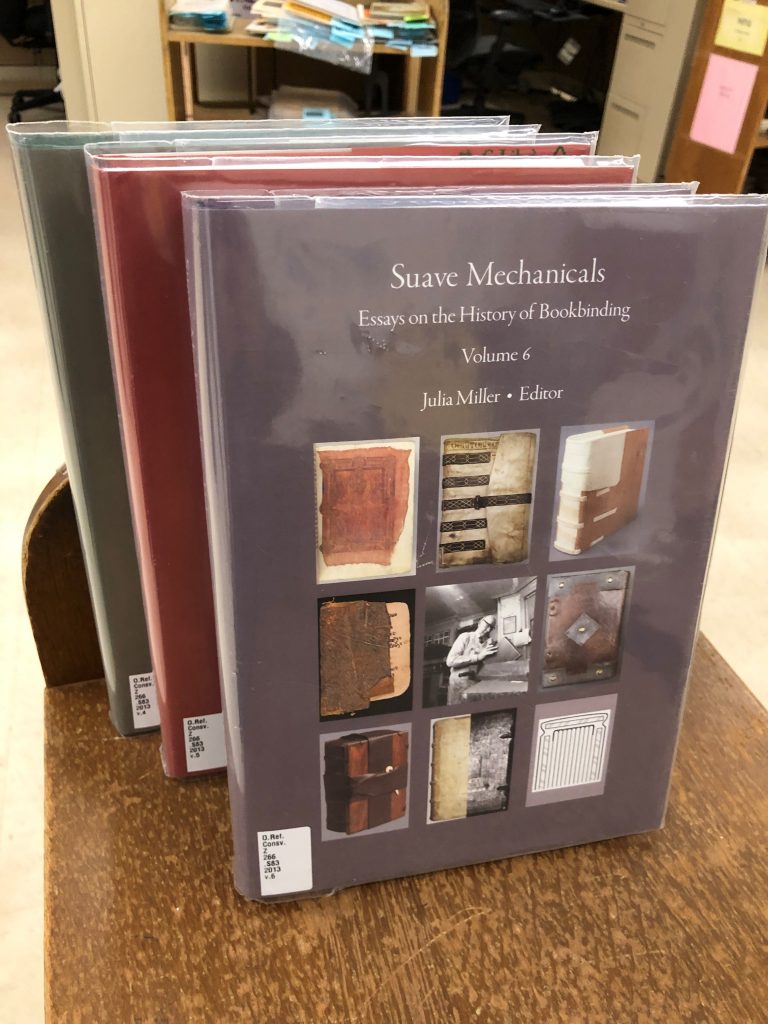
I also spied these three volumes of “Suave Mechanicals” ready for Conservation’s Official Reference collection in the lab. Our reference collection has grown over the years and has books on everything from coptic bindings to blueprints and electronic media.
Suave Mechanicals v. 4-6
Our very own Erin Hammeke has an essay in Suave Mechanicals v. 6. Erin, Chela Metzger from UCLA, and Alexander L. Ames from The Rosenbach, wrote an essay on the history of Anabaptist bookbindings titled “The Faith that Binds: Swiss Anabaptist Devotional Bookbindings in Early America.” I cannot wait to read this. The rest of volume 6 looks pretty darned good, too.
For more inside scoops on what happens at Smith Warehouse look no further than “Signal Boost,” the official blog of DUL Technical Services and Rubenstein Library’s blog “The Devil’s Tale.”
Taking a Break
Preservation Underground will be on hiatus until the new year. It is time to rest, recharge, and enjoy the season. We wish all of you a peaceful and healthy holiday, and a very happy new year. We will see you in 2021.
The beautiful view from my cubicle at Smith Warehouse. I love these old tobacco buildings.
You know the feeling when you get to work on a Monday intending to get stuff done because last week was one of those weeks? You get your tea, settle in, open your email…
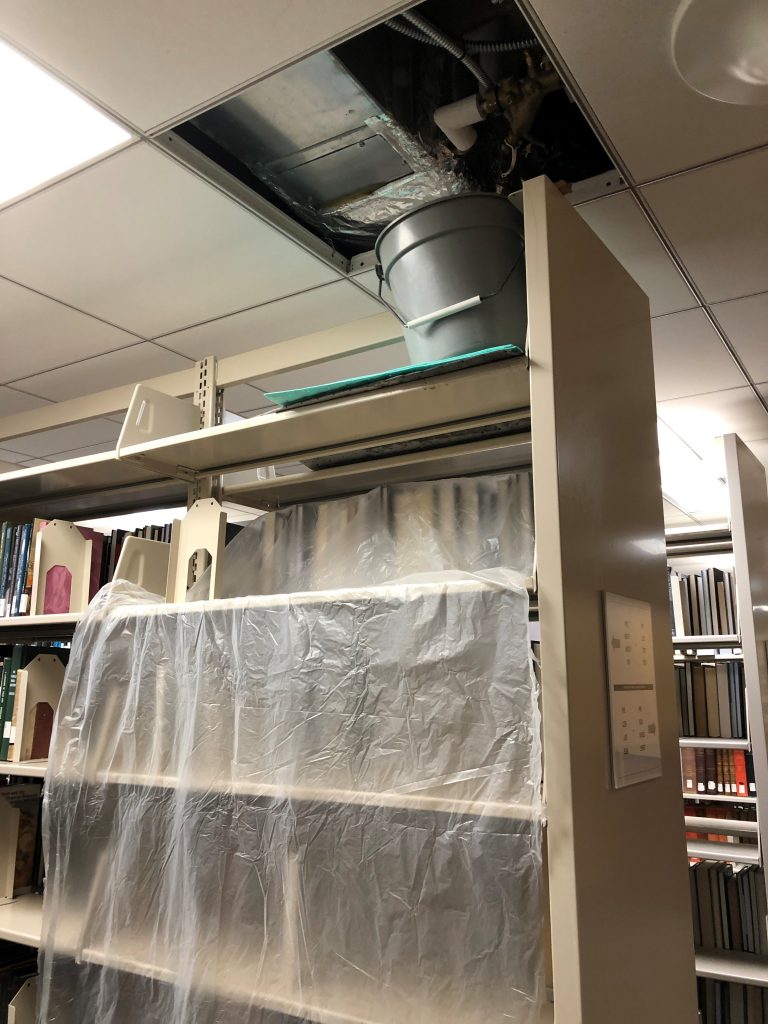
At least it was a slow drip.
So much for that morning to-do list…
Drip. Drip. Drip.
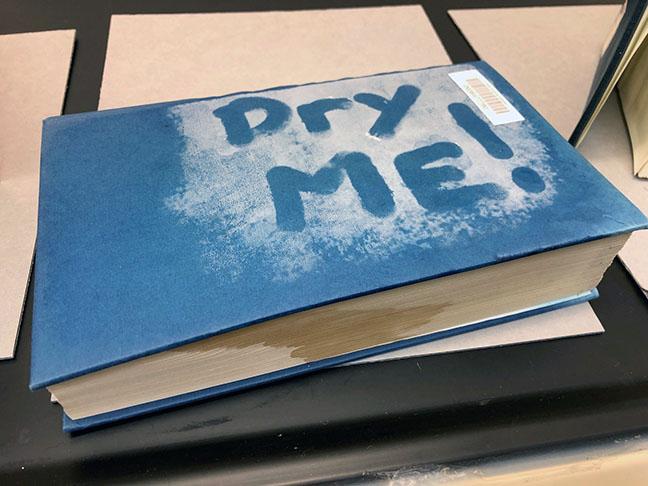
As disasters go we were lucky. This HVAC joint must have slow-dripped all weekend, or at least a portion of it. Some items were soaking wet, but most were damp or even dry.
Jovana sorts the dry, damp, and very wet books.
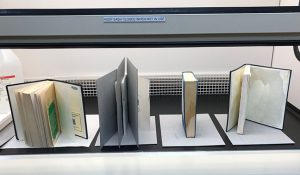
We removed 157 books from the shelf for evaluation, 23 were wet or damp. We were able to set out 18 of these to air dry in the fume hood (remember the wiggle!). Five went into the freezer.
Books drying in the fume hood. A few went to the freezer.
The books in the fume hood were dry enough to put into the press on Tuesday. The items in the freezer will be monitored for the next few weeks. When they (and we) are ready to dry, we will get those done and back to the shelf.
Access and Delivery Services, Security and Facility Services, Stacks Maintenance and Retrieval, Duke Housekeeping, and Duke Facilities, all helped with this small water event. We appreciate having so many eyes and hands to help!
Duke Libraries is not paid to advertise Onset products, we just really like them.
We all know how important a stable environment is for the long-term preservation of our collections. An environmental monitoring program is essential for collecting both short-term and long-trend data in critical areas of the library.
For many years now we have used Onset HOBO MX1101 dataloggers to monitor temperature and humidity conditions over long periods of time. These are bluetooth enabled, very accurate, and cost effective. We currently have about 30 of these monitors in a variety of locations around our library including our Exhibit Suite.
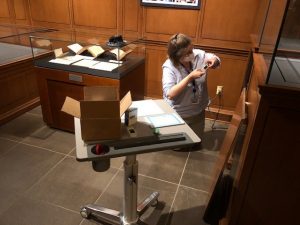
Meg installing HOBOs in the exhibit cases.
Last year we installed an Onset MX Gateway in the Exhibit Suite. This device allows us to look at data remotely from our desktop. It reads any HOBO within 100 feet of the Gateway, and uploads the data into the cloud. In fact, we get even more than 100 feet from our Gateway. It currently not only reads all the dataloggers in our exhibit suite, but three dataloggers outside the suite in the foyer, and three that are one level down in the Conservation and DPC labs.
Onset MX Gateway, MX1101 HOBO datalogger, and the Gateway interface.
Setting Up the Gateway and HOBO Dataloggers
The Gateway interface is fairly easy to use. If you set up your HOBOs correctly, assign them to groups, and are mindful of naming conventions, you can easily group related dataloggers together. This is helpful when you ask the Gateway to download reports.
A selection of HOBO dataloggers that can be seen by the Gateway.
Among the categories are Exhibit Cases (dataloggers inside the cases), Biddle Exhibit Suite (dataloggers in the various rooms in the suite), and the Labs (Conservation, Digital Production Center, and the Exhibits office). The Gateway allows you to set up dashboards to group similar dataloggers together.
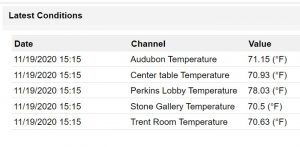
A Portion of the Gateway dashboard for the Exhibit Suite. It turns out that the table the Perkins Lobby datalogger is attached to was moved and is now over a heating vent. We didn’t realize this until we logged into the dashboard. See how useful the Gateway is?
Expanding the Monitoring Program
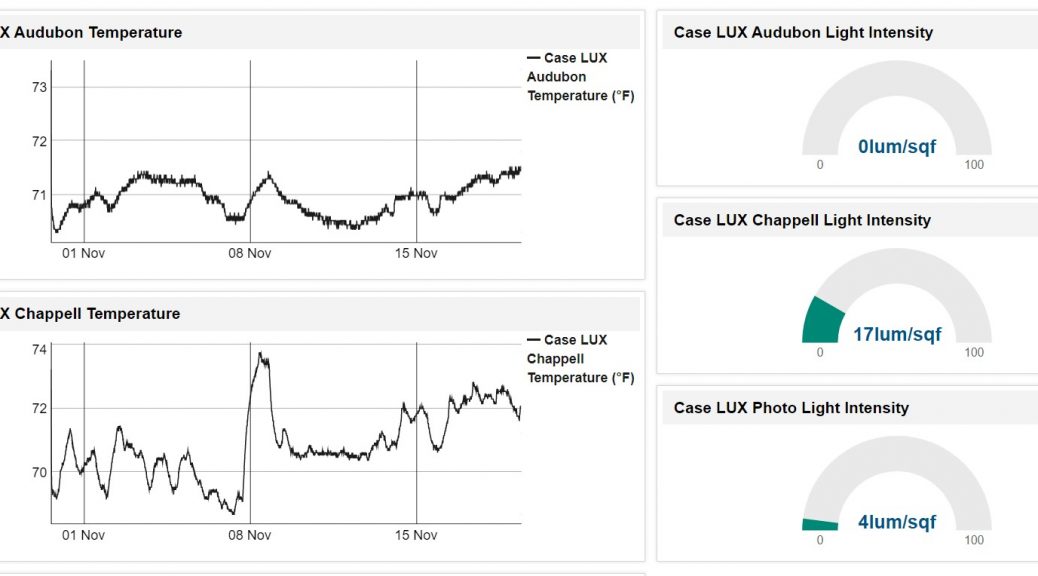
This summer we are expanding our exhibit monitoring to include the Onset MX2202 LUX/Temp meters. These are going inside a few exhibit cases to monitor light levels (LUX) and temperature (F). We have a couple cases near internal windows, and several outside in the library foyer. Before we got the MX2202 monitors we could only do spot readings with our Elsec light meter. We can now understand what sort of cumulative light exposure these cases get throughout the year.
The Gateway dashboard for the MX2202 dataloggers.
Since the Gateway allows you to download the data into Excel, you can set up templates to do your data analysis. I’ve set up a template that includes the min/max/median/mode for both the LUX and temperature readings. The graph gives you a quick visual for the time period you requested in the Gateway report.
Draft analysis template for the LUX meters. The meter in the photo gallery cannot be reached by the Gateway, so we will have to download that datalogger individually and add the data to the spreadsheet for analysis.
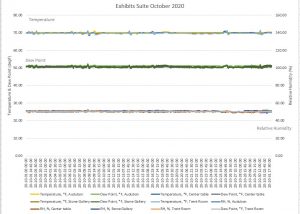
We have similar spreadsheets for the HOBOs in the Exhibit Suite that record temperature and relative humidity. We download the environmental data by month, and look to see if any trends or concerns arise. The Gateway also allows you to look at the data in real time so we can view it weekly to catch any problems.
Look at those beautiful flat lines.
Until we installed the Gateway we had to go upstairs and download each HOBO individually with our phone or iPad. This is so much easier and more efficient.