Category Archives: Technical Stuff

Hot Off the Democratic Party Press

DemoDigestManandHydrantThe typewriters and linotype machines were furiously clacking away… Cigarette smoke turned the air blue…  The year was 1960, Nixon and Kennedy were running for President, and the cartoonists, layout staff, copy editors, and office runners of the Democratic Digest were working hard to beat a deadline and push out the next issue of irreverent, energetic political opinion, news, and satire.

You can examine the content being prepared for the 1960 campaign issue as well as many other issues from 1955-1961 in a Rubenstein Library collection, the Democratic Digest Records. The Washington, D.C. publication, headed by Sam Brightman, was the official monthly of the Democratic Party, and the 28 boxes of its records, acquired by the library in 1961, are filled with drafts of editorial columns, political cartoons and other original artwork, and reprinted articles and opinion pieces from pro-Democratic U.S. newspapers across the country.

DemoDigestNixon

DemoDigestGraveyardThe correspondence files house provocative and eloquent letters sent in from readers, critics, and Democratic Senators and Governors, addressing the many turbulent political issues of the day: McCarthyism, scandals and corruption, civil rights, labor issues, farm subsidies, the U.S. economy, nuclear weapons, and of course, elections.  You’ll hear voices from ordinary citizens facing hard times: “Now that we have the D.D. [Democratic Digest],” writes one reader from Willifor, Arkansas in 1957, “I just don’t see how we could or ever did do without it. My work keeps me on the move and depend on getting it on the new-stands and believe under this new plan it will be easire [sic] done. While I have a wife and 7 children and not year round work, I will plan to get a Sub [subscription] or two for someone that will do something about it. They may do a good deed too.”
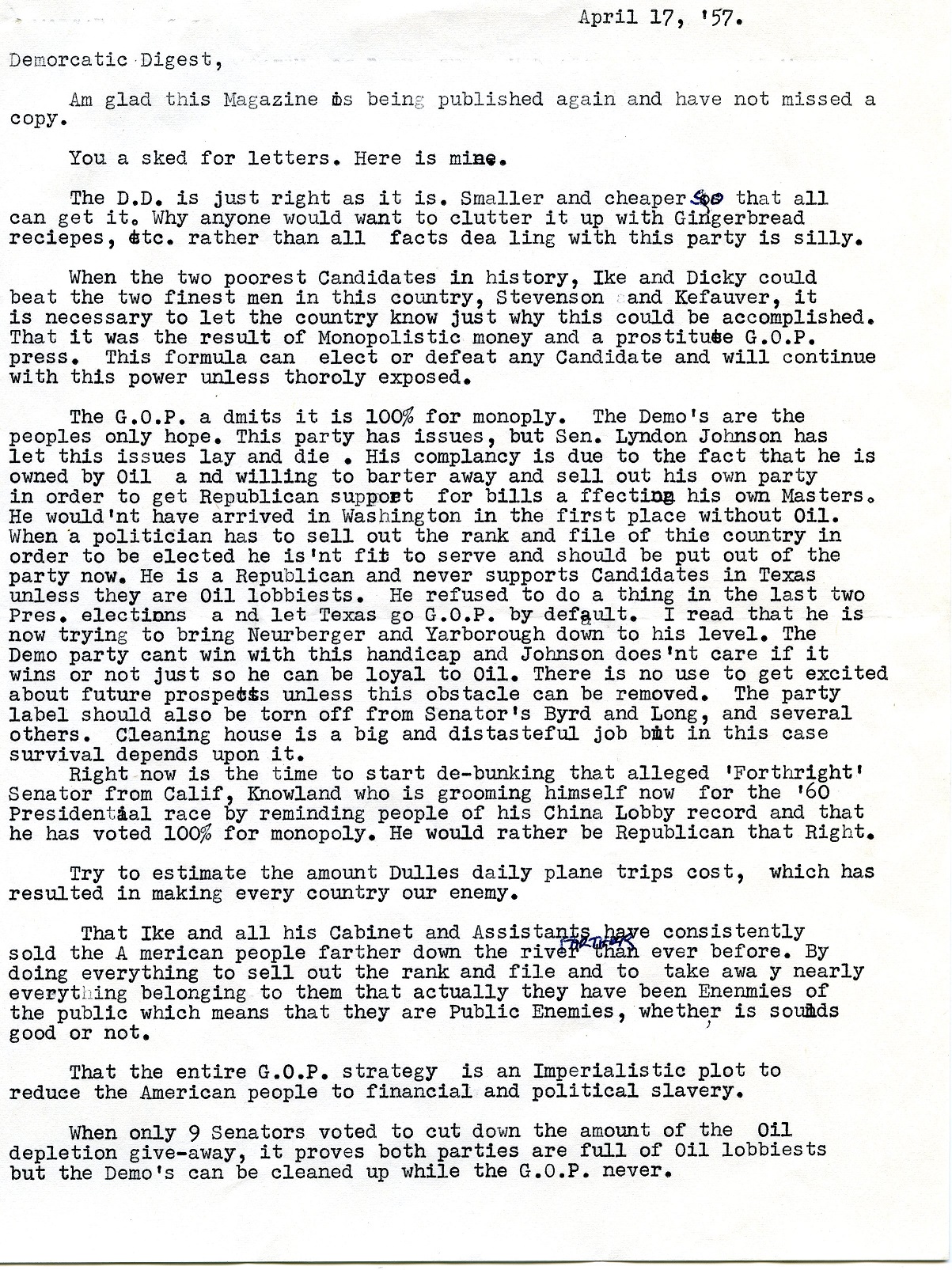
DemoDigest-letter1The materials in this collection cover a time of intense change and fragmentation in American society. Whether it’s a letter from a labor leader, cartoons featuring donkeys and elephants, or articles about big business being cozy with the government, the Democratic Digest files tell a fascinating tale of American politics and society.

DemoDigestcoverPost contributed by Paula Jeannet Mangiafico, Visual Materials Processing Archivist.

Heschel Highlights, Part 4

Welcome to the fourth post in a series documenting the processing of the Abraham Joshua Heschel Papers.

In 1939, Julian Morgenstern helped Abraham Joshua Heschel travel from Warsaw to London just six weeks before Germany invaded Poland. In 1940, upon his arrival in the United States, Heschel began teaching at Hebrew Union College (HUC) where Julian Morgenstern was President. HUC was the main seminary for Reform Judaism in the United States and Heschel was the Associate Professor of Jewish Philosophy and Rabbinics there for five years. Heschel resigned from the HUC faculty on May 18, 1945 over ideological differences. As we process the Abraham Joshua Heschel papers, we learn more about the complex relationship between Heschel, HUC, and the leaders of Reform Judaism. Through letters, essays, handwritten notes, and his books, Heschel expressed concerns about the role of God, spirituality and adherence to Jewish law among Reform Jews. At a few points in Heschel’s life, these concerns bubbled up and he took action as part of his larger effort to infuse American Judaism with spirituality.

Photographs and documents from the Heschel Papers.

In 1945, Heschel’s theological divergence from HUC became a serious issue for him and he resigned his position. In a handwritten draft of his resignation letter to Morgenstern Heschel wrote “from the beginning of my affiliation with the college I fully realized that the HUC stands for a distinctive philosophy of Judaism which it tries to realize in practice and with which my own interpretation of Judaism is not in full accord.” Heschel’s resignation was accepted with sadness and respect on the part of Julian Morgenstern. In a letter dated May 19, 1945, Morgenstern wrote that he and the HUC Board of Governors wished to express their feeling that he was doing the “right and honorable thing.” A number of letters related to Heschel’s resignation echo this sentiment. Heschel’s students, colleagues and friends approved of Heschel’s decision and wished him well. Despite his issues with the philosophy of HUC, Heschel expressed an interest in sustaining his friendship with Morgenstern in his resignation letter: “I earnestly hope and wish, however, that the cordiality and warmth of our friendship will not be impaired by my leaving this institution.” It is clear from the amount of correspondence from Morgenstern that their friendship continued until Heschel’s death. From the correspondence surrounding Heschel’s resignation from HUC (and subsequent acceptance of a position as Associate Professor of Jewish Ethics and Mysticism at the Jewish Theological Seminary) it seems that Heschel continued to be on good terms with many of the acquaintances and friends that he made during his time at HUC. However, his ideological differences remained.

In 1953, Heschel caused a stir among his Reform colleagues when he gave an address to the Reform Rabbinic Organization, the Central Conference of American Rabbis (CCAR), entitled “Towards an Understanding of Halacha.” Heschel appears to have denounced the CCAR for failing to hold to the doctrine of Halacha (Jewish law) in this address. From the correspondence we have surrounding the address and its subsequent publication by the CCAR, it is clear that Heschel earned himself both admirers and detractors as a result. However, even the harshest letters reveal a great deal of respect for Heschel. A 1954 letter that begins with the exclamation “I am profoundly shocked by your persistent misinterpretation of Reform’s position on practice” concludes with the author, a reform rabbi, noting that Heschel could be helpful to the Reform movement as they move forward. Another letter from a Reform rabbi seems wary of Heschel’s denunciation of the CCAR but the author also wrote that “all your papers have a few extra calories of spiritual warmth which lift the heart.” And yet another rabbi’s letter reveals the power of a meeting with Heschel to assuage anger: “But of my prior disturbance, I can say ‘gam zu l’tovah’ [this is also for good] for it provided the occasion for a most stimulating and edifying chat with you.” Heschel remained in constant communication with Reform Rabbis and the leaders of the Reform movement throughout his life and his correspondence reveals that this exchange was beneficial to Heschel, to many Reform rabbis and perhaps even to Reform Judaism.

Post contributed by Adrienne Krone, Heschel Project Assistant in Rubenstein Technical Services.


Playing Around

For several months now, I have been working my way through several thousand acetate negatives transferred to the University Archives from the Sports Information Office.

Dinkey and Jap reenact William Tell.

Several weeks ago, I wrote about finding negatives of women students playing baseball, which was an unexpected, yet welcomed, find. Today I came across another unexpected image, seen above. Described as “football miscellany,” it features football players, Leonard “Dinkey” Darnell and Jasper “Jap” Davis, in an iconic archery pose, dated July 1939. I wish I knew the story behind this image. Was it from a physical education class on archery? The Women’s Athletic Association had an archery season. Maybe the men joined them one afternoon for a bit of fun? I hope you enjoy the image as much as I do.

Post contributed by Kim Sims, Technical Services Archivist for University Archives.

Heschel Highlights, Part 3

(Un)obsequiously Yours: An Out-of-the-Blue Letter from the Spiritual Master Alfred R. Pulyan

Welcome to the third post in a series documenting the processing of the Abraham Joshua Heschel Papers.

One of the most intriguing features of the Abraham Joshua Heschel collection is its ability not only to shed light, by virtue of the abundance and diversity of the materials it contains, on his intellectual biography, private persona, and scholarly and political work, but also to comment widely on a variety of issues related to the contemporary public and private sphere in the United States. Among such issues are certainly the socialization of the function of secular and religious thinkers and the material importance of correspondence in the establishment and furthering of social networks and intellectual affinities.

More particularly, in the case of as prominent and publicly exposed a figure as Heschel, it is interesting to notice the recurrence with which individuals of different persuasions, professions and social standing, struck by the reading of his works, spontaneously set out to address him letters. They often did so in order to offer their perspective on an issue they deemed dear to him, expose their views about various religious problems, or simply secure an opportunity to meet him in person. The particular sub-genre emerging from these “first letters,” in which an awkwardly deferential act of addressing turns into a self-conscious emergence from anonymity, may yield some insights into the relationship that links writing, and particularly epistolary writing, to the processes of subjectivation.

One exceptional, aberrant instance of such messages-out-of-the-blue genre can be cited. It is a neatly-penned and beautifully-styled letter, spanning five columns and three sheets of paper, addressed to Heschel by Alfred R. Pulyan, one of those figures whose relative notoriety derives in part by the respectable legitimacy with which the adjective “obscure” can be attached to their names. Writing to Heschel in 1964, ostensibly about Cardinal Augustin Bea’s draft of the declaration Nostra aetate (but really about Judaism, Christianity, the awakening, and the sense of existence), Pulyan, a spiritual teacher based in South Kent, Connecticut, by the end of his letter makes no mystery of his intentions: to turn the Polish-born rabbi into one of his pupils.

Processing Intern Emanuel works with the Heschel Papers.

The esoteric teacher seems aware of the unlikelihood that his proposition hit its mark: “In your [i.e. Heschel’s] case,” he writes, “the rejoinder I judge will be neglect or rejection (the great “no” of [Constantine P.] Cavafy), unless you childishly fear I am trying to edge you into Christianity by a back door.” Whether or not the lures of Pulyan’s coquettishly uncompromising tone did indeed fall flat is difficult to tell, in the absence (for the time being) of other messages from this tough-sounding enlightened master. What the reader is left with is the charm of an unpredictably effective hortatory prose and, as is often the case with this collection, an indecipherable piece of archive, through whose very recalcitrant oracularity a glimmer of a whole universe of meaning is revealed.

Post contributed by Emanuel Fiano, processing intern for the Abraham Joshua Heschel Papers in Technical Services.

A Family with a Mission: The McGee Family Papers

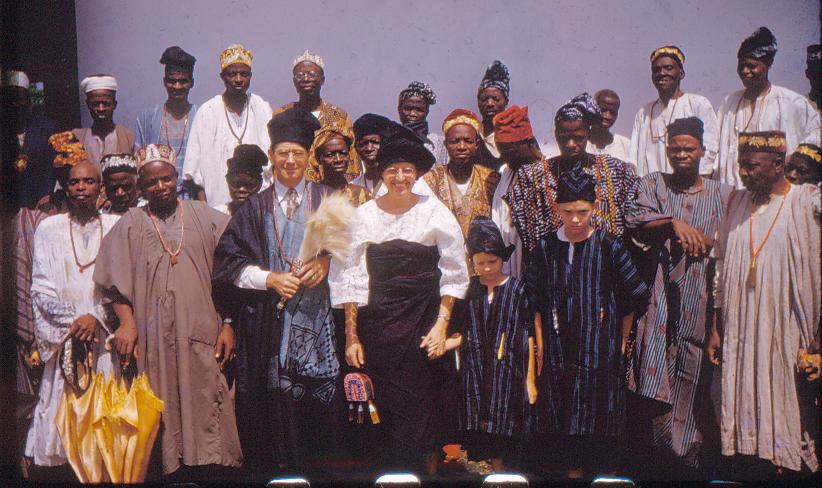
We just wrapped up processing an exciting new addition to the McGee Family Papers. John S. and Doris McGee were Baptist missionaries to Nigeria in 1945, where they served until their retirement in 1977. Their two sons, John David and Sidney, joined them in Africa for their formative years before finishing their education in America. During the McGee family’s time in Nigeria, they served at the Baptist College of Iwo and the Baptist Mission in Igede-Ekiti and Ikogosi, and they helped found the sixth Baptist high school in Nigeria–the Ekiti Baptist High School in Igede. They were made “Chief Gbaiyegun of Igede” by the Onigede and Chiefs of Igede-Ekiti, the paramount chief by the Ewi of Ado, and “Chief Akorewolu of Ikogosi” by Loja and Chiefs of Ikogosi-Ekiti.

McGees and chiefs, Gbaiyegun event, 1957
McGees and Nigerian chiefs, Gbaiyegun event, 1957

Some of the items in the new accession include correspondence (as well as reel-to-reel “audio letters”) between the family members while they were separated  during their various Nigerian tours; Doris’ many prayer diaries; and seven beautiful 16×20 color prints documenting life in various Nigerian missionary camps.

John S. McGee baptizing believers in Nigeria

The collection offers fascinating insight into the lives and histories of a family on a Baptist Mission to Nigeria in the mid-twentieth century.

Heschel Highlights, Part 2

Welcome to the second post in a series documenting the processing of the Abraham Joshua Heschel Papers.

Processing the materials in the Abraham Joshua Heschel papers over the past three months has presented interesting challenges, including deciphering a wide assortment of languages represented in the collection (we’re up to nine languages thus far) and determining date ranges for the materials. As a result, we’ve come up with some creative, yet practical solutions to address these challenges and are hopeful they will positively affect how researchers interact with and interpret the materials in the collection.

Language materials

Materials in English make up about 57% of the collection; materials in Hebrew and Yiddish about 38%; materials in German 4%; and materials in Italian, Spanish, French, Latin, and Polish about 1%. There are varying degrees of the amount of language materials in each folder and oftentimes multiple languages are represented in a single folder (sometimes in a single document!). Hebrew is particularly challenging as Heschel not only wrote in Hebrew but also frequently wrote folder titles in Hebrew.

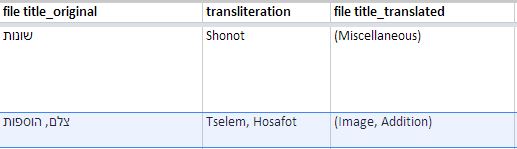
To assist researchers understand the language(s) represented in the collection and its extent, each folder description will include a note identifying the language(s) and its extent in the folder. As an example, if all the materials are in German, the note will read “All materials in German,” or if there is a mix of language materials, the note may read “Most materials in German and Yiddish.” To assist researchers with the folder titles in Hebrew, we will be providing the original folder title in Hebrew, the transliteration of the title, and a translation of the title.

Capture1

Look on both sides!

Heschel tended not to date the materials he authored, nor did he date the folders. However, he does appear to have been a master at recycling paper for his handwritten notes. So far, we’ve discovered he reused coupons, correspondence, receipts, other handwritten notes, memoranda, and (my personal favorite) his student’s blue exam books. In many cases, turning these scraps of paper or documents over has provided essential clues to the date(s) of the materials in the folder.

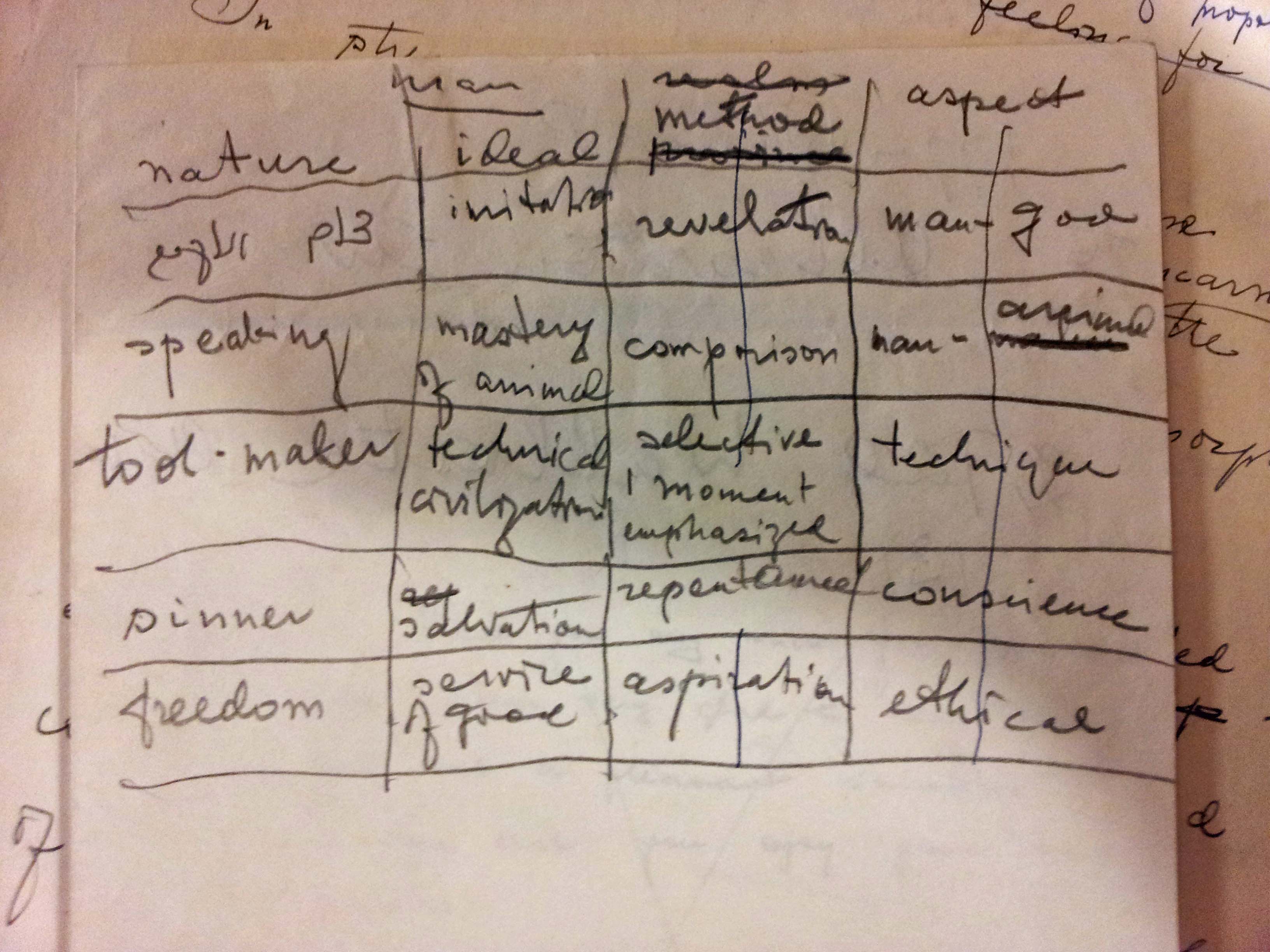
Looking on the other side of the materials has also had some unexpected benefits by providing additional clues to Heschel that may not have been discovered. As an example, we came across a handwritten table which provides descriptions related to the topic of “Man.”

Capture 2On the reverse side is a draft letter Heschel wrote in 1941, about a year after he arrived in the United States. He asks the recipient of the letter about the availability of a room and if she knows of a place where he could “take one meal every day.” Heschel crossed the letter off and then reused it for other purposes.

Capture 3Stayed tuned for more Heschel Highlights in the near future!

Post contributed by Mary Samouelian, Heschel Processing Archivist in Rubenstein Technical Services.

Rubenstein Library Construction: Beautiful Wreckage

Construction on the new Rubenstein Library is in full swing. Library staff and patrons have no doubt observed the temporary walls around the library building, seen the giant crane in the loading dock, and heard the dulcet tones of demolition throughout the Perkins stacks.

Rubenstein and Duke University Library staff had the opportunity to take a fascinating tour of the construction in progress in recent weeks. Here are some highlights.

looking_at_cageFirst off we got to wear official vests, hard hats and protective glasses – safety first! Above our touring librarians  and archivists are pictured in the old Rubenstein reading room, looking into the a section of the 1948 closed stacks previously referred to as the “cage.”

gothic_reading_roomThe renovation of the Gothic Reading Room has also started, and demolition crews are removing non-original features of the room. Please note that both the character of the room and its distinctive architectural elements will be retained as we modernize the building. The windows and light fixtures will be restored as close to their original look as possible, but the shelving will be replaced. We toured the entire construction site with Will Dunlop from EHG Demolition. Will commented that the Gothic Reading Room is “one of the most beautiful rooms I’ve ever been called upon to wreck.”

gothic_exterior_revealed

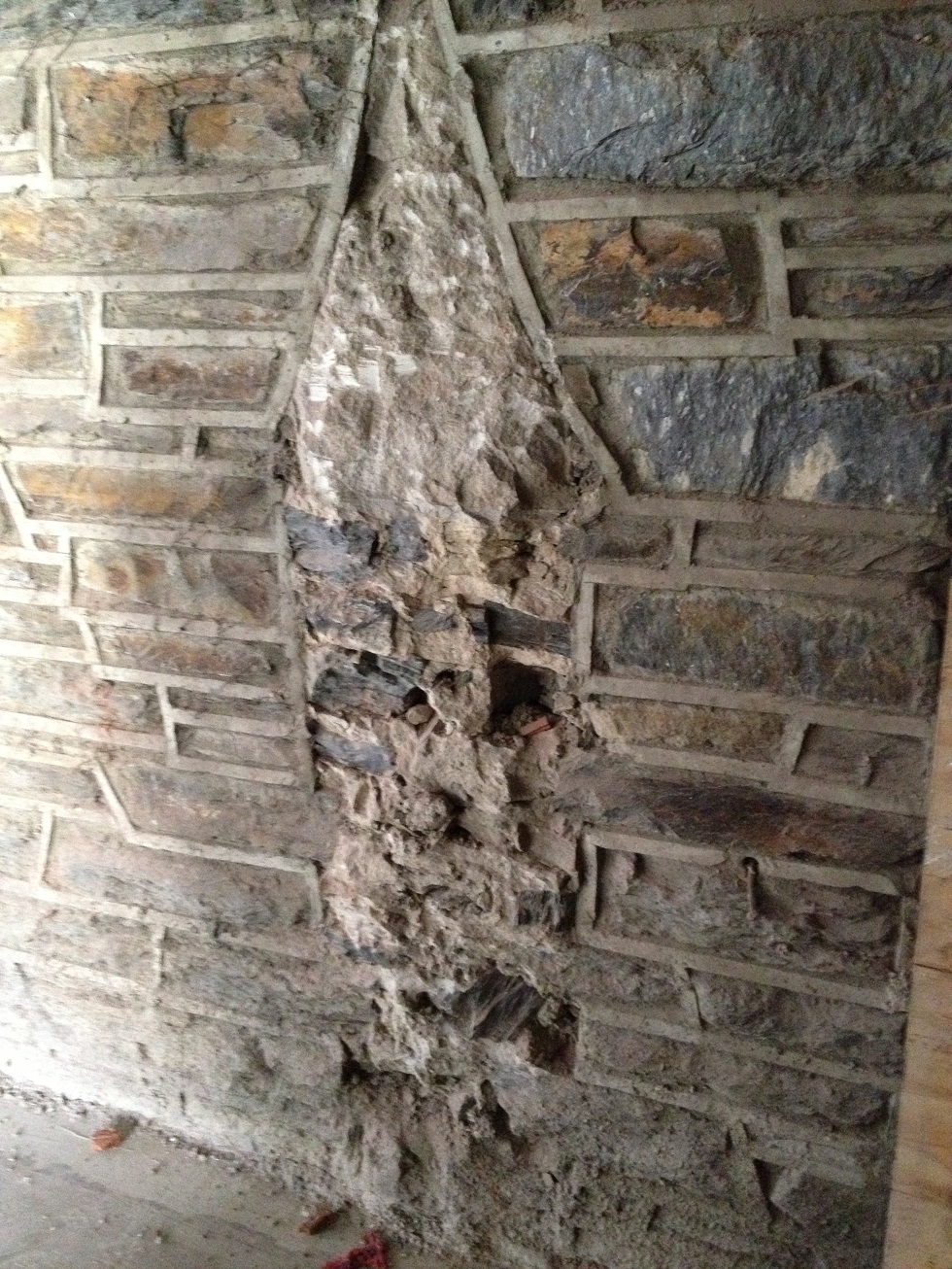
ivy_28wallThe demolition process has revealed the old exterior wall of the 1928 building. Originally, the Gothic Reading room had windows on both sides of the room. When the 1948 addition was built, one side of windows were filled and the exterior wall was covered by the expansion project. In the first picture above we see the old exterior wall, and the outline of decorative stone elements that were removed. The next image shows the remains of ivy vines that must have been growing on the exterior wall when it was covered around 1948.

RL_2nd_floor_officesThe Rubenstein Library director and collection development offices, formally on the 2nd floor of Perkins outside of the Gothic Reading room, have been completely demolished. Here you see the gutted space and the bracing that has been added to protect the building’s structure during renovation.

room_201The room formerly known as Perkins 201 was located right across from the Breedlove Room. Our Technical Services Department worked there before moving to Smith Warehouse several years ago. As you can see in the picture, the windows have been removed and boarded up. This is also where debris is being taken and pitched to dumpsters in the loading dock.

loading_dockOut on the loading dock you can see where a chute (the black tube looking thing coming out of the top window) has been constructed to funnel debris from the demolition area (and Room 201) into dumpsters.

Post contributed by Molly Bragg, Collections Move Coordinator.

Summer in the Archives with Oskar Morgenstern and Robert Solow

Summer in the Archives is a collaborative initiative of two institutions at Duke – the Center for the History of Political Economy and the David M. Rubenstein Rare Book and Manuscript Library — focusing on Rubenstein’s Economists’ Papers Project. It is based on joint work of Rubenstein’s staff and outside experts, who are often Ph.D. students in economics. The goal of Summer in the Archives is to improve the availability of the economists’ collections to the research community, as well as to allow young researchers to get hands-on experience with archival work.

Rubenstein Technical Services staff worked closely with myself and Crystal Wong, Ph.D. candidate at University of Washington. Our task was to improve description and organize the existing collections of distinguished economist Oskar Morgenstern and Nobel Prize winner Robert Solow. I would now like to share a couple of interesting “bits and pieces” that we came across while working with the collections.

Oskar_Morgenstern1
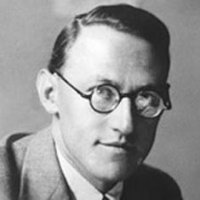
Oskar Morgenstern

Oskar Morgenstern was born in today’s Austria and left his home country in the late 1930s to join Princeton University.  Among many other activities and contributions, Morgenstern was a co-founder of the Game Theory and an important force behind the rise of the Economics Department at NYU, which was one of his last projects before he lost his battle with cancer in the late 1970s.  The document that I want to bring the attention to is a 1950 letter from F.A. Hayek, another economist with Austrian roots, who received the Nobel Prize in 1974.

morgto_hayek_1941-page-002x
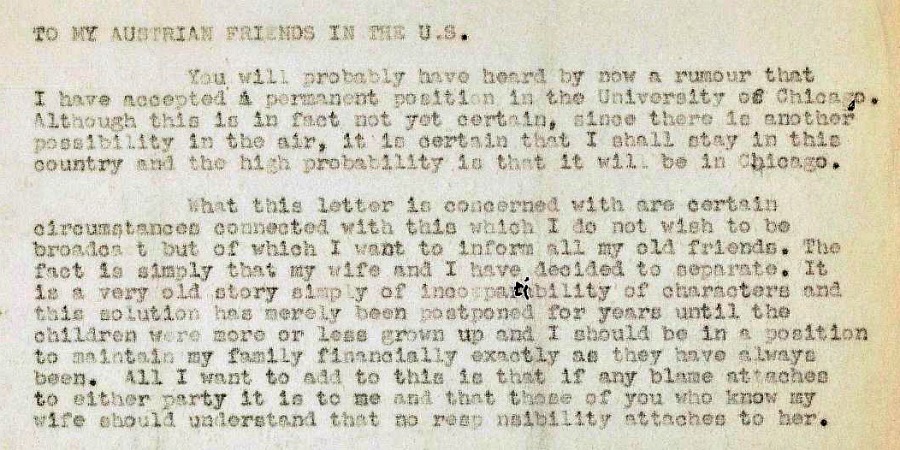
Economist Scandal: A letter from Hayek explaining his divorce. He went on to marry his cousin.

The letter is confidential and Hayek addresses it to his “Austrian friends in the U.S.,” listing five other addressees besides Morgenstern – Mises, Haberler, Furth, Machlup, and Schutz. In the letter, Hayek explains that he and his wife are separated because of the incompatibility of their characters. Hayek is taking the full blame for the separation and he also notes that his personal situation is related to his decision to move from London to the U.S. While other copies of the letter might still exist, I am not aware of them and it is possible that this is the only surviving copy. Whether that is the case or not, the letter certainly documents an interesting part of Hayek’s personal life – his divorce, his subsequent marriage to his cousin, and his related move from a comfortable professorial position at London School of Economics to the U.S.

solow
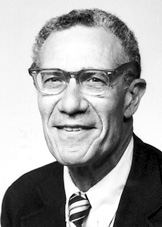
Robert Solow

Crystal and I also spent a lot of time improving the description of the Robert Solow Papers’ correspondence series. One interesting exchange I found is from 1982, between Solow and Ronald Coase, another economics Nobel Prize winner. Both Solow and Coase put their finger on a critical issue of difference between social sciences and natural sciences.  It is no wonder, Coase says, that economists are so notoriously known for disagreeing with each other – an issue that was particularly noticeable during the recent economic crisis.  Unlike physicists, economists often cannot run controlled experiments and therefore cannot repeat such experiments to check conclusions of each-other’s research.  According to Coase, it is thereby much harder for economists to resolve their disagreements than it is for natural scientists.

The material that we went through is in many ways breathtaking. The quality and the quantity of thoughts and conversations in the collections lead an aspiring scholar towards humility. Indeed, greatness is hard to achieve; but there is no better inspiration than interaction with great minds – whether it is in person, or through their archives.

Post contributed by Dr. Simon Bilo, Assistant Professor in Economics at Allegheny College, PA.

A Cartoon Version of John Hope Franklin

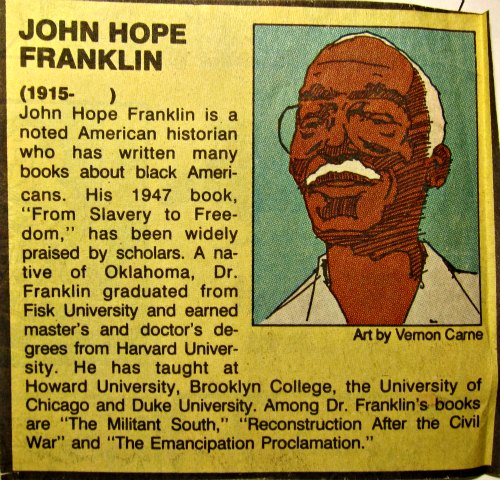
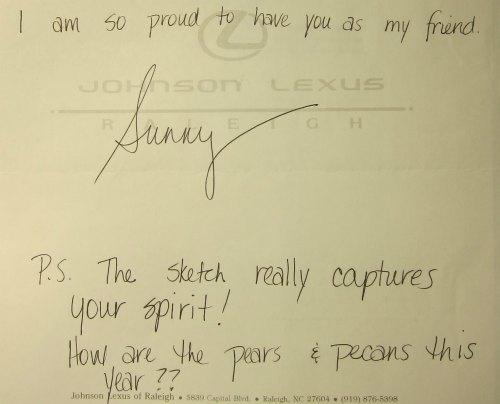
We are wrapping up processing on the John Hope Franklin Papers — more on that soon! — but I couldn’t let this project end without sharing a bit of its lighter side. Newspaper drawings and cartoons of Franklin popped up throughout processing, often having been clipped and sent to Franklin by his friends and admirers. Here is a case where we see Franklin’s reaction to one of his cartoons, shared with him by a friend in Raleigh.

IMG_1116

The sketch in question appears to have been published as part of a syndicated comic strip in newspapers around the country.

IMG_1117

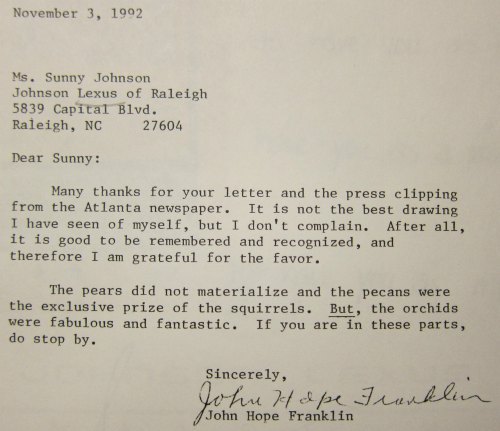
Here is Franklin’s response:

IMG_1114

“It is not the best drawing I have seen of myself, but I don’t complain.” Understatement of the year, maybe? Franklin’s friendly good humor is prevalent throughout his papers, which has made them particularly enjoyable to process over the past year. Stay tuned for more information about the conclusion of the Franklin Papers processing project.

Post contributed by Meghan Lyon, Technical Services Archivist.
Civil Disobedience and the Church in North Carolina

The recent Moral Monday civil protests being held at the state legislature in Raleigh has become national news. Since late April, roughly 700 more protestors have been arrested at the civil disobedience demonstrations. The leadership of clergy within the Moral Monday movement–including Rev. William Barber II, President of the North Carolina State Conference of the NAACP–calls attention to the historical role of the church in civil disobedience and racial justice struggles, both in North Carolina and nationally.

herzogThe Frederick Herzog Papers at the Rubenstein Library provide just such a history. A review of the collection situates the Moral Monday protests within the radical traditions of clergy–particularly Protestant ministers but also rabbis and priests–established during the civil rights era and the ability of the Church to organize and influence direct action. Herzog was a liberation theologist and, from 1960 until his death in 1995, a professor at Duke Divinity. Ordained in the ministry of the United Church of Christ, Herzog played an active role in the civil rights struggles in North Carolina in the 60s. His papers give detailed accounts of not only his reflections but also reflections by various others on “wrestling with the role of the church in the face of current racial tensions . . .” (Letter from A.M. Pennybacker, a minister with Heights Christian Church in Shaker Heights, Ohio).

On January 3, 1964, Herzog and ten others were arrested on trespass charges for participating in a sit-in demonstration at a restaurant just outside Chapel Hill to protest segregation. They were beaten and hosed and spent a night in jail. The court offered to commute the sentences of several of the protestors if they affirmed that they would not take part in such demonstrations again. Herzog’s colleagues, William Wynn of the University of North Carolina and Robert Osborn of Duke University refused to say, for theological and moral reasons, that they felt they did not have the right to break the law. They were sentenced to 90 days in the county jail. Herzog, however, affirmed that he could not take part in such action again.

Herzog writes in a brief statement “Christian Witness and a Sit-In” (filed in the Papers under Writings and Speeches) that he initially understood his civil disobedience as an attempt “to fulfill rather than to break the law,” turning to both the Gospels and Rev. Martin Luther King Jr. for justification of his act. Yet Herzog goes on to observe that the arrests of the apostles and Christ’s persecution were “not part of a technique of nonviolence or a planned civil disobedience campaign. It was the result of taking seriously the obligation to witness to Christ.” Their acts were not, in other words, a “crusade against only one specific injustice or wrong.” Herzog comes to the conclusion that this articulation of the Gospel was missing from his “attempt on January 3rd to witness to greater social justice.”

In his statement, Herzog further distinguishes between the refusal to obey a direct requirement of the state and the direct testing of existing laws, the latter which, he argues, characterized his participation in the sit-in. “Is it possible that civil disobedience is a misnomer when applied to this type of activity?” Herzog nevertheless affirms the necessity of reexamining “the forms in which the Christian witness finds expression in the protest movement” and concludes that marching to jail with our fellow men is only a partial solution. We must also, he states, become personally responsible for one another: “The person to person effort has to be tied to new political groups that in the democratic process openly engage in reshaping the societal structures.”

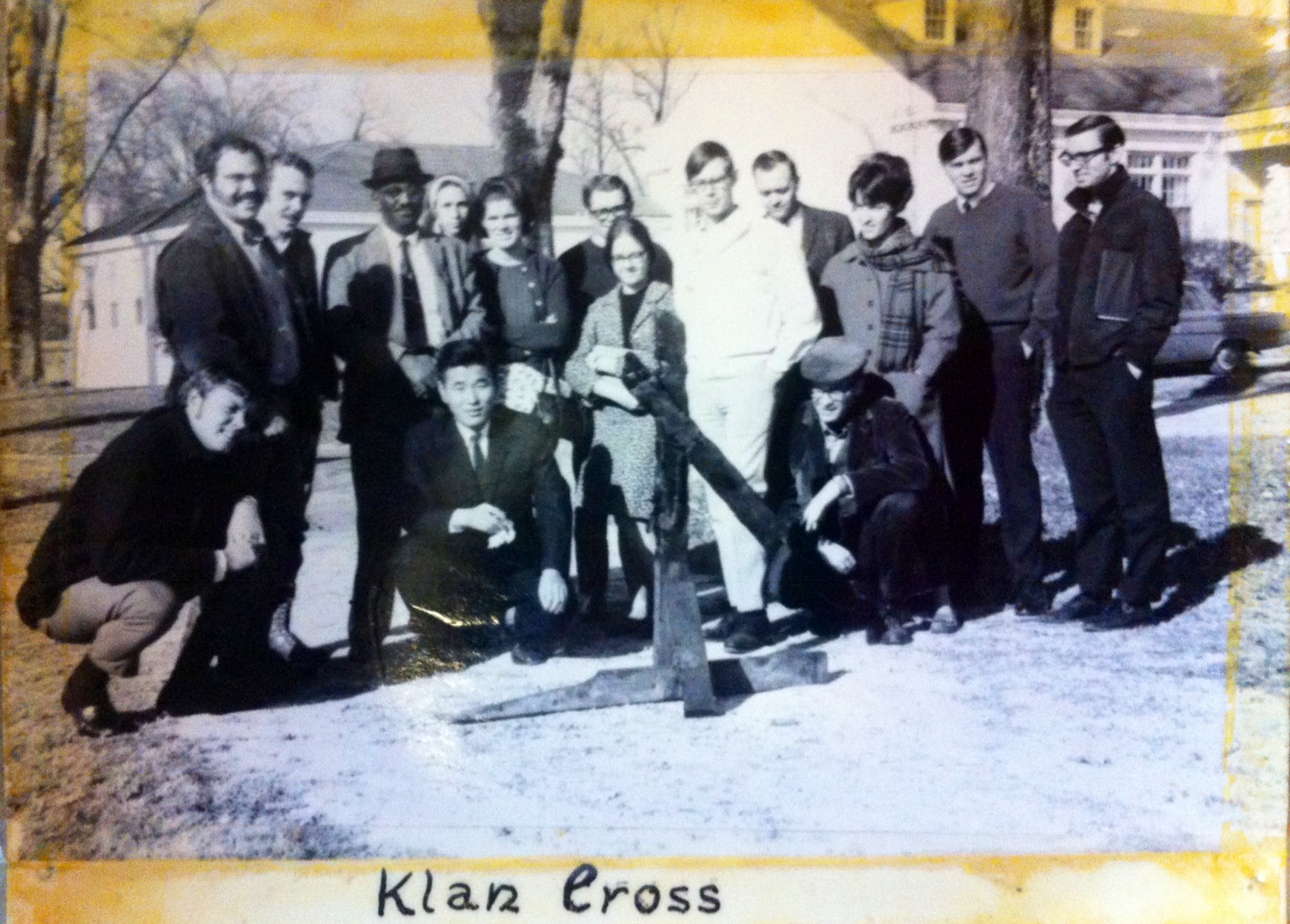
Klancross
Photograph of a KKK Cross in North Carolina, from the Frederick Herzog Papers.

Moral Mondays do not constitute a crusade against one specific injustice but rather employ the broader language of offering a place in society to our most disenfranchised citizens. Herzog’s statement nevertheless complicates and deepens the relationship between theology and protest, and prompts me to ask where Moral Mondays fall within his distinction between refusing to obey and direct testing? Would Herzog classify the occupation of the Capitol as civil disobedience?

Post contributed by Clare Callahan, Rubenstein Technical Services student assistant.