A cataloger with a photographic memory could be a source of endless fragments of information. We have only a few minutes with each of the thousands of books that pass through our hands, and much of that time is taking up with verification of details of the title, the imprint, the author’s authorized heading, etc. Subject analysis is often a quick selection from an endless list of dry headings and academic buzzwords—Economic development, Queer theory, Postcolonialism, Lie groups, Wachiperi language—and their associated classification. Some subjects appear over and over. The catalog has 179 entries under “Egypt—History—Protests, 2011-” and more under that heading with subdivisions. In other cases, the cataloger is amazed that even one book has been written on the topic. The author of a slim volume on Hedjhotep, the Egyptian god of weaving, admitted that this deity is “little known, even among Egyptologists.”
As my memory is far from photographic, sometimes at the end of the day I am hard pressed to remember what parts of the river of human knowledge I have seen flow by. Determining what a book is about, though a fascinating process, gives just a snapshot of the content, and varied snapshots blur together in my mind. After more than thirty years of cataloging as a generalist, I have been exposed to bits and pieces of a wide range of subjects, but questions about any detail send me to Google.
A selection of Jewish prayer books, one for each holiday.
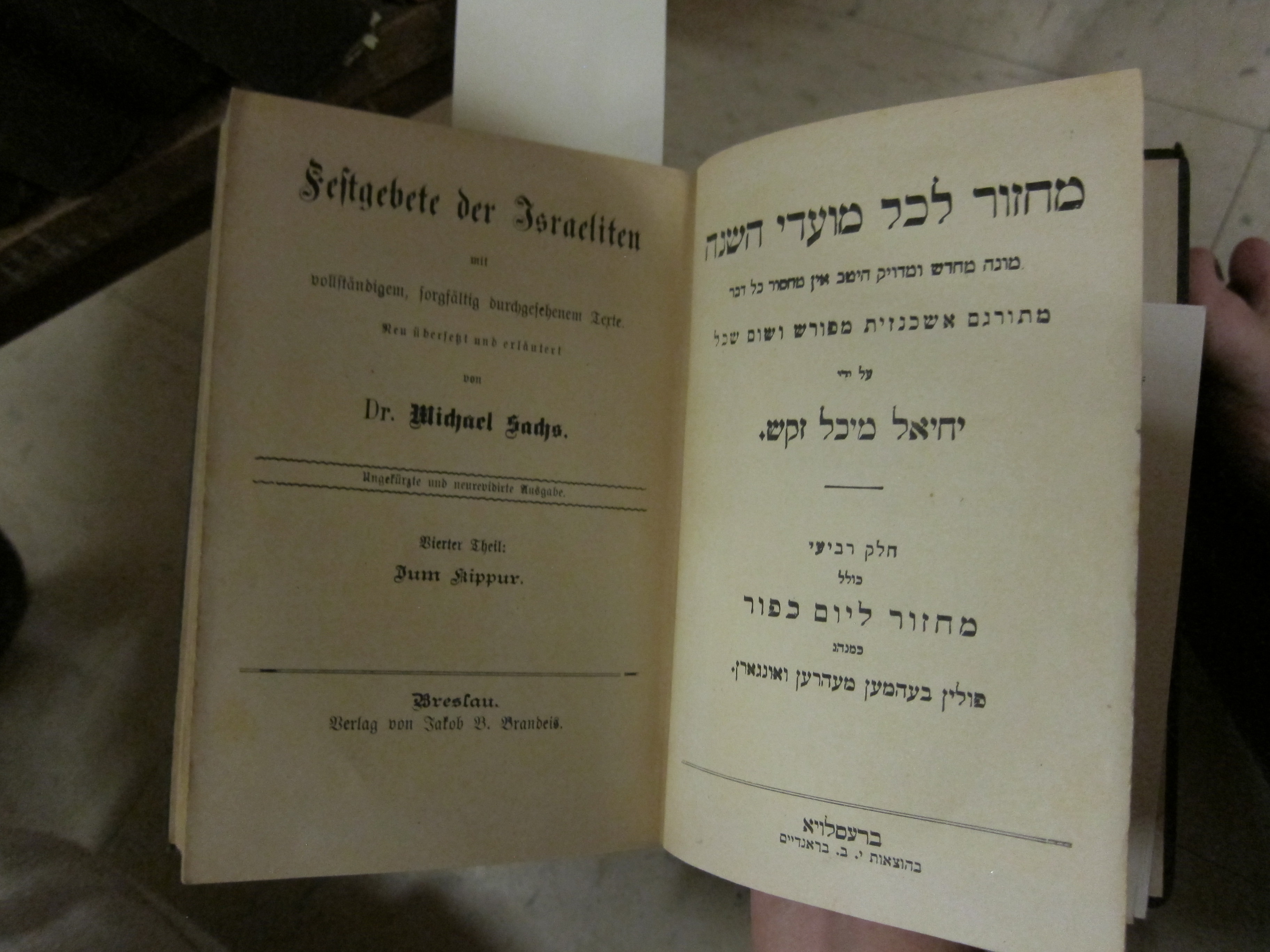
Recently, the library acquired a Judaica collection of more than 6000 late 18th century to early 20th century books. Most are in German, with some Hebrew and Yiddish. As part of a team of catalogers working with this material, I have been able to spend days on end with interrelated books. Questions about the context of a work or an author’s identity send me to Wikipedia, and what I learn there brings more life to the books, which creep into corners of my consciousness not inhabited by my usual work. Opening one dusty anti-Semitic tract after another can be as bone-chilling as the movie Schindler’s List. After cataloging dozens of editions of the Siddur (Jewish daily prayers) I somehow feel that I could step into a German synagogue and pick up a worn black prayer book, and be part of the recitation of words that have comforted so many generations.
This prayer book for Yom Kippur has a title page in both Hebrew and German.
Post contributed by Amy Turner, Original Cataloger in the Cataloging and Metadata Services Dept.
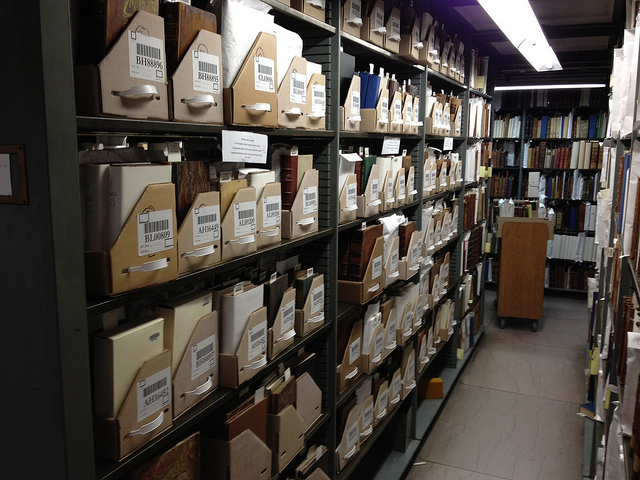
It has been a busy summer here at Rubenstein Renovation HQ. With the help of the entire Rubenstein staff, we have prepared over 50,000 rare books for the move! These are books that have been reviewed and loaded into acid-free cardboard trays for safe transport to and storage at the Library Service Center.
We have made progress on the archival and manuscript collections front as well, and these collections are now almost 100% ready to move to our swing space and the LSC. Below, please find some highlights of some of the work being done:
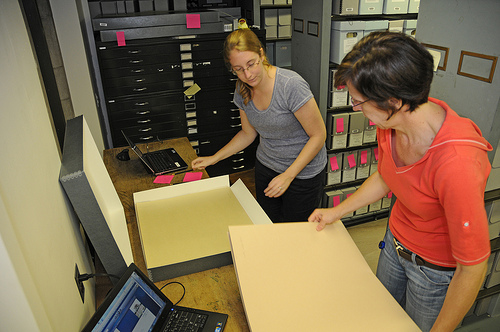
Oversize Materials: 670 linear feet of oversize materials and flat files have been reviewed and re-packaged for long term storage.
Archivists Meghan Lyon and Mary Samouelian prepare oversize folders for the move.
Ledger-mania: Our Conservation Lab has been working wonders on our extensive collection of ledgers. The bulk of this work has been completed. Our ledgers have never looked better! Read more about the ledgers project on the preservation department’s blog Preservation Underground.
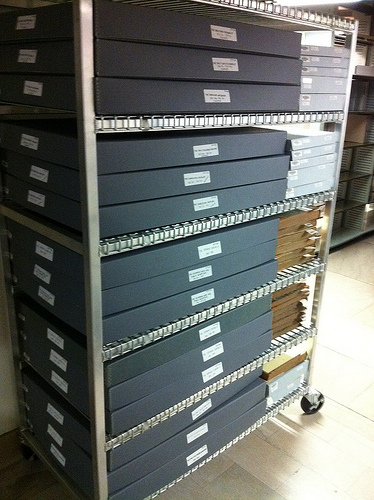
Extra Extra!The Rubenstein Newspaper collection is getting enhanced catalog records, better housing and some much needed TLC in preparation for its journey and new life over at the LSC. This has been a multi-team undertaking led by the Rubenstein Print Materials Coordinator, her holdings management team, our colleagues at Perkins Technical Services, and of course the Perkins conservation team.
Newspapers in new boxes, ready to ship to the LSC
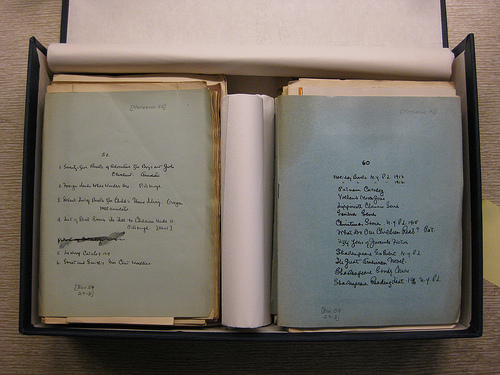
Manuscript Box Stabilization: Many of our manuscript collections are housed in flat boxes. To keep things from needlessly shifting during transport we have padded boxes with what will forever be affectionately referred to as “burritos.” These are pieces of folder stock rolled into tubes and wrapped in tissue paper so they stay rolled. Here are the burritos in action.
Flat manuscript box, padded and ready to move.
A new Rubenstein Renovation website is in the works! Stay tuned for an announcement about this site, it will be a one-stop shop for all your renovation news needs.
What’s Next?
We are beginning the home stretch of our move preparation efforts. Materials are starting to be shipped over to the Library Service Center in small but consistent batches now that the Center’s 3rd module is nearly online.
The bulk of our materials will be moving in January and early February 2013. This will be a very busy time at the Rubenstein, so if you are planning on visiting us during this time, please contact us so we can plan ahead for your visit. Don’t forget that the reading room will actually be closed December 17, 2012 – January 6, 2013 so we can move the reading room and our offices over to our temporary location on the 3rd floor of Perkins library. We look forward to welcoming you to swing space on January 7, 2013!
Post contributed by Molly Bragg, Collections Move Coordinator in the Rubenstein Technical Services Dept.
Happy Friday! Preparing for our upcoming renovation continues at the Rubenstein. This book’s title made us giggle, especially considering the high temperatures we’ve been facing lately in Durham. If you’d like to learn more about Spontaneous Combustion: A Literary Curiosity, you can check out the catalog record. It is a 1937 medical publication discussing cases of spontaneous combustion in literature.
We’re celebrating the beginning of a new fiscal year with a week’s worth of new acquisitions from the first half of 2012. Two newly acquired selections have been featured in a post every day this week. All of these amazing resources are available for today’s scholars, and for future generations of researchers in the Rubenstein Library!
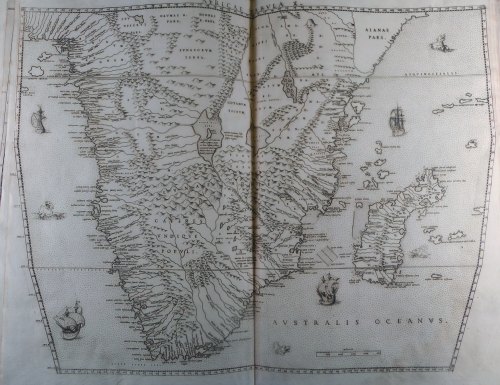
Livio Sanuto, Geografia: This work, published in 1588 in Venice, is the first edition of the first printed atlas of Africa. It contains twelve double-page engraved maps showing the continent; for its date, the maps are surprisingly detailed and accurate, correcting many of the earlier errors in French and German maps. Nevertheless, Sanuto also kept many preconceived European notions about Africa, and introduced new errors in the text of the atlas, making the work a fascinating case study of European views of Africa in the sixteenth century. The work is foundational for the study of European depictions of Africa, and will be a cornerstone for African collections in the John Hope Franklin Research Center for African and African-American History and Culture.
Map of southern Africa, from Livio Sanuto, Geografia (1588).
Ezekiel Skinner Papers: Ezekiel Skinner (1777-1855) was a missionary and physician who worked in Monrovia, Liberia for the American Colonization Society during the 1830s. Although almost 60 years old, Skinner believed it was his duty to continue the work of his son, Benjamin Rush Skinner (named for the famous physician Benjamin Rush, under whom Ezekiel had studied), who had died in Liberia a few years before. The papers contain correspondence and other documents written by Dr. Skinner during his time in Liberia, including a description of a “slave factory” and other details of the slave trade, and discussion of medical treatment of Liberian colonists, including treatment of a fellow doctor, the African-American Charles Webb. The Skinner papers enrich the collections of both the John Hope Franklin Research Center and the History of Medicine Collections.
We’re celebrating the beginning of a new fiscal year with a week’s worth of new acquisitions from the first half of 2012. Two newly acquired selections will be featured in a post every day this week. All of these amazing resources are available for today’s scholars, and for future generations of researchers in the Rubenstein Library!
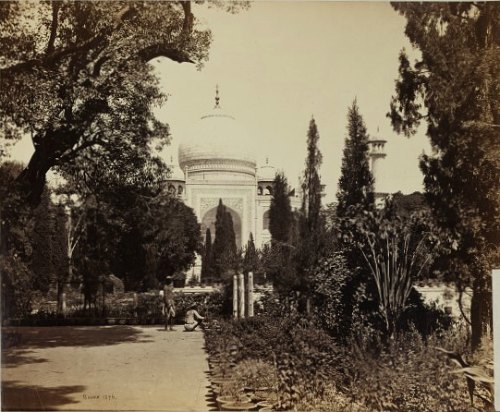
Samuel Bourne Photographs: Samuel Bourne is the best-known photographer of India under British rule, capturing landscapes, architectural studies, and genre scenes from 1863 to 1870. He co-founded the studio Bourne and Shepherd, still active today in Kolkata as the world’s oldest operating photographic studio. The Library has acquired over 300 of Bourne’s photographs, prized for their technical quality, their documentation of Indian sights, and the insight they can provide into British views of Indian life. The Bourne photographs are a valuable addition to a growing body of photographs of India in the Archive of Documentary Arts.
Samuel Bourne, “The Taj, from the Garden, Agra,” 1860s.
Daniel Defoe, The Life and Surprizing Adventures of Robinson Crusoe; The Farther Adventures of Robinson Crusoe; Serious Reflections Upon the Life and Surprising Adventures of RobinsonCrusoe: One of the most groundbreaking and influential narratives in literary history, Defoe’s tale of a castaway on an uncharted island has been endlessly reprinted, adapted, updated, copied, and critiqued since its first appearance in 1719. Thanks to a generous donation by Alfred and Elizabeth Brand, the Library now holds the second edition of The Life and Surprizing Adventures of Robinson Crusoe, printed days after the first edition in 1719, as well as first editions of the two continuations of the story, including the famous map of Crusoe’s “Island of Despair.” This invaluable set will be a jewel in the Library’s large collection of works by Defoe, and is also a key complement to the Negley Collection of Utopian Literature.
We’re celebrating the beginning of a new fiscal year with a week’s worth of new acquisitions from the first half of 2012. Two newly acquired selections will be featured in a post every day this week. All of these amazing resources will be available for today’s scholars, and for future generations of researchers in the Rubenstein Library!
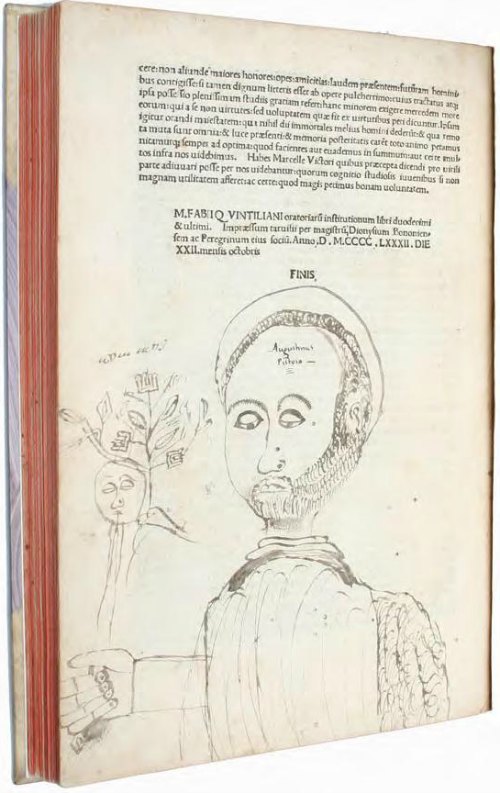
Quintilian, Institutiones Oratoriae: This 1482 incunable (or book printed in Europe before 1501) printed in Tarvisio, Italy, is a rare edition of one of the great Renaissance guides to rhetoric. The remarkable copy now at Duke is unique, bearing the extensive handwritten annotations of a 16th-century scholar, Augustino Pistoia (or Agostino da Pistoia). In addition, Pistoia drew two self-portraits at the end of the text, and noted the date on which he finished reading the work: “On the 20th of October [?] 1583 I Augostino Pistoia have read this book by Quintiliano under the teaching of mag. Pompeo Gilante my master/ 1583 1584.”
Self-portrait by Augustino Pistoia, in Quintilian, Institutiones Orationae (1482).
Edith Ella Baldwin Papers: Born in 1870 in Worcester, Massachusetts, Ms. Baldwin was an artist, craftswoman, and author. Frustrated in her early attempts to publish her writings, Baldwin decided instead to keep one copy of each of her works for posterity, making a binding for each herself. The collection consists of 38 unpublished volumes of stories, novels, poetry, lecture notes, and family history, including a novel about sex education for women, diary excerpts describing her visits with painter Mary Cassatt in 1890s Paris, and copies of letters from her aunt, Ellen Frances Baldwin, dating from 1848 to 1854. Edith Baldwin’s writings tend to cover timeless themes of religion and love, although many compositions feature contemporary issues such as automobiles, labor strikes, and women’s rights. The Baldwin Papers add to the rich body of materials documenting women’s literary expression in the Sallie Bingham Center for Women’s History and Culture.
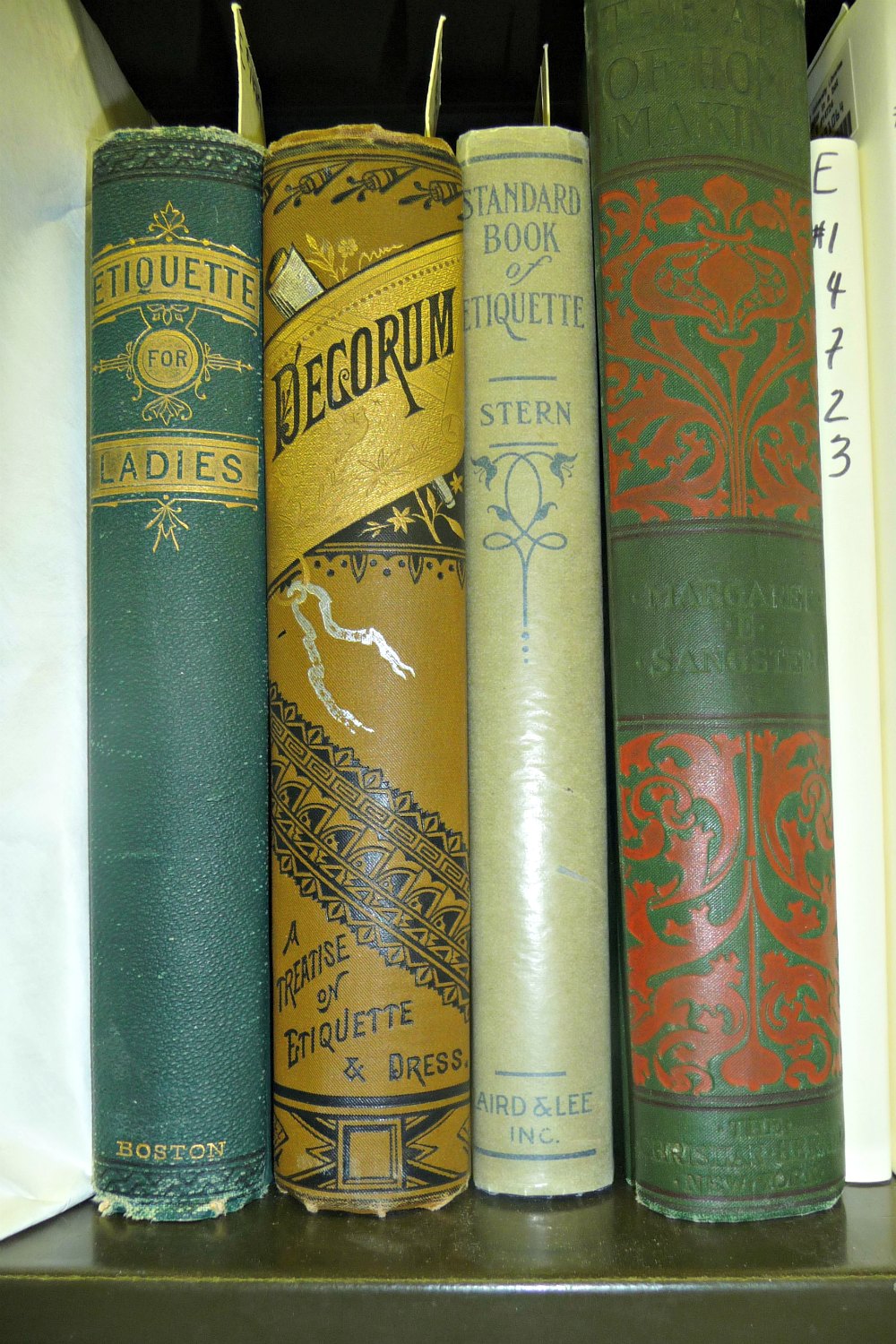
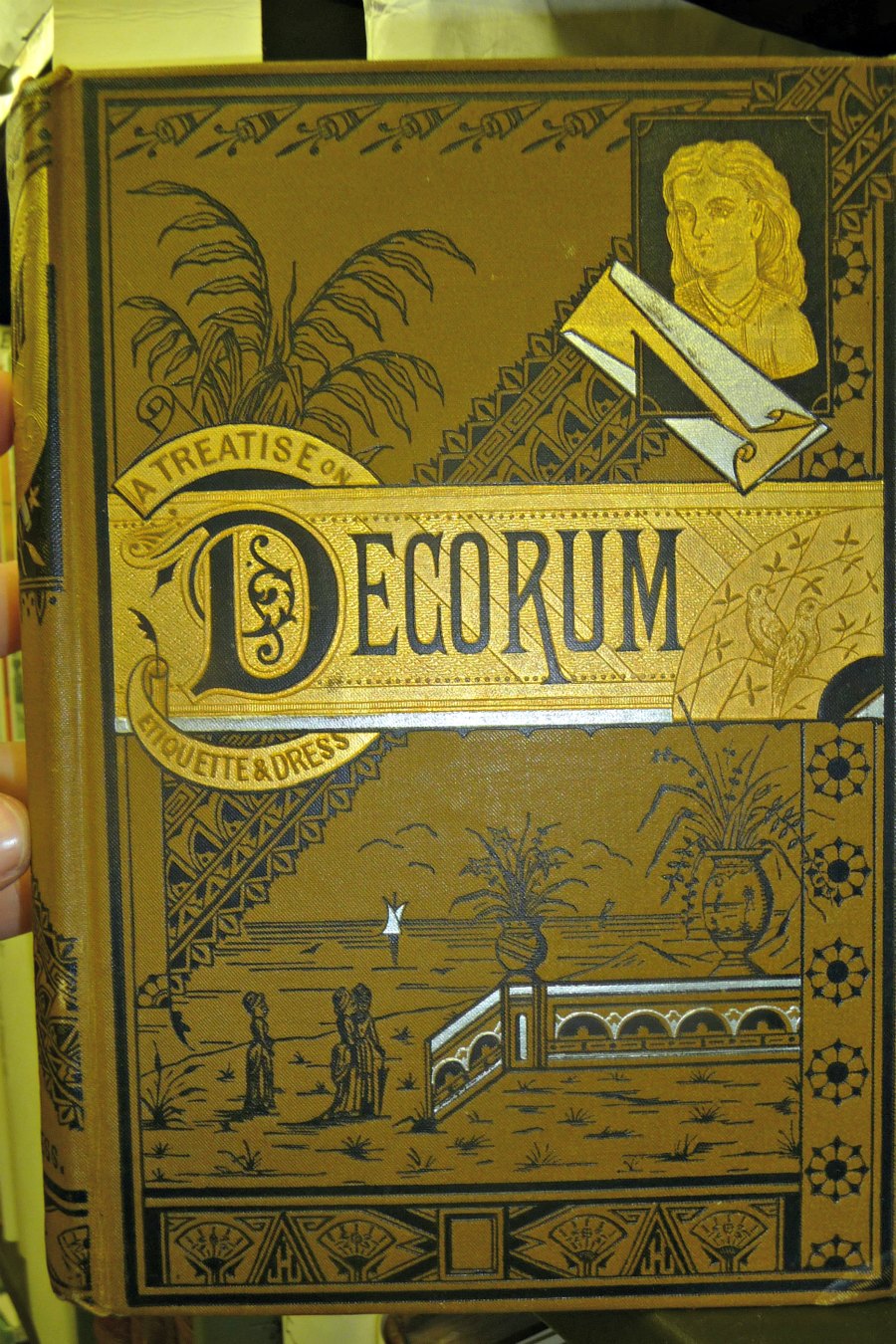
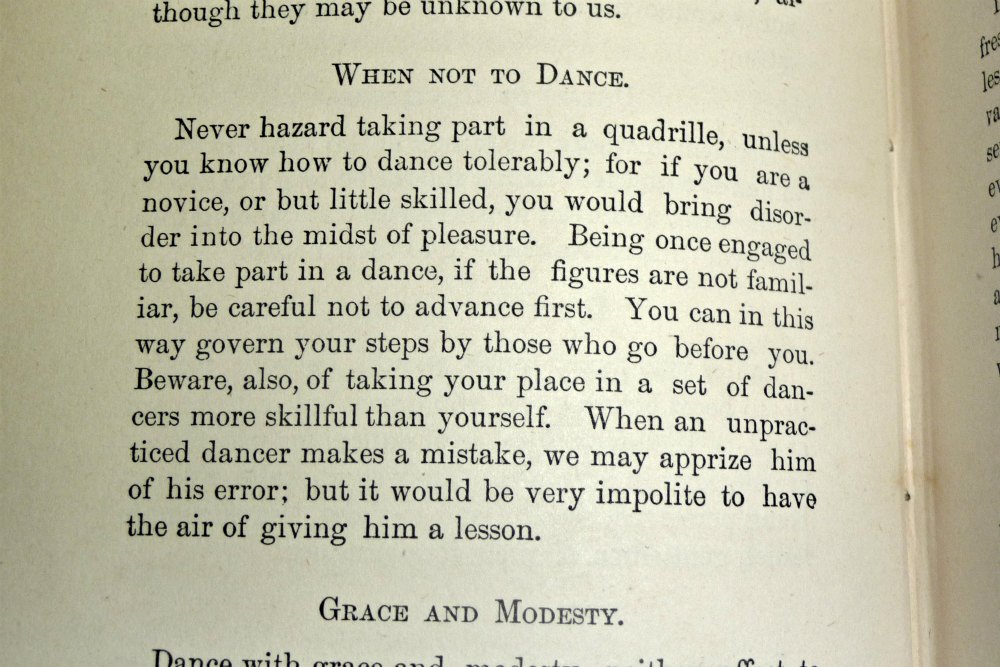
While working on preparing print materials for the Rubenstein Library’s upcoming move, I came across a few books on American women’s etiquette. I glanced inside and found rules, rules, and more rules! Although the publication dates range from 1873-1924, the authors seemed to agree on specific social laws of conduct. For instance, one must never shout hello to an acquaintance across the street (“a certain sign of vulgarity”), and a lady should never have a man on each arm or vice versa (apparently, this is only done in Ireland). One of the books decreed never to join in a dance unless you skillfully know the steps. Otherwise, one will “bring disorder into the midst of pleasure!”
Books on etiquette for American womenDecorum: a practical treatise on etiquette and dress of the best American society, written in 1881 by John Ruth."A lady should never take the arms of two men, one being upon either side, nor should a man carry a woman upon each arm. The latter of these iniquities is practiced only in Ireland; the former perhaps in Kamtskatcha.""Never hazard taking part in a quadrille, unless you know how to dance tolerably; for if you are a novice, or but little skilled, you would bring disorder into the midst of pleasure."
These social rules were listed under headings describing every instance of everyday life imaginable- dressing, eating, visiting relatives or friends, attending church, weddings, traveling, even how to not hurt a person’s feelings. It was very interesting to see how vastly different American society and culture were 100 years ago. We have our rules as well (whether followed or not), but nothing like these prim guidelines.
Cullen Cornett is a Holdings Management Assistant in Rubenstein Technical Services.
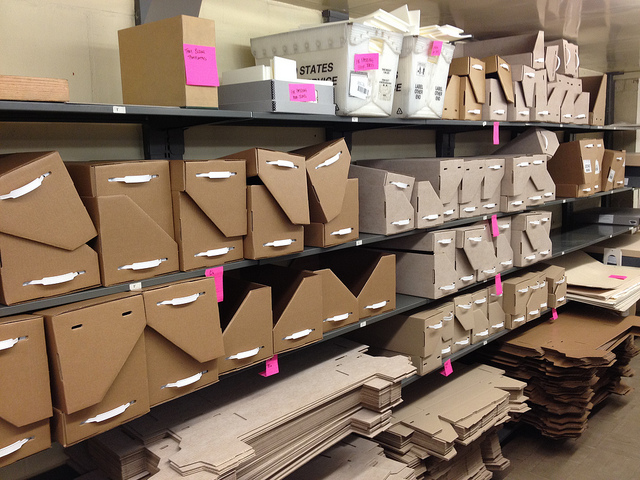
The Rubenstein Renovation team has been spending a lot of time thinking about, planning for, and generally fretting over how we are going to move portions of our priceless collection of rare books to the Library Service Center (LSC) in preparation for the renovation. Right now we are estimating that between 150,000 and 200,000 print items will be sent to LSC. Books at the LSC are stored in book trays, which are made of cardboard and resemble a box that is open on two sides. We will be taking some of our books into our new enabling space as well, but these will not be packed into trays.
In late 2011, we decided that we would load the books into book trays ourselves for two key reasons. First, loading the books ourselves will make processing the books into the LSC a much faster process, because our staff at LSC will not have to load the books. This means the books will be available to the public sooner. Secondly, we believe it will be safer for the books to travel off campus already loaded into trays as opposed to traveling on rolling book trucks.
Empty book trays in various stages of assembly.
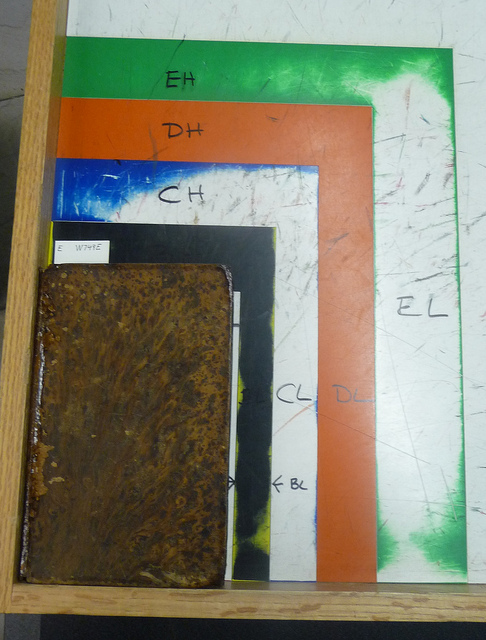
This whole project was a very abstract plan floating out on the move horizon until the last few weeks, when we have started traying books in earnest. First, we had to find a place to store hundreds (eventually thousands) of flat and assembled book trays in the library. Second, loading books into trays is not nearly as simple as it sounds. The trays come in 5 sizes and each size has a high and low sub-size to account for book height. It is essential to match the books to the correct tray size for safe storage (books of varying sizes should not be loaded into the same tray). However there are many nuances to this process. For example, some of our books fit one size in width, but another in height and so on and so forth. Additionally the trays need to be full, but not over or under filled.
LSC measuring block, to help us figure out what tray size is best for each book.
There are also a number of our books have been placed in Tyvek envelopes by our conservation team for safe keeping. As these books are trayed, we have to transfer call numbers and barcodes from the book flags to the envelope. Finally, we are also tracking the barcodes of each volume and tray for record keeping and easy retrieval after the move. All in all, this is a very involved process.
Books that are trayed and ready to move.
Currently the books are not scheduled to move to LSC until next winter, but we are starting now because as you can guess, book traying can be a time consuming process. Unfortunately, the downside of being so pro-active is that it will take us longer to retrieve our books when patrons request them. We do have strategies in place to minimize retrieval time, and we are extremely thankful for our patrons’ patience. This is a lot of work for everyone in the Rubenstein, but we believe this is the best way to move our books. The end result will be a collection that is safe, ready to move, and quite impressive-looking as well! For more pictures of the Rubenstein move, check out our Rubenstein Renovation set on Flickr.
Post contributed by Molly Bragg, Collections Move Coordinator.
Among the many fascinating documents, portraits, and letters of early Methodist preachers and missionaries in the Frank Baker Collection of Wesleyana and British Methodism are a variety of woodcut prints, engravings, and other visual sources depicting subjects as varied as social satire and British birds that might be rather unexpected in a collection that is primarily concerned with religious history. As an art historian, I am particularly drawn to such visual records, and so was especially struck by both the beautiful technique and the relative completeness of a portfolio of etchings by George Cruikshank in which the artist depicts various scenes from the adventures of Shakespeare’s Sir John Falstaff.
Cruikshank, a prominent nineteenth-century British artist who worked primarily in graphic media, is known for his virulent social satires and is frequently discussed alongside similarly comic-minded Brits such as William Hogarth and Thomas Rowlandson. By the middle of the nineteenth century, Cruikshank’s reputation was well-established and the artist had already completed prints for pamphlets by his friend, William Hone, a series of illustrations of the works of Charles Dickens, and the first English edition of the Grimm Brothers’ fairy tales. It is around this time that Cruikshank began work on a concept for a collaborative project with Robert B. Brough which, upon its publication in 1858, would be entitled The Life of Sir John Falstaff: A Biography of the Knight from Authentic Sources.
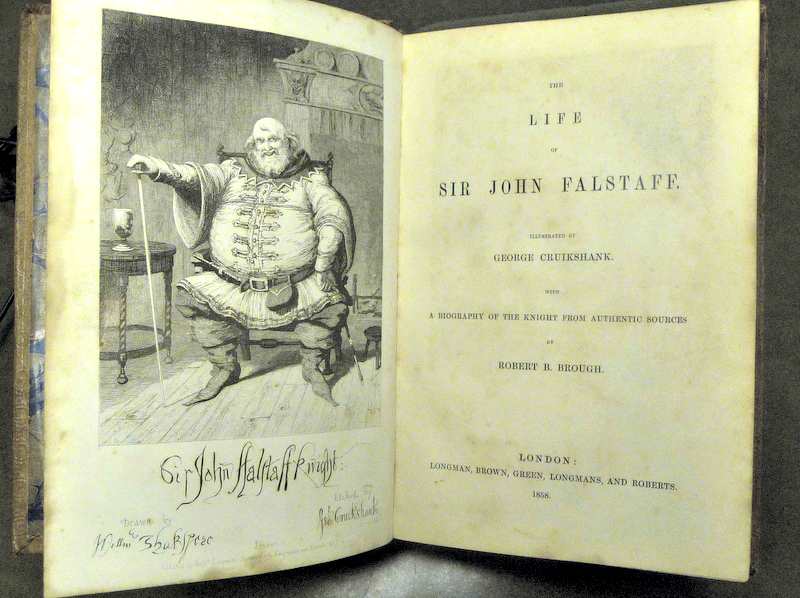
Robert Brough’s The Life of Sir John Falstaff: A Biography of the Knight from Authentic Sources of 1858
A copy of Brough’s rather unusual text is available in Rubenstein Library and provides an imaginative biography of the fictional Falstaff, who appears in the Bard’s Henry IV and The Merry Wives of Windsorand who is himself believed to have been a satirical portrayal of one of Shakespeare’s unfortunate contemporaries.
Cruikshank’s etchings appear throughout The Life of Sir John Falstaff, illustrating twenty scenes with expressive lines and an abundance of humorous detail in a compact, approximately 5×8” book-size format. While processing visual sources in the Baker Collection, I came across a larger set of these same prints; seventeen unbound plates on crisp white paper that are approximately 10×14” in size. The higher quality of the etched lines and cross-hatching seems to indicate that the Baker portfolio is an earlier edition. Missing only three scenes from the set reproduced in Brough’s text, the Baker Collection series begins with a print that is dated 1857 and bears a handwritten dedication along the bottom of the page, signed lightly in pencil by the artist and brought to my attention by archivist Michael Shumate.
Large-scale printed version of Cruikshank’s etching, next to the printed frontispiece of Robert Brough’s The Life of Sir John Falstaff: A Biography of the Knight from Authentic Sources of 1858.
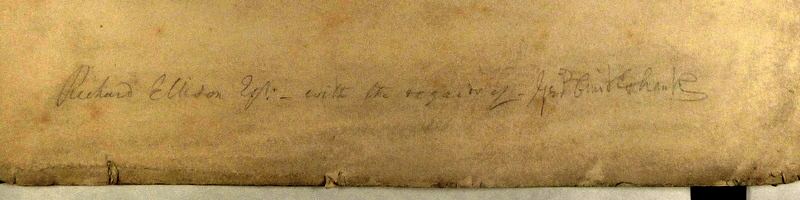
The Falstaff print, a smaller copy of which also appears at the start of Brough’s book, depicts the portly title character, perched on a seat wearing pseudo-chivalric garb and staring out at the viewer, his mouth pursed in what can only be described as a mischievous grin. In addition to the volume’s title, publisher, and other documentary information, the print is inscribed with Cruikshank’s inimitable stylized signature which corresponds directly to the dedication, “Richard Ellison Esq. – with the regards of Geo. Cruikshank” scribbled below.
Autograph Signature: George Cruikshank’s signature in a dedication written in pencil along the bottom of the Baker print.
How this unique object came into the possession of Frank Baker, a former professor in Duke’s Religion Department, is a mystery; however the prints themselves invite further study. Did this 1857 portfolio serve as a kind of prototype for the images included in Brough’s 1858 book? What was the historical reception of Falstaff, and how would Cruikshank’s prints have been understood by nineteenth-century individuals? Indeed, these questions and countless other subjects of interest to art historians, British scholars, and literature students emerge in this visual document. Fortunately for those who, like myself, are intrigued by Cruikshank’s work and would like to learn more, Duke Libraries maintains a number of different sources on the topic, located at both the David M. Rubenstein Rare Book & Manuscript Library and within Lilly Library’s collection. In addition to the Cruikshank materials, the Baker Collection of Wesleyana contains more than 10,000 visual documents including portraits, landscapes, maps, and many other fascinating scenes.
Elisabeth Narkin is a doctoral student in Duke’s Dept. of Art, Art History and Visual Studies. She is also a student assistant in Rubenstein Technical Services.
On this day in 1865 the infamous John Wilkes Booth, assassin of President Abraham Lincoln, died of a gunshot wound on the porch of the Garrett home in Virginia after twelve days on the lam. Or did he?
What if I told you that Booth was actually a tobacco merchant in east Texas in 1873? Or that he was a Shakespeare-quoting house painter in Enid, Oklahoma in the early 20th century? And that one could view his mummified remains at various circuses after the First World War? Crazy, right?
According to Bates, John St. Helen, a merchant in Granbury, TX, confessed his true identity while suffering from an illness to which he supposed he would eventually succumb. After his unexpected recovery, St. Helen elaborated on his confession to Bates and offered additional details of the conspiracy to assassinate Lincoln. The most explosive of these was the originator of the assassination plot, Vice-President Andrew Johnson. He also offered the true identity of the man mortally wounded by a Federal soldier at the Garrett farm. Bates immediately notified the State Department and Department of Defense but his pleas fell on deaf ears (conspiracy, anyone?).
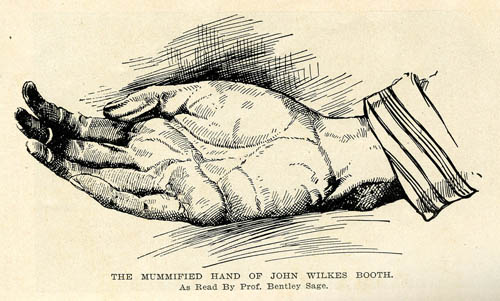
In 1903, a house painter from Oklahoma named David E. George, committed suicide with a fatal dose of arsenic. Among some papers found on George was a note requesting that Bates be summoned. Upon his arrival several days later, Bates was able to identify the deceased George as his friend from Texas, John St. Helen, nee John Wilkes Booth. After claiming possession of the body, Bates then toured mummified remains around the United States, and, eventually, even offering for purchase to Henry Ford.
Come to the Rubenstein Library and read this true account of the life and death of John Wilkes Booth. Conspiracy theorists welcome!
Engraving from The Escape and Suicide of John Wilkes Booth.
Post contributed by Joshua Larkin Rowley, Research Services Coordinator.
Dispatches from the David M. Rubenstein Rare Book and Manuscript Library at Duke University