Category Archives: News and Features

Researching Black Health in the South

It was a great pleasure to conduct research at the Rubenstein Rare Book & Manuscript Library at Duke. As a recipient of the John Hope Franklin Research Center for African and African American History and Culture travel grant, I looked forward to exploring the Library’s holdings that would advance my understanding of black women’s history.
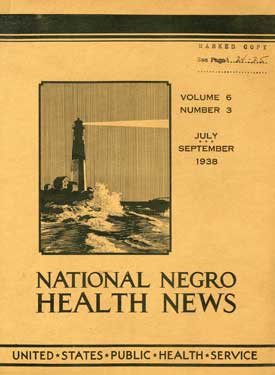
National Negro Health News. From the Alliance for Guidance of Rural Youth Records.
National Negro Health News, Vol. 6, no. 3. From the Alliance for Guidance of Rural Youth Records.

My dissertation project, “Mind, Soul, Body, and Race: Black Women’s Physical Culture, 1900-1939,” investigates the structural barriers to health and fitness for black women and the ways in which they circumvented those barriers and engaged in the physical culture movement. I examine how black women used purposeful exercise to create a new, fit vision of black womanhood that had implications for public health, recreation, and ideas of beauty, citizenship, and racial uplift. As a national project, I want to capture how Southern women, who had even less resources and access to physical culture, participated in the movement.

A significant portion of my dissertation discusses the state of black health and the Library proved to be a valuable repository for exploring the public health aspects of black southern history. The archivists were informed and genuinely interested in assisting researchers and with their help; I consulted about a half a dozen collections in all including the African American Photo Collection, the Alliance for Guidance of Rural Youth records, and the North Carolina Mutual Life Insurance Company archives.

One of the most useful collections was the Alliance for Guidance of Rural Youth. Although the Alliance was primarily a vocational guidance service organization, it sought to address several issues affecting poor, rural young people in the first half of the twentieth century including health issues. I found several documents from the collection related to health campaigns and the barriers to health for black people in the South. For example, a note in the 1934 National Conference on Negro Education proceedings indicated that “environmental rather than racial factors” compromised black health including low income, insufficient housing, and limited access to hospitals, preventive care, and recreational facilities. As it relates to black women’s health, the collection describes some of the difficulties black women had in accessing health information and clinics for their obstetric needs. The collection also contains sources on black unemployment, the black nursing profession, diet and malnutrition, and leisure during the New Deal era.

Additional records at the Library on black health in the twentieth century include William J. Covington’s physician account books and the thesis, Black Health in Segregated Durham.

Post contributed by Ava Purkiss, PhD candidate, University of Texas at Austin and 2012-2013 Franklin Travel Grant recipient.
Celebrating 175 Years of Duke History

Date: Friday, December 6, 2013
Time: 3:00-5:00 PM
Location: Perkins Gallery
Contact Information: Amy McDonald, amy.mcdonald(at)duke.edu

Join the staff of the Duke University Archives for a reception celebrating the exhibit, “Outrageous Ambitions: How a One-Room Schoolhouse Became a Research University,” currently on display in the Perkins Gallery.

175th Exhibit Banner, part 1

Enjoy light refreshments while you trace Duke University’s 175-year history through fascinating artifacts, photographs, architectural drawings, and other historical materials. The reception will also be an excellent chance to get a look at some of the University Archives’ recent acquisitions, which will be on display for the first time.

The exhibit will be on display through February 16, 2014 and was curated by Maureen McCormick Harlow, 175th Anniversary Intern in University Archives, and Valerie Gillispie, University Archivist.

Unable to make the reception? Visit the online exhibit!

175th Exhibit Banner, part 2

Achenbaum Dedicates Papers, Endows Hartman Center Travel Grants

On Thursday, November 7th, twenty of Al Achenbaum’s family and close friends joined Duke library staff and faculty in a ceremony to dedicate his papers as part of the John W. Hartman Center for Sales, Advertising & Marketing History. In a series of comments given by Hartman Center staff, Achenbaum’s papers were lauded for their unique insight into building brand equity, strategic marketing planning, maximizing advertising agency-client relationships, and using systematic quantitative research as a guide to effective decision-making.

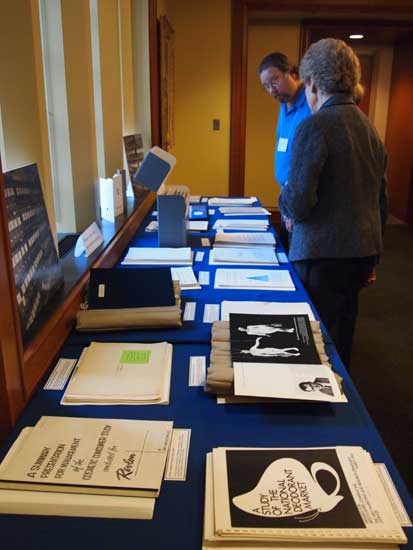
A display of materials from the Alvin Achenbaum Papers.
A display of materials from the Alvin A, Achenbaum Papers.

Over a remarkable 60-year career, he advised leading global marketers, including Procter & Gamble, GE, Toyota and Nestlé, on how to use marketing tools to improve the economic value of their businesses.  He held senior executive positions at four major advertising agencies in New York, and was chairman of a series of leading marketing consulting firms which provided over 150 companies with systematic tools for addressing complex business challenges.

This 233-box collection will enrich the experiences of many students and scholars interested in the evolution of the advertising industry in the second half of the 20th century or the career of Al Achenbaum, known to many as the “Einstein of Advertising” and one of Advertising Age’s  100 most influential advertising people of the 20th century. Al’s son, Jon Achenbaum, described his father as the reason he started his own career in marketing, applying many of the marketing innovations that Al brought into the business world and read two passages from Al’s upcoming book.

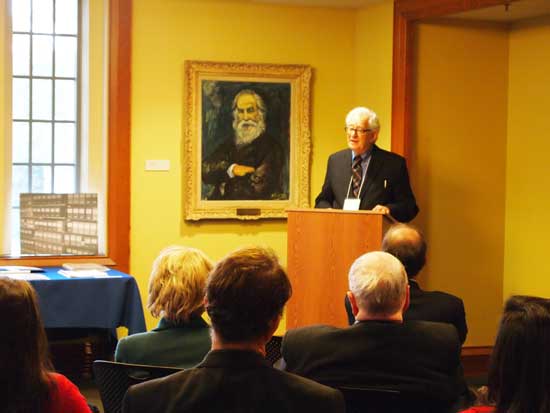
Rounding out the event were remarks by Al Achenbaum himself, in which he stated that “marketing is the single most important driver of our modern economy” and that it will “continue to play a critical role in economic success – both in the U.S. and abroad.”  He expressed his gratitude to his family and friends for supporting him throughout his life and career and expressed his enthusiasm for donating his papers to Duke and the Hartman Center.

P1011531-web

To top off the ceremony, he announced that he is endowing the Hartman Center’s travel grant program, which will be named the Alvin A. Achenbaum Travel Grants.  These travel grants will enable students and scholars to come from afar to use Hartman Center collections as part of their research each year. Since Achenbaum is in many ways a scholar of advertising and marketing himself, this is a wonderful way to continue his legacy in perpetuity.

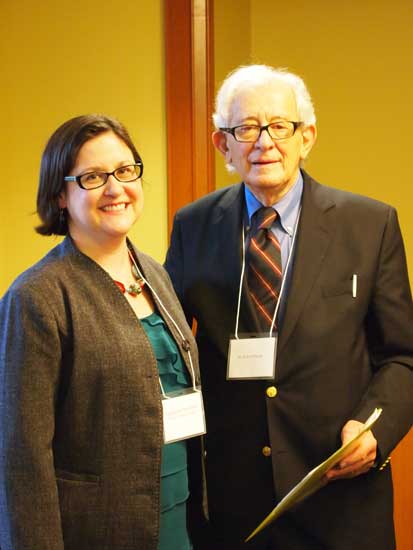
Hartman Center director Jackie Reid Wachholz and Al Achenbaum.

Post contributed by Jackie Reid Wachholz, director of the John W. Hartman Center for Sales, Advertising & Marketing History.

Screamfest in Pictures

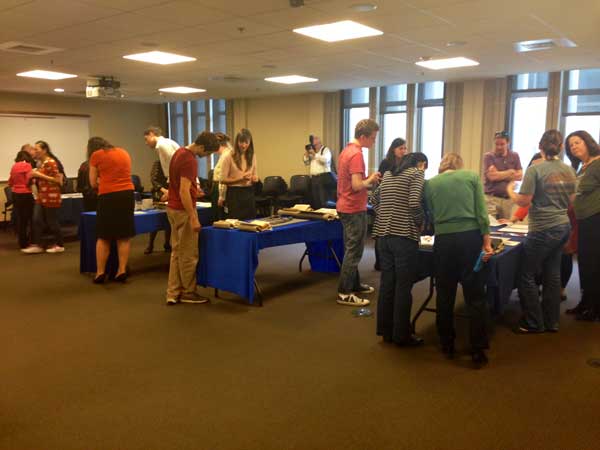
Look at all of the boys and ghouls (sorry, we had to) at our Haunted Library Screamfest!

Screamfest Visitors

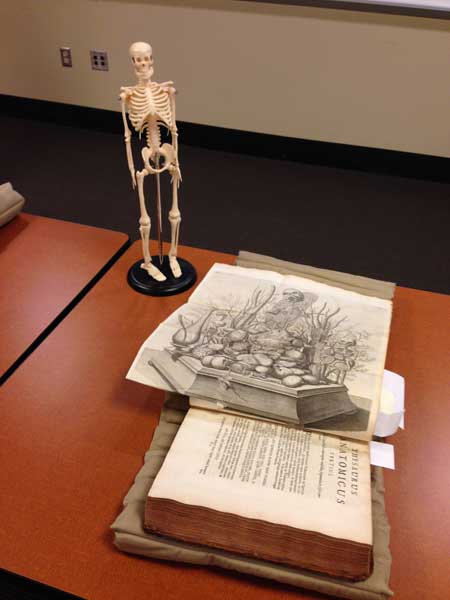
We had materials on display from all of the creepy, spooky corners of the Rubenstein Library, including these items from the History of Medicine Collections:

History of Medicine Collections Materials at Screamfest

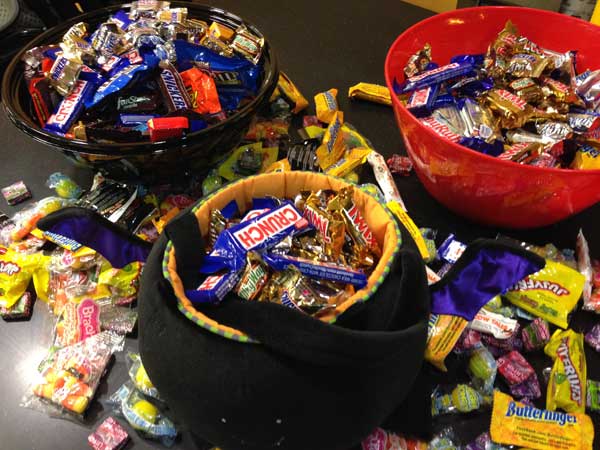
And no, the skeleton wasn’t made of white chocolate. Although some of this was!

Screamfest Candy

Visit the Screamfest 2013 set on the Duke University Libraries’s Flickr photostream for more pictures of the fun. And check out Duke Today’s report!

New Look for our Homepage

[Update, October 15: Our new website (slated for launch yesterday) isn’t quite ready, but is coming soon.]

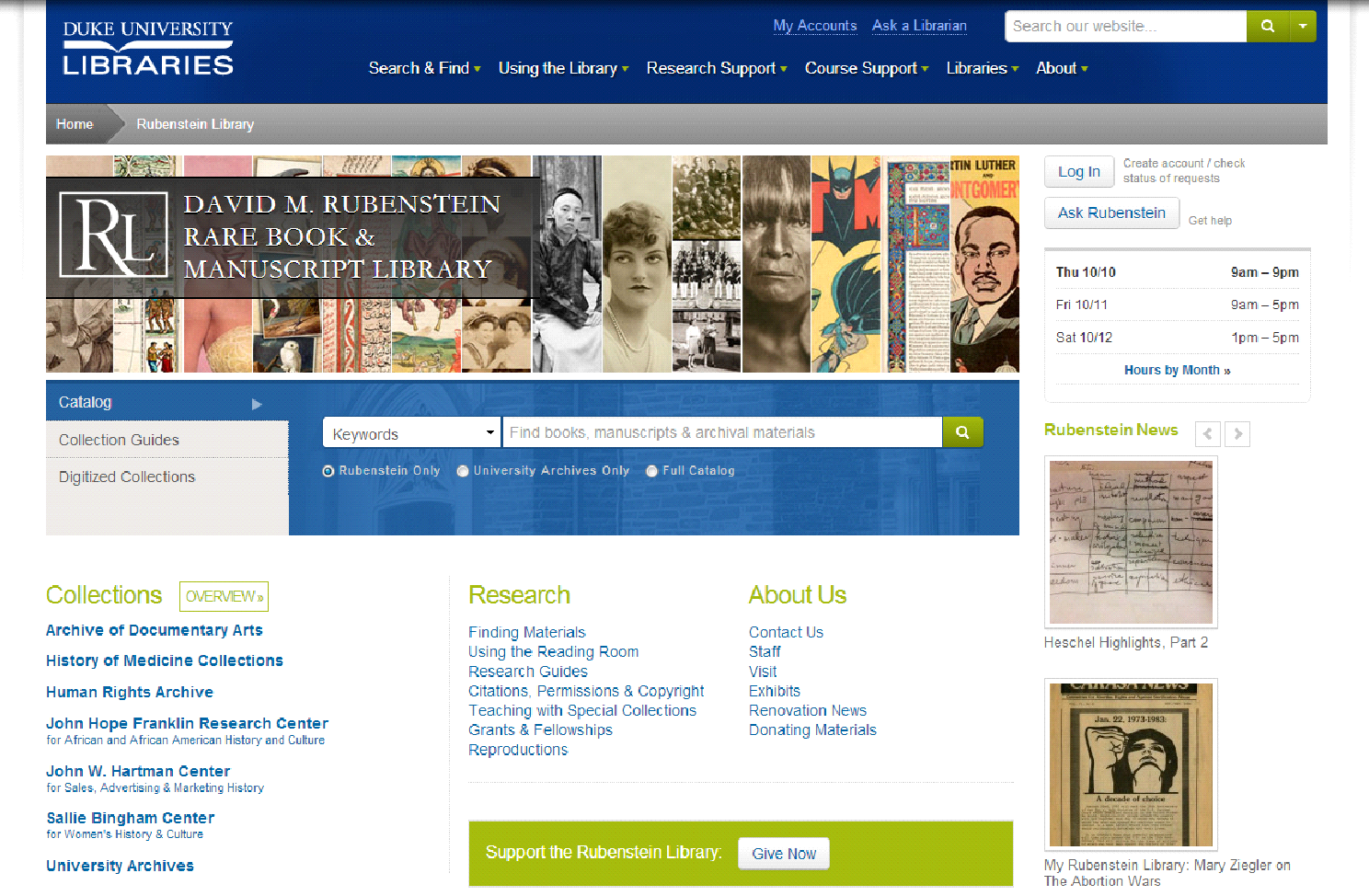
As you may have heard and will certainly notice, the Rubenstein Library’s website is getting a new look!  As part of a library-wide website redesign, a new version of Rubenstein Library’s homepage will be launching today.

New Rubenstein Library Homepage


What’s changed?

  • Updates to the tabbed search box on our homepage:
  • Catalog: Search our catalog for both archival collections and print materials
  • Collection Guides: Formerly known as Finding Aids, but you’re still able to search our 2,000+ collection guides which provide provide in-depth descriptions of our archival collections
  • Digitized Collections: Now you can search our digitized collections right from our homepage
  • New location for logging in to your special collections request account and for getting in touch with one of our librarians, both in the upper-right hand corner of our homepage:log in and ask

  • You’ll also find that content throughout our website has been updated to be more current and easier to read.
  • Getting to our homepage from the Duke University Libraries’ main homepage is a little different now too.  Look for us in the header under the “Libraries” dropdown menu:

Main Library Homepage


What hasn’t changed?

  • Requesting Materials.  We’re still using the same online request system that we implemented a year ago that lets you place requests online to use material in our reading room.  Though we do have improved directions for registering as a researcher and requesting material on our new site.

Welcome to Blogging, Medical Center Archives!

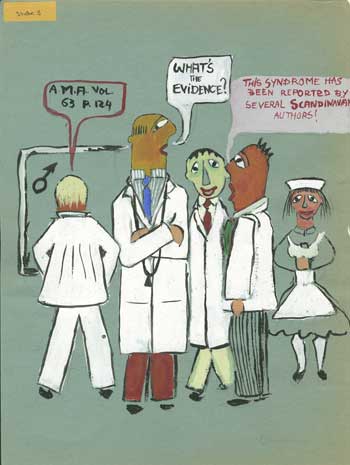
Illustration from the Malcolm Tyor Papers, Duke University Medical Center Archives.
From the Malcolm Tyor Papers, Duke University Medical Center Archives.

This morning, we’re sending best wishes to our friends at the Duke University Medical Center Archives, who have just entered the blogosphere!

Visit their new blog for stories about the history of the DUMC community; interesting images, artifacts, and documents from their collections (like the illustration at right); and information about their resources, services, news, and events.

Recent posts include:

All illustrated with great finds from the Medical Center Archives’ collections.

Look for new posts every other week! Happy blogging, y’all!


My Rubenstein Library: Mary Ziegler on The Abortion Wars

With generous assistance from a 2013 Mary Lily Research Grant, I visited the Sallie Bingham Center for Women’s History and Culture last summer to do research for an article and for my book, now under contract with Harvard University Press, The Lost History of the Abortion Debate.

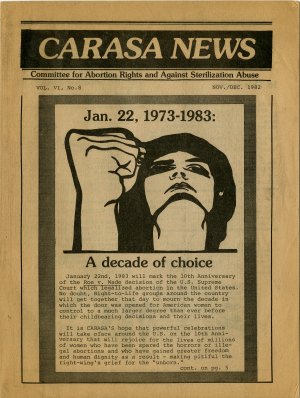
CARASA001resizedThe Bingham Center offers researchers access to many forgotten voices from the abortion wars, from pioneering feminists to founding members of the women’s health movement. I focused on materials documenting the policies and struggles of abortion providers in the years after Roe v. Wade. My search uncovered documents chronicling the work of individual clinics and the activities of political organizations, like the National Coalition of Abortion Providers, that lobby for those working in clinics. These documents revealed a complex legal discourse forged by lay actors—women, clinic staff, providers and activists seeking to redefine what abortion rights meant. Non-lawyers routinely interpreted Supreme Court decisions, using them as raw material for new visions of reproductive freedom.

The story told by the documents housed at the Bingham Center differs substantially from the conventional narrative of post-1973 abortion politics. We often believe that the Supreme Court set the course for the abortion wars of future decades. In particular, by defining abortion as a privacy issue, the Court supposedly short-circuited popular debate about what abortion rights ought to mean. The materials I found complicated this narrative. Far from leaving constitutional issues to the courts, providers, patients, and political activists drew on judicial decisions in creating bold, new ideas about the rights women deserved. The documents I found at the Bingham Center provide indispensable evidence of the true impact of Roe, since the Bingham collections recapture the often-neglected voices of abortion providers. We stand to learn a great deal from studying these materials. I certainly did.

Post contributed by Mary Ziegler, an assistant professor of law at Florida State University College of Law.


In the Lab: Whitmaniana

Recently our next-door neighbors in the Digital Production Center (DPC) had a large project digitizing volumes of Walt Whitman manuscript material from the Trent Collection of Whitmaniana. The digital images are headed for the online Walt Whitman Archive, in part for a digitized collection of Whitman’s marginalia, the notations that he made in and about books and articles he read.

Bound volumes of manuscripts in the Trent Collection of Whitmaniana.

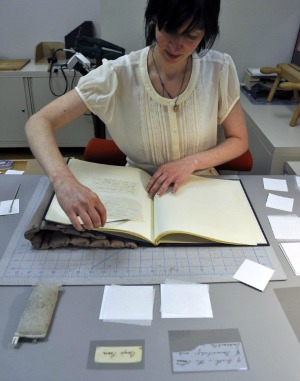
Many of the items were small paper scraps mounted in beautifully bound albums, but the manner in which each item was adhered to the page made it impossible to see what was on the back. Some of the manuscript notes had been damaged by readers trying to lift them, even if they were blank on the reverse. It was decided that conservation would remove the items from their pages to allow them to be digitized front and back, and then we would reattach them to the album pages in a safer manner.

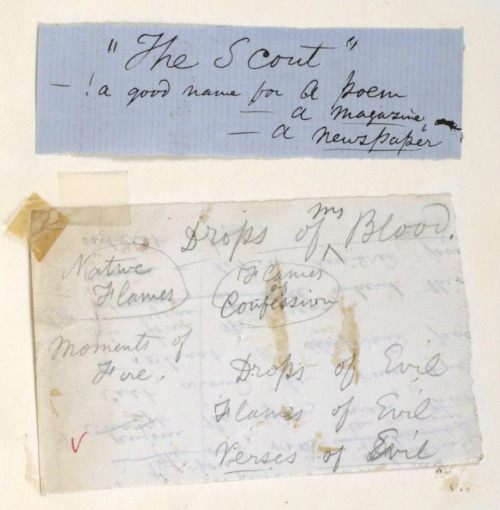
ManuscriptScrapExample

Rachel Penniman working on one of the Trent Collection volumes.

I worked on this project with Rachel Penniman, the newest member of our conservation team, and I collaborated with Alex Marsh in DPC. For this project, Alex scanned 470 pages of material, many with multiple items glued to the pages. Will Hansen, Assistant Curator of Collections in the Rubenstein Library, identified 103 items in 21 albums or boxes to be lifted from their pages.

Rachel and I used moisture to soften the adhesive, being careful to avoid damage to any of the inks. A few items were found to be too risky for removal because of sensitive inks or insoluble adhesive, but for the most part we were successful.

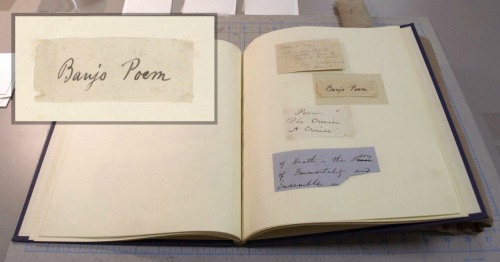
We enjoyed reading the items as we worked on them. Many appeared to be Whitman’s notes on themes for poems and little reminders to himself, some with drafts of lines and corrections, and others simply ideas with no elaboration. Our favorite said simply “Banjo poem.” (Did he ever write his proposed banjo poem?)

banjo page open After Alex digitized all the loose items in DPC, they came back to conservation to be reattached to their pages. Instead of adhering the items at the corners again, I hinged them with Japanese paper to allow them to be lifted safely by readers who want to see the backs.

hinge1

Post contributed by Grace White, Conservator for Special Collections, as part of our ongoing “In the Conservation Lab” series.


Rubenstein Library Construction: Beautiful Wreckage

Construction on the new Rubenstein Library is in full swing. Library staff and patrons have no doubt observed the temporary walls around the library building, seen the giant crane in the loading dock, and heard the dulcet tones of demolition throughout the Perkins stacks.

Rubenstein and Duke University Library staff had the opportunity to take a fascinating tour of the construction in progress in recent weeks. Here are some highlights.

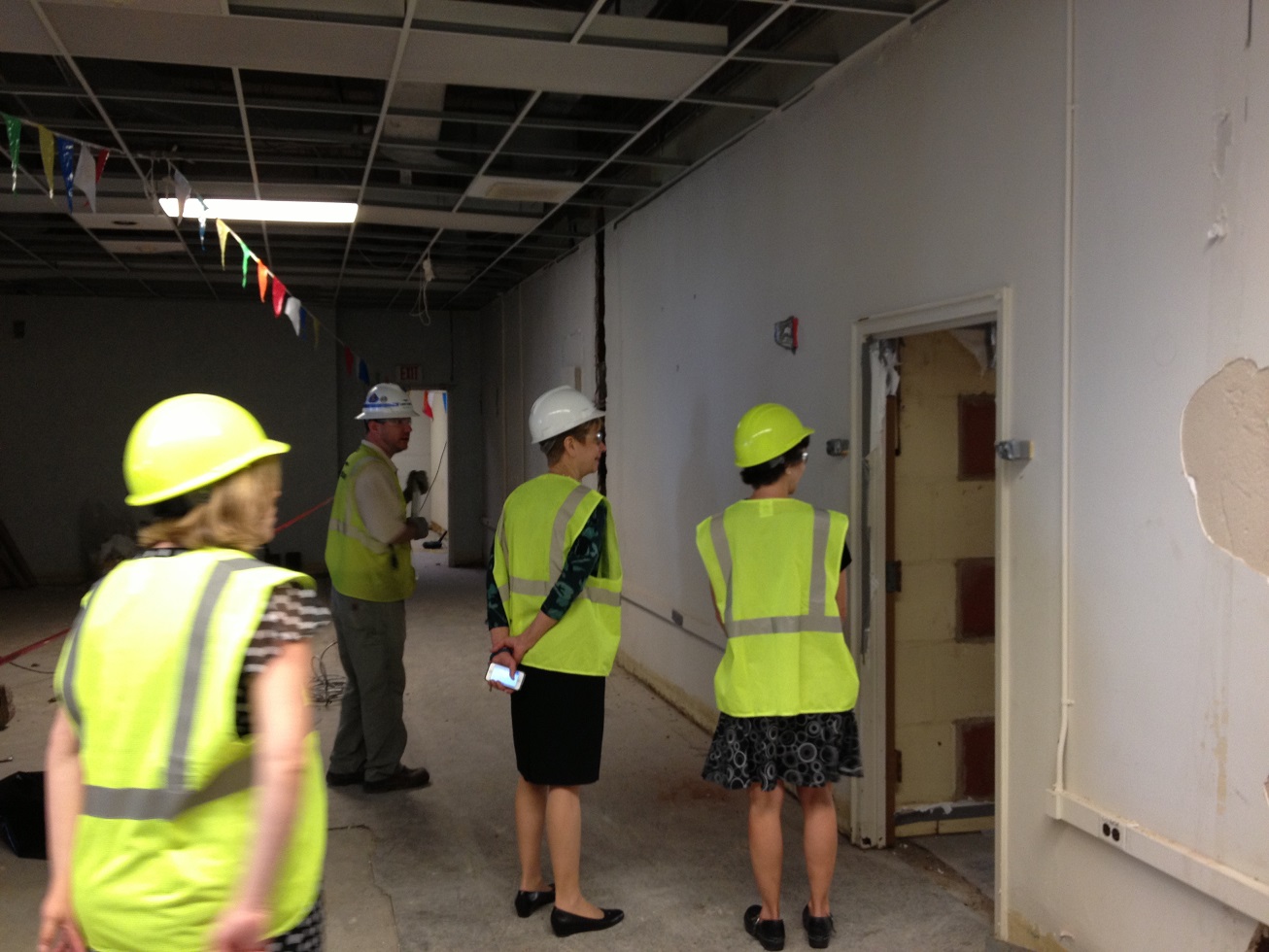
looking_at_cageFirst off we got to wear official vests, hard hats and protective glasses – safety first! Above our touring librarians  and archivists are pictured in the old Rubenstein reading room, looking into the a section of the 1948 closed stacks previously referred to as the “cage.”

gothic_reading_roomThe renovation of the Gothic Reading Room has also started, and demolition crews are removing non-original features of the room. Please note that both the character of the room and its distinctive architectural elements will be retained as we modernize the building. The windows and light fixtures will be restored as close to their original look as possible, but the shelving will be replaced. We toured the entire construction site with Will Dunlop from EHG Demolition. Will commented that the Gothic Reading Room is “one of the most beautiful rooms I’ve ever been called upon to wreck.”

gothic_exterior_revealed

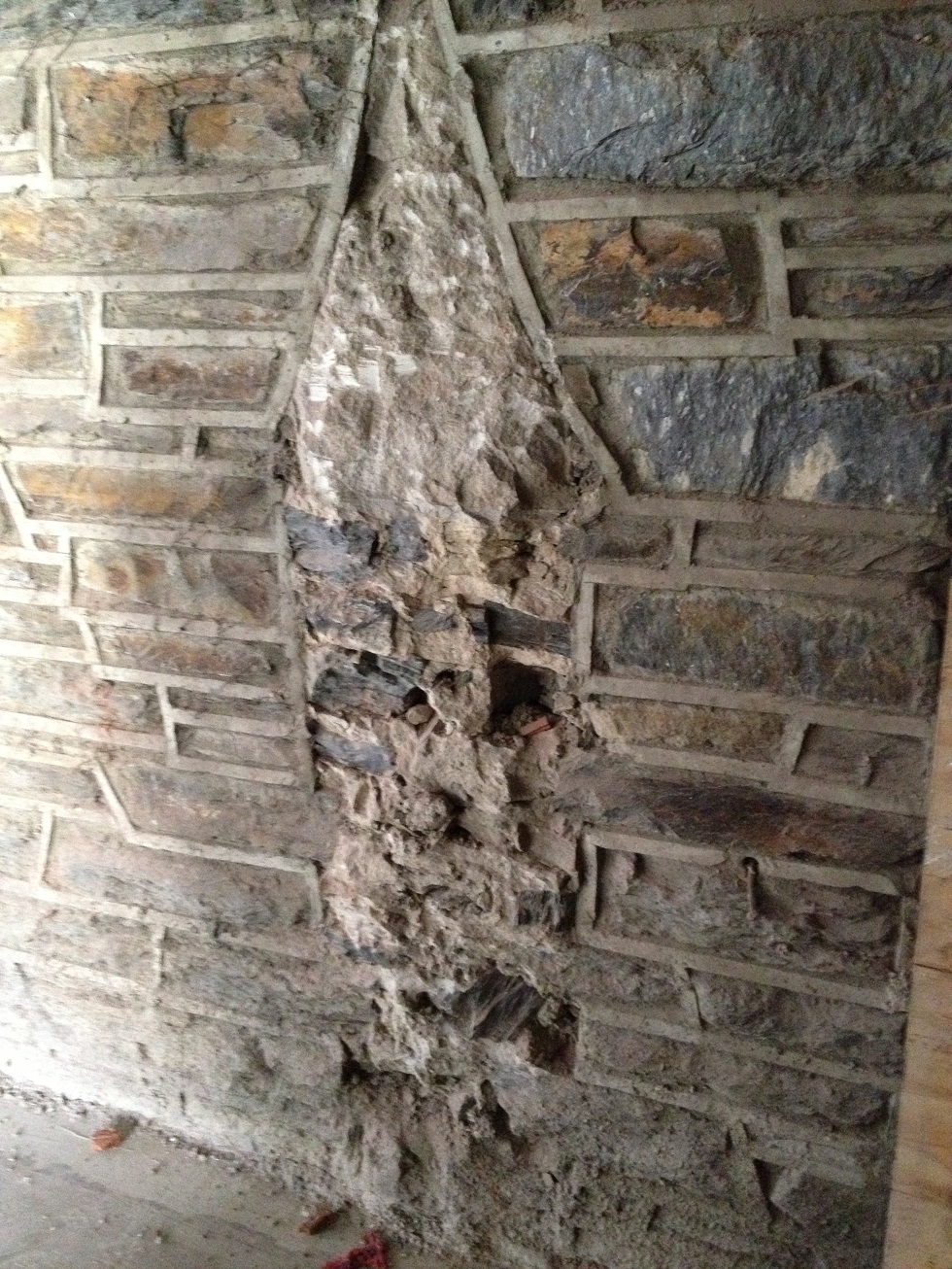
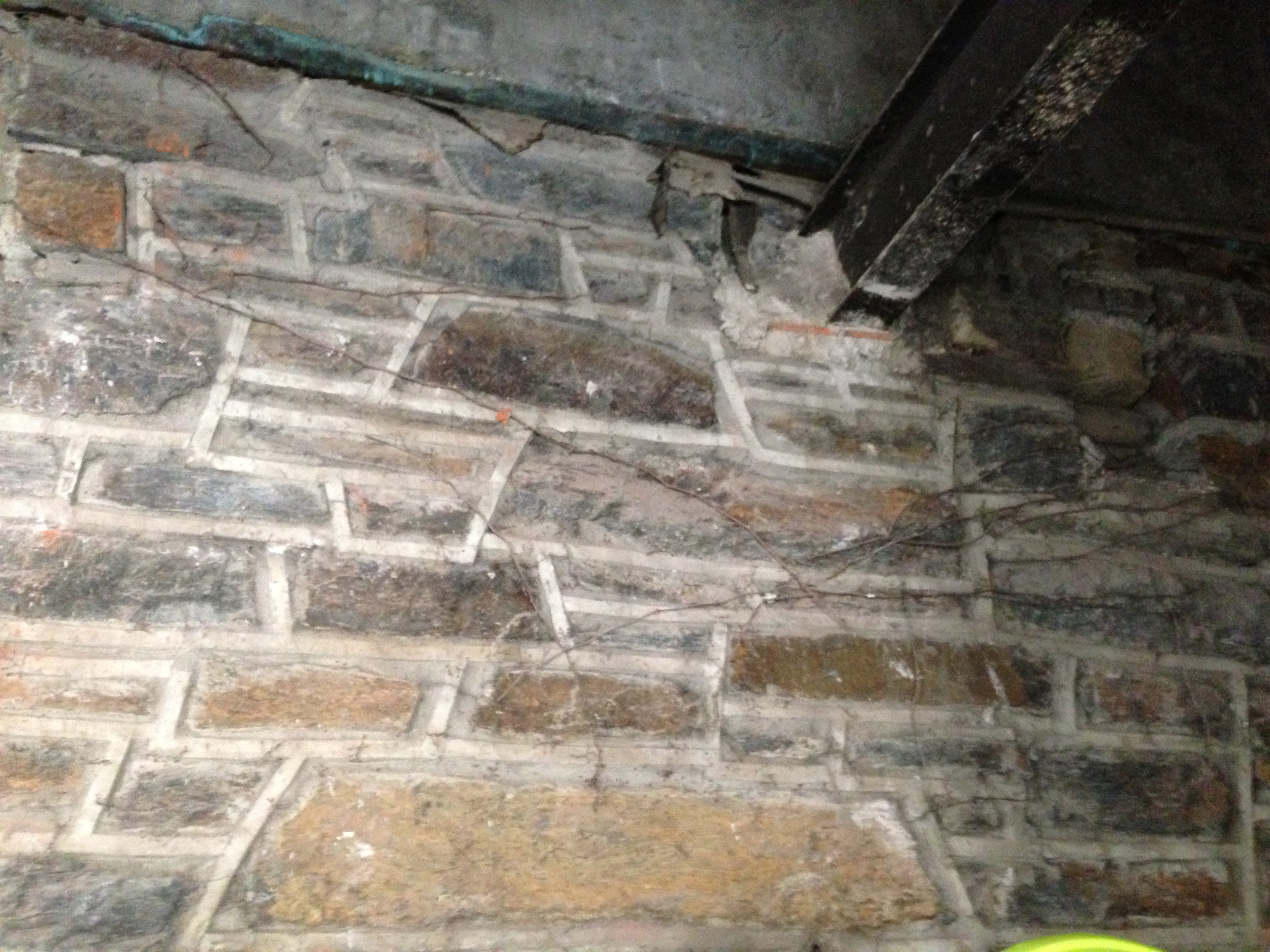
ivy_28wallThe demolition process has revealed the old exterior wall of the 1928 building. Originally, the Gothic Reading room had windows on both sides of the room. When the 1948 addition was built, one side of windows were filled and the exterior wall was covered by the expansion project. In the first picture above we see the old exterior wall, and the outline of decorative stone elements that were removed. The next image shows the remains of ivy vines that must have been growing on the exterior wall when it was covered around 1948.

RL_2nd_floor_officesThe Rubenstein Library director and collection development offices, formally on the 2nd floor of Perkins outside of the Gothic Reading room, have been completely demolished. Here you see the gutted space and the bracing that has been added to protect the building’s structure during renovation.

room_201The room formerly known as Perkins 201 was located right across from the Breedlove Room. Our Technical Services Department worked there before moving to Smith Warehouse several years ago. As you can see in the picture, the windows have been removed and boarded up. This is also where debris is being taken and pitched to dumpsters in the loading dock.

loading_dockOut on the loading dock you can see where a chute (the black tube looking thing coming out of the top window) has been constructed to funnel debris from the demolition area (and Room 201) into dumpsters.

Post contributed by Molly Bragg, Collections Move Coordinator.

Spot the Difference?

Recognize this place?

Old Reading Room during Renovation


Maybe if it had tables full of researchers and some lovely teal carpeting?

Reading Room Pre-Renovation


That’s right, it’s our old reading room! As you can see it has undergone quite a change since renovation began earlier this summer.  Not only is that teal carpeting gone, but steel bracing has been installed for extra structural support. Check out theRubenstein Library Renovation blog for more pictures and updates on our ongoing renovation.