
Category Archives: Events

Rubenstein Library to Welcome Visiting Filmmaker and Artist in October

In October, the Rubenstein Library will host the third Barbaralee Diamonstein-Spielvogel Visiting Filmmaker and the inaugural Barbaralee Diamonstein-Spielvogel Visiting Artist.


nelson pic_crop
Stanley Nelson

This year’s filmmaker is award-winning director/producer, Stanley Nelson. Nelson is the director and/or producer of over a dozen documentary films, principally highlighting the life and history of African Americans. His most recent release is the acclaimed Freedom Summer, and this past summer he was recognized as a 2013 National Humanities Award winner. Nelson will visit Duke’s campus from October 16-18 and will engage in a public conversation with Dr. Diamonstein-Spielvogel on his career and work at the Nasher Museum of Art on October 17 at 6:00 pm, reception to follow.


roden 2_crop
Steve Roden

As the inaugural Diamonstein-Spielvogel Visiting Artist, internationally known sound and visual artist, Steve Roden will participate in a three-week residency in the Rubenstein Library from October 13-30. Roden’s residency will include extensive research in the Rubenstein Library collections to inform his process of artistic creation. Roden will also engage in two public events during his visit. On October 18 at 6:30 pm, he will present an overview of his work entitled “Ragpicker” at the Full Frame Theater at American Tobacco Campus. And on October 23 at 5:00 pm, he will share his experiences working in the Rubenstein Library at the Center for Documentary Studies.


All of these events will be free and open to the public and are made possible through the generous support of Dr. Barbaralee Diamonstein-Spielvogel. They are additionally co-sponsored by the Archive of Documentary Arts, Center for Documentary Studies, Franklin Research Center, Program of Arts of the Moving Image and Master of Fine Arts and Experimental and Documentary Arts Program.


More details to come soon.


Post contributed by John B. Gartrell, director, Franklin Research Center
Two Upcoming Events with Author and Activist Alix Kates Shulman

An Evening with Alix Kates Shulman: Fiction or Memoir—How to Choose

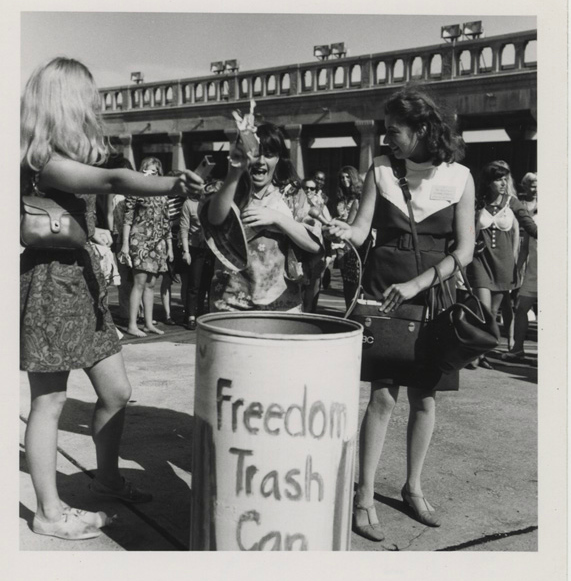
Protest, Miss America contest, 1968. Photo by Alix Kates Shulman; used with permission.

Date:Tuesday, September 9, 2014
Time: 7:00-8:30 p.m.
Location: Durham County Library, 300 N. Roxboro St., Durham, NC

Join author and activist Alix Kates Shulman who has explored the challenges of youth and midlife in her novels, and in her memoirs has probed the later stages in the ongoing drama of her generation of women. Shulman is the award-winning author of 3 memoirs including To Love What Is: A Marriage Transformed and 5 novels including the ground breaking Memoirs of an Ex-Prom Queen. Also the author of many personal essays and stories, Shulman will discuss her process of deciding whether to tell her story as fiction or as memoir, and will examine some of the quandaries, fears, and competing motives that come into play whenever she confronts this crucial choice. This program is co-sponsored with the Durham County Library.


Digitizing the Women’s Liberation Movement: A Conversation with Movement Leader Alix Kates Shulman

Date:Wednesday, September 10, 2014
Time: 9:30-11:00 a.m.
Location: Perkins Library, Room 217
Contact: Kelly Wooten, kelly.wooten@duke.edu

RSVP on Facebook (optional)

This program will give insight both to the women’s liberation movement and to the life cycle of a digital project, and celebrate the launch of the Women’s Liberation Movement Print Culture digital collection. “Documents from the Women’s Liberation Movement: An On-line Archival Collection,” was created in 1997 to support a Duke course on the Social History of American Women, and became one of Duke Libraries’ most popular digital collections. Alix Kates Shulman will reflect on her experiences as a feminist activist and writer during the 1960s and 70s, including the 1968 Miss America pageant protest, the iconic event that launched the myth of bra burning and the women’s movement in the popular consciousness. Molly Bragg, Digital Collections Program Manager, will share a behind-the-scenes perspective on how digital projects are proposed and how they are made to magically appear online, and Kelly Wooten, librarian with the Sallie Bingham Center, will share the process of stewarding permissions for this project and other challenges. Bagels and coffee will be served, remarks will begin at 9:45. Co-sponsored with the Professional Affairs Committee (PAC) of the Librarians Assembly.

Hugh Mangum Exhibit at Durham History Hub

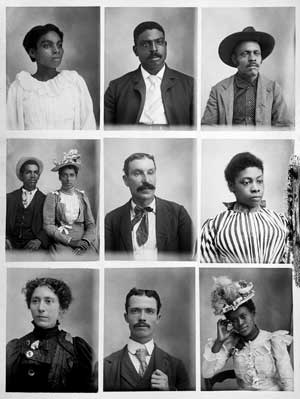
Portrait photos by Hugh Mangum. From the Hugh Mangum Photographs, #N258.

The portraits of Durham photographer Hugh Mangum are the subject of a new exhibit, opening July 22nd at the Museum of Durham History’s History Hub. “Hugh Mangum on Main Street: Portraits from the Early 20th Century” shows Mangum’s largely unknown portraits of Southern society after Reconstruction.

Mangum was born in Durham in 1877 and began establishing studios and working as an itinerant photographer in the early 1890s. During his career, Mangum attracted and cultivated a clientele that drew heavily from both black and white communities, a rarity for his time. Mangum’s photographs are now part of the Rubenstein Library’s Archive of Documentary Arts.

“Although the late-19th-century American South in which he worked was marked by disenfranchisement, segregation and inequality — between black and white, men and women, rich and poor — Mangum portrayed all of his sitters with candor, humor, and spirit. Each client appears as valuable as the next, no story less significant,” said curator Sarah Stacke. “His portraits reveal personalities as immediate as if the photos were taken yesterday.”

Stacke, a photographer and a 2014-2015 Lewis Hine Fellow at Duke’s Center for Documentary Studies, and Margaret Sartor, who teaches at CDS, are working together on a book about Mangum’s life and work. This new exhibit expands on “Keep All You Wish,” an exhibit of Mangum’s work that Stacke curated for CDS in 2012.

“Hugh Mangum on Main Street: Portraits from the Early 20th Century” opens at the History Hub, 500 W. Main St., on Tuesday, July 22 and runs through August. The exhibition will be in the Our Bull City area.

The public is invited to a launch party for the exhibition on Wednesday, July 23, from 5:30pm to 7pm, and a program on Mangum and his work at 3pm on Sunday, August 10.There is no charge for the exhibit, program, or party. The Hub is open Tuesday-Saturday, 10am to 5pm.

2014 Zine Librarians (un)Conference + Zine Reading

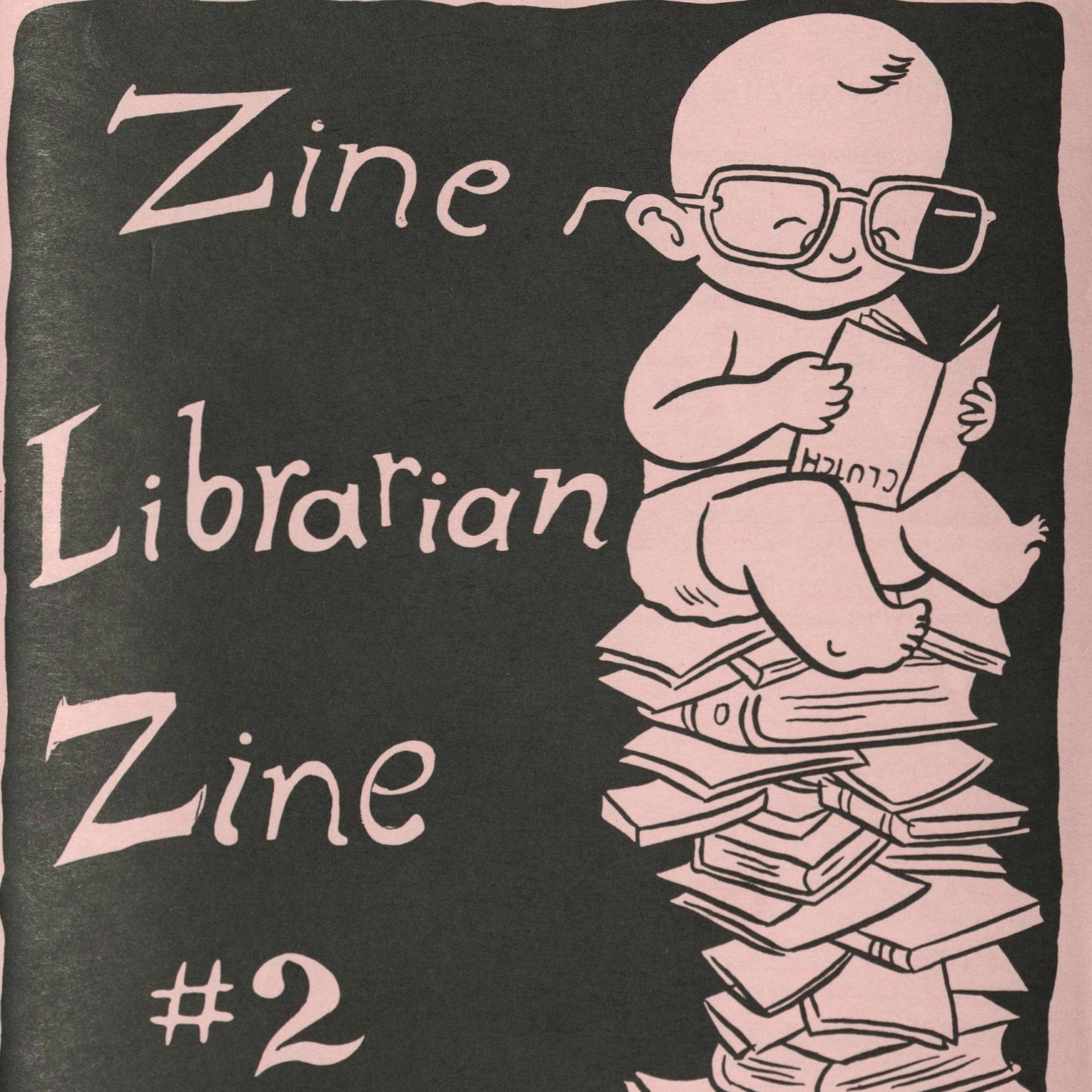
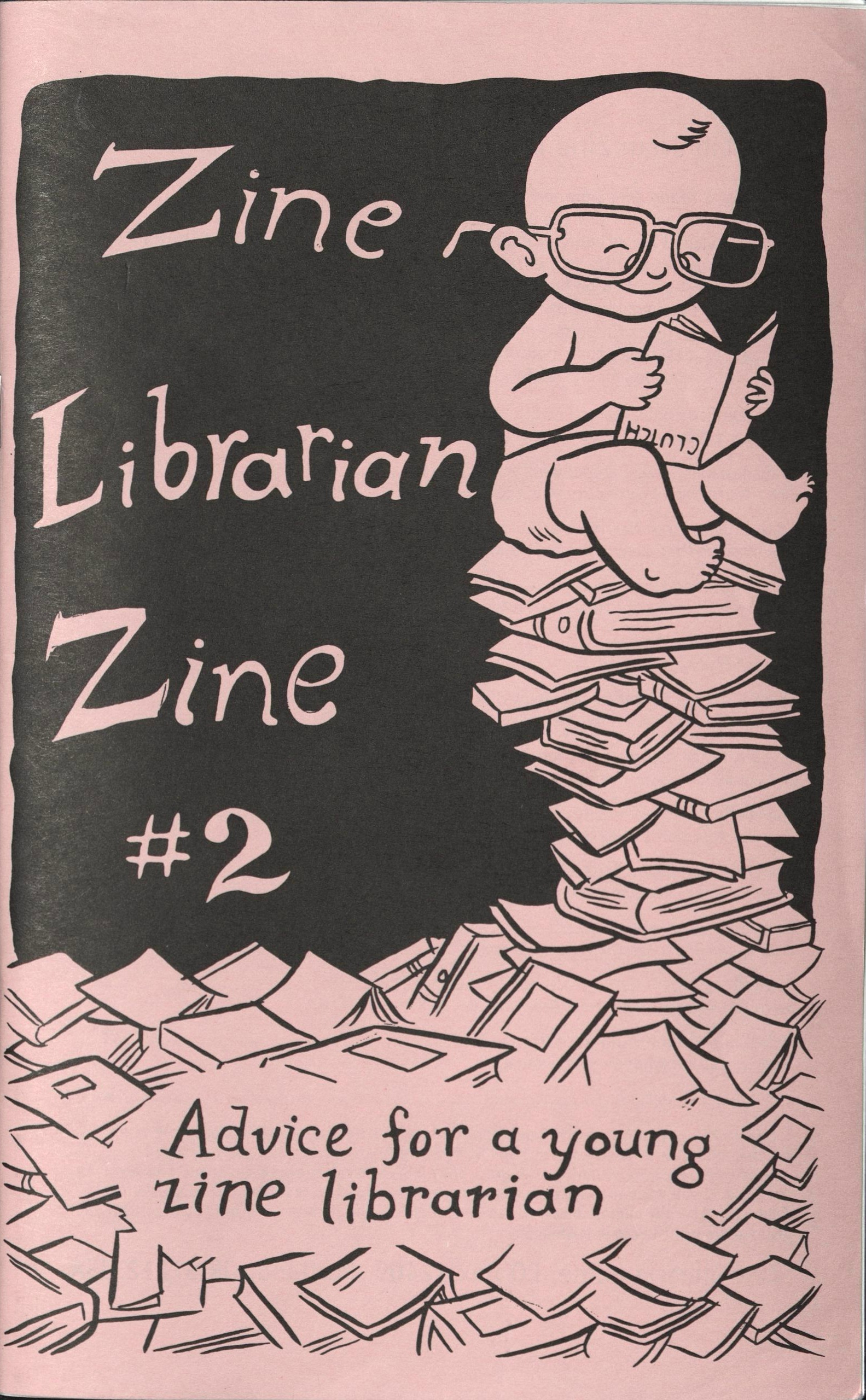
ZineLibnZine big cropNext weekJuly 18-19, a diverse group of energetic zine librarians from academic, public, and independent libraries, and archives will meet in Durham to share ideas and skills for providing access to zines to readers in our communities. The Bingham Center’s collection of women’s and queer zines from the 1990s to the present is one of our signature collections was one of the main draws for the selection committee who chose Duke University as the location for the 6th annual Zine Librarians (un)Conference. Though some elements of the program will be planned in advance, the unconference format allows the attendees to determine their interests, goals, and priorities for learning and sharing their knowledge as a group at the beginning of the event.

This conference will have no registration fee in order to increase accessibility to attendees, and will be open to all who are interested in zines and libraries. Elements of the program will be broadcast online to allow wider participation. More details via the zine libraries wiki.

Like zines but can’t make it to the conference? There’ll be a zine reading on Friday, July 18 from 5:30-7:00pm at the Pinhook in Downtown Durham!  Open mic sign-ups to read from your own teenage angsty zine (or the one you wrote last week) or choose a passage from our pile of extras–you know you want to! Zinesters, librarians, riot grrrls, and everyone else are welcome to join. Donations will be collected to support participation by zine librarians of color in next year’s Zine Librarians (un)Conference. RSVP on Facebook.

An African American Surgeon in the U.S. Civil War: Talk by Dr. Margaret Humphreys

Date: Wednesday, June 18, 2014
Time: 12:00 PM
Location: Room 102, Duke Medical Center Library
Contact: Beverly Murphy, beverly.murphy@duke.edu

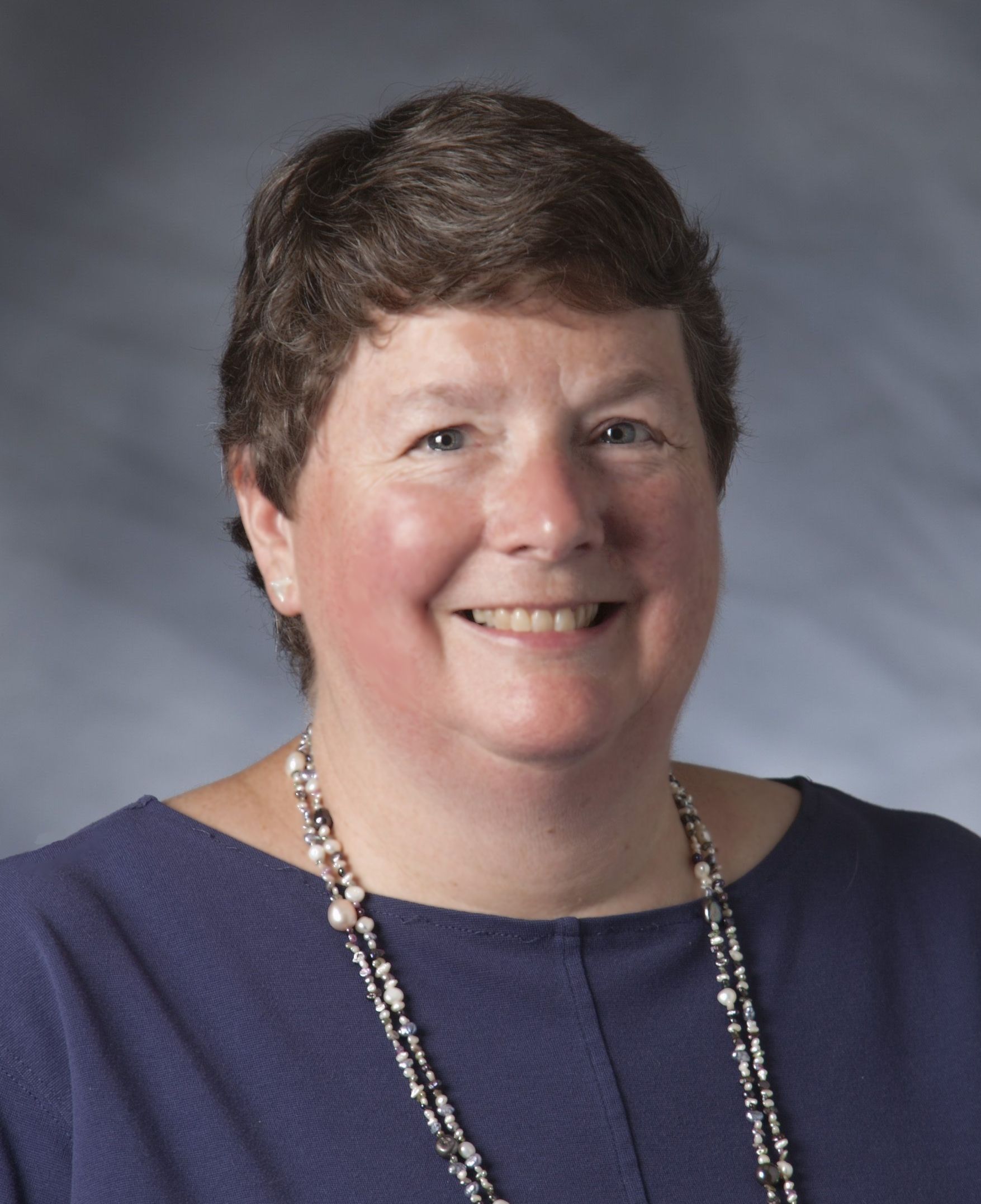
Dr. Margaret HumphreysPlease join us on Wednesday, June 18 at noon for a lecture by Dr. Margaret Humphreys titled “Finding Dr. Harris: an African American Surgeon in the U.S. Civil War.” The event will be held in Room 102 of the Duke University Medical Center Library. Lunch will be provided.

Dr. Humphreys is the Josiah Charles Trent Professor of the History of Medicine and Professor of Medicine at Duke University and current President of the American Association for the History of Medicine. She is the author most recently of Marrow of Tragedy: The Health Crisis of the American Civil War (Johns Hopkins University Press); a book for which she was a finalist for the Gilder Lehrman Lincoln Prize—awarded annually for the finest scholarly work in English on Abraham Lincoln or the American Civil War era.

Dr. Humphreys’ talk coincides with several exhibits at the Duke Medical Library. From June 9 through July 19, 2014, the Medical Library & Archives will host the National Library of Medicine’s travelling exhibit Binding Wounds, Pushing Boundaries: African Americans in Civil War Medicine. The lower level of the Medical Library includes an exhibition on Civil War medicine, highlighting many materials from the History of Medicine Collections and Rubenstein Rare Book & Manuscript Library on display through September of 2014.

Dr. Humphreys talk is co-sponsored by the Duke University Medical Center Library & Archives and the History of Medicine Collections in the David M. Rubenstein Rare Book & Manuscript Library. For questions about the event, please contact Beverly Murphy at beverly.murphy@duke.edu or (919) 660-1127.


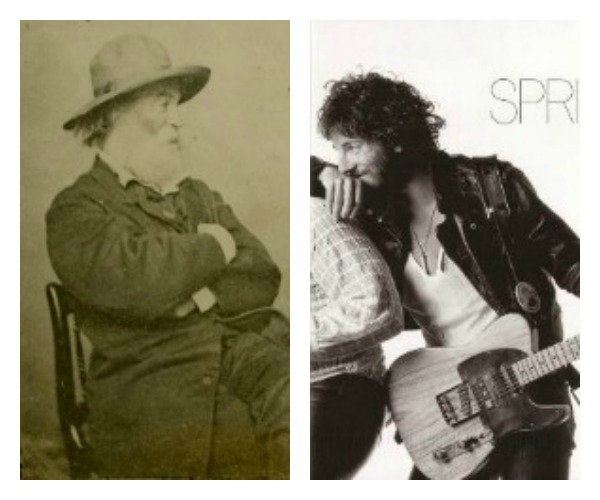
Tramps Like Us: Springsteen and Whitman

You may have heard the news: a working draft of one of the iconic songs in American music, Bruce Springsteen’s “Born to Run,” will be displayed in Perkins Library on May 8-11, and then here in the Rubenstein Library from May 12-June 27.  While at the Rubenstein, Springsteen’s draft, owned by Floyd Bradley, will be in the very good company of one of the largest collections of manuscripts by another favorite son of New Jersey, Walt Whitman, in the Trent Collection of Whitmaniana.

Walt Whitman, 1869, from the Trent Collection of Whitmaniana, box III-6C (Saunders 29); Bruce Springsteen, on the cover of the album Born to Run, 1975.
Walt Whitman, 1869, from the Trent Collection of Whitmaniana, box III-6C (Saunders 29), by M. P. Rice; Bruce Springsteen, on the cover of the album Born to Run, 1975, by Eric Meola.

Both Whitman and Springsteen felt and expressed a deep connection with working-class Americans.  After a transient childhood, Whitman worked as a journeyman printer before becoming the “Good Gray Poet”; Springsteen’s mother famously took out a loan to buy him a guitar when he turned sixteen, and years of honing his musical craft at small venues for low pay preceded the breakthrough of “The Boss.”

The working draft of “Born to Run” includes many passages that were changed or excised from the final lyrics, but the chorus “tramps like us, baby we were born to run” is already in place.

The chorus of "Born to Run" in the working draft. Image courtesy of Sotheby's.
The chorus of “Born to Run” in the working draft. Image courtesy of Sotheby’s.

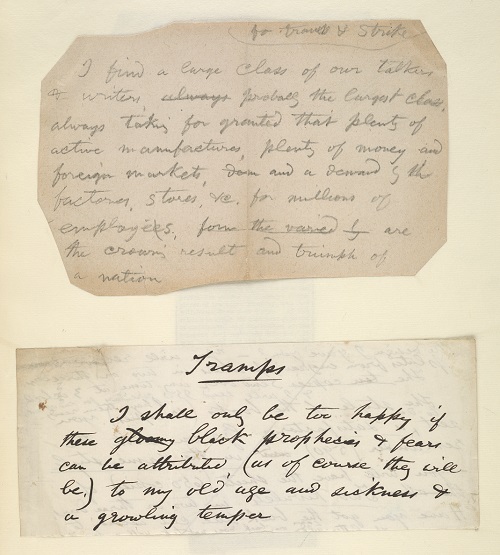
“Tramps,” or homeless itinerants looking for steady work and a place to live, became a particular concern in the United States (and for Whitman) during and after the “long depression” of the 1870s.  Whitman wrote about this phenomenon in many different contexts, perhaps most memorably in a fragment entitled “The Tramp and Strike Questions.”  In a sentence that gets to the core of an element of “Born to Run” and other Springsteen songs, Whitman writes there: “Curious as it may seem, it is in what are call’d the poorest, lowest characters you will sometimes, nay generally, find glints of the most sublime virtues, eligibilities, heroisms.” A volume in the Trent Collection, given by Whitman the title “Excerpts &c Strike & Tramp Question,” contains manuscripts and newspaper stories annotated by Whitman in preparation for a lecture on the topic, which was never delivered.

Two prose fragments from "Excerpts &c Strike & Tramp Question," Trent Collection of Whitmaniana Box II-7B.
Two prose fragments from “Excerpts &c Strike & Tramp Question,” Trent Collection of Whitmaniana Box II-7B.

We’re excited to host the “Born to Run” draft, and please contact us if you’d like to take the chance to see this treasure of American culture alongside items in the Trent Collection of Whitmaniana.

Post contributed by Will Hansen, Assistant Curator of Collections.

Photographers Vincent Cianni & Mariette Pathy Allen, April 23-25th

Cover of Gays in the Military by Vincent CianniThe Archive of Documentary Arts has partnered with Daylight Books, the Sallie Bingham Center for Women’s History and Culture, the Center for Documentary Studies, and SPECTRE Arts to bring documentary photographers Vincent Cianni and Mariette Pathy Allen to Durham for a series of events April 23-25.

  • Wednesday, April 23 at 12:00pm: A Conversation with Vincent Cianni and Mariette Pathy Allen, Center for Documentary Studies, 1317 W. Pettigrew Street, Durham, N.C. Lunch will be provided.
  • Thursday, April 24 at 6:00pm: Artist Talk and Presentation, SPECTRE Arts green space, 1004 Morning Glory Ave., Durham, N.C.
  • Friday, April 25 at 6:00pm: Book Signing and Opening Exhibit, Daylight Project Space, 121 West Margaret Lane, Hillsborough, NC

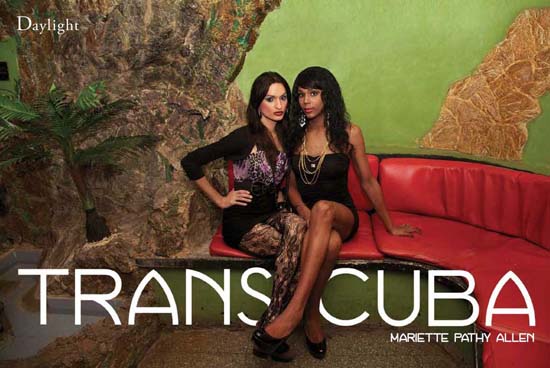
The series will culminate in a book signing and exhibition of work by the artists to celebrate the release of the artists’ monographs TransCuba and Gays in the Military. The book signing and exhibit will take place at the Daylight Project Space on April 25 from 6 to 9pm. Refreshments will be served and the artists will be on hand to sign books and answer questions. More information at www.daylightbooks.org

Cover of TransCuba by Mariette Pathy Allen

About the Artists:

Through compelling photographs and interviews made over three years on road trips across the US, Vincent Cianni (born 1952) has created an important historical record of the struggles of gay and lesbian veterans and service members in the US military. As the Human Rights Commission attests, the US military has a long history of civil rights abuses against homosexuals, with harassment and discrimination frequently resulting in lost careers. In many cases, these men and women—highly skilled, well educated, patriotic, courageous and productive—had attained high rank, received numerous medals and held top-level jobs essential to the military. With essays by Alison Nordstrom, Don Bramer and Alan Steinman shedding light on the cultural, personal and political consequences of the ban on homosexuality, this volume tells the stories of men and women who served in silence and oftentimes were penalized and prohibited from receiving the benefits accorded them for serving in the military.

For more than 30 years, New York based photographer and painter Mariette Pathy Allen has been documenting transgender culture worldwide; in 2004 she won the Lambda Literary Award for her monograph The Gender Frontier. In her new publication, TransCuba, Allen focuses on the transgender community of Cuba, especially its growing visibility and acceptance in a country whose government is transitioning into a more relaxed model of communism under Raúl Castro’s presidency. This publication therefore records a cultural watershed within Cuba. In addition to color photographs and interviews by Allen, the book also includes a contribution from Raúl Castro’s daughter, Mariela Castro, who is the director of the Cuban National Center for Sex Education in Havana. In 2005, Castro proposed a project, which became law three years later, to allow transgender individuals to receive sex reassignment surgery and change their legal gender.

Post contributed by Kirston Johnson, Curator of the Archive of Documentary Arts.


Freedom Means Everybody: A Lecture by Mab Segrest

Date: Thursday, April 27, 2014
Time: 6:00 p.m.
Location: Richard White Auditorium, Duke East Campus
Contact: Kelly Wooten, kelly.wooten@duke.edu
Optional RSVP for this event
segrest event

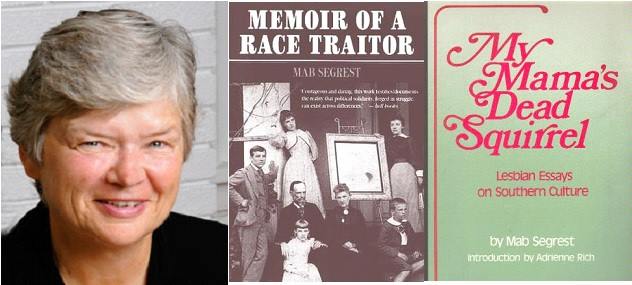
Dr. Mab Segrest, Fuller-Maathai Professor of Gender & Women’s Studies at Connecticut College, received her M.A. and Ph.D. from Duke University, and became active in lesbian-feminist political and cultural work in North Carolina and nationally during the late 1970s and early 1980s. She left the academy in the early 1980s to work full-time in social movements for the next decade. She is a co-founder of North Carolinians Against Racist and Religious Violence, an organization focused on targeting neo-Nazi and Ku Klux Klan activity. Segrest’s 1995 book, Memoir of a Race Traitor, narrates this experience. Segrest’s 2002 book, Born to Belonging: Writings on Spirit and Justice, uses travel memoirs in a search for alternatives to the apartheid of her southern childhood.

She is currently working on a social history of Georgia’s state mental hospital at Milledgeville that grows out of her continuing interest in the interface between the intimate and the historical, specifically what constitutes that redundancy of Southern insanity when viewed through archives of an iconic Southern state hospital. Segrest’s personal papers are held by the Sallie Bingham Center.

This program is the culminating event for the Women’s Studies Senior Seminar, which combines feminist and queer theory with historical research on local activists. Co-sponsored by the Sallie Bingham Center, Durham County Library, and Duke Program in Women’s Studies.

Rubenstein Library Acquires Radio Haiti Archives

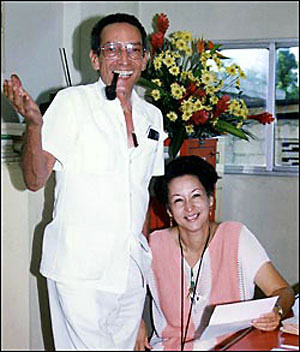
Jean Dominique and Michèle Montas in the Radio Haiti newsroom.
Jean Dominique and Michèle Montas celebrating the anniversary of the station in the Radio Haiti newsroom, 1990. From the Radio Haiti Records.

The Human Rights Archive at Duke University’s Rubenstein Library and the estate of broadcaster Jean Dominique have announced a partnership to preserve the broadcast archives of the journalist’s iconic Radio Haiti station.  From the 1960s to 2002, Radio Haiti was that country’s first independent radio station, promoting democratic freedoms, speaking out against human rights abuses, and celebrating Haitian life and culture. The station’s archive includes approximately 2,500 audio recordings of programs, as well as 28 boxes of paper records. Recordings include daily coverage of events, cultural programs, interviews on public affairs, political analysis, and roundtable discussions on different aspects of Haiti’s recent history.

“The Radio Haiti collection is an incredibly important resource for understanding the recent history of Haiti,” said Laurent Dubois, Marcello Lotti Professor of Romance Studies and History at Duke. “Because the station broadcast news and reportage largely in Creole and extensively covered events both in Port-au-Prince and the rural areas of Haiti, the collection gives us unequalled access to an understanding of one of the most important grassroots democratic movements in recent history: the movement that overthrew the Duvalier dictatorship in 1986.”

The Radio Haiti archives were donated to the Rubenstein Library by Michèle Montas, station co-anchor and widow of Jean Dominique. Dominique had an unquenchable passion for Haiti and its people, and his quest for truth and justice may have led to his assassination in 2000.

According to Montas the archives “capture a time and place in which journalists and broadcast journalism played a major role in redefining a country and reaching a people. Beyond Haiti, they bear witness to the turbulent transition from a dictatorship to a functioning democracy. ”

Montas stressed that the archives matter today because they touch on and track issues that remain of paramount importance in Haitian society. “By saving these archives and making them once more accessible to large audiences, Duke and the Rubenstein Library are playing a crucial role in advancing the dialogue about Haiti and its future.”

On April 3, Montas will be at Duke to discuss the history of Radio Haiti and its archive. Archivists from the Rubenstein Library will also share some of the challenges of preserving such a large audio collection and discuss the importance this archive has for the broader Haitian community and the human rights movement.  Those interested in learning more about preserving Radio Haiti can visit Duke Library’s Youtube channel.  The event is free and open to the public and will be held at 12 p.m. in the Forum for Scholars and Publics, Old Chemistry Building Room 011, on Duke’s West Campus. Lunch will be provided.

The Radio Haiti archives join other recent acquisitions by the Rubenstein Library documenting the history of Haiti, including the records of the National Coalition for Haitian Rights, the Mark Danner Papers, and a scribal copy of the Haitian Declaration of Independence dating from 1804.

The Radio Haiti archives will open for research after conservation review and archival processing are complete. For more information, contact Patrick Stawski, Human Rights Archivist.

Trent History of Medicine Lecture Series Presents Dr. Edward C. Halperin

Date: Monday, March 31, 2014
Time: 5:30 p.m.
Location: Room 102, Duke Medical Center Library
Contact: Rachel Ingold, rachel.ingold@duke.edu or 919-684-8549

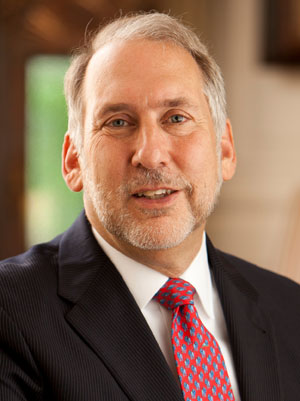
Dr. Edward C. HalperinPlease join the History of Medicine Collections for our spring Trent History of Medicine Lecture Series event. We are pleased Dr. Edward C. Halperin, M.D., M.A., will be presenting, “A Defense of the Humanities in Medical Education.” In his lecture, Dr. Halperin will distinguish between medical humanism and the medical humanities, discuss the role of the medical humanities in medical education with particular emphasis on the role of medical history, and provide some specific examples of the value of the humanities in the education of physicians.

Dr. Halperin was on the faculty at Duke from 1983 to 2006. He was the LR Prosnitz Professor of Radiation Oncology and the RJ Reynolds Professor of Medical Education. From 2006 to 2012 Dr. Halperin was dean of the School of Medicine, Ford Foundation Professor of Medical Education, and professor of radiation oncology, pediatrics, and history at the University of Louisville and university vice provost.

Dr. Halperin’s research has focused on pediatric cancer and the history of racial, religious, and gender discrimination in higher education. He is the co-author/editor of the first five editions of the textbook Pediatric Radiation Oncology and of the fifth and sixth editions of Principles and Practice of Radiation Oncology. He has published more than 200 articles in the peer-reviewed scientific, historical, education, and ethics literature.

Dr. Halperin is currently Chancellor for Health Affairs and Chief Executive Officer at New York Medical College and Professor of Radiation Oncology, Pediatrics, and History as well as Provost for Biomedical Affairs at Touro College.