All posts by Meghan Lyon

Happy Valentine’s Day, My Rapturous Codfish!

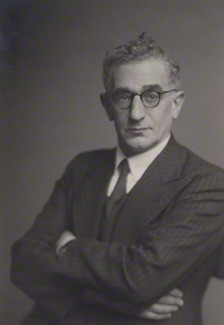
Image of Leon Simon, taken from London's National Portrait Gallery.
Image of Leon Simon, taken from London’s National Portrait Gallery.

As my student assistant, Sophia Durand, began the physical processing of the 131 letters in the Leon Simon collection (1915-1916, 1918), she noticed something intriguing. Leon Simon addressed each letter to his future wife, Esther Ellen Umanski, differently. Until they made official plans to marry, she was “My Dear Nellie.” But once the date was set, Simon became creative and effusive, his word choices sometimes questionable as endearments.

Romantics everywhere tend to be sugary in their pet phrases. Simon was no different, perhaps just more over-the-top. He addressed his letters to: My essence of honeycomb, My exquisite Peach Melba, My lump of sweetness, My peachiest apricot, My succulent meringue, My belovedest mimosa, My jujubious confection, My sweet Sugar plum(p).

As you can already tell, Simon was quite fond of food and cooking. Other highlights in the letters include My stewed apricot, My eversweet parsnip, My most succulent kipper, My pickled herring (You know how I love them!), My pickledest onion (=on’y ‘n  =only one), My own dumpling, My coo (k) ing dove, My rapturous codfish, My toasted crumpet, and–my personal favorite–My incandescent soup-tureen.
Simon
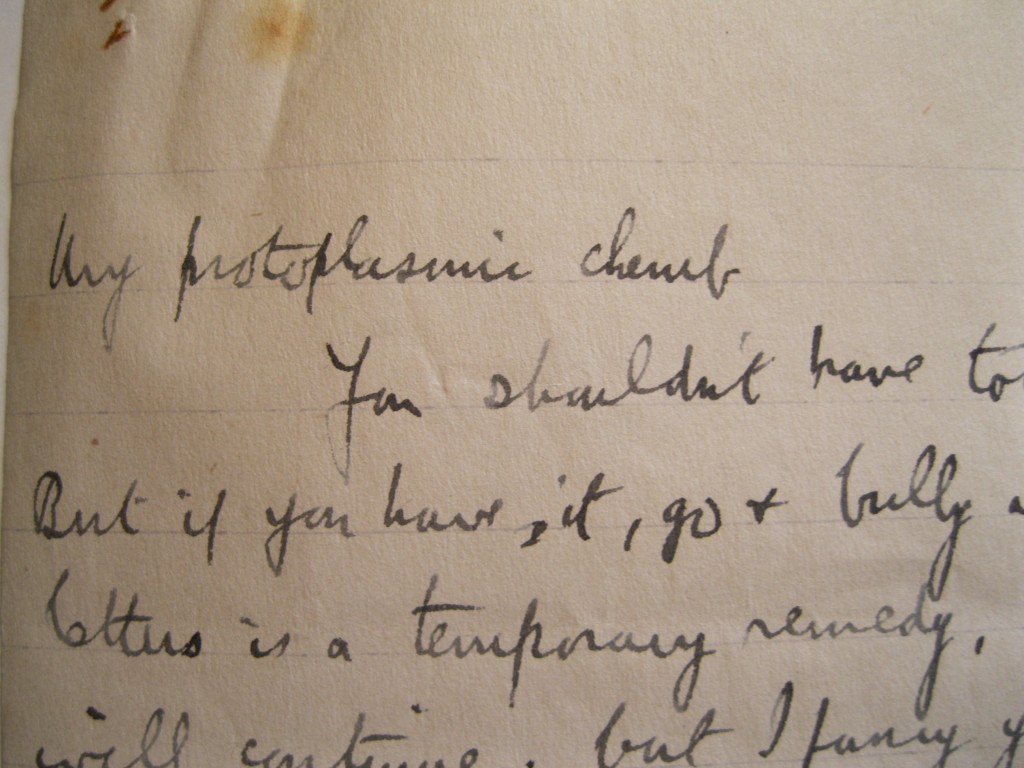
Simon wrote Nellie at least once a week. On October 12, 1915, he called her “My protoplasmic cherub.”

Occasionally, Simon sought to be reassuring about his odd turns of phrase. On October 20, 1915, he wrote to Nellie, who was studying German, “My most exquisite Stumpfenbach, (Don’t worry about the meaning of this; it is a term of endearment invented for the occasion & means nothing at all except that all recognized terms of endearment are hopelessly inadequate)…” A Duke German professor says that he was unwittingly referring to a city in Bavaria.

So, if on this Valentine’s Day your terms of affection seem stale, why not borrow one coined by Simon: My adorable whelk, My kitchy-kooish boo-woo, My jokaceous blue bottle, My bilingual Scaramouche, My unique joy, My tender flamingo, My early paradise, My copious ink-pot, My imperative necessity, My darlingpetangelanddelightallrolledintoone. Perhaps you and your loved one will then share in one of his closings, a “Quintessence of hugs & kisses ad lib.”

Sheesh.

Post contributed by Alice Poffinberger, Original Cataloger.
Jefferson Davis’s Hair Revisited

One of my favorite Rubenstein collections is the C.C. Clay Papers, which document the life and times of Clement Claiborne Clay and his family. The Clays lived in Alabama in the nineteenth century, and sided with the Confederacy during the Civil War. In the war’s early years, C.C. Clay served as a Confederate States senator. His opposition to raising soldiers’ pay (it would have been too expensive!) led to his being voted out of office in 1863. Clay and Confederate States President Jefferson Davis were good friends, however — Clay was godfather to Davis’s son Joseph — and rather than send Clay back to his plantation, Davis sent him on a secret mission to Canada to spy, bribe, and generally foment rebellion. (Clay’s mission did not end up helping the C.S.A.)

Clay was in Canada from mid-1864 through early 1865. He returned to the South just in time for the Confederacy to surrender. President Lincoln was assassinated shortly after his return, and both Davis and Clay were arrested by the Federal government on suspicions of treason relating to Lincoln’s assassination. (Clay’s time in Canada looked extremely suspicious.) The men were imprisoned in Fortress Monroe, Virginia. Clay was held for about a year without being charged until finally his wife, Virginia Clay, convinced President Andrew Johnson to pardon him. (She was a cool lady. You can read her 1905 memoir here.) Davis was imprisoned until 1867 before finally being released on bail.

jefferson_davis_hair-blog
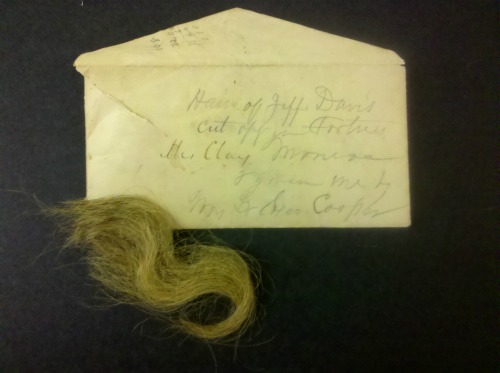
This is only a selected portion of the Davis hairball held in the Clay Papers.

What does all this backstory have to do with Jefferson Davis’s hair? Well, there are giant clumps of it in the Clay Papers, and for years we did not know why. The mystery behind the hair did not stop us from displaying it in a Perkins Library exhibit three years ago. The only clue was from an envelope, where Virginia Clay had written, “Hair of Jefferson Davis cut off in Fortress Monroe, given me by Mrs. Dr. Elva Cooper.”

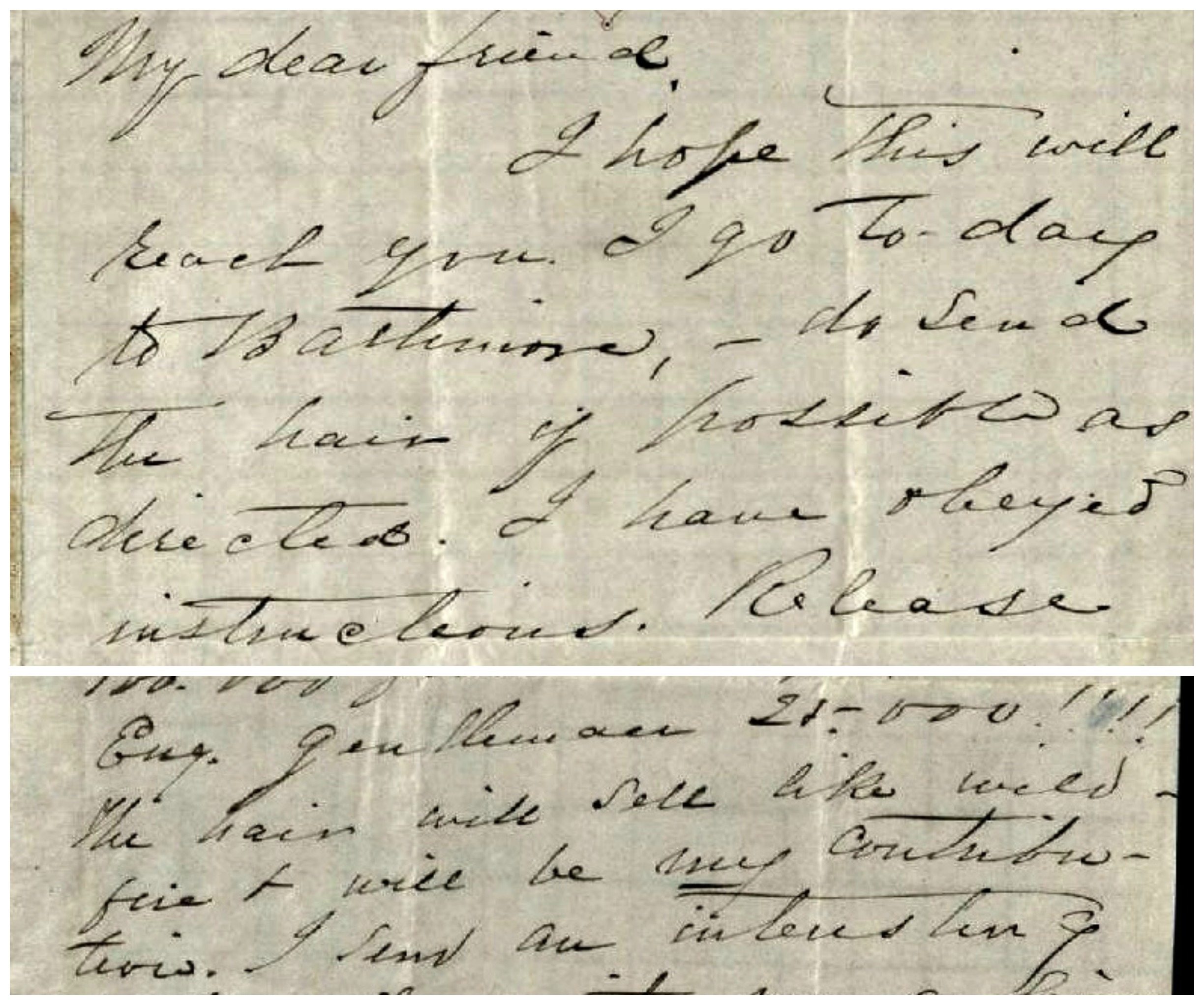
Recently, in reading through the Clay Papers correspondence, I came across the letter that explains it all. Virginia Clay wrote to Elva Cooper in April 1866, days before receiving Johnson’s pardon for C.C. Clay, asking her to “do send the hair if possible as directed.” Later on in the letter, Virginia recounted the number of donations received toward Jefferson Davis’s bail, adding that “the hair will sell like wildfire + will be my contribution.”

davisCollageIt appears that the plan was for the clumps of hair to be sold to Davis supporters as souvenirs, raising money for his aid. This explanation makes a lot more sense than the various reasons we had thought up over the years. Hair tokens are not rare in manuscript collections, but the fact that the Clays had so much of it struck us as a little odd. Fortunately, the story doesn’t end there. An annotation from Ada Sterling, the editor for Virginia’s memoir, offers this extra gem:

davis3Even Davis’s contemporaries were not interested in purchasing locks of his hair! Sterling explained that as she helped write the memoir in the early 1900s, the hair was still lying in “‘mussy’ bundles, among Mrs. C’s things.”And so it now remains forever in the Rubenstein. Mystery solved!

Post contributed by Meghan Lyon, Technical Services Archivist.

Heschel Highlights, Part 5

The Wow! Factor

Welcome to the fifth post in a series documenting the processing of the Abraham Joshua Heschel Papers.

It’s no secret I have an affinity for oversize materials (see here).  And while the Abraham Joshua Heschel Collection only contains a modest number of oversize materials, those that are in the collection are proving to be quite extraordinary. Here are just a few of my favorites:

MaimonidesDust jacket from first edition of Maimonides eine Biographie, 1935.

Completed in only 7 months, the book was Heschel’s first major work. He was 28 years old.

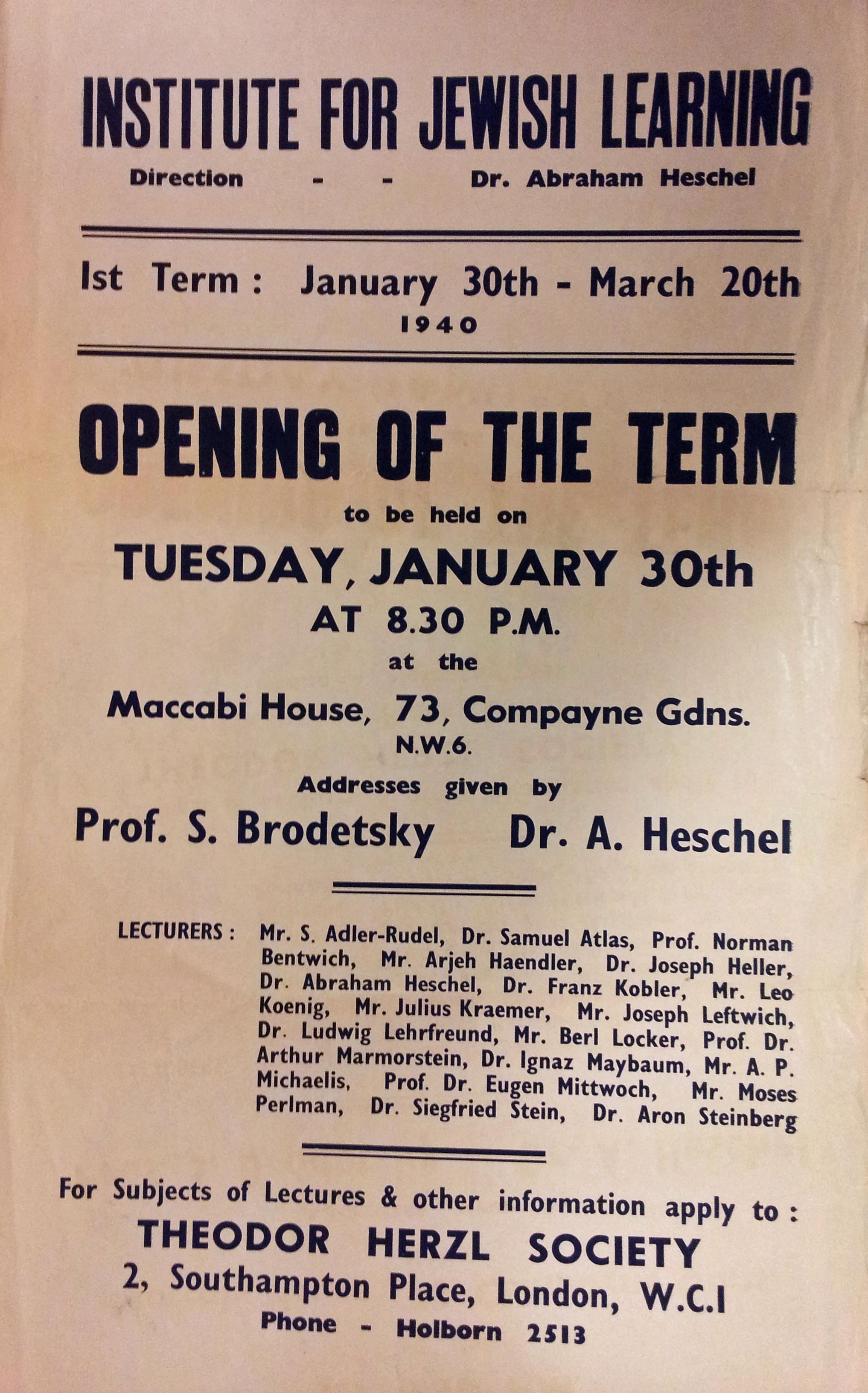
InstitutePoster, Opening of the Term at the Institute for Jewish Learning, London, 1940.

In 1939 Heschel received official confirmation from Julian Morgenstern, president of Hebrew Union College in Cincinnati, OH, of a position of a research fellow in Bible and Jewish Philosophy. Heschel left Warsaw for London, England to obtain an American visa for emigration to the United States. While in London, he founded the Institute for Jewish Learning to “introduce all ages and classes of Jew to the history and tradition of their forbears.”

Antwort“Antwort an Einstein” in Aufbau, 1940

Heschel’s article “Answer to Einstein” in the newspaper Aufbau (Reconstruction) which was a rebuttal to Albert Einstein’s paper “Science and Religion.” As a recent immigrant, this was an audacious and surprising move for Heschel.

Post contributed by Mary Samouelian, Heschel Processing Archivist in Rubenstein Technical Services.

“No car, no money, no food…just me.”

In the mid 1980s, Duke history student Joseph Sinsheimer interviewed veterans of the fight for voting rights in early-1960s Mississippi. The generational distance between the interviews and the subject worked in Sinsheimer’s favor: his narrators had gained the perspective of years but many still had their youth, with memory intact, and were ready to talk at length of their experiences. The collection guide to these remarkable interviews is a roll call of Civil Rights Movement leadership in the deep South:  C.C. Bryant, Robert Moses, Lawrence Guyot, Willie Peacock, Hollis Watkins and others detail Mississippi’s struggle through stories of their involvement.

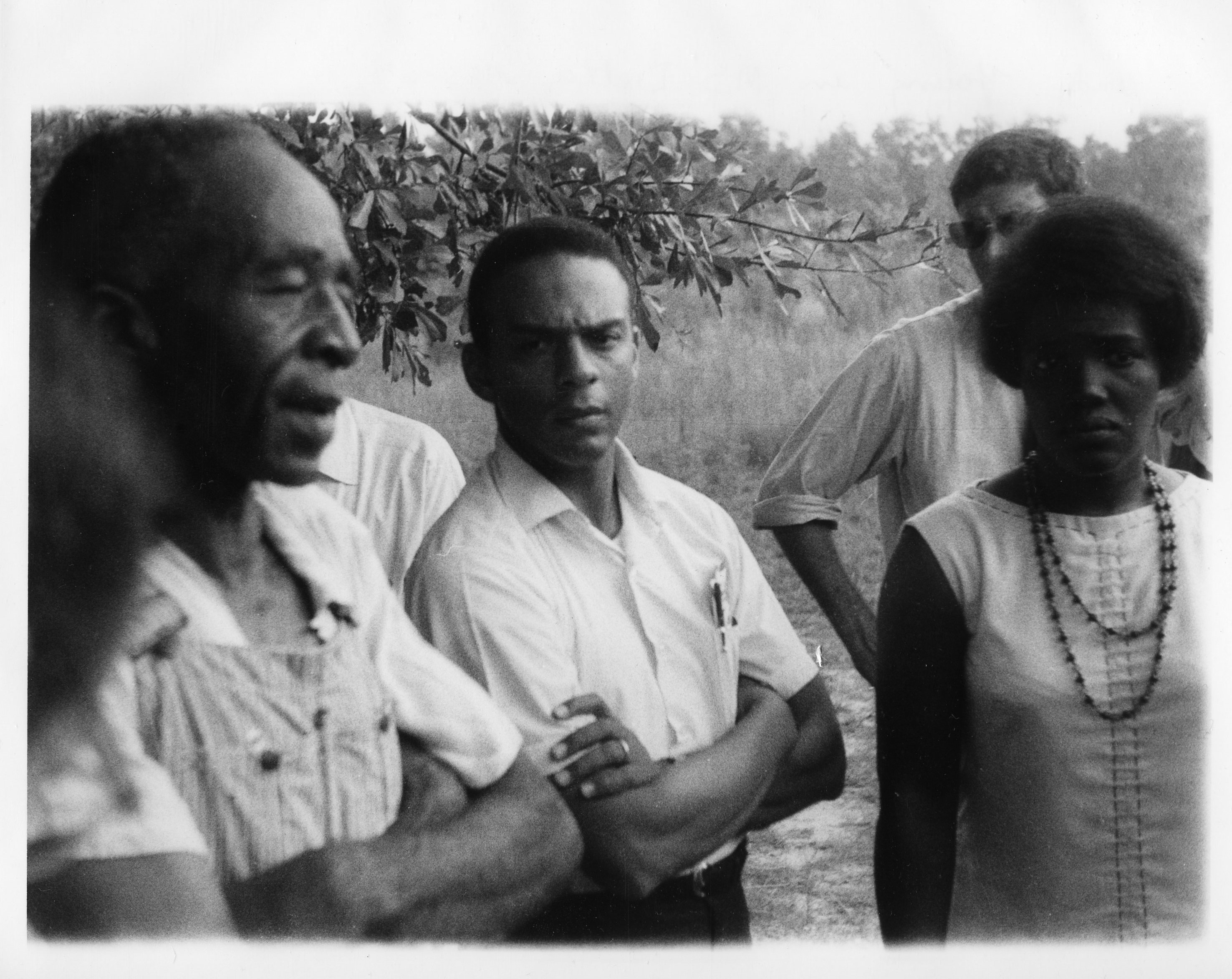
Andrew Young in Mississippi, 1963
Andrew Young during Mississippi’s Freedom Summer, 1963. From the Joseph Sinsheimer Papers.

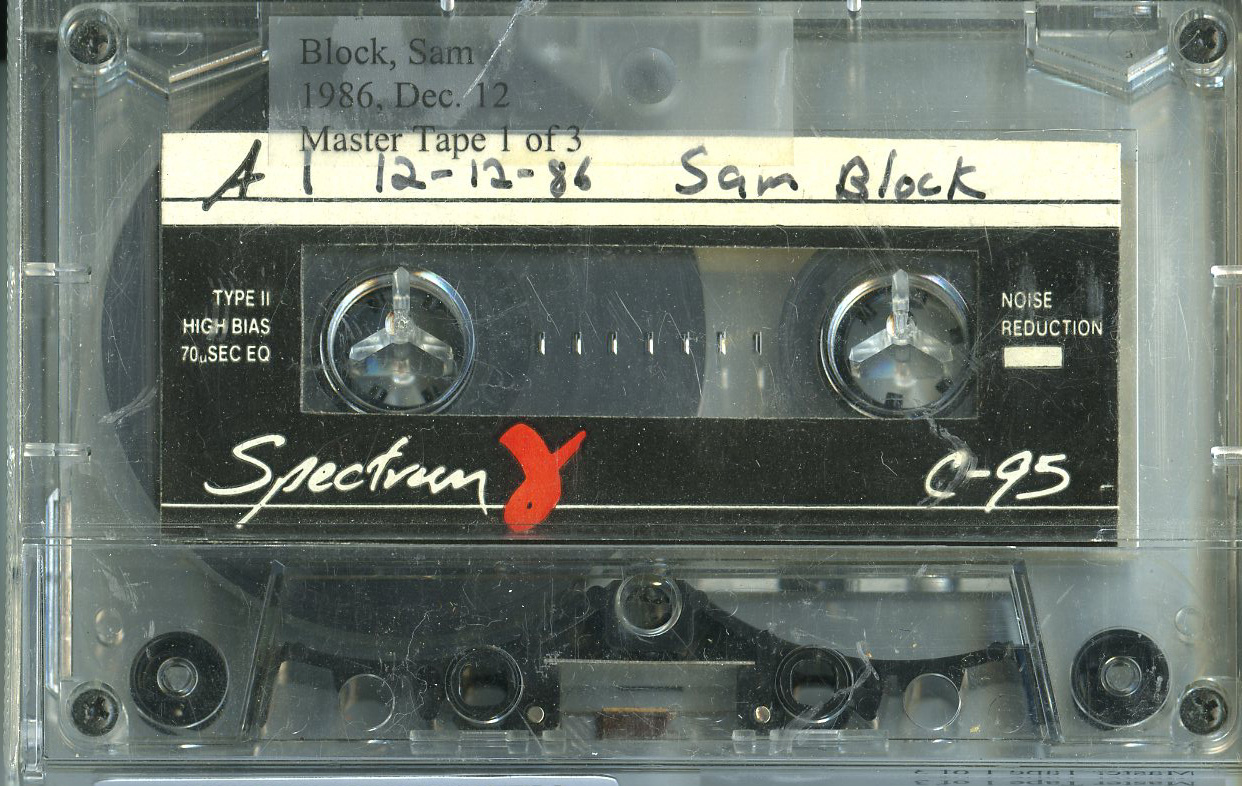
As we digitize the audiocassettes that Sinsheimer used to record the interviews, one story immediately stands out. Activist Sam Block’s retelling of how he came to be involved in the movement is a coming-of-age story informed by the death of Emmett Till and galvanized by a confrontation with a white customer at his uncle’s service station. His subsequent recruitment into the Movement via the Student Nonviolent Coordinating Committee, and his training at Highlander Folk School, were prologue to the courage Block demonstrated when he asked Robert Moses to drop him in Greenwood, Mississippi, with “no car, no money, no food…just me.”

Listen here: Sam Block interviewed by Joseph Sinsheimer

BlockTape_Sinsheimer

Post contributed by Craig Breaden, Audiovisual Archivist in the Technical Services Dept.

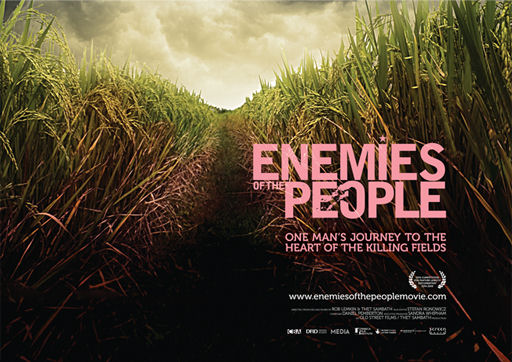
Rights!Camera!Action! presents “Enemies of the People”

Join R!C!A! for a screening of Enemies of the People, 2009 (TRT: 94 minutes)

When: Thursday, January 23, 7:00pm
Location: FHI Garage, Bay 4, Smith Warehouse
Free and open to the public.

enemiesofthepeopleCambodian investigative reporter Thet Sambath exposes the reasons for the 1975-1979 Khmer Rouge genocide in which almost two million people were executed. Thet conducted interviews throughout the countryside with men who actually carried out the killings. Courageously, they tell the truth and show where the bodies are buried. But many still do not understand why they were ordered to kill. A crucial piece in Cambodia’s national process of reconciliation, these testimonies trace the transformation of abstract political principles into mass murder. In English and Cambodian, with English subtitles.

Directors: Rob Lemkin and Thet Sambath

Awards: Anne Dellinger Grand Jury Award 2010 and Charles E. Guggenheim Emerging Filmmaker Award 2010

Directions & parking information.

Contact: Patrick Stawski, Duke University Libraries: 919-660-5823 or patrick.stawski [at] duke.edu

JWT Newsletters Are Now Available Online!

We are pleased to announce one of Rubenstein’s newest digital collections: over 1,600 newsletters of the J. Walter Thompson Co. advertising agency from 1916 to 1986. These internally distributed newsletters touch on myriad topics of interest to the company, such as account and client news; general and client-specific marketing surveys; developments in print, radio, and television advertising and marketing research; as well as personnel news such as new hires, transfers, promotions, and brief biographical sketches.

The agency’s newsletters are among the most requested and circulated collections in the J. Walter Thompson Co. Archives. Thanks to the work of the Duke University Libraries’ Digital Projects and Production Services Department and Conservation Department, this tremendously rich resource is now available online. You can browse by title, year, and date, and can also search by keyword. Some select issues include:

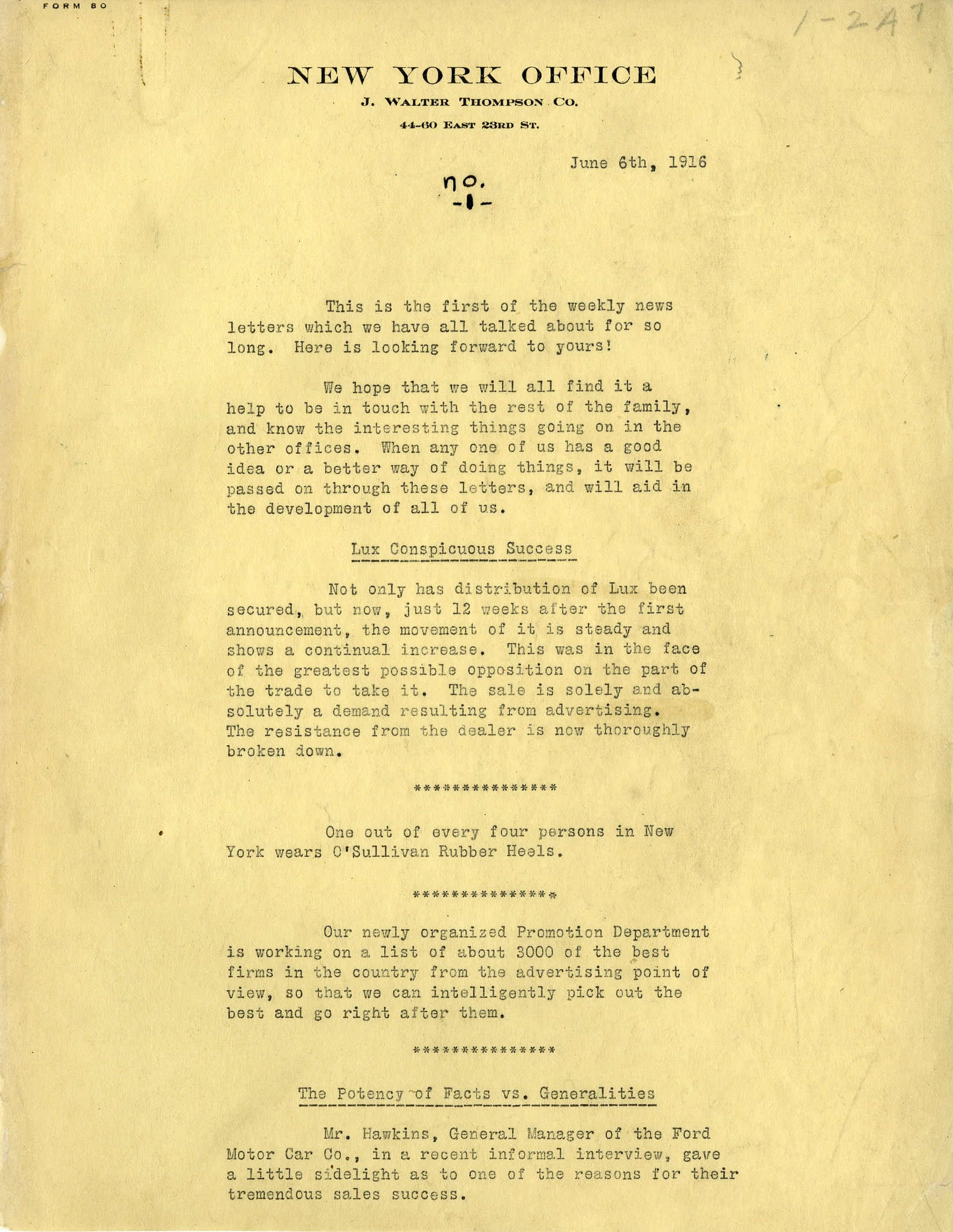
Issue No. 1, June 6, 1916

The first J. Walter Thompson Co. newsletter contains client and product news. It also includes an article, “Selling to the Multitude,” which discusses the professionalization of the advertising industry, its superiority over traditional modes of salesmanship, and the hope that one day advertising will be a budget line in all industries, right alongside “material, labor, overhead, and personal selling.”

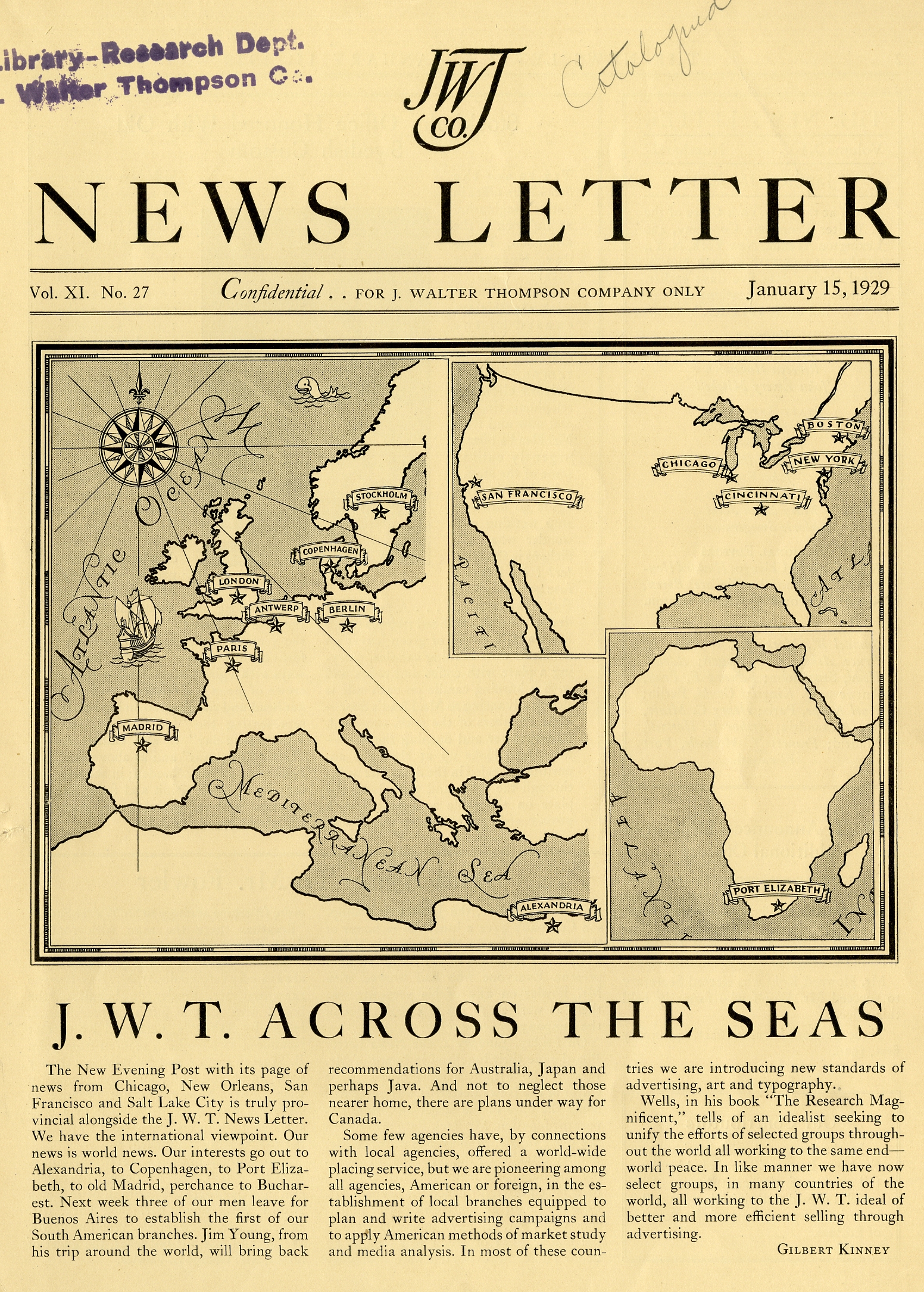
“JWT Across the Seas,”  January 15, 1929
“JWT Across the Seas,” January 15, 1929

This particular newsletter is focused on news briefs from various overseas offices including London, Stockholm, Copenhagen, Antwerp, Paris, Berlin, and Madrid.

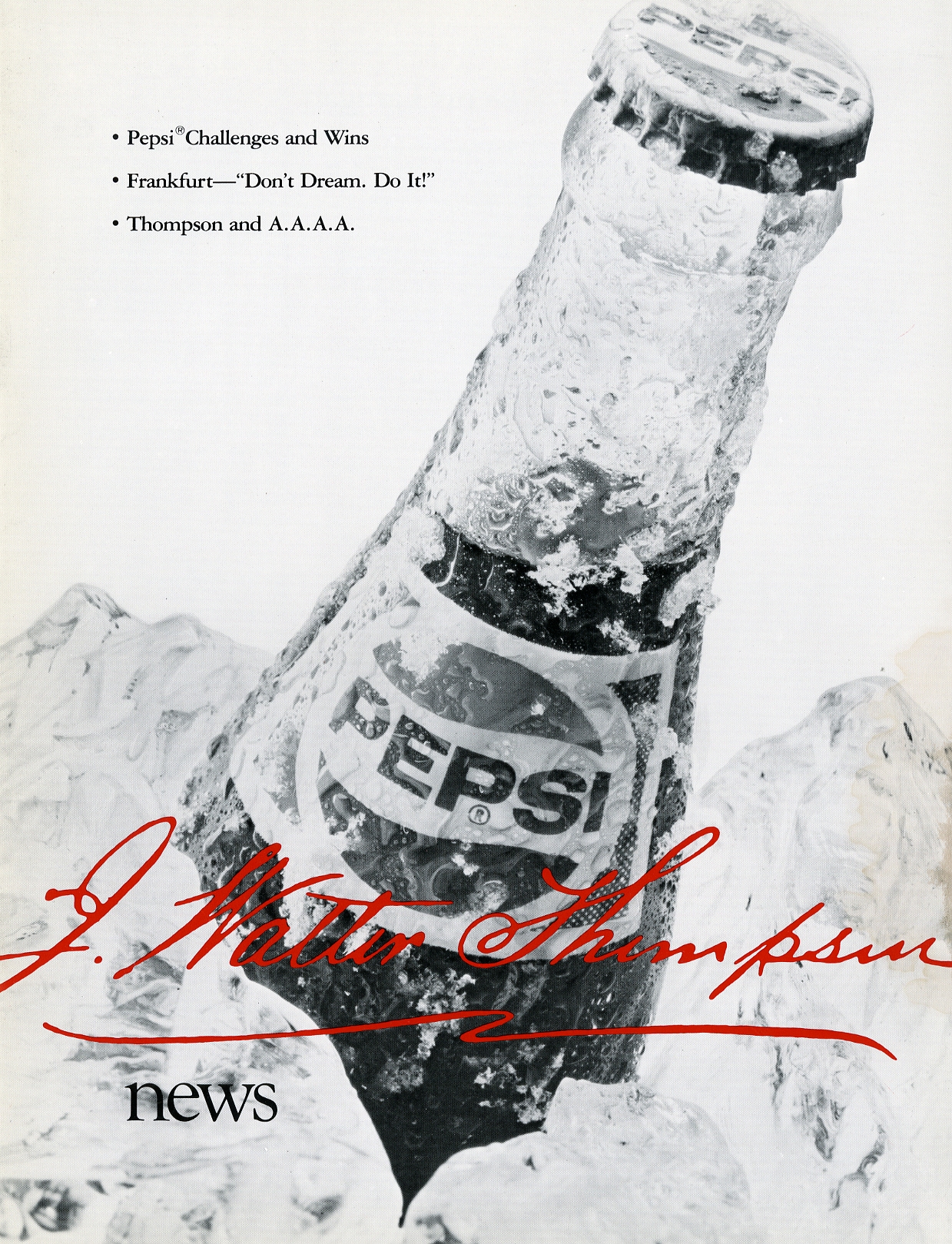
“Pepsi Challenges and Wins,” Fall 1982.

The fall 1982 newsletter highlights the success of the “Challenge” campaign in foreign markets.  JWT launched the international campaign in Canada in 1976; it is considered the first notable worldwide application of an aggressive comparative campaign.

Check out the rest of the collection online and be sure to tune in to the Digital Collections blog for more information about this new collection.

Post contributed by Joshua Larkin Rowley, Hartman Center Reference Archivist.

Hot Off the Democratic Party Press

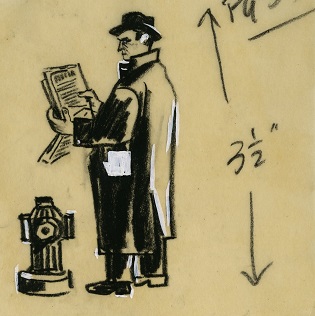
DemoDigestManandHydrantThe typewriters and linotype machines were furiously clacking away… Cigarette smoke turned the air blue…  The year was 1960, Nixon and Kennedy were running for President, and the cartoonists, layout staff, copy editors, and office runners of the Democratic Digest were working hard to beat a deadline and push out the next issue of irreverent, energetic political opinion, news, and satire.

You can examine the content being prepared for the 1960 campaign issue as well as many other issues from 1955-1961 in a Rubenstein Library collection, the Democratic Digest Records. The Washington, D.C. publication, headed by Sam Brightman, was the official monthly of the Democratic Party, and the 28 boxes of its records, acquired by the library in 1961, are filled with drafts of editorial columns, political cartoons and other original artwork, and reprinted articles and opinion pieces from pro-Democratic U.S. newspapers across the country.

DemoDigestNixon

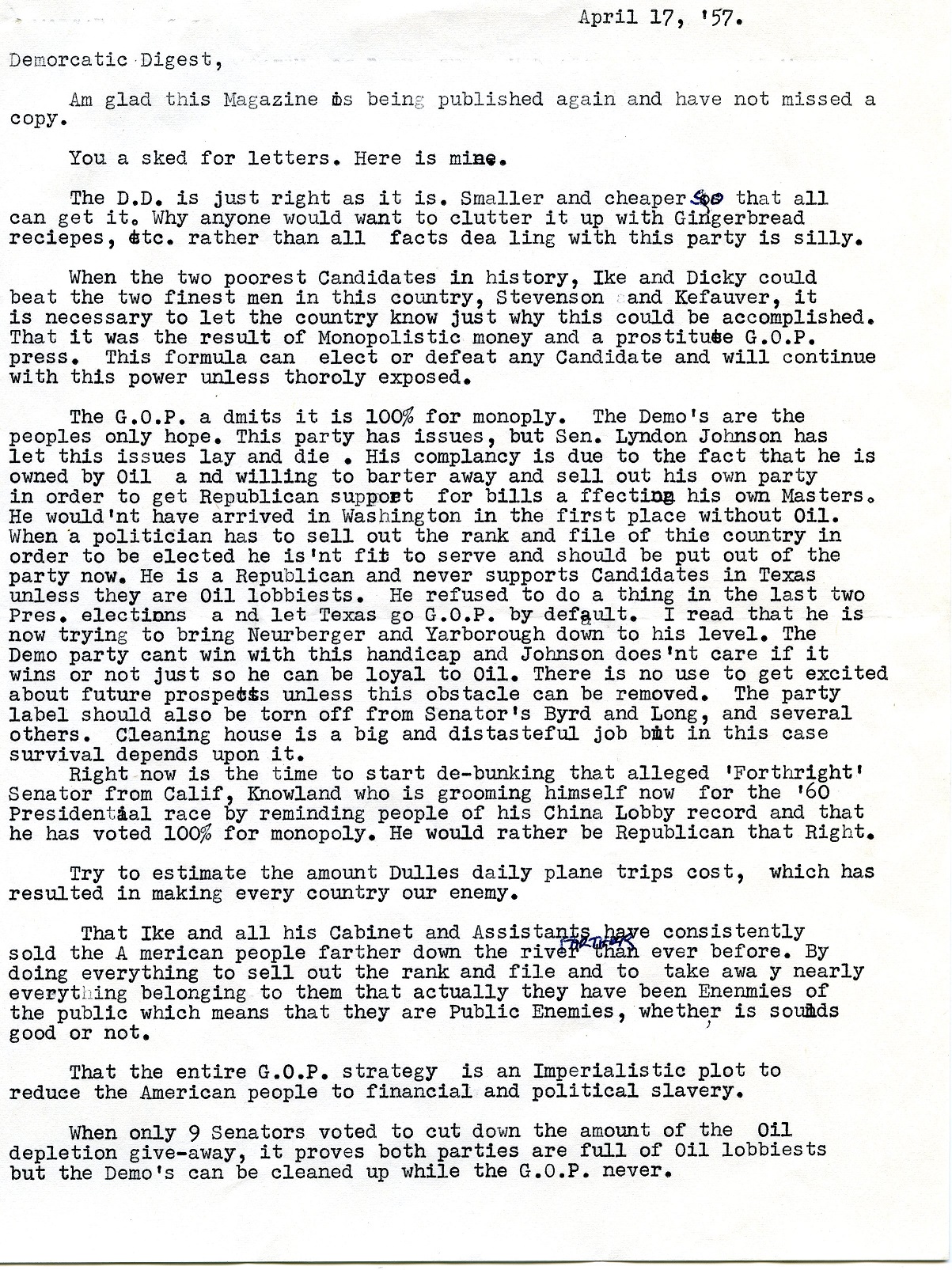
DemoDigestGraveyardThe correspondence files house provocative and eloquent letters sent in from readers, critics, and Democratic Senators and Governors, addressing the many turbulent political issues of the day: McCarthyism, scandals and corruption, civil rights, labor issues, farm subsidies, the U.S. economy, nuclear weapons, and of course, elections.  You’ll hear voices from ordinary citizens facing hard times: “Now that we have the D.D. [Democratic Digest],” writes one reader from Willifor, Arkansas in 1957, “I just don’t see how we could or ever did do without it. My work keeps me on the move and depend on getting it on the new-stands and believe under this new plan it will be easire [sic] done. While I have a wife and 7 children and not year round work, I will plan to get a Sub [subscription] or two for someone that will do something about it. They may do a good deed too.”

DemoDigest-letter1The materials in this collection cover a time of intense change and fragmentation in American society. Whether it’s a letter from a labor leader, cartoons featuring donkeys and elephants, or articles about big business being cozy with the government, the Democratic Digest files tell a fascinating tale of American politics and society.

DemoDigestcoverPost contributed by Paula Jeannet Mangiafico, Visual Materials Processing Archivist.

Heschel Highlights, Part 4

Welcome to the fourth post in a series documenting the processing of the Abraham Joshua Heschel Papers.

In 1939, Julian Morgenstern helped Abraham Joshua Heschel travel from Warsaw to London just six weeks before Germany invaded Poland. In 1940, upon his arrival in the United States, Heschel began teaching at Hebrew Union College (HUC) where Julian Morgenstern was President. HUC was the main seminary for Reform Judaism in the United States and Heschel was the Associate Professor of Jewish Philosophy and Rabbinics there for five years. Heschel resigned from the HUC faculty on May 18, 1945 over ideological differences. As we process the Abraham Joshua Heschel papers, we learn more about the complex relationship between Heschel, HUC, and the leaders of Reform Judaism. Through letters, essays, handwritten notes, and his books, Heschel expressed concerns about the role of God, spirituality and adherence to Jewish law among Reform Jews. At a few points in Heschel’s life, these concerns bubbled up and he took action as part of his larger effort to infuse American Judaism with spirituality.

Photographs and documents from the Heschel Papers.

In 1945, Heschel’s theological divergence from HUC became a serious issue for him and he resigned his position. In a handwritten draft of his resignation letter to Morgenstern Heschel wrote “from the beginning of my affiliation with the college I fully realized that the HUC stands for a distinctive philosophy of Judaism which it tries to realize in practice and with which my own interpretation of Judaism is not in full accord.” Heschel’s resignation was accepted with sadness and respect on the part of Julian Morgenstern. In a letter dated May 19, 1945, Morgenstern wrote that he and the HUC Board of Governors wished to express their feeling that he was doing the “right and honorable thing.” A number of letters related to Heschel’s resignation echo this sentiment. Heschel’s students, colleagues and friends approved of Heschel’s decision and wished him well. Despite his issues with the philosophy of HUC, Heschel expressed an interest in sustaining his friendship with Morgenstern in his resignation letter: “I earnestly hope and wish, however, that the cordiality and warmth of our friendship will not be impaired by my leaving this institution.” It is clear from the amount of correspondence from Morgenstern that their friendship continued until Heschel’s death. From the correspondence surrounding Heschel’s resignation from HUC (and subsequent acceptance of a position as Associate Professor of Jewish Ethics and Mysticism at the Jewish Theological Seminary) it seems that Heschel continued to be on good terms with many of the acquaintances and friends that he made during his time at HUC. However, his ideological differences remained.

In 1953, Heschel caused a stir among his Reform colleagues when he gave an address to the Reform Rabbinic Organization, the Central Conference of American Rabbis (CCAR), entitled “Towards an Understanding of Halacha.” Heschel appears to have denounced the CCAR for failing to hold to the doctrine of Halacha (Jewish law) in this address. From the correspondence we have surrounding the address and its subsequent publication by the CCAR, it is clear that Heschel earned himself both admirers and detractors as a result. However, even the harshest letters reveal a great deal of respect for Heschel. A 1954 letter that begins with the exclamation “I am profoundly shocked by your persistent misinterpretation of Reform’s position on practice” concludes with the author, a reform rabbi, noting that Heschel could be helpful to the Reform movement as they move forward. Another letter from a Reform rabbi seems wary of Heschel’s denunciation of the CCAR but the author also wrote that “all your papers have a few extra calories of spiritual warmth which lift the heart.” And yet another rabbi’s letter reveals the power of a meeting with Heschel to assuage anger: “But of my prior disturbance, I can say ‘gam zu l’tovah’ [this is also for good] for it provided the occasion for a most stimulating and edifying chat with you.” Heschel remained in constant communication with Reform Rabbis and the leaders of the Reform movement throughout his life and his correspondence reveals that this exchange was beneficial to Heschel, to many Reform rabbis and perhaps even to Reform Judaism.

Post contributed by Adrienne Krone, Heschel Project Assistant in Rubenstein Technical Services.


The African Americans: Rubenstein Recap #4

Episode 4: Making a Way Out of No Way (1897 – 1940)

Last Tuesday’s episode, “Making a Way Out of No Way (1897 -1940),” began at the dawn of the Jim Crow era. Having already been forcibly removed from voting rolls, black southerners lived under the ever-present threats of violence, limited opportunities, and daily injustices of white supremacy.

The Behind the Veil project captured the experiences of hundreds of African Americans in the South living under Jim Crow. Listen to some of their stories here.

Many took a chance, abandoning the South in hopes of something better. By the end of the First World War, a massive influx of African Americans had transformed cities across the North and West. The freedom that they found in urban centers, like Harlem, inspired an explosion of black artistic creativity. The vibrant music, writing, films, and dancing of the Harlem Renaissance helped defy the rampant stereotypes of African Americans.

AAMR, 4, AfAmsinFilm001
African Americans in Film, Box 3, Folder: LoveBug, 1919.

This movie poster for the 1921, The Green Eyed Monster, promotes the film’s all-black cast, assuring readers that there is nothing of “the usual mimicry of the Negro” in the show.

But cultural richness did not end the second-class citizenship that limited all black Americans. During the Jim Crow era, black insurance agencies, grocery stores, doctors, educational institutions, and clubs and organizations multiplied, as black Americans turned inward, utilizing the resources they had.

AAMR, 4, NCMutual003
North Carolina Mutual Archives, Box 78, Folder: The Negro’s Adventure in the Field of Life Insurance, by W.J. Kennedy, Jr., 1934.

The North Carolina Mutual Life Insurance Company opened its doors in Durham in 1899. It grew into the largest black-run financial institution in the country and helped support the city’s sizable black middle class. This 1934 booklet, “The Negro’s Adventure in Life Insurance” explains how life insurance policies benefited African Americans.

From Booker T. Washington’s plans for economic development to W.E.B. DuBois’ ideas of racial uplift, black Americans continually sought new and sometimes conflicting strategies to secure full citizenship in the years before World War II.

AAMR, 4, BookerWashington001
Booker T. Washington Papers.

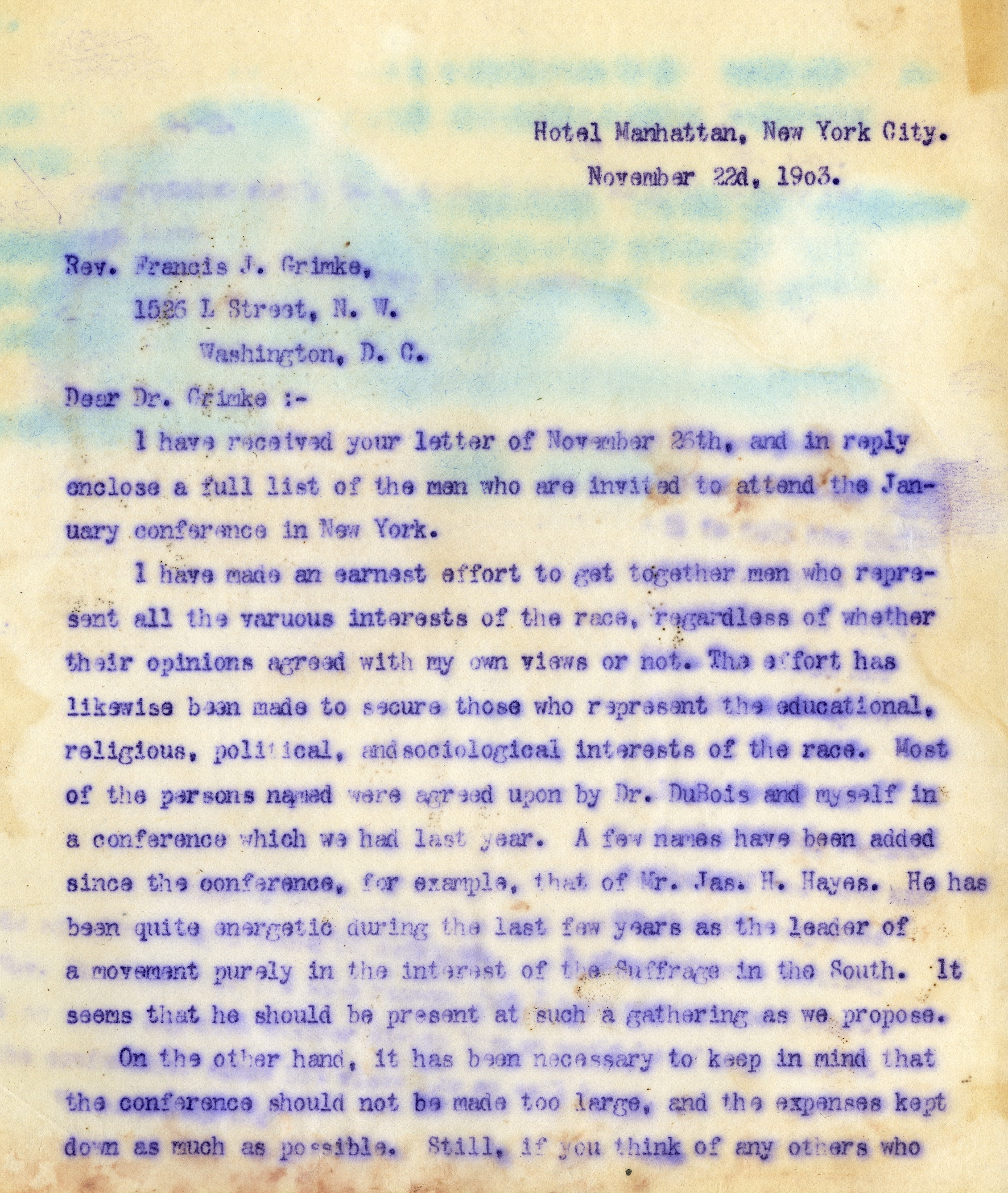
In 1904, Booker T. Washington, with assistance from W.E.B. DuBois, gathered leading black men in New York City to discuss the dire conditions facing African Americans. Washington explains his idea for the conference and the importance of including a variety of opinions in this 1903 letter to activist and Presbyterian minister, Francis Grimke. 

Post contributed by Karlyn Forner, John Hope Franklin Research Center Graduate Intern.

Playing Around

For several months now, I have been working my way through several thousand acetate negatives transferred to the University Archives from the Sports Information Office.

Dinkey and Jap reenact William Tell.

Several weeks ago, I wrote about finding negatives of women students playing baseball, which was an unexpected, yet welcomed, find. Today I came across another unexpected image, seen above. Described as “football miscellany,” it features football players, Leonard “Dinkey” Darnell and Jasper “Jap” Davis, in an iconic archery pose, dated July 1939. I wish I knew the story behind this image. Was it from a physical education class on archery? The Women’s Athletic Association had an archery season. Maybe the men joined them one afternoon for a bit of fun? I hope you enjoy the image as much as I do.

Post contributed by Kim Sims, Technical Services Archivist for University Archives.