Date: Tuesday, February 7, 2012 Time: 4:00 PM Location: Biddle Rare Book Room Contact Information: Kelly Wooten, 919-660-5967 or kelly.wooten(at)duke.edu
Hoffman is a pioneer in developing and providing women’s health services; an award-winning writer; and a fearless advocate for women who has been in the forefront of cutting edge issues for over 40 years.
We note with sadness the passing of Mary Duke Biddle Trent Semans. Mrs. Semans was the great-granddaughter of Washington Duke, and the granddaughter of Benjamin Duke. She came to Duke University as a 15 year-old freshman in 1935, and was an alumna of the class of 1939 of the Woman’s College. She remained a tireless advocate for Duke University throughout her life, serving as a longtime trustee and supporter of numerous projects on campus. These include the Mary Duke Biddle Rare Book Room, named for Mrs. Semans’ mother.
In 1938, Mrs. Semans married Josiah Charles Trent, a Duke alumnus and later the first Division Chief of Thoracic Surgery. The couple collected rare books related to the history of medicine, and Walt Whitman materials. Dr. Trent died of lymphoma in 1948. In 1953, Dr. James Semans and Mrs. Semans were married. They were known on campus, in Durham, and throughout North Carolina as supporters of the arts, higher education, civic projects, and other charitable endeavors. Mrs. Semans was a longtime trustee of the Mary Duke Biddle Foundation (named for her mother), which has supported projects in the library, among many other grant recipients.
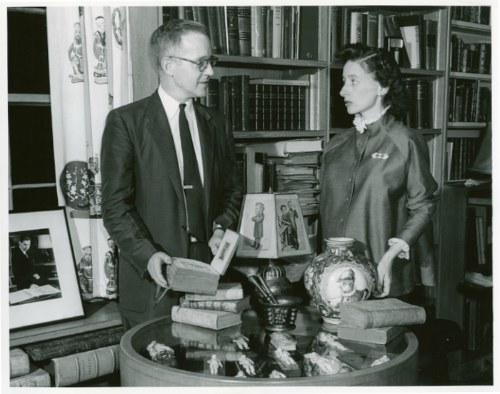
Mary Duke Biddle Trent Semans with Curator of Rare Books Thomas M. Simkins. The materials pictured are now part of the History of Medicine Collections in the Rubenstein Library. Photo from the University Archives Photograph Collection.
The Trent Collection of Whitmaniana and Trent Collection of history of medicine materials, along with Semans Family Papers, are significant parts of the Rubenstein Library today. We are grateful to the generosity of Mrs. Semans over the years, and the way she continued the legacy of philanthropy begun by her relatives. Mrs. Semans never stopped supporting the institution that her family transformed. Her contributions to the library, the institution, and our community will not be forgotten.
Post contributed by Valerie Gillispie, Duke University Archivist.
Date: Tuesday, January 17, 2012 Time: 6:00 PM Location: Biddle Rare Book Room Contact Information: Amy McDonald, 919-681-7987 or amy.mcdonald(at)duke.edu
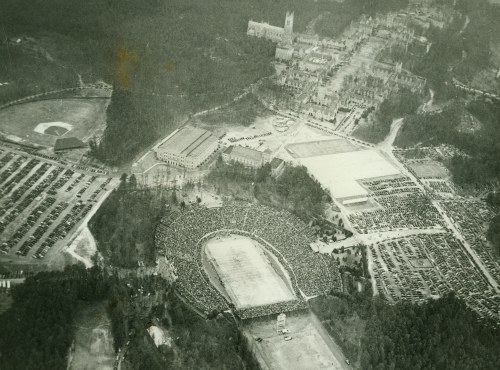
Join “Voice of the Blue Devils” Bob Harris as he shares thoughts on how Duke football has changed from the legendary 1942 Rose Bowl held in Wallace Wade Stadium to today’s modern game. He will also talk about the impact of the game on campus beyond the stadium walls.
Rosemary Davis and Jessica Wood, curators of the current “From Campus to Cockpit” exhibit, will highlight photographs and other artifacts from the 1942 Rose Bowl, including archival film from the game.
Following the presentation, game day refreshments will be served, and Harris will sign copies of his autobiography, How Sweet it Is! From the Cotton Mill to the Crow’s Nest.
“From Campus to Cockpit” is on display in the hallway cases outside the Biddle Rare Book Room through January 29th. An online exhibit—including the complete film of the game recorded by Duke’s coaching staff—is also available.
For Sally: Topper Toys advertised a line of Suzy Homemaker® products for girls who were “square” because they washed regularly, wore shoes rather than beads, and got “more fun out of being a cook than a kook.” Rebellious Sally will surely love spending the day cleaning with her new Vacuum and Super Sweeper, baking Dad a chocolate cake with the High Speed Mixer and Safety Oven, and then getting gussied up at the Vanity before she sneaks out to see Glen. The perfect gift to reinforce traditional gender roles (or perhaps the best way to create a feminist)!
Click to enlarge.
For Roger Sterling: What could be better than Milton Bradley’s Drop in the Bucket game, the highlight of the next office holiday party! Apparently it was “so zip-zap new” that you would be “hailed like Columbus for discovering it.” Who else would have the nerve to strap a net to his waist as coworkers try to drop “bouncy cubes” in it? Just add a few martinis and watch the merriment commence!
Click to enlarge.
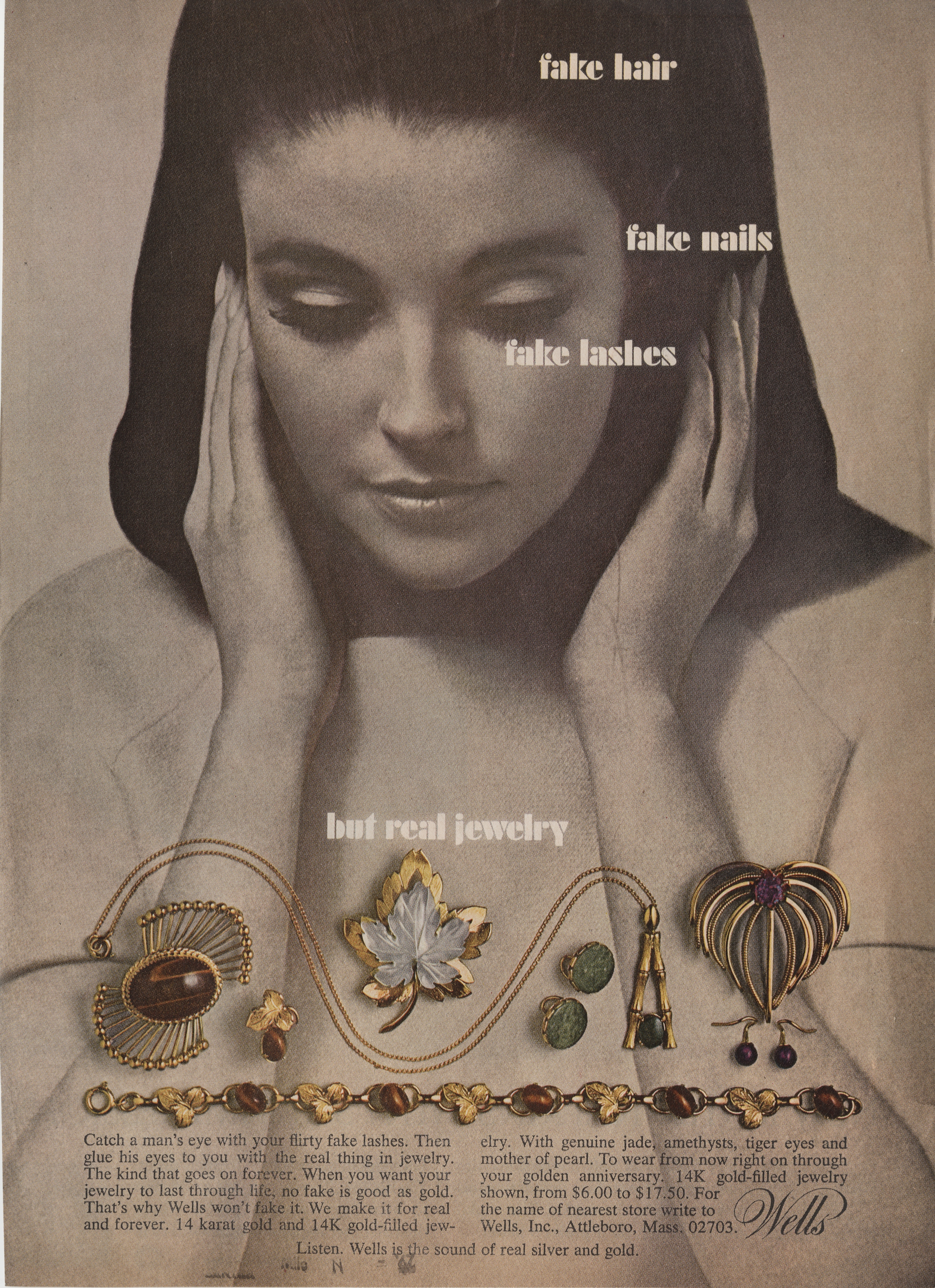
For Megan: Jewelry is the obvious choice for Don’s new young wife, and nothing says “I love you” more than the tagline “Fake hair, fake nails, fake lashes, but real jewelry.” Only the best for his lovely bride!
Click to enlarge.
For Betty: Don still has a soft spot for his ex-wife, so he needs to find something that says “Merry Christmas and I’m sorry I never told you my real name.” How about astrology soap on a rope! “Boldly sculptured” in “fragrances and colours to match every personality,” I’m sure he will find the one that fits Betty’s polished, repressed and passive aggressive nature.
Click to enlarge.
And Don, don’t forget Rover! French’s People Crackers for Dogs would be the perfect choice for the furry member of his family. The dog can literally take a bite out of the mailman, the policeman, and even the dogcatcher!
Don will surely be thirsty after all that shopping. Since he is cutting back on alcohol, why unwind with some drink ideas from Campbell’s Soup? Perhaps he could make Tomato Ice by freezing Tomato Soup, or chill some Consommé until it jellies and serve it with “a lemon slice, cucumber or sour cream.” And who doesn’t love Beef Broth on the Rocks “poured right from the can over ice”? That’s what we call “Mmm Mmm Good!” (This ad is from the Roy Lightner Collection of Antique Advertisements.)
Click to enlarge.
Happy Holidays from the Hartman Center!
Post contributed by Jackie Reid, Director of the Hartman Center, and Liz Shesko, Hartman Center intern.
Searching for the perfect gift for that special Duke fan on your list?
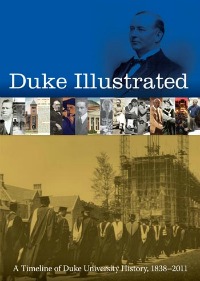
We’d like to suggest the Duke University Archives’ new book, Duke Illustrated: A Timeline of Duke University History, 1838-2011. This beautiful, 80-page, full-color history of the events, traditions, and people that have made Duke one of the world’s leading research universities is the product of almost four decades of research by University Archives staff.
Donors who contribute $50 or more to the Duke University Archives will receive a complimentary copy of Duke Illustrated (and become a member of the Friends of the Duke University Libraries)—so it’s a double gift! Not only will you be sharing Duke University history with your loved ones, you’ll be ensuring that the University Archives is able to continue its work to preserve Duke’s rich historical legacy.
Order your copy today via our secure website. We’ll send it directly from our wintry Gothic Wonderland to your or your lucky recipient’s home! (Orders placed by December 15th should be delivered in time for the holidays!)
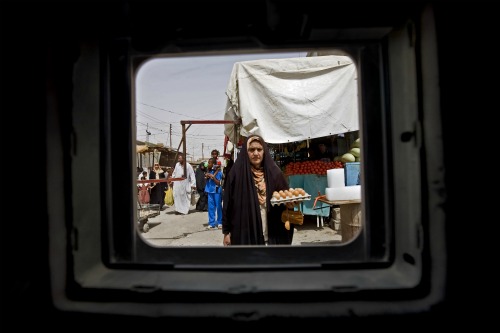
Catch Ben Lowy’s exhibit, “Iraq|Perspectives: Photographs by Benjamin Lowy,” in the Rubenstein Library Gallery through December 11.
Can’t make it to the Rubenstein Library? There is an online exhibit as well, where you can view Lowy’s award-winning photographs and listen to a recording of his talk about his work, given here at the Rubenstein Library this past November.
The Internet Archive just reached an important milestone by digitizing 5,000 books at Duke. The 5,000th book, The British Album: In Two Volumes, contains poetry by “Della Crusca, Anna Matilda, Arley, Benedict, The Bard” and other writers on themes including love, horror, jealousy, and death, and is part of the general collections of the Rubenstein Library. The “Ode to Death” begins “THOU, whose remorseless rage, Nor vows, nor tears assuage, TRIUMPHANT DEATH!—to thee I raise, The bursting notes of dauntless praise!” The second volume can be found here.
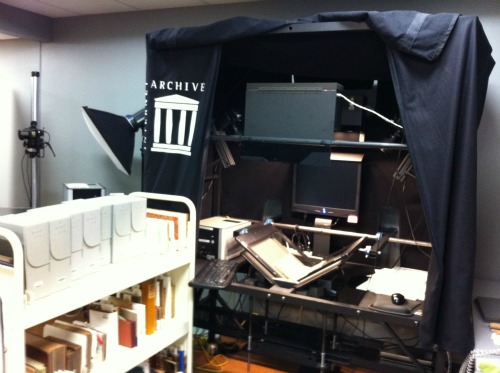
The Scribe Scanner. Photo by Rita Johnston.
The Internet Archive scanning center at Duke University has been in operation for one and a half years and has digitized materials from collections within the Rubenstein Library, including the University Archives, Utopian Literature, and Confederate Imprints. I scan about 450 pages per hour and around 50 books a week. Most books in the public domain under 11 x 13 inches in size can be digitized on the Scribe book scanner, as well as pamphlets and loose documents.
Books digitized through Internet Archive are usually available on the site by the next day, are full-text searchable, and can be read in a web browser or downloaded to a computer; e-book reader; or mobile device. You can find newly digitized Duke materials by clicking on the RSS feed link at the bottom right on this blog or by visiting the Duke University Libraries Internet Archive page. Patrons can request a book to be digitized by the Internet Archive by contacting Rubenstein Library staff.
Post contributed by Rita Johnston, Scribe scanner operator.
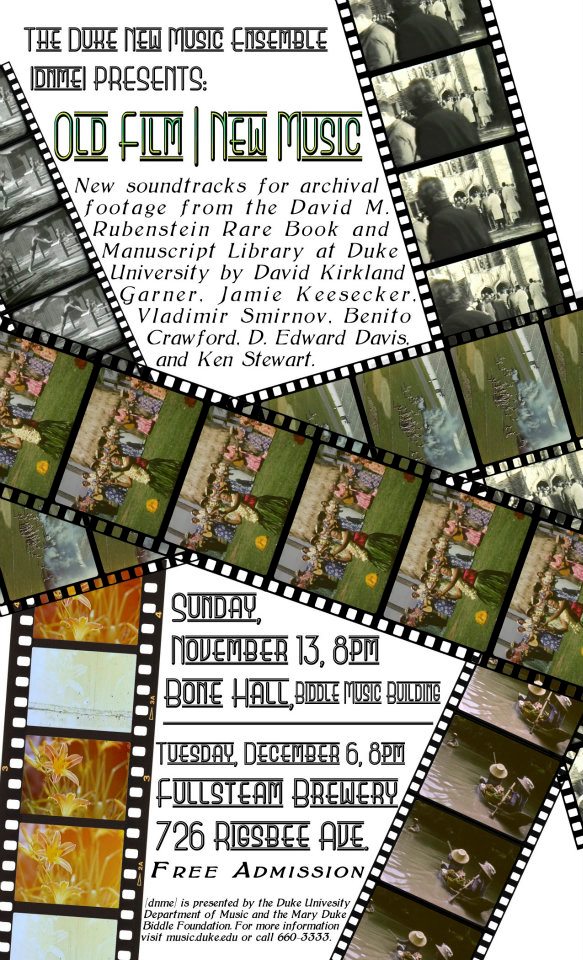
Tonight and on December 6th, the Duke New Music Ensemble will be performing new compositions written as soundtracks for films from the Rubenstein Library’s collections. We asked the dnme composers to tell us a little bit about the films they chose and how they inspired their compositions. For more details about the performances, visit the group’s Facebook page or click the poster at right to enlarge it.
David Kirkland Garner
The video I chose to use is from H. Lee Water’s “Spindale ’37” film (from the H. Lee Waters Film Collection). I chose the portions of the video having to do with the factory for Yelton’s Flour, opening with footage of the flour refining process from inside the building then turning to the procession of workers leaving the factory at the end of the day. The music I wrote is not meant to be closely synced with the video. Rather, it creates a singular mood for the film images. The music is created in two parts: a repeating groove in the keyboard, bass and 3 banjos and a slowly unfolding melody in the other instruments. At the beginning and end of the piece the ensemble uses percussion instruments to imitate the sounds of summer in rural North Carolina.
Jamie Keesecker
Margolin’s 1965 Hawaii film footage (from the Morris and Dorothy Margolin Film Collection) presents a challenge in that almost every moment captured in the footage comes from a performance that was originally accompanied by music, and the musicians themselves can be seen throughout most of the film. Seeing the musicians strumming guitars and ukeleles in unison is one of the aspects that attracted me to this film. But rather than attempting to recreate the music that would have originally accompanied the images in the video, I have written music that is merely meant to represent my own reactions to seeing the film. At the same time, I have chosen to write for a consort of mostly plucked string instruments similar to those depicted in the video. Musical gestures are at times intended to be synchronized with the musicians on film, and other times not, just as the musical material itself contains hints of Hawaiian tropes while remaining, on the whole, quite different from what would actually have been played by the musicians on film.
D. Edward Davis
My archival footage is of a student protest that occurred at Duke University in 1969 (from the Radio TV Services Records). Despite the “homemade” image quality (or perhaps because of it), the images capture the drama of the protesters in action, with the cameraman acting as a participant and not a spectator. I’m drawn to this film because of its connection with the University’s history, and I tried to mirror the intensity but also the sinister beauty of these images with my music. As students are presently (Nov 2011) involved in “Occupying Duke” in the same physical location as the 1969 protests, I love how the film has both a distant timeless quality and a captivating immediacy. Thanks to the staff of the Archives for preserving this footage and also for making it accessible to researchers and artists.
Vladimir Smirnov
The video I chose was footage of traveling down a river (the Chao Phraya, I presume?) in Bangkok from a collection of travel footage by former Duke Professor Margolin (from the Morris and Dorothy Margolin Film Collection). I myself have never traveled to Thailand, and the video drew me in with its images of a very exotic world and with its slow hypnotic pace. I tried to create a musical atmosphere that the video suggested to me with very gentle and exotic sounds—muted piano, bowed vibes, slow swells on the guitar and bass, flute that is sung into at the same time as it’s played, banjo, and very sparse strings. I didn’t really think too much that I was working with archive film when writing, I just focused on the images and atmosphere.
Kenneth David Stewart
The footage I selected is of the Sarah P. Duke Gardens from 1937 (from the Radio TV Services Records). What moves me about this footage is how striking the color of the flowers appears as captured by the Kodachrome film. It is interesting how this footage from 1937 is just two years after Kodak made this kind of film commercially available—in fact, the famous color scenes in the Wizard of Oz were shot with this same film. This captured color, to me, almost has its own texture independent of the hue itself.
The written music for the instruments is based on the live ensemble playing the role of three choirs simultaneously ‘singing’ different music, but at the same time each contributing to a larger, composite texture. In addition to this, there is an electronic track with supporting harmony and the sounds of a typical journey in the rain from my home to the Biddle Music Building recorded onto microcassette.
The process used to construct the visual narrative is based on whether the camera shot is close to the flowers themselves or farther, panning across the gardens. At the same time a ‘chord progression’ of color directs the footage from yellow to orange to red to pink to white to ivory and back to yellow again to repeat the cycle. None of these textures are more important than another and in this way, the whole is truly greater than the sum of its parts.
My mother, a former professional horticulturalist, instilled in me a love of plants and flowers at a young age. Some of my fondest childhood memories are of my mother and I outside planting flowers and vegetables in our family garden. This piece is dedicated to her.
Post contributed by the members of the Duke New Music Ensemble.
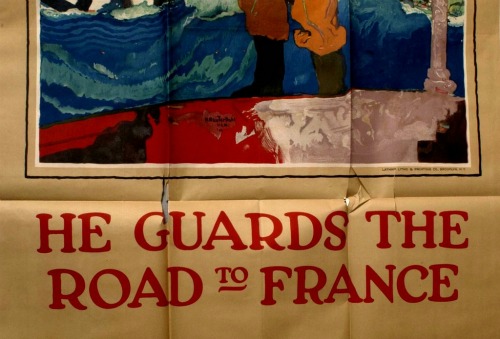
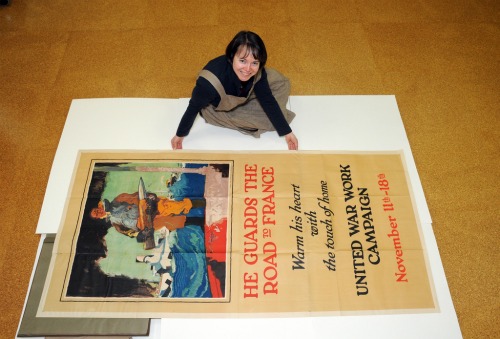
In 1918, the week of November 11-18 was not only a celebration of the end of World War I, but was coincidentally also a week of massive fundraising by the United War Work Campaign to support troops and boost morale until their work was done. The scrapbook of posters and pamphlets from the campaign was described previously in the post “Scrapbooking for Victory.”
The scrapbook has been undergoing treatment in the conservation lab for the last couple of months. As a paper conservator, I’ve been collaborating with book conservator Meg Brown to treat the album’s myriad problems, from the damaged binding to the fragile items glued to the pages. The scrapbook has been a challenge because of its large size and the awkward folding items it contains. The conservation problems have required hands-on treatment, lots of brainstorming sessions, and ongoing dialogue with curators to understand how the scrapbook will be used. It’s a popular item with librarians, professors and researchers, and it’s no surprise; it’s a wonderful book!
Before Treatment: Tears to a Poster in the United War Work Campaign Scrapbook
Meg cleaned, consolidated and relined the spine to make the text block stronger, and she used the spine lining to securely attach the text block to the cover. I’ve been mending tears and flattening creases in the posters and leaflets, many of which have broken at the folds from handling and from insect attack. A few of the damaged booklets will be lifted from the pages and housed in pockets for easier, safer access. The largest poster in the book unfolds to 82 x 41 inches (208 x 104 cm), so I’ve had to commandeer extra table space. It’s especially useful at times like this to have a table on wheels that adjusts in height!
When the treatment is finished, a storage box will be made, and the scrapbook will be sent back upstairs to the Rubenstein Library for all to enjoy.
For more photos of the scrapbook, and its restorative sojourn in the Conservation Lab, visit the “United War Work Campaign Scrapbook” set on the Rubenstein Library’s Flickr photostream.
This is the fourth in a series highlighting film shorts from theFull Frame Archive, a collection within theArchive of Documentary Arts that preserves masters of all past winners of Durham’s Full Frame Documentary Film Festival. The Full Frame Archive has acquired 79 films since 2007 and continues to grow; DVD use copies of these films can be viewed in the Rubenstein Libraryreading room. The Full Frame Archivefinding aid provides a complete list with descriptions, as well as titles of award-winners not yet acquired.
Oil Blue opens to long shots of only sea and sky, vast and awe-inspiring. Not until after the two-minute mark does any sign of humankind appear, when a gigantic oil tanker slowly moves across the screen. Finnish film student Elli Rintala sought to make a film about the North Sea oil industry, but not a conventional documentary. “I wanted to explore the area between experimental film and documentary film.” Oil Blue won the 2009 Full Frame President’s Award for the best student film.
“On the coastline of my hometown Porvoo is situated the biggest oil harbor and oil refinery of Scandinavia,” she explained to me by email. “I remember that as a child I was fascinated by the massive ships moving slowly in the horizon. . . . Of course I could have made a more traditional and more informative documentary on this subject, but somehow I wanted to maintain the viewpoint of a child, which shows the vessels as a mystery.”
Filming at sea was not easy. “Because the conditions were quite demanding we had to plan everything in advance as precisely as possible. Every image and every angle had to be known beforehand, we couldn’t improvise that much. But I think that all that planning was a great advantage for the film.”
Rintala was granted access to film aboard the oil tankers without much difficulty, however. “Neste Oil, the company which owns the refinery and the tankers, was very cooperative from the very beginning. . . . [They] realized that my aim was not to make a provocative or accusing film.”
But the strict security regulations were a challenge. “Any electrically powered cameras or equipment were prohibited on the deck because of the danger of an explosion. So we had to use a very old spring-wound Bolex camera when shooting on the deck. . . .
“Part of the material is shot from a tiny inflatable in order to get as close to the water level as possible.” Filming on a raft presented its own challenges. “Occasionally the swell of the sea was quite strong and naturally that made the filming more difficult. Once our camera-assistant even threw up during the filming.”
The absence of words in the film compel the viewer to listen—to the sounds of the ocean and machines and to the evocative musical score. “In general I like the way the music and the sound design coalesce in the Oil Blue. The structure of the film is quite musical in any case. One person said to me, that it is possible to watch it the same way you listen to ambient music. This was a great compliment for me, because my aim was that the images could be like music.”
Although Rintala wants to leave any message in Oil Blue open to interpretation, she says it “could be seen as an allegory of our life style also in a more general way. The oil transportations are only one example of this balance of terror between human race, technology and nature, which is so typical for our time.”
Rintala is currently at work on her graduation film “about the main airport of Finland, Helsinki-Vantaa and the development of air traffic from 1950s to this day. I’m going to use archive material and current footage to portray the lost innocence of flying in our time. So from the element of water in Oil Blue I’m moving on to the element of air.”
Post contributed by Tanya Lee, Full Frame Archive Intern.
Dispatches from the David M. Rubenstein Rare Book and Manuscript Library at Duke University


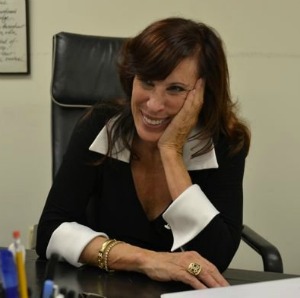
 Next Tuesday, Merle Hoffman reads from her new memoir, Intimate Wars: The Life and Times of the Woman Who Brought Abortion from the Back Alley to the Boardroom.