

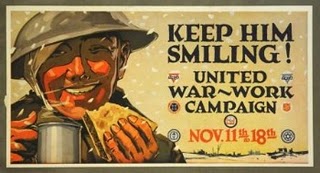
These chipper slogans grace the 20 posters, handbills, brochures, stickers, song lyrics, newspaper ads, and cartoons found in a United War Work Campaign Scrapbook recently acquired by the John W. Hartman Center for Sales, Advertising & Marketing History. This collection of fundraising and morale-boosting materials was produced for a multi-institutional drive during the final months of World War I. Only one other copy is known to exist at Stanford University’s Hoover Institution Archives.
On September 9, 1918, President Woodrow Wilson wrote to Raymond Fosdick, coordinator of the War Department’s Training Camp Activities, requesting that aid organizations pool their resources on a massive single campaign to raise funds for soldier morale programs “in order that the spirit of the country in this matter may be expressed without distinction of race or religious opinion in support of what is in reality a common service.”

The campaign coordinated the efforts of seven organizations that had previously managed individual fundraising drives: the YMCA, YWCA, American Library Association, War Camp Community Service, National Catholic War Council (Knights of Columbus), Jewish Welfare Board, and Salvation Army. Each organization would continue to address their traditional demographic or service focus (for example, the Knights of Columbus worked primarily with Catholic communities, and the American Library Association sent books to soldier encampments) while organizing their activities around a central set of promotional messages.
The goal was to raise $170 million during a campaign scheduled for the week of November 11-18, 1918 (whether prescient or brilliantly planned, November 11 was also the day that Germany signed the Armistice, officially ending hostilities.) The end of the war was already in sight during the campaign-planning period, but it was estimated that the demobilization of nearly four million U.S. troops would require at least two years and a staggering sum for programs to maintain the morale of returning soldiers. With a nearly $1 million operating budget, a National Publicity Committee was formed and chaired by Bruce Barton, a journalist and magazine editor who had been an active official with the YMCA. All media would be employed: print, outdoor advertising, leaflets, stickers, lapel pins, radio spots, motion picture shorts, even a women-run telephone brigade. The campaign was a resounding success, raising over $203 million dollars that funded soldier aid programs through 1920. It was hailed in the press at the time as the largest fundraising event in human history.
As an advertising history-related aside, the United War Work Campaign may have been the launching platform for one of America’s most successful advertising agencies. Ad men Roy Durstine and Alexander Osborn worked on the campaign alongside Bruce Barton. In early 1919, just a few months after the campaign wrapped up, the three men founded ad agency Barton Durstine & Osborn, which merged in 1928 to become Batton, Barton, Durstine & Osborn (BBDO). BBDO rapidly grew to become one of the largest and most respected advertising agencies in the United States. The Hartman Center is proud to add this important scrapbook to its growing collection of war-related advertising materials.
For more photos from the scrapbook, take a look at the scrapbook’s set on the RBMSCL’s Flickr photostream.
Post contributed by Rick Collier, Technical Services Archivist for the John W. Hartman Center for Sales, Advertising & Marketing History.
I saw these on Flickr this morning. Awesome.
And now there’s Scrapbooking for Victory Part Two!