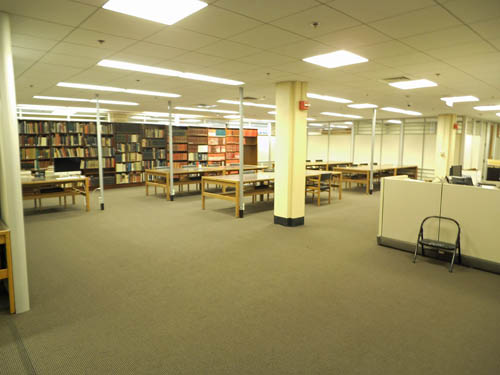
Welcome to the second installment of the photo diary of the Rubenstein Library’s move! We’re going to start off by showing you our new secure stacks, the future home of many of our archival collections and rare printed materials for the duration of the renovation.
Our new stacks!
Nice and empty, right? But they were a teensy bit dusty . . . So we organized a Rubenstein staff flash dusting mob yesterday afternoon!
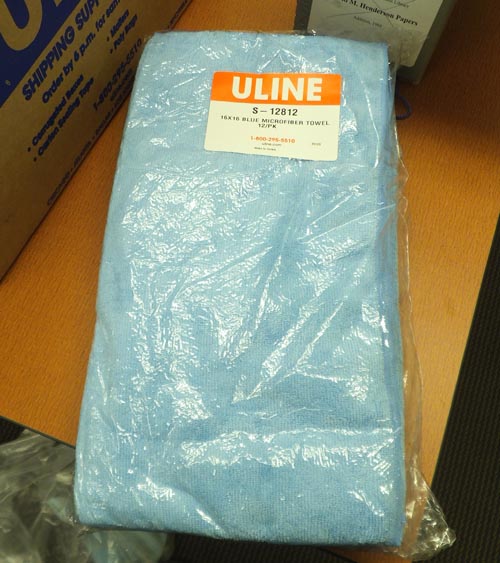
Our dusting cloths. We apologize for their color.The dusting flash mob in action.
And now our new stacks are clean and ready to be loaded with collections materials. Just in time, too, because the collections move starts on Monday!
Dear readers, did you enjoy your winter break? We did, too—but we were busy!
Since December 17th, we’ve been packing our offices, our reading room, our common workspaces—basically, everything that’s not a rare book or archival collection—and moved to our new digs on the 3rd floor of Perkins Library. This is where you’ll come to do research (and visit us!) during the renovation, which is currently slated for completion in the summer of 2015.
Now that we’re all settled into our new space, we’ll be spending the rest of January and the first half of February moving our collections from their current stacks locations to our 3rd floor Perkins stacks or to the Library Service Center. (Yes, you’ll still be able to visit and do research during this collections move. Visit our “FAQ for Researchers” to learn more about researching at the Rubenstein Library during the move period.)
Since we need all hands on deck to ensure that our collections are moved safely and securely, we’re going to be temporarily turning the blog into a photo diary of the move process. Check back a few times each week to get a behind-the-scenes glimpse at a logistical process that’s been a couple of years in the making! (And the blog will return to its normal self on February 18th.)
And now, we present “What We Did Over Our Winter Vacation” by the Rubenstein Staff:
Our paper finding aids are packed and ready to go! What’s a finding aid?Doughnuts increase packing efficiency. Especially when they’re homemade salted caramel chocolate doughnuts. We were surprised to find even one left when we arrived to take this photo.3rd floor Perkins Reading Room, before the move.3rd floor Perkins Reading Room, after the move. Looks like home!
At the same time, we are working on the finishing touches of the Elna Spaulding Papers, the largest collection that Duke is contributing to the CCC Project. Look for more updates on these collections in upcoming blog posts on The Devil’s Tale.
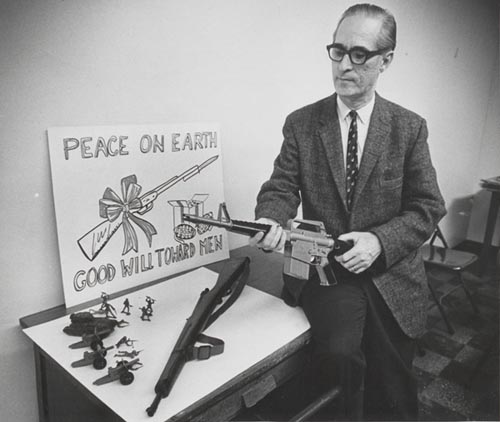
For this month, we wanted to highlight a photograph that conveys the holiday spirit. We recognize that it is the season for peace on Earth, good will toward all, and (toy) firearms.
Photograph taken by Jim Thornton for the Durham Herald-Sun, undated. Women-in-Action for the Prevention of Violence and Its Causes Records, Box 11, Folder 1: wiams11001036
If we were giving out year-end awards for the CCC Project, this photograph has to win the “Most Ironic” trophy. Normally, at this point, we would provide context that would explain exactly what this spokesman is trying to convey. Unfortunately, all that we know about this photograph is that it appeared in the Durham Herald-Sun and the photographer was Jim Thornton. The fact that this photograph appears in the Women-in-Action records indicates that the event was some sort of anti-violence demonstration that perhaps encouraged parents to avoid purchasing violent toys for Christmas. However, this explanation is at best an educated hypothesis.
No matter the explanation, this photograph and the rest of the CCC materials are quite thought-provoking. And our final thought for this update: Happy Holidays from the CCC Staff!
To learn more about the CCC Project, please visit CCC on Facebook.
The grant-funded CCC Project is designed to digitize selected manuscripts and photographs relating to the long civil rights movement. For more about Rubenstein Library materials being digitized through the CCC Project, check out previous progress updates posted here at The Devil’s Tale!
Post contributed by Josh Hager, CCC Graduate Assistant.
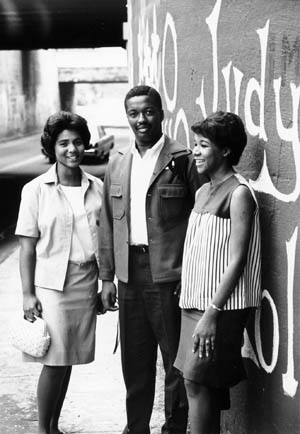
Wilhelmina Reuben-Cooke, Nathaniel White, Jr., and Mary Mitchell Harris, the first African-American undergraduates to receive degrees from Duke University. From the University Archives Photograph Collection.
Fifty years ago, Duke University first admitted African-American students into its undergraduate classes. Drawing upon the collections of the Duke University Archives, “The Road to Desegregation at Duke” uses historic photographs, correspondence, flyers, newspapers, and more to tell the story of how Duke became a more diverse university.
The exhibit examines the contributions of African Americans at Duke prior to integration, the process of desegregation at the University, and the ways in which black students have shaped Duke since 1963.
Part of a larger, campus-wide commemoration of this milestone anniversary, “The Road to Desegregation” is a thought-provoking look at why Duke changed, and what it meant to become a truly integrated university.
If you’re not able to visit the Duke University Libraries to see the exhibit, please have a look at the online exhibit!
Post contributed by exhibit curators Valerie Gillispie, University Archivist, and Maureen McCormick, Isobel Craven Drill Intern.
Date: Monday, December 10th, 2012 Time: 1:00 PM to 12:00 AM Location: Rare Book Room suite Contact Information: Amy McDonald, amy.mcdonald(at)duke.edu
Need we remind you, dear busy students, that next Monday is the final Reading Day before exams begin? The Rubenstein Library is convening a very special study hall to help relieve at least the stress of finding a library studying space (you’re on your own for your chemistry final).
We’ll be opening the Biddle Rare Book Room’s double doors promptly at 1:00 PM and leaving them open until midnight. You’ll be able to read over your notes on our comfy couches, review your flashcards next to the Audubons, and finish up your final paper under the History of Medicine Collection’s ever-watchful glass eyeballs. The rooms were designed to look like the library of an 18th century English manor house, so yeah . . . study like it’s 1799. With wi-fi!
And it’s your chance to say “so long” to the Rare Book Room suite before it closes for renovation on December 17th. (Wondering what renovations will take place in the Rare Book Room suite? Check out our Rubenstein Renovation FAQ!) Rubenstein Library staff will also be around to answer questions about the renovation and what research at the Rubenstein Library will look like over the next few years.
Space will be available on a first-come, first-served basis, and no food or drink will be permitted (there ARE still rare books in the room’s bookcases, after all).
There might even be a pop quiz . . . .
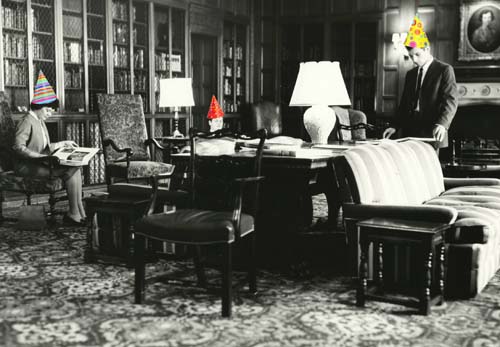
Biddle Rare Book Room, ca. 1950s. Party hats not included.
In 2013, Duke will mark 50 years since the desegregation of the undergraduate student body. The campus-wide theme, “Celebrating the Past, Charting the Future: Commemorating 50 Years of Black Students at Duke University” will be woven into annual events, like commencement, reunion, and Founder’s Day, and will also be a topic of reflection through exhibits, speakers, and service opportunities. Working together across the University, this milestone year offers all of us the opportunity to learn more about Duke’s history.
The University Archives has a rich photographic collection, and we have added a number of photos on Flickr as part of the anniversary celebration. They show us moments of protest and performance, as well as celebration. The photographs are featured on a new website dedicated to this fiftieth anniversary commemoration.
The University Archives contains many collections that provide historical context and primary source documentation on the desegregation of the school, the black student experience at Duke, and much more. Interested in diving in? A new guide to conducting research on African-American history at Duke is now available, and the UA staff is glad to consult on particular questions or projects. (Contact us here!)
Post contributed by Val Gillispie, University Archivist.
Date: Thursday, November 15, 2012 Time: 6:00 PM, reception to follow Location: Biddle Rare Book Room Contact Information: Kirston Johnson, kirston.johnson(at)duke.edu
Please join the staff of the Archive of Documentary Arts next Thursday, November 15 for a talk with documentary photographer Gary Monroe.
In the late 1950s in rural Florida, a group of young, self-taught African-American artists began to paint optimistic and colorful Florida landscapes. They periodically left their backyard studios and took to the highway to sell their works to white customers, earning the name The Highwaymen. Their glowing images represented the American dream. Photographer Gary Monroe got to know these artists and will speak about their work and their legacy.
About Gary Monroe: Gary Monroe is a professor of art at the Southeast Center for Photographic Studies in Daytona Beach and author of The Highwaymen: Florida’s African-American Landscape Painters.
Post contributed by Kirston Johnson, Curator of the Archive of Documentary Arts.
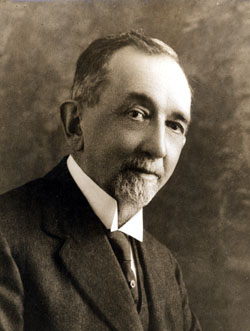
Benjamin Newton Duke. From the University Archives Photograph Collection.
Recently, I was tasked with the job of researching and learning about the life of Benjamin Newton Duke, affectionately known as “Mr. Ben.” Mr. Ben was the older brother of James B. Duke, and one of tobacco tycoon Washington Duke’s children.
J.B. was placed in charge of many of the family’s business ventures and became famous for his role in running American Tobacco and other Duke ventures, but Ben was the Duke family’s chief philanthropist. He gave away copious amounts of the family’s sizeable wealth, and was known for his generosity. He also served on several charitable boards, such as the Oxford Orphan Asylum north of Durham.
The purpose of my assignment was to create a timeline (coming soon!) that tells the story of Ben Duke’s remarkable life through words and pictures. In creating the timeline, I looked through boxes upon boxes of photos, letters, and ledgers related to his life. Among the photos that I looked at was a series of interior shots of his home in Durham, “Four Acres,” before it was demolished.
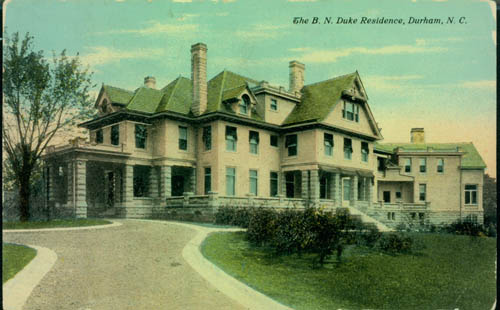
Postcard of Four Acres, the home of Benjamin Newton Duke. From the University Archives Postcard Collection.
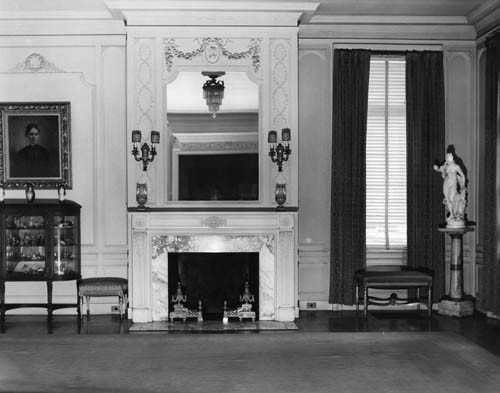
Somewhere in the lot was this photo, a look at one of the rooms in Four Acres. If you look closely at the photo, you’ll notice a statue on a pedestal on the right side.
Interior of Four Acres. From the Benjamin Newton Duke Papers.
As part of our ongoing renovation preparation work, we have been researching the origins and provenance of some artifacts in our possession. One of these was a statue that has been residing in the office of the Duke University Libraries’ Exhibits Curator for a decade. We had documentation that the statue came from Four Acres, but we had no photographic evidence to prove it: until now. This series of previously unexamined photographs helped us confirm that the statue in the Exhibits Curator’s office is, in fact, the statue from Four Acres.
It’s nice to know that this simple project of learning about Mr. Ben has connected us so tangibly to all that he did for Duke University.
When Senator John F. Kennedy’s plane landed in Raleigh on December 2nd—one hour before he was due to speak at Duke University—he hadn’t yet declared his candidacy for the 1960 presidential election. Writing about that evening’s address, the Duke Chronicle wrote simply that the “boyish John Kennedy” was the “leading unannounced candidate for the Democratic presidential nomination” and noted a recent decrease in his popularity, especially when compared with potential Republican candidates New York Governor Nelson Rockefeller and Vice President Richard M. Nixon.
Kennedy’s aspirations were, however, clear. The arrangements for the speech were made by J. Leonard Reinsch, then a member of the Democratic National Committee and director of the 1960 Democratic National Convention, whose two children were students at Duke. WUNC-TV filmed the evening—necessitating that the speech be given in the smaller Page Auditorium, rather than Duke Indoor Stadium (not yet known as Cameron)—and the WUNC radio station recorded it for later broadcast.
Kennedy spoke as part of the Major Speakers Series planned by the Student Union’s Educational Affairs Committee. For the 1959-1960 academic year, the student committee, led by chair Byron Battle, attempted to build a non-partisan slate of candidates for high public office. According to their meeting minutes, their efforts to secure Duke alumnus Richard Nixon involved “a constant barage [sic] of letters” from Duke administrators, including President A. Hollis Edens. They also considered extending an invitation to Hubert Humphrey, but decided against it, on the grounds of “a possible preponderance of Democrats, and a fear that he might not have anything worthwhile to say.” (Humphrey did eventually speak at Duke in 1965.)
Letter, Byron Battle to John F. Kennedy, June 23, 1959. From the Duke University Union Records. Click to enlarge.
Local newspaper accounts indicate that the speech, titled “The Challenge to American Colleges” and ranging over key national and regional issues like the space race, North Carolina’s progress toward integration, and Kennedy’s position on birth control, was well-received.
But we’re less sure of the Duke student body’s reaction to the speech, perhaps because the campus’s attention turned almost immediately to a different election. In the same issue of the Duke Chronicle that looked forward to Kennedy’s speech, a undergraduate student reporter named Steve Cohen published the first part of a satire that set the nativity story in World War II-era Poland. Tipped off by the paper’s printer, and worried that the piece would cause controversy damaging to Duke’s reputation, President Edens acted swiftly, suspending publication of the Duke Chronicle until the editorial board could be reorganized.
Senator John F. Kennedy before his address in Page Auditorium, December 2, 1959. Kennedy is standing in the Flowers Building’s Music Room. From the University Archives Photograph Collection.
The Duke Chronicle published its next issue on December 14, 1959, 11 days later. The issue carries only a brief mention of Kennedy’s speech, in an editorial from new editor-in-chief hopeful Jim Brown, who wrote:
We are constantly in danger of focusing all our attention on the sensational. Significant events often pass unnoticed. People all over the nation know of the Chronicle incident. But how many of them heard about the speech that Senator Kennedy made the day after the Cohen article was published. . . . Senator Kennedy’s masterful presentation had a considerable impact on the student body. But compared with “A Christmas Story” the attention that it received was negligible.
Later that afternoon, Marian Sapp was elected by the University Publications Board as the Duke Chronicle’s new editor-in-chief. Kennedy declared his candidacy for president on January 2, 1960. We’re not definitively certain what happened to Steve Cohen, but Sapp herself alluded in her own December 14th editorial to the “destruction . . . of one boy’s right of expression in any University publication.”
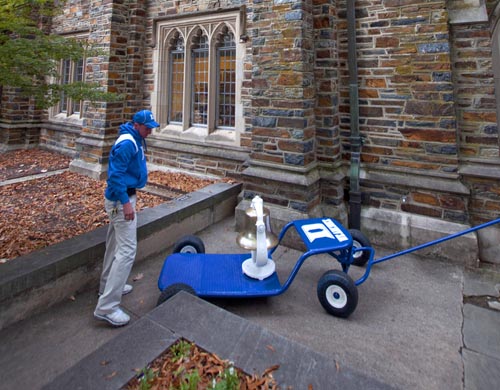
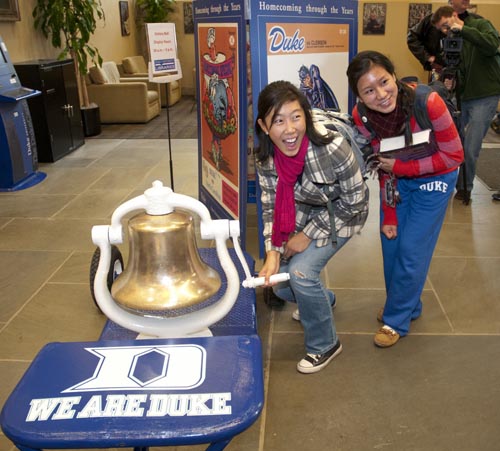
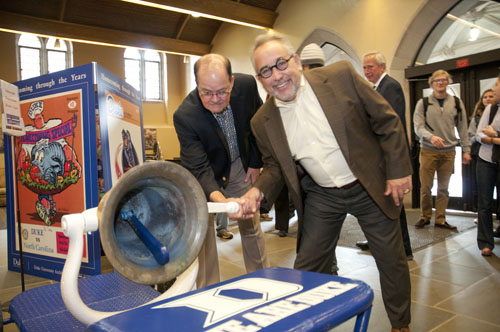
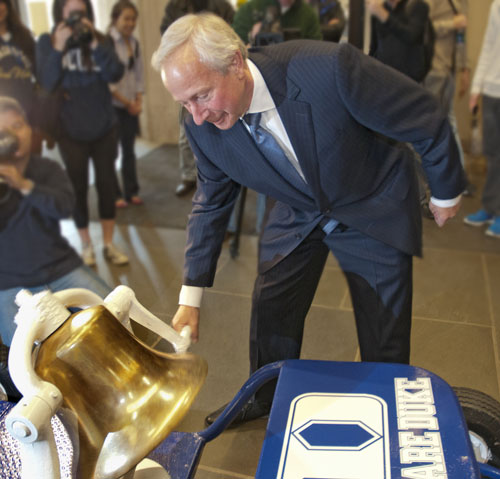
Shortly after Duke’s football win over the University of North Carolina on October 20th, the Duke University Libraries’ Communications and Development Departments and the Duke University Archives had an idea: why not bring the Victory Bell to Perkins Library? The University Archives has tons of historical material about Duke’s football team and the Victory Bell—including the bell’s original clapper, “liberated” from a UNC gymnasium in 1964—and, well, how much fun would it be to ring a bell in a quiet library?
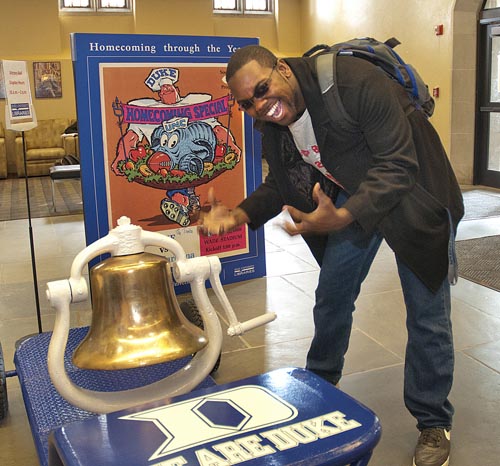
After a few phone calls to our friends in Duke Athletics, the Victory Bell’s cart rolled over to Perkins Library this past Friday morning. Here are a few pictures from what proved to be a very fun—and occasionally very noisy—day. And, no, even though we’re librarians, we didn’t shush any of our bell ringers!
The Victory Bell arrives at Perkins Library!An excited student reacts after ringing the Victory Bell.Two more students get ready to ring the Victory Bell.Coach David Cutcliffe and Provost Peter Lange share a turn. Note some remaining blue spray paint on the inside of the bell.President Brodhead rings the Victory Bell.
So what do you think, Coach Cutcliffe? Shall we do this again next year?