All posts by Amy McDonald

Trish Wheaton on Sustainability and the Socially Conscious Consumer

Date: Tuesday, March 4th
Time: 5:30 PM, reception to follow
Location: Perkins Library room 217
Contact: Jacqueline Reid Wachholz, j.reid(at)duke.edu

“From Niche to Mainstream: Planet Brands and the Rise of the Socially Conscious Consumer”

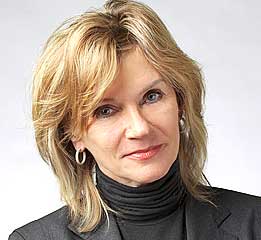
Trish WheatonTrish Wheaton is CMO of Wunderman and Managing Partner of Y&R Advertising, two global marketing giants. In her role for both companies, Wheaton identified the untapped marketing opportunity around sustainability and now leads a cross-disciplinary sustainability consulting practice that works with major brands to tell their sustainability story credibly and compellingly.

In this talk, Wheaton will share how many of the world’s leading brands are becoming more sustainable in their operations, their manufacturing, and in the products they make. These “Planet Brands” are leading the way to take sustainability from niche interest to a mainstream sentiment.

Wheaton will also introduce you to a rapidly growing global market of socially conscious consumers, “The Aspirationals,” who are demanding that companies be part of solving social and environment problems. And in an age of increasing transparency, The Aspirationals also want companies to talk about what they are doing: “If you do it, say it.” Wheaton’s talk will also include best case examples of companies who have told their sustainability story credibly and well.

The event is co-sponsored by the Nicholas School’s Environmental Innovation and Entrepreneurship Center, the Duke Marketing Club and the Markets & Management Studies program.

Post contributed by Jackie Reid Wachholz, director of the John W. Hartman Center for Sales, Advertising & Marketing History.

An Interview About a Duke University Pioneer

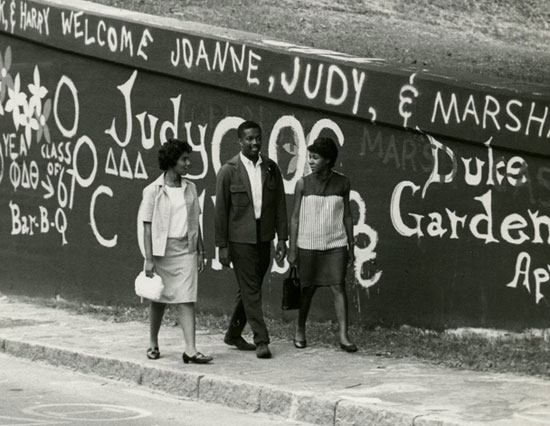
Nathaniel White, Jr was among the first five black students to attend Duke University in 1963. He was not, however, the first person in his family to attend college. His father, Nathaniel White, Sr., had attended Hampton Institute prior to founding his own printing business in Durham. In a newly-digitized interview, White, Sr. discusses his life, his memories, and his experience as a black man living in Virginia and North Carolina during the 20th century.

White’s interview is part of the Behind the Veil digital project, which has just added over 300 new interviews with North Carolinians, including many from Durham. The interviews capture details of what life was like in the Jim Crow South for African Americans. In White’s interview, he shares the story of his childhood, the black business community in Durham, and the influence of scouting on his life. Of particular interest to local researchers, he describes individuals and businesses in the Durham black community in the mid-20th century, providing deep insight into Durham’s history.

Nathaniel White, Jr., center, was a native of Durham and one of the first three African-American students to graduate in 1967.

He also briefly discusses his son’s pioneering role at Duke. He mentions that White, Jr., had considered Hampton Institute himself, but then had the opportunity to attend Duke. His father candidly remarks in the interview, “There’s one thing about a situation like that, it’s more like the real world than some other places that you might go and everything seems like it’s alright but it’s not training you for what you’re going to meet when you get outside. It’s a real struggle out there. The sooner you learn that, the better off you might be. . . . In other words, every day he had what it’s like to be an African American citizen in this country. So he didn’t have to learn that after he graduated. He learned it every day at Duke.”

Learn more about the fascinating Behind the Veil project on Bitstreams, the blog of the digital collections department of Duke University Libraries.

Post contributed by Val Gillispie, Duke University Archivist.

Calling All Duke Student Photographers!

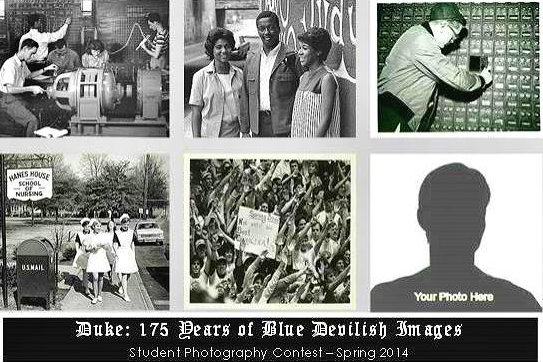
Duke: 175 Years of Blue Devilish Images – Student Photography Contest

Duke students are invited to celebrate the 175th anniversary of Duke University’s origins and win cash prizes at the same time!  Explore and emulate the rich images of Duke’s past found in photos from the Duke University Archives and then reinterpret them with your own contemporary vision. Categories include Academics, Athletics, Campus Scenes and Social Life.

Duke: 175 Years of Blue Devilish Images

What you need to know:

  • Who may enter: Currently-enrolled Duke students.
  • When: Contest begins Monday, February 24th and ends Sunday, March 23rd at midnight.
  • Prizes: Winning photographs in each category will receive $200. First runners-up receive $50.
  • Official contest details and rules, including the entry form.

That’s not all!

All contestants are invited to the Awards Ceremony on April 8, 2014 in the Thomas Room in Lilly Library. Winners will be announced and their photographs will be displayed in Lilly Library this spring.

The contest is sponsored by Lilly Library and the Duke University Archives.

Fear and Loathing in Page Auditorium

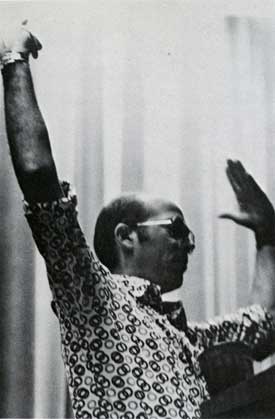
Hunter S. Thompson at Page AuditoriumHunter S. Thompson took the stage at Page Auditorium on October 22nd, 1974 at 8:50 PM. He was thirty five minutes late, visibly inebriated, and apparently quite unhappy to be there. He began his remarks to the packed auditorium of 1,500 saying, “I have no speech, nothing to say; I feel like a piece of meat.”

According to newspaper articles and editorials following the event, throughout the forty minutes Thompson remained onstage he dipped in and out of comprehensibility, exchanged insults and invectives with the audience, wrestled with a microphone, and bemoaned the lack of substance apparent in the questions written by the audience on 3×5 index cards. He read off one of the questions, “What is the happiest experience you’ve had in the past two weeks?” “That’s crap,” was the reply as he tossed the cards to the floor.

“Are you serious? The level of questions from this audience makes any sort of exchange completely impossible.”

As Thompson’s behavior appeared to become increasingly erratic, including asking himself questions and mumbling incomprehensible answers, worried administrators were having frantic discussions backstage attempting to decide how to handle the situation. At 9:05 they decided to let the speech continue and reevaluate the situation at 9:30. As 9:30 approached, Thompson began attempting to remove a fixed microphone from the podium in an effort to give it to an audience member asking a largely inaudible question about the rise of consumer politics. In failing to separate the microphone, he began wrestling with it, kicking the podium and the chairs onstage, and flung his bourbon onto the stage curtain. The bourbon was the final straw, and Linda Simmons, the Union program director, came on stage and asked him to leave. Although a third of the students attending had already left the auditorium, those remaining booed as Thompson left the stage, accusing the administration of curtailing free speech.
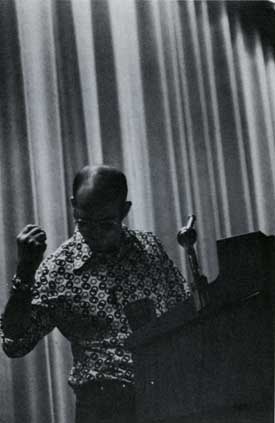
Hunter S. Thompson at Page AuditoriumOut on the lawn behind the auditorium after the event, Thompson sat with over a hundred students for an hour and a half in a more informal setting before leaving the campus.

Over the next few days, several newspaper articles were written on the event, and many students sent letters to the editor both praising and decrying the appearance. The University refused to pay the speaking fee, claiming that Thompson had violated the terms of his contract. The decision was not contested by the marketing firm who had contracted Thompson for the event.

One letter to the editor, however, never saw the light of day: Thompson’s himself. Thompson’s side of the story, in all of its gonzo glory, is part of the records of the Major Speakers committee.

He starts with a description of his state of intoxication while writing the letter, and discloses his state of intoxication while getting onstage at Page. Settling down, he states he wants to set the record straight as to exactly what happened at “J.B. Duke’s carcinogenic citadel. . . . [his] Southern Sanctuary for wayward New Jersey lads.”

Surveying the audience, I found 3,000 youthful, transvestite politicos, clutching their law boards and caressing their left legs. I decided to hallucinate them into 3,000 animated (and horny) Okra plants so I could begin my speech, speaking Okraese (Too-Maa-Too) in my best drawl. . . . Suddenly I realized the microphone was a local cottonmouth with heparin-filled fangs. While wrestling with the snake, I sensed danger from the rear and quickly lit my handy glass of Bacardi 151 and ether and launched it at the curtain, ran outdoors and evacuated the Nicotinic city.

If you want to see Thompson’s full letter, the newspaper articles and editorials the appearance sparked, or any of the other Major Speakers records, they, and much more, are accessible at the Duke University Archives.

Post contributed by Matt Schaefer, Drill Intern for the Duke University Archives.

Researching Black Health in the South

It was a great pleasure to conduct research at the Rubenstein Rare Book & Manuscript Library at Duke. As a recipient of the John Hope Franklin Research Center for African and African American History and Culture travel grant, I looked forward to exploring the Library’s holdings that would advance my understanding of black women’s history.

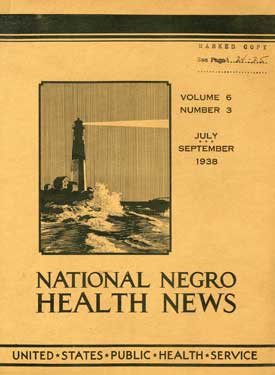
National Negro Health News. From the Alliance for Guidance of Rural Youth Records.
National Negro Health News, Vol. 6, no. 3. From the Alliance for Guidance of Rural Youth Records.

My dissertation project, “Mind, Soul, Body, and Race: Black Women’s Physical Culture, 1900-1939,” investigates the structural barriers to health and fitness for black women and the ways in which they circumvented those barriers and engaged in the physical culture movement. I examine how black women used purposeful exercise to create a new, fit vision of black womanhood that had implications for public health, recreation, and ideas of beauty, citizenship, and racial uplift. As a national project, I want to capture how Southern women, who had even less resources and access to physical culture, participated in the movement.

A significant portion of my dissertation discusses the state of black health and the Library proved to be a valuable repository for exploring the public health aspects of black southern history. The archivists were informed and genuinely interested in assisting researchers and with their help; I consulted about a half a dozen collections in all including the African American Photo Collection, the Alliance for Guidance of Rural Youth records, and the North Carolina Mutual Life Insurance Company archives.

One of the most useful collections was the Alliance for Guidance of Rural Youth. Although the Alliance was primarily a vocational guidance service organization, it sought to address several issues affecting poor, rural young people in the first half of the twentieth century including health issues. I found several documents from the collection related to health campaigns and the barriers to health for black people in the South. For example, a note in the 1934 National Conference on Negro Education proceedings indicated that “environmental rather than racial factors” compromised black health including low income, insufficient housing, and limited access to hospitals, preventive care, and recreational facilities. As it relates to black women’s health, the collection describes some of the difficulties black women had in accessing health information and clinics for their obstetric needs. The collection also contains sources on black unemployment, the black nursing profession, diet and malnutrition, and leisure during the New Deal era.

Additional records at the Library on black health in the twentieth century include William J. Covington’s physician account books and the thesis, Black Health in Segregated Durham.

Post contributed by Ava Purkiss, PhD candidate, University of Texas at Austin and 2012-2013 Franklin Travel Grant recipient.

Browsing the Chanticleer

Title Page of Chanticleer, 1939In August of this past year, I was hired as the student assistant for the Duke University Archives. The position is a thrill because it enables me to get paid for a hobby of mine: learning about Duke’s rich and diverse history.

Several of my projects have required me to use the Chanticleer, the university’s yearbook (view digitized volumes!), as a research tool. Scanning through old Chanticleers, it is interesting to observe the transformations in styles of clothes and hair from 1912 to the present day. Additionally, it is interesting to look at students with American history in mind. While researching, I found evidence of students’ mindsets during various points in American history: the world wars; the Jim Crow Era; the integration of Duke; the assassinations of President Kennedy and Martin Luther King, Jr.; Vietnam; Watergate; and 9/11.

The Chanticleer makes it very clear that Dukies of yesteryear—like Dukies of today—enjoy their time at Duke. Duke students have always been dedicated to making Duke a home through involvement in various organizations, academics, and general college fun.

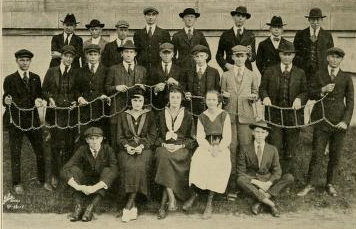
The Hades Club, circa 1920

One club that caught my attention as representing the jest of college students was the Hades Club, which existed during the 1920s. The club described itself as, “An organization of ministers’ sons and daughters who have never been caught,” and club members referred to themselves as “imps and impesses.”

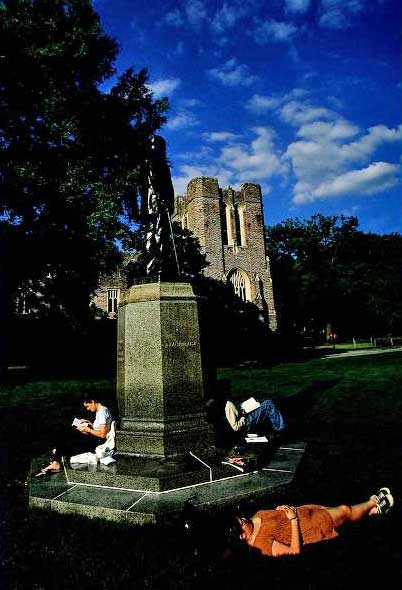
From the 1998 Chanticleer.

The sight of familiar buildings has been most impactful during my research. Amidst all the natural construction that takes place in academia, Duke has remained remarkably unchanged since about 1928. Students throughout the Chanticleer are posed and candidly photographed around West Union, Baldwin and Page, the Plaza, Wallace Wade and Cameron, and the various dorms. These scenes around Duke serve as a link between the eras.

After a semester discovering more Duke history, I now often walk the university’s unchanged pathways and look at its unchanged buildings wondering, “What fellow Dukie was walking these very steps fifty or one hundred years ago? What was on his or her mind that day? What was he or she headed to? Was it the same thing I am going to do now?”

It feels incredible to be part of the Duke legacy.

Post contributed by C. Bradford Ellison, student assistant for the Duke University Archives.

In Memoriam: Nelson Rolihlahla Mandela, 1918-2013

Perhaps no world leader in recent time has served as a symbol for his country and cause than Nelson Mandela. We honor his life and legacy by sharing some of our materials related to his impact on the world.

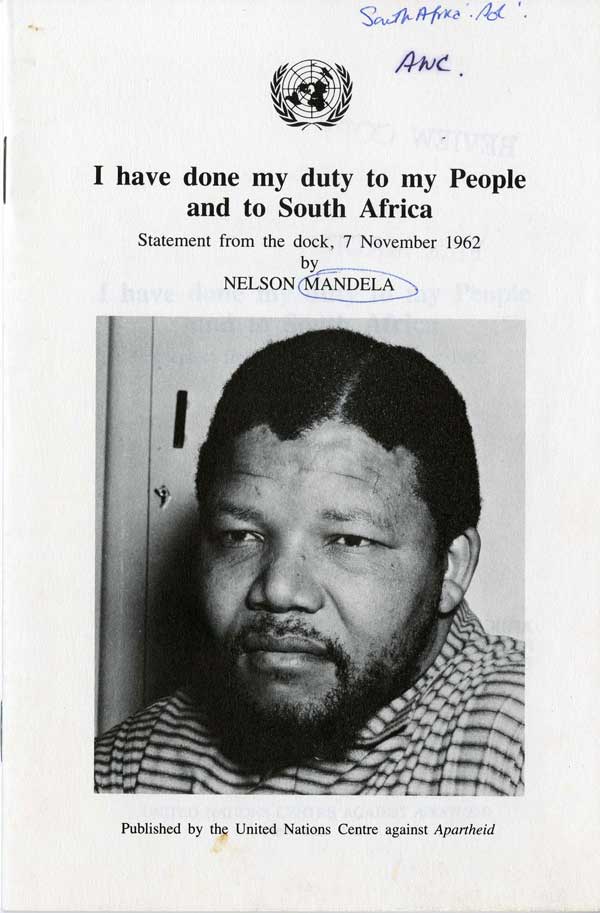
“I have done my duty to my People and South Africa,” pamphlet by Nelson Mandela, 1962, Leroy T. Walker Africa News Service Archive
“I have done my duty to my People and South Africa,” pamphlet by Nelson Mandela, 1962. Leroy T. Walker Africa News Service Archive


South African provincial election ballots, 1994, Nelson Mandela is listed as the candidate for the African National Congress
South African provincial election ballots, 1994. Nelson Mandela is listed as the candidate for the African National Congress.


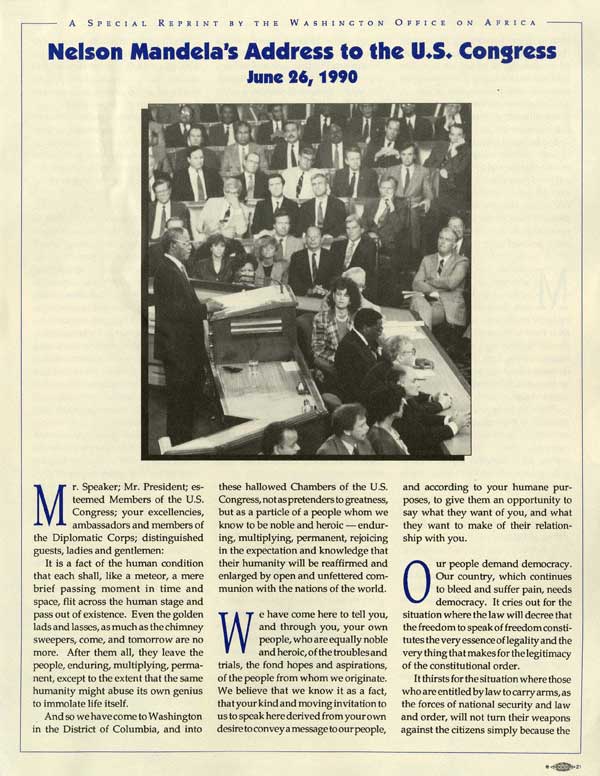
“Nelson Mandela’s Address to the US Congress,” article June 1990, Leroy T. Walker Africa News Service Archive
“Nelson Mandela’s Address to the US Congress,” article June 1990. Leroy T. Walker Africa News Service Archive.


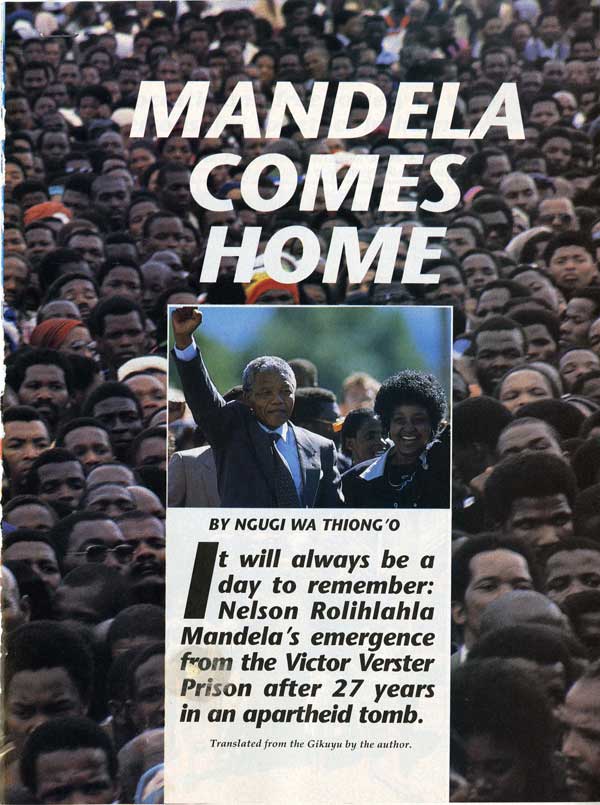
“Mandela Comes Home,” Time Magazine, Feb. 1990, Leroy T. Walker Africa News Service Archive
“Mandela Comes Home,” Time Magazine, Feb. 1990. Leroy T. Walker Africa News Service Archive.

Post contributed by John Gartrell, director of the John Hope Franklin Research Center for African and African American History and Culture.

The African Americans: Rubenstein Recap #6

Each Tuesday, PBS is showing the next installment of a six-part series, The African Americans: Many Rivers to Cross. Written and narrated by Dr. Henry Louis Gates, Jr., the documentary traces African American history from the shores of West Africa to the election of Barack Obama. Join us each week as we feature documents from the John Hope Franklin Research Center that resonate with the previous week’s episode.

The final episode of The African Americans: Many Rivers to Cross, “A More Perfect Union (1968 – 2013),” explored African Americans’ strides in the wake of the civil rights movement against the backdrop of deeply rooted inequalities that persist into the present. The extraordinary civil rights gains of the 1960s did little to undo the economic barriers facing black Americans. Black power – the dream to empower African Americans political and economically – became the rallying cry of the 1970s. During that decade, the Black Panther Party for Self Defense started community programs in Oakland, CA, while cultural nationalists embraced African heritage and art to spread the message that black was beautiful.

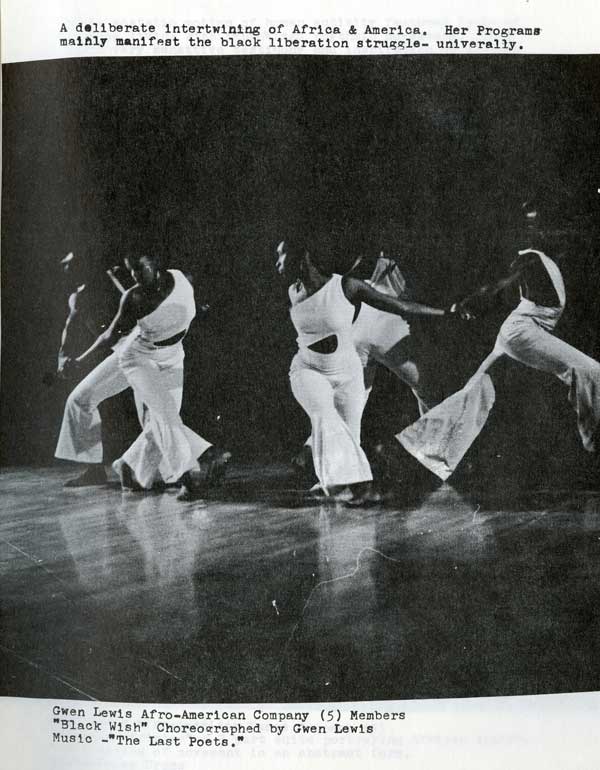
The Gwen Lewis Afro-American Company, a dance company in Oakland, was part of a flourishing black arts movement in the 1970s that saw reclaiming African heritage as part of the liberation struggle.
The Gwen Lewis Afro-American Company, a dance company in Oakland, was part of a flourishing black arts movement in the 1970s that saw reclaiming African heritage as part of the liberation struggle. Walter J. Taylor Papers, 1934 – 2000.

Affirmative action programs gave some African Americans the chance to attend elite colleges and climb corporate ladders and helped fuel a growing black middle class.

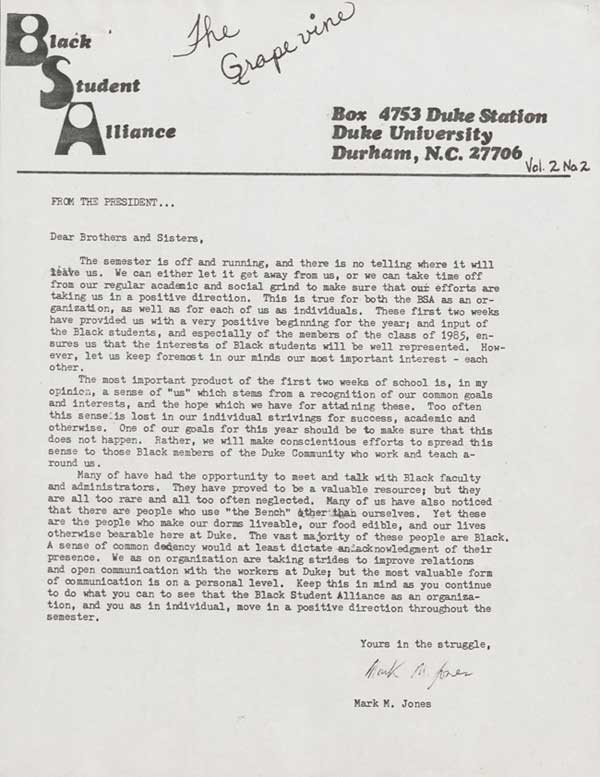
The Black Student Alliance at Duke was formed in 1969 and continued to provide support and represent the interest of African American students throughout the following decades. This 1981 newsletter, called The Grapevine, reminding black students that they are part of a community and urging them to reach out to both black faculty and black workers on Duke’s Campus.
The Black Student Alliance at Duke was formed in 1969 and continued to provide support and represent the interest of African American students throughout the following decades. This 1981 newsletter, called The Grapevine, reminding black students that they are part of a community and urging them to reach out to both black faculty and black workers on Duke’s Campus. Black Student Alliance records, 1969 – 2006.

But throughout the 1980s, the majority of black Americans found no escape from the poverty and unemployment that confined them to abandoned inner cities and rural areas.


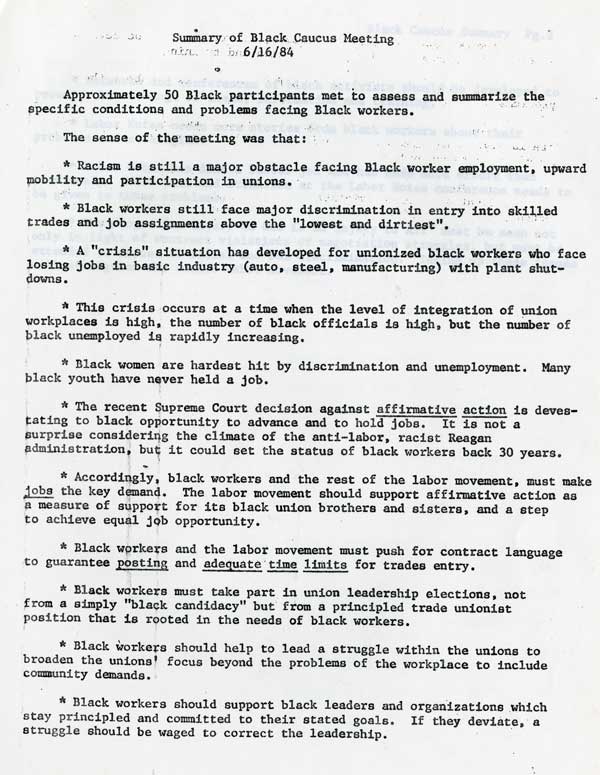
This list of observations drawn up by the Black Caucus, a labor group focused on African American workers, in 1984 laid out the tremendous barriers facing black workers twenty years after the civil rights movement.
This list of observations drawn up by the Black Caucus, a labor group focused on African American workers, in 1984 laid out the tremendous barriers facing black workers twenty years after the civil rights movement. Theresa El-Amin Papers, 1960s – 2010.


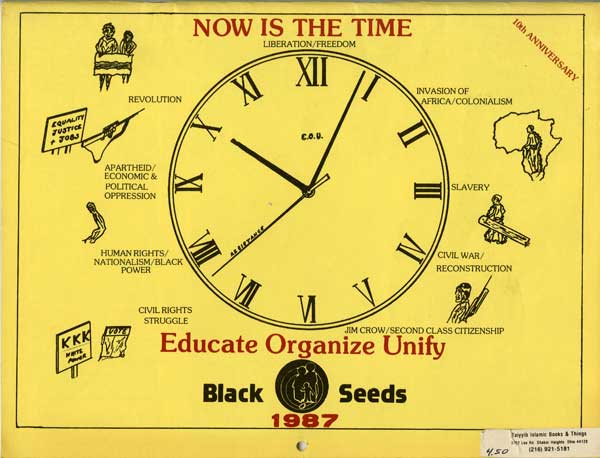
This 1987 calendar, published by the Black Seed organization, maps out the progression of the black liberation struggle. After the rising poverty and drug wars of the 1980s, the arms of the clock read that it’s revolution time.
This 1987 calendar, published by the Black Seed organization, maps out the progression of the black liberation struggle. After the rising poverty and drug wars of the 1980s, the arms of the clock read that it’s revolution time. Theresa El-Amin Papers, 1960s – 2010.

Ronald Reagan’s War on Drugs then targeted poor black neighborhoods and sent hundreds of thousands of black men to prison with harsh sentencing laws, a reality that lead to numerous legal battles in the last thirty years. Yet when Barack Obama was elected president in 2008, he fulfilled the dreams of centuries of African Americans. But as the effects of the disaster of Hurricane Katrina (2005) and controversy over the death of Trayvon Martin (2013) made clear, continuing racial inequality run deeper than one black president could solve.

Post contributed by Karlyn Forner, John Hope Franklin Research Center Graduate Intern.

Celebrating 175 Years of Duke History

Date: Friday, December 6, 2013
Time: 3:00-5:00 PM
Location: Perkins Gallery
Contact Information: Amy McDonald, amy.mcdonald(at)duke.edu

Join the staff of the Duke University Archives for a reception celebrating the exhibit, “Outrageous Ambitions: How a One-Room Schoolhouse Became a Research University,” currently on display in the Perkins Gallery.

175th Exhibit Banner, part 1

Enjoy light refreshments while you trace Duke University’s 175-year history through fascinating artifacts, photographs, architectural drawings, and other historical materials. The reception will also be an excellent chance to get a look at some of the University Archives’ recent acquisitions, which will be on display for the first time.

The exhibit will be on display through February 16, 2014 and was curated by Maureen McCormick Harlow, 175th Anniversary Intern in University Archives, and Valerie Gillispie, University Archivist.

Unable to make the reception? Visit the online exhibit!

175th Exhibit Banner, part 2

Achenbaum Dedicates Papers, Endows Hartman Center Travel Grants

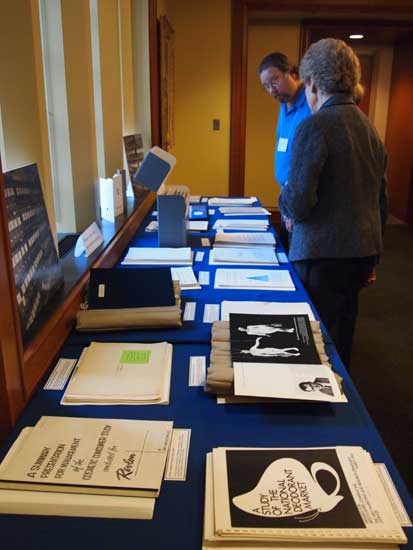
On Thursday, November 7th, twenty of Al Achenbaum’s family and close friends joined Duke library staff and faculty in a ceremony to dedicate his papers as part of the John W. Hartman Center for Sales, Advertising & Marketing History. In a series of comments given by Hartman Center staff, Achenbaum’s papers were lauded for their unique insight into building brand equity, strategic marketing planning, maximizing advertising agency-client relationships, and using systematic quantitative research as a guide to effective decision-making.

A display of materials from the Alvin Achenbaum Papers.
A display of materials from the Alvin A, Achenbaum Papers.

Over a remarkable 60-year career, he advised leading global marketers, including Procter & Gamble, GE, Toyota and Nestlé, on how to use marketing tools to improve the economic value of their businesses.  He held senior executive positions at four major advertising agencies in New York, and was chairman of a series of leading marketing consulting firms which provided over 150 companies with systematic tools for addressing complex business challenges.

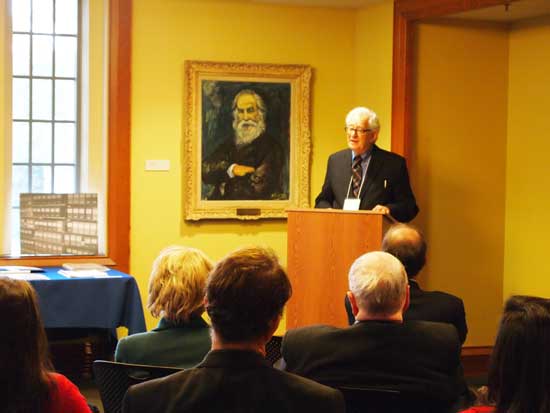
This 233-box collection will enrich the experiences of many students and scholars interested in the evolution of the advertising industry in the second half of the 20th century or the career of Al Achenbaum, known to many as the “Einstein of Advertising” and one of Advertising Age’s  100 most influential advertising people of the 20th century. Al’s son, Jon Achenbaum, described his father as the reason he started his own career in marketing, applying many of the marketing innovations that Al brought into the business world and read two passages from Al’s upcoming book.

Rounding out the event were remarks by Al Achenbaum himself, in which he stated that “marketing is the single most important driver of our modern economy” and that it will “continue to play a critical role in economic success – both in the U.S. and abroad.”  He expressed his gratitude to his family and friends for supporting him throughout his life and career and expressed his enthusiasm for donating his papers to Duke and the Hartman Center.

P1011531-web

To top off the ceremony, he announced that he is endowing the Hartman Center’s travel grant program, which will be named the Alvin A. Achenbaum Travel Grants.  These travel grants will enable students and scholars to come from afar to use Hartman Center collections as part of their research each year. Since Achenbaum is in many ways a scholar of advertising and marketing himself, this is a wonderful way to continue his legacy in perpetuity.

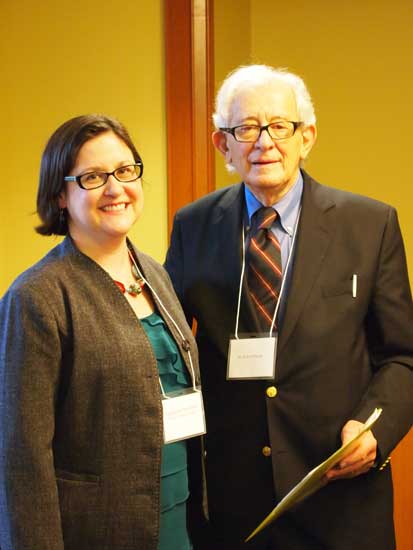
Hartman Center director Jackie Reid Wachholz and Al Achenbaum.

Post contributed by Jackie Reid Wachholz, director of the John W. Hartman Center for Sales, Advertising & Marketing History.