D is for Diaries, Drama, and Dracula

Buck and his chewing gum.

I’m lucky. As a volunteer at the RBMSCL, I’ve been creating finding aids for small manuscript collections—collections such as love letters and travel diaries from the 19th century—which can be more compelling than any historical novel. One in particular I found to be especially memorable is the John Buck Diary.

Elaborate script and comic sketches recount the eight week long vacation in England and Scotland in 1887 of John Buck, an affluent, young American who spent several days in close company with Henry Irving, the famous English actor; the equally famous actress and Irving’s rumored paramour, Ellen Terry; and the business manager of the Lyceum Theatre as well as Irving’s personal assistant, Bram Stoker. Yes, the Bram Stoker who later wrote Dracula. His visit begins with the Royal Lyceum’s performance of another popular demonic tale:

I reached Edinburgh at seven o’clock and was met by Mr. Stoker. He took me to the Edinburgh Hotel (close by the station) where Mr. Irving was staying. . . . Mr. Stoker after fixing me comfortably hurried away to the theatre and I had my dinner served in Mr. Irving’s dining room. The dinner was good but I was so anxious to see some of “Faust” that I left at the end of the third course and jumping into a hansom drove to the Royal Lyceum Theatre, where I found Mr. Stoker “laying” [?] for me. He . . . took me into the only remaining private box. Mephistopheles was just transforming Faust into a young man as I entered the box, so I had not missed much of the play. . . . At the end of the act Mr. Stoker took me around [to the stage] to see Mr. Irving and Miss Terry. . . . While we were chatting and I was being questioned about “home affairs” the scene shifters were building Marguerite’s room around us, and very soon I was compelled to “skip” as the curtain was about to be rung up. . . . Mr. Irving was grand, and he will make a tremendous hit with Faust in America. (pages 67-70)

One of Buck's sketches.

The diary is so extraordinarily descriptive and entertaining; it is as if Buck, who loved the theater, were writing the storyline for his own theatrical play. At times, I could imagine his diary recast as a BBC period drama! Equally remarkable is the extent to which Buck’s personality is so clearly revealed. He was sometimes irreverent and informal, even when visiting the Duke of Beaufort at Badminton House in Gloucestershire, highly competitive, a bit arrogant, and more interested in pretty young women, having fun, and socializing than sightseeing; he seemed so American, and so amazingly like a few modern young men that I have known.

Happy Halloween!

Post contributed by Danielle Moore, RBMSCL Technical Services volunteer.

Devil’s Food

Our celebration of National Dessert Month has been surprisingly chocolate-free, so we’re aiming to correct that today with recipes from Chocolate and Cocoa Recipes, published around 1922. Instead of boring candy bars, we at The Devil’s Tale want our plastic pumpkins filled with Devil’s Food cake!

Devil’s Food

2 cups sugar
3/4 cup butter
4 ounces Baker’s Premium No. 1 Chocolate
4 eggs (3 may be used)
2 1/4 cups flour
4 1/2 teaspoons baking powder
1/4 teaspoon salt
1 1/2 teaspoons cinnamon
1/4 teaspoon clove
1 1/4 cups milk

Cream butter and add sugar gradually, while beating to a cream; add chocolate, melted, and beaten yolks and mix thoroughly. Sift together flour, salt, cinnamon, clove and baking powder and add to butter mixture, alternately with the milk. At the last, fold in the stiffly beaten egg whites and bake in a deep pan and ice when cold.

And, just because you can never have too many chocolate recipes (and because there were no pictures of the Devil’s Food cake):

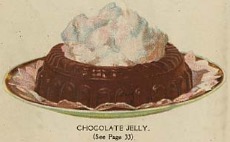
Chocolate Jelly

1 pint boiling water
Pinch salt
1 square Baker’s Premium No. 1 Chocolate
2 tablespoons gelatine
1/3 cup sugar
1 teaspoon vanilla

Put the water, salt and chocolate in a saucepan. Cook, stirring until the chocolate melts, then let it boil for three or five minutes. Soften the gelatine in a little cold water and pour the boiling mixture over it. Stir until disolved, then add sugar and vanilla. Pour into a mould and set aside to harden, serve with cream and powdered sugar or sweetened whipped cream.

RBMSCL Travel Grants: $$$ to Visit Us!

Photo by Mark Zupan.

Good news, researchers! The RBMSCL is now accepting applications for our 2011-2012 travel grants.

The Sallie Bingham Center for Women’s History and Culture, the John Hope Franklin Research Center for African and African American History and Culture, and the John W. Hartman Center for Sales, Advertising & Marketing History will award up to $1,000 per recipient to fund travel and other expenses related to visiting the RBMSCL. The grants are open to undergraduate and graduate students, faculty, independent scholars, artists, and activists living outside a 100-mile radius from Durham, NC with research projects that would benefit from access to the centers’ collections.

More details—and the grant application—may be found on our grants website. Applications must be postmarked or e-mailed no later than 5:00 PM EST on January 31, 2011. Recipients will be announced in March 2011.

We’re also excited to announce that the RBMSCL will be offering three new grants this year for scholars interested in using our German Studies and Judaica collections. Additional information about applying for one of these three grants will be available on our grants website soon. These new grants will have a later deadline.

Congratulations to the 2010 Middlesworth Award Winners!

On Friday, the RBMSCL celebrated with students and parents at one of our favorite events of the year: the Middlesworth Award and Durden Prize Reception.

Given annually, the Middlesworth Awards recognize the authors of the best undergraduate and graduate student papers based on research in the collections of the RBMSCL. Funding for the awards has been generously provided by Chester P. Middlesworth (A.B., 1949) of Statesville, NC.

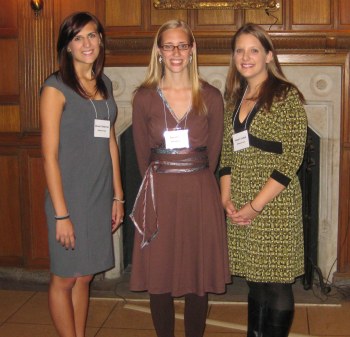
2010 Middlesworth Award winners Adrienne Niederriter, Bonnie Scott, and Hannah Craddock.

Undergraduate student winner Adrienne R. Niederriter plumbed the depths of the Hartman Center’s Ad*Access image database for her paper, “Speak Softly and Carry a Lipstick: Government Influence on Female Sexuality through Cosmetics during World War II.”

Undergraduate student winner Hannah C. Craddock received her award for her senior honors thesis, “‘A New Self-Respect and a New Consciousness of Power’: White Nurses, Black Soldiers, and the Danger of World War I.” Craddock’s study focused upon the Ann Henshaw Gardiner Papers and the Samuel Loomis Hypes Papers.

Graduate student winner Bonnie Scott’s paper began at the heart of Duke’s West Campus, as she compared sermons preached in the Duke Chapel to those preached by North Carolina minister Kenneth M. Johnson during the Civil Rights Movement.

Their papers will now become part of the RBMSCL’s collections.

We know that great papers are being researched and written this semester as well. If you are a Duke student, submit your paper and we might be toasting you next fall! Details about submitting your paper can be found here.

Rights! Camera! Action!: Brother Towns

Date: Monday, 1 November 2010
Time: 7:00 PM
Location: Carolina Theatre
Contact Information: Patrick Stawski, 919-660-5823 or patrick.stawski(at)duke.edu, or Kirston Johnson, 919-681-7963 or kirston.johnson(at)duke.edu

Brother Towns / Pueblos Hermanos (59 min.) is a story of two towns linked by immigration, family, and work: Jacaltenango, Guatemala, a highland Maya town, and Jupiter, Florida, a coastal resort town where many Jacaltecos have settled. The docunmentary film chronicles how and why people migrate across borders, how people make and remake their communities when they travel thousands of miles from home, and how people maintain families despite their travel. To learn more, visit the film’s website.

This screening is part of the Latin American Film Festival sponsored by the Consortium in Latin American and Caribbean Studies at UNC-Chapel Hill and Duke University, the Center for Documentary Studies, and the Carolina Theater and will be followed by a panel discussion (panelists TBD).

The Rights! Camera! Action! film series, which is sponsored by the Archive for Human Rights, the Archive of Documentary Arts, the Duke Human Rights Center, the Franklin Humanities Institute, and Screen/Society at Duke’s Arts of the Moving Image Program, features documentaries on human rights themes that were award winners at the annual Full Frame Documentary Film Festival. The films are archived at the RBMSCL, where they form part of a rich and expanding collection of human rights materials.

Not Even Covered in Chocolate Sauce

Wonders never quite cease at the RBMSCL. If ever there were a foodstuff that we strongly believed should not be associated with dessert, it was cauliflower. And then we discovered The Dessert Book: A Complete Manual from the Best American and Foreign Authorities with General Economical Recipes (written by a Boston Lady in 1872). So, in honor of National Dessert Month, we present:

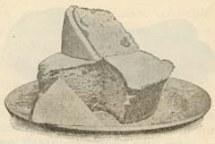
Not dessert.
Not dessert.

Meringues in the Form of Cauliflowers

Fill a biscuit-forcer with Italian meringue-paste, and push this out upon bands of paper, in knobs, or large dots, superposed or mounted one upon the other in such form or fashion, that, when complete, it shall represent, as nearly as possible, the head, or white part, of a cauliflower (of course, on a very diminished scale, of the size of a pigeon’s egg, for instance): this pat of the cauliflower, when fashioned, is to be sprinkled over with rather coarse granite sugar.

The under part, or green leaves, which envelop a cauliflower, are imitated in a somewhat similar manner to the above by pushing out the paste in pointed dots upon bands of paper, in the manner and form as directed for the imitation of the heads, only somewhat flatter: these, in order the better to represent green leaves, are to be sprinkled over with green granite sugar; and when both parts have been dried in the closet, or screen, stick the head, or white part, upon the leafy or green part; thus you will form more or less truthful imitation of a cauliflower, according as in a greater or lesser degree you may have displayed your taste.

Should you want to make these for your next dinner party—imagine the aghast looks on your guests’ faces!—you’ll find the recipe for Italian Meringues after the jump.

Continue reading Not Even Covered in Chocolate Sauce

In Conversation: Michael Cuscuna

Date: Wednesday, 27 October 2010
Time: 7:00 PM
Location: Regulator Bookshop
Contact Information: Jeremy Smith, 919-660-5839 or jeremy.smith(at)duke.edu

Grammy Award winning record producer Michael Cuscuna (Blue Note Records, Mosaic Records) will discuss his work producing the recordings of jazz pianist Horace Silver.

Silver was one of the leading composers and pianists of the hard bop era of jazz, and his music will be the focus of a concert by the SFJAZZ Collective the following evening at Page Auditorium.

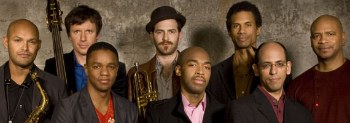
SFJAZZ Collective

This event is co-sponsored by Duke Performances and the Jazz Archive.

Pictures at an Exhibition

Click to enlarge.

On Friday, library staff members and UNC SILS students gathered for an impromptu gallery talk for our new exhibit, “Book + Art: Artists’ books from the Sallie Bingham Center for Women’s History and Culture,” led by curators Christine Wells and Kelly Wooten and exhibits coordinator Meg Brown. For more pictures from the gallery talk, visit the Bingham Center’s Flickr photostream.

And remember: book artist and photographer Bea Nettles will be speaking tomorrow at 5:30 PM in the Rare Book Room as part of this fall’s Book + Art series of events!

Stories of SNCC

Date: Sunday, 24 October 2010 
Time: 3:00 PM
Location: Durham County Library Auditorium, 300 N. Roxboro Street
Contact Information: Will Hansen, 919-660-5958 or william.hansen(at)duke.edu

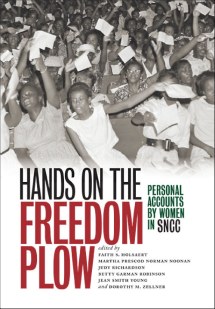
To celebrate the publication of the essay collection, Hands on the Freedom Plow: Personal Accounts by Women in SNCC, editor Faith S. Holsaert (whose papers are held by RBMSCL) and contributor Margaret Herring will speak along with Nia Wilson, Executive Director, and Mya Hunter, member of SpiritHouse, a local grassroots organization that supports the empowerment, transformation, and self-determination of marginalized communities of color.

In Hands on the Freedom Plow, fifty-two women—northern and southern, young and old, urban and rural, black, white, and Latina—share their courageous personal stories of working for the Student Nonviolent Coordinating Committee (SNCC) on the front lines of the Civil Rights Movement. Along with these stories, participants in the panel will discuss the legacy and continuing work of women for civil rights and equality.

This event is co-sponsored by the Sallie Bingham Center for Women’s History and Culture, the North Carolina Collection at Durham County Library, and The Regulator Bookshop.

Voting = Cake

In honor of National Dessert Month (which everyone celebrates, right?), we’ll be posting recipes from the RBMSCL’s collection every Friday this month. Last Friday—The Devil’s Tale’s first birthday—we started the celebration with a recipe for a pretty pink birthday cake.

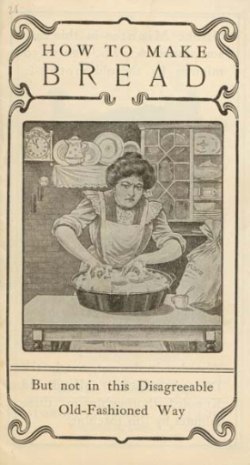
Today’s recipe comes from an advertising brochure with a marvelous title: How to Make Bread (But Not in This Disagreeable Old-Fashioned Way). Really, we’re not making that up:

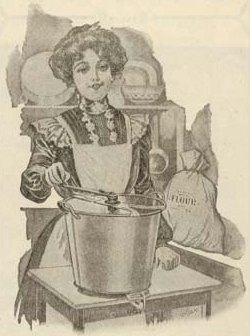
You see, this brochure advises the smart homemaker to purchase The Universal Three Minute Bread Maker from Landers, Frary & Clark (of New Britain, Connecticut). The transformation is nothing short of astonishing:

And, of course, no advertisement for an absolutely revolutionary bit of kitchen gadgetry would be complete without a few recipes to make with said gadgetry. So, in honor of a certain approaching first Tuesday in November, we offer this fine recipe:

Loaf, or Election Cake

Put into the Bread Maker one and one-half cups milk, one cup potato yeast, one cup sugar, five cups flour, turn crank three minutes, put on cover and raise till light. When light, add one cup shortening, (half butter and lard), one cup sugar, whites of two eggs, nutmeg to season, turn crank five minutes, cover and raise again till light. Fill pans with batter and fruit (raisins or citron, or both), well floured alternately, until pans are two-thirds full, add also fruit on top.

The cake should stand in the pans about one-half hour and then be baked in a moderate oven.

Now we’re off to eBay to find a 100-year-old Universal Three Minute Bread Maker.

Dispatches from the David M. Rubenstein Rare Book and Manuscript Library at Duke University