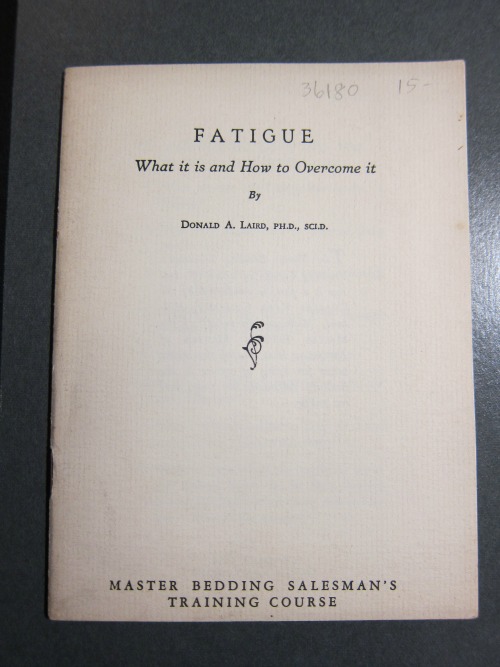
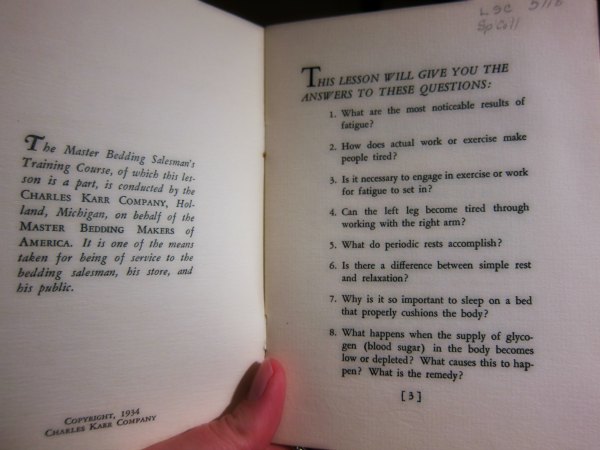
Dr. Laird describes fatigue as “a diminished capacity for doing work, and diminished capacity for enjoying life,” and describes symptoms as irritability, bad temper, nervousness, and peplessness.
If you are pepless or suffering from other symptoms of late-semester fatigue, here are some suggestions from the booklet:
“The bed equipment should be used by the housewife for a few minutes several times during the day. It is not essential to sleep, but to lie down on a cushion that makes it possible to relax.”
“Sometimes excitement from the day makes it difficult to relax, even on a well-designed sleep cushion. The condition will be helped by a sleeping room that is designed and decorated to promote calming down emotionally by the judicious use of blues and greens.”
“The muscular relaxation coaxed by the bed cushion, in fact, will help mental calming down, just as a good way to overcome anger is to try to smile and not act angry.”
While this pamphlet was published almost 80 years ago and some of the advice seems less than scientific, this section seemed especially appropriate even today:
“The present generation probably needs at least better sleep than the previous generations. Radio programs, sleep-disturbing night noises from traffic, a greater assortment of time and energy consuming evening pleasures made possible by electricity all probably keep us from getting as much sleep as our fathers did. Then the emotional strain of modern high speed automobile traffic, and the present gnawing apprehension caused by the depression, also conspire to make us need the safety-valve of dreams as never before.”
Replace “radio programs” with “the internet” and “evening pleasures made possible by electricity” with “smartphones,” and that sentence is quite modern sounding.
The final section of the pamphlet gives advice to the Master Bedding salesman on prescribing the appropriate kind of mattress just as a doctor would prescribe a medicine. Naturally, the booklet warns against selling the cheapest mattress: “One’s bed is in reality one’s best friend, and to practice false economy at its expense is indeed false reasoning.” You wouldn’t be cheap with your best friend, would you?
Smile, paint your bedroom blue, and lie down for a bit. Doctor’s orders.
If you’d like to learn more, the Rubenstein Library also holds the companion pamphlet in the Master Bedding salesman’s training course: A New Mattress Era by Marvin C. Lindeman.
Post contributed by Rachel Penniman, Rubenstein Library Assistant for Research and Technical Services.
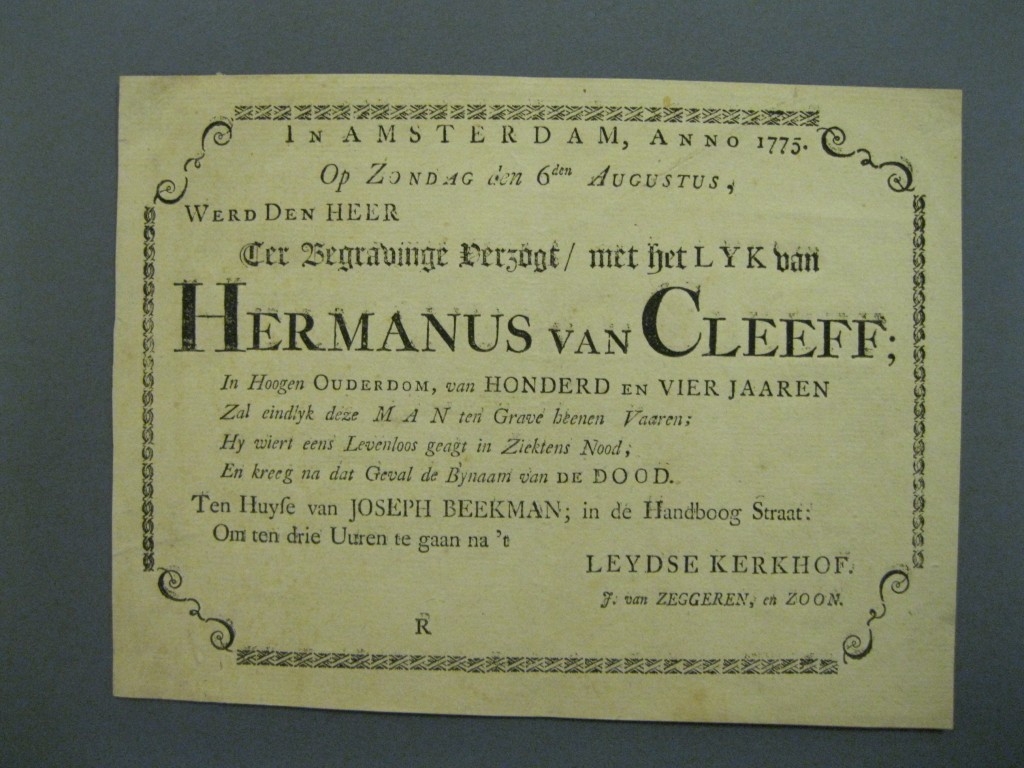
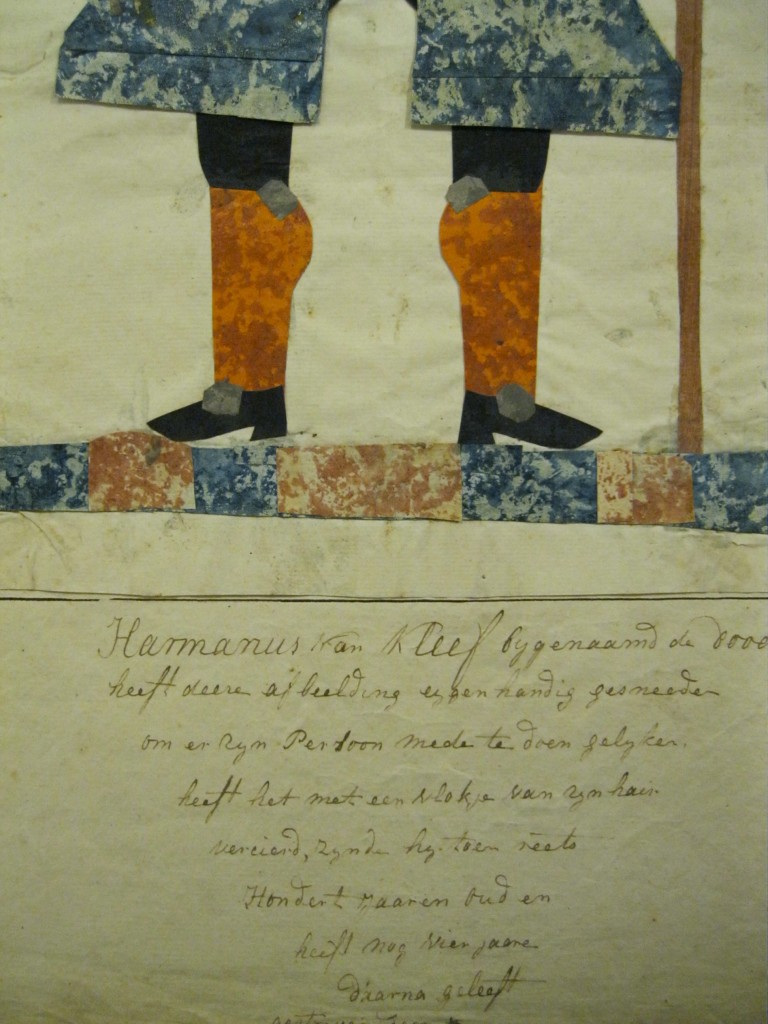
In Amsterdam, in the year 1775, on Sunday, the 6th of August, will be interred the body of Hermanus van Cleeff; in high old age, 104 years, shall finally this MAN be put into his grave; he was once lifeless, in dire need, but revived; and acquired after that event the nickname of Death.
Thus begins a burial announcement that found its way into the History of Medicine Collection Picture File, an assembly of posters, cartoons, engravings, and caricatures all relating to the practice of medicine. The collection is currently being arranged and described, and there are some interesting finds throughout.
In actuality there are three pieces to this funerary group, which was purchased from the Shuman family – rare book and manuscript dealers from whom Dr. Josiah Trent, surgeon and Duke Medical School faculty member, acquired most of his rich collection in medical history.
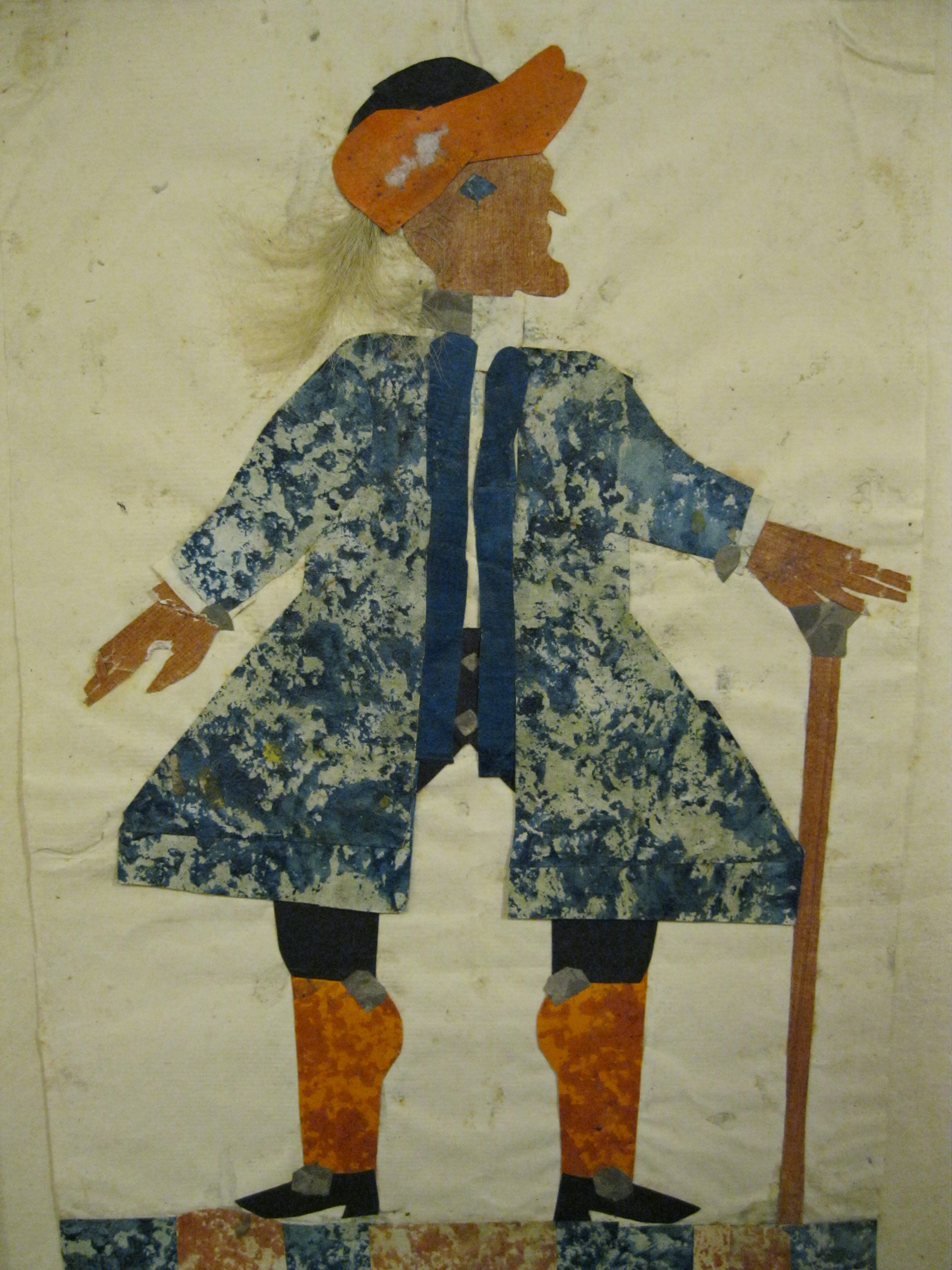
The first two items – the printed burial notice, and its English translation on University of Chicago letterhead – are intriguing enough. But the third piece captivates the imagination: a lively self-portrait of an old man with a cane, allegedly the centenarian himself, fashioned from colored paper and finished off with a real lock of white hair (ostensibly human).
The English translation to the caption under the silhouette states that “Hermanus van Kleef, nicknamed Death, has cut out his picture with his own hand, made it look like his own person, provided it with a lock of his hair. One hundred years old and lived yet four years thereafter…”
I haven’t been able to discover who Hermanus van Kleef (or Cleeff) was – he may have been an ancestor of the famous Jewish family that later founded the jewelers Van Cleef and Arpels. As I gaze at this little figure triumphantly standing his ground, I congratulate him for cheating death through this wonderful piece of self-expression!
Post contributed by Paula Jeannet Mangiafico, Senior Processing Archivist in Rubenstein Technical Services.
Anyone reading this blog knows that archives are full of wonderfully weird ephemera just waiting to be discovered and discussed, of conversations waiting to happen. This is the story of two archives that, it turns out, have a lot to talk about.
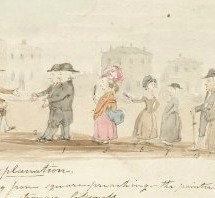
“Sunday evening in St. James’s, Barton,” from the John Rylands University Library
Ostensibly, this is a doodle, maybe an early comic. It depicts an ordinary meeting between preachers and parishioners. Only one thing stands out: the stocky girl just off the center dressed in bright pink and orange, while everyone around her wears drab brown. Look closer and you see that she her awkwardness is not limited to her dress: oblivious to the women gossiping behind her, our young heroine “stands, patiently, while her papa shakes hands with all the colliers, not knowing but she must do so too – a perfect pattern! Dear lady!” This oblivious fool is also the artist.
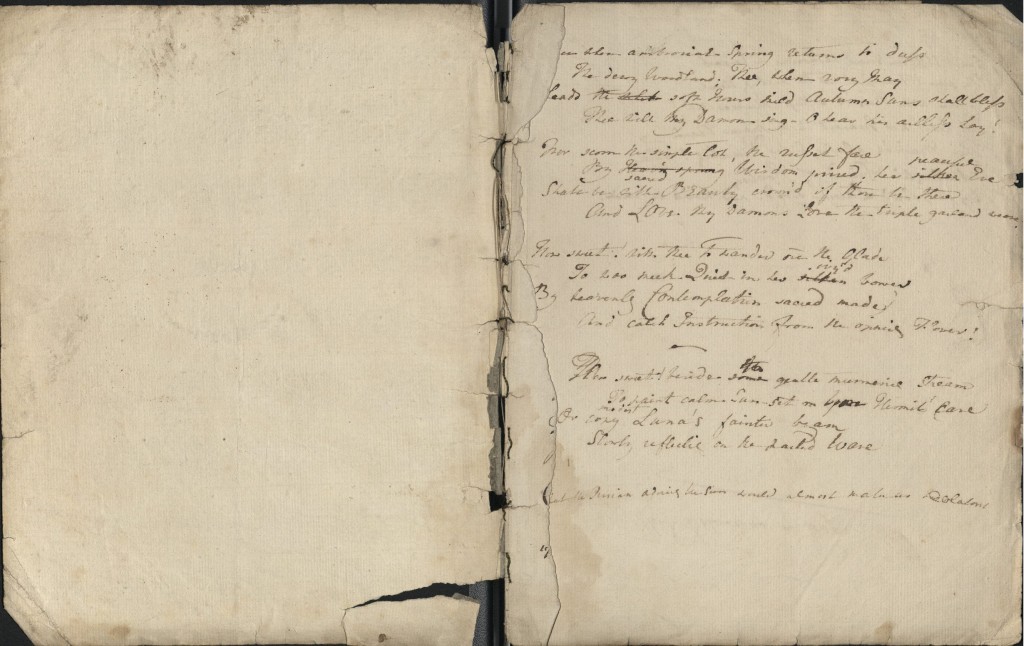
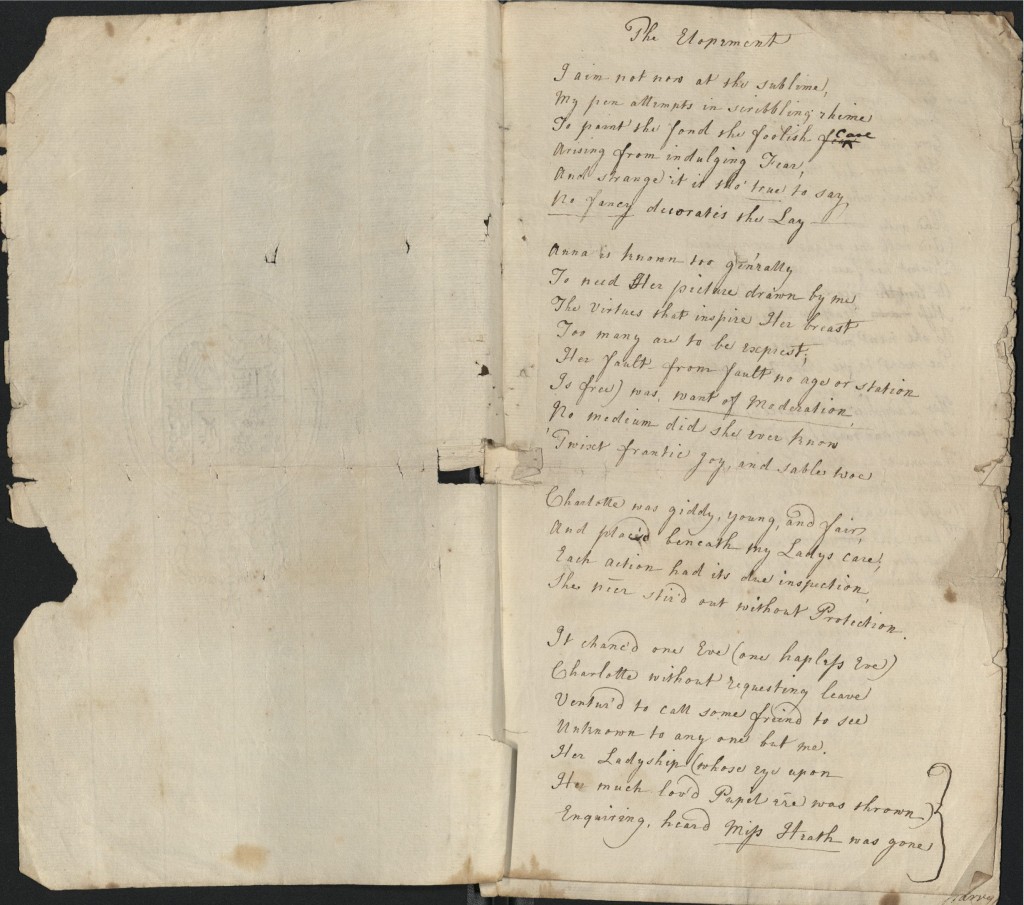
Cut to our own archive: Two summers ago, I was working in the Frank Baker Collection of Wesleyana and British Methodism when I came upon some poems. Having cataloged plenty of manuscript materials within the collection, I wouldn’t have thought much of them, except I noticed that they were tied together with string. Fanciful English student that I am, I recalled that Emily Dickinson’s manuscripts had been likewise fashioned together, and so began my grandiose visions: had I stumbled upon the British Emily? Could these poems help to reinvigorate the field of 18th-century women’s poetry – revolutionize it, even? It’s the fantasy held dear by every budding academic: to discover the next Milton or Frost, to shake the scholarly world to its core. Needless to say, literary scholarship remains unshaken, but it does have a new name on its register: Sarah Wesley.
The poems I found were written by our pink-and-orange artiste, the daughter of Charles Wesley, a co-founder of British Methodism. What is so fascinating about Sarah Wesley is her outright resistance to the restrictive practices of her every-day life – and how, perhaps as a result of that resistance, she has since all but disappeared from most histories of British Methodism.
Bound manuscript with Sarah Wesley’s writings in the Frank Baker Collection.
Her poetry in particular served as an outlet for questioning her father’s religion, as well as engaging with emergent conversations about the rights of women. Even while Wesley’s social commitments were progressive, she remained a devout Methodist throughout her life. But through her writing, most of which she kept hidden away from the judgmental eyes of her community, Wesley takes us to a place we don’t often think of when we read the eighteenth century: the private mind of the teenage girl.
Caitlin Flanagan’s recent book Girl Land (Little, Brown and Co., 2012) makes a compelling case for the fundamental significance of a particular marker of female adolescence: that time when a girl recedes into her room for a few years and emerges a brooding melodramatic for a few more. Flanagan posits that as a society, we take too lightly “a girl’s sudden need to withdraw from the world for a while and inhabit a secret emotional life” (1). But in fact, this is time and space that young girls need in order to come to terms with the world and their place within it. And so, Flanagan urges us to celebrate, rather than denigrate, the importance of this space she calls “girl land.”
Flanagan’s study is predicated on a particular reading of the history of the teenager. But even before “adolescence” became a discrete intellectual category in the twentieth century, Sarah Wesley was, in many ways, a typically modern teenage girl.
She wrote poetry that was evocative, romantic, and highly self-reflexive:
The Pilot Reason stays on Shore, The boisr’ous Passions more, Youth is the Ship and Hope the Oar, And O! the Sea is Love!
~from “Sonnet,” 1770
In particular, much of her work is preoccupied with exploring her budding sexuality:
Her Eyes enraptur’d shall your Beauties own Her snowy Fingers be your Virgin Lone! Her Lips shall bid Thee with a sigh Adieu! Her Lips shall greet Thee with ambrosial Dew! Descending showers shall fall from Heaven to gaze! Within your silken Folds shall Graces lie And panting Zephryss on your Bosom die! The Muse shall stamp Thee with Idalia’s Crest, And Venus court Thee to adorn her Breast.
~from “On receiving a Nosegay,” n.d.
However, she was not without some snark when it came to matters of romance:
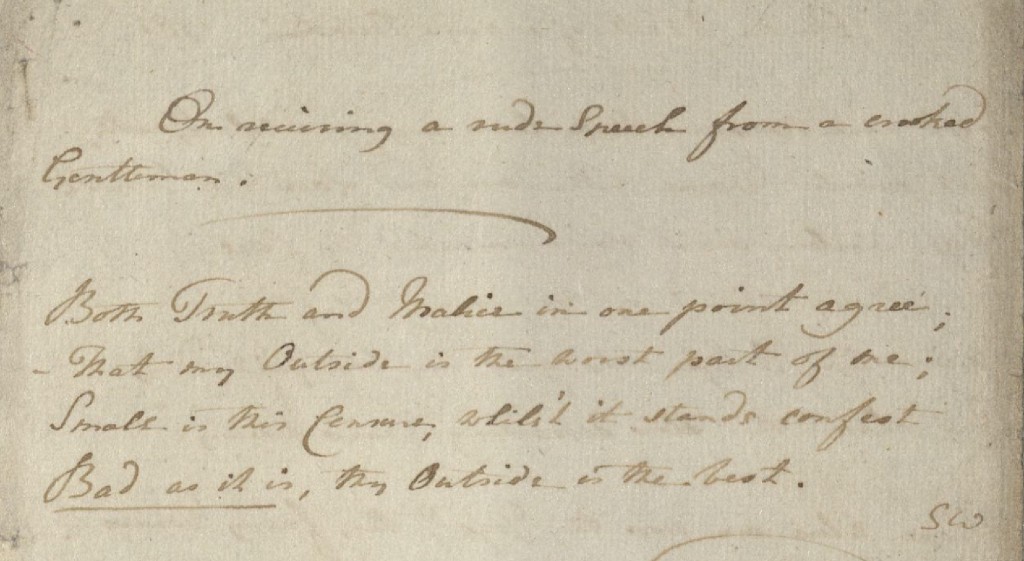
Both Truth and Malice on one point agree That my outside is the worst part of me Small is the censure, whilst it stands confest Bad as it is, thy outside is the Best!
~“Epigram: on receiving a rude Speech from a Crooked Gentleman,” 1777
As we saw in the drawing from the Manchester archive, she held some anxiety over her appearance and the perceptions of others.
And in perhaps the defining feature of “girl land,” she was adamant about challenging the values she inherited from her family in order to come to her own understanding of her world (for more on the particulars of Wesley’s intellectual rebellion, see my essay in the Winter 2013 volume of Eighteenth-Century Studies, which expounds on her feminist and abolitionist interests).
“The Elopement” figures prominently in Koretsky’s article, “Sarah Wesley, British Methodism, and the Feminist Question, Again,” Eighteenth-Century Studies 46.2 (Winter 2013), pages 223-237.
So did my work in the Frank Baker Collection yield the next Emily Dickinson? Not exactly. At the level of versification, Wesley’s poetry is derivative at best. But in the connections she asks us to draw between religion and the secular discourses of the key social issues at the end of the eighteenth century, Wesley’s voice raises many productive questions, which I hope eighteenth-century scholars will continue to engage. And further still, the familiar tenor of her poetry demonstrates the persistence of “girl land,” and how productive that sometimes alien-seeming place can be.
Post contributed by Deanna Koretsky, a Ph.D. candidate in the Duke English Dept. and a graduate student assistant in Technical Services.
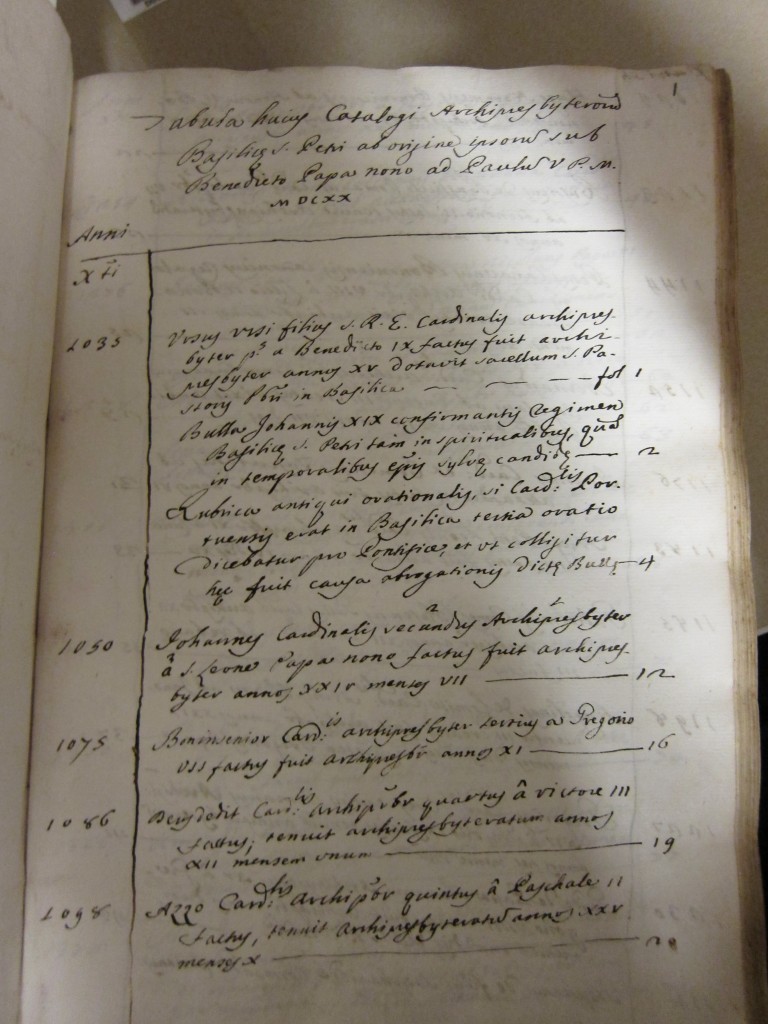
Vatican history is not something the Rubenstein Library actively collects, but it is always fun to discover how our materials relate to current events, like the election of a new pope. Over lunch one day last week, several of us archivists began wondering what sort of collections we have related to popes. A quick search in our catalog uncovered this volume, the Basilica di San Pietro in Vaticano Records, which is described as “Copies of records in Latin and Italian, including the catalogue of all archpriests of the Vatican Basilica of St. Peter from Pope Benedict (1032-1045) to Pope Paul V (1605-1621); the succession of canons in the Vatican Basilica of St. Peter; and decrees of the council for propagating the faith.”
“Copies of records” normally don’t bring a pitter-patter to the archivist’s heart, but the fact that the volume was dated 1620-1751 made it seem worth taking a look. We called back the item from the Library Service Center. It is a hefty vellum-bound tome, about two-thirds blank, interspersed with pages of handwritten Italian and Latin. The first part of the book has a list of popes, beginning in 1035 and ending in 1620. Later entries date from the 18th century, explaining where the 1751 date came from in the original catalog record.
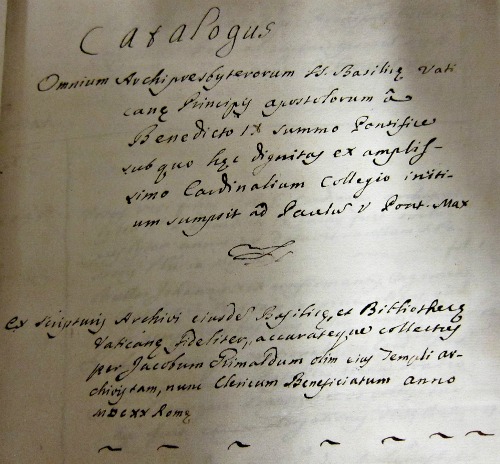
Now that we had the book in hand, we were curious about its origins. Who wrote the book? The spine’s label reads “Miscellan. MS.,” and the date span, different handwriting styles, and numerous blank pages suggest that there are multiple authors within the text. However, the only name we came across (other than various names of popes) was Jacobum Grimaldum, on the first page. The book’s title page appears to say that “From the writings of the archive and the Basilica and from the library of the Vatican, the catalogue[?] was collected by Jacobum Grimaldum, once the archivist of the temple, now a distinguished cleric. 1620 Rome.”
Research by our rare book cataloger revealed that what at first looked like Jacobum Grimaldum is probably a version of Giacomo Grimaldi (1560-1623), an archivist at the Vatican. Grimaldi authored hundreds of unpublished texts on the history and artwork of the Vatican. His drawings are some of the only evidence remaining of certain tombs, mosaics, and monuments following renovations of St. Peter’s Basilica under Pope Paul V. The more we learned about Grimaldi, the more we liked him. Grimaldi’s research and conservation efforts preserved many of the early church’s altars, tombs, and artwork in the Vatican grottoes, still accessible today.
Although this manuscript is only a part of the larger bound miscellany, circumstantial evidence supports the theory that this part of the book was authored by Grimaldi. For one thing, the content matches Grimaldi’s interests in Vatican history and records. Also, according to Oxford Art Online, Grimaldi was elected notary and archivist of St. Peter’s in 1581 and died in 1623, putting this work’s date of 1620 within his lifespan. Of course, at this point there is no way to know whether what we have at Duke is something written in Grimaldi’s hand, or whether it is just a copy of his work by some random monk. If someone out there is an expert on Grimaldi handwriting, we’d love to hear from you.
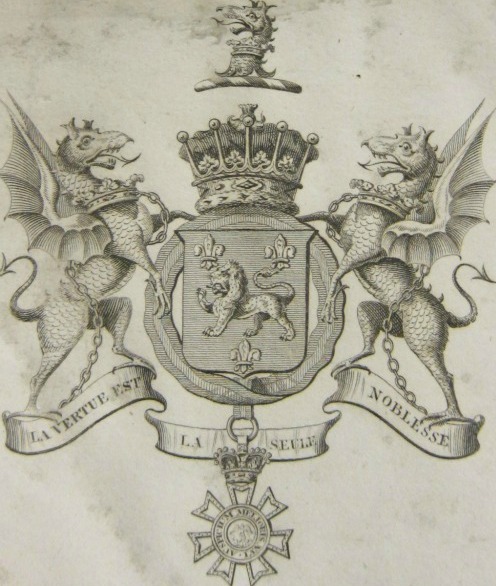
We were also curious about how Duke came to own this miscellany. All we knew about it was that it had been owned by the library for a long time. Our curator of collections checked the records, and found it was purchased from a book dealer in London for $25.00 in the 1950s. Good deal, but a dead end in terms of provenance. We decided to try the bookplate.
Fortunately, Google helped us here: A search of the motto got lots of hits, all directing to the Earl of Guilford. But which one? This helpful page narrowed it down to Frederick North, 5th Earl of Guilford, by pointing out the medal at the bottom of the bookplate was not established until 1818. Guilford must have owned this volume at some point between 1818 and his death in 1827. Additional searches uncovered the British Library’s Guilford Project, which describes the Library’s attempts to digitize and catalog its holdings of Guilford’s manuscripts. The project website mentions that following his death, Guilford’s vast collection of manuscripts were sold at several auctions, including a “large number of early modern manuscripts relating to Italian history and European diplomacy, with particular emphasis on Venice and the Papacy.” This would explain how this volume of miscellaneous manuscripts came to the market in England, and how Duke eventually acquired it. Furthermore, surely the good Earl of Guilford had the knowledge and expertise to buy an original Grimaldi manuscript, not someone else’s copy. Right?
Post contributed by Meghan Lyon, Technical Services Archivist.
Update: An earlier version of the post led with the phrase that Vatican history is not something Duke actively collects, but that is inaccurate: plenty of Vatican history is available in the Divinity School Library.
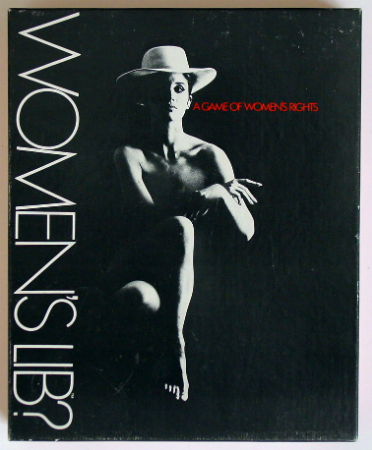
In the wake of our collections move, I came across a board game, “Women’s Lib? A Game of Women’s Rights.” As a child of the seventies, the box’s Bob Fosse-esque cover image caught my eye, as did the oh-so-1970 line drawings that reminded me of Schoolhouse Rock and other educational cartoons of my youth. However, this board game has a decidedly adult theme.
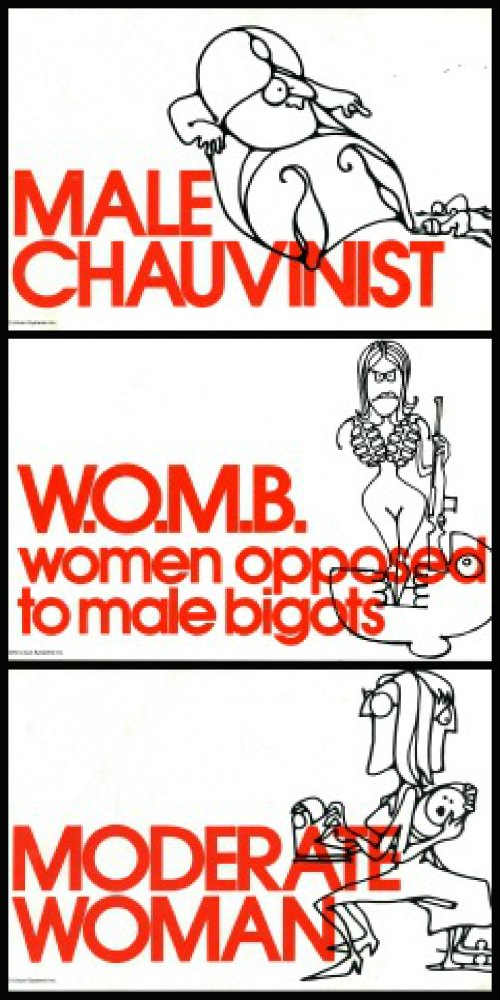
Each player selects a character that represents one of six different stances on the Women’s Liberation Movement, ranging from “Male Chauvinist” to “Moderate Woman,” to “W.O.M.B. (Women Opposed to Male Bigots).” Characters then vote on contemporary issues as prompted by playing cards. These topics are familiar to us over 40 years later: Abortion, Day Care, Employment Equality, Women’ Legislation and Domestic Issues. In fact, the only category on the election docket that we don’t hear much about today is “Male Contraception.”
Points are awarded to players who successfully campaign and debate to achieve the goals favored by the character they represent. The game sets out to educate players about controversial gender issues in a rapidly changing world. Although this piece of memorabilia seems anachronistic today, the topics it addresses are still extremely relevant.
Usually catalogers spend most of our time thinking about appropriate subject headings, title added entries, transcription of titles and other useful information. We have developed efficient ways to do this quickly and accurately and aren’t often conscious of our role in preserving a book because it is an historical object. Sometimes, however, there is something about a book that brings the cataloging process to a temporary standstill.
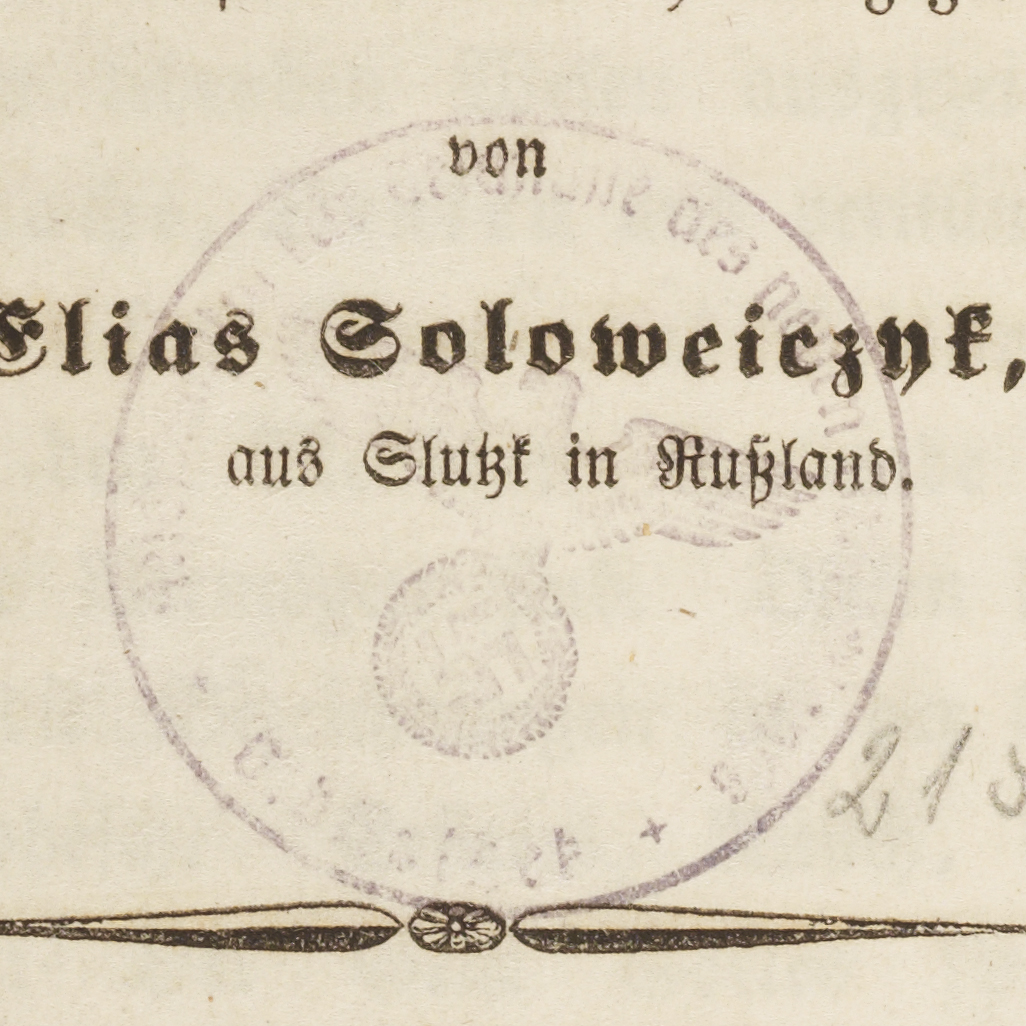
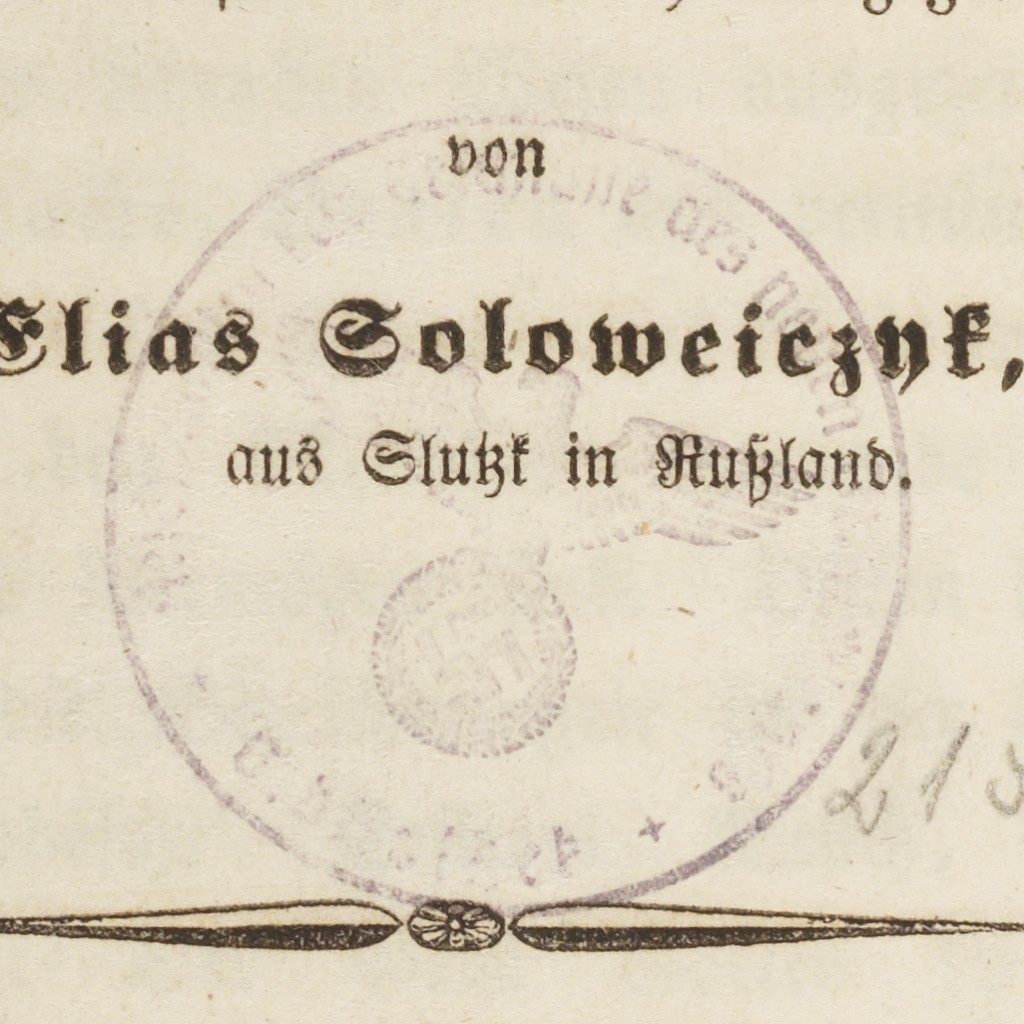
A book that was acquired recently as part of the German Judaica Project suddenly made me stop and think about the history of Europe during the Nazi period. The particular title in question is Jad hachasakah, oder Mischna Thorah, 1. Buch. Maddah, published in 1846 by E.J. Dalkowski in Königsberg (once the capital of Prussia, now known as Kaliningrad). It was edited by Elias Soloweiczyk “aus Slutzk in Russland.” (Slutzk, or Slutsk, is a town near St. Petersburg.) There are hundreds of editions and commentaries of Moses Maimonides works, edited by a wide variety of authors and there isn’t anything too unusual about the text of the book. It isn’t even extremely rare, as there is at least one other copy in the United States. What is very interesting is that, clearly stamped on the title page, is the ownership mark of one of the libraries of the Nationalsozialistische Deutsche Arbeiter-Partei Schutzstaffel or “SS.” It’s unfortunate that the identity of the specific library is not quite clear, but the central symbol is distinctive.
So many questions came to my mind as I cataloged: How did this little volume manage to survive the war at all, since Jewish libraries were systematically destroyed? How did it arrive in the hands of the SS, who were definitely part of the destruction? Why did they save it? Did it possibly serve a purpose in the officer training schools as an example of why Judaism should be destroyed? How did this it survive the destruction of the SS libraries after the war and find its way first to the United States and finally to Duke?
This little ownership stamp also reminded me of a cataloging project that I completed in the 1980s. It was a large collection of pamphlets that was given to the library following World War II. They were materials literally picked up from the streets or plucked from the waste bins as the libraries belonging to the Nazis were dismantled. They remain a treasure-trove of everything from official Nazi propaganda on race to manuals for pistols. Many of the items had ownership stamps similar to the one in the Maimonides work described above. In order to more easily locate these resources, we devised two categories of locally developed subject headings: Nazi period (further subdivided by place of publication and date) and Provenance (followed by the former owner).
It seems serendipitous that I would catalog the new title because I am probably the only cataloger who would realize the philosophical connection to the earlier project and create the same type of subject added entries.
Post contributed by Lois Schultz, Catalog Librarian for Monographic Resources in Perkins Technical Services.
We are in the middle of processing the John Hope Franklin Papers, and it has been inspiring to see Franklin’s wide range of intellectual interests and community engagements. He was a very busy man! One recent discovery, mixed in with folded programs and family correspondence, is Franklin’s “Grownup School List,” an all-encompassing list he created of must-reads in African American history. Always a humble scholar, he omitted his own monumental works. We’ve reproduced the Grownup School List here, along with Franklin’s annotations. You can find all of these books, along with Franklin’s own extensive scholarship, online or in the Duke Libraries.
Frederick Douglass, My Bondage and My Freedom (1855). “A remarkable work by a former slave who became a leading thinker and activist in post-Emancipation America.”
W.E.B. DuBois, Souls of Black Folk (1903). “This classic clearly delineates the utter frustration of African Americans who attempt to adjust to the American racial jungle.”
Darlene Clark Hine, Black Women in America (1993). “A comprehensive biographical tool providing topic information on notable African American women.”
Kenneth Stampp, The Peculiar Institution (1956). “A remarkable book that deromanticizes slavery in the United States. One of the pioneer works undertaking to refute the apologists for slavery.”
Gunnar Myrdal, An American Dilemma: The Negro Problem and Modern Democracy (1944). “In many ways this is the most comprehensive treatment of the nexus of race and American social, economics, and political institutions in the post World War II years.”
August Meier and Elliott Rudwick, Black History and the Historical Profession (1986). “A remarkable history and analysis of the way in which African American history has affected historians and their craft.”
Post contributed by Meghan Lyon, Technical Services Archivist. This is the second in a series of posts on interesting documents in our collections to celebrate Black History Month.
As the German Judaica Intern for the Rubenstein Rare Book and Manuscript Library, I have had the opportunity to work with a number of rare and interesting materials. I am currently processing a collection of German Judaica books dating from the late eighteenth century through the twentieth century. These materials represent a range of topics, including prayer books, histories of the Jewish people, commentary in German on Jewish religious texts, Zionism, and works on the “Jewish question.” My job is to catalog these books so that they can be made available to the public. Over the course of this project several books have piqued my interest, and I would like to share them with you.
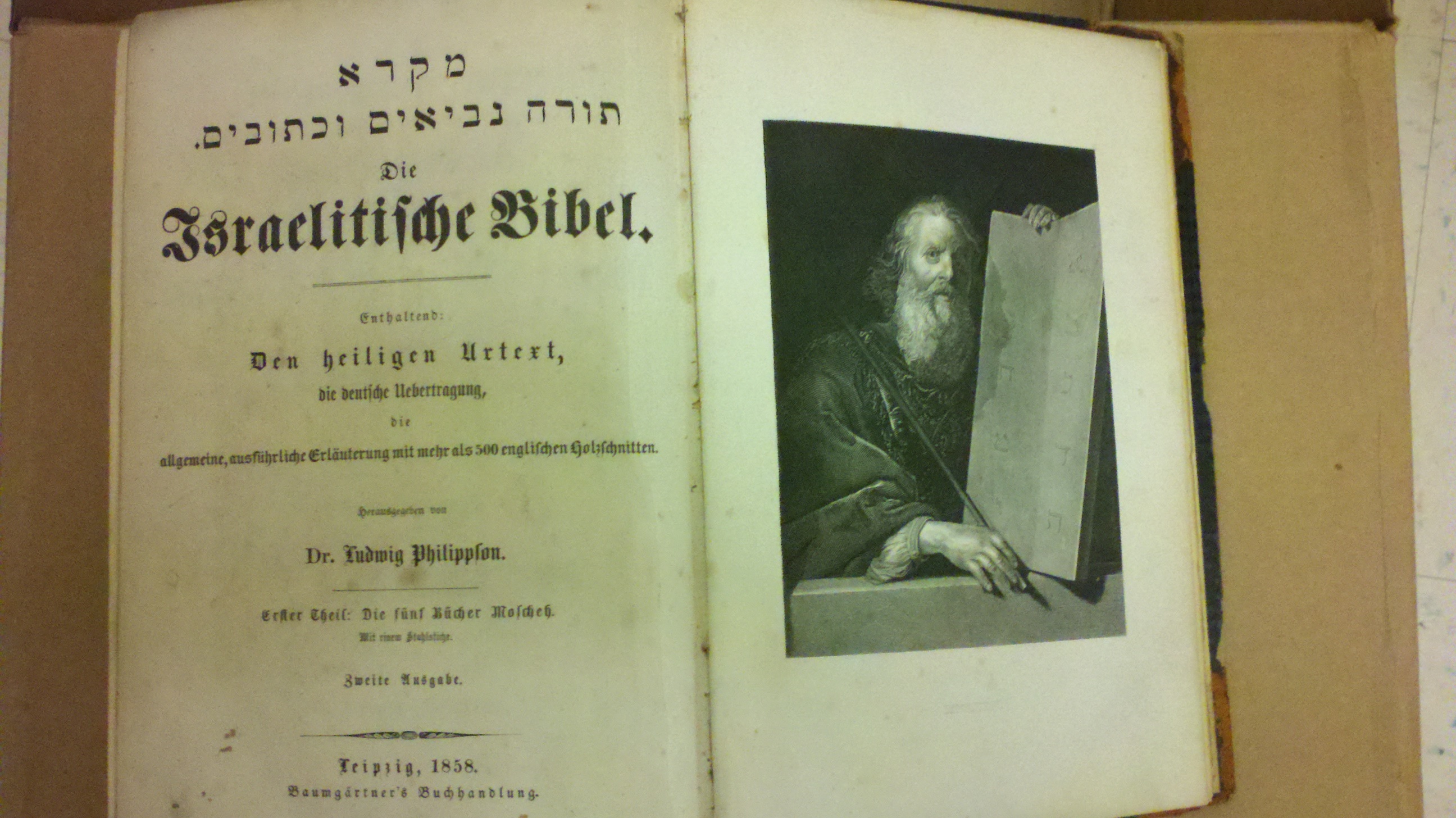
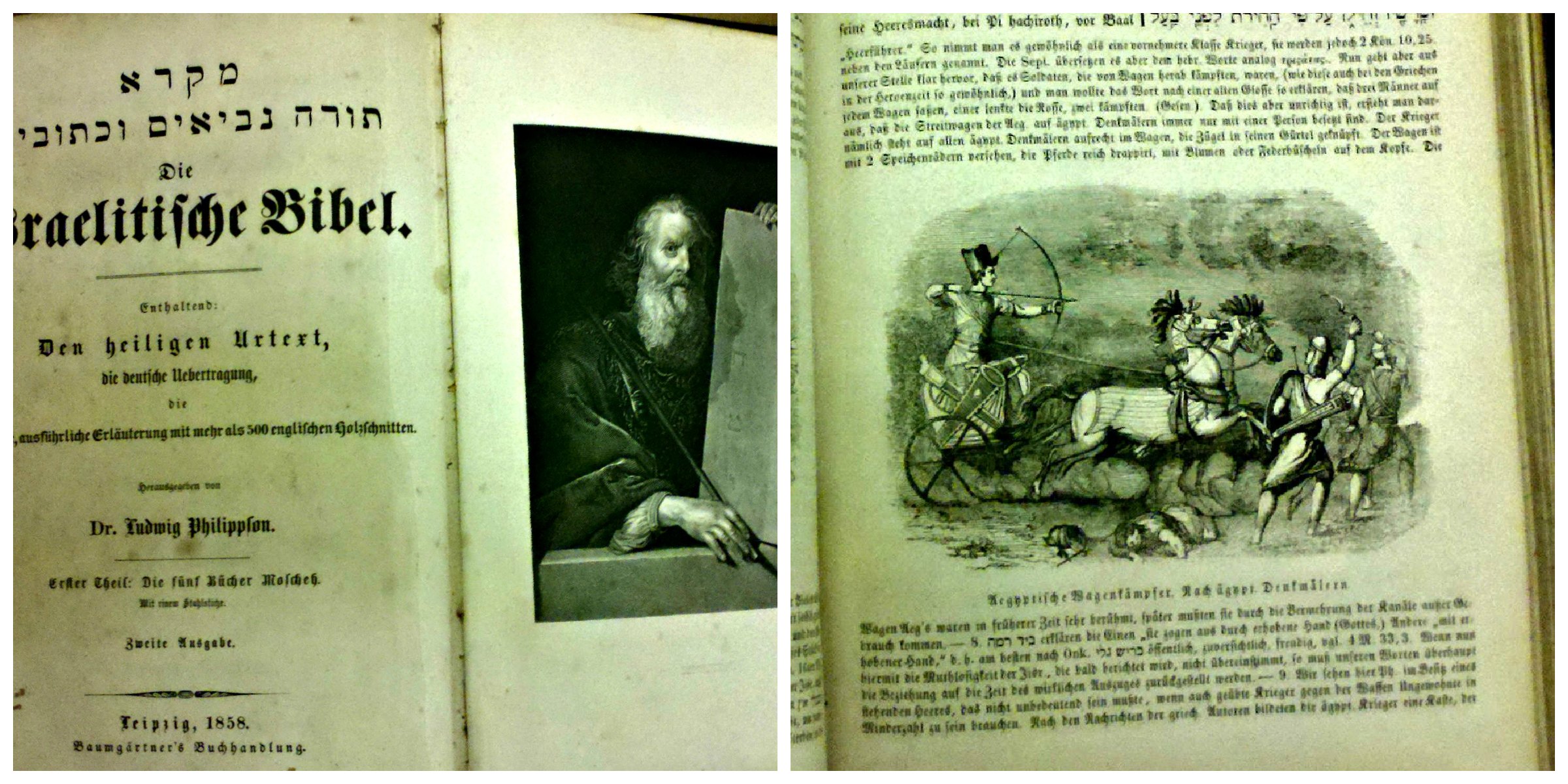
The first are two pictures from the book Die Israelitische Bibel, a mid-nineteenth century illustrated Hebrew and German Bible with annotations by Ludwig Philippson.
Die Israelitische Bibel
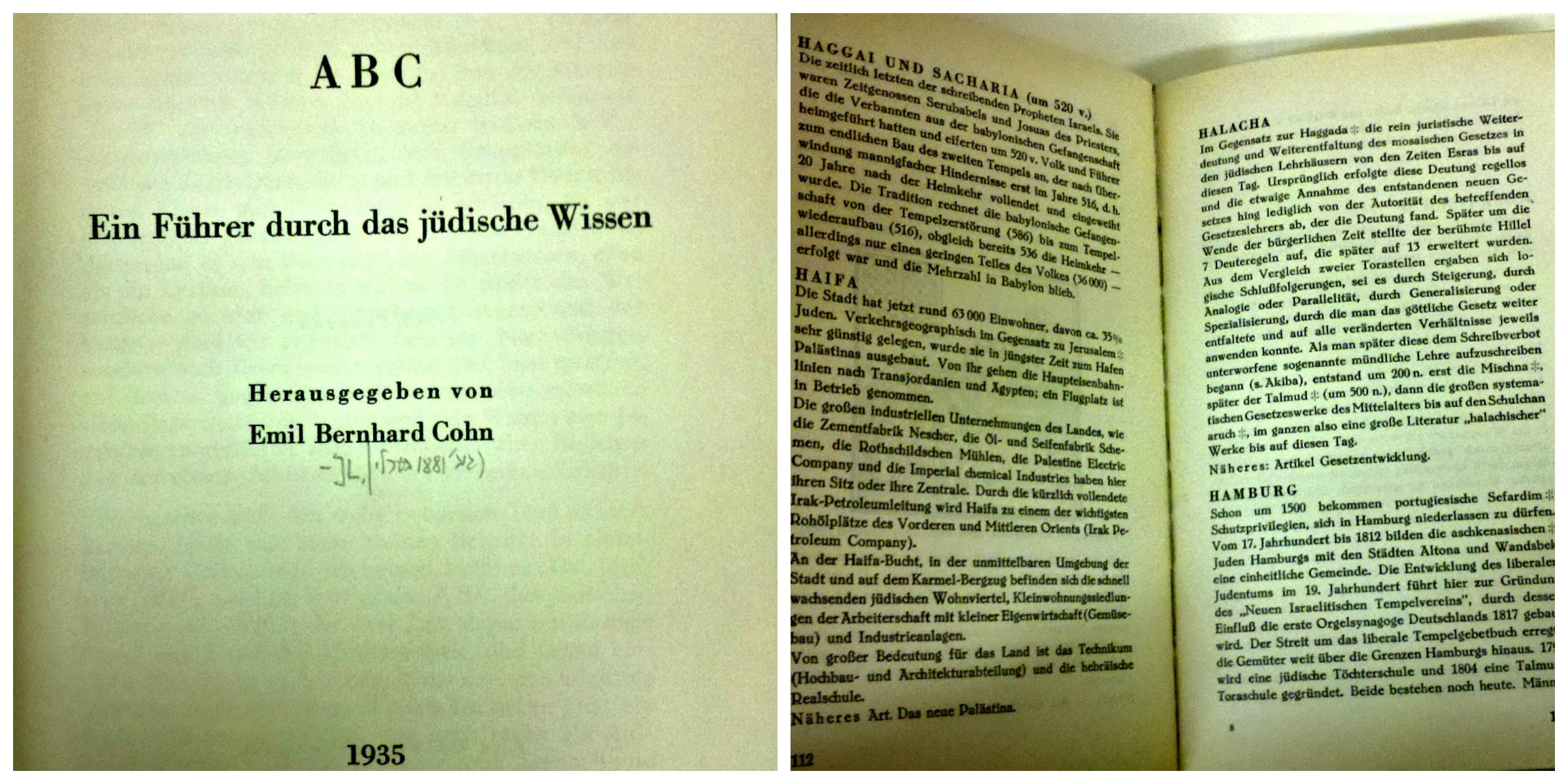
The second book is titled Das Judische ABC. It is a dictionary of sorts about key figures and events in Jewish history, covering topics such ranging from the patriarch Abraham to authors such as Martin Buber.
Das Judische ABC, with entries from the letter “H.”
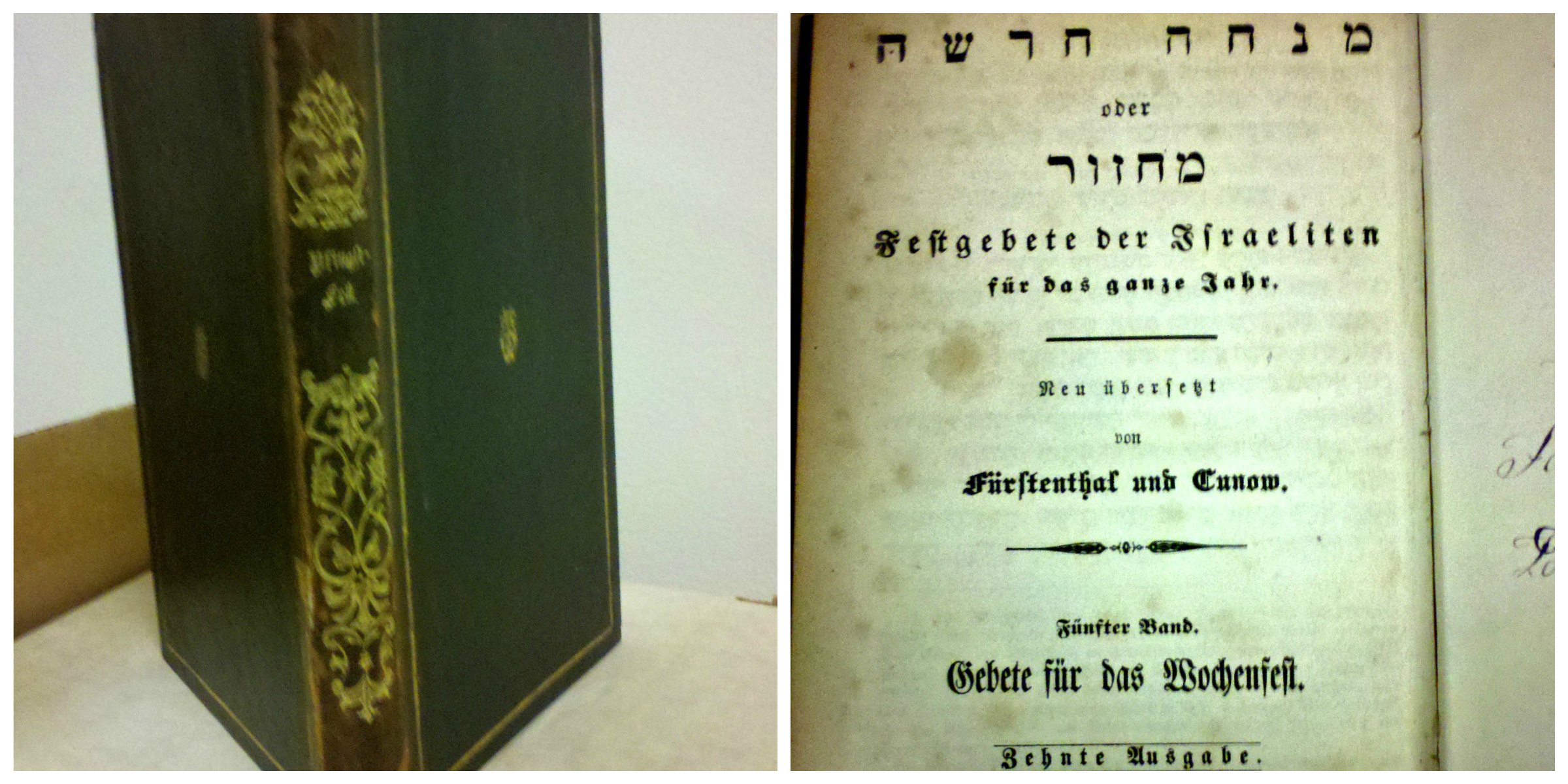
The final book I would like to highlight is a prayerbook. A number of these types of books have been cataloged, including holiday prayer books and daily prayer books. Many of them are in Hebrew, and have elegant covers and pages lined in gold leaf.
Prayerbook from the collection.
The collection as a whole is extensive and an excellent addition to the Duke Library. My hope is that through cataloging these materials, more people can have access and utilize them in their research.
Post contributed by Crystal Reinhardt, intern for the German Judaica Project in Rubenstein Technical Services.
Reminder: The Rubenstein Library is closed until Jan. 7!
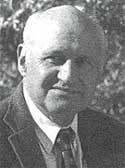
Martin Shubik, from the Yale Dept. of Economics webpage.
As research fellows at Duke’s Center for the History of Political Economy, this summer we processed the papers of Martin Shubik, emeritus professor of mathematical institutional economics at Yale University. By arranging and describing Shubik’s life-long correspondence, his class notes from the time of his graduate training at Princeton in the late 1940s, files of professional engagements, as well as materials related to nearly all of his published works, we had the chance to get an overview of Shubik’s distinguished career as an academic and a practicing economist during an important historical period encompassing the Cold War years in the United States.
While Shubik was born in New York City in 1926, he received his early education in England. After moving to Canada, he graduated with a B.A. in mathematics and subsequently with an M.A. in political economy from the University of Toronto in 1947. Equipped with this background, Shubik arrived at Princeton University in 1949, where the archival record begins. He received a Ph.D. in economics in 1953 under the supervision of Oskar Morgenstern, one of the founding fathers of game theory. The influence of his supervisor becomes apparent in Shubik’s collection, not only through the class notes Shubik took of Morgenstern’s lectures and in the correspondence with him throughout the years, but also indirectly through Shubik’s life-long contributions to game theory and its application to economic problems. And, like Morgenstern, Shubik frequently voiced a critical attitude towards purely theoretical work.
Shubik’s collection is a treasure-house of primary resources on economics, especially for researchers interested in the early years of game theory. Shubik was part of an inspiring group of students during his stay at Princeton, including Harold Kuhn, John McCarthy, John Milnor, John Nash (Nobel Prize, 1994), Norman Shapiro, and Lloyd Shapley (Nobel Prize, 2012), who were pioneers in the field of game theory and would continue to shape the history of American mathematical economics during the second half of the 20th century. Innumerable drafts of Shubik’s collaborative works, often accompanied by correspondence and research notes by his co-authors, afford an inspiring set of resources evoking that historical period. The collection contains Shubik’s and Shapley’s drafts and notes on their joint works on game theory, from their early papers in the 1950s to their collaboration during the 1970s at the RAND corporation. The collection also allows for personal glimpses into Shubik’s life. For example, Shubik’s life-long friendship and professional collaboration with Shapley is reflected in the extensive correspondence throughout their academic careers. Similarly, Shubik’s exchanges with Nash (sometimes through humorous cards and joke letters) offer a unique source for historians interested in the early years of game theory and the history of modern economics.
While Shubik made fundamental contributions to mathematical economics, the collection shows that his interests were not confined to academia. Very early in his career, he took on consultancy positions for companies including General Electric and the Watson Research Lab of IBM. He also took on research and teaching responsibilities outside of the U.S., participating in projects such as the Cowles Commission’s research on simulation modeling in Latin America. The collection also contains a large amount of correspondence, trip reports, memoranda, and conference invitations that reflect Shubik’s professional development as an expert in the strategic analysis of warfare. More generally, the material reflects not only the increasing use of mathematical methods in American economics during the Postwar period, but also affords insights into the actual application of those new theoretical tools to specific problems that economists were concerned with during that time, and the institutional context within which those undertakings were embedded.
The papers of Martin Shubik reveal the mosaic of the career of an exceptional and multi-faceted economist during a highly charged professional and political climate, and the degree to which the field of economics is built on collaborative research. In short, it is a must for any historian interested in the origins of modern economics.
Post contributed by Catherine Herfeld and Danilo Silva, research fellows at Duke’s Center for the History of Political Economy.
Reminder: The Rubenstein Library is closed until Jan. 7!
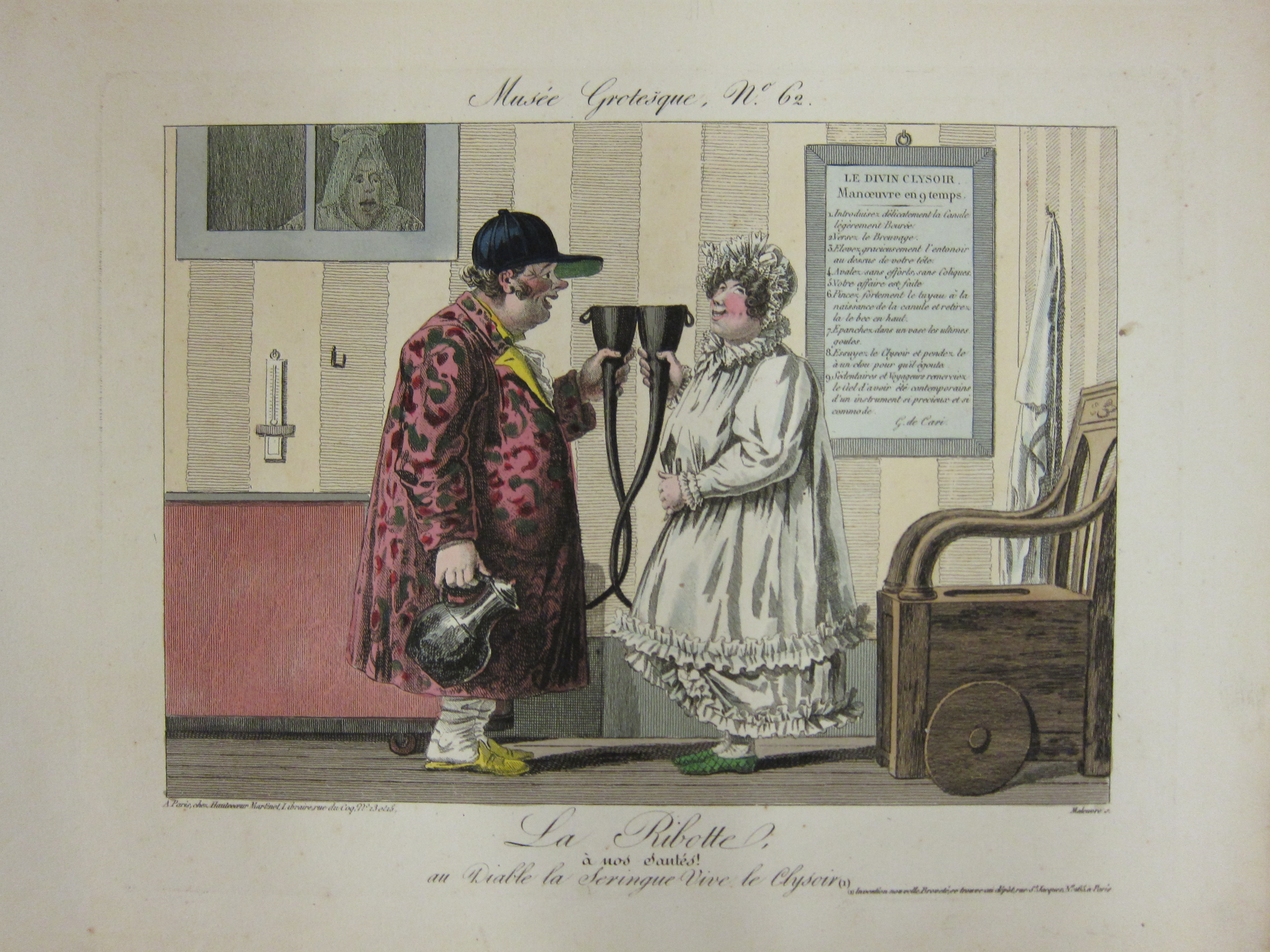
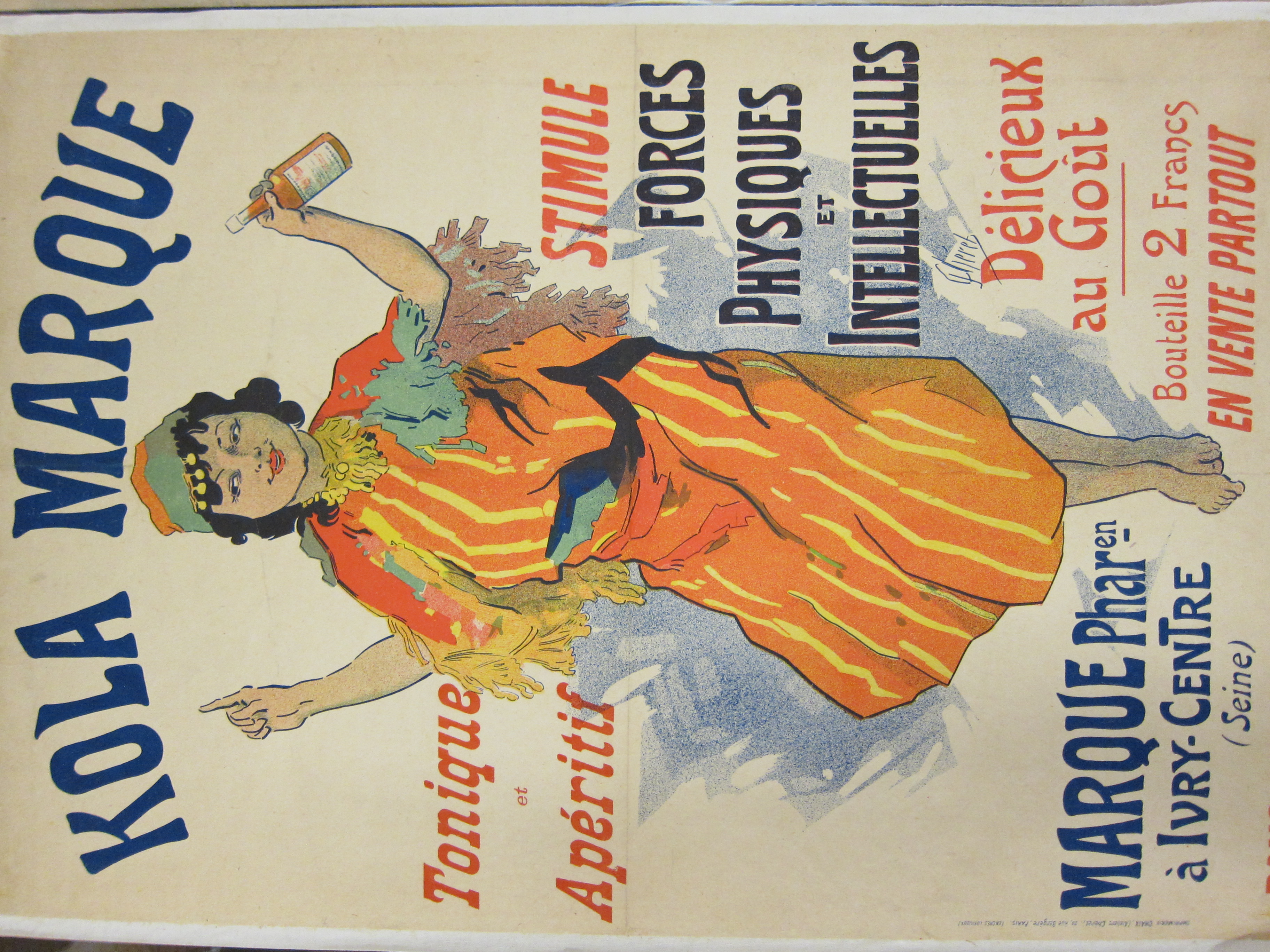
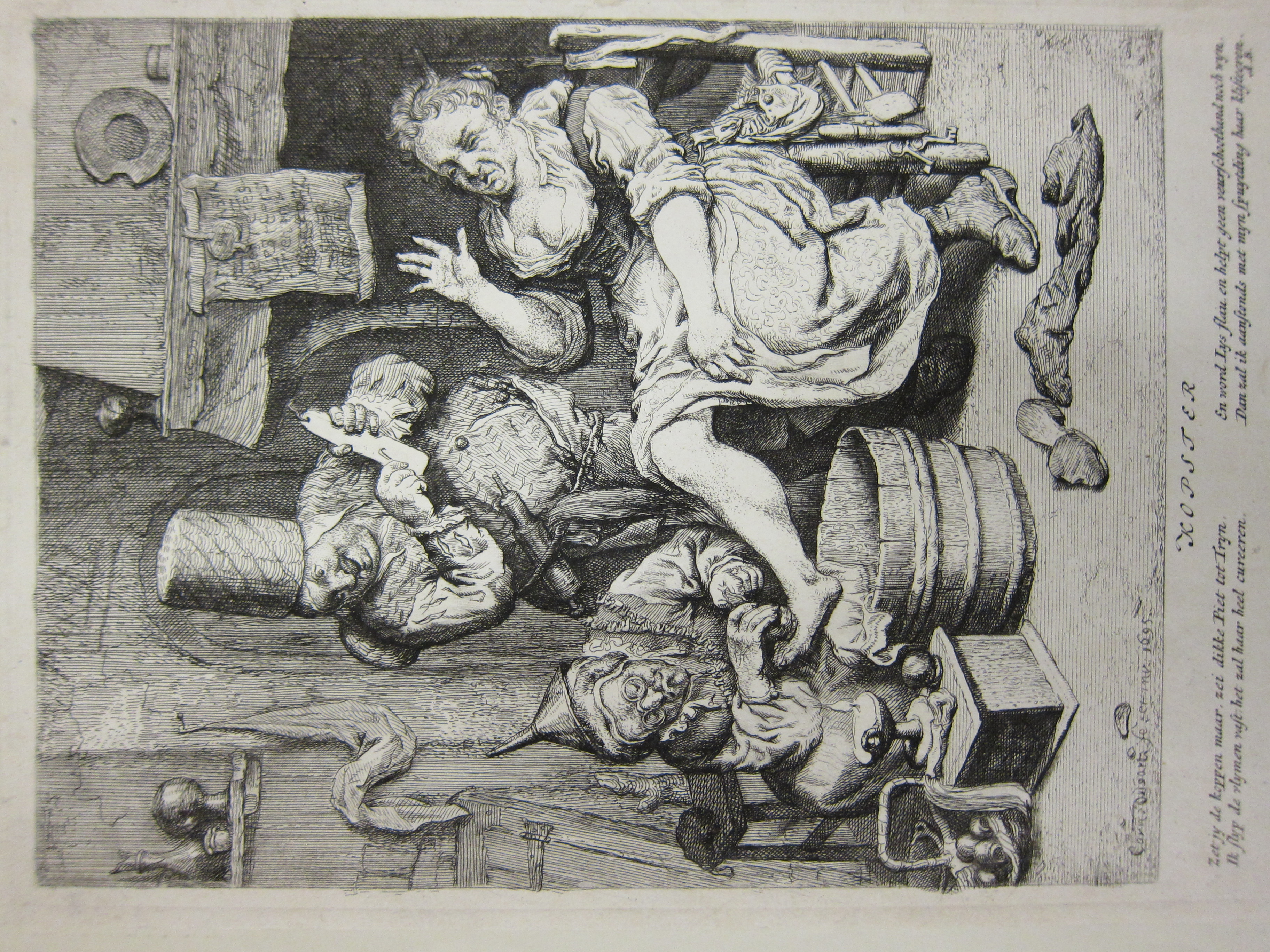
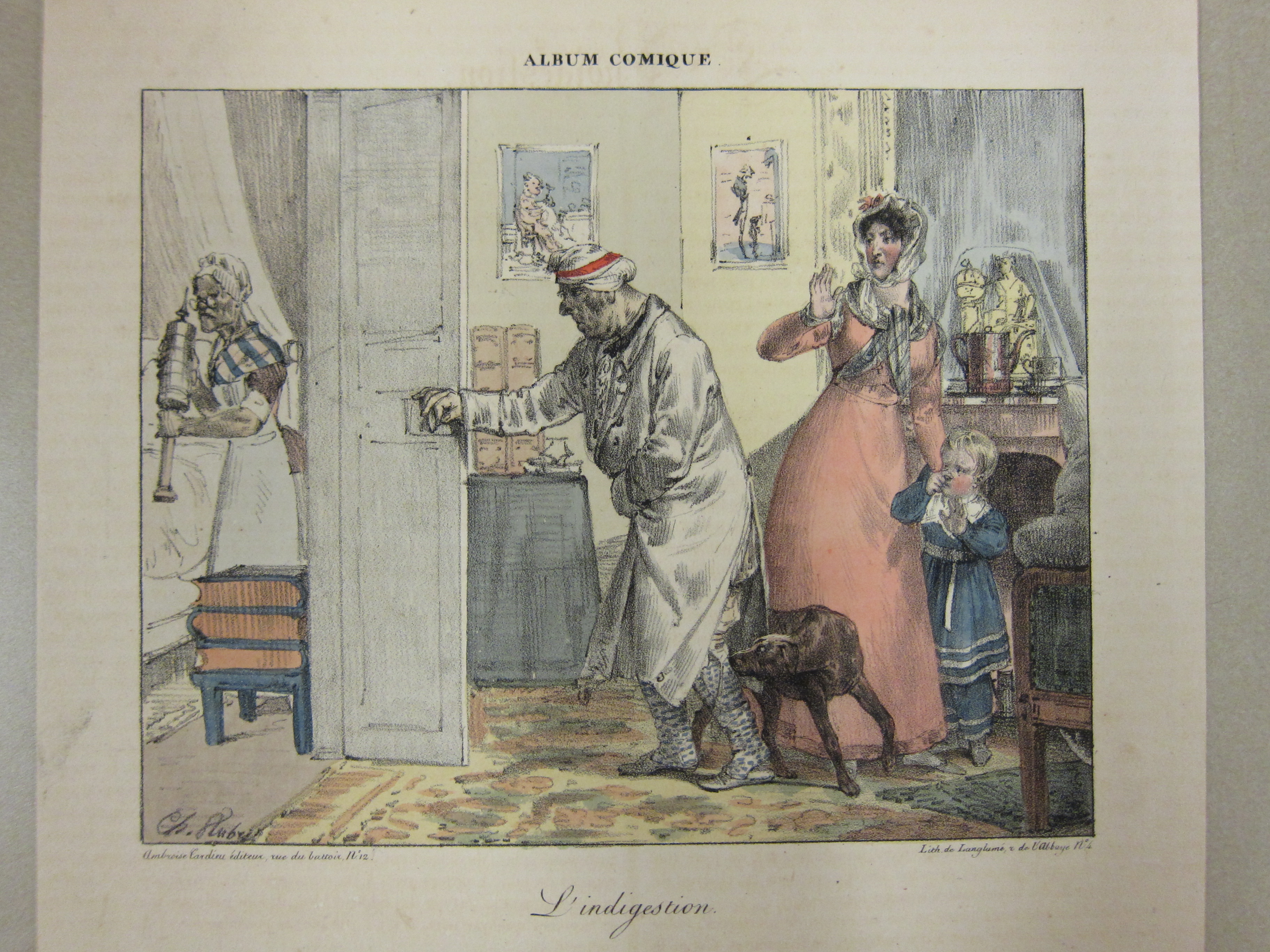
As we sit down to our Thanksgiving dinners, I leave you with a few images from a recent acquisition of thirty-four medical prints collected and donated by William H. Helfand. The posters date mainly from 18th century Paris, but the earliest dates to 1695 (the Kospter poster below) and the latest to 1991. They are all beautiful prints–heavy with political satire and caricatures, quack doctors and alchemy. But they also serve as wise reminders to eat in moderation this season. Happy Thanksgiving from the Rubenstein Library!
Maleuvre, “La Ribotte a nos chants”, color lithograph, Paris 1823Cheret, J., “Kola Marque,” color lithograph, Paris, c. 1895Dusort, Cornelius, “Hopster,” engraving, Holland, 1695Grandville and Forest, “Memento Homo Quia Pulvis…”, hand color lithograph, Paris, 1833Langlumé, “L’indigestion” from Album Comique, color lithograph, 1823
Post contributed by Joanne Fairhurst, Technical Services Intern and doctoral candidate in the Classical Studies Dept.
Dispatches from the David M. Rubenstein Rare Book and Manuscript Library at Duke University