Category Archives: Do Your Research

Final Papers, Meet New Finding Aids

Time to get cracking on those final papers? Start your research with one of the collections described in these brand-new finding aids!

African American Miscellany, 1757-1983

This collection of approximately 400 print and manuscript items relating to African and African American history was assembled over a number of decades by the staff of the RBMSCL. These documents—largely from the southern United States—speak to the sales, escapes, and emancipations of slaves from colonial times through the Civil War, the civil rights era from 1950-1970, and to a lesser extent, the period in between the 1870s and the 1950s.

South Africa Documentary Photographs Collection, 1940s-2007 and undated

Metal artist Titus Moteyane, Atteridgeville, Pretoria, 1984. Gisele Wulfsohn. From the South Africa Documentary Photographs Collection.

Acquired as part of the Archive of Documentary Arts, the South Africa Documentary Photographs Collection consists of four series of photographs documenting South African social conditions under and after apartheid, dating from approximately the 1940s-2007: Beyond the Barricades, The Cordoned Heart, Then and Now, and Underexposed. Each series originated in an exhibition, book, or project developed jointly by Duke University and South African institutions. The collection represents work by 45 South African photographers, many of whom were members of Afrapix, a collective photography agency that was politically active in the 1980s, or were otherwise active in documenting anti-apartheid struggle.

Louanne Watley Photographs, 2002-2010

The photographs and supporting materials created by Louanne Watley depict communities of Catholic nuns in Indiana, Kentucky, North Carolina, and Virginia, and images of their religious life in those communities. She typically focuses on the women’s individual faces, hands, and feet. There are also a few images of monks and their communities as well. The formats are primarily black-and-white prints with some color prints, contact prints, Polaroids (diffusion transfer process), large color inkjet prints, and negatives. As with many Archive of Documentary Arts collections acquired in recent years, digital scans of Watley’s work are also included.

Walter McGowan Upchurch Papers, 1841-1977

Walter McGowan Upchurch, Jr. served as a member of Duke’s Board of Trustees and was senior vice-president of Shell Companies Foundation, Inc. This collection contains personal correspondence among members of the Upchurch family, including correspondence between Upchurch and his brother during World War II, when they were both serving in the U.S. Navy; professional correspondence concerning Duke University administrative affairs; and genealogical materials for the Upchurch, Daniel, and Meadows families of North Carolina. Additional materials include Shell Development Company records on personnel issues such as labor relations and salary administration at the progressive Emeryville Laboratories; and Shell Companies Foundation records from 1963 to 1974, chiefly relating to the foundation’s endowments, scholarships, grants, and donations. The Duke University Archives also holds a smaller collection of Upchurch’s papers.

Please remember that many RBMSCL collections are stored off-site in our wonderful Library Service Center and need to be requested by RBMSCL staff members at least 24 hours before your research visit. We encourage you to e-mail special-collections(at)duke.edu for assistance.

Research for Human Rights

A continuing goal of the Archive for Human Rights at the RBMSCL is to explore how archives can help sustain and nurture human rights and social justice. Over the past few months, we have had the exciting opportunity to provide our knowledge and services to the staff of the Center for Death Penalty Litigation (CDPL), a Durham, NC-based non-profit that provides post-conviction legal representation to indigent defendants accused or convicted of capital crimes in the state of North Carolina.

On August 11, 2009, Governor Bev Purdue signed into law the North Carolina Racial Justice Act, which will allow defendants facing the death penalty to present evidence of racial bias, including statistics, in court. Since the act was signed into law, CDPL lawyers have been working with the CDPL case files archived here at the RBMSCL to uncover evidence of such bias. CDPL staff easily accessed the well-arranged collection through its online finding aid to determine which boxes and files contained relevant material. They then worked with RBMSCL staff to call boxes for review in our research room and to take advantage of our duplication services.

In addition to research for the Racial Justice Act, CDPL and ACLU lawyers have been reviewing case files in our reading room to research how broader discovery and prosecutorial issues may impact future death penalty cases. We hope our services will continue to aid their efforts.

Post contributed by Patrick Stawski, Human Rights Archivist.

RBMSCL Travel Grants: $$$ to Visit Us!

Photo by Mark Zupan.

Good news, researchers! The RBMSCL is now accepting applications for our 2011-2012 travel grants.

The Sallie Bingham Center for Women’s History and Culture, the John Hope Franklin Research Center for African and African American History and Culture, and the John W. Hartman Center for Sales, Advertising & Marketing History will award up to $1,000 per recipient to fund travel and other expenses related to visiting the RBMSCL. The grants are open to undergraduate and graduate students, faculty, independent scholars, artists, and activists living outside a 100-mile radius from Durham, NC with research projects that would benefit from access to the centers’ collections.

More details—and the grant application—may be found on our grants website. Applications must be postmarked or e-mailed no later than 5:00 PM EST on January 31, 2011. Recipients will be announced in March 2011.

We’re also excited to announce that the RBMSCL will be offering three new grants this year for scholars interested in using our German Studies and Judaica collections. Additional information about applying for one of these three grants will be available on our grants website soon. These new grants will have a later deadline.

Congratulations to the 2010 Middlesworth Award Winners!

On Friday, the RBMSCL celebrated with students and parents at one of our favorite events of the year: the Middlesworth Award and Durden Prize Reception.

Given annually, the Middlesworth Awards recognize the authors of the best undergraduate and graduate student papers based on research in the collections of the RBMSCL. Funding for the awards has been generously provided by Chester P. Middlesworth (A.B., 1949) of Statesville, NC.

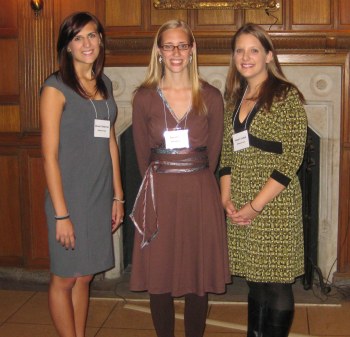
2010 Middlesworth Award winners Adrienne Niederriter, Bonnie Scott, and Hannah Craddock.

Undergraduate student winner Adrienne R. Niederriter plumbed the depths of the Hartman Center’s Ad*Access image database for her paper, “Speak Softly and Carry a Lipstick: Government Influence on Female Sexuality through Cosmetics during World War II.”

Undergraduate student winner Hannah C. Craddock received her award for her senior honors thesis, “‘A New Self-Respect and a New Consciousness of Power’: White Nurses, Black Soldiers, and the Danger of World War I.” Craddock’s study focused upon the Ann Henshaw Gardiner Papers and the Samuel Loomis Hypes Papers.

Graduate student winner Bonnie Scott’s paper began at the heart of Duke’s West Campus, as she compared sermons preached in the Duke Chapel to those preached by North Carolina minister Kenneth M. Johnson during the Civil Rights Movement.

Their papers will now become part of the RBMSCL’s collections.

We know that great papers are being researched and written this semester as well. If you are a Duke student, submit your paper and we might be toasting you next fall! Details about submitting your paper can be found here.

From the RBMSCL Wire

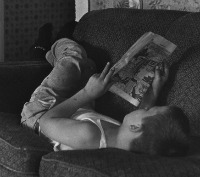
Boy lying on couch, reading comics. From the William Gedney Photographs and Writings, 1950s-1989.

Sure, you could lie on a couch and read comic books, but why not have a look at some of the articles and blog posts about the RBMSCL that have been published recently?

A profile of Susie King Taylor appears at TheAtlantic.com. (Read the post here). Taylor’s Reminiscences of My Life in Camp is part of the John Hope Franklin Research Center for African and African American History and Culture’s Black Voices Collection.

Our new exhibit, “‘As Far as Possible from Forgetfulness’: The Trinity College Historical Society,” found itself on the front page of the Durham Herald-Sun. (Read the article online.)

And Hartman Center travel grant recipient Ari Samsky wrote about his two-week research visit to the RBMSCL for web magazine Splice Today. You’ll find his essay—which makes us glad that Durham’s cooled off considerably in the past few days—here.

Let us know if you find any other mentions of the RBMSCL during your wanderings across the Internet and through print.

Dear Diary: Girls Rock!

7/13/10

Dear Zine Diary,

Today was one of my favorite days of the year: zine workshop day at Girls Rock Camp. Amy and I spent the morning doing a zine workshop for about 45 young girls at Durham’s Girls Rock Camp. The day started with everyone standing in a circle, holding hands, and then turning to the person beside them and telling them “You rock!” What a way to start the day. We were able to talk with the girls about zines, as well as more about the Sallie Bingham Center for Women’s History and Culture and how they can come and look at zines in our collection. The girls were so excited to work on their own zine pages. We brought tons of markers, stickers, stamp pads, magazines, and glue sticks for them to make their own zine pages, and they did not disappoint! The zine pages they created included lots of things, such as their band names (Black Lizards, Beach Girls, 24/7, and The Flaming Moonshiners) and stickers proclaiming their love of music (and animals), and included statements like “I want to be a singer, an actress, and an architect.” I was asked how to spell words like “appreciate” and “different.” It was so great. Oh Zine Diary, every day should be like this!

Until next year. . .
Rachel


7/14/10

Dear Zine Diary,

Kelly and I spent yesterday morning at Girls Rock Camp in Chapel Hill. I was amazed at how eager, smart, and enthusiastic the girls were to learn about women’s history and zine-making! We went around the room and introduced each other and Kelly and I found out the names of the girls’ bands. We talked about the three waves of feminism and we even did the wave! We also talked about female stereotypes and how we can fight them together. Then the girls got down to business with markers, stickers, magazines, glue sticks, and stamps. They made pages for their bands as well as individual pages, and as Rachel mentioned, their pages were creative and inspiring. I was so excited to hear the girls talk about everyday injustices and how they want to fix them. Kelly told them that since they are part of the Third Wave they are the future of feminism and will help to decide the future for women. After yesterday, I’m glad to know the future is in good hands.

Rock on,
Alex

For more photos from Girls Rock Camp, visit the Bingham Center’s Flickr photostream!

Post contributed by Rachel Ingold, former Bingham Center intern and Conservation Technician, and Alex Krensky, Bingham Center intern.

Networks for Freedom

Date: Wednesday, July 21, 2010
Time: 3:30 PM
Location: Rare Book Room
Contact Information: Amy McDonald, 919-681-7987 or amy.mcdonald(at)duke.edu

1862 broadside.

Join the staff of the John Hope Franklin Research Center for African and African American History and Culture for a program with historian Deborah Lee, recipient of a 2010-2011 Franklin Research Center travel grant.

Dr. Lee’s research traces the networks of anti-slavery activists that operated between 1810 and 1865 in the upper Potomac River basin. As Dr. Lee writes, “these white and black anti-slavery men and women used sophisticated peaceful means—persuasion, law, philanthropy, colonization, and the underground railroad—to help thousands of individual bondspeople obtain freedom, fray the institution of slavery locally, and advance the movement nationally.”

Dr. Lee’s visit to the RBMSCL will allow her to examine a number of our 19th century manuscript collections, including the Rankin-Parker Papers, the John Rutherfoord Papers, and the Funkhouser Family Papers.

Light refreshments will be served.

Hot New Finding Aids!

Is the heat wave getting to be too much to bear? Head on over to the RBMSCL and do some research in our cool reading room!

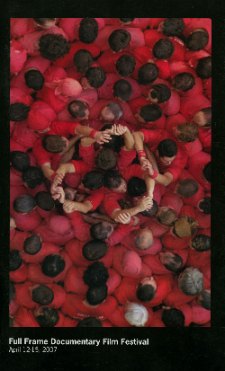
Full Frame Festival Program, 2007. From the Full Frame Archive Film Collection.

Full Frame Archive Film Collection, 1998-2010

The largest film festival in the United States entirely devoted to documentary film, the Full Frame Documentary Film Festival has been an annual highlight of Durham’s cultural scene since 1998.

In 2007, Duke University Libraries and Full Frame, with support from Eastman Kodak and Alpha Cine Labs in Seattle, announced the creation of the Full Frame Archive, to be housed at the RBMSCL, with the aim of acquiring, archiving, and preserving copies of all of the Festival’s award-winning films. The Full Frame Archive Film Collection comprises preservation masters of documentary films that won awards at the Full Frame Film Festival between 1998 and 2010. Each year’s festival will bring new additions to the collection!

Confederate States of America Collection, 1850-1876

One of our older collections has a brand new finding aid. This perennially-popular collection includes a wide variety of records from the administrative bodies within the Confederate States of America, including original and typed copies of acts and statutes of the C.S.A. Congress, Army soldiers’ correspondence and papers of several Army units, and records from the Treasury Department. There might even be a clue about the lost Confederate gold!

Commercials in the Classroom

[youtube=http://www.youtube.com/watch?v=BxFv29qzEGc]

How have TV commercials changed over time? The answer to part of that question is found in this video about AdViews. Five Duke undergraduates discuss their small group project using commercials found in AdViews as primary sources for a fall 2009 Markets & Management Studies class taught by George Grody.

Using AdViews, the students compared a number of historic 1960s and 1970s commercials with corresponding ones from today. The students analyzed commercials for Hardees, Schick, Bounce, Pledge, and perfume, finding both interesting similarities and drastic contrasts that reflect the branding strategies of each time period.

AdViews, a digital archive of over 8,000 vintage television commercials dating from the 1950s to the 1980s, is one of the newest resources available from the Hartman Center for Sales, Advertising & Marketing History.

The Hartman Center collects and provides access to commercials, print ads, books, and other documents chronicling the advertising and marketing of products from the mid 19th century to the present. Our staff also provides targeted presentations to a wide range of classes each semester, helping to integrate primary source material into subjects ranging from Anthropology to History to Visual Studies, and most anything in between. Students are able to discover not only how TV commercials have changed, but how advertising tracks the evolution of not only the ad industry but also of society itself.

If you are interested in learning more about AdViews, classroom presentations, or research assistance, please contact the Hartman Center Reference Archivist at hartman-center(at)duke.edu or 919-660-5827.

Post contributed by Lynn Eaton, Hartman Center Reference Archivist.

Drawing Feminism

Date: Tuesday, June 15, 2010
Time: 3:30 PM
Location: Rare Book Room
Contact Information: Kelly Wooten, 919-660-5967 or kelly.wooten(at)duke.edu

Detail of portrait of Irene Peslikis by Alice Neel. From the Irene Peslikis Papers.

The summer research project season is in full swing!

Next Tuesday, Katie Anania, graduate student in Art History at the University of Texas-Austin and recipient of a Mary Lily Research Grant, will discuss her research on the feminist adoption of drawing as an intimate means of artistic expression.

Anania’s research at the RBMSCL has focused on the Irene Peslikis Papers and the Kate Millett Papers.

Light refreshments will be served.

For more about feminism and art, visit “Stretching the Canvas: Women Exploring the Arts” and “The Feminist Art Movement, 1970s-1980s,” online versions of two exhibits prepared for the Sallie Bingham Center for Women’s History and Culture‘s 2007 symposium, Neither Model Nor Muse: Women and Artistic Expression.