Category Archives: Rare Books

Renovation Prep: Fascinating Finds in the Stacks

My part in the preparation for the Rubenstein’s upcoming renovation is to assist in making sure that all of our beloved materials have accurate records before the move. Imagine when you have moved to a new house or dorm room and realized you just can’t find that book from that library that’s overdue. Now multiply that scenario by thousands of volumes and the importance of our task becomes clear!

Rows of books checked by the Holdings Mgmt Team
Rows of books checked by the Holdings Management Team

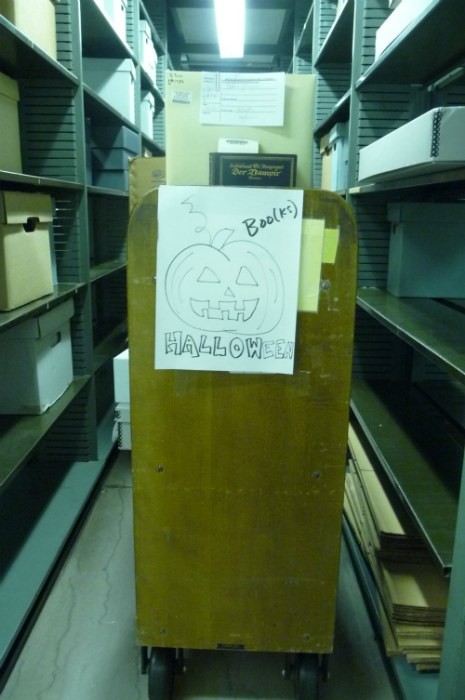
Our Holdings Management Team members are going through the stacks systematically, checking records and barcodes on periodicals, reference items, pamphlets, and many, many sets of books. Out of the 13,000 volumes I personally have checked, over 2,000 needed to be fixed in some way. Our way of keeping track of various interdepartmental progress? Multi-colored post-it notes line the ends of shelf rows (ours are blue).
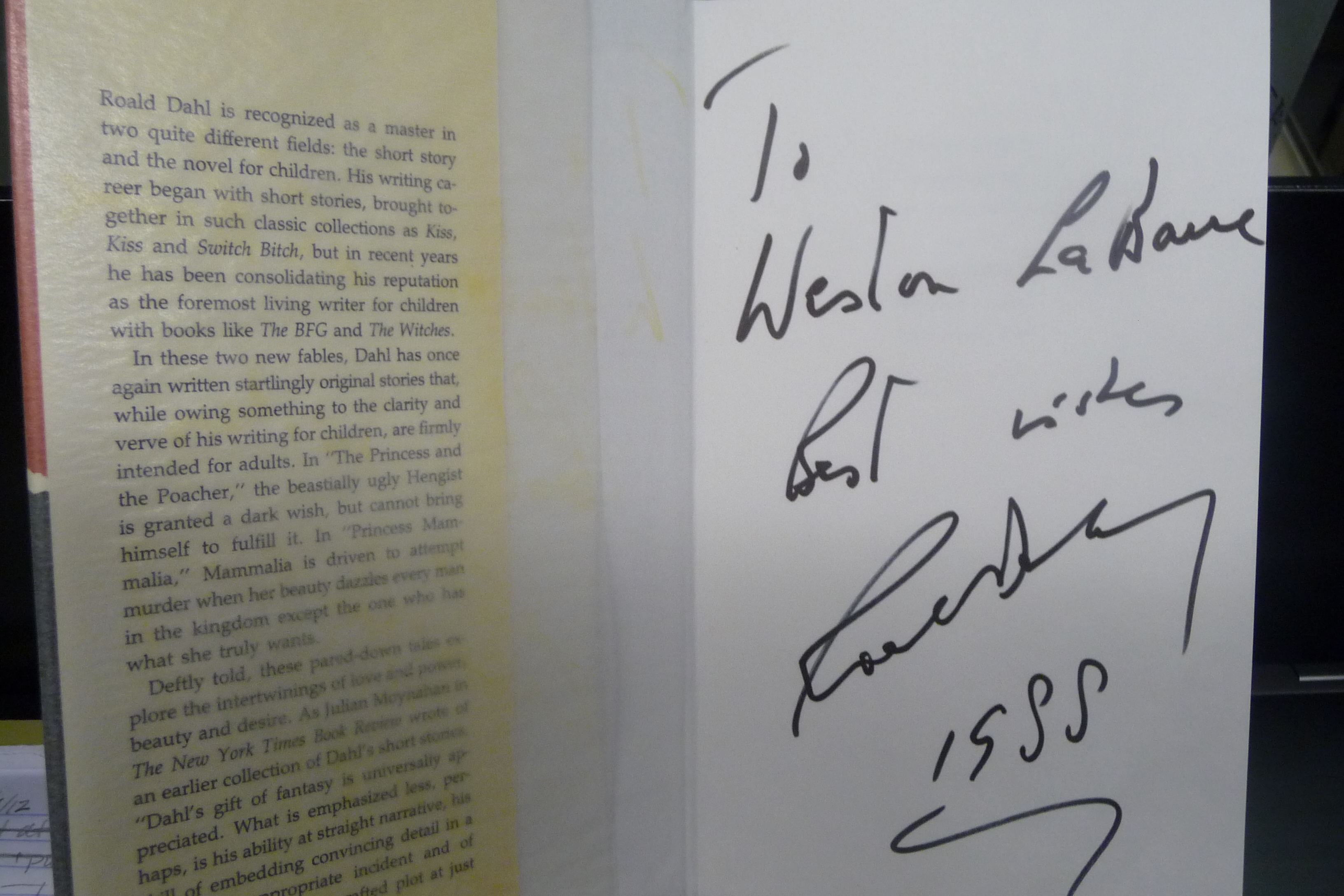
Roald Dahl's signature inside one of our books

It is always interesting to open a book and see the owner’s signature or personal bookplate. Today, I found a Roald Dahl book that was signed by the author in 1988. Once, I found a book on proper housekeeping that was signed to a friend on my birthday (except 200 years before I was born).  I’m excited for the next 13,000 volumes!

Cullen Cornett is a Holdings Management Assistant in the Rubenstein Technical Services Dept.
A Dear Friend of the Rubenstein Library

We note with sadness the passing of Mary Duke Biddle Trent Semans. Mrs. Semans was the great-granddaughter of Washington Duke, and the granddaughter of Benjamin Duke.  She came to Duke University as a 15 year-old freshman in 1935, and was an alumna of the class of 1939 of the Woman’s College. She remained a tireless advocate for Duke University throughout her life, serving as a longtime trustee and supporter of numerous projects on campus. These include the Mary Duke Biddle Rare Book Room, named for Mrs. Semans’ mother.

In 1938, Mrs. Semans married Josiah Charles Trent, a Duke alumnus and later the first Division Chief of Thoracic Surgery. The couple collected rare books related to the history of medicine, and Walt Whitman materials. Dr. Trent died of lymphoma in 1948. In 1953, Dr. James Semans and Mrs. Semans were married. They were known on campus, in Durham, and throughout North Carolina as supporters of the arts, higher education, civic projects, and other charitable endeavors.  Mrs. Semans was a longtime trustee of the Mary Duke Biddle Foundation (named for her mother), which has supported projects in the library, among many other grant recipients.

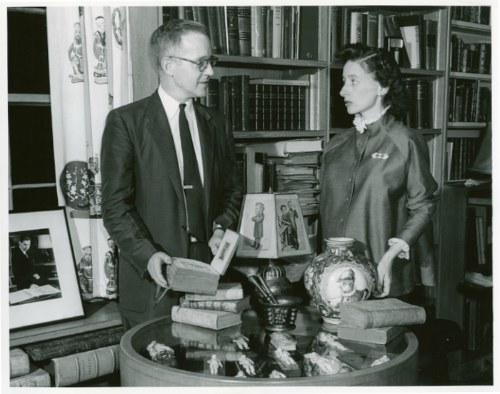
Mary Duke Biddle Trent Semans with Curator of Rare Books Thomas M. Simkins.
Mary Duke Biddle Trent Semans with Curator of Rare Books Thomas M. Simkins. The materials pictured are now part of the History of Medicine Collections in the Rubenstein Library. Photo from the University Archives Photograph Collection.

The Trent Collection of Whitmaniana and Trent Collection of history of medicine materials, along with Semans Family Papers, are significant parts of the Rubenstein Library today. We are grateful to the generosity of Mrs. Semans over the years, and the way she continued the legacy of philanthropy begun by her relatives. Mrs. Semans never stopped supporting the institution that her family transformed. Her contributions to the library, the institution, and our community will not be forgotten.

Post contributed by Valerie Gillispie, Duke University Archivist.

Robert Burns, Unglued

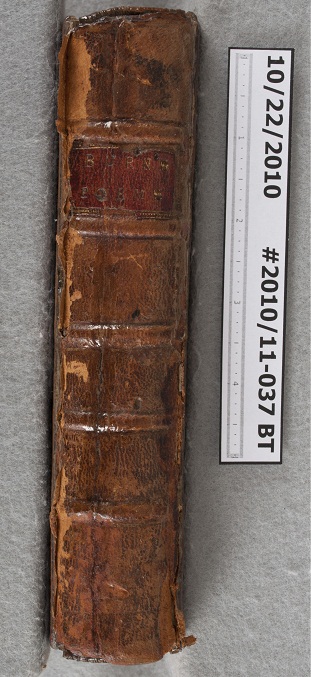
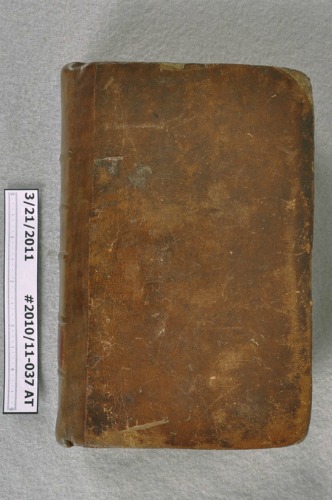
The Rubenstein Library owns a well-worn copy of Robert Burns’ Poems, Chiefly in the Scottish Dialect that was selected for conservation treatment in October of 2010. The full sheepskin binding was in fair condition and broken at the board hinges.  A previous spine repair attempt with what appeared to be Elmer’s glue left the leather on the spine looking, shall we say,… shiny? The glue coating also resulted in irreparable damage to the fragile sheepskin covering and caused the outer layer of the leather to separate and peel.

Spine of Poems, Chiefly in the Scottish Dialect , before treatment

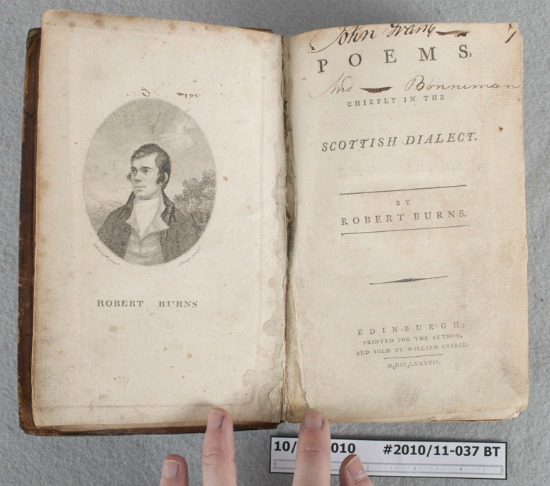
In addition, the pages were fairly dirty and, at the front of the text, were tipped to one another in ways that made it difficult to turn them safely.

Poems, Chiefly in the Scottish Dialect before treatment

In consultation with curators, conservators from the Conservation Services Department decided on a treatment that involved surface cleaning the text; removing damaging previous repairs; page mending and hinging in loose pages; reinforcing the board attachments; and recovering the spine with leather dyed to match the original sheepskin covering.  The treatment resulted in a binding that retains the character and evidence of use of the original but is much more stable and functional.

Poems, Chiefly in the Scottish Dialect after treatment

Post contributed by Erin Hammeke, Conservator for Special Collections. Thanks Erin! Visit the Conservation blog, Preservation Underground, for more from our friends in the lab!

Stinking for Skinking

Happy Robert Burns Day!

Perchance you’ll be supping on “warm-reekin, rich” haggis in yer luggies this wonderful Burns nicht, in celebration of the Scottish poet’s birth 253 years ago.

If so, or even if not, consider the story of the “Stinking Edition.”

The first volume of poems by Robert Burns, Poems, Chiefly in the Scottish Dialect, was published on July 31, 1786, in Kilmarnok. On the strength of this edition, a second, enlarged edition was planned and published on April 17, 1787 in Edinburgh.

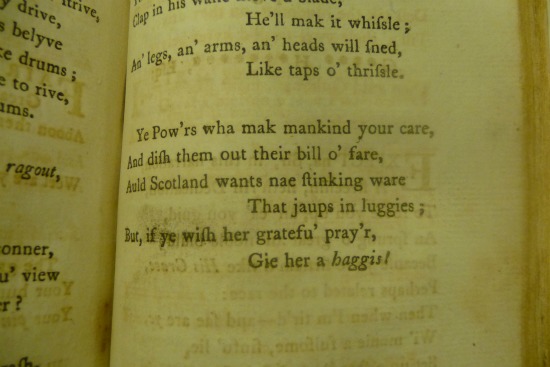
This edition featured an unfortunate misprint in the excellent poem “To a Haggis.” In the last stanza of the sausagey poem, the adjective “skinking,” which means “watery,” was printed as “stinking,” which obviously means “stinking.”

Stinking for skinking

Ye pow’rs, wha mak mankind your care,

And dish them out their bill o’ fare,

Auld Scotland wants nae stinking [skinking] ware,

That jaups in luggies;

But if ye wish her gratfu’ prayer,

Gie her a Haggis!

Trans.:

You powers, who make mankind your care,

And dish them out their bill of fare,

Old Scotland wants no stinking {watery} ware,

That splashes in small wooden dishes;

But if you wish her grateful prayer,

Give her a Haggis!

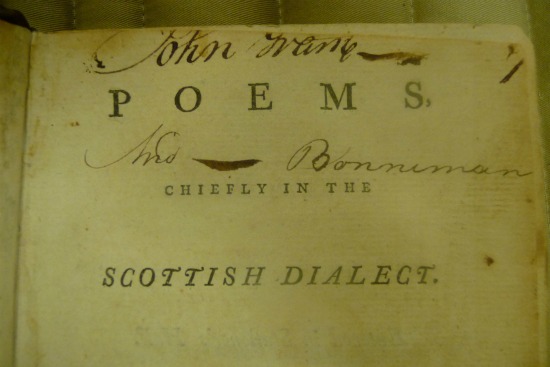
The Rubenstein’s copy of this so-called Stinking Edition was purchased  by the Duke Library in 1951. It was first owned, however, by one of the original subscribers (or financial supporters) of the edition, a Mr. John Grant, who signed the title page.

Title page with John Grant's signature

Interestingly enough, a keyword search for “stinking” in the Rubenstein library holdings retrieves this book and only this book. No doubt this is a positive thing for our collections.

Season’s Greetings from Robert Frost

The Academy of American Poets recently published an article about Robert Frost’s annual winter holiday poems, which were printed as small chapbooks and sent through the mails as holiday greetings.

Published for more than 30 years from Joseph Blumenthal’s Spiral Press, the poems were often written specifically for this purpose.

Robert Frost's The Wood-Pile

The Rubenstein Library has an excellent collection of Frost’s books, chapbooks, broadsides, and other ephemera. Part of the important Trent family collections, the Frost collection is kept in the Trent Room, fittingly with the Walt Whitman collection.

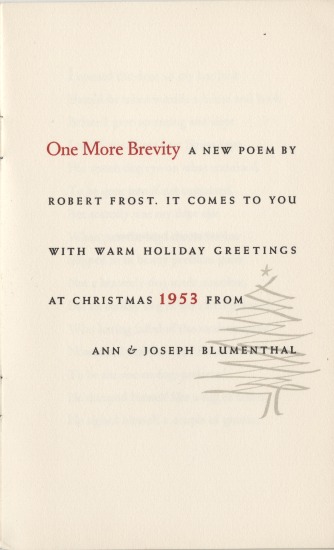
One More Brevity
Robert Frost's One More Brevity

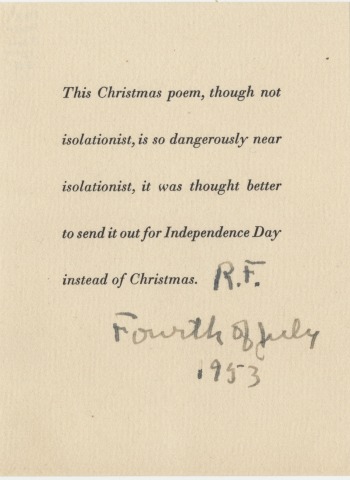
Rubenstein’s Frost collection sometimes includes multiple copies of particular winter poems. Occasionally, a copy will come with an inscription from the poet or a comic or personal remark.

Note from Robert Frost
Note included with Robert Frost's Does no one but me at all ever feel this way in the least

For more information about Rubenstein’s literature collections, visit our literature library guide.

Happy holidays!


5,000 Digital Books and Counting

The Internet Archive just reached an important milestone by digitizing 5,000 books at Duke. The 5,000th book, The British Album: In Two Volumes, contains poetry by “Della Crusca, Anna Matilda, Arley, Benedict, The Bard” and other writers on themes including love, horror, jealousy, and death, and is part of the general collections of the Rubenstein Library. The “Ode to Death” begins “THOU, whose remorseless rage, Nor vows, nor tears assuage, TRIUMPHANT DEATH!—to thee I raise, The bursting notes of dauntless praise!” The second volume can be found here.

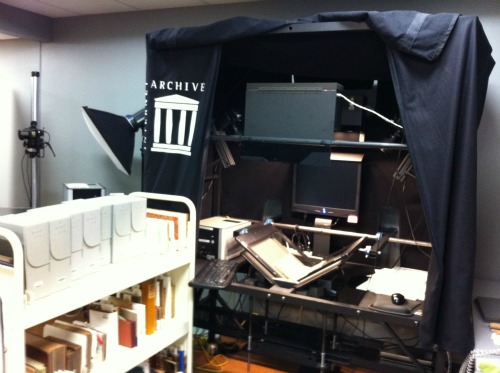
The Scribe Scanner
The Scribe Scanner. Photo by Rita Johnston.

The Internet Archive scanning center at Duke University has been in operation for one and a half years and has digitized materials from collections within the Rubenstein Library, including the University Archives, Utopian Literature, and Confederate Imprints. I scan about 450 pages per hour and around 50 books a week. Most books in the public domain under 11 x 13 inches in size can be digitized on the Scribe book scanner, as well as pamphlets and loose documents.

Books digitized through Internet Archive are usually available on the site by the next day, are full-text searchable, and can be read in a web browser or downloaded to a computer; e-book reader; or mobile device. You can find newly digitized Duke materials by clicking on the RSS feed link at the bottom right on this blog or by visiting the Duke University Libraries Internet Archive page. Patrons can request a book to be digitized by the Internet Archive by contacting Rubenstein Library staff.

Post contributed by Rita Johnston, Scribe scanner operator.

He Lives! Frankenstein in the Rubenstein

Scary, but true: the Rubenstein’s Hinton Collection of Plays contains what’s believed to be the first published image of Frankenstein’s Creature (or “Monster,” if you’re feeling pejorative).  Are you ready to face the horror?


Now that you’ve recovered from the shock, you’ll be interested to know that this image is of the actor Richard John O. Smith portraying the Creature in an 1826 stage adaptation of Shelley’s novel by Henry Milner.  The Hinton Collection also contains a prompt book for Milner’s play as produced at the Theatre Royal in Birmingham, England, probably in the 1830s. The image below shows the page of the prompt book for the Creature’s awakening, with the inserted dialogue “He lives / He lives”:

This echoes the line “It lives! It lives!” from the first stage adaptation of Frankenstein, R. B. Peake’s wildly successful 1823 play Presumption (you can find an edition of this in the Hinton Collection, as well), and prefigures perhaps the most famous scene in horror cinema.

Adaptations and reimaginings of the story of Frankenstein continue to proliferate today.  See these and many more chilling items, including an issue of Frankenstein Comics from the 1940s, at the Haunted Library Screamfest from 11am-1pm today!

Post contributed by Will Hansen, Assistant Curator of Collections.

Haunted Library Screamfest

Date: Halloween, Monday, October 31, 2011
Time: 11:00 AM-1:00 PM
Location: Rare Book Room
Contact Information: Rachel Ingold, 919-684-8549 or rachel.ingold(at)duke.edu

Have you ever wandered around a library’s stacks in the dark? Or wondered what might go bump in an archival box?

Stop by the Rubenstein Library’s Rare Book Room for a special Halloween “eeeks”-ibit and open house. We’ll be dragging out some of the creepiest and most macabre items from the shadowy depths of the library’s vaults—including the thirteen unlucky items below.

This event is free and open to the living and the dead. There will be candy. Lots and lots of candy.

49 Glass Eyeballs
49 Glass Eyeballs. From the History of Medicine Collections.

1. A travel diary written by John Buck, a young American who found himself face-to-face with Bram Stoker (before he wrote Dracula)

2. Letters to Duke University’s Parapsychology Laboratory describing the 1949 poltergeist case that became the basis for The Exorcist

3. Opera Omnia Anatomico-Medico-Chirurgica by 18th century Dutch anatomist Frederik Ruysch, featuring illustrations of fetal skeletons playing instruments  among “trees” made of veins and arteries and “rocks and stones” that are actually organs, gallstones, and kidney stones

4. An entire box of glass eyeballs (49, to be exact)

5. “Jack the Ripper” and “Cthulhu by Gaslight,” two board games from the Edwin and Terry Murray Role Playing Game Collection

6. Artists’ books Mountain Dream Tarot by Bea Nettles and Femmes Fatales by Maureen Cummins. Tarot cards and pictures of medieval torture devices!

7. Brochures and advertisements for coffins and other funeral-related paraphernalia from the Advertising Ephemera Collection

8.Two copies of Henry Milner’s 1826 melodramatic adaptation of Mary Shelley’s Frankenstein, with the very first illustration of (the actor portraying) “the Monster”

9. Bela Lugosi’s signature

10. Maps and photographs of the Rigsbee Graveyard (yes, the graveyard in the Blue Zone)

11. Comics Review #1, 1965, which includes  Stephen King’s first published story, “I Was a Teenage Grave Robber,”  from the Edwin and Terry Murray Fanzine Collection

12. Halloween postcards (complete with spooky messages . . . or invitations to Halloween parties) from our Postcard Collection

13. Trixie Belden and the Mystery of the Whispering Witch by Kathryn Kenny, 1980

Which one will give you nightmares come the witching hour?

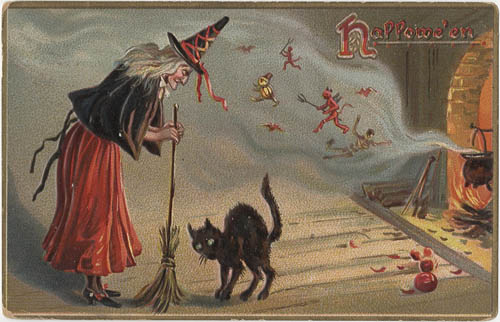
Halloween Postcard, 1908.
Halloween Postcard, 1908. From the Postcard Collection.

Happy North Carolina Archives Week!

It’s North Carolina Archives Week, a weeklong celebration of North Carolina’s cultural heritage repositories and the wonderful researchers that use them—that’s you!

Stop in, meet your friendly neighborhood special collections librarians, and request some archival collections and rare books—we think you’ll find that the Rubenstein Library has something for everyone! Or check out the North Carolina Archives Week’s website to find more ways to celebrate with cultural history repositories throughout the state.

Need some inspiration? We’ve gathered together a few previously-published blog posts written by our researchers:

We’ll see you in the reading room!

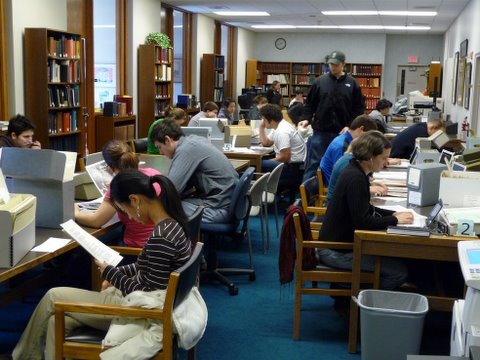
A very fill Rubenstein Library reading room!