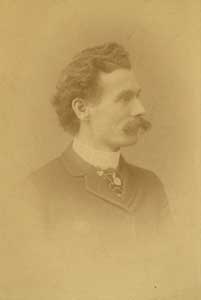
Pictured above: Not John Wilkes Booth. From the James Thomas Powers Papers.
In a recent appearance on Jeopardy!, former Rubenstein Library intern Josh Hager announced that he had discovered a previously unknown image of John Wilkes Booth in the James Thomas Powers papers at Duke. That would have been exciting—if it were true.
Hager thought there was a resemblance between the man in the image and the images of Booth he found online, and he wrote a post about the apparent resemblance on this very blog in 2010. This was jumping the proverbial gun—on the blogger’s part as well as ours. More work was needed to verify this conclusion. And indeed, a little further research confirms that the image is not Booth. We appreciate the comments from those who saw Hager on Jeopardy! and then wrote us to question the accuracy of the post. They are right—we never should have published it. In the interest of setting the historical record straight (and protecting the innocence of the unknown man in the photo), we have taken it down and added this new post.
The Barbaralee Diamonstein-Spielvogel Visiting Filmmaker Series will be sponsoring screenings of four films directed by Stanley Nelson prior to his visit to Duke on October 16-18. Co-sponsors of the series are the Archive of Documentary Arts, Center for Documentary Studies, Franklin Research Center, Screen/Society and the Program in Arts of the Moving Image. Voter registration will be available before and after the screenings. Each screening begins at 7:00pm and is free and open to the public.
Date: Tuesday, September 16, 2014
Location: Richard White Lecture Hall, Duke University East Campus
Film: The Murder of Emmett Till
Introduction by Mike Wiley, past Lehman Brady Visiting Joint Chair Professor in Documentary Studies and American Studies at Duke University and the University of North Carolina at Chapel Hill
Date: Wednesday, September 24, 2014
Location: Griffith Theatre, Duke University West Campus
Film: Jonestown: The Life and Death of Peoples Temple
Date: Thursday, October 2, 2014
Location: Hayti Heritage Center, 804 Old Fayetteville St, Durham, NC 27701
Film: A Place of Our Own
Date: Tuesday, October 7, 2014
Location: Durham Public Library, Main Branch, 300 Roxboro Street, Durham, NC 27701
Film: Freedom Summer
Discussion will be lead by SNCC veteran and Visiting Activist Scholar, Charlie Cobb
Post contributed by John B. Gartrell, director John Hope Franklin Research Center
In October, the Rubenstein Library will host the third Barbaralee Diamonstein-Spielvogel Visiting Filmmaker and the inaugural Barbaralee Diamonstein-Spielvogel Visiting Artist.
Stanley Nelson
This year’s filmmaker is award-winning director/producer, Stanley Nelson. Nelson is the director and/or producer of over a dozen documentary films, principally highlighting the life and history of African Americans. His most recent release is the acclaimed Freedom Summer, and this past summer he was recognized as a 2013 National Humanities Award winner. Nelson will visit Duke’s campus from October 16-18 and will engage in a public conversation with Dr. Diamonstein-Spielvogel on his career and work at the Nasher Museum of Art on October 17 at 6:00 pm, reception to follow.
Steve Roden
As the inaugural Diamonstein-Spielvogel Visiting Artist, internationally known sound and visual artist, Steve Roden will participate in a three-week residency in the Rubenstein Library from October 13-30. Roden’s residency will include extensive research in the Rubenstein Library collections to inform his process of artistic creation. Roden will also engage in two public events during his visit. On October 18 at 6:30 pm, he will present an overview of his work entitled “Ragpicker” at the Full Frame Theater at American Tobacco Campus. And on October 23 at 5:00 pm, he will share his experiences working in the Rubenstein Library at the Center for Documentary Studies.
All of these events will be free and open to the public and are made possible through the generous support of Dr. Barbaralee Diamonstein-Spielvogel. They are additionally co-sponsored by the Archive of Documentary Arts, Center for Documentary Studies, Franklin Research Center, Program of Arts of the Moving Image and Master of Fine Arts and Experimental and Documentary Arts Program.
More details to come soon.
Post contributed by John B. Gartrell, director, Franklin Research Center
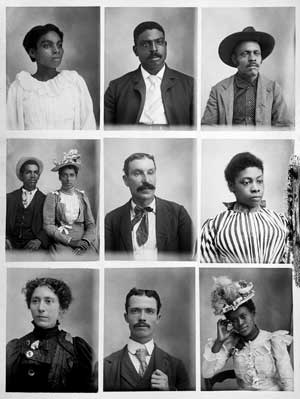
Portrait photos by Hugh Mangum. From the Hugh Mangum Photographs, #N258.
The portraits of Durham photographer Hugh Mangum are the subject of a new exhibit, opening July 22nd at the Museum of Durham History’s History Hub. “Hugh Mangum on Main Street: Portraits from the Early 20th Century” shows Mangum’s largely unknown portraits of Southern society after Reconstruction.
Mangum was born in Durham in 1877 and began establishing studios and working as an itinerant photographer in the early 1890s. During his career, Mangum attracted and cultivated a clientele that drew heavily from both black and white communities, a rarity for his time. Mangum’s photographs are now part of the Rubenstein Library’s Archive of Documentary Arts.
“Although the late-19th-century American South in which he worked was marked by disenfranchisement, segregation and inequality — between black and white, men and women, rich and poor — Mangum portrayed all of his sitters with candor, humor, and spirit. Each client appears as valuable as the next, no story less significant,” said curator Sarah Stacke. “His portraits reveal personalities as immediate as if the photos were taken yesterday.”
Stacke, a photographer and a 2014-2015 Lewis Hine Fellow at Duke’s Center for Documentary Studies, and Margaret Sartor, who teaches at CDS, are working together on a book about Mangum’s life and work. This new exhibit expands on “Keep All You Wish,” an exhibit of Mangum’s work that Stacke curated for CDS in 2012.
“Hugh Mangum on Main Street: Portraits from the Early 20th Century” opens at the History Hub, 500 W. Main St., on Tuesday, July 22 and runs through August. The exhibition will be in the Our Bull City area.
The public is invited to a launch party for the exhibition on Wednesday, July 23, from 5:30pm to 7pm, and a program on Mangum and his work at 3pm on Sunday, August 10.There is no charge for the exhibit, program, or party. The Hub is open Tuesday-Saturday, 10am to 5pm.
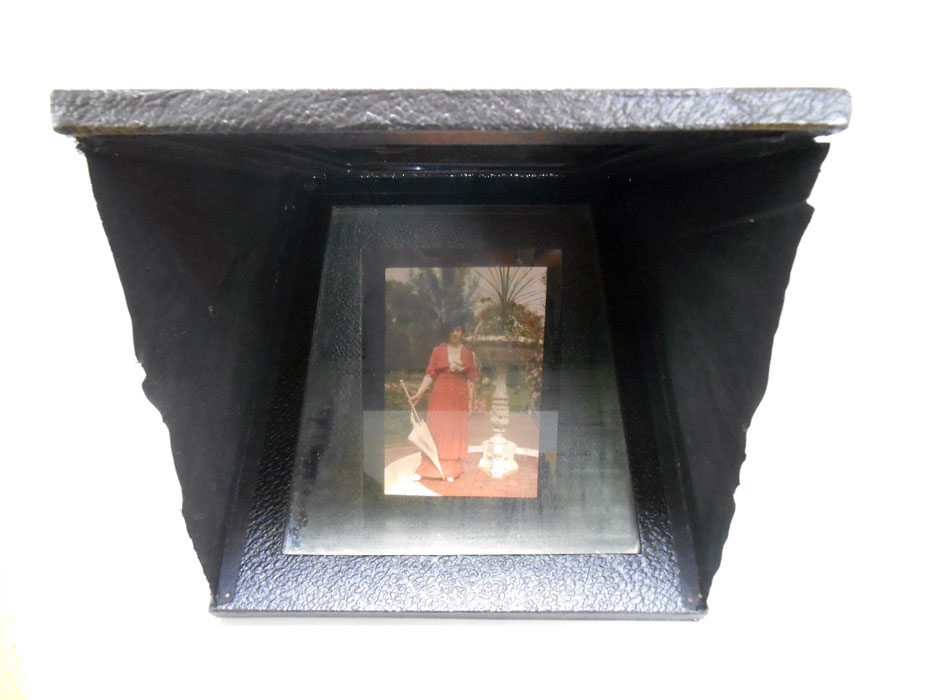
Duke Libraries is digitizing our collection of four autochrome lumières from the Semans family papers and they recently came to conservation for pre-imaging review. Autochromes are an early color photographic process. Our autochromes depict Mary Duke Biddle and Sarah P. Duke and date to about 1910. The color in autochromes lumières is uniquely produced with a color filter layer comprised of fine potato starch grains that are dyed different hues (commonly green, orange-red, and blue-violet) and adhered to a glass plate with lamp black applied to fill the interstices. The undeveloped color filter layer, if viewed under magnification, resembles color pixels and is reminiscent of a pointillist painting.
Autochrome of Sarah P. Duke in a diascope
The autochromes are viewed with transmitted light and are often housed in a hinged viewer called a diascope. The photographic plate, along with a ground glass diffuser, is attached to one cover of the diascope and a mirror in the other. Light passes through the diffuser and autochrome and the viewer sees the reflected image of the photograph in the mirror. The dyes used to produce autochromes are extremely light sensitive and we are taking great care not to expose our materials to excessive light during the digitization process.
Post contributed by Erin Hammeke, Senior Conservator for Special Collections, as part of our ongoing “In the Conservation Lab” series.
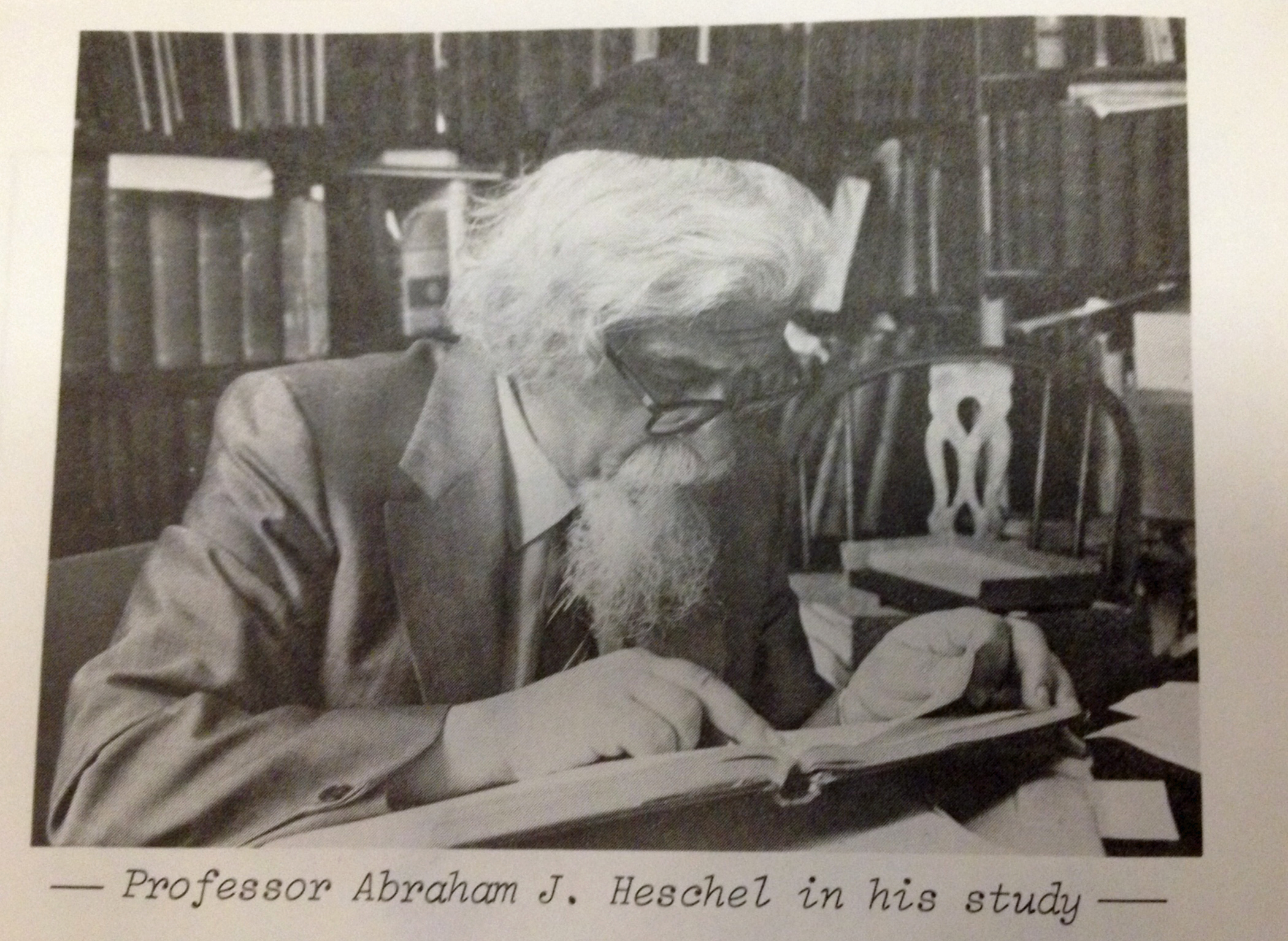
Today the Abraham Joshua Heschel papers are officially opened and available for use. Having just finished processing the collection with a crack team of interns (thank you Adrienne Krone, Sam Kessler, Annegret Oehme, and Emanuel Fiano!), I can attest to the richness of the collection and am thrilled that patrons will be able to explore Heschel’s personal, academic, and public life. The collection guide is available here. In total, 16 languages are represented. Materials related to all of Heschel’s published books, along with 145 published articles are also in the collection. Some of the more unique and unexpected items in the collection include an audio reel of the broadcasted radio show “Way to Go” with host Ormond Drake in which Heschel speaks about his personal life, an original typed document of Heschel’s deportation from Frankfurt in 1938, and a telegram from President John F. Kennedy requesting Heschel’s presence at the White House.
Look for an opening event sometime in October that will feature Susannah Heschel!
Post contributed by Mary Samouelian, Project Archivist
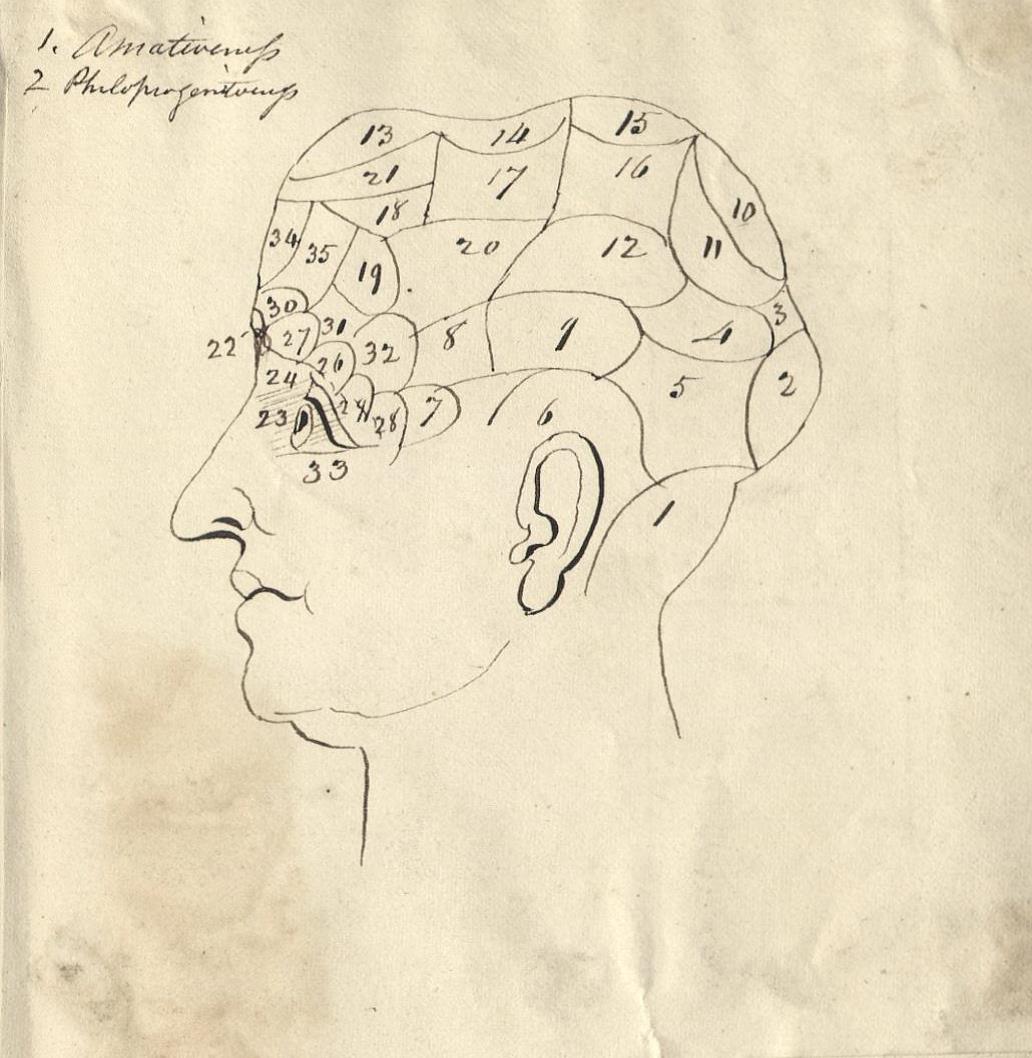
Phrenological bust from the commonplace book of E. Bradford Todd.
The image above, taken from the commonplace book of E. Bradford Todd (found in the Rubenstein Rare Book & Manuscript Library), is representative of a popular view of the science of phrenology. Seen today on ironic posters and T-shirts, as well as modern ceramic reproductions, the phrenological bust has come to serve as metonym for the entire science of phrenology. The image persists, but so too do misconceptions about the nature of this peculiar nineteenth-century science, which proposed to articulate and even predict the character of an individual based on the shape of the skull.
Phrenology was attractive to the masses and inspired writing of all kinds, from diary entries to letters, as well as published texts and broadsides. E. Bradford Todd, as shown above, recorded the phrenological doctrine – complete with his own sketches – into his commonplace book in mid-nineteenth-century America. Eugene Marshall, a schoolteacher in 1851 in Rhode Island, went to see a phrenological lecture and resolved to study the science, a project he took on with such zeal that he eventually attempted to phrenologize himself. Writing in 1823 when the science was still young, another individual gossiped to a friend via letter that a mutual acquaintance was looking for a wife “with all the proper bumps on her head for he is a great believer [of phrenology]” (Eliza K. Nelson papers). As seen in these letters and diaries from Duke University’s Rubenstein Rare Book & Manuscript Library, from its earliest introduction, phrenology captured the mind of the public and promised solutions to life’s problems, both great and small, not least of which was the problem of crime.
With generous assistance from the History of Medicine travel grant, I recently visited the Rubenstein Rare Book & Manuscript Library to conduct research in support of my dissertation, “Criminal Minds: Law, Medicine, and the Phrenological Impulse in America, 1830-1890.” My research takes a serious look at the “pseudoscience” of phrenology and considers the ways in which it was viewed as truthful, scientific, and useful to nineteenth-century individuals. In particular, I examine how phrenology, at the beginning of the century, came to be viewed as a valuable possibility for crafting a criminal science avant la letter, more than half a century before the introduction of Cesare Lombroso’s positivist criminology that would later be considered the birth of modern criminology.
Phrenologists wrote early and often about the problem of crime, which was drawing attention from all corners in the nineteenth century. The growth of cities and urbanization, the increasing rapidity and ease of movement of peoples within and between countries, and the rise of mass media that made sensational stories about murder and theft national (and international) news – all of these nineteenth-century trends combined to render crime a particularly fraught problem. Yet well before “criminology” had been introduced, phrenologists and other enthusiasts were considering the ways in which this new science could be used to help solve crime.
While it was primarily intellectuals and professional phrenologists operating within a narrow orbit who ruminated on the potential of phrenology with regard to the criminal problem, we can also find glimpses of the reception of these ideas in the records of non-phrenologists who encountered the science. For example, in the diary of Jane Roberts, a British author, she records a trip on January 6, 1837, to visit a phrenologist in London, Dr. DeVille, with her friend Mrs. Phillips, Lord Byron’s daughter. During this visit, both received phrenological readings by DeVille, but they also heard a long discourse from him about the truth of the science. Interestingly, the examples DeVille chooses to illustrate and prove the science are linked directly to bad behavior and crime, explaining that attention to the developments of the mind (as read in the skull) can serve to prevent or cure evil propensities. He illustrates this claim with two examples: one story in which he identified two robbers before the fact, and a second where a father brings his son in to see DeVille, before he eventually is sent to prison for his crimes. Miss Roberts was impressed by these stories, and resolved to visit him again.
Whether or not Miss Roberts repeated her pilgrimage to the phrenologist’s office, this interaction is representative of the ways in which phrenological ideas about crime entered into vernacular culture. Phrenologists framed their enterprise as a solution to one of the era’s most pressing problems, in part to sell their services to individuals like Miss Roberts. Yet, as I argue, phrenology also made a clear claim attempted to predict and explain the behavior of criminals, and in so doing signaled the development of a new science of crime.
Courtney Thompson is a PhD candidate in the History of Science and Medicine Program, History, at Yale University
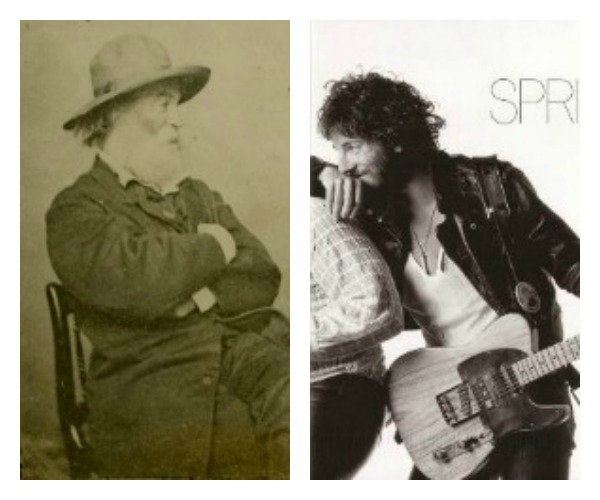
You may have heard the news: a working draft of one of the iconic songs in American music, Bruce Springsteen’s “Born to Run,” will be displayed in Perkins Library on May 8-11, and then here in the Rubenstein Library from May 12-June 27. While at the Rubenstein, Springsteen’s draft, owned by Floyd Bradley, will be in the very good company of one of the largest collections of manuscripts by another favorite son of New Jersey, Walt Whitman, in the Trent Collection of Whitmaniana.
Walt Whitman, 1869, from the Trent Collection of Whitmaniana, box III-6C (Saunders 29), by M. P. Rice; Bruce Springsteen, on the cover of the album Born to Run, 1975, by Eric Meola.
Both Whitman and Springsteen felt and expressed a deep connection with working-class Americans. After a transient childhood, Whitman worked as a journeyman printer before becoming the “Good Gray Poet”; Springsteen’s mother famously took out a loan to buy him a guitar when he turned sixteen, and years of honing his musical craft at small venues for low pay preceded the breakthrough of “The Boss.”
The working draft of “Born to Run” includes many passages that were changed or excised from the final lyrics, but the chorus “tramps like us, baby we were born to run” is already in place.
The chorus of “Born to Run” in the working draft. Image courtesy of Sotheby’s.
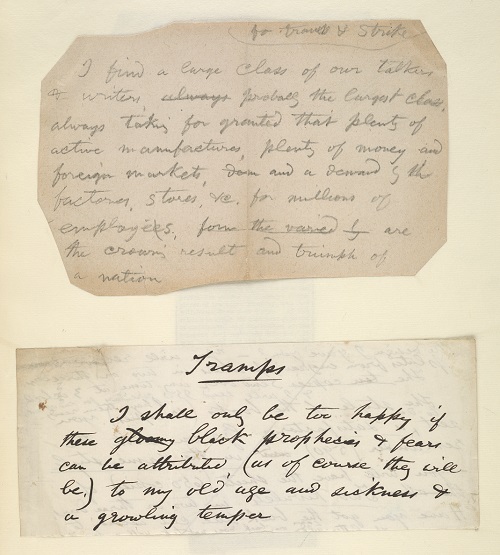
“Tramps,” or homeless itinerants looking for steady work and a place to live, became a particular concern in the United States (and for Whitman) during and after the “long depression” of the 1870s. Whitman wrote about this phenomenon in many different contexts, perhaps most memorably in a fragment entitled “The Tramp and Strike Questions.” In a sentence that gets to the core of an element of “Born to Run” and other Springsteen songs, Whitman writes there: “Curious as it may seem, it is in what are call’d the poorest, lowest characters you will sometimes, nay generally, find glints of the most sublime virtues, eligibilities, heroisms.” A volume in the Trent Collection, given by Whitman the title “Excerpts &c Strike & Tramp Question,” contains manuscripts and newspaper stories annotated by Whitman in preparation for a lecture on the topic, which was never delivered.
Two prose fragments from “Excerpts &c Strike & Tramp Question,” Trent Collection of Whitmaniana Box II-7B.
We’re excited to host the “Born to Run” draft, and please contact us if you’d like to take the chance to see this treasure of American culture alongside items in the Trent Collection of Whitmaniana.
Post contributed by Will Hansen, Assistant Curator of Collections.
Dearest readers, do you ever feel that there’s not enough Rubenstein Library in your social media day? True, we’re on Facebook, and we have this wonderful blog, and many of our collecting centers also have extensive social media presences (check out the list in the right-hand column) . . . but what if you could follow our every rare-book-and-manuscript action on Twitter?
Well, do we have good news for you! We’ve joined the twitterverse! Come follow us @rubensteinlib, let us know about your research projects and your latest special collections discoveries, and get a behind-the-scenes look at how we spend our working days (and sometimes our non-working days).
My most recent project in the conservation lab has been a set of 32 newspapers, issues of the Charleston Courier from 1815 to 1851. Some time in the past, they had been damaged by water, mold, insects, and dirt. All of them had tears, and many also had large losses and were exceedingly fragile. When they arrived in the lab, I could tell immediately that they were going to require a lot of work, but that they would also be fun and rewarding. While modern newspapers are made of wood pulp which quickly degrades, turning brittle and yellow, old newspapers were printed on rag paper made from textile fibers like cotton and linen, and thus they are much more resilient and pleasant for a conservator to work with.
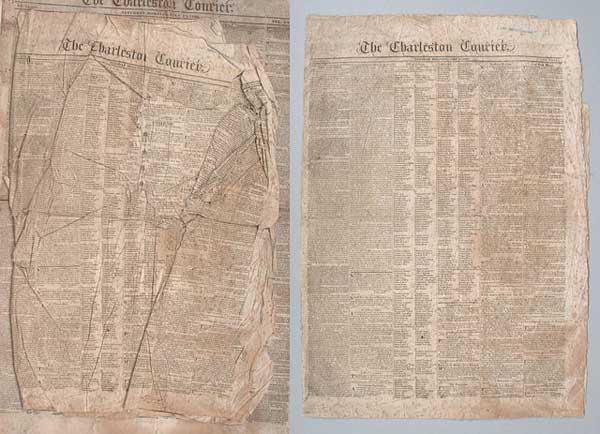
Charleston Courier newspapers before treatment
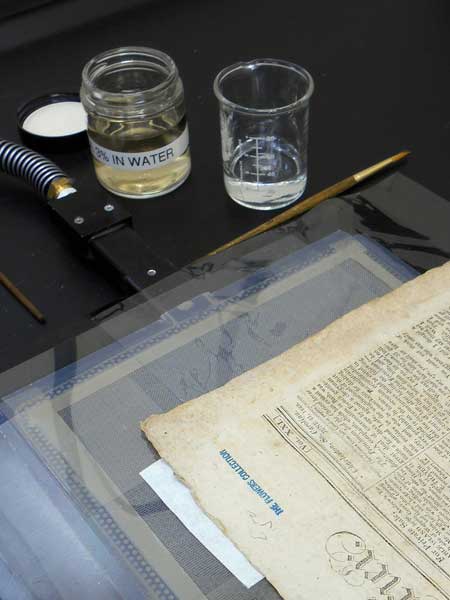
I knew I would need to do aqueous treatments, so, after cleaning off the surface dirt, I tested the inks to make sure they would not be soluble in water. While the black printing ink was stable, most of the papers had a collection stamp in turquoise ink that was sensitive to water. However, I was able to find three ionic fixatives, chemicals that are used to make certain dyes insoluble. I tested all three, and one (Mesitol NBS) turned out to be exactly what this ink needed. I used a brush to apply a small amount to the blue inked area, working over the suction platen to pull the chemical all the way through the paper, and then my newspapers were ready to wash.
Fixing soluble ink
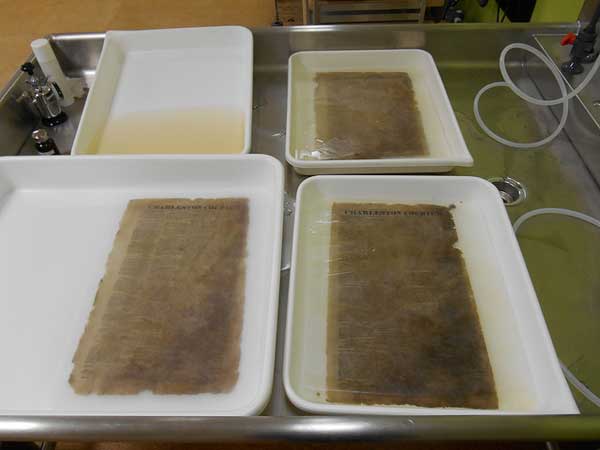
Each newspaper was immersed in a bath of deionized water. Extensive discoloration and degradation products were washed out, turning the water peachy yellow. I changed the water in each tray until it stayed clear, signaling that washing was complete. It was rewarding to see what a visual and physical difference there was between the washed and unwashed papers.
Aqueous treatment to remove discoloration and degradation products. The upper left tray shows the extent of discoloration removed from a page in its first bath.Comparison of newspapers before and after washing
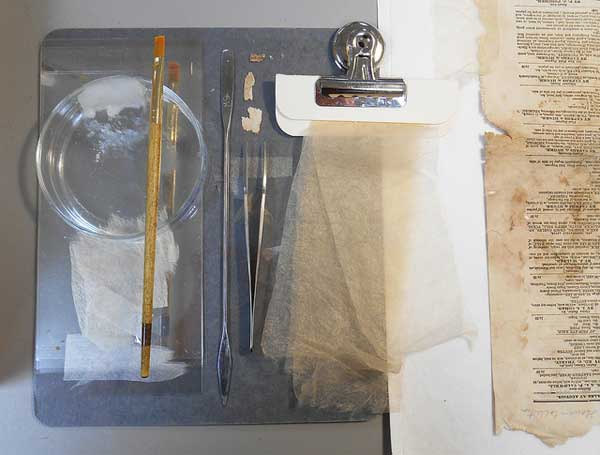
After washing and drying, I had many hours of mending to do, and many little puzzle pieces of newspaper to put in place. For my mends I used wheat starch paste and very thin Japanese papers which are almost transparent so as not to obscure the text on the newspapers. I did not fill all of the numerous losses, but I made the newspapers more stable for researchers to handle.
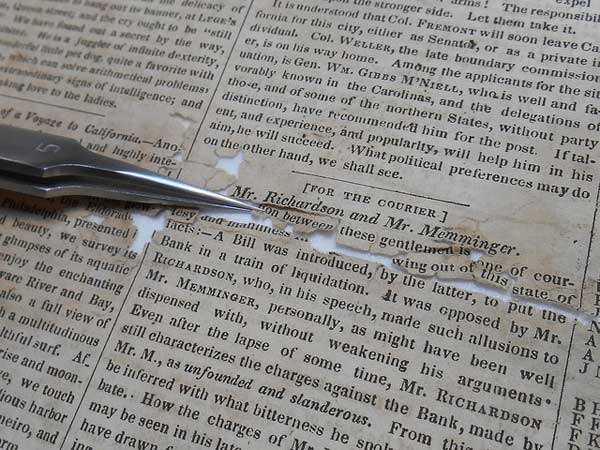
Aligning tears to prepare for mendingMending materials: wheat starch paste and lightweight Japanese paper
While working on the repairs, I was often confronted with fragments that would say something like “General / troops / fired” on one side and “congress / voted / article” on the back, and thus I would find myself reading the papers to know where the pieces might belong, which is something I rarely get the chance to do beyond a quick perusal. The earlier newspapers had battle reports, as the war of 1812 was still going on. The articles were fascinating, and the advertisements even more so. Many were similar to modern ads: houses for rent, job postings, theater listings, lost and found, dubious medical cure-alls, and sales of merchandise, often accompanied by decorative printed icons. Some were a little more unusual and interesting, like an ad for “Daguerreotype Paintings” or a woman offering her service as a wet nurse. But I was surprised to see ads for slaves, either for sale or wanting to buy, and many alerts for runaways. The runaways were the most intriguing as they gave personal details of the individuals, and I found myself wondering what happened to them, applauding their escape and hoping that they found a better life.
Advertisements including a young girl for sale and a runaway slave
When the mending was finished, I housed each of the newspapers in a clear Mylar sleeve so they can be handled with greater ease and safety. Even after treatment many of them are still fragile, but now they can be handled and used by researchers with much less risk of damage. And I hope they will be used, as they are fascinating! To see more images of treatment and examples of interesting advertisements, see our Flickr page.